The U.S. Spends $5.9 Billion on Foreign Military Financing. Guess Which 2 countries received 75% of the Total….
HowMuch.net – November 10, 2015
According to the U.S. State Government 2013-2015 Foreign Assistance report, an estimated $5.9 billion was spent on foreign military funding alone in fiscal year 2014. This is equivalent to 17% of the estimated $35 billion spent on total global aid discussed in our previous article. U.S. foreign military aid to countries ranged from $200,000 to $3.1 billion. Of the top 10 recipients, two countries received 75% of the $5.9 billion. Take a look on the map below to see who is getting the most foreign military financing from the U.S.
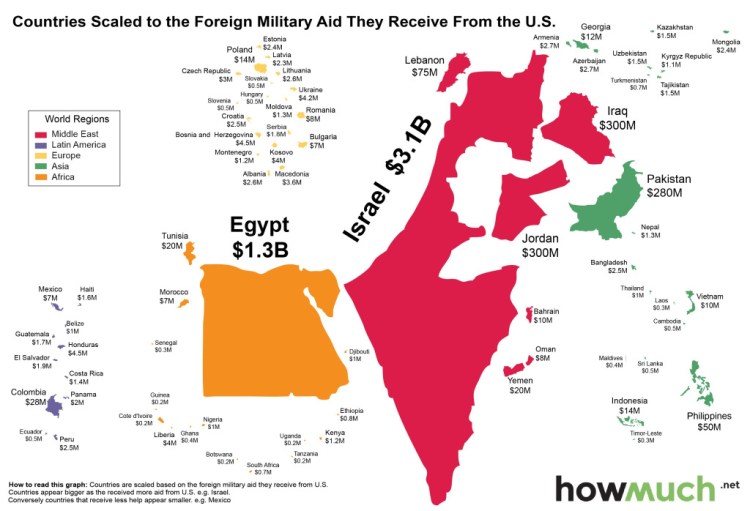
Below is a ranking of the the top 10 recipients and their respective world regions.
-
Israel: $3.1B (Middle East)
-
Egypt: $1.3B (Africa)
-
Iraq: $300M (Middle East)
-
Jordan: $300M (Middle East)
-
Pakistan: $280M (Asia)
-
Lebanon: $75M (Middle East)
-
Philippines: $50M (Asia)
-
Colombia: $29M (Latin America)
-
Tunisia: $20M (Africa)
Research conducted by the World Bank shows that the on average, countries spend approximately 2.2% of GDP on the military. Israel, Iraq, Jordan and Pakistan allocated above average spending towards their military in 2014. The data shows that each country spent approximately 5.2%, 4.3%, 3.5%, and 3.4% of GDP, respectively, on military expenditures. These countries are also part of the top 5 recipients of U.S. foreign military financing, totaling $4.0 billion. … Full article
Punished for his work: medic Ahmad Nasser describes his recent arrest
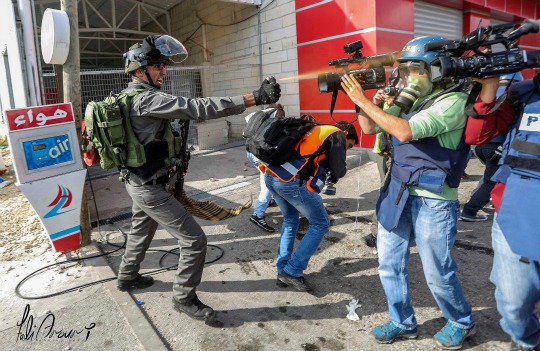
Israeli forces attacking journalists and medics (Ahmad) at clashes near Beit El Oct 30 – Photo credit Fadi Arouri
International Solidarity Movement | November 10, 2015
Ramallah, Occupied Palestine – In the early morning of November 2nd 2015, Ahmad Nasser was kidnapped by Israeli forces from his home near Ramallah. He was accused of attempting to kill soldiers by throwing stones and molotov cocktails, and was released without charge 15 hours later. He was repeatedly assaulted during his arrest and suffered broken ribs and further injuries.
It is Ahmad’s belief that the arrest was directly related to his work as a medic and humanitarian activist at demonstrations.
Just 60 hours before his arrest he was acting as a medic in a private ambulance service, administering medical aid to demonstrators injured at a Friday clash in Beit El. Along with journalists and other medics, he was directly targeted in his work on that day and prevented from tending to a demonstrator run over by an army jeep. Israeli forces threw a sound grenade at the group, teargassed the ambulances and then proceeded to viciously pepperspray press and medics.
The media surrounding this, coupled with his work in previous weeks tending to those shot with live ammunition in clashes near Ramallah, are likely reasons he was chosen for arrest as another victim of the recent increase in intimidation tactics being used against Palestinians, especially young men. As he states: “they try to accuse me of some charges but they cannot – if they had some real evidence that I threw stones they would never release me, but they didn’t – they just want to punish me for my work.” This is his account of his arrest and assault: just one story in the daily narrative of the occupation.
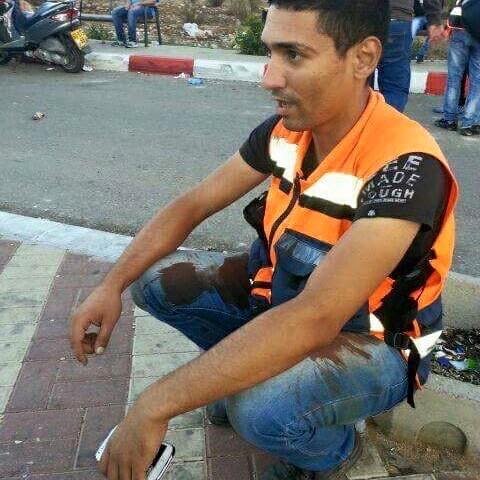
Ahmad in his work as a medic at demonstrations near Ramallah in October. Blood is from a man wounded in the chest with live ammunition shot by Israeli forces.
On the night of the 2nd of November I got home around 2 in the morning. Five minutes later I heard the Israeli army jeeps stopped outside my house and I took a look from my window to see what was going on. I didn’t know they were looking for me, and I saw the soldiers go to my neighbor’s house and start to knock on the door. When someone answered they questioned him and asked about who is living in the building. The neighbor, an old man, said that he didn’t know, so they started to beat him – they struck him with the end of the gun and they hit him and they took him with them to check the other houses and they entered his house with his family inside.
Then they knocked on my door and I opened it for them and I saw a lot of soldiers, about 60, standing there with their guns and ready to shoot. I saw the hatred and anger in their eyes and one of them asked me “who are you?” so I told him my name is Ahmad so he asked me “Ahmad what?” so I said “Ahmad Nasser.” He checked his phone and asked me for my I.D. but I didn’t have it at the time so I gave him the number of my I.D. He told me to stand on the side outside our front door, and to take my jacket off and give it to my mother. My mother and my brother, who was recently released from prison, were both in the room. My mother was very scared – you know, she is a mother. They kicked my kitten because she was playing around them, and they started to check me and he asked me again about my I.D. number to confirm it.
After that they went through my house and started to look and search for something and the soldiers outside were asking me if I have guns so I told them I do not. One of them asked me to take my shoes off and he checked it and after that asked me to put them on again. He told me to face the wall again and put the zip-tie hand-cuffs on my hands, behind my back. I told him that I have a problem in my right hand from an old injury and he said okay, but he tightened it more. They blindfolded me and asked me to sit on the stairs, with my arms back behind me, and after a few minutes they came out of my house with some personal things they had taken, and they told my family not to move or they will shoot them. They told me to walk and one of the soldiers grabbed me in a bad way and told me “MOVE!” and I told him that there is stairs but he pushed me down the stairs so that I fell onto my knee and slid down.
He started to say bad things about me and my family and started to beat me up until we arrived to the jeep and he shoved me into the edge of the front door. After that they pushed me against the side of the jeep and then against the back door and another soldier told him that there is no space in that car, so he took me to another jeep and hit me on the back door and started to punch me and hit me with something metal, I think the end of the gun. This is when they broke my ribs. There were many soldiers around. I heard one shout at my brother “GO! Or I will shoot you!” because he was trying to film from inside.
I was on my knees in front of the back step and a soldier put all his weight on me and after that he tightened the zip-tie (hand-cuffs) again but this time more strong. He told me to sit but I couldn’t do that because I don’t see a thing so they just pushed me inside the jeep and after a few seconds grabbed me out again so that the soldiers can sit and pushed me again inside the jeep on the ground. I was in a bad position until we arrived to the Ofer military base near to that area. After that he opened the door and grabbed me again and one of them helped me to stand and he was holding me in a bad way and another one came to me and he started to ask me if I throw stones at the Israeli soldiers. I said no and he told me that I am lying and said bad things to me and hit me in my stomach again and pushed me until we got to the arrest truck and he told me there are steps. I got into the truck and a female soldier asked me to sit and to shut up so I told them that they should take the hand-cuffs off, because they were so tight that my hands were swollen, but they didn’t listen to me.
When we arrived to the clinic to check me one of the soldiers was fighting with the zip-tie trying to take it off and that hurt me more but in the end he took it and the doctor checked me. They took the blindfold off inside the closed room and asked me questions, like if I am sick, if I am taking medication, if I have had any surgery, if I have any problems with my health. He checked where I was sore but said “you are fine.” They put the blindfold back on me and they took me out and I was waiting for 20 minutes until some soldiers came and took me to the truck again. I was waiting in the truck for a few minutes and they brought another prisoner from my town. I knew he was there because I heard them say “watch your head” but it hit against the truck, and I knew him from his voice. When we tried to talk to each other the soldiers shouted at us to shut up and they start to move and they took us somewhere, we didn’t know where. After a while driving they stopped and we got out and they told us to sit and it was so cold and windy, and we just had to sit out like that for a few hours.
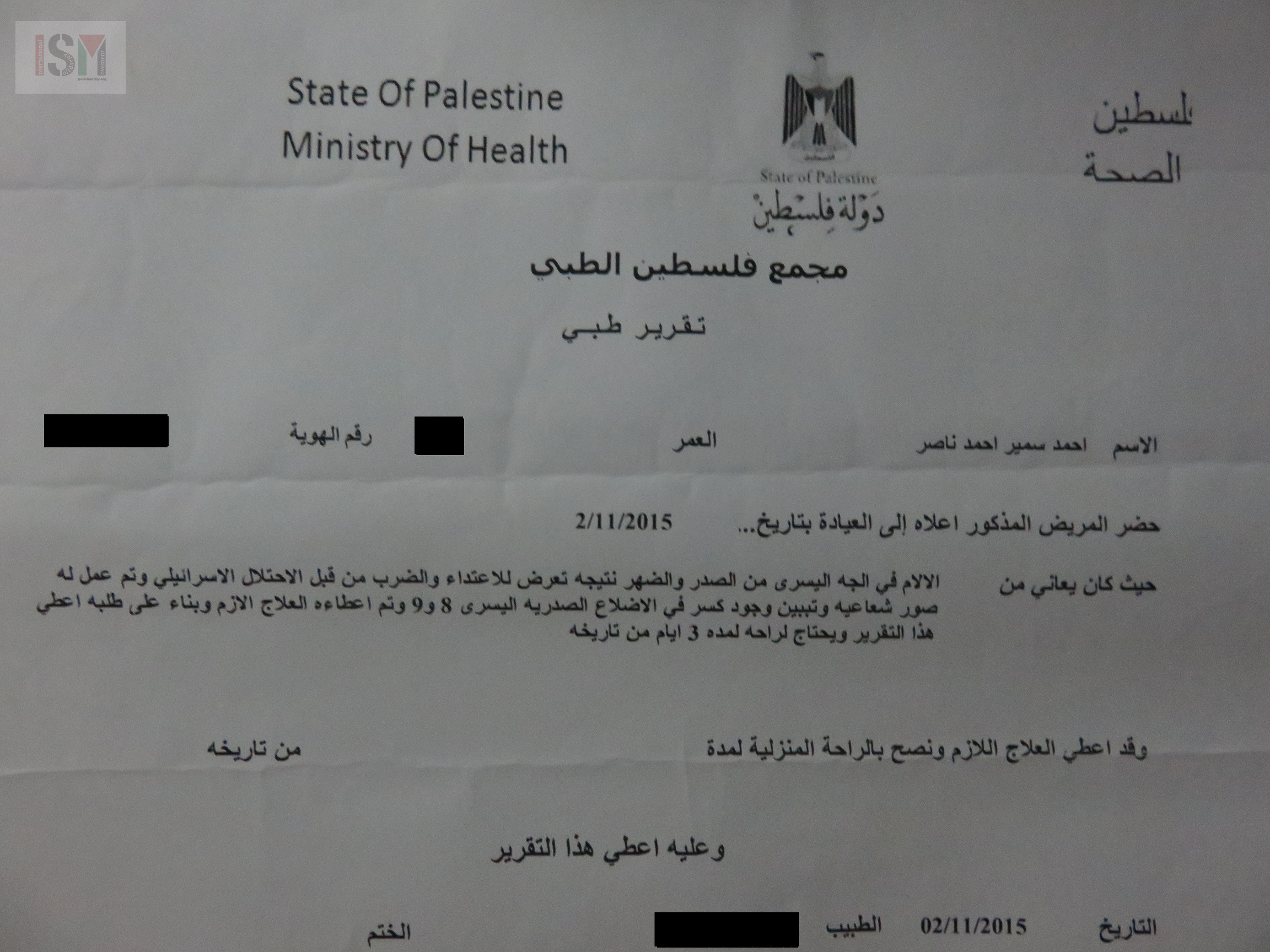
Medical certificate which Ahmad initiated after he was released, when Israeli forces medic had said he was “fine” directly after beating. Report reads: “The patient came to the clinic 2/11/15; He was suffering from – Pain on the left side of his chest and back, caused by beating by the Israeli occupation forces. Patient has been X-rayed and broken ribs found on the left side, number 8 and 9. He has been administered treatment and this report on request.”
When I was talking to the other prisoner, a female soldier came and told us to shut up and said we couldn’t talk. I asked why and she said “I am treating you as a human being, just stop talking.” So I told her “it’s boring for us! So I will talk to him… and if you are treating me like a human being, for the first place I shouldn’t be here, and second, you should bring me a jacket and a blanket and water and we should be sitting in a warm room, not outside.” So she didn’t know what to say and she said, “just stop talking,” and she left. After about one hour, they brought me a jacket and a blanket and they left. After about 3 hours, another soldier came and took the blankets from us. A few hours later again, around 7am, he came again with the blanket, put it on us, and he left. In the morning, around 8.30, we told the soldier who was guarding the gate that we wanted to go to the toilet, but he didn’t listen to us, and after we hassled him for a few minutes he went to check whether there was another soldier to take us. He came back and said there is no-one to take you, so you can’t go. So, we kept annoying him for one hour, and after that, a female soldier came and she said “the toilet is closed, so there is no toilet” and she took me to a spot, behind the jeep. She would not give us any privacy. After that, they put us both on chairs and they left again for about half an hour.
Another jeep came with three soldiers, they put us in the jeep, and they took us to the Ofer military prison again. We stayed there for half an hour, and then they took us to Sha’ar Binyamin [illegal settlement] police station. They put us in a room with another 2 prisoners and we stayed there for a while, sitting on the ground until the investigator (police) came and took us to interrogate us. It was only at this point that the blindfold and handcuffs were taken off… all the time before that, I was blind. He started to ask me questions. He told me “we suspect you – you were throwing stones and molotovs, and you tried to kill soldiers with stones. What do you say about that?” So, I said “about what exactly?” He said “about what I told you” I told him “you are imagining that…. nothing like this could happen” And he said “OK but we have evidence.” I asked him “who told you that?” He said “just, we have evidence” so I demanded that they show it to me. They showed me a photo of another guy, someone I don’t know. I told him “this one is not me and I deny what you are saying and I want to talk to my lawyer,” so he called my lawyer. This was the first time I had been allowed to contact my lawyer, so many hours after I was arrested.
I talked to my lawyer for a while and after that he told me “stop talking and give me the phone.” He started to ask me if I have ever thrown stones or molotovs, and do I know people who throw stones or molotovs and if I join demonstrations against the soldiers or if I am thinking to join a demonstration. So, I told him “I don’t join demonstrations, and I would not do that, because when I go to a demonstration I go as a medic and work as a humanitarian mission.” And they said “but you still don’t want to tell me if you know anything.” So I told him, “I don’t know anything, and I deny everything that you have, and your evidence is fake.” So he decided to take my DNA and fingerprints and they also took photos of me. Another investigator, he asked to see my hands, so I showed them to him and he said “these hands are not throwing stones… these hands are throwing molotovs.” I started to laugh and told him “you are dreaming” and he said “OK, what is your name” so I gave him my name and he told me “we have been looking for you for a long time.” I said “really? I am in Ramallah… and you are 10 minutes away, and you could take me any time.. so don’t make fun of me.” He said “OK, go down” and when I was about to go into the elevator, he showed me his hand, with 4 fingers, and he asked me “how much is it?” So I told him “it’s four.” He said “no, it is five.” I told him, “no it’s four.” He flipped his hand around, and said “no, like this it’s 4,” he flipped his hand again, “and like this [with a bent thumb on the palm side], its five.” I told him “if it’s four or five it’s your problem, I see four.” They told me “OK, just go.”
So, the other policeman took me to the room where I was sitting with the soldiers and the other 3 prisoners and they kept us there for about 2 hours. It must have been about 3pm by then. Three policeman came, and they said “these 2 guys [pointing at the others, from Jalazon camp] – to Ofer.” And me and the other guy, “to the custody room.” We stayed there around one hour before the policeman came and opened the door for us. He said “we have nothing against you. So, you can leave. And, do you know how to go out from here [the police station]?” I told him yes, but when I got to the main door I said to him “you didn’t charge us, but you release us inside a settlement, and we might get killed here” He said “no, you are fine, just leave,” so we left. They try to accuse me of some charges but they cannot – if they had some real evidence that I threw stones they would never release me, but they didn’t – they just want to punish me for my work. And I am free now. Thanks for everyone who tried to help me, in any way. I appreciate it.
***
The Women’s Center for Legal Aid and Counseling (WCLAC) estimates that approximately 1,350 night raids are occurring annually in the West Bank, with that number having escalated in the tensions of recent months. Most of these raids occur between 2:00 and 4:00am “and commence with aggressive banging on the front door. In some cases the door is simply kicked in or blown off its hinges.” While night raids are used extensively as an arrest tactic, the WCLAC explains that in fact in the majority of cases no arrests are made, and it is moreover a “strategy of mass intimidation of the Palestinian civilian population.” According to the Addameer Prisoner Support and Human Rights Association, in October alone, Israeli occupation forces arrested 1,195 Palestinians including 177 children, 16 females and 23 after they were injured. Among those arrested, 128 were placed under administrative detention, 31 of whom were arrested for alleged “incitement” including through social media, 3 of whom were children from Jerusalem. This brought the total number of Palestinian political prisoners to 6,700 by the end of October. They state that the “Israeli occupation authorities have publicly declared that these mass arrests as well as other measures taken against Palestinians in the occupied territory are aimed at suppressing the recent uprising, clearly indicating that the mass arrests are a form of collective punishment and political oppression aimed at forcing Palestinians to submission.”
Related information:
See 972 magazine report on clashes near Beit El on 30th October
Addameer Prisoner Support and Human Rights Association special report on October arrests
UK Regime Boycotts Palestinian Academics and Mental Health Specialists
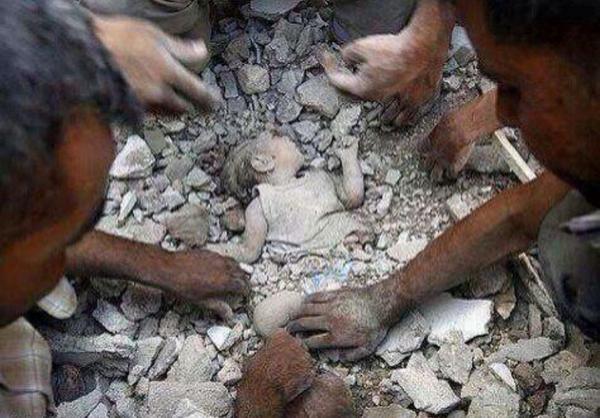
By Gilad Atzmon | November 10, 2015
The Independent reported today that “a decision by Britain to refuse a group of Palestinian medical experts from Gaza permission to participate in an international conference at Kingston University on trauma in war zones has been condemned by campaigners.”
I guess that someone in the British Government is convinced that the Palestinians know little about Trauma or living in a war zone.
Three doctors and a nurse who work for the Ministry of Health in Gaza, and were due to give presentations at the conference taking place this weekend, have had their visa requests refused by British authorities. Interestingly enough, some Israeli academics are invited to attend the conference. I guess that the British government is buying into the primacy of Jewish trauma.
In addition to the four mental health specialists refused entry, Dr Nahida Al-Arja, a psychologist from Bethlehem University, has had her visa application rejected.
A letter by the UK Palestine Mental Health Network, co-organisers of the conference, published in the Independent, says: “It is beyond our comprehension how such an interference with intellectual and clinical discussion on such an important topic could be justified. This is a measure that further isolates clinicians from Gaza, already struggling under the impact of military assaults and siege,”
It adds: “We urge the UK authorities to reverse this decision immediately, and to resolve to nurture, rather than undermine, urgently needed psycho-social support services for the people of Gaza.”
To read more on this story: http://www.independent.co.uk/news/uk/home-news/uk-decision-to-refuse-gaza-medical-experts-from-joining-kingston-university-conference-condemned-by-a6727576.html
What Obama Should Have Told Bibi
And also the World Jewish Congress
By Philip Giraldi • Unz Review • November 10, 2015
Israeli Prime Minister Benjamin Netanyahu is currently making one of his periodic devastating plundering raids on Washington and New York. During his visit he discreetly picked up a bunch of large checks from the Wall Street crowd, benefited from the plaudits dutifully delivered by the media and chattering class and has even met with President Barack Obama, whom he quite openly despises. Netanyahu and Obama carefully concealed their mutual dislike when in front of the cameras but the president also made all the right noises about Israel’s security “needs.” Apparently all the violence occurring in Israel-Palestine is the fault of the Palestinians and Israel always has the right to do whatever it wants to defend itself. Obama will follow up on the meeting by throwing billions of dollars of additional Danegeld at Netanyahu as a token of America’s undying love and fealty to Israel’s interests.
One wonders if Obama had his fingers crossed behind his back to indicate that he was lying to Bibi except for the intention to come up with more money, which is always an easy way out for America’s ruling class. It is generally convenient to pay off blackmailers like Netanyahu in hopes that they will stop whining. The president will in any event have to prepare himself to endure the usual firestorm coming from GOP presidential candidates later this week over his less than enthusiastic support for America’s greatest ally and best friend, which would have been a consequence of the visit no matter how it had turned out.
Last Thursday a full page ad placed by the World Jewish Congress appeared in the Washington Post, New York Times and the Wall Street Journal. The group’s president Ronald Lauder, the cosmetics company heir, provided the White House with suggestions for how to deal with the visiting Israeli leader. Predictably, he delivered some debatable assertions in constructing his argument as to why the president and prime minister should kiss and make up.
Lauder wants to “reinvigorate” the relationship with Israel because “never has this relationship been more important.” Wrong Ron, the Israeli connection is an enormous liability for the United States strategically speaking that has cost well in excess of $100 billion to the American taxpayer and has done untold political damage. Compared to other strategic partners in the region including Turkey and Egypt Israel is of little or no importance but for the fact that it has an enthusiastic, politically powerful and extremely wealthy domestic lobby conniving on its behalf. Which includes you, Ron.
Lauder goes on to cite “human disaster in Syria, ISIS moving on Iraq, [and] Iran’s bid to destabilize the region.” Well Ron, the human disaster in Syria and ISIS in Iraq have been caused by policies pushed by Israel and carried out by the United States, all starting with the Iraq war which was initiated at least in part for Israel by a cadre of neocons in the Bush Administration. Iran may not be a friend of the United States, but its support is desperately needed to eliminate ISIS and help stabilize Iraq. As always, Israel sees a U.S. led military solution to each and every problem dealing with Muslims. That might provide a comfort zone for Israeli politicians but it is bad for the United States and to be completely honest it is not even good for the Israeli people.
The ad also cites “the ongoing violent attacks against Jews in Israel” and that Israel is the “only democracy” in the Middle East. Ron, more than seven Palestinians have been killed for each dead Israeli, many of them shot execution style, but you seem to have forgotten that. The simple solution to the attacks would be for Israel to give up its endless and endlessly brutal occupation of the West Bank as well as its siege of Gaza. The knifings would end.
And what about democracy when it only applies to Jews? Netanyahu has proposed expelling thousands of Palestinians from East Jerusalem, where they and their ancestors have lived for centuries. And the continuous theft of Arab land and destruction of their livelihoods proceeds at an accelerated pace. If Ron Lauder and his friends really cared about suffering humanity instead of only the Jewish subset he would be using his considerable leverage to complain directly to Netanyahu and ask him to reverse his policies.
And how to fix things? Lauder claims that Netanyahu has “the greatness, the vision and the courage to move this relationship forward on a positive path.” Sure. And pigs have wings. Let’s face it Ron, Bibi is quite likely clinically insane. Even many Israelis are saying so, though they still vote for him based on his government’s relentlessly implemented and self-fulfilling program of inciting fear of Arabs.
For what it’s worth, this is what I propose Obama should have said to Bibi but didn’t, with a transcript of the conversation also faxed over to Ron Lauder at the World Jewish Congress:
- “Nice to have you back Prime Minister, but not really as it’s close to lunchtime, to which, incidentally, you are not invited. Why don’t you stay home? You have been interfering in our politics and denigrating both me personally and my office for far too long. How would you like it if I were to go to Israel and endorse one of your opponents? If you keep up this crap I will revoke your visa and you’ll never visit here again.”
- “And by the way, your plan to expel thousands of Arabs from East Jerusalem and to shoot kids throwing stones at your occupying army is not acceptable to us. And then there are new reports of your harvesting organs and other medical transplant material from the bodies of Palestinians that you have killed. There’s a long history of that in your country, but it’s a bit much even by your standards, isn’t it, and it begs the question whether there is anything that you won’t do. Next time a motion comes up in the United Nations condemning your brutality we will support it. Maybe we’ll co-sponsor or even propose it to show that we’re serious.”
- “We are running out of money here in Washington and are thinking of cutting benefits to our own people. I note that Israelis have free medical care and university education, which means that we are subsidizing things that we Americans do not have so it hardly seems fair. We have been giving you more than $3 billion in aid every year and also looking the other way when you benefit from tax free charitable contributions that actually are illegal under American law. By executive order, I am stopping the cash flow and asking the IRS to look at your friends over here.”
- “And speaking of Israel’s many friends, your good buddy at the State Department Victoria Nuland is now working down in the mail room. And I am asking the Justice Department to register the American Israel Public Affairs Committee (AIPAC) as a foreign agent, subject to having its finances and operations monitored by U.S. authorities. Oh, and your spy Jonathan Pollard will be denied parole later this month and will be the guest of a federal prison for the next twenty years.”
- “I cannot see where you have done anything for us except complain. As you are now pledging Israel to continue its occupation of Palestinian land and ‘live by the sword’, meaning the killing of Arabs will accelerate, I am suspending all military cooperation with you until you come up with a plan to remove most of your settlers from the West Bank. Come back when you have something to show me. Don’t let the door hit you in the ass on the way out.”
Well, okay, it was never bloody likely to happen that way, but I can dream, can’t I? If you think Obama is spineless when confronted by Ron Lauder and the usual suspects, just think of how bad it will be when we have President Clinton or President Rubio, proxies for their Israel firster donors Haim Saban and Paul Singer respectively. The new president and his or her staff will have to learn how to perform proskynesis whenever Netanyahu enters the oval office.
Israel benefited from Hariri assassination: Lebanon ex-President Lahoud
Press TV – November 7, 2015
Lebanon’s former President Emile Lahoud says the Israeli regime has benefited most from political assassinations in the country, including that of former Prime Minister Rafic Hariri, Press TV reports.
In an exclusive interview with Press TV, segments of which were aired on Saturday, Lahoud rejected accusations that the Syrian government and Lebanon’s resistance movement Hezbollah had a role in the 2005 assassination of Hariri.
The Tel Aviv regime was the entity that largely benefited from Hariri’s killing and other assassinations in Lebanon, Lahoud stated.
He also cited as a proof the fact that the satellites that were watching over the area where Hariri was killed in Beirut belonged to Israel and the United States. Neither Tel Aviv nor Washington later accepted to share their data and images on the assassination, he said.
The former Lebanese president said the West and Israel have accused everybody in Lebanon for the killing, so that they can divert public attention from their own potential role in the incident.
Lahoud said the assassination of Hariri showed that the United States and Saudi Arabia have been doing what Israel wants them to do in the Middle East.
The Infamous Video of an Aircraft Exploding in Air at High Altitude and the “Big Chutzpah” Construct
By Doug E. Steil | Aletho News | November 7, 2015
Only a day after the Russian Metrojet airliner Flight 9268 went down, killing 224 people, a short video went onto the Internet on YouTube, purporting to show the explosion of the Airbus 321-200 aircraft in mid-air, at roughly 30 thousand feet elevation. This video was immediately ridiculed because the group claiming responsibility for bringing down the airliner, ISIS, which was said to have presented the video as proof, did not have the sophisticated military capacity, according to intelligence analysts, to shoot down any aircraft at such an altitude. Yet the video did not show a missile approaching the jet, nor did the group claim to have shot it down in such a manner. It simply showed an explosive burst, consistent with a bomb being detonated, and heavy black smoke trailing the aircraft as it subsequently descended.
Even though a civilian style aircraft, with two engines mounted below its wings, can be discerned, and no such video had previously been seen — nor were there reports of any civilian aircraft with such features having exploded in mid-air during daytime — the video was denounced as a fake (computer generated imagery) nonetheless, perhaps because the video quality was poor or not sufficiently specific, which was suspiciously indicative of an attempt to obfuscate any confirmatory information.
A dose of skepticism is certainly legitimate when being presented with such videos, which may be intended to convey false political propaganda. However, since no compelling proof of the imagery not possibly showing what was claimed has yet been presented, the authenticity cannot be completely discounted. Indeed, this question is currently a point of discussion on some technical forums. What appears to be the case is that the shaky nature of both embedded videos — a second version appears at 20 seconds in the 32 second video — both came from two mobile phone camera recordings that were taken of a screen playback of the explosion. It has also been suggested that the imagery was actually shot from another aircraft following the fateful jet from farther below. Though this was likely the case, it would not necessarily invalidate the claimed authenticity of this particular jet being shown.
It should be noted that a professional quality video recording, filmed through a heavy zoom lens mounted upon a camera on a stationary tripod, would provide investigators with sufficient information to calculate a small circle on the ground from where the shots were most probably taken, which would likely not be in the interest of the perpetrators or co-conspirators. If, for the sake of argument, one presumes the authenticity of what was being filmed, then the most interesting and compelling proof of a desire to obfuscate and mislead comes from the obvious image reversal, which is particularly evident during the first second. The sky to the left of the screen is bright whereas, in stark contrast, it is dark on the right side, though exactly the opposite should be the case because the jet was then flying northward at a track of 340° in the morning, shortly after sunrise.
The ground track in the eastern portion of the Sinai peninsula during the final minutes of flight was exactly parallel to and 40 km away from the border between Israel and Egypt. The mid-air explosion occurred west of the highest mountain in the Negev Desert (Har Raman, 1035 meters), not hard to make out on a topographic map of the area. The impulse of the explosion and its aerodynamic effects then changed the heading of the aircraft by more then 15°. When viewing the video through a mirror to correct the image reversal, one sees that the vantage point of the camera is behind, below, and to the right (east) of the aircraft’s flight path. When one accepts the notion that the incident was filmed from another aircraft, pursuing the Airbus in roughly the same direction, then one must logically conclude that the video was taken from within — or just slightly outside of — Israeli airspace, likely by a surveillance drone, operating in the southern region, north of Eilat. One would expect Israeli surveillance drones to operate here on a regular basis because this region, at the northernmost part in the Gulf of Aqaba, is strategically important; the borders of Saudi Arabia, Jordan, Israel, and Egypt nearly converge here.
While the notion of a military drone operating near this particular region on a Saturday morning may not be unusual, what certainly should raise some questions is that the Russian Metrojet aircraft — assuming, as before, that the video is not a fake but authentic — would have been pursued and filmed (surveillance operations would be more interested in what happens on the ground rather than pursuing a civilian airliner emitting its tracking data by beacon and not posing a potential threat). Even more worthy of question or inquiry is that these modified (second-hand) video versions of the on-board explosion and descent of the aircraft would be loaded onto the Internet the next day, allegedly by the ISIS terrorist group, which has been publicly exposed to be in an alliance with Israel, the United States, and Saudi Arabia in the Syrian battleground.
While the concept of the “Big Lie” is based on the idea that (nearly) everyone will believe a major fabrication that is completely untrue because these heavily conditioned people couldn’t possibly imagine that their government would dare lie to them so blatantly about something so important, viewers of the video may have been subjected to the opposite phenomenon, namely “Big Chutzpah”, the raw truth presented right in your face in such a brazen way that (nearly) everyone will still refuse to believe it because these people cannot possibly imagine that the Israeli government would dare to actually do something like that.
A guide to Palestine in the British media
By Amelia Smith | MEMO | November 6, 2015
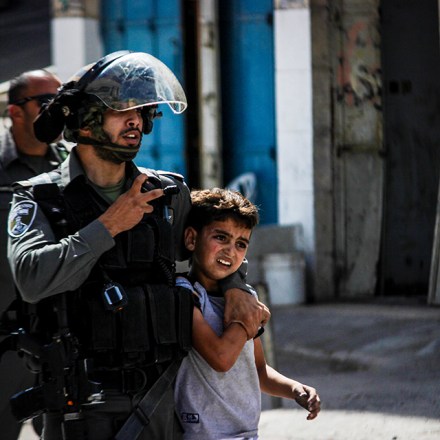 On a trip to Cuba in May, I had to look twice when an elderly man selling newspapers walked past the restaurant I was eating in. On the front page of one was a huge photograph of an Israeli soldier holding a Palestinian boy by the neck, the boy’s face twisted away from the camera in pain.
The photo said it all: an aggressive, well-built soldier wearing a helmet, bulletproof vest and carrying a machine gun was manhandling a child half his size, not more than 10 years old, dressed in jeans and a t-shirt. Why was I so shocked to see such an image published on the front page of a mainstream newspaper? Because this would be a rare moment in the UK.
Over here, the images that are used to represent almost 50 years of military occupation are of Palestinian youth throwing stones, black-and white-kuffiyeh wrapped around their faces. The Cuban picture portrays the Palestinian as the subject of aggression, the UK image as the perpetrator; just like that, our media helps perpetuate the myth that Palestinians are faceless terrorists predisposed to random outbursts of violence and against whom Israel has every right to defend itself.
A closer look at how the British media has covered the recent escalation of violence in Palestine reveals some worrying trends. For the past year right-wing Israeli groups have entered the Haram Al-Sharif compound daily with their armed escorts, often chanting anti-Arab and anti-Palestinian slogans. This came to a head on 13 September when a group of settlers and the Israeli minister of agriculture Uri Ariel, protected by Israeli soldiers, actually entered the Al-Aqsa mosque shooting tear gas, stun grenades and rubber coated steel bullets at worshippers, injuring Palestinians inside and causing damage to the interior of the mosque.
With this in mind take a look at how these confrontations were described in the Telegraph : “Four Israelis and 23 Palestinians have died in 12 days of bloodshed fuelled in part by Muslim anger over increasing Jewish access to the Al-Aqsa mosque compound in Jerusalem.”
And earlier in the year, Reuters reported that: “Those groups [devout Jews and Israeli nationalists] are at the centre of a creeping shift in Jerusalem: After 900 years, Jews are chipping away at Muslims’ exclusive control of the site, the third holiest in Islam. The shift, which has provoked violence in the past, threatens to open a dangerous new front in the Israel-Palestinian conflict, adding religious enmity to a political struggle in the very heart of the disputed city.”
Not only do these reports reduce the provocation by Israeli settlers and soldiers in the Al-Aqsa mosque to Muslim anger and a failure to compromise over increased Jewish access to the compound, but they make the current protests in Palestine sound as though they are merely a religious dispute. Al-Aqsa is the third holiest site in Islam and holds huge religious significance for Muslims across the world, but Palestinians are also protesting against almost 50 years of military occupation under which their land has constantly been taken away from them.
Since 14 September, 72 Palestinians and 11 Israelis have been killed and over 8,000 Palestinians and 134 Israelis have been injured – yet many reports have picked out and highlighted the knife attacks carried out by Palestinians, using phrases such as “Israel’s knife terror”, describing “knife wielding” Palestinians or “anti-Israeli knife attacks”. The following report published on the BBC answered the question of what is happening between the Israelis and the Palestinians in the following manner:
“There has been a spate of stabbings and gun attacks on Israelis by Palestinians since early October, and one apparent revenge stabbing by an Israeli. The attacks, some of which have been fatal, have struck in Jerusalem and in northern and central Israeli cities and towns, and in the occupied West Bank. Israel has tightened security and clashed with rioting Palestinians, leading to deaths on the Palestinian side. There has also been associated violence in the border area inside the Gaza Strip.”
Note that there is not even a mention of what took place at Al-Aqsa mosque on 13 September. The weapons used by Palestinians are specified but Israel’s excessive use of tear gas, stun grenades, live ammunition and rubber bullets is not included.
The term “Palestinian rioters” (other reports have used “Muslim rioters”) has been widely adopted in the British media; the notion of “rioters” is associated with wild disorder and conjures up very different images than the word “protesters”, which suggests a group of people who are simply asking for their rights. Another common term used in the above quotation and frequently in other articles is “clash”, which implies fighting between two equal forces– Israeli soldiers, part of the fourth largest army in the world, storming the Al-Aqsa mosque and firing tear gas and rubber bullets at Palestinians armed with stones, sticks and knives cannot be described as a “clash”.
Deaths on the Palestinian side are a result of rioting Palestinians, and so somehow justified. This headline from Reuters, this one in the Independent and this one in the Daily Mail all report Palestinian deaths but say they took place after Palestinians attacked Israelis with knives. In contrast, this article from the BBC is typical of how Israeli casualties are reported across the media: “Three Israelis killed in Jerusalem bus attacks.” No justifications or explanations of the deaths in sight.
The BBC casually writes about “associated violence” in the Gaza Strip. Between 13 September and the publication of this article, 12 Palestinians in Gaza have been killed, including 26-year-old Nour Rasmi Mohammed Hassan who was five months pregnant and her three year-old daughter, both of whom were at home when an Israeli airstrike hit their house.
Rather than recognise that their excessive use of force and almost 50 years of occupation – under which Palestinian homes have been demolished, children have been arrested, freedom of movement restricted and Gaza placed under siege – may evoke anger in some Palestinians, Israeli authorities, echoed in news reports, would rather blame Palestinian leaders and the use of social media for “inciting” violence, as seen in this headline: “Israel sentences Islamic leader to jail for incitement”; and this one too: “Is social media driving the current violence?”
In this video, Israeli security forces have planted undercover stone throwers among a group of Palestinians who then turn on one of the Palestinians in the same group before ten Israeli soldiers drag him away (note – excessive use of force). In fact there are numerous videos online that highlight Israeli aggression and incitement of violence towards Palestinians but they are not widely published in the mainstream press. This particularly disturbing video filmed on a mobile phone in Aida refugee camp last week captures an Israeli soldier announcing: “You throw stones and we will hit you with gas until you die – the children, the youth, the old people; you will all die. We won’t leave any of you alive.” This video shows an Israeli soldier running over a Palestinian then preventing paramedics helping him; this one shows settlers throwing stones at Palestinian homes in Hebron.
On 16 October, much media attention was focused on the case of a Palestinian man who dressed up in a press jacket and inflicted moderate wounds on an Israeli soldier in Hebron before being shot dead by another soldier. On the same day, four other Palestinians died, including 36-year-old Shawqi Jamal Jaber Ebeid who succumbed to injuries after sustaining a bullet wound to the head a week before whilst working in a stone factory in Gaza. His story is much harder to find and yet it is part of the media’s job to help give a voice to those who have been deliberately silenced – those like Shawqi Ebeid and his family – and to hold politicians and people in authority to account when they do something wrong; even more so if they commit war crimes. If, however, the media is complicit in silencing those same people, then in some cases we may be looking at political propaganda dressed up as news.
ICC prosecutor must rethink Gaza flotilla probe: Judges
Press TV – November 7, 2015
Judges at the International Criminal Court (ICC) say the court’s prosecutor must reconsider an earlier decision not to open a probe into an Israeli attack on a Gaza-bound aid flotilla back in 2010.
Following a few months of deliberations, judges at the appeals chamber ruled on Friday that prosecutor Fatou Bensouda must rethink her decision against the Gaza flotilla probe.
Judges at The Hague-based court had initially asked Bensouda to reconsider her decision in July, saying she made “material errors in her determination of the gravity” of the case.
The latest decision could force Bensouda to open a full investigation into the case.
Last year, Bensouda declined a request by the Indian Ocean island nation of Comoros to investigate the attack on the Turkish Mavi Marmara ship that was sailing under a Comoros flag. She ruled the case was not serious enough to merit an ICC probe.
The prosecutor said publicly available information provides “a reasonable basis” to believe that the Israeli forces committed war crimes during the attack in international waters back in 2010, but the case does not fall under their jurisdiction for an official probe.
However, lawyers representing Comoros had sought a review of Bensouda’s original rejection, insisting that “the interests of justice and fairness, which are the core of the ICC’s mandate, strongly militate in favor of the prosecutor reconsidering her decision.”
On May 31, 2010, Israeli commandos attacked the Freedom Flotilla in international waters in the Mediterranean Sea, killing nine Turkish citizens, including a teenager with dual Turkish-US citizenship, and injuring about 50 other people who were part of the team on the six-ship convoy. Another injured activist died in May 2014 after having been in a coma for four years.
The flotilla was attempting to break the Israeli naval blockade of the Gaza Strip, carrying aid to Palestinians in the enclave.
Gaza has been blockaded since June 2007, a situation that has caused a decline in the standard of living, unprecedented levels of unemployment, and unrelenting poverty.
The attack sparked international outcry and plunged relations between Tel Aviv and Ankara to an all-time low at the time.
Clinton vows to strengthen relations with Israel
MEMO | November 6, 2015
Democratic presidential candidate, Hillary Clinton, vowed to strengthen ties with Israel if she is elected president.
In an op-ed published by the American-Jewish newspaper The Forward, Clinton wrote: “The alliance between our two nations transcends politics.”
The piece was published before Israeli Prime Minister Benjamin Netanyahu’s visit to Washington, where President Barack Obama will receive him.
This will be the first meeting between Obama and Netanyahu after the Iranian nuclear agreement was reached in July between Tehran and the P5+1, which Netanyahu described as a “historic mistake.”
Clinton also added: “I will do everything I can to enhance our strategic partnership and strengthen America’s security commitment to Israel, ensuring that it always has the qualitative military edge to defend itself.”
“I would also invite the Israeli prime minister to the White House in my first month in office,” she wrote.
The former US Secretary of State wrote that she believed Netanyahu’s visit to Washington “is an opportunity to reaffirm the unbreakable bonds of friendship and unity between the people and governments of the United States and Israel.”
She stressed that she has always supported Israel and she mentioned that she had first visited Israel in 1981. She wrote: “As president I will never stop working to advance the goal of two states for two peoples living in peace, security and dignity.”
With regards to the Iranian issue, Clinton reaffirmed her commitment not to allow Iran to acquire nuclear weapons.
Is Israel Bombing Syrian Military to Benefit ISIS Near Lebanon?
By Daniel McAdams | Ron Paul Institute | November 2, 2015
The neoconservative Washington Free Beacon is reporting that the Israeli air force has attacked a Syrian government-controlled missile base near Syria’s border with Lebanon. The Beacon cites a pro-rebel website that claims:
Israeli planes breached Lebanese and Syrian airspace and bombed the Syrian regime’s 155th Brigade [base] in the Qutayfa area, destroying a number of missile warehouses.
If the report is accurate it would suggest that Israel is attacking military facilities of the Syrian government to the benefit of ISIS and the al-Qaeda franchise in Syria, at least according to the latest battle map released by the Institute for the Study of War (when coordinated with a Google map search for Qutayfah, Syria).
Israel has routinely violated Syrian airspace to bomb Syrian territory and uses any stray rocket fire into Israel-occupied Golan Heights as a pretext to hit Syrian government positions inside the country.
Recently Israel has been forced to back down from its routine flights over Syrian airspace by the arrival of Russian fighters, and after at least one Israeli close call with sophisticated Russian fighter jets a hotline was reportedly set up for the two countries to avoid any clashes in the area.
Though these reports of Israel hitting Syrian government assets to the benefit of ISIS in the area should be taken with a grain of salt, if true this would mark yet another very volatile variable in an already very complicated and dangerous part of the world. If the Russians are busy bombing ISIS and al-Nusra positions in the area north of Damascus toward Aleppo, how will Moscow take to Tel Aviv making it difficult for Syrian ground forces to take advantage on the ground of their operations in the air?
Featured Video

Why the U.S. Should Pull Back From the First Island Chain
or go to
Aletho News Archives – Video-Images
From the Archives
Only 19.7% of Americans agree with US State Dept on Israeli settlements
… Most American adults of voting age don’t appear willing to reject the applicability of international law to Israel’s ongoing colonization of occupied territories in East Jerusalem, the West Bank and Golan Heights. … Full article
Blog Roll
 Aletho News
- British Government Employees Were Fact-Checking the News at the BBC. Nobody Told You.
- Albania on fire: who’s behind the riots?
- Egypt’s Civil Democratic Movement rejects involvement in regional war
- Egypt collaborates with Israel to build ‘Green Rafah’ project over erased Palestinian city
- Rising fuel prices and shortages have helped drive ongoing protests and rioting in France
- Tokyo protests demand Takaichi’s resignation over support for ‘Israel’
- Jennifer Kavanagh: Why the U.S. Should Pull Back From the First Island Chain
- Yemen denounces international community’s silence on Saudi aggression, siege
- UAE and Saudi Arabia move toward renewed coordination against Sanaa
- How Iran’s two-week retaliatory strikes exposed cracks in US military architecture in Persian Gulf
- If Americans Knew
- More on how Bari Weiss is using CBS on behalf of Israel
- What the UK Is Doing to Pro-Palestine Novelist Sally Rooney Is an Act of Orwellian Villainy
- ‘We will build palaces for Jews in Gaza’: Right-wing activists establish new outpost near border
- ‘You see us burning, you stay silent’: Family’s agony over mother and sons burned to death in Gaza tent
- Israel keeps Palestinian journalist Bushra al-Tawil in isolation for 46 days
- US-Israel integration plan puts US military tech in Israel’s hands
- Israeli Strike Burns Gaza Mother Alive in Front of Toddler, ‘Without Generating Any Headlines’
- ‘The Israel Experience with Mike Huckabee’: The Ambassador’s Family Sells Trips to Israel
- As Gazans carry out mass burial, food insecurity is getting worse – Daily Update
- Israeli rabbi permits occupiers to steal Palestinian olive harvest in West Bank
- No Tricks Zone
- Predictions Made By Renowned Climate Proifessor Over Past Decades Have Been Proven To Be Poor
- New Study Suggests Large Regions Of The Pacific Ocean Have Been Cooling For The Last 80 Years
- Germany’s Green Energy Debacle: High Energy Costs Force Kahla Porzellan to Close After 182 Years!
- New Study: 50 Years Of The Most Aggressive ‘Net Zero’ Policies Can Only Affect The Global Climate By 0.03°C
- US September “Heat” Was No Record…Many Records Set Decades Ago
- Latest European Green Energy Debacle; Portugal’s Largest Flagship Solar Park Insolvent!
- Green Energy Debacle: German Expert Professor Fritz Vahrenholt Warns Of Severe Economic And Social Consequences
- Two More Paleo Reconstructions Affirm Meters-Higher Sea Levels Across Ireland, Brazil 7000-6000 Years Ago
- New Study: Earth And Venus Surface Warmth Largely Explained By Convection And Lapse Rate, Not CO2 Or Radiation
- 2025 Nature Paper Claiming Worsening Global Drought Gets RETRACTED …Heavily Flawed

