Al-Waleed bin Talal supports Israel against Palestinians
MEMO | October 29, 2015
 Saudi multibillionaire Al-Waleed bin Talal has said that he would stand with Israel against the Palestinians if a new uprising was ignited, Kuwaiti media reported on Tuesday.
According to the AWD news website, bin Talal told the Kuwaiti newspaper Al-Qabas: “I will side with the Jewish nation and its democratic aspirations in case of outbreak of a Palestinian Intifada.”
He also added: “I shall exert all my influence to break any ominous Arab initiatives set to condemn Tel Aviv, because I deem the Arab-Israeli entente and future friendship necessary to impede the dangerous Iranian encroachment.”
Regarding the foreign policy of Saudi Arabia, bin Talal said that “[Saudi] must reconsider its regional commitments and devise a new strategy to combat Iran’s increasing influence in the Gulf States by forging a Defence pact with Tel Aviv.”
It seems that he urged his country to take this measure in order “to deter any possible Iranian moves in the light of unfolding developments in the Syria and Moscow’s military intervention.”
AWD reported that the Kuwaiti news agency KUNA has quoted bin Talal as saying that: “The whole Middle East dispute is tantamount to matter of life and death for the Kingdom of Saudi Arabia.”
He continued: “I know that Iranians seek to unseat the Saudi regime by playing the Palestinian card. To foil their plots, Saudi Arabia and Israel must bolster their relations and form a united front to stymie Tehran’s ambitious agenda.”
ISIL Rose as Puppet ‘Terrorist Battering Ram’ of World Powers – FSB
Sputnik – October 28, 2015
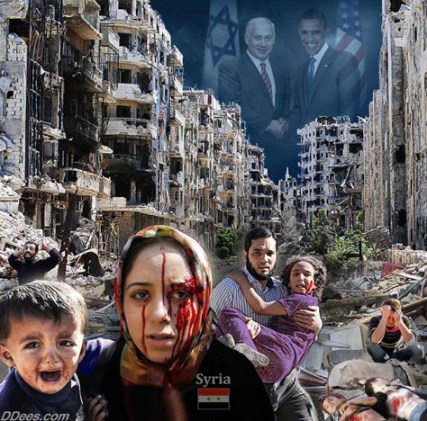 The Islamic State project has grown out of the Arab Spring and has gained momentum under the double standards of certain world powers trying to reach their own goals in Asia and Africa, Russian Federal Security Service head Alexander Bortnikov said Wednesday.
“The international community has now hit a new geopolitical challenge, an international criminal group in the name of the Islamic State. This project, which grew out of the ‘Arab Spring,’ has gained momentum thanks to the double [political] standards of certain world regional powers by using ‘a terrorist battering ram’ to reach their own strategic goals in Asia and Africa,” Bortnikov said during a security session with the special services from the Commonwealth of Independent States.
In late 2010, a revolutionary wave of anti-government protests began in the Arab world, which later evolved into the so-called Arab Spring, leading to political fragmentation and longtime rulers being forced from power in a number of countries, including Egypt, Libya and Yemen.
The most drastic consequences of the Arab Spring can be seen in Syria, where opposition factions tried to oust the country’s president, Bashar Assad. As the opposition failed to overthrow Assad immediately, mass anti-government protests escalated into an open armed confrontation between government troops and allied militias on the one hand, and the Syrian opposition on the other.
The conflict is ongoing, and apart from fighting the opposition, Assad has also had to counter extremist groups, including the notorious Islamic State, which has occupied large swathes of land in Syria in recent years.
In 2014, the militants expanded into Iraq which was trying to recover from the Iraq War caused by a US-led invasion and occupation of the country that lasted for over eight years.
“As a result, these states [global powers] have put the world on the brink of global religious and civilization conflict with extremely destructive consequences.”
Fighters From 100 Countries in Islamic State Ranks, Recruits Constitute 40% of Forces
“According to our estimates, citizens from more than 100 countries are currently fighting in the ranks of terrorist structures and the recruits constitute up to 40 percent of their forces,” Bortnikov said.
Afghan militants joining the Islamic State terrorist group has led to a sharp rise in threats and their invasion of Central Asia, Bortnikov said.
“The escalation in tensions in Afghanistan has brought on serious dangers. There are numerous criminal groups included in the Taliban movement on the northern borders of this country right now. Some of them have also [began operating] under the Islamic State flag, which has led to a sharp rise in the threat of terrorists invading Central Asia.”
Islamic State is a Sunni militant group, which seized large territories in Syria and Iraq, in 2012 and 2014, respectively. The group is known for its excessive brutality as well as for recruiting young people from all over the world, primarily via social media.
Some 20,000 to 30,000 foreign fighters are fighting alongside extremists against government forces in Syria and Iraq, according to various estimates. Up from last year’s estimates of no more than 15,000.
In August, the Russian Civic Chamber launched a hot-line to counter radicalization and protect young people from ISIL recruitment.
The following month, Russia, Syria, Iraq and Iran created the Baghdad Information Center to coordinate joint military action against ISIL. The four countries are represented by officers of the national armed forces, whose primary task is to collect and analyze data related to militant operations in the region.
On September 30, Moscow began pinpoint airstrikes on Islamic State positions in Syria following a request from President Bashar Assad.
Israel to demolish East Jerusalem home of alleged attacker’s brother
Ma’an – October 27, 2015
JERUSALEM – Israeli authorities on Tuesday delivered a home demolition order to Ibrahim Dwayyat from Sur Bahir in East Jerusalem, the brother of Shurouq Dwayyat, who Israel accuses of attempting to stab an Israeli settler earlier this month.
Their mother told Ma’an that the Israeli municipality claimed the home had been built without the necessary permits.
She said that her son began building the house four years ago and in a few months had planned to get marry and move into the home.
She said that Israeli authorities recently stormed the building where they took photos and took down its measurements.
It was not initially clear whether the demolition was intended as a punitive demolition following an alleged attack by Ibrahim’s 18-year-old sister, Shurouq.
Shurouq was shot and injured by a 35-year-old Israeli settler in Jerusalem’s Old City after she allegedly attempted to stab him on Oct. 7.
Israeli media said at the time that the man sustained light injuries, while medics told Ma’an that Shurouq was shot four times in her upper body, leaving her in serious condition.
Witnesses told Ma’an that she had been assaulted by the Israeli settler and did not have any sharp objects on her at the time of the incident.
After initially being treated at Hadassah Hospital in Ein Karem, Shurouq was later taken to Hasharon prison.
Her mother told Ma’an that several days ago, Israeli forces detained another of her sons, 22-year-old Muhammad, and have since sentenced him to six months of administrative detention, without trial or charge.
She added that Israeli authorities had refused family visits to Shurouq after she was shot.
Earlier this month, Israeli Prime Minister Benjamin Netanyahu called to fast track the demolition of family homes of alleged attackers, following a series of attacks that have left nine Israelis dead.
Human rights groups have criticized Netanyahu’s call as an unlawful form of collective punishment due to its displacement of Palestinians who have not committed crimes.
In a statement released last year, Human Rights Watch stated that the demolitions may also constitute a war crime as they are carried out in occupied territory.
Palestinian MP among 34 issued administrative detention orders
Ma’an – October 27, 2015
RAMALLAH – Israeli authorities issued administrative detention orders against 34 Palestinian prisoners, including a Hamas-affiliated lawmaker, for periods of three to six months on Tuesday, a prisoners’ rights group said.
The Palestinian Prisoner’s Society told Ma’an that some of the detainees have previously spent years in administrative detention, an Israeli practice that allows for internment without trial or charge indefinitely.
The society said that Hamas-affiliated lawmaker Hassan Youssef had been issued a six-month sentence under administrative detention.
Youssef, a member of the Palestinian Legislative Council, Palestine’s parliament, has been imprisoned by Israel on several occasions previously.
Most recently, he was released from Israeli custody in June after spending a year without trial or charge.
Since the start of October Israeli forces have detained around 1,000 Palestinians, according to prisoners’ rights group Addameer.
The 34 newly ordered administrative detainees are listed as follows with the periods of their detainment:
1. Shaher Jamil al-Hih, Hebron, 6 months.
2. Rasmi Jihad Khatib, Hebron, 3 months.
3. Idris Youssef Hassan, Ramallah, 3 months.
4. Hussein Saleh Abu Aker, Bethlehem, 6 months.
5. Ali Abd al-Karim Eweiwi, Hebron, 6 months.
6. Sadeq Muhammad Siyaj, 6 monyhs.
7. Jaafar Muhammad Maloul, Jenin, 3 months.
8. Mahmoud Wajih Qatt, Nablus, 6 months.
9. Nihad Muhammad al-Dib, Hebron, 4 months.
10. Maher Nathmi Jaradat, Hebron, 6 months.
11. Ashraf Muhammad Zaid, Jenin, 3 months.
12. Hatem Hafeth shawamreh, al-Ram, 3 months.
13. Mahmoud Imad Shawqi, Bethlehem, 6 months.
14. Ahmad Jamal Abu Jalaghif, Bethlehem, 4 months.
15. PM Hassan Youssef, Ramallah, 6 months.
16. Wissam Walid Khashan, Jenin, 6 months.
17. Munir Othman Zahran, Ramallah, 4 months.
18. Diyaa Aziz Imla, Hebron, 6 months.
19. Sami Hassan Shqeir, Ramallah, 6 months.
20. Mujahed Haitham Qawasmeh, Hebron, 3 months.
21. Ahmad Jamal Hreimi, Bethlehem, 6 months.
22. Abd al-Ghani Hassan Hammad, Ramallah, 3 months.
23. Ibrahim Khalid Ghafri, Ramallah, 3 months.
24. Muhammad Hani Suman, Bethlehem, 6 months.
25. Ibrahim Muhammad Sweiti, Hebron, 3 months.
26. Hussam Muhammad Abu Dayyeh, Bethlehem, 6 months.
27. Muhammad Atta Zahran, Qalqiliya, 6 months.
28. Muhammad Jamal Youssef, Ramallah, 6 months.
29. Ibrahim Abd al-Rahman Khasib, Ramallah, 3 months.
30. Fayiz Saad al-Rajabi, Hebron, 6 months.
31. Taysir Taleb Abu Snineh, Hebron, 6 months.
32. Diyaa Abd al-Rahim Abu Daoud, Hebron, 6 months.
33. Ahmad Hassan Nasr, Ramallah, 4 months.
34. Fadi Muhammad Srour, Hebron, 6 months.
Israel Takes On the First Amendment
Free speech except regarding Palestine

Philip Giraldi • Unz Review • October 27, 2015
I always enjoy reading the Washington Post each morning even though it drives my blood pressure up to stratospheric levels. Its embrace of the inexorability of a fabulous new Camelot-like Clinton White House is thrilling to witness as it unfolds, but it is the promotion of the neocon Israeli narrative that is most exciting. On October 23rd, the op-ed section outdid itself with a piece “Free speech is flunking out on campus” by Catherine Rampell, who described the increasingly sorry state of first amendment rights on politically correct American university campuses. Blacks, LGBTers, women and victims of sexual assault were all identified as constituencies demanding “safe spaces” resulting in curtailment of free speech but somehow Israel and its supporters screaming anti-Semitism at every drop of the hat were left out in spite of the fact that Jews on campus have been both extremely and successfully active in taking political action to pressure universities whenever they claim to feel “threatened.”
The conflict between the Israelis and Palestinians has again reached a boiling point. Palestinian frustration over Israel’s fifty year occupation of the West Bank and its continued theft of Arab land and resources has produced an uprising of mostly young Palestinians that is being called in some circles a new intifada. The conflict is playing out with knives and bullets in Palestine and Israel but it is also being fought internationally in the media, through cultural and economic boycotts and, most pointedly, at many colleges and universities. Israeli Prime Minister Benjamin Netanyahu realizes that the pressure on Israel is, for the first time, serious and has not hesitated to lie outrageously about the slaughter of Jews in Europe during the Second World War. According to Netanyahu, the Palestinian Grand Mufti of Jerusalem gave the idea to Hitler, presumably justifying whatever the Israelis of today choose to do to suppress the current unrest.
Israel has inevitably responded brutally, producing a death toll of significantly more Palestinians than Israelis. Netanyahu has been referring to the protesters as terrorists and has issued new rules of engagement which permit soldiers to shoot stone throwers. Israeli plainclothes soldiers and police have been identified as infiltrating the protesters while pretending to be Palestinians, urging the young Arabs to hurl stones before pulling out concealed handguns to beat protesters, shoot them and make arrests.
In Gaza five teenagers were shot dead by Israeli soldiers for the crime of coming too close to the separation barrier, which government press releases described as the “frontier.” Killing teenagers in Gaza is a bit like shooting fish in a barrel as they are fenced in and have in reality no way to actually confront the Israeli border guards. On the day following the killing of the boys a mother and infant were killed in an Israeli airstrike. Within Israel an Eritrean was even mistakenly killed by Israeli police because he was reportedly acting oddly.
Because of a hostile media’s self-censorship buttressed by an unfriendly political class, here in the United States one of the few places in which the Palestinians can exercise something like free expression relating to their national aspirations is on college campuses. Israel and its powerful supporters understand that gap in their ability to control the narrative and are doing everything possible to shut down the option.
Friends of Israel, as ever, work from the same playbook orchestrated by the large donors who fund them. They claim that anti-Israel protests on campus to include even letters to the editor in college newspapers constitute a “threatening environment” for Jewish students. The argument is based on a fundamental falsehood, which is that criticism of the actions of a foreign government is equivalent to hatred for the dominant religion of that country, that religion is exactly the same as nationality. Applying that notion liberally would mean that criticism of any country where there is de facto or de jure a dominant state religion would be unacceptable speech. If applied liberally countries spanning the globe would be exempt from criticism, to include not only Israel but also Saudi Arabia and Iran.
But this is not about Christian or Muslim sensitivities. It is all about protection against insult for Jews and it relies on a perception of perpetual victimhood, which can be and is produced on demand to stifle any criticism that might be regarded by some as objectionable. Indeed, if calls for violence directed against Jews as a race or religion were occurring pleas for some form of mitigation might have some very slim cogency, but campus protest movements have very carefully and deliberately avoided falling into that trap. And it might also be pointed that on many campuses a considerable proportion of the dissenters are themselves Jews who are appalled by Israeli behavior.
Criticism of Israel does not just include complaining about the policies of that country’s government. It also has inevitably involved the so-called BDS movement, “boycott-divest-and sanction” which aims to make Israel pay an economic and social price for its behavior, similar to the pressure that was once directed against apartheid South Africa. This second narrative has been cleverly woven into the complaints about “harassment,” labeling any campus calls for BDS ipso facto anti-Semitic and “hurtful.” School authorities have generally been accommodating to claims made by Jewish groups that students are feeling “threatened,” obstructing and intimidating critics of Israel and denying tenure to faculty members who are seen as troublemakers. They have looked the other way as organizations like Canary Mission began exposing college students on its website who are reported to be “anti-Freedom, anti-American and anti-Semitic” with the deliberate intention of damaging their future employment prospects.
Between January 2014 and June 2015 there were more than 300 incidents on 65 college campuses in 24 states involving intimidation or prevention of protests against Israel. Students at Northeastern University distributing flyers at dorms were interrogated by campus police and had their group suspended by college authorities. Some were disciplined. And faculty members have also been on the receiving end, with Steven Salaita at the University of Illinois, denied a teaching position after he sent tweets complaining about Israel’s 2014 assault against Gaza which killed more than 500 children.
Richard Blum, a member of the University of California’s regents, has demanded that students who criticize Israel be suspended for expelled because they are “intolerant,” exhibiting anti-Semitic bigotry. Blum is the multimillionaire husband of California Senator Dianne Feinstein. Feinstein has also hinted that she could have the government look into possible violations occurring at federally funded institutions. The definition of bigotry being promoted by Blum and Feinstein conflates criticism of Israel with anti-Semitism and includes in its purview what are increasingly being referred to as “speech crimes.” The university regents are currently considering new language for their statement of policy against intolerance on campus but are under intense pressure from Jewish organizations that are lobbying them aggressively.
Many of the groups involved in the harassment of pro-Palestinian demonstrators are perhaps not surprisingly not indigenous to the colleges themselves. Stand With Us (SWU) and “Campus Maccabees” are national organizations well-funded by billionaire Sheldon Adelson and SWU has close ties to the Israeli government as does the lawfare center Shurat HaDin, which has filed lawsuits against Muslim and progressive groups on campus. Predictably, Congress and state legislatures have gotten into the act, seeking to pass laws that make it impossible for colleges and universities supported by taxpayer money to fund student groups that call for boycotts. The bills are drafted in terms of rejecting all selective boycotts but they are really all about Israel and everyone knows it. The fact that advocating voluntary boycotts is very much a part of one’s First Amendment rights appears to be irrelevant.
How to deal with it? The brouhaha is impossible to ignore as the advocates for Israel are relentlessly in one’s face even when the argument is being constructed in a restrained fashion and purposely framed so as not to offend Jews. It is consequently necessary to disarticulate being Israeli from being Jewish. Judaism is a religion and Israel is a foreign country. And it is important to recognize that legitimate direct criticism of Jewish groups for their involvement in pressuring universities should not itself be off limits. If the organizations self-identify as Jewish and they are attempting to restrict the discussion on Israel contrary to the First Amendment they become fair game. The First Amendment exists, after all, to permit free and open discussion of all issues and if some Jewish individuals and organizations are mobilizing to deny fundamental American rights on behalf of a foreign nation the rest of us have the responsibility to object forcibly and to make transparent just who is doing what to whom.
J. K. Rowling and the Prisoners of Israel
By Omar Robert Hamilton | CounterPunch | October 26, 2015
“Words are, in my not-so-humble opinion, our most inexhaustible source of magic.”
— J. K. Rowling, Harry Potter and the Deathly Hallows, 2007.
How disappointing to see JK Rowling and Hilary Mantel signing this nefarious letter calling for the need for ‘cultural bridges’ with Israel.
The letter, assembled by a new organisation calling itself Culture for Co-Existence, is a litany of the tired tropes and doublespeak employed by Israel and her apologists.
It opens, point blank, saying, “We do not believe cultural boycotts are acceptable.” Within two sentences the reader finds herself in the patrician hallways of the British conservative, being simply instructed what to think, what is polite. Cultural boycotts are never acceptable? Ever?
The lazy argumentation continues, with the limp disbelief that “the letter you published accurately represents opinion in the cultural world in the UK.” This is in reference to a letter published by Artists For Palestine UK in which 1,000 UK cultural workers pledged to boycott Israel until it reverses its policies of apartheid and ethnic cleansing.
The letter struggles on with a series of meaningless assertions about the need to “inform and encourage dialogue” to “further peace.” When you’re dealing with the mechanized destruction of an entire people by one of the most technologically advanced and diplomatically shielded militaries in the history of mankind then talk, in 2015, of ‘cultural engagement’ is nothing more than further cover for Israel’s continuing colonization of what remains of Palestine.
Let us consider what the last twenty years of dialogue, mutual engagement and negotiation have brought us. Since the Oslo Accords were signed in 1993 the Israeli government has constructed 53,000 homes to house 500,000 new settler-colonists in the West Bank, has subjected Gaza to a medieval siege for over 6 years, destroyed 15,000 Palestinian homes, expelled 11,000 Palestinians from Jerusalem and divided the West Bank into 167 segregated population zones that are divided from each other by a 440km concrete wall and 522 military checkpoints. It has suppressed a popular uprising and launched four major offensives that have left over 7,000 Palestinians dead.
Israel, for all of those years (and we’re not even going back to 1948 here), has enjoyed full diplomatic and economic relations with all the world’s major players, it is at the centre of global trade in arms, hi-tech and diamonds. It competes in European sporting and musical competitions and enjoys European trade benefits. It has the US Congress in thrall to its every whim and has an army of lobbyists at work in every Western capital. Israel does not suffer from a shortage of ‘bridges.’
Words such as ‘dialogue,’ ‘peace’ and ‘bridges’ are hallmarks of the peace industry that has built up around Palestine in these years since 1993. Development money was released in reward for the PLO signing Oslo and foreign NGOs quickly came pouring into the West Bank armed with a new lexicon designed for annual reports and donor drives and an ultimate perpetuation of conflict and salaries. In this new language ‘peace’ means ‘submission’ and ‘dialogue’ means ‘silence.’ It’s not an Apartheid Wall, it’s a Separation Barrier – sometimes even fence. It’s not a ‘massacre’ it’s ‘fighting.’ The word justice is nowhere to be found. When Rowling’s letter states that “cultural engagement builds bridges, nurtures freedom and positive movement for change” one can only applaud the crisp professional meaninglessness of it.
Who do we have to thank for this exercise in euphemistic insincerity?
They call themselves ‘Culture for Co-Existence’ and the coordinators include: an Executive Board member of One Family Israel, ‘a leading support organisation that deals with victims of terror in Israel’; the executive director of Friends of Israel Educational Foundation; an Israeli software designer whose Facebook profile picture is a big Star of David and an investment banker who assists campaigns for the charity Jewish Care.
Surely the Culture of Co-Existence Clan is missing something? Could they not find a single House Arab to sign on with them? Or did they decide that wasn’t even necessary?
Who exactly are they planning on co-existing with?
And then you realise. They are not actually talking about dialogue between Israelis and Palestinians. They are talking about dialogue between themselves and Israel. The Palestinians are irrelevant. Peace, here, means being left at peace to keep doing business with the last apartheid state of the modern world. Dialogue and cultural exchange, in this lexicon, means that if you speak out about Israel then you can exchange your job for another one. In just the last week both the US State Department and MSNBC have had to retract statements that fell short of the Israel lobby’s standards. What chance, then, do independent institutions like London’s Tricycle Theatre have to exercise their moral right to refuse funding from an apartheid state? The answer: none. Because, remember, according to JK Rowling, cultural boycotts are never acceptable. A travelling troupe of KKK improvistas wants to ‘re-interpret’ a lynching in your school’s theatre to show the other side of the story? Right this way, sir. A cultural boycott would only single out white men from Mississippi unfairly when the world is so variously filled with wrong.
The Tricycle Theatre, like several politicians, popstars and athletes, was laid siege to last year when it tried to turn down Israeli government funding. They were quickly dialogued into submission and bridges were forced onto them in a manner reminiscent of the British Opium Wars.
Considering that Ms Rowling’s trade is in language it is deeply surprising to see her name attached to such a letter. Clearly this Co-Existence Coterie, which consists of her agent and two trustees of her charity, Lumos, came into being entirely for her signature. Many of their fans hope, though, that Ms Rowling and Ms Mantel reconsider their position and remove their names from this document. It is nothing more than a plea to allow Israel to continue the ethnic cleansing of Palestine. Economic and cultural isolation worked to end apartheid in South Africa and it can end it in Palestine too. If it is peace that people actually want, they have to recognize that it can only come with justice.
Omar Robert Hamilton is a filmmaker, writer and a producer of the annual Palestine Festival of Literature.
Netanyahu Proposes Cutting Off 80,000 Palestinians from Jerusalem
By Celine Hagbard | IMEMC News | October 26, 2015
Israeli Prime Minister Binyamin Netanyahu, in a recent Cabinet meeting, proposed revoking the residency rights of 80,000 Jerusalemites, which would mean that the people of Sho’afat refugee camp and Kafr Aqab, as well as other neighborhoods, would be cut off from the rest of Jerusalem.
The proposal was considered by the Israeli Cabinet in their recent meeting, but no decision was made.
Already, the 3 million Palestinians living in the West Bank have been severed from Jerusalem due to the Israeli construction of a massive Wall over the past 13 years. The Wall has annexed large sections of Palestinian land and made them a de facto part of the state of Israel, in direct violation of the responsibilities of an occupier under the Fourth Geneva Convention.
Israel’s government signed the Convention in 1957, requiring it to provide for the needs of civilian populations under occupation. The Convention also requires that an Occupying Power must not transfer any civilians into the land it has militarily occupied. But Israel has transferred over half a million people into settlements constructed on Palestinian land that was militarily occupied, then illegally seized, since the Israeli occupation of the West Bank, Gaza and the Golan Heights began in 1967.
In Jerusalem, the Israeli Annexation Wall has been constructed in such a way as to annex as much of Jerusalem as possible for the Israeli state, while forcing the Palestinian population into smaller and smaller enclaves. Now, under the Israeli Prime Minister’s proposal, residents of those enclaves would lose their residency rights altogether.
Israel has an identity card system for the residents of Jerusalem that is completely unique in the world. Jewish Israelis who live in Jerusalem or in paramilitary colonies in the West Bank are afforded full Israeli citizenship. But Palestinians who live on their ancestral land in Jerusalem are given a different kind of identity card, which ensures that they have far fewer rights than Jewish residents of the city.
If a Palestinian resident of Jerusalem, for example, were to travel abroad for more than a year, Israel would consider that person to be an ‘absentee property owner’, and would seize their land and home and annex it to Israel, denying the Palestinian owner the right to return to their home. The rule only applies to Palestinian residents of Jerusalem, and not to Jewish residents of the city.
According to the Israeli paper Yedioth Ahranoth, following the construction of new walls and barricades in recent weeks to further separate and segregate Palestinian residents of Jerusalem from Jewish residents, the Israeli Prime Minister told his Cabinet ministers, “We need to examine the possibility of canceling their [Palestinian Jerusalemites] residency. There needs to be a discussion about it.”
Some Israeli ministers voiced opposition to the plan, not because they were concerned about the Palestinian Jerusalemites losing their residency rights, but because they believe such a division would “give up territory” that some Israelis believe should belong to Israel.
That claim is based on a military takeover of the land by Israeli forces. Neither international law nor signed agreements recognize military takeover of land as a legitimate way of expanding state territory.
Gaza journalists say Israeli forces ‘deliberately target’ media

Ma’an – October 25, 2015
GAZA CITY – Palestinian journalists across the Gaza Strip, who work for different Palestinian, Arab and international news agencies, are reporting that Israeli troops have “deliberately targeted” media while covering clashes between young Palestinian men and Israeli forces near the border fence between the coastal enclave and Israel.
Palestine TV reporter Sali al-Sakni told Ma’an on Sunday she and her crew had deliberately stayed away from the center of clashes near al-Bureij refugee camp, but that they were still “showered with tear gas” while covering the clashes.
She added that dozens of other reporters and photojournalists “wearing helmets and flak-jackets with ‘PRESS’ marked clearly,” were also attacked with tear gas in the area. Al-Sakni said three tear gas canisters were fired directly at her crew.
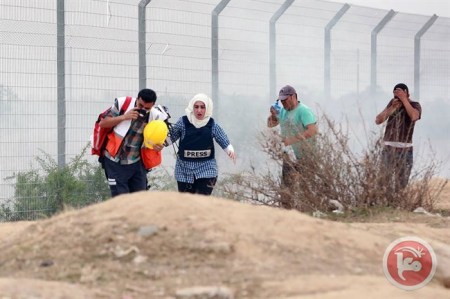
Similarly, cameraman of Palestine Today news agency Dawood Abu al-Kas was hit with a rubber-coated bullet in the foot while covering clashes near the border opposite to the Israeli Kibbutz of Nahal Oz in the northeast Gaza Strip.
“I was trying to capture photos while standing near an ambulance more than 300 meters away from the border fence when I was shot,” al-Kas told Ma’an.
Al-Kas highlighted that he was wearing a flak-jacket marked “PRESS” during the incident.
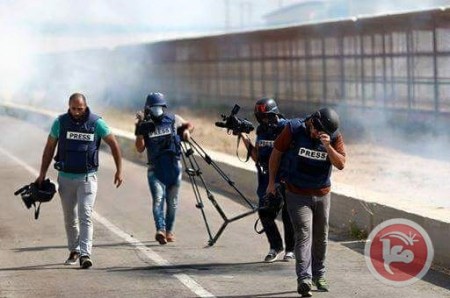
Al-Kas said that having been shot would not deter his efforts to “expose the crimes Israeli occupation commits against the Palestinian people.”
The deputy speaker of the Union of Gaza Journalists, Tahsin al-Astal, said Israeli assaults against journalists are consistent with Israeli violations of Palestinian rights in general.
“The Israeli occupation carries out systematic assaults against journalists who work in the field to prevent them from telling the truth about the crimes the occupation forces are committing against the Palestinian people,” al-Astal said.
“These serious breaches are classified war crimes and violations to international treaties and conventions,” he said.
Al-Astal added that the Union of Gaza Journalists, “has updated the International Federation of Journalists of the terrorism against Palestinian journalists at the hands of Israeli occupation forces.”
The IFJ, he said, is expected to issue a press release condemning “Israeli crimes and breaches against our people.”
‘US blindly supports Israeli interests in Middle East’
US to reduce aid to the Palestinian Authority
Press TV – October 24, 2015
The United States is the “proxy” for Israeli interests in the Middle East and “blindly supports” the regime’s position in the region, says an American political scientist.
In a phone interview with Press TV, Wilmer Leon pointed to US Secretary of State John Kerry’s meeting with Palestinian President Mahmoud Abbas on Saturday in the Jordanian capital of Amman, saying “anything is really going to come out of this.”
“I don’t really see anything substantive or long term coming out of these meetings,” he said, because “the United States has failed to do anything substantive in order to get Israel to honestly negotiate.”
He also noted that Kerry first held a meeting with Israeli Prime Minister Benjamin Netanyahu and “took Netanyahu’s position to Palestinian Authority President [Mahmoud] Abbas, instead of meeting with Palestinian Authority President Abbas first and taking the Palestinian positions to the Israelis.”
On Thursday, Kerry held talks with Netanyahu in Berlin and called for an immediate end to “all incitement” and “violence” against the Palestinians.
“For all intents and purposes, the United States is the proxy for the Israeli interests and until the United States decides to become an unbiased real arbiter actually working for peace in the region, instead of continuing to blindly support the Israeli position, I don’t see how anything is going to happen,” Leon added.
In supporting the regime’s positions, the US State Department said it will reduce its annual aid to the Palestinian Authority from $370 million to $290 at the end of September.
The 22-percent cut for the 2015 fiscal year came after US Congress sent a letter to Palestinian President Mahmoud Abbas, telling him that the US funds were contingent on tamping down “incitement.”
The latest wave of Israeli-Palestinian clashes began when Tel Aviv restricted the entry of some Palestinian worshipers into the al-Aqsa Mosque on August 26.
The surge in tensions, triggered by Israeli raids on the al-Aqsa Mosque in East al-Quds (East Jerusalem), as well as increasing violence by Israeli settlers, has seen some 54 Palestinians killed and hundreds more injured since October 1. Eight Israelis have also died in the same time period.
Jerusalem Palestinian loses eye after indiscriminate Israeli fire

Ma’an – October 24, 2015
JERUSALEM – Thirty-six year old Palestinian Luay Faisal Ubeid lost his left eye after an Israeli soldier shot him with a rubber-coated steel bullet in al -Issawiya neighborhood of occupied East Jerusalem earlier this week.
“Minutes after I arrived home on Wednesday evening, I heard bangs, so I opened the door of my balcony land looked down on the street,” Ubeid told Ma’an while receiving treatment at Hadassah hospital in Ein Karem in West Jerusalem.
“Seconds after opening the door an Israeli soldier fired a rubber-coated bullet directly at me, hitting my left eye,” Ubeid said.
He received first aid at home before being evacuated to Shaare Zedek medical center. He was later transferred to Hadassah hospital.
Doctors discovered that Ubeid had skull fractures and his left eye had been gouged out.
Ubeid told Ma’an he planned to bring suit against the Israeli forces, saying that “there hadn’t been clashes in the area” when he was shot. Israeli police have carried out an initial investigation, he added.
Ubeid is a father of five children, aged 4 to 13 and works as a bus driver for tourists in the area.
Member of a local committee, Muhammad Abu al-Hummus, told Ma’an that Israeli forces entering al-Issawiya on a near-daily basis are increasingly using indiscriminate force on the neigbhorhood’s residents.
“Israeli soldiers and police officers fire rubber-coated bullets and stun grenades, and hose houses indiscriminately with foul-smelling liquids,” al-Hummus told Ma’an.
Several people — including children — have been hit with rubber-coated steel bullets over the past month while sitting in their homes.
Ubeid is one of thousands of Palestinans in the occupied Palestinian territory to sustain injuries this month, according to Palestinian Red Crescent documentation.
As clashes mar the occupied West Bank and Gaza Strip, Palestinian residents of East Jerusalem have come under unprecedented restrictions following calls by Israeli PM Benjamin Netanyahu for increased measures against the population, in the wake of attacks that have left nine Israelis dead since Oct. 1.
Since the call, Israeli authorities have demolished homes of alleged attackers, sealed entrances to Palestinian neighborhoods, and detained several, in what Amnesty Intenational earlier this week termed the “collective punishment of thousands of people.”
Brookings Wants to Strengthen the Syrian Rebels by Bombing Hezbollah
By Steven MacMillan – New Eastern Outlook – 24.10.2015
Western think tanks have been working relentlessly to try and counter Russia’s geopolitical masterstroke in Syria, which has clearly taken most strategists in the West by complete surprise. Reading through the analysis by these think tanks on Russia’s role in Syria, one is starkly reminded of how immoral Western foreign policy actually is, when you remember that these organisations are freaking out because Russia is bombing terrorists! Obviously, the reason why they are so distraught is because Russia is bombing the West’s terrorists, which they have been using as proxy armies to try and force regime change in Damascus (a strategy that has completely failed).
Potential countermeasures are the subject of a recent article for the Brookings Institution written by Pavel K. Baev, a nonresident senior fellow in the Center on the United States and Europe at Brookings, titled: Russia’s Syrian entanglement: Can the West sit back and watch? Baev suggests that “the decision to withdraw the batteries of Patriot surface-to-air missiles [from Turkey] must be cancelled”,before arguing that the US and its allies could bomb “Hezbollah bands around Damascus”:
“Finally, the United States and its allies could deliver a series of airstrikes on the Hezbollah bands around Damascus. That would be less confrontational vis-à-vis Russia than hitting Assad’s forces. Hezbollah has already suffered losses in the Syrian war and is not particularly motivated to stand with Assad to the bitter end, away from [its] own home-ground in Lebanon. (Israel would appreciate such punishment, too.)”
Striking Hezbollah may not have the desired effect Baev seems to envisage however, as this belligerent action is as likely to galvanize the group and ensure it will fight “to the bitter end” with the Syrian army, than encourage it to scale back its involvement in Syria. Airstrikes on Hezbollah could also potentially provoke a response against the perpetrators of the violence, further escalating a conflict that already involves a plethora of regional and international powers. Furthermore, many people would consider an attack on Hezbollah to be essentially an attack on Iran, as the Lebanese based group is funded by Tehran and closely aligned with the country.
Brookings recommendations once again highlight the fact that large sections of the US establishment have absolutely no focus on defeating ISIS in the region, as Brookings is advocating bombing a major group that has been fighting ISIS for years now. Rather, many within the US are still focused on toppling the regime in Damascus (which is never going to happen) in addition to weakening the forces that are battling ISIS. If the West was serious about defeating ISIS, they would support and cooperate with the forces that are truly fighting against this new so-called caliphate.
TTIP is an Geoeconomic Tool against Russia
Western strategists are terrified of Europe moving closer to the East, and an EU-Russian (especially a German-Russian) alliance arising. Merging Russia and the EU in the future is an objective of some US strategists, but Washington only desires this if both Russia and the EU are completely subservient to US dictates. Today however, Russia is a sovereign, independent nation which is not controlled by the US, and some within the EU are increasingly tiring of being vassals of Washington. This means closer relations between Russia and the EU is a geopolitical disaster for the US at the present moment, as Washington’s power will be severely diminished if this tectonic shift occurs.
By understanding this reality, it is now obvious how essential the trade deal between the US and the EU – the Transatlantic Trade and Investment Partnership (TTIP) – is to US geostrategy. As well as being a corporate fascist deal that empowers multi-national corporations at the expense of citizens, TTIP is a geoeconomic weapon against Russia to cement the transatlantic alliance between the US and the EU.
Ensuring TTIP passes was a recommendation of another Western organisation that has been working on potential counter strategies to Russia, namely the Washington-based Atlantic Council (AC). In a testimony before the US Senate Armed Services Committee in Washington on October 8, 2015, Gen James L. Jones, Jr., the Chairman of the Atlantic Council’s Brent Scowcroft Center on International Security and a former National Security Advisor, Jones emphasises the importance of TTIP “successfully concluding” for the West:
“Energy security is instrumental for transatlantic growth, prosperity, and security. The same can be said of successfully concluding TTIP. Europe and the US have the largest trading partnership in the world. Strengthening it serves our mutual interests and reaffirms the centrality of the transatlantic alliance in the 21st century. TTIP also affords the U.S. a unique opportunity to author the rulebook and roadmap for 21st century advanced economies.”
Jones other recommendations include working to diversify the EU’s energy supply to “undermine Putin’s use of energy as a political weapon”, continuing to impose sanctions on Moscow, in addition to admitting Montenegro into NATO next year and working to pull Macedonia into the military alliance. The retired General also asserts that the US should provide the government in Kiev with “anti-tank missiles, intelligence support, training and counter-electronic warfare capabilities”.
Russia of course is well aware of the importance of TTIP to Washington’s long-term agenda. In Vladimir Putin’s speech at the United Nations at the end of September, Putin appeared to confront some of the US-led trade deals which we have seen being negotiated in recent years, most probably referring to TTIP and the Trans-Pacific Partnership (TPP) (from 18.45 into the speech):
“I would like to point out another sign of a growing economic selfishness. Some countries have chosen to create closed and exclusion economic associations, with the establishment being negotiated behind the scenes in secret from those countries own citizens, the general public [and] the business community. Other states whose interests may be effected are not informed of anything either. It seems we are about to be faced with an accomplished fact that the rules of the game have been changed in favour of a narrow group of the privileged, with the WTO having no say. This could imbalance the trade system completely and disintegrate the global economic space. These issues affect the interests of all states and influence the future of the world economy as a whole.”
For a multitude of reasons, defeating TTIP would be a colossal achievement for the world. Many European’s are diametrically opposed to this deal, with hundreds of thousands protesting TTIP in Germany a recent illustration of this sentiment. Stop TTIP!
Featured Video

Why the U.S. Should Pull Back From the First Island Chain
or go to
Aletho News Archives – Video-Images
From the Archives
Only 19.7% of Americans agree with US State Dept on Israeli settlements
… Most American adults of voting age don’t appear willing to reject the applicability of international law to Israel’s ongoing colonization of occupied territories in East Jerusalem, the West Bank and Golan Heights. … Full article
Blog Roll
 Aletho News
- British Government Employees Were Fact-Checking the News at the BBC. Nobody Told You.
- Albania on fire: who’s behind the riots?
- Egypt’s Civil Democratic Movement rejects involvement in regional war
- Egypt collaborates with Israel to build ‘Green Rafah’ project over erased Palestinian city
- Rising fuel prices and shortages have helped drive ongoing protests and rioting in France
- Tokyo protests demand Takaichi’s resignation over support for ‘Israel’
- Jennifer Kavanagh: Why the U.S. Should Pull Back From the First Island Chain
- Yemen denounces international community’s silence on Saudi aggression, siege
- UAE and Saudi Arabia move toward renewed coordination against Sanaa
- How Iran’s two-week retaliatory strikes exposed cracks in US military architecture in Persian Gulf
- If Americans Knew
- More on how Bari Weiss is using CBS on behalf of Israel
- What the UK Is Doing to Pro-Palestine Novelist Sally Rooney Is an Act of Orwellian Villainy
- ‘We will build palaces for Jews in Gaza’: Right-wing activists establish new outpost near border
- ‘You see us burning, you stay silent’: Family’s agony over mother and sons burned to death in Gaza tent
- Israel keeps Palestinian journalist Bushra al-Tawil in isolation for 46 days
- US-Israel integration plan puts US military tech in Israel’s hands
- Israeli Strike Burns Gaza Mother Alive in Front of Toddler, ‘Without Generating Any Headlines’
- ‘The Israel Experience with Mike Huckabee’: The Ambassador’s Family Sells Trips to Israel
- As Gazans carry out mass burial, food insecurity is getting worse – Daily Update
- Israeli rabbi permits occupiers to steal Palestinian olive harvest in West Bank
- No Tricks Zone
- Predictions Made By Renowned Climate Proifessor Over Past Decades Have Been Proven To Be Poor
- New Study Suggests Large Regions Of The Pacific Ocean Have Been Cooling For The Last 80 Years
- Germany’s Green Energy Debacle: High Energy Costs Force Kahla Porzellan to Close After 182 Years!
- New Study: 50 Years Of The Most Aggressive ‘Net Zero’ Policies Can Only Affect The Global Climate By 0.03°C
- US September “Heat” Was No Record…Many Records Set Decades Ago
- Latest European Green Energy Debacle; Portugal’s Largest Flagship Solar Park Insolvent!
- Green Energy Debacle: German Expert Professor Fritz Vahrenholt Warns Of Severe Economic And Social Consequences
- Two More Paleo Reconstructions Affirm Meters-Higher Sea Levels Across Ireland, Brazil 7000-6000 Years Ago
- New Study: Earth And Venus Surface Warmth Largely Explained By Convection And Lapse Rate, Not CO2 Or Radiation
- 2025 Nature Paper Claiming Worsening Global Drought Gets RETRACTED …Heavily Flawed

