Israel’s Thug at the UN
By Jonathan Cook | CounterPunch | August 25, 2015
The appointment by Israeli prime minister Benjamin Netanyahu of one of his most hawkish and outspoken rivals as Israel’s new ambassador to the United Nations has prompted widespread consternation.
As one Israeli analyst noted last week, Danny Danon’s appointment amounts to a “cruel joke” on the international community. The new envoy “lacks even the slightest level of finesse and subtlety required of a senior diplomat”.
Last year Netanyahu sacked Danon as deputy defence minister, describing him as too “irresponsible” even by the standards of Israel’s usually anarchic politics. Danon had denounced the prime minister for “leftist feebleness” in his handling of Israel’s attack on Gaza last summer.
Danon is a UN official’s worst nightmare. He is a vocal opponent of a two-state solution and has repeatedly called for the annexation of the West Bank.
Back in 2011, days before the UN General Assembly was due to vote on Palestinian statehood, Danon dismissed the forum as irrelevant: “Even if there will be a vote [in favour], it will be a Facebook state.”
On the face of it, Netanyahu’s timing could not be worse. Danon is to represent Israel as the Palestinians are expected to step up efforts at the UN to entrench recognition of their statehood. He will also be a leading spokesman as Israel tries to fend off war crimes investigations at the International Criminal Court in the Hague.
The generally accepted explanation is that Netanyahu’s move is driven by domestic, not diplomatic, calculations. Danon is the Israeli right’s poster boy, one who makes the prime minister look too cautious and conciliatory.
The two faced off for the Likud party leadership last November. Danon lost but Netanyahu doubtless fears, as his party and the Israeli public shift ever rightwards, that his rival’s time is coming.
The posting removes Danon as head of the Likud’s powerful central committee, dispatches him to a distant land, and should provide him with opportunities aplenty to self-harm.
But that is not the whole story. Danon’s appointment reveals something more significant about Israel’s deteriorating relations even with its international supporters.
It is hard nowadays to recall that Israel once took the UN very seriously indeed. It had to.
In the decade following 1948, Abba Eban, the country’s foremost diplomat, sought to carve out international recognition and respectability for Israel at the UN.
Eban often used deceit and misdirection – he is reported to have avowed that “diplomats go abroad to lie for their country”. But he never forgot the importance of creating a façade of moral justification for Israel’s actions, even as it launched wars of aggression in 1956 at Suez and again against Egypt in 1967.
Reality caught up with Israel when the UN adopted a resolution in 1975 equating Israel’s official ideology, Zionism, with racism. The resolution was only revoked 16 years later, after the Soviet Union collapsed and the United States emerged as the world’s sole superpower.
Washington arm-twisted the General Assembly with promises that Israel would engage in a peace process with the Palestinians, culminating a short time later in the Oslo Accords.
But as Oslo slowly unravelled, and Israel’s leaders – not least Netanyahu himself – were exposed as the true rejectionists, Israel was forced on to the back foot again.
Today, the consensus in Israel is not only that the UN is a bastion of anti-Israel prejudice but that it is an incubator of global anti-semitism, much of it supposedly spawned by Arab states. Israel is blameless, so this story goes, but the world has fallen under the haters’ spell.
The parting shot of Danon’s predecessor, Ron Prosor, last week was to accuse yet again a leading UN official, Jordan’s Rima Khalaf, of anti-semitism for pointing out the untold misery caused by Israel’s near-decade blockade of Gaza.
Earlier this year, after stepping down as Israel’s ambassador to the US, Michael Oren went further, arguing that the plague of anti-semitism had infected even America’s leading Jewish journalists. Their critical coverage of Israel was proof of self-hatred, he claimed.
The need for such desperate diplomacy has grown as Israel’s moral image has tarnished, even for its allies. But the hectoring and intimidation by seasoned diplomats like Prosor and Oren has produced diminishing returns.
Danon’s posting is part of a discernible pattern of recent appointments by Netanyahu that reflect a growing refusal to engage in any kind of recognisable diplomacy. Confrontation is preferred.
The trend started with Netanyahu’s decision in 2009 to let the thuggish Avigdor Lieberman lead the foreign ministry and Israel’s diplomatic corps.
Notably, Netanyahu picked Ron Dermer, a high-profile partisan of the US Republican party, to replace Oren in 2013. Dermer is widely credited with engineering Netanyahu’s provocative address earlier this year to the US Congress, in an undisguised effort to undermine President Barack Obama’s talks with Iran.
Danon’s appointment, like Dermer’s, indicates the extent to which the Israeli right has abandoned any hope of persuading the international community of the rightness of its cause – or even of working within the rules of statecraft.
Just as Dermer has turned Obama’s White House into a diplomatic battlefield, Danon can be expected to barrack, abuse and alienate fellow ambassadors at the UN in New York.
An Israel that has no place for negotiations or compromise wants only to tell the world that it is wrong and that Israelis don’t care what others think. Danon is the right man for that task.
As Gaza Lies in Ruins, The NY Times Blames the Victims
By Barbara Erickson | TimesWarp | August 24, 2015
Israel’s attacks on Gaza ended a year ago, but the strip remains an expanse of rubble and devastation. Who’s to blame for this outrage? The New York Times has an answer: everyone but Israel.
Jodi Rudoren comes up with this response in a story that aims to whitewash Israel’s brutal treatment of Gaza by blaming the Palestinian victims along with the international community for the lack of rebuilding. It is all summed up in the story’s subhead, “Political Infighting and Lack of Funds Stymie a Reconstruction Mechanism.”
Her article takes pains to present the process as a collaborative project between the Palestinian Authority, Israel and the United Nations, and she is hazy about Israel’s role, describing it as nothing more than “involvement in approving projects and participants.”
Rudoren furthers her efforts in a single paragraph that absolves Israel completely: “[The Palestinian minister of housing], other Palestinian leaders and United Nations representatives all said that Israel had done its part in reasonable time and allowed cement into Gaza. Empty coffers, they said, are the primary problem.”
Times readers, however, never learn the direct quotes or the names of the “leaders” and “representatives” that would help substantiate this claim, nor does Rudoren explain what “Israel’s part” actually refers to here.
In fact, Israel controls everything that goes into Gaza, from people to foodstuffs to building material, and the agreed-on process for rebuilding the strip—the “reconstruction mechanism” referred to in the subhead—is built solely on Israeli demands. (Israel also blocks Gaza traffic by sea and has the full cooperation of the Egyptian government on that border as well.)
Although the United Nations and the Palestinian Authority have roles in the process, Israel determines who gets building materials, what they get and in what amounts. As Harvard-based Gaza expert Sara Roy notes, the two major documents outlining the reconstruction process “read like security plans, carefully laying out Israeli concerns and the ways in which the United Nations will accommodate them.”
Roy adds, “Israel will have to approve all projects and their locations and will be able to veto any part of the process on security grounds.” Moreover, she writes, “No mechanism for accountability or transparency will apply to Israel.”
Without doubt, Palestinian bureaucracy, donor fears of yet another attack on Gaza and other factors come into play in reconstruction efforts, but Rudoren ignores the major element, which is the Israeli blockade.
Her story, in fact, never refers to the eight-year blockade of Gaza and makes only vague mention of Israeli “control” of the enclave. Readers are left without any relevant context.
Rudoren’s article also omits other details that would place Israel’s role in a different light: the fact that by July of this year it had allowed the passage less than 1 percent of the construction materials needed to adequately house Gaza residents or that as of May, a total of 20 schools (kindergarten to college level) completely destroyed by Israel had yet to be repaired.
Readers never learn, for instance, that aid agencies in Gaza were forced to rely on temporary building materials as the Israeli-mandated process kept concrete, cement and steel supplies to a trickle. They also never learn the sequel to this chapter: that Israel stepped in to squelch the effort just as it was gaining momentum.
The project was run by Catholic Relief Services, which began using lumber to build temporary homes for the displaced residents this year, and media reports in February and March stated that 70 had been built and 40 families had moved into the new houses. CRS had plans to construct more than 100 additional wooden homes, but in April the program came to an end when Israel suddenly banned all lumber for housing.
Here we can see how Israel actually operates in the opaque rebuilding process mentioned in Rudoren’s piece. Times readers, however, never learn of this sad narrative nor of many others that would reveal how Israeli actions are destroying the economy and depressing the living conditions in Gaza.
And yet, the Times story would have us believe that Israel has “done its part” in the reconstruction of Gaza, ignoring the obvious: that Israel alone has complete control of its borders with the strip, and if Israel so willed, Gaza residents would have moved out of the rubble long ago.
Lawsuit: US taxpayer dollars fund ‘Jewish terror’ against Palestinians
Press TV – August 25, 2015
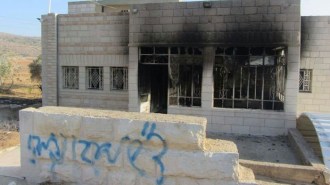 A rights organization has filed a complaint in the United States against an Israeli group for using US taxpayer money to sponsor “Jewish terrorism” against Palestinians.
In the lawsuit, T’ruah, The Rabbinic Call for Human Rights, asked the New York state Attorney General’s Office to investigate Honenu, a New York-based Israeli nonprofit organization that provides financial support to Jewish settlers convicted of or on trial for violence against Palestinians.
The complaint also names Honenu’s fiscal sponsor, the Central Fund of Israel, according to Israeli media.
Since 2003, Honenu has operated a fundraising program in the state of New York. The tax-exempt Israeli organization raised $233,700 in 2010, the last year for which official data is available, according to tax filings.
Israeli media say Honenu’s budget for 2013 was approximately $600,000.
In one instance in 2013, the organization provided funds to the family of an Israeli convicted of killing seven Palestinians in May 1990.
The lawsuit follows a recent expose by Israel’s Channel 10 about Israeli settlers’ crimes in the occupied Palestinian territory.
The television program was aired earlier this month in the aftermath of the July 31 firebombing of a Palestinian home in the West Bank by Israeli settlers in which a Palestinian baby and his father were burned to death.
In a statement issued hours after the incident, the Palestinian Liberation Organization (PLO) condemned the “brutal assassination” of the Palestinian infant, stressing that the regime in Tel Aviv bears “full responsibility” for the arson attack.
Earlier this month, Israel released all suspects held in connection with the arson attack in the village of Duma.
The Demographics of American Jews
By Lenni Brenner | CounterPunch | October 24, 2003
A friend once got a bit of a reputation by pointing out that “you don’t need the weatherman to know which way the wind is blowing.” But you do need a demographer to know which way the Jews are going.
Some readers will recall the journalistic hockey brawl in the NY Times over the National Jewish Population Survey 2000/2001, partially released in October 2002. Now the full survey is out, but the sticks are still flying, and the penalty box is full.
J. J. Goldberg, editor of Forward, the leading ‘Jewish community’ weekly, contributed an op-ed to the 9/17 Times, denouncing “flawed figures.” James Tisch, chair of the Conference of Presidents of Major American Jewish Organizations, replied in the 9/22 issue, defending their numbers against “critics” who “try in vain to ascribe to us ulterior motives.”
If gentile readers were confused about the furor, they will be comforted in knowing that most Jews likewise don’t grasp the underlying issues. But valid stats are crucial to a scientific understanding of the evolution of American Jewry. And with the US military all over the Middle East, and Palestine/Israel certain to be a priority concern in the forthcoming presidential election, universal misunderstanding of the status of Jewry in modern America can have fatal consequences for Palestinians, Israelis and Americans.
The best way for us to start is with the reader estimating the percentage of Americans who are Jews. Got your number? Now the scholars’ calculations. Their figures sit between 2.2% and 2.5%. Now compare your estimate and these figures with the guesses put forth by Americans in a 3/90 Gallup poll.
Twenty-four percent had no opinion. Beyond them, the average American thought that America was 18% Jewish.
That broke down to eight percent of Americans thinking that Jews are less than 5% of the people, 10% saying that Jews are between 5% and 9%, 25% believing that Jews are between 10% and 19%, 18% estimating that Jews are between 20% and 29%, 12% coming up with between 30% and 49%, and 3% reckoning that Jews are 50% — or more! — of all Americans.
Pretty wild? But why should gentile Americans know better? Their guesses are based on what they see. Turn on the TV, go to the movies, pick up a newspaper, follow an election, and in every case Jewish involvement is far above 2.5%.
It is much more shocking that most Jewish estimates are also surreal. Here are the numbers given by American Jews in a 3/98 poll, done nationally by the LA Times.
Twelve percent of our Jews think they are 2% of Americans, 13% think Jews are 3%, and 11% say they don’t know, which is also a ‘proper’ answer. But 7% of America’s Jews think they are 1% of Americans. Five percent of the Jews thought Jews are 4%. Ten percent of the Jews said they are 5%. Eighteen percent believed Jews are 6-10%. Six percent estimated our Jews to be 11-15%, and 18% of America’s Jews projected themselves as over 15% of the population, a whopping margin of error of over 600%.
So, where did those delicious Jewish overestimations come from? Jews know the country is overwhelmingly Protestant, and that the Jewish percentage is much smaller than the Catholics. But they watch the same TV, go to the same movies, etc. Thus, while their numbers aren’t as stratospheric as most gentiles, they likewise tend to be on the high side.
There are two reasons for the Jewish miscalculations. They fall into two broad categories, religious and non-religious. Pious Jews may or may not read the Bible, but the overwhelming majority definitely don’t read much about the mundane history of Judaism since biblical times. And while atheists and agnostics know enough about their ex-religion’s follies to justify abandoning it, once they bail out they usually lose interest in its evolution.
To be sure, many Jews, nationally, read the NY Times, which ran stories on the 1990 NJPS and the 2000-1 follow-up. Atheists might read an article about a bombing in Israel, but they often ignore articles about Judaism as a religion as they see it as not worth reading about. And most religious Jews don’t read the Times or the community weeklies which sit, for the most part unbought, on newsstands in their neighborhoods.
The scholars, real and alleged, argue over the absolute number of Jews because the US census doesn’t count people by religion and it doesn’t accept ‘Jewish’ as an ethnic category. While the contested figures range from 5.2 million in the 2000-1 Survey, to a high of 6.7 million give by a few dissenters, the blood really flows over the intermarriage rate.
The 1990 Survey reported a 52% intermarriage rate. The latest survey reports that “the intermarriage rate for Jews who have married since 1996 is 47%. Differences between intermarriage rates … are due to differences between the “born Jewish” definition used for the 1990 analysis and the “currently Jewish” definition used in this report.”
They say that 1990 NJPS researchers “calculated and presented an intermarriage rate for ‘born Jews,’ a category that included those they considered Jewish at the time of the survey and some they considered non-Jewish, including non-Jews who had been born to at least one Jewish parent and were raised in a non-Jewish religion.”
They admit further on that “In the current survey, applying the broad “born Jews” definition to people whose marriages began in 1991-95 and since 1996 yields intermarriage rates of 53% and 54%, respectively.”
To understand their distinctions between “born Jews” and “currently Jewish,” you must appreciate the sociological law which, as I’m its discoverer, I call, with my customary modesty, Brenner’s law: All religions lie about how many followers they have, and all left wing groups lie about how many people came to their last demonstration. Indeed, more paper has been wasted on debates over who is a Jew than on any other topic, including who really is a Trotskyist.
Today, with the enormous intermarriage rate, the Jewish establishment can’t face reality. They know that “slightly more than a fifth of Jewish adults who were raised by two Jewish parents are intermarried. In contrast, nearly three-quarters of Jewish adults with just one Jewish parent are intermarried. In other words, Jewish adults who are the children of intermarriages are more than three times as likely to be married to non-Jews themselves. At the same time, among those who had intermarried parents, a Jewish upbringing reduces the rate of intermarriage. Almost 60% of Jewish adults who were raised Jewish by intermarried parents are themselves intermarried, compared to 86% of their counterparts who had intermarried parents but were not raised Jewish by them.”
So they stopped counting adults who convert to another monotheistic religion as Jews, and don’t put kids of intermarried Jews, who aren’t raised Jewish, in their ‘current Jews’ category, and, lo presto, they come up with the 47% figure.
Serious scholars find this grotesque. Bob Dylan, my friend mentioned above, converted to Christianity. But many pollsters consider him to be the most famous Jew of his generation. Subsequently, Bob oriented towards Menachem Schneersohn, the late Lubavicher ‘rebbe,’ who most members of his Orthodox sub-sect believe to be the messiah, hovering over his grave in New York, eventually to come back again. It would be unworkable for demographers tracking the evolution of Jewry to drop Bob from their rolls of Jewry because he became a Jesus freak, and then put him back, but as a convert from Christianity.
When doing scientific surveys of religions, races, nationalities, the standard rule is ‘all’s fish that comes into the net.’ T. S. Elliot became a British citizen, but every literary critic correctly lists him as an American poet.
The intermarriage rate has become such an obsession with the Jewish honchos that they overlook an even more ominous stat. Eight out of 10 Jews living with a sexual partner without benefit of clergy is sleeping with a non-Jew. But in their formalistic minds, ‘only’ 47%, for marriages, means that they are still in business, if in deep trouble, whereas if a majority of kids with at least one born Jewish parent intermarry, and the rest are shacking up with gentiles, “organized Jewry,” as their journals call them, is unmistakably little more than the dirty ring in the bathtub after the water is gone down the drain.
For all their abracadabras, Judaism is well and truly shriveling up, everywhere except in Israel, and it doesn’t matter what intermarriage percentage they concoct. Intermarriage is a symptom of the collapse of Jewry, not its cause.
The 1st colonial American Jews, known as the Sephardim, of Portuguese and Spanish descent, in time intermarried and converted to Christianity, as did most of the 1st colonial Ashkenazis, meaning German and Eastern European Jews. In the 19th century, almost 200,000 German Jews came here. About 60,000 converted in that century. By now, most of the rest have intermarried, tho not necessarily converted, and have no connection to organized Jewry.
From 1881 and the 1st czarist pogroms, thru to 1921, when the US established immigration quotas, to keep out Jews and other undesirables, a minority of Ashkenazis from the Russian empire came here already Marxist atheists. They still considered themselves Jews because they spoke Yiddish, which only Jews spoke. Once here, they recruited other immigrants to leftist atheism.
In the 30s, another minority of American-born Jews became Communists. They also saw themselves as Jews because most lived in Jewish neighborhoods, and most married atheist Jews. Moreover anti-Semitism was still a force here, and they were considered Jews by the larger American public. But most of their descendants, usually no longer leftists, are completely assimilated
Today things are significantly different. Many young Jews grow up in ‘white’ suburbs, mixed in with gentiles. They don’t know a word of Yiddish. They go to school with and then work with gentiles. Most of them never encounter anti-Semitism. This is the sociological basis for the intermarriage wave.
Their great-grandparents came here ‘Orthodox,’ now only 9.7% of our Jews, by the NJPS numbers, even less in other surveys. Orthodoxy segregates women in a separate section of the synagogue. Only men can be rabbis. Everyone keeps the kosher laws, no pork, shrimp, etc. Somewhere along the line most of their families abandoned Orthodoxy for either the ‘Conservative’ sect, 15.2%, with its synagogues having local option on segregation and women rabbis, or ‘Reform,’ 17.4%. They have complete gender equality and now have some gay rabbis. They also have, according to rabbi Arthur Hertzberg, an intermarriage rate of “60% to 70%.”
Even if they went to Hebrew school after their day in public school, after their bar mitzvah, their initiation into theological adulthood, at 13, most drop away from any form of Jewish identification. Some of the consequences were described by Reform’s Michael Myers in “Beyond Survival and Philanthropy,” a book based on a symposium in Israel, re the disintegration of American Jewry:
“Host cultures, especially that of America, represent a more serious threat to our collective Jewish existence than ever before. Not only are Jews more socially acceptable then ever in the past, but so is Judaism. The problem is that Jewish tradition is seen as narrow and prejudiced the moment it makes any claim to exclusivity, the moment it makes any claim to superiority.”
Two contributors, Steven Cohen and Charles Liebman, presented the problem from a Zionist perspective:
“After all, if all people are to be treated equally without regard to race, religion, national origin, sex, and most recently, sexual preference, how can American Jews feel totally comfortable in maintaining a special relationship with, let alone granting preference to, Israelis?”
The end result of the process of de facto assimilation is expressed in a host of stats from the 2000-1 NJPS, and from the American Jewish Identity Survey-2001, done at the Center for Jewish Studies at City University of New York. The latter is based on the methodology of the 1990 NJPS and is more reliable than the 2000-1 NJPS, compromised as it is by sugarcoating facts to please the establishment.
According to the AJIS, “More Jews than most other Americans respond ‘None,’ when asked ‘What is your religion, if any?’…. Fewer Jews than members of most other American religious groups agree with the essential proposition of religious belief that ‘God exists.’” Twenty-seven percent of all Jews are uncertain or reject theism, with only 14% of Americans saying they have no religion. The AJIS reported that by 2001 only 51% still believed in some form of Judaism, a 12% decline since 1990. By my reckoning, by this writing, a majority of US Jews reject Judaism. Even the NJPS 2000-1 concedes that only 46% belong to synagogues. That minority divides up 39% Reform, 33% Conservative, 21% Orthodox, 7% other types.
Inevitably the Zionist movement has been dramatically affected by the migrations into religious skepticism and intermarriage. A 1995 American Jewish Committee poll found only 22 percent of America’s Jews calling themselves Zionists, down from 90 percent in 1948. I haven’t found a later percentage figure, but, according to an article in New York’s May 2002 Jewish Post, the decline continues. In 1997, 107,802 votes were cast for American delegates to the World Zionist Congress. In 2002, 88,753 votes were cast.
Even that decline doesn’t tell the whole story of the movement’s decadence. Reform’s slate got 42.24% of the vote, the conservatives received 22.29% and the Orthodox slate garnered 20.23%. The American branch of the Israeli Labor Party got 2.2% and Meretz, a liberal ally of the LP received 3.96%. The rest went to tiny factions supporting Sharon’s ruling Likud Party.
Followers of the late terrorist, Meir Kahane, are not allowed to run in the elections, but they number a few dozen to a couple of hundred, at most. The most significant outside group are the Lubavitchers, who number about 15,000. They are major funders of the Likud and many New York Democrats and Republicans. When the rebbe was alive, a visit to him was a ritual stop for our politicians. Although most Jews look upon the Lubavichers as the Jewish Amish, and have nothing to do with them, a photo op with Schneersohn meant you were ‘good for the Jews.’
The election percentages give an impression that is contradicted by visible reality. Everyone attending the annual NY Salute to Israel Day parade notices that almost all the men wear kippot, Hebrew for skull caps, which tells us that they are Orthodox. Reform and Conservative rabbis got their congregations to sign up for the election so that they could put pressure on the Israeli government to grant equality to their co-religionists there, who are not allowed to legally marry or divorce even their own followers. But the bulk of the voters do nothing more than vote.
The vote drop from 1997 to 2002 can be explained, in large part, by disenchantment over the fact that Israel didn’t do anything significant in the way granting them their rights. Reform Zionists have an ideology of ‘Jewish peoplehood,’ which ties them to Israel in spite of their getting nothing more than a kick in the teeth from the government. In case you haven’t noticed, most politicians, everywhere, operate on one principle. ‘If we don’t give the beggars what they want, what will they do to hurt us?’ Since the Reform rabbis will do nothing, they get nothing. But the penalty they and Zionism pay is that the bulk of Reform, especially the youth, are de facto non-Zionist. As Beyond Survival and Philanthropy delicately put it, US Jews “have such difficulty appreciating the virtual monopoly the Orthodox exercise over the meaning of Judaism in Israel.”
Our universities are disaster areas for Judaism and Zionism. Darwin and physics courses destroy most students lingering faith in the Old Testament. And the devil, taking the form of left-wing professors and the anti-war movement, does the rest. The 1/4/02 issue of Ha’ aretz, Israel’s liberal daily, reported that out of “about 400,000 Jewish students … only about 5 percent have any connection to the Jewish community.”
In many respects, the best illustration of Zionism’s increasing isolation are the tourist stats. According to the NJPS, “just over one-third of all American Jewish adults have been to Israel, (35%).” Ninety-two percent of all Jews have traveled abroad, but England and France outrank Israel as a destination. Although Reform’s members are the most affluent of the 3 groups, they are least likely to go to Israel.
We see this again with immigration to Israel. Most of the true believers who go there to live, and especially the ones who actually stay, are Orthodox.
It is characteristic of the NJPS that it didn’t ask a direct question, ‘are you a Zionist?’ Instead it asked vague questions as to emotional attachment, whether US and Israeli Jews shared a common destiny, etc.
“My people are American. My time is today.” George Gershwin, who was never even bar mitzvahed, said that in 1926. Its taken decades for the typical young Jew to get to that point, but that is the case today. And the assimilation process is a worldwide one, with intermarriage rates of over 50% in every country in the world except Israel and Australia, and even in that last country the rate is climbing.
Why then is the Zionist lobby so powerful when their own scholars write endlessly about the alienation of their youth from the movement? The answer is simple: the Jews are the richest ethnic or religious stratum in the US. Because their standard of living is so high, they are the most educated. Because they are the most educated, they are the most scientific oriented, hence most inclined towards atheism or religious skepticism. But the true believer minority still has an unbelievable amount of money to throw at the politicians.
In 1991, I interviewed Harold Seneker, then the editor of the Forbes 400 list of the richest Americans, for an article in The Nation. I told him that I found Jews, 2.2% of the population, to be about 25% of the 400. He told me that he thought this a success story, both for American capitalism and for the Jews, and that he wanted to write a story on it. But Forbes wouldn’t let him. The then publisher had gone thru the Hitler era, when talking about Jewish money was an anti-Semitic specialty.
This mentality is still common on the left as well, and it is wide spread among elderly Jews. Forbes, much of the left, and old Jews share what must be called a ‘folk Marxist’ mentality. Despite the differences in their politics, they all believe that history repeats itself. Someday there is going to be another 1929 Depression. The capitalists will, once again, call up central casting and get another Hitler to smash the left.
This is fantasy. Its a projection of the past, and Germany’s past at that, into America’s future. In reality, journalists constantly turn out articles for Zionist publications about how Jewish campaign contributors play a major role in funding both parties and, very rarely, the topic is touched on in the mainstream media. “The Political Future of American Jews,” a 1985 American Jewish Congress pamphlet by Seymour Martin Lipset and Earl Raab, declared that “While there have been few reliable statistics on the subject — and some reluctance to gather any — the journalistic and anecdotal evidence is overwhelming that more than a majority of Democratic funds on a national level, and as much as a quarter of Republican funds have come from Jewish sources.” They were referring to private contributions, as was an article in the 1/5/93 NY Times announcing that “Jews contributed about 60 percent of Mr. Clinton’s noninstitutional campaign funds.”
My estimate is that 84 of the latest 400 are Jews. The magazine doesn’t list religious affiliations unless the person involved is distinctive in giving to religious charities, etc. And not all of the Jews are pro-Zionists. Some listees are among the educated disaffiliated we are discussing. But Zionist money is prodigious. James Tisch, chair of the Conference of Presidents of Major Jewish Organizations isn’t on the list, altho he is CEO of Loews Corp., listed on the Fortune 500 list. But daddy, Laurence, is, at $2 billion, and uncle Preston is worth $2.3 billion. His predecessors at the Conference were Ronald Lauder, $1.8 billion, and Mort Zuckerman, who struggles along with a penny ante $1.2 billion. Chaim Sabon, $1.7 billion, is a University of California regent. Mayhaps he got the job because he gave the Democrats the largest campaign contribution in American history?
Because of the establishment’s cover-up of the extent of the disintegration of organized Jewry, it is reasonable to think that most gentile politicians don’t realize it. But the Jewish pols do. And there is no reason to think that the gentiles would stop pandering to Zionists even if they understood that they are a shrinking minority among Jews.
Both major parties pick their candidates via primaries which any member can enter. So occasionally an honest Democrat or Republican is elected to congress and begins to criticize their party’s Israel über alles line. Usually it doesn’t take long before a tidal wave of Zionist cash pours in against them in the next election and out they go.
Some Arabs denounce Zionist funding, all day and all night, but there is no way of suppressing Zionist campaign contributions without doing away with the whole structure of privately funded campaigns, and they never talk about that. Many leftists don’t like to talk about it because of their fear of raising anti-Semitism. They want to talk about oil money. That’s fine. Any kid who they let cross streets alone knows that oil is the major reason that the US in so deeply involved in the Middle East. But that doesn’t explain why the two capitalist parties are so pro-Zionist. Indeed their pro-Zionism creates problems for them with the Arab masses. And it doesn’t explain why liberal Democrats are as zealous for Israel as the most fanatic Republican Christian Zionist.
If liberals constantly badmouth big business, they don’t get contributions from the major corporations. But Zionist money is single issue money. A liberal can dump on oil companies, or whatever, and he still gets a share of the Zionist gusher.
A personal experience tells it all about liberals and Zionism. In 1971, the Vietnam-era National Peace Action Coalition asked me to draw in Eldon Clingen, the Liberal Party member of the New York City Council from Manhattan. We had been in the Socialist Party’s youth In the 1950s. He joined the Libs on assignment but subsequently involved himself in Democratic Party politics, without changing party registration. But, as he was “Mr. Clean Air” for his leadership in the anti-pollution effort, the Libs asked him to be their Council candidate.
He was pleased to get his Lib faction involved. We chatted. I mentioned that lower-case liberals, against war in Vietnam, shot passing Arabs, even camels, to get Jewish votes.
“Oh, you have me wrong. I’m of Christian descent, and when I think of the terrible things Christians have done to Jews, I say I can’t do enough for the Jews.”
I told him that the next time he called for more ‘enough’ for Israel, he should write a check to me because, although I’m a Jew, I don’t get any of that ‘enough.’
“OK, I’ll tell it like it is: In order for a liberal — and I mean a lower-case liberal — to win in New York, he must have the Black, Puerto Rican and Jewish votes because he can’t get the Irish or Italian vote. They are locked away with the right-wing. But Blacks and Puerto Ricans don’t give us money. So don’t tell me about terrible things Israelis are doing to Palestinians. It would upset me. But I’m not going to break with my meal ticket.”
The moral of the story is that, while it is crucial to talk about oil industry domination of US foreign policy, it is just as crucial to talk about Zionist funding and its enormous influence on domestic politics. The discussion of both factors must be within a context of insisting that ordinary Americans, Jew or gentile, are fools if they continue to support parties that are so obviously funded by the rich.
Far from being afraid of discussing Zionist funding, it should be a major point in any critique of private contributions. Jews are less than 2.5% of the people. Zionists are now considerably less than 22% of all Jews. (My current estimate is ca. 10%.) And rich campaign contributors are a minority of Zionists. Yet we have an overwhelmingly gentile Congress that is emphatically more pro-Zionist than the majority of Jews.
Far from being a diversion of public attention from the capitalist nature of American politics, as some leftists fear, talking about Zionist money is one of the best ways of making that point. Because of the civil rights struggle and other battles, equality for all races, religions, nationalities, has become part of the broad American value system. Because of this, my percentage estimate of the Jewish proportion of the 400 richest Americans, which, trust me on this, is shared by serious scholars, has an automatic tendency to shock. But isn’t capitalism about inequality? It is absurd to think that a system that sanctifies inequality could be egalitarian in the ethno-religious distribution of wealth.
All that is necessary to make the important point that it isn’t Jewish contributions but Zionist slush that is offensive, is to cite the fact that we now can see that the Zionists are a minority of Jews. Talk about the oil industry and Zionist contributions at the same time, and people will get the correct idea that we are trying to explain a complex problem in detail.
Let’s go further. What US support for Israel and support for Saudi Arabia additionally have in common is that both regimes are theocratic states. An atheist of Jewish background should be concerned if we talked about Israel and didn’t talk about Saudi Arabia. So the moral of the story is talk about both. Additionally, everyone now sees a growing alliance between the Zionist establishment and the so-called Christian Zionists. These fanatics support Israel because of their lunatic notion that the creation of Israel means that Christ is coming, any minute now, to save a Christian America, and send all those atheist Jews, and atheist gentiles, to hell. Hitherto, the Jewish establishment could at least be relied on to resist attempts to convert America into a ‘Christian’ government. But, with the new alliance on foreign policy, that resistance is getting weaker and weaker. The Christian right now reasonably expects an increase in Zionist votes and funding for their candidates. Indeed it is a central tenet of Jewish neo-con politics that it is unreasonable to expect perpetual Christian Zionist support for Israel, unless they get something back in return.
In other words, we are now in a complex political crisis with profound domestic and international consequences. A complex situation can’t be dealt with in a one-sided manner. We have no choice but to examine all parts of the situation. If we denounce all the criminals, Americans, Arabs, Christians, Israelis, Jews, Muslims, for their crimes, from a democratic secular perspective, in a scientific manner, the Zionists and their Democratic and Republican patrons can say anything they want. An educated public will see that we don’t want to deny anyone their rights. On the contrary, they will see that we want to extend human equality and secularism, here and in the Middle East.
LENNI BRENNER is editor of 51 Documents: Zionist Collaboration with the Nazis.
The Age of Imperial Wars
From Regional War, “Regime Change” to Global Warfare
By Prof. James Petras | Global Research | August 22, 2015
2015 has become a year of living dangerously.
Wars are spreading across the globe.
Wars are escalating as new countries are bombed and the old are ravaged with ever greater intensity.
Countries, where relatively peaceful changes had taken place through recent elections, are now on the verge of civil wars.
These are wars without victors, but plenty of losers; wars that don’t end; wars where imperial occupations are faced with prolonged resistance.
There are never-ending torrents of war refugees flooding across borders. Desperate people are detained, degraded and criminalized for being the survivors and victims of imperial invasions.
Now major nuclear powers face off in Europe and Asia: NATO versus Russia, US-Japan versus China. Will these streams of blood and wars converge into one radiated wilderness drained of its precious life blood?
Living Dangerously: The Rising Tide of Violent Conflicts
There is no question that wars and military threats have replaced diplomacy, negotiations and democratic elections as the principal means of resolving political conflicts. Throughout the present year (2015) wars have spread across borders and escalated in intensity.
The NATO allies, US, Turkey and the EU have openly attacked Syria with air strikes and ground troops. There are plans to occupy the northern sector of that ravaged country, creating what the Erdogan regime dubs a ‘buffer zone’ cleansed of its people and villages.
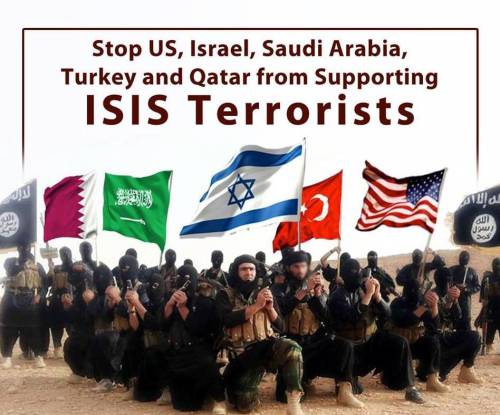
Under the pretext of ‘fighting ISIS’, the Turkish government is bombing Kurds (civilians and resistance fighters) and their Syrian allies. On Syria’s southern border, US Special Forces have accelerated and expanded operations from their bases in Jordan on behalf of the mercenary terrorists – funded by the monarchist Gulf States.
Over 4 million Syrians have fled their homes as refugees and over 200,000 have been killed since the US-EU-Turkey-Saudi-sponsored war against the secular Syrian government was launched four years ago.
Dozens of terrorist, mercenary and sectarian groups have carved up Syria into rival fiefdoms, pillaged its economic and cultural resources and reduced the economy by over ninety percent.
The US-EU-Turkish military intervention extends the war into Iraq, Lebanon and…. Turkey – attacking secular governments, ethnic minority groups and secular civil society.
The feudal, monarchist Saudi Arabia and the United Arab Emirates have invaded Yemen with tanks, launching air strikes against a country without any air defenses. Major cities and towns are devastated. Saudi ground troops and armored carriers are killing and wounding thousands – mostly civilians. The brutal Saudi air and sea blockade of Yemen’s ports have led to a humanitarian crisis, as ten million Yemenis face starvation deliberately imposed by a grotesque and obscenely rich monarchy.
The Yemeni resistance fighters, driven out of the major cities, are preparing for prolonged guerrilla warfare against the Saudi monsters and their puppets. Their resistance has already spread across the frontiers of the absolutist Saudi dictatorship.
The brutal Israeli occupation troops, in collaboration with armed ‘settler’ colonists, have accelerated their violent seizure of Palestinian lands. They have stepped up the ethnic cleansing of Palestinians, Bedouins, Druze and Christian inhabitants replacing their communities with racist ‘Jews-only’ colonial settlements.
Daily assaults against the huge ‘concentration camps’ of Gaza accompany an armed blockade of land, air and water, preventing the reconstruction of the tens of thousands of homes, schools, hospital, factories and infrastructure, destroyed by last year’s Israeli blitzkrieg.
Israel’s continued annexation and ethnic cleansing of Palestinian territory precludes any diplomatic process; colonial wars have been and continue to be Israel’s policy of choice in dealing with its Arab neighbors and captive populations.
Africa’s wars, resulting from earlier US-EU interventions, continue to ravage-the Continent. Somalia, Sudan, Kenya, Libya are riven by bloody conflicts between US-EU backed regimes and armed Islamic and nationalist resistance movements.
Throughout North and Sub-Sahara Africa, US-EU backed regimes have provoked armed upheavals in Libya, Nigeria (Boko Harem), Egypt (ISIS, Moslem Brotherhood et al), Chad, Niger, South Sudan, Somalia and elsewhere.
Imperial client Egyptian and Ethiopian dictators rule with iron fists – financed and armed by their EU and US sponsors.
Imperial wars rage throughout the Middle East and South Asia. Hundreds of experienced Baathist Iraqi military officers, who had been expelled or jailed and tortured by the US Occupation army, have now made common cause with Islamist fighters to form ISIS and effectively occupy a third of Iraq and a strategic swath of Syria.
There are daily bombings in Baghdad undermining its US client. Strategic advances by ISIS are forcing the US to resume and escalate its direct combat role
The US-Baghdad retreat and the defeat of the US-trained Iraqi military in the face of the Baathist-Islamist offensive is the opening salvo of a long-term, large-scale war in Iraq and Syria. The Turkish air-war against the Kurds in Iraq will escalate the war in Northern Iraq and extend it into southeast Turkey.
Closer to ‘home’, the EU-US-backed coup (‘regime change’) in Kiev and the attempt to impose dictatorial-pro-West oligarchic rule in Ukraine have detonated a prolonged civil-national war devastating the country and pitting NATO’s proxies against Russian-backed allies in the Donbas.
US, England, Poland and other NATO powers are deeply committed to pushing war right up to Russia’s borders.
There is a new Cold War, with the imposition of wide-ranging US-EU economic sanctions against Russia and the organizing of major NATO military exercises on Russia’s doorsteps. It is no surprise that these provocations are met with a major counter-response – the Russian military build-up. The NATO power grab in Ukraine, which first led to a local ethnic war, now escalates to a global confrontation and may move toward a nuclear confrontation as Russia absorbs hundreds of thousands of refugees from the slaughter in Ukraine.
The US puppet regime in Afghanistan has faced a major advance of the Taliban in all regions, including the capital, Kabul.
The Afghan war is intensifying and the US-backed Kabul regime is in retreat. US troops can scarcely advance beyond their bunkers.
As the Taliban military advances, its leaders demand total surrender of the Kabul puppets and the withdrawal of US troops. The US response will be a prolonged escalation of war.
Pakistan, bristling with US arms, faces a major conflict along its borders with India and permanent war in its semi-autonomous Northwest frontier states with Islamist and ethnic Pashtu guerrilla movements backed by mass regional political parties. These parties exercise de facto control over the Northwest region providing sanctuary and arms for Taliban militants operating in Afghanistan and Pakistan.
Armed ethno-religious conflicts persist in western China, Myanmar and northern India. There are large-scale popular resistance movements in the militant northeast Thailand opposed to the current military-monarchist dictatorship in Bangkok.
In the 21st century, in South and Southeast Asia, as in the rest of the world, war and armed conflicts have become central in resolving ethnic, social, tribal and regional differences with central states: diplomacy and democratic elections have been rendered obsolete and inefficient.
Latin America – On the Verge
Burgeoning violent extra-parliamentary right-wing movements, intent on overthrowing or ‘impeaching’ elected center-left Latin American governments face major confrontations with the state and its mass supporters.
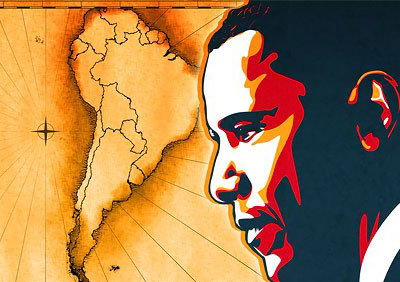 In Ecuador, Venezuela and Brazil, US-backed opposition groups are engaged in violent demonstrations, directed toward ousting the elected regimes. In the case of Ecuador, ‘popular sectors’, including some indigenous leaders and sectors of the trade union movement, have called for an ‘uprising’ to oust President Correa. They seem oblivious of the fact that the hard-right oligarchs who now control key offices in the three principal cities (Guayaquil, Quito and Cuenca) will be the real beneficiaries of their ‘uprisings’.
The resurgent Right envisions violent ‘regime change’ as the first step toward ‘wiping the slate clean’ of a decade of social reforms, independent regional organizations and independent foreign policies.
‘Civil war’ may be too strong a word for the situation in Latin America at this time – but this is the direction which the US-backed opposition is heading. Faced with the mess and difficulty of dislodging incumbent regimes via elections, the US and its local proxies have opted for the choreography of street violence, sabotage, martial law and coups – to be followed by sanitized elections – with US-vetted candidates.
War and violence run rampant through Mexico and most of Central America. A US-backed military coup ousted the popularly elected, independent President Zelaya in Honduras. The ensuing US-proxy regime has murdered and jailed hundreds of pro-democracy dissidents and driven thousands to flee the violence.
The 1990’s US-brokered ‘Peace Accords’ in El Salvador and Guatemala effectively blocked any agrarian reform and income redistribution that might have led to the rebuilding of their civil societies. This has led to over two decades of mass disaffection, the rise of armed ‘gangs’ numbering over 100,000 members and an average of six to ten thousand homicides a year with El Salvador becoming the ‘murder capital of the hemisphere’ on a per capita basis. The annual murder toll under the US-brokered ‘Peace Accords’ now exceeds those killed each year during the civil war.
The real ‘carnage capital’ of the hemisphere is Mexico. Over 100,000 people have been murdered during the decade-long, US-backed ‘war on drugs’ – a war which has become a state-sponsored war on the Mexican people.
The internal war has allowed the Mexican government to privatize and sell the crown jewels of the national economy – the petroleum industry. While thousands of Mexicans are terrorized and slaughtered, the US and EU oil companies are curiously shielded from the drug lords. The same Mexican government, its police, officials and military, who collaborate with the drug lords in dividing up the billions of drug dollars, protect foreign oil companies and their executives. After all, narco-dollars are laundered by banks in New York, Miami, Los Angeles and London to help fuel the speculation!
From Regional to Nuclear Wars
Regional and local wars spread under the shadow of a looming world war. The US moves its arms, planes, bases and operations to the Russian and Chinese borders.
Never have so many US troops and war planes been placed in so many strategic locations, often less than an hour drive from major Russian cities.
Not even during the height of the Cold War, did the US impose so many economic sanctions against Russian enterprises.
In Asia, Washington is organizing major trade, military and diplomatic treaties designed to exclude and undermine China’s growth as a trade competitor. It is engaged in provocative activities comparable to the boycott and blockade of Japan which led to the Second World War in Asia.
Open ‘warfare by proxy’ in Ukraine is perhaps the first salvo of the Third World War in Europe. The US-EU-sponsored coup in Kiev has led to the annexation of Western Ukraine. In response to the threat of violence toward the ethnic Russian majority in Crimea and the loss of its strategic naval base on the Black Sea, Russia annexed Crimea.
In the lead-up to the Second World War, Germany annexed Austria. In a similar manner the US-EU installed a puppet regime in Kiev by violent putsch as its own initial steps toward major power grabs in Central Asia. The military build-up includes the placement of major, forward offensive military bases in Poland.
Warsaw’s newly elected hard-right regime of President Andrzej Duda has demanded that Poland become NATO’s central military base of operation and the front line in a war against Russia.
Wars and More Wars and the Never-ending Torrents of Refugees
The US and EU imperial wars have devastated the lives and livelihoods of scores of millions of people in South Asia, North and Sub-Sahara Africa, Central America, Mexico, the Balkans and now Ukraine.
Four million Syrian refugees have joined millions of Afghan, Pakistani, Iraqi, Yemeni, Somali, Libyan, Palestinian and Sudanese refugees fleeing US-EU bombs, drones and proxy mercenaries ravaging their countries.
Millions of war refugees escape toward safety in Western Europe, joining the millions of economic refugees who have fled free market destitution in Lithuania, Latvia, Estonia, Bulgaria, Romania, Poland, the Balkans and other EU satellites.
Panic among the civilian population of Western Europe sets in as hundreds of thousands cross the Mediterranean, the Aegean and the Balkans.
Droves of refugees perish each day. Tens of thousands crowd detention centers. Local labor markets are saturated. Social services are overwhelmed.
The US builds walls and detention camps for the millions trying to escape the harsh consequences of imperial-centered free markets in Mexico, narco-terror and the fraudulent ‘peace accord’-induced violence in Central America.
As Western wars advance, the desperate refugees multiply. The poor and destitute clamber at the gates of the imperial heartland crying: ‘Your bombs and your destruction of our homelands have driven us here, now you must deal with us in your homeland’.
Fomenting class war between the refugees and ‘natives’ of the imperial West – may not be on the agenda . . . for now, but the future for ‘civil’ society in Europe and the US is bleak.
Meanwhile, more and even bigger wars are on the horizon and additional millions of civilians will be uprooted and face the choice of starving, fleeing with their families or fighting the empire. The ranks of seasoned and infuriated resistance fighters are swelling in Afghanistan, Iraq, Libya, Yemen, Ukraine and elsewhere.
The US and EU are becoming armed fortresses. US police deal with the marginalized citizenry as an occupying army, assaulting African-Americans, immigrants and dissidents – while looting poor communities . . . and protecting the rich…
Conclusion
War is everywhere and expanding: No continent or region, big or small, is free from the contagion of war.
Imperial wars have spawn local wars . . . igniting mass flights in a never-ending cycle. There are no real diplomatic success stories! There are no enduring, viable peace accords!
Some pundits may protest this analysis: They point to the recent US – Cuba rapprochement as a ‘success’. They conveniently forget that the US is still subverting Cuba’s biggest trading partner, Venezuela; that Washington’s major regional proxies are demanding regime change among Cuba’s allies in Ecuador, Brazil and Bolivia and that Washington is increasingly threatening Cuba’s alternative markets in Russia and China. The vision of the US flag flapping in the breeze outside its embassy in Havana does little to cover Washington’s iron fist threatening Cuba’s allies.
Others cite the US – Iran peace accord as a major ‘success’. They ignore that the US is backing the bloody Saudi invasion of neighboring Yemen and the massacre of Shiite communities; that the US has provided Israel with a road map detailing Iran’s entire defense system and that the US [Israel] and EU are bombing Iran’s Syrian ally without mercy.
As for the US – Cuba and Iranian agreements– are they enduring and strategic or just tactical imperial moves preparing for even greater assaults?
The war epidemic is not receding.
War refugees are still fleeing; they have no homes or communities left.
Disorder and destruction are increasing, not decreasing; there is no rebuilding the shattered societies, not in Gaza, not in Fallujah, not in the Donbas, not in Guerrero, not in Aleppo.
Europe feels the tremors of a major conflagration.
Americans still believe that the two oceans will protect them. They are told that placing NATO missiles on Russia’s borders and stationing warships off China’s shores and building electrified walls and laying barbed wire along the Rio Grande will protect them. Such is their faith in their political leaders and propagandists.
What a packet of lies! Inter-continental missiles can ‘rain down’ on New York, Washington and Los Angeles.
It is time to wake up!
It is time to stop the US – EU headlong race to World War III!
Where to start? Libya has been irrevocably destroyed; it is too late there! Syria, Iraq and Afghanistan are aflame. We are being plunged deeper into war while being told we are withdrawing! Ukraine sucks in more guns and more troops!
Can we really have peace with Iran if we cannot control our own government as it dances to the Israelis tune? And Israel insists on war – our waging war for them! As the Israeli war criminal General and Prime Minister Ariel Sharon once told some worried American Zionists: “Trouble with the US? We lead them by the nose…!”
Just look at the terrified families fleeing carnage in the Middle East or Mexico.
What is to be done?
When will we cut our losses and shake off the bonds of these war makers – foreign and domestic?
“Human Rights” in the Arab World: the Instruments of War, a Test Case for the UN High Commissioner for Human Rights
By Lana Habash | CounterPunch | August 21, 2015
Sometimes I love Republicans. They lay bare with such clarity what underlies and drives US foreign policy– the bottom line strategic interests without the pretense that more adept politicians use to justify US military aggression: the US government’s “concerns” about “human rights” for instance.
Take Syria.
John McCain laid it all out in his interview on CNN’s Situation Room in 2013:
“Look, the Middle East is about to erupt. This is turning into a regional conflict: Lebanon is destabilized, Jordan can’t — the king of Jordan can’t last, the conflict is spreading throughout the region, Hezbollah is all in. This is becoming a Sunni-Shia conflict . . . and it’s an unfair fight!” While arguing for more US military intervention in Syria, he goes on to say, “It’s a great blow to Iran — the greatest in twenty-five years, and they’re cut off from Hezbollah, which would mean that Hezbollah would die on the vine.”
It is strange to hear American politicians wring their hands about the instability of the Jordanian monarchy and its regime while pontificating about US intentions to “bring democracy to the Middle East.”
Over the past two decades, we have witnessed the increasing use of the human rights discourse by the United States as justification for US military aggression. In some cases, these human rights abuses (as in the case of Iraq) proved nothing more than Department of Defense propaganda that was later proved false. More recently, the Assad regime in Syria has been accused of such violations as torture and arbitrary arrest and detention, though the US hasn’t been above using these alleged services themselves. (US former CIA agent Robert Baer once said of US held prisoners, “If you want them to be tortured, you send them to Syria.”) The UN High Commissioner for Human Rights has echoed these allegations about the Syrian regime. These alleged human rights abuses, the same ones that Jordan continues to perpetrate against its own citizens with impunity, have been used as justification for US military intervention in Syria, including the arming and training of rebel forces in Jordan by US troops, which has resulted in the deaths of at least 220,000 people and over 3 million refugees. These interventions have done nothing to advance the human rights of the Syrian people, but have achieved some strategic goals for the US and Israel: Hezbollah, the only player that poses a serious threat to American and Israeli strategic interests regionally, is now embroiled in a Syrian civil war, and as McCain stated, a “great blow” has been served to both Iran and Hezbollah.
Last year, at his confirmation as the UN High Commissioner for Human Rights by the General Assembly, Prince Zeid Ra’ad Al Hussein spoke of his commitment to push forward human rights on the Asian continent. It has been hard to take seriously this pronouncement when the High Commissioner has used his office to support concrete measures that, not coincidentally, mesh with US strategic interests, while he remains silent about the human rights abuses in his own country, the Hashemite Kingdom of Jordan. Jordan is a signatory to the International Covenant on Civil and Political Rights, yet has one of the most abysmal human rights records in the world. The recent case of Amer Jubran reveals the entire spectrum of repression to which Jordanians are subjected.
Amer Jubran is an internationally known Palestinian activist, speaker and writer on the rights of Palestinians and against US and Israeli policies in the Arab world. He has also distributed information about US involvement in destabilizing Syria.
Jubran was arrested in Jordan on May 5, 2014, when 20 men in black military uniforms broke into his home in the middle of the night. He was held incommunicado by Jordan’s secret police, the General Intelligence Directorate (GID) for 2 months at an undisclosed location, in violation of Article 9 of the International Covenant on Civil and Political Rights. A petition against arbitrary detention was filed on his behalf with the UN Working Group on Arbitrary Detention. Nothing came of this.
Jubran was finally charged in August, 2014 under a new law that makes “harming the relationship with a foreign government” a crime of “terrorism.” The wording of this law is so vague that it criminalizes a broad range of political activities including journalism, in violation of Article 19 of the ICCPR, guaranteeing freedom of opinion and expression.
This same law was enacted one month after Amer Jubran’s arrest, also constituting a violation of Article 15 of the ICCPR, which stipulates, “No one shall be held guilty of any criminal offense … which did not constitute a criminal offense…at the time when it was committed.”
Jubran was tried before Jordan’s State Security Court (SSC), a military tribunal that fails to meet even minimum standards of judicial independence, violating Article 14 of the ICCPR, which guarantees the right to a fair trial by a “competent, independent and impartial tribunal established by law.” Jubran’s defense team effectively proved the “terrorism” charges against him false, but the verdict of the SSC was reached without regard for evidence. The only evidence presented in Jubran’s trial was the coerced testimony of other defendants, also arrested in May, 2014, subjected to interrogation, and all of whom received reduced sentences of two to three years. Robert Baer also said: “If you want a serious interrogation, you send a prisoner to Jordan.” While Jubran was being detained incommunicado and “interrogated” he was threatened not only with imprisonment, but with being disappeared when he refused to infiltrate Hezbollah and act as an informant for the GID. He was recently sentenced to ten years of hard labor by Jordan’s State Security Court (see statement by Amer Jubran on his sentencing.)
The human rights abuses perpetrated against Amer Jubran are the rule in Jordan, rather than the exception. Jordan’s long history of the use of arbitrary detention and torture have been well documented by the UN. In 2013, the UN Human Rights Council Working Group on Arbitrary Detention issued a report on Jordan, detailing a series of cases like that of Jubran in which basic political freedoms had been trampled. The report had a special section on the State Security Court:
“The Committee against Torture and the Human Rights Committee have repeatedly recommended that Jordan abolish special courts such as the State Security Court… The Committee reiterates its 1994 recommendation that the State party consider abolishing the State Security Court.” (Human Rights Council Working Group on Arbitrary Detention, November 2013).
What has the UN High Commissioner done thus far to respond to these recommendations and push forward the issue of human rights in his own country? When asked during a press conference as to whether it was illegal to criticize the king in the press in Jordan, the Human Rights Chief replied, “Essentially, we believe we are still a family,” while plugging the king’s new book (USA Today August 13, 2014). The UN High Commissioner failed to mention Jordan’s long history of criminalizing speech and imprisoning journalists like Jamal Ayyoub.
Interestingly, Jubran has written nothing about the Jordanian regime. His writing has consistently concerned itself with the policies of the US and Israel in the region. This speaks to the new law of “harming relationships with foreign governments.” Mr. Jubran has stated that he was told directly by his GID interrogators that any decision made about him would involve “our American and Israeli friends.”
Recent revelations about NSA cooperation with Jordanian intelligence agencies underline the central role Jordan plays in the US and Israeli “security” regime for the region. Spying on Palestinians and providing intelligence about “high security targets” is perhaps the least of the services Jordan provides. The abuses of fundamental freedoms in Jordan are consistently carried out, as in Amer Jubran’s case, in the interests of protecting US and Israeli power.
Institutions like the Office of the UN High Commissioner for Human Rights are supposed to exist to guarantee the protection of human and political rights globally. The real test of the UN High Commissioner’s commitment to push forward the issue of human rights in Asia must begin in his home country of Jordan and will involve a confrontation not only with that regime, but with the nation states calling the shots. Will the UN High Commissioner Zeid Ra’ad Al Hussein use the powers of his office to advocate for human rights, when those powers come in conflict with the US, Israel, and their regional allies? If not, then the term “human rights” has become nothing more than Orwellian doublespeak, and the Office of the UN High Commissioner for Human Rights is just one more weapon in the military arsenal of US regional dominance.
More details about the case of Amer Jubran can be found at freeamer.wordpress.com.
Lana Habash is a Palestinian physician living in Boston, MA. She can be reached at defense@amerjubrandefense.org.
Are Zionist terrorist settlers backed by the Israeli regime?
Press TV
After the burning alive of 18-month-old Ali Dawabsheh by a fanatical Zionist settler, the world has reacted with outrage.
The attack was so horrendous that even Israeli leader Benjamin Netanyahu distanced himself from it, calling it an act of terrorism.
But on today’s show we will be asking to what extent Israel is responsible for the activities of its extremists. Are these fanatical terrorists really just a few bad apples, as Netanyahu would have us believe?
Or are they the product of decades of deliberate Zionist policy to colonize stolen land?
Alert: 21st Aug 2015 – Demand Freedom For Amer Jubran & Muhammed Allan
inminds – August 20, 2015
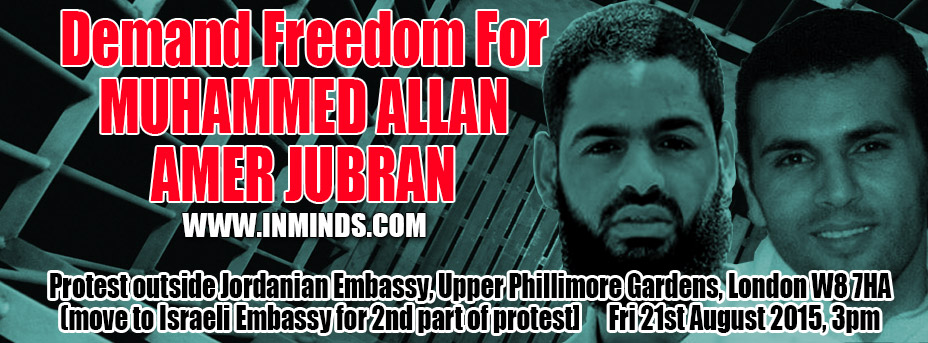
Date: Friday 21st August 2015 3pm-5:30pm
Location: Jordanian Embassy, Upper Phillimore Gardens, London W8 7HA (few minutes walk from High Street Kensington tube station), move to Israeli Embassy around 4:30pm
Facebook: https://www.facebook.com/events/947233385320459
Assalaamu Alaikum
Please join us as we hold two vigils this friday for Palestinian prisoners. At 3pm we will be outside the Jordanian Embassy demanding freedom for Palestinian father and human rights activist Amer Jubran who is facing a 10 years prison sentence in Jordan at the behest of Israel for refusing to betray the Lebanese resistance against Israel. Then at around 4:30pm we will move to the Israeli Embassy a few streets away to demand the unconditional and immediate release of Palestinian lawyer and hunger striker Muhammed Allan.
Muhammed Allan is again in a comma, breathing through a respirator, after having suffered brain damage whilst in Israeli custody. Muhammed launched his hunger strike on 15 June 2015 to protest Israel’s illegal practice of Administrative detention – of caging Palestinians indefinitely without charge or trial. He has been caged by Israel without charge since 6th Nov 2014 on never ending rolling detention orders. Allan ended his hunger strike after 65 days on 19th Aug after the Israeli Supreme Court on health grounds ordered the suspension of the administrative detention order against him. But Israel is still threatening to reimpose his administrative detention and imprisonment should he recover, its imperative at this time that we maintain the pressure and demand his immediate and unconditional release.
LATEST UPDATES ON MUHAMMED ALLAN
(courtesy Samidoun Palestinian Prisoners Solidarity Network)
20th Aug: Reports state Palestinian hunger striker Muhammad Allan again in a coma, on respirator
http://samidoun.net/2015/08/reports-state-palestinian-hunger-striker-muhammad-allan-again-in-a-coma-on-respirator/
19th Aug: Breaking News: Reports state Muhammad Allan has ended his strike after decision of the Israeli Supreme Court
http://samidoun.net/2015/08/breaking-news-reports-state-muhammad-allan-has-ended-his-strike-after-decision-of-the-israeli-supreme-court/
18th Aug: Muhammad Allan regains consciousness, pledges to continue hunger strike
http://samidoun.net/2015/08/muhammad-allan-regains-consciousness-pledges-to-continue-hunger-strike/
17th Aug: Muhammad Allan rejects attempt to forcibly deport him from Palestine as Supreme Court considers case
http://samidoun.net/2015/08/take-action-muhammad-allan-rejects-attempt-to-forcibly-deport-him-from-palestine-as-supreme-court-considers-case/
17th Aug: Israeli Supreme Court to hear petition for release of hunger striker Mohammed Allan
http://samidoun.net/2015/08/israeli-supreme-court-to-hear-petition-for-release-of-hunger-striker-mohammed-allan/
16th Aug: Palestinian doctor denied access to Muhammad Allan as he faces life-threatening infection
http://samidoun.net/2015/08/palestinian-doctor-denied-access-to-muhammad-allan-as-he-faces-life-threatening-infection/
14th Aug: Muhammed Allan on ventilator in coma; Palestinian prisoners under Israeli lockdown
http://samidoun.net/2015/08/action-alert-muhammed-allan-on-ventilator-in-medical-crisis-palestinian-prisoners-under-israeli-lockdown/
AMER JUBRAN – BACKGROUND
Palestinian activist Amer Jubran has a long history of being targeted for his activism on behalf of Palestine, first in the US and then in Jordan.
In the US he formed the “New England Committee to Defend Palestine” and in November 2002, two days after leading a demonstration in Boston calling for justice in Palestine, the FBI stormed Amer Jubran’s home and arrested him under the Patriot Act initially holding him without charge. When public outcry made it difficult to continue holding him they initiated deportation proceedings against him and he was deported to Jordan in January 2004 where he continued his activism for Palestine.
In Jordan he was under constant surveillance of the notorious Jordanian secret police. On 5th May 2014, 20 armed me in black uniforms stormed his home where he lived with his wife and four young children, smashing the doors and windows. The secret police abducted Amer, and for months he was interrogated at an undisclosed location without charge and without access to a lawyer.
Finally in August 2014 Amer Jubran was charged under a new law that didn’t exist when he was arrested, that makes “harming the relationship with a foreign government” a crime of “terrorism”. Last month on 29th July 2015 we was sentenced by a military court to 10 years hard labour, reduced from a 15 year sentence. Following his visit to Lebanon to speak an an Anti-Apartheid week function he was accused of working with the Lebanese resistance Hizbullah against Israel, hence ‘harming’ Jordan’s relationship with a friendly country. During his interrogation he was told by the secret police that any decision made about him involves “our American and Israeli friends”. Amer says it “all started when I refused to be a sell-out and work against the Lebanese resistance. I was told then that I will be sent behind the sun for such a refusal. And frankly it is very easy for me to disappear behind the sun rather than to be well, outside but a sell-out and traitor. “. Essentially he is being persecuted and imprisoned because he refused to work for Israeli /Jordanian intelligence as an infiltrator and informant against the resistance.

BACKGROUND – ADMINISTRATIVE DETENTION
Muhammad Allan was on hunger strike to protest against Israel’s practice of Administrative detention. Administrative detention is a practice used by Israel to imprison Palestinians indefinitely without charge or trial. Prisoners are given rolling detention orders which can be anything from 1-6 months, renewable indefinitely. Such practice is against international law.
For example administrative detainee Mazen Natsheh has been locked up cumulatively for nearly 10 years without charge or trial. Muhammad Allan has in total been caged for 3 years under different administrative detention orders without charge or trial.
Detention orders are based on so called “secret information” which never needs to be produced, either to the detainee nor their lawyer. Administrative detention is often used to arbitrarily jail Palestinians where there is no evidence for a trial. It is also used for punishment as in the case of 8 Palestinian MPs who are currently caged in Israeli dungeons to punish them for their political stance.
Palestinian prisoners rights group Addameer have documented “many cases where the detainees themselves will say that administrative detention is actually far worse than a fixed sentence, be that five years, ten years, 20 years, or whatever and why. With a fixed sentence, you know when you’re going home, a prisoner knows when he goes home. It could be ten years or 15 years down the line, but they know when they’re going home. Not with an administrative detention..” They have documented “many cases where prisoners or detainees have been literally leaving the prison, walking out of the prison with their bags in their hand after their administrative detention order has expired [with their family waiting on the other side] and the Israelis have handed that detainee another administrative detention order and they have to go back into the cell to recommence another administrative detention order. Now, this is a form of psychological torture for not only the detainee [but also] their families.”
Israel has on average issued over 2000 detention orders every year (between 2007 and 2011). Today there are around 450 administrative detainees. Most of them, like Muhammad Allan, having been transferred from the West Bank into Israel in contravention of Article 76 of the Fourth Geneva Convention, with their families being prevented from visiting them.
On 18th August 2015, 250 Palestinian prisoners held under administrative detention in the “Negev” prison in the Naqab desert in the south of Palestine announced they will launch an open-ended hunger strike to defeat administrative detention. Their statement reads “the growing use of administrative detention.. represents a clear and explicit violation of all international conventions and human rights principles, where we are arrested for extended periods, for years continuously, at the mercy of a so-called “secret file,” where we have no right to defend ourselves. Administrative detention is a sword hanging over our necks, that eats away our flesh and blood and years of our lives without trial and without mercy.”
LIVE UPDATES DURING PROTEST
We will, inshAllah, be tweeting live from the protest with live photos being uploaded to our twitter and facebook page. So if you can’t join us on the day, please help us by sharing the photos as they get uploaded.
https://www.facebook.com/inmindscom
https://twitter.com/InmindsCom
If you support this activity please share this alert widely, thank you.
JazakAllah,
Abbas Ali
Palestinian Prisoners Campaign
http://www.inminds.com/caged
http://fb.com/inmindscom
http://twitter.com/InmindsCom
http://youtube.com/user/inminds
Israeli Supreme Court Releases Hunger-Striking Prisoner
By Richard Silverstein | Tikun Olam | August 19, 2015
The Israeli Supreme Court has ruled that hunger striking Palestinian prisoner, 31 year-old Mohammed Allan, will be released from administrative detention… but only if medical tests show that he’s suffered “irreversible” damage as a result of his 65-day hunger strike. Apparently, a healthy Allan was a grave national security threat. While a near-dead Allan poses no such threat. While the Court has done the decent, humane thing, it erased any good will it might’ve generated by compelling Allan had to prove that his ordeal had caused damage to his body and mind so severe that it supported freeing him.
If he recovers and shows no sign of permanent damage, he could be rearrested and forced to serve the remainder of his term under administrative detention. Further, he could be rearrested at any time by authorities under a new order. Such is the caprice of the Israeli legal system regarding security offenses. Under administrative detention, a victim need not be charged with a crime. And such detentions may be extended for six month periods indefinitely. That is why prisoners have begun to resort to hunger strikes. Killing themselves seems to be the only message that moves the hardened Pharaonic hearts of Israel’s security services.
Israel was placed in this “awkward” position by a ruling from the national medical association refusing to participate in force-feeding him, which had been the prison service’s plan. After no doctor would agree, it had to let the hunger strike run its course. It is a pleasant surprise that the Israeli security police couldn’t mange to find a professional willing to perform such a ghoulish procedure. Keep in mind, that a number of countries including the U.S. do permit force-feeding of hunger strikers.
This is a cold, brutal judicial decision in line with a string of such judgments offered by this Court since a hardline majority took over in the past several years. Lest any apologists continue prattling about the liberal views and support for human rights offered by the highest judicial body as a counter to the racism of the legislative branch, the days of Aharon Barak are long past. Nor are we likely to see such a person on the court in the future.
That doesn’t mean the extreme right in Israel is any less angry at this Court. In fact, one minister said last week the Court should be “bulldozed.” Apparently, having a court that is obeisant to the right-wing policies of the government as this one is, isn’t enough. They want a Court that opens its sessions with the Likud anthem and swears allegiance to Rabbis Ginsburgh and Lior.
PA security: No proof Palestinians attempted stabbing attacks
Ma’an – August 18, 2015
RAMALLAH – The Palestinian Authority security forces on Tuesday said that there was no evidence that Palestinians shot by Israeli forces in recent days, in two cases fatally, had stabbed Israeli soldiers.
In the last week, Israeli forces have shot three Palestinians, killing two, who they claimed attempted to stab Israeli soldiers or Border Police officers.
However, the spokesperson for the PA security forces, Major-General Adnan Dmeiri, said in a statement that Israel had provided no evidence to support its allegations.
He questioned the fact that in each case the Israeli army or police force investigated its own soldiers or officers, “without the interference of any other party.”
He said that the investigations had portrayed the Israeli soldiers and officers as “heroes.”
Dmeiri criticized the fact that the army and police force were both the investigators and the “executors” of Palestinians.
Most recently, Israeli forces shot dead a young Palestinian man on Monday afternoon after they claimed he attempted to stab an Israeli Border Police officer.
An Israeli army spokeswoman alleged that the Palestinian man approached Israeli Border Police officers at Tappuah junction, known to Palestinians as Zaatara military checkpoint, asking for “medical assistance.”
The spokeswoman said that he then pulled out a knife and attempted to stab an Israeli officer before he was shot dead.
She said that the Israeli police officer was lightly injured.
Two days earlier, Border Police shot dead another Palestinian after the army said he stabbed an Israeli Border Police officer near Beita in southern Nablus.
Rafeeq Kamil Rafeeq al-Taj, 21, was shot five times, the Palestinian Red Crescent Society said.
On the same day, Israeli forces shot and lightly injured a Palestinian man after he allegedly stabbed a soldier west of Ramallah. He was taken into custody following the incident.
Israeli media recently reported that the Israeli army had implemented new rules of engagement, requiring soldiers in the occupied Palestinian territory to hold their fire unless there is a genuine threat to their lives.
Previous rules allowed Israeli soldiers to use fire “warning shots” when their lives were not at imminent risk, and subsequently aim for lower extremities when engaging with Palestinians on the ground.
Since the beginning of 2015 Israeli forces have injured an average of 37 Palestinians a week, and killed a total of at least 25 Palestinians, according to UN figures.
Fish farms in Gaza counter Israeli restrictions on fishing limit
MEMO | August 17 2015
 Israel’s occupation of the Gaza Strip is ongoing, despite frequent reminders that it “withdrew” its settlers and army posts 10 years ago. Legally and practically it is still the occupying power and it remains inflexible.
For example, Palestinian territorial waters off the coast of the Gaza Strip as defined by the 1982 UN Convention on the Law of the Sea, should extend to 12 nautical miles (22.2 km or 13.8 miles) but the Israeli navy enforces a six mile limit, sometimes even five and a half miles, for Gaza’s fishermen. In addition, the Israeli occupation authorities often make petty and spiteful “security” excuses to reduce the already reduced fishing limit to three miles.
On top of that, Palestinian fisherman are harassed by the Israeli navy on a daily basis; their boats are fired upon, sunk and confiscated, and the fishermen themselves are often arrested if they are not killed or wounded in the process. All of this, of course, has an impact on the amount of fish caught off the Gaza coast, which should be a rich fishing ground. Catching more and larger fish requires sailing into international waters, as fishermen from other countries do.
Palestinian investors in Gaza have thus resorted to fish farming. Speaking to MEMO, Yasser Al-Haj said that he invested in this sector for personal gain as well as to ease the crisis in the Palestinian market. Although it is not regarded as a solution to the crisis, it can alleviate it.
Al-Haj’s newly-opened fish farm only produces one type of fish, sea bream. It is imported from Israel and then raised in this farm and others. He says that his farm produces 7 per cent of the Gaza Strip’s needs and sells about 250kg a day. One kilo of sea bream costs about $12.
For an ordinary middle-class citizen, this price is high, but for a poor citizen it is very expensive, given the average income in the Gaza Strip. The high price is set by many factors, including the price of fish feed from Israel, which is $1,850 per tonne, plus the issue of the power cuts suffered across the territory.
Fish farms require generators to keep the oxygen moving and water pumping continuously in the ponds. Yasser Al-Haj notes that he is unable to breed the fish in the sea because of pollution, which poses a danger to the fish and people who eat them. The sewage processing plants aren’t working due to the power cuts and lack of maintenance resulting from the Israeli blockade.
Images from MEMO photographer: Mohammad Asad
Featured Video

Liberty Cannot Exist Inside a Panopticon
or go to
Aletho News Archives – Video-Images
From the Archives
Left-leaning despisers of 9/11 Truth movement: Do you really believe in miracles?
David Ray Griffin | Global Research | 06 Jul 2010
An Open Letter to Terry Allen, Noam Chomsky, Alexander Cockburn, David Corn, Chris Hayes, George Monbiot, Matthew Rothschild, and Matt Taibbi.
[1]According to several left-leaning critics of the 9/11 Truth Movement, some of its central claims, especially about the destruction of the World Trade Center, show its members to be scientifically challenged. In the opinion of some of these critics, moreover, claims made by members of this movement are sometimes unscientific in the strongest possible sense, implying an acceptance of magic and miracles. … Full article
Blog Roll
 Aletho News
- Iran calls for emergency UNSC meeting over Trump’s ‘brazen’ bomb talk, Israeli threats
- Iranian sources reveal details of Russia-China Hormuz proposal
- Plan for more US-Israel integration puts our military tech at risk
- Another Round Against Iran Will Break What Is Left of the Gulf
- SVR Report on Ukraine’s Mexican Drug Gang Links Could Pressure Zelensky, Won’t Change US Policy
- British Government Employees Were Fact-Checking the News at the BBC. Nobody Told You.
- Albania on fire: who’s behind the riots?
- Egypt’s Civil Democratic Movement rejects involvement in regional war
- Egypt collaborates with Israel to build ‘Green Rafah’ project over erased Palestinian city
- Rising fuel prices and shortages have helped drive ongoing protests and rioting in France
- If Americans Knew
- US Officials Face Fresh Pressure After Another American ‘Brutalized’ by Israeli Settlers in West Bank
- Israel-Backed Palestinian Militias Terrorize Displaced Families in Gaza
- FBI subpoenas pro-Palestine activists over Israeli weapons plant disruption
- Fourth winter arrives in wartorn Gaza, too early – Daily Update
- More on how Bari Weiss is using CBS on behalf of Israel
- What the UK Is Doing to Pro-Palestine Novelist Sally Rooney Is an Act of Orwellian Villainy
- ‘We will build palaces for Jews in Gaza’: Right-wing activists establish new outpost near border
- ‘You see us burning, you stay silent’: Family’s agony over mother and sons burned to death in Gaza tent
- Israel keeps Palestinian journalist Bushra al-Tawil in isolation for 46 days
- US-Israel integration plan puts US military tech in Israel’s hands
- No Tricks Zone
- Predictions Made By Renowned Climate Proifessor Over Past Decades Have Been Proven To Be Poor
- New Study Suggests Large Regions Of The Pacific Ocean Have Been Cooling For The Last 80 Years
- Germany’s Green Energy Debacle: High Energy Costs Force Kahla Porzellan to Close After 182 Years!
- New Study: 50 Years Of The Most Aggressive ‘Net Zero’ Policies Can Only Affect The Global Climate By 0.03°C
- US September “Heat” Was No Record…Many Records Set Decades Ago
- Latest European Green Energy Debacle; Portugal’s Largest Flagship Solar Park Insolvent!
- Green Energy Debacle: German Expert Professor Fritz Vahrenholt Warns Of Severe Economic And Social Consequences
- Two More Paleo Reconstructions Affirm Meters-Higher Sea Levels Across Ireland, Brazil 7000-6000 Years Ago
- New Study: Earth And Venus Surface Warmth Largely Explained By Convection And Lapse Rate, Not CO2 Or Radiation
- 2025 Nature Paper Claiming Worsening Global Drought Gets RETRACTED …Heavily Flawed

