Professors for Israel try to shut down Lancet
By Jonathon Cook | The Blog from Nazareth | April 24, 2015
Academia is far from the bastion of free thinking and free speech it would like to claim for itself, as a newly confected “row” involving the leading medical journal The Lancet confirms.
Recently Southampton University in the UK caved in on hosting an important conference examining Israel and international law, following an intensive campaign of intimidation from Israeli apologists.
Now some 400 medical professors are blackmailing Reed Elsevier, publishers of The Lancet, by threatening to boycott its publications unless the company sacks editor Richard Horton – or as they duplicitously phrase it, “enforce appropriate ethical standards of editorship”.
By refusing to publish papers or peer review them, the professors, including five Nobel winners, hope Reed Elsevier will capitulate from fear that such a boycott might bring it to its knees.
Why target Horton? Because he has committed the cardinal sin of transforming what was once a sleepy academic publication into a journal dealing seriously with global health issues, including – and here’s the rub – reporting on the medical implications for Palestinians of Israel’s occupation, especially its attack on Gaza last summer.
According to the eminent professors, this is “stereotypical extremist hate propaganda” and “dishonest and malicious material that incites hatred and violence”.
What the professors would like is for The Lancet to follow the medical establishment’s traditional Three Wise Monkeys approach: they see, hear and speak no evil when it comes to Israel’s oppression of Palestinians, including its documented torture, even of children, in its prisons, overseen by Israeli doctors.
Much is at stake here. Very gradually, the space to have an honest and critical debate about Israel is opening up in places where once it was almost impossible, including in the media, in academia and even among the conservative medical community. Those committed to protecting Israel at all costs are desperate to shut down those spaces. It is important that we don’t let them succeed.
There are signs that the apologists’ hand is weakening. Note that Southampton University was so incapable of justifying its decision to shut down the conference on academic or ethical grounds, it was forced to lie and claim that, despite police assurances that they could cope with any protests, the conference could not go ahead because of “safety concerns”.
Therefore, we should support Horton and The Lancet and make sure Reed Elsevier understands that there is also a price to pay if it capitulates to the authoritarian professors. It is good to see that a rival set of medical academics has already written to Reed Elsevier in support of Horton and The Lancet here.
US to deliver F-35 jets to Israel to maintain military edge

RT | April 24, 2015
US Vice President Joe Biden said that Israel will be getting a shipment of the United States’ new F-35 fighter jet so that its military can retain its “qualitative edge” in the Middle East.
Biden made the announcement in Washington, DC while giving a speech during a celebration of Israel’s Independence Day, Reuters reported. The relationship between Israel and the US has been strained over the past few years due to disagreements about Jewish settlements in Palestinian territories and Iran’s nuclear program, but the two nations continue to maintain strong military ties.
“Next year we will deliver to Israel the F-35 Joint Strike Fighter, our finest, making Israel the only country in the Middle East to have this fifth-generation aircraft,” Biden said.
According to Haaretz, the deal involves Israel purchasing 14 F-35 jets for $110 million each. That is in addition to a previous agreement in 2010 that saw Israel agree to buy 19 jets. The first two planes are set to arrive in Israel in 2016, with the others making their way into the country by 2021.
While the US has invested a lot of time and money into the high-tech, high-powered F-35, questions remain about its effectiveness. The trillion-dollar program has suffered numerous setbacks over the years and issues continue to crop up.
Earlier this month, the House of Representatives’ Armed Services Committee learned that the jet’s software maintenance system gives false-positive readings 80 percent of the time. The Autonomic Logistics Information System (ALIS) is meant to flag issues with the plane so that maintenance teams can repair them, but Air Force Lt. Gen. Christopher Bogdan told lawmakers it still “has a long way to go.”
“We have taken steps in the last two years to change fundamentally the way we develop ALIS, but it takes time to realize those results,” Bogdan said, though he added that the software is not a central part of the plane. A smaller version is being developed that should be ready in July.
Before that, news reports stated that a computer glitch kept the aircraft’s four-barreled rotary cannon from firing, potentially delaying the jet from being fully operational until 2019.
Last year, the vice president of the Super Hornet and Growler programs at Boeing – a rival of Lockheed Martin, which manufactures the F-35 – questioned the stealth capabilities of the jet, arguing that it’s not as effective against Chinese and Russian air defense systems as other aircraft are.
Read more: Pentagon’s F-35 stealth fighter jet has a ‘brain’ problem
Israeli pesticides destroy Gaza Crops: Report
Palestine Information Center – April 23, 2015
Isam Abu Mohareb, a Palestinian farmer from Gaza, did not think that the Israeli agricultural aircraft’s spray on Tuesday would ruin all his hopes of compensating his loss in the Israeli aggression of 2014.
As the farmers finished their night shift, Israeli agricultural aircraft were spraying unknown pesticides over large farming areas to the south and north of Kissufim military site.
Unaware of the gravity of the spray, Abu Mohareb left the farm and came the next morning to find that the watermelon, pepper, yard-long cucumber, squash, and mallow plants had withered and lost color. He then knew that the aircraft spray had destroyed the crops over 500 meters to the north of Gaza-Israeli borders, with another 700-meter agricultural area destroyed by the pesticides carried by the eastern wind.
The Israeli agricultural aircraft repeatedly sprayed the Gaza agricultural border lands this week, destroying tens of agricultural fields. The Ministry of Agriculture has not estimated the losses yet.
Abu Mohareb said, “We have been in a 30,000-Shekel debt since the last Israeli aggression as the Israeli forces bulldozed a water well, a warehouse of agricultural tools, water networks, and a number of our houses. The Israeli agricultural aircraft destroyed our crops and dashed our hopes. We use the money we earn from our farming to sustain 60 family members.”
Workers of the farm witnessed the incident as the Israeli aircraft flew at 10-meter height above the crops and sprayed foul-smelling pesticides.
Marwan Abu Mohareb, Isam’s brother, appealed to the Ministry of Agriculture and the concerned officials to protect the border farmers from what he called Israeli “displacement campaigns” that target the Palestinian farmers on the Gaza borders.
Marwan continued, “A friend took me on his motorcycle to Abdullah Abu Mughseib’s farm. The land there is low and the Israeli watchtowers and espionage balloons appear clearer.”
Abu Mughseib expressed his surprise as he saw the withered almond and grape buds and the destroyed red-colored squash, beans and okra plants.
He added, “The crops are not in 300-meter buffer zone. Israel destroyed a 500-meter wide strip of our lands and the winds carried the pesticides to destroy another area over 700 meters deep.”
Ahmad Abu Sawaween, a farmer of the destroyed lands, had to increase the irrigation water hoping to recover the destroyed squash and bean plants.
During the last Israeli aggression on Gaza, Israeli forces destroyed Abu Sawaween’s house, murdered one of his brothers, and arrested another.
He said that the Israeli pesticides destroyed the squash, okra, and bean crops, as well as many other vegetable seedlings. He added, “We had to harvest the bean plants ahead of time, and we lost a huge amount of the crops over an area of around 20 acres. This is the second time we lose this season. We are going to remain heavily in debt. We are going to feed the crops for the livestock.”
Israeli deliberate policy
The agricultural engineer, Ahmed Abd Al-Hadi, Director of the Ministry of Agriculture in Deir Al-Balah governorate, said it was the second time for the Israeli agricultural aircraft to spray chemical pesticides over the Gaza farms.
Abd Al-Hadi went on, “The first time was in January following the Israeli aggression of 2014. It is probably pesticides similar to herbicides. It destroyed crops, vegetables, and trees over 90 acres in Wadi Al-Salqa village alone, in addition to large areas in eastern Al-Qarara town.”
Abd Al-Hadi confirmed the Israeli deliberate efforts to destroy the agricultural lands on its borderline with the Gaza Strip. He also asserted that several human rights and humanitarian organizations have recently documented the incident, including the Red Cross, the Danish Institute for Human Rights, and other local and international organizations.
The Palestinian residents on Israel-Gaza borders said that Israel, that used to continuously bulldoze the borders and destroy the crops under security pretexts, has started implementing a new tactic to destroy the crops and evacuate the farmers without military vehicles.
University of East Anglia students back boycott of ‘apartheid’ Israel
MEMO | April 22, 2015
The University of East Anglia’s student body has endorsed the Palestinian-led Boycott, Divestment and Sanctions (BDS) campaign, in a motion passed last Thursday.
Meeting for the final time this academic year, the Council of the Union of UEA students passed the motion “in support of international law and human rights in Palestine” with 41 in favour and 15 against, with 11 abstentions.
The motion commits the SU to severing ties with companies that “facilitate Israel’s human rights abuses, military capacity, or settlement expansion”, as well as to opposing any university contract with complicit companies.
The SU also resolved to lobby the university “to adopt an academic boycott of Israeli universities” and provide scholarships for Palestinian students.
The motion describes Israel as “an apartheid state” and mentions specific crimes and abuses including illegal settlements, atrocities in Gaza, and “systematic” discrimination in both the occupied Palestinian territory (oPt) and inside Israel’s pre-1967 lines.
Israel’s “expansion” in the oPt is described as “a settler-colonial project, predicated on the ethnic cleansing and expulsion of its indigenous people.”
Proposed by a member of the campus Amnesty International group and seconded by the Ethnic Minorities Officer, the motion notes recent pro-BDS resolutions at NUS National Executive Council, NUS Women’s Conference, NUS Postgraduate Conference and NUS Black Students Conference.
In addition, it was recalled that students have voted for boycotts of Israel on campuses across the UK, including “Kent, Goldsmiths, Birkbeck, Kingston, Swansea, Exeter, Brunel, the University of Strathclyde, Edinburgh, Dundee, Essex, Sussex and SOAS.”
The case for BDS, according to the motion, is based on “Israel’s multitude of human rights and international law violations” and its lack of accountability. The motion affirms Palestinian students’ right to education unhindered by discrimination, and the necessity of international solidarity from students in response to the BDS campaign.
The motion asserts that “global boycotts are a non-violent, legitimate and effective tactic”, that “all other methods of pressuring Israel and the ending of the occupation have failed,” and that members of an academic community “have a responsibility to ensure that ethical considerations and social justice are at the heart of research and academia.”
The Union Council rejected a proposed amendment which would have removed BDS from the motion. Procedural motions to delay the vote were also voted down.
Who Are the Starving and Besieged Residents of Yarmouk and Why Are They There?
By Paul Larudee | Dissident Voice | April 21, 2015
There are many illusions about what is happening to the Yarmouk district of Damascus and its Palestinian refugee population. The district was originally set aside in 1957 for Palestinian refugees already living there, whom Israel had expelled from their homes in 1948, with periodic additional populations thereafter. Today it is home to around one million Syrians and Palestinians, of whom the Palestinians number roughly 170,000. Palestinians in Syria have all the rights of Syrian citizens except voting, and in Yarmouk their homes are indistinguishable from those of the Syrian residents.
Starting in 2012, armed elements trying to overthrow the Assad government gained a foothold in Yarmouk. Most Palestinians disapproved, since this violated the traditional exchange of Syrian hospitality for Palestinian neutrality. However, there was no consensus among Palestinians to forcibly expel the intruders.
By June, 2013, the Syrian Arab Army (SAA) had established a siege on the camp in order to prevent further encroachment toward the center of Damascus, which already receives a daily dose of random mortar attacks. (Three landed just outside my hotel in April, 2014, one killing three people.) Most of the population fled, until only 18,000 remained by October, 2013, according to Fateh leader Abbas Zaki, as reported to Ma’an News. Many thousands are now living outside the camp, in shelter provided by the Syrian government and Syrian humanitarian aid organizations.
In April, 2014 I visited a school that had been converted to living quarters for Yarmouk refugees. The accommodations were immensely crowded and by no means comfortable, a consequence of having to provide for nearly 8 million displaced people in government areas, doubling the normal population for those areas. Nevertheless, food is being provided, as well as education and health services.
Until Daesh (ISIS or the Islamic State) entered the camp on April 1, 2015, the figure of 18,000 residents continued to be reported consistently for the next year and a half despite a siege that cut off electricity and water and reduced the availability of essential food and medical supplies. More than a hundred civilians are reported to have died of starvation or lack of medical treatment during those eighteen months. Who are the remaining civilians and why are they refusing to evacuate to outside shelter like so many others?
Local humanitarian relief supervisors report (personal communication) that some of them are not from Yarmouk and some are not Palestinian. They include the families of Syrian and foreign fighters that are trying to overthrow the Syrian government by force of arms, and some of them came from districts adjacent to Yarmouk, such as the Daesh stronghold of Hajar al-Aswad. It is hard to know how many are being forcibly prevented from leaving by the armed groups in the camp and how many choose not to leave because they are afraid of the potential consequences.
Some might be considered “human shields”, used by the fighters to deter attacks against them. But they might equally be concerned about becoming “human hostages” if they leave, i.e. of being used to pressure fighters to surrender. The motivations can be complex, but no evidence has been presented to show that the Syrian government is preventing civilians from leaving the camp. In fact, 90% of the population has already left.
Is the Syrian government preventing the distribution of food and medicine in the camp?
Siege is one of the most common military strategies of the SAA. Typically, the army lays siege to an area and prevents food, medicine and of course arms from entering, to the extent possible. On the other hand it welcomes evacuation of civilians, and provides humanitarian aid to those who leave.
The objective is to remove the civilians from the area as much as possible and then attack the enemy or provoke surrender, sometimes with amnesty as an inducement. This is classic military strategy, though hard on the civilians, as usual.
In the case of Yarmouk, there is another dimension to the siege. The Syrian government has a long-standing agreement with the Palestinian governing council of the camp that it will not enter without their request. However, the council has never made such a request and the Syrian authorities have never asked for permission. This agreement still holds, although Palestinian forces defending the camp against Daesh have recently formed a joint command and are coordinating their efforts with the Syrian military, which has been providing artillery and aerial support. In addition, the army has been attacking areas adjacent to Yarmouk that are Daesh strongholds, in order to impede their access to Yarmouk and prevent resupply to Daesh forces in the camp.
There is no indication that the SAA is preventing humanitarian aid from being distributed in Yarmouk. Despite the siege, it has allowed the stockpiling of supplies on the edge of the camp and it has permitted civilians from inside to collect and distribute the aid. However, the government wants the civilians to leave, not to introduce additional persons into the camp, so it is reluctant to allow outsiders to enter, especially in consideration of the fact that they have no means of assuring their safety. Nevertheless, it has permitted humanitarian NGOs, including UNRWA, to distribute aid roughly half the time.
The result has been a modest but insufficient flow of aid to camp residents until Daesh captured much of the area. In the fighting to defend the camp and retake the Daesh-occuped areas, it has been much too dangerous for anyone to undertake aid distribution, with horrific consequences on the remaining civilians. As a result, the number of civilian residents has probably dropped to less than half of the 18,000 initial estimate, despite their qualms about evacuating.
Has the Syrian military been using barrel bombs on Yarmouk?
There is no recorded use of barrel bombs in Yarmouk before the entry of Daesh in late March, 2015. Their use in April, 2015 is confirmed, although the number of casualties due to such ordnance is astonishingly small. One or possibly two barrel bombs appear to have been dropped on the street outside the Palestine Hospital in the camp, but with no reported casualties. Higher numbers have been mentioned, but without evidence.
During the heaviest fighting, the Syrian Air Force (SAAF) has used both conventional bombs delivered by jet aircraft and “barrel” bombs in the Daesh stronghold of Hajar al-Aswad and the adjacent part of Yarmouk. Residents report hearing dozens of explosions, but it is unclear how many were in Yarmouk, how many casualties there may have been and how many were civilians. A total of 18 civilian casualties were counted in all of Yarmouk during a week of intensive fighting at the beginning of April, but none have been attributed to the barrel bombs and it is uncertain who is responsible for the killings.
Does the Syrian army massacre civilians?
One of the main complaints against barrel bombs and the tactics of the SAA is that they cause massive civilian casualties. There is no doubt that disproportionate numbers of civilian casualties have occurred on specific occasions. Overall, however, the number of civilians killed by government forces and loyalists is less than the number of casualties in the fighting forces themselves, possibly as low as two combatants for each civilian. Not since World War One has this been the case for US forces.
As for the “barrel bombs”, the claims of their use against civilians and their exaggerated savagery do not hold up. Like any bomb, they are made of high explosives, sometimes with projectiles added. In this respect they are no different from many types of explosive ordnance used in military forces throughout the world. They are designed for destruction, including destruction of life.
The complaints against them are that a) they are by nature indiscriminate and hit unintended targets and b) they are almost invariably used against civilians. The first is patently untrue. Conventional bombs are usually delivered by fighter-bombers at high speed and often in proximity to the target. In Syrian and other engagements, the speed of delivery offers protection from ground fire. Such speed also reduces accuracy, but the relative proximity to the target compensates substantially for this disadvantage.
Barrel bombs are usually deployed from relatively a greater height that is out of range of ground fire. However, they are dropped from stationary helicopters, which provides greater accuracy that compensates for the height disadvantage. There are few if any reports of barrel bombs failing to hit their intended target (although occasionally the selected target might be the result of poor intelligence).
It has been reported that thousands of barrel bombs have been used by the SAAF since 2012, when they were first deployed, and that there have been thousands of casualties from such weapons. Unfortunately, little more is known except for anecdotal cases. Although some bombs have resulted in only material destruction, others have caused two dozen or more casualties. The available data do not provide much statistical help, such as the average number of casualties per use. Is it more or less than for convention bombs or for US drone weapons, for example? How many of the casualties are civilians and how many combatants? We do not know, but the overall civilian casualty rate remains unusually low compared to most other conflicts in the past century.
What seems clear is that the western press, governments and NGOs have treated barrel bombs as the devil’s weapon. The reason seems to be that while conventional bombs are capable of inflicting just as much damage and loss of life (and are being used extensively by the Ukrainian government), western arsenals do not contain barrel bombs. If these weapons can be sufficiently vilified as a weapon type rather than by their manner of use, Syrian military forces can be blamed for inhumane weaponry without the taint falling upon nations that use different weapons, even ones that are equally or more destructive. Oddly enough, the inhumane DIME and white phosphorous weapons used in Gaza did not provoke equal condemnation, even though the ratio of Israeli military to civilian casualties has been as much as 100 times higher than for the Syrian military.
Why, then, are Amnesty International, Human Rights Watch, Chris Gunness of UNRWA, and most western press agencies condemning the Syrian government for the use of barrel bombs, for starving camp residents, and for preventing residents from leaving? Palestinians and their supporters are accustomed to false and biased reporting on the subject of Palestine. They know that the western media work overtime to protect Israel. That is their agenda. Do they think that these agencies are unbiased with respect to Syria?
The west, Israel, the Gulf monarchies, Turkey and many sycophants and puppets of western powers have made abundantly clear that they intend to overthrow the Syrian government, in violation of the UN Charter and other international law prohibiting wars of aggression, and against Syrian national sovereignty. AI, HRW, and other human rights imperialists have never once recognized these facts vis-à-vis Syria. In fact, they have supported the west’s illegal push for regime change.
Is it not also clear that western institutions and media are distorting their coverage of Syria in order to promote this goal? Apparently not, even to persons who should know better and are accustomed to seeing such distortions in the reporting on Palestine.
Paul Larudee is one of the founders of the Free Gaza and Free Palestine Movements and an organizer in the International Solidarity Movement.
Israel boycotts Carter’s visit over “his meetings with Hamas”
Palestine Information Center – April 21, 2015
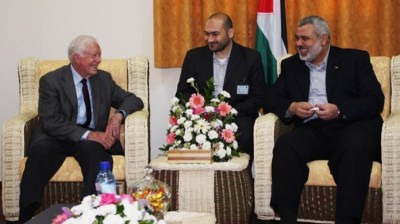
OCCUPIED JERUSALEM – Israel decided not to meet former US President Jimmy Carter and former Norwegian Prime Minister Gro Brundtland when they visit the region over their expected meeting with Hamas leader Ismail Haneyya and over their anti-Israeli views, Yediot Ahranot revealed.
Carter and Brundtlend will arrive on April 30 for a 3-day trip to Israel, the Palestinian Authority territories, and the Gaza Strip. Israel officially decided to boycott Carter’s visit, although it will not prevent him from entering Israel or entering the Gaza Strip through the Erez crossing, the newspaper said.
Israeli president Reuven Rivlin heeded the Foreign Ministry’s advice and decided not to meet former US President Jimmy Carter and former Norwegian Prime Minister Gro Brundtland when they visit the region.
Carter and Brundtland are both members of the Elders, an independent group of global former leaders who work together for peace and human rights. They were brought together in 2007 by Nelson Mandela.
Carter had earlier met with head of Hamas’s political bureau Khaled Mishaal and former Palestinian Prime Minister Ismail Haneyya.
Sources in the Israeli Foreign Ministry said the reason they were boycotting Carter’s visit was because “he consistently helps delegitimize Israel and that any meeting with an Israeli official would only contribute to this process.”
Carter will arrive in the region on an emergency mission, mainly intended to mediate between the Palestinian Authority and Hamas in Gaza, according to the newspaper.
Carter has been vocally critical of Israel in recent years. He has referred to Israeli apartheid numerous times.
The newspaper said that Carter has visited Israel in the last few years, but former Israeli president Shimon Peres would generally meet him even though Carter spent the meetings criticizing the former president’s views.
The Siege – cultural resistance in Palestine
International Solidarity Movement | April 20, 2015
Jenin, Occupied Palestine – The room was overflowing with people who had come to witness the opening of the play The Siege. Pushing our way through the throng we managed to find some seats, squashed in the middle of a diverse and lively audience. We were sitting in the Freedom Theatre, a Palestinian community-based theatre and cultural centre located in Jenin Refugee Camp in the northern part of the West Bank. Started in 2006, the theatre’s aim is to generate cultural resistance through the field of popular culture and art as a catalyst for social change in the occupied Palestinian territories. So, after two months of rehearsals, they were finally ready to show us their eagerly anticipated new play.
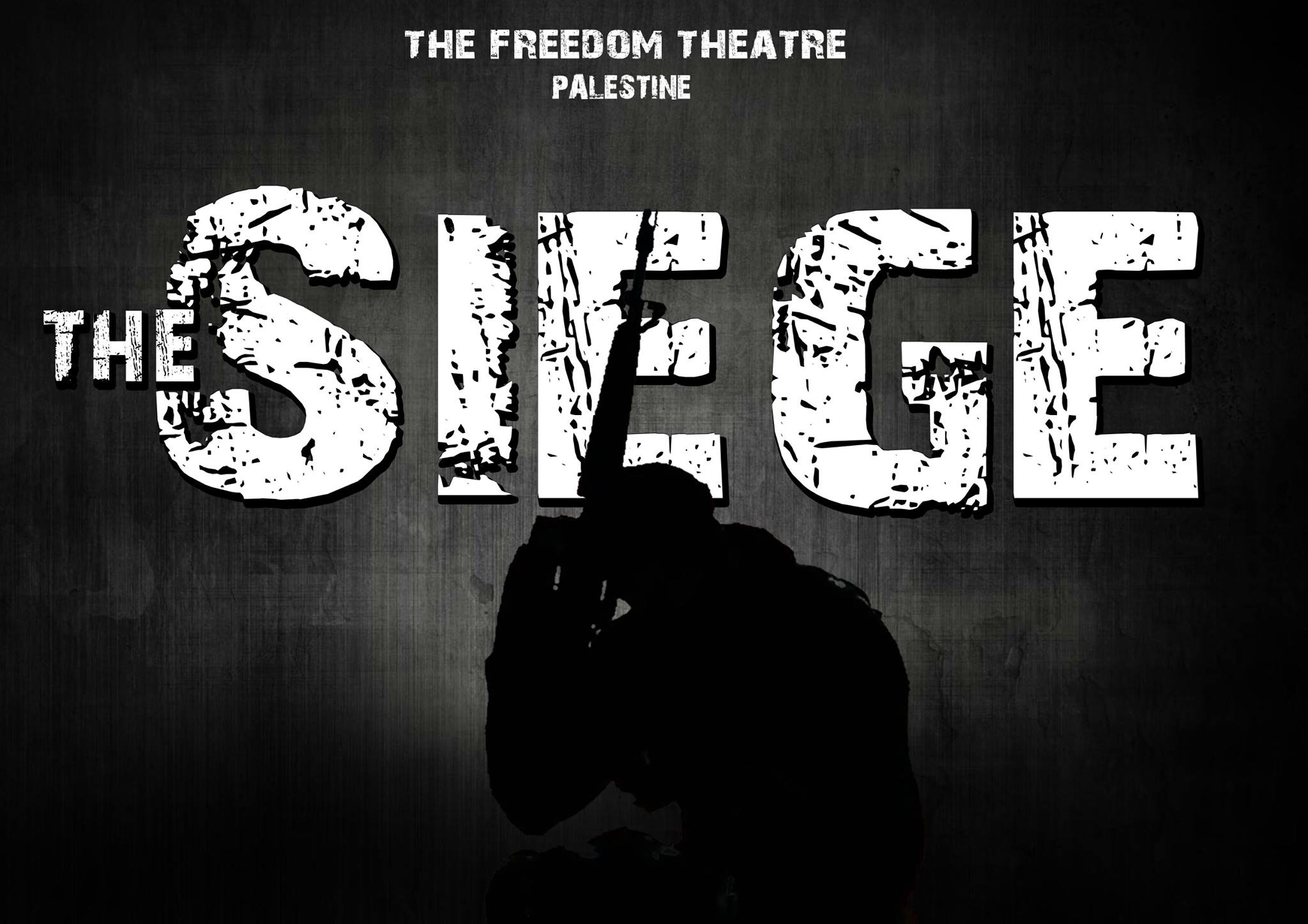
Poster for the play – The Freedom Theatre
The day started off with a theatrical memorial for Juliano Mer-Khamis, one of the founders of the Theatre School who was shot and killed in 2011 by a masked gunman. We then watched Journey of a Freedom Fighter; a documentary that recounts the story of Rabea Turkman, a talented student of the theatre who turned from armed resistance to cultural resistance. He was subsequently shot by the Israeli army and died a few years later as a result of his injuries.
Inspired by the true story of a group of freedom fighters, now exiled across Europe and Gaza, The Siege tells of a moment in history that took place during the height of the second intifada in 2002. The Israeli army had surrounded Bethlehem from the air and on land with snipers, helicopters and tanks, blocking all individuals and goods from coming in or out. For 39 days, people were living under curfew and on rations, with their supply of water cut and little access to electricity. Along with hundreds of other Palestinians, monks, nuns and ten activists from the International Solidarity Movement, these five freedom fighters took refuge in the Church of the Nativity, one of the holiest sites in the world.
The play gives some insight into what it was like to be trapped inside the church, surviving on so little, with the smell of decaying dead bodies in the building, shot by Israeli snipers. It brings out the hard choice they were faced with between surrendering or resisting until the end. However, no matter what they chose, they were given no other option than to leave behind their family and homeland for ever, as all the freedom fighters – in reality 39 – were deported and have not been able to come back since.
The play exceeded all expectations! Everyone seemed amazed by what they had just witnessed. We talked with Osama, a student and a friend from the Freedom Theatre School who was brought up in Al Azzeh refugee camp, in Bethlehem. His words were lost in the power of his emotion. “I would have loved to play in that show!”, he finally managed to share. Only 12 at the time when the tanks entered his city, the show related so much to his childhood and brought back many memories of that time in his life. He recounts how the loud bang, heard at the start of the play, was a reenactment of the shot that had pierced the city’s water tank. This sound is still strongly engrained in his mind as it was the start of the long and difficult days that the inhabitants were about to face. “We are under occupation, but we are not weak. We stand up with what we can, be it our bodies, our voices or our guns!” – Osama believes in armed resistance as one of many ways to fight the occupation. And as an actor, it is important for him to represent these resisters in “another way, a good way. We die because we want to live!”
Alaa Shehada, the assistant director of the play, explained a bit about the making of The Siege. During their research period, they had gone over to Europe and interviewed 13 refugees in order to hear their stories first hand. They even managed to get an interview with one of the 26 refugees in Gaza. He explained how this story is not just about what happened during 2002, but is a microcosm of the whole Palestinian struggle. It reveals the continuous Israeli propaganda that has been going on since 1948, representing the Palestinians as terrorists through false accusations. In this particular situation, the Israeli army blamed the fighters for having attacked the church and holding the monks inside it. This has later been proven to be a lie. The truth being that the monks had allowed the fighters in and they were working together during the whole time of the siege. Ultimately, during the 67 years of Israeli occupation, even with the whole world watching, there has been no justice for the Palestinian people. 50% of Palestinians are refugees from their own country and still have not been given the right to return.
At the Freedom Theatre, Cultural Resistance is their way of defying the occupation. Ahmed Jamil Tobassi, one of the actors from the show, explained that among many other things, theatre creates a context that can support other forms of resistance. It revives stories, gives people a way of expressing themselves and ultimately frees the mind. The idea of cultural resistance is to work alongside other forms of resistance, not against. Yet “if you cannot start by deconstructing the occupation within yourself, how are you going to be able to free the country from the bigger, external occupation?” argues Jonatan Stanczak, managing director of the Theatre.
During the months of May and June, this play will be touring the United Kingdom, a country the theatre group has not yet been too. It is also as a message for the British to take responsibility for their prominent role in the ethnic cleansing of Palestinians and the ongoing occupation.
You can get more information on the dates and the play on the Freedom Theatre UK Friends website: www.thefreedomtheatreukfriends.com
Frida and Jenny.
Leaked emails reveal Hollywood execs at work for Israel
By Alastair Sloan | MEMO | April 20, 2015
Top Hollywood bosses enjoy a strong relationship with the Israeli government and various pro-Israel lobbying groups across the United States, according to a cache of Sony internal emails leaked to Wikileaks and published for the first time last week.
The emails reveal a dinner between Sony executives and Prime Minister Benjamin Netanyahu; the presenter of American X-Factor chiding actress Natalie Portman aggressively for her views on Israel; meetings between top entertainment chiefs and the Israeli consulate-general; close ties between Sony’s Co-Chairperson and various pro-Israel lobbying groups; and film chiefs planning, in detail, a new documentary about the rise of anti-Semitism in Europe, about which the emails also reflect rising concern.
Amy Pascal, Co-Chairperson of Sony Pictures Entertainment from 2006 until 2015, was signed up to regular email updates on the security situation in Israel, from a right-wing pressure group called The Israel Project. The group was described by Jewish Daily Forward in 2010 as a Zionist group which, “Stokes Fear of Islam for Political Profit.” The Israel Project has been admonished by the more liberal pro-Israel lobby group J-Street for taking a pro-settler stance. The daily emails sent to Pascal by The Israel Project had subject lines like “Protect Israel from a Nuclear Iran”, “Fighting Anti-Israel Hate” and “Hamas Agrees to Ceasefire then Breaks It, Again”. Most of the emails, which were being sent as often as once a day, contained requests for financial donations.
Pascal also received an email from the Anti-Defamation League, an anti-Semitism watchdog with close links to the Israeli government, thanking her personally for being amongst eighteen entertainment executives whose names were displayed prominently in an ADL advert in Variety, The Jewish Journal, and The Hollywood Reporter. The advert quoted Golda Meir from 1957: “We can forgive them [the Palestinians] for killing our children. We cannot forgive them for forcing us to kill their children. We will only have peace with them when they love their children more than they hate us.” The quote was prefaced with additional commentary from ADL: “As talk turns to the future of Gaza, these haunting words of Golda Meir are as current as today’s headlines. She could have been talking about Hamas.”
Another leaked email exchange shows Pascal, who has since left Sony, being invited to “an intimate salon style discussion” at a J-Street supporter’s home, in August 2014. The email emphasised that a special guest would be in attendance, J-Street President Jeremy Ben-Ami. Pascal declined the invitation as she was on holiday in Vietnam, but responded, “I’m in for next steps and want to know how to get myself educated [sic].” J-Street bills itself as a “Pro-Israel, Pro-Peace” organisation and is regarded as the liberal element of the US pro-Israel lobby.
Another email that Pascal received and responded to shows an organisation called Creative Community for Peace, “a group of influential music execs… which battles the BDS movement… which tries to stop artists performing in Israel” reminding Pascal that they had taken her and her husband on a trip to Israel back in 2007.
“At that time,” wrote David Lonner, a top Hollywood executive and Advisory Board Member for CCP, “the war with Hezbollah had just ended and our community had exhibited a great deal of apathy and some ignorance on what Israel was up against.” Lonner added: “My hope in the end, was that if there was another crisis, we would not be silent. 7 years have passed since our trip and tragically we are in another crisis with Hamas.”
Lonner than claimed that CCP worked with Rihanna, Paul McCartney and Alicia Keys when international pressure nearly prevented them from playing concerts in Israel. The email asked for Pascal’s and her husband’s signatures on another appeal, this time to “support Israel” during the Toronto Film Festival. Pascal replied to the email, “Count on both us.” [sic]
Pascal and her husband Bernard Weintraub also received a personal invitation to attend a private event in September last year with the Israeli Consul-General, according to another email in the leaked archive. Held at the home of media lawyer and marketing tycoon Michael Kassan, the event was billed as “A Special Briefing on the Situation in Israel by David Siegel, Consul General of Israel in Los Angeles, and Jay Sanderson, President and CEO of The Jewish Federation of Greater Los Angeles.” The evening included “cocktails and hors d’oeuvres,” and guests were advised to wear “Business Casual Attire.”
Another top Sony executive, Michael Lynton, was also emailed by Israeli intelligence operative and veteran film producer Arnon Milchan, arranging for him to have an “intimate dinner” with Prime Minister Benjamin Netanyahu. The dinner was later held at Milchan’s private home in Malibu.
One of the most extraordinary exchanges in the leaked emails came as Hollywood executives discussed Ken Loach’s call for “a complete cultural boycott of Israel”. “Enough with this pathetic limousine liberals ignorant bs,” responded Ben Silverman, Executive Producer of hit shows like The Office, Ugly Betty and The Tudors.
Silverman then claimed that Gazans watching Loach’s films will “be lined up and shot in the street for doing so.” He asserted that anyone
“with a wife, daughter, mother or sister knows the evil anti woman rhetoric of the sharia Islamists and it is time to draw attention to the fact that you can have a voice and a choice in our democracies and you can have nothing but hate in their monarchies and dictatorships who thrive on censorship that would never allow their works to be shown. Let’s go gents. We can’t lie down. We must stand up.”
Hollywood star Natalie Portman is copied on the email. She complained that she doesn’t want her personal email address shared with a group of people she doesn’t know. Ryan Kavanaugh, a well-known producer, reported billionaire and Variety magazine’s 2011 “Showman of the Year,” then reproached her sarcastically.
“Sorry. You are right jews being slaughtered for their beliefs and cannes members calling for the boycott of anything Israel or Jewish is much much less important than your email address being shared with 20 of our peers who are trying to make a difference. my deepest apologies.
I know that you don’t care so I’ll leave it alone, but I had lunch yesterday with Israel consulate general who brought J street up to me. He was so perplexed confused and concerned when he heard you supported them that he begged me to connect you two. I told him how you felt, you didn’t want to hear from or speak to anyone who disagrees with your position. Three times he said “buts she’s Jewish and smart.”
Just thought you should know”
In another round-robin email, Hollywood executives discussed making a documentary about the recent resurgence in anti-Semitism. The well-respected independent film producer and agent Cassian Elwes suggested,
“How about we all club together and make a documentary about the rise of new anti-Semitism in Europe I would be willing to contribute and put time into it if others here would do the same. Between all of us I’m sure we could figure out a way to distribute it and get it into places like Cannes so we could have a response to guys like Loach. Perhaps we try to use it to rally support from film communities in Europe to help us distribute it there.”
Copied in on the email are dozens of Hollywood names, including Natalie Portman and fellow actress Scarlett Johansson, executives at Lionsgate Productions, MGM and Fox, X-Factor presenter and producer of “Keeping up with the Kardashians” Ryan Seacrest, and several high profile actors’ agents. One unidentified executive called the proposed documentary “A brilliant idea.” Also copied is Amy Pascal of Sony, who writes “Me too,” in response.
Jason Binn, the owner of luxury shopping website Gilt, then offered to promote the film to its nine million members and the three million readers of his luxury magazine DuJour.
Glenn Feig, owner of the entertainment law firm Reder and Feig, offered pro bono legal services for the planned documentary, before copying in his client Ram Bergman, producer of the upcoming Star Wars Episode VIII and Star Wars Episode IX, and the thriller Looper, which starred A-Listers Bruce Willis, Emily Blunt and Joseph Gordon-Levitt.
Also copied in on the email discussion about the upcoming film is Elliot Brandt, who was named in September 2014 as National Managing Director for the America Israel Public Affairs Committee (AIPAC), a pro-Israel lobbying and political financing organisation. The emails reveal anxiety amongst the predominantly Jewish film executives regarding the rise of anti-Semitism.
One round-robin email, sent out by Bart Rosenblatt of Code Entertainment, is entitled “Too close to home.” It details a hate crime at Emory University in October 2014 in which swastikas were scrawled onto a Jewish fraternity house. Executives also emailed each other articles from The Guardian newspaper saying that anti-Semitism “was at its worse since the Nazis”, and an article claiming that Germany is now a no-go area for Jews.
Producer Ryan Kavanaugh wrote
“We can continue to be silent and pretend this isn’t happening because it is not in our country yet. We can ignore the anti-Semitism akin to pre ww2 Germany… now lining the streets of London, France, Germany and around the world. We all may think we’re protected here in the free US. We are not. It had now hit our doorstep and yet we remain silent?”
Another producer, Ron Rotholz, argued that
“many lines are being crossed … it’s a new reality for us. The tacit and subtle recognition of Hamas as a legitimate government with legitimate policies and a legitimate charter, by Western governments is a hate crime on a global scale”
Rotholz also called out the UK’s National Union of Students:
“In the UK as you well know there has been a shocking rise in anti-Israel and anti-Semitism on university campuses here, both in terms of faculty and students and student orgs such as the potent and powerful NUS ( Natl Union of Students which holds great weight within the natl. Labour Party ).
The NUS has a long history of anti-Israel leadership and policy and their rhetoric and policies have become much more aggressive in the last year or so … The intimidation of Jewish students, and those who support Israel in UK universities both by administrators, faculty and students is widespread, commonplace and alarming … it’s a dire situation and quite shocking in a nation which prides itself on tolerance and civility.”
Those working on the anti-Semitism documentary also discussed who should present the film. One producer said that the project would need “a really good director who on the face of it doesn’t seem completely biased, so that we can show something that gets the message across without making it seem like propaganda.”
Organisers also planned to lean heavily on European institutions to make the film, anticipating good support. One executive wrote,
“I think we will get full cooperation from the impt media in europe, the eu, the current conservative govt. in the uk, the current govt in france, angela merkel in germany, many academics ( def at Oxford, Cambridge, LSE ) and of course, major jewish orgs in the uk france germany and in most eu countries … This documentary is an essential tool for spreading our message.”
Hollywood has often been accused being the propaganda arm of the Israeli government. These leaked emails appear to confirm that this is indeed the case.
Please follow on Twitter @AlastairSloan for more updates.
Report: Israel Willfully Targeted & Murdered Gaza Children

IMEMC | April 20, 2015
A new report by Defense for Children International-Palestine, titled “Operation Protective Edge: A War Waged On Gaza’s Children”, has displayed documented events proving that that Israel deliberately murdered Palestinian children during its last offensive on the Gaza Strip, this past summer.
According to the report, the number of children killed in the offensive on Gaza last summer hit 535, a majority of them under the age 12. Another 3,400 children were injured – over 1,000 maimed for life. They need vital medical care which is unavailable because of Israel’s lawless siege – ongoing aggression by any standard with full US-led Western support.
Operation Protective Edge was the sixth Israeli military offensive on Gaza in the past eight years, and raised the number of children killed in assaults on Gaza to 1,097 since 2006, the Palestinian News Network informs. Between December 2008 and January 2009 Israeli forces killed at least 353 children, as well as a further 33 children in November 2012.
According to the report, Israel considers all civilians legitimate targets. However, international law defines this as a war crime.
DCIP’s report said that “2014 was a year that brought violence, fear and loss (to Gaza).” The Israeli military offensive” lasting 51 days from early July to late August killed about 530 Palestinian children. Nearly 3,400 other children were wounded – many from illegal terror weapons. Over 2,200 Palestinians died – mostly defenseless civilians.
“Investigations undertaken by (DCIP) into Palestinian child fatalities during Operation Protective Edge found overwhelming and repeated evidence of international humanitarian law violations committed by Israeli forces. These included direct attacks on children, and indiscriminate and disproportionate attacks on civilian homes, schools, and residential neighborhoods.”
The report included stories and testimonies from witnesses of the war in Gaza, documenting targeting places that should have been provided children with shelter and safety were not immune from attacks from Israeli forces.
“Missiles fired from Israeli drones and warplanes, artillery shelling, and shrapnel scattered by explosions killed children in their homes, on the street as they fled from attacks with their families, and as they sought shelter from the bombardment in schools.”
One of many examples affected Rawya Joudeh and four of her five children. An Israeli drone attack murdered them in cold blood – “as they played together” in the family’s Jabalia refugee camp yard.
Around half the number of children Israel killed came from attacks on residential buildings. A nighttime and ground assault on the residential Gaza City Shuja’eyya neighborhood killed 27 children. It injured at least 29 others.
The report stated that Israeli occupation forces are “regularly implicated in serious, systematic and institutionalized human rights violations against Palestinian children living in the Occupied Palestinian Territory.”
The report looked back at the Israeli military offensive known as Operation Summer Rains, between June 28 and September 30, 2006, around “289 Palestinians were killed, of whom 65 per cent were children, and over 1,261 injured in the Gaza Strip, of whom 189 were children.”
Results show that Israeli military “incursions and shelling as well as direct military attacks have damaged school and health facilities.” Nearly eight years later, by simply updating the figures in these statements, the same language could be used in the Secretary-General’s next annual report to detail the situation for Palestinian children in 2015.
Evidence of Israel’s high crimes in the report was completely overwhelming. It shows repetitive unaccounted aggression against Palestinian children.
DCIP called for an immediate end to the current regime of collective punishment, targeted assassinations, and regular military offensives.
Defense for Children International Palestine is an independent, local Palestinian child rights organization based in Ramallah dedicated to defending and promoting the rights of children living in the West Bank, including East Jerusalem, and the Gaza Strip. For over 20 years, DCIP investigated, documented and exposed grave human rights violations against children; held Israeli and Palestinian authorities accountable to universal human rights principles; and advocated at the international and national levels to advance access to justice and protection for children. They also provide direct legal aid to children in distress.
Israeli court brings 12 charges against MP Khalida Jerrar
Ma’an – 18/04/2015
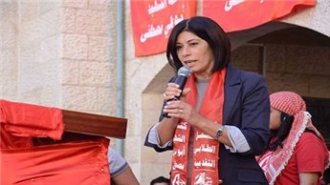
BETHLEHEM – An Israeli military court has brought 12 charges against Palestinian lawmaker Khalida Jerrar in connection to her membership of the Popular Front for the Liberation of Palestine, an international rights group said.
Having been detained and interrogated since Apr. 2, Jerrar was charged by the Israeli military prosecution on Wednesday, according to a report released Friday by Amnesty International.
Charges included membership of an illegal organization, participation in protests, and incitement to kidnap Israeli soldiers.
A review of the charges against her will take place on Apr. 29, the report said.
Jerrar’s defense team argued there was no basis to the incitement charge and that it was vindictive, according to Amnesty’s report.
The majority of Palestinian political organizations are considered illegal by Israel, including those that make up the PLO, and association with such parties is often used as grounds for imprisonment, according to prisoners’ rights group Addameer.
Jerrar was elected to the Palestinian Legislative Council in 2006 as a member of PFLP.
Jerrar was detained on Apr. 2 from her home in the Ramallah neighborhood of al-Bireh, and was afterwards held and interrogated at the Ofer detention center. She was later taken to Hasharon prison inside Israel.
An Israeli army spokeswoman told Ma’an that Jerrar had been detained for being the leader of a “terrorist organization,” and had encouraged “terror activities” in the previous few weeks.
The arrest also came after Jerrar refused a deportation order from Israeli authorities in August, demanding that she leave the Ramallah district for Jericho.
‘A symbol of resistance’
Jerrar has been targeted by Israeli authorities throughout her life, although Wednesday was the first time the lawmaker had been officially charged by Israeli military courts.
Palestinian factions have decried the arrest, with one PLO committee saying it was “an outrageous violation of her parliamentary immunity.”
Legislative Council lawmaker Jamil al-Majdalawi said: “Israel does not lose a chance to attempt to break the resistance’s will, the people’s resistance and their leadership symbols, and Khalida Jarrar is one of those symbols of resistance.”
In February, Jerrar joined the Palestinian committee in charge of conducting an International Criminal Court investigation into Israeli war crimes and crimes against humanity.
She is also vice-chair of prisoners’ rights group Addameer.
Until the charges against her on Wednesday, Jerrar had been held in Israeli prisons under administrative detention.
Palestinians held in administrative detention are often held without charge or trial for months and without access to the evidence that led to their detention, even though international law stipulates this tactic only be used in exceptional circumstances.
Israeli prisons currently hold 14 members of the PLC, eight of them in administrative detention
GOP presidential hopeful ratchets up anti-Iran rhetoric, seeks military action
Press TV – April 18, 2015
US Republican presidential hopefuls have ratcheted up their rhetoric against Tehran and denounced the Obama administration’s efforts to reach an agreement with Iran over its nuclear energy program, with Senator Marco Rubio calling on Washington to bomb Iran’s nuclear infrastructure.
Rubio, the first-term senator from Florida a candidate for the 2016 presidential elections, told participants at a Republican Party reception in New Hampshire on Friday that the world, particularly the Middle East, is in chaos because of President Barack Obama’s policies.
The Cuban American politician, known as an ultimate opportunist within the party, warned of a coming terrorist attack on US soil and even raised the specter of Iranian missiles striking the United States.
“We may have to decide at some point what is worse: a military strike against Iran or a nuclear-armed Iran,” the 43-year-old said during a question-and-answer session.
“I am not cheerleading for war. I don’t want there to be the need to use military force, but a nuclear Iran is an unacceptable risk for the region and the world,” he added.
He went on to say that “Iran is developing long-range rockets that will at some point, in less than a decade, be capable of reaching the East Coast of the United States.”
Iran and P5+1 group of countries – the US, Britain, France, China, Russia and Germany – reached a mutual understanding on Tehran’s nuclear program on April 2 in Switzerland. The two sides are expected to start drafting a final deal which they seek to sign by the end of June.
If a final deal is reached, it would lift all international sanctions imposed against the Islamic Republic in exchange for certain steps Tehran will take with regard to its nuclear program.
Rightwing elements in the Republican Party along with Israeli Prime Minister Benjamin Netanyahu and some of their allies accuse Iran of pursuing military objectives in its civilian nuclear program.
Iran rejects the allegation, arguing that as a committed signatory to the nuclear Non-Proliferation Treaty (NPT) and a member of the International Atomic Energy Agency (IAEA), it has the right to use nuclear technology for peaceful purposes.
Rubio, who has recently emerged as one the strong supporters of Israel in the Senate, said earlier this week that the United States must abandon the Obama administration’s drive to reach a comprehensive agreement with Iran, and renew its commitment to Israel and strengthen the military.
“If America accepts the mantle of global leadership… then our nation will be safer, the world more stable, and our people more prosperous,” Rubio said.
Hands Off The Lancet
WRITING GROUP:
Professor Graham Watt MD FRCGP FRSE FMedSci, Professor of General Practice, University of Glasgow, UK
Sir Iain Chalmers DSc FFPH FRCP Edin FRCP FMedSci, Coordinator, James Lind Initiative, Oxford, UK
Professor Rita Giacaman, PharmD, MPhil, Professor of Public Health, Birzeit University, occupied Palestinian territory
Professor Mads Gilbert MD PhD, Professor of Emergency Medicine, University of Tromsø, Norway
Professor John S Yudkin MD FRCP, Emeritus Professor of Medicine, University College London, UK
Introduction
On 31 March 2015, 396 professors and doctors, led by Professor Sir Mark Pepys, submitted a complaint to the Senior Management and Board of Reed Elsevier concerning “egregious editorial misconduct at The Lancet that is unacceptable in general and also gravely violates your own published Editorial Policies”.
The signatories include 5 Nobel laureates, 4 knights and a Lord. 193 (49%) of the signatories are from the US, 95 (24%) from Israel, 33 (8%) from the UK, 26 from France, 19 from Canada, 12 from Australia with smaller numbers from Belgium (3), Brazil (3), Italy (2), Denmark (2), Mexico (1), Panama (1), South Africa (1), Sweden (1) and Switzerland (1).
The complaint makes brief mention of The Lancet’s publication of the paper by Wakefield, linking MMR vaccine to autism, which was shown subsequently to be fraudulent, but is chiefly concerned with The Lancet Editor-in-Chief, Richard Horton, and his alleged “persistent and inappropriate misuse of The Lancet to mount a sustained political vendetta concerning the Israel-Palestinian conflict, to promote his own well known personal political agenda”.
The centre of the complaint concerns “An open letter for the people of Gaza” by Manduca and 23 others, which was published online by The Lancet on 22nd July and in hard copy on 2nd August 2014, 14 days into “Operation Protective Edge”, Israel’s 50 day attack on Gaza.
The complainants consider that this letter, and The Lancet’s handling of the controversy it aroused, breached both the Journal’s own policies and the Code of Conduct and Best Practice Guidelines for Journal Editors issues by the Committee on Publication Ethics (COPE).
The complaint ends by requiring “Reed Elsevier to behave ethically by retracting the Manduca letter, apologizing for its publication and ensuring that any further editorial malpractice at The Lancet is prevented”.
Chronology of events
8 July 2014
Israel began a major military assault on the Gaza Strip, the fourth in eight years. It lasted 50 days and was more devastating than previous offensives. 2,220 Gaza residents were killed, of whom at least 70% were civilians, including over 500 children. More than 17,000 residents were wounded and over 100,000 made homeless (UN OCHAopt, 2014). According to Israeli official accounts, 73 Israelis were killed: 67 soldiers and 6 civilians, including one child and one migrant worker. 469 Israeli soldiers and 255 civilians were wounded (Bachmann et al. 2014).
15-22 July 2014
A report cited by the Sunday Telegraph newspaper records that 125 children were killed during the week 15-22 July 2014, including 59 on 20th July.
22 July 2014
On the 14th day of Israel’s 50-day assault ‘An open letter for the people in Gaza’, co-authored by 24 signatories from Italy, the UK and Norway, was published by the medical journal The Lancet, initially online and subsequently in print (Manduca et al. 2014a). One of the signatories provided eyewitness accounts of the medical consequences for the civilian population, while working clinically at the largest trauma centre in Gaza during the first weeks of the assault. The letter was endorsed online by more than 20,000 signatories.
9 and 16 August 2014
The Lancet published 20 letters in hard copy editions, divided equally between authors criticising and supporting the Open Letter. Some correspondents declared that medicine “should not take sides” and that those who speak out against the consequences of war for civilians incited hate or introduced politics “where there is no place for it” (see, for example, Konikoff et al. 2014). Others described the letter as “anti-Jewish bigotry, pure and simple” (Marmor et al. 2014), although at least one of the authors of the ‘Open Letter’ was Jewish, and the word “Jewish” did not appear in the letter. Similar charges were made in the lay press, both within Israel and elsewhere (see Simons 2014, for example).
One of the letters published in response to the ‘Open Letter’ was co-authored by seven Jewish health professionals in South Africa (London et al. 2014). They suggested that “remaining neutral in the face of injustice is the hallmark of a lack of ethical engagement typical of docile populations under fascism”. They had witnessed and exposed some of the worst excesses of state brutality under apartheid, and had been harassed, victimised or detained for being anti-apartheid activists. They pointed out that they did not have the opportunity to air their views in their national medical journal, which suppressed public statements made by concerned health professionals and labelled such appeals for justice and human rights as ‘political’.
They expressed support for The Lancet’s decision to permit a discussion of the professional, ethical, and human rights implications of the conflict in Gaza, emphasizing that it is appropriate for health professionals to speak out on matters that are core to their professional values.
30 August 2014
After 20 responses to the ‘Open Letter’ had been published, its authors accepted The Lancet’s invitation to reply (Manduca et al. 2014b). They denied any financial conflicts of interests, as had been alleged, and listed the variety of experiences and affiliations that had led to their support for Palestinian society.
They noted that the allegations by the Ministry of Health in Gaza that gas had been used by the Israeli military would need to be tested by an independent Commission of Inquiry set up by the UN Human Rights Council. They ended by recalling the context in which they had written their letter: during the preceding two days one Palestinian child was being killed, on average, every two hours, and the UN had made clear how serious the situation had become:
“The huge loss of civilian life, alongside credible reports about civilians or civilian objects (including homes) which have been directly hit by Israeli shelling, in circumstances where there was no rocket fire or armed group activity in the close vicinity, raise concerns about the principles of distinction and proportionality under international law.” (OCHA oPt 2014)
22 September 2014
Some were dissatisfied with The Lancet’s handling of the Open Letter. Two medical academics at University College London registered complaints with The Lancet Ombudsman (Simons 2014). One of them, Professor Sir Mark Pepys, was quoted in The Telegraph as having written that “The failure of the Manduca et al. authors to disclose their extraordinary conflicts of interest… are the most serious, unprofessional and unethical errors…The transparent effort to conceal this vicious and substantially mendacious partisan political diatribe as an innocent humanitarian appeal has no place in any serious publication, let alone a professional medical journal, and would disgrace even the lowest of the gutter press.”
Pepys suggested that the behaviour of Dr Horton, editor of The Lancet, was “consistent with his longstanding and wholly inappropriate use of The Lancet as a vehicle for his own extreme political views, which had greatly detracted from the former high standing of the journal.” (quoted in Simons 2014).
The article in The Telegraph also alleged that two of the authors of the Open letter – one of them Chinese – have sympathies with the views of “an American white supremacist” (Simons, 2014), following the mistaken forwarding of emails, for which both individuals subsequently apologised.
When one of the authors of the ‘Open Letter’, the Norwegian doctor Mads Gilbert, who has worked clinically in Gaza during every Israeli assault on the Strip since 2006, was voted “Norwegian Name of the Year” in a national poll in December 2014, Pepys and eight other doctors wrote to the largest Norwegian newspaper, VG, to complain about his silence on the ‘loathsome hatred and racism’ of his co-authors. They asked for his national award to be reconsidered (Cohn et al. 2015).
17 October 2014
The Lancet Ombudsman published her report online on 17 October (Wedzicha, 2014). She said that she had received many emails and letters, some supporting and others opposing the position expressed in the ‘Open Letter’, and that some of them had been inappropriate in tone and of a personal nature. She stated that it was “entirely proper that medical journals and other media should seek to guide and reflect debate on matters relevant to health, including conflicts”.
She was not persuaded by calls for retraction of the ‘Open Letter’, “I do not believe that sufficient grounds for retraction have been established, and this would make other letters referring to the publication in question difficult to interpret”.
The Ombudsman went on to address allegations of bias among the authors of the ‘Open Letter’. “Given the shocking images and statistics reported from Gaza at the time, the use by Manduca and colleagues of emotive language, in description of the ‘massacre in Gaza’ for example, can be understood. Where the letter is less successful is in its portrayal of the armed element of the conflict on the Palestinian side. Given the authors’ close association with the region they will have been aware that several thousand potentially lethal rockets and mortars were fired from Gaza into Israel during the conflict, leading to loss of life.”
The authors were criticised for not having disclosed at the time of submission “any financial or other relationships that could be perceived to affect their work”, and she indicated that she would be asking the journal’s editors to put a policy in place as soon as possible to rectify this. The Ombudsman criticised the authors for not referencing in their original letter the source for their statement about the possible use of gas in Gaza.
The Ombudsman’s most serious criticism of the letter was the “regrettable statement” that, because only 5% of Israeli academics had supported an appeal to the Israeli government to stop the military operation in Gaza (Gur-Arieh 2014), the authors had been “tempted to conclude that…the rest of the Israeli academics [had been] complicit in the massacre and destruction of Gaza”.
“In summary”, the Ombudsman concluded, “the letter by Manduca and co-authors was published at a time of great tension, violence and loss of life. Given these circumstances the letter’s shortcomings can be understood, as a measure of balance has been achieved by the publication of further letters from both sides of the debate.”
3 November 2014
The Ombudsman’s decision to reject calls for the letter to be withdrawn from the public record was supported by Dr Richard Smith, former editor of the British Medical Journal, former chair of COPE and author of COPE’s Code of Conduct for Editors (Smith 2014): The Lancet letter was “passionate, overstated in parts, inflammatory to some, and one sided; and the authors failed to declare competing interests and two of them had acted in an objectionable but not illegal way. But none of these are grounds for retraction.”
He ended his commentary on an historical note:
“The Lancet was made the great journal it is by Thomas Wakley, the founder and first editor, publishing articles that were so inflammatory that his critics burnt his house down. That radical tradition has not always shone brightly in the nearly 200 years since, but Horton has restored it strongly, establishing the Lancet as a world leader in global health, speaking truth to power and giving a voice to those who are not heard (like the children of Gaza). It’s against that radical tradition and leadership that the Gaza open letter must be viewed. It should and has been disputed, but it shouldn’t be retracted.”
Contrasting views of journal editors
Editors have disagreed on whether political issues should be addressed in scientific journals.
For example, the American Diabetes Association issued a statement, signed by several editors of leading diabetes and endocrine journals, indicating that they “will refrain from publishing articles addressing political issues that are outside of either research funding or health care delivery” (American Diabetes Association 2014).
In response, a commentary signed by the current and two previous editors-in-chief of the European Journal of Public Health, one of whom has longstanding and very extensive collaborations with Israeli colleagues (McKee et al. 2015), voiced strong support for The Lancet, arguing that medical journals cannot ignore the political determinants of health, including those arising from conflicts. They noted, “It seems strange that it was the diabetes community that feels it necessary to take this decision,” noting how the global epidemic of diabetes, fuelled by forcing markets open to energy-dense food, reflects a policy identified primarily with Republicans rather than Democrats in the United States.
Following the Ombudsman’s Report
Soon after Israel’s 2014 assault, Physicians for Human Rights-Israel (PHR-Israel) assembled a medical fact-finding mission (FFM) of 8 international medical experts, unaffiliated with Israeli or Palestinian parties. Four had expertise in the fields of forensic medicine and pathology; four others were experts in emergency medicine, public health, paediatrics and paediatric intensive care, and health and human rights. The FFM made three visits to Gaza between 18 August and November, 2014.
The principal conclusion in the report of the FFM (Bachmann et al. 2014) is as follows: The attacks were characterised by heavy and unpredictable bombardments of civilian neighbourhoods in a manner that failed to discriminate between legitimate targets and protected populations and caused widespread destruction of homes and civilian property. Such indiscriminate attacks, by aircraft, drones, artillery, tanks and gunships, were unlikely to have been the result of decisions made by individual soldiers or commanders; they must have entailed approval from top-level decision-makers in the Israeli military and/or government.
The FFM (pp 98-99) listed many examples “suggestive of several serious violations of human rights and international humanitarian law”, including disproportionality, attacks on medical teams and facilities, and denial of means of escape. They also reported (pp 53-55) evidence which suggested the use of anti-personnel weapons and gas during the conflict.
These accusations have also been made in reports by Amnesty International (Amnesty, 2014), Human Rights Watch (Human Rights Watch, 2014), B’Tselem (B’Tselem – The Israeli Information Centre for Human Rights in the Occupied Territories, 2015) and the United Nations (OCHA, 2014, 2015).
The FFM called on the UN, the EU, the US and other international actors to take steps to ensure that the governments of Israel and Egypt permit and facilitate the entry of investigative teams into Gaza, including experts in international human rights law and arms experts, and noted (in January 2015) that this had still not been done, months after the offensive. Specifically, the UN Commission of Inquiry has been denied entry to Israel, the West Bank and Gaza (See: United Nations Independent Commission of Inquiry on the 2014 Gaza Conflict).
The FFM recommended further urgent and rigorous investigation into the impact of this war, as well as the previous armed conflicts, on public health, mental health and the broader social determinants of health in Gaza, adding that, in its assessment, the implacable effects of the on-going occupation itself would have to be taken into account.
There have been subsequent accusations by Amnesty International of war crimes committed by both sides of the conflict (BBC 2014; Linfield 2015).
Further calls for retraction of the Open Letter
Dissatisfied with the Ombudsman’s report, critics of the Open letter continued to call for it to be withdrawn and for The Lancet editor to apologise for publishing it. In a new development, the authors of the Open letter, and the journal, are being accused of being anti-Semitic. The current complaint to Reed Elsevier now refers to the Open Letter as “stereotypical extremist hate propaganda, under the selective and hypocritical disguise of medical concern”. On 24 February 2015, its lead author Professor Sir Mark Pepys wrote to 58 Israeli academics (Pepys, 2015):
The Lancet under the editorship of Richard Horton has published, for more than the past 10 years, many disgracefully dishonest and unacceptable articles about Israel. Horton has made no secret of the fact that these pieces express his own very strongly held personal views which he has published elsewhere in detail.
Last July, at the height of the Gaza war, The Lancet published a piece by Manduca and others which was at an unprecedentedly low level. It combines outright lies and slanted propaganda viciously attacking Israel with blood libels echoing those used for a thousand years to create anti-Semitic pogroms. It completely omitted the Hamas war crimes which initiated and sustained the conflict. There was no historical or political background. Crucially there was no mention of any conflict of interest among the authors despite the fact that Manduca and all the co-authors have long participated enthusiastically in not just anti-Israel but frankly Jew hating activities. All these individuals are close colleagues and collaborators of Horton.
Many of us have been trying as hard as we can since the Manduca publication to get it retracted, to get an apology for it and to convince Elsevier, the owners of The Lancet to both sanction Horton and to prevent any repetition of such shameful and unacceptable behaviour. So far there has been no satisfactory response. Indeed Horton continues to stand by the Manduca piece and refuses to accept that it is not factual and correct.
The goal of the attached protest to Elsevier document is to get the [‘Open letter’] retracted. I hope that all of you will sign it. Meanwhile colleagues at the Rambam Hospital have, as you know, invited Horton to Israel and shown him the reality of Israeli medicine, as opposed to the vicious anti-Semitic fantasy he has promoted. They have engaged in long discussions with him. Despite his refusal to either retract or apologise for his publications some colleagues are apparently convinced that Horton has reformed. Others, including Professor Peretz Lavie, the President of the Technion, who met with him for one and a half hours, were unconvinced by Horton’s presumed change of heart.
My view is that the Manduca piece was written by dedicated Jew haters, though some choose to mask this by being overtly passionate only about hating Israel. But they all agree that a Zionist/Jewish lobby or power group controls the world and its destiny and must be brought down. The Manduca piece would have made Goebbels proud and Streicher would have published it in Der Stürmer as happily as Horton published it in The Lancet…… anybody who was not a committed anti-Semite would firstly not have published (the Open letter), and secondly would have retracted instantly when the first author’s long track record of blatant anti-Semitism were exposed. In Horton’s case he already knew and liked her and her co-authors well, fully aware of all their vicious anti-Israel and frank, overtly anti-Semitic backgrounds.
Pepys’ text was distributed widely beyond the Israelis to whom the initial text had been sent, including, on 30 March, to over 150 academics with the subject line amended to:
‘DO NOT CITE The Lancet in your work – Their content includes fraudulent data’ (Lewis 2015).
As a result of this correspondence, 396 people have co-signed the complaint, including the statement “The collaboration of the academic community with Reed Elsevier and its journals is based on trust in their maintaining high ethical and scientific standards. None of us is under any obligation to submit and review material for publication in their journals or to serve on their editorial or advisory boards”.
The long history of pro-Israel suppression of medical freedom of expression
The heavy-handed escalation of the dispute and the use of ad personam charges of anti-Semitism to suppress freedom of expression in medical journals are not new.
In 1981, a short article in World Medicine informed medical readers who were considering attending the ‘medical olympics’ in Israel that the event was going to be held on the site of a massacre ordered by the then prime minister of Israel (Sabbagh 1981). The pro-Israel protest led eventually to the demise of the journal (O’Donnell 2009).
In 2001, pro-Israel objections to the historical background in an article on ‘The origins of Palestinians and their genetic relatedness with other Mediterranean populations’ published in Human Immunology (Arnaiz-Villena et al. 2001) led Elsevier to remove it from the public record.
In 2004, an article entitled ‘Poverty, stress and unmet needs: life with diabetes in the Gaza Strip’ (Tsapogas 2004) published in Diabetes Voice was expunged from the public record and the editor resigned, again because of charges of political bias.
In 2004, there was an outcry from pro-Israel doctors when the British Medical Journal published a personal view entitled ‘Palestine: the assault on health and other war crimes’ (Summerfield 2004). The editor received nearly a thousand emails, many of them personally abusive and alleging anti-Semitism (Sabbagh 2009).
In 2009, commenting on several British Medical Journal papers exposing and discussing these issues, a senior British Medical Journal editor concluded that authors, editors, publishers, advertisers, and shareholders should ignore orchestrated email campaigns (Delamothe 2009). Citing another editor he suggested that the best way to blunt the effectiveness of this type of bullying is to expose it to public scrutiny.
Conclusion
The “Open letter to the People of Gaza” was written in deep concern and outrage during a military assault on the Gaza Strip, killing large numbers of civilians, including women and children, on a daily basis. The world was shocked and appalled. The content and tone of the letter were controversial, as shown by subsequent correspondence in The Lancet, for and against.
The Lancet Ombudsman criticised aspects of the letter but neither she nor a former Chair of COPE considered that it should be withdrawn.
The involvement of 396 senior researchers in a mass effort to force Reed Elsevier to withdraw the letter is the latest in a series of heavy-handed interventions to stifle media coverage of the Israel-Palestine issue and should be resisted.
Richard Horton should be supported as an exceptional editor of The Lancet, in the best traditions of the Journal.
The “unfinished business” of Operation Protective Edge is not whether the “Open Letter to the People of Gaza” should be retracted, but in the light of reports by Physicians for Human Rights-Israel, Amnesty International, Human Rights Watch, the United Nations and others, to determine whether and by whom, from either side of the conflict, violations of international human rights and humanitarian law were committed.
Will the 396 signatories of the complaint to Reed Elsevier give their support to that objective?
~
References and Supporting Signatories available at source.
If you wish to communicate with the Writing Group please email HandsOffTheLancet@Gmail.Com
If you wish to add your name to this list of supporting signatories please use the form here
Featured Video

Iran’s Next Strike May Not Explode. It Could Shut You Down
or go to
Aletho News Archives – Video-Images
Book Review
New paperback: Butchered by “Healthcare”
Lies are Unbekoming | October 20, 2026
 Butchered by “Healthcare” is Robert Yoho’s plain-spoken account of how American medicine stopped being a profession and became an industry. 341 pages. Over a thousand references. Thirty-eight chapters.
“Screening Tests Are Useless”, on tests that find diseases that would never have hurt you. “The FDA Protects the Big Drug Companies”, on an agency funded by the companies it regulates. “The Journals’ Sins Are the Editors’ Sins”, on ghostwritten studies and captured peer review. “Opioids and ‘Pain Management’”, on how a generation was prescribed its way into addiction. “Prozac and Relatives” and “Antipsychotics Are Disastrous”, on what psychiatry does to adults and children. “Surgery: Money Before Patients”. “Failed Cancer Treatments”. “Futile CPR and Overprescribing”. “Billing Scams & Specialty Warfare”. “Hospitals Are Sharks”. Each with a Patient Tips section at the end on how to survive it.
If you have ever walked out of a doctor’s office with a prescription you didn’t ask for, or watched a parent put through a treatment that made them worse, this is the book you want on your shelf before the next appointment. … Full review
Butchered by “Healthcare” is available on Lulu now.
Blog Roll
 Aletho News
- Iran’s Next Strike May Not Explode. It Could Shut You Down /Col Doug Macgregor
- Iran: US political targets legitimate if assassinations return
- Iraq shuts key border crossing with Iran under US pressure: Report
- Undersea Internet cables could be targeted in retaliation for attacks on Iran: IRGC deputy chief
- EU sending ‘biased’ observers to interfere in Serbian election – president
- White House envoy declares kinetic action against Yemen ‘fruitless’
- Ukraine deployed thousands of microdrones in Iraqi Kurdistan: Tasnim
- Iran calls for emergency UNSC meeting over Trump’s ‘brazen’ bomb talk, Israeli threats
- Iranian sources reveal details of Russia-China Hormuz proposal
- Plan for more US-Israel integration puts our military tech at risk
- If Americans Knew
- Americans at National Conservatism Conference held in Israel this year criticize Israel
- Christiane Amanpour exits CNN with a legacy shaped by the debate over Israel
- Israel’s war on Iran is the final move in a decades-old strategy
- Israel Denies Entry to French Journalist, U.S. Researcher Amid Rise in Entry Denials
- Gaza’s hospitals are running out of life-saving fuel – Daily Update
- Mysterious bot accounts reportedly spread fake ‘man on the street’ videos for Michigan Senate candidate
- Israeli Defense Minister Katz Says Over 60 Lebanon Villages Have Been Destroyed
- Why Is Israel Running TV Ads in Iowa Ahead of the Midterms?
- Hind Rajab’s Alleged Killer Is in the United States. HRF Demands His Arrest.
- US Officials Face Fresh Pressure After Another American ‘Brutalized’ by Israeli Settlers in West Bank
- No Tricks Zone
- E-Cars Reduce CO2 Emissions By Only 41% Compared To Internal Combustion Engine Vehicles
- Predictions Made By Renowned Climate Professor Over Past Decades Have Been Proven To Be Poor
- New Study Suggests Large Regions Of The Pacific Ocean Have Been Cooling For The Last 80 Years
- Germany’s Green Energy Debacle: High Energy Costs Force Kahla Porzellan to Close After 182 Years!
- New Study: 50 Years Of The Most Aggressive ‘Net Zero’ Policies Can Only Affect The Global Climate By 0.03°C
- US September “Heat” Was No Record…Many Records Set Decades Ago
- Latest European Green Energy Debacle; Portugal’s Largest Flagship Solar Park Insolvent!
- Green Energy Debacle: German Expert Professor Fritz Vahrenholt Warns Of Severe Economic And Social Consequences
- Two More Paleo Reconstructions Affirm Meters-Higher Sea Levels Across Ireland, Brazil 7000-6000 Years Ago
- New Study: Earth And Venus Surface Warmth Largely Explained By Convection And Lapse Rate, Not CO2 Or Radiation

