Touring the devastated industrial zones of Gaza

By Martin Lejeune | Ma’an | August 18, 2014
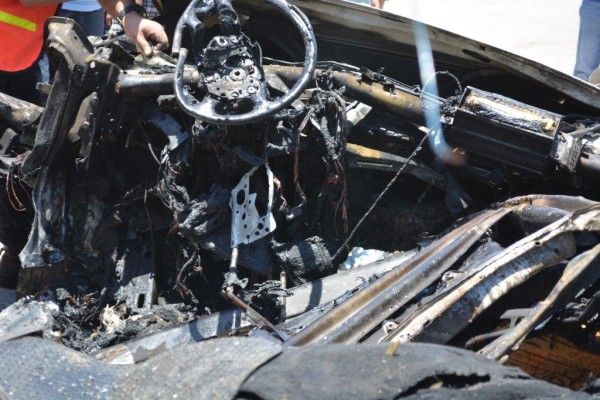
On the night of the July 27, the first day of the Muslim Eid-Al-Fitr festival following the fasting month of Ramadan, the Israeli air force dropped three bombs on Al-Hurani’s carpentry workshop. Each of the three bombs had an explosive force of 250 pounds.
Al-Hurani pointed towards the charred left overs of the tables, armchairs and beds, “all designed according to the desires of each individual customer, processed with the best woods and decorated with passion, as our customers expect from us,” he told Ma’an.
The carpentry of the Al-Hurani family is well-known across the northern Gaza Strip city of Jabaliya, and is respected throughout the Gaza Strip for its precise designs. In addition to family members, Al-Hurani employed 25 workers in his workshop before the Israeli assault.
“Due to the total destruction of our plant everyone had to be dismissed immediately and I do not know how to feed my family anymore. We don’t know how to move on from here,” he said.
The family possesses no savings for the construction of a new workshop and they believe there is no hope for obtaining any kind of compensation for the estimated $450,000 in damages they have suffered.
Abu Eida, one of the largest construction companies in the Gaza Strip, is headquartered in the industrial area east of Jabaliya that the air force also dropped several 250 pound bombs on Aug. 2.
Abed Rabou Abu Eida, CEO of the construction company, told Ma’an he was not aware of the exact number of bombs being dropped.
An on-site inspection of the premises, however, revealed the extent of the destruction: Three large buildings, which had all been reinforced by concrete, the warehouse containing cement and bricks, as well as the construction machinery have all been flattened.
Abu Eida estimates the cost of the total damage to be around $7.5 million. As a result of the attack, he had to dismiss all of his 70 permanent workers because the company could no longer operate. Hundreds of part-time workers that deal with Abu-Eida on a sporadic basis are also out of work.
“In 2008 and 2012 the factory premises were already completely destroyed by the Israeli air force and our company has not received any kind of compensation, due to the law passed in 2007,” Abu Eida said, referring to an Israeli law that defined Gaza as enemy territory and thus its residents ineligible for compensation through civil suits.
“This time we have no more money to rebuild our company a third time.”
At the end of Abu Khayr street in the Jabaliya industrial area sits the Al-Fayoumi family farm. The farm once owned 150 cows and sold milk twice a day to dairy factories.
130 of the cows were killed in their stables during the Israeli bombing on Aug. 2, according to workers on the farm.
During a visit to the ruined courtyard on August 13, workers were still trying to collect and burn the remaining corpses. The terrible smell of the semi-decomposed carcasses of cattle lay side by side with charred hens when Ma’an visited.
A swarm of flies covered the corpses, trying to get its share.
“Where can the Al-Fayoumis get new cows from?” asked a worker who did not want to give his name. “The borders to Gaza are closed and the smuggling tunnels destroyed.”
Wael Al-Wadia, owner of the Saraio candy factory in the same area, showed Ma’an the remains of his completely ruined factory buildings, where ice cream, biscuits, and cakes were once made.
“I had 100 workers on permanent contracts. 100 workers who have fed 100 families and now have no income,” al-Wadia said. The factory produced five tons of sweets on a daily basis, he said. Now, everything is gone.
Al-Qadia estimated that it would cost him $7 million to purchase the same equipment again, which he had initially brought to Gaza from Italy.
“We have made the best biscuits in the Gaza Strip. Every market in Gaza sold our products. Our biscuits were as good as the Biscotti’s from Italy,” he told Ma’an.
But it was not only factories, hospitals, schools, farms, agricultural land, and the famous orange groves of Beit Hanoun that were bombed during the worst of the Israeli assault between July 6 and Aug. 3.
Gaza’s sole power station, its largest mosques, and the building of the popular TV station Al-Quds were also hit, while tens of thousands of private homes were destroyed or severely damaged.
Muhsen Abu Ramadan, Director of the Arab Center for Agricultural Economic Development in Gaza, told Ma’an that the damage to the besieged coastal enclave’s economy, however, predates the recent Israeli assault.
“The economic crisis began long before the aggression, and is a result of the eight years lasting blockade of Gaza,” he said.
Abu Ramadan estimates that even before the beginning of the Israeli attacks in July, 40 percent of the labor force was unemployed, 30 percent lived below the poverty line, 57 percent were at risk of malnutrition, and 70 percent received food parcels from the United Nations Relief and Works Agency for Palestine Refugees in the Near East or other organizations.
“These numbers have increased dramatically since the bombings,” said Abu Ramadan.
He also said that Israeli army completely destroyed 220 factories in the campaign, while hundreds more suffered partial damage.
Abu Ramadan estimates the cost of destruction of agricultural land at around $200 million and the amount of the total costs to the economy at several billion dollars.
“Gaza would need five years to rebuild the destroyed infrastructure,” he said.
But given the current economic conditions caused by the occupation and the blockade of Gaza, he estimated that reconstruction will take at least ten years.
“We have the right to import building materials and this right must be given to us immediately, especially with the help of the international community. Otherwise, we will not be able to rebuild our destroyed houses and factories,” Abu Ramadan added.
Tens of thousands have joined the ranks of the unemployed since the imposition of the harsh Israeli blockade in 2007, and given the scale of the damage suffered during the massive Israeli assault, of those who were still employed in industry and agriculture in July it is unlikely that more than a few thousand are still working in either sector. A few thousand out of 1.8 million people.
“Israel is not only attacking civilians and their homes, but also systematically destroyed the economy of the Gaza Strip in order to make people dependent on emergency aid,” Abu Ramadan argued.
“Now that almost the entire economy is destroyed, people can no longer work, thus cutting their purchasing power dramatically. Now youth want to emigrate at even younger ages than before. Due to the emigration of young skilled workers the economy is becoming even weaker.”
“Israel has managed to transform a functioning economy into a third world country through eight years of embargo and three assaults in five years. Without ending the embargo, it is impossible to break out of this vicious cycle ourselves,” Abu Ramadan added.
Martin Lejeune is a German journalist based in Gaza. Follow him on twitter
Attacking journalists makes Israel a plastic democracy
By Alastair Sloan | MEMO | August 18, 2014
I’ve just had the pleasure of spending eight hours in detention at the border between Egypt and Israel, between Tabaa and Israel’s southern-most city, Eilat. My crime at first appeared to be a single male travelling alone into a Middle Eastern country. But once the immigration police realised I was a journalist, I was in for the long haul.
At first – I was asked the standard cavalcade – where was I staying, who with, and what were my plans? But on discovering my profession, brows furrowed faster than a Horah dance at a bar mitzvah.
My stay in a holding area, punctuated by increasingly aggressive interrogations, peaked when the most senior official asked me to write down the names and addresses of all my sources in Israel and Palestine.
Of course they wanted sources in “the Palestinian Territories,” and in a Freudian slip, I blurted out that I certainly wouldn’t be revealing any sources in the “Occupied Territories”. After a brief staring match, the official kept tapping away into her computer.
I didn’t give them the information they were after, not wanting to endanger anyone – which resulted in a further four hour wait, during which not much appeared to be happening. They let me go in time for me to miss my best friend’s engagement party, where I was stopping by before heading up to Ramallah. They knew I was in a rush to make this, and they knew I was best man. I’ll never know if they let me go when they did out of spite, but I suspect they did. Bullies enjoy a pathetic victory.
Thomas Jefferson was unequivocal in his support for the media, summarising that “the basis of our government being the opinion of the people, the very first object should be to keep that right; and were it left to me to decide whether we should have a government without newspapers, or newspapers without a government, I should not hesitate a moment to prefer the latter.”
Nelson Mandela, no friend to Israel but a hero to civilised nations – described freedom of information as “the lifeblood of democracy”. Curbing journalistic freedoms is not only a red rag to the bull – it’s arrogant and betrays the electorate. Too often we think of democracy as happening at the ballot box – but it is the media that informs the voter before they reach the polling station and in harassing, imprisoning and even killing journalists, Israel makes a mockery of their insistent claim to be “the only democracy in the Middle East”.
What I experienced was a mere bump in the road compared to other journalists’ troubles. Majd Kayyal, a Palestinian journalist, was arrested in April 2014 on his return from Beirut – allegedly for entering an “enemy state” and conspiring with a “foreign agent”. He was held in a windowless room for five days, interrogated by Shin Bet, and denied access to a lawyer. The government prohibited Israeli media outlets from reporting on the matter in real time – a ban which was luckily ignored by many editors. The charges were later dropped – however veteran Israeli journalist Itai Anghel noted that having travelled to several “enemy states”, including Iraq and Afghanistan – he had not once been stopped or detained by the Israeli security services.
But again, what happened to Kayyal is, sadly, mild. Seventy-one journalists were killed in Israel last year. Over 2,000 reported being physically attacked or threatened. Eighty-seven were kidnapped. Over 800 were arrested. Seventy seven had had enough and fled the country and, as of December 2013, there were 178 journalists in Israeli prisons. This doesn’t sound like a free press.
At the end of last year – diplomats, politicians, activists and NGOs concluded that the Palestinian territories were one of the worst places in the world to practice journalism. Not only is violence regularly deployed to repress domestic and foreign reporters, censorship laws are used to deny useful debate and manipulate opinion – often in favour of war.
For example, on July 24 the Israeli Broadcasting Authority prohibited the broadcast of an advert produced by B’Tselem, an Israeli NGO, which listed the names of 150 children killed in Gaza. Likewise, the killings of three Israeli teenagers took place almost immediately after their kidnapping, shortly before Operation Protective Edge began, yet a gagging order on the media prevented publishing the key facts.
Instead, Prime Minister Benjamin Netanyahu orchestrated a phoney manhunt for three weeks in which pro-war fervour was whipped up. He even lied to the children’s parents.
Now, talking to Israelis across the country, it is clear that support for the most recent Gaza onslaught is near unprecedented – based on the distorted image of the events leading up to the war. The range of opinions I heard was extremely narrow, with narratives drawing clearly on simplistic hasbara distributed by the government. To take a country to war, you need the media with you. Netanyahu has become an expert on this.
Similar censorship laws were invoked when Lt Hadar Goldin was apparently briefly captured by Hamas during the most recent conflict, and Israeli artillery shelled his location in an effort to kill him. This infamous “Hannibal Doctrine”, which dictates Israeli soldiers should be killed by friendly fire rather than become prisoners, was considered so unpalatable to the national spirit – that reporting on it was completely banned. In an extraordinary display of arrogance, Israeli military censors even attempted to stop The New York Times from publishing further information on the case.
So far, only Haaretz has run a piece seriously questioning the doctrine. Thankfully, the newspaper ended a 10 year reporting ban of the Doctrine in 2003, when they completed an investigation into the matter. Still, knowledge of the Doctrine was not as apparent as you would hope for from the ordinary Israelis I spoke to this week.
Though part of the Israeli public’s thirst for war can be attributed to a lack of media information, many Israelis are wilfully blind to the misgivings of the Israeli Defence [sic] Force (IDF). In a survey last year, Tel Aviv University found that just over half of Israelis believe that the media should not publish immoral conduct by the IDF. This has created an environment in which self-censorship is the norm. Recent civilian casualties in Gaza, despite numbering over 2,000 have barely been reported. The morning after the offensive began, Israel’s most widely circulated newspaper, Yisrael Hayom, did not contain a single word regarding civilian casualties. Instead, editors splashed an enormous explosion in Gaza City, and an emotive photo of an IDF conscript hugging his girlfriend goodbye. Yisrael Hayom’s slogan is sickeningly unquestioning for a major media outlet: “Remember, we are Israelis.”
The complicity of the Israeli media – largely a phoney industry with a sense of social responsibility akin to Blackwater or G4S, fills responsible hacks with professional disgust. One in 10 members of the Knesset is a former journalist. The leader of the country’s second most popular party is Yair Lapid and the leader of the Labour Party is Shelly Yachimovich, both came from Channel 2, Israel’s largest TV station. Of course many highly capable leaders have come from journalistic backgrounds, but the mass migration to the other side of the fence suggests the industry has a fundamental misunderstanding of what journalism is about: holding power to account.
Moreover – the continuing brutality of the Israeli regime against Palestinian and foreign journalists is profoundly troubling. I was lucky – my punishment was eight hours in detention and an unplanned overnight stay in Eilat (incidentally – a depressing sinkhole of tourist tack thronging with recently released IDF conscripts, celebrating their mass slaughter in Gaza).
But for many journalists, the price they pay for reporting on Israel’s crimes is beating, arrest, imprisonment, kidnapping or death. For Israel to be anything more than a plastic democracy its leaders need to rethink press freedoms. And if Israelis want to understand why the world is constantly so critical of them, they need to understand that they live in a media bubble in which only a certain reality about the Occupied Territories is presented. The full picture might not be nice, but is extremely important.
UK government faces lawsuit over arms sales to Israel
Press TV – August 17, 2014
The British government is facing unprecedented legal action over its continued arms sale to Israel in the wake of the recent deadly Israeli aggression against the Gaza Strip.
British law firm, Leigh Day, representing the Campaign Against Arms Trade (CAAT), said Saturday that it has written to Business Secretary Vince Cable, calling for the immediate suspension of arms export licenses to Israel.
The law firm said the UK government’s failure to suspend the licenses is illegal, adding that it has been instructed to seek a High Court judicial review of the administration’s reluctance to halt the arms sales to Israel.
A recent report by the British parliamentary committee for arms export controls showed that Israel received around £8 billion in the form of 400 arms licenses from the UK in 2013.
Leigh Day further said there is a risk that British-made weapons may have been used by Israel during its recent onslaught on Gaza in breach of humanitarian and human rights law.
“If arms from the UK are being used to commit crimes against humanitarian law, and human rights law, then export licenses for these materials must be revoked immediately,” said Rosa Curling, representing the CAAT, adding, “If this is not done, the government’s current policy is unlawful and susceptible to legal challenge.”
The British government has come under persistent pressure to toughen its stance against Israel, including by halting arms exports, since Tel Aviv began its onslaught on the besieged Palestinian enclave more than a month ago.
Nearly 2,000 Palestinians, including 470 children, have lost their lives and more than 10,200 have been wounded since the Israeli military unleashed fatal assaults against Gaza on July 8.
Human rights groups say Israeli forces are systematically killing Palestinian children and youths.
Palestine Supporters Block Israeli Ship from Docking on California Coast
By Celine Hagbard | IMEMC News | August 16, 2014
The Israeli cargo ship ‘Zim’ was set to dock in the Oakland port, on Saturday morning. But activists have claimed credit for an announced delay in the ship’s docking, and are planning to stop the ship wherever it tries to dock.
The U.S. activists are following the lead of trade unionists in South Africa, who successfully blocked Israeli ships from docking on several occasions, to protest Israeli aggression against Palestinians and call for a just and lasting peace.
Activists in Oakland, California are gathering Saturday to carry out direct action to stop the ship from being able to dock at the port. And, activists in Seattle, WA and Vancouver, BC are also planning to blockade scheduled stops in those ports.
The actions could potentially cost Israeli exporters millions of dollars, if their goods are unable to reach their ports of destination. The exact products on board the Zim are unknown, but they are likely to include Sodastream, a do-it-yourself soda-making device that is manufactured in an Israeli settlement on illegally-seized Palestinian land, Ahava dead sea salts, which are seized from Palestinian land in violation of the Dead Sea Agreement, and Osem brand food products, some of which are manufactured and packaged in Israeli settlements on illegally-seized Palestinian land, in the West Bank.
In their organizing materials, protesters say, “Palestine is calling us to action! Palestinian laborers [and the] Palestinian General Federation Trade Union have called on workers around the world to refuse to handle Israeli goods.”
They say that their “Block the Boat” actions are in response to a call by the Palestinian General Federation of Trade Unions, which calls for people around the world to “educate and build awareness among the labor movements of the U.S., and urge them to condemn the Israeli aggression and to boycott Israel.”
The Oakland action ran into some complications when the local branch of the International Longshore and Warehouse Union, or ILWU, was unable to take a public stand in favor of the action – reportedly because of an active negotiation between the union and management. But individual union members are supporting the action, and are part of Saturday’s blockade.
One of the organizers of the event, Reem Assil of the Arab Resource and Organizing Center, told reporters, “Symbolically, for Oakland we can say, ‘Not in our name!’ We’re not going to be complicit and an accomplice to the ongoing genocide and massacres going on.”
In 2010, Oakland activists successfully turned back an Israeli ship, while protesting the Israeli siege on Gaza. But that ship was later able to dock in Los Angeles. This time, activists are coordinating via social media and contact lists to ensure that protesters prepared for direct action will be on hand to meet the ship in Los Angeles, Seattle, or Vancouver, BC if it decides to re-route.
The protesters are calling for an end to the Israeli siege on Gaza, and an end to the Israeli occupation of Palestinian land. Their demands are in sync with the Palestinian core demands, which include equal rights for Palestinian people, the return of Palestinian refugees to their former homes in what is now Israel, and the release of Palestinian prisoners held in Israeli prison camps.
Israeli analyst explains that the “special relationship” benefits Israel, NOT the US
By Alison Weir | August 17, 2014
While Israel partisans in the US and some others (often former Israel partisans) sometimes claim that the US-Israel “special relationship” is driven by the US, Israeli writers are more honest. Most recently, retired Israeli diplomat Alon Pinkas writes on Ynet* (emphasis added):
Apart from Israel’s ability to defend itself, there never was – and probably will never be – a more important strategic asset to the country than its relationship with the United States. Since its founding – and especially since the end of the 60s and the start of the 70s – these ties have provided Israel a superpower to lean on, a supporting pillar of military deterrence, and a force-multiplier in the international arena.
The United States has not only vetoed more than 50 anti-Israel resolutions at the United Nation’s Security Council, it has also provided military aid totaling more than $140 billion, as well as access to American weapon systems and advanced ammunition. But the US has also garnered a reputation as an almost-automatic defender of Israel – its layer of protection from international isolation.
The relationship between the two countries has often been defined as “special”, “extraordinary”, and an “unshakeable alliance.” Since the 80s, Israel has often pushed to define itself as a “strategic asset” for the United States and, though Americans have never used the phrase themselves, they have not denied it.**
But on this matter there is some confusion in Israel borne of an exaggerated sense of self-importance. The strategic asset in this equation is the US for Israel, not the other way around.
____________________
* Ynetnews, according to its website, “is part of the prominent Yedioth Media Group, which publishes Yedioth Ahronoth – Israel’s most widely-read daily newspaper – as well as several popular magazines and dozens of local publications.”
** Actually many American experts have denied that Israel is a strategic asset – see, for example, The National Summit to Reassess the US-Israel Special Relationship.
Self-defense or provocation: Israel’s history of breaking ceasefires
IMEU | May 15, 2012
Since Israel’s creation in 1948, Israeli political and military leaders have demonstrated a pattern of repeatedly violating ceasefires with their enemies in order to gain military advantage, for territorial aggrandizement, or to provoke their opponents into carrying out acts of violence that Israel can then exploit politically and/or use to justify military operations already planned.
The following fact sheet provides a brief overview of some of the most high profile and consequential ceasefire violations committed by the Israeli military over the past six decades.
2012 – On November 14, two days after Palestinian factions in Gaza agree to a truce following several days of violence, Israel assassinates the leader of Hamas’ military wing, Ahmed Jabari, threatening to escalate the violence once again after a week in which at least six Palestinian civilians are killed and dozens more wounded in Israeli attacks.
2012 – On March 9, Israel violates an Egyptian-brokered ceasefire and assassinates the head of the Gaza-based Popular Resistance Committees, sparking another round of violence in which at least two dozen Palestinians are killed, including at least four civilians, and scores more wounded. As usual, Israel claims it is acting in self-defense, against an imminent attack being planned by the PRC, while providing no evidence to substantiate the allegation. Following the assassination, Israeli journalist Zvi Bar’el writes in the Haaretz newspaper:
“It is hard to understand what basis there is for the assertion that Israel is not striving to escalate the situation. One could assume that an armed response by the Popular Resistance Committees or Islamic Jihad to Israel’s targeted assassination was taken into account. But did anyone weigh the possibility that the violent reaction could lead to a greater number of Israeli casualties than any terrorist attack that Zuhair al-Qaisi, the secretary-general of the Popular Resistance Committees, could have carried out? “In the absence of a clear answer to that question, one may assume that those who decided to assassinate al-Qaisi once again relied on the ‘measured response’ strategy, in which an Israeli strike draws a reaction, which draws an Israeli counter-reaction.”
Just over two months prior, on the third anniversary of Operation Cast Lead, Israeli army Chief of Staff Lt. Gen. Benny Gantz tells Israel’s Army Radio that Israel will need to attack Gaza again soon to restore its power of “deterrence,” and that the assault must be “swift and painful,” concluding, “We will act when the conditions are right.”
2011 – On October 29, Israel breaks a truce that has maintained calm for two months, killing five Islamic Jihad members in Gaza, including a senior commander. The following day, Egypt brokers another truce that Israel proceeds to immediately violate, killing another four IJ members. In the violence, a total of nine Palestinians and one Israeli are killed.
2008 – In November, Israel violates a ceasefire with Hamas and other Gaza-based militant groups that has been in place since June, launching an operation that kills six Hamas members. Militant groups respond by launching rockets into southern Israel, which Israel shortly thereafter uses to justify Operation Cast Lead, its devastating military assault on Gaza beginning on December 27. Over the next three weeks, the Israeli military kills approximately 1400 Palestinians, most of them civilians, including more than 300 children. A UN Human Rights Council Fact Finding Mission led by South African jurist Richard Goldstone subsequently concludes that both Israel and Hamas had committed war crimes and crimes against humanity during the fighting, a judgment shared by human rights organizations such as Amnesty International and Human Rights Watch.
2002 – On July 23, hours before a widely reported ceasefire declared by Hamas and other Palestinian groups is scheduled to come into effect, Israel bombs an apartment building in the middle of the night in the densely populated Gaza Strip in order to assassinate Hamas leader Salah Shehada. Fourteen civilians, including nine children, are also killed in the attack, and 50 others wounded, leading to a scuttling of the ceasefire and a continuation of violence.
2002 – On January 14, Israel assassinates Raed Karmi, a militant leader in the Fatah party, following a ceasefire agreed to by all Palestinian militant groups the previous month, leading to its cancellation. Later in January, the first suicide bombing by the Fatah linked Al-Aqsa Martyr’s Brigade takes place.
2001 – On November 23, Israel assassinates senior Hamas militant, Mahmoud Abu Hanoud. At the time, Hamas was adhering to an agreement made with PLO head Yasser Arafat not to attack targets inside of Israel. Following the killing, respected Israeli military correspondent of the right-leaning Yediot Ahronot newspaper, Alex Fishman, writes in a front-page story: “We again find ourselves preparing with dread for a new mass terrorist attack within the Green Line [Israel’s pre-1967 border]… Whoever gave a green light to this act of liquidation knew full well that he is thereby shattering in one blow the gentleman’s agreement between Hamas and the Palestinian Authority; under that agreement, Hamas was to avoid in the near future suicide bombings inside the Green Line…” A week later, Hamas responds with bombings in Jerusalem and Haifa.
2001 – On July 25, as Israeli and Palestinian Authority security officials meet to shore up a six-week-old ceasefire, Israel assassinates a senior Hamas member in Nablus. Nine days later, Hamas responds with a suicide bombing in a Jerusalem pizzeria.
1988 – In April, Israel assassinates senior PLO leader Khalil al-Wazir in Tunisia, even as the Reagan administration is trying to organize an international conference to broker peace between Israelis and Palestinians. The US State Department condemns the murder as an “act of political assassination.” In ensuing protests in the occupied territories, a further seven Palestinians are gunned down by Israeli forces.
1982 – Following Israel’s invasion of Lebanon in June, and after PLO fighters depart Beirut under the terms of a US-brokered ceasefire, Israel violates the terms of the agreement and moves its armed forces into the western part of the city, where the Palestinian refugee camps of Sabra and Shatila are located. Shortly thereafter, Israeli soldiers surround the camps and send in their local Christian Phalangist allies – even though the long and bloody history between Palestinians and Phalangists in Lebanon is well known to the Israelis, and despite the fact that the Phalangists’ leader, Bashir Gemayel, has just been assassinated and Palestinians are rumored (incorrectly) to be responsible. Over the next three days, between 800 and 3500 Palestinian refugees, mostly women and children left behind by the PLO fighters, are butchered by the Phalangists as Israeli soldiers look on. In the wake of the massacre, an Israeli commission of inquiry, the Kahan Commission, deems that Israeli Defense Minister (and future Prime Minister) Ariel Sharon bears “personal responsibility” for the slaughter.
1981-2 – Under Defense Minister Ariel Sharon, Israel repeatedly violates a nine-month-old UN-brokered ceasefire with the PLO in Lebanon in an effort to provoke a response that will justify a large-scale invasion of the country that Sharon has been long planning. When PLO restraint fails to provide Sharon with an adequate pretext, he uses the attempted assassination of Israel’s ambassador to England to justify a massive invasion aimed at destroying the PLO – despite the fact that Israeli intelligence officials believe the PLO has nothing to do with the assassination attempt. In the ensuing invasion, more than 17,000 Lebanese are killed.
1973 – Following a ceasefire agreement arranged by the US and the Soviet Union to end the Yom Kippur War, Israel violates the agreement with a “green light” from US Secretary of State Henry Kissinger. According to declassified US documents, Kissinger tells the Israelis they can take a “slightly longer” time to adhere to the truce. As a result, Israel launches an attack and surrounds the Egyptian Third Army, causing a major diplomatic crisis between the US and Soviets that pushes the two superpowers to the brink of nuclear war, with the Soviets threatening to intervene to save their Egyptian allies and the US issuing a Defcon III nuclear alert.
1967 – Israel violates the 1949 Armistice Agreement, launching a surprise attack against Egypt and Syria. Despite claims Israel is acting in self-defense against an impending attack from Egypt, Israeli leaders are well aware that Egypt poses no serious threat. Yitzhak Rabin, Chief of the General Staff of the Israeli army during the war, says in a 1968 interview that “I do not believe that Nasser wanted war. The two divisions he sent into Sinai on May 14 would not have been enough to unleash an offensive against Israel. He knew it and we knew it.” And former Prime Minister Menachem Begin later admits that “Egyptian army concentrations in the Sinai approaches did not prove that Nasser was really about to attack us. We must be honest with ourselves. We decided to attack him.”
1956 – Colluding with Britain and France, Israel violates the 1949 Armistice Agreement by invading Egypt and occupying the Sinai Peninsula. Israel only agrees to withdraw following pressure from US President Dwight Eisenhower.
1949 – Immediately after the UN-brokered Armistice Agreement between Israel and its neighbors goes into effect, the armed forces of the newly-created Israeli state begin violating the truce with encroachments into designated demilitarized zones and military attacks that claim numerous civilian casualties.
Israel bans human rights NGO broadcast on Gaza children
Press TV – August 14, 2014
An Israeli court has banned the broadcast of Israeli human rights NGO B’Tselem that listed the names of Palestinian children killed during Israel’s month-long offensive in the Gaza Strip.
On Wednesday, the Supreme Court rejected B’Tselem’s appeal to overturn a decision by the Israel Broadcast Authority to ban a broadcast produced by the NGO, saying it is of political nature.
The broadcast listed the names of children killed in the war in the besieged enclave.
“The hidden objective of the broadcast… is to get the public to make the government stop the (Israeli army operation) in Gaza, due to civilian deaths and children in particular,” the judges’ decision read, adding, “The broadcast is clearly not meant for informative purposes only,” it added.
Israel launched the latest war against the coastal enclave on July 8, killing at least 1,962 Palestinians, including 470 children, and wounding at least 10,100 others.
On Wednesday, Israel and the Palestinian resistance movement Hamas agreed to extend a temporary truce in Gaza for five more days as Israeli and Palestinian negotiators continued talks to reach a long-term deal in the Egyptian capital Cairo.
On Thursday, Khalil al-Haya, a senior member of the Hamas delegation at the talks, said any deal with the Israel regime must include Palestinian’s demand to end the blockade of the Gaza Strip.
Israel launched the latest war against the blockaded Gaza Strip on July 8. Nearly 1,962 Palestinians, mostly civilians, have so far lost their lives and at least 10,100 have been injured in the Israeli war.
The militarization of police agencies from Ferguson to the Middle East
By Roqayah Chamseddine | Al-Akhbar | August 14, 2014
The arming of US police agencies with military-grade weaponry and tactics can be traced back, at the very least, to the creation of the paramilitary “Special Weapons and Tactics” Unit (SWAT) in 1967. In Overkill: Rise of Paramilitary Policing journalist Radley Balko notes that what inspired the heavily militarized SWAT team of today was “a specialized force in Delano, California, made up of crowd control officers, riot police, and snipers, assembled to counter the farm worker uprisings led by Cesar Chavez.” Balko writes in August 2013 for The Wall Street Journal that by 1975 from this first experimental SWAT unit grew to “approximately 500 such units. Today, there are thousands. According to surveys conducted by criminologist Peter Kraska of Eastern Kentucky University, just 13 percent of towns between 25,000 and 50,000 people had a SWAT team in 1983. By 2005, the figure was up to 80 percent.”
In War Comes Home: The Excessive Militarization of American Policing, published in June 2014 by the American Civil Liberties Union (ACLU), it is reported that federal programs “are arming state and local law enforcement agencies with the weapons and tactics of war with almost no public discussion or oversight.” One such policy is the Department of Defense (DoD) Excess Property Program, or the 1033 Program, which “provides surplus DoD military equipment to state and local civilian law enforcement agencies for use in counter-narcotics and counter-terrorism operations, and to enhance officer safety.” Items provided by the DoD include, but are not limited to, mine-resistant ambush protected armored vehicles, aircrafts, grenade launchers, countless machine guns, magazines, bomb suits, forced entry tools and units of surveillance.
In the small city of Ferguson, Missouri, an unarmed African American teenager, Michael Brown, was shot multiple times by a police officer on August 9. Witnesses say that the police officer had initiated a confrontation with Brown, and then physically assaulted him, as reported by Margaret Hartmann for New York Magazine :
“Brown’s friend, Dorin Johnson, says they were walking in the street when the officer pulled up and told them to “get the eff onto the sidewalk.” Johnson says the officer then reached “his arm out the window and grabbed my friend around the neck.” Witness Piaget Crenshaw said he saw the officer chasing Brown. “They shot him and he fell. He put his arms up to let them know that he was compliant and he was unarmed, and they shot him twice more and he fell to the ground and died.”
After the murder of Michael Brown, protests began to quickly take shape in Ferguson in response, not only at the scene of the crime but in front of the Ferguson Police Department headquarters. The police response to these protesters, many of whom literally had their hands raised above their heads while shouting “don’t shoot!”, was alarming – dogs were called, and heavily armed police officers lined up, intimidating the men, women and children of Ferguson. At least one police officer was recorded shouting, “Bring it, all you fucking animals! Bring it!” Extremely troubling was the implementation of a no-fly zone over Ferguson, meant “to stop media from flying over the area to film.”
The targeting of Black communities by law enforcement is historic and ubiquitous; it has long colored every aspect of life for even those indirectly impacted by police actions – when systematic racism meets a militarized police force the outcome is continued dehumanization of Black bodies, societal acceptance of black deaths at the hands of the police and a disastrous escalation, oftentimes with public approval, of violent tactics against the Black people and communities of color. Modern US police departments share a colonial history that gives context to police violence of today – recognizing this framework is essential when examining how police brutality has developed historically. From constables in the 1600s who made up a sort of “neighborhood watch,” wherein they would capture slaves and prevent them from organizing for payment, the slave patrols of the early 1700s, the brazen appointment of police officers by way of their political affiliations in the 1880’s and stop-and-frisk, adopted from English common law, we learn that not only is violence an inherent part of the institution itself but it is a necessary component which allows for the state to control its citizens, and it has emerged and developed in the most destructive of ways. Police officers are trained to use force and are given the most lethal of weapons in order for them to do so and, according to data presented in the June 2014 report by the ACLU, this violence is overwhelmingly directed towards people of color. “Sixty-one percent of all the people impacted by SWAT raids in drug cases were minorities” and a majority are Black:
“[W]hen the data was examined by agency (and with local population taken into consideration), racial disparities in SWAT deployments were extreme. As shown in the table and graph below, in every agency, Blacks were disproportionately more likely to be impacted by a SWAT raid than whites, sometimes substantially so. For example, in Allentown, Pennsylvania, Blacks were nearly 24 times more likely to be impacted by a SWAT raid than whites were, and in Huntington, West Virginia, Blacks were 37 times more likely. Further, in Ogden, Utah, Blacks were 40 times more likely to be impacted by a SWAT raid than whites were.”
Despite this, the focus on the actions of individual officers, while warranted, should not overwhelm the discourse – the data presented by the ACLU is not only an indictment of police officers alone but of the police institution itself. Police agencies have created an environment which not only employs violence against minorities but encourages violence against them.
Present-day US law enforcement as an institution has cooperated with a long list of state agencies which are integral components of the larger machinery of government as well as international police forces. The joint training between the United States and Israel is one such example. In May 2010, 50 retired US admirals and generals vigorously argued that Israel is a security asset in a letter to President Obama, that “American police and law enforcement officials have reaped the benefit of close cooperation with Israeli professionals in the areas of domestic counter-terrorism practices and first response to terrorist attacks,” they wrote in part. In 2010, the Anti-Defamation League publicized that it had sponsored 15 senior law enforcement officials – including from the FBI, NYPD and Boston Police – to take part in an intensive “counter-terrorism training mission” in Israel so that they could share “information, strategies and tactics,” then again in 2011 and 2013. This program, which was first established in 2003, has sent over 115 state, federal and local law enforcement executives to Israel. In 2013, members of a US bomb squad from Arizona, including a US deputy, traveled to Israel for training which included “going to a West Bank outpost with the Israeli National Police bomb squad… learning about port inspections as they relate to counter explosives and counter IED operations.”
One of the reasons for this training? “To improve techniques and tactics they use along the US-Mexico border.”
The ADL is not the only organization boasting of this militarized US-Israel partnership. The American Israel Public Affairs Committee (AIPAC) has an entire publication dedicated to this “strategic partnership,” noting that “Israel has worked with multiple American agencies, including the FBI, NYPD, LAPD, and the Washington, D.C. Police Department.” According to the pamphlet not only have the U.S. Capitol Police undergone training in “Israeli counterterrorism techniques” but the partnership between these two colonial entities is far reaching, even beyond the scope of traditional law enforcement, with FEMA and the National Guard “often [traveling] to Israel to participate in Israeli homeland security drills.” The United States is not only learning from the brutality of the Israeli occupation forces but sharing their knowledge with other nations. The Middle Eastern Law Enforcement Training Center, which is co-sponsored by the FBI and the U.A.E. at the Dubai Police Academy, where FBI agents offer special training courses that “[involve] many aspects of law enforcement, including ways to combat white-collar crime, violent crime, forensics and counter-terrorism.” The United States also conducts military exchange programs in places like Egypt where US forces and Egyptian forces take part in joint military exercises, and offers FBI training to Egypt’s secret police who “routinely tortured detainees and suppressed political opposition” according to victim testimony.
Police institutions, which continue to work and expand under the guise of law while merging with the most prominent characters behind war-making, including the arms industry, lobbyists, and politicians, demand that communities, most often those of color, surrender what little autonomy they have so that they may receive “protection.” That they are ever permitted to collect on this guardianship is of no consequence because these institutions define protection and determine, for everyone, what is a most satisfactory response to any and all actions on the part of the community members.
Black men and women have long fought, with their blood, for the decentralization and democratization of the police and the right of their communities to determine their future without threat of police brutality – the Black Panther’s Ten Point Program, written in 1966, is a clear-cut example. “We Want An Immediate End To Police Brutality And Murder Of Black People,” the program reads in part. “We believe we can end police brutality in our Black community by organizing Black self-defense groups that are dedicated to defending our Black community from racist police oppression and brutality.” An article in the Palm Beach Post, published in 1969, reads “Decentralized Police Sought By Black Panthers”:
“Six intense Black Panthers have come in out of the West as advance men for a national conference which will drumbeat a simplistic theme – decentralize the police systems of big cities, place the cops under neighborhood control and give each community its own police commissioner.”
US police forces uphold white supremacy with their racist implementation of violence, where in places like Ogden, Utah, Black people “were 40 times more likely to be impacted by a SWAT raid than whites were,” according to the ACLU. These forces work towards the preservation of capitalism, and the police, as an institution, use elitism, violence and authoritarianism in order to preserve the state.
Decentralization is not only possible but proving to be a necessary process in order to dismantle the structuralized and militarized brutality that communities of color face at the hands of racist paramilitary police forces. The police have proven that they are not accountable to the communities they allegedly “serve and protect,” and so in order to implement restorative justice the institution itself should be dismantled and replaced with an organization that is transparent, represents the diversity of these communities and which, most importantly, is limited in regards to the scope of the organization’s power.
Roqayah Chamseddine is a Sydney based Lebanese-American journalist and commentator. She tweets @roqchams and writes ‘Letters From the Underground.‘
Undercover Israeli forces detain Hamas leader in Beit Ummar
Ma’an – 14/08/2014
HEBRON – Undercover Israeli forces detained a Hamas leader in the town of Beit Ummar on Thursday, a local community leader said.
The spokesperson of Beit Ummar’s popular committee said Israeli forces from an undercover unit who disguise themselves as Palestinians, known in Hebrew as Mistaravim, kidnapped Ahmad Khader Abed Abu Maria, 47, from his house at 10 a.m.
His relative, Hashem Khader Abu Maria, 45, was shot and killed during a Gaza solidarity protest in the town on July 25.
Locals in the town said they noticed 15 masked men hiding in an ice-cream truck in the town and began throwing stones at the vehicle.
The masked men, who were undercover Israeli forces, fired live ammunition at the villagers, with no injuries reported.
Israeli soldiers then fired tear gas canisters at locals who had attempted to push back the undercover unit, who retreated to the nearby illegal Karmi Tsur settlement.
Israeli forces also raided the home of Muhammad Munir Radwan Qawqas, 36, and pointed a gun at his mother.
He was blindfolded, handcuffed and taken to Etzion military base.
Muhammad is an ex-prisoner who spent 10 years in Israeli prisons. He is a married father of two girls and teaches Hebrew in a school in Bethlehem.
Israeli forces also detained Usama Mahmoud Awad Kamil, 26, and Ahmad Khaled Mahmoud Kamil, 26, in the Jenin village of Qabatiya.
An Old Man and a Young Man in Gaza
By Heathcote Williams

Actor Alan Cox reads Williams’ accusatory, vibrantly disturbing poem, “An Old Man and a Young Man in Gaza.” Click here for audio
A bearded old man holds a placard:
“You take my water, burn my olive trees,
Destroy my house, take my job, steal my land,
Imprison my father, kill my mother,
Bombard my country, starve us all,
Humiliate us all, but I am to blame:
I shot a rocket back.”
From the Zionist Book of Psalms
A selection of ungodly chants
Are used to justify the destruction
Of a country and its inhabitants:
“We must blow Gaza back to the Middle Ages
Destroying all the infrastructure including roads and water”
– Eli Yishai, former Deputy Prime Minister.
Amen
“There should be no electricity in Gaza,
No gasoline or moving vehicles, nothing…
We need to flatten entire neighborhoods…
Flatten all of Gaza”
– Gilad Sharon, Ariel Sharon’s son in the Jerusalem Post.
Amen
“There are no innocents in Gaza. Mow them down …
Kill the Gazans without thought or mercy.”
– Michael Ben-Ari, an ex-member of the Knesset.
Amen
Gaza should be “bombed so hard the population
Has to flee into Egypt”
– Israel Katz, a Minister of Transportation.
Amen
Gaza should be “wiped clean with bombs”,
– Avi Dichter, a Minister of Home Front Defense.
Amen
Israeli soldiers must “learn from the Syrians
How to slaughter the enemy”,
– Israeli Rabbi Yaakov Yosef.
Amen
Here is Ze’ev Jabotinsky, admirer of Mussolini
And the godfather of Zionist terrorism,
Justifying the flattening of Arab villages in 1948
And turning their inhabitants into refugees in vast numbers
“The world has become accustomed to the idea
Of mass migrations and has become fond of them.”
Jabotinsky adds, “Hitler, as odious as he is to us
Has given this idea a good name in the world.”
Amen
It is ironic that Jabotinsky used Hitler
As precedent for the transfer of the inhabitants
Since forcible expulsion
Was among the charges against Adolf Eichmann –
An architect of the Nazi Holocaust
Captured in Argentina, and tried and hanged in Israel.
Undeterred, the former chief rabbi,
Mordechai Elyahu, has urged Israel,
Its army and its government
To “employ the Nazi choice”
Against the Palestinians.
To carry out a series of carpet bombings
Of Palestinian population centres in Gaza;
He urges the “indiscriminate killing of civilians”.
On religious grounds.
Amen
The Chabad Lubavitch Rabbi Schneerson,
A self proclaimed Messiah
Whose followers await his return from the dead,
(As if the Rabbi hadn’t preached
Enough when alive by his making the claim
That his religion heralded a new Master Race) –
Has a devoted and powerful acolyte, Rabbi Manis Friedman,
Who declares that the “only way to fight a moral war”
Is to “destroy the Arabs’ holy sites” and “to kill them.”
To “kill men, women and children”, and to eliminate anyone
Who stands in the way of a Greater Israel.
Friedman embraces Israel’s ruthless colonizing power
With an Old Testament ferocity –
With what Christopher Hitchens has called,
“The root of religious evil” –
Whereby the Torah can be misused
To mow down men in a mosque
With an automatic rifle,
And such vengeful triumphs
Given a country’s blessing:
Streets in Israeli cities
Are routinely named after armed cuckoos –
Murderous Israeli heroes
Who’ve evicted indigenous birds
From the Palestinian nest,
And then killed them.
The Head of Israeli’s National Defense College,
Professor Arnon Sofer,
Outlines his country’s Defense strategy:
“If we want to remain alive, we will have to kill and kill and kill.
All day, every day.”
Amen
Colonel Yoav Gal, an Israeli Air Force pilot,
Tells Israel’s Army Radio
“I believe that it [Operation Cast Lead]
Should have been even stronger! Dresden! Dresden!
The extermination of a city!
Not even a stone will be thrown at us. Because we’re Jews.
I want the Arabs of Gaza to flee to Egypt.
This is what I want. I want to destroy the city.”
Amen
Ethnic cleansing is Israel’s origin
Not peace:
Netanyahu tells students at Bar Ilan University,
“Israel should have exploited the repression
Of the demonstrations in China,
When world attention focused on that country,
To carry out mass expulsions
Among the Arabs of the territories.”
“The Palestinians are like crocodiles,
The more you give them meat, they want more”
Says Ehud Barak, when Prime Minister of Israel.
Despondently, the philosopher Martin Buber
Once told a New York audience,
“When we followers of the prophetic Judaism
Returned to Palestine…the majority of Jewish people
Preferred to learn from Hitler rather than from us.”
Enflamed when Palestinians fight back
With increasing desperation
And despite overwhelming odds
To try to regain their ancestral land,
Israelis chant “Death to the Arabs”
“A Jew is a brother, an Arab is a bastard”.
In front of their Arab neighbours,
A song is sung by settlers at Purim
Praising Baruch Goldstein’s massacre
Of 29 Palestinians at prayer during Ramadan:
“Dr. Goldstein, there is none other like you in the world.
Dr. Goldstein, we all love you… he aimed at terrorists’ heads,
Squeezed the trigger hard, and shot bullets,
And shot, and shot.”
At this settler hero’s funeral, Rabbi Yaacov Perrin
Famously claimed that even one million Arabs
Are “not worth a Jewish fingernail”.
Goldstein’s mass murder created suicide bombers –
Some two hundred amongst ten million Palestinians –
Which led to Israel’s land-grabbing apartheid wall.
The Israeli lawmaker, Ayelet Shaked, calls
For the genocide of Palestinians on Facebook
And she advocates “the slaughter of Palestinian mothers
Who give birth to ‘little snakes,'”
“The entire Palestinian people is the enemy.”
She urges their complete destruction,
“Including its elderly and its women.”
The new media are used to demonize the innocent
And to host persistent irrationalities:
A Jerusalem city councillor in charge of municipal security, Aryeh King, publicly advocates the murder
And the mutilation of non-Jews:
“I am calling out to all the Pinchases that are here …
Every one of us has a mission …
The Rebbe, who is here with us, expects us to commit acts of Pinchas.”
Pinchas (Phineas in English) in the Torah was so incensed
By interracial (Jewish-Midianite) sex
That he took a sword and plunged it through both bodies
Of a couple in the middle of their lovemaking.
Then with a medieval fervor, Rabbi Noam Perel
Advocates scalping Arabs
By removing their genitalia –
A blood sacrifice to a mad mind-set
Of mystical thuggery.
Two Israeli girls hold up a banner
“Hating Arabs is not racism, it’s values!”
Placing the Hebrew word for “Arabs”, ARAVIM,
Into Twitter reveals young Israelis desiring
That Arabs die or be tortured to death.
The US House of Representatives
Votes unanimously to reaffirm its full support for Israel.
US jets duly declare war on Arab children
Whose futures they disintegrate.
In the southern Gaza city of Khan Younis,
Eight members of the Al Haj family
Are killed, including five children.

Four Arab children, fishermens’ children
First cousins from the Bakr family, aged nine to eleven,
Playing football on the Gaza beach in July, 2014,
Are shot dead by an Israeli gunboat.

A 12-year-old boy loses 18 members of his family in an air raid
From US planes including his father, a schoolteacher,
A photograph of Abdul Rahman Al-Batsh
Shows his shoulders slumped against a car.
It’s the moment that he’s discovered
That his father is amongst the dead.

Abdul Rahman Al-Batsh, aged 12, loses 18 members of his own family
Later Abdul Rahman would say,
“They think we are worth nothing. They are killers,
They have no humanity,
And one day I will avenge my father.”
Israel receives more aid from the US
Than the whole of the continent of Africa
Whilst the US population remains docile.
The Israeli Foreign Minister, Avigdor Lieberman,
Says that Israel must “go all the way” in Gaza.
Comfortably seated on camp chairs and sofas
Some fifty Israelis gather to eat popcorn
And watch from a Sderot hilltop
As bombs rain down from US-supplied F-16s.
They clap and applaud each deadly blast
From 1,000-pound iron fragmentation bombs.

Israelis gathered on a hilltop outside the town of Sderot to watch the bombardment of Gaza.
“We are here to see Israel destroy Hamas,” Eli Chone,
A 22-year-old American tells Allan Sørensen,
Of Kristeligt Dagblad, pointing to a dot of light in the sky.
“It is a fighter who is about to dive. This means that it is about to shoot.”
The conquerors’ fans draw up their chairs;
Swigging on beers as they tend their barbecue
And watch Gaza burn from their vantage-point
In Sderot (once the Palestinian village of Najd).
One says, “this is our entertainment.”
Someone points out that Hamas
(Rather than it having been elected)
Is “a death-cult” and Palestinians “enjoy martyrdom”
So “we’re doing the Arabs a favour.”
A lurid cocktail of triumphalist hatred,
Mixed with smoke from burning flesh,
Blinds them to Palestine’s righteous yearning
For self-determination,
Their right in international law;
Their right to be unencumbered by occupation;
To be free from being Israel’s penal colony;
Free from being stateless in a brutalized Bantustan –
A colonized people who are jeered at and decried
For their minimal attempts to fight back.
Later that night a bomb would land on a Gaza care home
Filled with elderly patients who cannot move
And with children who are already disabled;
Both are bombed in their wheelchairs or in their beds.
The Rabbi Noam Perel, head of Bnei Akiva
The world’s largest religious-Zionist youth organization,
Urges on his Facebook page that the IDF,
The Israeli Defense Force be transformed
Into an army of avengers,
“Which will not stop at 300 Philistine foreskins”

A young man in Shuafat, Jerusalem,
Muhammad Abu-Khdeir,
A 16-year old boy with a knowing, elfin smile
Is pulled into a car
And kidnapped in East Jerusalem
While waiting to go into the mosque.
He is tied and beaten;
He has gasoline poured into his mouth
And he is burned alive.
His body is found in the Jerusalem Forest;
Battered in the head
And with soot deposits in the lungs
Suggesting he’s still breathing
When set on fire.
Ninety per cent of his body is burned.
Another victim of Israel’s slow motion genocide –
A holocaust which, this time,
Is being financed and uncritically supported
By ‘the good guys’,
By the internationally ‘great and the good’,
By the craven chorus of the compliant
Who ritually pipe up to defend
Israel’s right to defend itself –
To defend the indefensible,
And to supply the money
The weapons, and the excuses
To enable it to do so.
On Friday July 2014
The Israeli Defence Force
Invades Gaza by land.
An Israeli soldier posts a selfie
Of himself having black camouflage paint
Applied to his face.
He tweets, “From the Field: Our soldiers preparing to enter Gaza.
The whole nation stands behind us”
Another tweets: “We have hit Hamas hard,
And we will continue to hit Hamas hard.”
Tzipi Livni, Israel’s Justice Minister,
Says she backs the invasion “wholeheartedly”.
And expresses “love and confidence in our soldiers strength”.
Israel’s soldiers’ strength is misused
To produce genocide as well as a scorched policy
Whereby 800,000 olive trees in Occupied Palestine
Are destroyed to drive Palestinian farmers from their land.
King Herod revisits his massacre of the Innocents,
But this time round he has the mainstream media
On his side: his spin doctors have them swallowing
His party line that toddlers are terrorists if they’re Arab,
And Herod has journalists fired who don’t please him.
“Expel the Palestinians, and populate Gaza with Jews”,
Urges the Knesset’s deputy speaker, Moshe Feiglin,
“Israel must attack Gaza even more mercilessly”
To expel the population “with maximum force”.
The deputy speaker of Israel’s parliament, the Knesset,
Promotes war crimes as a state sanctioned tactic:
After “softening” the targets with firepower
He recommends the IDF “conquer the entire Gaza.”
He is emboldened by the US’s blank cheques,
And in their support of Israel’s heroism
In attacking a defenceless population,
Few see fit to mention that Israel’s
First victim in its ground invasion of Gaza
Is a five-month-old baby killed
By an Israeli tank in southern Rafah
On July 17, 2014 – almost as if King Herod
Has returned to rule his zombie state.
The “most moral army in the world”
Is reportedly targeting women and children,
And even animals.
A doctor speaking to Al Jazeera says that the Israeli army
“Is shooting at anything moving in Shujaiyah”
And consequently the streets of East Gaza are strewn
With dead bodies and severed limbs.
A Norwegian doctor in Shifa hospital, Mads Gilbert,
Is overwhelmed by the ground invasion:
By the carloads of those “maimed, torn apart, and bleeding; Shivering, and dying – all sorts of injured Palestinians,
All ages, all civilians, all innocent.”
“The heroes in the ambulances,” he continues,
“And in all of Gaza’s hospitals
Are working 12-24 hour shifts, grey from fatigue
And inhuman workloads – they care, they triage,
And they try to understand the incomprehensible chaos
Of bodies, sizes, limbs, walking, not walking, breathing,
Not breathing, bleeding, not bleeding humans. HUMANS!”
With these words Dr Gilbert addresses himself
to the President of the United States.
Predictably there’s no response.

Israel’s vision of itself was once
As a “light unto the nations”.
It has no need of the fearful hatred,
Fuelling its bombs and its bullets,
Unless it wishes to fade away –
Putting out the light that might enable it
To see the stranger as a friend.
Israel wants a truce that does not include a halt on assassinations
MEMO | August 13, 2014
While Cairo is witnessing talks about a cease-fire in the Gaza Strip and in light of an international effort to reach a long-term truce between Hamas and Israel, Israeli security officials have demanded that the policy of assassinations against the Palestinian leaders should not stop.
Israeli media reports quoted security officials on Tuesday as saying that currently there are three options available, namely: an international effort to extend the cease-fire, or “surrendering” to some of Hamas’ demands, or launching a new aggression against the Gaza Strip. According to the officials themselves, the latter is less likely to happen.
Security officials added that “Hamas has put on the negotiating table demands for a seaport and an airport as a counterweight to Israel’s demand to strip the sector of any weapon,” and that the Israeli security apparatus “wants to test Hamas’ long-term steps, therefore, Hamas must be prevented from achieving anything that could help the movement’s strength grow.”
The security officials explained that the security apparatus demands that the Israeli government “reserves the possibility of returning to the assassinations choice,” adding that “it is prohibited to waive this requirement in the context of the negotiations” taking place in Egypt.
Walla website quoted an Israeli security official as claiming that the assassinations issue is a “point of serious concern among the movement leaders.”
He added, in a sarcastic tone, that “if Hamas wants to control the sector, it should do so from the tunnels and cellars.”
The same security official said an agreement has been reached between the parties involved in Cairo negotiations regarding a section of the demands put forward by Hamas, including the issuance of permits for the exit of a limited number of Palestinians through Erez crossing, under the control of the Shin Bet, and the immediate expansion of the volume of goods coming into the Gaza Strip through Karam Abu Salem crossing, as well as handing over control of the Palestinian side of the Rafah border crossing to the Palestinian Authority, so that the crossing would be supervised by both Israel and Egypt.
The Israeli official also confirmed that among the agreements reached was an agreement regarding the transfer of funds from Qatar, Saudi Arabia and other Gulf states into the Gaza Strip, where the parties agreed that this should only happen through the Palestinian Authority and under strict international-Israeli-Egyptian supervision.
Featured Video

Israel furious at Trump over Turkey, Syria to invade Lebanon
or go to
Aletho News Archives – Video-Images
From the Archives
The toxic legacy of nuclear weapons testing serves as a stark warning of the danger these weapons pose
By Scott Ritter | RT | March 11, 2021
Millions of people suffer and die from the effects of radiation exposure from decades of nuclear weapons testing. Their experience should give serious pause to those who continue to embrace the viability of a nuclear deterrent.
A dust storm originating in the Sahara Desert swept across parts of Spain, France, the UK, and Ireland last month. In addition to bringing a red tinge to the sky, the dust caused a slight, yet noticeable, spike in radiation in the areas it reached. This radiation spike was caused by the presence of cesium-137, a radioactive isotope produced through the nuclear fission of uranium-235 in nuclear weapons. A legacy of French nuclear weapons testing that occurred in Algeria during the 1960s, the cesium-137 contamination is a reminder that while the testing of nuclear weapons may have been halted for the time being, the consequences of these tests live on through the poisoning of the planet mankind calls home.
The Saharan radioactive dust cloud is but the most recent visible phenomenon of a plague that has infected much of the world. … continue
Blog Roll
 Aletho News
- Israel furious at Trump over Turkey, Syria to invade Lebanon – w/ Col. Macgregor
- IRGC says it struck US military positions, warns of broader response
- Russia stops record number of Ukrainian drones overnight – MOD
- Denmark admits ‘no evidence’ for Russian drone hysteria
- Washington agreement ‘will not pass’: MP Fadlallah
- Iran mocks US for ‘solving’ domestic hunger problem, lecturing others on issue
- Germany, Israel hold joint naval drill off Haifa amid Gaza genocide
- Trump’s war on Iran becomes ‘most unpopular conflict’ in US history
- The Middle East is wringing its hands of Washington. Finally
- The Starmer legacy the establishment media won’t tell you: Celebrity sex crimes, imprisoning Assange and torture terror
- If Americans Knew
- Four Reasons the Netanyahu-Backed Plan to ‘End’ U.S. Military Aid to Israel Is a Scam
- Archbishop of Canterbury vows to help Palestinians achieve ‘freedom you deserve,’ calls for end to Israeli occupation
- The scars left behind by Israel’s white phosphorus in Lebanon
- Drones and decomposing babies: What’s in UN report on Israel’s genocide of Palestinian children
- Crimson Thread: The new Israeli separation wall that cuts through the ‘breadbasket of Palestine’
- Gaza ceasefire talks back to square one as Israel changes the rules – Daily Update
- The NDAA Proposed Merger of the U.S. and Israeli Military is Strategically Unwise and Inherently Unconstitutional
- Victories by Pro-Palestinian Democrats Show the Party’s Shift on Israel
- Massie moves to strike $3.3B in Israel military aid from the budget
- How Jeffrey Epstein’s Israeli Network Shaped Congo’s Deadly Mineral Trade
- No Tricks Zone
- 2025 Study: Cloud Effects Reduce Downwelling Longwave Radiation, Overriding The CO2 Impact
- 3 New Studies Find Increasing Trends In Solar Radiation Since The 1980s – Easily Explaining Warming
- THE TRANSCEIVER PARADOX: Why Organoid Intelligence (OI) Could Become Our Ultimate Alien Predator
- German Wind Turbines Face Regulatory Shutdown Due To Excessive Noise
- New Study: Chile’s Relative Sea Level Was 3.2 Meters Higher Than Today During The Mid-Holocene
- Beyond The Pitch: Why FIFA’s World Cup Is One Of Humanity’s Best Investments
- Climate Alarmists Now Using Natural Phenomena To Support Their Claims
- New Study: Significant CO2 Fluxes From Non-Volcanic Sources Are Largely Neglected In Carbon Budgets
- Women Climate Scientists Being Harassed, Insulted By Skeptics, Claims Berkeley Earth Researcher
- Germany’s Longterm Spring Climate Data Show “No Climate Trend”
 Aletho News