US Intelligence Community is Covering its Ass… What is Really Going On with the US War on Iran?
By Larry C. Johnson – SONAR21 – March 8, 2026
Let’s start with the big news from a US Intelligence Community leak to the Washington Post… John Hudson and Warren P. Strobel got the story:
A classified report by the National Intelligence Council found that even a large-scale assault on Iran launched by the United States would be unlikely to oust the Islamic republic’s entrenched military and clerical establishment, a sobering assessment as the Trump administration raises the specter of an extended military campaign that officials say has “only just begun.”
The findings, confirmed to The Washington Post by three people familiar with the report’s contents, raise doubts about President Donald Trump’s declared plan to “clean out” Iran’s leadership structure and install a ruler of his choosing.
The report, completed about a week before the United States and Israel initiated the war on Feb. 28, outlined succession scenarios stemming from either a narrowly tailored campaign against Iran’s leaders or a broader assault against its leadership and government institutions, the people familiar with its findings said. In both cases, the intelligence concluded that Iran’s clerical and military establishment would respond to the killing of Supreme Leader Ayatollah Ali Khamenei by following protocols designed to preserve continuity of power, these people said.
This means the war in Iran is not going well and the US IC is beginning the Washington game of, “Don’t blame me, I warned you not to do it.” I don’t know if Tulsi Gabbard authorized this leak, or if it came from senior analysts from the four principal agencies that were involved in writing this classified report — i.e., the CIA, the Defense Intelligence Agency, State Department’s Bureau of Intelligence and Research, and the National Security Agency. It is important to understand that this report was produced by the National Intelligence Council, aka the NIC, and it is under the direct control of Tulsi Gabbard. In any event I see this as a clear signal from people involved in producing this report that they will not be the scapegoats when the Iran war turns into a debacle for Donald Trump.
I get dozens of emails a day from readers asking questions and offering commentary. I try to read and respond to all. Today I received a series of questions from one of my subscribers. Instead of responding to this person personally, I decided to save time and post for all to see. Hopefully this helps you plow thru the ton of propaganda being spewed by Trump and the Zionists.
1) I’ve read that Tehran is now being hit with gravity bombs. Does the US now have total air space control? What happened to S300-400 and super long range radar able to detect stealth aircraft?
The US does not have air supremacy. The US and Israeli planes are flying close to Iran’s western border and releasing primarily the Joint Air-to-Surface Standoff Missile aka JASSAMs, which have a range between 230 and 600 miles depending on the variant (AGM-158A JASSM (baseline): ~370 km [230 miles] and AGM-158B JASSM-ER (Extended Range): ~980 km [610 miles]). I don’t know how many, if any, S300-S400 are deployed in Iran. Iran has reportedly shot down 29 MQ9s and Hermes drones since 28 February, which represents a financial loss of $800 million.
2) What does it imply that Iran has apologized to its neighbors for attacking them?
That is a misreading of what the Iranian President said. Pezeshkian personally apologized to the neighboring countries (Gulf/Arab states) that had been affected by Iranian missile and drone strikes, saying something along the lines of: “I should apologize to the neighboring countries that were attacked by Iran, on my own behalf and on behalf of Iran.” However, Pezeshkian in later remarks emphasized that any de-escalation gesture was undermined by US actions (like Trump’s response framing it as capitulation). As long as the US continues to conduct military operations from the territories of the Gulf/Arab states Iran will (and has) continue to attack the US targets in those countries.
3) What are the targets of the new cluster bomb rockets? Airfields?
The most recent video evidence shows Iran has hit Ben Gurion airport in Tel Aviv, the oil refinery in Haifa. The clusters from the Iranian rocket are hitting ground targets in Tel Aviv and Haifa at a minimum.
4) Why can’t Iran stop the constant barrage they are undergoing? They seem as defenseless as Gaza.
Iran does not have a perfect air defense system. Worth noting that despite Donald Trump’s threats, the number of US AGM strikes in Iran have declined by 80%. According to Simplicius :
US’s strikes have likewise fallen off from nearly 1,000 on the first day to an estimated 200-300 per day or less since then—and many if not most of those strikes are hitting superficial targets to “fluff up the score”, like a plane boneyard which surely added a couple dozen “points” to the “impressive” strike list
5) Is the Iranian Air Force destroyed?
No. The strikes on Iranian combat planes have been largely confined to the Western part of Iran. They still have ample capability in the East. Iran maintains 17 Tactical Fighter Bases (TFBs), and in recent years several new airfields have been constructed in central and eastern Iran, with at least two becoming permanent TFBs — the first established since 1979. One known eastern base is TFB.14 near Mashhad, in the far northeast. To protect assets from preemptive strikes, Iran has moved much of its air power underground. The “Eagle 44” (Oghab 44) airbase, unveiled in 2023, is a massive facility carved into the Zagros Mountains, designed to withstand bunker-buster bombs and housing fighter jets, drones, and command facilities. As of February 28, 2026, reports indicate MiG-29s flying over Tehran and Su-24 strike aircraft being repositioned, suggesting active defensive preparations.
6) Is it hard to put airfields out of service? For example send all fuel tanks up in flames. The conclusion I reach is that it requires high precision missiles and Iran doesn’t have enough of those types to expend them on that type of target. Meanwhile Tehran burns and some US radars are gone.
Blowing up fuel tanks can create a fuel shortage, but it does not disable airfields. Cratering an airfield and putting it permanently out of commission is difficult because the runways can be repaired. You need to stop listening to the US propaganda claims about massive destruction. And how do you know how many high precision missiles Iran has? I don’t know, but what I continue to see is that Iran is firing several waves of precision missile attacks into Tel Aviv and Haifa as well as US bases/ installations throughout the Persian Gulf.
7) The fact that US has been blinded by radar loss hasn’t seemed to help Iran much. Newer Iranian missiles are getting through but that would have been true regardless of those radar stations status.
You answer your own question. Yes, the US loss of the advance radar systems has blinded it and, as a consequence, Iranian missiles are getting through. So what is your real question?
I had an excellent conversation about the current state of the war on Iran with Mario Nawfal this afternoon:
Andrei Martyanov and I spent an hour on Friday afternoon with Randy Credico on his show, Live on the Fly:
Step into My Parlor
By William Schryver | March 7, 2026
The dominant narrative in relation to the Iran War is that the United States and Israel are mercilessly mauling the Iranians, and are on the verge of administering the coup de grâce, after which Iran will obeisantly submit to unconditional surrender, and bathe Emperor Trump’s feet with their penitent tears.
At least that’s the Hollywood version of the tale.
Here in the real world, American stockpiles of long-range stand-off strike munitions (Tomahawk: ~900 nautical miles; JASSM: ~600 nautical miles) have reached a critical stage.
In the case of the US, it is almost certain that usable Tomahawk inventory is now no more than ~2500, perhaps as few as ~2000 when you consider how many “duds” there have been in recent years.
They may have ~3000 JASSM left.
So, about ~5000 subsonic cruise missiles to finish off the job of subduing Iran, and still have enough to fight elsewhere if the need arises.
But it’s already not even remotely enough to go up against Russia or China. They would be gone in a matter of days.
It’s a pitiful state of affairs for the erstwhile “Greatest Military in Human History”.
In any case, given the severely depleted stockpiles of American long-range cruise missiles, we have arrived at a very important juncture in this war.
In order to defeat Iran without compromising its already tenuous ability to face Russia and/or China, the US will have to start using glide bombs instead of its precious stand-off missiles.
The problem with that, of course, is that dropping JDAM glide bombs requires the launching of aircraft to get within ~40 nmi.
That is well within the “Danger Zone” of Iranian air defenses.
Of course, most people believe Iranian air defenses have been completely eradicated; that US and Israeli aircraft are now flying over Iran unopposed.
Total air supremacy.
I am not nearly so sanguine when it comes to this question.
Sure, when this war started back up in earnest almost a week ago, Iran didn’t have sufficient breadth and depth of integrated air defenses to defend comprehensively against Tomahawk, JASSM, or the relative handful of Sparrow ALBMs Israel has.
So they decided to defend a few very important sites as best they could, but otherwise accept the reality that other targets were going to get hit — at least until the inherent limitations of the strained US stockpiles began to assert their inexorable logic.
What I believe the Iranians have done is to judiciously husband their air defense systems in anticipation of the day when the US and Israel would be compelled to venture into range in order to drop glide bombs.
That day is either already here, or is very soon approaching.
Missiles and bombs are a challenge to shoot down, but aircraft are not. They are all exceedingly vulnerable, including the B-2, F-22, and F-35.
If the US flies “stealth” aircraft into Iran to drop short-range munitions, I fully expect some will get shot down, including the devoutly venerated B-2.
And if the US flies “non-stealth” aircraft into Iran to drop short-range munitions, I fully expect several to get shot down.
Then we’ll have a serious crisis on our hands.
Hezbollah Foils Israeli Landing in Lebanon’s Bekaa
Al-Manar | March 7, 2026
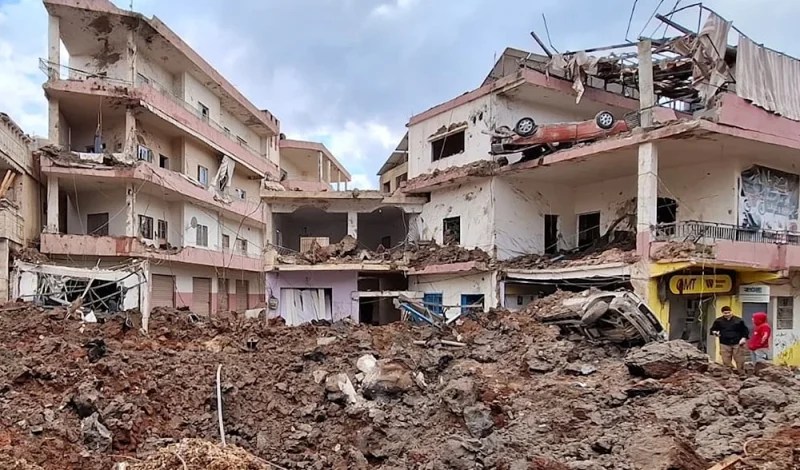
Hezbollah foiled an Israeli landing in the town of Nabi Sheet in the eastern Lebanese region of Bekaa before dawn overnight on Friday-Saturday.
Hezbollah’s Military Media said Islamic Resistance fighters observed four Israeli enemy helicopters infiltrating from the Syrian direction and landing an Israeli infantry force at the mountainous triangle linking the towns of Yahfoufa, Khraibeh, and Maaraboun.
“The enemy unit then advanced toward the eastern neighborhood of Nabi Sheet, (Al-Shukr). At 11:30 AM, upon reaching the cemetery area, the Israeli force was engaged by a group of resistance fighters using light and medium weapons, triggering a fierce clash after the infiltrating force was exposed,” the Military Media’s first statement for Saturday read.
As the confrontation intensified, the Israeli enemy unleashed heavy firepower, launching around forty airstrikes by warplanes and helicopters, to cover the withdrawal of its troops from the engagement zone, according to the statement.
Meanwhile, Hezbollah resistance artillery delivered concentrated fire with appropriate weapons on the perimeter of the battlefield and along the enemy’s withdrawal route, while residents of nearby villages joined in providing supporting fire, the first statement added.
The video shows exchange of fire between resistance fighters and Israeli enemy forces in Nabi Sheet.
In another statement, the third one on Saturday, Hezbollah’s Military Media said: “In response to the enemy’s landing in the Bekaa region, the Islamic Resistance fighters targeted the evacuation area in the outskirts of Nabi Sheet with rocket barrages at 04:15 on Saturday.”
Hebrew media reported that Israeli forces attempted to withdraw after resistance forces revealed the military activity in eastern Lebanon, and that Israeli warplanes and helicopters eventually retreated from the area after the failed airborne landing attempt.
Another video shows heavy destruction in the town of Nabi Sheet after the Israeli landing.
Lebanese Heaslth Ministry announced that the Israeli assault on Nabi Sheet led to martyrdom of 16 people and the injury of 53 others.
Iraqi Resistance: Attacks on Beirut suburbs threaten US interests
Al Mayadeen | March 7, 2026
The Iraqi Resistance Coordination Committee affirmed that recent years have demonstrated that the entire region is governed by one equation: “Either security for all, or security for none.”
Addressing the ongoing aggression against Lebanon, the Iraqi resistance stressed that the security and stability of the southern suburbs of Beirut and their residents form an integral part of the regional security equation. It added that any escalation there would have repercussions for the vital interests of the US in the region.
The committee warned that any attack on the security of the densely populated civilian suburb would inevitably be met with threats to the security of embassies belonging to the aggressor countries, whether in Iraq, Bahrain, Kuwait, or Lebanon.
It further stated that undermining the security of the Beirut suburbs would also directly affect the security of major American oil companies operating in the Arabian Peninsula, stressing that “a warning has been given.”
‘Israel’ issues massive displacement threat to Beirut Southern Suburb
The Israeli occupation, in an unprecedented move, issued a massive displacement threat on Thursday against entire neighborhoods in Beirut’s Southern Suburb. Previously issuing displacement warnings against specific buildings, the Israeli occupation has discarded this strategy and now threatens thousands of homes, businesses, medical facilities, schools, and civilians with bombardment.
The threats have specifically named the neighborhoods of Bourj el-Barajneh, Hadath, Haret Hreik, and Chiyah, which house tens of thousands of civilians, who were ordered to head east along the Beirut-Damascus highway, or north towards Matn or Beirut-Tripoli highways, respectively.
This resulted in severe traffic congestion at the entrances to Beirut’s southern suburbs as residents began leaving their homes.
The Israeli threat eerily resembles those in Gaza, where hundreds of thousands and up to a million civilians were forced to flee their zones amid mass displacement plots.
US approves $151.8M weapons sale to Israel, waiving congressional review
MEMO | March 7, 2026
The Trump administration approved a possible $151.8 million weapons sale to Israel on Friday, invoking “emergency” authority to waive the congressional review requirements as Washington and Israel continue to attack Iran, Anadolu reports.
According to a statement from the State Department’s Bureau of Political-Military Affairs, the proposed sale includes 12,000 BLU-110A/B general purpose, 1,000-pound bomb bodies, along with engineering, logistics and technical support services.
“The Secretary of State has determined and provided detailed justification that an emergency exists that requires the immediate sale to the Government of Israel,” the agency said, waiving the congressional review requirements under Section 36(b) of the Arms Export Control Act.
The principal contractor for the proposed sale will be Repkon USA, based in Garland, Texas, with part of the bomb bodies expected to be transferred from existing US stock, said the statement.
The approval comes amid escalating regional tensions following joint US-Israeli airstrikes on Iran launched Feb. 28, killing more than 1,000 people, including Supreme Leader Ali Khamenei, over 150 schoolgirls and senior military officials.
The conflict has triggered widespread regional instability and retaliatory attacks from Tehran against US-linked sites across the region. A drone strike in Kuwait killed six US service members at a tactical operations center.
The move also comes as criticism in Congress about US arms transfers to Israel has grown during Israel’s genocidal war on the Gaza Strip. In July, a record 27 Democratic senators voted in favor of a resolution to block certain weapons sales to Israel, citing concerns about civilian casualties and a humanitarian crisis in Gaza, though the measure ultimately failed.
Iran Red Crescent says 6,668 civilian sites targeted in US-Israeli attacks
MEMO | March 7, 2026
The Iranian Red Crescent Society said that 6,668 civilian locations have been targeted in attacks carried out by the US and Israel, including thousands of homes and dozens of public service facilities, Anadolu reports.
In a statement, the Iranian aid organization said that the attacks by the US and Israel struck a wide range of civilian infrastructure across the country.
According to the statement, 5,535 residential buildings, 1,041 commercial units, 14 health centers, 65 schools, and 13 facilities affiliated with the Red Crescent were among the locations hit.
The organization also reported that numerous aid and rescue vehicles were damaged during the attacks, while several relief workers and Red Crescent staff members were injured.
The statement emphasized that the attacks by the US and Israel targeting civilians violate the Geneva Conventions.
“International institutions, humanitarian aid organizations, and human rights defenders are expected to take urgent and effective measures to protect civilian lives, ensure the safety of aid workers, and guarantee respect for the rules of international humanitarian law,” it added.
Maybe Attacking Iran Was Not Such A Good Idea
By Philip Giraldi • Unz Review • March 7, 2026
The completely unprovoked attack on Iran initiated by the United States and Israel has, after a little more than a week of military action, opened a new depth of geopolitical insanity. As suspected, the attack was all about protecting Israel while also minimizing the damage to US military, intelligence and diplomatic facilities in the Persian Gulf region. In that it has been less than a great success in that there has been reportedly considerable damage done by Iranian missiles and drones in both the Jewish State and at American bases. Iran has also suffered substantially and the US bomb that killed 165 schoolgirls continues to fuel huge demonstrations and rage that is feeding a willingness to resist the United States among the Shia communities both inside Iran and in adjacent states and regions, expanding the conflict.
The combined Israel-US onslaught was intended to destroy Iranian military capabilities, most particularly its fictional nuclear and missile programs, and to bring about regime change after killing its Supreme Leader. As the attack took place, President Donald Trump announced by way of his Truth Social platform, that “We are going to destroy their missiles and raze their missile industry to the ground. It will be totally — again — obliterated. We’re going to annihilate their navy.” On Saturday March 7th Trump elaborated, tweeting how “Today Iran will be hit very hard! Under serious consideration for complete destruction and certain death, because of Iran’s bad behavior, are areas and groups of people that were not considered for targeting up until this moment in time.”
Trump also expressed himself in a post on Truth Social how Americans will die against Iran, elaborating that “the lives of courageous American heroes may be lost” in what the Pentagon dubbed “Operation Epic Fury… We may have casualties.” As Trump’s entire family has avoided military service, the ultimate price for his warmaking will consist of using other American families’ sons and daughters as cannon fodder and he may be preparing for a political backlash by demonstrating now how much he cares about the average Americans who will be impacted by his policies. Of course, he clearly does not care unless your name is Adelson or Netanyahu.
That the war is taking place at all is due to Israel’s absolute control over America’s political class, a reality that Netanyahu and his predecessors in office have not been exactly shy about admitting. The US is a hapless giant that has been corrupted by Jewish billionaire money from within, totally committed to the expansion of greater Israel no matter how many have to die in the process. Do the Israelis care what happens to the American people? No. It is only necessary to take a look at the planned or actual killing of Americans by Israel starting with the Lavon Affair in 1954 which planned to bomb US Embassy offices in Egypt. Then there came the attack on the USS Liberty in international waters in 1967, an attempt to sink the navy ship and kill all its crew, which was covered-up by President Lyndon B Johnson and his Secretary of Defense Robert McNamara. More recently, a number of American citizens have been killed with impunity by Israelis. One might mention prominent peace activist Rachel Corrie in 2003 who was deliberately run over by an Israeli army bulldozer.
To cite how this works in practice and to demonstrate how the United States uniquely favors Israel, one might cite the recent February 18th killing of the nineteen year old Philadelphia native Nasrallah Abu Siyam, who was shot in the West Bank village of Mukhmas, when rampaging settlers attacked Palestinian farmers. Nasrallah was trying to stop the settlers from stealing livestock when he was shot and it took hours to transport him to a hospital due to “security” checkpoints and Jews-only roads established by the Israeli government. Israeli settlements, built on land stolen in the Palestinian territories, have been expanding at a rapid pace and the rampaging settlers are routinely protected by the army and police. Settler attacks soared to over 1,800 incidents last year, according to a United Nations report. Attacks have included violence, property damage, arson, killing of livestock and theft.
In a normal country, the US Embassy or Consulate would pressure the local government to investigate and seek to have the killers arrested, tried and brought to justice, but that does not take place in Israel where the attitude is “we’ll let the Israelis handle it.” Sure. Nine US citizens have been murdered in Israel in the past several years, but no one has been criminally charged in the killings while the United States has declined to open any independent investigations. The death toll includes New Jersey-born Amer Rabee, 14, who was shot by soldiers on April 6th, 2025, amid unproven allegations that he had thrown stones. Also there was Saifullah Kamal Musallet, a 20-year-old resident of Tampa, Florida, who was beaten to death by Israeli settlers in July; and Khamis Ayyad, 44, who died of smoke inhalation in August after settlers set fire to houses in his village. Tawfic Abdel Jabbar and Mohammad Ahmed Mohammad Khdour, both 17, were shot and killed in separate incidents in February 2024 while in September of that year, a soldier fatally shot in the head Aysenur Ezgi Eygi, 26, of Seattle, during a protest against illegal settlements. And then there was Omar Assad, 78, who was walking in his village before being seized by soldiers for no reason, handcuffed and gagged, with his hands bound behind his back, and then left alone on his stomach at a cold construction site. He died from a stress-induced heart attack in January 2022.
There is also the high-profile killing of journalist Shireen Abu Akleh, who lived in New Jersey as a child, in May 2022. Israeli authorities determined that the gunfire from soldiers was likely accidental, despite investigations by media and the UN concluding she was deliberately targeted and killed lest she report on Israeli war crimes. Beyond Abu Akleh, Israel is responsible for two-thirds of all journalists killed in the line of duty worldwide.
Interestingly, in the case of the teenager Nasrallah and the other recent deaths, more than 30 US senators have signed a letter demanding that the Trump administration open an independent investigation. “For all nine of these killings, no one has yet been held accountable by the Netanyahu government, nor has the US government upheld its duty to protect Americans and secure justice and accountability for their deaths,” the letter from the Congressmen says. “It is unclear to us how many more Americans must die in the West Bank in order for this administration, and other administrations, to take serious, credible steps to secure accountability and ensure an end to the ongoing killings of Americans without consequence.”
The State Department responded that it extends condolences to the family and expects “a full, thorough and transparent investigation into the circumstances surrounding the death,” indicating that it would rely on Israeli authorities to investigate, which means that nothing will be done. The unwillingness to represent the interests of actual American citizens is due to the fact that all recent US Ambassadors to Israel have themselves been ardent Zionists, with the worst of the lot being the current incumbent Mike Huckabee who has cordially met with Israel’s leading spy against the US Jonathan Pollard and has endorsed a Greater Israel which will stretch from the Nile River to the Euphrates. The indigenous population will of course be removed, just as the Gazans, Palestinians on the West Bank and the inhabitants of South Lebanon are being currently disposed of with the assistance of Donald Trump and company. Huckabee, in an interview with Tucker Carlson, said that it “would be fine if they took it all” [Greater Israel] for the Jewish state, as it was a “land given by God to the Jewish people.” This was not a casual remark but a moment of unscripted candor, a world-changing admission of a supremacist belief system favoring the Jewish state that had long operated in the shadows of US foreign policy.
US Secretary of War Pete Hegseth, a fervent Christian Zionist, even foresees great benefit coming from a Biblically predicted Armageddon global conflict beginning in the Middle East which will lead to “End Times” after which the faithful will be wafted up to heaven in the so-called “Rapture.” If one wonders just what has happened to US foreign and national security policy Hegseth and Huckabee are good places to start.
The point is that Israel is beyond brutal in its treatment of anyone who is not a Jew yet Donald Trump and company appear to think that that is just fine. Last week I saw a video on Facebook which was sickening. It showed a Christian woman walking her dogs in Jerusalem and being assailed by a mob of screaming hysterical Orthodox Jewish students who attacked her, and the dogs, for no other reasons beyond the fact that she existed. To be sure, I am an animal lover, but the attackers were so far outside the realm of conventional morality that one has to despise what they represent. Their on-display manifestation of what they regard as their Yahweh-given exceptionalism should be revolting to most others who do not share their so-called faith. The truly disgusting part is that the woman and her dogs were not exactly an extreme example of the interactions that Christians are now experiencing in Jerusalem with their presumed Jewish overlords. Churches are regularly vandalized and Christians are blocked from attending services while also being spat upon, cursed and otherwise harassed in the streets. There are reports that “Spitting on Christians is a Jewish custom!”
Unfortunately the Christian Zionist belief system has successfully dominated American evangelicalism and Israeli policy. This ideology asserts a “divine right” to conquer, pillage, and commit genocide, positioning itself above all man-made laws and international norms. It is, by its very definition, an ethnic and theological supremacist doctrine that dehumanizes all neighboring peoples as obstacles to a divine plan. As I’ve noted previously, this philosophy “is rooted in ethnic supremacism” and claims that “God gave modern day Israel the right to kill anyone they want, to steal any land they want.” This is not seen as a symbolic promise but a literal deed to real estate, with the millions of current occupants to be “subordinated, expelled, or dealt with by whatever means history requires.” Such a worldview reduces the US Constitution, international law and the UN Charter to be mere inconveniences. Mike Huckabee has argued that “the United Nations charter doesn’t count because God said so.” And his boss Donald Trump has declared that as President of the United States “I can do whatever I want!” which includes permitting genocide and land theft. With such beliefs in place, it is no wonder that many Americans are increasingly coming to appreciate that what is going on in our nation is leading us towards disaster!
Philip M. Giraldi, Ph.D., is Executive Director of the Council for the National Interest, a 501(c)3 tax deductible educational foundation (Federal ID Number #52-1739023) that seeks a more interests-based U.S. foreign policy in the Middle East. Website is https://councilforthenationalinterest.org address is P.O. Box 2157, Purcellville VA 20134 and its email is inform@cnionline.org
UK readies deployment of Prince of Wales carrier amid war on Iran
Al Mayadeen | March 7, 2026
The United Kingdom is reportedly preparing one of its naval assets for possible deployment to West Asia as Western military pressure on Iran continues to grow following the US-Israeli assault on the country.
According to media reports, the Royal Navy aircraft carrier HMS Prince of Wales is being placed on higher readiness, with its preparation time reduced so that it can be deployed more quickly if ordered by the British government. Crew members have reportedly been warned that the vessel could be sent to the region amid the escalating confrontation triggered by the US and Israeli strikes on Iran.
According to reports, the move does not mean the carrier will necessarily be dispatched immediately. However, raising its readiness would allow the government of Prime Minister Keir Starmer to deploy the warship rapidly should the aggression against Iran escalate further.
Western buildup around Iran
The preparations come as Britain gradually expands its military presence across the region following the US–Israeli assault on Iran that began on February 28.
Since then, London has moved additional forces to the Middle East, including deploying more fighter jets to Qatar and sending helicopters equipped with counter-drone systems to Cyprus.
British forces have also been involved in intercepting drones and missiles across several countries in the region, while the Royal Navy has ordered the destroyer HMS Dragon to the eastern Mediterranean to reinforce security around British bases on the island of Cyprus.
These deployments also follow a drone strike targeting the British air base at RAF Akrotiri, during which British forces identified the drone as a Shahed-type model widely associated with Iranian production. The launch location was not immediately known.
Despite Western attempts to increase their military presence, Iranian officials have repeatedly rejected calls for surrender and warned that any further escalation will be met with additional responses.
Iranian Crisis Becomes Embarrassment for US Military That Can’t Protect Anyone – MidEast Analyst
Sputnik – 07.03.2026
Prior to the arrival of the United States, the Persian Gulf was essentially the domain of the British Empire which ended up handing over its holdings to the US to ensure that the latter would be at the forefront of any major war in the region, Middle East affairs expert Mais Kurbanov tells Sputnik.
Currently, the US controls a network of military installations that don’t just serve as military garrisons – these are all elements of a system of control of the Gulf ‘gas station,” Kurbanov remarks.
This defensive network was never meant to protect the Arab states of the Gulf – it’s real purpose was to protect Israel.
“This entire shield was created to keep Israel safe and to intercept missiles. They were more or less able to intercept them during the previous conflicts, before Iran started targeting their radars. And now they got nothing to intercept because Iran destroys the early warning system itself,” notes Kurbanov.
The US is unwilling and unable to defend the Gulf states – it only cares about its own interests. And all of the Gulf states besides Iran are now vulnerable because they don’t have any air defense systems, he adds. The US focuses on protecting only its own assets in the region.
“The US has embarrassed itself in front of the entire world. Everybody now knows that the Americans are no protectors,” says Kurbanov. “They used to mock Russia when Ukraine scored some hits, acting as if they are invincible. Now Iran keeps pummeling them, and US ships have to flee two thousand kilometers into the ocean to escape Iranian missiles.”
“It means the US has no meaningful air defense. Neither Israel’s Iron Dome nor the US’ vaunted Patriots can do anything. Consider this: such weapon system costs a billion dollars and an Iranian Shaheed, this dirt-cheap drone worth twenty thousand, just takes it out.”
All of the weapons the US peddled across the world – stealth aircraft, MQ-9 Reaper drones they were so proud of – turned out to be useless,” he points out.
Meanwhile, Iran keeps demonstrating the kind of new missiles that maybe two other leading world powers beside them possess.
“The US should just leave. There will be no negotiations with them and they know it,” argues Kurbanov.
Though the US does possess an extensive global network of military installations – several hundred facilities in dozens of different countries – even it cannot ensure an immediate stabilization of the situation. He points out that Russia and China haven’t yet become actively involved in the current crisis, and that without their involvement the US would be hard-pressed to deal with global issues.
Iran pledges to ‘respect sovereignty of neighbors’, declares US-Israel assets ‘primary targets’
The Cradle | March 7, 2026
The Iranian armed forces warned that US and Israeli military installations across the region remain legitimate targets, as officials seek to ease tensions with neighboring countries.
“Should the previous hostile actions continue, all military bases and interests of criminal America and the fake Zionist regime on land, at sea, and in the air across the region will be considered primary targets and will come under the powerful and crushing strikes of the mighty armed forces of the Islamic Republic of Iran,” the Iranian Revolutionary Guard Corps (IRGC) said in a statement on Saturday.
The warning came alongside a declaration by Iran’s Khatam al-Anbiya Central Headquarters that Iranian forces “respect the national interests and sovereignty of neighboring countries” and “have not carried out any act of aggression against them.”
Nevertheless, military officials emphasized that installations used by the US or Israel to launch attacks against Iran remain fair game. Lieutenant Colonel Ibrahim Zolfaghari said that at least 21 US personnel have been killed and many more injured in attacks on the US Navy’s Fifth Fleet infrastructure, while additional casualties occurred during strikes on Al-Dhafra Air Base.
He also said Iranian forces targeted a US-owned oil tanker in the northern Persian Gulf.
Earlier in the day, President Masoud Pezeshkian announced that Iran’s interim leadership council had ordered the armed forces to cease striking neighboring countries unless attacks originate from their territory.
“The temporary leadership council approved yesterday that neighboring countries should no longer be targeted and missiles should not be fired unless an attack on Iran originates from those countries,” Pezeshkian said in a pre-recorded address.
Pezeshkian’s statement was made amid increasing tensions over regional airspace with Iran’s neighboring countries.
Turkish authorities claimed this week that NATO missile defenses intercepted a ballistic projectile allegedly launched from Iran that crossed Iraqi and Syrian airspace before approaching the northwestern Syria-Turkiye border.
In Azerbaijan, officials accused Tehran of launching a drone attack that struck the Nakhchivan airport terminal, prompting President Ilham Aliyev to warn Iran “will regret it,” while Iranian authorities denied involvement.
Tehran vehemently denied involvement in either of these attacks.
Saudi journalist Adhwan al-Ahmari said in a recent interview with Asharq News that “not all attacks” targeting Gulf states come from Iran, warning the war could be “an American-Israeli trap to implicate the Gulf countries and draw them into a confrontation with Iran.”
Iranian officials told Middle East Eye (MEE) that some recent drone strikes on Gulf energy infrastructure were not carried out by Tehran, with one official describing the attack on Saudi Aramco’s Ras Tanura facility as “an Israeli effort to sabotage regional peace and alliances between neighbours.”
“I can categorically say that some of the attacks were not carried out by us [Iran],” the anonymous official told MEE.
Saudi Arabia, Qatar, the United Arab Emirates, Kuwait, Bahrain, and Oman have all sustained strikes within their territories due to the presence of US assets within their borders.
USA and Israel: Who is the lord and who is the colony?
By Raphael Machado | Strategic Culture Foundation | March 7, 2026
The Epstein Coalition (USA and Israel) began a war against the Islamic Republic of Iran on February 28th. The starting shot was the murder of 171 girls in an elementary school (perhaps as a sacrifice to Baal, the Epsteinians’ favorite deity?), followed by the martyrdom of Ayatollah Ali Khamenei, in his own residence.
It was the beginning of an “operation” that the USA expected to see finished in a few hours, then in 3 days. Well, the operation has now exceeded 6 days, and all analysts indicate that the war will last at least a few weeks, with significant losses on both sides.
What led to this operation being initiated? The easy and predictable answer is that the USA wants Iran’s oil and other natural resources.
Usually, those who reason this way also tend to say that the State of Israel represents an enclave of the USA or the “collective West” in the Middle East, whose purpose would be to serve as a trading post to facilitate or enable the occupation of the region, to ensure the exploitation of its natural resources. This is perhaps the inevitable result of looking at the comparative statistics of both countries.
The USA is larger, has a larger GDP, more powerful and numerous armed forces, has more billionaires; in short, it is “superior” in every possible and imaginable aspect, so that the US-Israel relationship can only be perceived as one in which the USA commands and Israel obeys.
Indeed, Marxian and, in general, materialist readings go in this direction. But does the Iran War confirm this assessment?
If Israel is the obedient colony of the USA, then the decision to start the conflict would have been eminently that of the USA, with Israel simply obeying the determination of its “metropole.”
But what is perceived from the official statements of Secretary of State Marco Rubio and Secretary of War Pete Hegseth is exactly the opposite: they made it quite clear in their press conferences that the USA became involved in the conflict only because Israel had already decided to attack Iran, with Washington simply following the Zionist determination.
The pretext of alleging a pre-emptive attack plan by Iran was used, but the pretext was quickly abandoned after being refuted by the Pentagon. In fact, Iran had no plan to attack either the USA or Israel.
In other words, Israel would have made the USA attack Iran. How is that possible?
The solution to the mystery seems to lie in the role of the Jewish community in the USA and its influence over the country’s internal affairs, regardless of whether its members hold Israeli citizenship or not. After all, despite comprising only 2.4% of the US population, 25% of its members have an income equivalent to the top 4% richest among non-Jews.
And if in many countries a large part of the Jewish community is critical or indifferent to Israel, in the USA, 90% of community members support Israel against its enemies. And this support is not merely verbal, expressing itself through the formal organization of lobbies that finance pro-Israel candidates and harm anti-Israel candidates, the most famous of these organizations being AIPAC, which invested almost 130 million dollars to elect its candidates in 2024.
A much more important asset, however, is the fact that, as indicated by income, many members of this community occupy positions of power and influence in the mass media, the banking system, and entertainment. Even though they are only, again, 2.4% of the US population, they constitute 33% of the CEOs of major banks, 40% of the CEOs of major media conglomerates, and 50% of the CEOs of major companies in the entertainment industry.
And these are the sectors that basically control the flow of investments, as well as shape the opinions and tastes of the country’s population.
Years ago, geopolitical analysts John Mearsheimer and Stephen Walt released an excellent book on the Zionist lobby in the USA. What they make very clear in that work is that US support for Israel is not linked to any strategic interest of Washington. The cost of supporting Israel is immense, both in money and in the international popularity of the USA. In fact, the USA only harms itself by supporting Israel against its enemies.
So how could one say that the USA controls Israel?
Returning to the current presidential administration, figures like Hegseth and Lindsay Graham openly admit that the main goal of the USA is to facilitate the reconstruction of the Temple in Jerusalem to pave the way for the coming of the Jewish Messiah. Eschatologically, the problem there is that, for Catholics, Orthodox, and traditional Protestants, the Jewish Messiah is the Antichrist.
As much as Israel is dependent on US financial and military aid, Zionism has captured the decision-making and public opinion-forming mechanisms so completely that we could practically compare the unipolar hegemon to a headless golem. In place of “America First,” it is the policy of “Israel First.”
While US bases, radars, planes, and personnel are hit by barrages of missiles and drones, and Washington loses influence and the capacity to project power in the Middle East, it becomes inevitable to reach the conclusion that Israel is the one calling the shots in this relationship, and that Tel Aviv will instrumentalize the USA as long as it serves its own expansionist interests.
Indian journalist reveals severe Israeli censorship after escape from occupied territories
Press TV – March 7, 2026
An Indian journalist who was trapped in the occupied territories from February 28 to March 6 has revealed severe Israeli censorship amid the regime’s war of aggression against Iran.
Braj Mohan Singh of India’s Sandha News said he witnessed people dying in 100‑foot‑deep bunkers while Israeli officials withheld details.
Missiles “don’t differentiate between Indian or Israeli,” he said.
He contrasted press freedom in India with the restrictions in Israel, noting journalists cannot film bodies, visit hospitals, or receive accurate casualty numbers. Local accounts often reveal far higher losses than official reports, he added.
“When an incident takes place, we are not given the details of the location. The next day, when we visit the site, we are told, ‘There was only one casualty,’ but a local told us, ‘There were four houses, and everyone died,” which shows there was a major incident,’” he added.
Despite Israel’s touted advanced warning systems, Singh reported missiles arriving without sirens or prior alerts, highlighting technology failures and the unpredictability of drone and missile attacks.
He also mentioned reports of Iranian targeting of US embassies across West Asia and possible attempts in Tel Aviv, underscoring the heightened danger in the region.
The regimes in Washington and Tel Aviv started their unprovoked military assault on February 28, assassinating Leader of the Islamic Revolution Ayatollah Seyyed Ali Khamenei and top Iranian military commanders.
Iran began to swiftly retaliate against the criminal aggression by launching barrages of missile and drone attacks on the Israeli-occupied territories as well as on US bases in regional countries.
Featured Video

“Historic Russia”: The Land Putin Will Not Give Back
or go to
Aletho News Archives – Video-Images
From the Archive
How Ukraine Tortured and Slaughtered Donbass
By Kit Klarenberg | Al Mayadeen | July 11, 2024
Almost immediately after the proxy war erupted, ISIS-tier footage of the torture and murder of Russians in Ukrainian custody emerged.
On July 6th, the New York Times published an astonishing investigation: In Ukraine, Killings of Surrendering Russians Divide an American-Led Unit. The article documents in grim detail how Chosen Company, an international volunteer battalion for Kiev, routinely executes Russian prisoners of war. It is the very first mainstream admission that this practice – a brazen breach of the Geneva Conventions, and a grave war crime – is widespread among Ukraine’s fighters, both foreign and homegrown. … continue
Blog Roll
 Aletho News
- Record Oil, Empty Tanks: The UAE’s Miracle Recovery
- Burnham tackles Britain’s poverty with aggression in Yemen
- Peace in Ukraine: the easy way – or the hard way
- Trump & the Rrrrussians
- US taxpayer money laundered back through Ukraine – Musk
- Before COVID, an NIH lab chief proposed making a SARS-like bat virus more infectious
- Gates, Bourla on Trial in Netherlands Accused of ‘Great Reset’ Scheme at Vaccine Injury Hearing
- BRITAIN’S WARNING: PREPARE FOR WAR
- “Historic Russia”: The Land Putin Will Not Give Back
- How the Cambridge Analytica scandal still haunts Mark Zuckerberg
- If Americans Knew
- DAILY UPDATE: Latest essential news on Palestine, Israel, & region
- Damning report shows the media must confront its failures on Gaza
- BBC senior broadcaster speaks out on Gaza coverage
- Netanyahu vows vast West Bank invasion in response to 20-minute skirmish that left 2 Israeli soldiers and 2 Palestinian fighters dead
- Tied up and tortured: Israel using US-made electroshock weapons on Palestinian detainees
- The outsourced risk: how newsrooms rely on Gaza’s freelancers without protecting them
- Gaza bakeries forced to shut as Israel blocks flour shipments
- Gaza’s breast cancer patients face a deadly wait for treatment amid Israel’s genocide
- DAILY UPDATE: Latest essential news on Palestine, Israel, & region
- The Israel Lobby’s Changing Fortunes
- No Tricks Zone
- Two New Studies Find Thwaites Glacier Melt Cannot Be Driven By Human Activity Or A Warming Ocean
- E-Cars Reduce CO2 Emissions By Only 41% Compared To Internal Combustion Engine Vehicles
- Predictions Made By Renowned Climate Professor Over Past Decades Have Been Proven To Be Poor
- New Study Suggests Large Regions Of The Pacific Ocean Have Been Cooling For The Last 80 Years
- Germany’s Green Energy Debacle: High Energy Costs Force Kahla Porzellan to Close After 182 Years!
- New Study: 50 Years Of The Most Aggressive ‘Net Zero’ Policies Can Only Affect The Global Climate By 0.03°C
- US September “Heat” Was No Record…Many Records Set Decades Ago
- Latest European Green Energy Debacle; Portugal’s Largest Flagship Solar Park Insolvent!
- Green Energy Debacle: German Expert Professor Fritz Vahrenholt Warns Of Severe Economic And Social Consequences
- Two More Paleo Reconstructions Affirm Meters-Higher Sea Levels Across Ireland, Brazil 7000-6000 Years Ago

