Israeli navy captures two Gaza fishermen, including one injured by gunfire
By Rosa Schiano | International Solidarity Movement | November 13, 2013
Gaza, Occupied Palestine – On the morning of Sunday, 10th November, brothers Saddam Abu Warda (age 23) and Mahmoud Abu Warda (age 18) were captured by the Israeli navy in Palestinian waters off the Gaza Strip. They were released later in the evening and their boat was confiscated. Mahmoud was injured by a bullet in the right side of his abdomen.
We went to visit the two young fishermen in their home in the town of Jabaliya, in the northern Gaza Strip.
In the absence of electricity, the house was dark like most homes in Gaza Strip, which is stifled by the siege and a severe fuel crisis. Without electricity, water could not reach the house’s plumbing system.
“We cast our nets into the sea at a distance of about 500 meters from the forbidden fishing area,” Saddam told us. “We were far away from the Israeli gunboats.” The two fishermen were on a small boat, or hasaka, without an engine.
Saddam told us that an Israeli gunboat approached their boat. The soldiers shouted for them to leave in less than five minutes. “We had to cut our nets in order to flee,” Saddam said. “The soldiers came closer to us and started shooting at our boat.”
Without a motor, the two fishermen could not escape. The Israeli soldiers ordered the two fishermen to undress and jump into the water. Meanwhile, they continued to open the fire. “I was shocked,” Saddam said. “I could not move. They were shooting, and I thought I would be killed.”
As we listened to Saddam, F-16 fighter jets rumbled overhead at low altitudes, a constant threat in the darkness.
“I shouted, asking the soldiers to stop shooting and save our lives,” Saddam said. According to him, another Israeli gunboat reached them and attacked the fishermen using water cannons. The two fishermen jumped into the water. “Three Israeli gunboats surrounded us, our boat was now far away, and the water was cold,” he added. The soldiers told them to swim to the forbidden maritime area. “I was scared. My brother was away from me, and the soldiers kept firing. He was wounded. He could not swim. I reached him to save him. His blood was everywhere in the sea. Two Israeli dinghies reached us. The soldiers took my brother Mahmoud and closed his wound to stop the bleeding. They didn’t take me, too. They left me in the water. They told me to swim to the marker that delimits the maritime area allowed by Israel, then took me. They covered my head. I could not see anything. They pointed a gun at my head and cuffed my hands and feet. They hit me, kicking me on the back. Then I fainted for about an hour. I don’t remember anything more.”

Mahmoud (left) and Saddam Abu Warda. (Photo by Rosa Schiano)
The two fishermen were transported to a medical center in the port of Ashdod. “When I woke up, I saw my brother beside me,” Saddam said. “Two soldiers then took me to a special room and interrogated me. They asked me why we were fishing in the forbidden area. I told them that we were 500 meters away from the limit, and that the soldiers forced us to swim until we reached it. An investigator asked me how my brother was wounded, since it was not by the Israeli soldiers. I told him my brother was wounded by Israeli gunfire. The investigator tried to convince me that Mahmoud was not wounded by the soldiers. Then I told him that three Israeli gunboats were shooting over our heads and my brother’s blood was everywhere in the sea”.
The investigators then showed Saddam a map on a laptop, placing their boat in the forbidden maritime area. Investigators interrogated the two fishermen individually. Afterwards, the two brothers were detained in another room, and at the end of the day, were transferred to Erez, where they received another interrogation. “They asked me about my family, my neighbors, fishermen, and every detail of my life,” said Saddam. “Then they showed me a map and asked me about every house around my home. They also asked me how many boats I had.”
The Israeli port of Ashdod now holds three boats belonging to Saddam’s family. In the past, in fact, other members of the Abu Warda family had been arrested and seen their boats confiscated. Now they have none left.
After interrogation, the fishermen were detained in a cell for two hours before being released through the Erez checkpoint later in the evening.
Saddam’s family has 15 members. Fishing is their only source of livelihood. The other eight brothers are also fishermen. They don’t have any other source of income, and they don’t believe they will get their boats back.
Mahmoud showed us the wound on the right side of his abdomen. The bullet did not enter his body, but brushed it. Doctors in the Ashdod medical center closed his wound with two stitches. Mahmoud also told us of the physical and verbal abuse he received from Israeli soldiers. We asked him if he will return to fishing. “Of course,” he said. “We have no choice. We have to face the danger.”
What its fishermen earn only allows the Abu Warda family to survive. Sometimes, they return home without anything. Other times, what they earn only covers the cost of fuel.
The fishermen told us that they would like more support from international associations, especially when they are in the north of the Gaza strip. There, attacks are more frequent and the majority of confiscated boats have been lost.
We continue to hope that one day the international community will break its silence and force Israel to stop attacking Gaza fishermen, and to release all their boats it has confiscated.
Background
Israel has progressively imposed restrictions on Palestinian fishermen’s access to the sea. The 20 nautical miles established under the Jericho agreements, between Israel and the Palestine Liberation Organization (PLO) in 1994, were reduced to 12 miles in the Bertini Agreement of 2002. In 2006, the area Israel allowed for fishing was reduced to six nautical miles from the coast. After its military offensive “Operation Cast Lead” (December 2008 – January 2009) Israel imposed a limit of three nautical miles from the coast, preventing Palestinians from accessing 85% of the water to which they are entitled under the Jericho agreements of 1994.
Under the ceasefire agreement reached by Israel and the Palestinian resistance after the Israeli military offensive “Operation Pillar of Defense” (November 2012), Israel agreed that Palestinian fishermen could again sail six nautical miles from the coast. Despite these agreements, the Israeli navy has not stopped its attacks on fishermen, even within this limit. In March 2013, Israel once again imposed a limit of three nautical miles from the coast. On 22 May, Israeli military authorities announced a decision to extend the limit to six nautical miles again.
Related article
- Army Invades Southern Gaza (imemc.org)
Soldier killed in Occupied Palestine as Israel calls for “intelligent” settlements
Al-Akhbar | November 13, 2013
A 16-year-old Palestinian stabbed an Israeli soldier to death on a bus on Wednesday in an attack apparently motivated by the jailing of his relatives in Israel, police said.
The death came as Israel backtracked on an announced plan to expand illegal settlements in the West Bank, calling for “intelligent and coordinated” construction despite international condemnation.
The killing, in the town of Afula in Occupied Palestine, follows a surge in violence in the West Bank, where 10 Palestinians have been shot dead by Israeli troops and three Israelis killed since peace talks resumed in July.
Israel’s northern police commander, Ronny Attia, said the attacker was from the West Bank town of Jenin, and that he was in custody.
According to police, the Palestinian youth did not have a permit to be inside Israel.
“By his account, his uncles are in prison in Israel and this is the reason he decided to carry out the terrorist attack,” Attia said.
Israel refers to many acts of protest against the decades-long occupation – whether violent or non-violent – as terrorism.
Police spokesman Micky Rosenfeld said the soldier, aged 18, was pronounced dead in hospital.
The attack occurred a day before the one-year anniversary of the Israeli Pillar of Cloud offensive on Gaza, in which six Israelis and more than 100 Palestinian civilians were killed in eight days.
Peace talks orchestrated by US Secretary of State John Kerry have faced serious obstacles, including the high rate of Palestinians incarcerated in Israeli prisons, many in indefinite administrative detention, as well as extensive plans to expand Israeli settlements in the West Bank.
A report by British newspaper The Guardian on Tuesday revealed that Israeli troops conducted mock arrests and raids in the West Bank without informing the local population that their actions were drills, causing extreme distress to many Palestinians.
The attack came as Israel’s Intelligence Minister Yuval Steinitz urged “coordinated” settlement building, a day after a new plan for settler homes in the West Bank drew international condemnation.
Settlements in Israeli-annexed east Jerusalem and the West Bank “must be done in an intelligent and coordinated way,” Steinitz told Israeli public radio on Wednesday.
The settlements are deemed illegal under international law.
Israeli Prime Minister Benjamin Netanyahu late Tuesday cancelled plans to build 20,000 new settler homes in the West Bank, hours after their announcement sparked US and Palestinian criticism.
State Department spokeswoman Jennifer Psaki had said Washington was not only concerned by the initial announcement, but also “surprised” and sought an explanation from Israel.
She repeated the longstanding US position on settlements that “we do not accept the legitimacy of continued settlement activity.”
Netanyahu then ordered Israeli Housing Minister Uri Ariel “to reconsider all of the steps for evaluating planning potential (for the settler homes) that he distributed without any advance coordination,” the premier’s office said.
(Reuters, AFP, Al-Akhbar)
Related video
French starting to see Zionist lobby pull: Analysis
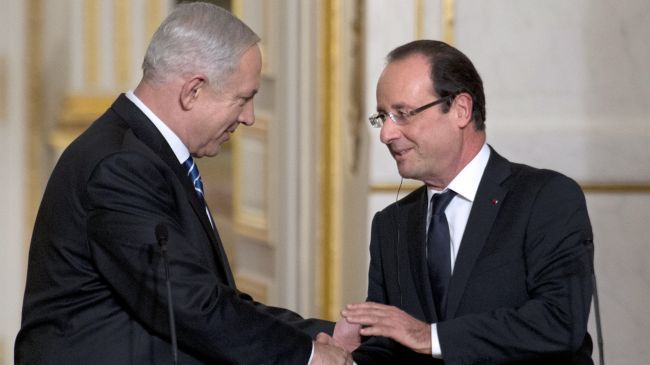
By Tahmineh Bakhtiari | Press TV | November 11, 2013
Since the formation of Israel and even before that, Tel Aviv has always resorted to lobbying to pursue its illegitimate objectives, including efforts to earn recognition for its so-called government.
Israel’s most active lobby is in the US, but it is also highly active in European countries such as Britain, Germany, France and even Italy and Spain.
This article seeks to discuss the influence of the Zionist lobby and France-Israel ties.
After a book by John Mearsheimer and Stephen Walt about the influence of the Israeli lobby on US foreign policy was published in 2007, French daily Le Monde published an article in October that year describing the Zionist lobby in France as a non-transparent and deceitful group. From that point, the issue of the Zionist lobby in France and its influence on the country’s foreign and domestic policy has been taken into consideration.
The Zionist lobby in France has extensive influence in three areas: A: Media and their affiliate companies, including Eutelsat; B: Political parties who receive campaign funding and media sponsorship from the Zionist lobby; C: Oil and arms companies.
The history of Zionist lobby in France
The Zionist movement led by Joseph Fisher started its activities in France between the first and second World Wars. Later in 1949, Fisher became Israel’s ambassador to Belgium. France had incurred heavy losses during World War II and that laid the groundwork for the presence of affluent Jews in different economic, social, judicial, cultural, religious and political arenas of the country.
At present, there are over 100 Jewish organizations and societies in France and all of the active Israeli parties have offices in Paris. In 1977, different Jewish groups in France merged and formed the Representative Council of French Jewish Institutions (Le Conseil Representatif des Institutions Juives de France (CRIF)).
The group is tasked with pursuing the interests of Israel inside France and its foreign policy. The group which owns a myriad of newspapers, magazines, TV networks and satellite service providers, has extensive influence in France’s political and legal bodies. Moreover, the Zionist lobby has a lot of lucrative businesses and financial institutions under its control.
The Zionist lobby in Israel has also formed certain groups for defaming, suing and even bringing to trial the individuals and groups which do not assert Israel’s interests. The French Union of Jewish students, the union of Jewish merchants in France, the SOS Racisme (established by the French Socialist Party to curry favor with Israel), the Organization of Lawyers without Borders France and the Anti-Defamation League are some examples.
French parties and the Zionist lobby
In domestic politics, some of the political parties are in competition with each other to forge friendly ties with Israel due to their need of pro-Israeli funds for victory in elections.
One of the examples of the Zionist Lobby’s sway in France is the naming of one the key roundabouts in Paris as David Ben-Gurion by the council of the city, which is comprised of rightist and socialist parties. Interestingly, the socialist mayor of Paris performed the ceremony with Shimon Peres.
Moreover, there are other Parisian squares named after the Zionist leaders such as Theodor Herzl and Yitzhak Rabin.
In 2012, around 112 French lawmakers, both rightists and leftists, held a festival in support of Israel. The move was aimed at opposing Palestine’s UN membership. The French parliamentarians stood up singing Israel’s national anthem.
The influence of the Zionist lobby in France reaches its peak during the election campaign in the country where each candidate competes with the others to ingratiate itself with Israel.
Among the French parties, the Socialist party has the closest ties with Israel and it adjusts most of its work plans, particularly vis-à-vis foreign policy, with the officials in Tel Aviv. The recent stance of Socialist French Foreign Minister Laurent Fabius regarding the nuclear talks with Iran was aligned with his illogical compliance with Tel Aviv’s policies towards Tehran.
Israel-France intelligence and security cooperation
Apart from the poisoning of Yaser Arafat, the former president of the Palestinian National Authority, and his hospitalization at a military hospital in Paris — which was a sort of French-Israeli intelligence and security coordination – the history of Paris-Tel Aviv ties is fraught with such cooperation.
From the outset of the fake Israeli regime, the French government authorized its intelligence apparatus to cooperate with the Mossad elements in assassinations of Arab and Palestinian fighters.
In 1965, under the presidency of Charles De Gaulle, Mossad abducted Mehdi Ben Barka, an opponent to King Hassan II, in cooperation with the French intelligence service. In 1972, Mossad killed Palestine Liberation Organization’s Representative to Paris, Mahmoud Al-Hamshri in cooperation with French intelligence elements.
Moreover, in the judiciary section, the French government has always acted in accordance with the interests of the Zionist lobby, the trial of Roger Garaudy, the writer of The Founding Myths of Israeli Politics, being an example.
Most of the world media are under the Zionist lobby’s sway and, using this powerful tool, they have managed to control world public opinion. That’s why when a media outlet moves in the path of actually informing the public, they spare no effort to prevent its activities.
The Zionist lobby in France puts pressure on the companies which provide services to the anti-Zionist satellite networks. The pressures by the Zionist lobby on the French Satellite service provider Eutelsat to stop the broadcasting of al-Manar, al-Alam, Press TV, Sahar and other networks is another example of such media sway.
Generally speaking, the Zionist lobby in France is enormously powerful in different spheres, despite its unpopularity among the French public. It has tried hard to portray Israelis as oppressed people. However, given the growth in public awareness, the information revolution and expansion of information dissemination tools, Zionism can no longer dominate public opinion.
The domineering and greedy nature of the Zionist regime and the futility of its claims about its opponents are being unmasked on a daily basis. This will lead to mounting pressure of public opinion’s pressure on the politicians. Nonetheless, for the time being, the majority of French politicians need the money and economic leverage of the Zionist lobby for the achievement of their objectives and the French media have to keep silent in order to survive and avoid the anti-Semitism tag.
In other words, at present France is under the domination of Zionists and their supporters, but the French public is gradually becoming aware of the fact.
~
Tahmineh Bakhtiari is an Iranian journalist and an expert on the Middle East and Latin America. Her writings have appeared in many print and online journals and newspapers including The Khorassan Daily, Jam-e Jam, Jomhuri Islami and Aftrab-e Yazd. Her book ‘The Genealogy of Zionism’ was published in 2001. Bakhtiari has a master’s degree in international relations.
Related article
Two Broken Cameras
By Yossi Gurvitz | November 11, 2013

Israeli soldiers try to arrest Activestills photographer Yotam Ronen, as Palestinian and international activists block 443 highway, which connects Tel Aviv and Jerusalem through the West Bank, during a protest against the violence of the Israeli settlers, October 16, 2012.
One morning last September, Nadel Shafiq Taher Shatiya heard the loudspeakers of the mosque in his village, in the Nablus region, announce that settlers were approaching the village’s land. Shatiya, a photojournalist by trade, grabbed two cameras and raced to the scene.
Based on his account, it turns out that when he arrived, several tractors and settlers – who, according to the reports received by Shatiya, came from thenearby Elon Moreh settlement – were trying to plough the village’s lands while several dozen Palestinian farmers tried to expel them. A settlement security vehicle showed up, and two settlers stepped out of it (Shatiya believes he can identify them), and started shooting live ammo at the farmers. Some of them took cover; Shatiya kept taking photos. That’s his job.
About ten minutes later, a large IDF force arrived at the scene, and did what it usually does: joined the settlers. The soldiers fired tear gas canisters and stun grenades at the farmers, and as the area is full of dry thorns, a fire broke out. The Palestinian farmers tried to put it out, and the two armed settlers demanded that the troops stop them (Yours truly was present for another incident, in which IDF soldiers fired at Palestinians who tried to put out a fire which had erupted after a demonstration due to canister fire.) The soldiers confronted the Palestinians, and Shatiya saw – and documented – one of the soldiers pull out a knife and threaten one of the farmers.
Our brave troops don’t know how to deal with nonviolent resistance. Major General (res.) ‘Amon Gilad became famous abroad when he told the American embassy “we don’t do Ghandi very well.” In such cases, the IDF’s instinct is to use excessive force. It makes for bad publicity, and the soldiers know that – so they try to suppress the evidence.
Shortly after Shatiya photographed the knife-wielding soldier, other soldiers assaulted him and took his cameras and camera bag from him. He witnessed another soldier tearing a phone out of the hands of a farmer, who was using it to document the incident; the farmer was beaten and detained.
So far, no surprises. Anyone who has either served in the West Bank or demonstrated there is familiar with the loving care the soldiers lavish on photographers. But in Shatiya’s case, the story underwent an unusual twist: the soldiers took his cameras to an officer, who turned them over, along with his camera bag, to a settler. Shatiya protested to the officer, saying “you’re in charge of security, and if, as part of your duty, you want to confiscate the cameras, keep them; why do you give them to the settler?” In return, the officer blamed Shatiya for the fire. Later on, Shatiya saw a settler moving among the detained Palestinians, telling the soldiers who should be kept in detention.
Turning the cameras over to the settler caused some fuss, with Israeli DCO officers telling the army it had no authority to detain journalists or confiscate their cameras, that only policemen may do so. This is inaccurate, by the way: in the West Bank soldiers have the same authority as cops, until the latter reach the scene. The Military Commander is the sovereign in the West Bank, as it is legally considered to be held under belligerent occupation; the police only act in the West Bank because they have been delegated that authority by the Military Commander. In the end, several officials promised Shatiya he’d get his cameras back, but afterwards they simply ignored and then began avoiding him.
Some 12 days after the incident, the Israeli DCO contacted the Palestinian DCO, and informed the latter Shatiya could come and retrieve his cameras. He found them broken and rubbed with sand. The damage to the cameras is estimated at 21,000 NIS (about 6,000 USD). That’s what happens when you try to document the most moral army between the Jordan and the Mediterranean while it fails to move into Ghandi mode.
So, to sum it up, we’ve had settler violence, immediately backed up by the army; the destruction of evidence by soldiers, using a settler for this purpose; yet another example of problematic cooperation between soldiers and settlers, where a settler tells soldiers who to detain and they obey, and, finally, another example of the security forces in the West bank misunderstanding their role. There’s a strain of thinking in Israel, particularly among the center and on the left, which says that the problem in the West Bank is the settlers, and that the soldiers are not at fault.
But the soldiers know full well that they are at fault – Had they felt no guilt, they wouldn’t have felt the need to destroy evidence, and they would neither have broken the farmer’s cell phone nor given Shatiya’s cameras to a settler, in order to rid themselves of responsibility for taking the cameras away from him. In the West Bank, the soldiers and the settlers are part of the same pattern, the pattern of an occupation whose inner logic is annexation by a quiet population transfer of the Palestinians.
Yizhak Shamir, an Israeli prime minister, once said that one is allowed to lie for Eretz Israel (the ‘Land of Israel”). The IDF soldiers take this one step further: in the name of Eretz Israel, they destroy evidence and intimidate journalists and innocent civilians.
Related video

Join Palestinians on November 30th to protest against the Prawer plan
Prawer Won’t Pass Campaign | November 10, 2013
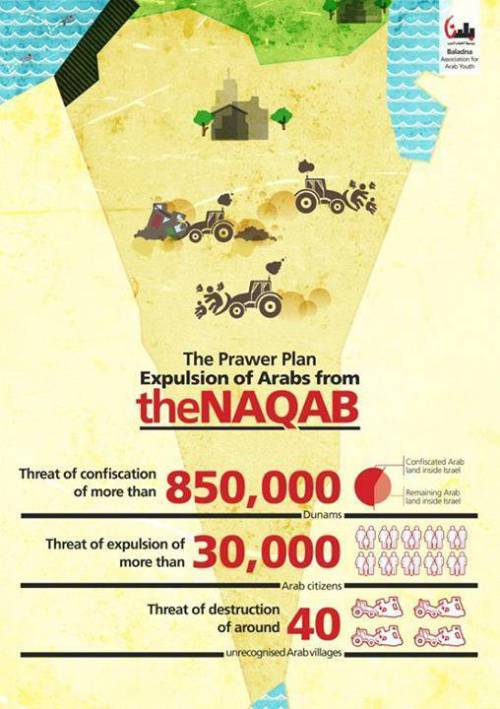 Occupied Palestine – On the 24th of June, the Israeli Knesset approved the Prawer-Begin plan, which if implemented will result in the destruction of more than 35 unrecognized villages in Al-Naqab and the forced expulsion and confinement of more than 70,000 Palestinian Bedouins. The Prawer plan is the largest Israeli land-grab since 1948. It epitomizes the nature of Israel’s policy; Israeli-Jewish demographic expansion and Palestinian-Arab demographic containment.
The International community has repeatedly called on Israel to halt the implementation of the Prawer Plan due to its discriminatory nature and the severe infringement it causes on the rights of Palestinian Bedouins in Al-Naqab. The UN committee on the elimination of Racial Discrimination called on Israel to withdraw the proposed legislation of the Prawer Plan. Also, in 2012, the European Parliament passed a resolution calling on Israel to stop the Prawer plan and its policies of forced displacement and dispossession.
Injustice, humiliation and forced displacement are a recurring theme in Palestine’s history. This is lesson that we as a group of youth take to the heart. We will oppose, resist and work against the continuous assault that our communities, across Palestine face. Therefore, we launched the “Prawer will not pass” campaign with an eye to preventing this plan to be yet another chapter in Palestine’s long and tragic history.
Opposing the Prawer Plan is to oppose ethnic cleansing, displacement and confinement in the 21st century.
Join us by organizing marches, protests, sending letters to those with positions of influence in your country or community, by doing whatever you can, in order to force Israel to stop the Prawer plan.
Join us on the 30th of November in saying “Prawer shall not Pass”.
For more information, please contact:
Email: PrawerWontPass@gmail.com
Israel to lobby US against possible Iran nuclear deal

Press TV – November 10, 2013
As the prospect of a nuclear deal between Iran and the group of six major world powers grows stronger, Israel strives to lobby the US Congress to prevent any possible agreement.
“Before the talks resume, we will lobby dozens of members of the US Congress to whom I will personally explain during a visit beginning on Tuesday that Israel’s security is in jeopardy,” Israeli’s Economy Minister Naftali Bennett said on Sunday.
The remarks come after Iran and the five permanent members of the UN Security Council – Britain, France, China, Russia and the US – plus Germany concluded three days of intense negotiations over Tehran’s nuclear energy program early on Sunday.
Iran and the six world powers have agreed to continue negotiations on November 20 in Geneva, Switzerland.
Although an agreement was not reached in the nuclear negotiations, both sides said significant progress had been made and expressed optimism about the prospect of achieving a deal.
British Foreign Secretary William Hague said in an interview with the BBC later on Sunday that, “On the question of will it happen (a deal will be reached) in the next few weeks, there is a good chance of that.”
“A deal is on the table and it can be done. But it is a formidably difficult negotiation, I can’t say exactly when it will conclude,” he added.
Israeli ministers, however, have voiced strong opposition to any possible deal between Iran and the world powers, with Minister of Military Affairs Moshe Ya’alon describing an agreement with Iran as a historic mistake.
Israeli Prime Minister Benjamin Netanyahu also rejected a possible nuclear agreement with Iran as “a very bad deal” before meeting US Secretary of State John Kerry on Friday in Tel Aviv.
Netanyahu’s office had also launched a Twitter campaign against the Islamic Republic in which several photographs including the one of the Iranian students marking the 34th anniversary of the 1979 takeover of the former US embassy in Tehran were shown. The images were re-tweeted by a few Israeli officials.
Related articles
Time to Ignore Netanyahu the Rejectionist
By Ludwig Watzal | Palestine Chronicle | November 10, 2013
Benyamin Netanyahu’s hyperventilated fury didn’t surprise anybody. Even before the first outlines of a possible long-term agreement between Iran and the West on Iran’s nuclear program were publicized, Israel’s Prime Minister categorically rejected any such agreement. This irrational behavior disqualifies him as a serious partner to other heads of state. His extremism goes even so far as to promote further sanctions against Iran. Netanyahu wants Iran to capitulate and abolish its entire nuclear industry. He announced that Israel does not feel bound by the agreement. Netanyahu arrogates Israel the right to override decisions by UN Security Council members.
That Western leaders should consult the leader of a tiny country before they act shows the imagined power they attribute to Netanyahu. To seek advice from Netanyahu shows how intimidated Western politicians are. By now, they should be aware of his hostility to peace, be it with Iran or the Palestinians. How submissively the United States acts, is shown by the phone call between Obama and Netanyahu and by Secretary of State Kerry’s visit to Jerusalem, as if they needed Netanyahu’s blessing for the negotiations with Iran. The best political strategy would be to ignore him.
What infuriated Netanyahu and made him go wild was John Kerry’s statement made in Bethlehem: “We consider now and have always considered the settlements to be illegitimate.” The US has finally returned to its erstwhile stance that all Israeli settlements are contrary to international law, after they have gone astray under Bill Clinton and George W. Bush junior. Netanyahu appears increasingly isolated with regard to the Iran deal. He appears willing to do anything to derail a possible agreement between the US and Iran. His last weapons are the political bull terriers of the American Israeli Public Affairs Committee, better known as AIPAC, and their supporters in the US Congress. But Netanyahu is increasingly a political nuisance, not only for the Obama administration but also for other powers. For the last 25 years it has been his mantra to warn that a nuclear armed Iran is just around the corner.
Netanyahu and the war party in the US will do everything in their power to prevent an agreement between Iran and the West. Netanyahu exerts not only great influence on the US Congress via AIPAC, but does so personally, as his last speech before both Houses in May 2012 has shown, during which US lawmakers outdid themselves in celebrating his reactionary speech. AIPAC could try to arrange again another such ridiculous circus. That doesn’t mean that Netanyahu would make it this time, knowing that he would jeopardize the recently improved relations with the Obama administration.
The political charade, which Netanyahu performs, has nothing to do with the imaginary Iranian nuclear threat. The Israeli political establishment knows this and fears that it would lose its hegemony over the entire Middle East and Northern Africa if Iran would go nuclear. The late Israel Shahak has pointed out in his book “Open Secrets. Israeli Nuclear and Foreign Policies”, that Israel’s main goal is to maintain its hegemony from India to Mauritania.
The political interests of the Western powers and Israel are not the same. The West has suffered heavy economic losses by bowing to Israeli interests; especially US soldier had to pay a high price in Iraq. Netanyahu can perhaps bamboozle the U.S. government again, but Israel’s relationship with Europe is on a downward slide. Europe, and especially Germany, can look back on an enduring friendship with Iran. This friendship should not be damaged by unregenerate politicians. Germany would do well to normalize its relations and reestablish its traditionally excellent relations with Iran, regardless of the outcome of the US-Iran negotiations.
By now, the US and the other Western countries should have understood that Netanyahu as well as former Israeli governments have been torpedoing every chance for a peace agreement with the Palestinians, because their colonial hunger for land has not yet been satisfied. The so-called peace negotiations, which are once again taking place, is likely to go nowhere because the Netanyahu government is not willing to make any real concessions that fall short of total surrender by the Palestinians.
Related article
Featured Video

or go to
Aletho News Archives – Video-Images
New Documentary
“Inside Gaza” wins best documentary at Montreal’s Cinemania film festival
Palestine Information Center – November 16, 2026
MONTREAL – The documentary “Inside Gaza,” which chronicles the experiences of Palestinian journalists working with Agence France-Presse (AFP) while covering the Israeli war on the Gaza Strip, won the Best Documentary Award at the 32nd Cinemania International Francophone Film Festival held in Montreal, Canada.
Directed by Helene Lam Trong, the 72-minute film follows the daily lives of four AFP journalists who bear witness to the difficulties of reporting in a war-torn territory largely closed off to international media.
The film is compiled from material produced by the team on the ground, as well as from interviews conducted after they left.
The film also won the People’s Choice Award at the festival on Saturday. … continue
Blog Roll
 Aletho News
- Austria seeks to strip former foreign minister of citizenship over Russia ties
- “Inside Gaza” wins best documentary at Montreal’s Cinemania film festival
- Activists block German munitions plant over arms exports to ‘Israel’
- The Nasser Hospital attack and Israel’s relentless lies
- Could it be satan? No, Huckabee, just the Americans you work for
- AIPAC and more: Network of pro-Israel influence in US Congress
- Putin aide reveals Moscow’s stance on Europe at peace talks
- Imran Khan warns Pakistani judges he may die in prison
- IOF used Amazon facial recognition to track millions of Palestinians
- More EU Citizens Face Sanctions For Criticizing The Ukraine Proxy War
- If Americans Knew
- An error has occurred; the feed is probably down. Try again later.
- No Tricks Zone
- Argentina’s Perito Moreno Glacier Joins Antarctica and Arctic In Defying Doomsday Melt Claims
- New Study: Barents Sea Temperatures Were Warmer And Sea Ice Less Extensive In The 1700s Than Today
- German Authorities Start Initiative To Evaluate Public Register For Climate “Disinformation” Spreaders!
- Zonal Asymmetry of Temperature Change in the Antarctic Circumpolar Current
- New Study: The Net Fossil Fuel Contribution To Rising Atmospheric CO2 Has Been Zero For 500 Years
- Germany’s Green Energy Transition Becoming Increasingly Expensive…Another 6 Trillion Euros!
- Sudden Stratospheric Warming, Powerful El Niño Combination May Lead To Extreme Europe Cold, Energy Crisis!
- Two New Studies Find Thwaites Glacier Melt Cannot Be Driven By Human Activity Or A Warming Ocean
- E-Cars Reduce CO2 Emissions By Only 41% Compared To Internal Combustion Engine Vehicles
- Predictions Made By Renowned Climate Professor Over Past Decades Have Been Proven To Be Poor

