Obama at the UN
By Mazin Qumsiyeh | Popular Resistance | September 25, 2013
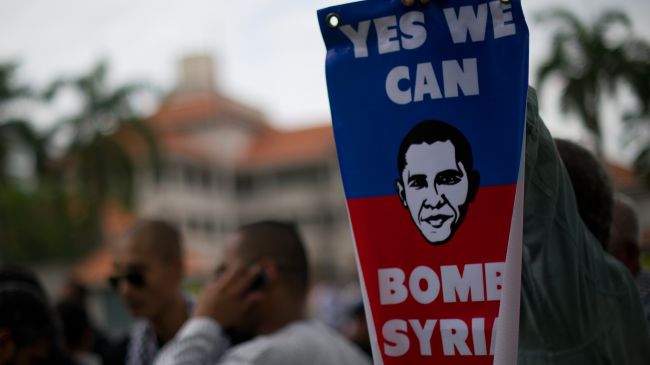 President Barak Obama said in the middle of his 40 minutes of lies and hypocrisy at the UNGA as world leaders looked on in dismay: “With respect to Syria, we believe that as a starting point, the international community must enforce the ban on chemical weapons.” (The US and Israel both possess and have used chemical weapons, see below) and added “Although we will at times be accused of hypocrisy and inconsistency [!], we will be engaged in the region for the long haul” [to serve Israel].
Incredibly he also said he believed in American “exceptionalism” [white man’s burden]. Hypocritically he also mentioned Martin Luther King Jr. But MLK opposed American imperialism and exceptionalism and who said in a speech in 1968: “God didn’t call America to do what she’s doing in the world now. God didn’t call America to engage in a senseless, unjust war ….. We have committed more war crimes almost than any nation in the world.” [we still do]
Related
What does the Syrian chemical disarmament deal mean?
By Zaher Mahruqi | Press TV | September 24, 2013
Bashar’s acceptance to let go of his “Nukes of the poor” arsenal could mean that the Syrian government has assessed the potential outcome of an American sustained offensive to be a game changer and desperately agreed to any way out.
Handing over chemical weapons in a gradual more controlled manner would have been understandable but giving up the location of the chemical sites with such immediacy hints to a much weakened Syrian position. It is no secret that the details given to the UN will eventually end up in Israeli hands, then why would the Syrian government accept such a deal other than Assad’s real fear of loosening his grip on power?
Netanyahu’s remarks following the chemical handover deal that “negotiating with Syria and Iran with a real and present threat to use force is the only way to make them cooperate” suggests that Syria’s president is indeed at the mode of fighting for survival. But that too is too simplistic provided that, surrendering chemical weapons or not, the US is sure to pursue him to the very bitter end. Then why give up such a strong deterrent?
The fact of the matter is that Bashar al-Assad is an intelligent man who at the very least understands that betraying Russia and Iran, who have been supporting his efforts in the past two years, would be a serious mistake. Therefore, any big decision Syria makes has to have been consulted with its main backers and has been given some sort of guarantees that giving up chemical weapons is not as risky as it might appear and that a credible backup plan is in place.
Smartly, Syria is giving both the US and Russia a face saving mechanism to avoid any further escalation between the two super powers and at the same time it is buying crucial time. Bashar himself declared that at least one full year is required to clear Syria of chemical weapons.
For Syria, chemical weapons are much harder to dispose of than replenish because Syria’s allies have stockpiles upon stockpiles of them. And so if the US chooses to change course somewhere during the period of chemical disarmament and attacks Syria, the very scenario that has been averted would be quickly reintroduced.
One ship full of chemical weapons is all that is required to rearm Syria, after all the main target of such weapons is a country the size of a province; Israel. Moreover, the Iranian and Hezbollah threat of intervening by attacking Israel will not be changed by simply handing over the chemical weapons.
Of course, the decision to hand over the weapons which buys the Syrian government crucial time is unwelcome by the “saboteur” of the region, Saudi Arabia and Turkey. The real danger for them is that this could actually lead to further weakening of the Syrian opposition and force them unto Geneva peace talks; talks which have just been strengthened by Syria’s agreement to declare its chemical arsenal.
Turkey and Saudi Arabia know well that their stances on Syria in the past two years makes it impossible for relations with Bashar’s Syria to normalize or even a negotiated Syria where opposition participates in governance.
Regardless of Turkish and Saudi stances, the US administration and Israel had strong interests in making sure that a war is averted in some way. Had the US congress vote gone ahead and disapproved of any attack on Syria in order to fulfill the wishes of the American people, it would have been a huge blow to them.
For Obama, it would have meant being stripped of legitimacy as it relates to Syria and wider international engagements and for Israel it would have meant the weakening of the Zionist lobby within US politics and a disastrous counter attack from Iran, Syria and Hezbollah.
Bashar’s objectives to consolidate alliances and weaken the counter alliance and buying time have all been thus far satisfied. The one year disarmament period that Bashar suggested will be needed is no speculation at all; it is well calculated period during which time to weaken the opposition and its supporters and to deny the US and her allies any legitimate pretext to attack Syria.
Moreover, if Iran and Hezbollah felt justified to intervene early on, now any attack from the US or her allies before the chemical disarmament is complete makes the Iran and Hezbollah retaliation against Israel with the support of Russia even more justified.
On the other hand, the US, Turkey and Saudi Arabia, (the latter seeming more keen than the US to overthrow Bashar’s government), provided that the SNC is in a weakened position and the desperation of the trio is acute, places them in a real danger of open colluding with the likes of Al Qaeda and Al-Nusra Front. So much for fighting “terrorism”!
Every time one sees a billboard advertising Syrian International Trade Exhibition across the world one wonders how can a government in a war state for over two years manage to facilitate an environment where its factories can produce? The answer could simply be that Syria is not nearly as chaotic or as weak as Western media portrays it to be. That position has just been strengthened by Syria’s agreement to disarm.
The objective of the US and Israel has always been to disarm any Arab army that might use its weapons against Israel; the issue is not whether a country owns a huge arsenals of weapons or not, but whether it has enough potential will to use them against Israel.
The Saudis are armed to the teeth and so are the Turkish but it is their clear stance on ensuring Israel’s peace that makes them allies rather than enemies. It is for that reason that Syria is a prime target as was Saddam’s Iraq.
Five armies that pose serious threat to Israel were the priorities of the US and Israel namely Iranian, Syrian, Egyptian, Iraqi and Hezbollah and so far only one has been dealt with; that of Iraq. In the case of Egypt, the US and Israel are pleased because the Egyptian army is suspect and they truly believe they will eventually buy out its generals. That means Hezbollah, Iran and Syria are left to fight this war that will not stop until one side secures a clear victory.
Where Russia had disappointed in the past as was the case with Iraq, now it appears poised to put up a stronger posture and as such days ahead will clarify the longevity of the new Russian posture. But the latest events have revealed that Russia is no longer a mere Security Council voter but a physical actor in world events.
Therefore, it is naive to assume that Russia has been blackmailed or tricked by the US into pressuring Syria to surrender her most prized deterrent against Israel. Syria will comply albeit at a calculated pace and will give America and Israel no legitimate pretext to attack it and as such Russia will have no choice but to stand its ground. If an attack takes place, Russia’s response is likely to be far stronger than the recent showdown in the Mediterranean or else Russia becomes a goofball.
The stance of Western media and Aljazeera is a good indication that the US and her allies are not in a war mood. When a war is imminent, there are certain networks that have a duty to fulfill and that is drumming for war. They are not doing that just yet!
While it will be naive to assume that Bashar will hold on to power indefinitely, it is clear that the Syrian civil conflict will be a long term struggle and will not end nor conclude the way the US and Israel are hoping for.
Related articles
- Nasrallah: Saudi Arabia, Turkey have failed in Syria (alethonews.wordpress.com)
- Questions on Syria’s Chemical Weapons disarmament (alethonews.wordpress.com)
Is the Israel Lobby Only a Chimp Among Gorillas?
By DIANA JOHNSTONE | CounterPunch | September 23, 2013
Some friendly criticism of our article “The People Against the 800 Pound Gorilla” provides a welcome opportunity to clarify the discussion. Shamus Cooke, while largely agreeing with the points made by Jean Bricmont and myself, reproaches us for focusing on the pro-Israel lobby as the major factor promoting U.S. war against Syria to the detriment of much bigger factors: the U.S. capitalist class, the big banks, “empire”, oil, the military-industrial complex – in a word, capitalism.
The problem with our article, writes Shamus Cooke, “is that the authors elevate the Israeli gorilla to a weight class it doesn’t belong in; and in so doing the authors are forced to minimize the size of several other giant gorillas, whose combined weight overshadows the Israeli chimp.”
Of course, “capitalism”, however you want to define it, vastly dwarfs the Israel lobby. So do the military-industrial complex, the oil business, or U.S. imperialism, all of which have existed prior to and independently of the Israel lobby.
But is weighing the Israel lobby against “capitalism” a valid comparison? The Israel lobby is a clearly identifiable pressure group, with names, addresses and policies that are clearly stated. Capitalism is an economic system that at present, since the collapse of the Soviet Union, prevails in almost the entire world. Today, every specific policy in most countries is defined within a capitalist context, and some of those policies, notably on highly emotional issues, are opposed to each other, without challenging for a moment the existence of “capitalism”.
So it is with policy toward the Middle East and the war in Syria. Capitalism is not at stake in those conflicts, and “the system” is resilient and elastic enough to profit from whatever policy is adopted.
The very existence of the gigantic U.S. military machine constitutes a constant danger of being used to meet some “threat” cooked up by think tanks, interest groups and foreign lobbies. At the start of the Cold War, the notorious China Lobby personified by Mme Chiang Kai-Shek exerted a negative influence on U.S. policy in the Far East. More recently the Cuban lobby of anti-Castro exiles has influenced US policy to the detriment of U.S. export sectors such as agribusiness. Today, the politically powerful Israel lobby stimulates and exacerbates the worst tendencies in a divided political establishment. If the American people had the awareness, and American politicians the courage, to say “no” to that lobby and its specious arguments, the less belligerent forces in Washington would have a better chance of prevailing.
A century ago, denouncing capitalism as the source of war found an echo in large, active political parties which theoretically aspired to replacing capitalism with socialism. But even those massive parties failed to prevent the First World War. And today, there is no significant political force in any Western country prepared to carry out a coherent program of replacing capitalism with something else. So if stopping war depends on first getting rid of capitalism, we are doomed.
One can always argue that capitalism is an underlying factor that promotes war. Perhaps one can say the same about “human nature”. But we do not care to wait until capitalism collapses or human nature changes in order to prevent the disaster of greater war in the Middle East.
What interests us now is to expose and oppose the single most significant political influence promoting ongoing war in the Middle East. That is unquestionably the Israel lobby, which overlaps on the right with the so-called neo-conservatives, and on the left with the “humanitarian” interventionists. To argue against war, it is therefore the Israel lobby that needs to be confronted.
Shamus Cooke says that strategists “such as the Project for a New American Century” (the neo-cons who dominated the Bush II administration) are “the ‘vanguard’ of American capitalism, and their geopolitical outlook is firmly rooted in the economic interests of the corporations that most benefit from overseas investing.”
I would say, rather, that PNAC, and its various reincarnations, is a cohort of fanatically pro-Israel strategists aspiring to control U.S. foreign policy by claiming to promote the interests of a capitalist class which has no unified strategic outlook of its own. There is no reason for American capitalism, which has interests on all continents, to focus so single-mindedly, and so aggressively, on the Middle East. The United States needs Middle Eastern oil less than those countries need to sell it. Many sectors of Western capitalism actually suffer from the sanctions imposed on a country like Iran. The focus on the alleged Iranian “threat” serves only to maintain Israel’s status as sole nuclear power dominating the Middle East, backed up by the United States.
To oppose war, it is necessary to oppose those who advocate it. And that is the Israel lobby, not “capitalism”. Why is there so much more reluctance to criticize the Israel lobby than to criticize capitalism? These days, criticism of capitalism is accepted even in mainstream media. But criticism of capitalism has never stopped a war.
Defeating the Israel lobby and changing U.S. policy in the Middle East from a policy of bullying, sanctions and bombing to a policy of diplomacy and compromise would not put an end to capitalism, to the military-industrial complex or to U.S. imperialism. But such a victory would be a good basis for going on to oppose the huge network of overseas U.S. military bases, the encircling of Russia and China, the exploitation of Africa and any return to the traditional imperialist treatment of Latin America.
The political fight against the Israel lobby is not the only campaign for peace, but it is the one that is most urgently necessary today.
Diana Johnstone can be reached at diana.josto@yahoo.fr
Related articles
Two-State Solution or Illusion?

By Lawrence Davidson | Al-Ayham Saleh | September 21, 2013
Part I – The Two-State Solution
Peter Beinart is a “liberal Zionist” who has written a piece in the New York Review of Books of 26 September 2013 entitled “The American Jewish Cocoon.” In this essay he laments, “The organized Jewish community [is] a closed intellectual space.” By this he means that most American Zionist Jews (it is important to remember that not all Jews are Zionists) know little or nothing about those who oppose them, particularly Palestinians. They also seem to have no interest in changing this situation. For these Zionists the opposition has been reduced to an irredeemably anti-Semitic “them.”
Beinart goes on to tell us that such is the political clout of the organized Zionist community that this know-nothing attitude has come to characterize the “debate about Israel in Washington” and the opinions offered in the mass media as well. While Mr. Beinart does not say so, I can tell you that this has been the basic situation since the early 1920s. Beinart does note, however, that over time this situation has led Palestinians and those who support them to show less willingness to dialogue with Zionists, most of whom they consider irredeemably racist.
Beinart thinks this prevailing ignorance is a disaster. Why so? Because he feels that Jews betray the lessons of their own past by failing to understand the meaning of the “dispersion and dispossession” of the Palestinians. They do not seem to care that this particular people has had its “families torn apart in war – [continue] to struggle to maintain [their] culture, [their] dignity, [their] faith in God in the face of forces over which [they] have no control.” This sort of situation, according to Beinart, is something “the Jews should instinctively understand.”
Be this as it may, achieving such an understanding is, for Beinart, a means to an end. That end is realizing a two-state solution to the ongoing Israeli-Palestinian struggle. For this to happen the Zionists have to essentially feel the pain of the Palestinians and the Palestinians have to understand their no-win situation so that everyone agrees to a Palestinian mini-state on “22 percent of British mandatory Palestine” along with “compensation and resettlement [for the] people whose original villages and homes have long ceased to exist.”
Part II – The Two-State Illusion
An important question is whether Mr. Beinart’s two-state solution does not itself represent a goal whose practicality has “long ceased to exist”? That certainly is the opinion of Ian Lustick, a professor of political science at the University of Pennsylvania. In the Sunday Review section of the New York Times of 15 September 2013, he published an op-ed piece entitled “Two-State Illusion.”
According to Professor Lustick, the two-state idea has become something of a fraud behind which lies opportunistic political motives. For instance, the Palestinian Authority (PA) keeps this hope alive so that it can “get the economic aid and diplomatic support that subsidizes the lifestyle of its leaders, the jobs of tens of thousands of soldiers, spies, police officers and civil servants.” The Israeli government keeps this hope alive because “it seems to reflect the sentiments of the Jewish Israeli majority and it shields the country from international opprobrium, even as it camouflages relentless efforts to expand Israel’s territory into the West Bank.” Finally, the U.S. government maintains the hope of a two-state solution to “show that it is working toward a diplomatic solution, to keep the pro-Israel lobby from turning against them and to disguise their humiliating inability to allow any daylight between Washington and the Israeli government.”
Lustick believes the two-state solution is an impossible hope that has produced periodic negotiations which have always been “phony” and have prevented new ideas for positive change from being seriously entertained. This long-term stifling has also set the stage for possible “sudden and jagged” events that can send the conflict off in catastrophic directions. Oddly enough Lustick finds this prospect of heightened conflict a necessary one.
He tells us that only when the “neat and palatable” two-state solution disappears – and with it the PA and its policies of collaboration – will we get the “mass mobilization, riots, brutality, terror, Jewish and Arab emigration and rising tides of international condemnation of Israel,” along with the subsequent withdrawal of unconditional U.S. support for the Zionist State. At that point
“Israeli leaders may then begin to see, as South Africa’s white leaders saw in the late 1980s, that their behavior is producing isolation, emigration and hopelessness.” Then, finally, they will become reasonable, and something new and acceptable (a one-state solution?) will be possible.
Lustick’s necessary scenario happens to be Peter Beinart’s nightmare and in the latter’s essay it is called “civil war.” Beinart’s call for greater mutual understanding is designed to prevent this violence. One can assume that, for Professor Lustick, things have gone too far for this understanding to suddenly prevail. “Peacemaking and democratic state building require blood and magic,” he tells us. Delaying the inevitable with false hopes will only make things worse.
By the way, Lustick is not alone in his view that the two-state formula is a dead end. One of Israel’s very best historians, Ilan Pappe, who now is the director of the University of Exeter’s European Centre for Palestinian Studies, believes that this prospect has been dead for over a decade. What killed it, and what keeps it dead, are “Zionist greed for territory and the ideological conviction that much more of Palestine [beyond the 1967 borders] is needed in order to have a viable Jewish State.” It is worth noting that it is just this ideological conviction that renders Peter Beinart’s plea for more understanding of the Palestinian position by American Zionist Jews a nonstarter. Any ideology that can justify incessant ethnic cleansing has to make its adherents incapable feeling their victims’ pain.
Part III – Conclusion
If Beinart’s hope for mutual understanding is naive, Lustick’s hope that more “blood” will lead to the “magic” of a positive outcome is not at all assured.
One might ask just how much disaster is necessary before the hard-line Zionists who have long controlled Israel will compromise their ideological commitment. Keep in mind that the Israeli political elites, right and left, have always been expansionist. Even Peter Beinart is not pushing for a return to the 1967 Green Line and an evacuation of illegal settlements, as far as I can tell. In the past, the Israeli elites have judged their terror and brutality to be justified. They will do so in the future as well. Some of them will interpret any increase in Jewish emigration (a process already ongoing) as a weeding out of weak elements. Militarily the Israelis can probably maintain superiority over their neighbors even in the face of reduced American aid, and as far as world opinion is concerned, most of them care little about it. If this assessment has any validity, the Israelis could go on ethnically cleansing for a very long time.
In my view, the only viable weapon against such vicious stubbornness is a worldwide comprehensive economic boycott on the South Africa model. However, even this may not be the last page in the drama. Such an economic boycott may prove strong enough to undermine the will of some Israeli ideologues, but not all of them. And then, unlike South Africa, you may need an intra-Israeli Jewish civil war to finally bring the curtain down on the tragedy of Zionism.
Related article
EU calls for explanations from Israel over diplomat scuffle
RT | September 22, 2013
European diplomats are holding Israel accountable over an incident where IDF servicemen attacked a EU humanitarian convoy in the West Bank on Friday. So far Tel Aviv has left the scandal in limbo, offering no official explanation for the incident.
Diplomats from several EU countries have spoken out against the shocking incident of harassing a person with diplomatic immunity, clearly awaiting some sort of official reaction from the state of Israel.
After disturbing photos of the French diplomat, Marion Fesneau-Castaing, spread on the ground with IDF soldiers standing around her hit international news, the scandal over hijacked EU aid to homeless Bedouins from demolished villages in the West Bank has gained momentum.
“EU representatives have already contacted the Israeli authorities to demand an explanation and expressed their concern at the incident,” says a statement issued by the spokesmen for EU foreign policy, Catherine Ashton and Humanitarian Aid Commissioner, Kristalina Georgieva.
An EU official described the Israeli actions as “shocking and outrageous”, the BBC reported.
The British Consulate General in Jerusalem is “concerned at reports that the Israeli military authorities have prevented the affected community from receiving humanitarian assistance,” the consulate’s spokesman said.
“We have repeatedly made clear to the Israeli authorities our concerns over such demolitions, which we view as causing unnecessary suffering to ordinary Palestinians, as harmful to the peace process and contrary to international humanitarian law,” the spokesman added.
The Israeli authorities should “live up to their obligations as occupying power to protect those communities under their responsibility,” the UN Humanitarian Coordinator James Rawley said.
‘Illegal diplomatic activity’
The Israeli Foreign Ministry’s spokesperson, Paul Hirschson, has threatened to lodge a complaint over Marion Fesneau-Castaing’s actions, Agence France-Presse reported.
“If she did participate then a formal complaint will be filed because that is not the way diplomats behave,” he said.
On Saturday the EU ambassador in Israel called the Foreign Ministry Deputy Director-General for Europe, Rafi Shutz, demanding explanations regarding the IDF in the West Bank on Friday.
“What was done there by the European diplomats was a provocation,” said Shutz as quoted by the Haaretz.
Mr Shutz claimed that force against the female French diplomat was used because she slapped one of the soldiers. He also announced that the state of Israel is looking into allegations that foreign diplomats “abused their diplomatic privileges”.
Because Palestinian construction at the site of former Khirbet Al-Makhul village was ruled illegal by an Israeli court, the European diplomats were engaging in illegal activity, Shutz stated. He also pointed out that humanitarian aid to Palestinians should be delivered through the proper channels, coordinated with Israel.
The IDF explained the use of stun grenades during the incident, claiming that stones were thrown at security forces. Stun grenades were thrown directly into a group of European diplomats, aid workers and locals who were trying to deliver emergency aid to the residents of a demolished Palestinian village, Reuters reported.
On Friday a truck with EU humanitarian aid for the villagers of the demolished Khirbet Al-Makhul settlement was attacked by IDF personnel, who confiscated the truck and the payload. French diplomat Marion Fesneau-Castaing, who attempted to prevent confiscation of the aid, was pulled out of the truck and forced to the ground. The incident received wide international coverage.
Houses, stables and a kindergarten at Khirbet Al-Makhul village were demolished on Monday after a decision by Israel’s High Court, which ruled that villagers had illegal building permits. The villagers refused to leave the ruins saying they have been living on that land for generations.
The seizure incident of a truck carrying humanitarian aid has become yet another page in the row between Brussels and Tel Aviv. In July the EU announced it is going to stop all financial assistance to Israeli organizations operating in the occupied territories, starting from 2014.
The government of Prime Minister Benjamin Netanyahu reacted angrily, denouncing the move as interference in Israel-Palestine relations and retaliated by blocking EU humanitarian aid to tens of thousands of Palestinians in the West Bank.
Israel and the Palestinian Autonomy remain in fruitless peace talks, with the major stumbling block being the ongoing construction of Jewish settlements in the West Bank and East Jerusalem, occupied since the 1967 Middle East war.
Related article
Syrian chemical weapons counter Israel’s nuclear threat, says Putin
MEMO | September 20, 2013
Syria has chemical weapons, claims Vladimir Putin, in order to counter Israel’s nuclear threat. The Russian president raised this point in a discussion with Western leaders on Thursday.
After admitting that he could not be 100 per cent certain that the Syrian regime would disclose all information about its chemical weapons, Putin suggested that Israel does not need nuclear weapons because of its “technical supremacy” in other areas.
The Russian president said that he does not oppose a military strike on Syria because of perceived Russian interests there; in fact, he does not want to see an international organisation like the United Nations misused for such an action.
“We do not have some exclusive interests in Syria which we would seek to protect by defending the current government,” he insisted. “We are striving to preserve the principles of international law.”
Putin asked his counterparts in the West about the opposition rebels affiliated to Al-Qaeda. In the absence of any reply, he asked, “What sense does it make to launch a strike if you do not know how it will end?”
Blaming rebels for the use of chemical weapons, Putin claimed that there is “every reason” to believe that it was done as a provocation
Israeli soldiers rough up EU diplomat, confiscate aid supplies for Palestinians
Al-Akhbar | September 20, 2013
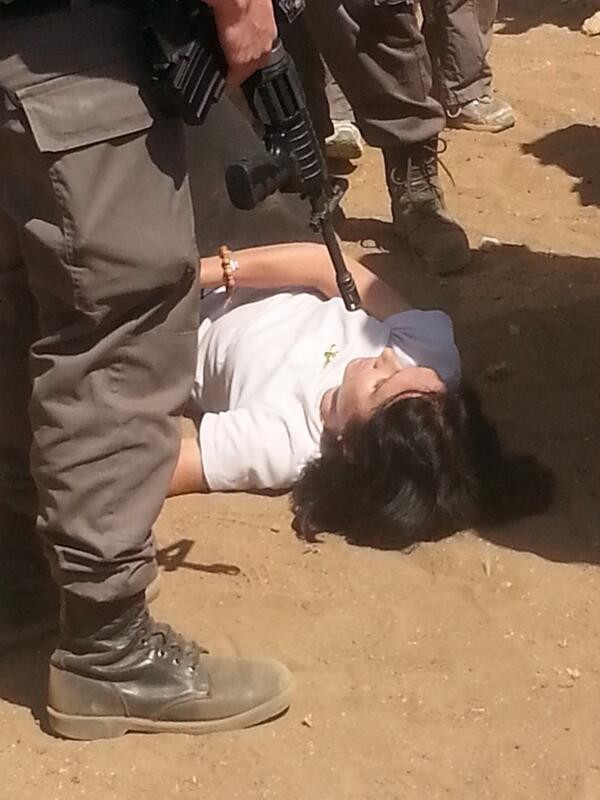 Israeli soldiers manhandled European diplomats on Friday and seized a truck full of tents and emergency aid they had been trying to deliver to Palestinians whose homes were demolished this week.
A Reuters reporter saw soldiers throw sound grenades at a group of diplomats, aid workers and locals in the occupied West Bank, and yank a French diplomat out of the truck before driving away with its contents.
“They dragged me out of the truck and forced me to the ground with no regard for my diplomatic immunity,” French diplomat Marion Castaing said.
“This is how international law is being respected here,” she said, covered with dust.
The Israeli army and police declined to comment.
Locals said Khirbet al-Makhul was home to about 120 people. The army demolished their houses, stables and a kindergarten on Monday after Israel’s high court ruled that they did not have proper building permits.
Despite losing their property, the inhabitants have refused to leave the land, where they say their families have lived for generations along with their flocks of sheep.
Israeli soldiers stopped the International Committee of the Red Cross (ICRC) delivering emergency aid on Tuesday and on Wednesday IRCS staff managed to put up some tents but the army forced them to take the shelters down.
Diplomats from France, Britain, Spain, Ireland, Australia and the European Union’s political office, turned up on Friday with more supplies. As soon as they arrived, about a dozen Israeli army jeeps converged on them, and soldiers told them not to unload their truck.
“It’s shocking and outrageous. We will report these actions to our governments,” said one EU diplomat, who declined to be named because he did not have authorization to talk to the media.
“(Our presence here) is a clear matter of international humanitarian law. By the Geneva Convention, an occupying power needs to see to the needs of people under occupation. These people aren’t being protected,” he said.
In scuffles between soldiers and locals, several villagers were detained and an elderly Palestinian man fainted and was taken for medical treatment.
The UN Office for the Coordination of Humanitarian Affairs (OCHA) said in a statement that Makhul was the third Bedouin community to be demolished by the Israelis in the West Bank and adjacent Jerusalem municipality since August.
Palestinians have accused the Israeli authorities of progressively taking their historical grazing lands, either earmarking it for military use or handing it over to the Israelis whose settlements dot the West Bank.
Israeli forces regularly demolish Palestinian homes, claiming they do not have the proper construction permits. However, the Israeli government regularly announces the expansion of settlements, which are considered illegal under international law.
Israelis and Palestinians resumed direct peace talks last month after a three-year hiatus. Palestinian officials have expressed serious doubts about the prospects of a breakthrough.
“What the Israelis are doing is not helpful to the negotiations. Under any circumstances, talks or not, they’re obligated to respect international law,” the unnamed EU diplomat said.
(Reuters, Al-Akhbar)
Israel’s latest Syria ‘game-changer’ — ‘The al-Qaeda-Assad alliance’
By Maidhc Ó Cathail | The Passionate Attachment | September 21, 2013
In a highly speculative September 12 report entitled “Game-Changer: Signs of the al-Qaeda-Assad Alliance,” PJ Media’s Washington editor Bridget Johnson attempts to turn conventional wisdom about the current Syria debate on its head by asserting that “al-Qaeda is working not against Bashar al-Assad but in concert with the dictator.”
In support of this rather tendentious claim, Johnson cites a “student dissident” named Ahed Al Hendi whom she says fled Syria five years ago after imprisonment and torture by the Assad regime. According to Al Hendi, Damascus was secretly collaborating with Al-Qaeda during the Iraq War even as it sought to convince the U.S. that it was serious about fighting terrorism. That covert alliance persists to this day, asserts Johnson:
Assad appears OK with losing a building now and then by a car bomb — bombings that never hit too close to his home and that come with ample warning anyway. Al-Qaeda units, meanwhile, get left alone by Assad’s forces. “They never touch them,” Al Hendi said.
PJ Media’s spurious effort to persuade readers that Al-Qaeda is an ally rather than a foe of Assad makes a lot more sense, however, when you know that both the “conservative” American website and its seemingly objective Syrian source both have intimate ties to the country that has done most to induce Washington to use military force against Syria.
The effort to raise the $3.5 million in venture capital to start Pajamas Media [the original name for PJ Media] was led by Aubrey Chernick. A former trustee of the Washington Institute for Near East Policy, a think tank created by the American-Israel Public Affairs Committee, Chernick provides funding for a broad spectrum of pro-Israel organizations from the supposedly liberal Anti-Defamation League to the extremist Islamophobia-promoting Jihad Watch.
Ahed Al Hendi is Arabic Program Manager for a organization called Cyberdissidents.org. As I wrote in a May 2011 piece entitled “Arab Dissidents’ Strange Bedfellows”:
CyberDissidents.org is a project launched in 2008 by the Jerusalem-based Adelson Institute for Strategic Studies “to research and focus attention on the online activities of democracy advocates and dissidents in the Middle East, in the hope of empowering them at home and raising awareness of their plight abroad.” Until its demise in 2009, the Adelson Institute was located at the Shalem Center, a controversial research institute associated with right wing Zionist causes.
While Israel and its media assets might like Americans to believe that Assad and al-Qaeda are allies, there is far more reason to suspect an al-Qaeda-Israeli alliance in Syria. As Israel’s outgoing ambassador to the U.S. Michael Oren recently admitted to the Jerusalem Post:
“The initial message about the Syrian issue was that we always wanted [President] Bashar Assad to go, we always preferred the bad guys who weren’t backed by Iran to the bad guys who were backed by Iran,” he said.
This was the case, he said, even if the other “bad guys” were affiliated to al-Qaida.
Maidhc Ó Cathail is an investigative journalist and Middle East analyst. He is also the creator and editor of The Passionate Attachment blog, which focuses primarily on the U.S.-Israeli relationship. You can follow him on Facebook and Twitter @O_Cathail.
Related articles
- Syria and the ‘devious’ Israeli connection – Dr. Olmert doth protest too much, methinks (alethonews.wordpress.com)
- Was Kerry’s ‘Munich moment’ on Syria created by a protégé of the Israel lobby? (alethonews.wordpress.com)
- Israelis Flying Aid to Syrian Rebels Under the Cover of Humanitarianism (thepassionateattachment.com)
Military Training Amid Villages in South Hebron Hills
CPTnet | September 19, 2013
During their most recent weekly visit to villages in the South Hebron Hills, CPTers witnessed a large group of Israeli soldiers in the area and heard an artillery training activity. Every week, Christian Peacemaker Teams, along with other internationals, provides a presence in an area, home to twelve villages, that the Israeli military has designated as Firing Zone 918—a closed military zone for training maneuvers.
On Sunday, 15 September, CPTers witnessed soldiers and a military vehicle near the village of Halaweh and two helicopter flyovers as children studied and played at the school in Al Fakheit. They heard several other helicopters flying nearby during the night. On the morning of 16 September, CPTers heard what seemed to be bomb detonation and machine gun fire. Later in the morning, when they visited the village of Jinba, residents confirmed that the Israeli military had conducted infantry training exercises nearby from about 6:00 to 8:00 a.m. that morning.
During their visit to Jinba village, CPTers learned that the Israeli authorities had stopped employees of World Vision as they were driving from Jinba to Al Fakheit and confiscated their car on 11 September. According to a United Nations employee, soldiers said they would not return the car for at least sixty days.
The area has been relatively quiet since May – with no training activities seen or heard, though helicopter flyovers continued even during this “quiet” time and settler violence and a military raid occurred in July. Here is a video of an Israeli military helicopter harrassing the village of Al Fakheit:
On their way into the area, CPTers also witnessed the digging of a new cistern. The Israeli government issued a stop work order on the cistern saying it is in a “nature reserve” (as well as the firing zone.) Nevertheless, the work continues.
The area is currently the subject of a court case in the Israeli Supreme Court. Eight of the twelve villages, where about 1,000 people live, are under eviction orders. Many structures within those villages also have demolition orders. When the case came to court on 2 September, the judicial panel proposed mediation. The case will again come before the court on 2 October. The military exercises CPTers witnessed were the first since the 2 September court date.
The U.N.’s 2012 Humanitarian Impact of Israeli-declared “Firing Zone” in the West Bank Factsheet reports that in addition to restriction on grazing livestock (the livelihood of many inhabitants of the area),
residents of firing zones face a range of other difficulties including the confiscation of property, settler violence, harassment by soldiers, access and movement restrictions and/or water scarcity. Combined, these conditions contribute to a coercive environment that creates pressure on Palestinian communities to leave these areas… International law also prohibits the destruction or confiscation of private or public property, unless for reasons of military necessity, as well as the forced displacement or transfer of civilians.”
Related articles
- Soldiers Demolish Northern Plains Village (imemc.org)
- Israeli forces seize tents in demolished village (altahrir.wordpress.com)
Featured Video

or go to
Aletho News Archives – Video-Images
New Documentary
“Inside Gaza” wins best documentary at Montreal’s Cinemania film festival
Palestine Information Center – November 16, 2026
MONTREAL – The documentary “Inside Gaza,” which chronicles the experiences of Palestinian journalists working with Agence France-Presse (AFP) while covering the Israeli war on the Gaza Strip, won the Best Documentary Award at the 32nd Cinemania International Francophone Film Festival held in Montreal, Canada.
Directed by Helene Lam Trong, the 72-minute film follows the daily lives of four AFP journalists who bear witness to the difficulties of reporting in a war-torn territory largely closed off to international media.
The film is compiled from material produced by the team on the ground, as well as from interviews conducted after they left.
The film also won the People’s Choice Award at the festival on Saturday. … continue
Blog Roll
 Aletho News
- How The Jensen Huang Chinese Spy Hoax Is Russiagate 2.0
- Austria seeks to strip former foreign minister of citizenship over Russia ties
- “Inside Gaza” wins best documentary at Montreal’s Cinemania film festival
- Activists block German munitions plant over arms exports to ‘Israel’
- The Nasser Hospital attack and Israel’s relentless lies
- Could it be satan? No, Huckabee, just the Americans you work for
- AIPAC and more: Network of pro-Israel influence in US Congress
- Putin aide reveals Moscow’s stance on Europe at peace talks
- Imran Khan warns Pakistani judges he may die in prison
- IOF used Amazon facial recognition to track millions of Palestinians
- If Americans Knew
- An error has occurred; the feed is probably down. Try again later.
- No Tricks Zone
- Argentina’s Perito Moreno Glacier Joins Antarctica and Arctic In Defying Doomsday Melt Claims
- New Study: Barents Sea Temperatures Were Warmer And Sea Ice Less Extensive In The 1700s Than Today
- German Authorities Start Initiative To Evaluate Public Register For Climate “Disinformation” Spreaders!
- Zonal Asymmetry of Temperature Change in the Antarctic Circumpolar Current
- New Study: The Net Fossil Fuel Contribution To Rising Atmospheric CO2 Has Been Zero For 500 Years
- Germany’s Green Energy Transition Becoming Increasingly Expensive…Another 6 Trillion Euros!
- Sudden Stratospheric Warming, Powerful El Niño Combination May Lead To Extreme Europe Cold, Energy Crisis!
- Two New Studies Find Thwaites Glacier Melt Cannot Be Driven By Human Activity Or A Warming Ocean
- E-Cars Reduce CO2 Emissions By Only 41% Compared To Internal Combustion Engine Vehicles
- Predictions Made By Renowned Climate Professor Over Past Decades Have Been Proven To Be Poor

