October 7 “Rape” Hoax Exposed
Norman Finkelstein’s new book debunks Zionist tall tales
By Kevin Barrett – September 13, 2026
Last May, an Israeli commission published a report alleging an organized campaign of rape and sexual abuse by Hamas during its October 7, 2023 concentration camp breakout. The Civil Commission on October 7th Crimes by Hamas Against Women and Children, chaired by Cochav Elkayam-Levy, titled its report “Silenced No More.”
October 7 rape claims, like similar accounts of babies beheaded and roasted in ovens, have long been greeted with skepticism in nations whose media and politicians are not owned and operated by Zionists. Perhaps for that reason, the Israelis felt the need to “document” their rape stories in the Elkayam-Levy report.
But in publishing their “rape” report, the Israelis inadvertently exposed the mendacity of their own assertions. The Commission included many “rape survivor” testimonies that read uncannily like the breathless stories of alleged Holocaust survivors who claim they were raised by wolves, or who, like Anthony Blinken’s stepfather Samuel Pisar, claim to have sneakily walked backward toward the door of the gas chamber and then snuck out right before it was closed and the gas was turned on.
The “Hamas rape” stories are exaggeratedly lurid and full of outrageously improbable or impossible details. But the real problem is that all Hamas fighters wore bodycams recording everything they did—and roughly half of the 3,000 or so who entered Israel were killed, and in most cases their body cams were recovered by Israeli authorities. The Ekayam-Levy Commission says it had access to 10,000 pictures and videos from those bodycams as well as others from Israelis filming with phones. And then there are the Israeli surveillance cameras. If, as the Commission alleges, Hamas pursued a deliberate policy of terrorizing Israelis with widespread sexual violence, obviously there should be, at minimum, hundreds of images and videos documenting these heinous acts.
But there are none. Zero. As Jewish scholar Norman Finkelstein shows in his new book GAZA’S GRAVEDIGGERS: An Inquiry into Corruption in High Places:
“Neither the Israeli State nor the Civil Commission has released even one frame, from among the ten thousand photographs and digital segments it amassed, that depicted Hamas committing rape or other acts of sexual violence… Not a single Israeli CCTV, traffic surveillance camera, or individual cellphone captured Hamas committing rape or other acts of sexual violence. The Commission collected ‘extensive’ digital evidence from Hamas digital paraphernalia. Hamas allegedly exploited its gruesome images from 7 October and of the Israelis held hostage as ‘an instrument of terror.’ If inspiring terror was the avowed objective, then, it would seem, the more barbaric the sexual violence it disseminated the better. But not a single confiscated Hamas bodycam, GoPro, or dashcam contained an image of rape or other acts of sexual violence.”
The October 7 Israeli rape allegations, in reality, have always been just as patently ridiculous as the tales of roasted and beheaded babies. Everyone with the slightest knowledge of Hamas and the cultural and religious context in which it operates knows that it would never pursue a policy of sexual misbehavior. Hamas rigorously and scrupulously adheres to futuwwa or “Islamic chivalry.” Anyone who has viewed the videos of hostages being released by Hamas, in which smiling Israelis almost wistfully say goodbye to their chivalrous captors, knows that claims of widespread systematic mistreatment of captives are hysterical exaggerations at best, outright propaganda lies at worst.
This is not to say that no Israelis were harmed on October 7. But Hamas did not deliberately kill or hurt civilians. It engaged in firefights with some of the IDF’s elite units, and in most cases won, as described by Scott Ritter in his memorable article “The most successful military raid of this century: the October 7 Hamas assault on Israel.”
Hamas’s orders were to 1) engage and defeat the IDF, 2) take IDF prisoners as hostages, and 3) as a fallback measure if all else failed, take civilian hostages. Scott Ritter explains:
“The taking of hostages was meant to provide Hamas with negotiating leverage for the release of the 10,000 prisoners held by Israel.”
Hamas fighters stumbled on the Nova Music Festival by accident. In the midst of firefights and chaos, some Hamas fighters took the opportunity to capture Israeli hostages. The abduction scenes, with Hamas fighters dragging off women as well as men and heading back toward Gaza in vehicles, have been well documented. It wasn’t a pleasant experience for the hostages…especially the more than 500 of them who were deliberately massacred by Israel’s tanks and helicopter gunships under its Hannibal Doctrine.
But there is no hard or convincing evidence that a single Hamas fighter perpetrated even one sexual assault, much less that there was any deliberate policy of rape. The Israelis, as usual, are lying outrageously and shamelessly, exhibiting the chutzpah for which they are justly renowned.
Subscribe to American Free Press to get early or exclusive access to great articles like this.
Matt Gaetz’s Brilliant Exposé on Israel Partisans’ Claims of “Antisemitism”
If Americans Knew | September 11, 2026
From The Matt Gaetz Show on OAN (One America News), Matt Gaetz exposes the dishonest double standard in American politics meant to shut down the conversation as support for Israel in the United States continues to collapse. “The Republican Jewish Coalition can say that they took out Thomas Massie but if you say they did, that is anti-Semitic. And if you say Israel caused the Iran War, that’s bigotry—unless it’s uttered by Netanyahu on the campaign trail, then it’s leadership.” – Matt Gaetz.
Source: https://x.com/OANN/status/20974901703…
Gaetz is a political commentator and former Republican Congressman from Florida. He generally identifies as a libertarian populist.
Trita Parsi: Massive Houthi Victory Transforms U.S.-Iran War
Glenn Diesen | September 12, 2026
Trita Parsi is the co-founder and Executive Vice President of the Quincy Institute for Responsible Statecraft. Follow the Substack of Trita Parsi: https://tritaparsi.substack.com/
Follow Prof. Glenn Diesen:
- Substack: https://glenndiesen.substack.com/
- X/Twitter: https://x.com/Glenn_Diesen
- Patreon: https://www.patreon.com/glenndiesen
Support the research by Prof. Glenn Diesen:
- PayPal: https://www.paypal.com/paypalme/glenndiesen
- Buy me a Coffee: buymeacoffee.com/gdieseng
- Go Fund Me: https://gofund.me/09ea012f
- Buy Diesen merchandise: https://diesen-shop.fourthwall.com/en-nok
Britain stands against oppression in Palestine… by supplying F-35s
By Finian Cunningham | Strategic Culture Foundation | September 11, 2026
So, Britain announced with much fanfare this week that it was imposing sanctions on Israel’s illegal settlements in Palestine. Note that the sanctions are not against the Israeli state, but rather a much narrower definition: Israeli entities in the Occupied Territories.
British Prime Minister Andy Burnham claimed that the move was an example of Britain giving international leadership to stand against oppression and injustice.
Addressing the British Parliament, Burnham said: “In this difficult and dangerous world, Britain has to stand for something, Britain has to show leadership, Britain has to stand for fairness against injustice… That is what the British people expect of us, and that is what this government will do.”
Several other European states and Canada have also joined the British-led initiative to ban trade and investment with companies doing business in the Occupied Territories of the West Bank.
Israel’s occupation is illegal under international law, yet Britain, the European Union and the United States have done nothing in the way of imposing sanctions. Sanctions are something the West prefers to impose on Russia, Iran, China, Cuba, North Korea, among others.
In announcing the sanctions, the United Kingdom’s foreign minister Ed Miliband told the House of Commons that “Britain was a country that upholds its values at home and around the world, fighting against oppression and suffering, and standing up for what is right.”
The pious tones from London about Israel’s “ethnic cleansing” are not convincing.
For starters, the supposed sanctions do not cover British components for the F-35 fighter jets that the United States sells to Israel. The British parts are crucial for flying the US-made stealth aircraft. The warplane has played a major role in razing Gaza to the ground. Also not included in the sanctions are drones and surveillance equipment that British firms supply to the Israeli military. All those components are crucial for enabling the nearly three-year genocidal violence that Israel has conducted in Gaza.
If the British government were serious about “standing against oppression,” it would go a lot further than focusing on violations by Israeli settlers in the Occupied Territories. The pogroms and construction of new settlements are carried out with the full assistance of the Israeli state, not just by gun-wielding fanatical settlers. Britain and other Western states have provided the legal and diplomatic cover for Israeli war crimes.
In any case, the supposed measures against Israeli business and exports from the West Bank are minimal. A recent Al Jazeera investigation found that Britain has billions of dollars invested in companies that are intimately involved in illegal settlement building. We can be sure that London is not going to cancel investments.
Total British-Israeli trade is estimated at $8 billion a year, including lucrative military items. The amount of business that Britain does with the Occupied Territories is about 1 per cent of its total trade with Israel.
Burnham and Miliband said the British government did not support boycott and divestment sanctions against the state of Israel. Both of them were at pains to emphasize that the measures are nominally limited to the violations going on in the Occupied Territories, not what Israel is doing right across Palestinian land, including Gaza, which is a genocide.
So there you have it. Britain’s “moral leadership” is nothing but tokenism and duplicity.
Should we expect anything else? After all, as former British diplomat Craig Murray pointed out this week, Burnham’s government has decided to give top-secret information for building cruise missiles to the corrupt Kiev regime. Murray warns that the Storm Shadow missiles will soon end up being sold on the black market, given the rampant corruption of Ukraine under the Zelensky cabal.
Britain is also supplying this NeoNazi regime with long-range drones that are being used to target Moscow and Russian civilians.
Is this standing up against oppression and for supposed British values?
What’s really behind London’s belated show of concern for Palestinians?
As Burnham and Miliband alluded, it’s all about Britain appearing to show international leadership. It’s a cheap way to burnish London’s “moral posturing” as a defender of “humanitarian values.”
Israel has hit back with the usual denunciations of “anti-semitism” and by closing down the British consulate in East Jerusalem. But for London, these repercussions are bearable for the bigger gains of British international PR.
As noted above, the lion’s share of its lucrative trade with Israel will go on, business as usual.
The other key motive for the Burnham government is that it realizes that a majority of the British public has become staunchly opposed to the Israeli regime. The three-year genocide has opened the eyes of many Britons (and those of other Western nations) to the historical injustices and illegal occupation of Palestinian lands. Israel is increasingly seen as a pariah, apartheid state that should be prosecuted for war crimes.
Britain’s role as the former colonial power in the Zionist annexation of Palestine is one of deep complicity and shame.
Andy Burnham was shoehorned into Downing Street to take over from the hopeless and hapless Labour leader Keir Starmer. The British establishment has bet on Burnham to shore up its imperialist interests by boosting military spending and deepening involvement in the NATO proxy war against Russia in Ukraine.
However, Burnham’s popularity has quickly worn off as he looks like Starmer 2.0.
The tokenistic moves to support Palestinian rights and oppose Israeli violations are a cynical electioneering ploy. By talking up sanctions against Israeli illegal settlements, Burnham is calculating that it will garner votes from the growing public anger over the genocide.
But the measures that London is taking are negligible. They amount to a polite tap on the wrist of the Netanyahu regime as it continues its genocide.
Britain is fuelling the genocide by Israel, as it is with the NATO proxy war in Ukraine against Russia. British duplicity is as legion as its hypocrisy.
Iran has good reason to bar IAEA inspectors from returning amid US aggression: Author
Press TV | September 12, 2026
Iran’s refusal to allow International Atomic Energy Agency (IAEA) inspectors back into the country amid ongoing US aggression is understandable, says a US-based author and activist, urging the UN nuclear watchdog to inspect Israeli nuclear facilities as well.
Speaking to the Press TV website, Anthony Donovan, a war veteran and political campaigner, said he supports Iran’s decision not to allow IAEA Director General Rafael Grossi and his team into the country while Iran remains under attack by the United States, Western countries and their allies.
“IAEA will be welcome when the threats cease. Perfect good sense. You have good reason to not trust Grossi and the US pushing for this absurd resolution in the UNSC,” Donovan said.
He added that the nuclear watchdog should instead be demanding an end to the attacks and warning about the dangers posed by military action against nuclear facilities.
“The IAEA needs to immediately and strongly demand an end to these bombings and aggressions, express the outrage at the danger this can pose,” Donovan said.
His comments came after the IAEA Board of Governors adopted a politically motivated resolution drafted by the United States, Britain, France and Germany calling on Grossi to report Iran to the UN Security Council and General Assembly.
The resolution was adopted with 23 votes in favor on Wednesday, while Russia, China and Niger voted against it and eight countries abstained. The move marked the first time in 20 years that Iran had been referred to the Security Council over its nuclear obligations.
Iran’s ambassador to international organizations in Vienna, Reza Najafi, dismissed the resolution as a “political tool” and said Tehran would cooperate with inspectors only “to the extent that circumstances and safety permit.”
It comes as the IAEA has been unable to access some Iranian nuclear facilities since a US-Israeli military aggression in June 2025 that included strikes on safeguarded nuclear sites. Access remained blocked after a broader aggression was unleashed against Iran on Feb. 28.
For Donovan, the circumstances surrounding the latest pressure on Iran made renewed inspections particularly problematic.
He said the West has remained heavily “obsessed” with Iran’s nuclear program even though “it has been inspected more than any other country.” He also warned against repeating the use of the unfounded nuclear weapons programs as a pretext for military action, citing the experience of Iraq.
“The echo of using the nuclear program as we did in Iraq is before us again, an excuse to bomb and kill, to violate all known international law, humanitarian law, and our own laws,” he said.
Donovan said inspections could resume once hostilities end and trust between Iran and the international community is restored, while noting that any future inspection regime should also address Israel’s clandestine nuclear facilities.
“When there is a true lasting peace, which seems very far away, and when there is mutual trust renewed, which is very far away, Iran remains naturally open to allow inspections, along with a requirement of full inspection of Israel’s nuclear weapons facility,” he said.
Israel’s nuclear program
Donovan pointed to a double standard in international nuclear oversight, noting that Israel should face the same scrutiny demanded of Iran.
He said President John F. Kennedy had “tried to prevent” the Israeli regime’s ability to gain access to nuclear weapons.
“Israel lied to him, built a mock facility hoping to fool him. He intuited that and gave several strong ultimatums to [then-prime minister David] Ben Gurion and his government to allow full inspection by his team and warned of serious repercussions if this was not allowed,” said Donovan.
Kennedy, he added, “was adamant they not get the bomb and was killed within months of these demands.”
He also linked the issue to Kennedy’s broader efforts to reduce the dangers of nuclear weapons during the Cold War, including his back-channel communications with Soviet leader Nikita Khrushchev and the 1963 Atmospheric Nuclear Test Ban Treaty.
“The Test Ban Treaty was a phenomenal success,” Donovan said, adding that Kennedy viewed it as an initial step toward ending the nuclear arms race.
Donovan noted that after Kennedy’s assassination, the US approach toward Israel’s nuclear program changed.
He also criticized the Nuclear Non-Proliferation Treaty (NPT), saying it had been weakened over time by nuclear-armed states and that Israel had not joined it.
Israel has never signed the NPT and has not submitted its nuclear facilities to IAEA inspections. The regime maintains a policy of nuclear ambiguity and has never officially acknowledged possessing nuclear weapons.
Estimates of the size of Israel’s nuclear arsenal vary widely, but it is widely believed to possess hundreds of nuclear warheads and maintains delivery capabilities involving missiles, aircraft and submarines.
Donovan noted that focusing on Iran while nuclear-armed entities continue to expand their arsenals represents a dangerous double standard.
“The fact that we keep pointing at Iran maybe getting a weapon, while we are all wildly building these omnicidal devices claiming they ‘Ensure our Future,’ our security, etc. is blind, dangerous and extremely egocentric,” he said.
He said Iran’s historical experience had also shaped his understanding of Tehran’s security concerns, citing past wars and Western involvement in regional wars.
“I understand better now why it was important for Iran to be prepared for such murderous colonists,” Donovan said, referring to the US-Israeli front that has “violated life” in Iran, Palestine and Lebanon.
The author added that he would continue to call his representatives to “listen to any but Israel.”
“Fortunately, things are changing; people are rising. Most here know what we are doing in Iran is criminal, wrong,” he added.
Why the Israelis are so afraid of a liberated Yemen
By Robert Inlakesh | Al Mayadeen | September 12, 2026
The liberation of Yemen by a staunchly pro-Palestinian movement is a nightmare scenario for the Zionist Project in the region, it ensures that the cause of occupied al-Quds will remain alive and that a new power will emerge to champion it. To the Israelis, what they are looking at is like the birth of a new Iran in the Arab World.
For long the Ansar Allah-led government of Yemen had been underestimated and treated as little more than a nuisance, one that Saudi Arabia and the United Arab Emirates were handed the task of dealing with. In 2022, this dynamic began to shift, as the Yemeni Armed Forces demonstrated advanced missile and drone capabilities that shook vital targets in Saudi Arabia, even reaching as far as the United Arab Emirates.
The stalemate of the Marib offensive of 2021 may have also worked to deceive the US-Israeli alliance in the region, who clearly failed to take the armed forces of the Ansar Allah-led government in Sanaa seriously. However, Riyadh did end up taking them seriously in early 2022, as did Abu Dhabi, hence their decision to agree to a United Nations mediated temporary ceasefire.
Since then, Yemen’s leadership has become the only government on earth to directly order its military to open fire on the Zionist entity in order to support the people of Gaza. From the very beginning of the Genocide, the Yemeni Armed Forces began firing missiles at the Israelis, before imposing a blockade on them in the Red Sea.
These measures would have been notable had they come from any nation, let alone one that had suffered 400,000 deaths in brutal conflict and suffered through an illegal and inhumane siege themselves. There was nothing material that the Ansar Allah-led government sought to gain from its tangible and unapologetic support of the Palestinian Resistance in the Gaza Strip, which is what made it all the more unpredictable in the eyes of the US-Israeli alliance.
Because Sanaa had been so underestimated, the Israelis and the US were essentially left blind inside of Yemen, not having anywhere near the required intelligence to deal a serious blow to Ansar Allah. Instead, the Zionist regime did the predictable thing: it bombed civilian targets and then called in its US allies to launch three separate military operations in an attempt to break the blockade established in support of Gaza.
Yemen is a nation that, if fully liberated from the proxy forces of Saudi Arabia and the United Arab Emirates, would undoubtedly dedicate its foreign policy to opposing the Zionist entity and supporting the Palestinian Resistance. This alone is a major threat to the Israeli regime.
Yet, it will also mean something else. It will be the only Arab country that has an independent government which is not allied with the United States. In other words, it will serve as an example to the entire region and will represent the spirit of Arabism. For Riyadh, Damascus, Amman, Cairo and beyond, this is a major problem, because once the example is set, their own populations could begin getting ideas about what their future should look like.
Yemen’s liberation will represent the only truly successful revolution of the Arab Spring. In the case of every other example, the nation has ended up under US domination, with the latest example being the case of Syria.
A Yemen that can gain access to its own resources, live free of blockade and have influence over the Bab al-Mandab Strait could become a major powerhouse, especially while allied with the Islamic Republic of Iran. It is a major gain for the regional resistance to US imperialism and an enormous strategic loss to the Zionist regime, along with a blow to the Washington-backed Arab dictatorships.
The only means of combating the gains made on the ground by the Yemeni Armed Forces, is to try and spread as much sectarianism throughout the region as possible. This, the Gulf Arab regimes and US-Israeli alliance, may believe to be an effective means of combating the revolutionary fervor of the Arab public who have been greatly agitated by the Gaza Genocide.
Part of the reason why the majority of the Arabic-language media, along with the entirety of the Western corporate media refer to the Ansar Allah-led government as the “Houthi rebels” is for this very reason. They hope to paint the movement as a band of Shia rebel fighters that are “proxies of Iran”. It works to both delegitimize the Yemeni Armed Forces and government based in the Capital City of the country, while also selling a false sectarian narrative.
To the great misfortune of the US-Israeli-Arab aligned bloc, their attempts to pull the wool over the eyes of the public is wearing thin. The Gaza Genocide exposed where everyone stands, and now the truth is clear for everyone to see.
Anthropic bans Israeli account over Iran, Gulf social media citizen profiling
The Cradle | September 11, 2026
An operation run by or on behalf of the Israeli-Singaporean commercial intelligence vendor S2T Unlocking Cyberspace used Claude models to map, classify, and profile social media users across Iran and the Persian Gulf, according to a threat intelligence report published by Anthropic on 11 September.
The platform recorded the locations of users, sorted them as supporters or opponents of their governments, and grouped populations into six demographic categories covering urban, clerical, military, youth, diaspora, and rural.
Its output was written in formal Arabic and styled as official government communications, with sentiment scores broken down by Gulf nationality alongside recommended counternarratives.
The actor fed the model batches of roughly 25 social media posts at a time and directed it to return each poster’s demographic group, location, and political leaning, with confidence ratings attached to every finding.
Anthropic identified a second workstream of more than 255 fabricated social media accounts, which the company said indicated the actor was assembling a stock of fake profiles for later deployment.
In a separate task, the actor directed the model to generate posts for online personas in Persian, Arabic, English, and German, intended to pass as members of both pro- and anti-government Iranian populations.
The company said its findings independently corroborate a February 2023 investigation by the journalism network Forbidden Stories, which documented an S2T surveillance product described in a company brochure recovered from leaked Colombian military files.
Anthropic said the capabilities in that brochure map closely onto the behavior it observed.
Anthropic added that it identified the activity at its pilot stage and found no evidence that later stages of the surveillance chain described by Forbidden Stories were used against real targets before the account was banned.
Israel has invested heavily in cyber capabilities, signals intelligence, artificial intelligence (AI), and advanced surveillance – a technological expansion that shifted the balance of its intelligence collection away from recruited human agents.
Mossad chief Roman Gofman dismissed two of the agency’s most senior officials in August over the failed plot to topple the Iranian government earlier this year.
One had run the intelligence directorate since December while the other headed the Mossad’s Iran division, and both were among the architects of a plan to bring down the Iranian government by igniting nationwide protests and supplying military and communication equipment to opposition groups and insurgents.
Channel 12 said the plan was drawn up in coordination with Washington and was meant to unfold under joint Israeli-US airstrikes.
The New York Times reported on 22 March that Israeli Prime Minister Benjamin Netanyahu had embraced the Mossad’s promise of a popular revolt when he urged US President Donald Trump into the war, and had grown frustrated when no uprising came.
Before the war on Iran, then-Mossad chief David Barnea had told Netanyahu and Trump that once Iran’s leaders were killed, his agency could galvanize the Iranian opposition into renewed mass unrest, swiftly producing regime change.
Leaked chemical dossier reveals Israel’s role in Sudan’s civil war: Report
Press TV – September 11, 2026
A dossier of evidence alleging chemical weapons use by the Sudanese Armed Forces (SAF) was compiled by Israeli intelligence and shared with Western media outlets in a coordinated operation to discredit the army and bolster its paramilitary rival, a report says.
The dossier, described by the New York Times and Washington Post over the weekend as “shared by a Middle Eastern intelligence agency,” contained nearly 150 documents, bomb blueprints, images, videos, voice notes and several thousand intercepted text messages allegedly detailing how a secretive SAF unit developed and produced chlorine bombs over six months in 2024.
Multiple Sudanese and US sources told Middle East Eye that the “Middle Eastern intelligence agency” is Israeli, and that the dossier was nearly identical to one Israel handed to the US government before Washington sanctioned Abdel Fattah al-Burhan, leader of the SAF, in January 2025.
A former US official described the interception of vast numbers of messages as “an advertisement for Pegasus,” the spyware developed by Israeli cyber-intelligence firm NSO Group to infiltrate mobile phones.
“The thing that is shocking is how much Mossad has been tracking this,” one Sudanese security analyst, who could not be named, told Middle East Eye.
“I knew Mossad had interests in Sudan… but the level and depth and length of surveillance suggests that Israel is more involved in Sudan than we think.”
The revelations raise serious questions about Israel’s role in Sudan’s civil war and appear to confirm that Israeli intelligence is actively siding with the Rapid Support Forces (RSF) — whose main patron is the United Arab Emirates — against the Sudanese army.
On 13 September 2024, the RSF released a statement accusing the army of firing “toxic” missiles on al-Jaili, a crucial oil refinery north of Khartoum controlled at the time by the paramilitary.
There were no confirmed deaths in the attack, and there are no other confirmed occasions in which the SAF used chlorine bombs. The dossier does not contain medical evidence or testimony from any victims.
In a statement shared with Middle East Eye, the Sudanese government clarified that Sudan is a state party to the Chemical Weapons Convention and “has remained committed to its provisions and procedures, including the non-production, non-stockpiling and non-use of chemical weapons.”
It said that “all chlorine stocks in the country are designated exclusively for water purification, civilian industrial uses and energy, and it stands ready to demonstrate this before any competent international body.”
Israeli sources involved in the Zionist regime’s decision-making in the Horn of Africa have previously sought to develop and maintain relationships with a variety of different players, rather than backing one side or another.
“The Israeli love story with Hemedti intensified in 2021,” one North African analyst told Middle East Eye, referring to RSF head Muhammad Hamdan Dagalo Musa. The RSF chief was believed at the time and afterwards to have developed ties with Mossad.
In the leadup to Sudan’s war, then-Israeli foreign minister Eli Cohen met Burhan as part of what the Israelis called a “historic diplomatic visit” intended to pave the way for the finalization of a peace agreement. The war scuppered this.
But Hemedti maintained his ties with Israel, whose key ally the UAE continued to support the Sudanese paramilitary — charges Abu Dhabi still denies, despite mounting evidence, including from the United Nations.
“This feels like they are picking sides,” a former US official said of Israel, the dossier and the RSF. “The intelligence they shared with Washington succeeded in getting Burhan and the SAF sanctioned.”
“The Israel-UAE relationship has only grown deeper,” the source said.
Last month, Africa Intelligence reported that two of Hemedti’s brothers, Abdul Rahim and Algoney, had travelled secretly to Tel Aviv in May 2025 and again in February this year to meet with Israeli intelligence and foreign ministry officials.
The dossier’s Israeli origins fit a broader pattern of Israeli intelligence operations aimed at shaping narratives, influencing Western media and undermining governments that refuse to align with its regional agenda.
By feeding selectively leaked and unverified material to American newspapers, Israeli intelligence has succeeded in manufacturing a chemical weapons scandal that has been used to justify sanctions against Sudan’s army leadership while its rival — accused of genocide by the UN — receives continued support from Israel’s Persian Gulf allies.
YAF secure Bab al-Mandab, advance toward Dhubab
Al Mayadeen| September 11, 2026
The Yemeni Armed Forces have advanced into Dhubab on the western coast, reaching the area overlooking the strategic Bab al-Mandab Strait, Al Mayadeen’s correspondent reported on Friday. The advance follows their taking control of al-Mokha and other positions along the Red Sea coast, as normal life returns to the area and government institutions resume their work.
The Saudi-backed government confirmed that the Yemeni Armed Forces had completed their control over the Bab al-Mandab Strait and taken control of the strategic Mayyun Island, AFP reported, citing a local Yemeni official.
Two officials in the Saudi-backed government also told Reuters that the Saudi-backed forces had withdrawn from Perim Island, located in the Bab al-Mandab Strait.
Saudi-backed forces face encirclement
Saudi-backed forces also told AFP that the YAF were besieging their forces on the Greater and Lesser Hanish Islands.
“We do not know the fate of our forces, numbering more than 2,000 personnel on the islands,” the sources said. “As far as we know, the Houthi enemy has called on them to surrender.”
A senior military official told AFP that the besieged forces had appealed to the authorities to “rescue them, send food and water, and lift the siege,” adding that this would require air support.
‘A strategic disaster for Washington and Riyadh’
The Yemeni Armed Forces had taken control of the Yemeni city of al-Mokha on the Red Sea. Reuters quoted a military official in the Aden government and witnesses as confirming the development, noting that the YAF were advancing toward areas adjacent to the strategic Bab al-Mandab Strait.
The Yemeni Armed Forces also took control of al-Khokha and Hays, south of the coastal Red Sea province of Hodeidah, as well as al-Wazi’iyah in Taiz.
As part of international and regional assessments of these developments, The Guardian described the Yemenis’ control of the Red Sea coast as a “strategic disaster” for the United States and Saudi Arabia.
Meanwhile, Israeli media outlets continued to follow developments in Yemen, with Israeli Channel 14 stating that the “Houthis’ control of the city of Mokha constitutes a strategic event that could have far-reaching repercussions.”
YAF prepare to announce a large-scale military operation
The YAF advances come as the Saudi aggression across Yemen continues, with the aim of supporting and reinforcing Saudi military mobilizations on the ground.
Meanwhile, Saudi Arabia is carrying out airstrikes targeting several provinces, including Marib, al-Jawf, Taiz, and Hodeidah.
In this context, the Saba News Agency reported on Friday that Saudi Arabia had carried out two airstrikes on al-Mokha Airport, west of Taiz province in southwestern Yemen.
Meanwhile, the Yemeni Armed Forces are expected to issue a statement today announcing a large-scale and qualitative military operation.
YAF take control of key areas, military sites in Mokha, west of Taiz
The Yemeni forces have taken control of key areas and military positions in the coastal district of al-Mokha, west of Taiz Governorate, Al Mayadeen’s correspondent reported on Thursday.
In detail, our correspondent revealed that the Yemeni Armed Forces have taken control of Khalid Camp Base and Jabal al-Nar Camp, which serves as the command headquarters for military forces on the western coast.
This development comes as the YAF made advances in several areas, taking control of al-Wazi’iyah, al-Khokha, and Hays, before reaching the outskirts of the city of al-Mokha.
It is worth noting that the area of the districts of Hays and al-Khokha to the south of the coastal Hodeidah governorate on the Red Sea exceeds 1,050 square kilometers, local sources told Al Mayadeen.
The accelerating developments follow the Yemeni Armed Forces’ announcement in July that the 2022 truce with Saudi Arabia had collapsed following Saudi Arabia’s aggression on Sanaa International Airport.
Insider trading proves 9/11 foreknowledge
By Kit Klarenberg | Al Mayadeen | September 11, 2026
On September 12th 2001, chaos reigned supreme. Yet, as governments the world over struggled to make sense of the previous day’s catastrophe, and before a motive was established, any perpetrators identified, or other basic facts ascertained, the US Securities and Exchange Commission launched an investigation into potential insider trading by unknown figures with apparently precise foreknowledge of 9/11. The evidence seemed overwhelming. Mainstream journalists openly mocked the implausibility of numerous deeply abnormal stock market trades immediately prior to the attacks being pure coincidence.
For one, several companies prominently impacted by the event were abruptly ‘shorted’ at inexplicable levels over the preceding weeks. In other words, investors bet certain stocks would perform poorly in the near future, and sought to profit accordingly. For example, just five days before 9/11 over 2,000 shorts were placed against United Airlines – 90 times more in a single day than over the entirety of August. The company’s share price collapsed following the attacks, turning $180,000 in shorts into $2.4 million.
Meanwhile, substantial investments were serendipitously made in private security, intelligence and defence firms that benefited enormously from the 9/11 attacks and ensuing ‘War on Terror’. On September 10th, purchase of shares in major US defence contractor Raytheon surged sixfold. Just one week later, as the Pentagon began bulk purchasing Raytheon’s flagship Patriot and Tomahawk missiles in preparation for invading Afghanistan, the firm’s shares rocketed 37%. Other major defence stocks, including Boeing and Lockheed, also experienced abnormal trading pre-9/11.
Purchase and shorts of dozens of stocks in almost every conceivable industry that one way or another profited, or were harmed, as a result of 9/11 incongruously spiked in the weeks before the fateful day. The evidentiary trail was literally globespanning, with major financial authorities in several Western countries launching their own investigations. Numerous officials in European capitals alleged the trading was definitively indicative of 9/11 foreknowledge, and “terrorists” were responsible.
For example, commenting on Italian securities regulator CONSOB’s investigation into the suspicious market activity on September 17th 2001, Italian Foreign Minister Antonio Martino boldly declared “terrorist states and organizations [were] behind speculation on the international markets.” One week later, German central bank President Ernst Welteke asserted his researchers had uncovered “irrefutable proof of insider trading.” He and his team were certain “people connected to the terrorists must have been trying to profit from this tragedy”:
“You look at the movements in markets before and after the attacks, it really makes your brow furrow… we are confident we will be able to pinpoint the source.”
Welteke declined to release further information, pending consultation with European and US regulators. However, the 9/11 insider trading scandal quickly faded from public consciousness thereafter. In July 2004, the SEC announced the end of its grand investigation – conducted in conjunction with the Department of Justice and FBI – having “not [developed] any evidence suggesting that anyone who had advance knowledge of the September 11 attacks traded on the basis of that information.” Which, rather than closing the case, begs the obvious question of who did.
Declassified records of one suspicious pre-9/11 trade probed by the FBI sheds potential light on why US and other authorities may have decided to leave the entire issue alone. From September 6th – 10th 2001, a total of 56,000 Stratesec shares were purchased by a single investor. The company provided security systems to several airports, including New York City’s Dulles from where one of the hijacked planes departed, and the World Trade Center. Its share price almost doubled in the attacks’ wake.
The shady trades were traced back to Wirt D. Walker III – a distant relative of the Bush family and business partner of Marvin Bush, then-President George W. Bush’s brother. The FBI reportedly uncovered “no ties to terrorism or other negative information” regarding Walker, so didn’t even interview him before concluding his lucrative transactions were innocent happenstance and closing the investigation. Apparently, the evident possibility Walker III possessed foreknowledge of 9/11 via other means than “ties to terrorism” wasn’t worth exploring.
Still, this sleight of hand granted the Bureau, Department of Justice and SEC an extremely effective “out”. The 9/11 Commission likewise summarily dismissed any suggestion of “unusual pre-9/11 trading activity” on the basis investors involved “had no conceivable ties to Al Qaeda.” Such specious reasoning was sufficient to kill the scandal dead in the mainstream. Nonetheless, ever since, numerous peer reviewed academic papers have contrarily concluded insider trading did occur, and was motivated by 9/11 foreknowledge.
In 2006, University of Illinois professor Allen Poteshman authored a well-cited study focusing on suspicious pre-9/11 trading activity in airline stocks. He concluded this shorting was “unusually high”, and “terrorists or their associates traded… on the basis of foreknowledge of the impending attacks.” Similar findings were reached by a 2011 Multinational Finance Journal paper, which identified highly abnormal market movements in numerous key industries, including insurance and reinsurance stocks directly impacted by 9/11. This was “consistent with insiders anticipating the 9-11 attacks.”
While the media failed to report on these studies, they were academically impactful, and cited as precedents in a December 2023 paper tracking peculiar Israeli stock market activity in the days preceding Operation Al-Aqsa Flood on October 7th that year. Authored by two US scholars, they found a “significant spike” in the shorting of publicly listed Israeli companies days prior to that world-changing strike on the Zionist entity. This activity was “consistent with informed traders anticipating and profiting from the Hamas attack.”
The authors found shorting of Israeli companies listed on the Tel Aviv stock exchange “increased dramatically” before October 7th. Israeli stocks on major US exchanges also experienced a “sharp and unusual increase” during the same period. Shorting of publicly traded Zionist entity firms on October 2nd “far exceeded” levels of shorting witnessed at the start of COVID19 pandemic, which triggered a temporary global stock market collapse. No wonder the paper concludes it was “extremely unlikely the volume of short selling… occurred by random chance.”
“Random chance” seems an even less plausible explanation when one considers “similar patterns” of shorting Israeli stocks were also identified in early April 2023, right when Hamas was planning to conduct a comparable attack to Al-Aqsa Flood during Passover. In the immediate aftermath of October 7th too, a flurry of mainstream media reports exposed how Zionist Occupation Forces had numerous advance warnings of an impending Hamas attack for months prior. This included a detailed “point by point” battle plan, outlining Al-Aqsa Flood.
Fast forward to today, and Haaretz reveals UAE President Mohamed bin Zayed personally warned Benjamin Netanyahu 10 days prior to October 7th Hamas intended to wage a major offensive, but “Israel’s” premier failed to act. This disclosure comes at a time the mainstream media finally acknowledges the need for a complete reevaluation of what happened on 9/11. Any new investigation should surely focus on the insider trading angle – ascertaining who knew what when, and why, could unravel the entire conspiracy.
Algeria cuts ties with UAE over interference, destabilization
The Cradle | September 10, 2026
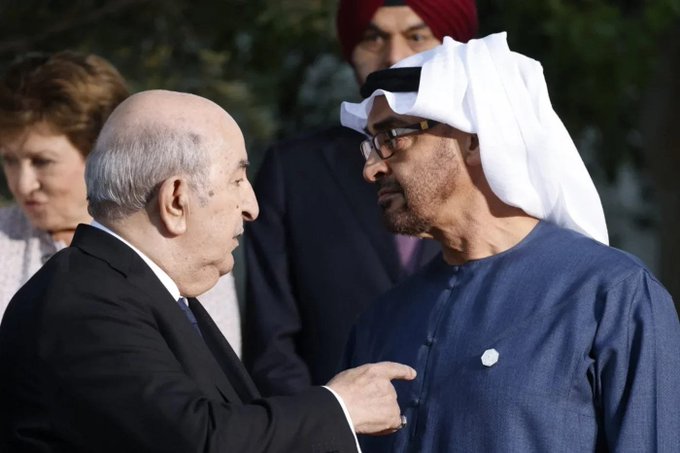
Algeria announced on 10 September that it will sever its diplomatic relations with the UAE in response to “provocative or hostile actions” and after “exhausting all means to preserve bilateral relations.”
The Algerian Foreign Ministry said in a statement that the government had decided to “sever diplomatic relations with the United Arab Emirates” after exercising “great restraint and a high sense of responsibility.”
The statement said Algiers had repeatedly warned Abu Dhabi of the “grave consequences” if such actions persisted.
The ministry reported that the UAE ambassador to Algeria was officially informed of the decision and given a 48-hour deadline to comply.
Last year, Algerian President Abdelmadjid Tebboune described his country’s relations as warm with all Gulf states except one, in a veiled reference to the UAE.
He described relations with Saudi Arabia, Kuwait, Oman, and Qatar as “fraternal,” while accusing the unnamed country of interfering in Algeria’s internal affairs and seeking to destabilize it.
Tensions escalated in February when Algeria began proceedings to cancel an air services agreement with the UAE signed in Abu Dhabi in May 2013.
The cancellation came amid reports that the UAE was seeking to support the Movement for the Self-Determination of Kabylie (MAK), a separatist group in northern Algeria, which Algiers considers a terrorist organization.
Relations between the two countries have deteriorated in recent years amid the UAE’s efforts to destabilize states and fuel civil wars across West Asia and North Africa in partnership with Israel.
In April 2024, Algerian President Abdelmadjid Tebboune referred to the UAE when he stated that, “Wherever there is conflict, the money of this state [the Emirates] is there – in Mali, Libya, and Sudan.”
The UAE has also strongly backed Morocco in its bid to annex Western Sahara, while Algeria supports the Polisario Front, which fights for self-determination in the territory.
The UAE also supported Morocco’s normalization with Israel as part of the Abraham Accords, which Algeria opposed.
Since gaining independence from France in 1962, Algeria has consistently supported the Palestinian cause, in part due to both countries’ shared history of resisting foreign colonial occupation.
Algiers cut ties with Morocco after Rabat normalized relations with Israel under US auspices in December 2020, viewing the deal as a direct threat to Algeria’s borders and security.
“Morocco’s military exercises with Israel contradict the principles of good neighborliness that we have always tried to uphold,” stated President Tebboune in an interview with French media.
Featured Video

Iran’s Next Strike May Not Explode. It Could Shut You Down
or go to
Aletho News Archives – Video-Images
From the Archive
Zionism’s Violent Legacy
By Donald Neff | Washington Report On Middle East Affairs | January 1996
On January 4, 1948, Jewish terrorists drove a truck loaded with explosives into the center of the all Arab city of Jaffa and detonated it, killing 26 and wounding around 100 Palestinian men, women and children.[1] The attack was the work of the Irgun Zvai Leumi – the “National Military Organization,” also known by the Hebrew letters Etzel – the largest Jewish terrorist group in Palestine. The Irgun was headed by Revisionist Zionist Menachem Begin and had been killing and maiming Arabs, Britons and even Jews for the previous ten years in its efforts to establish a Jewish state.
This terror campaign meant that at the core of Revisionist Zionism there existed a philosophical embrace of violence. … continue
Blog Roll
 Aletho News
- Trump’s Iran war is on an Israeli leash
- Saudi oil boss issues global supply warning
- Riyadh Says Its Oil System Is Intact. The Numbers Say Otherwise.
- Trump and Netanyahu Want to “Finish the Job” on Iran
- US ‘one-sided dictation’ not Iran’s beliefs makes rational talks impossible: Baghaei
- Iran’s Next Strike May Not Explode. It Could Shut You Down /Col Doug Macgregor
- Iran: US political targets legitimate if assassinations return
- Iraq shuts key border crossing with Iran under US pressure: Report
- Undersea Internet cables could be targeted in retaliation for attacks on Iran: IRGC deputy chief
- EU sending ‘biased’ observers to interfere in Serbian election – president
- If Americans Knew
- The Israel Lobby’s Changing Fortunes
- AIPAC has become such a political liability that it’s shifting to a more “nimble” approach to buying politicians
- At least 160 Israeli settler attacks in 2 weeks
- Will Gaza’s Ancient Christian Community Disappear Forever?
- Israel’s vision of regional security rests on keeping Arab states weak
- Heidi Levine recounts how Palestinian youths helped save her in settler attack
- DAILY UPDATE: Latest essential news on Palestine, Israel, & region
- Trump’s Intensifying Sabotage of the ICC, for Israel’s Sake
- Israeli military detain US and UK volunteers in West Bank including Democratic NY politician Brad Lander
- Americans at National Conservatism Conference held in Israel this year criticize Israel
- No Tricks Zone
- E-Cars Reduce CO2 Emissions By Only 41% Compared To Internal Combustion Engine Vehicles
- Predictions Made By Renowned Climate Professor Over Past Decades Have Been Proven To Be Poor
- New Study Suggests Large Regions Of The Pacific Ocean Have Been Cooling For The Last 80 Years
- Germany’s Green Energy Debacle: High Energy Costs Force Kahla Porzellan to Close After 182 Years!
- New Study: 50 Years Of The Most Aggressive ‘Net Zero’ Policies Can Only Affect The Global Climate By 0.03°C
- US September “Heat” Was No Record…Many Records Set Decades Ago
- Latest European Green Energy Debacle; Portugal’s Largest Flagship Solar Park Insolvent!
- Green Energy Debacle: German Expert Professor Fritz Vahrenholt Warns Of Severe Economic And Social Consequences
- Two More Paleo Reconstructions Affirm Meters-Higher Sea Levels Across Ireland, Brazil 7000-6000 Years Ago
- New Study: Earth And Venus Surface Warmth Largely Explained By Convection And Lapse Rate, Not CO2 Or Radiation

