BETHLEHEM – Palestinians on Wednesday erected a new “village” encampment in Eizariya to stake their sovereignty and claims to return to their towns and villages.
Activists said they set up 15 tents on a hillside near the original “Bab al-Shams” village that Israeli forces tore down two months earlier.
In a statement, the activists described the initiative as “first, to claim our right as Palestinians to return to our lands and villages, second, to claim our sovereignty over our lands without permission from anyone.”
The action coincided with US President Barack Obama’s arrival at Ben Gurion International Airport.
The activists said it aimed to highlight their opposition to the Obama administration’s policies in the region, saying in the statement that it has been “complicit in Israeli occupation and colonialism.”
“An administration that used the veto 43 times … in support of Israel and against Palestinian rights, an administration that grants military aid to Israel of over three billion dollars annually, can’t have any positive contribution to achieve justice,” the statement said.
March 20, 2013
Posted by aletho |
Ethnic Cleansing, Racism, Zionism, Illegal Occupation, Progressive Hypocrite, Solidarity and Activism | Al-Eizariya, Bab Al-Shams, Israel, Obama, Palestine, Zionism |
Leave a comment
From talk of “red lines” and cartoon bombs to having “all options on the table”, an undeniably delusional logic emanates from leadership in Washington and Tel Aviv regarding the alleged threat posted by Iran’s nuclear program. When Israeli Prime Minister Benjamin Netanyahu famously took to the stage of the UN General Assembly with his doodled explosive, he claimed that Iran would soon have the capability to enrich uranium to 90 percent, allowing them to construct a nuclear weapon by early-mid 2013. In his second administration, Obama, who recently said a nuclear-Iran would represent a danger to Israel and the world, appears to be seeing eye-to-eye with Netanyahu, despite previous reports of the two not being on the same page. For whatever its worth, these two world leaders have taken the conscious decision to entirely ignore evidence brought forward by the US intelligence community, as well as appeals from nuclear scientists, policy-advisers, and IAEA personnel who claim that the “threat” posed by Iran is exaggerated and politicized.
It’s common knowledge that Washington’s own National Intelligence Estimate (NIE) on Iran, which reflects the intelligence assessments of America’s 16 spy agencies, confirmed that whatever nuclear weapons program Iran once had was dismantled in 2003. Mr. Netanyahu has not corrected his statements insinuating that Iran was nearing the red line of 90 percent enrichment, even when recent UN reports that show Tehran has in fact decreased its stockpiles of 20 percent fissile material, far below the enrichment level required to weaponize uranium. Hans Blix, former chief of the International Atomic Energy Agency (IAEA), has challenged previous IAEA reports on Iran’s nuclear activities, accusing the agency of relying on unverified intelligence from the US and Israel. Flynt Leverett and Hillary Mann Leverett, former Washington insiders and analysts in the Clinton and Bush administrations, recently authored a book titled “Going to Tehran”, arguing that Iran is a coherent actor and that evidence for the bomb is simply not there.
Clinton Bastin, former director of US nuclear weapons production programs, has commented on the status of Iran’s capacity to produce nuclear weapons, stating:
“The ultimate product of Iran’s gas centrifuge facilities would be highly enriched uranium hexafluoride, a gas that cannot be used to make a weapon. Converting the gas to metal, fabricating components and assembling them with high explosives using dangerous and difficult technology that has never been used in Iran would take many years after a diversion of three tons of low enriched uranium gas from fully safeguarded inventories. The resulting weapon, if intended for delivery by missile, would have a yield equivalent to that of a kiloton of conventional high explosives”.
Bastin’s assessments corroborate reports that show Iran’s nuclear program is for civilian purposes; he further emphasizes the impracticality of weaponizing the hexafluoride product of Tehran’s gas-centrifuges, as the resulting deterrent would yield a highly inefficient nuclear weapon.
The fact that Iran’s Supreme Leader Ayatollah Ali Khamenei issued several fatwas (a religious prohibition) against the production of nuclear weapons doesn’t seem to have helped much either. An unceasing combination of Islamophobia-propaganda, a repetitive insistence that Tehran is edging closer to the threshold, and devastatingly negligent misreporting of Iran and its pursuit of domestic nuclear power has created a situation where the country is viewed as an irrational actor. In the court of Western mainstream opinion, Iran is grouped in the same category as bellicose North Korea, despite the fact that it is a law-abiding signatory to the Nuclear non-Proliferation Treaty (NPT) that has consistently cooperated with the IAEA while publically renouncing the use of nuclear weapons. This leads to the current scenario, where Iran and its people are punished under an unethical barrage of economic sanctions for possessing a weapon that they do not possess.
The severity of economic sanctions against Iran and the fabricated allegations of it possessing nuclear weapons serve as a disturbing parallel to the invasion and destruction of Iraq during the Bush administration. From the perspective of this observer, the US does not actually want to go to war with Iran – such an ordeal would bring about an array of overwhelmingly negative ramifications that Obama would probably want to avoid. What the US does want to do however, is to dismantle the foundations of the Islamic Republic by completely destroying its economy through sanctions, prompting the population to rise up and overthrow the regime – so basically, Obama is happy to conduct war by other means. Ayatollah Khamenei’s recent proclamations of the US holding a gun to the head of the Iranian nation can only be perceived as entirely accurate.
Its easy to see why the Supreme Leader has doubts over the prospect of negotiations with the US; the deal put forward at the most recent meeting of the P5+1 essentially argued that the US would roll back sanctions that prevent Iran from trading gold and precious metals in exchange for Iran completely shutting down its uranium enrichment plant at Fordo. The substance of this offer appears like it was deliberately drafted to be rejected by the Iranian side, given the fact that it would mandate Iran to shutdown one of its main facilities while keeping in place the most punishing sanctions that have destroyed the Iranian currency and made life-saving medications unaffordable for most – its more of an insult than an offer. For the average Iranian business owner and worker, US-led sanctions and currency devaluation have affected everyday transactions that provide paychecks and economic viability for millions of people.
From urban shopkeepers to rural restaurant owners, many have been forced to close their businesses because they are unable to profit from reselling imported goods purchased with dollars. Isolation from the global banking system has made it increasingly more difficult for Iranian students studying abroad to receive money from their families. Sanctions targeting Iran’s central bank aim to devastate the Iranian export economy, affecting everyone from oil exporters to carpet weavers and pistachio cultivators. By crippling Iranian people’s livelihoods and hindering their ability to pursue education and afford necessities, the Obama administration believes such measures will erode public confidence in the government and challenge its legitimacy. It is important to recognize that these sanctions are not only aimed against Iran’s government, but at its entire population, especially to the poor and merchant population. An unnamed US intelligence source cited by the Washington Post elaborates, “In addition to the direct pressure sanctions exert on the regime’s ability to finance its priorities, another option here is that they will create hate and discontent at the street level so that the Iranian leaders realize that they need to change their ways.”
These sanctions, which are Obama’s throwback to ham-fisted Bush-Cheney era policies, must be seen as part of a series of measures taken to coax widespread social discontent and unrest. US sanctions have broadened their focus, targeting large swaths of the country’s industrial infrastructure, causing the domestic automobile production to plummet by 40 percent, while many essential medical treatments have more than doubled in price. Patients suffering from hemophilia, thalassemia, and cancer have been adversely affected, as the foreign-made medicines they depend on are increasingly more difficult to get ahold of. Over the past two years, general supermarket goods have seen a price hike between 100 to 300 percent. For the first time in the world, a media ban has been imposed, on PressTV, Iran’s state-funded English language international news service. Ofcom, a UK-based communications regulator linked to the British government, spearheaded the prohibition. The European Union has also imposed a travel ban on Press TV CEO Mohammad Sarafraz and eight other officials.
While editorials and commentators in the New York Times and Washington Post regularly accuse Iran of violating international law, the editors of these papers have shown no willingness to scrutinize the US and Israel by holding them accountable when they violate international law, namely, a prohibition of “the threat or use of force” in international relations unless a nation is attacked or such force is authorized by the UNSC, as embodied in the United Nations Charter. It is undeniable that by failing to question the brutal tactics meted out by Washington and Tel Aviv, these papers and the commentators affiliated with them, endorse policies that intimidate and coerce civilian populations in addition to employing terrorist tactics such as targeted cyber-strikes and extrajudicial assassinations – all of which the Iranian nation has been subjected to in utter defiance of the standards and rules of international law and their fundamental bedrock of protecting civilians.
The facts have been proven time and time again, Iran seeks economic development, technological advancement, and energy independence – it wants domestic nuclear power and the freedom to enrich uranium to 20 percent for the medical development of radiopharmaceuticals and industrial isotopes, as it is entitled to as an NPT signatory. Washington’s threats to impose “secondary” sanctions against third-country entities doing business with the Islamic Republic represents a mafia-mentality so characteristic of the unipolar reality in which the US sees itself. Washington has recently threatened energy-hungry Pakistan with sanctions over its partnership with Tehran in a $7.5-billion gas pipeline between the two nations, a project that would do infinite good by promoting regional stability and delivering energy to poverty stricken regions in Pakistan. Washington’s sanctions regime will collapse if the US Congress insists that China sharply cut its energy trade and relations with Iran. China will not adhere to such stringent foreign interference into its trade relationships, and Washington is in no position to sanction China because it buys oil from Iran.
If Beijing calls Washington’s bluff, other growth-focused non-Western economies like India, Malaysia, and South Korea will be less fearful of conducting business and buying oil from Tehran. Obama has taken some cues from the revolutionary students of 1979 and his administration has come up with a hostage crisis of its own, involving holding captive the civilian population of Iran – and Washington looks keen to let the sanctions bite until either the regime bows down, or the people rise up. One of the best examples of the perverted logic behind the US position on Iran comes from Vice President Joe Biden, who recently stated, “We have also made clear that Iran’s leaders need not sentence their people to economic deprivation”. Such a statement embodies the upside-down logic of Washington policy-makers who claim the moral high ground while enabling terrorism and engaging in unethical campaigns of economic and military warfare – the present state of affairs simply cannot continue.
Nile Bowie is an independent political analyst and photographer based in Kuala Lumpur, Malaysia. He can be reached at nilebowie@gmail.com
March 19, 2013
Posted by aletho |
Economics, Progressive Hypocrite, Timeless or most popular, War Crimes | Benjamin Netanyahu, International Atomic Energy Agency, Iran, Israel, National Intelligence Estimate, Obama |
Leave a comment

According to official estimates, the Islamic Republic of Iran is now roughly a year away from acquiring a nuclear bomb. Well, that is, if it were actually building a nuclear bomb. Which it’s not.
“Right now, we think it would take over a year or so for Iran to actually develop a nuclear weapon, but obviously we don’t want to cut it too close,” President Barack Obama told an Israeli television station on March 14, 2013. In order to stop Iran, Obama vowed to “continue to keep all options on the table,” a euphemism for engaging in an unprovoked military attack, thus initiating a war of aggression, the “supreme international crime.”
Obama’s statement came just two days after his own Director of National Intelligence told a Senate committee that the Iranian government had not made a decision to weaponize its legal, safeguarded civilian nuclear energy program. “We do not know if Iran will eventually decide to build nuclear weapons,” DNI James Clapper said. Even if it did, he added, Iran wouldn’t be able to secretly divert any of its stockpiled and safeguarded enrichment uranium to a weapons program.
The American president failed to make this distinction in his interview, instead saying only that a nuclear-armed Iran would be “dangerous for the world. It would be dangerous for U.S. national security interests.”
Repeating his administration’s main talking point, Obama told his Israeli interviewer, “What I have also said is that there is a window, not an infinite period of time, but a window of time where we can resolve this diplomatically and it is in all of our interests.”
But this window has already been open for decades and Iran has supposedly been only a year away from a bomb for the past ten years.
In November 2003, then Mossad chief Meir Dagan told the Knesset Foreign Affairs and Defense Committee that Iran’s nuclear program would be at a “point of no return” within the next year and would then “have the potential to produce 10 nuclear bombs a year.” Israeli Defense Minster Shaul Mofaz repeated the one year “point of no return” timeline in early 2005, a claim reinforced by other Israeli officials throughout that year.
Similar estimates were made in 2006, 2007 and 2008. Oh, and 2009.
In April 2010, Ronald Burgess, director of the U.S. Defense Intelligence Agency, told the Senate Armed Services Committee that the “general consensus” was that Iran could develop a single nuclear bomb within a year if the leadership decided to do so, despite maintaining that Iran didn’t have an active nuclear weapons program.
As the years have passed, this assessment has held fast.
In late January 2011, Aviv Kochavi, director of Israeli Military Intelligence, admitted Iran was not actively working on a nuclear weapon, but claimed it could build one in “a year or two” once “the leader decides to begin enriching at 90 percent.”
A year later, in January 2012, Defense Secretary Leon Panetta told 60 Minutes, “The consensus is that, if they decided to do it, it would probably take them about a year to be able to produce a bomb.”
Just few days later, Kochavi told a panel at the Herzliya security conference that “Iran has enough nuclear material for four bombs,” adding, “We have conclusive evidence that they are after nuclear weapons. When Khamenei gives the order to produce the first nuclear weapon – it will be done, we believe, within one year.”
Last week, addressing the very same conference, Kochavi was back with a new prediction – actually, it was the same one as before. He claimed that, in the coming year, the Iranian “leadership would like to find itself in the position of being able to break out to an atomic weapon stage in a short period of time, according to the IDF’s intelligence assessments. However, he said that Iran has not yet decided to build the bomb.”
Greg Thielmann, a former U.S. intelligence analyst now with the Arms Control Association, recently explained that “calculating such a time line involves a complicated set of likely and unlikely assumptions,” telling journalist Laura Rozen, “If Iran decided today to build nuclear weapons, it would require years, not weeks or months, to deploy a credible nuclear arsenal.”
Meanwhile, with Obama set to visit Israel this week, Reuters now notes that “Netanyahu has not publicly revised the spring-to-summer 2013 dating for his ‘red line’,” the stated point at which the Iranian nuclear program advances far enough to automatically trigger an Israeli attack, a threat laid down by the Israeli Prime Minister last September. “But several Israeli officials privately acknowledged it had been deferred, maybe indefinitely,” Reuters adds before quoting an anonymous official: “The red line was never a deadline,” he said.
Clearly, when it comes to propagandistic prognostications about the imminence of an Iranian bomb, they never really are.
March 19, 2013
Posted by aletho |
Militarism, Progressive Hypocrite, Timeless or most popular, Wars for Israel | Iran, Israel, Meir Dagan, Obama, United States, United States Senate Committee on Armed Services |
Leave a comment
JERUSALEM – Last month, an international fact-finding mission on Israeli settlements in the Occupied Palestinian Territory (OPT) commissioned by the UN Human Rights Council found that settlements constituted a violation of international human rights and humanitarian law and called on Israel to stop all expansions immediately and withdraw from settlements.
A controversial Israeli plan, known as E-1, to build thousands of housing units and hotel rooms near the Ma’ale Adummim settlement, has garnered much attention in the media because it would sever Palestinian East Jerusalem from the rest of the West Bank. (See IRIN’s briefing on E-1 here.)
But at the same time, Israel has been moving forward with equally controversial settlement plans under less scrutiny and with unusual speed.
As US President Barack Obama prepares to visit the region this week, IRIN takes a look at some of the details that have been overlooked in the discussion.
What’s the Giv’at HaMatos plan?
According to Israeli NGO Ir Amim (“City of Nations”), which works to preserve Jerusalem as a home for both Jews and Palestinians, one settlement plan of “critical importance” is Giv’at HaMatos.
In a sense, Giv’at HaMatos does in the south what E-1 does in the east. The planned large housing and hotel complex at the southern perimeter of Jerusalem would further disrupt the contiguity of land between East Jerusalem and the rest of the West Bank required for a future Palestinian state, seriously impeding a two-state solution, research and rights groups say. It would also mark the first new settlement construction in Jerusalem since 1997.
“All construction is problematic but there are several plans that are, in our view, more dangerous if implemented,” Hagit Ofran, director of the Settlement Watch project at the Israeli NGO Peace Now, told IRIN. “Giv’at HaMatos is the most dangerous plan that is now approved.”
Part of the plan – to build 2,612 units – was approved by the Jerusalem Regional Planning Committee on 19 December.
Most of Giv’at HaMatos is currently uninhabited, but according to the International Crisis Group (ICG), which recently released a two-part report on the future of East Jerusalem, its build-up would cut off Arab neighbourhoods in southern Jerusalem, like Beit Safafa and Sharafat, rendering them “Palestinian enclaves”.
Giv’at HaMatos would connect the dots of several other planned or expanding settlements along southern Jerusalem – including Giv’at Yael in the southwest; and Har Homa and East Talpiyot in the southeast – forming “a long Jewish continuum severing Bethlehem’s urban continuum from Palestinian Jerusalem”, ICG said. Last year, the Israeli government also approved more than 2,000 new units in neighbouring Gilo.
This kind of attachment to Jewish expansions could make peace negotiations even harder.
“From an Israeli public opinion perspective, Giv’at HaMatos is in the municipal border of Jerusalem,” Ofran said. “It’s considered a legitimate part of Israel.”
Barak Cohen, the Jerusalem Municipality’s adviser for foreign affairs and media, told IRIN Giv’at HaMatos is part of Jerusalem’s “natural and much-needed growth”, allowing both Arab and Jewish landowners to develop their properties.
Indeed, part of the Giv’at HaMatos plan, approved on 18 December, allows for the building of 549 units for Palestinians – though Betty Herschman, director of international relations and advocacy at Ir Amim, points out much of it retroactively legalizes building that has already been completed. The figures, she added, amount to just over one-fifth of the Jewish expansion.
“For many Arab East Jerusalemites, the battle for their city is all but lost.”
Still, Cohen insisted, the development would benefit Jerusalem as a whole: “Not planning and developing Jerusalem neighbourhoods ultimately harms all residents and landowners – Arabs and Jews alike.”
Last year, Israel also issued tenders for the construction of 606 new housing units north of East Jerusalem, in the Ramot settlement, just north of the Green Line marking the border between Israel and the West Bank, and approved another 1,500 units in the neighbouring settlement of Ramot Shlomo, according to Ir Amim.
What other settlements are planned?
Beyond Jerusalem, there was movement on a number of other settlements projects in disputed areas, according to Settlement Watch.
In June 2012, the Israeli government announced it would build 851 new units in the West Bank, including more than 230 in the controversial settlements of Ariel and Efrat. Like Giv’at HaMatos, these two settlements make a contiguous Palestinian territory impossible, Settlement Watch says.
Overall, settlements expanded much faster than usual last year.
In 2012 the Israeli government approved the construction of 6,676 settler housing units in the West Bank, compared with 1,607 in 2011 and several hundred in 2010, according to Peace Now.
For plans that were already approved, it issued more than 3,000 tenders to construction contractors – more than any other year in the last decade, Peace Now said. Construction has actually begun on 1,747 homes.
Regardless of the settlements, Palestinians, especially in Area C, are under immense pressure. Recent weeks have seen a considerable upswing in demolitions of Palestinian structures. According to the Displacement Working Group, a grouping of aid agencies helping displaced families, Israeli forces destroyed 139 Palestinian structures, including 59 homes, in January – almost triple 2012’s monthly average. The demolitions occurred in East Jerusalem and the West Bank – with a majority taking place in Area C – and left 251 Palestinians, including over 150 children, displaced.
The office of the Coordinator of Government Activities in the (Palestinian) Territories (COGAT) told IRIN there was no connection between the removal of unauthorized buildings and the construction of Israeli settlements. “All construction in the West Bank is subject to building codes and planning laws and unauthorized constructions are dealt with accordingly,” the office said in an email.
What are the knock-on effects?
Settlements are often discussed through the lens of their illegality under international law or as obstacles to a peace agreement between Israel and the Palestinians. But everything associated with the settlements – including Israeli-only infrastructure, the separation barrier, military checkpoints, restrictions on Palestinian freedom of movement, suppression of freedom of expression and political life, and control of Palestinian natural resources – causes a ripple effect through Palestinian society, adversely impacting the people.
The UN estimates there are now 520,000 Israeli settlers in East Jerusalem and the West Bank, with 43 percent of the land there allocated to local and regional settlement councils. According to the UN Secretary-General, Israel has transferred roughly 8 percent of its citizens into OPT since the 1970s, altering the demographic composition of the territory and furthering the Palestinian people from their right to self-determination.
Baker, of the Israeli Prime Minister’s Office, said a future Palestinian state should include a Jewish minority. “The assumption behind this… is that Jews have no right to live in the West Bank, an assumption that we reject. In fact we see ourselves as the true indigenous people of this land.”
But Israeli settlements have violated Palestinian rights to equality under the law, to religious freedom and to freedom of movement, according to the UN fact-finding mission. They have also eroded Palestinian access to water and to agricultural assets, and the ability to develop economically, it said.
For example, Bedouins from the Palestinian village of Khan Al Ahmar, northeast of E-1, cannot sell their dairy products at their traditional Souq Al Ahmar market any more. Because of movement restrictions (they hold West Bank IDs and lack the proper permits to enter East Jerusalem), they cannot get there.
The UN secretary-general has said that Palestinians “have virtually no control” over the water resources in the West Bank, with 86 percent of the Jordan Valley and the Dead Sea under the de facto jurisdiction of the settlement regional councils.
There is a statistical correlation between Palestinians’ proximity to settlements and their rates of food insecurity, according to a UN and government survey, which found that one quarter of Palestinians who live in Area C, home to the largest number of settlements in the West Bank, are food insecure. In Areas A and B, the average rate of food insecurity is 17 percent.
In addition, “all spheres of Palestinian life are being significantly affected by a minority of settlers who are engaged in violence and intimidation with the aim of forcing Palestinians off their land,” the mission said.
Operation Dove, an international organization working in the Palestinian village of At-Tuwani and the South Hebron Hills, reported that Palestinian children have a very hard time going to school due to settler attacks.
The UN and rights groups say radical settlers use violence against Palestinians with impunity and their illegal outposts are often recognized and retroactively legalized by the government.
Since the occupation began, Israel has detained hundreds of thousands of Palestinians, some of them without charge, and some of them children. Most of the minors are arrested “at friction points, such as a village near a settlement or a road used by the army or settlers”, the fact-finding mission said.
Israel uses what they term “administrative detention” when it considers the detainee a threat to the security of the state.
Ir Amim’s Herschman says Israel is also attempting to create a “greater Jerusalem” through additional means, for example: the Israeli separation barrier, planned national parks, and the construction of highways dividing villages, dispossessing Palestinians of their land and making it harder for them to access services like schools and mosques.
In recent weeks, residents of the Palestinian village of Beit Safafa have been protesting against the planned extension of the Begin Highway that would divide their village in order to connect major Israeli settlement blocks outside the city to Jerusalem.
The planned root of the separation barrier, in addition to a potential national park around the perimeter of the barrier would also close off nearby Palestinian village al-Wallajeh.
The planned route of the barrier extends all the way around and far beyond Muale Adummim and in other areas south and north of Jerusalem. “These lines are a unilateral declaration of a much greater Jerusalem, a unilateral expanding of the boundaries, an exponential increase,” she told IRIN.
Or as the ICG put it, “for many Arab East Jerusalemites, the battle for their city is all but lost.”
March 19, 2013
Posted by aletho |
Ethnic Cleansing, Racism, Zionism, Illegal Occupation | East Jerusalem, Human rights, IRIN, Israel, Israeli settlement, Jerusalem, Palestine, United Nations Human Rights Council, West Bank, Zionism |
Leave a comment
After a brief respite from incessant warmongering nonsense following the reelection of Barack Obama in November 2012, it appears old rhetorical devices have reemerged. With a vengeance.
Israeli Prime Minster Benjamin Netanyahu, addressing his minions at AIPAC via video chat on March 4, spent a bunch of his time saying supposedly scary things about “Iran’s pursuit of nuclear weapons” and dismissing negotiations.
“I have to tell you the truth,” he told the fawning crowd. “Diplomacy has not worked. Iran ignores all these offers. It is running out the clock.” He continued:
Iran enriches more and more uranium. It installs faster and faster centrifuges. It’s still not crossed the red line I drew at the United Nations last September. But Iran is getting closer to that line, and it’s putting itself in a position to cross that line very quickly once it decides to do so.
Netanyahu deliberately ignored the fact that Iran’s stockpile of enriched uranium remains far from weapons-grade and that Iran has, for over a year now, been systematically converting much of its 19.75% enriched stock to fuel plates that precludes the possibility of being diverted to military purposes.
Of course, the fact that Iran has an inalienable legal right to a fully-functioning nuclear energy program – including the indigenous mastery of the nuclear fuel cycle – was not addressed at all. For Netanyahu and his acolytes, any Iranian nuclear program is synonymous with a weapons program – and not only that, but a weapons program designed to “exterminate” Israel’s “Jewish people.” Facts remain irrelevant. Hasbara reigns.
Netanyahu once again demonstrated his complete disregard for the tenets of the United Nations Charter by calling for Iran to be explicitly threatened with a military attack if it doesn’t comply with absurd Israeli demands. He insisted “with the clarity of my brain” (whatever that means) that “words alone will not stop Iran. Sanctions alone will not stop Iran. Sanctions must be coupled with a clear and credible military threat if diplomacy and sanctions fail.”
Addressing the same audience, Vice President Joe Biden also spoke at length about “Iran’s dangerous nuclear weapons program,” which the U.S. intelligence community and its allies, including Israel, have long assessed doesn’t exist.
The consensus view of all 16 American intelligence agencies has maintained since 2007 that Iran ceased whatever research into nuclear weaponization it may have conducted by 2003, and has never resumed that work. The NIE has been consistently reaffirmed ever since (in 2009, 2010, and again in 2011).
In early 2012, James Clapper, Director of National Intelligence, stated in testimony before the Senate Armed Services Committee, “We do not know…if Iran will eventually decide to build nuclear weapons.” The same day, Defense Intelligence Agency Director Ronald Burgess said that “the agency assesses Iran is unlikely to initiate or intentionally provoke a conflict” and maintained that Iran’s military doctrine is defensive in nature and designed only for deterrence.
Clapper repeated this conclusion verbatim just last week before the Senate Intelligence Committee.
Moreover, the IAEA itself continually confirms that Iran has no active nuclear weapons program and has stated it has “no concrete proof that Iran has or has ever had a nuclear weapons program.”(emphasis added)
Undeterred by facts or reason, Biden continued to tell the AIPAC fanatics that “Iraq’s [sic] acquisition of a nuclear weapon not only would present an existential threat to Israel, it would present a threat to our allies and our partners — and to the United States. And it would trigger an arms race — a nuclear arms race in the region, and make the world a whole lot less stable.” Biden made sure to repeat the mantra that “all options, including military force, are on the table” when it comes to Iran.
First, Biden’s Iraq/Iran slip wasn’t merely Freudian. Since the Iraq script from a decade ago is nearly identical to the Iran script now, it’s unsurprising that Biden can’t keep his manufactured threats straight. One need only recall Biden’s claims on Meet The Press in August 2002 that Saddam Hussein constituted “a long term threat and a short term threat to our national security” and “an extreme danger to the world.” Consequently, said Biden, “We have no choice but to eliminate the threat.”
Years later, on the same program, Biden stood by his statements. When asked by Tim Russert about weapons of mass destruction that didn’t exist, Biden blithely insisted that “everyone in the world thought he had them. The weapons inspectors said he had them. He catalogued—they catalogued them. This was not some, some Cheney, you know, pipe dream. This was, in fact, catalogued. They looked at them and catalogued. What he did with them, who knows?”
Biden was lying, of course.
International weapons inspectors had been perfectly clear about what “he did with them.” After losing the Gulf War in 1991, Iraq’s weapons programs were subject to intrusive inspections and international sanctions. By 1998, the IAEA concluded that “there is no indication that Iraq possesses nuclear weapons or any meaningful amounts of weapon-useable nuclear material.” The next year, the UN Security Council affirmed that UN weapons inspectors “have been effective in uncovering and destroying many elements of Iraq’s proscribed weapons programmes,” adding, “The bulk of Iraq’s proscribed weapons programmes has been eliminated.”
In 2000, UN inspector Scott Ritter explained that “as early as 1997” it was possible “to determine that, from a qualitative standpoint, Iraq had been disarmed. Iraq no longer possessed any meaningful quantities of chemical or biological agent…and the industrial means to produce these agents had either been eliminated or were subject to stringent monitoring. The same was true of Iraq’s nuclear and ballistic missile capabilities.”
In July 2002, as calls for war grew louder, Ritter wrote in the Boston Globe that “the Bush administration provides only speculation, failing to detail any factually based information to bolster its claims concerning Iraq’s continued possession of or ongoing efforts to acquire weapons of mass destruction. To date no one has held the Bush administration accountable for its unwillingness – or inability – to provide such evidence.”
When, days later, then Senate Foreign Relations Committee chairman Joe Biden convened hearings to assess the threat posed by Iraq and implications of a potential U.S.-led attack, Ritter called the hearings a “sham” and said the Delaware Senator and “most of the Congressional leadership have pre-ordained a conclusion that seeks to remove Saddam Hussein from power regardless of the facts, and are using these hearings to provide political cover for a massive military attack on Iraq.”
Such is Joe Biden’s penchant for telling the truth. Returning to his comments at AIPAC, Biden’s recent fear-mongering hypotheticals about Iran are also wrong.
Beyond being obvious that Iran poses literally no threat to the United States, numerous Israeli military and intelligence officials openly reject the notion that a nuclear-armed Iran would “present an existential threat to Israel.” Former Mossad chief Ephraim Halevy recently told the UK Zionist Federation that Israel’s existence “is not in danger and shouldn’t be questioned.”
Furthermore, Biden’s axiomatic contention that an Iranian nuclear bomb would spark a regional arms race has also been rejected for years by less hysterical analysts. In fact, Biden made his comments soon after the publication of a new report by the Center for a New American Security which judged the scenario extremely unlikely.
For obvious reasons, Biden claimed that the United States is “not looking for war” and prefers “a diplomatic solution” to the impasse over Iranian nuclear program. Still, he said, the “window is closing” for a negotiated outcome, after which military action would be taken.
This formulation has been echoed by senior Obama officials of late, including both Secretary of State John Kerry and Secretary of Defense Chuck Hagel.
The window has apparently been closing for some time now and yet, incredibly, Iran never gets any closer to actually having the nuclear weapon it isn’t building and that it constantly insists it doesn’t want.
In early June 2009, Israeli Defense Minister Ehud Barak privately told a visiting Congressional delegation in Tel Aviv that there was an estimated “window between 6 and 18 months from now in which stopping Iran from acquiring nuclear weapons might still be viable.” A month later, Joint Chiefs chairman Mike Mullen warned that the “window is closing” on preventing Iran from acquiring a nuclear weapon. He declared that Iran was only one to three years away from successfully building a nuclear weapon and “is very focused on developing this capability.”
With history repeating itself (remember in early 2001 when the Department of Defense reported, that “Iraq would need five or more years and key foreign assistance to rebuild the infrastructure to enrich enough material for a nuclear weapon”?), it remains crucial to assess facts rather than blindly accept propaganda, to recall the lessons of the past in order to avoid future blunders and to know – unequivocally – that the implications and consequences of the pathological Iraqization of Iran inevitably lead to the commission of murderous war crimes, not merely Freudian slips.
March 18, 2013
Posted by aletho |
Deception, Mainstream Media, Warmongering, Timeless or most popular, Wars for Israel | AIPAC, Iran, Iraq, Israel, Joe Biden |
Leave a comment
Israel arrested the brother of former-Palestinian prisoner Ayman Sharawneh in the West Bank early Monday just hours after the long-term hunger striker was released from Israeli prison and deported to the Gaza Strip, Ma’an News Agency reported.
Israeli forces raided the home of Jihad Sharawneh, 24, at dawn Monday in Deir Samir, southwest of Hebron.
An Israeli military spokesman told Ma’an that Jihad Sharawneh was arrested and taken in for security questioning.
Amjad Najjar, head of the Hebron branch of the Palestinian Prisoners Society, denounced the arrest as an act of revenge to punish the Sharawneh family.
Ayman Sharawneh signed an agreement with Israeli authorities to be deported to Gaza for 10 years, bringing an end to his eight-month-long hunger strike, Qadura Fares, head of the Palestinian Prisoners Society, said in a statement.
He arrived at the Erez crossing Sunday night, where a Palestinian ambulance was waiting to take him into Gaza. Hundreds of people crowded at the Palestinian side of the checkpoint to greet him.
Fares said that Israel had previously proposed to deport Sharawneh outside of Palestine, but then offered to exile him to Gaza after he refused to leave his homeland.
Sharawneh agreed to be deported after months of hunger striking to protest his detention, and after numerous warnings by doctors regarding the severe deterioration in his health, Fares added.
The 36-year-old father of nine had previously demanded that authorities allow him to return to Hebron to be with his family.
The under secretary of the PA Ministry of Detainee Affairs, Ziad Abu Ein, told Ma’an that Sharawneh’s agreement was signed without notifying the ministry.
Earlier Sunday, the Minister of Detainee Affairs Issa Qaraqe said the Palestinian Authority rejected the deportation of prisoners as political blackmail.
Sharawneh was released in the October 2011 prisoner swap deal between Israel and Hamas but was rearrested in January 2012 and accused of violating the terms of his release.
Israeli authorities refused to reveal how Sharawneh violated his release terms, even to his lawyers, and he was jailed without charge or trial.
Israeli prosecutors sought to cancel Sharawneh’s amnesty and jail him for 28 years, the remainder of his previous sentence. He went on hunger strike to demand his release.
Abu Ein said Israeli authorities were pressuring Samer Issawi, who has been on hunger strike for 228 days, to make a similar deal.
(Ma’an, WAFA, Al-Akhbar)
March 18, 2013
Posted by aletho |
Civil Liberties, Ethnic Cleansing, Racism, Zionism, Illegal Occupation, Subjugation - Torture | Human rights, Israel, Palestine, Palestinian prisoners in Israel, West Bank, Zionism |
Leave a comment

On 16 March 2013 the South Hebron Hills Popular Committee built a tent to protect school children from Tuba and Maghayir Al Abeed while they wait for their military escort. Hours after the ceremonious construction of the tent — attended by villagers, school children, internationals and various media outlets — was over, the Israeli military demolished the tent and arrested one of the internationals present.
The schoolchildren coming from Tuba and Maghayire Al Abeed walk between the Israeli settlement of Ma’on and the outpost of Havat Ma’on in order to get to school in At-Tuwani. Since 2001 settlers have repeatedly attacked the children along this route, preventing most of the children, who feared for their safety, from being able to attend school. In 2004 volunteers from Christian Peacemaker Teams (CPT) and Operation Dove began accompanying the children along the path, but the violent attacks continued. These attacks brought the matter to the attention of the Children Rights Committee of the Knesset, which established in November 2004 a military escort to protect the children.
Since November 2004, CPT and Operation Dove have constantly monitored the military escort, documenting the failures of the Israeli army as well as settler violence toward the children. During the school year 2011-2012, the volunteers of Operation Dove and CPT published a report, The Dangerous Road to Education, which found that in 35% of cases the military escort was late. In addition, in 48% of cases, the military escort arrived late after school, forcing the children to wait for a total time of about 21 hours. There is nothing to shelter the children, some as young as six years old, from the elements as they wait for their unpunctual military escort.
The Popular Committee wanted to give the children a tent to shelter them while they wait. The event had around one hundred in attendance. These included some of the children whom the tent was being made for, teachers and administrators from the school, CPT and other international organizations, Palestinians from At-Tuwani and surrounding villagers and the media. The crowd was immediately met by soldiers who filmed all the attendees and took down Palestinian flags that children had put up around the building area. The children played and chanted in front of the soldiers while settlers on the next hilltop yelled down at them, “Kill all the Arabs.” The tent was completed and christened “Michele’s tent” after the late daughter of the Italian woman who funded the project.
As the afternoon wore on the crowd started to leave. Two hours after the tent was build the Israeli military demolished it and arrested one of the international volunteers who had remained there. The volunteer was released, but must leave the West Bank for two weeks. The Popular Committee plans to rebuild the tent, but as for now the schoolchildren will have to wait out in the rain when they return to school on Sunday.
March 16, 2013
Posted by aletho |
Ethnic Cleansing, Racism, Zionism, Subjugation - Torture | Christian Peacemaker Teams, Israel, Israeli settlement, Ma'on Har Hebron, Operation Dove, Palestine, Tuwani, West Bank, Zionism |
Leave a comment
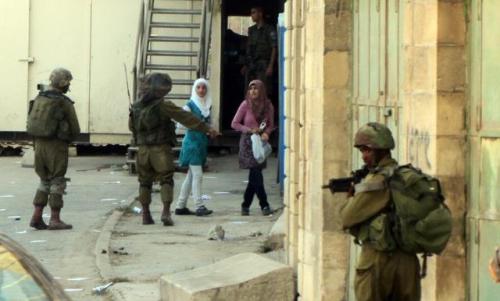
The United Nations’ Commission on the Status of Women (CSW) has condemned Israel for violating the rights of Palestinian women.
In a resolution issued on Friday, the UN policy-making body, condemned Tel Aviv’s regime for the degrading living conditions for Palestinian women.
“The Israeli occupation remains the major obstacle for Palestinian women with regard to their advancement, self-reliance and integration in the development of their society…” the eight clause resolution read.
The resolution was passed by 29 votes. It was rejected only by Israel and the United States. 10 other countries also abstained.
The UN commission also issued a declaration, urging an end to violence against women across the world.
“The commission urges states to strongly condemn all forms of violence against women and girls and to refrain from invoking any custom, tradition or religious consideration to avoid their obligations with respect to its elimination,” said the declaration.
The declaration also called on the word’s countries to “devote particular attention to abolishing practices and legislation that discriminate against women and girls, or perpetuate and condone violence against them.”
The 18-page declaration includes the viewpoints of Iran and other Muslim countries. Activists have described the document as a victory for women.
March 16, 2013
Posted by aletho |
Civil Liberties, Ethnic Cleansing, Racism, Zionism, Subjugation - Torture | CSW, Human rights, Israel, Status of Women, United Nations Commission on the Status of Women, United States |
Leave a comment
Rachel’s Legacy
“Parents can be awakened by their children”
–Cindy Corrie, 2003 Commencement address
Ten years have now passed since we received the terrible phone call telling us our young friend Rachel Corrie was dead. We had gone to see her off the drizzly winter day she left Olympia to work in Gaza with the International Solidarity Movement. We couldn’t know that we were seeing her for the last time, nor foresee the legacy she would leave as she said goodbye to her hometown, and stepped into history.
Rachel would be killed on March 16, 2003, crushed beneath an armored Israeli bulldozer as she tried to prevent the demolition of a Palestinian home in the Gazan border town of Rafah.
It seems likely that Rachel’s story would by now have faded from memory as just one more among the thousands of deaths in Gaza over the past decade, but for the efforts of her parents, Craig and Cindy. Having no prior involvement in the Israel-Palestine issue, they immersed themselves in a process of self-education and public activism so relentless and untiring that even now it leaves their friends slack-jawed in amazement.
Rachel’s family has witnessed an eventful decade—in the Middle East and at home. They’ve pursued legal struggles, led public campaigns, traveled the world, and kept Rachel’s story alive through books, plays, films and media outreach.
We sat down with them recently to talk about the changes they’ve seen.
Working Inside the System
As we detailed in an article five years ago, much of the Corries’ initial efforts focused on moving the three branches of the American government to deliver justice after Rachel’s killing. They pressed the Executive branch, through the State and Justice departments, for an investigation, they used the court system for a civil trial against the Caterpillar Corporation, and they sought a Congressional resolution calling for a U.S.-led investigation. As hardly needs saying, these efforts failed spectacularly in their primary goals. The Corries challenged—and for many newcomers, exposed–a powerful and deeply entrenched foreign policy apparatus that grants virtual impunity to Israel, even for the killing of an American peace activist.
But the Corries take a long view, and try to see the good. Cindy says, “Many people in government, particularly in the diplomatic corps, are there for good reasons– there are people with good hearts. I think their willingness to meet with us is partly because they know that Rachel’s story does have significance, around the world, and in the Arab world particularly. And certainly they know it has resonance in Gaza and with Palestinians.”
Craig and Cindy know that they carry an authority that few others can claim, and although it was unsought, they use it conscientiously.
“It’s been ten years for us now, and for our family,” added Craig. “That includes extended family like sisters and brother in laws, and it’s amazing how many people who are high up in government we’ve talked to. Either them or their assistants… all these people now have some understanding of the situation, and I think they have some respect, they can’t just write us off as crazy.”
“In the last attack on Gaza, in November, we were there. Israel started to drop bombs, and we woke up to a flash of light, then the concussion–it was that close to us. When we came back, we went to the State Dept. We spent about an hour talking to the head of the Israel-Palestine desk. They’ve never been to Gaza, none of these people knew anything about Gaza.” In a sense, the Corries have become civil society’s ambassadors to Gaza, a region abandoned by U.S. (and European) diplomatic isolation since the rise of the democratically elected Hamas government there.
Cindy said, “The State Department doesn’t have anybody in Gaza. I think many of them know that’s maybe not the most productive policy for them, it’s difficult when they don’t have people in places. We shared with them that we went to the funeral of a young boy killed playing soccer in front of his house in Khan Younis by the Israeli military. I went with his mother, and we talked to his friends who showed us where they had been playing soccer. You realize that for these children, that’s an experience they may carry with them forever. If you want to make progress, you have to stop these kinds of situations that have to fill people with so much hurt and rage. It shouldn’t happen.”
The Civil Trial in Israel
The Corries, at their own expense, have spent the last eight years pursuing a wrongful death lawsuit in Israeli courts, charging the State of Israel and its Defense Ministry with the intentional and unlawful killing of their daughter. If the effort to move the U.S. government was Herculean, the task of moving the Israeli government would prove Sisyphean. Personally attending all of the courtroom proceedings, the family logged some nine months in Israel for the trial. Seeking accountability, not money, they asked for $1 in symbolic damages.
Craig explained, “The courts are the way that we have agreed as a society to settle our disagreements nonviolently. That’s the official way to do it. And so I feel very strongly that you have to demand that they work. And so we did.”
They encountered double standards from the outset. Cindy told us,
”They didn’t want to hear anything about home demolitions. In some ways, Rachel’s lost in the trial. She’s just a dead person. And the reasons for why she was there, the home demolitions and all that was happening, oh they bristled so. When B’tselem gets brought up, the Israeli human rights organization that’s reporting what’s happening in the Occupied Territories, they just brush it away: ‘What’s B’tselem? We don’t trust their data!’ It’s so shocking because this is the Israeli state. That’s what we were seeing, the Israeli state, in the courtroom. And it’s very shocking, the lengths to which they will go to prevail.”
“They had a woman who testified as an ‘expert’ on the International Solidarity Movement—she had never done any research on ISM. She was the military spokesperson when Rachel was killed and so that made her an expert on ISM. She submitted to the court a 100-page report demonizing ISM, demonizing Rachel.”
Craig broke in: “She submitted that two weeks before she was coming to testify, so it’s all in Hebrew. We said, ‘How are we going to get this translated? ….What are we gonna do with it?’” (The Corries had to pay for the English translation of thousands of pages of documents). “Then we learn that she just picked it up off the internet. She has no expertise on this. And it all goes in, and it’s just made-up garbage. When we have witnesses, it can’t be about what Israel is doing in Gaza, but when they have witnesses, it can be about what the ISM is doing in Jenin. “
They were struck early on by the casual trial preparation by the military, signaling its confidence in a friendly judge’s courtroom. Craig recalled with exasperation the testimony of the former Gaza Division’s Southern Brigade Commander, Colonel Pinhas (Pinky) Zuaretz, who was in charge when Rachel died. The colonel had testified in a sworn affidavit that an injury he had received had occurred in the area Rachel where was working, known as the Philadelphi Corridor, which was untrue. “So our attorney says, ‘So you’re telling me, you’re injured near the Philadelphi Corridor?’ And he said ‘No, I never said that’. ‘Well, here, you want to read this (affidavit)? ‘Oh, well, it’s wrong.’ ‘Wrong? Why is it wrong?’ He said it’s wrong because of ‘inattention’!”
“Then he said his troops had been fired at with rockets from the Nasrallah’s home (the family Rachel was defending). They’re putting in a public document that anybody can read, that the family are terrorists. He then says, well it was after the family had been forced to move out. So it was when the house was controlled by the Israeli military! And it completely escapes them that they were safer with the family living in the house than when it was under their control. These are experienced, good attorneys turning out this sort of (Expletive Deleted), and it’s an important trial, but they know going in that they’ve got it won, and they don’t have to do any better than that. “
Last August the Corries finally received a verdict in the trial. While not unexpected, it was stunning in the scope of its implications.
The judge, Oded Gershon, ruled that the military was blameless in Rachel’s death. He said that the military’s own investigation (which had exonerated itself) had been “properly conducted.” Even the U.S. government rejects that finding; the Bush State Dept. told the Corries in writing that Israel had never conducted the “thorough, credible and transparent” investigation it promised in 2003.
But the judge didn’t stop there. He went on to condemn the Gandhian tactics of the ISM as “de facto violence,” and– in words indistinguishable from a military press release–said that ISM protected Palestinian families “involved in terrorism;” specialized in “disrupting operational activities of the IDF”; and shielded “terror activists wanted by the Israeli security forces.” The group also provided “financial, logistic and moral support to the Palestinians, including terrorists and their families,” and was involved in “disrupting the demolition or sealing of homes of terrorists who carried out suicide attacks that caused many casualties.”
The notion that home demolitions were defensive actions taken in response to suicide bombings is ludicrous on its face: over 1,600 homes were demolished in Rafah alone, between 2000 and 2004. This was a policy of mass collective punishment, and deliberate destruction of civilian infrastructure, a war crime. But more galling than this is the sheer hypocrisy. To Palestinians and their supporters accustomed to decades of Israeli demands that Palestinians use only non-violent tactics of resistance, Judge Gershon’s opinion could have come from the pen of Kafka.
Moreover, the real locus of “terrorism” had indeed been available from court testimony.
The Southern Brigade Commander, Colonel Zuaretz, had testified that the rules of engagement were to “shoot to kill any adult person on the [Philadelphi] route.” Another Israeli colonel had testified, “There are no civilians in a war zone.” Even the judge himself said, “She consciously put herself in harm’s way.”
As the Corries’ attorney Hussein Abu Hussein put it, “By accepting the testimony of Zuaretz and others, Judge Gershon essentially accepted that the ‘shoot to kill’ order was acceptable, which violates the fundamental tenets of international humanitarian law, mandating that soldiers distinguish between combatants and civilians.”
Indeed. And in addition, there is the unbounded irony of an Israeli judge dismissing the Fourth Geneva Convention. That convention, which mandates protection of civilians in wartime, was adopted by the U.N. in 1949 in response to the Nazi atrocities. In 1993, the Convention became a part of “Customary International Law,” binding even on non-signatory nations.
Following the verdict, former U.S. President Jimmy Carter of the Carter Center joined other distinguished critics in condemnation, saying that the “Court’s decision confirms a climate of impunity, which facilitates Israeli human rights violations against Palestinian civilians in the Occupied Territory.”
Changes over 10 years: Getting the story right
When Carter, a former U.S. president, can title a book Palestine: Peace or Apartheid, an undeniable shift has occurred in the public discourse on this issue. Countless activists working for decades have contributed to this slow change in perceptions. Palestinian civil society, religious activists, organizations such as ISM and the U.S. Campaign to end the Occupation, and prominent figures like Carter have all contributed.
Cindy particularly emphasizes “the Palestinian voices that have become so strong in this decade” and the importance of the Boycott, Divestment and Sanctions (BDS) movement: “It was courageous of those who first stepped out to support BDS, but now more and more people understand that BDS developed because other things have not worked, that there’s injustice to address, and this is a way that people are doing it.” She further highlights groups such as Jewish Voice for Peace and Young, Jewish & Proud who confront Israeli political figures and lobbyists and pointedly challenge the Occupation. She gives special note to “the remarkable courage of human rights organizations in Palestine and Israel” for helping to change public attitudes.
And, we believe, some of this shift can be attributed to Rachel’s inspiring stand for justice, the global impact of her story, and her family’s unrelenting work.
Ten years ago, Rachel was an early international witness to the mounting human catastrophe in Gaza that continues to this day. She wrote of Israel’s demolition of water wells, greenhouse cooperatives, and family homes, describing “the systematic destruction of people’s ability to survive.” Today her father contrasts this to the vast Israeli construction in the occupied West Bank, of settlements, roads, the Separation Wall. “You see the construction and you think ‘maybe this is better,’” as there is at least some employment. “But the people living there see the last parts of apartheid being set up–maybe it does matter if you have a little bit better standard of living under apartheid, but apartheid is what they are seeing there.”
In recent years, the mainstream media has come closer to getting the story right. The Corries pointed out the novelty of a major U.S. network reporting live from Gaza, during Israel’s November 2012 attack (a.k.a. “Operation Pillar of Defense”). Anderson Cooper’s coverage for CNN was “a huge sea change,” Cindy said. “It’s a bellweather…people may not know much about the issue, but they now know there’s something wrong with what Israel is doing there.” But, Craig added, “The part you don’t see in the paper is the siege of Gaza, which is always there—the basic injustice. “
Yet Israel’s attempt to isolate Gaza from the world, and the unprecedented destruction of its 2008 attack (“Operation Cast Lead”, which killed over 1400 Palestinians), has only brought more attention to Gaza’s plight. The Corries found themselves at the center of public response. In March 2009, they joined a Code Pink delegation, which included such public figures as Alice Walker and Medea Benjamin, to bear witness to Gaza’s destruction. Cindy also recounts how Rachel’s own congressman, Brian Baird, visited Gaza in the wake of Cast Lead, then “stood on the floor of Congress with a photo of three dead Palestinian children… and tried to speak to his colleagues about why there was something very wrong with all of this. I don’t know if this ever happened before. . .” Baird’s shift in position grew from his relationship with the Corries and his own eye-witness encounter with the sordid realities of daily life in Gaza. As Cindy explains, “When he first started talking to us, he started almost every sentence with ‘I’m supportive of Israel, but . . . ‘ and I said to him at one point, ‘I’m tired of hearing that. Can’t you just be pro-people?’”
The growing violence also spurred international activism to new levels of commitment. The Gaza Freedom Flotillas (2010-11) sought to break the siege of Gaza by delivering much-needed humanitarian supplies to the coastal strip, using unarmed civilian ships reaching Gaza from its Mediterranean coast. Israel’s military assault on the relief ship Mavi Marmara, killing eight Turkish activists and one Turkish American, drew widespread condemnation and further contributed to Israel’s pariah status. Another aid ship, christened MV Rachel Corrie, was intercepted in international waters by Israeli commandos in May, 2010. The Corries would tour the Mavi Marmara on a visit to Turkey in 2011, giving their condolences to the families who had lost loved ones in circumstances so similar to their own daughter’s.
Craig believes such actions have only backfired. He points out, “When you look at who voted for recognition of Palestine at the United Nations (last year), “it’s the U.S. that’s being isolated. You got the U.S., Canada, Israel and a couple of islands in the Pacific–and the rest of the world either voted Yes or abstained.”
Rachel’s Legacy
The award-winning play, My Name is Rachel Corrie (2006), produced by Alan Rickman and Kathryn Viner, has reached audiences in more than 20 countries and over a dozen languages—a fact that Craig thinks is “fairly astounding.” In addition, Rachel’s collected journal writings in Let Me Stand Alone (2008), published by WW Norton, convey Rachel’s gift as a young writer and poet, with an intense awareness and creatively quirky self-expression. Craig describes Rachel as a flawed, joyous, much more humorous person than the iconic figure of Rachel that has emerged, but he is glad that some of her humor comes through in both the play and the book. He explains, “When she went to Palestine, her voice changed and her writing changed dramatically.” Cindy, however, sees continuity in Rachel’s writing and her empathetic way of looking at the world: “She wrote a poem when she about 12 years old about lost souls. I think more than about anybody I know she made a conscious effort never to look away from somebody. And I think going to Gaza is a rational extension of that.”
Here in Olympia, the impact of Rachel’s story is manifest on the walls of our city and in the collective efforts that made the Olympia Food Coop the first grocery in the U.S. to successfully boycott Israeli products. In 2007 the Olympia City Council voted against official recognition of the Olympia-Rafah Sister City relationship initiated by Rachel, despite over 70% support in public testimony. Shortly thereafter, plans for the world’s largest Palestine solidarity mural emerged under the direction of Susan Greene, a Jewish American mural artist from San Francisco, whose work also appears on the Separation Wall in Palestine, as well as in the Palestinian refugee camps Sabra and Shatilla. Olympia’s mural, in the heart of downtown, can be viewed at (http://olympiarafahmural.org/).
Local BDS activists also won a significant victory when the Olympia Food Co-Op board passed a boycott in July 2010. They compounded that victory when they defeated a lawsuit brought by plaintiffs backed by the pro-Israel group Stand with Us. The lawsuit was struck down in February, 2012 as an illegal attempt to make it prohibitively expensive for the Co-Op to exercise its right to free speech. Under the provisions of a new Washington State law, the plaintiffs were ordered to pay attorneys’ fees plus $160,000 in damages to the Co-0p board members. This victory establishes a precedent for other groups to embrace the boycott strategy free from legal harassment.
In their travels across the country and around the world, Cindy and Craig encounter young people who have been inspired to act by Rachel’s story. “That happens over and over again,” Cindy said. “People say that her example resonates with them, and makes them feel they have to do something more with their lives.” She told us of a young man who approached them at a recent talk in Washington, D.C. and said that Rachel was the reason he had become politically involved. Craig recalled an actress who had done two long runs of the play in Australia, then went and volunteered in Africa. “And she told us, ‘I didn’t do that, Rachel did that, that’s not anything that was in me before I played Rachel.’”
Cindy spoke of being approached by Palestinians from the beginning. At first, she said, she didn’t understand why it was so important for Palestinians, young and old, to come meet them. Many would cry. “It took me awhile to understand it, and all that they were carrying, and have been carrying for over sixty years. I think it’s that there was this American kid–and as they struggled to get their message out and struggled to challenge what’s happened to them—she came, and she did that. I know, because they tell me how much that means, and it’s very personal.”
In the weeks approaching this 10th anniversary, the Rachel Corrie Foundation for Peace and Justice has been coordinating with activists in Australia, Scotland, Israel and Palestine, as well as in the U.S. In the past week alone, Craig and Cindy have traveled to Edmonton, Calgary, San Diego and Portland, and will be home in Olympia for a March 16 commemoration titled Rachel Corrie, 10 Years: The Person and the Continuing Struggle.
Cindy and Craig couldn’t throw out even a wild guess as to how many places they’ve traveled to in the past decade. “Continents,” Craig said. “I could tell you how many continents. All but Australia and Antarctica.” Recalling one event in Mobile, Alabama, Cindy said, “To me it’s heartening that no matter where you go, the smallest places, there are people—it may not be Palestine exactly—but they’re really a part of the movement, they know that it needs to be changed, and they’re finding a way to respond to that. It’s really inspiring, it keeps us going.”
Tom Wright directed the 1997 documentary, Checkpoint: The Palestinians After Oslo.
Therese Saliba is on the faculty of International Feminism and Middle East Studies at The Evergreen State College, Olympia. Mail can be sent to tomwright59@comcast.net.
March 15, 2013
Posted by aletho |
Solidarity and Activism, Subjugation - Torture, Timeless or most popular | Gaza, International Solidarity Movement, Israel, Palestine, Rachel Corrie, Zionism |
Leave a comment
Moshe Ya’alon, an ex-Israeli Chief of Staff and now Member of the Knesset, has been appointed Israel’s Minister of Defence in Netanyahu’s latest government coalition. Ya’alon replaces Ehud Barak.
Ya’alon was Chief of Staff of the IDF in July 2002 when Palestinian activist Salah Shehade was murdered in the Gaza Strip by a one tonne bomb dropped by an Israeli Air Force F-15 jet. Fourteen Palestinian civilians were also killed in the attack.
In 2005 a group of relatives of victims of the 1996 Israeli shelling of the Lebanese town of Qana, where some 106 civilians died, filed a suit demanding a jury trial against Ya’alon in Washington DC. Predictably, the case went no further. A year later in 2006 Ya’alon was visiting New Zealand on a fund-raising trip when an Auckland court issued a warrant for his arrest on charges relating to the Gaza Strip deaths. The warrant was over-ruled by New Zealand’s Attorney-General and Ya’alon was able to return to Israel. Then in October 2009 Ya’alon was forced to cancel a trip to the UK for fear of being arrested on war crime charges, again relating to the 2002 killings in the Gaza.
This man, who is pro-settlement, stridently anti-Iran, and fervently against the existence of any kind of Palestinian state, will be Israel’s next Defence Minister. This war criminal will probably be shaking President Obama’s hand when the President visits Israel next week.
No doubt more crimes will be planned when they meet.
March 15, 2013
Posted by aletho |
Ethnic Cleansing, Racism, Zionism, Progressive Hypocrite, War Crimes | Ehud Barak, Israel, Israeli Air Force, Moshe Ya'alon, Obama, Palestine, Salah Shehade, Zionism |
Leave a comment
Iran cannot produce enough highly-enriched uranium for a nuclear weapon without being found out by the international community, the US National Intelligence Director told Congress. He also countered claims Tehran had decided to build an atomic bomb.
Developments in Iran’s nuclear capabilities intended to “enhance its security, prestige, and regional influence” would ultimately “give the Islamic Republic the ability to develop a nuclear weapon,” US National Intelligence Director James Clapper told a Senate panel during an annual report on global threats on Tuesday.
Despite these advances, “we assess Iran could not divert safeguarded material and produce a weapon-worth of WGU (weapons-grade uranium) before this activity is discovered,” he continued.
Clapper further said “we do not know if Iran will eventually decide to build nuclear weapons.”
His assessment reiterated last year’s analysis from intelligence agencies stating “Iran’s nuclear decision-making is guided by a cost-benefit approach” which had subsequently precluded efforts to build a bomb.
“…We have not changed our assessment that Iran prefers to avoid direct confrontation with the United States because regime preservation is its top priority,” he continued.
Clapper’s statements come on the same day an Iranian news agency reported Tehran plans on telling the UN it has no plan of building an atomic bomb.
“Iran plans to declare in the UN that it will never go after nuclear bombs,” the semi-official Mehr news agency quotes Vice President Mohammed Reza Rahimi as saying.
Rahimi provided no further details on when such an announcement might be made.
The reports foreshadow President Barack Obama’s upcoming trip to Israel, where top officials have warned that the world has until the summer to stop Iran from acquiring the bomb.
Israeli Prime Minister Benjamin Netanyahu has repeatedly threatened to pre-emptively strike Iran if it crosses the red line where Israel believes Iran would be able to build a nuclear weapon.
“It’s still not crossed the red line I drew with the United Nations last September,” Netanyahu told the American Israel Public Affairs Committee earlier this month.
“But Iran is getting closer to that red line, and it is putting itself in a position to cross that line very quickly once it decides to do so.”
Netanyahu reiterated previous warnings that on-going efforts must be “coupled with a clear and credible military threat if diplomacy and sanctions fail.”
On Tuesday Israeli President Shimon Peres told the European Parliament that the Iranian regime was “the greatest danger to peace in the world.”
“Nobody threatens Iran,” the Jewish Chronicle cites him as saying. “Iran threatens others.”
Israel has long pushed the White House to use military force to halt Iran’s suspected nuclear weapons program, demands which have mostly been rejected by the Obama administration.
The White House, while refusing to take the military option off of the table, has thus far relied on diplomacy and increasingly harsh sanctions to force Iran to fully comply with the International Atomic Energy Agency.
On Tuesday President Obama extended the “national emergency with respect to Iran” sanctions package against the Islamic Republic for an additional year.
In February, the United States introduced sanctions which “effectively bar Iran from repatriating earnings from its oil exports, depriving Tehran of much needed hard currency,” the IEA said in its monthly report on the world oil market.
The new sanctions came six months after the US said it would deny access to the US financial system to countries buying Iranian oil.
Iran has long maintained that its uranium enrichment program is solely for peaceful purposes.
March 13, 2013
Posted by aletho |
Militarism, Wars for Israel | American Israel Public Affairs Committee, Benjamin Netanyahu, Iran, Israel, James R. Clapper, United States, Zionism |
Leave a comment
More bad news emerged from Israel in recent weeks. Indeed, good news is seldom associated with Israel and its military occupation and institutionalized discrimination and mistreatment of Palestinians.
But now even those international organizations that are often supportive of Israel’s militancy seem to be joining the consensus that Tel Aviv is on an irrevocably perilous course.
Few international law experts would defend Israel’s fervent settlement-building on occupied Palestinian land.
Yet the Western powers, led by the United States, have brought little pressure to bear on Israel to cease its illegal activities.
In fact, without US and European funding it would have been nearly impossible for Israel to build settlements and transfer over half a million Israelis over the years to live on stolen Palestinian land, in violation of numerous international laws including the Fourth Geneva Convention.
Worse still, trade with European and other countries sustained these illegal settlements, allowing them to flourish at the expense of Palestinians who have suffered massive ethnic cleansing campaigns since 1967.
But at last EU diplomats in east Jerusalem and the West Bank are speaking out in unequivocal terms.
In a report released at the end of last month, the diplomats declared that “settlement construction remains the biggest single threat to the two-state solution. It is systematic, deliberate and provocative.”
The report called on EU states “not to support … research, education and technological co-operation” with settlements and to “discourage” investing in Israeli companies that operate in the occupied territories.
Expectedly, the report is non-binding. And even if such recommendations are considered, Israel and its EU friends and lobbyists are likely to find loopholes that would deprive any EU action of substance and vigor.
Without civil society action focused on turning up the heat on European governments, especially die-hard supporters of Israel such as the British government, business with Israel is most likely to carry on as usual.
Not only is Israel flouting international law but the supposed guardians of international law are the very ones that are empowering Israel in carrying out its illegal acts, disempowering and bankrupting Palestinians.
Last January an Oxfam report said that the Palestinian economy, which is currently in utter disarray, could generate urgently needed income – $1.5 billion to be exact – if Israel eased its restrictions in the Jordan Valley alone.
But without suitable access to their own land and to water sources, Palestinians in the valley continue to struggle while the settlers are thriving.
Although the US government is well known to have done everything in its power to defend Israel at any cost and ensure Israel’s superiority and military edge over all of its neighbors, the EU has falsely acquired a more balanced reputation. Nothing could be further from the truth.
In a recent report the Palestinian rights group al-Haq emphasized that trading in produce grown in settlements had “directly contributed to the growth and viability of settlements by providing an essential source of revenue that allows them to thrive.”
The reported value of total EU trade with illegal Israeli settlements amounts to approximately $300 million a year. This may appear small compared with the $39bn of total trade between the EU and Israel reported in 2011, for example, but it does mean that “the EU has some room for leverage given it is Israel’s largest trade partner, and it receives some 20 per cent of total Israeli exports,” as pointed out by Dalia Hatuqa writing for al-Monitor.
The fact is that Europe is ultimately taking part in the subjugation of the Palestinians by funding Israel’s illegal occupation and its massively growing settler population. And no amount of diplomatic “recommendations” or newspeak can alter that fact.
But settlement growth cannot be considered in a vacuum. It makes no sense to talk about boycotting settlements while supporting the main organs that ordered or sanctioned the illegal settlements in the first place.
So differentiating between products made in Israel or those made in the settlements is absurd at best.
The settlers are not self-sustaining autonomous outposts. They are considered part and parcel of the so-called Israel proper.
In the eyes of the Israeli government there is little distinction between settlers from Ma’ale Adumim or residents of Tel Aviv.
Yigal Palmore of the Israeli Foreign Ministry responded to the EU report in withering terms.
“A diplomat’s mission is to build bridges and bring people together, not to foster confrontation. The EU consuls have clearly failed in their mission,” he said.
Nothing is random in Israeli planning. As is already the case in various parts of the occupied territories, Palestinians are becoming an unwanted presence on their own land.
Prime Minister Benjamin Netanyahu’s has decided to develop more settlements in an area known as E1, which is set to cut off east Jerusalem from the rest of the West Bank.
There is unlikely to be a turning back from the construction plans, which include the building of 3,000 settler homes in the land corridor near Jerusalem.
Israel is unrelenting and seems to have no regard for international law. It is emboldened in its actions by the weakness of its neighbors, the unhindered backing of its friends, and the gutlessness of its critics, who all too often are consumed in intellectual tussles over the boundaries of language and proper ways to frame the discourse.
None of this wrangling is of any concern to Israel, which is merely winning time to achieve its own harrowingly ugly version of apartheid.
For those who still feel uneasy with this provocative term, consider the latest Israeli transport ministry’s initiative. It has designated bus line No 210, which shuttles cheap Palestinian laborers to and from the West Bank, to be “Palestinian only.”
Of course this is not an isolated policy but a continuation of a dreadful track record.
Bad news from Israel is likely to continue.
Almost every day there is a new disturbing development in Israeli practices against Palestinians.
All too often this is merely met with feeble international criticism without any substantial action.
Civil society organizations and groups must tell their governments that enough is enough.
While Israel should be held responsible for its own behavior, the EU and other countries should not finance the occupation while decrying the settlements. This hypocrisy can no longer be tolerated.
– Ramzy Baroud (www.ramzybaroud.net) is an internationally-syndicated columnist and the editor of PalestineChronicle.com. His latest book is: My Father was A Freedom Fighter: Gaza’s Untold Story (Pluto Press).
March 13, 2013
Posted by aletho |
Deception, Ethnic Cleansing, Racism, Zionism, Illegal Occupation | Benjamin Netanyahu, European Union, Fourth Geneva Convention, Israel, Palestine, United States, West Bank, Zionism |
Leave a comment

 Photo: OCHA – View larger version of map here


 Aletho News

