Israeli forces surround new ‘village’
Ma’an – 21/03/2013
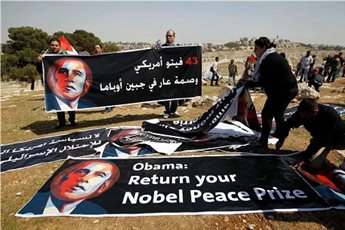
BETHLEHEM – Israeli forces on Wednesday surrounded a new tent village erected by Palestinian activists in Eizariya east of Jerusalem.
An Israeli military spokeswoman said hundreds of Palestinians established “an illegal settlement” and that security forces were in the area “to maintain order.”
She said soldiers arrested the driver of a truck loaded with equipment including tents.
Mohammad Khatib, a spokesman for the activists, said soldiers handed protesters a document declaring the area a closed military zone.
“We are staying. We are Palestinians, and we will stay here. They will have to evacuate us. They will have to use their power to do it, but we will not do it by ourselves,” Khatib told Ma’an.
“We are staying here because this is Palestinian land. This is our land, and no one has a right to evacuate us.”
As US President Barack Obama arrived in Israel, activists set up 15 tents on a hillside near the site of the Bab al-Shams protest village that Israeli forces tore down in January.
They have named the new neighborhood Ahfad Younis, after the main character in the novel Bab al-Shams.
In a statement, the activists described the initiative as “first, to claim our right as Palestinians to return to our lands and villages, second, to claim our sovereignty over our lands without permission from anyone.”
The activists said it aimed to highlight their opposition to the Obama administration’s policies in the region, saying that it has been “complicit in Israeli occupation and colonialism.”
“An administration that used the veto 43 times … in support of Israel and against Palestinian rights, an administration that grants military aid to Israel of over three billion dollars annually, can’t have any positive contribution to achieve justice,” the statement said.
Related article
- Palestinians erect new ‘village’ as Obama lands in Israel (alethonews.wordpress.com)
Briefing: Beyond the E-1 Israeli settlement
IRIN | March 18, 2013
JERUSALEM – Last month, an international fact-finding mission on Israeli settlements in the Occupied Palestinian Territory (OPT) commissioned by the UN Human Rights Council found that settlements constituted a violation of international human rights and humanitarian law and called on Israel to stop all expansions immediately and withdraw from settlements.
A controversial Israeli plan, known as E-1, to build thousands of housing units and hotel rooms near the Ma’ale Adummim settlement, has garnered much attention in the media because it would sever Palestinian East Jerusalem from the rest of the West Bank. (See IRIN’s briefing on E-1 here.)
But at the same time, Israel has been moving forward with equally controversial settlement plans under less scrutiny and with unusual speed.
As US President Barack Obama prepares to visit the region this week, IRIN takes a look at some of the details that have been overlooked in the discussion.
What’s the Giv’at HaMatos plan?
According to Israeli NGO Ir Amim (“City of Nations”), which works to preserve Jerusalem as a home for both Jews and Palestinians, one settlement plan of “critical importance” is Giv’at HaMatos.
In a sense, Giv’at HaMatos does in the south what E-1 does in the east. The planned large housing and hotel complex at the southern perimeter of Jerusalem would further disrupt the contiguity of land between East Jerusalem and the rest of the West Bank required for a future Palestinian state, seriously impeding a two-state solution, research and rights groups say. It would also mark the first new settlement construction in Jerusalem since 1997.
“All construction is problematic but there are several plans that are, in our view, more dangerous if implemented,” Hagit Ofran, director of the Settlement Watch project at the Israeli NGO Peace Now, told IRIN. “Giv’at HaMatos is the most dangerous plan that is now approved.”
Part of the plan – to build 2,612 units – was approved by the Jerusalem Regional Planning Committee on 19 December.
Most of Giv’at HaMatos is currently uninhabited, but according to the International Crisis Group (ICG), which recently released a two-part report on the future of East Jerusalem, its build-up would cut off Arab neighbourhoods in southern Jerusalem, like Beit Safafa and Sharafat, rendering them “Palestinian enclaves”.
Giv’at HaMatos would connect the dots of several other planned or expanding settlements along southern Jerusalem – including Giv’at Yael in the southwest; and Har Homa and East Talpiyot in the southeast – forming “a long Jewish continuum severing Bethlehem’s urban continuum from Palestinian Jerusalem”, ICG said. Last year, the Israeli government also approved more than 2,000 new units in neighbouring Gilo.
This kind of attachment to Jewish expansions could make peace negotiations even harder.
“From an Israeli public opinion perspective, Giv’at HaMatos is in the municipal border of Jerusalem,” Ofran said. “It’s considered a legitimate part of Israel.”
Barak Cohen, the Jerusalem Municipality’s adviser for foreign affairs and media, told IRIN Giv’at HaMatos is part of Jerusalem’s “natural and much-needed growth”, allowing both Arab and Jewish landowners to develop their properties.
Indeed, part of the Giv’at HaMatos plan, approved on 18 December, allows for the building of 549 units for Palestinians – though Betty Herschman, director of international relations and advocacy at Ir Amim, points out much of it retroactively legalizes building that has already been completed. The figures, she added, amount to just over one-fifth of the Jewish expansion.
“For many Arab East Jerusalemites, the battle for their city is all but lost.”
Still, Cohen insisted, the development would benefit Jerusalem as a whole: “Not planning and developing Jerusalem neighbourhoods ultimately harms all residents and landowners – Arabs and Jews alike.”
Last year, Israel also issued tenders for the construction of 606 new housing units north of East Jerusalem, in the Ramot settlement, just north of the Green Line marking the border between Israel and the West Bank, and approved another 1,500 units in the neighbouring settlement of Ramot Shlomo, according to Ir Amim.
What other settlements are planned?
Beyond Jerusalem, there was movement on a number of other settlements projects in disputed areas, according to Settlement Watch.
In June 2012, the Israeli government announced it would build 851 new units in the West Bank, including more than 230 in the controversial settlements of Ariel and Efrat. Like Giv’at HaMatos, these two settlements make a contiguous Palestinian territory impossible, Settlement Watch says.
Overall, settlements expanded much faster than usual last year.
In 2012 the Israeli government approved the construction of 6,676 settler housing units in the West Bank, compared with 1,607 in 2011 and several hundred in 2010, according to Peace Now.
For plans that were already approved, it issued more than 3,000 tenders to construction contractors – more than any other year in the last decade, Peace Now said. Construction has actually begun on 1,747 homes.
Regardless of the settlements, Palestinians, especially in Area C, are under immense pressure. Recent weeks have seen a considerable upswing in demolitions of Palestinian structures. According to the Displacement Working Group, a grouping of aid agencies helping displaced families, Israeli forces destroyed 139 Palestinian structures, including 59 homes, in January – almost triple 2012’s monthly average. The demolitions occurred in East Jerusalem and the West Bank – with a majority taking place in Area C – and left 251 Palestinians, including over 150 children, displaced.
The office of the Coordinator of Government Activities in the (Palestinian) Territories (COGAT) told IRIN there was no connection between the removal of unauthorized buildings and the construction of Israeli settlements. “All construction in the West Bank is subject to building codes and planning laws and unauthorized constructions are dealt with accordingly,” the office said in an email.
What are the knock-on effects?
Settlements are often discussed through the lens of their illegality under international law or as obstacles to a peace agreement between Israel and the Palestinians. But everything associated with the settlements – including Israeli-only infrastructure, the separation barrier, military checkpoints, restrictions on Palestinian freedom of movement, suppression of freedom of expression and political life, and control of Palestinian natural resources – causes a ripple effect through Palestinian society, adversely impacting the people.
The UN estimates there are now 520,000 Israeli settlers in East Jerusalem and the West Bank, with 43 percent of the land there allocated to local and regional settlement councils. According to the UN Secretary-General, Israel has transferred roughly 8 percent of its citizens into OPT since the 1970s, altering the demographic composition of the territory and furthering the Palestinian people from their right to self-determination.
Baker, of the Israeli Prime Minister’s Office, said a future Palestinian state should include a Jewish minority. “The assumption behind this… is that Jews have no right to live in the West Bank, an assumption that we reject. In fact we see ourselves as the true indigenous people of this land.”
But Israeli settlements have violated Palestinian rights to equality under the law, to religious freedom and to freedom of movement, according to the UN fact-finding mission. They have also eroded Palestinian access to water and to agricultural assets, and the ability to develop economically, it said.
 Photo: OCHA – View larger version of map here
For example, Bedouins from the Palestinian village of Khan Al Ahmar, northeast of E-1, cannot sell their dairy products at their traditional Souq Al Ahmar market any more. Because of movement restrictions (they hold West Bank IDs and lack the proper permits to enter East Jerusalem), they cannot get there.
The UN secretary-general has said that Palestinians “have virtually no control” over the water resources in the West Bank, with 86 percent of the Jordan Valley and the Dead Sea under the de facto jurisdiction of the settlement regional councils.
There is a statistical correlation between Palestinians’ proximity to settlements and their rates of food insecurity, according to a UN and government survey, which found that one quarter of Palestinians who live in Area C, home to the largest number of settlements in the West Bank, are food insecure. In Areas A and B, the average rate of food insecurity is 17 percent.
In addition, “all spheres of Palestinian life are being significantly affected by a minority of settlers who are engaged in violence and intimidation with the aim of forcing Palestinians off their land,” the mission said.
Operation Dove, an international organization working in the Palestinian village of At-Tuwani and the South Hebron Hills, reported that Palestinian children have a very hard time going to school due to settler attacks.
The UN and rights groups say radical settlers use violence against Palestinians with impunity and their illegal outposts are often recognized and retroactively legalized by the government.
Since the occupation began, Israel has detained hundreds of thousands of Palestinians, some of them without charge, and some of them children. Most of the minors are arrested “at friction points, such as a village near a settlement or a road used by the army or settlers”, the fact-finding mission said.
Israel uses what they term “administrative detention” when it considers the detainee a threat to the security of the state.
Ir Amim’s Herschman says Israel is also attempting to create a “greater Jerusalem” through additional means, for example: the Israeli separation barrier, planned national parks, and the construction of highways dividing villages, dispossessing Palestinians of their land and making it harder for them to access services like schools and mosques.
In recent weeks, residents of the Palestinian village of Beit Safafa have been protesting against the planned extension of the Begin Highway that would divide their village in order to connect major Israeli settlement blocks outside the city to Jerusalem.
The planned root of the separation barrier, in addition to a potential national park around the perimeter of the barrier would also close off nearby Palestinian village al-Wallajeh.
The planned route of the barrier extends all the way around and far beyond Muale Adummim and in other areas south and north of Jerusalem. “These lines are a unilateral declaration of a much greater Jerusalem, a unilateral expanding of the boundaries, an exponential increase,” she told IRIN.
Or as the ICG put it, “for many Arab East Jerusalemites, the battle for their city is all but lost.”
Palestinian assailed by Israeli women, stripped of hijab
Al-Akhbar | February 27, 2013
 A Palestinian woman waiting at a light rail station in Jerusalem on Monday was attacked and stripped of her headscarf by religious Jewish women, Israeli newspaper Ma’ariv reported Tuesday.
According to bystanders, a young Jewish woman punched the Palestinian suddenly as she was passing by the station. A friend of the assailant began aiding her in beating the Palestinian, pushing her against the wall, and ultimately ripping off her headscarf.
The Palestinian was accompanied by an old man who tried to push the attackers away to no avail.
The event occurred at about three o’clock in the afternoon. It is unclear whether the incident involved only the two assailants mentioned in witness accounts, or a larger group shown in the photo.
“There were about 100 Orthodox and yeshiva students who disembarked the tramway and spotted an Arab woman accompanied by an older man,” a witness, who photographed the event, told Ma’ariv.
“It developed into arguing and yelling, and I don’t know what the content was that everyone jumped on her.”
According to the witness, an activist named Dorit Jordan Dotan, a municipality security officer passively watched the event and seemed to be smiling. Many residents also stood by.
“The entire time, the guard stood and smiled and did not even try to break up the fight,” a witness said.
Dotan confirmed that the incident took place at the station where a group of young people had just arrived from the train, but seemed to downplay the event by suggesting the attackers were intoxicated.
“Young people drink a lot of wine for Purim. Screams were heard everywhere. A woman tried to fight [the Jewish students] but they yelled at her not to dare touch the Jews and continued to beat [the Arab woman],” Dotan said.
Following publication in Ma’ariv, police launched an investigation into the case.
“It’s a shame that the Arab whore didn’t die”
On the day the report was published, Israeli police officer Ariel Shapiro re-posted the article on his Facebook page and issued a chilling endorsement: “Very good,” wrote Shpiro “It’s a shame that the Arab whore didn’t die.”

Screenshot of Shapiro’s Facebook page along with the offending status message
The message was publicized by Palestinian Member of Knesset Ahmad Tibi.
Israeli army and police officers have come under fire in recent weeks for showcasing dehumanizing images of and slogans about Palestinians. The most famous of these is an Instagram photo of Mor Ostrovski, 20, showing the crosshairs of a rifle being aimed at the head of a Palestinian boy.
Message from Samer el Issawi, day 209 hunger strike
February 16, 2013
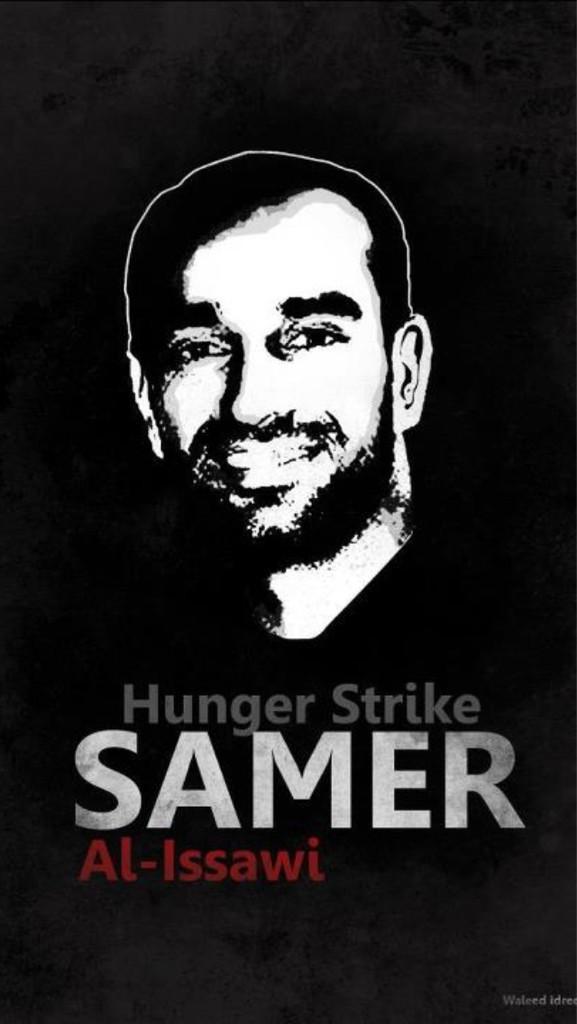 “I turn with admiration to the masses of our heroic Palestinian people, to our Palestinian leadership, to all forces, parties and national institutions. I salute them for standing by our fight to defend our right to freedom and dignity.
I draw my strength from my people, from all the free people in the world, from friends and the families of the prisoners who continue day and night chanting for freedom and an end to the occupation.
My health has deteriorated dramatically and I’m hung between life and death. My weak body is collapsing but still able to be patient and continue the confrontation. My message is that I will continue until the end, until the last drop of water in my body, until martyrdom. Martyrdom is an honor for me in this battle. My martyrdom is my remaining bomb in the confrontation with the tyrants and the jailers, in the face of the racist policy of the occupation that humiliates our people and exercises against us all means of oppression and repression.
I say to my people: I’m stronger than the occupation army and its racist laws. I, Samer al-Issawi, son of Jerusalem, send you my last will that, in case I fell as a martyr, you will carry my soul as a cry for all the prisoners, man and women, cry for freedom, emancipation and salvation from the nightmare of prisons and their harsh darkness.
My battle is not only for individual freedom. The battle waged by me and by my heroic colleagues, Tariq, Ayman and Ja’affar, is everyone’s battle, the battle of the Palestinian people against the occupation and its prisons. Our goal is to be free and sovereign in our liberated state and in our blessed Jerusalem.
The weak and strained beats of my heart derive their steadfastness from you, the great people. My eyes, which started to lose their sight, draws light from your solidarity and your support of me. My weak voice takes its strength from your voice that is louder than the warden’s voice and higher than the walls.
I’m one of your sons, among thousands of your sons who are prisoners, still languishing steadfast in the prisons, waiting for an end to be brought to their plight, their pains and the suffering of their families.
The doctors told me I became exposed to stroke because of the disorder of my heartbeats, the shortage of sugar and the drop in blood pressure. My body is full of cold and I can’t sleep because of the continued pain. But despite the extreme fatigue and chronic headaches, as I move on my chair, I’m trying to summon all my resources to continue on the road till its end. There is no going back, only in my victory, because I’m the owner of Right and my detention is invalid and illegal.
Do not be afraid for my heart if it will stop, don’t be afraid for my hands if they will be paralyzed. I am still alive now and tomorrow and after death, because Jerusalem is moving in my blood, in my devotion and my faith.”
**Via Rona Merrill, Neta Golan
Related article
- Shireen Al-Issawi: PA did not take prisoners’ issue to the UN (alethonews.wordpress.com)
Historic buildings around Al-Aqsa continue to be demolished
MEMO | February 9, 2013
For the third day in a row, Israeli bulldozers are demolishing historic arches and facades of Islamic buildings dating back to the Mamluk and Ottoman eras on the north side of Buraq Square. The site lies just 50 metres from the Noble Sanctuary of Al-Aqsa.
Details of the architectural vandalism by the Israeli occupation authorities were provided by Al-Aqsa Foundation for Religious Endowments and Heritage in a press statement. The Israeli demolition work is a prelude to the establishment of a centre promoting the state’s Judaisation policies in the occupied Palestinian territories. The buildings in question formed part of the Moroccan Quarter of the Old City, which was demolished by the Israelis in 1967 at the start of the occupation of Jerusalem, the West Bank and the Gaza Strip.
The foundation said that it will use exclusive maps and documents to show how the Israelis plan to establish a synagogue, a police station, a reception area and show rooms on the site, all of which will be linked to tunnels under Al-Aqsa Mosque. A press conference will be held on Sunday for that purpose which will be attended by the head of the Islamic movement in Israel, Sheikh Raed Salah. Among the other speakers will be the Chairman of the Islamic Supreme Council and the Imam of Al Aqsa Mosque, Dr Sheikh Ikrima Sabri, and Hatem Abdel Qader, who deals with the Jerusalem file for Fatah, as well as the foundation’s director, Amir Khatib.
According to the documents held by Al-Aqsa Foundation, the development will necessitate the destruction of noted Islamic landmarks. It is worth noting that the State of Israel pledged in its Declaration of Independence that it “will safeguard the Holy Places of all religions; and it will be faithful to the principles of the Charter of the United Nations”. The State of Israel regularly breaks both pledges with apparent impunity.
Related articles
- Palestine: Occupation continues to falsify al-Aqsa’s history, protest villages continue & violations against Gaza’a fishermen (realisticbird.wordpress.com)
- Palestine: Hundreds of Israelis storm Nabi Yusuf tomb, part of Buraq Square destroyed, a crime against Al Aqsa & demolitions (realisticbird.wordpress.com)
Report: Israeli Occupation Authorities established 482 outposts last year
Palestine Information Center – 04/02/2013
RAMALLAH — The Israeli Occupation Authorities (IOA) demolished 465 Palestinian buildings and established 482 outposts in the West Bank and the occupied city of Jerusalem during the last year, a Palestinian official statistical report documented.
The PA Ministry for Settlement and Wall Affairs stated in its report issued on Sunday that the occupation authorities have set up over the past year 185 settlements and 175 outposts, in addition to another 29 settlement sites.
The report pointed out that the Israeli authorities completed 444 kilometers of a total 757 kilometers currently under construction of the Apartheid Wall that will isolate 10.2 per cent of the occupied West Bank.
The report documented that 465 Palestinian facilities were demolished during the last year concentrated mainly in al-Khalil, Jerusalem and the Jordan Valley, pointing out to 728 demolition orders concentrated in al-Khalil and Jerusalem.
The report revealed new Israeli ways to confiscate Palestinian territories, where IOA began issuing decisions to confiscate isolated lands behind the separation wall such as those within the city of Jerusalem to the north of Bethlehem.
Related articles
- Israeli occupation authorities halt entry of West Bankers to 1948 occupied Palestine (alethonews.wordpress.com)
- Israeli occupation forces kill 7 Palestinians, arrest 300 others during January (alethonews.wordpress.com)
- Israeli Soldiers Attack, Evict, Bab Al-Shams, Arrest Dozens (alethonews.wordpress.com)
- Palestine: Teen shot, demolition, new outpost north of Qalqilia & warning of scheme to displace 30,000 (realisticbird.wordpress.com)
Israeli Foreign Ministry Produces A Film Replacing Al-Aqsa Mosque With Jewish Temple
By Saed Bannoura | IMEMC & Agencies | January 30, 2013
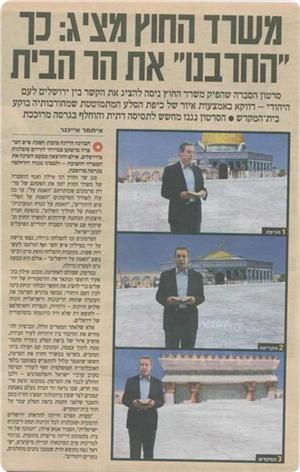 In a film that was produced by the Israeli Foreign Ministry, and was banned from being officially published, Israeli Deputy Foreign Minister, Danny Ayalon, is seen standing and speaking in various areas of Jerusalem, including in front of the Dome Of The Rock, where in the film, it disappears and is replaced by Jewish temple.
The film, “The Fact About Jerusalem”, is meant, from an Israeli point view, to encourage tourism and portray harmony, but at the same time is meant to show the sole Jewish history of the holy city, while Ayalon also claims that the film “is about freedom of religion of the three faiths – Judaism, Christianity and Islam.
The Israeli source, Yedioth Aharonoth, said that the film includes provocative content and was not published due to fear of causing anger among the Muslims, not only in Palestine, but around the world.
Ayalon “stars” in the movie by appearing at different areas of occupied Jerusalem, showing its history, advanced technology, public transportation systems, and also appears standing in front of the Dome of the Rock before it disappears and is digitally transformed into a temple.
Yet, he talks about “diversity” and “harmony” in the Holy City, “in a Jerusalem that is shared not divided”.
The Foreign Ministry said that the film is about “facts”, different “facts” from its point of view about Jerusalem, the West Bank and the peace process.
The film was also translated to various languages attracting attention of millions of viewers around the world.
Despite the fact that the film was banned from being officially published, Ayalon uploaded it onto his own YouTube Channel.
Ayalon said that the film is about history and about what he called religious freedom, describing it as being produced to show what he described as the “freedom of religion to followers of the three faiths in the region”.
Palestinians denounced the film dubbing it as part of the ongoing Israeli attempts to void the Arab and Islamic history, culture and archeology.
Despite his claims of diversity and sharing the city of “the united not divided” Jerusalem, Israel prevents millions of Arab Muslims and Christians, from entering the city to pray at their holy sites or to tour the city.
Related article
- Knesset candidate calls for bombing Aqsa Mosque’s Dome of the Rock (alethonews.wordpress.com)
Mahmoud Sarsak – Palestinian International Footballer
Free Gaza Scotland | January 29, 2013
On Wednesday 23rd of January I with other members of our group had the pleasure and honour to meet Mahmoud Sarsak in our appartment. He is a slight, quietly spoken young man, with a gentle manner and his good humour and patience with our questioning betray none of the pain he has suffered over the last 3 and a half years. When he begins to speak about his experience of imprisonment he tells his story with a matter of fact, quiet sincerity that is striking and makes the horror of his experience all the more shocking.
 Mahmoud was 21 years old, at the start of a playing career which had already seen him being recognised as one of the best young prospects in Palestine, already a regular for the Palestinian National side. He had an invitation to play for a football team in Nablus in the West Bank. This meant that he had to ask for permission from the Israelis to cross from Gaza through Erez crossing into Israel in order to travel on to the West Bank. This did not worry him as it was a trip he had already done twice before and when he recieved his permission he went to the crossing looking forward to the opportunity of playing in Nablus. However when he got to Erez at 9am on the 22nd July 2009 his whole world changed, instead of being allowed to cross he was arrested and taken to a Police Station, from here his family were called and informed that he was being taken to Ashkelon Jail.
He was made to take off his clothes and change into overalls, an ‘under investigation uniform’. He describes how for the first 18 days he was tied to a chair with his eyes covered, the only times he was untied was when he was given food and they untied his hands or when he was allowed to go to the toilet when his legs were untied. He explains that during this time he was kept awake, not fed properly and questioned daily, every 4 days he was taken to a court where a judge gave permission for him to be held for a further 4 days. This treatment he says ‘wasn’t so bad’ in comparison with what was to come although I think that most people would call it torture.
At the end of that 18 days he was taken to a Military Jail in the South where he was kept for 6 days and his treatment became much worse. He was beaten regularly and was put in what he described as a fridge, he also had very hot and very cold water put under his feet. During all of this time in both places he was questioned, his interrogators were wanting him to say that he had been involved in ‘activities against Israel’. He didn’t understand what they meant by this, he was a footballer, he had not been involved in anything else and so refused to make things up to make his interrogators happy. He had no idea why he had been arrested.
At the end of these 6 days he was taken back to a civilian jail for another 11 days where suddenly things got much better. He was fed and allowed to sleep properly, his captors became very friendly offering him his freedom, a new house, a salary, a car, access to proper training facilities to help his playing career and foreign travel. All he had to do was become a collaborator. He refused, which provoked many serious threats from his Israeli interrogators. They told him that they would burn his family home down, attack his family and kill his brothers. Despite the pressures upon him and his ordeal so far, he continued to refuse to collaborate.
Except for short visits to court when his lawyer was present, during this initial 35 days of incarceration he had absolutely no contact with anyone but his jailors and interrogators. His lawyer told him that he was going to be all right, the court had said he was going to be released. Instead he was told by a Military Officer that he was now being held under ‘The Law of An Illegal Fighter’ and that they no longer needed to go to court to ask permission to keep him. He was then taken to Kitseot Jail near Bersheva where at least he could see other prisoners and his time of interrogation was over. He asked the other prisoners what this ‘Law of an Illegal Fighter’ meant but none of them had ever heard of it. When he was finally allowed access to his lawyer and was able to ask him he was told that it was a law that the Israeli authorities use when they have nothing against you but they want to hold onto you. He then asked his lawyer what rights he had under this law and was told that he had none, he could now be held in jail for as long as the Israeli Military wanted to keep him.
Mahmoud was the first Palestinian who had been held under this law, the only other people he knows of who had previously been held under it were 2 Hizbollah members from Lebanon who were arrested in 1982. He thinks that because he had no rights he was put in a cell which was 2m x 1m for his time in Kitseot, this cell had only a matress and toilet in it and he developed chest, skin and back problems while there. He was not taken to a hospital while there, and was only seen briefly by a prison doctor for these problems. He was allowed out of his cell for 1 hour a day for exercise with his fellow prisoners when he played football with them.
On the 22nd of February 2010 Mahmoud was taken to Tel Aviv for a court hearing to extend his imprisonment and then to another court hearing for the decision in Jerusalem two weeks later. The journey to court and between jails is in what the prisoners call a ‘post bus’ which is metal bus with steel compartments in which you are jostled and hit off the steel walls. He knew before he was taken to the second hearing that he was going to be held for another six months. After this hearing he was also barred from playing football with his fellow prisoners for that precious hour in the mornings and was told that this was due to his back being too bad. At this time they also started to move him between prisons every 2 months and he was still taken to court every 6 months in order to have his stay in prison extended.
On the 23rd of August 2011 he was told that he was going to be released, he was happy and said goodbye to the other prisoners. He was taken by ‘post bus’ to Erez, his hands and legs were not tied as they usually were, the window was open and when he got there they opened the door of the prison van and the guards moved away talking among themselves. He stayed where he was as he didn’t know what was happening and he didn’t want to be shot if they thought he was trying to escape. He called to the guards to ask what was happening and they told him they were taking him back to jail, he wasn’t being released. He was taken to a different jail for 2 weeks with only the clothes he had on when they took him to Erez. He said that he was later told about another prisoner who had been taken to Erez and left in an open ‘post bus’ with his legs untied in the same way. He had gone to the door to look out and been instantly shot in the leg and accused of trying to escape. After this 2 week period he was taken back to the jail he had originally been in when first imprisoned, here his other clothes and small number of belongings were finally brought to him.
When he was taken to this jail he was given another 6 months but his lawyer was promised that he would be released when this time ended on the 23rd of February 2012. The 23rd of February came and went, 10 days after this he was taken back to court, he had decided that this time if he wasn’t released he would go on hunger strike and stay on hunger strike until they promised in writing that he would be released. So when he was told that he was going to be imprisoned for another 6 months he prepared himself for 10 days, eating less each day and gradually reducing his physical activity. On the 15th of March 2012 he started his hunger strike. He only took water and sometimes a little salt in order to prevent his stomach from beginning to rot.
7 days after he started they began to move him from jail to jail before putting him in Nafha Jail which meant he was put in with the Israeli criminal population. Then he was put into isolation for a spell followed by hospital in Bersheva for 2 days tied to his bed then back to Nafha. From here he was sent to Eshel jail where he was put in isolation again and became very sick. This time they wouldn’t take him to hospital but would only allow him to see the Doctor in Eshel. After 35 days of this the Doctor in Eshel refused to continue to be responsible for him and he was taken to the Prison hospital in Ramle jail where he was with another 5 Palestinian prisoners who were also on hunger strike. He refused treatment here and was put back into isolation, this time his isolation cell had no windows so he was in darkness. After 47 days on hunger strike he bagan to have serious problems with his stomach, he couldn’t even drink water without vomiting. First white then black then brown vomit. They took him back to Ramle Prison hospital then and gave him antibiotics.
Along with the other hunger strikers he was asked regularly to break his hunger strike, on the 15th of May he was told that if he would break his hunger strike he would be released on the 23rd of August and the other hunger strikers were also told that they would have their demands met if they broke theirs. 3 of them accepted but along with 1 of the others Akram Al Rihawy he refused, he had heard promises of release before and he insisted that he have the promise in writing signed by a senior Judge and a Minister from the Israeli Ministry of the Interior. He was also told that he would not be allowed to return to Gaza, he had to choose between Germany, France or Norway which he also refused to accept. At this time he finally began to get International Committee of the Red Cross visits twice a week and he was asked daily to break his hunger strike, he continued to refuse until he got it in writing that he would be released back to Gaza and that he would be properly monitored by a committee of doctors when he started eating again.
Eventually on the 18th of June 2012 on the 96th day of his hunger strike a Minister from the Israeli Ministry of the Interior came to see him with the signed paper that he had been asking for stating in writing that he would be released on the 20th of July 2012. The Minister asked him if he would now please give up his hunger strike and he agreed. The Minister asked him to drink a glass of milk in front of him so that he could confirm and report that he had indeed broken his hunger strike which he did alathough he immediately vomited this back up. His stomach couldn’t cope even with milk after such a long time with no more than water going into it. He said that even though his stomach rejected this cup of milk his whole body felt as though it had drunk and felt relieved.
For 14 days he had to build up to eating again with first intravenous vitamins and nutrition, followed by nutritional drinks, before finally eating his first bit of bread after this 14 day period, which he still vomited back up. During the time of his hunger strike he was only allowed 2 visits from his lawyer, on the 40th day and on the last day. I asked if he was allowed any visits from his family during his time in jail. He replied that because he was given no rights under the ‘Law of An Illegal fighter’ he was not only denied visits from family but was not even allowed the 6 monthly letters delivered to his fellow prisoners by the Red Cross. He wasn’t able to write to them either, not even one short note.
At no time during Mahmoud’s entire incarceration was he actually accused of anything other than being asked to admit to the vague term ‘activities against Israel’ and he was never charged with anything. He was very clear that he had no idea why he was arrested. He was a footballer. The court appearances he attended were simply formalities under Military Law which say that every 6 months any detention order must be renewed.
All Palestinians from the West Bank and Gaza who are arrested by Israel are dealt with under Military Law not Israeli Criminal Law and therefore it is not necessary for Israel to ever bring charges against them. Many who are prosecuted are those who have signed false confessions under torture and are not able to retract them afterwards. Mahmoud’s case was slightly worse than normal Military law, under which there are a few rights which at least give some protection in prison. Mahmoud had none of these rights under this so called ‘Law of an Illegal Fighter’ by which he was held.
I asked Mahmoud if he was back in training for football and if he thought that it would be possible for him to return to his playing career. He said that finally he had managed to attend 3 training sessions and was hoping to be able to return to the team at some point in the future once he was back to full fitness. I sincerely wish him luck with this and hope that he will reach that stage very soon.
This has to be one of the clearest examples of why the BDS (Boycott Divestment and Sanctions) campaign should be supported by everyone and why Israel should be barred from participating in International Sporting events. Currently the 2013 UEFA U-21 Championship is scheduled to be played in Israel. How can this be allowed when they can treat a Palestinian International Player like this? Not to mention that they bombed the only 2 football pitches in Gaza during Operation Pillar of Cloud as well as destroying many local playing areas in the West Bank over the years. I saw several during my visit there in 2004 including one in Ramallah which had been bulldozed.
Mahmoud told us that the other prisoner who had stayed on hunger strike with him, Akram Al Rihawy, had spent his whole sentence in hospital due to his medical problems. His reason for being on hunger strike was not for release but for proper medical treatment. He stopped his hunger strike after being told that he was going to be released on Wednesday the 23rd of January 2013. Yesterday, on the 25th of January 2013 we were told that he was not released as promised and that he is now back on hunger strike.
To join the campaign against Israel hosting the 2013 UEFA U-21 Championship go to the following link and get involved: http://redcardapartheid.weebly.com/
Related articles
- Former mayor put in administrative detention (alethonews.wordpress.com)
- Genocide by Proxy: Palestinian patient Salah Salluha dies at Erez due to prolonged security measures (occupiedpalestine.wordpress.com)
- Hundreds of Palestinians detained without evidence (occupiedpalestine.wordpress.com)
- Palestine: Documenting the torture of a boy in occupation jails, two wounded by shooting & East of Gaza flooded by Israelis (realisticbird.wordpress.com)
Israeli Authorities Change Route Of Wall To Fully Annex Jerusalem For Israel
By Saed Bannoura | IMEMC & Agencies | January 21, 2013
The Israeli Defense Ministry announced on Sunday that they will re-route a section of the Wall east of Jerusalem in order to close off an existing gap and fully annex the city of Jerusalem into Israel. The new route means the complete encirclement of the Palestinian village of Al-Zaim, with the Wall to the West and a security fence to the east.
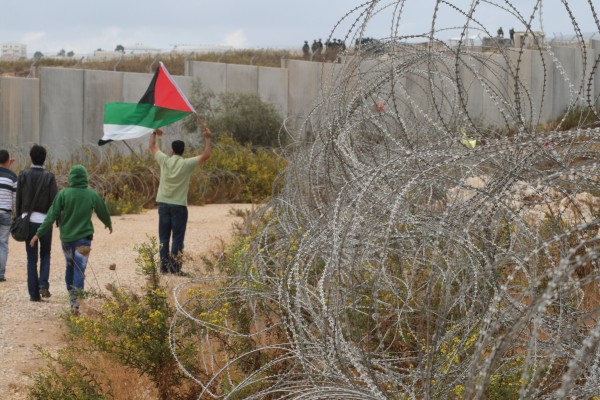 Other Palestinian towns are also completely isolated and encircled into ghettoes, including the town of Sheikh Sa’ed and the city of Qalqilya. Israeli authorities isolated these towns in order to create Palestinian-free zones and routes throughout the West Bank to allow Israeli settlers to travel unencumbered without either having to stop at checkpoints or to drive on the same roads as Palestinians. But in order to do that, Israeli forces have had to maintain over 600 checkpoints throughout the West Bank, and to force Palestinians off their own roads and onto dirt roads or trails.
The new route of the Wall will put the settlement of Ma’ale Adumim on the Palestinian side of the Wall, along with dozens of other Israeli settlements constructed in violation of international law all over the West Bank. But Israeli officials have assured the residents of these settlements that they will construct other Walls and fences to allow them to access Jerusalem without having to go through Palestinian areas.
These additional fences and barriers will, like the Annexation Wall itself, be constructed on land seized from Palestinian owners by Israeli authorities who claim that they have the right to take the land ‘for security reasons’. All Israeli settlements on Palestinian land are considered illegal under international law and the Fourth Geneva Convention, which forbids an occupying military power from settling its civilian population on land occupied by military force.
The announcement is seen as a response to the Palestinian encampment Bab Al Shams, which was established on the land in question, known to Israeli officials as ‘E1’, last weekend, then demolished by Israeli forces. The Palestinian non-violent activists who established the encampment entered the area through the village of Al-Zaim.
Israeli Prime Minister Binyamin Netanyahu has openly declared his intention to build a settlement on the ‘E1’ land, and completely enclose the eastern edge of Jerusalem, thus effectively annexing the city of Jerusalem to the state of Israel. This renders any peace agreement with the Palestinian Authority impossible, since one of the Palestinian Authority’s base demands is sharing the city of Jerusalem. The base demands, which Palestinians have asked Israel to recognize time and again to no avail, are: the recognition of a Palestinian state with east Jerusalem as its capital, the right of return of Palestinian refugees and the release of the thousands of Palestinian political prisoners being held in Israeli prison camps.
Related articles
- The long road to Bab al-Karama (alethonews.wordpress.com)
- Israeli politician: Palestinian ghettos were always the plan (sott.net)
The long road to Bab al-Karama
International Solidarity Movement | January 20, 2013
Bab al-Karama, Occupied Palestine – The road to Bab al-Karama, the new tent neighborhood created by Palestinians on land that will be separated from the village of Beit Iksa by the Apartheid wall, exposes a landscape of Apartheid.
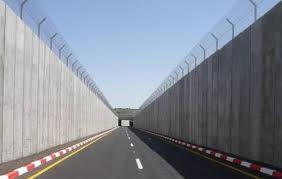 To reach Bab al-Karama from Occupied Ramallah one needs to take the “Palestinian only” road that runs under the “Israeli only” 443 Highway between Ramallah and Beir Naballah.
Beir Naballah used to be a suburb of Jerusalem. Affluent Jerusalemites built their homes in Beir Naballah to escape from the housing crisis imposed on Palestinians by Jerusalem’s municipality housing polices. It sits on a road that connected the villages in the area with Jerusalem and continued on to Latrun. Now Beir Naballah is completely surrounded by an Israeli wall. The old road was widened and transformed into an Israeli highway called 443. The highway now connects Jerusalem to Tel Aviv and the Palestinian residents of the area are barred form using it. The Jerusalemite residents were forced to abandon their homes and many businesses dependent on clientele from Jerusalem have closed.
We exit Beir Naballah through a second tunnel that connects the Beir Naballah enclave to another enclave where 8 Palestinian villages are also isolated by Israeli walls. This tunnel is even more surreal than the first. Not only does it run under two Israeli only roads but as well as under the Apartheid wall and through the Givaat Zeev settlement bloc. High cement walls with razor wire on top of them hug the sides of the road.
We drive in Biddu and drive through the villages that had been since their creation connected to Al Quds but are now cut off from it and artificially connected to Ramallah. True to the Orwellian tradition of Israel’s military language they call the Palestinian network of roads they have built under their highways “fabric of life roads”. The landscape is beautiful and almost idyllic. Goats grazing on green hills, old stone houses…, but this ideal setting is surrounded by walls, gates and settlements.
The last village we reach, the one closest to Jerusalem is Beit Iksa. But to enter it we need to pass a military checkpoint. At the edge of the village we finally reach Bab al-Karama overlooking a network of Israeli highways and the city of Jerusalem. In the valley right below Bab al-Karama one can see two tunnels that will be connected by a bridge on which a fast track train connecting Jerusalem to Tel Aviv will run. The train will run on the village’s land but not only will the villagers be barred from accessing it, Israel’s Apartheid wall will be built between the village and the train separating the villagers from over 4500 dunams (60%) of their agricultural land. More than 1300 dunams had already been taken in the 70s for the construction of Ramot Allon settlement.
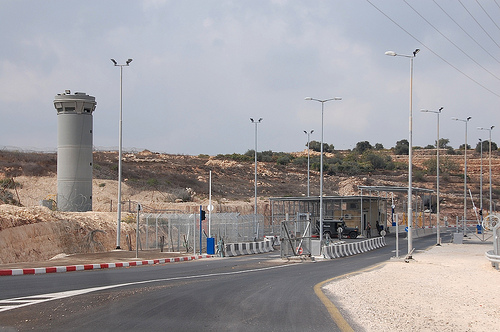
Checkpoint at the entrance of Beit Iksa
Related articles
- ‘Gate of Dignity’ built on lands of Beit Iksa north of Jerusalem (alethonews.wordpress.com)
- Army Invades Bab Al-Karama (imemc.org)
- Palestinians Establish a new Village, Bab Alshams, in Area E1 (alethonews.wordpress.com)
Featured Video

Macgregor: We Haven’t Seen the Worst of the Iran War Yet
or go to
Aletho News Archives – Video-Images
New Book
Breast Cancer: Before You Consent
A new Unbekoming paperback
Lies are Unbekoming | September 18, 2026
Peter Gøtzsche reviewed every randomised mammography screening trial ever conducted for the Cochrane Collaboration. Cochrane’s headline is that, assuming a 15% mortality reduction, one woman in 2000 avoids dying of breast cancer over ten years. Ten are overdiagnosed and treated. Two hundred experience false alarms.
But that headline assumes the reduction. When Gøtzsche looked only at the trials with adequate randomisation — the higher-quality ones — the reduction disappeared. No effect on breast cancer mortality. No effect on all-cause mortality.
This is the Cochrane finding, published in the establishment’s own database of systematic reviews.
No woman being asked to consent to a mammogram this week knows it.
That is why the new Unbekoming paperback exists. … continue
Blog Roll
 Aletho News
- Yemeni army claims responsibility for strikes on sensitive sites in Saudi capital, Aramco facilities in Yanbu
- Iran Judiciary issues indictments against 159 US, Israeli officials for assassination of Leader, commanders
- Turkiye revokes Iranian bank license under US sanctions campaign
- US-Denmark Agreement on Greenland Is ‘PR Stunt’ Ahead of Midterms
- Araghchi: Military intervention cannot create security; coercion cannot bring peace
- Fraud Squared
- Breast Cancer: Before You Consent
- Iran’s Plan to Shut Down AI in the Persian Gulf
- Israel seeks ‘compensation’ from Washington over Saudi F-35 sale
- Saudi crown prince seeks dialogue with Ansarullah after Yemeni blows: Report
- If Americans Knew
- Inside Gaza’s death trap of collapsing, bombed-out buildings
- The everyday items Israel bans from Gaza every day
- Inside the siege, the ruined buildings of Gaza – Daily Update
- Debunking The Claim That Macklemore Has A “History Of Antisemitism”
- CPJ demands release of arrested Palestinian-US journalist near Bethlehem
- Robert Kraft: The Billionaire Friend of Netanyahu Pulling The Strings Behind the Macklemore/Ed Sheeran Blow Up
- Columbia Administered Fund Gives Big Money to Pro-Israel Groups
- Deportation Case of Palestinian Activist Salah Sarsour Tests First Amendment
- ‘We Will Not Forget’: Palestinians Mark 44 Years since Sabra and Shatila
- Why do we let Zionists decide what we can and can’t say?
- No Tricks Zone
- New Study: ‘Global Drought Shows No Detectable Recent Acceleration Under Climate Warming’
- Economic Masterminds: German Socialists Suggest Taxing Productivity Gains Stemming From Using AI
- The South China Sea Has Not Been Cooperating With The Climate Change Narrative
- Energy Crisis: Germany Enters Heating Season With Historically Low Gas Reserve Fill Levels
- New Study: The Antarctic Ice Sheet Gained Mass From 2020-2024 Due To Staggering Snow And Ice Accumulation
- Study: Ocean Heating Rates From Thousands Of Years Ago ‘Dwarf’ Modern Ocean Heating Rates
- Climate Extremists Target, Attack Large-Scale Power Grid Infrastructure In Germany!
- New Study: Antarctic Ice Melt Has Contributed Less Than 1 Centimeter To Sea Level Rise In The Last 30 Years
- Fear Of Debate: Alarmist German Climate Scientist Calls On Mainstream Media To Discredit Skeptic Voices
- End-Of-August Arctic Sea Ice Extent Hasn’t Fallen In 20 Years, Official Data Show!
 Aletho News