Kuwait Files Cases Against Web Users Criticizing Qatar Blockade
Sputnik – 23.08.2017
The Kuwaiti Attorney General’s office filed criminal cases against several social media users who have been criticizing Arab states and their leadership for the decision to cut ties with Qatar and impose a blockade, Kuwaiti Information Minister Sheikh Mohammad Abdullah Al Sabah said Tuesday.
“We do not tolerate offensive remarks regarding any friendly Arab country, made by both licensed Kuwaiti media and social media users. The Attorney General’s office will deal with all those who offended Persian Gulf states,” Al Sabah said in an interview to Saudi Arabian Okaz newspaper.
He also noted that the names of those users had been already submitted to the Attorney General’s office.
In early June, Saudi Arabia, the United Arab Emirates, Bahrain, Egypt and a number of other countries broke off diplomatic relations with Qatar in early June, accusing it of supporting terrorism and interfering in their internal affairs. The move has been strongly condemned by a number of Kuwaiti journalists and analysts, who have a large number of followers on social media.
Kuwait, acting as a mediator in the crisis, handed over the four Arab states’ ultimatum containing several demands to Doha. The list included requests to sever relations with Iran, close Turkey’s military base on Qatar’s territory, shut down Al Jazeera TV channel and end support for the Muslim Brotherhood, a terrorist organization banned in Russia. Doha has refused to comply with the demands.
The Price of Defiance: Why US, Saudi Arabia Turning Kuwait Against Iran
Sputnik – 22.07.2017
Commenting on the latest twist in the diplomatic row in the Persian Gulf, this time between Kuwait and Iran, Iranian political analysts spoke to Sputnik Iran, revealing who’s really behind this new development and which of the two countries will suffer the most from the consequences.
On Thursday, Kuwait sent a diplomatic note to Iran’s embassy stating that the office of military and cultural attaches would be closed down. The note also said that 15 Iranian diplomats, including Ambassador Alireza Enayati, would have to leave the country within 45 days, leaving only four Iranian diplomats in Kuwait.
Kuwait’s acting information minister, Sheikh Mohammad al-Mubarak al-Sabah, said in a statement that the move was taken in “accordance with diplomatic norms and in abidance with the Vienna conventions with regards to its relationship with the Islamic Republic of Iran.”
According to mass media reports, the moves were made following the conviction of the members of Al Abdali terror cell, whose Kuwaiti members were accused of alleged intelligence contacts with Iran and Hezbollah, a Lebanese Shiite militant group.
The Ministry of Foreign Affairs of Iran has responded by summoning the Kuwaiti charge d’affaires. While rejecting the accusations, Iran has said that the measures taken by Kuwaiti officials are regrettable, given that the existing tensions in the region are now in a critical condition.
“We expect Kuwait to act rationally instead of responding to pressures and worsening the tensions,” Iranian Foreign Ministry spokesman Bahram Qassemi was quoted as saying by the Mehr news agency.
In an interview with Sputnik Iran, Sabbah Zanganeh, a political commentator, Iranian envoy to the Organization of Islamic Cooperation and former adviser to the Iranian foreign minister, said that the moves of the Kuwaiti authorities have been evidently fuelled by pressure from Saudi Arabia.
The Iranian authorities have not been informed of any details of the ongoing investigation in Kuwait and any charges which have been put forward. Neither the Iranian legal representative, nor any independent Iranian experts have been allowed to study the case in more detail.
The Iranian political analyst recalled that there have already been groundless and unsubstantiated accusations made against Iran, alleging that it played a major role in liberating the territories of Kuwait from the occupation of Saddam Hussein by supporting and mobilizing hundreds of thousands of Kuwaiti residents, similar to the current accusations against Tehran.
“In due course, Saddam Hussein made a very ambitious offer to Iran to capture not only Kuwait, but the territories of other countries of the Persian Gulf. However Iran had never had a goal of the occupation of the territories of sovereign states and the destruction of the system of government of these countries,” Sabbah Zanganeh told Sputnik.
“Hence this demarche of Kuwait is baseless and is fuelled purely by the pressure of Saudi Arabia, which does not want to put up with the idea that the Arab states of the Persian Gulf, such as Kuwait and Qatar, have good relations with Iran. Saudi Arabia is exerting strong pressure on the Kuwaiti authorities and its mass media,” he added.
The political commentator further explained that until recently, Kuwait has been pursuing a very reasonable and moderate foreign policy; however it has come under strong pressure from the Saudis. Where Qatar was the first target of the Saudis, now it is Kuwait’s turn. The Saudis cannot tolerate Kuwait’s key positions in the settlement of the Qatari crisis, in the negotiations of the Yemeni issue and in the issue of diplomatic correspondence with Iran on behalf of the Cooperation Council for the Arab States of the Persian Gulf. Kuwait, unlike Qatar, is to a far lesser extent an independent state.
In a separate comment on the issue, Iranian political analyst and expert on Middle East and Iranian-Arab relations, former editor-in-chief of the Iranian news agency Mehr News, Hassan Hanizadeh told Sputnik that Kuwait will be the country to suffer from its demarche, while it will have no impact on the economic environment of Iran.
“These actions of Kuwait, aimed at decreasing diplomatic relationship with Iran, have been evidently dictated by Saudi Arabia and the US. As we remember, during his trip to the Middle East, Donald Trump had an important meeting with the leaders of six Arab states of the Persian Gulf in Riyadh. Trump demanded that these states cut their diplomatic relations with Iran or at least lower the level of their ties. Qatar is the first to be punished for disobeying this order,” he told Sputnik.
However, he further elaborated, Qatar held firm and defied pressure from Saudi Arabia and the US. Kuwait, in turn, is a sparsely populated country, compared to its neighbors, and prefers not to oppose the pressure of the US and the Saudis. The danger is that this demarche could spark tensions in the region between the Arab states and Iran even further.
For the last 30 years Iran has been maintaining good and friendly relations with Kuwait, avoiding any hostilities. Moreover, in 1990, during the attack of Saddam Hussein on Kuwait, the Iranian embassy in Kuwait sheltered over a hundred women and young ladies, wives and daughters of Kuwaiti emir and his brothers, on its territory from Hussein’s troops and then safely sent them to Iran for temporary relocation.
Unfortunately, the current Kuwaiti authorities have forgotten this and are putting forward baseless accusations against Iran under pressure from Saudi Arabia, the political analyst said.
“Kuwait will be the only one to suffer from this demarche. Iran is a large and strong country, which will easily overcome this crisis. Kuwait is not a high priority in the Iranian foreign policy and the lowering of the level of diplomatic relations between the two countries won’t have any impact on Iran,” Hassan Hanizadeh told Sputnik.
He explained that there are no deep trade-economic relations between the two states, only political and cultural. Hence the demarche won’t have any impact on the economy of Iran.
Commenting on the conviction of the members of the Al Abdali terror cell, and the accusation of the members in espionage on behalf of Iran, Hassan Hanizadeh noted that Iran would not spend any resources attempting to glean intelligence from Kuwait, hence all the accusations are illogical and unreasonable.
“Kuwait is not the type of country for Iran to spend its intelligence resources on. It has neither a strong army nor any objects of infrastructure, such as a nuclear power plant, for example. It is not of any particular value to Iranian intelligence services. Hence, any accusations of espionage are absurd and unreasonable,” he told Sputnik.
The political analyst said that scenario, which has got the name of “Al Abdali process” had been planned beforehand by the Americans and the Saudis. One of its aims is to clear the way for the breakup of ties between Iran and the member states of the Cooperation Council for the Arab States of the Persian Gulf.
Among other possible reasons of the Kuwaiti demarche, Hassan Hanizadeh suggested that it could be the discontent of the fast growing Shia Muslim population of the country. The Shia Muslim community makes over 40% of the total population of the country. And the Kuwaiti authorities don’t want them to set their eyes on Iran. Thus they are trying to lessen Iran’s influence on their country, he concluded.
Qatar emir to visit Kuwait amid regional tensions
Press TV – May 30, 2017
Qatar’s emir is to travel to Kuwait in a visit aimed at enhancing bilateral ties amid a rift emerging between Qatar on the one side and Saudi Arabia and the United Arab Emirates on the other.
The monarch, Tamim bin Hamad Al Thani, will enter Kuwait City on Wednesday, Qatar’s al-Sharq paper reported on Tuesday.
Last Friday, Kuwait’s First Deputy Prime Minister and Foreign Minister Sheikh Sabah Khalid Al Hamad Al Saba visited Doha.
Qatar drops a bombshell
Last Thursday, an article appeared on Qatar’s state-run news agency, quoting the emir as criticizing the United States, Saudi Arabia, and their client states for attempting to stir up tensions with “Islamic power” Iran.
A post also appeared on the agency’s Twitter page, quoting the Qatari foreign minister as saying that his country was withdrawing its ambassadors from Kuwait, Bahrain, Egypt, Saudi Arabia, and the UAE amid tensions.
The Qatari government soon said that the state agency had been hacked and that the remarks attributed to the emir and the foreign minister had never been made.
The official denial, which was offered several more times, nevertheless failed to stop the rift between the Persian Gulf Arab countries from widening. Saudi media viciously attacked Qatar, accusing it of having “betrayed” the other Arab countries particularly at a time when they had attempted to stage a show of “unity” against Iran in a much-publicized and extravagant series of events in Riyadh.
Saudi Arabia and the United Arab Emirates also blocked Qatari websites and broadcasters.
Qatari Foreign Minister Mohammed bin Abdulrahman Al Thani (seen below) later said the country was being targeted in a “hostile media campaign, which we will confront.” He was referring to the media blackout.
Demonstrating a more moderate stance however, Kuwait did not join the blackout. Deputy Foreign Minister Khaled Jarallah called the ban “regrettable” and expressed Kuwait’s readiness to converge its views with those of Qatar.
Some analysts say Riyadh fears that the Arab Persian Gulf countries it has long sought to co-opt may be gravitating toward Iran, which Saudi Arabia perceives as a regional adversary.
Tehran has said time and again that it does not seek tensions with any of its neighbors, including Saudi Arabia.
UK in panic over Johnson’s remarks against Saudi regime
Press TV – December 11, 2016
UK Foreign Secretary Boris Johnson’s recent criticism of Saudi Arabia has worried British officials, with various government figures trying to gloss them over as Johnson’s own personal views.
During a conference in Rome last week, Johnson blasted the Riyadh regime over its “proxy wars” in the Middle East and its unprovoked military aggression against Yemen, which has killed over 11,000 Yemenis since March 2015.
UK Prime Minister Theresa May’s spokeswoman immediately rebuked the remarks back then, saying the comments did not reflect “the government’s views on Saudi and its role in the region.”
Johnson’s statements divided the UK Parliament, with many of the lawmakers saying that he was stating the truth and should not face public chastisement.
UK Defense Minister Michael Fallon lashed out at the media on Sunday, for blowing the story out of proportions and confecting an artificial row between Johnson and the Downing Street.
“Let’s be very clear about this. The way some of his remarks were reported seemed to imply that we didn’t support the right of Saudi Arabia to defend itself… and didn’t support what Saudi Arabia is doing in leading the campaign to restore the legitimate government of Yemen,” Fallon said during a BBC interview.
“Some of the reporting led people to think that,” he added. “The way it was interpreted left people with the impression that we didn’t support Saudi Arabia and we do.”
Fallon said the months-long Saudi invasion against its impoverished southern neighbor was in self-defense, a right that London thought Riyadh was entitled to.
“The government’s view is absolutely clear – that what Saudi Arabia is entitled to do is defend itself from these attacks across its own border,” he said.
Johnson’s remarks came at a time when May was in the Middle East, trying to cement military and economic ties with [Persian] Gulf Cooperation Council nations – Saudi Arabia, the United Arab Emirates, Kuwait, Oman, Bahrain and Qatar.
Besides helping Bahrain with a heavy-handed crackdown on its popular uprising, Britain has also been providing weapons and intelligence to Saudis in the attacks against civilian targets in Yemen.
10 years in jail for Kuwaiti activist for “spreading false news” on Twitter
By Alex Christoforou | The Duran | December 4, 2016
Another shot fired in the war against “fake news”.
This repressive monarchy in Kuwait is using the pretense of “fake news” (thank you liberal left media) to punish citizens and critics of the emir.
The Middle East Eye is reporting that a Kuwaiti online activist was sentenced to 10 years in prison, an appeals court has ruled, for posting messages on Twitter that “insulted the emir” and “spreading false news” that endangered the country.
The AFP reported that “the court on Thursday confirmed the jail term against Waleed Fares handed down by a lower court in May.”
More from The Middle East Eye…
Fares was arrested in September 2015 for comments under the name “Gibrit Seyassi” about Kuwait’s emir and ruler, Sheikh Sabah al-Ahmad Al Sabah, “offending the judiciary” and “accusing the attorney general and public prosecution of being biased”.
Fares said at his trial he had been beaten and threatened into a confession, according to a statement by the Arabic Network for Human Rights Information (ANHRI).
He was briefly released in October, when the appeals court suspended his jail sentence until its review.
Dozens of opposition politicians and activists have in recent years been arrested by the Kuwait authorities and sentenced to prison, mostly on charges of insulting the emir or undermining his authority.
The crackdown came after the emir dissolved an opposition-dominated parliament in 2012 sparking two years of mass street protests.
US not arming Nusra, but our allies might – State Dept
RT | September 26, 2016
Al-Nusra Front is a terrorist group and the US will never provide it with any aid, said the State Department, reacting to revelations in a German newspaper – while admitting that unnamed US allies might be backing the jihadist militants in Syria.
On Monday, the German newspaper Kölner Stadt-Anzeiger published an interview with an Al-Nusra commander in Syria, identified only as “Abu Al-Ezz.” In the interview, conducted 10 days ago outside of Aleppo, Al-Ezz said that US allies were providing Al-Nusra with tanks and artillery.
“The Americans are on our side,” Al-Ezz reportedly said.
The US government has categorically denied providing any aid to Al-Nusra, while admitting awareness that its allies in the region may be arming the militants.
“That’s complete poppycock,” State Department spokesman Mark Toner told reporters at the press briefing Monday. “Whatever he’s saying, no.”
“We would never provide Nusra with any kind of assistance at all,” Toner continued, explaining that the group is a designated foreign terrorist organization.
Asked why the US has been unable to persuade the “moderate opposition” in Syria from separating itself from Al-Nusra, Toner replied it was the rebels’ responsibility, and that they would need a seven-day ceasefire to do so.
He blamed the Syrian government offensive against East Aleppo, which he said would drive “some of those forces, not all of them” into the arms of Al-Nusra. If the Syrian government continues to insist on the military solution, “there are those – not the US – who back various opposition groups in Syria, who might also seek to arm them,” and that would lead to escalation, Toner said.
Asked to clarify if that meant that US allies might be arming Al-Nusra, Toner replied that “countries that support the opposition may want to supply them with assistance.”
Al-Nusra has been receiving funding from Saudi Arabia, Qatar and Kuwait, and has obtained tanks and artillery from Libya via Turkey, according to what the commander, Al-Ezz, told the German newspaper. The group especially appreciated the US-supplied TOW anti-tank missiles.
“The missiles were given directly to us,” he said. “They were delivered to a certain group.”
The issue of Al-Nusra receiving outside aid was brought up by Russia’s ambassador to the UN, Vitaly Churkin, at the special session of the Security Council on Sunday.
“They are armed by tanks, APCs, field artillery, multiple rocket launchers… All of this has been received by them and is still being shipped to them by generous Western backers, with the US, presumably, turning a blind eye,” Churkin said.
“We have to see proof that there is a genuine desire to separate US-allied rebel groups from the Al-Nusra Front, then destroy the Al-Nusra Front and bring the opposition into a political process. Otherwise our suspicions that this was only meant to shield the Al-Nusra Front would only grow stronger,” the Russian envoy added, referring to the ceasefire agreed between Moscow and Washington that collapsed last week.
On Monday, however, the State Department talked about expecting “significant gestures” from Russia or the Syrian government to “restore their credibility” so the talks might continue, suggesting that the Syrian government should stand down its air force and cease the offensive on East Aleppo.
“The ball is somewhat in Russia’s court right now,” said Toner. However, he said the US was not ready to walk away from the talks. “If you’re asking about the legendary Plan B, we’re not there yet.”
Russian Foreign Minister Sergey Lavrov shrugged off the US rhetoric about Aleppo, however, pointing out that it was the US airstrike against the Syrian Army position besieged by Islamic State (IS, formerly ISIS/ISIL) that ended the ceasefire.
“I would like to emphasize that the Americans and their Western allies, for one thing, want to distract public attention from what had happened in Deir ez-Zor,” Lavrov told NTV on Monday.
Read more:
West still arming Al-Nusra in Syria, peace almost impossible – Russia’s UN envoy
Hillary Clinton’s Memoir Deletions, in Detail
By Ming Chun Tang | The Americas Blog | May 26, 2016
As was reported following the assassination of prominent Honduran environmental activist Berta Cáceres in March, former Secretary of State Hillary Clinton erased all references to the 2009 coup in Honduras in the paperback edition of her memoirs, “Hard Choices.” Her three-page account of the coup in the original hardcover edition, where she admitted to having sanctioned it, was one of several lengthy sections cut from the paperback, published in April 2015 shortly after she had launched her presidential campaign.
A short, inconspicuous statement on the copyright page is the only indication that “a limited number of sections” — amounting to roughly 96 pages — had been cut “to accommodate a shorter length for this edition.” Many of the abridgements consist of narrative and description and are largely trivial, but there are a number of sections that were deleted from the original that also deserve attention.
Colombia
Clinton’s take on Plan Colombia, a U.S. program furnishing (predominantly military) aid to Colombia to combat both the FARC and ELN rebels as well as drug cartels, and introduced under her husband’s administration in 2000, adopts a much more favorable tone in the paperback compared to the original. She begins both versions by praising the initiative as a model for Mexico — a highly controversial claim given the sharp rise in extrajudicial killings and the proliferation of paramilitary death squads in Colombia since the program was launched.
The two versions then diverge considerably. In the original, she explains that the program was expanded by Colombian President Álvaro Uribe “with strong support from the Bush Administration” and acknowledges that “new concerns began to arise about human rights abuses, violence against labor organizers, targeted assassinations, and the atrocities of right-wing paramilitary groups.” Seeming to place the blame for these atrocities on the Uribe and Bush governments, she then claims to have “made the choice to continue America’s bipartisan support for Plan Colombia” regardless during her tenure as secretary of state, albeit with an increased emphasis on “governance, education and development.”
By contrast, the paperback makes no acknowledgment of these abuses or even of the fact that the program was widely expanded in the 2000s. Instead, it simply makes the case that the Obama administration decided to build on President Clinton’s efforts to help Colombia overcome its drug-related violence and the FARC insurgency — apparently leading to “an unprecedented measure of security and prosperity” by the time of her visit to Bogotá in 2010.
The Trans-Pacific Partnership
Also found in the original is a paragraph where Clinton discusses her efforts to encourage other countries in the Americas to join negotiations for the Trans-Pacific Partnership (TPP) trade agreement during a regional conference in El Salvador in June 2009:
So we worked hard to improve and ratify trade agreements with Colombia and Panama and encouraged Canada and the group of countries that became known as the Pacific Alliance — Mexico, Colombia, Peru, and Chile — all open-market democracies driving toward a more prosperous future to join negotiations with Asian nations on TPP, the trans-Pacific trade agreement.
Clinton praises Latin America for its high rate of economic growth, which she revealingly claims has produced “more than 50 million new middle-class consumers eager to buy U.S. goods and services.” She also admits that the region’s inequality is “still among the worst in the world” with much of its population “locked in persistent poverty” — even while the TPP that she has advocated strongly for threatens to exacerbate the region’s underdevelopment, just as NAFTA caused the Mexican economy to stagnate.
Last October, however, she publicly reversed her stance on the TPP under pressure from fellow Democratic presidential candidates Bernie Sanders and Martin O’Malley. Likewise, the entire two-page section on the conference in El Salvador where she expresses her support for the TPP is missing from the paperback.
Brazil
In her original account of her efforts to prevent Cuba from being admitted to the Organization of American States (OAS) in June 2009, Clinton singles out Brazilian President Luiz Inácio Lula da Silva as a potential mediator who could help “broker a compromise” between the U.S. and the left-leaning governments of Venezuela, Ecuador, Bolivia and Nicaragua. Her assessment of Lula, removed from the paperback, is mixed:
As Brazil’s economy grew, so did Lula’s assertiveness in foreign policy. He envisioned Brazil becoming a major world power, and his actions led to both constructive cooperation and some frustrations. For example, in 2004 Lula sent troops to lead the UN peacekeeping mission in Haiti, where they did an excellent job of providing order and security under difficult conditions. On the other hand, he insisted on working with Turkey to cut a side deal with Iran on its nuclear program that did not meet the international community’s requirements.
It is notable that the “difficult conditions” in Haiti that Clinton refers to was a period of perhaps the worst human rights crisis in the hemisphere at the time, following the U.S.-backed coup d’etat against democratically elected president Jean-Bertrand Aristide in 2004. Researchers estimate that some 4,000 people were killed for political reasons, and some 35,000 women and girls sexually assaulted. As various human rights investigators, journalists and other eyewitnesses noted at the time, some of the most heinous of these atrocities were carried out by Haiti’s National Police, with U.N. troops often providing support — when they were not engaging in them directly. WikiLeaked State Department cables, however, reveal that the State Department saw the U.N. mission as strategically important, in part because it helped to isolate Venezuela from other countries in the region, and because it allowed the U.S. to “manage” Haiti on the cheap.
In contrast to Lula, Clinton heaps praise on Lula’s successor, Dilma Rousseff, who was recently suspended from office pending impeachment proceedings:
Later I would enjoy working with Dilma Rousseff, Lula’s protégée, Chief of Staff, and eventual successor as President. On January 1, 2011, I attended her inauguration on a rainy but festive day in Brasilia. Tens of thousands of people lined the streets as the country’s first woman President drove by in a 1952 Rolls-Royce. She took the oath of office and accepted the traditional green and gold Presidential sash from her mentor, Lula, pledging to continue his work on eradicating poverty and inequality. She also acknowledged the history she was making. “Today, all Brazilian women should feel proud and happy.” Dilma is a formidable leader whom I admire and like.
The paperback version deletes almost all references to Rousseff, mentioning her only once as an alleged target of NSA spying according to Edward Snowden.
The Arab Spring
By far the lengthiest deletion in Clinton’s memoirs consists of a ten-page section discussing the Arab Spring in Jordan, Libya and the Persian Gulf region — amounting to almost half of the chapter. Having detailed her administration’s response to the mass demonstrations that had started in Tunisia before spreading to Egypt, then Jordan, then Bahrain and Libya, Clinton openly recognizes the profound contradictions at the heart of the U.S.’ relationship with its Gulf allies:
The United States had developed deep economic and strategic ties to these wealthy, conservative monarchies, even as we made no secret of our concerns about human rights abuses, especially the treatment of women and minorities, and the export of extremist ideology. Every U.S. administration wrestled with the contradictions of our policy towards the Gulf.
And it was appalling that money from the Gulf continued funding extremist madrassas and propaganda all over the world. At the same time, these governments shared many of our top security concerns.
Thanks to these shared “security concerns,” particularly those surrounding al-Qaeda and Iran, her administration strengthened diplomatic ties and sold vast amounts of military equipment to these countries:
The United States sold large amounts of military equipment to the Gulf states, and stationed the U.S. Navy’s 5th Fleet in Bahrain, the Combined Air and Space Operations Center in Qatar, and maintained troops in Kuwait, Saudi Arabia, and the UAE, as well as key bases in other countries. When I became Secretary I developed personal relationships with Gulf leaders both individually and as a group through the Gulf Cooperation Council.
Clinton continues to reveal that the U.S.’ common interests with its Gulf allies extended well beyond mere security issues and in fact included the objective of regime change in Libya — which led the Obama administration into a self-inflicted dilemma as it weighed the ramifications of condemning the violent repression of protests in Bahrain with the need to build an international coalition, involving a number of Gulf states, to help remove Libyan leader Muammar Gaddhafi from power:
Our values and conscience demanded that the United States condemn the violence against civilians we were seeing in Bahrain, full stop. After all, that was the very principle at play in Libya. But if we persisted, the carefully constructed international coalition to stop Qaddafi could collapse at the eleventh hour, and we might fail to prevent a much larger abuse — a full-fledged massacre.
Instead of delving into the complexities of the U.S.’ alliances in the Middle East, the entire discussion is simply deleted, replaced by a pensive reflection on prospects for democracy in Egypt, making no reference to the Gulf region at all. Having been uncharacteristically candid in assessing the U.S.’ response to the Arab Spring, Clinton chose to ignore these obvious inconsistencies — electing instead to proclaim the Obama administration as a champion of democracy and human rights across the Arab world.
As Saudi and Allies Bombard Yemen US Clocks up $33 Billion Arms Sales in Eleven Months
By Felicity Arbuthnot | Dissident Voice | April 1, 2016
Sometimes even to the most towering cynic, American hypocrisy is more than breathtaking.
As they lambast their latest “despot”, Syria’s President al-Assad — a man so popular in his country and the region that the US Embassy in Damascu had, by the end of 2006, devised a plan to oust him — arms sales to countries where human rights are not even a glimmer on the horizon have for the US (and UK) become an eye watering bonanza.
The latest jaw dropper, as Saudi Arabia continues to bombard Yemen with US and UK armaments dropped by US and UK-made aircraft, is sales worth $33 Billion in just eleven months to the Gulf Cooperation Council (GCC) according to Defense News.
The GCC, a political and economic alliance of six Middle East countries, comprises of Saudi Arabia, Kuwait, the United Arab Emirates, Qatar, Bahrain and Oman. It was established in the Saudi Capital, Riyadh, in May 1981.
Weapons sold to the alliance since May 2015 have included: “… ballistic missile defense capabilities, attack helicopters, advanced frigates and anti-armor missiles, according to David McKeeby, a spokesman for the State Department’s Bureau of Political-Military Affairs.”
“In addition, the U.S. government and industry also delivered 4,500 precision-guided munitions to the GCC countries in 2015, including 1,500 taken directly from U.S. military stocks – a significant action given our military’s own needs,” he added, stressing: “that the US government would like to continue to strengthen partnerships with Kuwait and Qatar through defense sales and other security cooperation activities.”
A metaphor for our times that “partnerships” are “strengthened” with lethal weapons, not in trade of goods, foods, medical, educational or intellectual exchanges.
A fly or two in the oil of the wheels of the US arms trade is the two year delay in approval of sales 40 F/A-18 Super Hornets to Kuwait and Qatar and also 72 F-15 Silent Eagles to Qatar.
Suspicion has been voiced that this has something to do with a pending US-Israel military financing deal, a suggestion emphatically denied by Washington.
In the meantime as Yemen continues to be blitzed, with the UN stating that eighty percent of the population are in need of humanitarian assistance, 2-4 million are displaced and approaching four thousand dead.
It seems Saudi and its allies have more than enough ordinance to continue the slaughter and more than enough US and UK military advisors to help them in the decimation.
Felicity Arbuthnot is a journalist with special knowledge of Iraq. Author, with Nikki van der Gaag, of Baghdad in the Great City series for World Almanac books, she has also been Senior Researcher for two Award winning documentaries on Iraq, John Pilger’s Paying the Price: Killing the Children of Iraq and Denis Halliday Returns for RTE (Ireland.)
Kuwait revokes residency visas of 60 Lebanese over alleged Hezbollah links
Press TV – March 28, 2016
Kuwait has revoked the residency visas of more than 60 Lebanese individuals over their alleged links with Lebanon’s Hezbollah resistance movement.
The Kuwaiti Arabic daily al-Qabas quoted a Kuwaiti security source as saying that the people to be deported can stay in Kuwait under a temporary residency visa of one to two months until they receive their financial dues and make the necessary arrangements.
The source, however, added that those among the group of would-be-deportees that have been classified as “dangerous” have only 48 hours to leave the country.
The daily also quoted Maj. Gen. Mazen al-Jarah, the interior assistant undersecretary of the citizenship and passports affairs, as saying that decisions for deportations fall within the purview of Interior Minister Sheikh Mohammad al-Khalid, adding that the cancellation of the deportations can only be made with his approval.
The daily had reported on March 21 that the Kuwaiti government deported 11 Lebanese and three Iraqis on charges of having links to Hezbollah.
The move came after the [Persian] Gulf Cooperation Council ([P]GCC), under the influence of the Saudi regime, branded Hezbollah a “terrorist” organization on March 2. Arab League foreign ministers, except those of Iraq and Lebanon, later followed suit.
The [P]GCC — comprising Saudi Arabia, Qatar, the United Arab Emirates, Oman, Bahrain and Kuwait — however, did not provide any evidence for the accusation. The first three monarchies mentioned themselves stand accused of supporting extremists and terrorists in the region.
Hezbollah has denounced the decision.
Saudi Arabia and its allies in the council have opposed Hezbollah’s presence in Syria and its assistance to the government of President Bashar al-Assad in the fight against Takfiri terrorists. Hezbollah says its aid to Assad is necessary to stop the spillover of violence into Lebanon.
Kuwait expels 14 people for links with Hezbollah: Report
Press TV – March 21, 2016
The Kuwaiti government has deported 11 Lebanese and three Iraqis on charges of having links to Lebanon’s resistance movement, Hezbollah, a report says.
The Kuwaiti Arabic daily al-Qabas quoted a security source as saying on Monday that the 14 people had been expelled on the order of the state security service.
The move came nearly three weeks after the [Persian] Gulf Cooperation Council ([P]GCC), under the influence of the Saudi regime, declared Hezbollah a “terrorist” organization. Arab League foreign ministers, except those of Iraq and Lebanon, later followed suit.
The [P]GCC – comprising Saudi Arabia, Qatar, the United Arab Emirates, Oman, Bahrain and Kuwait – however, did not provide any evidence for its allegation. This comes as the first three monarchies themselves stand accused of supporting extremists and terrorists in the region.
Describing the [P]GCC decision as “reckless and hostile,” Hezbollah blamed it on Saudi Arabia.
Elsewhere in its report, Qabas said that Kuwaiti security officials have prepared a list of “unwanted” Lebanese and Iraqi people, including advisers to big companies, to be expelled for “the public interest.”
The people will not be allowed to enter the [P]GCC member states after their deportation, the daily said.
GCC not after protecting Lebanon: Hezbollah chief
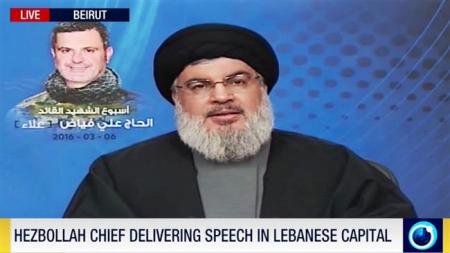
Press TV – March 6, 2016
Sayyed Hassan Nasrallah, the secretary general of the Lebanese resistance movement Hezbollah, says the Arab member states of the [Persian] Gulf Cooperation Council ([P]GCC), which recently listed the resistance group as terrorists, do not have the interests of Lebanon in mind.
During a live televised speech on Sunday, Nasrallah said those who assume that the Arab regimes will protect Lebanon have “pinned their hopes on a fantasy.”
Had Lebanon waited for a unified Arab strategy in the face of Israel instead of opting to resist against the occupying regime, “then the fate of this territory would have been the same as the fate of the territories Israel has taken control of,” he said.
On Wednesday, the six-nation Arab bloc issued a statement labeling Hezbollah a terrorist organization. The [P]GCC comprises Bahrain, Kuwait, Oman, Qatar, Saudi Arabia and the United Arab Emirates.
“Many of these Arab countries today, who designate us as terrorists, what do they have to do with this resistance and these victories and these achievements?” Nasrallah said.
Israel unleashed an all-out offensive on Lebanon 10 years ago under the pretext of releasing Israeli soldiers allegedly captured by Hezbollah in southern Lebanon. The invasion claimed the lives of nearly 1,200 Lebanese people, most of them civilians.
The Tel Aviv regime was, however, forced to retreat without achieving any of its objectives after Hezbollah fighters displayed heavy resistance against the Israeli military.
“Back then, we said to them (the Arab countries) ‘we don’t want anything from you… Today, we also say to them, to these regimes, ‘We don’t want anything from you. We don’t want money, nor do we want weapons, nor do we want support or blessing,” he said. “Just leave this resistance alone, leave this country alone, and leave this people alone.”
He blamed some Arab regimes for conspiring against anyone standing against Israel.
Nasrallah also underlined the assistance provided by the resistance group to the Iraqi government in its fight against the Takfiri terror group Daesh and reminded that Hezbollah did not wait for any orders to initiate its anti-terror fight in Syria and only fulfilled its religious commitment.
The secretary general of Hezbollah also addressed the tension that has been bubbling up between Saudi Arabia and Lebanon, causing the former to take a raft of hostile measures against the latter.
“If it’s angry with us, it has the right to. I understand Saudi Arabia’s anger. Why? Because when one fails, at the very least he will be angry,” Nasrallah said.
He went on to explain that the Saudi rage has emanated from the kingdom’s failures in Yemen and Syria.
“In Syria, there’s a very great Saudi anger because what they had calculated in Syria [was that] in two or three months, ‘Syria would fall into our hands,’” Nasrallah said.
Hezbollah has been successfully aiding the Syrian military against foreign-backed militant groups.
“He, who confronts Saudi Arabia in Syria is the real defender of the Lebanese national interests,” Nasrallah said.
“The same goes for Yemen. The estimations of the new Saudi leadership was that ‘we will decide the battle in Yemen. We will teach a lesson to all the Arab countries and the Arab world… and we will impose ourselves on the Arab world,’” he said.
Saudi Arabia launched a campaign of military aggression against Yemen in late March last year in a bid to bring fugitive former Yemeni President Abd Rabbuh Mansur Hadi, a Riyadh ally, back to power and undermine Yemen’s Houthi Ansarullah movement.
Riyadh has, however, failed in accomplishing either of the two objectives, and has become entangled in a prolonged expensive war, whose adverse economic impacts—along with economic mismanagement—have gradually been giving rise to domestic discontent inside Saudi Arabia.
Featured Video

No Threat Can Force Iran’s Surrender /Trita Parsi & Lt Cl Daniel Davis
or go to
Aletho News Archives – Video-Images
From the Archives
An Expert Military Analysis of War with China
Actually, None is Necessary
By Fred Reed • Unz Review • December 13, 2020
The Correlation of Armed Forces: U.S. goods and services trade with China totaled an estimated $634.8 billion in 2019. Exports were $163.0 billion; imports were $471.8 billion. The U.S. goods and services trade deficit with China was $308.8 billion in 2019. Trade in services with China (exports and imports) totaled an estimated $76.7 billion in 2019. Services exports were $56.5 billion; services imports were $20.1 billion. The U.S. services trade surplus with China was $36.4 billion in 2019.
There is talk within the Washingtoniat of a possible war with China. Steve Bannon, who apparently was dropped on his head as a child, actually favors such a war. We hear the usual shoo-the-boobs alarm about how the Chinese are doing something terrible and we must gird our loins and American values and show them what for, bow wow, woof. The danger is that the current game of who-blinks-first in Asian waters might actually provoke a shooting war. You know the kind of thing: One warship refuses to get out of the way of another, a collision ensues, some retard lieutenant who signed up on waivers opens fire, and we’re off and running. It is not a good idea to let children play with matches.
The said war is discussed either in emotional terms by idiots or in purely naval terms by those familiar with such things, so we hear of the First Island Chain and the Second Island Chain and whose missiles against the other’s missiles and so on. This would be appropriate if we were fighting World War Two again. Which we aren’t. Let’s take a quick-and-dirty look at how such a war might go.
To begin the war, America would overestimate itself and underestimate China. This is doctrine in the Pentagon. … continue
Blog Roll
 Aletho News
- Iran To Target Military Industrial-Tech Complex That Facilitated Gaza Genocide
- Collapsing Empire: The Resistance Disarms ‘Israel’
- Suicide Should Not Be a Government Service
- Rethinking America’s greatest threat: Iran vs. Israel-Firsters
- Iran accuses adversaries of false flags to strain Turkey ties
- Poland rules out sending Patriot missiles to US/Israel amid war on Iran
- Tehran approves new Hormuz plan with major restrictions
- No Threat Can Force Iran’s Surrender /Trita Parsi & Lt Cl Daniel Davis
- UK’s New Pandemic Plan Would Turn Big Tech Into a Mass Location Tracking Network
- Growing insecurity, soaring prices fuel protests in north as regime bans evacuation: Sources
- If Americans Knew
- Joe Kent Urges Americans To Call White House and Congress To Object To Sending Troops Into Iran
- DNC Resolution to Reject AIPAC Funding Puts Democratic Leaders in the Hot Seat
- Swedish foundation to build 400 schools as over 650,000 Gaza children remain without education for 2 years
- Israeli army admits photshopping image of slain Lebanese journalist
- This is how Israel is systematically killing health workers under the cover of war in Lebanon
- Carrying life under fire: Israeli invasion of Lebanon leaves pregnant women facing deadly risks
- Champagne all around for the new death penalty (for Palestinians) law – Not a ceasefire Day 172
- Why are Palestinian books struggling to be seen on Amazon?
- The Line Between Affinity and Conspiracy
- As Iran targets US military bases, will they be relocated to Israel? Not a ceasefire Day 171
- No Tricks Zone
- New Study Finds Warming Saves Lives…Cold Temperatures 12 Times More Deadly Than Excess Heat
- German Science Blog Accuses PIK Climate Institute Of Hallucinating Climate Tipping Points
- Devastating Assessment Of Comirnaty Vaccine By Former Senior Pfizer Europe Toxicologist
- New Study: CO2 Is ‘Effectively Negligible’ As An Explanatory Climate Change Factor Since 2000
- Former Pfizer Toxicologist Dr. Helmut Sterz Tells Bundestag Hearing Pfizer Vaccine Should Have Never Been Approved
- Energy Expert: Germany’s Nuclear Phaseout Was A “500 Billion Euro Mistake”
- New Research: South Australia’s Mid-Holocene Sea Surface Temperatures Were 4°C Warmer Than Today
- Storing Green Energy To Last Germany 10 Days Would Require A 60-Million Tonne Battery
- New Studies: UK Sea Levels Were 4 Meters Higher Than Today During The Mid-Holocene
- Destructive Green New Deal: German Energy And Metal Group Warns Of Drastic Crisis
 Aletho News