ASA Summit Promotes South-South Ties, Regional Integration
Venezuelanalysis | March 1, 2013
The signing of twenty-seven new economic and social agreements between the nations of South America and Africa was the product of three days of meetings held between representatives of more than 60 countries in Equatorial Guinea last week.
The Third South America Africa Summit (ASA) took place just outside the capital of Malabo, where heads of states and high-ranking officials outlined ways to improve commercial, technological and transportation collaboration between the two continents.
Brazilian President Dilma Rousseff as well as Bolivia’s President Evo Morales were in attendance on Friday as were the presidents of Nigeria, South Africa, Senegal, Suriname and Cape Verde, among others.
“We are here to contribute with our experiences together, always thinking about the liberation of our countries in Africa as well as in Latin America and the Caribbean”, said President Morales on Friday.
During his speech, Morales drew attention to the need to take back the natural resources that have been “looted” by the United States and Europe, highlighting the gains that have been made as a result of such policies in the Americas.
“We began to take back our resources and the result has been a change in the economic and financial history of much of the countries in Latin America and the Caribbean”, the Bolivian head of state asserted.
“Unity for the dignity of our peoples, unity for equality, and, above all, unity for our liberation”, he added.
This sentiment of economic and political independence was echoed by the majority of ASA representatives including Nigerian Foreign Minister, Viola Adaku Onwuliri.
“Let’s show our ability to make tangible decisions that will lead to economic development and the integration of Africa and South America.
With true political will, we will be able to achieve it, just a s we have already been able to overcome the burdens of colonialism and racism”, Onwuliri said.
For his part, Venezuelan Foreign Minister Elias Jaua read a letter written by Hugo Chavez who apologized for his inability to participate personally in the conference.
“I truly lament, in the deepest of ways, my inability to be physically present with you and I reiterate once again…my most irrevocable commitment to the cause of union between our people”, the Venezuelan President wrote.
In his missive, Chavez hailed the “indivisible historic ties” that bind the regions and which have obliged the two continents “to walk together until the very end”.
“I will never be tired of saying it: we are one people. We must find each other, beyond the formalities and the speeches, in the feeling of unity.”
“In this way we will take our people out of the labyrinth where they had been cast by colonialism and, in the 20th century, by neoliberal capitalism”, the head of state said.
EXPANDING THE ALLIANCE
Apart from the commercial accords inked on Saturday, participating countries also expressed their support for Argentina in its territorial dispute with the United Kingdom over the Falkland Islands.
A further resolution saw the condemnation of the more than 50 year-old US blockade on Cuba and a declaration calling for Palestine to become a full member of the United Nations.
Many countries expressed their desire for the expansion of the ASA alliance, advocating the inclusion of all of Latin America and the Caribbean, not only those members belonging to the Union of South American Nations (Unasur) bloc.
President Nguema of Equatorial Guinea described the absence of these nations as “unjustifiable” given the important commonalities that exist between Africa and the developing nations of the Americas.
“The history of our continents, largely exploited by other countries, compels us to take measures of South-South cooperation which will allow us to emerge with liberty, independence and coexistence in this globalized world of confronting interests”, Nguema said.
Following this line, the President of the Spanish-speaking African nation proposed that ASA be incorporated into the recently established Community of Latin American and Caribbean States (CELAC) alliance that includes all countries in the Americas except the United States and Canada.
Venezuelan Foreign Minister Jaua reported that Nguema’s proposal has received the support of many allied Latin American nations and that “what needs to be done is to discuss [the proposal] with Unasur and then with CELAC”.
Jaua additionally informed that there will be an encounter between the leading members of ASA next month in the Venezuelan capital of Caracas to guarantee the materialization of the agreements signed last weekend.
“On April 26, there will be a meeting of the Follow-Up Commission which is made up of Nigeria, Brazil, and Equatorial Guinea to see through the accords that have been solidified in this third summit,” the Venezuelan Minister said.
FINDING ITS FOOTING
The tri-annual ASA first took place in Abuya, Nigeria in 2006 and was followed by a second encounter in Margarita Island, Venezuela in 2009.
While many member nations agree that more needs to be done to strengthen the alliance, trade between the continents has grown from $7.2 billion in 2002 to $39.4 billion in 2011.
Ecuadoran Foreign Minister Ricardo Patino explained that relations between the two regions have not been easy over the years “because we don’t know each other very much and we don’t have much work experience together.”
At the same time, Patino affirmed that there are great possibilities for collaboration and that the two continents “have much to offer one another” in ways that go beyond pure commercial relations.
Ecuador is slated to host the next ASA summit in 2016.
Related article
- Venezuela’s Chavez to Africa – South America Summit: We Must Unite (venezuelanalysis.com)
Killings Continue in Bajo Aguán as New Report Documents Abuses by U.S.-Trained Honduran Special Forces Unit
By Alex Main | CEPR Americas Blog | February 22, 2013
A few days ago two more land rights activists were murdered in the Bajo Aguán, a region of Honduras where dozens of campesinos have been killed over the last three years. On February 16, Jacobo Cartagena, member of the Unified Campesino Movement of the Aguán (or MUCA, by its Spanish initials), was shot and killed as he waited for a bus. Hours later, José Trejo Cabrera, was shot down while driving a motorcycle near the town of Tocoa. Trejo was the brother of Antonio Trejo Cabrera, a lawyer who had defended small farmers’ land claims who himself was shot to death last September as he was leaving a wedding. Amnesty International has called on the Honduran government to “urgently investigate” José Trejo’s killing and noted that “the day before he was shot dead [he] had been in the Honduran capital Tegucigalpa, to meet with officials in an effort to ensure justice for his brother’s murder and visiting media outlets to keep the spotlight on the case.”
In an interview with the Associated Press, José Trejo had said “if they killed my brother, what will they not do to me?” He and others blamed the powerful businessman Miguel Facussé for his brother’s murder. Facussé and a handful of other wealthy landowners in the region have hundreds of armed security guards who are believed to be responsible for many of the numerous killings and other attacks targeting campesino activists. Honduran authorities have failed to bring those responsible for the killings to justice or to take effective measures to protect the activists. As the AP notes, “no one is serving time in prison for any of the 89 assassinations of campesinos committed in the Aguán Valley since December of 2009 when land occupations began…”
Since August of 2011, hundreds of Honduran soldiers have been stationed in the Bajo Aguán as part of the so-called Xatruch Intervention Force, ostensibly to mitigate the ongoing violence taking place there. But targeted killings of campesinos have continued unabated and representatives of land rights movements have accused military personnel of being involved in attacks on their members. A new report authored by Annie Bird of Rights Action adds significant weight to these allegations. It documents 34 cases of abuses directly involving members of Honduras’ 15th Battalion, a special forces unit of the Honduran army that has been present in the region for decades and has played a central role in the Xatruch Force.
The report describes in detail specific instances of torture, threats, forced disappearances and killings in which members of the 15th Battalion have been reportedly involved, often in tandem with police and private security forces operating in the Aguán. Only a small handful of these abuses have been partially investigated and none of those responsible have been prosecuted.
The report also examines how military officials have sought to criminalize the region’s campesino movements, associating them with terrorism and drug-trafficking, while steadfastly defending the property claims of powerful landowners.
Those who have reported on the abuses of security forces in the Aguán have also been criminalized by military officials. On February 18th the Commander of the Xatruch Intervention Force publicly accused various journalists, human rights defenders by name of “denigrating the actions of the armed forces” and of “besmirching the image of the Honduran nation.” Following the incident, Reporters Without Borders issued a release stating that the accusations were “a clear attempt to intimidate and censor” and that “this kind of public stigmatization directly exposes those concerned to significant risks, given the human rights situation in Aguán in particular and Honduras in general, where those who dare to provide information about land disputes and environmental problems are systematically criminalized.”
As Rights Action notes, the 15th Battalion reportedly receives training and assistance from the U.S. government. The Honduran media has reported that U.S. Army Rangers have trained personnel from the Battalion and that U.S. Special Operations South has funded the upgrading of the Battalion’s Rio Claro base.
A provision attached to the annual U.S. Foreign Operations Appropriations Act – known as the Leahy Amendment, after the U.S. Senator who first introduced it – prohibits U.S. military assistance to foreign units that commit gross human rights violations with impunity. The provision states: “No assistance shall be furnished under this Act or the Arms Export Control Act to any unit of the security forces of a foreign country if the Secretary of State has credible evidence that such unit has committed gross violations of human rights.” The only exception being if the “Secretary determines (…) that the government of such countries is taking effective measures to bring the responsible members of the security forces unit to justice.” A similar provision can be found in Defense Appropriations Acts, though it only deals with the funding of training activities for foreign troops.
Rights Action’s report appears to provide “credible evidence” that the 15th Battalion and other Honduran authorities are involved in gross abuses and there is no indication that Honduran authorities have pursued any form of judicial action to address these abuses. If the U.S. government has plans to fund further military assistance to the unit there may well be cause for the Secretary of State to cut off assistance until abuses are adequately investigated and any responsible military personnel are brought to justice.
Other recent incidents involving Honduran security forces have also appeared to be within the realm of Leahy Amendment action. Last November the AP reported on how Honduran soldiers trained and vetted by the U.S. murdered an unarmed teenager who ran through a check point last May. The same month, four Honduran villagers in the Moskitia region were killed in the course of a counternarcotics operation carried out jointly by the DEA and a special Honduran police unit trained and vetted by the U.S. As a joint report and previous posts have explained, the Honduran investigation of the incident was flawed and inconclusive, a fact which the State Department still appears unwilling to acknowledge.
Related articles
- Honduras: Murdered Lawyer’s Brother Killed in Aguán (alethonews.wordpress.com)
- Honduras: Two More Campesinos Murdered in Aguán (alethonews.wordpress.com)
- Honduras: Miguel Facusse is Tragically Misunderstood (alethonews.wordpress.com)
- NPR Examines One Side of Honduran “Model Cities” Debate (alethonews.wordpress.com)
Correa wins re-election by a landslide
MercoPress | February 18, 2013
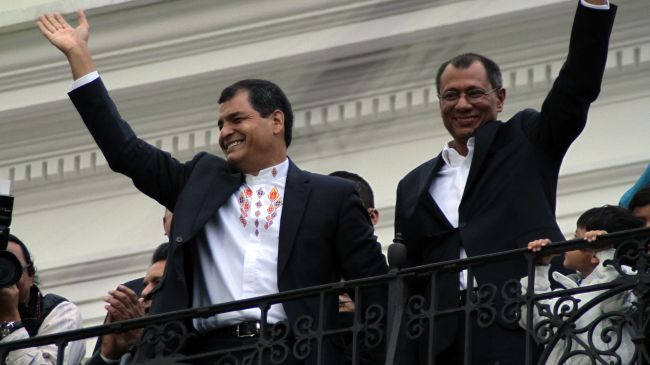
President Rafael Correa swept to a re-election victory on Sunday promising to strengthen state control over Ecuador’s economy and continue using booming oil revenues to build roads, hospitals and schools in rural areas and shanty towns.
Correa won 58% of the votes compared with 24% for runner-up Guillermo Lasso, according to preliminary results released by the electoral authority based on almost 40% of the votes counted. Correa was so confident of his victory that he appeared on state TV less than an hour after polls closed.
“Nobody can stop this revolution,” a jubilant Correa told supporters from the balcony of the Carondelet presidential palace, after claiming victory. He added “we are making history; we are building our own homeland which is Ecuador and the great homeland which is Latin America.“
The populist US-trained economist took power in 2007 and has won strong support among the majority of the population of the country which is poor.
Correa, 49, may now be in line to become Latin America’s main anti-American voice and de facto leader of the ALBA bloc of populist governments as Venezuelan President Hugo Chavez has been silenced during his battle with cancer. Correa said he dedicated his victory to Chavez.
The principal challenge in Correa’s new four-year term will be wooing investors needed to boost stagnant oil production and spur the mining industry. A 3.2 billion dollars debt default in 2008 and aggressive oil contract negotiations scared many off.
Critics view Correa as an authoritarian leader who has curbed media freedom and appointed aides to top posts in the judiciary.
But the fractured opposition failed to make a consolidated challenge. It fielded seven candidates, making it easy for Correa, and he is now on track for a decade in office.
That is rare stability in a country where three presidents were pushed from office by coups or street protests in the decade before Correa took power in 2007. He is already the longest-serving president in Ecuador since the return to democracy in the 1970s following a military dictatorship.
Correa’s success has hinged in part on high oil prices that allowed for liberal state spending, including boosting cash handouts to 2 million people, and spurred solid economic growth.
He has promised to diversify the economy away from its dependence on oil, in part by bringing in new investment for the mining sector. Despite promising reserves of gold and copper, mining operations have barely gotten off the ground.
In a news conference on Sunday after polls closed, Correa played down the need for more foreign investment. He insisted the ultimate goal was to ensure economic growth rather than ”mortgaging“ the country to bring in cash from abroad.
”We welcome foreign investment, and we’re already getting plenty of it,“ Correa said. ”Ecuador is one of the most successful economies in Latin America.”
Ecuadorans also chose a new Congress on Sunday.
The ruling Alianza Pais party was expected to win a majority in the legislature, which would let Correa push ahead with controversial reforms, including a media law and changes to mining legislation, without having to negotiate with rivals.
The results of the vote for Congress are not expected to be known for several days.
Related articles
Venezuelan arms maker to continue Iran trade despite US bans
Press TV – February 17, 2013
Venezuelan officials say the state-owned weapons manufacturer, CAVIM, will keep on trading with Iran in defiance of the US sanctions imposed on the company, Press TV reports.
“We think that it is logical for Venezuela to have trade and economic relations with all countries in the world. We are exercising our sovereignty,” Venezuelan Envoy to international rights bodies German Saltron said.
“We feel it is an abuse of power that the United States’ government is trying to block Iran from trading with other countries,” he added.
On February 11, the US State Department imposed sanctions on CAVIM allegedly for violating the so-called Iran Nonproliferation Act of 2000, which aims to prevent Tehran from acquiring weapons of mass destruction.
According to the US State Department website, sanctions on the Venezuelan weapons manufacturer will be in place until February 2015.
The US, the Israeli regime and some of their allies have repeatedly accused Iran of seeking to produce an atomic bomb under the cover of its nuclear energy program, a claim Iran has categorically rejected.
In 2011, Washington imposed sanctions on Venezuela’s state-owned giant oil company, PDVSA, for having oil deals with Iran’s energy industry and as part of its campaign to tighten sanctions on the Islamic Republic over its nuclear energy program.
Under the sanctions, PDVSA is denied US government contracts and banned from Washington’s export financing.
The administration of President Barack Obama is alleging that Iran is using its close economic relationship with Socialist President Hugo Chavez’s government to establish a military presence in Latin America.
In December 2012, the US president enacted a law “aimed at countering Tehran’s alleged influence in Latin America.”
Strategically dubbed as ‘Countering Iran in the Western Hemisphere Act of 2012’, the act calls for the State Department to develop a plan within 180 days to “address Iran’s growing hostile presence and activity.”
However, Iran and Venezuela have continued to expand their trade ties despite these sanctions.
More than 100 bilateral agreements have been signed between the two countries over the past decade, while last year Iranian firms signed a USD2.5 billion contract to build 17,000 houses for underprivileged people in Venezuela.
The Islamic Republic has been seeking to expand relations with Latin American countries over the past years, describing the endeavor as one of its major foreign policy strategies.
Iran’s growing popularity in Latin America has raised major concerns in Washington, which regards the region as its strategic backyard and traditional sphere of influence.
Related articles
- Venezuela wants best of relations with the US based on ‘mutual absolute respect’ (alethonews.wordpress.com)
- US probes Swiss medicine giant for trade with Iran (alethonews.wordpress.com)
Pentagon Continues Contracting US Companies in Latin America
By John Lindsay-Poland | FOR | January 31, 2013
The Pentagon signed $444 million in non-fuel contracts for purchases and services in Latin America and the Caribbean during the 2012 fiscal year, an overall decrease of nearly 15% from the previous year. But US military spending in the region is still considerably higher than during the George W. Bush administration, when the equivalent Pentagon spending in Latin America averaged $301 million a year.
Fellowship Of Reconcilliation conducted an analysis of Defense Department contracts listed on usaspending.gov for Fiscal Year 2012, building on the review we did last year.
More than a third of funds for these contracts in the region are being carried out in Cuba, with $158 million for housing upgrades, intelligence analysis, port operations and other services. The United States maintains the Guantanamo naval base in Cuba, site of the 11-year-old detention center that holds 171 prisoners without trial, many of whom have been cleared for release.
An additional $130 million in Pentagon contracts was for fuel purchases, including more than $44 million in Brazil, $35 million in Costa Rica, and $24 million in Honduras. Such fuel purchases supply the Fourth Fleet of the Navy, as well as military aircraft and land vehicles used in exercises, operations, and training.
Colombia remained the country with the largest amount of Pentagon contracts in continental Latin America, with $77 million. A multi-year contract shared by Raytheon and Lockheed for training, equipment and other drug war activities accounted for more than a third of Pentagon contract spending in Colombia. Honduras, which has become a hub for Pentagon operations in Central America, is the site for more than $43 million in non-fuel contracts signed last year.

The US Southern Command (SouthCom), responsible for US military activities in Central and South America and the Caribbean, is assisting the Panamanian border police, known as SENAFRONT, by upgrading a building in the SENAFRONT compound. The force was implicated in killings of indigenous protesters (PDF) in Bocas del Toro in 2011, and fired indiscriminately with live ammunition (PDF) on Afro-Caribbean protesters last October.
Many countries that host US military activities hope to receive economic benefits and jobs as a result. But more than five of every six Pentagon dollars contracted for services and goods in the region went to US-based companies. Only nine percent of the $574.4 million in Pentagon contracts signed in 2012 (including fuel contracts) were with firms in the country where the work was to be carried out. In the Caribbean, there were virtually no local companies that benefited from the $245 million in Defense Department contracts.
A few corporations dominated Pentagon contracts in the region. CSC Applied Technologies, based in Fort Worth, Texas, received more than $53 million in contracts to operate the Navy’s underwater military testing facility in the Bahamas. Lockheed Martin received more than $40 million in contracts, almost entirely for drug war training, equipment and services in Colombia and Mexico.
Pentagon Focus on Guatemala
Although the Pentagon spent less in most Latin American countries in 2012 than the year before, DOD contracts have more than doubled since 2010 in Guatemala, where there is a ban on most State Department-channeled military aid to the army. However, the ban does not apply to Defense Department assistance. The contracts for nearly $14 million in 2012 amount to more than seven times what it was in 2009. In addition, the US military spent another $8.1 million on fuel in Guatemala last year, probably for “Beyond the Horizon” military exercises held there and in Honduras from April to July, and perhaps to support the deployment of 200 Marines to Guatemala in August.
The contracts included new assistance to the Guatemalan special forces, known as Kaibiles, former members of which have been implicated in giving training to the Zetas drug cartel, as well as the worst atrocities during the genocide period of the 1980s. Two contracts, funded by SouthCom and signed in September, were for a “shoot house” and “improvements” at the Kaibiles training base in Poptun, Petén.
SouthCom also funded a contract for construction of a new $3 million counter-drug base in Santa Ana de Berlin, in Quetzaltenango. This year, SouthCom is slated to build a $1.8 million counternarcotics operations center and barracks in Mantanitas, Guatemala, according to an Army Corps of Engineers presentation.
The expenditures included equipment. For the last two years, SouthCom has been providing Boston whaler boats, radios, and tactical vehicles (Jeeps) to Central American militaries. Guatemala is receiving more of the equipment than other countries in the region – 47 Jeeps and 8 Boston whalers, according to a SouthCom document. SouthCom signed a $2.5 million contract in September for Jeeps for Guatemala, and it has purchased more than $2.8 million of Harris military radios for Guatemala since September 2011.
Department of Defense contracts, summaries of which are posted on usaspending.gov, only represent a portion of Pentagon spending. A report to Congress last April (PDF) of Defense Department assistance worldwide showed more than $15 million in military aid to Guatemala in 2010, including $9 million for intelligence analysis, training, boats, trucks, night vision devices, and a “base of operations.” These funds also included more than $6 million of unspecified support for Guatemalan police operations in Cobán, in the Guatemalan highland department of Alta Verapaz. The report didn’t include data after 2010.
On December 7, the Pentagon’s Defense Logistics Agency signed a $1.4 million contract with a Guatemalan firm to manage a 10,000-barrel supply of turbine fuel for the next five years in Puerto Quetzal, on Guatemala’s southern coast. This followed a July 2012 solicitation to deliver 63,000 gallons of jet fuel to another southern Guatemalan site, in Retalhuleu.
FOR compiled data on the “country of performance” for contracts. For Guatemala, we also examined data on additional contracts that reference the country, which included a $2.5 million contract signed in late September with a Chrysler distributor to deliver tactical vehicles – some of the Jeeps slated for the country. The US Army also purchased $7.6 million worth of trousers from a producer in Guatemala in 2012.
“Mini-Bases”
Some legislation for DOD drug war construction of bases and other infrastructure limits projects to $2 million, and the Southern Command continues to employ this authority frequently to construct a variety of facilities all over the Americas. Here are some of the facilities the US military is constructing around Latin America.
| City, Country | Amount of contract | Date signed | Description |
|---|---|---|---|
| Tecun Uman, Guatemala | $550K | Dec. 5, 2011 | Health post refurbishment |
| Champerico, Guatemala | none — part of multi-award contract | Sept 17, 2012 | Counter Narco-terrorism (CNT) Ops Center; pier and fuel |
| Santa Ana de Berlin, Guatemala | $3 million (Army Corps of Engineers says $4.1 million) | Sept 29, 2012 | CNT Barracks, Latrines, refurbish chow hall, motorpool |
| Las Mantanitas, Guatemala | $1.8 million | Not known; see ACE FY13 plan. | CN Operations Center/Barracks |
| Summit, Panama | $1,078,971 | Sept 22, 2012 | Counternarcotics maintenance facility |
| Hunting Caye, Belize | $1,778,420 | August 10, 2012 | Construction of operations barracks/maintenance facility |
| Puerto Castilla, Honduras | $374,882 | March 9, 2012 | Construction of helicopter landing pads and team room improvements |
| Dominican Republic | $1.8 million | Sept 28, 2012 | Construct dormitory building |
| Santo Domingo, Dominican Republic | $414,444 | Jan. 24 and March 8, 2012 | Refurbish peace keeping operations training school buildings |
| Antigua | none — supplemental to existing contract | October 19, 2011 | Emergency response warehouse |
| Tarapoto, Peru | $1,049,265 | September 12, 2012 | Disaster relief warehouse and search and rescue training facility |
| Puno and Huaraz, Peru | $1,037,808 | July 27, 2012 | Emergency Operations Centers |
| Piura and Concepción, Peru | $853,500 | July 27, 2012 | Emergency Operation Center and Disaster Relief Warehouse |
AP Investigation: U.S. Spends $20 Billion Over 10 Years on Increasingly Bloody Drug “War” in Latin America; Rejects Drug Policy Reform
By Alex Main | CEPR Americas Blog | February 5, 2013
It started in Colombia in 2000, moved on to Mexico in 2008 and now rages in Central America. Since the beginning of the century, the U.S.-backed “war on drugs” has progressively spread throughout the northern part of Latin America, leaving tens of thousands of lost lives in its wake. An in-depth investigative piece published by the Associated Press over the weekend explains how this so-called “war” – which relies on U.S. funding, training, equipment and troops – has grown in recent years to become “the most expensive initiative in Latin America since the Cold War.”
The article, authored by Pulitzer-prize winning reporter Martha Mendoza, describes how the U.S. has “spent more than $20 billion in the past decade” and deployed U.S. army, marine and navy troops to support a heavily militarized campaign to fight drug trafficking throughout the region. The fact that the efforts have been accompanied by soaring violence – with, for example, 70,000 Mexican lives lost in the last six years – doesn’t seem to trouble the U.S. officials in charge of implementing U.S. drug policy internationally. In fact, they seem to consider spikes in violence to be a sign that the “strategy is working.”
William Brownfield who heads the State Department’s Bureau of International Narcotics and Law Enforcement Affairs, told Mendoza that “the bloodshed tends to occur and increase when these trafficking organizations… come under some degree of pressure.”
For others in Washington, the shocking number of lives lost suggests that the strategy is in fact not working. New York Congressman Elliot Engel, a moderate Democrat who is now the ranking minority member on the House Foreign Affairs Committee, told the AP that he supports a congressional review of counternarcotics programs in the Western Hemisphere.
“Billions upon billions of U.S. taxpayer dollars have been spent over the years to combat the drug trade in Latin America and the Caribbean,” he said. “In spite of our efforts, the positive results are few and far between.”
Particularly worrying is the fact that the administration seems to be unable to account for enormous sums that have been authorized to be spent on military equipment. The article notes that,
neither the State Department nor the Pentagon could provide details explaining a 2011 $1.3 billion authorization for exports of military electronics to Honduras — although that would amount to almost half of all U.S. arms exports for the entire Western Hemisphere.
The first major militarized anti-drug campaign that the U.S. supported in the region was Plan Colombia in 2000, and the U.S. administration frequently presents that initiative as a shining example for the region given that homicide rates and cocaine production have fallen in that country. But this assessment disregards the tragic “side effects” of the Colombian campaign, including thousands of abuses carried out by the Colombian military and by paramilitary groups, and the displacement of millions of poor Colombians from their lands. Furthermore, Colombia continues to be one of the top cocaine producers in the world and is still the number one exporter of cocaine to the U.S.
Today Central America is increasingly the focus of U.S. militarized counternarcotics programs. As the New York Times revealed in early May of last year, tactics and personnel that were previously used in Iraq and Afghanistan have been transferred to Central America, including the DEA’s Foreign-deployed Advisory Support Team (FAST) that first operated in Afghanistan.
Only days after the Times article was published, four innocent villagers – including a pregnant woman and a 14-year-old boy — were killed in an anti-drug operation in northeastern Honduras which involved at least ten FAST team agents. The killings were denounced by human rights groups in Honduras and the U.S., particularly after it became clear that the victims had been abandoned by authorities and that the Honduran attorney general’s investigation of the incident was deeply flawed. Consequently human rights groups and 58 members of Congress have called on U.S. authorities to carry out a full investigation of the incident to determine what role may have been played by U.S. agents.
As a result of this and other recent incidents, $30 million in aid to Honduras has been put on hold by Congress, according to Mendoza. Yet, she notes, “there are no plans to rethink the strategy.” Instead, Brick Scoggins, who manages counternarcotics programs at the Defense Department, told Mendoza: “It’s not for me to say if it’s the correct strategy. It’s the strategy we’re using (…) I don’t know what the alternative is.”
President Obama and Vice President Biden cannot pretend to be as unaware of alternatives to the administration’s “war on drugs.” In recent multilateral meetings, both Obama and Biden were asked by regional leaders to reconsider the current militarized approach to fighting drugs and to consider paths toward drug decriminalization or, at the very least, to consider placing a greater focus on reducing demand for drugs in the U.S. and treating the drug problem as a public health issue. Both rejected any change of course in the current war on drugs, and – despite the fact that the president of Colombia himself supported the discussion of alternative policies – both Obama and Biden have insisted that Plan Colombia is the model to follow.
Piñera Praises Chávez at CELAC Summit
Media Influences Public Opinion on Venezuela But Not So Much Governments
By Mark Weisbrot | CEPR Americas Blog | January 29, 2013
In writing about the media’s ongoing hate-fest for Hugo Chávez, I pointed out that the major media’s reporting had been effective, in that it has convinced most consumers of the Western media – especially in the Western Hemisphere and Europe – that Venezuela suffers from a dictatorship that has ruined the country.
But there is an important sense in which it has failed. Of course it has failed to convince Venezuelans that they would be better off under a neoliberal regime, and that is one reason why Chávez and his party have won 13 of 14 elections and referenda since he was first elected in 1998. Perhaps of equal importance, it has also failed to persuade other governments that President Chávez is motivated by some kind of irrational hatred of the U.S. – as the media generally reports it. Most foreign ministries have some research capacity, and although they are influenced by major media, at the higher levels they have better information and make their own evaluations.
That is why Chávez has been able to play a significant role in the growing independence and regional integration of Latin America, despite his vilification in the media, and years of effort by the U.S. government to isolate Venezuela from its neighbors. For example, the governments that decided to form the Community of Latin American and Caribbean States (CELAC) – a new hemispheric organization including all countries other than the U.S. and Canada – don’t care whether the media dismisses it as “Chavez’s project.” When Brazil, Argentina, and Uruguay decided to admit Venezuela as a full member of the trading bloc Mercosur, they didn’t care what the media in any of their respective countries would say about it.
Of course the left governments of Argentina, Brazil, Ecuador, Bolivia, Uruguay and others have been quite sympathetic to Chávez and see him as a very important ally. But the region has changed so much in the last 10 or 15 years that it is not only the left governments who appreciate him. Here is what one of the only remaining right-wing presidents in South America, Sebastián Piñera of Chile, said on Sunday about Chávez, in Santiago:
I want to acknowledge a President who is not with us today, but whose vision, tenacity and strength has had a profound impact on the creation of the CELAC. I refer to President Hugo Chávez, the father of this regional group that welcomes all nations of Latin America and the Caribbean, 33 in all, and which excludes only two countries on the continent: the United States and Canada. We are all hoping for you to win this battle, perhaps the toughest battle of your life, which you are doing with the same strength and courage as always, and that you regain your health and that you can return in full capacity as President of Venezuela.
Back in 2006, the New York Times ran a front-page news article with a large-type headline: “Seeking United Latin America, Chávez is a Divider.” The thesis was being pushed by the Bush State Department, and was echoed by the anti- Chávez sources cited in the article.
How completely wrong they turned out to be.
Related articles
- CELAC Strengthened by Second Annual Summit (venezuelanalysis.com)
- Cuba takes over presidency of regional group Celac (morningstaronline.co.uk)
- Venezuela wants best of relations with the US based on ‘mutual absolute respect’ (alethonews.wordpress.com)
Why Latin America Will Not Bow to US Pressure over Iran
By Yusuf Fernandez | Al-Manar | January 11, 2013
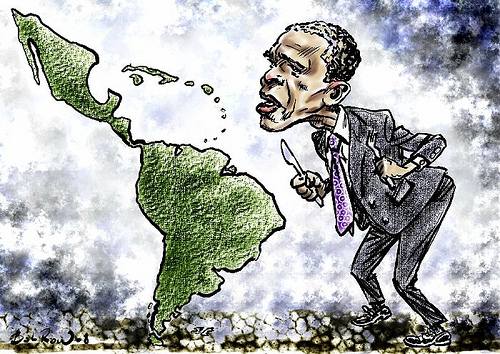
On December 28, US President Barack Obama enacted the so-called “Countering Iran in Western Hemisphere Act” which seeks to undermine Iran´s growing relations with Latin America, a region that has traditionally seen by the United States as its backyard and sphere of influence.
The Act, passed by congressmen earlier this year, requires the US Department of State to develop a strategy within 180 days to “address Iran´s growing hostile presence and activity” in Latin America. The Act points out that “Iran´s business and diplomatic ties are a threat to US national security”. It is seen, however, as another anti-Iranian move fabricated by the Zionist lobby in the US.
Shortly before, in July 2011, Robert F. Noriega – former Assistant Secretary of State for Western Hemisphere affairs, former US ambassador to the Organization of American States (OAS) and current Visiting Fellow at the American Enterprise Institute, one of the main neoconservatives -controlled entities in the US – said in a hearing before the House Subcommittee on Counterterrorism and Intelligence that Iran was carrying out “an offensive strategy” in Latin America.
The Iranian presence in the Latin America has also been harshly attacked by the pro-Israeli hawk Ileana Ros-Lehtinen, Foreign Affairs Committee Chairman and self-appointed bulwark against the alleged “Islamo-Boliviarian threat” to US security. She was co-star of a so-called “documentary” entitled “La amenaza iraní” (The Iranian Threat), in which she said, without blushing, that the US should attack Iran in order to “avert bomb explosions in various Latin American capitals”. The film was aired by Univision, a US broadcast network, which is owned by someone who has hosted galas in honour of the occupying Israeli army.
In 2009, another ridiculous “documentary” released by Univision involved the Venezuelan consul in Miami, Livia Acosta, in an absurd cyber-plot against the US allegedly promoted by “Iranian diplomats and Mexican computer hackers”. This was the pretext used for expelling her from the United States in a move that was widely seen as an American political revenge for Venezuela´s independent foreign policy.
Actually, the US Act rudely violates Latin American countries´ sovereignty and contains some stupid claims such as that the opening of Iranian embassies or cultural centers is to “spread terrorism”. Former Defense Secretary Leon Panetta also echoed those views by claiming, in a recent visit to Colombia, that Iranian attempts to expand its influence in South America amounted to expanding terrorism. Of course, no real evidence has ever been shown to support that laughable allegation.
“The paranoid nature of these estimations, and the scant evidence presented for them, are eerily reminiscent of the kind of broad-strokes, hawkish fear-mongering on display in the lead up to the war in Iraq. The testimony comes from a group bent on hyping security threats and, as Noriega admitted in the testimony, is not even in agreement with the State Department or intelligence agencies”, wrote John Glaser in a recent report.
The US accusations against Iran are also a way of targeting and casting suspicion on Latin American Muslims. In the Act, Washington speaks of “isolating Iran and its allies” and US officials accuse Iran or other pro-Iranian forces of “establishing mosques or Islamic centers throughout the region” in order to advance violent jihad “on our doorstep”.
US declining influence in Latin America
However, Latin American people know well that for over a hundred years it was the United States, and not another country, which wrought terror, war, poverty and repression throughout Latin America in the form of CIA-orchestrated military coups and support of paramilitary crimes, terrorism and dictatorial regimes. Military personnel found guilty of the worst violations of human rights in Latin American countries were trained in the notoriously famous School of Americans by US officers.
Actually, the Act is more evidence that US influence in Latin America is rapidly waning. Latin American countries have developed their own policies and set up independent blocks -ALBA, UNASUR and CELAC- while the Organization of American States, which includes the US and Canada, has been declining due to its submission to US policies on issues such as Cuba´s participation in its summits.
Iran has been seeking to increase its relations with Latin America in a bilateral way and in the framework of the Non-Aligned Movement and other international organizations. This has irritated Washington, which still seems to consider Latin American countries as vassals not having the right to pursue an independent foreign policy or seek its own friends and partners. Any agreement between Latin American states and Iran –or Russia and China- always arouses suspicion in the US.
Several Latin American countries have enhanced their diplomatic and trade ties with Iran in recent years, while their relations with the US have been downgraded amid popular demands for an end to dependence on Washington. Although the United States is still the largest economic partner of many Latin American countries, its economic and financial crisis has adversely affected them. This has led some nations, such as Mexico, to announce their intention to diversify their commercial partners in the next years.
As an international partner, the Islamic Republic is one of the best positioned to help Latin American countries develop their economies and their scientific and technological skills in many fields. The Iranian industry is highly developed. It has remarkable expertise in oil and gas exploitation and other sectors including health, defence, agriculture and space technology.
Iran has helped Venezuela build unmanned drone aircraft as part of their military cooperation. Referring to a Spanish media report that US prosecutors were investigating drone production in Venezuela, President Hugo Chavez said: “Of course we are doing it, and we have the right to. We are a free and independent country.”
In a televised speech to military officers at Venezuela´s Defense Ministry, Chavez said the aircraft only had a camera and was exclusively for defensive purposes. He said that Venezuela planned to soon begin exporting the unmanned drone. Moreover, Iran and Venezuela have mutual investments of about $ 5 billion in factories to make cement, satellites and tractors and the Iranians have helped the Latin American country build 14,000 houses.
Tehran has forged significant economic and political relations with the government of Evo Morales in Bolivia and with that of Rafael Correa in Ecuador. Iran´s links with Argentina, where Zionist circles have unsuccessfully tried to blame Iran for the AMIA attack in 1994, are also rapidly improving, as the government of President Cristina Fernandez is promoting a more conciliatory line towards Tehran.
Latin American countries, especially those that follow an independent foreign policy, trust Iran because they know that the Iranians cannot be pressured into betraying an agreement that disturbs the US or its allies. This is a main reason of Iran´s rising popularity in Latin America despite the propaganda of Zionist-owned media outlets and the US political and diplomatic actions.
HispanTV, the Spanish-language channel similar to the English-language Press TV channel, is also feared by the US establishment and Zionist circles because it is giving Latin American audiences accurate information about the Middle East and international developments that exposes the lies of Zionist-controlled agencies and media. The recent expulsion of Hispan TV from the Spanish-owned Hispasat channel is, in this sense, a desperate attempt to prevent the channel from reaching mass audiences. However, this move, as other similar ones in the past, is doomed to failure.
Therefore, Latin American nations won´t allow the US to dictate their foreign policy on the issue of their relations with Iran or any other country. In fact, Washington has already had a sign of this when it tried to pressure these countries to vote against Palestine’s bid to gain the status of a non-member state at the United Nations. Only one country, Panama, whose government has strong links with the Zionist entity and the local Zionist lobby voted against it.
Related articles
- US, Israel instill fears over Iran’s growing influence in Latin America (alethonews.wordpress.com)
- Ecuador to maintain foreign policy, ties with Iran: FM (alethonews.wordpress.com)
Ecuador to maintain foreign policy, ties with Iran: FM
Press TV – January 11, 2013
Ecuador’s Foreign Minister Ricardo Patino has reaffirmed his country’s determination to maintain its foreign policy and continue bilateral ties with Iran and other friendly countries despite disagreements by the US.
Recent US legislation aimed at countering the Iran-Latin America ties will not affect Ecuador’s relationship with Iran, Prensa Latina news agency quoted Patino as saying in an interview on Thursday.
On December 28, 2012, US President Barack Obama enacted the law to counter Iran’s growing relations with Latin American countries. The Countering Iran in Western Hemisphere Act requires the US Department of State to develop a strategy within 180 days to “address Iran’s growing hostile presence and activity” in Latin America.
The Ecuadorian minister decried the US legislation and said Washington believes that when it breaks off relations with a country, the rest must also follow suit.
He emphasized that Quito would proceed with its relations with Iran, China, Russia, Middle East, Africa and all the countries with which it has traditionally maintained ties.
He expressed hope that the Community of Latin American and Caribbean States (CELAC) would support Ecuador’s stance during their next meeting.
Patino added that the new US law seeks to affect countries in Latin America that have good relations with Iran as in the case of Ecuador.
This law refers only to the US interests and not the global peace, he said, emphasizing that we should not maintain the interests of the power elites.
Major Latin American nations have enhanced their diplomatic and trade ties with Iran in recent years. The promotion of all-out cooperation with Latin American countries has been among the top priorities of the Islamic Republic’s foreign policy over the past few years.
Washington considers Latin America as its strategic backyard, a term used to refer to the USA’s traditional areas of dominance.
Related articles
- US, Israel instill fears over Iran’s growing influence in Latin America (alethonews.wordpress.com)
Bolivia slams US over ‘irrefutable evidence’ of meddling
RT | January 7, 2013
Bolivia has “concrete evidence” that the US is plotting to destabilize the Latin American nation, Minister Juan Ramon Quintana said. Proof of US “harassment” of the Bolivian government will be handed over to President Obama, he added.
The Bolivian government is “scrupulously following” US activity in Bolivia, Minister for the Bolivian Presidency Quintana said in a press conference
“There is so much evidence to hand over to the President of the USA to say to him: Stop harassing the Bolivian government, stop politically cornering and ambushing us!” Quintana stressed. He added that investigations into drug-trafficking and human rights abuses would reveal a “permanent battle” waged by the US to impede progress in Bolivia.
“In the offensive against the government there are no visible subjects… What we’re seeing are the political machinations of the US Embassy,” which seeks to damage the image of the Bolivian government, Quintana said.
The country’s US ambassador was ejected in 2008 after being accused of plotting against the Bolivian government by President Evo Morales. The US quickly followed suit, removing its Bolivian ambassador.
A charge d’affaires now heads the American Embassy in La Paz; both nations signed a deal in 2011 that would pave the way for the reinstatement of the ambassadors. However, diplomatic relations between the two countries have yet to be normalized.
Larry Mermmot, the US diplomatic representative in La Paz, said that he was confident that 2013 would see the ambassadors restored in both countries.
A significant bone of contention in these tensions is drug-trafficking in Bolivia. A damning report released by the American government last year ranking Bolivia, along with Venezuela and Burma, as “failing demonstrably during the previous 12 months to adhere to their obligations under international counternarcotics agreements.”
President Morales denied the findings, accusing the US of hypocrisy and calling the illicit drugs trade with Latin America the US’ “best business.”
A thorn in the US’ side
Bolivia has been a thorn in the US’ side because of its anti-neoliberal and anti-imperialist policies, pioneered by President Evo Morales; the US also could not permit challenges to its policies in the heart of Latin America, Minister Quintana said in an interview with state radio station El Pueblo.
“What we have been fighting since 2006 and what we will continue to fight is a war against Bolivian progress,” he said, adding that the political objective of the US was to dismantle the “process of rebellion” by any means necessary.
Bolivia is currently led by Evo Morales, the country’s first indigenous leader, who is a close ally of Venezuelan President Hugo Chavez and Ecuadorian President Rafael Correa. The three leaders are known for their anti-American rhetoric, and have often been critical of what they criticize as the US overstepping its authority in Latin America.
Ecuadorian President Correa spoke out over the weekend, voicing concerns of a possible CIA plot to remove him in the run-up to governmental elections in February. He cited a report written by a Chilean journalist, which described an alleged US plot to destabilize the region.
Related articles
- Bolivia’s GDP and Minimum Wage double under Evo Morales’ MAS ‘process of change’ (alethonews.wordpress.com)
- – Bolivia: US embassy actively working to undermine govt. (Press TV)
Venezuela’s Economy Grows by 5.5 Percent in 2012
By Chris Carlson | Venezuelanalysis | December 28th, 2012
Punto Fijo – Venezuela’s economy grew by 5.5 percent in 2012, fuelled largely by public spending and government housing programs, according to statistics released yesterday by Venezuela’s central bank.
The 5.5 percent growth in gross domestic product makes for 9 consecutive quarters of growth, higher than the 4.8 percent growth reported for 2011, and higher than the 5 percent growth forecast by the government.
A heavy push by the government to construct hundreds of thousands of homes in 2012 created a growth of 16.8 percent in construction, whereas government services expanded 5.2 percent, according to preliminary figures.
Commerce grew by 9.2 percent and communications by 7.2 percent, whereas manufacturing grew by only 2.1 percent, and the oil sector grew by 1.4 percent.
“We are above what we had forecast, even as the world is submerged in a crisis,” said central bank president Nelson Merentes.
Statistics released from the National Institute of Statistics (INE) also showed that unemployment had decreased to 6.4 percent, while formal employment had grown from 48 percent to 57 percent of total employment.
“Informal employment has continued to decrease from 51 percent to 42.5 percent, and around three million new formal jobs have been created during this period,” said INE president Elías Eljuri.
Some analysts have predicted that the Venezuelan economy could be hit hard in 2013 as the state is forced to devalue the currency and reduce spending from 2012.
However, government officials have forecast 6 percent growth for 2013, and assure that the economy is entering a period of consolidated growth.
“The negative events of the economy are behind us. We have entered a stage of growth, and we are among the five fastest growing economies in Latin America,” said finance minister Jorge Giordani.
Officials did not make any mention of a devaluation of the currency, but said that those kinds of adjustments are not announced beforehand.
According to calculations by Bank of America, Venezuela’s fiscal deficit for 2012 is around 8.8 percent of GDP, much lower than the 20 percent number that has been circulating among opposition sources and used to criticize government spending.
Related articles
- Economic BS in Rich Countries is Reinforced by BS about Venezuela (alethonews.wordpress.com)
- The Achievements of Hugo Chavez (alethonews.wordpress.com)
- Venezuela Among the Most Positive Countries, Gallup Says (alethonews.wordpress.com)
Featured Video

EUROPE FEARS RUSSIA’S NEXT MOVE / Ian Proud
or go to
Aletho News Archives – Video-Images
New Book
New Book: No Autoimmunity The Body Doesn’t Attack Itself
Lies are Unbekoming | September 24, 2026
 The label for Humira, once the best-selling drug in the world, lists its risks in plain print. One of them, in the label’s own words, is new “autoimmune” disease.
A drug prescribed for a condition labelled autoimmune carries a warning that it can cause a condition labelled autoimmune. That contradiction sits in every box, on a folded paper almost nobody reads.
My new book starts there.
No Autoimmunity: The Body Doesn’t Attack Itself
For seventy years, “your body is attacking itself, and we don’t know why” has ended the conversation for people diagnosed with multiple sclerosis, lupus, rheumatoid arthritis, Hashimoto’s, Type 1 diabetes, Crohn’s and psoriasis. More than eighty conditions now carry the autoimmune label. The diagnosis comes with a prescription for life. It almost never comes with a question about cause.
This book asks the question and answers it from the framework’s own records: its drug labels, its journals, its regulatory filings, and its own experiments. … continue
Blog Roll
 Aletho News
- Israeli settlers terrorize West Bank Palestinians with state-provided drones: Report
- They see them, then kill them: Israeli quadcopters track, deliberately target civilians in Gaza
- Debunked: Trump’s egregious UNGA claims on war against Iran crumble under scrutiny
- Europe was part of the infrastructure of US aggression against Iran: Deputy FM
- New evidence on the Bucha Massacre
- Italy and France debunk reports CIA issued ‘Russian drone threat’ warning
- How Russia is Rewiring the Global South
- Britain’s elites want you ready to die for a war they keep imagining
- Inside Ukraine’s propaganda operation targeting Americans
- Hackers From US, France, Singapore Tried to Disrupt Russian Elections – Internet Provider
- If Americans Knew
- Trump betrayed voters with his campaign lies and prioritized a foreign country once he took office
- Netanyahu calls Israel’s war in Gaza ‘opposite of genocide’ in UN speech to near-empty hall
- Settler Kidnappings: Torture, Sexual Abuse and Terrorisation of Palestinian Abductees as Israel Deepens Annexation of West Bank
- Gaza winter nears as 162,000 tents become unusable, raising fears of humanitarian crisis
- Netanyahu says, “It’s the opposite of genocide”; UN says Gaza economy is world’s ‘most severe crisis on record’ – Daily Update
- Israel’s US-Backed Assault on Gaza Has Created the ‘World’s Most Severe Economic Crisis on Record’: UN
- ‘Protecting U.S. Citizens’… From Israel
- ‘This is where I live now, the back of a truck’: a day in the life of a grandmother in Gaza
- In UN Speech, Iran’s President Displays Pictures of Children Killed by US, Brings Attention to Israel’s Nuclear Arsenal
- Israel displaces hundreds of Palestinians amid wave of demolitions in West Bank
- No Tricks Zone
- New Study: Earth And Venus Surface Warmth Largely Explained By Convection And Lapse Rate, Not CO2 Or Radiation
- 2025 Nature Paper Claiming Worsening Global Drought Gets RETRACTED …Heavily Flawed
- New Study: ‘Global Drought Shows No Detectable Recent Acceleration Under Climate Warming’
- Economic Masterminds: German Socialists Suggest Taxing Productivity Gains Stemming From Using AI
- The South China Sea Has Not Been Cooperating With The Climate Change Narrative
- Energy Crisis: Germany Enters Heating Season With Historically Low Gas Reserve Fill Levels
- New Study: The Antarctic Ice Sheet Gained Mass From 2020-2024 Due To Staggering Snow And Ice Accumulation
- Study: Ocean Heating Rates From Thousands Of Years Ago ‘Dwarf’ Modern Ocean Heating Rates
- Climate Extremists Target, Attack Large-Scale Power Grid Infrastructure In Germany!
- New Study: Antarctic Ice Melt Has Contributed Less Than 1 Centimeter To Sea Level Rise In The Last 30 Years

