Russian Envoy: “Deal of Century” a Matter of Surrender to ‘Israel’, Not Peace
Al-Manar | June 22, 2018
Russian Envoy to Lebanon, Alexander Zasypkin, stressed that the so-called “deal of century” with the Zionist entity is a matter of surrender, not peace with the occupation regime.
In an interview with Lebanese daily, Al-Akhbar, the Russian diplomat said that Tel Aviv bets on the Arabic obedience.
“The deal of century is a matter of surrender. It’s not peace. Israel’s calculations which suit with some Arab states don’t match with the condition of Syria, Lebanon and Palestine,” Zasypkin told Al-Akhbar’s Firas Al-Shoufi.
He said stressed that the Syrian army will retake control of the war-torn country’s south, ruling out a possible confrontation between the Zionist entity from one side and Iranian and Hezbollah from the other side.
“When discussions started on de-escalation zones, there were talks with all sides on importance of confronting terrorism. Israel fears the presence of Iran and Hezbollah in Syria. We say that the Syrian army is now engaged with the Russian forces in liberating the country’s south, and there is no justification for any Israeli action that could derail confronting terrorism,” the Russian diplomat said.
But he acknowledged that the Zionist entity exploits the presence of terrorist in Syria’s south, but assured that the terrorists will be crushed at last.
“A confrontation is not of favor of any side. There exists a balance of deterrence,” Zasypkin said.
On the other hand, the Russian ambassador dismissed reports of alleged disagreements between Russia and Syria, stressing that such reports are just “out of place propaganda” aimed at sowing discord between the two states whose alliance is “deep”.
“Russia and Iran are bound by very big geopolitical and even economic interests and their alliance is deep, not only in Syria but in entire Eurasia,” Zasypkin added.
Meanwhile, the Russian envoy revealed that the US has been renewing its support to the terrorist groups in Syria, ISIL and Nusra Front.
“It’s right that ISIL and Nusra were dealt blows. However, they still exit and are being supported by US, and they pose a threat to stability and are capable of launching attacks. Now, we have information that the US has renewed its support to some terrorist groups, including to White Helmets which belongs to Nusra,” Zaspakin told the Lebanese daily.
The West & Gulf Couldn’t Sway These Lebanese Elections
By As`ad AbuKhalil | Consortium News | May 31, 2018
The recent Lebanese parliamentary election generated a lot of publicity in Western media. To be sure, free elections are rare in the Middle East, and Western media get excited over the prospects of success for what they dub as “pro-Western” candidates or coalitions anywhere. Also because foes of Israel and the U.S. were in the running, Western media become automatically invested in the outcome. This time, Western media decided that Hizbullah won “a majority of seats” in the election—as the headline of The Financial Times had it. The results were certainly a blow to Western and Gulf regimes who invest—politically and financially–heavily in Lebanese elections.
We can’t really talk about free elections in the Middle East—or anywhere else in the developing world for that matter. Not because people there don’t want them but essentially because Western governments and Gulf regimes won’t allow it. To be fair, the U.S. is clearly in favor of free elections, but only when the results guarantee a victory for its puppets. Thus, when Hamas won the legislative elections of 2006 (which the U.S. had been insisting on), the U.S. not only refused to recognize the free expressions of the Palestinian people but the U.S. worked on a covert operation to undermine the results and to overthrow Hamas in Gaza.
Historically, the U.S. (among other outside parties, chiefly Gulf regimes) intervened heavily in Lebanese elections through the provision of cash payments to its favored right-wing, anti-communist candidates. For instance, the 1947 election lives on as one of the most corrupt in Lebanese history, and former CIA agent, Wilbur Eveland, wrote about his adventures of driving to the residence of then president, Kamil Sham`un, with a load of cash to ensure that the right-candidates win. But the cash wasn’t really necessary because Sham`un forged the election anyway and arranged for the defeat of his opponents.
In 1968, the U.S. was most likely behind the rise of the far-right coalition of “the tripartite alliance,” which included the Phalanges, who swept through the election and, in few years, would—with U.S. help—trigger the Lebanese civil war. (New U.S. archival materials show the extremely close relations between those parties and U.S. and Israel).
But the U.S. and Saudi Arabia surpassed all previous foreign intervention in Lebanon in the 2009 election, when they threw close to a $1 billion to sway the vote on the side of the March 14 coalition, which included the Muslim Brotherhood and right-wing groups—all dubbed “pro-Western” by U.S. media. The victor was arranged although the election was very close: no one side was able to rule without veto power by the other side.
In this election, the Saudis didn’t spend as much as previously probably because they thought it wouldn’t make much difference since a new electoral system had changed the rules. But Western and Gulf governments convened a special economic conference in Paris to prop up the leadership of Sa`d Hariri, who claimed in the wake of the conference that he would be create no less than 900,000 jobs.
Elections in ‘Democracies’
Elections in democratic political systems are merely some of the people selecting representatives who speak on behalf of “all the people.” The propaganda about the virtue of elections is highly exaggerated in order to provide the political system with much more political legitimacy than warranted.
In the U.S., there is still a clear agenda to suppress wide political participation. The U.S. is one of the few countries in the world which holds the vote on a working day—and in the winter where much of the East coast is buried under rain and snow. Furthermore, the U.S. requires voter registration, when most democracies don’t. The low voter turnout in the U.S. is by design, and not by default. If the U.S. were to adopt a proportional representation system—which both parties won’t allow because they enjoy holding the exclusive monopoly over political representation—voter turnout would increase. Most world democracies have—at least partially or at some level—adopted proportional representation.
The leftist coalition during the Lebanese civil war years, the Lebanese National Movement, proposed political reforms in 1975. They included—among other things—the adoption of proportional representation at the national level, with Lebanon designated as one electoral district. The political class rejected that because they preferred the single-member district (at a small local level) since it facilitates the utilization of cash in swaying voters. Also, Lebanese national proportional representation wouldn’t fit well with regional sectarian leaderships.
The May 6 Lebanese election took place nine years after the previous one. Regional conflicts and Lebanese internal turmoil gave sectarian leaders the excuse to postpone the elections repeatedly. Sectarian leaders also had a hard time agreeing on a new electoral law. But the election of Gen. Michel Aoun to the presidency in 2016 expedited the process of finally holding a ballot. His parliamentary bloc had been vociferous in calling for new elections. After long months of acrimonious negotiations, the sectarian leaders agreed on a new electoral law.

Aoun: Pressed hard for a vote.
Hizbullah and the progressives in Lebanon called for a proportional representation system, while Hariri and his allies fought against it. Hizbullah was willing to risk losing a few seats in return for the election of some of its allies from different sects, while Hariri knew that his broad coalition in parliament would lose substantially because most of his Christian MPs were elected in specially-designed districts where the majority Muslims vote for Christian and Muslim MPs.
The design of electoral districts is not a simple matter in Lebanon because the system has to balance different political interests with a sectarian arithmetic formulae (which is incorporated into the political system of the country). For example, the top posts of government (presidency, speakership, and prime ministership) are distributed among Maronites, Shi`ites, and Sunnis respectively.
Elections to the 128-seat Lebanese parliament must split seats evenly between Christians and Muslims though Muslims surpassed Christians demographically long before the 1975 civil war. It is estimated that Christians are now no more than a third of the population. There is a quota for Christians in the Lebanese parliament that keeps up the pretense that they are half the population no matter how different the demographic reality. In fact, the Lebanese state refuses to conduct a census for fear of upsetting Christians. The last census was conducted in 1932.
So Lebanese leaders agreed on a new electoral law that would mix the proportional representation system with the single-member district. They arrived at a law which divided Lebanese governorates as electoral districts but then gave the voter the choice to rank one candidate on the electoral list as his/her “favored” candidate, which basically prioritized sectarian preferences of voters. The whole purpose of proportional representation was defeated.
The law was quite complicated and the low voter turnout (around 49 %, less than the 2009 election) seems to confirm that many voters and even Interior Ministry experts did not fully understand the rules. The low turnout can also be explained by the low level of enthusiasm among voters and the diminished sense of expectations for change. Furthermore, sectarian leaders in Lebanon suppress the vote by not allowing 18-year-olds to vote. If they did it’s estimated that it would substantially increase the Muslim voters—especially Shi`ites.
Part Two will look closely at the election’s winners and losers and what it means.
As’ad AbuKhalil is a Lebanese-American professor of political science at California State University, Stanislaus. He is the author of the Historical Dictionary of Lebanon (1998), Bin Laden, Islam & America’s New ‘War on Terrorism’ (2002), and The Battle for Saudi Arabia (2004). He also runs the popular blog The Angry Arab News Service.
Lebanon launches search for first oil & gas reserves despite Israeli threats
RT | May 30, 2018
Beirut has announced the start of its oil and gas exploration for offshore energy reserves in the Mediterranean after approving a plan submitted by a consortium of France’s Total, Italy’s Eni and Russia’s Novatek.
Energy and Water Minister Cesar Abi Khalil said Lebanon plans to launch a second offshore licensing round by the end of 2018 or early 2019.
In February, the country signed its first offshore oil and gas exploration and production agreements with the Total-Eni-Novatek consortium for offshore Blocks 4 and 9.
Part of Block 9 contains waters disputed with neighboring Israel but the consortium said it had no plans to drill in that area. Lebanese authorities gave the go-ahead this week for exploration of the two blocks to begin, said Khalil.
The exploration period can last up to three years and the first well is expected to be drilled in 2019, providing all government departments grant necessary licenses and permissions “on time and without delay”, he added.
The minister explained that drilling would determine whether Lebanon had commercial reserves and, if so, their scale. Lebanon shares the Levant Basin in the eastern Mediterranean with Israel, Cyprus, and Syria. A range of big sub-sea gas fields have been discovered in the area since 2009.
However, the country was far behind Israel and Cyprus in exploring and developing its share of resources as a result of political issues over the past few years, and a dispute with Israel over Lebanon’s southern maritime border.
Israel had earlier threatened Lebanon over drilling in areas which it considers to be disputed. It warned Lebanon that it would pay a “full price” if another war breaks out between the two countries.
Three months ago, Lebanese President Michel Aoun appealed to US Secretary of State Rex Tillerson, asking for Washington’s “effective role” in settling the dispute with Israel over offshore oil drilling areas. After the US proposed sharing the offshore blocks, Lebanon rejected its offer to “help.”
The US proposal reportedly specified that the Lebanese would take up 65 percent of the disputed sections of the shelf. Commenting on the proposal Aoun said Lebanon will not give Israel a “millimeter.” He underlined that the offshore energy blocks are located in Lebanon’s waters and thus are within Beirut’s exclusive economic zone.
Lebanon and Israel’s dispute runs over a triangular area of around 860 square kilometers (332 square miles) of waters, which could contain huge reserves of natural gas and maybe even crude oil.
Israel Now Faces New Rules Of Engagement In Syria
By Tyler Durden | Zero Hedge | May 11, 2018
Even as CNN is out with a new report condemning Iran for denying any responsibility or role in the latest massive exchange of fire between Israel and Syria, The New York Times has admitted (albeit buried deep in the story) that Israel was the actual aggressor and initiator of hostilities which threatened to spiral out of control overnight Wednesday and into Thursday morning.
While CNN and most Israeli and mainstream media sources blame Iran for initiating an attack on Israel, on the very day of the early morning strikes (Thursday), the Times acknowledged, “The barrage [of Syria/Iran missiles] came after an apparent Israeli missile strike against a village in the Syrian Golan Heights late Wednesday.”
This is significant as Israel is seeking to cast Iran as an aggressor on its border which must be dealt with preemptively; however Syria’s response—which involved between 20 and 50 missiles launched in return fire—imposed new rules of engagement on a situation in which Israel previously acted with impunity.
And though multiple international reports have pointed to strikes landing on the Israeli side, Israel has apparently been extremely careful in preventing photographs or video of any potential damage to see the light of day. According to professor of Middle East history Asad AbuKhalil, “Israel censor still hasn’t allowed any reports about casualties or damage.”
Up until recently, Assad had not taken the bait of Israeli provocation for years now in what we previously described as a kind of “waiting game” of survival now, retaliation later. But with the Syrian Army now victorious around the Damascus suburbs and countryside, and with much of Syria’s most populous regions back under government control, it appears that Assad’s belated yet firm response to the Israeli large scale attack has changed the calculus.
Even NYT admits towards end of the article that Israel initiated the exchange of fire:
“The barrage came after an apparent Israeli missile strike against a village in the Syrian Golan Heights late Wednesday.”
So why isn’t this the lead or headline??? https://t.co/P0Nw9AqkXz
— Trita Parsi (@tparsi) May 10, 2018
Damascus has now signaled to Israel that its acts of aggression will be costly as Syrian leadership has shown a willingness to escalate. But how did this new and increasingly dangerous situation come about, and which side actually has the upper hand?
* * *
Below is a dispatch authored and submitted by Elijah Magnier, Middle East based chief international war correspondent for Al Rai Media, who is currently on the ground in the region and has interviewed multiple officials involved in the conflict.
Israel hits Syrian and Iranian objectives and weapons warehouses again (evacuated weeks before) for the fourth time in a month. 28 Israeli jets participated in the biggest attack since 1974. Tel Aviv informed the Russian leadership of its intentions without succeeding in stopping the Syrian leadership from responding. Actually, what is new is the location where Damascus decided to hit back: the occupied Golan Heights (20 rockets were fired at Israeli military positions).
Syria, in coordination with its Iranian allies (without taking into consideration Russian wishes) took a very audacious decision to fire back against Israeli targets in the Golan. This indicates that Damascus and its allies are ready to widen the battle, in response to continual Israeli provocations.
But what is the reason why new Rules of Engagement (ROE) were imposed in Syria recently?
For decades there was a non-declared ROE between Hezbollah and Israel, where both sides were aware of the consequences. Usually, Israel prepares a bank of target objectives with Hezbollah offices, military objectives and warehouses and also specific commanders with key positions within the organization. Israel hits these targets, updated in every war. However, the Israelis react immediately against Hezbollah commanders, who have the task of supporting, instructing and financing Palestinians in Palestine, and above all the Palestinians of 1948 living in Israel. This has happened on many occasions where Hezbollah commanders related to the Palestinian dossier were assassinated in Lebanon.
Last month, Israel discovered that Iran was sending advanced low observable drones dropping electronic and special warfare equipment to Palestinians. The Israeli radars didn’t see these drones going backward and forward with their traditional radars, but were finally able to identify one drone using thermal detection and acoustic deterrence, to down it on its last journey.
In response to this, Israel targeted the Syrian military airport T-4 used by Iran as a base for these drones. But Israel was not satisfied and wanted to take further revenge, hitting several Iranian and Syrian targets during the following weeks.
Tel Aviv believed it could get away with repetitively hitting Iranian objectives without triggering a military response. Perhaps Israel really believed that Iran was afraid of becoming engaged in a war with Israel, with the US ready to take part in any war against the Islamic Republic from its military bases spread around Syria, in close vicinity to the Iranian forces deployed in Syria. Obviously, Iran has a different view from the Israelis, the Americans and even the Russians, who like to avoid any contact at all cost.
‘Israel retaliates’
The ridiculous trope that sums up ‘mainstream’ reporting on the Middle East. Israel: so often the victim, rather than the aggressor. Fake news. pic.twitter.com/bOfP0ANJmu
— Media Lens (@medialens) May 10, 2018
Regardless of how many Israeli jets took part in the latest attack against Iranian and Syrian objectives and how many missiles were launched or intercepted, a serious development has occurred: the Syrian high command broke all pre-existing rules and found no obstacle to bombing Israel in the occupied Golan Heights.
Again, the type of missiles or rockets fired by Syria against Israeli military objectives it is not important or whether these fell into an open space or hit their targets. What is important is the fact that a new ROE is now in place in Syria, similar to the one established by Hezbollah over Kiryat Shmona near the Lebanese border, when militants fired anti-aircraft cannons every time Israel violated Lebanese airspace in the 2000.
Basically Israel wanted to hit objectives in Syria but claims not to be looking for confrontation. Israel would have liked to continue provoking Syria and Iran in the Levant, but claims to be unwilling to head towards war or a battle. Israel would like to continue hitting any target it chooses in Syria without suffering retaliation.
But with its latest attack, Israel’s “unintended consequences” or provocation has forced the Syrian government to consider the occupied Golan Heights as the next battlefield. If Israel continues and hits beyond the border area, Syria will think of sending its missiles or rockets way beyond the Golan Heights to reach Israeli territory.
NEW MAP: #Israel strikes multiple targets in #Syria following rocket barrage pic.twitter.com/I3af5NzVO1
— Le Beck Int’l (@LeBeckInt) May 10, 2018
Actually, Hezbollah’s secretary general Sayyed Hasan Nasrallah said a few years back: “Leave Lebanon outside the conflict. Come to Syria where we can settle our differences.” Syria, logically, has become the battlefield for all countries and parties to settle their differences, the platform where the silent war between Israel and Iran and its allies is finding its voice.
In Damascus, sources close to the leadership believe Israel will continue attacking targets. However, Israel knows now where Syria’s response will be.This is what Israel has triggered but didn’t expect. Now it has become a rule.
The Israeli Iron Dome is inefficient and unable to protect Israel from rockets and missiles launched simultaneously. Now the battle has moved into Syrian territory occupied by Israel to the reluctance of Tel Aviv, and Russia. Iran and Syria are not taking into consideration Russia’s concern to keep the level of tension low if Israel is not controlling itself. Syria recognizes the importance of Russia and its efficient role in stopping the war in Syria and all the military and political support Moscow is offering.
However, Damascus and Tehran have other considerations, especially the goal of containing Israel. They have trained over 16 local Syrian groups ready to liberate the Golan Heights or to clash with any possible Israeli advance into Syrian territory.
Israel triggered what it has always feared and has managed to get a new battlefield, the Golan heights. It is true that Israel limited itself to bombing weapons warehouses never hit before. It has bombed bases where Iranian advisors are based along with Syrian officers (Russia cleared most positions to avoid the embarrassment of being hit by Israel). It is also true that Israel didn’t regularly bomb Iranian military and transport aircraft carrying weapons to Syria, or the main Iranian center of control and command at Damascus airport. This means that not all parties are pushing for a wider escalation, so far.
Can the situation get out of control? Of course it can, the question is when?!?
Hezbollah, Allies Make Sweeping Gains in Lebanon General Elections
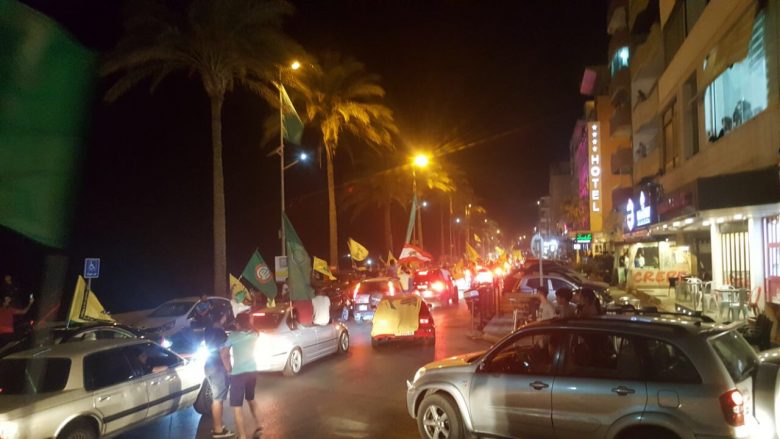
Al-Manar | May 7, 2018
Hezbollah, Amal movement and other allies secure major achievements in Lebanon parliamentary elections on Sunday, according to initial results reported by local media.
Mutual lists between Hezbollah and Amal, dubbed “Loyalty and Hope” swept in Lebanon’s two southern districts and Bekaa District 2 (Baalbeck-Hermel).
The allies secured all 18 seats in South Districts 2 and 3, while securing 8 out of ten seats in Bekaa District 2.
Elsewhere in South District 1 (Sidon-Jizzine), the list which was supported by Hezbollah and Amal gained 2 seats out of 5.
The allied lists also secured all four Shiite seats in Mount Lebanon District 3 (Baabda) and Beirut District 2.
Elsewhere in Western Bekaa, Hezbollah and allies secured 3 out of 6 seats.
Meanwhile in Zahle Hezbollah secured the Shiite seat in the Bekaist district.
In general, out of the 27 Shiite seats in the Lebanese parliament, Hezbollah and Amal secured at least 26 seats according to initial results.
Official results are to be announced by the interior ministry later on Monday.
Israel’s Murderous Strikes on Syria (via “Pacified” Lebanon)
By Andre Vltchek | New Eastern Outlook | May 1, 2018
On April 9, 2018 at least 14 people were killed during the murderous strike by the Israeli air force on the Syrian T-4 airfield at Homs.
Israeli F-15 fighter jets flew over Lebanese airspace, as they have done on many previous occasions, in total disregard of international law.
Both Israel and Lebanon are still technically at war, and the latest action could easily be considered as yet another shameless provocation. Apparently, whatever terror Western allies like Saudi Arabia and Israel decide to spread throughout the region, their actions will always go unpunished.
To add insult to injury, instead of condemning Israel, the Western mass media outlets began their predictable and embarrassing servile howling against the government in Damascus, some ‘correspondents’ even calling President al-Assad an “animal” (The Sun, 9th April, 2018).
This time, Lebanon, which in the past suffered from several brutal Israeli invasions, and where Israel is commonly referred to as ‘Palestine’, decided not to protest too loudly against the violation of its airspace. There were some statements made by individual Lebanese politicians, as well as a statement by the Lebanese Ministry of Foreign Affairs, which objected to the attack against Syria, claiming that Lebanon will file a complaint to the UNSC. Most of the statements, however, appeared only in the Arabic language. There was definitely no robust national response, as one would have expected.
Ms. Zeinab Al-Saffar, an Iraqi educator and television anchor based in Beirut, Lebanon, shared her thoughts on the subject:
It is not the first time that this is happening. Israeli forces have been violating the airspace of Lebanon, as well as the land and sea belonging to Lebanon. Violation of the territory of Lebanon [by Israel] became something ‘regular’. What happened recently is a flagrant intrusion which should not go unanswered, as they were using Lebanese air space in order to attack the Syrian land. I believe this is the right time for the U.N. to do something more than just to make the reports and write numbers. This is an extremely serious situation; to use the territory of a neighboring country in order to attack a third nation; it is a barefaced crime.
*****
Why do Lebanon’s protests not resonate louder?
There are several reasons. One: the country recently ‘secured’ an enormous package of mostly loans from the West, at a ‘Paris conference’, amounting to more than 11 billion dollars.
Two: A great percentage of the ‘elites’ of Lebanon is accustomed to taking orders from the West. The West is where their villas are, where their relatives live, and their permanent residency cards issued.
A much greater war may be nearing; both the U.S. and Europe are now attacking Syria directly. In this decisive time, the Lebanese rulers are opportunistically showing where their allegiances lie: not with the people of the devastated Middle East, but with Paris, London, Riyadh and Washington.
But back to the first point – to money. As reported by Reuters on April 6, 2018:
“The pledges include $10.2 billion in loans and $860 million in grants, France’s ambassador to Lebanon Bruno Foucher said on Twitter…”
Donors in turn want to see Lebanon commit to long-stalled reforms. In a nod to those demands, Prime Minister Saad al-Hariri pledged to reduce the deficit of the budget as a percentage of GDP by 5 percent in the coming five years.
Macron told Hariri in a news conference the aid aimed to give Lebanon a fresh start, adding that it put “an unprecedented responsibility” on authorities there to carry out reforms and preserve peace in the country.
“It is important to continue reforms in the coming months,” Macron said, adding: “We’ll be by your side.” …
French Foreign Minister Jean-Yves Le Drian told the conference: “… Lebanon needs major reforms of its economy, structural and sectoral.””
‘Structural reforms’ is a key term. This shameful package of loans which will further tie the hands of Lebanon could insure the complacency of the country: both economic and political obedience at the time when the West is ready to unleash a new wave of its military onslaught in the region.
There is hardly any transparency in Lebanon, and therefore almost no guarantee that the loans will be used to improve the standard of living of the suffering population. Corruption in Lebanon is endemic – it is institutionalized – to the point that it is often not even called ‘corruption’ anymore.
Social services are almost non-existent. Here, the contrasts are truly appalling. Ferraris and Lamborghinis, as well as outrageously expensive sailing boats, co-exist side-by-side with absolute misery and lack of social services, such as, at least periodically, garbage collection.
Hezbollah, a movement which is on the so-called terrorist list of many Western countries, is often the only reliable source of social services in the country.
The West will now demand more and more neo-liberal ‘reforms’. Almost nothing social will be built. Funds will disappear into the deep pockets of the shameless Lebanese ‘elites’ and ‘leaders’. It will be the poor, who will be expected to service the loans, as the rich in Lebanon hardly pay taxes.
In exchange for their booty, many Lebanese politicians will be further obliged to follow the Western line towards the region, including the neo-liberal and increasingly neo-colonialist policy of Washington and France (Lebanon’s former colonial master) towards Syria and the rest of the region.
******
And across the border line, the war is still raging. Washington and London fulfilled their shameful promises to perform ‘punitive actions’; to ‘chastise Syria’ for something that was clearly invented/manufactured just in order to justify an invasion, destabilization and in the end, the destruction, of this small but strong and proud nation.
A Syrian intellectual, who lives in both Beirut and Damascus, offered his analyses for this article. However, he requested not to be identified by his name, afraid of repercussions from both Lebanon and the West:
The Israeli attack comes at a time when the Syrian army is winning its fight against terrorist groups in Damascus suburbs, and it could be read as an indirect answer to these wins. It is also a dangerous move since the T4 airbase is heavily involved in the fight against the remaining of ISIS in Syria. This attack is unacceptable aggression against a sovereign nation and it is a violation of international laws. It also shows that Israel is helping directly and indirectly various terrorists groups operating on the Syrian territory.
*****
However, the commentaries that are being spread by the Western mainstream press are increasingly defying all logic. They are progressively turning out to be racist, supremacist. Well, actually now they are what they have always been earlier, throughout the centuries of European and then North American colonialism.

In Damascus, shelling a park right next to the Four Seasons Hotel, the UN accommodation from East Ghouta
Just read The Guardian article from April 9th, 2018- “Israel has launched countless strikes in Syria. What’s new is Russia’s response”:
Israel has launched many previous strikes into Syria, mainly to protect its borders from a buildup of Iranian-backed Hezbollah forces and armaments on the Golan Heights. Israel, has not, as a rule, attacked al-Qaida or Islamic State positions in Syria.
On all previous occasions, Russia – which has controlled Syrian air space since it sent troops to defend the regime of Bashar al-Assad in 2015 – has turned a blind eye. There had been an understanding that Israeli interests in Syria would be preserved by Russia, primarily by limiting the presence of Iranian-backed troops in Syria’s south-west. The Israeli fear is that access to the Syrian side of the Golan Heights allows Hezbollah to launch attacks into Israel.
At least The Guardian does not pretend that it believes in the Western fabrications that President Assad is poisoning his own people…
But the article is clearly trying to justify and find logic behind the Israeli terrorist attacks against the independent nation.
‘Poor Israel – it is worried about ‘Hezbollah forces and armaments on the Golan Heights.’

Spy-surveillance base on the hill overlooking Syria
But the Golan Heights is by international law an inseparable part of Syria. I repeat: by all international norms! Including, the United Nations Security Council UN Resolution 497. Golan Heights had been attacked, occupied and forcefully (and it looks like indefinitely) annexed by Israel, during the so-called ‘Six-Day War’ in 1981.
I visited the Golan Heights. I worked there, for several days, clandestinely, some 5 days ago. What I encountered there was true horror: ancient villages were totally destroyed, most of the original population deported from their land, Israeli-paid spies and provocateurs approaching and scrutinizing random visitors. All around – scattered rich Israeli agricultural enterprises protected by barbed wire and tall concrete walls. It all felt like working in Angola or Namibia, during the South African apartheid, or perhaps even worse; divided communities, stolen land, electric wire, and omnipresent fear and oppression.

Horrid border at Majdal al-Shams
But it is Israel which now has the right to ‘worry’ and to murder people in the name of its ‘security’. That is precisely what the tone of the Western mainstream periodicals clearly suggests.
Israel had stolen more than a thousand kilometers square of the Syrian territory in 1981, and now it is mercilessly bombing its victim; from Lebanese territory, in order to assure its ‘safety and security’. It is doing so from the territory of Lebanon, a country which was invaded by the Israeli military, on several occasions.
And the West is cheering.
*****
Of course, Israel is acting with total impunity, because it enjoys both the support and encouragement from its allies: The United States, the U.K. and Macron’s France.
Lebanon is panicking. Its’ ‘elites’ are trying to both survive, and not to anger the West.
Syrians have, it often appears, nerves of steel.
They worry but are determined not to give one single inch of their land to the invaders.
My friend in Damascus wrote to me, just a few hours before I submitted this report:
People are worried and they constantly follow up the news. My brother asked us to go to Safita for one month, as it is safer there. I’m not sure if we do it, but we are closely monitoring the situation.
My colleagues and comrades on the ground in Syria are angry, very angry. They can clearly see through the lies, which are being spread by the West.
Israel is repeatedly bombing heroic Syria.
On April 29, 2018, the Israeli attacks killed 26 Syrians and Iranians, just before Midnight, near Hama and Aleppo.
The U.S. and Europe are bombing and threatening to cause even more damage.
But this is 2018, not those dark years when the West could murder and rape without any consequences. If these attacks continue, there will be a counterpunch: fully justified, determined and powerful.
Then even the tiny Lebanon would have to decide where it stands.
• Photos by Andre Vltchek
Israeli forces kidnap Lebanese woman in Shebaa Farms
Press TV – April 29, 2018
Israeli forces have kidnapped a Lebanese woman in the Tel Aviv-occupied Lebanese territory, the Lebanese army says.
The incident happened in Lebanon’s Shebaa Farms on Saturday and the abductee was identified as Nohad Dali.
“On April 28 at 8.30 p.m., an Israeli enemy patrol carried out the abduction of Nohad Dali from the town of Shebaa and took her into occupied Palestinian territory,” said an army statement.
Lebanon has raised the seizure of Dali with the United Nations peacekeeping force, which is stationed on Lebanon’s border with the occupied territories. The Israeli military said it briefly held the Lebanese woman before releasing her.
Tel Aviv has been occupying Shebaa Farms since 1967, when it seized the territory from Lebanon during a full-scale war against Arab nations. Lebanon and Israel are technically at war as a result of the continued occupation.
Israel launched two wars on Lebanon in 2000 and 2006, in both of which the Lebanese resistance movement of Hezbollah inflicted heavy losses on the regime’s military.
In January, Lebanon’s Prime Minister Saad Hariri called Israel the greatest threat to Lebanon’s stability. “The only threat I see is Israel taking some kind of action against Lebanon, out of a miscalculation,” Hariri told an audience at the World Economic Forum in Davos, Switzerland.
Israel also takes great exception to Hezbollah’s assisting the government of Syrian President Bashar al-Assad in its battle against Takfiri terrorism and militancy.
The Israeli air force has repeatedly violated Lebanon’s airspace to strike Syria-based targets belonging to Hezbollah since the group started helping out the Syrian army.
Lebanon Rejects UN, EU Joint Statement on Displaced Syrians’ Crisis
Al-Manar | April 26, 2018
 President of the Republic, Michel Aoun, on Thursday voiced rejection of the joint statement by the United Nations and the European Union issued yesterday at the Brussels conference on the displaced Syrians’ crisis.
“The content of the joint statement by the UN and the EU contradicts the state’s sovereignty and endangers Lebanon,” President Aoun said in a statement released by the Presidency of the Republic.
Aoun rejected the content of the joint statement including phrases ‘voluntary return,’ ‘temporary return,’ ‘will to stay,’ and ‘integration in the labor market’ and other terms which contradict the Lebanese state’s sovereignty and laws.
Aoun brought to attention that Lebanon has dealt with the Syrian displacement predicament on the basis of brotherly relations and humanitarian obligation, emphasizing that the only viable solution to the crisis was the safe and dignified return of the displaced Syrians “to the possible areas inside Syria… notably that many Syrian areas have become safe.”
Aoun stressed that Lebanon adheres to a political solution in Syria and the restoration of stability in a way that preserves Syria’s unity and ends the suffering of its people.
Reports of Monday night attack on Syrian base blamed on false alarm
RT | April 17, 2018
Several sources in Syria said the overnight deployment of anti-aircraft weapons at a military base was triggered by a false alarm, not an actual missile attack, as previously claimed by some media outlets.
Syrian TV earlier reported a missile attack on Shayrat Airbase in Homs governorate, while a Lebanese media outlet with links to militant group Hezbollah said a separate attack targeted Al-Dumair base northeast of Damascus. Multiple sources now show the reports were inaccurate.
The Syrian news agency SANA cited a military source, who said anti-aircraft missiles were fired overnight after a false intrusion alarm. It was consequently established that no new attacks on Al-Dumair base happened.
A similar report came from a Reuters source in the regional pro-government military alliance. The commander, who spoke on condition of anonymity, said the false alarm was caused by an Israeli-US cyber warfare operation, but didn’t provide any proof.
Meanwhile, a Russian military source told Interfax news agency that there was no night incident at Shayrat Airbase. … Full article
Featured Video
BRITAIN’S WARNING: PREPARE FOR WAR
or go to
Aletho News Archives – Video-Images
From the Archive
How Ukraine Tortured and Slaughtered Donbass
By Kit Klarenberg | Al Mayadeen | July 11, 2024
Almost immediately after the proxy war erupted, ISIS-tier footage of the torture and murder of Russians in Ukrainian custody emerged.
On July 6th, the New York Times published an astonishing investigation: In Ukraine, Killings of Surrendering Russians Divide an American-Led Unit. The article documents in grim detail how Chosen Company, an international volunteer battalion for Kiev, routinely executes Russian prisoners of war. It is the very first mainstream admission that this practice – a brazen breach of the Geneva Conventions, and a grave war crime – is widespread among Ukraine’s fighters, both foreign and homegrown. … continue
Blog Roll
 Aletho News
- Israel Demolishes Home Of Lebanese Journalist Whose Viral Film Exposed Pager Attack
- Record Oil, Empty Tanks: The UAE’s Miracle Recovery
- Burnham tackles Britain’s poverty with aggression in Yemen
- Peace in Ukraine: the easy way – or the hard way
- Trump & the Rrrrussians
- US taxpayer money laundered back through Ukraine – Musk
- Before COVID, an NIH lab chief proposed making a SARS-like bat virus more infectious
- Gates, Bourla on Trial in Netherlands Accused of ‘Great Reset’ Scheme at Vaccine Injury Hearing
- BRITAIN’S WARNING: PREPARE FOR WAR
- “Historic Russia”: The Land Putin Will Not Give Back
- If Americans Knew
- An error has occurred; the feed is probably down. Try again later.
- No Tricks Zone
- Two New Studies Find Thwaites Glacier Melt Cannot Be Driven By Human Activity Or A Warming Ocean
- E-Cars Reduce CO2 Emissions By Only 41% Compared To Internal Combustion Engine Vehicles
- Predictions Made By Renowned Climate Professor Over Past Decades Have Been Proven To Be Poor
- New Study Suggests Large Regions Of The Pacific Ocean Have Been Cooling For The Last 80 Years
- Germany’s Green Energy Debacle: High Energy Costs Force Kahla Porzellan to Close After 182 Years!
- New Study: 50 Years Of The Most Aggressive ‘Net Zero’ Policies Can Only Affect The Global Climate By 0.03°C
- US September “Heat” Was No Record…Many Records Set Decades Ago
- Latest European Green Energy Debacle; Portugal’s Largest Flagship Solar Park Insolvent!
- Green Energy Debacle: German Expert Professor Fritz Vahrenholt Warns Of Severe Economic And Social Consequences
- Two More Paleo Reconstructions Affirm Meters-Higher Sea Levels Across Ireland, Brazil 7000-6000 Years Ago

