There is no triumphalism in the US, Britain or France over the missile strike in Syria on Friday. The mood is rather defensive. Indeed, evidence is still lacking on the alleged chemical attacks in Douma, which was the alibi for the missile strike. There are no tall claims, either, as regards the effectiveness of the missile strike in military terms.
On the contrary, Damascus is in upbeat mood. April 14 has been declared a day of celebrations. After all, the Syrian forces single-handedly faced the Western assault. The Russian reports underscore that the Syrian air defence system was highly effective. The Defence Ministry said in Moscow on Saturday that there haven’t been any Syrian casualties. Moscow attests that the Syrians shot down as many as 71 missiles out of the total 103 fired by the US, UK and France. Neither Washington nor London or Paris has so far contradicted the Russian assessment.
President Donald Trump is the solitary voice crowing about the missile attack. He tweeted bombastically:
So proud of our great Military which will soon be, after the spending of fully approved dollars, the finest that our Country has ever had. There won’t be anything, or anyone, even close!
But Trump was grandstanding in front of the domestic audience and avoided making any specific claims about the success of the strike by his “smart” missiles. In sum, this has been a theatrical show.
The military balance in Syria now comes into play. For the Syrian regime, this is baptism under fire. Only recently, the Syrians had shot down an Israeli jet. Now they have scored a 70% hit on Friday.
The Syrians are equipped with Soviet-era air defence systems developed in the 1960s. What if the Russians upgrade the systems? This is exactly what the head of Russian General Staff’s Main Operations Directorate Colonel-General Sergei Rudskoi hinted in Moscow on Saturday:
“A few years ago, taking into account a pressing request from some of our partners, we abandoned the supplies of the S-300 missile systems to Syria. Considering the latest developments, we deem it possible to get back to discussing this issue, not only in relation to Syria, but to other countries as well.”
No doubt, it will be a game changer if Russia equips the Syrian army with deterrent power to inflict unaffordable costs on potential aggressors. Iran has shown how such a strategy can work when it helped Hezbollah in Lebanon to acquire deterrence against Israel.
In fact, the Jerusalem Post newspaper has highlighted the Russian general’s remark. The paper notes that if Moscow carries out the threat, “Israel’s air superiority is at risk of being challenged in one of its most difficult arenas… And it could be just a matter of time before an Israeli pilot is killed.” The JP report adds,
Syrian air defenses are largely Soviet-era systems, comprised of SA-2s, SA-5s and SA-6s, as well as more sophisticated tactical surface-to-air missiles such as the SA-17 and SA-22 systems. The most up-to-date system that Moscow has supplied to the Syrian regime is the short range Pantsir S-1, which has shot down drones and missiles that have flown over Syria.
The advanced S-300 would be a major upgrade to Syrian air defenses and pose a threat to Israeli jets as the long-range missile defense system can track objects like aircraft and ballistic missiles over a range of 300 kilometers.
The system’s engagement radar, which can guide up to 12 missiles simultaneously, helps guide the missiles toward the target. With two missiles per target, each launcher vehicle can engage up to six targets at once.
Col.-Gen. Rudskoi chose his words carefully by hinting that Russia could also supply countries other than Syria (eg., Venezuela, North Korea, Lebanon, Iraq, etc.) The remark stems from President Vladimir Putin’s hugely significant statement on Saturday regarding US attack on Syria when he said, inter alia: “The current escalation around Syria is destructive for the entire system of international relations. History will set things right…”
Trump’s impetuosity to attack Syria is in defiance of the international system and it may open a Pandora’s box. Ironically, Israel, as “frontline state”, has the highest stakes if the unwritten understanding between the US and Russia unravels. (Moscow had collaborated with the Barack Obama administration and Israel to slow down the supply of S-300 missiles to Iran.) Equally, Turkey will have to think twice before venturing into further land grab in Syria if Damascus regains control of its air space.
The Foreign Terrorist Organization (FTO) label is a powerful tool used by the US; it is as a form of hostage-taking in a political sense, says Brian Becker, national coordinator at the Answer Coalition.
The leader of the Lebanese political party and militant group, Hezbollah, has revealed that Washington offered to remove it from the terrorism watch-list and give the group financial aid if it dropped its resistance to Israel.
“Following the 2000 victory, the Israeli enemy, along with the US, had realized that Lebanon’s real power lies within its resistance, which has managed to force the Israeli occupation out of Lebanon without any condition,” Sayyed Hassan Nasrallah said on Sunday, as cited by Iran’s Press TV. “We were offered money and to be part of the authority in Lebanon on condition that we cede resistance,” he continued, adding that it was his fault at that time that he “didn’t accept to take his paper, so that it would be a proof now.”
According to Nasrallah, the offer was made by former vice-president Dick Cheney via US-Lebanese businessman George Nader.
RT asked Brian Becker how he could comment on what – according to Nasrallah – was the US’ attempt to “bribe” Hezbollah.
“I think the report from the Lebanese resistance Hezbollah leadership is extremely instructive and revealing. The designation by the US government of an organization or a country as a foreign terrorist organization (FTO) is a form of hostage-taking in a political sense,” he said.
“When the US makes that designation, which is largely for political purposes, it puts the entity that has been designated into a terrible position: no one can do business with it, they can’t trade with it, it is persona non grata diplomatically, its leaders could be arrested and sent to the International Criminal Court in The Hague. And then the US can say ‘But, if you do what we want you to do or for some other political purpose we choose to lift this designation, then you are no longer subject to all of these economic, social and even criminal penalties.’ It is really just a weapon, it is a tool, it is an instrument, a blunt tool used by the US diplomacy. It shows that is not very diplomatic,” Becker explained.
For the US government to designate another country or organization as a foreign terrorist organization is an immensely powerful instrument, yet, it’s purely political. “It is a form of bullying on a grand scale,” Becker explained.
“It doesn’t really say anything about terrorism or about the people who are sanctioned under the FTO label,” Becker told RT. “The label doesn’t really correspond or correlate to reality, it is purely a political exercise.”
Often entities that have been designated as foreign terrorist organizations by the US are “the governments that seek to be independent from the US or have challenged US hegemony in their area or in their country,” the analyst said. At the same time, he noted, some of the terrorist organizations like the MEK (Mujahedin-e Khalq Organization), “in the case of Iraq, as long as they are fighting Iran, then the US says ‘It is ok, they are fighting our enemies.”
“So, even though they have an FTO label, it is not really applied. They have a sort of immunity from application. It is completely discreet or discretionary on the part of the US powerful government about how it should be used and who it should be used against,” Becker said.
Two Israeli F-15 fighters targeted Syria’s T-4 airbase in Homs province, the Russian Defense Ministry said on Monday. The jets fired eight guided missiles, but five of them were shot down before they hit the airfield.
In a statement on Monday, the Russian military said: “Two Israeli Air Force F-15 jets fired eight guided missiles at the T-4 airfield.” The Israeli aircraft did not enter Syrian airspace and launched the strikes while flying over Lebanon.
“Syrian air defense units have shot down five guided missiles,” the military said, but confirmed that three of the missiles “reached the western part of the airfield.”
Lebanese Armed Forces have also confirmed that Israeli fighter jets and a reconnaissance plane violated the country’s borders and remained in Lebanon’s airspace for about ten minutes. Israel’s aircraft were flying over Lebanon’s northern areas as well as over the sea, it said.
As a result of the strike, there were several “martyrs [killed] and wounded” among Syrian soldiers, SANA news agency reported, without specifying the number of casualties.
Three Iranian troops were killed in the Israeli airstrike on Sunday night, state news agency FARSreported later on Monday. The “Zionist attack in Homs” took the lives of Seyyed Ammar Moussavi, Mehdi Lotfi Niasar and Akbar Zavar Jannati, it said, publishing photographs of the soldiers.
The Israeli embassy in Moscow refused to comment on the Russian Defense Ministry’s report, Alex Gandler, the diplomatic mission’s press attache, told Sputnik. Asked about the Russian military’s statement, an Israeli Defense Forces (IDF) spokesman said he had no immediate comment, the Jerusalem Postreported.
Citing its own correspondent, Lebanon’s Al-Mayadeen channel said earlier on Monday that an Israeli reconnaissance aircraft was airborne during the attack on the Syrian base. The missiles crossed Lebanese airspace over Keserwan and Bekaa, heading towards Syria, according to the broadcaster.
The missile attack took place on Sunday night in Syria’s Homs governorate. State news agency SANA reported there were several “martyrs and wounded,” but did not disclose the exact number of casualties. The report also said that the US was “probably” behind the attack, although Washington denied any complicity in the strike.
“At this time, the Department of Defense is not conducting airstrikes in Syria,” the Pentagon told Reuters in a statement. “However, we continue to closely watch the situation and support the ongoing diplomatic efforts to hold those who use chemical weapons, in Syria and otherwise, accountable.”
France, which was also suspected of being involved in the attack, denied any responsibility for the military strike, AFP reported on Monday.
The strike on the T-4 base came shortly after Western powers accused the Syrian government of orchestrating an alleged chlorine attack in the militant-held town of Douma. The chemical incident was reported by the White Helmets, a controversial group repeatedly accused of having ties to terrorists.
Commenting on the unconfirmed gas attack, US President Donald Trump denounced the “mindless” atrocity, which he described as a “humanitarian disaster for no reason whatsoever.” He also accused Russia and Iran of bearing responsibility for the incident, due to their support for Syrian President Bashar Assad.
Washington and Paris have already held telephone talks, during which Trump and his French counterpart Emmanuel Macron decided to oppose Russia at the upcoming United Nations Security Council meeting, which is being convened to discuss the Douma incident. President Macron previously signaled that Paris might consider unilateral actions, including a military strike, if chemical weapons were ever used in Syria again.
The Russian Foreign Ministry denounced allegations regarding the chemical attack, calling them a “continuous series of fake news” and “baseless speculation.” It noted that Moscow had already warned about a false-flag chemical attack being prepared in recent months. Damascus also rejected the accusations, with the Syrian Foreign Ministry pointing out that similar allegations emerge every time the Syrian Army makes advances in its fight against terrorists.
Facebook on Wednesday blocked Hezbollah’s electoral page for the second time within 24 hours.
“Facebook administration has blocked our page for the second time within 24 hours,” ‘Nahmi Wa Nabni’ (We Defend, Establish), the official name of Hezbollah’s campaign on social media said in a statement.
‘Nahmi Wa Nabni’ is tasked with displaying some of Hezbollah’s achievements ahead of the parliamentary elections on May 6, 2018.
Earlier on Tuesday, Facebook blocked the first page established by ‘Nahmi Wa Nabni’. The newly-created page was rapidly re-followed by resistance supporters. But it seems that the high following records of a pro-resistance page did not please the Facebook administration.
In its Wednesday statement, ‘Nahmi Wa Nabni’ vowed to go ahead with its electoral campaign on social media, especially on Facebook platform.
A senior official of the Lebanese Hezbollah resistance movement has accused Saudi officials of interfering in Lebanon’s domestic affairs and pitting people from various walks of life against each other.
“Saudi Arabia’s latest interference in Lebanon’s internal affairs is embodied in meddling in the country’s upcoming parliamentary elections. Saudi interventions are pitting the Lebanese against each other, and creating divisions and political tensions among them,” Deputy Chairman of Hezbollah’s Executive Council Sheikh Nabil Qaouq said on Saturday.
He added, “Saudi Arabia wishes to change Lebanon’s political equations through interfering in the elections, collecting information about composition of future electoral lists and supporting candidates that could challenge Hezbollah.”
Commenting on the ongoing military drills between the US and Israeli armies in the southern areas of occupied Palestinian territories, the senior Hezbollah official pointed out that “the maneuver officially documents Israel’s recognition of the fact that Hezbollah can reach the depth of Israel, and that Israel has no ability to confront the resistance movement’ rockets.”
He stressed that Hezbollah is now the main obstacle to Israel’s expansionist policies in the Middle East region.
On October 30 last year, Saudi Minister of State for Persian Gulf Affairs Thamer al-Sabhan issued threats against Lebanon’s government as well as Iran and Hezbollah via Twitter, stating that the movement needed to be “toppled” in Lebanon.
The Saudi minister also warned in an interview with Lebanese MTV television station that there would be “astonishing” developments to “oust” Hezbollah.
He also said that Saudi Arabia would deal with Lebanon’s government as a hostile administration because of Hezbollah’s power-sharing role in it.
On November 4, 2017, Lebanese Prime Minister Saad Hariri announced his resignation in a televised statement from Saudi Arabia, citing many reasons, including the security situation in Lebanon, for his sudden decision. He also said that he sensed a plot being hatched against his life.
He returned to Beirut on November 21. All political factions in Lebanon had called on him to return back home.
Top Lebanese officials and senior politicians close to Hariri had earlier said that he had been forced to resign, and that Saudi authorities were holding him captive.
Lebanese President Michel Aoun had also refused to accept Hariri’s resignation.
Operation Juniper Cobra is not a routine exercise; it is a portent of a potentially devastating war against Syria, Hezbollah and Gaza for which Israel is actively preparing — a war likely to erupt within the coming months.
Last Sunday, the largest joint military exercise between the United States and Israel began with little fanfare. The war game, dubbed “Operation Juniper Cobra,” has been a regular occurrence for years, though it has consistently grown in size and scope. Now, however, this year’s 12-day exercise brings a portent of conflict unlike those of its predecessors.
Previous reports on the operation suggested that, like prior incarnations of the same exercise, the focus would be on improving Israeli defenses. “Juniper Cobra 2018 is another step in improving the readiness of the IDF [Israeli Defense Forces] and the IAF [Israeli Air Force] in particular to enhance their operational capabilities in facing the threat posed by high-trajectory missiles,” Brig. Gen. Zvika Haimovitch, the IDF’s Aerial Defense Division head, told the Jerusalem Post.
However, this year’s “Juniper Cobra” is unique for several reasons. The Post reported on Thursday that the drill, set to end on March 15, was not only the largest joint U.S.-Israeli air defense exercise to ever happen but it was also simulating a battle “on three fronts.” In other words, Israel and the U.S. are jointly simulating a war with Lebanon, Syria, and Palestine – namely, the Gaza strip – simultaneously.
What makes this last part so concerning are Israel’s recent statements and other preparations for war with all three nations, making “Juniper Cobra” anything but a “routine” drill. It is instead yet another preparation for a massive regional conflict, suggesting that such a conflict could be only a matter of months away.
As MintPress recently reported, Israeli officials recently told a bipartisan pair of U.S. Senators that it needed “ammunition, ammunition, ammunition” for a war against Hezbollah in Lebanon — a war that will expressly target Lebanese civilians and civilian infrastructure, such as hospitals, schools, and apartment buildings. The alleged motive for the invasion is the presence of Iranian rocket factories. However, this allegation is based solely on the claims of an anonymous deputy serving in the Iranian Revolutionary Guard and was first reported on by a Kuwaiti newspaper known to publish stories planted by the Israeli government.
In addition, Israel has been laying the groundwork for an invasion of Syria since last year and is largely responsible for the current conflict in Syria that has raged on for seven years. Israel’s current push to invade Syria is also based on flimsy evidence suggesting that Iran is establishing bases in Syria to target Israel.
Israel has also been preparing for a conflict on the embattled Gaza strip, which – owing to the effects of Israel’s illegal blockade and the devastation wrought by past wars – is set to be entirely uninhabitable by 2020. Reports have quoted officials of the Palestinian resistance group Hamas, which governs the Gaza strip, as saying that they place the chances of a new war with Israel in 2018 “at 95 percent” and that war games, like Operation Juniper Cobra, were likely to be used to plan or even initiate such a conflict. This concern was echoed by IDF Chief of Staff Gadi Eizenkot, who stated that another Israeli invasion of Gaza, home to 1.8 million people, was “likely” to occur this year. Eizenkot ironically framed the imminent invasion as a way to “prevent a humanitarian collapse” in Gaza.
U.S. lights match, prepares troops
Such a war is likely to be ignited by the unrest destined to follow the U.S.’ imminent move of its embassy from Tel Aviv to Jerusalem. The move, set to take place in May, led Hamas to call for a third intifada, or uprising, in response to the U.S.’ unilateral decision to recognize Jerusalem as the capital of Israel in defiance of the international consensus.
Beyond the fact that Israel is preparing to go to war with several countries simultaneously is the fact that U.S. ground troops are now “prepared to die for the Jewish state,” according to U.S. Third Air Force Commander Lt. Gen. Richard Clark. “We are ready to commit to the defense of Israel and anytime we get involved in a kinetic fight there is always the risk that there will be casualties. But we accept that, as in every conflict we train for and enter, there is always that possibility,” Clark told the Post.
However, more troubling than the fact that U.S. troops stand ready to die at Israel’s behest was Clark’s assertion that Haimovitch would “probably” have the last word as to whether U.S. forces would join the IDF during war time. In other words, the IDF will decide whether or not U.S. troops become embroiled in the regional war for which Israel is preparing, not the United States. Indeed, Haimovitch buoyed Clark’s words, stating that: “I am sure once the order comes we will find here U.S. troops on the ground to be part of our deployment and team to defend the state of Israel.”
Operation Juniper Cobra is not a routine exercise; it is a portent of a potentially devastating war for which Israel is actively preparing, a war likely to erupt within the coming months. In addition to overtly targeting civilians, these preparations for war — as Juniper Cobra shows — directly involve the United States military and give the war-bent Israeli government the power to decide whether or not American troops will be involved and to what extent. This is a devastating giveaway of national sovereignty by U.S. President Donald Trump.
While the potential involvement of the U.S. forces in such a war is being framed as limited in scope, there is no indication that such a war will be so in practice. Indeed, the U.S. is currently occupying 25 percent of Syria and the Trump administration has economically attacked Palestinians living in Gaza by withdrawing crucial aid, as well as Hezbollah by enforcing new sanctions against the group. Furthermore, Israel’s nuclear arsenal and the fact that Iran — and even Russia — could become involved in such a conflict means that it could quickly spiral out of control.
Whitney Webb is a staff writer for MintPress News who has written for several news organizations in both English and Spanish; her stories have been featured on ZeroHedge, the Anti-Media, and 21st Century Wire among others. She currently lives in Southern Chile.
The American Israel Public Affairs Committee (AIPAC) is back in Washington for its annual summit. Or at least it used to be called a summit but now it is referred to as a policy conference, which is perhaps a bit of very welcome transparency as if there is one thing that AIPAC is good at it is using its $100 million budget and 300 employees to harass lawmakers on Capitol Hill and generate policy for the United States to adhere to. Eighteen thousand supporters have gathered at the city’s Convention Center to hear speeches by U.N. Ambassador Nikki Haley, Ambassador to Israel David Friedman, Vice President Mike Pence, plus Senators Marco Rubio, Robert Menendez, Tom Cotton and Ben Cardin. My personal favorite is Maryland Congressman and House Minority Whip Steny Hoyer who has visited Israel so many times he might as well move there and who can be relied on to deliver a loud sucking noise as he enthuses over the many wonders of the Jewish state. And for a little foreign flair there is the disheveled French “philosopher” Bernard-Henri Levy, who has described the brutal Israeli Army of occupation as the “most moral in the world.”
If you want to get some idea of the money and political power represented at AIPAC this year I would recommend going through the speakers’ list, a dazzling display of precisely why the United States is in bondage to Israel and its interests. The heavyweight speakers and other attendees will be joined by hundreds more Congressmen, Supreme Court Justices, and senior government officials as well as a heavy dose of “experts” from the usual Jewish-dominated pro-Israel think tanks that have sprouted up like mushrooms along K Street, including luminaries like John Bolton, Victoria Nuland, Bill Kristol, Elliot Abrams and Eric Cantor. Those participants coming from the government will, of course, be ignoring their oaths of office in which they swore to uphold the Constitution of the United States against “all enemies domestic and foreign,” but it doesn’t matter as everyone performs proskynesis for Israel.
The slogan of this year’s gather is “Choose to Lead,” an interesting objective for an organization that has led successive presidents since Bill Clinton by their respective noses. Prime Minister Benjamin Netanyahu, facing indictment back home, will also be in town and will meet with President Donald Trump. He might just decide to stay awhile as one thing that Israel is particularly good at is trying, convicting and imprisoning its corrupt leaders.
There has been some informed speculation that Trump will unveil during their meeting a “two state solution” peace plan for Israel-Palestine, but as it will possibly require Israel to withdraw from much of the large chunks of the West Bank that it has “settled,” it will not be received favorably by Netanyahu. Israel is certainly vulnerable to possible pressure coming from the White House to impose a solution, but as Trump has proven unable or unwilling to punish an out-of-control Netanyahu in any way up until this point, it has to be considered unlikely that he will change course this time around.
AIPAC must be particularly pleased since Israel has had a sweet ride with the Trump Administration in place in Washington. The greatest gift to Netanyahu has been the Administration’s recognition of all of Jerusalem as Israel’s capital together with a commitment to move the U.S. Embassy to that city. No other country currently has its embassy in an internationally disputed Jerusalem though Guatemala has followed Washington’s lead and has stated that it also intends to physically move its diplomatic facility.
The original State Department relocation plan was to phase the embassy move while a new building is being constructed, but the White House recently accelerated the process, reportedly under pressure from Jewish billionaire GOP donor Sheldon Adelson, and will open a temporary facility in May to coincide with the 70th anniversary of Israel’s founding. Netanyahu has asked Trump to appear at the embassy opening ceremony and also to assist in the celebration of the founding.
Israel has also benefited from a Trump Middle East team that is all Jewish and committed to Israel. It is headed by his son-in-law Jared Kushner and includes former bankruptcy attorney Ambassador David Friedman, who has financially supported Israel’s illegal settlements, and Jason Greenblatt, the Trump Organization corporate lawyer, as Special Representative for International Negotiations. In addition, Kushner is reportedly personally advised by a group of Orthodox Jews that he knows from his Synagogue and through his business interests.
The outcome deriving from the all-Jewish team determining Middle Eastern policy combined with a benign White House is predictable, and it just as clearly does not include any benefits for the United States. Israel has been able to dramatically expand its settlements on stolen Palestinian land and is instigating several new wars in its region without any pushback coming from Washington. Quite the contrary as the United States has proven to be an enabler for new conflicts with Syria, Lebanon and Iran. Several Senators who have recently returned from Israel claim that an invasion of Lebanon is coming because of allegations that Hezbollah is constructing an Iranian-supplied factory to build sophisticated missiles, yet another phony narrative depicting Israel as the perpetual victim of its brutal and threatening neighbors when in reality the reverse is true. This animosity towards Iran and its allies is particularly dangerous as it could produce a new war that might spin dangerously out of control as third countries like Russia and China get involved to protect their own interests.
The reality is that it is a militarily dominant Israel that has been regularly bombing targets alleged to be Iranian or Hezbollah in Syria as well as Syrian military installations. It has threatened to bomb Lebanon back into the “stone age,” which leads one to ask what have those nations done to provoke the wrath of Zion? Close to nothing. An alleged Iranian drone reportedly launched from Syria wandered into the airspace over the Israeli-occupied Golan Heights before being shot down. How many Israeli drones have flown over Lebanon and Syria? Hundreds if not thousands.
And when Israeli planes flew deep into Syria to bomb what was claimed to be the base that the drone flew from, one was shot down by a Syrian air defense missile. Israel then launched a major bombing campaign against Syrian military targets and was only dissuaded from doing far, far worse by Vladimir Putin, who warned Netanyahu against broadening the conflict. Note that it was Russia that made Bibi back down, not Washington. The United States was meanwhile busy in trying to justify its continued presence in Syria, also at the urging of Israel and AIPAC.
Every American president has to bow before Jewish power in the United State and you better believe that both AIPAC and the hundreds of other Jewish and Christian-Zionist organizations that exist at least in part to nurture and protect Israel know it. Even Barack Obama, who had an openly frosty relationship with Netanyahu knew the score and gave the Jewish state $38 billion. He opposed Israel’s expansion into the formerly Palestinian West Bank but never did one thing to stop it until the end of his final term in office when he had the U.S. abstain on a U.N. vote condemning the illegal settlements, a pointless gesture.
Demands that AIPAC, an echo chamber for Israeli interests, should be required to register under the Foreign Agents Registration Act of 1938 have been ignored by various Attorneys General since the time of John F. Kennedy, who tried to get AIPAC’s predecessor organization the American Zionist Council to comply. He was killed soon after, though I am not necessarily trying to imply anything even though Jack Ruby does come to mind.
Here at home “The Lobby” has also been successful in 2017, with 23 states having now passed laws making it illegal to boycott Israel if one wishes to have dealings with the local or state government. Three months ago, the Anti-Semitism Awareness Act was approved by the House of Representatives with 402 affirmative votes and only two libertarian-leaning congressmen voting “no.” The Israel Anti-Boycott Act that is also currently making its way through a Senate committee would set a new standard for deference to Israeli interests on the part of the national government. It would criminalize any U.S. citizen “engaged in interstate or foreign commerce” who supports a boycott of Israel or who even goes about “requesting the furnishing of information” regarding it, with penalties enforced through amendments of two existing laws, the Export Administration Act of 1979 and the Export-Import Act of 1945, that include potential fines of between $250,000 and $1 million and up to 20 years in prison. According to the Jewish Telegraph Agency, the Senate bill was drafted with the assistance of AIPAC.
And there’s lots more to come in 2018. Lindsey Graham and Chris Coons were two of the senators who have just returned from the taxpayer funded “fact finding” trip to Israel and warned about a new war breaking out. And beyond that, what other “fact” did they find? Apparently that Israel needs more money from the U.S. taxpayer. Here is what was reported:
“… they considered the provision of $38 billion over 10 years, ‘a floor.’ Graham [also] said during a meeting with reporters that he thought provisions in the agreement phasing out an arrangement in which Israel could spend U.S. funds on its own defense industry and the provision of just $500 million in missile defense funding were ‘short-sighted.’ Coons said tensions in the broader region supported the idea of more funding for Israel, citing the ongoing war in Syria and Iran’s recent use of a stealth drone.”
So, we can look forward to Congress voting another half billion or so for Israel and the money can be spent on building up Israel’s own defense industry, which competes with that of the U.S. Currently most of the largess has to be spent on U.S.-made weapons, but clearly that will be changed to benefit Israel. You can always count on Congress pretending to do the right thing by the American people and it is good to know that the folks at AIPAC, gathered in their thousands this week and including both Senators Graham and Coons, are smiling.
A Lebanese man studying nuclear physics was found dead earlier this week in France, while reports on his death were conflicting.
It was initially reported that Hisham Salim Mourad- from the southern town of Braikeh in Nabatieh, was stabbed in his house.
However, Lebanon’s consul general in Marseille, Sonia Abou Azar, said the Grenoble police published its report on the death of Mourad and determined that he died after falling from the balcony of his house.
Mourad was studying at the Joseph Fourier University in the city of Grenoble. It was the last year of his master’s program.
The death sparked outrage among Lebanese people in Lebanon and abroad who were also shocked last week by the killing of another Lebanese student in Canada.
Hasan Ali Kheireddine, 23, was killed on Feb. 13 at a student residence on the St. Mary’s University campus in the Canadian region of Halifax.
The Lebanese Foreign Ministry announced earlier on Sunday that instructed the Lebanese embassy in Canada to “follow up on the case in order to unveil the details of this horrible crime and the motives behind it.”
Although Canadian authorities have been downplaying the murder of Kheireddine, it is seen by many in Lebanon as suspicious, especially that the bright student was studying economics and had been well-known for his research on the influence of Zionism on the international economy.
“Iran brazenly violated Israel’s sovereignty,” stated Netanyahu on 10 February. “They dispatched an Iranian drone from Syrian territory into Israel.”
In response to this alleged reconnaissance drone, which the Israeli military characterized as a “serious Iranian attack on Israeli territory,” Israel promptly bombed twelve Syrian and Iranian targets in Syria.
A vagueness persists about the alleged drone. Iran stated the claim was “baseless” and “ridiculous.” The US called the drone “provocative.” Israel noted that it waited for the drone to enter its territory and “chose where to bring it down,” just ninety seconds later. Some sources indicate it was over Beit Shean, some say over the Golan. While the drone caused no damage, Israeli airstrikes killed six people.
At the Munich Security Conference a week later, Netanyahu underscored his indignation: “[Iran’s] brazenness reached new heights, literally new heights. It sent a drone into Israeli territory, violating Israel’s sovereignty, threatening our security. We destroyed that drone and the control center that operated it from Syria.” He then portrayed Israel as the innocent victim under threat, characterising the alleged drone as an “act of aggression.”
Talk about brazen.
Let us recall that in August 2014 it was Israel’s drone that was shot down in Iranian territory. While Israeli media reported that the “device looks like a kind of UAV used by the Israeli military,” all sources agree with Reuters’observation: “Israel has always declined comment on such accusations.” Did the Netanyahu-labelled “tyrants of Tehran” respond as Israel has just done? Did Iran retaliate by sending fighter jets into Israel? Absolutely not. Instead, Iran did what it was meant to do as a cooperative member of the international community. It verbally condemned the affront; it reported it to the IAEA (INFCIRC/867) and to the UN Security Council (S/2014/641). The IAEA merely circulated the complaint to member states, and the world ignored the brazenness of Israel.
Let us recall that in August 2011 it was a US drone that was shot down in Iranian territory. Somehow this was not “provocative,” but was rather, as then-current and former officials said, “part of an increasingly aggressive intelligence collection program aimed at Iran,” encouraged by “public debate in Israel.” This 2011 drone is even flaunted in current Israeli media, noting the US “initially denied the incident but eventually acknowledged the loss.” A bit brazen, wouldn’t you say?
Let us recall Israel’s unconscionable use of air power, including drones, over Occupied Palestine. Seen as “near continual surveillance and intermittent death raining down from the sky,” its decades-long aerial persecution of the Palestinians epitomises brazenness.
Lastly, let us recall Lebanon. Since the 1960s, Israel has routinely occupied Lebanese skies. This flagrant defiance of international law is a matter of record. Lebanon has issued numerous formal complaints with the UN—to no avail. Lebanese skies are violated virtually daily by a combination of helicopters, reconnaissance aircraft, and two, four or eight Israeli warplanes. They fly through all regions of Lebanon, including over UNIFIL territory, over Beirut, and over the Ba‘abda Presidential Palace. The Israeli overflights might just spy, or they might create sonic booms, or they might fire flares, or they might fly round-the-clock shifts so that there are always one or two Israeli aircraft in the skies of Lebanon. Or they might fly through Lebanese airspace to bomb Syria.
“Israel continued to violate Lebanese airspace on a daily basis, in violation of resolution 1701 (2006) and Lebanese sovereignty. From 1 July to 30 October [2017], UNIFIL recorded 758 air violations, totalling 3,188 overflight hours, an increase of 80 per cent compared with the same period in 2016.”
This was, of course, despite the Security Council’s previously reiterated call for “Israel to cease immediately its overflights of Lebanese airspace.” But, then again, that call has been reiterated by the UN for decades. Extraordinary brazenness.
It has been argued that Israel should not be bound by Resolution 1701 because Hezbollah has remained armed. Such an argument is simply making excuses for Israel’s belligerent conduct. It should be noted that:
UN Resolutions do not subscribe to the all-or-none approach; they specify obligations to each party separately.
Israeli overflights in Lebanese airspace are in direct violation of the 1949 Armistice, which forbids Israel to “enter into or pass through the air space” of Lebanon, clarifying specifically “for any purpose whatsoever.”
Prior to the formation of the Hezbollah Resistance there were already 28 Security Council Resolutions condemning Israel’s aggressions against Lebanon. Since at least 1972—a decade before Hezbollah—UNSC Resolution 316 called on Israel specifically “to desist forthwith from any violation of the sovereignty and territorial integrity of Lebanon.”
Resolution 1701 states that prohibitions on weaponry “shall not apply to arms, related material, training or assistance authorized by the Government of Lebanon or by UNIFIL.” This authorization is indeed expressed, as is custom, in the 2016 Ministerial Statement of the Government, which emphasises the right of Lebanese citizens to resist the Israeli occupation and to respond to its aggression. As President Aoun, a former Army General, explained: “Hizbullah’s arms do not contradict with the State and are an essential component of the means to defend Lebanon.”
With 552 violations of Lebanese airspace in 2016, Israel has exhibited extreme brazenness. With 805 violations in the ten months of 2017 that have been officially reported, Israel has surely forfeited the right to stand in judgement. Fifty years of consistent air violations in Lebanon and Palestine. And Netanyahu calls Iran “brazen” for ninety seconds?
Brenda Heard is the founder of Friends of Lebanon UK. She is the author of Hezbollah: An Outsider’s Inside View (2015). She can be reached at brenda.heard@friendsoflebanon.org.
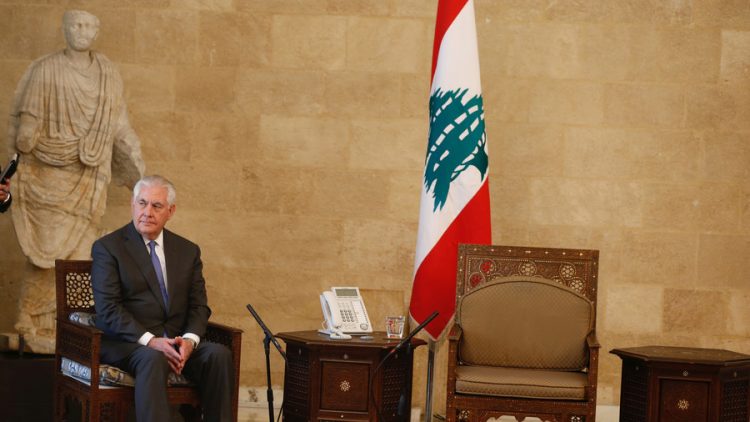
Rex Tillerson’s visit to Beirut didn’t resolve Lebanon’s persistent war threat from Israel, or Hezbollah’s perceived threat to Washington. The US has its own agenda for this country, which is spooking Lebanon’s president.
It might have been just a miscalculation, rather than a diplomatic faux pas, as Rex Tillerson did in fact arrive early for his meeting with Lebanese dignitaries, but he had to wait a few minutes before a door at Baabda Palace was opened and he was greeted by President Michel Aoun. It couldn’t have been an easy moment, shaking hands with Lebanon’s Hezbollah-supporting President, but Aoun and Foreign Minister Gebran Bassil both viewed the visit by Trump’s own envoy with some suspicion. And they were right to.
The day before, in Jordan, Tillerson appeared to have gone off message while recognizing Hezbollah’s political role both in Lebanon and the region, but few in Lebanon held out any real hope that the 65-year-old Texan was going to either resolve Lebanon’s gas and oil dispute with Israel, or for that matter its border spat, following Israel’s land grabbing as it carries out construction of a wall. Tillerson said that Lebanon’s own security was compromised by Hezbollah, which he referred to more than once as a “terrorist” organization when he met Lebanese Prime Minister Saad Hariri. The latter pointed out that Israel’s constant threats of attack and encroaching on Lebanon’s sovereignty were making a permanent ceasefire hard; earlier, Aoun had asked the US to “play an effective role” in resolving the tension.
But both Aoun and Hariri know that the US has plans for Hezbollah of its own, which will make a mockery of Tillerson’s endearing comments about wanting to help Lebanon “prosper.” There are two critical plans by Washington that are likely to cause chaos in Lebanon if enacted upon that may come into play at the backdrop of the US pouring money into supporting Lebanon’s army, which it believes is the key to redressing the power balance in Lebanon between the state and Hezbollah.
Lebanese banks cleaned up their act for Congress
One, is how far the US goes in targeting Hezbollah’s finances. In January, it ratcheted up its sanctions on the Shiite group’s key money people. This recent move follows Obama’s ‘Hezbollah International Financing Prevention Act,’ which was expected to both destabilize the Lebanese banking sector and impact Hezbollah, which the US accuses of using Lebanese banks to launder money.
In fact, it did neither – and now the US is eager to find new ways of blocking the flow of Hezbollah’s money both inside and outside of Lebanon, as it has yet to find a way of preventing Iran’s $800 million dollars from circulating in the banking system. The US money laundering crackdown, aimed at Hezbollah and Shias in general, has actually resulted in Lebanese banks cleaning up their act, with some analysts even going as far to say that Hezbollah knows it can no longer even use the banks. And, given that the US has provided $1.5 billion USD to Lebanon since the beginning of the Syrian conflict (through the banking system), and Lebanese expatriates are sending less money back to make up the $8 billion USD annually that the central bank receives, Lebanon is more committed than ever to working with the US.
But now, with reports in January that Iran’s military budget is about to rise, Washington may be planning another ruse which could destabilize Lebanon and direct anger towards Hezbollah. While Aoun asked Tillerson to assist in the return of almost a million Syrian refugees, he also hinted that he knows Washington is always the ultimate threat to Hezbollah’s led government, which is to cut aid to both Syrian refugees and the Palestinians. Such a move could have seismic implications in Lebanon, as an ‘intifada’ against Israel and the West could easily be carried out in Lebanon itself with 175,000 Palestinians who live in camps that Lebanese security forces fear to enter.
The carrot and stick of Washington – increase military spending to Lebanon’s army, while at the same time causing widespread insecurity – seems like a nefarious tactic. But Washington is facing tough challenges when it comes to reigning in Hezbollah. Aoun wants help with repatriating Syrians and the US wants Hezbollah to reduce its regional intervention. Is there a deal there to be made?
Aoun knows that if the US cuts aid to Lebanon, it would be a catastrophe in terms of (local) crime rates, not to mention many turning to terrorism. The situation in the Palestinian camps is at breaking point and there have been a number of ugly incidents in recent months. Lebanon has a lot to lose as the terrorism in Tripoli, which was dealt with in 2014 with the number of key arrests, might return, as hardcore extremist groups already exist in the Palestinian camps. Or, if Palestinians want to fight Israel, they have Fatah and Hamas inside Lebanon who can organize and train them. This is Aoun’s worry about the US cutting aid to UNRWA, which he says so far only affects Palestinians in Gaza.
It’s a similar situation in the Syrian refugee camps, where this year has been dire, as a funding shortfall was the biggest yet. Most years, the UN falls short of its requests from member states, but this year it was at an unprecedented low, so refugees, in general, are suffering like never before. If a Palestinian-led insurgency got off the ground in Lebanon, many from Syrian camps might join it, as there was evidence in recent years that some from the camps have joined ISIS.
But Tillerson is not the deal maker for this. He is not respected by all the main players, so the Lebanese leaders know he is not the one to cut a deal. But, they also know that, even within Lebanon, Washington’s carrot-and-stick game is idiotic at best and dangerously ill-conceived at worst. The more the Americans interfere, the stronger Iran and Hezbollah get. Washington’s meddling in the Syria war has allowed the fatuous Tillerson and others to whine about Iran’s presence in Syria, rather like an old man complaining about how ungrateful the younger generation is these days. And Aoun and the political elite in Lebanon know only too well that, just as it was in Iran and Hezbollah, in Syria, which wiped out most of the Sunni extremist groups there, the same is the case along Lebanon’s border with Syria. Tillerson mentioning Hezbollah as a stoic political entity is what is important about this trip, as it is a coded message that the Americans are ready to talk, which is a milestone in itself. The US program to destabilize Hezbollah and the Lebanese banking system has simply backfired, as Congress under-estimated the resilience of the Lebanese and its formidable central bank governor. It seems Tillerson is going to have to get used to waiting.
“Israel is climbing up a high horse,” Alex Fishman (the veteran Israeli Defence Correspondent) wrote in the Hebrew daily, Yedioth Ahronoth, last month, “and is approaching with giant steps a ‘war of choice’: Without mincing words, it’s an initiated war in Lebanon.” In Fishman’s article, he notes: “Classical deterrence is when you threaten an enemy not to harm you in your territory, but here, Israel demands that the enemy refrain from doing something in its own territory, otherwise Israel will harm it. From a historical perspective and from the perspective of international legitimacy, the chances of this threat being accepted as valid, leading to the cessation of enemy activities in its own territory, are slim.”
Ben Caspit also wrote about a fair prospect of a “war of choice,” whilst a Haaretzeditorial – explains Professor Idan Landau in an Israeli news blog – noted: “The Israeli government therefore owes Israeli citizens a precise, pertinent and persuasive explanation as to why a missile factory in Lebanon has changed the strategic balance to the extent that it requires going to war. It must present assessments to the Israeli public as to the expected number of casualties, damage to civilian infrastructure and the economic cost of going to war, as compared with the danger that construction of the missile factory constitutes.”
We live dangerous times in the Middle East today – both in the immediate present, and in the mid-term, too.
Last week saw the first ‘game changer’ that almost plunged the region into war: the downing of one of Israel’s most sophisticated aircraft – an F16i. But as Amos Harel notes, on this occasion: “Russian President Vladimir Putin put an end to the confrontation between Israel and Iran in Syria – and both sides accepted his decision … On Saturday afternoon, after the second wave of bombardments … senior Israeli officials were still taking a militant line, and it seemed as if Jerusalem was considering further military action. Discussion of that ended not long after a phone call between Putin and Prime Minister Benjamin Netanyahu” (emphasis added).
And that last statement represented the second ‘game changer’: In ‘good old days’, as Martin Indyk called it, it would have been to the US that Israel reflexively would have turned, but not this time. Israel asked President Putin to mediate. It seems that Israel believes that Mr Putin is now the ‘indispensable power’. And in terms of airspace in the north, he is. As Ronen Bergman wrote in the New York Times: “Israel will no longer be able to act in Syria without limitations”; and secondly, “if anyone was not yet aware of it, Russia is the dominant power in the region”.
So, what is all this about? Well for a start, it is not about a drone which may (or may not) have trespassed into what Israel calls Israel, or what Syria sees as ‘occupied Golan’. Let us ignore all that: or, think of it as ‘the butterfly wing effect’ in chaos theory, whose tiny wing changes ‘the world’, if you prefer. Ultimately however, these various warnings of impending war, precipitated out from the Syrian State’s success in defeating the jihadi insurgency mounted against it. This outcome has changed the regional balance of power – and we are witnessing states reacting to that strategic defeat.
Israel, having backed the losing side, wants to limit its losses. It fears the changes taking place across the northern tier of the region: Prime Minister Netanyahu has several times sought guarantees from President Putin that Iran and Hizbullah should not be allowed to gain any strategic advantage from Syria’s victory that might be to Israel’s disadvantage. But Putin, it seems clear, gave no guarantees. He told Netanyahu that whilst he recognised, and acknowledged Israel’s security interests, Russia had its interests, too – and also underlined that Iran was a “strategic partner” of Russia.
In practice, there is no effective Iranian or Hizbullah presence in any proximate vicinity to Israel (and indeed both Iran and Hizbullah have substantially pared their forces in Syria as a whole). But, it seems that Netanyahu wanted more: And to put leverage on Russia to guarantee a future Syria, free from any ‘Shi’a presence, Israel has been bombing Syria on almost a weekly basis, and issuing a series of war-like threats against Lebanon (on the pretext that Iran was constructing ‘sophisticated missile’ factories there), saying, in effect to President Putin, that if you do not give ironclad guarantees vis-à-vis a Syria free of Iran and Hizbullah, we will disrupt both countries.
Well, what happened is that Israel lost an F16: unexpectedly shot down by the Syrian air defences. The message is this: ‘Stability in Syria and Lebanon is a Russian interest. Whilst, we recognise Israel’s security interests, don’t mess with ours. If you want a war with Iran that is your business, and Russia will not be involved; but do not forget that Iran is, and remains our strategic partner’.
This is Putin’sGrand Bargain: Russia will assume a certain defined responsibility for Israel’s security, but not if Israel undertakes wars of choice against Iran and Hizbullah, or if it deliberately disrupts stability in the North (including Iraq). And no more gratuitous bombing raids in the north, intended to disrupt stability. But if Israel wants a war with Iran, then Russia will stand aloof.
Israel has now had a taste of President Putin’s ‘stick’: Your air superiority in the North has just been punctured by the Syrian air defences. You, Israel, will lose it completely were our Russian S400s air defences to be enabled: ‘Think it over’.
In case of doubt, consider this statement in 2017, by the Chief of Staff of the Russian Aerospace Forces, Major-General Sergey Meshcheryakov. He said: “Today, a unified, integrated air defense system has been set up in Syria. We have ensured the information and technical interlinkage of the Russian and Syrian air reconnaissance systems. All information on the situation in the air comes from Syrian radar stations to the control points of the Russian force grouping”.
Two things flow from this: First, that Russia knew exactly what was going on when the Israeli F16 met with a barrage of Syrian air defence missiles. As Alex Fishman, doyen of Israeli defence correspondents, noted (in Hebrew) Yediot Ahoronot on 11 February: “One of the [Israeli] planes was hit by the two barrages of 27 Syrian surface-to-air missiles… which is a huge achievement for the Syrian army, and embarrassing for the IAF, since the electronic warfare systems that envelope the plane were supposed to have provided protection from a barrage of missiles… The IAF is going to have to conduct an in-depth technical-intelligence inquiry to determine: are the Syrians in possession of systems that are capable of bypassing the Israeli warning and jamming systems? Have the Syrians developed a new technique that the IAF is unaware of? It was reported that the pilots did not radio in any alert that an enemy missile had locked onto their plane. In principle, they were supposed to report that. They might have been preoccupied. But there is also the more severe possibility that they were unaware of the missile that had locked onto them—which leads to the question of why they didn’t know, and only realized the severity of the damage after they had been hit and were forced to bail out.”
And the second: that subsequent Israeli claims that Syria was then punished by Israel through the destruction of 50% of her air defence system should be taken with a big pinch of salt. Recall what Meshcheryakov said: It was a fully integrated, unified Russian-Syrian system, which is to say it had a Russian flag flying over it. (And this initial Israeli claim has now been back-peddled by the IDF spokesman; see here).
Finally, Putin, in the wake of the F16 downing, told Israel to stop destabilising Syria. He said nothing about Syria’s drone patrolling the southern border (a regular Syrian practice for monitoring insurgent groups in the south).
The message is clear: Israel gets Russia’s limited security guarantees, but loses its freedom of action. Without air domination (which Russia already has seized), the assumed superiority over its neighbouring Arab states – which Israel long since has folded into its collective psyche – will see Israel’s wings clipped.
Can such a bargain be digested culturally in Israel? We must wait to see whether Israel’s leaders accept that they no longer enjoy air superiority over Lebanon or Syria; or whether, as the Israeli commentators warn in our introductory quotes, the Israeli political leadership will opt for a ‘war of choice’, in an attempt to pre-empt Israel’s final loss of its domination of the skies. There is, of course, a further option of running to Washington, in order to try to co-opt America into adopting the eviction of Iran from Syria – but our guess is that Putin has already quietly squared Trump with his plan beforehand. Who knows?
And would then a preventive war to try recuperate Israeli air superiority be feasible or realistic from the perspective of the Israeli Defence Forces? It’s a moot point. A third of Israelis are culturally, and ethnically, Russian, and many admire President Putin. Also, could Israel count, in such circumstances, on Russia not using its own highly sophisticated S400 air-defence missiles, stationed in Syria, in order to protect Russian servicemen stationed across Syria?
And the Israeli-Syrian-Lebanese tensions, in themselves, do not bring an end to the present clutch of risks associated with Syria. On the same weekend, Turkey lost a helicopter and its two crew, brought down by Kurdish forces in Afrin. Sentiment in Turkey against the YPG and PKK is heating up; nationalism and New Ottomanism is spiking; and America is being angrily portrayed as Turkey’s “strategic enemy”. President Erdogan asserts forcefully that Turkish forces will clear all the YPG/PKK forces from Afrin to the Euphrates, but an American general says that American troops will not budge from blocking Erdogan’s route, midway – at Manbij. Who will blink first? And, can this escalation continue without a major rupture to Turkish-US relations? (Erdogan has already noted that America’s defense budget for 2019 includes an allocation of $550 million for the YPG. What exactly does America mean by that provision?).
Also, can a US military leadership, concerned to play-out a re-make of the Vietnam war – but with America winning this time (to show that the Vietnam outcome was a wholly unmerited defeat for the US forces) – accept to pull back from its aggressively imposed occupation of Syria, east of the Euphrates, and thus lose further credibility? Particularly when restoring US military credibility and leverage is the very mantra of the White House generals (and Trump)? Or, will the pursuit of US military ‘credibility’ degenerate into a game of ‘chicken’, mounted by US forces versus the Syrian Armed Forces – or even with Russia itself, which views the US occupation in Syria as inherently disturbing to the regional stability which Russia is trying to establish.
The ‘big picture’ competition between states for the future of Syria (and the region) – is open and visible. But who lay behind these other provocations, which could equally have led to escalation, and quite easily slipped the region towards conflict? Who provided the man portable surface-to-air missile that brought down the Russian SU25 fighter – and which ended, with the pilot, surrounded by jihadists, courageously preferring to kill himself with his own grenade, rather than be taken alive? Who ‘facilitated’ the insurgent group which fired the manpad? Who armed the Afrin Kurds with sophisticated anti-tank weapons (that have destroyed some twenty Turkish tanks)? Who provided the millions of dollars to engineer the tunnels and bunkers built by the Afrin Kurds, and who paid for the kitting out of its armed force?
And who was behind the swarm of drones, with explosives attached, sent to attack the main Russian airbase at Khmeimim? The drones were made to look outwardly like some simple home-made affair, which an insurgent force might cobble together, but since Russian electronic measures managed to take control and land six of them, the Russians were able to see that, internally, they were quite different: They contained sophisticated electronic counter-measures and GPS guidance systems within. In short, the rustic external was camouflage to its true sophistication, which likely represented the handiwork of a state agency. Who? Why? Was someone trying to set Russia and Turkey at each other’s throats?
We do not know. But it is plain enough that Syria is the crucible to powerful destructive forces which might advertently, or inadvertently, ignite Syria – and – potentially, the Middle East. And as the Israeli defence correspondent, Amos Harel, wrote, we have already this last weekend, “come a hair’s breadth from a slide into war”.
The stakes couldn’t be higher. And it is happening in Syria. The goal of destroying the Islamic State is largely complete. Now the Syrian proxy war is entering a new stage. Who are the players and what are their aims? And what does winning mean?
CrossTalking with Abdel Bari Atwan, Marwa Osman, and Mohammad Marandi.
Almost immediately after the proxy war erupted, ISIS-tier footage of the torture and murder of Russians in Ukrainian custody emerged.
On July 6th, the New York Times published an astonishing investigation: In Ukraine, Killings of Surrendering Russians Divide an American-Led Unit. The article documents in grim detail how Chosen Company, an international volunteer battalion for Kiev, routinely executes Russian prisoners of war. It is the very first mainstream admission that this practice – a brazen breach of the Geneva Conventions, and a grave war crime – is widespread among Ukraine’s fighters, both foreign and homegrown. … continue
This site is provided as a research and reference tool. Although we make every reasonable effort to ensure that the information and data provided at this site are useful, accurate, and current, we cannot guarantee that the information and data provided here will be error-free. By using this site, you assume all responsibility for and risk arising from your use of and reliance upon the contents of this site.
This site and the information available through it do not, and are not intended to constitute legal advice. Should you require legal advice, you should consult your own attorney.
Nothing within this site or linked to by this site constitutes investment advice or medical advice.
Materials accessible from or added to this site by third parties, such as comments posted, are strictly the responsibility of the third party who added such materials or made them accessible and we neither endorse nor undertake to control, monitor, edit or assume responsibility for any such third-party material.
The posting of stories, commentaries, reports, documents and links (embedded or otherwise) on this site does not in any way, shape or form, implied or otherwise, necessarily express or suggest endorsement or support of any of such posted material or parts therein.
The word “alleged” is deemed to occur before the word “fraud.” Since the rule of law still applies. To peasants, at least.
Fair Use
This site contains copyrighted material the use of which has not always been specifically authorized by the copyright owner. We are making such material available in our efforts to advance understanding of environmental, political, human rights, economic, democracy, scientific, and social justice issues, etc. We believe this constitutes a ‘fair use’ of any such copyrighted material as provided for in section 107 of the US Copyright Law. In accordance with Title 17 U.S.C. Section 107, the material on this site is distributed without profit to those who have expressed a prior interest in receiving the included information for research and educational purposes. For more info go to: http://www.law.cornell.edu/uscode/17/107.shtml. If you wish to use copyrighted material from this site for purposes of your own that go beyond ‘fair use’, you must obtain permission from the copyright owner.
DMCA Contact
This is information for anyone that wishes to challenge our “fair use” of copyrighted material.
If you are a legal copyright holder or a designated agent for such and you believe that content residing on or accessible through our website infringes a copyright and falls outside the boundaries of “Fair Use”, please send a notice of infringement by contacting atheonews@gmail.com.
We will respond and take necessary action immediately.
If notice is given of an alleged copyright violation we will act expeditiously to remove or disable access to the material(s) in question.
All 3rd party material posted on this website is copyright the respective owners / authors. Aletho News makes no claim of copyright on such material.

 A Lebanese man studying nuclear physics was found dead earlier this week in France, while reports on his death were conflicting.
 Aletho News

