With astounding precision, Donald Trump zeroed in on the worst possible Middle East policy option in his recent trip to Saudi Arabia and made it his own. He rebuffed the efforts of Iran’s newly elected moderate government to open up communications with the West and instead deepened America’s alliances with decrepit autocratic regimes across the Persian Gulf.
Turning up his nose at Iran — a rising young power — he embraced Saudi Arabia, which is plainly on its last legs. It was a remarkable display — rather like visiting a butcher shop and passing up a fresh steak for one that’s rancid and smelly and buzzing with flies.
Saudi Arabia is not just any tired dictatorship with an abysmal human-rights record but one of the most spectacularly dysfunctional societies in history. It takes in half a billion dollars a day in oil revenue, yet is so profligate that it could run out of money in half a decade. It sits atop 18 percent of the world’s proven oil reserves, yet is so wasteful that, at current rates, it will become a net importer by the year 2030.
Its king travels with a thousand-person retinue wherever he goes while his son, Deputy Crown Prince Muhammad bin Salman, plunked down $550 million not long ago when a 440-foot yacht caught his eye in the south of France. Yet this pair of royal kleptocrats dares preach austerity at a time when as much as 25 percent of the population lives on less than $17 a day in trash-strewn Third World slums.
Similarly, Saudi Arabia’s appetite for high-tech weaponry is such that in 2015 it became the largest arms importer in the world. Yet its military is so inept that it is unable to subdue ragtag Houthi rebels in neighboring Yemen or even stop them from raiding deep inside Saudi territory and launching regular missile attacks.
The kingdom accuses Iran of sectarianism yet bans all religions other than Islam, arrests Christians for the “crime” of praying and possessing Bibles, equates atheism with terrorism, and has imposed a state of siege on Shi‘ite Muslims in its own Eastern Province. Although a bit restrained of late, its religious police are notorious for roaming the shopping malls and striking out with canes at anyone violating shari‘a law.
As the English novelist Hilary Mantel (of Wolf Hall fame) recalled of the four years she spent in the kingdom with her geologist husband, it was impossible to know what might arouse their ire: “it might be the flashing denim legs of a Filipina girl revealed for a second beneath an abaya gone adrift, or it might be the plate-glass shop front of a business that, as the evening prayer call spiraled through the damp air-conditioned halls, had failed to slam down its metal shutters fast enough. What were the rules? No one knew.”
Saudi Arabia also denounces terrorism at every turn even though its funding groups like Al Qaeda and ISIS (also known as ISIL and Islamic State) is an open secret. In 2009, then-Secretary of State Hillary Clinton complained in a diplomatic memo made public by Wikileaks that “donors in Saudi Arabia constitute the most significant source of funding to Sunni terrorist groups worldwide.” In September 2014, she observed that “Qatar and Saudi Arabia … are providing clandestine financial and logistic support to ISIL and other radical Sunni groups in the region.”
A few days later, Vice President Joe Biden told a Harvard audience that “the Saudis, the emirates, etc. … were so determined to take down [Syrian President Bashar al-] Assad and essentially have a proxy Sunni-Shia war … [that] they poured hundreds of millions of dollars and tens of thousands of tons of military weapons into anyone who would fight against Assad, except the people who were being supplied were Al Nusra and Al Qaeda and the extremist elements of jihadis coming from other parts of the world.” (Quote starts at 53:30.)
Arming the Saudis
Rather than fighting ISIS and Al Qaeda, the Saudis give them money so that they can wage jihad on religious minorities. Yet this is the country that Trump now calls upon to “drive out the terrorists and extremists,” which is as ludicrous as relying on the KKK to drive out racism. It’s also the country that he hopes will serve as the cornerstone of an “Arab NATO” so that he can sell it more jet fighters and Blackhawk helicopters.
But the Saudi military is already top-heavy with such gear while at the same time so short of infantry that it relies on ill-trained Sudanese mercenaries, scores of whom were reportedly killed in a recent battle in the Red Sea province of Midi in Yemen’s north. This is not surprising since no Saudi in his right mind wants to serve as a foot soldier so that the deputy crown prince can buy another yacht. But more such purchases will only add to the military imbalance while adding more fuel to the broader Middle East conflagration.
So how did this god-awful marriage come about? Is it all Trump’s fault? Or have others contributed to the mess? The answer, of course, is the latter.
Every president since Franklin Roosevelt has contributed to the catastrophe. Roosevelt declared Saudi Arabia a U.S. protectorate while Dwight Eisenhower got it into his head that a corrupt desert monarchy would somehow be useful in the fight against Communism. Worried that it might come under Soviet influence, Jimmy Carter commenced a military buildup in the Persian Gulf that, according to a 2009 Princeton University study, has now surpassed the $10-trillion mark.
Ronald Reagan relied on the Saudis to finance arms to the Nicaraguan Contras and to Jonas Savimbi’s pro-apartheid guerrillas in Angola. George H.W. Bush launched a major war to save the Saudis from the evil Saddam Hussein. George W. Bush and Barack Obama covered up the Saudi role in 9/11, while Obama and Secretary of State Hillary Clinton encouraged them and other Gulf monarchies to fund anti-government rebels in Libya and Syria during the Arab Spring. Both Libya and Syria fell to ruin as a consequence as hundreds of millions of dollars flowed to pro-Al Qaeda forces and the flames of Wahhabist terrorism spread ever wider.
Indeed, Donald Trump for a while seemed to augur something different. Rather than praising the kingdom, he denounced it in 2011 as “the world’s biggest funder of terrorism” and asserted, not inaccurately, that it was using “our petro dollars – our very own money – to fund the terrorists that seek to destroy our people while the Saudis rely on us to protect them.” Once on the campaign trail, he upped the ante by declaring that the Saudis “blew up the World Trade Center” and threatened to block their oil if they didn’t do more to fight ISIS.
Even more disconcertingly – at least to Washington’s endlessly bellicose foreign-policy establishment – Trump dismissed the cherished U.S.-Saudi-neoconservative goal of overthrowing Syria’s Bashar al-Assad, arguing that the U.S. should concentrate on fighting ISIS instead.
“I don’t like Assad at all,” Trump declared in his second presidential debate with Hillary Clinton. “But Assad is killing ISIS, Russia is killing ISIS, and Iran is killing ISIS.” If killing ISIS was the main goal, then it followed that checking the power of the other three could be safely put off to another day.
Prioritizing in this way made a modicum of sense. But it went counter to Official Washington’s self-serving orthodoxy that Assad was somehow in league with the terrorists and that weakening one would undermine the other. Trump’s “Assad is killing ISIS” line thus triggered a firestorm of protest from those “in the know.” Clinton shook her head sadly at Trump’s naiveté while the mainstream U.S. media agreed that Trump didn’t know what he was talking about.
CNN, a division of Time Warner, said the claim was false because “there has been no visible effort by Assad regime forces to go after ISIS.” The Huffington Post, owned by Verizon Communications, wrote that Syria’s “primary focus” was not to go after ISIS, but “to wipe out less radical Syrian rebel groups that pose a larger challenge to Assad because they could be a popular, internationally acceptable alternative to him.”
Another Groupthink
In other words, although it might look to an objective observer that Assad was fighting ISIS, the Washington groupthink held that he really wasn’t; he was somehow on ISIS’s side. Or so such mainstream outlets assured us.
But it was nonsense as IHS Markit, a London analytics firm with extensive aerospace and defense experience, made clear in a subsequent report. Beginning in April 2016, its study of actual field conditions in Syria found that government forces engaged Islamic State in battle two and a half times as often as U.S.-backed forces did. Damascus, for all its faults, was the one doing the heavy lifting, not the United States and its allies.
“Any further reduction in the capability of Syria’s already overstretched forces,” IHS Markit observed, “would reduce their ability to prevent the Islamic State from pushing out of the desert into the more heavily populated western Syria, threatening cities like Homs and Damascus.”
Added a Middle East analyst named Columb Strack: “It is an inconvenient reality that any US action taken to weaken the Syrian government will inadvertently benefit the Islamic State and other jihadist groups.”
Overthrowing Assad, in other words, means clearing a path for ISIS straight through to the presidential palace. This reality is obvious. Yet it is a reality that Official Washington prefers to ignore so it can continue selling Saudi Arabia more military goods.
As a result, Democrats, neocons and the liberal media opened up with a rhetorical artillery barrage when it became apparent that America had someone in the White House who might think differently. Trump, they cried, was a “Siberian candidate”! He was a Kremlin stooge!
The fact that Trump questioned whether overthrowing Assad should be the first priority of the U.S. strategy in Syria was proof that he was in league with Vladimir Putin! Reeling from the onslaught, Trump began to realize that he was in a no-win situation, just as Obama had eight years earlier when he gave Hillary Clinton and her neocon allies control of the State Department.
Bucking Washington’s foreign-policy establishment, a.k.a. “The Blob,” was a losing proposition. The neocons were too powerful. Resistance was pointless. So Trump surrendered to the “truisms” of Official Washington’s foreign-policy elite regarding the Middle East conflicts: Saudi Arabia and its allies: good; Russia, Syria, and Iran: baaaad.
Shoring up his right flank, Trump brought on board standard-issue hawks like Secretary of Defense James (“Mad Dog”) Mattis and National Security Adviser H.R. McMaster. He launched a raid inside Yemen and bombed a Syrian military air base, earning rave reviews from the press. He invited Saudi Defense Minister Muhammad bin Salman to a lavish White House lunch and then flew to Riyadh to cozy up with his dad, King Salman. Washington Officialdom was pleased. So was Israel.
Trump’s discordant comments on the campaign trail were forgotten as U.S.-Saudi relations settled back into their well-worn groove. The upshot was a record $110-billion arms deal, a sword dance, ritualistic denunciations of terrorists – Saudi-speak for anyone opposed to the royal family – and a good deal of incendiary rhetoric aimed at Tehran.
Where to Now?
The big question now is whether all this tough talk leads to something more substantial. If so, two flashpoints bear watching. One is the Red Sea port of Hodeidah, Yemen’s chief entry point for humanitarian aid and, according to the Saudis, for Iranian military aid to the Houthis. For months, the kingdom has been pushing for an all-out effort to wrest the port away from Houthi control, and the great danger now is that Trump, swept along by his own rhetoric, will go along.
But a frontal assault on a city of more than 300,000 is no easy matter. To the contrary, it would be a major undertaking requiring not only U.S. air and naval support but probably U.S. ground troops as well.
As the rightwing Jamestown Foundation noted: “Even with US assistance, the invasion will be costly and ineffective. The terrain to the east of Hodeidah is comprised of some of the most forbidding mountainous terrain in the world. The mountains, caves, and deep canyons are ideal for guerrilla warfare that would wear down even the finest and best disciplined military. The most capable units of what was the Yemeni Army and the Houthis themselves will inflict heavy losses on those forces that try to take Hodeidah and then, if necessary, move up into the mountains.”
It’s hard to imagine even Trump blundering into such a trap. This is why the second flashpoint is even more worrisome. Located some 1,800 miles to the north near the desert town of Al-Tanf, it is where the Baghdad-Damascus highway, a crucial supply route, crosses into Syria from Iraq. It is also where U.S. jets struck a pro-Syrian government convoy on May 18 as it neared a U.S.-British military outpost. It is an area where all sides – the Syrian army, Iraqi Shi‘ite militias, Iranian-backed forces plus U.S., U.K., and even Norwegian troops – are now beefing up their forces. With Trump’s “Arab NATO” vowing to contribute 34,000 troops to the struggle against both ISIS and Iran, the question is whether the U.S. and Saudis will push matters to the brink by attempting to sever a key Syrian supply link to the outside world.
If so, the upshot could well be a firefight that triggers a wider war. That will make the neocons and their Saudi allies very happy and no doubt please Israeli Prime Minister Benjamin Netanyahu as well. But it will scare the hell out of everybody else.
Daniel Lazare is the author of several books including The Frozen Republic: How the Constitution Is Paralyzing Democracy (Harcourt Brace).
May 28, 2017
Posted by aletho |
Militarism, Timeless or most popular, Wars for Israel | Islamic State, Middle East, Saudi Arabia, Syria, United States |
Leave a comment
Some ideas take on a character akin to sacred texts whose validity is rarely questioned. One such belief is that the Islamic Republic of Iran is the biggest threat to the Middle East and the United States. The threat narrative has become required foreign policy catechism in Washington, D.C.
Menacing stereotypes and bellicose rhetoric are the standards by which Iran has come to be judged. It has continually been in the crosshairs of American administrations since the Iranian Revolution of 1979. The process by which a country is determined to be a terrorist state is highly subjective and politicized. The United States has assumed the singular role of terrorism arbiter.
After only weeks in office, the Trump administration “officially put Iran on notice” for a ballistic missile test, and imposed new sanctions. It was only a matter of time before the Trump administration would resurrect the “Iran the terrorist state” mantra to deflect attention from its internal chaos.
The unpredictability of the Trump White House and volatility of the Middle East make it vital to understand the nature of Washington’s anti-Iran bias, how and why Iran has come to be cast as an international sponsor of terrorism, and most importantly, examine why the characterization is false.
The 1979 revolution and overthrow of the shah freed the country from its obsequious relationship to Washington. Iran’s regional influence spread not in terms of conquered territory; instead, its revolutionary ideology gave voice to Shi’ites living in oppressive Sunni majority-ruled countries.
The Islamic Republic presented a dilemma for Washington, accustomed to dealing with the ruling families and autocrats of the Middle East. To curtail the revolution’s influence, Washington manufactured a narrative depicting Iran’s leaders as irrational religious fanatics in charge of a dangerous state that acted contrary to traditional state behavior. America’s attitude was hardened with the takeover of the U.S. embassy in 1979, shaping the negative lens through which Iran’s policies and actions would be viewed thereafter.
The trauma inflicted by the Iran-Iraq War (1980-88) deepened Iran’s distrust of Washington. From Tehran’s perspective, America’s support for Saddam’s aggression was Washington’s attempt to restore the monarchy and to destabilize the government. The post-revolution 1980s were filled with uncertainties and excesses as Tehran struggled to survive its war with Iraq—a war largely subsidized by Saudi Arabia and supported by the United States.
In the 1990s, Iran’s foreign policy shifted toward integrating into the international community and shedding its hard-line image. Tehran attempted to develop closer relations with Saudi Arabia and build constructive ties to the West. Although Iran opposed the 2001 U.S. attack on Afghanistan, the goal of fighting terrorism and toppling the Taliban regime—-driven from power in November 2001—united the two countries in perhaps the most constructive period of U.S.-Iranian diplomacy.
At a December 2001 meeting in Bonn, Germany, Secretary of State Colin Powell credited Iran with being particularly helpful in establishing an interim Afghan government, following the American invasion. It was Javad Zarif, then Iran’s U.N. ambassador and current foreign minister, who mediated a compromise over the composition of Afghanistan’s post-Taliban government, ultimately leading to an agreement. And it was Iran that insisted that the agreement include a commitment to hold democratic elections in Afghanistan.
A burst of diplomatic talks between Iranian and American officials took place from 2001 through May 2003. Topics included cooperative activities against their mutual enemies: Saddam, the Taliban and al-Qaeda. Meetings resumed even after President George W. Bush listed Iran among the “axis of evil” countries in his 2002 State of the Union address.
Tehran’s final attempt to normalize relations came in May of 2003 in what became known as the “grand bargain.” Calling for broad dialogue “in mutual respect,” Iran suggested that everything was on the table, including full cooperation on Iran’s nuclear program, ending material support to Palestinian opposition groups and assistance in helping stabilize Iraq.
Convinced that the Iranian government was on the brink of collapse, and emboldened by its perceived victory in Iraq in March 2003, Bush administration officials belittled the initiative. The administration’s imperious posture and failure to build on Iran’s cooperation in Afghanistan, led senior officials in Tehran to conclude that Washington’s goal was regime change.
Bush strategists had another objective in ousting Saddam—-to isolate and increase the military and political pressure on Iran, and to a lesser extent, on Syrian President Bashar al-Assad’s government. Repeated often by administration officials was the refrain, “Today Baghdad, tomorrow Damascus, and then on to Tehran.”
To curb Tehran’s growing influence in Iraq after the 2003 invasion, Bush launched an unprecedented financial war against Iran. A list of strategies developed in 2006 by Stuart Levy—-the first under-secretary for terrorism and financial intelligence at the Treasury Department—-were implemented to drive Iran out of the global economy.
Where Washington sees terrorism, the Iranian government sees itself combating a power structure in the Middle East that benefits the United States, Israel and Sunni Arab regimes.
Congress defines an international sponsor of terrorism as a country whose government supports acts of international terrorism. Tehran does not support “international” terrorism, but it does provide material support to regional movements that it calls the oppressed, whose battle is directed toward the state of Israel—Hezbollah, Hamas, Palestinian Islamic Jihad and the Popular Front for the Liberation of Palestine. These groups have used violence against Israel to end the brutal occupation of their land.
Tehran regards as legitimate its support for national liberation movements that fight against Israeli occupation and aggression, insisting it is not terrorism. Iran’s leaders believe that Israel’s long-term goal is to weaken the Islamic world, eliminating all resistance, in order to carry out its expansionist designs.
From the perspective of the people of the region, Israel has a long history of occupation, invasion and state terrorism. Interestingly, the Arab media has accused Washington of sponsoring terrorism because of its support for Israel.
The Israeli government has relentlessly pushed the perception that Iran, specifically a nuclear-armed Iran, is the greatest threat to peace and stability in the region and world, and has successfully sold this provocative idea in the United States. Senior Israeli security officials have refuted the assertion that an Iranian nuclear weapon would threaten Israel. Their claims are poignant considering the fact that Israel enjoys a huge military and technical advantage in the region, and possesses an arsenal capable of deterring any nuclear aggression.
Prime Minister Benjamin Netanyahu’s motives for vilifying Iran are many, but primarily it serves to distract international attention as Israel continues settlement expansion in the occupied West Bank, Jerusalem and Syrian Golan Heights.
Saudi Arabia, like Israel, is doing everything in its power to make sure the United States remains engaged in the Middle East. Riyadh relies on Washington to do its heavy lifting, and anti-Iran propaganda helps in its campaign. Saudi rulers believe that the Assad government is pivotal to Iranian influence in the region, and have been encouraging Washington to get rid of him for years. They were buoyed by Trump’s missile attack on Syria and recent state visit as a sign that Washington is pivoting away from Obama’s policy of rapprochement with Iran, and renewing its ties to the kingdom.
The intense focus on Iran as a menace does not correspond to its capabilities, intent or danger. A 2017 Congressional Research Service report stated that Iran’s national security policy involves protecting itself from American or others’ efforts to intimidate or change the regime. According to the 2014 U.S. Defense Department Annual Review of Iran, “Iran’s military doctrine is defensive. It is designed to deter an attack….”
Forty-five U.S. military bases encircle Iran, with over 125,000 troops in close proximity. The Congressional Research Service asserted that Tehran allocates about 3 percent of GDP to military spending, far less than what its Persian Gulf neighbors spend.
Iran’s nuclear program has cultivated scientific innovation and national pride. It required pragmatic leadership to accept the constraints of the Joint Comprehensive Plan of Action. The agreement subjects Iran to greater restrictions and more intrusive monitoring than any state with nuclear programs, while its neighbors possess unlimited nuclear programs and, in the case of Pakistan and Israel, nuclear weapons.
Intelligence agencies and the International Atomic Energy Agency agree that Iran has not been attempting to develop nuclear weapons. According to the IAEA and the U.S. State Department, Iran has been fulfilling its obligations under the JCPOA.
Toughness on Iran has become a litmus test for American politicians to demonstrate their support for Israel. Congress overwhelmingly passed a ten-year extension of the Iran Sanctions Act, which was set to expire on December 31, 2016. The renewal makes it easier for the Trump administration to reimpose sanctions that Obama lifted under the JCPOA.
Unlike other countries in the Middle East that have integrated missiles into their conventional armed forces, Iran has been singled out for the same behavior. Iran’s recent missile test did not violate the JCPOA. It has no long-range missiles, no nuclear warheads for its missiles, and has not threatened their use. Without nuclear weapons, missiles are of negligible importance. Unlike the Saudis and Israelis, Iran does not have a large or modern air force.
A February 26, 2015, report by the director of national intelligence, titled “Worldwide Threat Assessment of the U.S. Intelligence Communities,” stated that Iran is not the chief sponsor of terrorism, and removed Iran and Hezbollah from its list of terrorism threats. The report asserted Tehran’s intentions are to “dampen sectarianism, build responsive partners and deescalate tensions with Saudi Arabia…, and combat Sunni extremists, including the Islamic State.”
Yet there are countless examples of aggression against Iran.
The Saudi government has sought for decades to motivate Sunnis to fear and resist Iran. To that end, it has spent billions on a campaign to expand Salafism (an ultra-conservative, austere form of Islam) as a major counterforce in the Muslim world.
In 2007, Congress agreed to a Bush administration request of $400 million to escalate covert operations to destabilize Iran’s government, with regime change the ultimate goal. The funding request came at the same time that a National Intelligence Estimate—-the collective work of America’s sixteen spy agencies—concluded that Iran had ceased its efforts to develop nuclear weapons in 2003.
Both the Bush and Obama administrations employed some of the most draconian financial methods ever used against a state, including crippling sanctions on Iran’s entire banking, transportation and energy sectors.
The first known use of cyber warfare against a sovereign state was launched against Iran by the United States and Israel in 2009. The Stuxnet virus crippled Iranian centrifuges used to produce nuclear fuel.
Beginning in 2008, four of Iran’s nuclear scientists were assassinated on the streets of Tehran; the evidence pointed to Israeli agents. In 2011, a military arms depot was blown up, killing 17 people. The incident was similar to a blast in October 2010 at an Iranian
Revolutionary Guard Corps missile base in Khorrambad. Both acts of sabotage were attributed to Israel.
American organizations such as the jingoistic United Against a Nuclear Iran, chaired by former Senator Joseph Lieberman, D-Conn., have called for attacks on Iranian ships in the
Persian Gulf and on Iranian military forces fighting the Islamic State in Syria, and are pressuring the Trump administration to increase sanctions and to cancel the JCPOA.
These acts of aggression are justified in Washington and elsewhere by the standard rhetoric of the Iranian terrorism myth, but there is scant intelligence to support the claim. In a 2011 poll conducted in twelve Arab countries by The Arab Center for Research and Policy Studies (based on face-to-face interviews of 16,731 individuals), 73 percent of those surveyed saw Israel and the United States as the most threatening countries, with 5 percent seeing Iran as such.
Most U.S. officials quietly acknowledge that Saudi Arabia and the Sunni-ruled Gulf monarchies are the major supporters of al-Qaeda and the Islamic State, not Shi’ite Iran. Vice President Joseph Biden concluded just that during a foreign policy speech at Harvard in October of 2014. A recently released classified State Department cable dated December 30, 2009, stated, “…donors in Saudi Arabia constitute the most significant source of funding to Sunni terrorist groups worldwide.”
It is Iran that is helping to fight the Islamic State in Iraq. Its offensive in the Syrian war was at the request of the country’s sovereign government. Iran lives in the neighborhood and relies on regional allies, such as Hezbollah in Lebanon and Assad in Syria, to bolster its security if attacked. Syria was the only country to support Iran during the Iraq war. Tehran is keenly aware that the outcome of the Syrian war may have major consequences for the region’s Shi’ites, and could reshape the Middle East.
Saudi Arabia and Israel have made Iran their major regional adversary, and to that end have built a formidable alliance. Syria has become the theater for competing regional interests. Both the Saudis and Israelis are aiding al-Qaeda affiliated forces in Syria. Washington has partnered with Saudi Arabia in the war to achieve its long-established goal of regime change, while Riyadh seeks to end what the Saudis see as the power emerging from the Shi’ite Crescent—Iran, Iraq, Lebanon and Syria.
Israel, for example, has been pressuring the United States and Russia to restrict and ultimately expel Iranian-backed militias from Syria, and has continued to attack pro-Iranian forces in southern Syria. From Israel’s perspective, Syria—ally of Iran and supporter of Hezbollah—has been one of the few remaining Arab states capable of standing in the way of its regional ambitions. Israel would like to see Syria fractured into small, sectarian enclaves, so weakened as to be no threat.
Israel has partnered with al-Qaeda’s franchise in Syria, Jabhat al-Nusra (also called the al-Nusra Front). Al-Nusra’s goal, like the Islamic State, is to overthrow Assad’s secular government and establish a radical Salafist regime. United Nations observers have documented the delivery of material aid and ongoing coordination between Israeli military personnel and al-Nusra armed groups. Al-Nusra terrorists are being cared for in Israeli hospitals.
By supporting al-Nusra, Israel has effectively sided with America’s enemy and has, therefore, emerged as a state sponsor of terrorism.
In the wake of the 9-11 attacks, President Bush, in his September 20, 2001, speech to Congress declared, “Every nation now has a decision to make. Either you are with us, or you are with the terrorists….From this day forward, any nation that continues to harbor or support terrorism will be regarded by the United States as a hostile regime.”
Iran has been fighting terrorism since 9-11. Its national security depends on stable borders and a stable region. To that end, it is fighting in Syria and aiding the Iraqi government to recapture territories held by the Islamic State, at great cost to its military.
Iranians know all too well the egregious effects of terrorism. For decades, U.S. and Israeli intelligence agencies have covertly financed, equipped and trained opposition groups that have fomented and carried out terrorist attacks inside Iran. Thousands of civilians and political figures, including Supreme Leader Ayatollah Khamenei, have suffered injury at the hands of terrorists. U.S. intelligence agencies have supported the acts of violence committed by the Mujahedin-e Khalq—listed by the State Department as a terrorist group (now delisted) that advocates the overthrow of the Islamic Republic—as well as the Baluchi militant Salafi group Jundullah. An Iranian ethnic minority, Jundullah is a Sunni group aligned with the thinking of al-Qaeda.
Terrorism is a cudgel used to engender fear. And fear, grounded in erroneous information, can result in destructive government policies, and in the worst case, war. This is especially true of the U.S.-Iran relationship. After almost four decades, Iran and the Middle East have substantially changed, while American policy has not. Iran’s evolving and nuanced political system does not fit into Washington’s outdated, hegemonic good guy-bad guy worldview.
American, Israeli and Saudi regional objectives depend on the existence of an enemy; and to that aim, Iran’s terrorism designation has proven a potent rhetorical weapon.
Washington’s hardline rhetoric and policies toward Iran merely strengthens the power of the country’s hardliners . Given the circumstances, Tehran will continue its defensive, cautious strategy, cooperating with the West on issues such as the fight against the Islamic State, while asserting what it sees as its historical role in the region.
M. Reza Behnam, Ph.D., of Eugene is a political scientist specializing in the governments and politics of the Middle East, and American foreign policy in the region.
May 26, 2017
Posted by aletho |
Timeless or most popular, Wars for Israel | Hamas, Hezbollah, Israel, Middle East, Sanctions against Iran, Saudi Arabia, United States |
Leave a comment
The Syria crisis has seen too many actors playing different yet identical games just as it has seen too many twists, taking place on pretty regular intervals. Whereas the last month (April) saw the proverbial demonization of Assad, as also Russia, for launching a so-called chemical attack that invited a subsequent US missile strike on the Syrian army, this month (May) has seen the US participating in the Russia-Iran led Syria talks in Astana, the capital of Kazakhstan. What makes it a truly dramatic development is that these talks are based upon the fundamental principle of restoring peace in Syria under Syria’s incumbent leadership, further leading to transition. Now, this is a point that has been the bane of contention between the US-led and Russia-led alliances, a point that saw intense reinforcement by the US and its allies in the wake of the verbal and diplomatic spree that had followed the chemical attack and US strike. While the US and its allies then stated in unequivocal terms that Assad “must go”, Russia and its allies maintained that the Syrian regime had nothing to do with the attack nor did it have in its possession any chemical weapons.
It seems that the dust has settled now and the Trump administration is now apparently revisiting the prism guiding its Syria policy. Welcome the US undersecretary, Stuart E. Jones, who is a professional career diplomat, in Astana.
Stuart Jones’ arrival came after the phone conversation between US President Donald Trump, and Russia’s Vladimir Putin. According to reports, the White House said the conversation was a “very good one” and the Kremlin was satisfied that it was “businesslike and constructive”. It was left to US Secretary of State Rex Tillerson to add texture to it. He said: “Well, it was a very constructive call that the two presidents had. It was a very, very fulsome call, a lot of detailed exchanges. So we’ll see where we go from here.”
For example, while Jones’ presence in Astana stresses that the US remains committed, even if theoretically, to political settlement in Syria, what lends further credence to the up-coming meeting between American and Russian presidents who would try to find “common grounds on Syria” on the sidelines of G20 summit during a possible one-on-one meeting at the beginning of July.
Clearly all this points to the fact that emphasis is back in the US on reaching a political settlement with Russia. But the key questions remain unanswered: what change has made the US revisit its position vis-à-vis the whole Russia-Iran led peace process? Will it lead to a major breakthrough?
Apparently, no significant change has happened at least within the US policy circles which remain dominated by the military establishment. Military brass is visibly in the driver’s seat on foreign-policy issues and the Pentagon harbors an enduring hostility towards Russia and is quite comfortable with an adversarial relationship with Moscow (read: the Pentagon officials think that Russia is a ‘foreign policy test’ for the Trump administration).
Is the US participation then a likely-to-die-soon development, rooted as it seems in the Trump administration’s attempts to carve out an independent foreign policy course to rescue itself from the defence establishment?
Whereas the gradual dispatch of Steve Bannon, chief strategist, into political oblivion in the White House suggests a ‘defeat’ for the anti-establishment elements, it cannot still be gainsaid that within Trump administration there is still a chance of co-operation.
For instance, the very decision to participate in the Astana talks shows that not only the Trump administration is not seeking regime change in Syria, it isn’t ratcheting up, very much unlike the Obama administration, pressure in Ukraine. In fact, in his remarks following talks in March in Moscow, Tillerson did not even mention Crimea once.
Still, there is a lot that doesn’t seem possible at this stage and would seem too much to expect. For one thing, Russia does no longer seem to think that a grand bargain is possible with the US, involving a rebalancing in Asia and beyond, due primarily to the way the Trump administration has succumbed on various occasions to the establishment.
Therefore, what is more likely to happen is small bargains in separate dealings on the various issues both Russia and the US have locked their horns in. The little-bit of softening we have seen is not a massive melting of the ice; it is only a narrow opening, not apparently capable of experiencing a heat-boom. For a boom to happen, a lot depends upon how the Trump administration deals with the domestic pressure coming in the wake of its warm gestures. Will another twist take place? Let’s wait and see!
Salman Rafi Sheikh is a research-analyst of International Relations and Pakistan’s foreign and domestic affairs.
May 26, 2017
Posted by aletho |
Militarism | Middle East, Syria, Ukraine, United States |
Leave a comment
Let me state this once again: beware, we are being used, abused, and lied to.
Monday, there was an explosion at a concert in Manchester, England, where reports indicate that it was a suicide bombing and 22 people have died.
As we have come to expect, within hours, before any investigation or evidence, officials labeled this a terrorist attack. And, as often happens, ISIS took responsibility.
Does this mean that Britain will escalate its military involvement in Syria as a response to this bombing? I’m willing to bet on it.
The timing of this attack is interesting. British Prime Minister Theresa May’s Conservatives are running for re-election on June 8 and their lead is shrinking. Will this event re-energize the Tories’ campaign? I would be surprised if it didn’t.
As things stand now, Parliament is not in session and, therefore, there is no one to hold the government in check. This will allow May the opportunity, although there is not great popular support, to increase Britain’s military involvement in Syria.
I don’t know how you feel about coincidences, but I see them as rare phenomena. Usually, events occur with some intent.
Luciana Bohne, a Facebook friend, posted the following coincidences on Facebook:
- 11 March 2004: terrorist attack in Madrid; three days before election by an electorate opposed to invasion of Iraq (2003) on pretext of war on terror
- 13 July 2007 Terrorist attack in London; strengthens Tony Blair’s alliance with US’s “war on Terror.” Blair refuses investigation into incident,.
- 15 November 2015: Terrorist attack in Paris; Hollande bombs Syria and declares state of siege (or similar assault on constitutional government).
- 22 May 2017: terrorist attack in Manchester in full gear election season.
Of course, we cannot leave out the “Mother of all Coincidences,” the 9/11 attack on the US. This attack opened the door for the US to justify militarizing the Middle East with its troops and armaments, overthrowing “regimes” that were not friendly to the US agenda of world domination and replacing them with “friendly, more democratic governments.”
Gaining popular support for military intervention in Iraq and other Middle East countries was the topic of discussion and a high priority from the very first meeting of the George W. Bush cabinet as reported by Bush’s Treasury Secretary, Paul O’Neill.
Can we shrug off the 9/11 attack as merely another coincidence and a fortunate occurrence for the Bush administration? They needed an event, similar to Pearl Harbor, to gather popular support to send troops into the Middle East and they got it. Coincidence?
The 9/11 attack not only effected US foreign policies, it created an atmosphere for the popular acceptance of the government’s trespassing on our basic civil and human rights. Such constitutional rights as due process, habeas corpus, privacy, the right to dissent and protest were taken from us.
Corporations were empowered to exploit and steal and use their money and wealth to control elections. Elections have been rendered meaningless and are nothing more than political theater allowing the populace to feel they have a stake in how this country is run. The reality is, for a candidate to actually rise to the point where he/she is an acceptable candidate, he/she must be endorsed and financially supported by the corporations . . . the Goldman Sachs and other banksters, the pharmaceuticals, the health insurance people, the war and weapons industries, etc. In other words, they must sell their collective souls.
Is it no wonder that we are vulnerable and left to the mercy of these predatory corporations who are allowed to operate in a predatory capitalist system? Is it a surprise that students who graduate from colleges are left with the burden of enormous debt . . . a debt that must be repaid in full regardless of circumstance or misfortune? Is it a surprise that Barack Obama was an ardent supporter of the Trans-Pacific Pact (TPP) an agreement that would have destroyed thousands of jobs here in the US and rendered tens of thousands of US workers unemployed?
Is it a coincidence that the mainstream press, which is corporate owned, is nothing more than an echo chamber for big business and US imperialism?
Is it merely coincidence that the government, “our” representatives, agree to abolish social service programs while giving tax breaks to the wealthy, while militarizing police departments, and adding $10 billion to the US military budget as well as agreeing to contribute to Israel’s military budget by offering them $35 billion over the next 10 years?
But, it doesn’t end there. We once had the right to privacy and the protection against unreasonable search and seizure. What do we live with today? We are all subjected to government surveillance of our mail, phone calls, texts, and personal records. This is all justified as necessary to keep us safe. Safe from whom? The police departments are supposed to keep us safe and they have been killing hundreds of unarmed, mostly African-American, US citizens every year.
But, it doesn’t end there. Using the National Defense Authorization Act (NDAA), the executive branch of “our” government has empowered itself to assassinate U.S. citizens. The government has also empowered itself to call the Army into the streets of this country to control civil unrest. Since 1878, this has been illegal. The executive branch can order the military to seize U.S. citizens deemed to be terrorists or associated with terrorists. Those taken into custody by the military can be denied due process and habeas corpus and held indefinitely in military facilities. Activists and dissidents, whose rights were once protected under the First Amendment, can be threatened under this law with indefinite incarceration.
So, when we talk about 9/11 or any other meaningful and impactful event, we must ask two basic questions . . . why now? and who benefits from this event?
We must never accept, at face value, the official narrative! We must always examine the outcome of these events in order to put into perspective what happened and why it happened.
May 26, 2017
Posted by aletho |
Deception, False Flag Terrorism, Mainstream Media, Warmongering | Middle East, UK, United States |
Leave a comment
Here’s what the media and politicians don’t want you to know about the Manchester, UK, suicide attack: Salman Abedi, the 22 year old who killed nearly two dozen concert-goers in Manchester, UK, was the product of the US and UK overthrow of Gaddafi in Libya and “regime change” policy in Syria. He was a radicalized Libyan whose family fled Gaddafi’s secular Libya, and later he trained to be an armed “rebel” in Syria, fighting for the US and UK “regime change” policy toward the secular Assad government.
The suicide attacker was the direct product of US and UK interventions in the greater Middle East.
According to the London Telegraph, Abedi, a son of Libyan immigrants living in a radicalized Muslim neighborhood in Manchester had returned to Libya several times after the overthrow of Muamar Gaddafi, most recently just weeks ago. After the US/UK and allied “liberation” of Libya, all manner of previously outlawed and fiercely suppressed radical jihadist groups suddenly found they had free rein to operate in Libya. This is the Libya that Abedi returned to and where he likely prepared for his suicide attack on pop concert attendees. Before the US-led attack on Libya in 2011, there was no al-Qaeda, ISIS, or any other related terrorist organization operating (at least with impunity) on Libyan soil.
Gaddafi himself warned Europe in January 2011 that if they overthrew his government the result would be radical Islamist attacks on Europe, but European governments paid no heed to the warnings. Post-Gaddafi Libya became an incubator of Islamist terrorists and terrorism, including prime recruiting ground for extremists to fight jihad in Syria against the also-secular Bashar Assad.
In Salman Abedi we have the convergence of both these disastrous US/UK and allied interventions, however: it turns out that not only did Abedi make trips to Libya to radicalize and train for terror, but he also travelled to Syria to become one of the “Syria rebels” fighting on the same side as the US and UK to overthrow the Assad government. Was he perhaps even trained in a CIA program? We don’t know, but it certainly is possible.
While the mainstream media and opportunistic politicians will argue that the only solution is more western intervention in the Middle East, the plain truth is that at least partial responsibility for this attack lies at the feet of those who pushed and pursued western intervention in Libya and Syria.
There would have been no jihadist training camps in Libya had Gaddafi not been overthrown by the US/UK and allies. There would have been no explosion of ISIS or al-Qaeda in Syria had it not been for the US/UK and allied policy of “regime change” in that country.
When thinking about Abedi’s guilt for this heinous act of murder, do not forget those interventionists who lit the fuse that started this conflagration. The guilt rests squarely on their shoulders as well.
May 25, 2017
Posted by aletho |
War Crimes | ISIS, Libya, Middle East, Syria, UK |
Leave a comment
When Britain’s collusion with death squads across the Middle East and Africa is mentioned it falls on deaf ears. The only time you’ll hear of Britain’s open collaboration with these forces are when they are branded “moderates” or “rebels” by the British media.
Firstly, what do I mean by death squad. I use this term to refer to a wide range of forces, namely Al-Qaeda and al-Qaida affiliated groups, Islamic State group, the UVF (Ulster Volunteer Force), UDA/UFF (Ulster Defence Association/Ulster Freedom Fighters), RHD (Red Hand Commandos), LVF (Loyalist Volunteer Force) and the British Army’s very own units such as the Military Reaction Force, Special Reconnaissance Unit and the Force Research Unit.
Loyalist death squads in Ireland were an extension of the British state. They worked hand in hand with British intelligence, British military and the colonial police (RUC). In 2012, the De Silva Report revealed that 85 percent of the intelligence the UDA received had been supplied by the British security forces. The UDA was not proscribed as a terrorist organisation until 1992 – the decade when the British were waging a campaign of pacification on the Provisional Republican movement.
Loyalist terror gangs were responsible for scores of terror attacks in partnership with said British forces. The 1974 Dublin and Monaghan bombings which claimed the lives of 34 people carried out by the UVF in cahoots with British intelligence. Britain keeps the files on this act of terror firmly under lock and key. The Miami Showband massacre in 1975, saw the British Army team up with the UVF to murder three members of a cabaret band. Human rights lawyers Pat Finucane and Rosemary Nelson were assassinated by loyalist death squads working with British military and intelligence. There are endless examples of British collusion with loyalist death squads over a forty year period.
The Irish motto is “collusion is not an illusion, it is state murder” and it rings true today with regard to Britain’s relationship with its death squad proxies across Africa and the Middle East.
Saudi Arabia is a British creation that serves the interests of the Brits and the United States to this day. The British re-established Saudi Wahhabism in the region after it had been rejected, using its intolerance to wage an internal war on the Ottoman Empire during WWI. In a typically British case of divide and conquer, they allied with the Al-Saud family who have been willing servants of British and American imperialism since their reign.
It was Winston Churchill who bankrolled and armed Ibn Saud, the first King of Saudi Arabia. He doubled his subsidy in 1922 to £100,000. In 1921, Churchill delivered a speech to the House of Commons whereby he branded the followers of Ibn Saud “bloodthirsty” and “intolerant.” For the British this was no problem as long as the Al-Saud family and its followers worked in their interest. And this remains the case today. Not only in relation to the Saudis but also to the various proxy forces fighting across the Middle East and Africa. So long as these contras work in British interest, the British will support them. When they render themselves useless or go rogue as often is the case, the British wages war on them.
“They [Ibn Saud’s followers] hold it as an article of duty, as well as of faith, to kill all who do not share their opinions and to make slaves of their wives and children. Women have been put to death in Wahhabi villages for simply appearing in the streets… [they are] austere, intolerant, well-armed and bloodthirsty”. – Churchill, 1921, speech to the House of Commons.
Thatcher’s open collusion with the Mujahideen in the 1980s saw her tell a large group on the Pakistan and Afghanistan border that the “hearts of the free world are with them.”
Britain covertly gave military training and supplies to the Mujahideen. The SAS was routinely going in and out of Afghanistan from Pakistan, moving supplies to the Mujahideen and other Afghan groups. In 1986 Britain shipped 600 shoulder launched anti-air craft missiles, with many going to the forces of Hizb-e-Islami, headed by Addul Haq whom Thatcher welcomed to Britain the same year. Haq had ordered a bombing in Kabul which killed 28 people, most of them students. Haq stated that the intention of the bomb was ‘to warn people’ against sending their children to the Soviet Union’.
Gulbuddin Hekmatyar, an associate of Osama Bin Laden, was also invited to London in 1986 by Thatcher. She hailed him a “freedom fighter.” He had gained status after throwing acid in a woman’s face. Known as the ‘Butcher of Kabul’, Hekmatyar, oversaw a campaign of terror which led to at least 50,000 deaths in Kabul alone.
The Mujahideen were bolstered with billions of dollars and military training mainly from the United States. Britain’s specific contributions were specialised military training and funnelling military supplies in to Afghanistan.
In Libya in 2011, Britain allied and worked with various death squads like the LIFG (Libyan Islamic Fighting Group). It was only in 2005, after the 7/7 bombings, that the LIFG was designated as a terrorist group. 6 years later though, the British were backing colluding with this very force against Libya, a country it has wanted regime change in since the al-Fatah revolution led by Muammar Gaddafi in 1969.
An SAS unit along with MI6 agents on a covert mission were captured just outside of Benghazi. They claim they were on their way to meet with Libyan ‘rebels’. Branded a “diplomatic team” by William Hague this blunder on behalf of the SAS was quickly swept under the carpet. A telephone conversation of then British ambassador Richard Northern asking for this “diplomatic team” to be released was leaked. In Basra 2005 an SAS team was apprehended by the Iraqi police after a clash in which two people were left dead. They were dressed in Arab clothing with heavy weaponry. The British Army sent in tanks to brake down the walls of the prison they were being held in.
We saw Britain assist the movement of thousands of militants in Bosnia who were there to fight against the Serbs. Hundreds of men from Britain have in recent years travelled to Syria and joined various death squads in the region. A trail collapsed in 2015 against a Swedish national whose lawyers argued British intelligence agencies were “supporting the same Syrian opposition group” as he was. They went on to allege British intelligence were supplying weapons to the group.
Britain is not the enemy of terrorism – it stokes the flames of sectarianism and facilitates death squads when and where it fits in with the agenda of their foreign policy.
May 24, 2017
Posted by aletho |
Deception, False Flag Terrorism, Timeless or most popular, War Crimes | Africa, MI6, Middle East, SAS, Saudi Arabia, UK, United States |
Leave a comment
Those who claim that Israel is opposed to Donald Trump’s now openly warm relations with Saudi Arabia are missing the actual point. On the surface, many assume that Israel and Saudi Arabia have poor relations. Neither country has diplomatic relations with one another, one is a self-styled Jewish state while the other is a Wahhabi Sunni monarchy.
But they both have the same regional goals, they both have the same enemies and both are intellectual anachronisms in a 20th century that has seen the fall of multiple monarchies, the end of traditional European colonialism and the fall of segregated regimes in Africa (Apartheid South Africa and UDI Rhodesia for example).
Israel and Saudi Arabia have always been enemies of secular, Arab nationalist states and federations. Whether an Arab state is Nasserist, Ba’athist, socialist, Marxist-Leninist or in the case of Gaddafi’s Libya a practitioner of the post-Nassierist Third Political Theory: Israel and Saudi Arabia have sought to and in large part have succeeded, with western help, at destroy such states.
Unlike Israel’s Apartheid military state and Saudi Arabia’s human rights free monarchy, the aforementioned Arab styles of government are worthy of the word modern. These are countries which had progressive mixed economies, had secular governments and societies, had full constitutional rights for religious and ethnic minorities, they championed women’s rights and engaged in mass literacy programmes and infrastructural projects. In the case of the Syrian Arab Republic, such things still apply.
Such things still have wide appeal not just in the Arab world but universally. The very charter of the UN subtly implies that such goals are the way forward.
Secular Arab governments have therefore not fallen due to their lack of popularity but they have fallen due to political and military aggression from Israel, monetary blackmail and terrorism funded from and by Saudi Arabia and a combination of all of the above from the United States and her European allies. Useful idiots in the west who claim that groups like the obscurantist and terroristic Muslim Brotherhood represent majoritarian public opinion in secular Arab states are simply worse than useful idiots: they are lying, dangerous idiots.
This is why Syria is a country that Israel and Saudi Arabia are both interested in destroying. Both countries have indeed invested time and money into destroying Syria and thus far they have not been successful.
Syria is the last secular Arab Ba’athist state in the world. Unlike in Israel, minorities have full constitutional rights and unlike in Saudi Arabia, all religions are tolerated. In Syria, women can act, speak and dress as they wish.
Syria’s independence has in the past thwarted Israel’s ambition to annex Lebanon, Iraq, Jordan, Egypt and additional parts of Syria itself (Israel still occupies Syria’s Golan Heights). Syria has also been a true ally of the oppressed Palestinians living under Israeli occupation.
Likewise, Syria has hurt Saudi Arabia and fellow backward Gulf state Qatar’s ambitions to expand their petro-empires. Qatar remains desirous to construct a pipeline running through Syria, something Qatar wants done on its terms and its terms alone.
Furthermore, since Saudi Arabia has little to offer the world in terms of culture, Saudi attempts to control and colonise their more educated and worldly Levantine Arabs is done through a combination of bribery and through the use of Salafist terrorist proxies such as ISIS and al-Qaeda.
There is also a psychological element to the mutual warfare which Saudi Arabia and Israel have waged on secular states like Syria.
So long as Syria exists, Saudi Arabia cannot say that there is no alternative to its backward style of government in the Arab world. Of course, others like Iraq, Lebanon and Egypt are secular states (Iraq less so now than at any time since independence), but these states have been wholly compromised through war and in the case of Egypt through political malaise.
Syria remains strongly independent and refuses to surrender its values.
Both countries also seek to destroy Iran. Iran unlike Saudi Arabia and Israel, practices an ethical foreign policy. Far from wanting to export its Islamic Revolution, Iran has been a staunch ally to secular Syria and has been at the forefront of the fight against Salafist terrorism like ISIS and al-Qaeda.
Iran has also taken a principled stance on Palestine, whilst most Arab states with the exception of Syria, have long ago given up on the Palestinian cause.
Israel and Saudi Arabia have superficial differences in foreign policy, but their main goals are exactly the same. Both seek to retard the progress of the Arab world and to taint Islam as something it is not.
Saudi Arabia and Israel both want non-Muslims to think of Islam as something representing bombs, female enslavement, physical mutilation and barbarity. Syria has shown the world that real Islam looks a lot like Christianity and frankly a lot more like Christianity than atheistic Europe does in 2017.
Saudi Arabia and Israel are allies in the material and psychological war against secular, modern Arab countries. It is a war which the United States has been fighting on behalf of Riyadh and Tel Aviv for decades.
May 22, 2017
Posted by aletho |
Economics, Ethnic Cleansing, Racism, Zionism, Timeless or most popular | Egypt, Iran, Iraq, Israel, Lebanon, Libya, Middle East, Syria, United States, Zionism |
Leave a comment
On the phony pretext of combating ISIS, the scourge America and its rogue regional allies support, a so-called Riyadh Declaration was agreed to by 55 Muslim countries in the Saudi capital on Sunday.
Claiming it’s “to combat terrorism in all its forms, address its intellectual roots, dry up its sources of funding, and take all necessary measures to prevent and combat terrorist crimes in close cooperation among their states” is a statement of mass deception.
Saudi Arabia, Israel and America’s regional presence constitute the epicenter of regional and global state terrorism – supporting its scourge, not combating it.
The Saudi Press Agency, saying “a global center for countering extremist thought… combating intellectual, media and digital extremism, and promoting coexistence and tolerance among peoples” based in Riyadh would be laughable if the threat posed by Washington, the Saudis and other regional rogue states wasn’t so grave.
Riyadh Declaration signatory countries committed to provide “a reserve force of 34,000 troops” – not “to support operations against terrorist organizations in Iraq and Syria when needed,” as claimed.
They’ll partner with Washington’s destructive imperial agenda, a plot to eliminate Syrian and Iranian sovereignty, assuring endless Middle East wars.
Iran was especially singled out, the document saying signatories “confirmed their absolute rejection of the practices of the Iranian regime designed to destabilize the security and stability of the region and the world at large and for its continuing support for terrorism and extremism” – polar opposite Tehran’s agenda.
It’s targeted for its sovereign independence, a nation America doesn’t control, a Saudi rival. Imperial plans call for regime change.
On Sunday, Iranian Foreign Minister Mohammad Javad Zarif tweeted “Iran – fresh from real elections – attacked by @POTUS in that bastion of democracy & moderation (Saudi Arabia). Foreign Policy or simply milking KSA of $480 billion?”
Separately in a London-based al-Araby al-Jadeed news network op-ed, Zarif said Trump “must enter into dialogue with (the Saudis) about ways to prevent terrorists and Takfiris from continuing to fuel the fire in the region and repeating the likes of the September 11 incident by their sponsors in Western countries.”
“(T)he Iranophobia project (was) initiated and promoted by the Zionist regime for years… Iran (seeks) stability in the entire region because it knows that achieving security at home at the expense of insecurity among neighbors is basically impossible.”
Sadly as Zarif knows, US and Saudi policies foster terrorism, using ISIS and likeminded groups to further their imperial agendas.
Trump’s Sunday Muslim world address was an exercise in deception – exposed by longstanding US policies, its endless wars of aggression, and announced deal to sell Riyadh hundreds of billions of dollars worth of powerful weapons over the next decade, entirely for offense, not defense.
Washington’s goal isn’t “stamping out (terrorist) extremism,” as Trump claimed, it’s supporting and encouraging it to further US aims for unchallenged global dominance.
The Riyadh Declaration is part of the scheme to pursue this objective, polar opposite what its signatories claim.
Stephen Lendman can be reached at lendmanstephen@sbcglobal.net. His new book is titled Flashpoint in Ukraine: How the US Drive for Hegemony Risks WW III.
May 22, 2017
Posted by aletho |
Deception, Timeless or most popular | Middle East, Saudi Arabia, United States, Zionism |
Leave a comment
Iran has urged the US to stop supplying arms to “main sponsors of terrorism” after President Donald Trump clinched a massive military deal with Saudi Arabia on his first visit to the Middle East.
Foreign Ministry spokesman Bahram Qassemi called on Washington on Monday to abandon its “policy of warmongering, meddling, Iranophobia and sales of dangerous and useless weapons to the main sponsors of terrorism.”
“Unfortunately, under the hostile and aggressive policies of the American statesmen, we are witnessing a renewed strengthening of terrorist groups in the region and miscalculation of the dictatorships which support these groups,” he said.
Qassemi hit out at Trump’s accusations that Iran was funding, arming and training “terrorists, militias and other extremist groups that spread destruction and chaos across the region.”
“Once again, by his meddling, repetitive and baseless claims about Iran, the American president tried to encourage the countries of the region to purchase more arms by spreading Iranophobia,” the spokesman said.
“It is surprising that Iran is being accused of destabilizing the region by a country which has been an accomplice to the Zionist regime’s crackdown on the oppressed Palestinian nation through all-out arms, financial and intelligence support for decades,” Qassemi said.
In recent years, the US “has been complicit in the massacre of the defenseless Yemeni people through arming certain Arab regimes in the Persian Gulf,” he added.
The official touched on US role in “creating and cultivating Takfiri-terrorist currents, including Daesh” and strongly criticized “deceitful stances, meddlesome statements, and destructive measures” of the new US administration.
Such measures, he said, are aimed at “confronting people’s rule on their destiny in the regional countries and consolidating the position and superiority of the Zionist regime.”
“US support and that of its regional allies for terrorists is so obvious that their escape forward and accusations of terrorism support against others have no buyers,” Qassemi said.
“If financial, arms and intelligence resources of Daesh, Nusra Front and other terrorist groups are cut, they will be finished easily. They resist because these countries’ support for the terrorists continues,” he added.
His remarks came a day after Trump ended his visit to Saudi Arabia where arms deals worth $110 billion were signed.
Qassemi said, “Regional countries, instead of spending billions of dollars from their people’s assets on an illusory American support, had better think about the real stability, welfare, tranquility and peace of their people and spend these exorbitant sums on development and constructive regional cooperation.”
Qassemi deplored that “certain regional countries, instead of depending on the power of their people and regional cooperation capacities, have set heart on the support of big powers.”
Those countries, he said, “are paving the way for vital infrastructures of the regional countries to weaken and collapse, a case in point being the deplorable situation of Yemen and destruction of Syrian infrastructures by Takfiri terrorists.”
Trump’s accusations against Tehran came shortly after Hassan Rouhani was re-elected president.
Qassemi said the US and its allies “should know that Iran, as a democratic, stable and powerful country enjoying popular support, is a harbinger of peace, tranquility and good neighborliness in the region and a front-runner in the global fight against violence and extremism,” and that Tehran would not go off this course with the hostile rhetoric of those countries.
May 22, 2017
Posted by aletho |
False Flag Terrorism, Timeless or most popular, War Crimes, Wars for Israel | Iran, Israel, Middle East, United States, Zionism |
Leave a comment
Hamas has roundly dismissed US President Donald Trump’s allegations against the Palestinian resistance movement, stating his description of the anti-Israel group exhibits his “complete bias” in favor of the Israel regime.
“The statements describing Hamas as a terror group are rejected. They are a distortion of the image of our popular resistance and cause, and show full bias towards the Israeli Occupation,” Hamas spokesman Fawzi Barhoum said in a statement posted on his Facebook page on Sunday, Arabic-language Safa news agency reported.
He added, “Hamas is a national liberation movement that is legitimately defending the rights of the Palestinian nation and fighting against terrorism.”
“It is the Zionist entity that is practicing mass murder against our people and committing crimes against humanity, particularly the siege of the Gaza Strip, through the support of US officials,” Barhoum pointed out.
The statement came hours after Trump addressed the leaders of 55 Muslim countries in the Saudi capital city of Riyadh, and described Hamas as a terror organization.
The Israeli military frequently targets the Gaza Strip, which Hamas controls, with civilians being the main victims of such attacks.
Israel has also launched several wars on the Palestinian sliver, the last of which began in early July 2014. The 50-day military aggression, which ended on August 26, 2014, killed nearly 2,200 Palestinians, including 577 children. Over 11,100 others – including 3,374 children, 2,088 women and 410 elderly people – were also wounded in the war.
The Gaza Strip has been under an Israeli siege since June 2007. The blockade has caused a decline in living standards as well as unprecedented unemployment and poverty in the coastal enclave.
May 21, 2017
Posted by aletho |
Ethnic Cleansing, Racism, Zionism | Hamas, Israel, Middle East, Palestine, Zionism |
Leave a comment
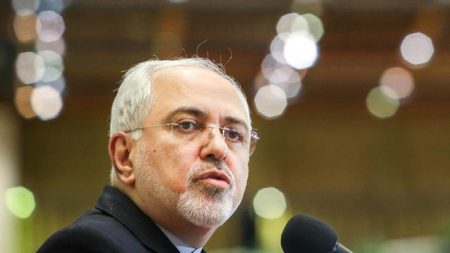
Iran’s Foreign Minister Mohammad Javad Zarif (Photo by Mehr News Agency )
Foreign Minister Mohammad Javad Zarif says Iran is ready to present peace to Saudi Arabia as a gift after the kingdom’s crown prince threatened to draw war into the Iranian territory.
“A Saudi official has recently threatened to ‘have the battle in Iran’. I declare formally and in the name of the government of Iran today that we are ready to present peace as a gift to the entire region, foremost to Saudi Arabia,” he said.
Zarif’s announcement came in an article published on the London-based al-Araby al-Jadeed media outlet on Saturday, in which he spelled out Iran’s conditions for peace.
“The realization of this issue, however, depends on the Saudi government ending its futile war and deadly attacks against the Yemeni people and abandoning its crackdown on the pro-democracy majority in neighboring countries,” he added.
He was reacting to Saudi Deputy Crown Prince and Defense Minister Mohammed bin Salman who recently said, “We will work to have the battle in Iran rather than in Saudi Arabia.”
Zarif said, “Some Arab governments have drawn our region into instability in recent years through escalating their destructive policies and measures.”
“Promoting and supporting extremist ideologies and presenting a violent and unrealistic image from Islam on the one hand, and sacrificing the interests of the regional countries through promotion of instability, bloodshed and fratricide on the other sums up these policies,” he said.
“These bellicose measures altogether would ultimately result in nothing other than serving the greatest enemies of the Muslim and Arab nations,” Zarif wrote.
The minister said the policy line currently being pursued by Saudi rulers is helping “the Iranophobia project which has been initiated and promoted by the Zionist regime for years.”
“Today, the stable Iran is seeking stability in the entire region because it knows that achieving security at home at the expense of insecurity among neighbors is basically impossible,” the article read.
Tensions between Iran and Saudi Arabia have escalated since the kingdom executed a prominent Shia cleric in January 2016.
The execution triggered angry protests in many countries, including Iran. Protesters attacked the Saudi Embassy in Tehran and its consulate in Mashhad, prompting Riyadh to cut diplomatic ties with the Islamic Republic.
The rupture was followed by exceedingly belligerent remarks against Iran by Saudi officials, including Salman and Foreign Minister Adel al-Jubeir.
On Monday, though, Iran’s Foreign Ministry said its response to such comments was that it did not seek tensions with Saudi Arabia.
Iran is critical of Saudi Arabia’s war on Yemen which has killed thousands of civilians and destroyed the impoverished nation’s infrastructure over the past two years.
Tehran has also lashed out at Riyadh’s assistance to militants fighting to topple the Syrian government as well as its contribution to the ongoing crackdown on pro-democracy protests in Bahrain.
Zarif touched on US President Donald Trump who is currently visiting Saudi Arabia on his first foreign tour since taking office.
“If the American president sees himself as a friend of the Riyadh regime and is loyal to his election campaign slogans, he should talk to it about the ways of containing Takfiri terrorists in the region and preventing other 9/11s from being repeated in Western countries by Saudi citizens.”
Zarif said, “Iran is ready to cooperate with regional and extra-regional countries on fighting terrorism and extremism and helping restore peace and tranquility in Syria.”
May 21, 2017
Posted by aletho |
Militarism | Iran, Middle East, Saudi Arabia, Zionism |
Leave a comment
Iran has sanctioned nine US-linked companies in response to American sanctions over the Middle East country’s ballistic missile program. While Iran’s re-elected president Rouhani said the country was ready for dialogue, the US came up with prerequisites to start it.
Nine more US-linked businesses, organizations and individuals are put in the sanctions list, created in March. The new list of sanctions is dated May 18, with AP reporting that it was put online on Saturday.
The sanctions mean that Iran could seize local assets of the listed organizations and deny their employees entry to the country. The first batch of sanctions were announced back in March in response to actions of the Trump administration, which sanctioned more than two dozen Iran-linked people and companies in February in retaliation for a ballistic missile test.
Tehran’s actions followed US President Donald Trump’s decision on Wednesday to renew the sanctions waiver maintaining the Iranian nuclear deal, but also to impose sanctions against two Iranian defense officials and a company allegedly linked to the missile program.
Iran’s re-elected President Hassan Rouhani vowed Saturday to continue reforms and said that the country was open for international dialogue.
“Our nation’s message in the election was clear: Iran’s nation chose the path of interaction with the world, away from violence and extremism,” Rouhani said.
US Secretary of State Rex Tillerson spoke of his vision of Iran’s dialogue “with the rest of the world.”
He made it clear the US would like to see an end to Iran’s missile program, as well as what he described as Iran’s role in supporting “destabilizing forces that exist in this region.”
Tillerson also called on Tehran to restore “the rights of Iranians to freedom of speech, to freedom of organization, so Iranians can live the life they deserve.”
“We hope that if Rouhani wanted to change Iran’s relationship with the rest of the world, those are the things he could do,” Tillerson said Saturday while speaking at a joint news conference with his Saudi counterpart in Riyadh.
In April, Tillerson described Iran as “the world’s leading state sponsor of terrorism” in a letter to Congress. Iranian Foreign Minister Mohammad Javad Zarif then said in response that instead of repeating accusations against Iran, the US should fulfil its obligations under the 2015 nuclear deal.
May 20, 2017
Posted by aletho |
Economics | Iran, Middle East, United States |
Leave a comment

 Aletho News
