What Kerry’s ‘Absolute Lines’ in Syria Really Mean
Sputnik | April 27, 2016
US Secretary of State John Kerry wants to draw “absolute” lines across Syria to create the Western “areas of influence” there. Such an approach resembles nothing so much as neo-colonialism, experts say.
The idea to create spheres of influence in Syria voiced recently by US Secretary of State John Kerry clearly indicates that Washington continues to pursue its Plan B in Syria.
In his interview with The New York Times editorial board Kerry narrated that the White House proposed to draw clear lines in Syria to the Kremlin.
“We’ve even proposed drawing a line, an absolute line, and saying, ‘You don’t go over there, we don’t go over here, and anything in between is fair game.’ And they are considering that, and I think we will get there in the next week or so,” Kerry told the editorial board.
However, according to the Russian Foreign Ministry, such an approach is oversimplified.
“This approach is slightly simplistic. The principal goal is to fight against terrorism [in Syria],” Russian Foreign Minister Sergei Lavrov said during a press conference on Monday, as quoted by RIA Novosti.
It should be noted that Kerry’s ‘offer’ followed the Saudi-backed High Negotiations’ Committee (HNC) decision to suspend its participation in the Geneva talks on April 21.
On that day most HNC members left Geneva in protest against the ongoing violence in Syria which they blindly blame on Damascus.
The HNC is well-known for its anti-Assad stance. However, by no means the entity represents the Syrian opposition as a whole. The HNC brought together Saudi-backed rebels in Syria, including notorious Ahrar ash-Sham and Jaysh al-Islam groups which actually share the same Islamist ideology as Daesh and al-Qaeda’s affiliate al-Nusra Front.
A day after the HNC demarche Lavrov called attention to the fact that besides the HNC there are also the Moscow and Cairo groups, Hmeymim group and the group of independent opposition members which express their willingness to continue the dialogue with Damascus over the situation in Syria.”Some people have already left [the Syrian opposition’s] High Negotiations Committee [HNC]. They disagreed that radicals ruled the committee, including Jaysh al-Islam leaders. This fact confirms that we were right while proposing to include it in the list of terrorist groups… This group, as well as Ahrar ash-Sham are actively proving in action that they fully support those anti-humane, brutal approaches used by Daesh and Jabhat al-Nusra [al-Nusra Front],” the Russian Foreign Minister underscored.
According to Elena Suponina, President of the Center for Asia and the Middle East at the Russian Institute for Strategic Studies, John Kerry’s offer to divide Syria into spheres of influence with Russia means that Washington now regards Moscow as an equal player in the Middle East.
In her Op-Ed for RIA Novosti Suponina recalls, that four years ago the Obama administration did not even bother to take Russia’s interests in the region into consideration.
However, in general, the White House continues to demonstrate a double-standard approach toward Syria and other regional players, according to the expert.
“It looks as if the colonial epoch and the times of re-division of the world by global powers have returned” Suponina writes, calling attention to the fact that Western policy-makers (most notably John Kerry himself) have repeatedly claimed that it is highly inappropriate to behave “in 19th-century fashion” in the 21st century.
And now Kerry proposes to draw “absolute lines” across the Middle Eastern region, she remarks, warning that Syria is “only the beginning.”
Kerry’s “fair game” in Syria will most likely prompt more destruction and devastation. Is Washington ready to take responsibility for chaos in the region?
On the other hand, Kerry’s proposal looks rather controversial since it was Russia, not the US that was invited to Syria by the legitimate Syrian government.
In his interview with Radio Sputnik political scientist Alexander Kamkin echoed Suponina’s stance.”Genuine peace still looks a way off and it looks like the Western nations still hope to implement the Libyan scenario in Syria… They use the war with Daesh as just a means of building large coalitions, but if you look at the previous such campaigns you will see that our American ‘partners’ rarely practice what they preach,” Kamkin told Radio Sputnik.
Hans-Christof Von Sponeck, former UN Assistant Secretary-General, expressed his concerns regarding the fact that Washington continues to conduct a “series of experiments” in Syria.
“The Americans are never short of experiment, never short of trying something new… It is jumping from one laboratory test to another, and in the meantime the country continues to go further towards a destroyed nation,” Sponeck told Russia Today.
Interestingly enough, it seems that there is no concordance in Washington regarding what to do next in Syria.
US President Barack Obama said Sunday that he does not support the idea of creating so-called “safe” or “buffer” zones in Syria as it would need Washington’s deeper military involvement in the region.
At the same time, Obama has signaled that 250 US Special Operation Forces troops will be soon deployed in the war-torn country.
Read more:
Syrian Parliament Election: Washington Unable to Strangle Assad’s Legitimacy
Israeli journalist: Sisi would accept a Palestinian state in Sinai
MEMO | April 27, 2016
An Israeli journalist has called on Israeli Prime Minister Benjamin Netanyahu to exploit the readiness of Egyptian President Abdel Fatah Al-Sisi to concede Egyptian land in return for money to solve the conflict with the Palestinians, Arabi21 reported yesterday.
Haggai Segal, the editor of the Israeli newspaper Makor Rishon, wrote: “Al-Sisi’s concession of Tiran and Sanafir islands shows that Arabs do not revere the land. Al-Sisi conceded the two islands for money.”
The journalist, who is very close to Netanyahu, added: “Two years ago, Al-Sisi showed his willingness to accept the establishment of a Palestinian state in Sinai. This makes us expect reaching an agreement with Al-Sisi and the Palestinian Authority (PA) regarding this in return for a respectable sum of money.”
“We have to measure the idea of establishing a Palestinian state in Sinai based on the equation: land for shekels.”
Segal was a member of a terrorist Jewish organisation that planned to destroy Al-Aqsa Mosque in the 1980s. He also carried out a number of explosions that killed and wounded scores of Palestinians, including heads of West Bank municipalities.
Two years ago, Israeli Army Radio revealed that Al-Sisi suggested the creation of a Palestinian state in Sinai in return for Palestinian concession of the West Bank.
Both Egypt and the Palestinian Authority denied the report, however many Israeli officials, including the Education Minister Naftali Bennett, confirmed the proposal had been put forward.
Meanwhile, former Israeli ambassador to Cairo Zvi Mazel said Al-Sisi recognises the size of the economic crisis his regime is currently facing and is therefore “ready to concede Egypt’s respect and dignity and ignore the constitution for financial support.”
NATO pledges to boost military presence in Eastern Europe
Press TV – April 27, 2016
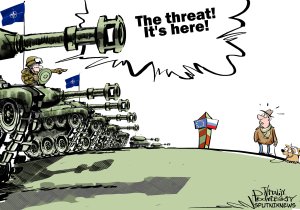 NATO has pledged to expand its military presence in Eastern Europe to protect its partners and allies from potential threats as the US sends two of the world’s most advanced warplanes to Romania.
In a speech at the University of Bucharest in Romania on Tuesday NATO Deputy Secretary-General Alexander Vershbow discussed the main issues the Western alliance is facing.
He said the alliance is struggling with many complex risks apart from the “destabilizing actions” of Russia and “the tide of instability which has swept across the Middle East and North Africa.”
“We are also wrestling with other complex risks and threats to our cyber security, to our energy supplies, and in the case of international terrorism to the safety of the people on our streets,” he said.
Vershbow said NATO is doing everything to respond to these challenges, adding that “the alliance takes a 360 degree approach to deterring threats, to protecting its member nations and if necessary to defending them.”
“That presence will be rotational, multinational, and combat capable. It will thereby send a clear message to any potential aggressor that if they violate NATO’s territory, they will face strong response from the whole alliance; Americans, Europeans and home defense forces,” he said.
The NATO secretary general also said that the organization has “set up a series of small headquarters, including here in Romania, to support planning, training and re-enforcement.”
“We are intensifying our maritime patrols, exploring the need for increased military and exercises, providing support to partners like Ukraine, Georgia and Moldova and encouraging efforts to strengthen energy security,” he said.
US sends F-22 Raptors to Romania
Vershbow’s comments came a day after the US sent two F-22 Raptor fighter jets to Romania as part of the commitment to NATO security.
The fighter jets, which travel at twice the speed of sound, touched down in Romania, close to the Black Sea and Ukraine, the Crimean Peninsula and Russia.
A US statement said the aircraft possess sophisticated sensors which would allow pilots to track, identify, shoot and destroy air-to-air threats without being detected.
The dispatch of the fighter jets, which can also attack surface targets, came two weeks after Russian fighter jets buzzed an American warship in the Baltic Sea.
The Western military alliance has been deploying troops and equipment close to Russia’s borders since it suspended all ties with Moscow in April 2014 after the Crimean Peninsula integrated into the Russian Federation following a referendum.
The United States and its European allies accuse Moscow of destabilizing Ukraine and have imposed a number of sanctions against Russian and pro-Russia figures. Moscow, however, rejects having a hand in the Ukrainian crisis.
This as Moscow has on many occasions slammed the Western military alliance’s expansion near its borders, saying such a move poses a threat to both regional and international peace.
‘Liberal’ Trudeau joins blood-soaked race for arms deals with Mideast despots
By Finian Cunningham | RT | April 24, 2016
In a remarkable spectacle of money-grubbing over arms deals, this month saw a parade of Western leaders jettisoning any pretense of upholding vaunted “liberal values” to court despotic Mideast regimes.
Justin Trudeau, the Canadian prime minister who sent liberal hearts aflutter when he was elected in November, with his espousal of feminism among other progressive causes, is the latest Western leader to show where real priorities lie. Trudeau signed off on an $11 billion deal with Saudi Arabia to export armored vehicles to the blood-soaked repressive regime.
With astounding cynicism, the 44-year-old Canadian premier said he was duty-bound to fulfill the arms contract drawn up by the previous administration as “a matter of principle” in order to demonstrate that his country’s “word means something in the international community.”
This week also saw US President Barack Obama in Saudi Arabia where he glad-handed King Salman and other Gulf monarchs, lauding them as partners in maintaining regional stability and fighting against terrorism. Conspicuously, Obama made little or no mention of human rights violations in the oil-rich kingdom where mass beheadings are a common method of capital punishment.
Western media talked about “strained relations” between Obama and his Saudi hosts. But underlying the superficial optics it was business as usual. Big business. US military affairs publication Defense One reported that high on Obama’s agenda was securing a $13 billion contract for warships and submarine-hunting helicopters with the House of Saud.
Before Obama touched down in Riyadh, his administration had angered American families by announcing that it would veto a bill going through Congress that could enable relatives of the 9/11 terror attacks to sue the Saudi rulers for their alleged involvement in sponsoring that atrocity. The topic didn’t even arise for discussion during Obama’s visit, indicating the president’s real concerns in meeting the Saudi and other Gulf rulers.
France has also nabbed market share from Western rivals in the Persian Gulf where over the past year Paris has sold billions of dollars’ worth of its Rafale fighter jets to Saudi Arabia, Qatar and the United Arab Emirates.
Similar prevarication over human rights is brazenly shown by the British government of David Cameron in its arms dealing with Saudi Arabia and the wider region. The Saudi-led war in Yemen has been a boon for British sales of bombs and missiles, even though as many as 9,000 Yemenis have been killed over the past year, many of them civilians from aerial bombing by Saudi warplanes.
Britain’s foreign minister, Philip Hammond, has dismissed condemnations by human rights groups in regard to Yemen, claiming that British weapons exports meet tough standards of international law. Britain, like Canada and other Western governments, makes the cynical claim that its military exports are not used for “internal repression” and that if it is proven that weapons are being used to kill civilians in Yemen then trade licenses will be canceled.
So what is Saudi Arabia dropping on Yemen? Cuddly British-made toys?
Duplicity of Western governments doing business with despotic regimes is nothing new. The Middle East’s absolute monarchs have long been a staple of American and other Western so-called “defense industries.” In 2010, the Obama administration signed a $60 billion weapons deal with Saudi Arabia – the biggest in US history.
During the 1980s, Britain under Margaret Thatcher won a comparable mammoth contract with Saudi Arabia known as the Yamamah deal.
Massive arms sales to tyrannical regimes give the real meaning to hackneyed euphemisms spouted by the likes of Obama, Cameron, Hollande and Trudeau, when they cite “regional partners for stability.” What they mean by stability is uninterrupted orders for weapons.
What is new, though, is the lack of discretion in how the West now pursues arms deals in the Mideast.
Western governments are apparently falling over themselves to bid for business. Yet this unseemly rush for arms selling is sharply at odds with not only intensifying repression within Middle Eastern “partner” regimes; it has also become abundantly clear that some of these same regimes are directly responsible for sponsoring terrorism in the region. The case of Saudi Arabia and its sponsorship of Wahhabi terror proxies in Syria, Libya and Iraq is perhaps the most glaring.
Part of the burgeoning Western race for arms business is related to the historical demise of their capitalist economies and the emergence of military industries as key components in whatever remains of gutted manufacturing sectors.
No doubt, critics will point out that Russia is also a major arms supplier to Middle Eastern regimes. According to the Stockholm International Peace Research Institute, Russia is indeed a prominent weapons exporter to the region and globally.
However, there is an important distinction. Western governments never cease to proclaim democracy, human rights and international law as foundational policies. Washington, London, Paris and so on continually invoke such rights as criteria by which they sanction, censure and even invade other countries to ostensibly uphold.
What is therefore more transparent than ever from Western countries soliciting arms deals in the Middle East is their shameless, sordid hypocrisy.
That Canada’s fresh face of “liberal values,” Justin Trudeau, has joined the throng of Western leaders cutting deals with tyrants and dictators just goes to show how cosmetic Western noble pretensions are.
Why should citizens in these countries believe anything that their governments tell them on any issue? Their governments all too evidently do not have a scrap of integrity or principle.
Official Western treachery, duplicity and hypocrisy have become a chronic condition that is no longer veiled by lofty rhetoric, as it once was. So-called liberal values are being stabbed in the back – left, right and center.
Read more:
UK sold Saudis £2.8bn in weapons since outbreak of Yemen war – report
Journey to the End of the Night: The Paris ‘Nuit Debout’ movement
By Gearóid Ó Colmáin | American Herald Tribune | April 17, 2016
In his novel ‘Journey to the end of the night’ Louis-Ferdinand Céline provocatively described the soldiers who had died in the First World War as ‘idiots’. The French writer was referring to the fact the soldiers had given their lives for a cause that was not their own- a futile slaughter of the poor for the benefit of the rich. In the book’s many pertinent reflections on the human condition, the Céline notes how, in modernity, the street has come to constitute the place of dreams. “Que fait-on dans la rue, le plus souvent ? On rêve. C’est un des lieux les plus méditatifs de notre époque, c’est notre sanctuaire moderne, la Rue – what do we most often do in the street, we dream. It is the most meditative place of our time, it is our modern sanctuary.”
Since the French government recently introduced legislation reforming labour laws, a new ‘spontaneous’ and acephalous, social movement has taken root throughout French cities- the ‘Nuit Debout- Up All night’ movement. As the title suggests, the social movement is taking place at night time and one of its slogans is ‘Rêve général !’ – general dream, which is a pun on ‘grève générale’-general strike. So, instead of calling for a general strike in order to bring the government to its knees, the activists are calling for dreaming in the streets!
The movement took off after the release on February 23 of journalist Francois Ruffin’s film ‘Merci Patron’- ‘Thank you boss’, a firm critical of French plutocracy.
Although the film criticizes the avarice of contemporary capitalism, it does not treat the relationship between monopoly capitalism, foreign wars of conquest in the service of capital accumulation, class warfare and mass media disinformation.
Nor does Ruffin’s film expose and denounce the complicity of all corporate French media outlets in war crimes and genocide in the Middle East and throughout Africa, through the dissemination of lies and disinformation about the role of Western imperialism in these wars. There is no mention of the fact that the reason President Laurent Gbagbo of the Ivory Coast was kidnapped in 2010 by French commandos- his country bombed and his character assassinated- was due to the fact that he defied the powerful Club de Paris, the circle of French bankers who control the African neo-colony’s money; Gbagbo had proposed that the Ivory Coast print it’s own currency- a bold move which would have enabled the resource-rich country to build up its own industrial base independent of colonial interests.
Although there is a stand at the place de la Republique claiming to expose the detrimental role of French policy in Africa, there is no real information of what that role is, nor have any of the pan-Africanist intellectuals who have written on the topic been invited to speak and sell their books. The ‘Nuit Debout’ movement is predominantly white and middle class.
Ruffin’s film also fails to point out how French bosses in the cereal industry colluded with terrorism against the people of Libya when they secretly met in Paris with Libyan traitors in November 2010 to organise the bombing and destruction of Africa’a richest and most democratic country.
The French ruling class are not just guilty of destroying centuries of social gains by French workers, they are complicit in genocide and crimes against humanity. So why is Ruffin silent about that fact?
Ruffin writes for ‘leftist’ publications which supported the NATO-backed ‘rebels’ in Libya- rebels who were in fact Al-Qaeda terrorists in the service of NATO. In 2011 the ‘left-wing’ Monde Diplomatique published an article on Libya declaring that there was no doubt about the ‘brutality of the regime’, in spite of the fact all of the crimes imputed to Colonel Gaddafi were carried out by the Takfiri ‘rebels’.
Ruffin and the dishonest publications he writes for are all complicit in the genocide waged by NATO against the people of the Southern Hemisphere states, from the Middle East and Africa to Latin America.
No, none of these uncomfortable realities are depicted in Ruffin’s ‘anti-capitalism.’ Instead, we have ultra-leftist slogans, petty-bourgeois irony and the mindless occupation of a public square by youths, who have neither the education nor the experience necessary to understand the structural reasons and deeper implications of the labour reform they claim to oppose.
The ‘Nuit Debout’ movement is certainly not spontaneous, nor is it grass-roots and acephalous as so many pundits claim.
On the contrary, it is the result of decades of careful policy analysis by US imperial ideologues. Since the undemocratic dissolution of the USSR in, 1991, the United States has perfected a regime change technique commonly referred to as ‘colour revolutions’. The strategy involves co-opting leftist slogans and symbols to serve a right-wing agenda. Lenin and the Bolshevik party had repeatedly denounced Leon Trotsky for utilizing this counter-revolutionary technique both before and after the October Revolution. It has now become a standard tool of US foreign policy.
The manipulation of youthful naivety and rebellion for the purposes of either overthrowing a foreign government hostile to US interests or creating a ‘left-wing’ opposition movement in imperial countries designed to kill all real opposition- this is a strategy which every would be activist needs to study if he wishes to engage in movements capable of real, social, political and economic change.
The ‘Nuit Debout’ movement is being led by petty-bourgeois, bohemians with little or no understanding of contemporary capitalism. The movement is organized on the same principals as the US backed colour revolutions in Eastern Europe and the Arab Spring- empty slogans, idiotic puns and political infantilism. Although we cannot yet prove it, the use of the clenched fist as the movement’s logo coupled with cretinous slogans, are strongly reminiscent of strategies and tactics of CANVAS, the Centre for Applied Non-Violent Actions and Strategies, a regime change youth training organization close to the CIA.
The ruling class in France have evidently spent more time reading Marx than their would-be opponents. For the objective allies of monopoly capitalism in Europe today are the likes of François Ruffin and the other leading bourgeois leftist ideologue of this movement Frédéric Lordon- both of whom mask the reactionary nature of their pseudo ‘anti-capitalism’ or, to be more precise, their ‘anti-neoliberalism’, with a mixture of convoluted semantics, pseudo-intellectualism and ultra-leftist sloganeering.
There are thousands of real, grass-roots organizations in France, and they get much of their information from independent media such as Meta TV, Cercle Des Voluntaires, Reseau Voltaire and many more. Real proletarian analysis of capitalism is provided by communist organizations such as OCF , and URCF. Coherent bourgeois critique of French and EU imperialism is provided by the political party UPR.
The ‘Nuit debout’ activists talk about a ‘convergence of struggle’ yet journalists and activists from these genuinely popular organisations have been forcibly escorted from the Place de la Republique and denounced as ‘fascists’. Antifa is an organisation which purports to fight fascism but spends most of its time attacking all genuine anti-imperialist activists by blackening their name with the label ‘fascist’.
Antifa have been active again in the ‘Nuit Debout’movement where genuine French anti-imperialists such as Sylvain Baron have been forcibly evicted from the square.
This writer repeatedly pointed out in 2011 that the failure of the left to understand the reactionary ideology of the Arab Spring and the role of US agencies in its planning and execution, would have dire consequences for progressive politics. Now, similar techniques are being used throughout the world in order to criminalize real anti-capitalist agitation and create the conditions of military dictatorship. The objective allies of that strategy are petty bourgeois ‘anti-capitalists such as François Ruffin and Frédéric Lordon; these are the phastamagorical, would-be intellectuals who shine in the streets of the nocturnal, metropolitan dream world so eloquently depicted by Céline.

The representation of imperialism’s foreign wars of aggression as ‘revolutions’ and ‘humanitarian interventions’, coupled with an infantile advocacy of vacuous concepts such as ‘social Europe’- this is the nefarious role played by these post-modern ‘revolutionaries’, who are the very avant-garde of reactionary imperialism. A malady when this writer denounced it in 2011, pseudo-leftism has now morphed into a serious planetary pandemic. If this form of leftism did not exist, imperialism would have had to invent it. The ‘Nuit Debout’ movement is now spreading throughout the world. Pseudo-leftist media will zealously present this movement as a global painting of Delacroix’s ‘Liberty Leading the People’ when sadly, it is rather more of a sinister version of the Pied Piper of Hamelin.
The soi-disant ”anti-fascists” in this movement denounce as ”fascists” those who expose corporate media lies used to justify the crimes of NATO’s foreign wars-the foreign wars of capital accumulation waged by the same corporations imposing austerity and class war at home; but it is they who are the fascists, it is they who are the enemies of the working class!
Ideological confusion is the great political illness of our time. Céline describes war and illness as the two ‘infinities of nightmare’. One could describe the two contemporary ‘infinities of nightmare’ as the proliferation of wars of aggression and the triumph of capitalist repression due to the political illness of ultra-leftist cretinism, which has taken over the labour movement in the last 30 years. Until our youth emancipate themselves from the pernicious influence of controlled opposition and pseudo-leftist ideology- which turns them into useful idiots of monopoly capitalism rather than revolutionaries- their good natured activism is tragically destined to precipitate civilization’s journey to the end of the night.
US readies ‘Plan B’ to supply heavy weapons to militants: Report
Press TV – April 13, 2016
The United States and its regional allies have prepared plans to supply more-powerful weapons to militants fighting the Syrian government, amid concerns that a landmark ceasefire is threatening to fall apart.
US officials said the so-called Plan B is aimed at providing vetted “moderate” militant units with weapons system that would enable them to launch attacks against Syrian government aircraft and artillery positions, the Wall Street Journal reported on Tuesday.
US-backed militants carried out a series of attacks in central and southern Syria on Monday even as the Damascus government was observing a ceasefire and holding talks with opposition groups to end the years-long conflict.
A ceasefire brokered by the US and Russia went into effect on February 27 across Syria. The truce agreement does not apply to Daesh and al-Qaeda-affiliated al-Nusra Front. A new round of discussions is to resume between the two sides in Geneva this week.
Concern has been growing that the recent uptick in violence is putting intense strain on the fragile truce.
US Secretary of State John Kerry floated the idea of a “Plan B” for the first time late in February, stressing that partitioning of Syria was on the table if the ceasefire collapsed.
The preparations for the “Plan B” were discussed at a secret gathering of intelligence chiefs in the Middle East before the ceasefire went into effect and in exchanges between intelligence services, the Journal said.
During those sessions, the CIA gave assurances to allies that they would be given approval to expand arms shipments to Syria’s “moderate” militants.
Coalition members reportedly agreed to the outlines of the plan, but the White House must approve the list of proposed weapons systems before they can be sent to Syria.
“The agreement is to up the ante, if needed,” a senior US official said.
The plan for introducing more sophisticated weapons into the Syrian battlefield is perceived as being part of a broader behind-the-scenes effort by the US to counter its adversaries in the conflict.
US officials have privately warned their Russian counterparts that the armed opposition will persist in Syria and that a return to full-scale fighting could put further strain on Russian pilots there, according to the Journal.
In addition, Pentagon officials said in recent weeks that the White House was looking to “greatly increase” the number of special forces deployed in Syria. The US military also said that it had resumed training new units of militants operating in the country.
The discussions for a possible escalation of the proxy war in Syria have been fueled to a large extent by a relatively successful Russian campaign in the country.
Terror Bombing in Brussels and Paris: Europe’s Islamist Legionnaires Come Home to Fight
By James Petras :: 04.08.2016
Introduction: The terror bombings in Paris and Brussels have raised a cacophony of voices, ranging from state officials, Prime Ministers and Presidents, to academics, journalists and media consultants. Tons of ink and print have focused on the psychology, networks and operations of the alleged perpetrators – radicalized young Muslim citizens of the EU.
Few have examined the long-term, large-scale policies of the EU, US and NATO, which have been associated with the development and growth of the worldwide terror networks. This essay will discuss the historical links between Islamist terrorists and the US-Saudi Arabian-Pakistani intervention in Afghanistan, as well as the consequences of the US invasion and occupation of Iraq. In Iraq, the US implemented a deliberate policy of destroying all secular state structures and promoting the Balkanization of the country via ethnic-religious and tribal wars – a policy it has followed in subsequent areas of intervention.
The last section will focus on the US-EU-Gulf Petrol-Monarchy proxy invasions and ‘regime change’ bombings of the secular republics of Libya and Syria with the further cultivation and growth of international Islamist terrorism.
Historical Origins of International Islamist Terrorism: Afghanistan
In 1979, President James Carter and his National Security Chief, Zbigniew Brzezinski, launched Operation Cyclone, a major Islamist uprising against the Soviet- aligned secular Afghan regime. The US coordinated its campaign with the rabidly anti-Soviet monarchy in Saudi Arabia, which provided the funding and mercenaries for ‘international jihad’ against secular governance. This brutal campaign ‘officially’ lasted 10 years until the Soviet withdrawal in 1989. It produced millions of casualties and decades of ‘blow-back’ when the CIA-Pakistani-Saudi trained Arab mercenaries (the ‘Afghan-Arabs’) returned to their home countries and elsewhere. The US intelligence agencies, Special Forces Commands and military directorates (especially Pakistan’s ISI intelligence service) trained and armed terrorists with US-Saudi funding. The American covert financial contribution mushroomed over the years rising to over $670 million dollars a year by 1987. Tens of thousands of Islamist mercenaries and adventurers were recruited from the Middle East, North Africa, the Gulf States, the Soviet Union (Chechens), Yugoslavia (Bosnians and Kosovars), China (Uigurs) and Western Europe.
With the defeat of the secular regime of President Najibullah in 1992, the Islamists and tribal factions then fought among themselves, converting Afghanistan into the world’s best-equipped training ground for International Islamist terrorists. Eventually, the Pashtun-based Taliban faction (with Pakistani arms and support) prevailed and established an extreme Islamist regime. The Taliban, despite its rhetoric, settled down to consolidating their brand of ‘Islamism in one country’, (1995-2001), a largely nationalist project. In its quest for respectability, it successfully destroyed the opium poppy fields, earning the praise of US President GW Bush in spring 2001. It also hosted a variety of Saudi princes and warlords, eventually including the jihadi-internationalist Osama bin Laden, who had been driven from North Africa.
Following the terrorist attack on the US in September 2001, the US and NATO invaded Afghanistan on October 2001 and overthrew the nation-centered Islamist Taliban regime. The subsequent chaos and guerrilla war opened up a huge new inflow and outflow of thousands of international extremists who came to Afghanistan, trained, fought and then departed, fully prepared to practice their terrorist skills in their countries of origin in Europe, North Africa and the Middle East.
The US interventions and invasion of Afghanistan provide some of the context for the subsequent bombings in Europe and the US. The Islamist ‘returnees’ to Europe and elsewhere had received funds from Saudi Arabia and training from the CIA and Pakistani intelligence. They began their work among a very ‘available’ constituency of potential recruits in the marginalized Muslim youth of the ghettos and prisons of Europe.
The Middle Period: the US-Zionist Invasion and Destruction of Iraq
The turning point in the growth and internationalization of Islamist terrorism was the US invasion, occupation and systematic reign of terror in Iraq. Largely under the guidance of key US Zionist policymakers (and Israeli advisers) in the Pentagon, State Department and the White House, the US dismantled the entire secular Iraqi army and police forces. They also purged the administrative, civil, educational, medical and scientific institutions of nationalistic secular professionals, opening the field to warring Islamist tribal factions. Hundreds of thousands of Iraqi civilians were killed and millions fled in a regime of ethnic cleansing – which Washington touted as a model for the rest of the Middle East. However, thousands of experienced, but jobless Iraqi military officers, who had survived the US-orchestrated purges, regrouped and eventually joined with tens of thousands of nationalist and internationalist Islamist extremists to form ISIS. Their motives were arguable less ethno-religious and more related to revenge for their displacement and the destruction of their own society.
The deliberate US (Zionist)-EU-Saudi strategy to divide and conquer Iraq initially involved working closely with Sunni feudal tribal leaders and other extremists to counter the rising power of pro-Iranian Shia. They promoted a policy of fragmenting the country with the Kurds dominating in the North, the Sunnis in the center and the Shia in the south (the so-called Joseph Biden-Leslie Gelb Plan of national dismemberment and ethnic cleansing). The rationale was to create a weak central authority completely under US-EU tutelage and a loose group of fragmented subsistence fiefdoms in what had been the most advanced secular Arab republic.
Despite pouring billions of dollars in arms from the US to create a puppet-colonial Iraqi ‘national army’, the Saudis and Israelis pursued their own policy of financing sectors of the Kurds and violent Sunni opposition – with the latter forming the original mass base of ISIS.
As the US-client Shia regime in Baghdad focused on stealing billions while killing or exiling hundreds of thousands of educated Sunnis, Christians and other secular Iraqis from the capital, the morale of its US-puppet troops plummeted. With the entire experienced and nationalist Iraqi officer core purged (slaughtered or driven into hiding), the new puppet officers were cowardly, corrupt and incompetent – as openly acknowledged by their US ‘advisers’. ISIS, meanwhile had acquired hundreds of thousands of US weapons and was financed by the Shia-hating Saudi Royal Family and other Gulf Monarchs. Armed Sunnis soon launched major, lightning-quick offensives under the leadership of ex-Baathist army officers, supported by thousands of terrorists, suicide bombers and foreign mercenaries. US and European ‘military experts’ expressed ’shock’ at their effectiveness.
ISIS routed the Baghdad-controlled army, their US advisers and Kurdish allies from northern Iraq, capturing major cities, including Mosul, thousands of productive oil wells and drove their forces to within a few dozen kilometers of Baghdad. Territorial conquest and military successes attracted thousands more Islamist volunteers from the Middle East, Europe, Afghanistan and even North America. ISIS provided the military training; Saudi Arabia paid their salaries; Turkey purchased their captured oil and antiquities and opened its borders to the transfer of jihadi troops and weapons. Israel, for its part, purchased captured ISIS petrol at a discount from corrupt Turkish traders. Each regional player had its snout in the bloody trough that had once been Iraq!
ISIS successes in Iraq, led it to expand its operations and ambitions across the border into Syria. This occurred just as the US and EU were bombing and destroying the secular government of Colonel Gadhafi in Libya, in another ‘wildly successful’ planned campaign of ‘regime change’ (According to US Secretary of State Clinton as she gleefully watched the captive wounded Gadhafi ’snuff film’ by unspeakable torture – ‘WE came and HE died’.).
The chaos that ensued in Libya led to an exponential growth of extremist Islamist groups with tons of weapons of ‘liberated’ Libyan weapons! Islamist terrorists in Libya gained territory, took over oil wells and attracted ‘volunteers’ from the marginalized youth of neighboring Tunisia, Egypt, Mali and as far away as Somalia, Afghanistan, Iraq and Syria. Flush with more guns, money and training. Many graduates went on to Syria and Iraq.
The Contemporary Period: EU-US-Turkey-Saudi-Israeli Sponsored War in Syria
In 2011, as ISIS rolled across the Iraqi border into Syria and terrorist Islamist bands seized cities in Libya, the US-EU-Turkish-Saudi and Israeli regimes financed and armed Islamist (and the mythical ‘moderate’) forces in Syria to overthrow the nationalist-secular Syrian regime of Bashar al Assad.
Thousands of Islamist extremist volunteers heeded the call (and the fat paychecks) of the Saudi regime and its Salafist propagandists. These constituted the Saudi Royal Family’s own ‘Foreign Legion’. They were trained and armed and shipped into Syria by Turkish intelligence. The US armed and trained hundreds of its own so-called ‘moderate rebels’ whose fighters quickly defected to ISIS and other terrorist groups turning over tons of US arms, while the ‘moderate rebel leaders’ gave press conferences from London and Washington. ISIS seized swaths of Syrian territory, sweeping westward toward the Russian naval and air bases on the coast and upward from the south, encircling Damascus. Millions were uprooted and minority populations were enslaved or slaughtered.
The news of ISIS territorial gains with their plundered oil wealth from sales to Turkey and the flow of arms from Saudi Arabia, the EU and the US attracted over 30,000 ‘volunteer’ mercenaries from North America, Europe, North Africa, the Middle East and South Asia.
These new terrorists received military training, including bomb making and logistical planning in Syria. Many were citizens of the EU, Islamist extremists, numbering over five thousand. These young fighters trained and fought in Syria and then returned to France, Belgium, Germany and the rest of the EU. They had gone to Syria with the tacit support and/or tolerance of their own European governments who had used them, rather than NATO troops, in the US-EU campaign of ‘regime change’ against Damascus.
The European governments were sure they had ‘their’ Muslim recruits under control as they joined the US in a reckless policy of overthrowing independent secular governments in the Middle East and North Africa. They happily encouraged their marginalized young Muslim citizens to flock to Syria and fight. They hoped they would remain in Syria (fighting on the ground or buried under the ground). Officially, EU leaders claimed to support ‘moderate rebels’ (the bland term Western media used to sanitize Islamist terrorists) fighting the Assad ‘dictatorship’. European regimes were not prepared to detain the battle hardened ‘returnees’, who had been trained in Iraq and Syria. These young European Muslims (children of immigrants or converts to Islam) had been heavily indoctrinated and incorporated into international terrorist networks. They easily melted back into their marginalized European urban ghettos – beyond the control of Europe’s bloated intelligence services.
In practice, the EU regimes saw the thousands of Europe’s Muslim youth flocking to Syria as an ‘EU Foreign Legion’, a glorified wastebasket for unemployed young thugs and ex-prisoners, who would advance NATO’s imperial goals while solving the domestic social problem of the marginalized children of North African migrants. Europe’s Muslim youth were viewed as convenient cannon fodder by NATO planners and the governments of France, Belgium and the UK. For public relations, it was better for these young men and women to die overthrowing the secular government in Syria than to send in European soldiers (white Christians) whose deaths would have domestic political repercussions.
The EU underestimated the depth of antagonism these ‘volunteers’ felt about US-EU intervention in the Middle East and North Africa, as well as their anger at Europe’s continued support for Israeli land grabs in Palestine. In its racist arrogance, EU leaders underestimated the capacity of ISIS to indoctrinate, train and organize these marginalized kids from Europe’s slums into effective international cells able to carry the war back to Europe.
 The EU smugly overlooked the active roles of Turkey and Saudi Arabia who had their own independent, regional ambitions. Ankara and Riyadh trained and financed the ‘volunteers’, and facilitated their flow into Syria from camps in Turkey and Jordan. The wounded were treated in Turkey and sometimes even in Israel. Thousands, many EU citizens, would flow back into Europe or to their countries of origin in the Middle East and North Africa, as well as Russia.
The EU had slavishly and blindly followed Washington’s lead in all its Middle East wars. Now it is now paying a big price: Thousands of trained terrorists have returned; bombings and attacks on European civilians and civil structures have occurred, while the European government leaders trip over each other in a mad rush to dismantle civil and constitutional citizen rights and impose wide ranging police state measures (States of Emergency).
These new Saudi-funded terrorist recruits (Riyadh’s Legionnaires) are active in all the countries where the US and EU have launched proxy wars: Iraq, Syria, Libya, Yemen, Afghanistan . . . Turkey funds ISIS terrorists in Syria, Iraq and Kurdish territories to advance its own expansionist ambitions – oblivious to the clucking disapproval of EU leaders. Now Turkey receives over 6 billion Euro’s from the EU in what amounts to blackmail: In return, Turkey will ‘contain’ the flood of regional refugees in barely disguised concentration camps out of European sight.
Conclusion
Ever since the US-EU policymakers decided to implement a war against Arab and West Asian secular nationalism in the Middle-East, Afghanistan, Iran and North Africa through serial ‘regime change’ campaigns they have relied on Islamist Salafist mercenaries and volunteers to do most of the killing on the ground, while the West operates from the air. Washington and its NATO allies operated on the assumption that they could use and then discard their recruits, mostly from marginalized urban youth and criminal gangs, once they had served imperial military purposes. A few with requisite talent and ruthlessness could be turned into puppet ‘leaders’ to unleash on the Russians and other ‘obstacles’ in future engagements.
The EU-US totally misunderstood the volunteers’ high level of independence, their organizational autonomy and their own understanding of the tactical nature of their alliance with Western imperialism. Islamist extremist leaders, like their Western counterparts, believe there are no permanent alliances – only permanent interests.
The EU and US have pursued a policy of overthrowing independent Muslim and secular Arab nations and returning them to the status of pre-independence semi-colonies. The rollback policy against secular nationalism (with its deep roots in the Dulles era) has extended from North Africa, through the Middle East to Southwest Asia. For its part, ISIS and its allies envision a return to a pre-colonial Islamic caliphate over the same lands and people to counter Western imperialism. Millions are caught in the middle.
ISIS views the Westernized secular elites in the Muslim countries as a fifth column for the spread of empire, while it has re-socialized and trained young Islamists from the EU to serve as networks of terrorists ‘behind enemy lines’ sowing mayhem in the West.
The political repercussions of this internationalized war are profound. Millions of civilians in the war zones have been and will be killed, uprooted and converted into desperate refugees flooding the EU. Police-state emergency rule, arbitrary searches, arrests and interrogations have become the norm in the highly militarized European airports, train and metro stations, as well as markets and cultural centers. The EU has increasingly undergone an ‘Israelization’ of its society, with its population polarized and resembling Israel- Palestinian . . . its Muslim community marginalized and confined into little Gaza’s.
In this charged atmosphere, Israeli high tech security companies and advisers flourish, mergers and acquisitions of police state technology multiply. Israeli Prime Minister Benny Netanyahu embraces the French Prime Minister Hollande in the club of electoral authoritarians.
Meanwhile the refugees and their children flow to and fro, the bombs come and go. We line up to place flowers on our latest dead and then pay our taxes for more wars in the Middle East. More young ‘volunteers’ will become cheap fodder to fight in our wars; some will return and plant more bombs, so we can mourn some more at patriotic vigils -protected by armed battalions…
Featured Video

AIDS Inc. by Gary Null (2007)
or go to
Aletho News Archives – Video-Images
From the Archives
Clash of Civilization, Iran Part II
By Jamal Kanj – Intifada-Palestine.com – January 14, 2011
Israel’s survival kit is: perpetuate conflict, insecurity to rationalize collective hate and finally playing victim.
Devoid of conflict, Israel implodes internally; without hate, Zionism loses its justification; and playing eternal victim to continue blackmailing the West. Absence of this holy trinity, Israel ceases to exist.
From its inception, the house of Zion has mastered exploiting adversarial powers to advance Israel’s cause. For instance, their influence over the Democratic Party in the US began with President Truman’s bid for 2nd term election in 1948.
Responding to strong opposition from Secretary of State General George Marshall and Department experts urging against recognition of Israel, President Truman replied: “I’m sorry gentlemen but I have to answer to hundreds of thousands [Jewish voters] who are anxious for the success of Zionism. I do not have hundreds of thousands of [voting] Arabs among my constituents”
Zionists influence over liberal American politics was matched with the doctrinal school of Conservative theoreticians aligning the Republican Party’s platform with Israel’s objectives. The Neoconservative Zionists, coined Zioncons, invented the “Clash of Civilization” concept to fight Israel’s wars. … continue
Blog Roll
 Aletho News
- Pro-Palestine protesters arrested outside UK’s ruling Labour Conference in Liverpool
- Mauritius denies landing permit to flight from Israel, forcing cancellation: Tour operator
- Israeli finance minister calls for genocidal war on West Bank, annexation of south Lebanon
- 12 Things Your Psychiatrist Was Trained Not to Tell You
- From Unipolar Universalism to Multipolar Civilizational Distinctiveness
- RSF military group defects, joins Sudanese army: State media
- Ireland goalkeeper refuses to play ‘Israel’ as squad weighs boycott
- China pushes back against US on Cuba, Iran
- Ukrainian Soldiers, Potential Mercenaries: Have Gun, Will Travel!
- Burnham’s UN debut… A masterclass in British disinformation
- If Americans Knew
- Israel forces Gazans to live in constant peril – Daily Update
- Deconstructing Netanyahu’s pants-on-fire UN rant – Daily Update
- Trump betrayed voters with his campaign lies and prioritized a foreign country once he took office
- Netanyahu calls Israel’s war in Gaza ‘opposite of genocide’ in UN speech to near-empty hall
- Settler Kidnappings: Torture, Sexual Abuse and Terrorisation of Palestinian Abductees as Israel Deepens Annexation of West Bank
- Gaza winter nears as 162,000 tents become unusable, raising fears of humanitarian crisis
- Netanyahu says, “It’s the opposite of genocide”; UN says Gaza economy is world’s ‘most severe crisis on record’ – Daily Update
- Israel’s US-Backed Assault on Gaza Has Created the ‘World’s Most Severe Economic Crisis on Record’: UN
- ‘Protecting U.S. Citizens’… From Israel
- ‘This is where I live now, the back of a truck’: a day in the life of a grandmother in Gaza
- No Tricks Zone
- New Study: Earth And Venus Surface Warmth Largely Explained By Convection And Lapse Rate, Not CO2 Or Radiation
- 2025 Nature Paper Claiming Worsening Global Drought Gets RETRACTED …Heavily Flawed
- New Study: ‘Global Drought Shows No Detectable Recent Acceleration Under Climate Warming’
- Economic Masterminds: German Socialists Suggest Taxing Productivity Gains Stemming From Using AI
- The South China Sea Has Not Been Cooperating With The Climate Change Narrative
- Energy Crisis: Germany Enters Heating Season With Historically Low Gas Reserve Fill Levels
- New Study: The Antarctic Ice Sheet Gained Mass From 2020-2024 Due To Staggering Snow And Ice Accumulation
- Study: Ocean Heating Rates From Thousands Of Years Ago ‘Dwarf’ Modern Ocean Heating Rates
- Climate Extremists Target, Attack Large-Scale Power Grid Infrastructure In Germany!
- New Study: Antarctic Ice Melt Has Contributed Less Than 1 Centimeter To Sea Level Rise In The Last 30 Years

