Ramadi and America’s Fracturing of Iraq
By Eric Draitser – New Eastern Outlook – 23.05.2015
The Western media has been consumed in recent days with the news that Islamic State militants have captured the strategically critical city of Ramadi in Iraq. The narrative is one of incompetence on the part of Iraqi military forces who, the corporate media tells us, are simply either ineffectual or hopelessly corrupt. Some analysts and pundits, especially those on the right who oppose Obama for various reasons, have used the fall of Ramadi to legitimize their claims that Obama’s “weakness” on the ISIS issue brought events to this point.
While there is truth to the assertion that Iraqi military forces are riddled with severe problems, from sectarianism in the command hierarchy, to poor training and, at times, organizational disarray, none of these issues is singularly responsible for the loss of Ramadi. Nor is it entirely accurate to say that Obama’s alleged weakness is really the cause.
Rather the primary reason, the one which the media carefully avoids including in their reportage, is the political and military sabotage of Iraq perpetrated by the United States in pursuit of its long-term agenda.
Indeed, while Washington waxes poetic about the need to more forcefully confront ISIS and destroy its military and terrorist infrastructure, the actual policies it has pursued are designed to achieve just the opposite. Instead of promoting unity of command and execution within the Iraqi armed forces, the Pentagon, Congress, and the White House have done everything to fracture Iraq’s political and military structures, fomenting rather than mollifying sectarian conflicts. Then the Washington Post can publish editorials blasting Iraqi fecklessness, and calling for a more robust US military presence. In this way, the US policy of promoting division and weakness within Iraq has directly led to the dire situation in Ramadi and throughout the country.
How Washington is Destroying Iraq… Again!
The fall of Ramadi has provided ammunition to opponents of Obama whose central argument – if such insanity can be believed – remains that the US should wage further war in Iraq. Leading warmongers, Republican Senators John McCain and Lindsey Graham, both claim that the failure is due to Obama’s “big mistake” in not leaving behind troops in 2011. Graham described US policy as “a failure of Obama’s military strategy,” while McCain referred to it as “one of the most disgraceful episodes in American history… [The] policy…is not enough of anything,” Aside from the obvious absurdity of their claims, McCain and Graham, and the media narrative surrounding the entire issue, are a perfect illustration of the utterly backwards narrative presented by the corporate media to the American public.
In reality, the US, with Congress very much playing a central role, has studiously worked to undermine any chances for national resistance and military victory inside Iraq by Iraqi security forces. Perhaps Graham and McCain forgot that the US has worked diligently to create divisions between Sunni, Shia, and Kurdish elements within the Iraqi military architecture.
As recently as late April 2015, Congressional Republicans were pushing for a defense authorization bill that would directly arm and fund Sunni and Kurdish militias inside Iraq, treating them as “independent countries.” An obvious means of fomenting further sectarian conflicts and fracturing the fragile and precarious unity of the government in Baghdad and its military forces, this bill is indicative of a broader policy, one aimed at de facto partition of Iraq along ethno-religious lines. Moreover, those who follow US politics and military adventurism should understand that legislation follows rather than precedes the policy. The US has likely been arming Sunni and Kurdish factions for a long time already, thereby further degrading the continuity of the military.
But aside from the political attempts to fragment the country, US military actions belie the real agenda which, rather than combating ISIS, is geared towards degradation of military capability of all sides, which is, in effect, support for ISIS.
Since the US campaign against the group in Iraq began, there have been countless media reports of US weapons and supplies falling directly into the clutches of ISIS, succoring it at precisely the time that it has suffered heavy losses at the hands of Shiite militias in Iraq and the Syrian Arab Army and Hezbollah across the border in Syria. As Naeem al-Uboudi, the spokesman for one of the main groups fighting ISIS in Tikrit told the NY Times, “We don’t trust the American-led coalition in combating ISIS… In the past, they have targeted our security forces and dropped aid to ISIS by mistake.”
This fact is critical to understanding the true motivation of Washington in this campaign, namely inflicting maximum damage on both ISIS and Shiite militias fighting it. In effect, this ‘controlled chaos’ strategy promotes and extends, rather than concludes the war. Additionally, the allegation of US-ISIS collusion is further supported by dozens of accounts of airdropped US weapons being seized by ISIS. As Iraqi MP Majid al-Ghraoui noted in January, “The information that has reached us in the security and defense committee indicates that an American aircraft dropped a load of weapons and equipment to the ISIS group militants at the area of al-Dour in the province of Salahuddin… This incident is continuously happening and has also occurred in some other regions.”
Looking at a map, one begins to see then that ISIS has received US support in each of the strategically significant areas where it has made important gains. When reports of US airdrops going to ISIS in the province of Salahuddin first emerged, it coincided with the group’s military success in Tikrit. Now we see Ramadi in the easternmost part of Anbar province has fallen within weeks of more reports emerging of US-supplied arms being destined for ISIS in the al-Baqdadi region of Anbar.
Taken in total then, it seems that US strategy has been to overtly attack ISIS while covertly supporting it. Similarly, the US has claimed to be supporting, or at least collaborating indirectly, with Shiite militias connected to Iran. At the very same time, those militias have repeatedly claimed that US has bombed them deliberately. Such seemingly contradictory military objectives lead to the inescapable conclusion that US policy has been, and continues to be, chaos and fomenting war. So for Washington to now claim that the fall of Ramadi is somehow a major tragedy, that it represents a failure of strategy, is utter disinformation. In effect, the fall of Ramadi is an orchestrated outgrowth of the “managed chaos” strategy.
The History and Politics of America’s Chaos Theory in Iraq
From a purely geopolitical perspective, the aim of the US is to foment sectarian conflict and prolong the war in Iraq as a means of checking Iranian influence in Iraq and throughout the region. The US is mostly incapable of achieving such an objective in Syria due to the continued success and cohesion of the Syrian Arab Army; in Iraq this is very much achievable. But this fragmentation and de facto partition of the country has been a long-standing policy, one that the US has pursued in myriad ways for more than a decade.
Keen political observers will recall that even before, and during the early stages, of the Iraq War in 2003, there was serious talk of dividing Iraq into religiously and ethnically homogenous territories. As influential neocon and President Emeritus of the Council on Foreign Relations Leslie Gelb wrote in an op-ed in the NY Times in November 2003, “The only viable strategy…may be to correct the historical defect and move in stages toward a three-state solution: Kurds in the north, Sunnis in the center and Shiites in the south.” While this policy was not enacted immediately, the United States has always pursued this long-term strategy to varying degrees.
The major stumbling block has been the stubborn desire of various members of Iraq’s political elite to be independent and sovereign actors, not US puppets. The primary offender from Washington’s perspective was former Prime Minister, and current Vice President, Nouri al-Maliki, who refused to bow to the diktats of Washington, and was instead portrayed as a corrupt, autocratic Iranian stooge. But what were Maliki’s real transgressions from Washington’s perspective?
First and foremost were Maliki’s attitudes and policies towards the US occupation and the presence of military and non-military personnel. In fact, it was Maliki’s refusal to grant the US request to maintain military bases in the country after the withdrawal – against Obama’s wishes – which prompted the first round of attacks on him and his government. And it was then that the image of Maliki as Iranian puppet truly became popularized, at least in Western media. Indeed, as The Guardian noted at the time, “The Pentagon had wanted the bases to help counter growing Iranian influence in the Middle East. Just a few years ago, the US had plans for leaving behind four large bases but, in the face of Iraqi resistance, this plan had to be scaled down this year to a force of 10,000. But even this proved too much for the Iraqis.”
Maliki also took the absolutely monumental step of closing down Camp Ashraf and killing or expelling its inhabitants. Far from being a camp for “Iranian political exiles” as Western media have attempted to portray, Ashraf was the base of the Iranian terrorist organization Mujahideen-e-Khalq (MEK), an organization supported wholeheartedly by neocons (as well as most “liberals”) in its continued terror war against Iran. Of course, because Maliki dared to cleanse Iraq of these US-sponsored terrorist thugs, he was immediately convicted in the court of US public opinion which described the operation as an assault on Iranian “freedom fighters.” We know all too well what the US means when it describes terrorists as freedom fighters.
And so, by refusing basing rights, refusing to extend immunity and legal protections to US contractors operating in Iraq, and wiping out Camp Ashraf and MEK members, Maliki became a villain. More to the point, it was his refusal to allow Iraq to be used by the US and its allies as a military and political bulwark against Iran that earned him the West’s ire. Far from wanting a “sovereign, self-reliant and democratic Iraq” as Obama eloquently proclaimed, Washington needed the country to remain a client state to be used as a weapon of US foreign policy in the region. By rejecting this, Maliki, almost overnight, became “a dictator.”
By ousting Maliki, the US once again pursued a policy of fragmentation, deliberately installing current Prime Minister Abadi who they knew would be weak, incapable of maintaining the unity of Iraq, and most importantly, amenable to US demands. As the NY Times wrote in the wake of the fall of Ramadi last week:
At the urging of American officials who sought to sideline the [Shiite] militias, Mr. Abadi… gambled that the combination of United States airstrikes and local Sunni tribal fighters would be able to drive Islamic State fighters out of [Ramadi]… But as the setback brought the Shiite militias, and their Iranian backers, back into the picture in Anbar, intensified Shiite infighting appeared to leave the prime minister more vulnerable than ever… He became prime minister last year with strong backing from the United States on the belief that he would be a more inclusive leader than his predecessor, Nuri Kamal al-Maliki, and would reach out to the country’s minority Sunni Arabs and Kurds. Mr. Abadi has done so, by pushing for the arming of local Sunni tribesmen and reaching a deal with the Kurds to share oil revenue.
As the Times correctly notes, Abadi has, quite predictably, followed orders from Washington and pursued a strategy which, from the western perspective is “inclusive,” but is in reality very much sectarian. This is the inverted reality that the US and the Western media portrays; the arming and support for Sunni and Kurdish factions is “inclusive” rather than divisive, which is what it is in the real world. By forcing the Shiites, the dominant group demographically and politically in Iraq, into a secondary role, the US once again foments, rather than bridges sectarian divides. What is this called if not “divide and conquer”?
It should not be lost on anyone that this policy which, as noted above, dates back more than a decade, is all designed to curb Iranian influence in Iraq and throughout the Middle East. By forcing Shiites into the back seat politically, economically, and militarily, the US has hoped to stifle Iran’s development from isolated nation into a regional power. By doing so, the US once again acts in its own interests, as well as those, of course, of Israel, Saudi Arabia, Qatar, and Turkey. Perhaps that grouping of countries rings a bell for people following the development of the war on Syria these past four years? Indeed, it is the same actors.
Seen in this way then, the US agenda and strategy in Iraq is precisely the same as that for the entire region: block Iran (and, on a grander scale, Russia and China) with regime change when and where possible. When regime change is impossible or undesirable, inflict chaos and foment conflict.
One might call such a policy cynicism of the highest order. While true, there are still other words that perhaps better reflect the true insidiousness of it all: colonialism and imperialism.
Repressive governments donated to Clinton Foundation, arms deals approved by Hillary’s State Dept. – report
RT | May 26, 2015
Nations openly chastised by the US for dismal human rights records donated billions to the Clinton Foundation, while gaining clearance for weapons deals approved by the Hillary Clinton-led US State Department, according to a new report.
As the Obama administration increased military weapons exports, Hillary Clinton’s State Department approved transfer of more than $300 billion worth of arms manufactured by US defense contractors to 20 nations that were or have since become donors of the Clinton Foundation, a major philanthropic organization run by the Clinton family. According to a review of available records of foundation donors by the International Business Times, those countries included governments that have received frequent criticism by the State Department for repressive policies.
“Algeria, Saudi Arabia, Kuwait, the United Arab Emirates, Oman and Qatar all donated to the Clinton Foundation and also gained State Department clearance to buy caches of American-made weapons even as the department singled them out for a range of alleged ills, from corruption to restrictions on civil liberties to violent crackdowns against political opponents,” IBT wrote.
Algeria, Kuwait, Oman, and Qatar were nations that directly donated to the Clinton Foundation during Clinton’s term as secretary of state, even as they were requesting weapons shipments. The donated money represents a loophole in US law regarding political contributions.
“Under federal law, foreign governments seeking State Department clearance to buy American-made arms are barred from making campaign contributions — a prohibition aimed at preventing foreign interests from using cash to influence national security policy,” IBT noted. “But nothing prevents them from contributing to a philanthropic foundation controlled by policymakers.”
The reviewed sales — both commercial and Pentagon-brokered — represent those made during “three full fiscal years of Clinton’s term as secretary of state (from October 2010 to September 2012),” IBT reported. The deals made with the nations in question during this time add up to far more than arms agreements made with the same countries during the last three full fiscal years of George W. Bush’s administration, according to the report.
“The word was out to these groups that one of the best ways to gain access and influence with the Clintons was to give to this foundation,” Meredith McGehee, policy director at the Campaign Legal Center, told IBT. “This shows why having public officials, or even spouses of public officials, connected with these nonprofits is problematic.”
The Clinton Foundation’s donor list has come under closer examination since Hillary Clinton announced she is seeking the Democratic Party’s presidential nomination in 2016. In April, the Clintons acknowledged they have made “mistakes” regarding transparency amid increased public scrutiny concerning donations from foreign entities, especially when Mrs. Clinton was secretary of state, from 2009 to 2013.
Earlier this month, former President Bill Clinton defended his family foundation’s donors.
“I don’t think there’s anything sinister in trying to get wealthy people in countries that are seriously involved in development to spend their money wisely in a way that helps poor people and lifts them up,” Mr. Clinton told NBC News.
The Clinton Foundation signed a foreign donor disclosure agreement just before Hillary Clinton became secretary of state, yet neither the department nor the White House raised issues with potential conflicts of interest regarding the weapons agreements.
IBT reported that in 1995 President Clinton signed a presidential policy directive demanding the State Department take into account human rights abuses when considering the approval of military equipment or arms purchases from US companies. Yet Mrs Clinton’s State Department ignored this stipulation, helping the Obama administration increase weapons transfers.
The State Department, under the aegis of Clinton, hammered the Algerian government in its 2010 Human Rights Report for “restrictions on freedom of assembly and association,” allowing “arbitrary killing,” “widespread corruption,” and a “lack of judicial independence.”
“That year, the Algerian government donated $500,000 to the Clinton Foundation and its lobbyists met with the State Department officials who oversee enforcement of human rights policies. Clinton’s State Department the next year approved a one-year 70 percent increase in military export authorizations to the country,” IBT reported. “The increase included authorizations of almost 50,000 items classified as ‘toxicological agents, including chemical agents, biological agents and associated equipment’ after the State Department did not authorize the export of any of such items to Algeria in the prior year.
“During Clinton’s tenure, the State Department authorized at least $2.4 billion of direct military hardware and services sales to Algeria — nearly triple such authorizations over the last full fiscal years during the Bush administration. The Clinton Foundation did not disclose Algeria’s donation until this year — a violation of the ethics agreement it entered into with the Obama administration.”
IBT also reported that major US weapons manufacturers and financial corporations such as Boeing, Lockheed Martin, and Goldman Sachs paid Bill Clinton lucrative speaking fees “reaching $625,000” just as arms deals they had an interest in were in the works with Mrs Clinton’s State Department.
Hillary Clinton had pledged during her Senate confirmation hearings in 2009 that “in many, if not most cases, it is likely that the Foundation or President Clinton will not pursue an opportunity that presents a conflict.”
US weapons sales tripled in 2011 to a new yearly high of $66.3 billion, according to the New York Times, mostly driven by sales to Persian Gulf nations allied against Iran. This dollar total made up nearly 78 percent of all worldwide arms deals that year, according to the Congressional Research Service.
Reuters reported in January 2013 that the State Department office that has oversight of direct commercial arms sales “was on track to receive more than 85,000 license requests in 2012, a new record.”
The boom in arms sales by the Obama administration has continued to the present day, as Arab allies like Saudi Arabia and United Arab Emirates are using American-made fighter jets against Islamic State and for proxy wars in places like Yemen and Syria.
According to the Times, foreign weapons sales now represent 25 percent to 30 percent of revenue taken in by Lockheed Martin, one of the top US-based arms dealers.
US, UK, and Canada Reject Nuke-Free Mideast
Press TV has interviewed two journalists and political commentators Hafsa Kara-Mustapha from London and Maxine Dovere from New York, to discuss the United States’ rejection of a proposal made by Arab countries to establish a nuclear weapons-free zone in the Middle East.
White House psychologist implicated in CIA torture now helping FBI
RT | May 8, 2015
Before the dust has had a chance to settle on the report detailing the American Psychologists Association’s complicity in the CIA torture program, the psychologist found to have violated the ethics code now appears to be helping the FBI do the same thing.
In late April, a 60-page report entitled ‘All the President’s Psychologists’ pointed to Susan Brandon as the White House architect behind the policies regulating the legality of an interrogator’s actions – something that goes against the APA’s own rulebook, which prohibits psychologists from making such judgments.
The document alleges the APA’s close coordination with the White House, the CIA and the Department of Defense on the formulation of a legal policy that would exempt the interrogators from prosecution, following a scandal involving allegation of torture at Iraq’s notorious Abu Ghraib prison. “Susan Brandon … played a central role in the development of the 2005 [Psychological Ethics and National Security] policy,” the report alleges – the second inquiry investigating the medical role in the practice.
“What we see is associations. And the associations with the apparent supervisor of [James] Mitchell and [Bruce] Jessen at each step of the process over a period of three years,” the report said then, in reference to the two masterminds of the CIA torture program, whom Brandon was allegedly in contact with in 2003, as evident from a string of emails.
Brandon’s complete role in the program is at this point unknown, but one particular email she was included on focuses on the pair “doing special things to special people in special places.”
“The issue here is not about what she thinks about torture; the issue is about what she did in the past to knowingly or unknowingly create a legal heat shield for the president using the ethics of the APA. That’s the issue. This is not a question of torture. It’s a question of alleged corruption,” says the report’s co-author and program director at the Harvard Humanitarian Initiative, Nathaniel Raymond, according to the Huffington Post.
Now Brandon is advising the FBI’s High-Value Detainee Interrogation Group – essentially the Obama’s administration continuation of the CIA program regarded as having crossed the line. She is tasked with research into determining whether a crime has been committed in the course of an interrogation.
The FBI has not officially commented on the claims yet. Journalists might not get a reply from Brandon anytime soon, as she’s still an HIG adviser and is not expected to break protocol – the association has a policy of operating in secrecy, according to fellow member Mark Fallon.
The initial reason for the government’s acceptance of the CIA torture program hinged, in part, on the presence of psychologists and their expertise acting as a check, as is evident from a 2005 Justice Department document.
The reason the APA had to be called in was apparently due to the CIA’s own psychologists’ refusal to sign off on the memo, claiming that the proposed assessments simply strayed outside of medical professionals’ competence.
As a result, Brandon’s Psychological Ethics and National Security policy became the document that could be “seen as opening the door for psychologists to fulfil a function that [CIA Office of Medical Services] health professionals were resisting,” according to the report.
Brandon’s own language went in a separate direction from the CIA doctors’, effectively paving the way for a psychologist’s role in judging the harm and effectiveness of an interrogation.
The APA has denied the report’s findings. Its own review of the complicity in the Bush-era program is ongoing.
Brandon’s role as one of the HIG’s top specialists is now under scrutiny, but she has defenders as well. Fallon, for one, has since said that Brandon “is a research scientist who was helping craft language, from what I can read in those emails, that might in fact be totally appropriate.”
“[Was] it a witting collaboration, or is it an unwitting person within the government who’s a research scientist looking to ensure that we’re at least learning lessons? I just could not conceive that she would ever do anything that would support degrading and inhumane treatment,” he added.
Read more: Study accuses psychologists group of complicity in CIA torture program
Russian security doctrine to be adjusted after Arab Spring, Ukraine turmoil – official
RT | May 06, 2015
The head of Russia’s Security Council has promised that the authorities will adjust the nation’s security doctrine after learning the lessons of the latest political crises in the Middle East and Ukraine.
“In order to update the basic concepts of national securitythe council has ordered to begin the work on making corrections to the main strategic plans – the National Security Strategy of the Russian Federation to year 2020 and the Informational Security Strategy,” Nikolai Patrushev said in an article published Wednesday in the Defense Ministry’s daily newspaper, Krasnaya Zvezda (Red Star).
He added that the necessity of such actions has arisen after the so-called Arab Spring (a wave of violent mass protests that led to overthrowing of governments and leaders in several Middle East countries in 2011-12), the wars in Syria and Iraq and also the situation in and around Ukraine.
Patrushev said that these events demonstrated the tendency for security threats to shift from the military sphere into the informational space. “As leading nations of the world fight for their interests they typically use ‘non-direct action,’ the population’s protest potential, radical and extremist groups and also private military contractors,” Patrushev wrote.
He also noted the increasing aggressiveness of the United States and NATO toward Russia, embodied in the beefing up of military potential near Russian borders and the continuing deployment of the global missile defense system.
The Security Council is Russia’s top consultative body on national security, and Nikolai Patrushev has headed the council since 2008. Before that, he was the director of the Federal Security Service for nine years.
In October 2014, Patrushev openly accused the United States of playing a role in the current turmoil in Ukraine and the military conflicts in Georgia and the Caucasus, saying these were direct results of the anti-Russian policy of the US administration. He also revealed in a press interview that intelligence analysts established that American special services were executing an anti-Russian program that dates back to the 1970s, and is based on Zbigniew Brzezinski’s “strategy of weak spots,” the policy of turning the opponent’s potential problems into full-scale crises.
In September 2014, President Vladimir Putin tasked senior military and state officials with developing an updated military doctrine that would meet the needs of changing global politics and modern military challenges and the new dangers and threats, in particular those manifested in the so-called Arab Spring, the civil war in Syria and the ongoing crisis in Ukraine.
An updated version of the doctrine was adopted in late December.
Read More:
‘Clearly anti-Russian’ – Moscow blasts latest US national security strategy
US-Saudi Led Blitzkrieg against Yemen is “An Ego Boost”
By Ahmad Barqawi | Global Research | May 3, 2015
“Slaughter Yemenis civilians, and win a free Bentley.” That pretty much sums up Saudi Arabia’s frivolous four-week military jamboree in Yemen otherwise known as Op “Decisive Storm”, if not its entire foreign (and now military) policy in the region; it may have been a “slip of the tweet” on the part of Saudi Prince Al Waleed Bin Talal, a Forbes top 100 billionaire who offered via his Twitter account to award Saudi fighter-jet pilots a fleet of 100 Bentley luxury cars, a bonus if you will, for their (bombing) services rendered; nonetheless it paints a vivid, albeit repulsive, picture of how politics are conducted in the oil-rich sheikhdoms of the Gulf: at the deviant whims of their Kings and Princes.
No wonder the Arab World is a complete mess of constant wars and conflicts; everything is subject to the often violent impulses of the ruling monarchies in the GCC club who now seem more than intent on leading the entire region, Kamikaze style, into a sectarian abyss with no foreseeable point of return; and Op Decisive storm, a codename that was shamelessly borrowed from America’s wars on the Arab World, was just that; a violent outburst that started, ended and now has even morphed into Op “Restoring Hope” at the mere sectarian fancies of Saudi Arabia with the helpless lot of Arab governments tagging along for the now routine trip of bombing yet another Arab country back to the stone age, and when you have a seemingly bottomless well of petrodollars, wield all the clout of mainstream media and a far-reaching religious authority; then forming a military coalition, especially one that is purely based on vicious sectarian grounds, is almost as easy as picking players for a football squad.
This is, in a nutshell, how the Saudi Government managed to crowbar eight countries into a military coalition comprising a mishmash of Gulf Cooperation Council members (sans Oman), Gulf Cooperation Council rejects (Jordan and Morocco) and Gulf Cooperation Council scroungers (Egypt and Sudan) to intervene in Yemen against a local political movement that just so happens to adhere to a religious sect that is often faintly (and inaccurately) traced back to Shia Islam. You could almost instantly smell the vile stench of oil and sectarianism all over Saudi Arabia’s latest, ongoing still, disastrous endeavor in Yemen.
The Saudis’ delusional sales pitch this time was that Iran (who else?) was about to take over Yemen via local militant “Shia” proxies attempting a coup against the “legitimate” government of outgoing/incoming/fleeing president Abed Rabbo Mansour Hadi (still holed up in Riyadh till now); therefore a military intervention with all (Sunni) guns blazing was in urgent order to safeguard “legitimacy” and maintain “stability” in an already impoverished and war-torn Yemen, and we know just how much the GCC club adores peace and stability in the region, its horrific portfolio of destabilization handiwork in Libya, Syria and Iraq is a bloody testament to that.
Of course legitimacy in this (Saudi) context refers to a flip-flopping, weakling of an interim president who, only with the help of Saudi money and support, managed to win a presidential election where he was actually the only candidate on the ballot, a president who outstayed both his tenuous welcome and his presidential term, resigned, fled to the port city of Aden, rescinded his resignation and declared himself president again only to flee once more, chased after by his people, into the waiting arms of the Saudis (perhaps better known to everyone else as his sole meal tickets) but of course not before demanding that his oil-rich patrons bomb his own country into smithereens because evidently that’s what “legitimate” presidents do, at least in the GCC’s book (of horrors).
Show me one of Saudi Arabia’s (many) lackeys in the region who didn’t ask for foreign military intervention into his own country, and I’ll show you Flying Pigs! The standard refrain of extending open invitations for foreign powers to wage devastating wars is strictly (and curiously) espoused by those whom the Saudi Kingdom considers (or designates) “legitimate representatives” of their people. From the Bahraini monarchy to the current Libyan government to the 14th of March alliance in Lebanon and the entirety of the Syrian opposition mismatched posses; not one of these handpicked Saudi puppets has missed an opportunity to ask, in fact beg, for the bombardment of his own country by a foreign government, as if it’s a mandatory rite of passage for those who wish to be on the Saudi payroll/leash and get the GCC’s stamp of approval. And this Abed Rabbo Mansour Hadi (none) character, whose return to power in Yemen was the only stated goal behind Saudi Arabia’s genocide in Yemen, is no different.
We’re told that the current blitzkrieg in Yemen is all about “restoring legitimacy”, but it’s near-impossible to take that claim seriously without bursting into an uncontrollable wave of laughter; none of the Saudi-led coalition members are exactly known for their democratic credentials, on the contrary; If you played a word-association game, the words “dictatorship”, “tyranny” and “authoritarianism” (or any random combination thereof) would elicit every single time the exact member list of the coalition currently bombing Yemen today into their warped versions of democratic rule and legitimacy.
In fact the war on Yemen is essentially nothing but an ego-boost for the Saudis in response to what’s perceived by the Kingdom as Iran’s growing influence in the region especially after an interim nuclear deal was signed with the west; a shot of (military) adrenaline for the oil-rich Kingdom to assert its political relevance and nothing beyond that at a time when its foreign policy is beginning to resemble a non-stop tragic-comedy of errors and blunders.
This ego-trip masquerading as a military operation has left, so far, more than a 1,000 Yemenis killed, countless others wounded and the wanton destruction of the country’s infrastructure; and although we’re thankfully spared the sight of Saudi-led coalition forces’ spokesman waffling around, trying in vain to finagle a military feat out of indiscriminately bombing civilian areas in Yemen in his daily briefings (or awkward rendezvous with his pro-war, GCC-funded media entourage); the war still goes on, given a new lease of life under a new codename; “Restoring Hope”, despite its “rosy” moniker which has tasteless PR written all over it, promises to be just as vicious and devastating as Decisive Storm if not more; now that free Bentleys are at stake here for outstanding achievements in criminality, I’m sure these hefty royal “incentives” will show in the destructive zeal the next time coalition pilots fly their sorties and drop their load of explosives on unsuspecting Yemenis.
We were told that Decisive Storm had “fulfilled its objectives”, according to a statement by Saudi Defense Ministry. What objectives? We don’t know; deposed Yemenis president is still in Riyadh and the Houthis along with the Yemenis army control much of the ground in Yemen, now unless the real objective was the step-by-step reenactment of Israel’s wars on the Gaza strip, in which case: mission accomplished indeed with flying colors (or overflowing blood of Yemenis!), the Saudis cannot claim any success whatsoever beyond reducing the country to debris and waste; a feat that was bizarrely celebrated in GCC-funded media as a “decisive blow” to Iranian influence in the region.
At the start of Operation Decisive Storm; then Saudi Ambassador to the U.S., current foreign minister, Adel Al-Jubeir said that the military operation was “…designed to protect the people of Yemen and its legitimate government from a takeover by a violent extremist militia”; protecting the people of Yemen… by bombing them into blind submission and a state of near-servitude, to keep the country an impoverished Saudi implantation and nothing more, I mean how dare the Yemenis even entertain the outrageous notion of self-determination when (Saudi) fate has ordained they be reduced to nothing more than an Oil-rich Kingdom’s backyard for gutter politics and inglorious exploits (or Achilles heel for that matter).
And no, in his statement; Ambassador Al Jubair was not referring to Al Qaida or the Islamic State militias which have been laying all manner of terror and destructive waste to Libya, Iraq and Syria with complete financial, logistical, political and ideological cover from the legitimacy-loving GCC folk, by “violent extremist militia”; Al Jubair was referring to the Ansarullah group; an indigenous Yemeni faction accused of being a mere tail for Iran, you know unlike the very independent Abed Rabbo Mansour Hadi, when in fact it does enjoy considerable political sway and popularity in Yemen.
Al Jubair also said that “all of Saudi Arabia’s allies were consulted before launching military operations in Yemen”. I’m guessing the consultations went something like this: the Saudis telling their allies to jump and everyone replying in unison, with a-cheese-eating-grin on their faces: “how high? … and please write those checks out to cash”.
And that’s the long version too.
“Coalition of the Willing…. to Get Paid from the GCC”
Only Pakistan, which the Saudis were hoping would join in the fun of leveling another impoverished Arab country into rubble; solely based on its “Sunni credentials” of course… and nuclear power, managed to bow out of this “coalition of the unwitting” escapade; thanks, ironically, to the only problem the Saudis can’t just fix or deal with no matter how much money they throw at it: Democracy… or a semblance thereof; when the Pakistani Parliament unanimously voted to remain neutral in the war on Yemen (i.e.: not to be a member of the GCC’s Suicide Squad parade).
There you can find a group of people with enough sense about them not to blindly follow the Saudis’ caprices into the Yemenis quagmire for a handful of cash and oil barrels, and heed instead the national interests of their own country first. Sadly this was not the case with the rest of coalition members whom are mostly made up of Arab governments posing as hired yes-men for Saudi Arabia (or yes-men posing as governments for that matter).
First we have Egypt; fresh out of an economic bash in Sharm Al Sheikh, which will sure keep Egypt locked in a tight GCC financial death grip for years to come, with billions of (petro) dollars dropping off his pockets; General Abdel Fattah al Sisi (“legitimate” President of Egypt, lest we forget, because this war is all about defending legitimacy against coup’d’etats) was the first in line to fully commit to Operation Decisive Storm, ground-troop-warts and all.
The man who sold himself to Egyptians as the Second Coming of President Jamal Abdel Nasser trampled all over Nasser’s legacy by fighting the Saudis’ dirty war in Yemen in an unholy alliance with the reactionaries of the Gulf (to paraphrase Nasser himself who’s probably rolling in his grave right about now).
Suddenly and at the flick of a (Saudi) switch; Egypt’s priorities were reshuffled beyond recognition or even the slightest bit of logic to best suit the GCC’s depraved interests in the region; the Houthis taking control of the Yemeni capital somehow became an existential threat to Cairo’s national security, trumping even threats coming from a terrorism-infested Sinai peninsula or over 1,000 km of open borders with the abyss of lawlessness and violence that is Libya today. And Bab Al Mandeb Strait in Yemen became the top priority for Sisi’s Egypt at a time when the land of the Nile faces potential drought and is threatened with the vanishing face of its landmark river, thanks to Ethiopia’s Renaissance Dam, along with another coalition member: Sudan.
Desperately wanting to prove that he too can wade in sectarian blood with the best of them; Sudanese President Omar al Bashir, probably lured by the promise of future-petrodollar-riches and the perfect opportunity to break his ICC-imposed isolation, stumbled over himself to heed Saudi Arabia’s call to (Sunni) arms and bomb some “infidel” Yemenis into god-forsaken oblivion (according to Sudanese state owned media). Never mind the embarrassing fact that the Sudanese “Air Force”, which is now dropping its load of bombs with a wanton exuberance on Yemeni civilians, stood completely idle and useless when Israel, on more than one occasion, practically used the entire country of Sudan as an open-field target practice for its fighter jets and F-16s under the pretext of targeting weapons’ depots and convoys destined for Palestinian Resistance factions in Gaza. Talk about priorities gone south.
It was only two years ago when the Saudis practically humiliated Sudanese President Omar Al Bashir when they blocked their own airspace to his plane as he was heading to… yes you guessed it, Iran to attend the inauguration of then newly elected president Rouhani, and now here is Al Bashir jumping into (criminal) action alongside the Saudis to bomb another Arab country into the throes of sectarian discord and potential partition.
Give that a moment’s thought and you might get a headache: Sudan, a country which itself is still reeling from a Western-sponsored partition scheme, is actively (and foolishly) participating in carving up yet another Arab country into two warring entities. There’s an almost Alice-in-Wonderland feel to it.
GCC hopefuls Jordan and Morocco of course happily tagged-along with the Saudis into yet another sectarian misadventure in what’s starting to look like a long drawn out series of auditions to join the GCC club which entail the two tiny monarchies to get down and dirty in the destruction of other Arab countries for the benefit (and amusement) of the Saudis; starting with Libya and Syria, and God knows where it’s going to go after Yemen; but you can be sure it’ll be under the spurious pretext of the “Shiite threat”,
And then you have the Arab League whose complete transformation from a schlocky, ineffectual entity into the proverbial make a wish foundation for the imperial West was epitomized in full shameless splendor in the unfortunate case of Yemen.
Gone are the days when the Arab League would grovel at the feet of NATO governments to intervene militarily somewhere in the Arab world or co-conspire with the West for yet another foreign invasion of one of its member states, now the Arab League, essentially nothing more than a mere echo chamber for the mercurial whims of the GCC nowadays, is finally taking matters into its own unreliable hands and summoning its American-made military might.
No time for niceties of the UNSC resolutions under the seventh chapter sort à la Libya or good-ol’ fashioned UN sanctions; Nah, the Arab League will no longer stoop to such pedestrian and banal methods, in the latest Arab League summit in Sharm Al Shaikh, the one which hastily rubber-stamped the Saudi war on Yemen, Arab leaders decided to resurrect a 65-year old near-dead defense pact and form a joint military force, which was about as thoughtful and welcome a notion as a fourth Netanyahu term, to counter… the Shiite threat in Yemen; kind of makes you yearn for the not-so-distant days when Arab Summits were all about vacuous, fig-leaf statements and “strong-worded” condemnations at best and public bickering and laughable finger-pointing at worst.
To put things into proper, albeit depressing perspective; neither Israel’s illegal occupation of Palestine nor America’s criminal invasion of Iraq has ever prompted Arab governments to even get near that defense pact; the GCC’s unhealthy obsession with Iran, bordering on hysteria, did.
Sectarianism is the New Black
“The Israel occupation of Palestine does not exist; it is a figment of our collective imagination. Iran is the enemy and Netanyahu and co. are allies.” that’s the only way we can reconcile ourselves with the bleak reality of the Arab world today which can be summed up in one word: Iranophopia… on Wahhabi steroids.
It’s quite telling when Netanyahu’s latest address to the Congress and the entirety of the last Arab league summit seem blurred into one big anti-Iran screed; Netanyahu could’ve made the same exact firebrand speech in Sharm Al Shaikh, steeped in anti-Iran buffoonery and short on intelligence, and it wouldn’t have seemed out of place or different… except for the number of standing ovations which I suspect would have been significantly higher than what he received from the jump-and-applaud-every-other-line U.S. Congress back in March.
So Iran… or Shiism (two interchangeable terms in GCC political discourse) is the enemy, evidently the alleged threat posed by Iran (and represented through the mere “presence” of Shiite indigenous communities in some Arab countries) supersedes the real existential threat posed by the Israeli expansionist project in Palestine (does anybody remember Palestine these days?) and beyond, notions like “Arab unity” and “Arab joint military pact”, which were constantly mocked by the monarchies of the Gulf as “wooden language” whenever they’re used in the context of the Palestine/Israel conflict, are now being used (and abused with a xenophobic fervor) by the GCC-camp only in relation to Iran.
So the GCC is perfectly fine with droves of illegal European settlers migrating all the way to Palestine, expelling Palestinians from their lands and squatting comfortably in their midst, but when it comes to indigenous Yemenis for instance, god forbid they “march towards the city of Aden”.
Pan-Arabism is for suckers; sectarianism is the new black in the Arab world… in the literal and most depressing sense of the word. The map of the Arab world has been reconfigured into areas of contending Saudi and (alleged) Iranian influence, and feuding mini-statelets laden with sectarian discord and internal bloodletting thanks only to Saudi Arabia’s growing and self-inflected paranoia against the “Shiite threat”.
Nothing makes sense in the Arab world unless put in a sectarian bracket; this is what more than ten years’ worth of a constant barrage of fear-mongering against Shiites has yielded so far; a trail of failed Arab states and conflict-ridden regions.
The Saudis (controlling the majority of media outlets in the Arab World along with the rest of the GCC) have managed to turn a minority religious sect, approximately one-fifth of the world’s Muslims if not less, into the new big bad boogeyman for the remaining majority of Muslims, and what started as laughable, clumsy attempts courtesy of the GCC at provoking friction among Muslims in the wake of Bush’s invasion of Iraq; is now a no-holds-barred sectarian confrontation engulfing the Arab world where everything from suicide bombings all the way up to F-16s goes, with Israel comfortably cheering from the sidelines, unencumbered in its occupation of Palestine, as both sides of the Sunni-Shiite divide tear each other to shreds.
Dangerous Parallels
Speaking of Israel; “the coalition of willing… to get paid from the GCC” is taking entire pages right out of the Israeli military’s own scorched-earth playbook by carpet-bombing civilian areas, vital infrastructure, schools, hospitals, factories, dairy plants, airports, one football stadium and, on at least two occasions, refugee camps, all the while imposing a no-fly-zone (we all know how the GCC is fond of those) coupled with a draconian siege reminiscent of that forgotten Israeli blockade on Gaza, which by the way, went totally unreferenced in the final statement of the latest gung-ho Arab Summit. Collective punishment is the name of the military campaign here, a strict “disciplinary” treatment delivered via extensive aerial bombardment to keep the Yemeni population in check and obediently toeing the Saudi line. I wonder where we have seen all of this before.
The parallels between Operation Decisive Storm/Restoring Hope and Israel’s own criminal wars on Gaza are ominously striking and equally horrid; the guilty-by-nonexistent-association doctrine, pioneered and espoused by Israel to justify its deliberate targeting of civilians by deeming all Palestinians in Gaza, including newborns and children, to be members of Hamas, was adopted with a demented zeal by the GCC in their own military misadventure in Yemen.
Thus all these ashen-faced victims of the coalition’s bombing campaign are militant “Shia Houthis”, and every charred skeleton, burned beyond recognition and crumbling in the arms of a shrieking loved one, is that of an Iranian agent’s, or so it’s reported in the callous sectarian coverage of Gulf-funded media which seem to fetishize the murder of Yemenis and the destruction of the country’s infrastructure with frenzied abandon, even the “courtesy” of at least shoving some of the nameless casualties of the air strikes under the euphemism of “Collateral Damage” is not extended to the Yemenis; just like it wasn’t extended to the Libyans when the city of Sirte was virtually flattened to the ground during Operation “Odyssey Dawn for Benghazi/Living Hell for the rest of the country”, these weren’t residential areas and universities that NATO was bombing back then we were told, but Gaddafi’s military command and control centers. In Yemen it’s Houthis’ training camps or “concentration centers”, whatever that means.
The deliberate de-Yemenization and even dehumanization of the victims of Operation Decisive Storm/Restoring Hope is practiced on a daily basis on Al Jazeera and Al Arabiya channels. Constantly referring to the victims of the bombing campaigns strictly as “Houthis”, prompting the viewer to think they’re an invasive alien breed and not indigenous people comprising almost 40% of the Yemeni population, while true Yeminis, according to the GCC, are those Hadi-supporters pathetically paraded all over Gulf-funded networks rallying in support of the Saudi airstrikes on their country.
Aljazeera Arabic TV talk-show host Faisal Al Qasem (known for his vulgar and trashy persona which makes Jerry Springer look like the paragon of classy journalism) summed up the entire sordid coverage of GCC funded media of the war on Yemen when he screamed at one of his guests; “look at the Houthis, just look at their faces… they don’t even look like us Arabs”.
Remember those leaflets with badly translated, “pseudo-apologetic” Arabic messages that the Israeli Army used to dump on Gazans before bombing the living daylights out of them with all manner of cluster ammunition and dime bombs? Well the same leaflets with the same exact clumsy messages are being dropped on Yemenis courtesy of the GCC’s coalition of the unwitting in another disgusting display of kinship verging on pathological idol-worship towards the IOF’s criminal tactics. Thus claims by Houthi rebels that the coalition is using White Phosphorous (Israel’s favorite weapon of choice) may not be that farfetched; the harrowing images trickling out of Yemen and shown on (few) Media outlets are proof positive that Yemen is being used as a test ground for GCC’s multi-billion dollar, American-made arsenal of death and destruction, including the use of internationally banned weapons.
The complete lack of subtlety in borrowing from the Israeli military’s book (of terrorism) and openly recycling its brand of criminality up to the smallest details against the Yemenis leaves no doubt that the alliance between the GCC and the Zionist entity has taken another gigantic leap forward into an all-hands-on-deck political, military and diplomatic integration.
The war on Yemen, like all wars waged on defenseless populations including Israel’s mass murdering sprees against Palestinians, is nothing but an ego boost, Decisive Storm/Restoring Hope was probably prompted by the Interim nuclear agreement Iran managed to strike with the West last month; I don’t even want to imagine how the Saudis will react if and when a full comprehensive deal is reached come June 30.
How to Turn a Nightmare into a Fairy Tale
40 Years Later, Will the End Games in Iraq and Afghanistan Follow the Vietnam Playbook?
By Christian Appy | TomDispatch | April 26, 2015
If our wars in the Greater Middle East ever end, it’s a pretty safe bet that they will end badly — and it won’t be the first time. The “fall of Saigon” in 1975 was the quintessential bitter end to a war. Oddly enough, however, we’ve since found ways to re-imagine that denouement which miraculously transformed a failed and brutal war of American aggression into a tragic humanitarian rescue mission. Our most popular Vietnam end-stories bury the long, ghastly history that preceded the “fall,” while managing to absolve us of our primary responsibility for creating the disaster. Think of them as silver-lining tributes to good intentions and last-ditch heroism that may come in handy in the years ahead.
The trick, it turned out, was to separate the final act from the rest of the play. To be sure, the ending in Vietnam was not a happy one, at least not for many Americans and their South Vietnamese allies. This week we mark the 40th anniversary of those final days of the war. We will once again surely see the searing images of terrified refugees, desperate evacuations, and final defeat. But even that grim tale offers a lesson to those who will someday memorialize our present round of disastrous wars: toss out the historical background and you can recast any U.S. mission as a flawed but honorable, if not noble, effort by good-guy rescuers to save innocents from the rampaging forces of aggression. In the Vietnamese case, of course, the rescue was so incomplete and the defeat so total that many Americans concluded their country had “abandoned” its cause and “betrayed” its allies. By focusing on the gloomy conclusion, however, you could at least stop dwelling on the far more incriminating tale of the war’s origins and expansion, and the ruthless way the U.S. waged it.
Here’s another way to feel better about America’s role in starting and fighting bad wars: make sure U.S. troops leave the stage for a decent interval before the final debacle. That way, in the last act, they can swoop back in with a new and less objectionable mission. Instead of once again waging brutal counterinsurgencies on behalf of despised governments, American troops can concentrate on a humanitarian effort most war-weary citizens and soldiers would welcome: evacuation and escape.
Phony Endings and Actual Ones
An American president announces an honorable end to our longest war. The last U.S. troops are headed for home. Media executives shut down their war zone bureaus. The faraway country where the war took place, once a synonym for slaughter, disappears from TV screens and public consciousness. Attention shifts to home-front scandals and sensations. So it was in the United States in 1973 and 1974, years when most Americans mistakenly believed that the Vietnam War was over.
In many ways, eerily enough, this could be a story from our own time. After all, a few years ago, we had reason to hope that our seemingly endless wars — this time in distant Iraq and Afghanistan — were finally over or soon would be. In December 2011, in front of U.S. troops at Fort Bragg, North Carolina, President Obama proclaimed an end to the American war in Iraq. “We’re leaving behind a sovereign, stable, and self-reliant Iraq,” he said proudly. “This is an extraordinary achievement.” In a similar fashion, last December the president announced that in Afghanistan “the longest war in American history is coming to a responsible conclusion.”
If only. Instead, warfare, strife, and suffering of every kind continue in both countries, while spreading across ever more of the Greater Middle East. American troops are still dying in Afghanistan and in Iraq the U.S. military is back, once again bombing and advising, this time against the Islamic State (or Daesh), an extremist spin-off from its predecessor al-Qaeda in Iraq, an organization that only came to life well after (and in reaction to) the U.S. invasion and occupation of that country. It now seems likely that the nightmare of war in Iraq and Afghanistan, which began decades ago, will simply drag on with no end in sight.
The Vietnam War, long as it was, did finally come to a decisive conclusion. When Vietnam screamed back into the headlines in early 1975, 14 North Vietnamese divisions were racing toward Saigon, virtually unopposed. Tens of thousands of South Vietnamese troops (shades of the Iraqi army in 2014) were stripping off their military uniforms, abandoning their American equipment, and fleeing. With the massive U.S. military presence gone, what had once been a brutal stalemate was now a rout, stunning evidence that “nation-building” by the U.S. military in South Vietnam had utterly failed (as it would in the twenty-first century in Iraq and Afghanistan).
On April 30, 1975, a Communist tank crashed through the gates of Independence Palace in the southern capital of Saigon, a dramatic and triumphant conclusion to a 30-year-long Vietnamese struggle to achieve national independence and reunification. The blood-soaked American effort to construct a permanent non-Communist nation called South Vietnam ended in humiliating defeat.
It’s hard now to imagine such a climactic conclusion in Iraq and Afghanistan. Unlike Vietnam, where the Communists successfully tapped a deep vein of nationalist and revolutionary fervor throughout the country, in neither Iraq nor Afghanistan has any faction, party, or government had such success or the kind of appeal that might lead it to gain full and uncontested control of the country. Yet in Iraq, there have at least been a series of mass evacuations and displacements reminiscent of the final days in Vietnam. In fact, the region, including Syria, is now engulfed in a refugee crisis of staggering proportions with millions seeking sanctuary across national boundaries and millions more homeless and displaced internally.
Last August, U.S. forces returned to Iraq (as in Vietnam four decades earlier) on the basis of a “humanitarian” mission. Some 40,000 Iraqis of the Yazidi sect, threatened with slaughter, had been stranded on Mount Sinjar in northern Iraq surrounded by Islamic State militants. While most of the Yazidi were, in fact, successfully evacuated by Kurdish fighters via ground trails, small groups were flown out on helicopters by the Iraqi military with U.S. help. When one of those choppers went down wounding many of its passengers but killing only the pilot, General Majid Ahmed Saadi, New York Times reporter Alissa Rubin, injured in the crash, praised his heroism. Before his death, he had told her that the evacuation missions were “the most important thing he had done in his life, the most significant thing he had done in his 35 years of flying.”
In this way, a tortured history inconceivable without the American invasion of 2003 and almost a decade of excesses, including the torture and abuse at Abu Ghraib, as well as counterinsurgency warfare, finally produced a heroic tale of American humanitarian intervention to rescue victims of murderous extremists. The model for that kind of story had been well established in 1975.
Stripping the Fall of Saigon of Historical Context
Defeat in Vietnam might have been the occasion for a full-scale reckoning on the entire horrific war, but we preferred stories that sought to salvage some faith in American virtue amid the wreckage. For the most riveting recent example, we need look no further than Rory Kennedy’s 2014 Academy Award-nominated documentary Last Days in Vietnam. The film focuses on a handful of Americans and a few Vietnamese who, in defiance of orders, helped expedite and expand a belated and inadequate evacuation of South Vietnamese who had hitched their lives to the American cause.
The film’s cast of humanitarian heroes felt obligated to carry out their ad hoc rescue missions because the U.S. ambassador in Saigon, Graham Martin, refused to believe that defeat was inevitable. Whenever aides begged him to initiate an evacuation, he responded with comments like, “It’s not so bleak. I won’t have this negative talk.” Only when North Vietnamese tanks reached the outskirts of Saigon did he order the grandiloquently titled Operation Frequent Wind — the helicopter evacuation of the city — to begin.
By that time, Army Captain Stuart Herrington and others like him had already led secret “black ops” missions to help South Vietnamese army officers and their families get aboard outgoing aircraft and ships. Prior to the official evacuation, the U.S. government explicitly forbade the evacuation of South Vietnamese military personnel who were under orders to remain in the country and continue fighting. But, as Herrington puts it in the film, “sometimes there’s an issue not of legal and illegal, but right and wrong.” Although the war itself failed to provide U.S. troops with a compelling moral cause, Last Days in Vietnam produces one. The film’s heroic rescuers are willing to risk their careers for the just cause of evacuating their allies.
The drama and danger are amped up by the film’s insistence that all Vietnamese linked to the Americans were in mortal peril. Several of the witnesses invoke the specter of a Communist “bloodbath,” a staple of pro-war propaganda since the 1960s. (President Richard Nixon, for instance, once warned that the Communists would massacre civilians “by the millions” if the U.S. pulled out.) Herrington refers to the South Vietnamese officers he helped evacuate as “dead men walking.” Another of the American rescuers, Paul Jacobs, used his Navy ship without authorization to escort dozens of South Vietnamese vessels, crammed with some 30,000 people, to the Philippines. Had he ordered the ships back to Vietnam, he claims in the film, the Communists “woulda killed ‘em all.”
The Communist victors were certainly not merciful. They imprisoned hundreds of thousands of people in “re-education camps” and subjected them to brutal treatment. The predicted bloodbath, however, was a figment of the American imagination. No program of systematic execution of significant numbers of people who had collaborated with the Americans ever happened.
Following another script that first emerged in U.S. wartime propaganda, the film implies that South Vietnam was vehemently anti-communist. To illustrate, we are shown a map in which North Vietnamese red ink floods ever downward over an all-white South — as if the war were a Communist invasion instead of a countrywide struggle that began in the South in opposition to an American-backed government.
Had the South been uniformly and fervently anti-Communist, the war might well have had a different outcome, but the Saigon regime was vulnerable primarily because many southern Vietnamese fought tooth and nail to defeat it and many others were unwilling to put their lives on the line to defend it. In truth, significant parts of the South had been “red” since the 1940s. The U.S. blocked reunification elections in 1956 exactly because it feared that southerners might vote in Communist leader Ho Chi Minh as president. Put another way, the U.S. betrayed the people of Vietnam and their right to self-determination not by pulling out of the country, but by going in.
Last Days in Vietnam may be the best silver-lining story of the fall of Saigon ever told, but it is by no means the first. Well before the end of April 1975, when crowds of terrified Vietnamese surrounded the U.S. embassy in Saigon begging for admission or trying to scale its fences, the media was on the lookout for feel-good stories that might take some of the sting out of the unremitting tableaus of fear and failure.
They thought they found just the thing in Operation Babylift. A month before ordering the final evacuation of Vietnam, Ambassador Martin approved an airlift of thousands of South Vietnamese orphans to the United States where they were to be adopted by Americans. Although he stubbornly refused to accept that the end was near, he hoped the sight of all those children embraced by their new American parents might move Congress to allocate additional funds to support the crumbling South Vietnamese government.
Commenting on Operation Babylift, pro-war political scientist Lucien Pye said, “We want to know we’re still good, we’re still decent.” It did not go as planned. The first plane full of children and aid workers crashed and 138 of its passengers died. And while thousands of children did eventually make it to the U.S., a significant portion of them were not orphans. In war-ravaged South Vietnam some parents placed their children in orphanages for protection, fully intending to reclaim them in safer times. Critics claimed the operation was tantamount to kidnapping.
Nor did Operation Babylift move Congress to send additional aid, which was hardly surprising since virtually no one in the United States wanted to continue to fight the war. Indeed, the most prevalent emotion was stunned resignation. But there did remain a pervasive need to salvage some sense of national virtue as the house of cards collapsed and the story of those “babies,” no matter how tarnished, nonetheless proved helpful in the process.
Putting the Fall of Saigon Back in Context
For most Vietnamese — in the South as well as the North — the end was not a time of fear and flight, but joy and relief. Finally, the much-reviled, American-backed government in Saigon had been overthrown and the country reunited. After three decades of turmoil and war, peace had come at last. The South was not united in accepting the Communist victory as an unambiguous “liberation,” but there did remain broad and bitter revulsion over the wreckage the Americans had brought to their land.
Indeed, throughout the South and particularly in the countryside, most people viewed the Americans not as saviors but as destroyers. And with good reason. The U.S. military dropped four million tons of bombs on South Vietnam, the very land it claimed to be saving, making it by far the most bombed country in history. Much of that bombing was indiscriminate. Though policymakers blathered on about the necessity of “winning the hearts and minds” of the Vietnamese, the ruthlessness of their war-making drove many southerners into the arms of the Viet Cong, the local revolutionaries. It wasn’t Communist hordes from the North that such Vietnamese feared, but the Americans and their South Vietnamese military allies.
The many refugees who fled Vietnam at war’s end and after, ultimately a million or more of them, not only lost a war, they lost their home, and their traumatic experiences are not to be minimized. Yet we should also remember the suffering of the far greater number of South Vietnamese who were driven off their land by U.S. wartime policies. Because many southern peasants supported the Communist-led insurgency with food, shelter, intelligence, and recruits, the U.S. military decided that it had to deprive the Viet Cong of its rural base. What followed was a long series of forced relocations designed to remove peasants en masse from their lands and relocate them to places where they could more easily be controlled and indoctrinated.
The most conservative estimate of internal refugees created by such policies (with anodyne names like the “strategic hamlet program” or “Operation Cedar Falls”) is 5 million, but the real figure may have been 10 million or more in a country of less than 20 million. Keep in mind that, in these years, the U.S. military listed “refugees generated” — that is, Vietnamese purposely forced off their lands — as a metric of “progress,” a sign of declining support for the enemy.
Our vivid collective memories are of Vietnamese refugees fleeing their homeland at war’s end. Gone is any broad awareness of how the U.S. burned down, plowed under, or bombed into oblivion thousands of Vietnamese villages, and herded survivors into refugee camps. The destroyed villages were then declared “free fire zones” where Americans claimed the right to kill anything that moved.
In 1967, Jim Soular was a flight chief on a gigantic Chinook helicopter. One of his main missions was the forced relocation of Vietnamese peasants. Here’s the sort of memory that you won’t find in Miss Saigon, Last Days in Vietnam, or much of anything else that purports to let us know about the war that ended in 1975. This is not the sort of thing you’re likely to see much of this week in any 40th anniversary media musings.
“On one mission where we were depopulating a village we packed about sixty people into my Chinook. They’d never been near this kind of machine and were really scared but they had people forcing them in with M-16s. Even at that time I felt within myself that the forced dislocation of these people was a real tragedy. I never flew refugees back in. It was always out. Quite often they would find their own way back into those free-fire zones. We didn’t understand that their ancestors were buried there, that it was very important to their culture and religion to be with their ancestors. They had no say in what was happening. I could see the terror in their faces. They were defecating and urinating and completely freaked out. It was horrible. Everything I’d been raised to believe in was contrary to what I saw in Vietnam. We might have learned so much from them instead of learning nothing and doing so much damage.”
What Will We Forget If Baghdad “Falls”?
The time may come, if it hasn’t already, when many of us will forget, Vietnam-style, that our leaders sent us to war in Iraq falsely claiming that Saddam Hussein possessed weapons of mass destruction he intended to use against us; that he had a “sinister nexus” with the al-Qaeda terrorists who attacked on 9/11; that the war would essentially pay for itself; that it would be over in “weeks rather than months”; that the Iraqis would greet us as liberators; or that we would build an Iraqi democracy that would be a model for the entire region. And will we also forget that in the process nearly 4,500 Americans were killed along with perhaps 500,000 Iraqis, that millions of Iraqis were displaced from their homes into internal exile or forced from the country itself, and that by almost every measure civil society has failed to return to pre-war levels of stability and security?
The picture is no less grim in Afghanistan. What silver linings can possibly emerge from our endless wars? If history is any guide, I’m sure we’ll think of something.
Christian Appy, professor of history at the University of Massachusetts, is the author of three books about the Vietnam War, including the just-published American Reckoning: The Vietnam War and Our National Identity (Viking).
Copyright 2015 Christian Appy

Israel main impediment to universality of NPT: Zarif
Press TV – April 27, 2015
Iran’s Foreign Minister Mohammad Javad Zarif says Israel is the main impediment to the universality of the Treaty on the Non-Proliferation of Nuclear Weapons (NPT) and the single violator of the accord.
“Unfortunately, Israel’s possession of nuclear weapons and its refusal to engage with the international community has become the greatest impediment to the universality of this treaty,” Zarif told Press TV correspondent in New York upon the arrival of Iran’s delegation of nuclear negotiators in the city to attend the 2015 Review Conference of the Parties to the NPT.
Israel is widely believed to be the sole possessor of a nuclear arsenal in the Middle East with up to 400 undeclared nuclear warheads. Tel Aviv has rejected global calls to join the NPT and does not allow international inspectors to observe its controversial nuclear program.
“Israel is the single most violator of this international regime (NPT) which is the requirement of the international community,” Zarif stressed.
The top Iranian diplomat further underlined the need for the establishment of a nukes-free zone in the Middle East.
“Since [the] 1970s, the General Assembly of the United Nations has been calling for the establishment of a nuclear weapons free zone in the Middle East, he said.
He underlined that the call for such a nuclear-free zone is not something new.
“In 1995, when the NPT was renewed, there was a declaration on the need for the universality of the NPT as well as the need for the establishment of the nuclear weapons free zone in the Middle East. This request, or requirement and demand of the international community and member states of the NPT was again repeated in 2010 in the last review conference,” Zarif said.
“One of the most important issues in the NPT review process is to look into ways and means of bringing about universality and bring about the Israeli compliance with NPT,” he added.
He also elaborated on the function of the NPT, stressing that the treaty “rests on three pillars: nuclear disarmament, non-proliferation and the peaceful use of nuclear energy.”
He also said that the issue of Israeli compliance with the NPT will top the agenda in the 2015 Review Conference.
Zarif further noted that he will probably have a meeting with US Secretary of State John Kerry on the sidelines of the event during which the will discuss the issues surrounding negotiations on Iran’ nuclear program. The meeting will be the first time since the groundbreaking talks on Iran’s nuclear program in the Swiss city of Lausanne earlier in the month.
The top Iranian diplomat said he will also hold separate meetings with EU foreign policy chief Federica Mogherini and some foreign ministers of the P5+1– the United States, Russia, China, France, Britain, and Germany, engaged in talks with Iran over its nuclear program.
Zarif also said that he will make a speech on behalf of the Non-Aligned Movement countries as Iran is the movement’s current chair. The countries of the Non-Aligned Movement represent nearly two-thirds of the United Nations members and contain 55 percent of the world population.
He further stressed that he will also sit for talks with foreign ministers of the countries in the region to discuss the ongoing crisis in Syria, Iraq, and especially in Yemen.
The NPT review conference, slated to be held from April 27 to May 22 at the UN headquarters, will address issues such as nuclear disarmament, nuclear non-proliferation, safeguards measures and the peaceful use of nuclear energy.
GOP presidential hopefuls woo big donors in Las Vegas
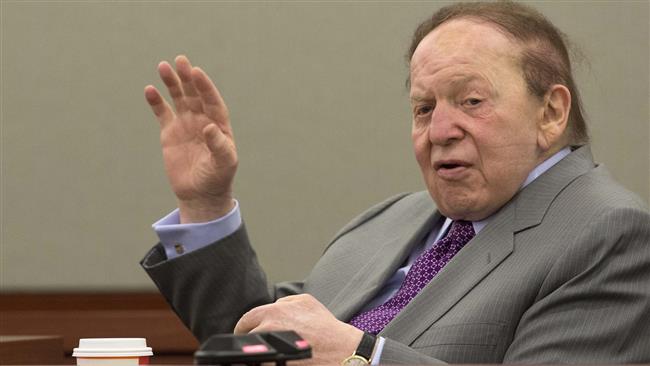
Press TV – April 25, 2015
US Republican presidential hopefuls and some other GOP lawmakers were in the state of Nevada on Saturday to attract big donors for their campaign funding.
Texas Senator Ted Cruz, Florida Senator Marco Rubio, Texas Governor Rick Perry, Senator Rob Portman (OH), Governor Mike Pence (IN), and Senator Lindsey Graham (SC), all Republicans, were in Las Vegas for the annual Republican Jewish Coalition’s spring meeting which began on Thursday.
The candidates wrapped up 3 days of lobbying for Israel to attract potentially billions of dollars in donations in the biggest gambling hub in the US.
They were there to win big donations from casino tycoons, most notably Zionist Sheldon Adelson who is the largest campaign donor in the US.
As far as the GOP contenders in Las Vegas are concerned, the fight to win Adelson’s support and others in Las Vegas is all about showing support and solidarity for Tel Aviv.
Former Texas Governor Rick Perry said, “Ignoring the lessons of history, our president aims to sign an agreement with… the Islamic Republic of Iran.”
“Sadly, the American friendship and alliance with Israel has never been more imperiled than it is right now today under this administration,” said Ted Cruz, one of the Republican presidential candidates.
About 800 members of the summit enthusiastically cheered the consecutive slaps on Obama and on a potential nuclear agreement with Iran and promises of loyalty to Tel Aviv.
In fact, Adelson was not there on Saturday, according to local media, because that’s when the session was open to the media.
It is reported that Adelson has a favorite candidate so far, and that’s Senator Marco Rubio who the tycoon “speaks to once every 2 weeks.”
Adelson spent almost $150 million in the last presidential election in 2012 and he is set to throw in millions of more dollars behind his favorite contender in 2016.
Adelson, a Jewish American and the country’s eighth-wealthiest person, has said that he will not invest in the 2016 elections based on personal loyalty but on a more strategic aim.
He is a prominent supporter of Israel’s Likud Party, which is currently headed by Prime Minister Benjamin Netanyahu. He is also known for his anti-Iran rants.
During a speech at Yeshiva University in New York City in October 2014, Adelson said that the US should drop a nuclear bomb on Iran before beginning negotiations with Tehran over its nuclear program.
Fear mongering, the ISIS gambit and Zionist recruitment
By Brandon Martinez | Non-Aligned Media | April 25, 2015
As the fear campaign advances into ever-more delirious extremes, Westerners continue to be submerged in sensationalist headlines about ‘homegrown terrorism’ and ‘ISIS recruits.’
The American, Australian, Canadian, British, French, German and other governments have been on the hunt lately, swooping up a handful of would-be ISIS recruits before they could make their journey to Syria and Iraq. The arrests appear to be part of a stage-managed public relations effort to 1) keep up the false pretense that the West is actually trying to stop people from joining ISIS, when in fact they have been gleefully turning a blind eye to it if not aiding and abetting it, and 2) to justify the growing surveillance state across the West.
ABC News tells us that more than 2000 Westerners, mostly from immigrant communities but also a number of white converts to Islam, have joined ISIS and other terrorist groups fighting to topple the Syrian government. Knowing the high level of surveillance and monitoring that Western agencies already employ against Muslim communities, it beggars belief that all of these individuals simply evaded the all-seeing eye of Western intelligence which includes the “Five Eyes” spy network consisting of the combined espionage might of the US, Canada, UK, New Zealand and Australia. The massive resources of the spy agencies of those countries in conjunction with the data mining brigands of the NSA makes it hard for one to believe that they’re just unable to track and intervene before Western citizens depart for the phony ‘jihad’ against Israel’s adversaries in Syria, Iraq and other parts of the Middle East.
The Intercept revealed that in a recent FBI ‘bust’ of an alleged ISIS sympathizer who was purportedly planning an attack inside the US, the suspect was goaded by FBI informants, as is the case with nearly every major foiled ‘terror plot’ in recent American history. John T. Booker Jr., the Kansas man accused of plotting a terrorist attack on behalf of ISIS, had checked himself into a mental hospital about a year before his arrest. The Intercept reports that the two FBI informants who initiated contact with Booker Jr. “provided the 20-year-old with the materials and support that led to his arrest on Friday on charges stemming from his alleged plans to carry out an attack against Fort Riley in support of the Islamic State.”
This example is merely one of many hundreds of cases involving the FBI’s army of 15,000 plus informants who infiltrate Muslim communities then work to incite and coerce impressionable, dejected young Muslims into completely inept and doomed-to-fail ‘terror plots.’
Canadian authorities have been caught mimicking the FBI’s duplicitous and unethical tactics of fabricating terror plots by way of informants. One recent case involved a bumbling British Columbia couple, John Nuttall and his wife Amanda Korody, who were prodded and pushed into a laughable ‘terrorist conspiracy’ by undercover RCMP agents. The Vancouver Sun reported that the undercover agents “spent more than four months in a futile attempt to have John Nuttall articulate a real [terrorist] plan.” Another Sun report described the ‘terror couple’ as “impoverished addicts” and delineated how an undercover agent coddled and encouraged them every step of the way, making suggestions about explosives and targets.
A story that broke earlier this year unveiled the West’s two-faced gambit as it relates to ISIS. The Turkish government exposed the identity of a Syrian national on the payroll of Canadian intelligence who was acting as a human trafficker for ISIS, escorting dozens of Europeans through Turkey and delivering them to ISIS strongholds in Syria, including three British schoolgirls.
“Turkish news agencies reported … that a foreign intelligence agent detained in that country on suspicion of helping the [three British] girls travel to neighbouring Syria to join ISIL was working for the Canadian government,” stated an Ottawa Citizen report on the scandal. The agent in question, Mohammed Mehmet Rashid, told Turkish authorities that he made routine trips to the Canadian embassy in Jordan where he received his marching orders from CSIS, Canada’s spy agency. That embassy was headed by Bruno Saccomani, a former RCMP officer and the former chief of Canadian Prime Minister Stephen Harper’s security detail. Harper handpicked Saccomani to be the ambassador to Jordan.
Another issue routinely overlooked by mainstream media is that ISIS is not the only violent radical group that Western citizens are bustling to join. Hundreds of Canadians, Americans, Australians and Europeans have joined the Israeli military over the years, participating in the murder of thousands of innocent Palestinian and Lebanese civilians, the mass destruction of property and other war crimes and crimes against humanity.
In an article entitled “Supporting ‘terror tourism’ to Israel gets Canadian tax credits,” Yves Engler, an expert on Canadian foreign affairs, observes that in Canada “[i]t is illegal for Somali Canadians to fight in that country but it is okay for Canadian Jews to kill Palestinians in Gaza. And the government will give you a charitable tax credit if you give them money to support it.” Engler documents the activities of pro-Israel charities operating freely in Canada that recruit young Jews to fight for Israel. “At least 25 volunteers from the Greater Toronto Area fought in Gaza during Israel’s 22-day 2008/2009 assault that left some 1,400 Palestinians dead,” notes Engler, adding that “during Israel’s 2006 attack on Lebanon the Canadian Jewish News reported that ‘Canadian youths leave home to join Israeli army.’”
“The double standard is extreme,” Engler writes, pointing out how Canadians are proscribed from recruiting for foreign militaries under the Foreign Enlistment Act, but this law apparently doesn’t apply to Jews who enjoy a privileged status in Canada and other Western countries.
The Canadian government’s pro-Israel extremism showed its ugly face in 2014 when the Harper administration added IRFAN-Canada, a Muslim charity which helped raise funds for the besieged people of Gaza and the occupied West Bank, to its list of banned ‘terrorist organizations.’ According to the Harper regime’s skewed Zionist logic, Muslim charities that work with the democratically elected leadership of Gaza in order to dispense humanitarian aid to the suffering Palestinians are engaged in ‘supporting terrorism.’ Yet Jewish-Zionist charities are allowed, even aided and abetted by the Canadian state through ‘tax credits’ for donors, to raise funds for the Israeli military and even to recruit radicalized Canadian Jews to fight in Israel’s bloody wars of aggression – but this somehow does not constitute material support for terrorism.
Evidently, in Harper’s pro-Zionist fantasy world ‘terrorist’ is a smear word applied exclusively to the opponents of Israeli imperialism, whereas a state birthed through ethnic cleansing and maintained by way of bribery, blackmail, and state-sponsored mass murder is praised to the heavens merely for allowing its privileged Jewish citizens and disenfranchised Arab subjects to vote for whichever hawkish Zionist politician will continue the policies of terror in the holy land.
Copyright 2015 Brandon Martinez
F-35 deal to destroy US leverage on Israel: Commentator
Press TV – April 24, 2015
Press TV has conducted an interview with Peter Rushton, a historian and political commentator from London, and Lawrence J. Korb, a former US Assistant Secretary of Defense in Washington, to discuss Washington’s delivery of new F-35 fighter jets to Israel.
Rushton says the delivery of fighter jets truly shows that the policies of US President Barack Obama are totally in line with those of his predecessor, George W. Bush, adding the most worrying fact is that the White House continues its military deals with Tel Aviv despite the regime’s longstanding aggressive policies.
The analyst slammed the recent military deal with Israel, which is the sole possessor of nuclear arms in the Middle East, saying such an accord strips Washington of any means of leverage that could enable the US to contain Tel Aviv’s warmongering policies.
Meanwhile, Korb believes the US is selling the equipment to Israel only to bolster the regime’s deterrence power in the face of dangers in the region.
Featured Video

AIDS Inc. by Gary Null (2007)
or go to
Aletho News Archives – Video-Images
From the Archives
Fanatical Followers of the Covid Regime: A Jim Jones-Style Cult?
By Professor Roger Watson and Dr. Niall McCrae | The Daily Sceptic | November 15, 2021
As scholars at leading British universities over recent decades, we witnessed the replacement of critical thinking and debate by narrative: facts are discrimination and scientific method is imperialism; truth, instead, is derived from ‘progressive’ values. This educational trend may be a major contributory factor to the ease in which society has been inculcated to the Covid ‘new normal’ of masking, testing, and repeated doses of vaccines for a disease of similar risk to severe influenza.
One doesn’t need much critical reasoning to observe the flawed logic of some vaccination enthusiasts, such as people who respond to experiencing any side effects, however debilitating, by saying “at least I know it’s working”, or, after contracting the disease despite their promised inoculation (over 90% effective, according to initial drug company claims), “I’d have been worse off without the jab.” … continue
Blog Roll
 Aletho News
- Merck Virologists Admitted to Falsely Certifying Vaccine Efficacy
- Mandatory Folic Acid for every man, woman & child
- Pro-Palestine protesters arrested outside UK’s ruling Labour Conference in Liverpool
- Mauritius denies landing permit to flight from Israel, forcing cancellation: Tour operator
- Israeli finance minister calls for genocidal war on West Bank, annexation of south Lebanon
- 12 Things Your Psychiatrist Was Trained Not to Tell You
- From Unipolar Universalism to Multipolar Civilizational Distinctiveness
- RSF military group defects, joins Sudanese army: State media
- Ireland goalkeeper refuses to play ‘Israel’ as squad weighs boycott
- China pushes back against US on Cuba, Iran
- If Americans Knew
- Israel forces Gazans to live in constant peril – Daily Update
- Deconstructing Netanyahu’s pants-on-fire UN rant – Daily Update
- Trump betrayed voters with his campaign lies and prioritized a foreign country once he took office
- Netanyahu calls Israel’s war in Gaza ‘opposite of genocide’ in UN speech to near-empty hall
- Settler Kidnappings: Torture, Sexual Abuse and Terrorisation of Palestinian Abductees as Israel Deepens Annexation of West Bank
- Gaza winter nears as 162,000 tents become unusable, raising fears of humanitarian crisis
- Netanyahu says, “It’s the opposite of genocide”; UN says Gaza economy is world’s ‘most severe crisis on record’ – Daily Update
- Israel’s US-Backed Assault on Gaza Has Created the ‘World’s Most Severe Economic Crisis on Record’: UN
- ‘Protecting U.S. Citizens’… From Israel
- ‘This is where I live now, the back of a truck’: a day in the life of a grandmother in Gaza
- No Tricks Zone
- New Study: Earth And Venus Surface Warmth Largely Explained By Convection And Lapse Rate, Not CO2 Or Radiation
- 2025 Nature Paper Claiming Worsening Global Drought Gets RETRACTED …Heavily Flawed
- New Study: ‘Global Drought Shows No Detectable Recent Acceleration Under Climate Warming’
- Economic Masterminds: German Socialists Suggest Taxing Productivity Gains Stemming From Using AI
- The South China Sea Has Not Been Cooperating With The Climate Change Narrative
- Energy Crisis: Germany Enters Heating Season With Historically Low Gas Reserve Fill Levels
- New Study: The Antarctic Ice Sheet Gained Mass From 2020-2024 Due To Staggering Snow And Ice Accumulation
- Study: Ocean Heating Rates From Thousands Of Years Ago ‘Dwarf’ Modern Ocean Heating Rates
- Climate Extremists Target, Attack Large-Scale Power Grid Infrastructure In Germany!
- New Study: Antarctic Ice Melt Has Contributed Less Than 1 Centimeter To Sea Level Rise In The Last 30 Years

