ISIS 101
What’s really terrifying about this threat
By John Chuckman | Aletho News | March 1, 2015
ISIS certainly is not what a great many people think that it is, if you judge what they think by what our corporate press proclaims incessantly.
Judging by what ISIS actually does and whom its acts benefit, its clandestine associates, and the testimony of some witnesses, ISIS is a complex intelligence operation. Its complexity reflects at least in part the fact that it serves the interests of several countries and that it has more than one objective. Its complexity reflects also the large effort to reinforce a false image with disinformation and staged events such as a video of a beheading which could not have been a beheading unless they’ve discovered a bloodless method until now unknown to science.
The subject of ISIS is not without brief glimmers of humor. The image of bands of men, swathed in Arabic robes and bumping their way around the desert in Japanese pick-up trucks with Kalashnikovs raised in the air for every picture has elements of Monty Python. The idea of modern, trained and well-armed military units turning and running from them resembles a war scene in a Laurel and Hardy comedy such as the one with Hardy stuck upside down in a WWI tank turret kicking his legs the whole time Laurel drives towards the German positions managing accidentally to round-up a whole trench-full of prisoners with some wire fencing that becomes snagged on the tank.
Despite the tiresome stupidities we see and hear about it, ISIS unquestionably does kill people and destroy things, that being its purpose, and there is no humor in that.
ISIS appears to have served several tasks so far. First, it frightened Iraq’s Prime Minister, Nouri al-Maliki, out of office in Iraq, a man America and Israel grew very much to dislike owing simply to his good relations with Iran, one of the unintended consequences of America’s invasion of Iraq being expanded Iranian influence in the region. No doubt al-Maliki was terrified not so much by ISIS approaching in their pick-up trucks as he was by his own military’s tendency, as if on cue, to turn and run from ISIS, often leaving weapons behind. The message was clear: you won’t be protected.
Second, America’s highly selective “air war” against ISIS somehow manages to attack infrastructure targets inside Syria with the feeble excuse that they are facilities helping ISIS. We’ve seen what American bombing can do when it’s undertaken seriously, and somehow I have a hard time imaging the men in Japanese pick-ups lasting long when faced with what hit the Taleban in Afghanistan or Gadhafi’s forces in Libya. The air strikes are partly a show for the world – after all, how can America be seen not to be fighting such extremely well-advertised, super-violent terrorists, guys putting out videos regularly from a studio trailer they must haul around with one of their pick-up trucks? The air strikes’ main purpose appears to be a way of hurting Assad and assisting those fighting Syria’s army without coming into conflict with Russia, as they would with a large, direct campaign. They likely also punish elements of ISIS which have exceeded their brief and serve as a reminder to the rest of what could happen to them if they stray too far from their subsidized purpose once the war comes to an end.
Three, in some of the ground fighting in Iraq where we’ve read of Iraqi units fighting ISIS, the units are often Kurdish, and sometimes the press uses expressions like “Iraqi and Kurdish troops.” But the Kurdish region is still part of Iraq legally, although it has been given a good deal of autonomy by the central government. The Kurdish region of Iraq is the country’s prime oil-producing area, and in the estimation of many observers, an area both the United States and Israel would very much like to see severed from Iraq in the way Kosovo was severed from Serbia after America’s devastating air war there. This would not only permanently assure Iraq’s weakness, it would create a rather grateful and more willing oil supplier.
Where does ISIS get its technical equipment and the know-how to produce videos and run Internet sites? These are not qualities commonly found among fanatical fundamentalists anywhere; indeed most true radical fundamentalists tend to eschew technology. A supply of advice, technical assistance, and equipment comes from somewhere. Where does ISIS get the money for food, gasoline, clothes, ammunition, and Japanese pick-up trucks? And I wonder, did one of those wild-looking jihadi types just show up one day at an Iraqi car dealership and order a fleet of Japanese pick-ups? Were they delivered out on the desert or did a gang of jihadists march in, waving their Kalashnikovs, to drive them away?
The effort to destroy the Syrian government, whether by means of ISIS or anyone else, is warmly and generously supported by Saudi Arabia and its buddy Qatar – another oil-rich, absolute monarchy where political parties are banned – both these countries’ primary interest being the defence of their immensely privileged situations against creeping threats of all progressive developments such as equal human rights or democracy or indeed against revolt led by external forces. The payments we now know the Saudi royal family long made to Osama bin Laden before 9/11 were simply bribes to keep him and his anti-establishment work out of the country. They really didn’t care a lot about what the money bought elsewhere, but since 9/11 and its many Saudi connections – 15 of the perpetrators plus the past financing plus the many members of the royal family and bin Laden family secretly flown out by American officials at the time – the Saudi authorities were genuinely fearful of how America might respond and have become far more responsive to what America wants in the Middle East and now apply their money to such projects. What America wants in the Middle East is, invariably, what Israel wants, so there is now extensive, secret cooperation where once there was complete official hostility.
We have reports from plane-spotters in the region of daily flights of mysterious planes from Israel to Qatar. We have several eye-witness reports and photographs of supply bundles dropped from unknown planes into ISIS territory. Maybe ISIS has its own air force now? We know Turkey has served both as an entry point for countless terrorists into Syria and as a place of retreat and refuge when fighting with the Syrian army becomes too hot for them, the volumes of such activity having been too great to keep secret. We have reports of Turkish supply flights. A Jordanian official recently told a reporter that ISIS members were trained in 2012 by American instructors working at a secret base in Jordan.
If ISIS is what our corporate news pretends that it is – a fanatical Muslim extremist group that sprang suddenly from the desert sands much like Jack’s bean stalk – one blindingly obvious question is, why does it not attack Israel or Israeli interest? Isn’t that what one would expect from such a cast of characters? But it has not done so, undoubtedly because Israel is an important covert benefactor and supplier.
We might equally ask why ISIS has not attacked Saudi Arabia or its interests, for although the Saudi royal family officially professes a strict and conservative form of Islam, Wahhabism, in fact many of them are very worldly people who spend a good deal of time and money at the world’s great pleasure palaces. Perhaps even more damning for a genuine fanatical fundamentalist, the Saudis now often secretly cooperate and make plans with Israel where mutual interests exist.
No, there is something highly suspicious about Islamic fundamentalist terrorists who avoid such interests while managing to brutally kill poor Syrian soldiers just doing their jobs along with the odd foreign journalist or aid worker who may just have seen something they shouldn’t have seen. Of course, we have Edward Snowden himself having described ISIS as an operation intended to protect Israel. Despite the fact that some news sources have said the interview in which this was revealed never took place, my instincts tell me it likely did. Snowden has never refuted it, and the news sources saying it did not are highly suspect on such a subject.
The way ISIS serves Israeli and American interests is by providing a focus point for extremists, attracting them from various parts of the world so that they can be recorded and kept track of. Also the tracks back to the various countries from which they come provide security services with leads to places where there might be some festering problems. In the meantime, ISIS serves the interest of helping to bring down President Assad, a goal dear to the hearts of Israelis. Please remember that black operations, even the ones about which we know, show little consideration for lives or property. Just think of Israel’s attack on an American spy ship in the Mediterranean during the Six Day War, its pilots knowingly shooting up and bombing for two hours the well-marked ship of its ally and benefactor, no explanation worth hearing ever having been offered.
Just read conservative mainline sources (pretty much a redundant pair of adjectives) about the harm Snowden has done: claims of everything from his revelations about American intelligence having served to help ISIS avoid detection (!) to his revelations having set up the United States for another 9/11! You might think intelligent people would be ashamed of making such asinine public statements, but, no, there are almost no limits to trying to discredit those revealing murderous, dark operations.
We’ve had many reports of officials in various countries, including Canada as I write, concerned about the odd individual or small group running off to join ISIS. Now why should that be a concern? A few flaky people going abroad just removes them from your country, something I should have thought was a complete gain from a security point of view. Even if they were ever to return in future, you would know exactly who they are. Where is the basis for serious concern? But the psychological advantages of noise and hype to scare people about obscure dangers and “lone wolves” and “home-grown terrorists” outweigh completely good sense and intelligence.
Finally, there are numerous reports that Abu Bakr al-Baghdadi (a nom de guerre, not his real name), the leader of ISIS, is a Western intelligence asset. What little we can learn about him makes that entirely plausible. The Supreme Leader of Iran, Ali Khamenei, has said that the man is a Mossad agent, a claim supported supposedly by documents revealed by Edward Snowden. Abu Bakr al-Baghdadi is by all accounts a secretive man who speaks directly with few people, and even his birth place, given as Samarra, Iraq, is not sure. Records of his past, as those from his period of American captivity (always a great opportunity to “turn” someone to serving two interests), are not available. He was once reported killed but is still alive. He is said to have received intensive training from Mossad and the CIA, and some sources give his real name as Simon Elliot (or, Elliot Shimon), but few details can ever be certain in such dark operations.
The truly terrifying aspect of ISIS and other forces fighting with it in Syria is that the United States and Israel have approved and supported such wanton destruction in so beautiful and formerly-peaceful a place as Syria. Millions of lives destroyed and countless historic places damaged as though they were all nothing more than a few pieces moved on a geopolitical chessboard. I think it fair to describe that as the work of psychopaths.
Israel asks US for additional $300mn for missile defense – report
RT | March 1, 2015
Israel reportedly bypassed the White House and asked the US Congress for an extra $317 million to be added to President Barack Obama’s budget for the next fiscal year in order to fund Israeli missile defense programs, Bloomberg reported.
The requested funds would be in addition to the $158 million already proposed by the Pentagon for Israel’s security needs for the fiscal year that will begin on October 1. The new allocation will allegedly finance the ‘David’s Sling’ and ‘Arrow-3’ programs – designed to intercept medium- to long-range missiles – as well as provide an anti-ballistic missile system.
According to Bloomberg’s report on Friday, the director of Israel’s missile defense organization Yair Ramati “visited lawmakers and aides to the congressional defense committees on February 2 and 3 to outline the case for more money and thank them for past assistance.”
Ramati completely bypassed the White House and the Pentagon. The report links the move to the tense relationship between the Obama administration and the Israeli government ahead of Prime Minister Benjamin Netanyahu’s speech to Congress on March 3, which is likely to stress that the White House is pursuing a “bad deal” by negotiating to curb Iran’s nuclear program.
The report revealed that Ramati’s proposal included $250 million to start production of the David’s Sling system, in addition to Obama’s $37 million request for development. Another $35 million Ramati requested for the initial production of Arrow 3, in addition to the $55.7 million the US administration is seeking for development.
During his visit to Capitol Hill, Ramati “distributed one-page sheets naming US contractors that would benefit from production funds for each of the missile defense systems.” According to Bloomberg’s information, the list included Chicago-based Boeing Co.; Waltham, Massachusetts-based Raytheon Co.; Arlington, Virginia-based Orbital ATK Inc.; and Falls Church, Virginia-based Northrop Grumman Corp.
When contacted by Bloomberg, the Israeli embassy in the US declined to comment on the report.
The US already provides Israel with $3.1 billion a year as “foreign military financing,” which excludes other missile defense funds, according to the report.
For the current fiscal year, Congress has reportedly provided $620 million, including about $347 million for missile defense programs. US Congress has appropriated more than $1.2 billion since 2011 for the Iron Dome, which is designed to intercept and destroy rockets.
In light of the large amounts of distributed funds, US lawmakers have been insisting that Israel use American-based defense contractors when spending the received money.
Last year, the Israeli government agreed to spend more than half the funds provided by the Pentagon for the Iron Dome in the US by this year. Until recently, the missile system was been built solely in Israel by Rafael Advanced Defense Systems Ltd.
Iran nuclear talks have created a significant rift between Israel and the US. Last week, the White House and State Department stated that Israel inaccurately provided information and twisted the official US position in nuclear talks with Iran, and accused Tel Aviv of “selectively” leaking details of sensitive talks.
Washington has also voiced suspicion that Netanyahu’s office directly provided Israeli journalists with the leaked information, including an alleged offer to Iran to keep 6,500 centrifuges for uranium enrichment. A White House spokesman expressed frustration with the “cherry-picked” information released by the Israelis out of context.
Bahraini exiles test Britain’s policy on statelessness
By Alastair Sloan | MEMO | February 9, 2015
The Al-Khalifa monarchy in Bahrain recently stripped over 70 exiled activists of their citizenship, eight of whom live in Britain. In 2012, they did something similar, stripping 31 human rights and pro-democracy activists of Bahraini citizenship, 11 of them living in the UK. These new exiles are testing Britain’s policy on statelessness.
Bahrain’s move is particularly ironic because much of its state security apparatus is made up of mercenary enforcers and interrogators from Pakistan, Yemen, Syria and Jordan. All have been given Bahraini citizenship, housing and salaries by the regime in return for their role in the torture, humiliation and shooting of peaceful pro-democracy protesters.
The Al-Khalifas use citizenship as a weapon. It is offered to those who take part in callous oppression, but removed from citizens who call for democracy.
This latest move was choreographed carefully to coincide with the confiscation of passports from preachers and fighters associated with ISIS. Thus the authorities have conflated the two movements in a clumsy smear.
The British charity Asylum Aid has been conducting wide-ranging research into the negative impacts of statelessness, interviewing stateless persons in Britain who have been destitute for months. They have been detained by the UK immigration authorities despite evidence that they have no prospect of returning to their home country, or that they have been separated for years from their families overseas. Some have been forced to sleep on the streets. Many have seen their accommodation and support cancelled repeatedly and then reinstated. In the absence of a dedicated and accessible procedure to identify people who are stateless, they have been left in a legal limbo for years.
In a rare moment of progressive policy making, Britain has taken steps recently to address the problem of statelessness. Across the European Union, approximately 600,000 quasi-citizens are estimated to be stateless. The UK is so far the only EU member to implement substantive measures to assimilate stateless refugees, implementing a specialised asylum procedure from April 2013. Thousands of refugees are currently applying through the official mechanism, with immigration officials deciding each case carefully; it is not a straightforward process.
The British authorities must act to treat the Bahraini exiles stripped of their citizenship on the same basis as other refugees. However, as the repression in Bahrain grows worse, it is becoming increasingly clear that the British government is sticking to its commitment to support the Al-Khalifa regime. As I have reported previously elsewhere, Britain has been accused of harassing, rather than helping, such exiles, often in collusion with the Bahraini government.
In January, Foreign Secretary Philip Hammond praised improvements in Bahrain’s human rights record, shortly before the Gulf state jailed its most prominent human rights activist, Nabeel Rajab, for six months. His “crime” was to send an “insulting tweet”. He is currently on bail pending an appeal scheduled for later this week. In July 2014, the Guardian revealed that Hammond had sat next to the Earl of Clanwilliam, a lobbyist for the Bahraini government, at a fundraising dinner for the Conservative Party.
The parliamentary Foreign Affairs Committee also lamented the government’s decision not to “bite the bullet” – its own words – by designating Bahrain as a human rights “country of concern” for 2014. “We see little or no evidence that Bahrain has made enough progress in implementing political reform and safeguarding human rights,” the committee judged. Civil society organisations described the British government’s reluctance as a whitewash.
The FCO response was short, disdainful and factually inaccurate. “On the human rights front Bahrain is by no means perfect,” it insisted, “but it is a country that is making progress and its leadership has shown a willingness to engage with the human rights challenges that it faces.”
Research by Bahrain Watch, an NGO which has been tracking progress on the Al-Khalifa government’s alleged reforms, shows that if British officials believe Bahrain to be “making progress”, they are wilfully and obstinately ignorant.
Of the 25 recommendations made to improve human rights in Bahrain after the 2011 uprising, 11 have been violated openly, six have seen no action at all, five have had no details about their progress released by the government, and three have been implemented “partially”. Not a single reform is judged to have been implemented in full.
The leader of the main opposition Al-Wefaq Party, Ali Salman, was arrested recently on what are claimed to be trumped-up charges. He was also slapped with a travel ban just as he was about to embark on “a major European tour, meeting officials, think tanks, civil society leaders, academics and media professionals.”
Despite this, Britain announced recently a significant expansion to its military assets in Manama harbour, with plans for a full-scale naval base. The Royal Navy has deployed small minesweepers out of Bahrain for some years, but when larger vessels visit the port the crews sleep on board; there are limited facilities for such ships. With a naval base, British warships will be able to deploy regularly from Bahrain. The expansion of the base will resume a long term British military presence in the area and mark the end of a 40-year Middle East policy by the government. Controversially, the Bahrain government will foot the bill for building the Royal Navy facilities, effectively buying Britain’s silence over its ongoing human rights abuses.
Britain has a patchy record on human rights, but addressing statelessness has been a more positive example of what can be done. In applying this new policy rigorously and fairly, they must include Bahraini exiles, as they would any other refugee.
Israel-Egypt cooperation surpasses expectation
MEMO | January 28, 2015
Cooperation between the Israeli and Egyptian military and intelligence apparatuses exceeds all expectations, Israel’s Channel 10 stressed on Monday, noting that Cairo agrees with Tel Aviv’s requests pertaining to confronting “radical” Islamic movements in Sinai and the Gaza Strip.
In a report the channel’s military affairs broadcaster Alon Ben-David said that cooperation between the Egyptian and Israeli armies does not depend only on the coordination and sharing of intelligence information, but goes beyond this to field cooperation, in reference to the parties’ joint operations against those who are considered sources of danger for Israel and Egypt in Sinai.
Last year the Israeli TV station revealed that Prime Minister Benjamin Netanyahu issued instructions to carry out operations in the heart of Sinai.
Meanwhile, Israeli newspaper Israel Hayom, which is close to Netanyahu, asserted on 12 June 2014 that the Egyptian army depends on intelligence information provided by Israel in its operations against jihadists in Sinai.
General Amos Yadlin, former head of the Israeli Military Intelligence Division, said the confluence of interests between Israel and the “moderate Sunni” governments represents an unprecedented opportunity for Israel to strengthen cooperation with them so as to enhance Israel’s strategic environment and help it cope with the significant challenges it faces.
In an article published by the Makor Rishon newspaper on Monday, Yadlin stressed that Israel has greatly benefited from cooperation with Egypt, Jordan and some countries in the Gulf, calling on Netanyahu’s government to take advantage of this opportunity.
However, Yadlin said that what could undermine such opportunity is the unstable situation in some Arab countries, as well as the deliberate embarrassment that Israel is causing the Arab ruling elites by rejecting the peace initiative that was launched by the late Saudi King Abdullah Bin Abdulaziz.
Illegal Occupation, the Elephant In The Room
The Origin of Modern Terror and Crumbling Western Values
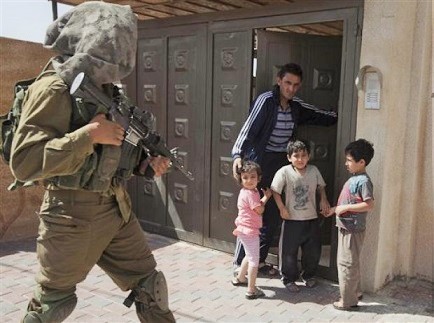
By John Chuckman | Aletho News | January 26, 2015
Do you ever solve problems by ignoring them? Most of us would say that is not possible, yet that is precisely what western governments do in their efforts to counteract what is called “Islamic terror.” Yes, there are vast and costly efforts to suppress the symptoms of what western governments regard as a modern plague, including killing many people presumed to be infected with it, fomenting rebellion and destruction in places presumed to be prone to it, secretly returning to barbaric practices such as torture, things we thought had been left behind centuries ago, to fight it, and violating rights of their own citizens we thought were as firmly established as the need for food and shelter. Governments ignore, in all these destructive efforts, what in private they know very well is the origin of the problem.
Have Islamic radicals always existed? Yes, we have records through the history of British and French empire-building of strange and fearsome groups. It appears every large religion has a spectrum of believers, always including at one end of the spectrum extreme fundamentalists. They are not a new phenomenon anywhere, so why has one group of them, in the sands of the Middle East, become part of our everyday awareness?
It is also nothing new that young men become hot-blooded and disturbed over what they regard as attacks upon their kind. Western society’s record of crusades, religious wars, colonial wars, and revolts, all total likely having no equal in the histories of the world’s peoples, offers countless examples of young men being angered by this or that circumstance and joining up or running off to fight.
George Bush told us today’s terrorists hate our freedom and democratic values, but like virtually every utterance of George Bush, that one was fatuous, explaining nothing. Nevertheless, his is the explanation pounded into public consciousness because governments and the corporate press never stop repeating versions of it, the Charlie Hebdo affair and its theatrical posturing over free speech being only the latest. Theatrical? Yes, when we know perfectly well that most of those who marched at the front of the parade in Paris are anything but friends of free speech.
All backward peoples are uncomfortable with certain western values, that being the nature of backwardness, and backwardness is a defining characteristic of all fundamentalist religious groups – Hasidic or ultra-Orthodox Jews, Mennonites, Roman Catholic Cardinals, cloistered nuns, Sikhs, and many others – who typically choose modes of dress, rules to obey, and even foods to eat having little or no relationship with the contemporary world and science. Of course, that is their right so long as they are peaceful and law-abiding.
Any fundamentalist group, pushed by more powerful people from outside their community, is entirely capable of, and even prone to, violence, and all human beings are capable of violence when faced with abuse and injustice. Centuries of religious wars and terrors in Europe about such matters as how the Mass is celebrated prove the proposition and should be held as a warning, but they are forgotten by most, if they were ever known. The tendency towards violence continues today amongst many fundamentalist faiths. In so relatively small and seemingly homogeneous a society as Israel, there are regular attacks from ultra-Orthodox Jews against the country’s worldly citizens or against fair-minded rules about such pedestrian matters as women riding buses or walking on a street. The attacks become quite violent – punching, spitting, burning down homes, and killing sometimes – and all go against what we call western values, but because the scale is fairly small, and our press also has a constant protective bias concerning all things Israeli, these events rarely make our mainline news. They must be found on the Internet.
It took Western Europe literally centuries to leave behind such recurrent and violent themes as witches and the need to burn them alive, the Evil Eye, casting out demons, execution for differences of belief, and countless other stupidities which characterized whole societies and destroyed lives. And if you want to go still further back, go to the Old Testament, a collection of ancient writing packed with violence, superstition, prejudice, and just plain ignorance, which Christians and others even today regard as containing important truths for contemporary life. Human progress, at least in some matters, takes a very long time indeed.
Our world has more backward people than most of us can imagine. The news does not feature their extremes and savageries because it serves no political purpose. In Africa, for example, we find practices and beliefs utterly repellent to modern minds: the practice of senior village men raping young girls as an accepted right, the genital mutilation of 3 million girls annually (an African, not an Islamic, practice), the hunting down and butchering such “strange” people as albinos, their parts to be eaten as medicine, and many others. In India, a country well on its way to becoming modern yet one with a huge backward population, we have practices such as marrying off mere girls to old men rich enough to pay dowries to poor parents. At one stroke this enriches the parents and relieves them of the burden of a child, a female child too, always viewed less favorably. The practice generates a large population of widows when the old husbands of girls married at, say, twelve die. These women are then condemned to entire lives as widows, never allowed to remarry, required to dress and eat in certain ways, and basically shunned to live in squalid equivalents of old folks homes, living entirely meaningless lives. India also has the practice of “bride burning” where new brides who are deemed unacceptable for various reasons become the prey of the groom’s family, literally being burned alive. There are many other barbarities in that society too, including “honor killing” and young women who are made inmates in certain temples to serve as glorified prostitutes.
Our press assiduously avoids much of the world’s horrors as it focuses on “Islamic extremism,” and politics are the only explanation for the bias. The press theme of Islamic terror and indeed real incidents of terror grow from a reality always taken for granted, never debated, and certainly never criticised: the elephant in the room, as it were, is Israel’s illegal and agonizingly long occupation of the Palestinians.
It may be not be important to our press and governments that Israel holds millions as prisoners, crippling the lives of generation after generation, or that Israel periodically strikes out in every direction – Gaza, Lebanon, Syria, the West Bank – causing the deaths of many thousands, or that Israel is seen to bulldoze people’s homes and sacred monuments with complete impunity, but it very much matters to many millions of Muslims in the world, and some of them, fundamentalist men, strike out against it just as young men everywhere have sometimes struck out against keenly-felt hurts and injustice.
In western countries, under the hard influence of America, a country in turn under the hard influence of the world’s best organized and financed lobby, the Israel Lobby, we have come to regard Israel’s behavior as normal, but it is, of course, not normal, not in any detail. What is normal about holding several million people prisoner for half a century? What is normal about bulldozing homes and literally stealing the land upon which they stood? What is normal about declaring an honestly elected government as criminal and treating its people as though they were criminals? What is normal about limiting people’s opportunity to earn a living or to import some of the needs of life? What is normal about killing nearly a thousand children, as Israel has done just in Gaza, since 2008?
Pretending that Israel’s behavior is not the major cause of what screams from our headlines and news broadcasts has reached absurd levels. America has only vastly compounded the problem of Israel’s organized abuse of a people: it and its silent partners have destroyed Iraq, destroyed Libya, are working hard to destroy Syria, have seen to it that Egypt’s tens of millions again live under absolute government, ignore countless inequities and barbarities in secretly-helpful countries like Saudi Arabia, and carry out extra-judicial killings through much of the region. All of it is carried out on Israel’s behalf and with Israel’s cooperation. Can any reasonable person not see that this vast factory of death also manufactures countless grievances and vendettas? The stupidity is on a colossal scale, rooted in the notion that you can kill your way out of the terrible consequences of terrible policies.
In America, paid political shills (Newt Gingrich was one) have campaigned about there being no such thing as a Palestinian. Others (Dick Armey was one) have said that millions of Palestinians should be removed, all their land left conveniently to Israel. That last is an odd thing to say, isn’t it, considering there are supposed to be no such thing as Palestinians? And just what country would take millions of “non-existent” Palestinians? Obviously no politician with even pretence of integrity would say such things, and how can intelligent and successful people like America’s Jews take satisfaction in hearing politicians reciting such embarrassing scripts? But this is a good measure of the way intelligence and sound thinking are scorned in American politics. How can you achieve anything worth achieving without intelligence and sound thinking? You cannot, but that doesn’t stop American Presidents and Secretaries of State from carrying on the world’s longest-running dumb show, something called the “peace process.” The sombre, moose-like figure of John Kerry is photographed playacting at statesmanship while American-supplied arms just keep killing thousands of innocent people.
Houthi leader sets conditions to end Yemeni crisis
MEMO | January 21, 2015
The Houthis have outlined four conditions to end Yemen’s political crisis, the Anadolu Agency reported the group’s leader as saying.
In a televised speech broadcasted by Yemen’s Al-Maseera satellite channel yesterday, Abdul-Malik Al-Houthi called for a speedy reformation of the National Supervisory Authority which was tasked with overseeing the results of the National Dialogue Conference and which ceased to be active in January 2014.
He also called for amendments to the country’s draft constitution to be expedited, the implementation of the peace and partnership agreement and to conduct comprehensive security reform.
Al-Houthi accused Yemeni President Abd Rabbuh Mansour Hadi of “protecting corruption and lack of seriousness in implementing the peace and partnership agreement, which brought the country to the current situation”.
He also accused him of supporting Al-Qaeda and supplying it with weapons. “President Hadi refused to allow the army to fight Al-Qaeda and gave the group the opportunity to rob banks,” he said.
The Yemeni capital Sanaa was been rocked by violent clashes for the second consecutive day on yesterday between presidential guards and Al-Houthi militants who are said to have seized the presidential palace with Prime Minister Khaled Bahah inside.
Al-Houthi said: “There is a conspiracy against Yemen and its people that is led by forces targeting the entire region. Yemen in on the verge of political, security and economic collapse. The Yemeni leadership is mired in corruption” he said.”
The Houthis seized control of Sanaa in September.
Charlie Hebdo, Zionism & Media Deception – Interview with Hafsa Kara-Mustapha
Brandon Martinez interviews Hafsa Kara-Mustapha on a January 18, 2015 episode of the Non-Aligned Media Podcast.
Hafsa Kara-Mustapha is a London-based journalist and political commentator who has written extensively about the Middle East for publications such as Middle East Magazine, Jane’s Foreign Report and El Watan newspaper. She also appears frequently on Press TV and Russia Today.
Brandon Martinez is an independent writer and journalist from Canada who specializes in foreign policy issues, international affairs and 20th and 21st century history. For years he has written on Zionism, Israel-Palestine, American and Canadian foreign policy, war, terrorism and deception in media and politics. Listeners can contact him at martinezperspective[at]hotmail.com or visit his blog.
Western Democracy Crusaders are Foes of Democracy
The World Seen Through a “Progressive” Western Keyhole versus a Panoramic Lens
By John V. Walsh | Dissident Voice | January 18, 2015
One of Castro’s closest comrades, the Argentine-born guerilla Che Guevara, had been in Guatemala in 1954 and witnessed the coup against Arbenz. Later he told Castro why it succeeded. He said Arbenz had foolishly tolerated an open society, which the CIA penetrated and subverted, and also preserved the existing army, which the CIA turned into its instrument. Castro agreed that a revolutionary regime in Cuba must avoid those mistakes. Upon taking power, he cracked down on dissent and purged the army. Many Cubans supported his regime and were ready to defend it. (Emphasis, jw)
Stephen Kinzer, The Brothers: John Foster Dulles, Allen Dulles and Their Secret World War
The stark choice that confronted Castro and Guevara is faced by every nation seeking independence from the U.S., a far more powerful nation with enormous resources in terms of “soft” power, economic power and military power. The more open the society, the more opportunities for CIA-engineered regime change. This was the lesson Arbenz learned in 1954 and Mossadegh before him in 1953, lessons that brought so much pain, death and destruction to their peoples in the decades to follow.
Judged by that outcome, the Castros made the right decision and as a result have presided over a healthy, educated and secure people. The drawback was that the Empire isolated Cuba economically, stifling the possibilities of more development and a higher standard of living. The Empire wants nations charting an independent course to be politically open to the regime change schemes and NGOs of the West but economically closed, shut off from more advanced economies. It is as simple as that.
For some defiant states the sort of regime change operation used against Mossadegh and Arbenz may be the only option which the United States has. This is certainly the case for China and Russia. All out war on these countries is out of reach – although the U.S. is trying to change that. The modus operandi of the Empire for the moment is to put Russia and China on the horns of tried and true dilemma. Open up politically, permit the development of forces that favor regime change – or remain less open and face criticism, especially criticism from Western governments and Western intellectuals, including the “progressive” or liberal intellectuals. This is crucial because “progressives” are the very people who – until Obama – were most likely to oppose imperial warfare – both military and economic. The Democracy Crusade is designed to neutralize them.
This criticism from the West is one lever, and an important one, that is used to force a society to be more open in its governance than its survival permits. Let us be clear. Without a rapacious West at the doorstep, the possibilities of openness and democracy are much greater in scope. Conversely, the more rapacious the West, the more restricted are the possibilities for a besieged nation if it wishes to survive and prosper with its sovereignty intact. Without sovereignty there can be no democracy. Rule conditioned on approval by a foreign source or by a puppet regime is never self-rule. So it is never democracy.
It follows that the best way to crusade for openness and democracy is to work against Western interventionism, whether that interventionism takes the form of armed attack, economic sanctions or the work of NGOs like the NED (National Endowment for Democracy). This is absolutely crucial to understand. A criticism of a besieged country will increase the pressure on that country and hence lead to a decrease in political openness. Paradoxically, this is true even if the criticism is one that calls for more democracy.
The recent events in Hong Kong are but the latest example of this dynamic. There the NED had long been actively involved in promoting “democracy,” along with other U.S. NGOs and the U.S. Consulate, with its staff of 600. These forces recruited very young “activists,” with high school students at the forefront. (A Chinese friend of mine noted with disgust that easily manipulated high school students were also in the forefront of the Cultural Revolution.) The movement sought elimination of the screening of candidates by a committee of 1,200 Hong Kong residents for the next election of the CEO, a position akin to governor. The composition of the committee was open to negotiation. (It went unmentioned in the West that there was no election when Hong Kong was a colony of the UK. The governor was appointed by the Queen – period. It also went unmentioned that there is a similar sort of “screening” of candidates in the U.S., with the major parties serving in the role of screeners. If you do not believe that, ask the Greens or the Libertarians or Ralph Nader.) Most importantly the leaders of the movement and their U.S. backers made no secret of their hope that the disturbances in Hong Kong would spread to the mainland and provoke a movement against the Chinese government. They are advocates of regime change in China as are their mentors at the NED.
What has the current government of China, led by its Communist Party, done for China? It has led China out of colonial domination by the West. It has forged a level of economic development with a rapidity unseen before in all of human history. It has ended poverty for 600 million people and continues on the quest to raise millions more out of poverty. For the world it has meant a power, China, which is sufficiently strong to provide a multipolar world. That in turn means that the countries of the world have an alternative to Western domination, which has been the fate of most of the world for hundreds of years. Russia and Iran, for example, can trade with China when the West slaps sanctions on them. As a result at this moment there is the possibility of genuine decolonization (or de-neocolonization, if you will) – after centuries of the planet’s domination by a small fraction of the world’s population.
In short, the current government of China is the agent of the most stunning defeat of Euro-American colonialism that the world has seen to date. After all the Chinese are almost one-fifth of humanity. One would think that this fact would be part of the evaluation of Western progressives when they looked at the Hong Kong affair. With few exceptions it was not. And this is a big problem. The world is going through a major upheaval as colonialism and neo-colonialism are suffering major defeats. That upheaval, that shift, is a lens through which Western “progressives” should look at the world. They rarely do. In failing to do so, they see the world through the ideological eyes of the West, that is, “the 1%“ at the top of the heap (or at least the 10%) if one may put it that way. China has achieved what the West hates most. It is relatively closed politically to the intrigues and machinations of the West – but economically open. This is the recipe for sovereignty and development.
The difference between the two views is the difference between looking at the world through a panoramic lens, with history in the background, and looking through a keyhole. In the latter case of tunnel vision one may only see a patch of grey through the keyhole, whereas a mighty elephant stands beyond the door.
Afterthoughts: Old China Hand. One “progressive,” and an “Old China Hand” to boot, even charged the minority on the Left with “neocolonialist” attitudes when they criticized him for siding with the NED in Hong Kong. He claimed that the dissidents in Hong Kong were too sophisticated, too “smart,” to be taken in by the NED, NID, U.S. Consulate officials and other detritus with whom they regularly consort.
But what about the cases where we now know that the CIA et al successfully deceived the population – sufficiently to overthrow an anticolonial government, as with Mossadegh or Arbenz or Allende? Does Old China Hand mean to say that the people of Iran or Guatemala or Chile were “stupid”? And is that not neocolonialist arrogance? No, Old China Hand is defending tunnel vision, the view through the keyhole, not the people of Hong Kong. And if ever there were an unwitting agent of neocolonialism, it is sadly the likes of Old China Hand.
John V. Walsh can be reached at john.endwar@gmail.com.
Assassination Nation
Drones and Targeted Killing
By Ron Jacobs | CounterPunch | January 16, 2015
Imagine living in a town or neighborhood where a serial killer is on the loose. The killer’s primary weapon is a pipe bomb filled with small metal projectiles like BBs and nails. The bombs are designed to kill and maim those in the vicinity of the explosion. The killer’s weapons are usually aimed at male targets, but quite often several others in the vicinity are also killed, including women and children. Oftentimes, a note is sent to the media after the attacks warning of future attacks unless the people being targeted give in to the killer or killers’ demands. The fact of the attacks’ unpredictability has created a perennial fear in the region, leaving every resident uncertain of their future and their family’s safety.
Now imagine the killer is the United States military and CIA. The pipe bombs are armed drones packing explosives powerful enough to kill everyone within a few hundred meters. Although the drones are not randomly aimed, the appearance to those targeted on the ground is that they are. In other words, nobody in the targeted vicinity knows when or exactly where the drone will hit and who it is intended to kill. In response, the local residents of the targeted area stay inside, not sending their children to school or going to work all the while hoping their families will not be murdered in the next attack. Then the drone strikes, killing at first a man and his fellow tea drinkers. The screams of the wounded and dying attract his neighbors, who go to retrieve the wounded. Some approach quickly while others much more tentatively, knowing of the likelihood of a second drone strike designed to kill the rescuers. Then, the silence.
Since the use of killer drones by the United States began, more than 3500 people have been killed. Many of those killed were civilians. The number of civilians killed depends on how one counts civilians. The US government tends to consider every male in a targeted area over the age of fourteen to be a militant (itself a rather ambiguous term) and does not count their deaths as civilian deaths even when it is clear they were not involved in hostilities. If we were to apply this metric to the deaths that occurred when the planes flew into the WTC on September 11, 2001, then it seems safe to assume that the number of civilian deaths in that event would drop quite a bit. I am not suggesting that we do this, merely pointing out that the statistics regarding deaths by drone published by the US government (and related corporations) are self-serving and, at best, only somewhat truthful when it comes to the numbers of civilian dead.
Marjorie Cohn is an attorney who teaches both international human rights law and criminal law. She is a former head of the National Lawyers Guild and the editor of the recently released book Drones and Targeted Killing: Legal, Moral and Geopolitical Issues. This text includes entries written by attorneys, religious leaders, antiwar activists and others. The writers, while predominantly from the United States, also include (among others) Bishop Desmond Tutu from South Africa and human rights activist Ishai Menuchin from Israel. As the title indicates, the essays cover the topic of assassination by drone and Special Forces hit squads through a variety of prisms. However, the primary prism is the prism of international law. The unanimous consensus of every writer is that these killings are illegal by virtually every measure and precedent that exists in the field of international law. […]
In short, this book is a rapid-fire attack on the US policy of targeted assassination by drone or other means. It is also a look at the origins of this policy in Tel Aviv’s onslaught against the Palestinians and its assassination of Palestinian leaders by missile strike and commando. Most importantly it is a reasoned and legalistic addition to the demand that this policy end now and forever. After reading this book, the best words I could come up with to describe the nature of the US policy of targeted killing and assassination by drone or other means are the same words spoken by Barack Obama in the wake of the recent murders of twelve journalists in Paris by men quickly labeled terrorists. To quote the US president, these killings are “cowardly, evil attacks.”
US to Deploy 400 Troops to Train Syria Militants
Al-Akhbar | January 16, 2015
Defense officials of the United States said on Thursday the US will deploy about 400 troops in countries neighboring Syria to train “moderate” opposition fighters.
The US military has not yet identified where it will draw its forces from for the training mission, expected to begin in the spring. Turkey, Qatar and Saudi Arabia have offered to host the training.
The training program is a part of the US’ plan to field local forces in Syria. The Pentagon has estimated that it can train more than 5,000 recruits in the first year and that up to 15,000 will be needed to retake areas of eastern Syria controlled by the Islamic State of Iraq and Syria (ISIS).
Since the start of the Syrian civil war, Western powers, and some regional countries have supported rebels by arming, financing and politically empowering militant groups in the country.
On January 5, a senior Turkish foreign ministry official said that Turkey and the US aim to finalize an agreement on equipping and training “moderate” Syrian rebels until the end of January. However, this support has backfired as many of the weapons provided have ended in the hands of ISIS fighters, who have been targeted by a US-led coalition in an air raid campaign since August.
“Around 1,500 to 2,000 people are expected to be trained in Turkey (in the first year),” the official said, adding that a “limited number” of US soldiers would come to Turkey to help carry out the training jointly with Turkish colleagues.
The US decision to train and equip rebel groups in Syria was criticized by several renowned officials who warned of dire consequences.
Former US Congressman Ron Paul denounced in an interview with Russia Today the plans, noting that these Western-backed forces have been helpful to ISIS, which since August has captured swathes of lands in Iraq and Syria.
“The Free Syrian Army (FSA) turned over the weapons, that we (the US) sent them, to ISIS,” Paul said. “It is pretty well recorded that for $50,000 the FSA turned over one of the two American journalists to ISIS.”
Meanwhile, Gulf state Qatar, with the help of the US, has already been covertly training “moderate” Syrian rebels to fight the Syrian army and ISIS, as well as other extremist groups for over a year, sources claimed in November.
The camp, south of Doha between Saudi Arabia’s border and Udeid area, the largest US air base in the Middle East, is being used to train the FSA militants and other rebels, the sources said.
In September a report by the London-based small-arms research organization Conflict Armament Research revealed that ISIS jihadists in Syria as well appear to be using US military-issued arms and weapons supplied to rebels by Saudi Arabia.
The report said the jihadists disposed of “significant quantities” of US-made small arms including M-16 assault rifles and included photos showing the markings “Property of US Govt.”
It also found that anti-tank rockets used by ISIS in Syria were “identical to M79 rockets transferred by Saudi Arabia to forces operating under the Free Syrian Army umbrella in 2013.”
(Reuters, Al-Akhbar)
Featured Video

New positive ivermectin evidence
or go to
Aletho News Archives – Video-Images
From the Archives
Fanatical Followers of the Covid Regime: A Jim Jones-Style Cult?
By Professor Roger Watson and Dr. Niall McCrae | The Daily Sceptic | November 15, 2021
As scholars at leading British universities over recent decades, we witnessed the replacement of critical thinking and debate by narrative: facts are discrimination and scientific method is imperialism; truth, instead, is derived from ‘progressive’ values. This educational trend may be a major contributory factor to the ease in which society has been inculcated to the Covid ‘new normal’ of masking, testing, and repeated doses of vaccines for a disease of similar risk to severe influenza.
One doesn’t need much critical reasoning to observe the flawed logic of some vaccination enthusiasts, such as people who respond to experiencing any side effects, however debilitating, by saying “at least I know it’s working”, or, after contracting the disease despite their promised inoculation (over 90% effective, according to initial drug company claims), “I’d have been worse off without the jab.” … continue
Blog Roll
 Aletho News
- New positive ivermectin evidence
- Met Office Caught Fabricating Daily Temperature Record Claims
- Merck Virologists Admitted to Falsely Certifying Vaccine Efficacy
- Mandatory Folic Acid for every man, woman & child
- Pro-Palestine protesters arrested outside UK’s ruling Labour Conference in Liverpool
- Mauritius denies landing permit to flight from Israel, forcing cancellation: Tour operator
- Israeli finance minister calls for genocidal war on West Bank, annexation of south Lebanon
- 12 Things Your Psychiatrist Was Trained Not to Tell You
- From Unipolar Universalism to Multipolar Civilizational Distinctiveness
- RSF military group defects, joins Sudanese army: State media
- If Americans Knew
- Israel forces Gazans to live in constant peril – Daily Update
- Deconstructing Netanyahu’s pants-on-fire UN rant – Daily Update
- Trump betrayed voters with his campaign lies and prioritized a foreign country once he took office
- Netanyahu calls Israel’s war in Gaza ‘opposite of genocide’ in UN speech to near-empty hall
- Settler Kidnappings: Torture, Sexual Abuse and Terrorisation of Palestinian Abductees as Israel Deepens Annexation of West Bank
- Gaza winter nears as 162,000 tents become unusable, raising fears of humanitarian crisis
- Netanyahu says, “It’s the opposite of genocide”; UN says Gaza economy is world’s ‘most severe crisis on record’ – Daily Update
- Israel’s US-Backed Assault on Gaza Has Created the ‘World’s Most Severe Economic Crisis on Record’: UN
- ‘Protecting U.S. Citizens’… From Israel
- ‘This is where I live now, the back of a truck’: a day in the life of a grandmother in Gaza
- No Tricks Zone
- New Study: Earth And Venus Surface Warmth Largely Explained By Convection And Lapse Rate, Not CO2 Or Radiation
- 2025 Nature Paper Claiming Worsening Global Drought Gets RETRACTED …Heavily Flawed
- New Study: ‘Global Drought Shows No Detectable Recent Acceleration Under Climate Warming’
- Economic Masterminds: German Socialists Suggest Taxing Productivity Gains Stemming From Using AI
- The South China Sea Has Not Been Cooperating With The Climate Change Narrative
- Energy Crisis: Germany Enters Heating Season With Historically Low Gas Reserve Fill Levels
- New Study: The Antarctic Ice Sheet Gained Mass From 2020-2024 Due To Staggering Snow And Ice Accumulation
- Study: Ocean Heating Rates From Thousands Of Years Ago ‘Dwarf’ Modern Ocean Heating Rates
- Climate Extremists Target, Attack Large-Scale Power Grid Infrastructure In Germany!
- New Study: Antarctic Ice Melt Has Contributed Less Than 1 Centimeter To Sea Level Rise In The Last 30 Years

