Dude, Where’s My Peace Dividend?
By Robert Ted Hinds | CounterPunch | January 14, 2015
In the 1970s and 1980s, Americans were conditioned with the idea that the extraordinary growth in military expenditure for the U.S. to “win the arms race” with the USSR would somehow lead to a “peace dividend.” That’s what the elected officials of the United States and its NATO allies called it. Eventually the Soviet Union did collapse under the weight of its own economic dysfunction and hyper-militaristic bureaucracy. When the Berlin Wall came down on November 9, 1989, compelled by massive nonviolent noncooperation with the dictatorial regime, it seemed that the leaders of the world might finally declare the peace dividend we had all been expecting. Mankind as a whole seemed to have hope that the specter of nuclear war had vanished and that a constitutional democracy could operate as a benevolent superpower.
It wasn’t long before President Bush Sr. replaced the old war with a new one. The New York Times disclosed official transcripts of a conversation between US Ambassador to Iraq, April Glaspie, and Saddam Hussein where she said, “We have no opinion on the Arab-Arab conflicts like your border disagreement with Kuwait. James Baker (Secretary of State) has directed our official spokesmen to emphasize this instruction.”
Soon after, Saddam Hussein invaded Kuwait and America’s action toward war was swift. King Hussein of Jordan, one of America’s strongest allies in the region (and whose wife was American), told the New York Times that the day of the invasion, Bush gave him 48 hours to negotiate a withdrawal of Iraqi forces from Kuwait.
The Jordanian king secured a promise from Saddam to withdraw all of his forces within a week to avert war. King Hussein could not understand why the deal was undermined by the Bush Administration. The US and its Allies proceeded to annihilate the Iraqi army it had supported for 10 years during the Iran-Iraq War which ended in 1988. George Bush had been able to maintain diplomatic relations with Saddam when Saddam was waging war against Iran, but not when he was offering to withdraw from Kuwait. Thus began the Gulf War in 1991 and a process of political destabilization in the Middle East that has been a pretense for ongoing military intervention to this day.
Harvard public policy professor Linda Bilmes published a study in 2013 estimating that the true cost of the current wars in Iraq and Afghanistan will run between $4 trillion and $6 trillion, including ongoing healthcare for veterans and interest on the war debt. A similar study by Brown University put the price tag at $4 trillion, but both of these studies preceded the rise of ISIS and do not account for rising tensions with Iran and Syria, or Russia in the Ukraine.
Where’s the peace dividend we were promised throughout the Cold War, that payback for defeating the evil superpower that prevented America from spreading peace and democracy by way of its “benevolent hegemony?” Where’s our $4 trillion? The war hawks and politicians in Washington D.C. will tell you it is being reinvested to defeat terror and secure American interests abroad; that the elusive dividend payment is just another war or two away. In an October 2014 interview with USA Today to promote his book Worthy Fights, President Obama’s former Secretary of Defense and CIA Director, Leon Panetta, stated that “we can expect kind of a 30-year war” that would need to include Nigeria, Yemen, Libya and other threats. Those who profit from the military-industrial complex will continue to recognize a return on their investments. The American people will only realize a peace dividend when their government begins to practice peace instead of war as a means to foreign policy.
Robert Ted Hinds is an activist, journalist, and professional analyst. He holds a Master of Business Administration from Washington State University and Bachelor of Science degrees in Psychology and Finance from the University of Oregon.
McCain & other top officials accused of illegally visiting Syria
RT | January 6, 2015
Several senior US and French officials, including US Senator John McCain, entered Syria illegally – without proper visas – on separate occasions, thus violating the country’s sovereignty, Syria said in a complaint submitted to the United Nations.
The list of officials also included former French Foreign Minister Bernard Kouchner and former US diplomat Peter Galbraith, according to a letter dated December 30 cited by Reuters and AFP.
In the letter, Syria’s UN ambassador Bashar Ja’afari urged UN Secretary-General Ban Ki-moon and the Security Council to put additional pressure on governments to implement “the necessary measures against their nationals who enter Syrian territory illegally.”
“Such actions are a blatant violation of Syria’s sovereignty and of the resolutions of the Security Council concerning Syria,” Ja’afari said.
The letter included complaints from “certain journalists and prominent figures” entering Syria illegally, pointing out McCain’s visit to the country in June 2013, as well as Kouchner’s visit in November 2014 and Galbraith’s in December 2014, along with other US political and military leaders.
Former Kuwaiti politician Walid Tabtabai is also mentioned as making an illegal visit in September 2013.
At the time, McCain’s spokesperson only confirmed that the former Republican presidential candidate visited Syria in May 2013 to meet with Syrian rebels.
McCain responded to the complaint by downplaying the accusations, and in turn accusing Syrian President Bashar Assad of the “massacre” of his own people.
“It is a sad but unsurprising truth that the Assad regime is less concerned with its massacre of more than 200,000 men, women and children than it is my visit with those brave Syrians fighting for their freedom and dignity,” McCain’s statement said. “The fact that the international community has done virtually nothing to bring down this terrible regime despite its atrocities is a stain on our collective moral conscience.”
According to earlier media reports, McCain crossed into Syria in May 2013 from Turkey with General Salem Idris, who was in charge of the Supreme Military Council of the Free Syrian Army, and stayed there for several hours before returning.
During the visit, the senator met with leaders of Free Syrian Army units in Turkey and Syria.
McCain’s visit created a media storm, especially after a picture surfaced of him posing with allegedly IslamicState-linked jihadists (formerly ISIS/ISIL).
The original claim came from Kentucky Republican Senator Rand Paul, who accused McCain of unknowingly meeting with Islamic State fighters.
Among the Senator’s other controversial visits was a trip to Ukraine in December 2013 amid mass anti-government protests. During the visit, McCain met with Ukrainian opposition leaders in the country’s capital of Kiev, voicing his support for the protests, adding that he saw Ukraine’s future with Europe.
Also, back in 2011, McCain visited Benghazi to meet the Libyan rebels, calling them “my heroes.” McCain boldly stated that the fall of the ousted Libyan leader Muammar Gaddafi would inspire people all over world – including in Russia – which raised eyebrows globally.
“We believe very strongly that the people of Libya today are inspiring the people in Tehran, in Damascus, and even in Beijing and Moscow,” said McCain.
McCain’s travel tendencies landed him on Russia’s black list in March, part of Russia’s retaliation against US-led sanctions. The list bans the Senator along with other individuals from traveling to Russia as well as freezes any of his assets there.
Glimpse into 2014 struggles draws image of upcoming year
By Roqayah Chamseddine | Al-Akhbar | December 31, 2014
This year was a powerful amalgamation of torment, dissent, and small victories – a mixture of struggles, oftentimes intersecting, which will shape the new year.
Resistance across Egypt, against the torrent of brutal authoritarianism, is ongoing, and the battle that is being waged against the Sisi regime, which is still netting protesters and attempting to expand its security forces, has not dimmed. This week, 24 protesters, including Yara Sallam, Transitional Justice Officer at the Egyptian Initiative for Personal Rights (EIPR), were sentenced to two years imprisonment after being charged under Egypt’s restrictive assembly law. This signifies not a deviation from the Mubarak-era suppression but a sustained follow-through, and arguably at times the actions of Abdel Fattah el-Sisi’s illegitimate government have outdone even Mubarak’s. Under the current regime a more brazenly Zionist Egypt has taken center stage, making life for Palestinians in Gaza, many of whom are internally displaced, a living nightmare as they watch another Arab regime collude with the occupier, preventing them from having access to education, healthcare and going as far as to plan the demolition of 1,000 homes in order to expand the Rafah border, forcing many, who are still healing from the latest Gaza war, deeper into the throes of despair.
The displacement of the Palestinians converges with another cruelty – the displacement of the Syrian people. Syrians have been forced into refugee tents by unwavering violence, not only from inside and above but from host countries who are preventing them from having access to proper medical care, work and housing. Lebanon, which is now home to the largest Syrian refugee presence, over 1.1 million according to UNHCR, has unleashed its own brutality against the Syrian people; from the sexual abuse of Syrian women, violence against Syrian workers, to incomprehensible living arrangements by greedy landlords who are looking to profit off misery. To make matters worse, Syrians are also facing ISIS, which threatens to destroy any viable resolution to the conflict, and seeks to expand a violent pseudo-state by indiscriminately targeting anyone deemed a threat, as ISIS is composed of equal opportunity destroyers.
In Bahrain the long shadow of despotism reaches far into the streets, generously filling the jail cells with people like women’s rights activist Zainab al-Khawaja, recently sentenced to three years in prison after she ripped up a photo of King Hamad bin Isa al-Khalifa, and Ghada Jamsheer, head of the Women’s Petition Committee, who has been under house arrest since December 19, facing at least 12 charges. Al-Khawaja and Jamsheer are not the only women in the region facing an all-encompassing totalitarian state. In Saudi Arabia, 25-year-old Loujain al-Hathloul, who called for women to join the October 26 movement to end, among other things, the absurd restrictions on driving by taking to the roads, was arrested for doing just that. Al-Hathloul and 33-year-old Maysa al-Amoudi were arrested November 30, al-Hathloul for attempting to drive from the United Arab Emirates to Saudi Arabia and al-Amoudi after she arrived to support her.
At the forefront of the greater campaign for women’s rights are organizations in the region that challenge patriarchy, heteronormativity, and imperialism such as Beirut-based Nasawiya and Lebanon’s secular Lebanese civil society organization KAFA (Enough). Nasawiya, working alongside other local groups, have been involved in the fight against Lebanon’s nationality laws, sectarianism, and domestic violence. A domestic violence law, the first of its kind in Lebanon, passed by Lebanon’s parliament on April 1, after a strong, year-long campaign lead by KAFA. KAFA, which works tirelessly to not only provide domestic abuse victims and abusers with counseling, but child protection services, has criticized legislators for not focusing more on women, though despite the laws shortcomings many are calling this a step forward and women’s right activists in Lebanon are promising to continue the fight so as to bring about even more impactful, long-lasting change.
Nasawiya and KAFA have long challenged local discourse regarding not only Lebanese women but migrant domestic workers in Lebanon, and provide migrants with social and legal counseling. A recent publication by KAFA, “If Not For The System,” reveals the stories of women migrant workers in Lebanon, in both English and Arabic, and the exploitation they face as they navigate the oftentimes racist and abusive landscape. Lebanon’s migrant workers, who already face physical abuse at the hands of those they work for, are now struggling even harder to make a living if they are found to be Syrian, as many Syrians are now facing the obstacle of a war being waged against their identities, as they are being senselessly blamed for violent extremism in the country. In Qatar we also see the horrific crimes being committed against migrant workers. In a report released in May the Qatari government admitted to some 1,000 migrant deaths, at least one a day, in the last two years alone. Six months after this report was published, and after promising to reform its abominable system, “only a handful of the limited measures announced in May have even been partially implemented,” according to Sherif Elsayid-Ali, Amnesty International’s head of refugee and migrant rights.
It is difficult to read into the future, despite the imprints left behind this year, like a constellation of stains on the inside of a coffee cup. But one can hope that the minor victories for rights that were attained this year – despite the major setbacks – can set the tone for the coming years and forge a more auspicious new year for all.
Roqayah Chamseddine is a Sydney based Lebanese-American journalist and commentator. She tweets @roqchams and writes ‘Letters From the Underground.‘
Gaza, Syria, militarized cops, and ‘lone-wolf’ shootings: during a brutal year, 9/11 truth held its own

The people of Gaza experienced real terrorism during a siege that left 2,100 dead
By Craig McKee | Truth and Shadows | December 30, 2014
Gaza, ISIS, Syria, Ukraine, Ferguson, militarized cops, Malaysian planes, torture, drones, and “lone-wolf” shootings. It has been a tough year for the truth.
But in the midst of all the deception and brutality, it has been an intriguing year for the struggle to expose the lies of 9/11. The elusive breakthrough that 9/11 truthers fantasize about may not be coming any time soon, but there are encouraging signs on a number of fronts. There were also some disappointments, but even those don’t seem so bad if you subscribe to the idea that there’s no such thing as bad publicity.
A major highlight was the spectacular sight of an 89-foot wide electronic billboard in New York City’s Times Square repeatedly showing the destruction of WTC 7 throughout the month of September. An estimated two million New Yorkers saw the message. Who would have thought something like that would ever happen? This latest project was the initiative of Rethink 9/11 and Architects and Engineers for 9/11 Truth, which were responsible for billboards in major cities around the world last year.
At the beginning of December we had the presentation of a petition asking the Canadian government to conduct a Parliamentary review of the evidence of 9/11. For years, no politician was willing to touch this subject or this petition in Canada until Green Party leader Elizabeth May agreed to present it to Parliament. Of course the likelihood of Parliament reviewing the evidence is about as good as Congress doing so in the U.S. But anything is positive that gets 9/11 into the news and lets people know that the movement continues to fight.
Unfortunately, May chose to tell the mainstream media that she only presented the petition because Parliamentary rules obligated her to do so. They don’t. She also said she doesn’t agree with the petition, which was regrettable but predictable. Any politician who shows any openness about 9/11 is going to get roasted in the media, and she was. But at least May was willing to take some political risk. Following up on the petition effort, AE911Truth has commissioned a poll of Canadians, asking them their views about 9/11.
Speaking of media, the High-Rise Safety Initiative launched by the New York Coalition for Accountability Now got 9/11 into the news even though it ultimately did not succeed in getting the initiative on to the New York City ballot. The goal was to force a change to the city charter obligating the Department of Buildings to investigate any building collapses going back to Sept. 11, 2001 (including Building 7 but not the twin towers).
The money was raised and the signatures were collected. It was quite an effort. But the courts did what they always do, dashing hopes for the time being. I know many truthers are quick to say that no official investigation will ever get to the truth of 9/11 – and that’s probably true – but the publicity the effort would produce would be worth it. Mayor Bill De Blasio calling the initiative “inappropriate after all the suffering that went on 9/11,” got the subject some welcome mainstream coverage.
The most hostile – and incoherent – attack on 9/11 truth occurred after AE9/11Truth distributed information pamphlets at the opening of the 9/11 Memorial and Museum at Ground Zero. The hook was that the pamphlets used the same design to offer an alternative view of what happened on 9/11. CNN’s Jake Tapper and his guest, Slate editor Emily Bazelon combined on a five-minute piece that made the usual gibberish about conspiracy theories seem intelligent.
My favorite quote from Bazelon: “You see these dark corners of the Internet where people pile on, and there’s this minute parsing of the technicalities of the supposed evidence, and more and more detail gets added and accumulated, and it kind of feeds on itself.”
Don’t you hate it when conspiracy theorists parse evidence and examine details?
Then there was the vicious maligning of Richard Gage and all truthers as being anti-Semitic hate mongers by the Canadian “news” network, Sun News. This came in an interview of Gage done by right wing hack Michael Coren in Toronto. I filed two complaints against Coren with the Canadian Broadcast Standards Council and waited more than six months for a decision from their adjudicating panel. I got an email from the national chair of the Council, Andrée Noel, saying that the complaint did not deal with anything that hadn’t been ruled on in the past, and that she had dismissed both complaints without giving them a hearing.
In an interview, Noel said that Coren’s accusation that Gage was a hate monger was “not unduly aggressive.” Riiiight. The only recourse left is to refer the complaint to the Canadian Radio and Telecommunications Commission (CRTC). My expectations for that are not high.
The year produced some excellent research material relating to 9/11 in the form of books, films, and art. Graeme MacQueen published an important book, The 2001 Anthrax Deception: The Case for a Domestic Conspiracy, which explains the failure of the anthrax false flag and reveals how 9/11 was its twin false flag. This excellent book was the subject of a review on Truth and Shadows by Barrie Zwicker.
David Hooper also released his personal documentary The Anatomy of a Great Deception, which chronicles his awakening about 9/11 as well as offering an excellent overview of the evidence that the official story of what happened at the World Trade Center is false.
The most pleasantly unexpected bit of news was that a wonderful piece of 9/11 truth art was (inexplicably) accepted into the private collection of the “official” 9/11 Museum. And the best part is that the artist, Anthony Freda, is a prominent illustrator who works with mainstream media like the New York Times and Rolling Stone, but who is also an articulate voice on behalf of 9/11 truth. The donation of the art will also be featured in an upcoming documentary called Behind Truth Art by John Massaria.
The bigger picture in 2014
While progress on the 9/11 front was encouraging but slow, world events were neither and seemed to be filled with ever more contrived chaos, deception and violence. The supposed “war on terror” – which was truly launched by the 9/11 false flag deception – played out in the CIA-backed assault on Syria, and the appearance of ISIS, the latest Muslim “threat.” The convenient and implausibly sudden emergence of this well-funded and outfitted band of “extremists” has provided the West with all the excuse it needs to bomb Iraq and Syria. There were highly suspicious videos of beheadings and a highly unbelievable back story to explain ISIS, the latest excuse for more military action in the Middle East and the stripping away of more civil liberties at home.
The U.S. Senate torture report got lots of press in 2014, but of course that’s because it serves the illusion that terrorists are truly a genuine threat, and the most important issue is how we deal with them.
On the domestic front, there was the police state crackdown on protests in Ferguson, Missouri after a cop shot unarmed black 18-year-old Michael Brown. Not only did this focus attention on the targeting of blacks for police violence, but also on the militarization of police forces across America – a process that has been ongoing for two decades.
We’re being conditioned to accept police in military gear as being standard and normal. In the U.S., 2014 was a truly disturbing year during which a shocking number of individuals were killed by police, often for minor infractions or no infractions at all. The most visible of those was the choking of Eric Garner as he was held down by five New York City police officers. Finally, we had the killing of two NYPD cops, seemingly in retaliation for police violence.
And the number of “lone wolf” shootings (in some cases labelled terrorist attacks) continued to increase in 2014. While the media automatically accepted all of these as being authentic and focused on the emotional and sensational aspects of each, many alternative voices seriously questioned whether some of the shootings were either staged or perpetrated by organized entities rather than crazed extremists or disturbed loners.
We had the killings of two soldiers in Canada in October. There was the Santa Barbara shooting, the Portland shooting, the Las Vegas shooting, the LAX shooting, the Seattle shooting, the Vancouver shooting, the Moncton shooting, and finally the Sydney hostage taking and shooting.
In the case of the LAX event, a drill had been practised three weeks before using “the exact same scenario,” according to an LAPD spokesman. We learned that in the few weeks before the Canadian one-two punch, authorities had carried out an exercise simulating a terrorist attack in Quebec followed by one in a large Canadian city – exactly what happened. We found out that police in Melbourne, Australia had practised their response to a hostage taking in a cafe just six weeks before the real thing happened in Sydney. They had also held a drill a year before in Martin Square where the hostage taking would play itself out 12 months later.
With all this, the story that affected me more than any other was Israel’s brutal siege against Gaza, leaving 2,100 Palestinians dead, tens of thousands homeless, and turned large parts of the city to rubble. And while this human catastrophe was going on the Israeli government and its apologists in the U.S., Canada, and elsewhere were making the Orwellian claim that Israel was the victim, that Hamas was the aggressor, and that it was the Palestinians’ own fault for electing them.
ISIL militants equipped with US anti-tank missiles: Report
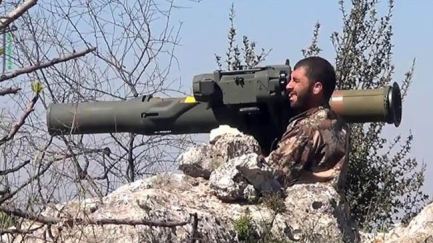
File photo shows a foreign-backed militant preparing to launch a US-made TOW anti-tank missile in Idlib countryside in northwestern Syria.
Press TV – December 30, 2014
The ISIL Takfiri group has released a photo showing one of its members preparing to launch a US-made TOW anti-tank missile against rival terrorists in Syria’s strategic and mountainous Qalamoun region along the border with Lebanon.
The ISIL militant is shown aiming at the positions of the Jaysh al-Islam militant group on the outskirts of al-Qaryatayn, located approximately 120 kilometers (74 miles) northeast of the capital, Damascus.
Political analysts say the photo shows the scale of threats the ISIL militants pose to the Qalamoun region against fighters of the Lebanese Hezbollah resistance movement.
On October 5, Hezbollah fighters killed scores of Takfiri militants after the gunmen crossed from crisis-hit Syria into eastern Lebanon and attacked the Lebanese resistance movement’s posts.
Most of the militants killed during the clashes were from the al-Qaeda-linked al-Nusra Front. Two Hezbollah fighters were also killed in the shootout.
Meanwhile, Ghuraba al-Sham Battlion and Lions of Shahba Battalion, both allied to the so-called Free Syrian Army, are reportedly training their members in a camp set up in Qalamoun.
Over the past months, Lebanon has been grappling with terrorist attacks by al-Qaeda-linked militants and rocket attacks, in what is said to be a spillover of the conflict in Syria.
The Takfiri ISIL terrorists currently control parts of Syria mostly in the east and north. They have also seized large swathes of land in neighboring Iraq.
More than 1.1 million Syrian refugees are currently taking shelter in Lebanon. The influx of Syrian refugees is exerting huge pressure on Lebanon’s poor infrastructure, education and health systems.
Syria has been grappling with a deadly crisis since March 2011. Western powers and their regional allies – especially Qatar, Saudi Arabia, and Turkey – are the main supporters of the militants operating inside Syria.
More than 200,000 people have died so far in the conflict in Syria, according to UN High Commissioner for Human Rights Zeid Ra’ad Zeid al-Hussein.
Selling ‘Peace Groups’ on US-Led Wars
By Margaret Sarfehjooy and Coleen Rowley | Consortium News | December 25, 2014
“War is peace” double-speak has become commonplace these days. And, the more astute foreign policy journalists and commentators are beginning to realize the extent of how “liberal interventionists” work in sync with neocon warhawks to produce and sustain a perpetual state of U.S. war.
More and more “peace and social justice” groups are even being twisted into “democracy promotion,” U.S. militarism style. But rarely do we get a window to see as clearly into how this Orwellian transformation occurs as with the “Committee in Solidarity with the People of Syria” (CISPOS) based in Minnesota’s Twin Cities, a spin-off of “Friends for a Nonviolent World” (FNVW), steering its Quaker-inspired founding in nonviolence to promote speakers and essayists with strong ties to the violent uprising to topple the Syrian government of President Bashar al-Assad, resulting in a war that has already taken some 200,000 lives.
Do the real pacifist members approve? Or even know?
Middle Eastern expats who support U.S. intervention in their countries are especially effective in promoting their message to Western audiences because they provide “proof” of the demonization of governments that the U.S. plans to invade and dominate, and often peace groups include these expats in presentations believing them to be representatives of an entire country.
In Minneapolis, FNVW and its spin-off CISPOS hosted several events with Syrian expats who were on record as supporting the U.S. bombing of their country. (This isn’t only happening in the U.S. In April 2011, a Vancouver peace group documented its objection to the fact that other Canadian “peace” groups were sponsoring speakers who justified and advocated “in favour of the NATO bombing of Libya.”)
Often Syrian “experts” speaking to peace groups, such as FNVW/CISPOS’s upcoming speaker, Mohja Kahf, have ties to the early destabilization of Syria. This American Prospect article documents how Najib Ghadbian, Kahf’s husband of over 20 years (apparently up to last year when they divorced) was one of the Syrian dissidents who attended the early 2006 meeting with Liz Cheney (then-Vice President Dick Cheney’s daughter), along with other Syrian dissidents to plan how to destabilize Syria and topple its government. Like some Syrian version of Ahmed Chalabi, the neocons’ choice to run post-invasion Iraq, Kahf’s husband apparently got himself invited to Liz Cheney’s “Iran-Syria Operations Group” by having signed the “Damascus Declaration” in 2005, the year before.
When Najib and Mohja sat down for a long 2011 interview with The Arkansas Traveler, they discussed their involvement with the Syrian Revolution, even joking about Ghadbian becoming the next Prime Minister. Kahf and Ghadbian reportedly divorced in 2013 but when CISPOS-FNVW first published her long essays, they were still appearing together at Syrian revolutionary meetings and speaking forums. Additionally, CISPOS’s latest handout (December 2014) lists Ghadbian’s organization, www.etilaf.us (The National Coalition of Syrian Revolutionary Forces) as a resource “For More Information on Syria and How to Help.”
Resources for information on Syria often come from “citizen journalists” with deep ties to neocons and U.S. government sources. From the State Department’s website , the $330 million in support for the Syrian opposition includes training for networks of citizen journalists, bloggers and cyber-activists to support their documentation and dissemination of information on developments in Syria.
Syrian dissidents received funding from the Los Angeles-based Democracy Council, which ran a Syria-related program called the “Civil Society Strengthening Initiative” funded with $6.3 million from the State Department. The program is described as “a discrete collaborative effort between the Democracy Council and local partners” to produce, among other things, “various broadcast concepts.”
James Prince, the founder and President of the Democracy Council, is also an adviser to CyberDissidents.org , a project created in 2008 by the Jerusalem-based Adelson Institute for Strategic Studies, founded and funded by Sheldon Adelson, a patron and confidant of Benjamin Netanyahu.
Other resources include postings on social media and alternative websites with sensational stories such as the anti-Assad activist “Gay Girl in Damascus” who turned out to be a middle-aged American man in Scotland or Syrian Danny Abdul Dayem, who was frequently interviewed using fake gun fire and flames in his interviews.
With all of the information about Syria, what are we to believe as true? We know the facts about recent U.S. interventions in Middle Eastern countries. Why would Syria be any different?
Afghanistan is still in shambles with the majority of the people living in extreme poverty; Libya, which had the highest GDP per capita and life expectancy on the continent, is now a failed state; Western intervention transformed Iraq from an emerging country with moderate prosperity into an impoverished country with a starving population. In the lead-up to each intervention, “experts” emerged to explain that while anti-imperialism is good in general and in past scenarios, this time is different. Is it?
Isn’t it time for war-weary Americans to wise up and stop falling for these pretexts of bringing democracy and human rights to foreign countries through training and funding of “color (and umbrella) revolutions,” inciting of coups and regime changes and eventually, through U.S.-NATO military might?
Liberal interventionists clearly assist neocon warhawks towards their mutual goal of “full spectrum dominance” under the euphemistic guise of Pax Americana. Only the “Pax” always turns out to be endless war and occupation.
Margaret Sarfehjooy is an anti-war activist and registered nurse in Minnesota. Coleen Rowley is a retired FBI agent and former Minneapolis Division legal counsel.
The EU shifting its strategy on Syria, Iraq and fighting ISIS
By Sami Kleib | Al-Akhbar | December 27, 2014
After the United States abandoned the idea of Syrian President Bashar al-Assad stepping down and enhanced security coordination with the Syrian army against the Islamic State in Iraq and Syria (ISIS), it appears the Europeans began some time ago a series of meetings to change their policy on Syria. According to information obtained by Al-Akhbar, some senior European officials did not hesitate to say at the last Council of European Union Foreign Ministers meeting that “this policy was wrong.” It is necessary, therefore, to change it and let the United Nations envoy Staffan de Mistura’s initiative lead the way. Does that mean we will soon see favorable signs towards the Syrian regime and further disregard for the external opposition?
Geneva – A European official told Al-Akhbar about the proceedings of an important meeting between United Nations (UN) envoy Staffan de Mistura and European Union (EU) foreign affairs ministers on December 11, confirming that there is a change in the European position towards Syria. He said the meeting was closed like all meetings during which Europeans discuss sensitive matters. De Mistura began to explain the situation in Syria and the regional and international framework surrounding his plan that is supposed to be implemented in three months “otherwise it loses its ability to be implemented.”
This, in short, is what de Mistura said and the Europeans’ position towards it.
- The plan to freeze the fighting in Aleppo is the only one currently available. There is no hope for another plan. Therefore, the EU should support it practically and not just verbally. It is the only plan capable of freezing the fighting, securing people’s needs and returning the displaced people who are burdening neighboring areas and states. It will also allow for the eventual process of reconstruction.
- Syrian President Bashar al-Assad, who showed readiness to ensure the success of the international plan in Aleppo, convinced Russian President Vladimir Putin of the plan and played a major role in convincing his Iranian allies as well. This was necessary because Moscow was reluctant, thinking that no US-Atlantic effort can be trusted and the plan might lead to dire consequences for Russia and its allies.
- Although the Americans expressed reservations and doubt about the plan at the beginning, they have become more flexible, tying their approval with that of some of their regional allies, meaning of course Saudi Arabia primarily. In any case, I am going to Riyadh to convince Saudi officials of the plan’s feasibility. If we obtain preliminary approval from them, I will subsequently continue my efforts in Damascus so we can start as soon as possible because time is running out.
Here, we should remember that Brahimi had told the Europeans once what he said on more than one occasion and in more than one place, namely, that his resignation will “relieve two people, Assad and Saudi Foreign Affairs Minister Saud al-Faisal” because his personal relationship with both men was quite bad. He was probably speaking about “Saud al-Faisal’s personal hatred towards Assad being a hindrance to finding a solution.” It is also known that the Syrian president, from his very first meeting with Brahimi, questioned his intentions especially when the Algerian UN envoy suggested that Assad should step down and intended to meet Syrian Vice President Farouk al-Sharaa before Assad prevented him from doing so, arguing that this is improper on an official visit. Brahimi at the time had to make do with a phone call. After a while, Sharaa was removed from power.
- Turkey remains a real problem for the Europeans. Some officials say it is impossible to predict what Ankara could do next. Others believe that Turkey is pretty much the only country still facilitating the passage of foreign fighters to Syria, it has not made up its mind about fighting the Islamic State in Iraq and Syria (ISIS) and is trying to blackmail the international community with its position. Here, the Europeans make two suggestions. Either put pressure on Turkey, including perhaps issuing a warning – which some believe is pointless because it might make the Turkish president Recep Tayyip Erdogan’s position more intransigent and push him further into Russia and Iran’s arms – or try to cajole and get closer to Turkey, prompting it to commit to the international decision to fight ISIS and stop the flow of foreign fighters. Either way, the Turkish position remains worrisome for Europe.
- Iran has become a central player in both the Syrian and Iraqi crises. It is necessary to deal with this reality regardless of the reservations that some might have. There is nothing to prevent engaging with Iran in a serious dialogue about Syria, even before signing a nuclear agreement. This is useful because it could lead to political concessions from the Syrian regime and it could strengthen the presence of European companies in Iran. Perhaps this has become a European need despite French reservations, which are understandable, given French-Saudi relations and France’s concern not to upset Israel.
- It is impossible to think of serious solution or temporary solutions in Syria without Saudi Arabia, which has extensive relations with a number of Anti-Assad parties. It is important to reassure Riyadh that the European efforts do not intend to buoy up the regime. De Mistura said that Saudi Arabia implicitly welcomes his initiative. The Spanish foreign affairs minister was clearer, saying that Riyadh accepts the plan and it is in France’s interest to tone down its critique otherwise it will appear more extremist than Saudi Arabia, which is not an understandable position. The Spanish minister went as far as suggesting that an international conference for Syria be held in his country given that the idea might be accepted by everybody.
- Russia remains the main obstacle to any solution that does not satisfy the Kremlin and the Syrian regime. Since its relationship with the US and Europe is currently strained because of Ukraine, it is necessary to look for ways to separate any discussion with Russia about Syria from the position regarding Ukraine. Some European officials intend to strengthen the dialogue with Moscow because “it is unacceptable to return to the logic of the cold war.” Perhaps the High Representative of the EU for Foreign Affairs and Security Policy Federica Mogherini will visit Moscow soon. Besides, Russia is active and serious about finding a political solution. The Europeans keeping their distance from Moscow might mean distancing the US and Russia.
The Europeans with and against Assad
First, everyone agrees to de Mistura’s plan, but they want to support it because it is the only plan currently available while awaiting the results of Russian efforts to bring the opposition and the Syrian regime delegation together in Russia. However, France, which currently enjoys strong trade relations with Saudi Arabia and Britain, is ahead of other Europeans in its contacts with Iran and insists that the plan should not support the Syrian army against the moderate opposition in Aleppo. In other words, the issue should not be portrayed as standing with the army against ISIS because in Aleppo and its surroundings there are fighters affiliated with the moderate opposition and they should be taken into consideration and supported “so we won’t appear as though we are drawing a parallel between the regime and the opposition and that we view both sides equally.”
The French foreign affairs minister was the most intransigent even though some within the current French administration point out the need to take a new position towards Syria, especially after the terrorist attacks that took place on French soil. Laurent Fabius said, “We don’t want what happened to Homs to happen in Aleppo,” where suspending the fighting benefited the regime only and was not balanced. The fighters left after they turned in their weapons to the state and were transported in government buses to the areas they come from.
A European official with ties to the Syrian opposition said “the departure of the fighters then was a farce for them. Imagine that the Grand Mufti, Ahmad Badreddin Hassoun, who is a regime loyalist showed up in the buses transporting the fighters joking with them and asking them isn’t it better to marry while they are young instead of getting killed on battlefronts? They were given cell phones to talk with their families and undermine their morale. In the end, the media image and the reality on the ground were in the interest of the regime.”
The French minister was insistent that “the regime should not benefit from this plan in terms of relieving it at the Aleppo front so it can focus on other fronts in other areas.” That is what Fabius was saying when the EU received information about the possibility of the Syrian and Iraqi armies engaging in a wide joint military operation in Deir Ezzor.
Second, the European relationship with Assad is possible, but it becomes evident during the discussions of the foreign affairs ministers and commissioners of the EU that they are at a loss on how to deal with Syria. For example, a European official in Geneva says that a number of his European colleagues have begun to talk about the failure of the policy adopted so far and about the “uncalculated mistake” of suggesting early on that Assad step down.
Some Europeans argue that their assessment of the situation was erroneous while others believe that trusting the US from the beginning was a mistake because Washington, as usual, places its interests ahead of all its alliances, often putting the Europeans in an awkward position. Still others argue that underestimating the capabilities of the Syrian army and its allies was their biggest mistake.
As such, EU officials are currently discussing how to “modify” the political position that has been adopted for more than three years in Syria. One sign of this change is abandoning the mantra of “Assad stepping down” and finding more realistic statements that have been repeated now and then, such as “Assad is not a final solution to the crisis” or “Assad will not stay at the end of the political solution” or “it is only natural that a political solution will eventually lead to transferring powers from the presidency and not all powers” according to Geneva I. Another sign of a change in position is abandoning the phrase “proceeding with a transitional process now” and replacing it with one accepted by all, namely, “calling for the start of a transitional process.”
It appears that Mogherini succeeded, to some extent, in promoting the point of view that “we agree on the end result but political realism and the developments of the situation require us to adjust our course and use new phrases.” In other words, even if everyone in Europe wanted Assad to step down, political realism suggests that this is not possible at this point and encouraging a political solution might eventually lead to this end, meaning this is no longer a European priority.
The security council in Aleppo?
In light of these discussions about modifying the European position towards the Syrian regime, the most important question in the EU is how to ensure the success of the Aleppo plan and how to implement it without portraying Assad as the winner, especially given that the Syrian army advanced in a noticeable way in Aleppo recently?
The dominant trend is to find a monitoring mechanism by the UN Security Council. However, the Europeans realize that this is impossible due to the dual Sino-Russian veto that is always ready to protect Syria. Therefore, unlike the French and British positions which insist on an international force from the UNSC, the EU is more inclined towards finding a diplomatic formula that talks about “a monitoring mechanism linked to the UNSC.”
All of this will be released soon in what is now called “the EU strategy on Syria, Iraq and fighting ISIS.”
Despair with the Syrian opposition, particularly, the National Coalition for Syrian Revolution and Opposition Forces, which for a long time monopolized, with international support, the representation of the opposition has infiltrated EU states after the US. The Europeans too are now more inclined towards expanding the scope of the opposition to include forces that were previously not accepted and undermine the Muslim Brotherhood.
It is remarkable for instance that when the head of the Coalition, Hadi al-Bahra, visited the EU in Brussels few days ago, representatives from the Coalition were calling the Europeans to say that Bahra no longer represents them. A European official says jokingly: “Everytime we begin to talk with an official from the Coalition, we discover that this Coalition held new elections and changed the official. So we start all over again. And every time we meet with a Coalition official, he repeats the same question, how are you going to prevent the regime from benefiting from the plan you are proposing? But we have noticed for some time now that some parties within the Coalition have come to accept the idea of negotiating with the regime and reaching a political agreement with it even if their ultimate goal is for Assad to step down. This is the case with Moaz al-Khatib and his team for instance. The problem of the Coalition is that it does not know the meaning of political realism and continues in its fragmentation as it is tossed around by conflicting foreign alliances.”
In light of all the above, is the EU starting to change its position towards Assad? Perhaps all its members still support the departure of the Syrian president. But political realism requires a change in behavior and approach and not insisting on Assad’s departure as a priority. This will become more evident in the future as terrorist attacks inside Europe have increased. The only solution left is to cooperate with Syrian security forces, the Syrian army and Iran in the context of fighting terrorism.
As for de Mistur’as plan in Aleppo, it is currently in a feverish race between a military solution and security arrangements that cannot be undertaken without the regime’s approval and that might be to its advantage.
Once again, history repeats the same old maxim, “international interests are more important than principles and people’s tragedies.”
The Persistent U.S. Opposition To Self-Determination
By Matt Peppe | Just the Facts | December 21, 2014
There is no principle in international law more fundamental than the right of all peoples to self-determination. This is universally accepted by the entire world, yet nearly 70 years after the signing of the UN Charter, the United States continues to fight tooth and nail against this most basic human right.
On December 18, the U.S. was one of only seven countries to vote against a UN General Assembly resolution that passed with 180 votes affirming the right of the Palestinian people to self-determination.
Earlier this year, the U.S. also found themselves on the wrong side of the international consensus when the UN Special Committee on Decolonization approved a statement to “reaffirm the inalienable right of the people of Puerto Rico to self-determination.”
Self-determination “denotes the legal right of people to decide their own destiny in the international order,” according to the Legal Information Institute.
This right was enshrined in international law with its inclusion in the UN Charter in 1945. Article 1 of the Charter states that one of the purposes of the United Nations is: “to develop friendly relations among nations based on respect for the principle of equal rights and self-determination of peoples.”
In the International Covenant on Civil and Political Rights and the International Covenant on Economic, Social and Cultural Rights, this was made even more explicit: “All peoples have the right of self-determination. By virtue of that right they freely determine their political status and freely pursue their economic, social and cultural development.”
For people deprived of equal rights and political participation, self-determination could take many forms: independence, assimilation, sovereign association, or another form they choose for themselves. But no one has a right to self-determination at the expense of someone else.
“It is well known that any attempt to deny a human group its self-determination only intensifies its demand for sovereignty and enhances its collective identity,” writes Shlomo Sand in The Invention of the Jewish People. “This does not, of course, give a particular group that sees itself as a people the right to dispossess another group of its land in order to achieve its self-determination. But that is precisely what happened in Mandatory Palestine in the first half of the twentieth century.”
Some people justify Israel’s right to exist by claiming that Jewish people deserve self-determination just like all other peoples. But European Zionists seeking self-determination did not have a right to conquer the indigenous population of an already-populated land to establish a state which did not include Palestinians. In 1947, Jews represented no more than 33% of the population and owned no more than 10% of the land in Mandatory Palestine. There is no justification for ethnically cleansing people, stealing their land, and preventing the return of refugees for seven decades in order to manipulate the demographics of the state and engineer an artificial ruling majority.
The United States has never respected self-determination as a concept or a right. As independence movements from Asia to Africa to the Middle East fought wars of liberation following World War II, the United States fought on the side of colonial domination and subjugation.
Self-determination is not just a utopian ideal. It is a legal right. The contents of the UN Charter and the Covenant on Civil and Political Rights – as well as all treaties ratified by the U.S. government – are the “supreme law of the land,” per Article 6 of the U.S. Constitution. Therefore, prevention of self-determination is a legally enforceable human rights violation.
The “traditional American conception” of self-determination, writes Noam Chomsky in The Fateful Triangle: The United States, Israel, and the Palestinians, is that “we will determine, since we are plainly the authentic representatives of the Palestinians – as of the Filipinos, the Nicaraguans, the Greeks, the Vietnamese, the Chileans, the Salvadorans, and many others who have been privileged to enjoy our beneficient attentions.”
When France decided to abandon a failed war to maintain colonial rule over Vietnam, the United States stepped in and escalated the war, carrying out wholesale slaughter of people seeking their liberation. U.S. military forces killed between 2.5 and 5 million Vietnamese, most of them civilians, in an attempt to prevent them from choosing their socioeconomic system on their own.
When the Portuguese dictatorship fell in 1974, clearing the way for independence for former colonies like Angola, the United States encouraged South Africa to invade that country the next year to install a puppet government friendly to the apartheid regime. The racist South Africans would have succeeded if it weren’t for a massive military intervention by Cuba on behalf of the populist Angolan government that crushed the invading forces and sent them back to Pretoria with their tail between their legs.
In 1898, American ships landed at Guánica. One hundred sixteen years later, Puerto Rico is still a colonial possession of the United States. In 1946, Puerto Rico was placed on the United Nations List of Non-Self Governing-Territories. The United States was forced to report regularly on the island’s political status with the goal of decolonization. Not willing to give up ownership of their tropical cash cow, the U.S. backed a new Puerto Rican Constitution that disguised the colonial status of the island. It was given the euphemistic status of a “Commonwealth,” in which the U.S. maintained sovereignty over Puerto Rico. Only the U.S. Congress – which Puerto Ricans cannot elect representatives to or participate in – is empowered to relinquish sovereignty over the island.
The United States has partnered with Israel in keeping Palestinians stateless since the creation of the Israeli state in 1948. In Gaza, the West Bank and East Jerusalem, which Israel has occupied since 1967, Palestinians do not have citizenship in any state and do not enjoy sovereignty over the territory the entire world has recognized as their own.
Israel has for decades demonstrated that it intends to maintain the nearly half-century occupation indefinitely and prevent any Palestinian state. Benjamin Netanyahu’s Likud party charter states: “The Jordan river will be the permanent eastern border of the State of Israel,” and “The government will flatly reject Palestinian proposals to divide Jerusalem.” As the majority party in the Knesset, they have been carrying this out in practice.
There is an name for ruling over people while preventing them from being part of the political process that governs their lives. It’s called colonialism, In international law, it is a crime against humanity.
Israel’s plan is to simply continue the status quo under the guise of a “peace process.” While Israel, with the help of the United States, uses the farcical cover of negotiations, they continue to steal Palestinian land and water while transferring in hundreds of thousands of Jewish Israelis onto stolen land and evicting residents of East Jerusalem to clear the way for more Jews.
It is what historian Illan Pappe and others have called “slow-motion genocide.” They create the conditions intended to drive as many Palestinians as possible from their land – to Jordan, Syria, or anywhere outside Greater Israel. They hope that as more 1948 refugees grow older and die their ancestors will lose their claim to the land they were systematically driven away from before the formation of the state of Israel. In this way, the Jewish state hopes to establish its permanence from the Jordan river to the Sea.
All this is only possible because the Israeli state denies Palestinians sovereignty to govern themselves or participate in a binational arrangement to share governance in Greater Israel. People who can’t vote and have no voice in these policies obviously cannot change them. Which is why it is so important to Israel to continue to deny Palestinians self-determination. Preserving their colonial domination over territory and people they have conquered is much more important to Israel than having a legitimate claim to being a democratic state that values human rights.
The rest of the world showed in voting for the UN resolution affirming the right of the Palestinian people to self-determination how isolated the U.S. and Israel are as they cling to a morally and legally indefensible position. Only Canada and four American client states (all tiny Pacific Island nations) joined them in voting against the measure.
The vote is a “strong affirmation of the international support for the legitimate rights of the Palestinian people, led by their right to self-determination and liberation,” said Riyad Mansour, Permanent Palestinian Observer at the UN.
When the Palestinians finally are able to achieve their basic human right of self-determination, it will be in spite of decades of U.S. interference and complicity in Israeli repression. As they were in Vietnam and Southern Africa, and as they continue to be in Puerto Rico, the United States will shamefully be on the wrong side of history.
Just 2% of pledges paid for rebuilding Gaza
MEMO | December 20, 2014
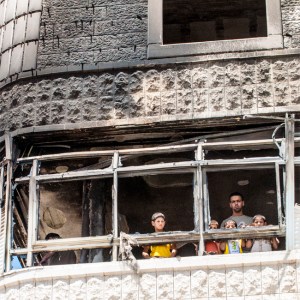 Palestinian and international officials have revealed that only 2 per cent of the pledges made by donor states to rebuild the Gaza Strip have actually been paid. The pledges were made in a donor conference in Egypt two months ago. A total of $5.4 billion was pledged for the reconstruction of the beleaguered territory after it was destroyed during Israel’s latest war against the civilians of Gaza during the summer. Of the major donors, Qatar pledged $1 billion, Saudi Arabia $500 million and the EU $780 million.
It was expected that half of these pledges would have been spent on rebuilding houses and infrastructure in the Gaza Strip and the remainder would boost the Palestinian Authority’s budget. According to UN officials, just $100 million has been handed over from donors.
“We received funds and pledges worth about $100 million for shelters and house renovation,” said Robert Turner, the Director of UNRWA Operations in Gaza. “This money will run out in December in the middle of a harsh winter.” The shortfall, he added, is $620 million.
Palestinian Housing Minister Mofeed Al-Hasayneh said that the Arab states did not pay anything from their pledges for this month. The Europeans, however, have paid “a few millions”.
UN General Assembly votes for Israel to compensate Lebanon for 2006 oil spill
Al-Akhbar | December 20, 2014
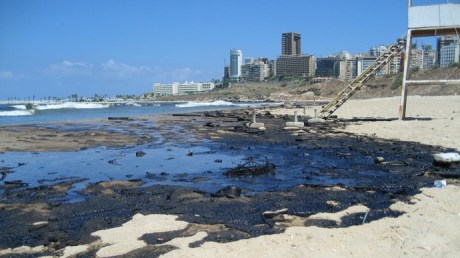
Israel was asked by the UN General Assembly on Friday to compensate Lebanon for $856.4 million in oil spill damages it caused during the July 2006 war.
The non-binding vote, which passed 170-6 with three abstentions, asks Israel to offer “prompt and adequate compensation” to Lebanon and other countries affected by the oil spill’s pollution.
While General Assembly votes are non-binding, they reflect broader international opinion without the possibility of veto by world powers like in the Security Council.
The resolution indicated that UN Secretary General Ban Ki-moon “expressed grave concern at the lack of any acknowledgment on the part of the government of Israel of its responsibilities vis-a-vis reparations and compensation” for the oil spill.
Lebanon’s permanent representative to the UN Nawaf Salam hailed the resolution, the Lebanese National News Agency reported.
“Lebanon considers this to be a major progress,” Salam said. “This resolution also paves the way for further compensation into other areas of damage (health, ecosystem services as habitat, potential groundwater contamination, and marine diversity), that were not considered in the current calculated amount.”
“Furthermore, its adoption asserts the will of the overwhelming majority of the international community to hold countries responsible for their internationally wrongful acts,” he added.
“We affirm that Lebanon will continue to mobilize all resources and resort to all legal means to see that this resolution is fully implemented, and that the specified compensation is paid promptly.”
In a statement, Israel condemned the resolution as “[serving] no purpose other than to contribute to institutionalizing an anti-Israel agenda at the UN,” Israeli media reported.
The oil spill was caused by Israel’s air force when it bombed oil tanks near a coastal Lebanese power plant during its fierce month-long war with Hezbollah resistance fighters.
The attack flooded the Mediterranean coastline with 15,000 tons of oil, according to the United Nations.
The adopted resolution cited $856.4 million (700 million euros) in damages caused by the oil spill, accounting for inflation of a October 2007 estimate by the United Nations Secretary General that reported the spill caused $729 million in damage.
Lebanon bore the brunt of the spill, but the Syrian coast and other Mediterranean countries have suffered as well, the UN said.
The oil slick made by the spill “has had serious implications for livelihoods and the economy of Lebanon,” the resolution said.
The UN asked Lebanon to continue clean-up efforts and the international community to increase funding for its environmental restoration.
The US, Australia, Canada and Israel were among the six states that voted against the UN text.
(AFP, Al-Akhbar)
Israeli Role in Syrian Conflict Brought Into the Open
By Nicola Nasser | The Peoples Voice | December 18, 2014
Overtly, the Israeli superpower of the Middle East has been keen to posture as having no role whatsoever in the four-year old devastating conflict in Syria, where all major regional and international powers are politically and militarily deeply involved and settling scores by Syrian blood.
In his geopolitical weekly analysis, entitled “The Islamic State Reshapes the Middle East,” on November 25 Stratfor’s George Friedman raised eyebrows when he reviewed the effects which the terrorist group had on all regional powers, but seemed unaware of the existence of the Israeli regional superpower.
It was an instructive omission that says a lot about the no more discreet role Israel is playing to maintain what the Israeli commentator Amos Harel described as the “stable instability” in Syria and the region, from the Israeli perspective of course.
Friedman in fact was reflecting a similar official omission by the US administration. When President Barak Obama appealed for a “broad international coalition” to fight the Islamic State (IS), Israel — the strongest military power in the region and the well – positioned logistically to fight it — was not asked to join. The Obama administration explained later that Israel’s contribution would reflect negatively on the Arab partners in the coalition.
“Highlighting Israel’s contributions could be problematic in terms of complicating efforts to enlist Muslim allies” in the coalition, said Michael Eisenstadt, a senior fellow at AIPAC’s arm, the Washington Institute for Near East Policy.
Covertly however Israel is a key player in prolonging the depleting war on Syria and the major beneficiary of neutralizing the military of the only immediate Arab neighbor that has so far eluded yielding to the terms dictated by the U.S. – backed Israeli regional force majeure for making peace with the Hebrew state.
Several recent developments however have brought the Israeli role into the open.
First the latest bombing of Syrian targets near the Damascus international civilian airport on December 7 was the seventh major unprovoked air strike of its kind since 2011 and the fifth in the past 18 months on Syrian defenses. Syrian Scientific research centers, missile depots, air defense sites, radar and electronic monitoring stations and the Republican Guards were targeted by Israel.
Facilitating the Israeli mission and complementing it, the terrorist organizations operating in the country tried several times to hit the same targets. They succeeded in killing several military pilots and experts whom Israeli intelligence services would have paid dearly to hunt down.
Foreign Policy on last June 14 quoted a report by the UN Secretary General Ban Ki – moon as saying that the “battle – hardened Syrian rebels … once in Israel, they receive medical treatment in a field clinic before being sent back to Syria,” describing the arrangement as a “gentleman’s agreement.”
Israeli Prime Minister Benyamin Netanyahu in February this year visited this “military field hospital” and shook hands with some of the more than 1000 rebels treated in Israeli hospitals, according to Lt. Col. Peter Lerner, a spokesman for the Israeli Occupation Forces (IOF).
Foreign Policy quoted also Ehud Yaari, an Israeli fellow at the Washington Institute for Near East Policy, as saying that Israel was supplying the rebel – controlled Syrian villages with medicines, heaters, and other humanitarian supplies. The assistance, he said, has benefited civilians and “insurgents.” Yaari ignored the reports about the Israeli intelligence services to those “insurgents.”
Israel facilitates war on UNDOF
Second, the latest quarterly report by the UN Disengagement Force (UNDOF) to the UN Security Council (UNSC) on December 1 confirmed what eight previous similar reports had stated about the “interaction … across the (Syrian – Israeli) ceasefire line” between the IOF and the “armed members of the (Syrian) opposition,” in the words of Ki-moon’s report to the Council on December 4.
Third, Ki-moon in his report confirmed that the UNDOF “was forced to relocate its troops” to the Israeli side of the ceasefire line, leaving the Syrian side a safe haven zone for the al-Qaeda affiliate al-Nusra Front, which the UNSC had designated a “terrorist group.”
UNDOF’s commander Lieutenant General Iqbal Singh Singha told the UNSC on October 9 that his troops were “under fire, been abducted, hijacked, had weapons snatched and offices vandalized.” Australia was the latest among the troop contributing countries to pull out its forces from UNDOF.
UNDOF and the United Nations Truce Supervision Organization (UNTSO) operate in the buffer zone of about 80 km long and between 0.5 to 10 km wide, forming an area of 235 km². The zone borders the Lebanon Blue Line to the north and forms a border of less than 1 km with Jordan to the south. It straddles the Purple Line which separates the Israeli – occupied Golan Heights from Syria. The west Israeli side of this line is known as “Alpha”, and the east Syrian side as “Bravo.”
Speaking at the U.S. military base Fort Dix on Monday, President Obama warned those who “threaten America” that they “will have no safe haven,” but that is exactly what Israel is providing them.
Israeli “interaction” has practically helped the UNDOF “to relocate” from Bravo to Alpha and to hand Bravo as a safe haven over to an al-Nusra Front – led coalition of terrorist groups.
Al-Nusra Front is officially the al – Qaeda affiliate in Syria. U.S. Secretary of State John Kerry told the Senate Committee on Foreign relations on this December 9 that his administration considers the IS to be a branch of al – Qaeda operating under a different name. Both terrorist groups were one under the name of the Islamic State in Iraq and Syria (ISIS) and only recently separated. Whoever accommodates either one is in fact courting the other.
“The 1,200-strong UN force is now mostly huddled inside Camp Ziouani, a drab base just inside the Israeli – controlled side of the Golan Heights. Its patrols along the de facto border have all but ceased,” the Associated Press reported on last September 18.
Israeli air force and artillery intervened several times to protect the al-Nusra Front’s “safe haven” against fire power from Syria, which is still committed to its ceasefire agreement of 1974 with Israel. Last September for example, Israel shot down a Syrian fighter jet that was bombing the Front’s positions, only three weeks after shooting down a Syrian drone over the area.
Israel is not violating the Syrian sovereignty only, but violating also the UN – sponsored ceasefire agreement and the UNSC anti-terror resolutions. More important, Israel is in fact undermining the UNDOF mandate on the Israeli – occupied Syrian Golan Heights.
This situation could only be interpreted as an Israeli premeditated war by proxy on the UN presence on the Golan Heights.
“Israel is the most interested in having (UN) peacekeepers evacuated from the occupied Golan so as to be left without international monitoring,” Syria’s permanent envoy to the UN, Bashar al- Jaafari, told reporters on September 17.
The UNSC seems helpless or uninterested in defending the UNDOF mandate on the Golan against Israeli violations, which risk the collapse of the 1974 ceasefire arrangements.
Syrian Foreign Ministry was on record to condemn these violations as a “declaration of war,” asserting that Syria reserves its right to retaliate “at the right moment and the right place.” Obviously a regional outbreak is at stake here without the UN presence as a buffer.
Upgrading unanimously Israel’s status from a “major non – NATO ally” to a “major strategic partner” of the United States by the U.S. Congress on December 3 could explain the UNSC inaction.
The undeclared understanding between the Syrian government and the U.S. – led coalition against the self – declared “Islamic State” (IS) not to target the latter’s forces seems to have left this mission to Israel who could not join the coalition publicly for subjective as well as objective reasons.
The AP on September 18 did not hesitate to announce that the “collapse of UN peacekeeping mission on Golan Heights marks new era on Israel – Syria front.” Aron Heller, the writer of the AP report, quoted the former Israeli military liaison officer with UNDOF, Stephane Cohen, as saying: “Their mandate is just not relevant anymore.” Heller concluded that this situation “endangers” the “status quo,” which indeed has become a status quo ante.
Israeli strategic gains
The emerging fait accompli seems very convenient to Israel, creating positive strategic benefits for the Hebrew state and arming it with a pretext not to withdraw the IOF from the occupied Syrian Golan Heights and Palestinian territories.
In an analysis paper published by The Saban Center at Brookings in November 2012, Itamar Rabinovich wrote that, “Clearly, the uncertainty in Syria has put the question of the Golan Heights on hold indefinitely. It may be a long time until Israel can readdress the prospect of giving the Golan back to Damascus.”
Moreover, according to Rabinovich, “the Syrian conflict has the potential to bring the damaged Israeli – Turkish relationship closer to normalcy … they can find common ground in seeking to foster a stable post – Assad government in Syria.”
The hostile Turkish insistence on toppling the Syrian government of President Bashar al-Assad, the concentration of the IS and other rebel forces in the north of the country and in central, eastern and southern Syria are diverting the potential and focus of the Syrian Arab Army northward and inward, away from the western front with the Israeli occupying power on the Golan Heights.
The protracted war on the Syrian government is depleting its army in manpower and materially. Rebuilding the Syrian army and the devastated Syrian infrastructure will preoccupy the country for a long time to come and defuse any military threat to Israel for an extended time span.
On the Palestinian front, the rise of the IS has made fighting it the top U.S. priority in the Middle East, which led Aaron David Miller, a former adviser to several U.S. administrations on Israeli-Palestinian negotiations, to warn in Foreign Policy early in September that the rise of the IS would pose “a serious setback to Palestinian hopes of statehood.”
The expected fallback internally of the post – war Syria would “hopefully” relieve Israel of the Syrian historical support for the Palestinian anti – Israeli occupation movements, at least temporarily.
Netanyahu on Sunday opened a cabinet meeting by explicitly using the IS as a pretext to evade the prerequisites of making peace. Israel “stands … as a solitary island against the waves of Islamic extremism washing over the entire Middle East,” he said, adding: “To force upon us” a timeframe for a withdrawal from the Israeli – occupied Palestinian territories, as proposed by Palestinian President Mahmoud Abbas to the UN Security Council, “will bring the radical Islamic elements to the suburbs of Tel Aviv and to the heart of Jerusalem. We will not allow this.”
Israel is also capitalising on the war on the IS to misleadingly portray it as identical with the Palestinian “Islamic” resistance movements because of their Islamic credentials. “When it comes to their ultimate goals, Hamas is ISIS and ISIS is Hamas,” Netanyahu told the UN General Assembly on September 29.
Nicola Nasser is a veteran Arab journalist based in Birzeit, West Bank of the Israeli-occupied Palestinian territories (nassernicola@ymail.com).
Featured Video

New positive ivermectin evidence
or go to
Aletho News Archives – Video-Images
From the Archives
Fanatical Followers of the Covid Regime: A Jim Jones-Style Cult?
By Professor Roger Watson and Dr. Niall McCrae | The Daily Sceptic | November 15, 2021
As scholars at leading British universities over recent decades, we witnessed the replacement of critical thinking and debate by narrative: facts are discrimination and scientific method is imperialism; truth, instead, is derived from ‘progressive’ values. This educational trend may be a major contributory factor to the ease in which society has been inculcated to the Covid ‘new normal’ of masking, testing, and repeated doses of vaccines for a disease of similar risk to severe influenza.
One doesn’t need much critical reasoning to observe the flawed logic of some vaccination enthusiasts, such as people who respond to experiencing any side effects, however debilitating, by saying “at least I know it’s working”, or, after contracting the disease despite their promised inoculation (over 90% effective, according to initial drug company claims), “I’d have been worse off without the jab.” … continue
Blog Roll
 Aletho News
- Arctic Scare Stories Melt Away
- Wrong, Euronews: Climate Change Has Not Created a Food, Energy, and Economic “Meta-Crisis”
- New positive ivermectin evidence
- Met Office Caught Fabricating Daily Temperature Record Claims
- Merck Virologists Admitted to Falsely Certifying Vaccine Efficacy
- Mandatory Folic Acid for every man, woman & child
- Pro-Palestine protesters arrested outside UK’s ruling Labour Conference in Liverpool
- Mauritius denies landing permit to flight from Israel, forcing cancellation: Tour operator
- Israeli finance minister calls for genocidal war on West Bank, annexation of south Lebanon
- 12 Things Your Psychiatrist Was Trained Not to Tell You
- If Americans Knew
- Israel forces Gazans to live in constant peril – Daily Update
- Deconstructing Netanyahu’s pants-on-fire UN rant – Daily Update
- Trump betrayed voters with his campaign lies and prioritized a foreign country once he took office
- Netanyahu calls Israel’s war in Gaza ‘opposite of genocide’ in UN speech to near-empty hall
- Settler Kidnappings: Torture, Sexual Abuse and Terrorisation of Palestinian Abductees as Israel Deepens Annexation of West Bank
- Gaza winter nears as 162,000 tents become unusable, raising fears of humanitarian crisis
- Netanyahu says, “It’s the opposite of genocide”; UN says Gaza economy is world’s ‘most severe crisis on record’ – Daily Update
- Israel’s US-Backed Assault on Gaza Has Created the ‘World’s Most Severe Economic Crisis on Record’: UN
- ‘Protecting U.S. Citizens’… From Israel
- ‘This is where I live now, the back of a truck’: a day in the life of a grandmother in Gaza
- No Tricks Zone
- New Study: Earth And Venus Surface Warmth Largely Explained By Convection And Lapse Rate, Not CO2 Or Radiation
- 2025 Nature Paper Claiming Worsening Global Drought Gets RETRACTED …Heavily Flawed
- New Study: ‘Global Drought Shows No Detectable Recent Acceleration Under Climate Warming’
- Economic Masterminds: German Socialists Suggest Taxing Productivity Gains Stemming From Using AI
- The South China Sea Has Not Been Cooperating With The Climate Change Narrative
- Energy Crisis: Germany Enters Heating Season With Historically Low Gas Reserve Fill Levels
- New Study: The Antarctic Ice Sheet Gained Mass From 2020-2024 Due To Staggering Snow And Ice Accumulation
- Study: Ocean Heating Rates From Thousands Of Years Ago ‘Dwarf’ Modern Ocean Heating Rates
- Climate Extremists Target, Attack Large-Scale Power Grid Infrastructure In Germany!
- New Study: Antarctic Ice Melt Has Contributed Less Than 1 Centimeter To Sea Level Rise In The Last 30 Years

