Muslim scholars’ union slams UAE ‘terrorist’ label
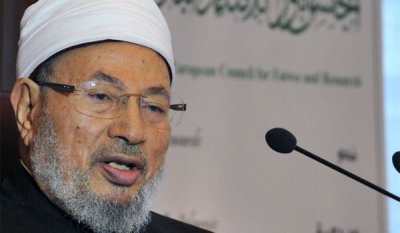
Yusuf Al-Qaradawi
MEMO | November 17, 2014
The International Union of Muslim Scholars (IUMS) expressed its surprise on Monday over the decision by the United Arab Emirates (UAE) to include the bloc on the country’s list of designated terrorist organisations.
In its statement, the union urged the UAE to “reconsider its unjustified position”.
The IUMS, established in 2004 and headed by Islamic scholar Yusuf Al-Qaradawi, was among 83 movements and organisations that were labelled terrorist groups by the UAE on Saturday.
Also included in the list were the Muslim Brotherhood, the Islamic State (ISIS), Yemen’s Shiite Houthi movement and the Egypt-based Ansar Beit Al-Maqdis militant group.
In its statement, the group said it rejects this labelling, asserting that since its establishment ten years ago, the IUMS “has promoted a moderate approach and discouraged extremism, terror and violence using cultural and educational means”.
“The IUMS has issued dozens of statements against terrorist and extremist groups,” it added.
On its website, the IUMS identifies itself as “an institution concerned with the call (Da’wah) to Islam by tongue, pen, and every contemporary legitimate medium; be it recorded, audio, or visual”.
“IUMS is not a local or a regional union, neither an Arab nor a national one, neither an eastern, nor a western union; rather, it represents all Muslims in the entire Islamic world, as well as all the Muslim [minority populations] and Islamic groups outside of the Islamic world.”
It also asserts that it “does not slant towards exaggerations and excesses, nor does it tilt towards default and negligence, but rather it adopts the centremost approach of the centremost Ummah (Islamic nation), an approach of mediation and moderation.”
The Egyptian-born Al-Qaradawi has been under fire by Egypt’s post-coup authorities for his vocal criticism of the military’s ouster – and subsequent imprisonment – of elected president Mohamed Morsi, a Muslim Brotherhood leader, last year.
Egypt branded the Brotherhood a “terrorist” movement late last year following the bombing of a security headquarters in the Nile Delta.
The label was attached to the movement amid a massive crackdown on its members, supporters and leaders on the streets of Cairo and other Egyptian cities and provinces.
Saudi Arabia also designated the Muslim Brotherhood a “terrorist” movement in March of this year, following in Egypt’s footsteps.
The UAE and Saudi Arabia were amongst the first countries to welcome Morsi’s ouster. Both countries – along with Bahrain – withdrew their ambassadors from Doha last March, accusing Qatar of interfering in their affairs.
Many observers, however, linked the rift to Doha’s perceived support for Morsi and the Muslim Brotherhood.
Yet, the three countries agreed on Sunday to return their ambassadors to the Qatari capital following a surprise Gulf summit in Saudi Arabia.
How Many Islamic State Fighters Are There?
By Ray McGovern | Consortium News | November 16, 2014
Why was I reminded of Vietnam on Saturday when Gen. Martin Dempsey, Chairman of the Joint Chiefs of Staff, visited Iraq to “get a firsthand look at the situation in Iraq, receive briefings, and get better sense of how the campaign is progressing” against the Islamic State, also known as ISIS or ISIL?
For years as the Vietnam quagmire deepened, U.S. political and military leaders flew off to Vietnam and were treated to a snow job by Gen. William Westmoreland, the commander there. Many would come back glowing about how the war was “progressing.”
Dempsey might have been better served if someone had shown him Patrick Cockburn’s article in the Independent entitled “War with Isis: Islamic militants have an army of 200,000, claims senior Kurdish leader.”
Fuad Hussein, the chief of staff of Kurdish President Massoud Barzani, told Cockburn that “I am talking about hundreds of thousands of fighters because they are able to mobilize Arab young men in the territory they have taken.”
Hussein estimated that Isis rules about one-third of Iraq and one-third of Syria with a population from 10 million to 12 million over an area of 250,000 square kilometers, roughly the size Great Britain, giving the jihadists a large pool of potential fighters to recruit.
While the Kurdish estimate may be high – it certainly exceeds “the tens of thousands,” maybe 20,000 to 30,000 that many Western analysts have claimed – the possibility that the Islamic State’s insurgency is bigger than believed could explain its startling success in overrunning the Iraqi Army around Mosul last summer and achieving surprising success against the well-regarded Kurdish pesh merga forces, too.
So, on his flight back to Washington, Dempsey will have time to ponder whether he has the courage to pass on this discouraging word to President Barack Obama about ISIS or whether he will put on the rose-colored glasses like an earlier generation of commanders did about Vietnam, where Westmoreland insisted that the number of enemy Vietnamese in South Vietnam could not go above 299,000.
Unfortunately, those obstinate Vietnamese Communists would not observe that artificial, politically inspired limit. Westmoreland was aware of the troubling reality but knew that acknowledging it would have undesired consequences in the United States where many Americans were souring on the war.
The inconvenient truth finally became abundantly clear during the Tet offensive in late January and early February 1968, but still the misbegotten war went on, and on, ultimately claiming some 58,000 U.S. lives and millions of Vietnamese.
Westmoreland’s gamesmanship with the numbers was known to some CIA officials – first and foremost, a very bright and courageous analyst named Sam Adams – but CIA Director Richard Helms silenced them out of fear of political retribution. “My responsibility is to protect the Agency,” Helms told them, “and I cannot do that if we get into a pissing match with a U.S. Army at war.”
Today’s CIA Director John Brennan is similarly at pains to protect the Agency on a number of fronts. Is he likely to tell the truth about ISIS if it means the prospects for a renewed war in Iraq and a new war in Syria are especially grim? If not, are there no Sam Adamses left at the CIA?
Honest Analysts?
Honest intelligence analysts played a key role in the November 2007 National Intelligence Estimate, “Iran: Nuclear Intentions and Capabilities,” which helped thwart Bush/Cheney plans to apply Iraqi-type “shock and awe” to Iran during their last year in office. The NIE concluded, unanimously and “with high confidence,” that Iran had stopped working on a nuclear weapon in late 2003.
In his memoir, Decision Points, President George W. Bush called the NIE’s findings “eye-popping.” He openly bemoaned how the estimate deprived him of the military option, writing “How could I possibly explain using the military to destroy the nuclear facilities of a country the intelligence community said had no active nuclear weapons program?”
The NIE on Iran was issued seven years ago. One has to hope that a few honest analysts on the Near East have survived the CIA directorships of Michael Hayden, Leon Panetta, David Petraeus and John Brennan and have the courage to tell the truth about ISIS – including how U.S. military intervention now is swelling ISIS’s ranks, much as the Bush/Cheney invasion of Iraq in 2003 created the conditions for the group’s birth, then called “Al-Qaeda in Iraq.”
If honest intelligence analysts are silenced, as Sam Adams was 47 years ago, they need to plumb their consciences and see if they have the guts to make public both the undercounting of enemy forces AND the fillip given to their multiplication by further U.S. military involvement.
Though having worked within the system to get the real enemy troop estimates to senior U.S. officials, Sam Adams went to an early, remorse-filled death, unable to overcome the thought of what might well have happened to shorten the war if he had broken with the CIA’s demands for secrecy and made the actual enemy numbers public.
Possibly, the armed conflict might have ended in 1968. Or, to put it another way, the Vietnam Memorial in Washington would have no need for a western wall since there would be no names to chisel into the granite.
If Gen. Dempsey decides to ape Westmoreland and dissemble about the realistic obstacles to military success against the Islamic State fighters and about the counterproductive effects of U.S. intervention, well, our country will need a new Sam Adams willing, this time, to blast the truth into the open.
Sam Adams Associates for Integrity in Intelligence
Sam Adams’s memory is invoked each year as Sam Adams Associates for Integrity in Intelligence make their annual award for integrity. SAAII is a movement of former CIA colleagues of former intelligence analyst Sam Adams, together with others who hold up his example as a model for those in intelligence who would aspire to the courage to speak truth to power.
SAAII confers an award each year to a member of the intelligence community or related professions who exemplifies Sam Adam’s courage, persistence and devotion to truth — no matter the consequences.
It was Adams who discovered in 1967 that there were more than a half-million Vietnamese Communists under arms — roughly twice the number that the U.S. command in Saigon would admit to, lest Americans learn that claims of “progress” were bogus.
Gen. Westmoreland had put an artificial limit on the number Army intelligence was allowed to carry on its books. And his deputy, Gen. Creighton Abrams, specifically warned Washington that the press would have a field day if Adam’s numbers were released, and that this would weaken the war effort.
A SECRET/EYES ONLY cable from Abrams on Aug. 20, 1967, stated: “We have been projecting an image of success over recent months,” and cautioned that if the higher figures became public, “all available caveats and explanations will not prevent the press from drawing an erroneous and gloomy conclusion.”
The Communist countrywide offensive during Tet made it clear that the generals had been lying and that Sam Adams’s “higher figures” were correct. Senior intelligence officials were aware of the deception, but lacked the courage to stand up to Westmoreland. Sadly, Sam Adams remained reluctant to go “outside channels.”
A few weeks after Tet, however, former Pentagon official Daniel Ellsberg rose to the occasion. Ellsberg learned that Westmoreland was asking for 206,000 more troops to widen the war into Cambodia, Laos, and North Vietnam — right up to the border with China, and perhaps beyond.
Someone else promptly leaked to the New York Times Westmoreland’s troop request, emboldening Ellsberg to do likewise with Sam Adams’ story. Ellsberg had come to the view that leaking truth about a deceitful war would be “a patriotic and constructive act.” It was his first unauthorized disclosure. On March 19, 1968, the Times published a stinging story based on Adams’s figures.
On March 25, President Lyndon Johnson complained to a small gathering, “The leaks to the New York Times hurt us. … We have no support for the war. This is caused by the 206,000 troop request [by Westmoreland] and the leaks. … I would have given Westy the 206,000 men.”
On March 31, 1968, Johnson introduced a bombing pause, opted for negotiations, and announced that he would not run for another term in November.
Sam Adams continued to press for honesty and accountability but stayed “inside channels” — and failed. He died at 55 of a heart attack, nagged by the thought that, had he not let himself be diddled, many lives might have been saved. His story is told in War of Numbers, published posthumously.
Ray McGovern works with Tell the Word, a publishing arm of the ecumenical Church of the Saviour in inner-city Washington. He was a close colleague of Sam Adams; the two began their CIA analyst careers together during the last months of John Kennedy’s administration. During the Vietnam War, McGovern was responsible for analyzing Soviet policy toward China and Vietnam.
The Endgame of the US ‘Islamic State’ Strategy
By Nicola Nasser | alarabi | November 11, 2014
Dismantling what the former US President George W. Bush once described as the Syria – Iran component of the “axis of evil,” or interrupting in Iraq the geographical contiguity of what King Abdullah II of Jordan once described as the “Shiite crescent,” was and remains the strategic goal of the US – Israeli allies in the Middle East unless they succeed first in “changing the regime” in either Damascus or Tehran.
The US, Israel and their regional allies have been on the record that the final target of their “regime change” campaign in the Middle East was to dismantle the Syria – Iran alliance.
With the obvious failure of Plan A to dismantle the self-proclaimed anti-Israel and anti-US Syrian – Iranian “Resistance Axis” by a forcible “regime change” in Damascus, a US – led regional alliance has turned recently to its Plan B to interrupt in Iraq the geographical contiguity of that axis.
This is the endgame of President Barack Obama’s strategy, which he declared on last September 10 as ostensibly against the Islamic State (IS).
This would at least halt for the foreseeable future all the signed and projected trilateral or bilateral Iranian, Iraqi and Syrian pipeline networks to carry oil and gas from Iran and Iraq to the Syrian coast at the Mediterranean.
Israeli Col. (res.) Shaul Shay, a research associate at the Begin-Sadat Center for Strategic Studies and a former Deputy Head of the Israel National Security Council anticipated in writing on last January 21 what he called the “Salafi Crescent” that is dangerously emerging to challenge the “Shia Crescent.”
“The growing involvement of Sunni Salafi jihadis in Iraq (since 2003), among the rebels in Syria (since 2011), and in Lebanon has created a ‘Salafi Crescent’ … from Diyala [in eastern Iraq] to Beirut,” he wrote.
“A positive outcome” of this Salafi Crescent “will be the decline in Iranian influence in the region,” Shay concluded.
Conspiracy theories aside, the eventual outcome is a sectarian Sunni military and political wedge driven into the Iraqi geographical connection of the Iran-Syria alliance in a triangle bordering Turkey in the north, Iran in the east, Jordan in the west and Saudi Arabia in the south and extending from north eastern Syria to the Iraqi province of Diyala which borders Iran.
Iraqi Kurdistan is already effectively an independent state and cut off from the central government in Baghdad, but separating Iran and Syria as well and supported by the same US – led anti – IS coalition.
Amid the misinformation and disinformation, the fact is that the IS threat is being used as a smokescreen to confuse and blur this reality.
The IS was conceived and delivered in an American womb. The US – drafted and enforced current constitution produced the sectarian government that is still trying to rule in Iraq. Sectarian cleansing and exclusion of Sunnis could not but inevitably create its antithesis.
The IS was the illegitimate fetus born and nurtured inside the uterus of the US – engineered political process based on a constitution legalizing a federal system based in turn on sectarian and ethnic sharing of power and wealth.
This horrible illegitimate creature is the “legacy” of the US war on Iraq, which was “conceived” in the “sin” of the US invasion of the country in 2003, in the words of the president of the Arab American Institute, James J. Zogbi, writing in the Jordan Times on last June 16.
US Senator John McCain, quoted by The Atlantic on last June 23, thanked “God,” the “Saudis and Prince Bandar” and “our Qatari friends” for creating the “monster.”
The pro-Iran government of former Prime Minister Noori al-Maliki was squeezed by the IS military advances to “request” the US help, which Washington preconditioned on the removal of al-Maliki to which Iran succumbed. The IS gave Obama’s IS strategy its first success.
However, al-Maliki’s replacement by Haider al-Abadi in August has changed nothing so far in the sectarian component of the Iraqi government and army. The US support of Iraq under his premiership boils down only to supporting continued sectarianism in the country, which is the incubator of the survival of its IS antithesis.
Moreover, the destruction of the Iraqi state infrastructure, especially the dismantling of Iraq’s national army and security agencies and the Iraqi Baath party that held them intact, following the US invasion, has created a power vacuum which neither the US occupation forces nor the sectarian Shiite militias could fill. The IS was not powerful per se. They just stepped in on a no-man land.
Similarly, some four years of a US – led “regime change” effort, which was initially spearheaded by the Muslim Brotherhood and which is still financed, armed and logistically facilitated by the US regional allies in Turkey, Qatar, Saudi Arabia as well as by allied western intelligence services, has created another power vacuum in Syria, especially on border areas and in particular in the northern and eastern areas bordering Turkey and Iraq.
US Senator Rand Paul in an interview with CNN on last June 22 was more direct, accusing the Obama administration of “arming” and creating an IS “safe haven” in Syria, which “created a vacuum” filled by the IS.
“We have been fighting alongside al Qaeda, fighting alongside ISIS. ISIS is now emboldened and in two countries. But here’s the anomaly. We’re with ISIS in Syria. We’re on the same side of the war. So, those who want to get involved to stop ISIS in Iraq are allied with ISIS in Syria. That is the real contradiction to this whole policy,” he said.
The former 16 – year member of the US Congress and two – time US presidential candidate Dennis Kucinich, writing in the Huffington Post on last September 24, summed it up: The IS “was born of Western intervention in Iraq and covert action in Syria.”
The IS could have considered playing the role of a US “Frankenstein,” but in fact it is serving as the US “Trojan horse” into Syria and Iraq. Fighting the IS was the US tactic, not the US strategy.
On record, Iranian deputy foreign minister Hossein Amir-Abdollahian said that “the best way of fighting ISIS and terrorism in the region is to help and strengthen the Iraqi and Syrian governments, which have been engaged in a serious struggle” against the IS. But this would not serve the endgame of Obama’s strategy, which targets both governments instead.
Beneficiaries of the IS “Trojan horse” leave no doubts about the credibility of the Syrian, Iranian and Russian doubts about the real endgame of the US – led declared war on the IS.
The United States was able finally to bring about its long awaited and promoted “front of moderates” against Iran and Syria into an active and “air-striking” alliance, ostensibly against the IS.
In Iraq, the IS served the US strategy in wrestling back the so called “political process” from the Iranian influence by proxy of the former premier al-Maliki. Depriving al-Maliki of a third term had proved that there is no unified Iran – backed “Shia house” in Iraq. The US has its own influence inside that “house.”
Installing a US Iraqi satellite was the strategic goal of the US – led invasion and occupation of Iraq in 2003. Instead, according to Doug Bandow, writing in Forbes on October 14, “Bush’s legacy was a corrupt, authoritarian, and sectarian state, friendly with Iran and Syria, Washington’s prime adversaries in the Middle East. Even worse was the emergence of the Islamic State.”
This counterproductive outcome of the US invasion, which saw Iran wielding the reigns of power in Baghdad and edging Iraq closer to Syria and Iran during the eight years of al-Maliki’s premiership, turned the red lights on in the White House and the capitals of its regional allies.
Al-Maliki, whom Bush had designated as “our guy” in Baghdad when his administration facilitated his premiership in 2006, turned against his mentors.
He edged Iraq closer to the Syrian and Iranian poles of the “axis of evil.” Consequently he opposed western or Israeli military attack on Iran, at least from or via Iraqi territory. In Syria, he opposed regime change in Damascus, rejected direct military “foreign intervention” and indirect proxy intervention and insisted that a “political solution” is the only way forward in Iraq’s western Arab neighbor.
Worse still was his opening Iraq up to rival Chinese and Russian hydrocarbon investments, turning Iraq a part of an Iran-Iraq-Syria oil and gas pipeline network and buying weapons from the Russian Federation.
Al-Maliki had to go. He was backed by Iran to assume his second term as prime minister in spite of the US, which backed the winner of the 2010 elections for the post, Ayad Allawi. The US had its revenge in the 2014 elections. Al-Maliki won the elections, but was denied a third term thanks to US pressure.
The IS was the US instrument to exert that pressure. US Secretary of State John Kerry during his visit to Baghdad on last June 23 warned that Iraq was facing “an existential threat.”
It was a US brinkmanship diplomacy to force al-Maliki to choose between two bad options: Either to accept a de facto secession of western and northern Iraq on the lines of Iraqi Kurdistan or accept the US conditional military support. Al-Maliki rejected both options, but he had paid the price already.
The turning point came with the fall of Iraq’s second largest city of Mosul to the IS on last June 10. Iraqi Kurdistan inclusive, the northern and western Iraq, including most of the crossing points into Syria and Jordan in the west, were clinched out of the control of Baghdad, i.e. some two thirds of the area of Iraq. Al-Maliki was left to fight this sectarian Sunni insurgency by his sectarian Iran-backed Shiite government. This was a non-starter and was only to exacerbate the already deteriorating situation.
Al-Maliki and Iran were made to understand that no US support was forthcoming to reign in the IS until he quits and a less pro-Iran and a more “inclusive” government is formed in Iraq.
The creation of the IS as the sectarian Sunni alternative against Iran’s ruling allies in Baghdad and Damascus was and is still the US tactic towards its strategic endgame. Until the time the US strategy succeeds in wrestling Baghdad from Iran influence back into its fold as a separating wedge between Iran and Syria, the IS will continue to serve US strategy and so far Obama’s strategy is working.
“America is using ISIS in three ways: to attack its enemies in the Middle East, to serve as a pretext for U.S. military intervention abroad, and at home to foment a manufactured domestic threat, used to justify the unprecedented expansion of invasive domestic surveillance,” Garikai Chengu, a research scholar at Harvard University, wrote in CounterPunch on September 19.
As a doctrine, since the collapse of the Ottoman caliphate early in the twentieth century, western powers did their best to keep Arabs separated from their strategic depth in their immediate Islamic proximity. The Syria – Iran alliance continues to challenge this doctrine.
Nicola Nasser is a veteran Arab journalist based in Birzeit, West Bank of the Israeli-occupied Palestinian territories (nassernicola@ymail.com).
The Silence of the Israelis on ISIS
By Stephen J. Sniegoski | Consortium News | November 5, 2014
In the war on the Islamic State, the alleged scourge of humanity, little is heard about the position of America’s much-ballyhooed greatest ally in the Middle East, if not the world, Israel. Now the Islamic State has been conquering territory in very close proximity to the border of Israel. But Israel does not seem to be fearful and it is not taking any action.
And the Obama administration and American media pundits do not seem to be the least bit disturbed. This is quite in contrast to the complaints about other Middle East countries such as Turkey that are being harshly criticized for their failure to become actively involved in fighting the Islamic State.
For example, a New York Times editorial, “Mr. Erdogan’s Dangerous Game,” begins, “Turkey’s president, Recep Tayyip Erdogan, once aspired to lead the Muslim world. At this time of regional crisis, he has been anything but a leader. Turkish troops and tanks have been standing passively behind a chicken-wire border fence while a mile away in Syria, Islamic extremists are besieging the town of Kobani and its Kurdish population.”
An article in the Boston Globe read “Turkey has failed Kobani, Kurds.” An editorial in the USA Today was titled “Turkey waits as ISIL crushes Kobani.”
Neocon Charles Krauthammer in “Erdogan’s Double Game” compared Turkey’s failure to come to the defense of the Kurds in the surrounded border town of Kobani to Stalin’s unwillingness to aid the uprising of Polish nationalist forces in Warsaw in 1944, thus allowing the latter’s destruction at the hands of the Nazis.
“For almost a month, Kobani Kurds have been trying to hold off Islamic State fighters,” Krauthammer wrote. “Outgunned, outmanned, and surrounded on three sides, the defending Kurds have begged Turkey to allow weapons and reinforcements through the border. Erdogan has refused even that, let alone intervening directly.”
Even the normally antiwar Noam Chomsky expressed support for protecting the Kurds. “With regard to Kobani, it is a shocking situation,” Chomsky opined. “This morning’s newspaper described Turkish military operation against Kurds in Turkey, not against ISIS, a couple of kilometers across the border where they are in danger of being slaughtered. I think something should be done at the UN in terms of a strong resolution to call for a ceasefire.”
“It is hard to impose the use of force,” Chomsky continued, “but to the extent that it can be done try and protect Kobani from destruction at the hands of ISIS, which could be a major massacre with enormous consequences.” Chomsky added that “the strategic significance of the town in the Kurdish region is pretty obvious, and the Turkish role is critical in this.”
Israel’s Reticence
Returning to the issue of Israel, the fact of the matter is that Israel acts to protect its own national interests. At the current time, the primary goal of the Islamic State is to purify Islam rather than attack non-Muslims.
In response to Internet queries as to why the militant group wasn’t fighting Israel instead of killing Muslims in Iraq and Syria, its representatives responded: “We haven’t given orders to kill the Israelis and the Jews. The war against the nearer enemy, those who rebel against the faith, is more important. Allah commands us in the Koran to fight the hypocrites, because they are much more dangerous than those who are fundamentally heretics.”
As justification for this stance, the group cited the position of the first caliph, Abu Bakr, who began his caliphate by fighting against those he deemed apostates who still professed to be followers of Islam. (Shiites hold a negative view of Abu Bakr and his policies). Also cited was Saladin, who fought the Shiites in Egypt before conquering Christian-controlled Jerusalem.
Considering the Islamic State is targeting Muslims, the Israeli government does not see it as a significant enemy at this time. And it is reasonable for Israeli leaders to believe that the Islamic State would never move on to attack their country because it will never be able to conquer its major Islamic foes, though American military involvement would further secure Israel from any possible threat from the Islamic State.
Moreover, the fact of the matter is that the Islamic State actually benefits Israel by causing problems for those very states that do actively oppose Israel and support the Palestinians, such as Syria. What the Islamic State is causing in the Middle East is perfectly attuned with the view of the Israeli Right — as best articulated by Oded Yinon in 1982 — which sought to have Israel’s Middle East enemies fragmented and fighting among themselves in order to weaken the external threat to Israel.
Currently, these divisions are not only plaguing Syria and Iraq, but also Turkey, where ethnic Kurds are rioting because of the government’s unwillingness to help their brethren in Syria, and Lebanon, where the Shiite group Hezbollah — allied with Iran, Israel’s foremost enemy — is being assailed by the radical jihadist Nusra Front, which has the support of many Lebanese Sunnis. [See Jonathan Spyer, “The Shia-Sunni War Reaches Lebanon,” Jerusalem Post, Middle East Forum, Oct. 17, 2014.]
More than this, the Netanyahu government is trying to take advantage of the Islamic State’s aggression by falsely claiming that Hamas is its equivalent. In an address to the UN General Assembly on Sept. 29, Netanyahu asserted that “Hamas’s immediate goal is to destroy Israel. But Hamas has a broader objective. They also want a caliphate. Hamas shares the global ambitions of its fellow militant Islamists.”
Thus, Netanyahu claimed that it is wrong for countries to criticize Israel’s brutal treatment of the Palestinians in its conflict with Hamas, pointing out that “the same countries that now support confronting ISIS, opposed Israel for confronting Hamas. They evidently don’t understand that ISIS and Hamas are branches of the same poisonous tree. ISIS and Hamas share a fanatical creed, which they both seek to impose well beyond the territory under their control.”
In short, Netanyahu maintained that the Islamic State and Hamas were essentially identical, “when it comes to their ultimate goals, Hamas is ISIS and ISIS is Hamas.”
National Interest
Now there is nothing strange about Israel’s position here. It is simply acting in its own national interest. There is no reason to fight a group that doesn’t threaten it. Furthermore, it is in Israel’s interest to try to make it appear that it is acting for the good of all humanity when attacking Hamas, and though these arguments are unlikely to sway any UN members, the prime minister did provide ammunition to the Israel lobby and its supporters that could be used to persuade some gullible Americans.
It can be argued that if Israel openly entered the fray as a member of the anti-Islamic State coalition, it would be counterproductive. Since many Arabs see Israel as their major enemy, Israel’s involvement in the war would turn them against fighting the Islamic State and maybe even cause some of them to support that militant jihadist group as an enemy of Israel.
So it might be understandable that the United States would not demand that Israel participate in the war against the Islamic State, just as it did not expect Israel to fight against Saddam Hussein. Although this might be understandable, if true it would mean that Israel could not really be an ally of the United States in the Middle East because it could not participate in America’s wars in the region, which is the very raison d’état of an ally.
Conceivably, Israel could covertly support the enemies of Islamic State. Israel has been doing just that in regard to Syria. During the past two years it has launched airstrikes against Assad’s forces which has helped the rebels. Israel takes the position that any attacks on its territory from Syria are the responsibility of the Assad government even if they are made by the rebels.
Moreover, just like the United States, Israel has provided training for Syrian rebels. For example, Abdul-Ilah al-Bashir al-Noeimi, currently the Chief of Staff of the Supreme Military Council (SMC) of the Free Syrian Army, secretly trained in Israel in 2013 after being admitted into the country for medical treatment. [See “Report: Commander of Syrian Rebels Trained in Israel, Jewish Press News Briefs,” Feb. 24, 2014. In regard to Israeli participation in training Syrian rebels, see: Jason Ditz, “Report Claims US, Israeli Trained Rebels Moving Toward Damascus,” Antiwar.com, Aug. 25, 2013,; Jinan Mantash, “Israeli analyst confirms link between Israel, ‘moderate’ Syrian rebels,” Alakbar English, Oct. 17, 2014.]
Staying Out of the Fray
Israel’s pro-rebel activities in the Syrian conflict have not been counterproductive in that they have not caused any of Assad’s many Arab enemies to abandon their effort to remove his regime. But it is not apparent that Israel is taking any steps like this regarding the Islamic State, and the United States does not seem to be pressuring it to do so.
What this means is that Israel is not really any type of ally of the United States. It does not bend its foreign policy to aid the United States but only acts in its own interest. It takes actions against the Assad regime because the latter is an ally of Iran and provides a conduit for weapons being sent to Israeli’s enemy Hezbollah.
Israel’s inaction toward the Islamic State, despite its close proximity, should actually provide a model for the United States to emulate. It shows that the Islamic State should not be regarded as a threat to the faraway United States. And this lesson is further confirmed by the fact that the nearby Islamic countries, which should be far more endangered than the United States, do not seem to be fighting hard against it. It would seem that the fundamental way for the United States to face significant attacks from the Islamic State is to attack it first, which is exactly what it is now doing.
Considering Israel’s inactivity, it is ironic that in the United States it is the supporters of Israel, such as the neoconservatives, who have taken the lead in pushing for a hard-line American military position against the Islamic State. [See Jim Lobe, “Project for a New American Imbroglio,” LobeLog Foreign Policy, Aug. 28, 2014.]
Neocon Max Boot, for example, wrote about the need for “a politico-military strategy to annihilate ISIS rather than simply chip around the edges of its burgeoning empire,” which would “require a commitment of some 10,000 U.S. advisors and Special Operators, along with enhanced air power, to work with moderate elements in both Iraq and Syria.”
Fred and Kimberly Kagan have developed a strategic plan involving up to 25,000 American ground troops to combat the Islamic State, which I have already discussed at length. Some of the other noted members of the neocon war-on-the-Islamic-State chorus include Bill Kristol, John Podhoretz, Dan Senor, David Brooks, John Bolton, Richard Perle, Danielle Pletka (vice president for foreign and defense policy studies at the American Enterprise Institute), and, as noted earlier, Charles Krauthammer.
Needless to say, neither the neocons, nor any other mainstream commentators for that matter, have uttered a word about Israel’s inaction. As Scott McConnell wrote in August in The American Conservative, “over the past two generations thousands of articles have been written proclaiming that Israel is a ‘vital strategic ally’ of the United States, our best and only friend in the ‘volatile’ Middle East. The claim is a commonplace among serving and aspiring Congressmen. I may have missed it, but has anyone seen a hint that our vital regional ally could be of any assistance at all in the supposedly civilizational battle against ISIS?”
However, it would be far wiser for the United States to follow the example of Israel here — and, in fact, always follow the example of Israel by adhering to national interest (that of the United States, of course, not Israel) — than to follow the advice of those American supporters of Israel who have, because of their influence on American Middle East policy, involved the United States in endless wars creating a regional environment beneficial to Israel from the perspective of the Israeli Right.
An Overwhelming Majority of Lebanon’s Christians Believe Hizbullah Protects Their Country
By Anthony F. Shaker | Mittag’s Journal | October 26, 2014
A recent poll by the Beirut Center for Research and Information (BCRI) found that two thirds (62.6%) of Lebanese Christians feel that, contrary to its vilification by members of the NATO alliance, Hizbullah has in fact protected their country from its most determined enemies—Israel, IS (known locally as Da‘ash), and Wahhabi-style terrorist groups linked to the Syria-Iraq conflagration.
The poll revealed also that very few of the respondents prefer UNIFIL to Hizbullah on the front line with the terrorist groups, as some domestic and regional actors have insisted. Nor do they believe the claim that the foreign “coalition” presently targeting IS in Iraq and parts of Syria seeks to “destroy” IS, as President Obama and his allies have declared.
As many as 73.1% dismiss this view entirely, which comes in the wake of endless reports in the mainstream media worldwide and growing evidence regarding Saudi, Turkish, Qatari, Israeli and NATO collaboration with anti-Syrian terrorist fronts and organizations.
Although some have interpreted the survey results as indicative of a “significant increase” in favorable attitudes—at least compared to two similar surveys in June 2013 and February 2014—there is no history of enmity between the Christian and Muslims communities, much less with Shi‘i Muslims.
During a visit to France in 2011, Maronite Patriarch Beshara Boutros Rai defended the government of President Bashar al-Assad and criticized states that had begun supplying arms to the terrorists gathering in Syria. Again in 2013, he said, “There is a plan to destroy the Arab world for political and economic interests and boost interconfessional conflict between Sunnis and Shi’ites. Some Western and East powers are fomenting all these conflicts. We are seeing the total destruction of what Christians managed to build in 1,400 years,” referring to peaceful cohabitation and historically productive relationship with Muslims.
“I have written to the Holy Father twice to describe what is happening,“ he had added. “I appeal again to the Holy Father, who only talks about peace and reconciliation.”
Hizbullah, which solidified the resistance against the Israeli occupation of South Lebanon, began largely in the Shi’a community, but then quickly expanded ties with other communities and organizations across the country. Today, it identifies its primary interests with Lebanon and does not claim to act on behalf of Shi’a Muslims only.
Strictly speaking, Lebanon’s woes are not confessional, even if they fed on endless disputes over confessionally based electoral rules and representation.
That a Wahhabi terrorist claims to speak for “Sunnis” does not by itself make for a Sunni-Shi’a divide. Nor does it define the armed conflicts that have erupted since the West began to sponsor a massive armed campaign to destroy the Syrian government and state. Few people know that this sponsorship dates, not from 2011 (when the terrorist onslaught gained traction), but from the early 1990s, after Syria insisted that Israel declare its intention to return the Golan Heights during the ”peace“ negotiations phase, a demand Israel categorically refused at the time.
The “West” (essentially, the United States, United Kingdom and France) has blacklisted Hizbullah as a “terrorist” organization and for years fought hard to pin the Hariri assassination on it, which many now believe Israel carried out, possibly even at Saudi Arabia’s behest, nearly provoking another civil war.
Hizbullah officials have repeatedly warned that a “terrorist” listing is a “big mistake,” one that will further damage the West’s standing in the region. In fact, this is no longer in doubt, given NATO’s current desperate effort to insinuate itself back into Iraq and to intervene for the first time inside Syria itself. NATO now has no choice but to tolerate Iran’s determined assistance to Iraqi military and security forces. This tolerance naturally must now be extended to Syria, where Hizbullah aims to deal decisively with the terror emanating from the Gulf, Turkey and Israel before it overwhelms Lebanon too.
Clearly, the events surrounding the Syria conflict have thrown deep doubts on Western intentions—and competence—in the Middle East. For some time, these doubts have been seeping into Western policymaking circles, diplomatically around the world, and most tellingly, inside the intelligence communities themselves.
Years ago, under a previous government just before Canada put Hizbullah on the terrorism list, Canadian security analysts and some federal cabinet ministers had cautioned against such a blanket interdiction. The former Liberal government’s decision, it had transpired, was based in the ever-quaint Washington Times, which merely quoted a professor claiming that Hizbullah leader Hassan Nasrallah had issued a worldwide call for “a suicide bombing campaign”and “don’t be shy about it.”
The “professor’s” claim happens to be in keeping with the Mickey Mouse warnings that Israel has for years been dishing out to Western countries about the Lebanese resistance. Yet, suicide bombings then, as now, are the Wahhabi terrorists’ choicest method in asymmetric warfare, not Hizbullah’s.
Developments since then have shrunk Canada’s blacklisting of Hizbullah to insignificance as an issue. This is because Canada has lost most of its diplomatic influence thanks to the deeply ideological character and the arrogant style of Conservative Prime Minister Stephen Harper.
Many Canadians have questioned the wisdom of blacklisting a party with elected members in the Lebanese parliament and government cabinet. This year marks a new watershed: few either in Canada or in the West are sure any more which side they are on according to their government.
To the Christians of Lebanon, such hesitation would have been unthinkable for the fatal consequences it entailed for them and their country.
One can only recall with nostalgia Hillary Clinton’s shrill call with the Friends of Syria: “Mr. Putin, you are on the wrong side of history!”
Dr. Anthony F. Shaker is the editor-in-chief and founder of Mittags Journal and visiting scholar at McGill University; his published works and articles are in classical Islamic philosophy and history, as well as modern politics.
U.S. Sends Planes Armed with Depleted Uranium to Middle East
By David Swanson | War is a Crime | October 28, 2014

The U.S. Air Force says it is not halting its use of Depleted Uranium weapons, has recently sent them to the Middle East, and is prepared to use them.
A type of airplane, the A-10, deployed this month to the Middle East by the U.S. Air National Guard’s 122nd Fighter Wing, is responsible for more Depleted Uranium (DU) contamination than any other platform, according to the International Coalition to Ban Uranium Weapons (ICBUW). “Weight for weight and by number of rounds more 30mm PGU-14B ammo has been used than any other round,” said ICBUW coordinator Doug Weir, referring to ammunition used by A-10s, as compared to DU ammunition used by tanks.
Public affairs superintendent Master Sgt. Darin L. Hubble of the 122nd Fighter Wing told me that the A-10s now in the Middle East along with “300 of our finest airmen” have been sent there on a deployment planned for the past two years and have not been assigned to take part in the current fighting in Iraq or Syria, but “that could change at any moment.”
The crews will load PGU-14 depleted uranium rounds into their 30mm Gatling cannons and use them as needed, said Hubble. “If the need is to explode something — for example a tank — they will be used.”
Pentagon spokesman Mark Wright told me, “There is no prohibition against the use of Depleted Uranium rounds, and the [U.S. military] does make use of them. The use of DU in armor-piercing munitions allows enemy tanks to be more easily destroyed.”
On Thursday, several nations, including Iraq, spoke to the United Nations First Committee, against the use of Depleted Uranium and in support of studying and mitigating the damage in already contaminated areas. A non-binding resolution is expected to be voted on by the Committee this week, urging nations that have used DU to provide information on locations targeted. A number of organizations are delivering a petition to U.S. officials this week urging them not to oppose the resolution.
In 2012 a resolution on DU was supported by 155 nations and opposed by just the UK, U.S., France, and Israel. Several nations have banned DU, and in June Iraq proposed a global treaty banning it — a step also supported by the European and Latin American Parliaments.
Wright said that the U.S. military is “addressing concerns on the use of DU by investigating other types of materials for possible use in munitions, but with some mixed results. Tungsten has some limitations in its functionality in armor-piercing munitions, as well as some health concerns based on the results of animal research on some tungsten-containing alloys. Research is continuing in this area to find an alternative to DU that is more readily accepted by the public, and also performs satisfactorily in munitions.”
“I fear DU is this generation’s Agent Orange,” U.S. Congressman Jim McDermott told me. “There has been a sizable increase in childhood leukemia and birth defects in Iraq since the Gulf War and our subsequent invasion in 2003. DU munitions were used in both those conflicts. There are also grave suggestions that DU weapons have caused serious health issues for our Iraq War veterans. I seriously question the use of these weapons until the U.S. military conducts a full investigation into the effect of DU weapon residue on human beings.”
Doug Weir of ICBUW said renewed use of DU in Iraq would be “a propaganda coup for ISIS.” His and other organizations opposed to DU are guardedly watching a possible U.S. shift away from DU, which the U.S. military said it did not use in Libya in 2011. Master Sgt. Hubble of the 122nd Fighter Wing believes that was simply a tactical decision. But public pressure had been brought to bear by activists and allied nations’ parliaments, and by a UK commitment not to use DU.
DU is classed as a Group 1 Carcinogen by the World Health Organization, and evidence of health damage produced by its use is extensive. The damage is compounded, Jeena Shah at the Center for Constitutional Rights (CCR) told me, when the nation that uses DU refuses to identify locations targeted. Contamination enters soil and water. Contaminated scrap metal is used in factories or made into cooking pots or played with by children.
CCR and Iraq Veterans Against the War have filed a Freedom of Information Act Request in an attempt to learn the locations targeted in Iraq during and after the 1991 and 2003 assaults. The UK and the Netherlands have revealed targeted locations, Shah pointed out, as did NATO following DU use in the Balkans. And the United States has revealed locations it targeted with cluster munitions. So why not now?
“For years,” Shah said, “the U.S. has denied a relationship between DU and health problems in civilians and veterans. Studies of UK veterans are highly suggestive of a connection. The U.S. doesn’t want studies done.” In addition, the United States has used DU in civilian areas and identifying those locations could suggest violations of Geneva Conventions.
Iraqi doctors will be testifying on the damage done by DU before the Tom Lantos Human Rights Commission in Washington, D.C., in December.
Meanwhile, the Obama Administration said on Thursday that it will be spending $1.6 million to try to identify atrocities committed in Iraq . . . by ISIS.
Two journalists hit by Israeli rubber bullets while covering protest (VIDEO)
RT | October 28, 2014
An AP photographer and his Swiss colleague were hurt after Israeli border police fired a crowd control grenade at a group of journalists covering Palestinian protests in the West Bank.
The news agency’s Majdi Mohammed and Swiss freelance journalist Lazar Simeonov were injured during the Israeli forces’ suppression of protests, where they deployed rubber-coated bullets, stun grenades and tear gas.
The photographers were working in the West Bank town of Silwad, where Palestinians were protesting after the funeral of a 14-year-old boy, who was killed in an earlier clash with Israeli soldiers.
Mohammed told the Agency that as he was taking pictures, an armored car pulled up behind him and a border policeman stepped out and fired directly at him from a distance of 10 to 20 meters.
The officer fired a round that discharges a number of rubber-coated steel projectiles, which is basically a grenade designed to hurt small groups of people. Simeonov was injured by the same round.
“The impact was so strong that it made me fall to the ground,” Mohammed said. “The policeman aimed straight at us … even though we were clearly a group of media people and there were no protesters at all around us.”
Both journalists reported minor injuries and Simeonov’s camera was also damaged.
AP said it would lodge a protest with the Israeli government. John Daniszewski, AP’s senior managing editor for international news, said the incident showed “outrageous disregard for the safety of journalists” lawfully doing their jobs.
Israeli police spokesman, Micky Rosenfeld, said it was not immediately clear why the border patrol policeman had opened fire on the journalists. He added the police “dispersed hundreds of rioters,” some of whom threw firebombs and stones at the Israeli forces.
Militarism and Capital Accumulation
The Pentagon and Big Oil
By James Petras | October 25, 2014
There is no question that, in the immediate aftermath and for several years following US military conquests, wars, occupations and sanctions, US multi-national corporations lost out on profitable sites for investments. The biggest losses were in the exploitation of natural resources – in particular, gas and oil – in the Middle East, the Persian Gulf and South Asia.
As a result some observers speculated that there were deep fissures and contradictory interests within the US ruling class. They argued that, on the one hand, political elites linked to pro-Israel lobbies and the military industrial power configuration, promoted a highly militarized foreign policy agenda and, on the other hand, some of the biggest and wealthiest multi-national corporations sought diplomatic solutions.
Yet this seeming ‘elite division’ did not materialize. There is no evidence for example that the multi-national oil companies sought to oppose the Iraq, Libyan, Afghan, Syrian wars. Nor did the powerful 10 largest oil companies with a net value of over $1.1 trillion dollars mobilize their lobbyists and influentials in the mass media to the cause of peaceful capital penetration and domination of the oil fields via neo-liberal political clients.
In the run-up to the Iraq war, the three major US oil companies, Exxon Mobil, Chevron, Conoco Phillips, eager to exploit the third largest oil reserves in the world, did not engage in Congressional lobbying or exert pressure on the Bush or later Obama Administration for a peaceful resolution of the conflict. At no point did the Big Ten challenge the pro-war Israel lobby and its phony arguments that Iraq possessed weapons of mass destruction with an alternative policy.
Similar “political passivity” was evidenced in the run-up to the Libyan war. Big Oil was actually signing off on lucrative oil deals, when the militarists in Washington struck again – destroying the Libyan state and tearing asunder the entire fabric of the Libyan economy.
Big oil may have bemoaned the loss of oil and profits but there was no concerted effort, before or after the Libyan debacle, to critically examine or evaluate the loss of a major oil producing region. In the case of economic sanctions against Iran, possessing the second largest oil reserves, the MNC again were notable by their absence from the halls of Congress and the Treasury Department where the sanctions policy was decided. Prominent Zionist policymakers, Stuart Levey and David Cohen designed and implemented sanctions which prevented US (and EU) oil companies from investing or trading with Teheran.
In fact, despite the seeming divergence of interest between a highly militarized foreign policy and the drive of MNCs to pursue the global accumulation of capital, no political conflicts erupted. The basic question that this paper seeks to address is: Why did the major MNCs submit to an imperial foreign policy which resulted in lost economic opportunities?
Why the MNCs Fail to Oppose Imperial Militarism
There are several possible hypotheses accounting for the MNC accommodation to a highly militarized version of imperial expansion.
In the first instance, the CEOs of the MNCs may have believed that the wars, especially the Iraq war, would be short-term, and would lead to a period of stability under a client regime willing and able to privatize and de-nationalize the oil and gas sector. In other words, the petrol elites bought into the arguments of Rumsfeld, Chaney, Wolfowitz and Feith, that the invasion and conquest would “pay for itself”.
Secondly, even after the prolonged-decade long destructive war and the deepening sectarian conflict, many CEOs believed that a lost decade would be compensated by “long term” gain. They believed that future profits would flow, once the country was stabilized. The oil majors entry after 2010; however, was immediately threatened by the ISIS offensive. The ‘time frame’ of the MNCs’ strategic planners was understated if not totally wrong headed.
Thirdly, most CEOs believed that the US-NATO invasion of Libya would lead to monopoly ownership and greater profits than what they received from a public-private partnership with the Gaddafi regime. The oil majors believed that they would secure total or majority control. In other words the war would allow the oil MNCs to secure monopoly profits for an extended period. Instead the end of a stable partnership led to a Hobbesian world in which anarchy and chaos inhibited any large scale, long-term entry of MNCs.
Fourthly, the MNCs, including the big oil corporations, have invested in hundreds of sites in dozens of countries. They are not tied to a single location. They depend on the militarized imperial state to defend their global interests. Hence they probably are not willing to contest or challenge the militarists in, say Iraq, for fear that it might endanger US imperial intervention in other sites.
Fifthly, many MNCs interlock across economic sectors: they invest in oil fields and refineries; banking, financing and insurance as well as extractive sectors. To the degree that MNCs’ capital is diversified they are less dependent on a single region, sector, or source for profit. Hence destructive wars, in one or several countries, may not have as great a prejudicial effect as in the past when “Big Oil” was just ‘oil’.
Six, the agencies of the US imperial state are heavily weighted to military rather than economic activity. The international bureaucracy of the US is overwhelmingly made up of military, intelligence and counter-insurgency officials. In contrast, China, Japan, Germany and other emerging states (Brazil, Russia and India) have a large economic component in their overseas bureaucracy. The difference is significant. US MNCs do not have access to economic officials and resources in the same way as China’s MNCs. The Chinese overseas expansion and its MNCs, are built around powerful economic support systems and agencies. US MNCs have to deal with Special Forces, spooks and highly militarized ‘aid officials’. In other words the CEOs who look for “state support” perforce have mostly ‘military’ counterparts who view the MNCs as instruments of policy rather than as subjects of policy.
Seventh, the recent decade has witnessed the rise of the financial sector as the dominant recipient of State support. As a result, big banks exercise major influence on public policy. To the extent that is true, much of what is ‘oil money’ has gone over to finance and profits accrue by pillaging the Treasury. As a result, oil interests merge with the financial sector and their ‘profits’ are as much dependent on the state as on exploiting overseas sites.
Eighth, while Big Oil has vast sums of capital, its diverse locations, multiple activities and dependence on state protection (military), weaken its opposition to US wars in lucrative oil countries. As a result other powerful pro-war lobbies which have no such constraints have a free hand. For example the pro-Israel power configuration has far less ‘capital’ than any of the top ten oil companies. But it has a far greater number of lobbyists with much more influence over Congress people. Moreover, it has far more effective propaganda – media leverage- than Big Oil. Many more critics of US foreign policy, including its military and sanctions policies, are willing to criticize “Big Oil” than Zionist lobbies.
Finally the rise of domestic oil production resulting from fracking opens new sites for Big Oil to profit outside of the Middle East – even though the costs may be higher and the duration shorter. The oil industry has replaced losses in Middle East sites (due to wars) with domestic investments.
Nevertheless, there is tension and conflict between oil capital and militarism. The most recent case is between Exxon-Mobil’s plans to invest $38 billion in a joint venture in the Russian Arctic with the Russian oil grant Rosneft. Obama’s sanctions against Russia is scheduled to shut down the deal much to the dismay of the senior executives of Exxon Mobil, who have already invested $3.2 billion in an area the size of Texas.
Conclusion
The latent conflicts and overt difference between military and economic expansion may eventually find greater articulation in Washington. However, up to now, because of the global structures and orientation of the oil industry, because of their dependence on the military for ‘security’, the oil industry in particular, and the MNCs in general, have sacrificed short and middle term profits for “future gains” in the hopes that the wars will end and lucrative profits will return.
Middle East borders bound to change: Israel minister
Press TV – October 24, 2014
Israeli Minister for Military Affairs Moshe Ya’alon says the borders of many Middle Eastern countries are bound to change in the future as a result of recent developments in the region.
The Israeli minister said in a recent interview with the US-based National Public Radio (NPR) that the current borders would change in the coming years, as some have “been changed already.”
The Israeli minister added that the borders of some countries in the region were artificially drawn by the West.
“Libya was a new creation, a Western creation as a result of World War I. Syria, Iraq, the same — artificial nation-states — and what we see now is a collapse of this Western idea,” he stated.
However, Ya’alon said the borders of some nations, including the Egyptian border with Israel, would remain unchanged.
“We have to distinguish between countries like Egypt, with their history. Egypt will stay Egypt,” said Ya’alon.
The minister did not say whether the borders of Israel, also drawn by Western powers after World War I, would change or not.
Regarding the right to return for Palestinian refugees, Ya’alon said Tel Aviv could not allow such a move, as it would keep the Israeli-Palestinian conflict alive “forever.”
He also said that the insistence to remove Israeli settlers from the West Bank amounts to ethnic cleansing.
The Israeli regime expelled more than 700,000 people from their homeland after it occupied Palestine in 1948.
Israeli forces have wiped nearly 500 Palestinian villages and towns off the map, leaving an estimated total of 4.7 million Palestinian refugees hoping for an eventual return to their homeland more than six decades later.
Since 1948, the Israeli regime has denied Palestinian refugees the right of return, despite United Nations’ resolutions and international laws that uphold the people’s right to return to their homeland.
Tel Aviv has built over 120 illegal settlements built since the occupation of the Palestinian territories of the West Bank and East al-Quds.
JSIL vs. ISIS
By Samer Jaber | Al-Akhbar | October 23, 2014
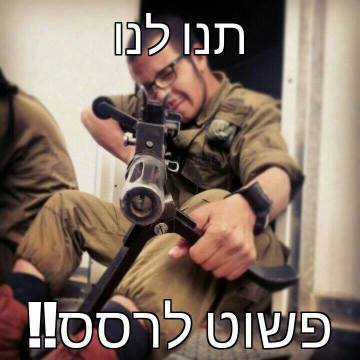
The Jewish state of Israel in the Levant (JSIL) and the Islamic State in Iraq and Syria (ISIS) are different in many ways. The most fundamental difference is that the former is a recognized state and a member of the United Nations, while the latter is not recognized as a legitimate polity and is considered a political/military terrorist organization. However, the two share core characteristics that define them and by recognising these similarities observers may be able to make predictions about their futures.
Divine right to exist
Both JSIL and ISIS display what might be termed “self-defined righteousness.” Although Israel is a modern state, its politics and treatment of others (Palestinians) are based on religious concepts and principles that can be traced back to the first century BC and the teachings of Rabbi Hillel, someone who would be considered a fundamentalist today. He instructed Jews to have a religious and social identity separate from those of other people (tribes). Israel introduces itself to the international community as a Jewish state and, based on this interpretation of Zionist Judaism, is a home to Jews wherever they are in the world. In other words, it is a state which includes all Jews but excludes the indigenous people of Palestine, the Palestinians. It uses its interpretation of Judaism to deny Palestinians equal rights and prevent them from accessing their lands.
ISIS believes that it is enacting God’s will and defines itself as the force to enforce the Islamic moral code, religious rituals and law (Sharia). ISIS’ interpretation of Islam goes back to Ibn Taymiyyah (1263-1328) who promoted the idea that Muslims are different from non-Muslims both in their way of life as well as in religious instruction. This notion of non-acceptance together with cultural differences led Ibn Taymiyyah’s followers to the practice of excluding others and in some cases putting them to death. This particular interpretation of Islam also means the rejection of other branches of Islam.
The form of righteousness practiced by ISIS leaders and Israeli politicians is also used to set apart the “good” people from the “bad” ones. The good are those who believe and support their respective political projects while the bad ones are those who stand against them. It is this stance that makes it permissible for Israel to inflict damage on the bad ones and reward the good. As such, the Palestinian people are depicted in the official Israeli narrative as the bad people who work hard to inflict damage on the good Israeli Jews.
Historically, the state of Israel was established on the self-proclaimed premise of the Zionist movement, that anti-Semitism and murder might surge again in the world. Thus, the resurgence of another wave of anti-Semitism will inflict another Holocaust on the world’s Jews. The Zionist movement took anti-Semitism and the Holocaust out of their historical context. In other words, the concepts were given an absolute ahistoric “religious” meaning. Consequently, the “Jews” started to become reified as an ethnic identity and Israel as a refuge for the world’s Jewry from harm.
For ISIS, one of the underlying reason for Muslims’ degeneration over the centuries is that too many people have strayed far from the fundamental principles of Islam. The role of ISIS is to establish an Islamic state ruled by the caliph. It considers itself to be the force that will revive true Islam and create a state in which all Muslims can live in under its interpretation of Islam. Similarly to Israel, where non-Jews are discriminated against, there is no place for non-Muslims to live as equal citizens in the so-called Islamic State.
Both JSIL and ISIS use the self-serving interpretation of religious texts to enact pragmatic politick. The Zionist narrative that gave birth to the state of Israel and is now its official ideology starts with the idea that the Jews are God’s chosen people and that God promised them the holy land. These two concepts of chosenness are ahistorical, unconditional, and self-limited. Thus, settler colonial expansion in Palestine beyond the 1948 borders is seen as the redemption of the biblically named Judea and Samaria for the Jewish people. Putting Palestinian communities under closure during Jewish holidays is usually disguised as a religious instruction and therefore not seen for what it is: a measure of control.
ISIS also claims it is justified in its actions; it considers itself the group fighting for God and enforcing the latter’s instructions on earth. The group’s interpretation of religious texts is based on its spiritual-political leaders’ rulings that place people into two main categories – believers in ISIS’ ideology are viewed as being on the right path for following the “correct” version of Islam while everyone else, including followers of other branches of Islam, is on the wrong path. Thus the expulsion or execution of Iraqi Christians and Yazidis in Mosul who refuse to convert or pay Jizya (a tax paid by non-Muslims) is introduced as a religious instruction that permits politically motivated discrimination.
Indiscriminate attacks on perceived “enemies”
International humanitarian law forbids parties in armed conflict from deliberately launching attacks against civilians but both Israel and ISIS carry out indiscriminate attacks against their enemies, and they cite similar justifications for such attacks, mainly operational reasons.
JSIL, like ISIS, says that engaging in conflict in residential areas makes it difficult to avoid harm to civilians. Israel, which deems itself “superior” to others, says it launches military operations to prevent harm to its own people whose lives are worth much than those of “others.” ISIS believes it is on the right path and views everyone else as living in a state of sinfulness and, according to the group, sinners deserve to be put to death. Ultimately, ISIS and Israel attack civilians as part of their strategy to dispose of the natives and remove them from their lands. As such, in their quest for control of the land they both practice ethnic cleansing under a myriad of guises.In areas controlled by ISIS, in both Syria and Iraq, the group has carried out the mass executions of opposition militants captured by its forces and any person who assists its enemies is liable to be sentenced to death. Israel carries out a similar strategy of collective punishment against Palestinian resistance. It used it in its latest war on the Gaza Strip and during the so-called Operation Cast Lead in 2008-09. Even when Israel states that its attacks are intended to kill only resistance fighters, its bombardment of residential areas always leads to the killing of civilians. These attacks are clearly designed to target and punish the combatants’ families and homes.
During Israel’s latest war on Gaza in the summer of 2014, the Israeli army intentionally converted 40 percent of the Gaza Strip into uninhabited land. The Israeli army displaced up to 500,000 Palestinians out of their neighborhoods. This is the same tactic ISIS has been using in vast swaths in Syria and Iraq. The latest incident is the ongoing fighting in Kobane, the Kurdish city under Syrian jurisdiction, where ISIS’ shelling of the city forced the majority of its citizens to be displaced.
Displacement, collective punishment, terrorism and ethnic cleansing in the name of God are but a few similarities between the two entities. It is worth considering how the state of Israel has embraced the legend of the Maccabees, a sect of Judaism which fought other Jews and foreign powers in the name of piousness and righteousness, and how it has incorporated it within the contemporary ethos. The Maccabees were fundamentalists who used violence against their enemies, both Jewish and non-Jewish, and carried out forced conversions much as ISIS does today.
Samer Jaber is a political activist and researcher. He is the managing director for Dar el-Karma Inc. for Media, Researches and Publication. He tweets at @Jerusalem_sbj
Syria Lambasts Alliance for Terrorism
October 21, 2014
Dr. Bashar al-Jaafari at the UN: “In Golan terrorists get paid ransom by Qatar with the help of Israel”.
Featured Video

New positive ivermectin evidence
or go to
Aletho News Archives – Video-Images
From the Archives
Fanatical Followers of the Covid Regime: A Jim Jones-Style Cult?
By Professor Roger Watson and Dr. Niall McCrae | The Daily Sceptic | November 15, 2021
As scholars at leading British universities over recent decades, we witnessed the replacement of critical thinking and debate by narrative: facts are discrimination and scientific method is imperialism; truth, instead, is derived from ‘progressive’ values. This educational trend may be a major contributory factor to the ease in which society has been inculcated to the Covid ‘new normal’ of masking, testing, and repeated doses of vaccines for a disease of similar risk to severe influenza.
One doesn’t need much critical reasoning to observe the flawed logic of some vaccination enthusiasts, such as people who respond to experiencing any side effects, however debilitating, by saying “at least I know it’s working”, or, after contracting the disease despite their promised inoculation (over 90% effective, according to initial drug company claims), “I’d have been worse off without the jab.” … continue
Blog Roll
 Aletho News
- The Coming GOP Bloodbath?
- Arctic Scare Stories Melt Away
- Wrong, Euronews: Climate Change Has Not Created a Food, Energy, and Economic “Meta-Crisis”
- New positive ivermectin evidence
- Met Office Caught Fabricating Daily Temperature Record Claims
- Merck Virologists Admitted to Falsely Certifying Vaccine Efficacy
- Mandatory Folic Acid for every man, woman & child
- Pro-Palestine protesters arrested outside UK’s ruling Labour Conference in Liverpool
- Mauritius denies landing permit to flight from Israel, forcing cancellation: Tour operator
- Israeli finance minister calls for genocidal war on West Bank, annexation of south Lebanon
- If Americans Knew
- In Gaza, ‘Whoever Survives the Bombing Won’t Survive the Rubble’
- Israel kills more Palestinians, amid push to resettle Gaza – Daily Update
- Israel forces Gazans to live in constant peril – Daily Update
- Deconstructing Netanyahu’s pants-on-fire UN rant – Daily Update
- Trump betrayed voters with his campaign lies and prioritized a foreign country once he took office
- Netanyahu calls Israel’s war in Gaza ‘opposite of genocide’ in UN speech to near-empty hall
- Settler Kidnappings: Torture, Sexual Abuse and Terrorisation of Palestinian Abductees as Israel Deepens Annexation of West Bank
- Gaza winter nears as 162,000 tents become unusable, raising fears of humanitarian crisis
- Netanyahu says, “It’s the opposite of genocide”; UN says Gaza economy is world’s ‘most severe crisis on record’ – Daily Update
- Israel’s US-Backed Assault on Gaza Has Created the ‘World’s Most Severe Economic Crisis on Record’: UN
- No Tricks Zone
- New Study: Earth And Venus Surface Warmth Largely Explained By Convection And Lapse Rate, Not CO2 Or Radiation
- 2025 Nature Paper Claiming Worsening Global Drought Gets RETRACTED …Heavily Flawed
- New Study: ‘Global Drought Shows No Detectable Recent Acceleration Under Climate Warming’
- Economic Masterminds: German Socialists Suggest Taxing Productivity Gains Stemming From Using AI
- The South China Sea Has Not Been Cooperating With The Climate Change Narrative
- Energy Crisis: Germany Enters Heating Season With Historically Low Gas Reserve Fill Levels
- New Study: The Antarctic Ice Sheet Gained Mass From 2020-2024 Due To Staggering Snow And Ice Accumulation
- Study: Ocean Heating Rates From Thousands Of Years Ago ‘Dwarf’ Modern Ocean Heating Rates
- Climate Extremists Target, Attack Large-Scale Power Grid Infrastructure In Germany!
- New Study: Antarctic Ice Melt Has Contributed Less Than 1 Centimeter To Sea Level Rise In The Last 30 Years

