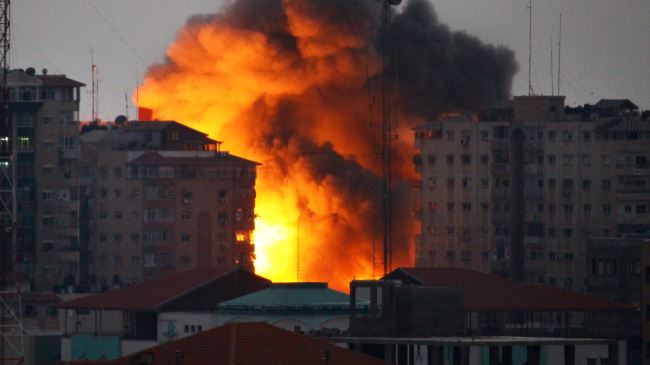
Obama’s ISIS speech would have provoked outrage if Bush gave it. Now, however, Democrats and Republicans are united over foreign war to such an extent that a prolonged military campaign without congressional approval barely raises an eyebrow. So one year after an attack on Syria was rejected by the American public bombs will be dropping after all.
More surprising than the bi-partisan escalation of Middle East war is the complete absence of strategy. Obama’s speech ignored the fundamental causes of ISIS’ rise, while putting forth a military strategy of pure fantasy. The only guarantee of Obama’s war strategy is the unnecessary prolonging of the Syrian conflict and the further growth of Islamic extremism. It’s as if President Obama hasn’t figured out the ABC’s of terrorism: the more you bomb, the more extremists you create. It isn’t rocket science.
The 13-year “war on terror” has fundamentally failed, creating an exponential growth in Islamic extremism, now sprawling across the very epicenter of the Middle East where its presence before was miniscule.
The president’s speech ignored how his strategy to fight the secular Syrian government — funding, training, and arming the Syrian rebels — has directly contributed to creating giant militias of Islamic extremists, filled with money and jihadists from Obama’s Gulf state allies of Saudi Arabia, Qatar, and Kuwait. If not for the U.S.-backed rebels in Syria, the conflict would have ended long ago, and ISIS would have remained marginal.
But instead of admitting that this failed approach helped create ISIS, Obama has doubled down on his ludicrous plan to further arm and finance the “moderate” opposition in Syria. The New York Times discussed the holes in Obama’s strategy:
“… Mr. Obama is still wrestling with a series of challenges, including how to train and equip a viable ground force to fight ISIS inside Syria, how to intervene without aiding President Bashar al-Assad, and how to enlist potentially reluctant partners like Turkey and Saudi Arabia.”
None of these issues are to be resolved, only compounded. Of course President Assad will benefit if Obama attacks his enemy ISIS, in the same way that ISIS has been benefitting the last two years from the U.S.-backed proxy war against President Assad.
Further exposing these issues is the highly regarded Middle East journalist Patrick Cockburn, who predicted Obama’s foolish speech with precision:
“So far it looks as if Mr. Obama will dodge the main problem facing his campaign against Isis. He will not want to carry out a U-turn in U.S. policy by allying himself with President Assad, though the Damascus government is the main armed opposition to Isis in Syria. He will instead step up a pretense that there is a potent “moderate” armed opposition in Syria, capable of fighting both Isis and the Syrian government at once. Unfortunately, this force scarcely exists in any strength and the most important rebel movements opposed to Isis are themselves jihadis such as Jabhat al-Nusra, Ahrar al-Sham and the Islamic Front. Their violent sectarianism is not very different to that of Isis.”
Later in the article Cockburn explains that the negligible moderate force is dominated by the CIA.
Obama dared not say explicitly that his plan to fight ISIS included a plan to fight the Syrian government, but that’s exactly what he implied by continuing to arm, fund, and train a “moderate” Syrian opposition that is fighting both ISIS and Assad.
Obama’s bombing campaign against ISIS can thus rapidly transition into a regime change bombing of the Syrian Government, as happened in the U.S.-led NATO bombing campaign in Libya that began as “humanitarian intervention” and veered into regime change after the first bomb dropped.
Before he announced the expansion of the war Obama claimed legal authorization to bomb without Congressional approval. The U.S. House Judiciary Chair issued a different opinion. And Democrats, too, had a different opinion when Bush was in office.
But now many congressmen from both parties would like Obama to act without Congress, since midterm elections are nearing and no congressman wants to be on record voting for war, since Americans are fed up with it. Better to skip democracy and have the president declare war unilaterally, war weary voters be damned.
Lastly, Obama failed to mention that perpetual war is the new normal for the U.S. government, no matter which party is elected. By not addressing any of the above-mentioned issues, a serious analysis was shelved in favor of the Bush Jr. circular logic that can be used to rationalize war forever, creating new generations of Islamic extremists that will justify permanent war. There can be only one real solution: remove the U.S. military from the Middle East.
Shamus Cooke can be reached at shamuscooke@gmail.com
On the eve of 9/11 President Obama announced a new U.S. war of aggression. Emergency response actions are urgently needed.
Obama lied last night just like Bush and Colin Powell lied in 2003 and Lyndon Johnson did in 1964. He told us how terrible ISIS is, how barbaric. He will announce a new “Coalition of the Willing”. He is using the Big Lie to launch another war.
But ISIS is not the “reason” the U.S. is going to war. ISIS is the PRETEXT. It is the latest of a string of pretexts from the Maine in 1898 to Vietnam’s Gulf of Tonkin in 1964 to “weapons of mass destruction” in 2003, pretexts/lies to maintain an empire.
ISIS is barbaric? It is the Pentagon that is barbaric. What are more barbaric than U.S. bombs in Syria and Iraq? U.S. drones wipe out whole wedding parties from Pakistan to Yemen, slaughtering men, women and yes, children.
It was U.S. war and occupation that killed more than a million Iraqis and destroyed that country. It was U.S. arms that fed Syria’s civil war, killing hundreds of thousands and half-destroying that country. Now Obama wants to destroy the other half.
ISIS grew from the poison of U.S. wars, arms and the cynical policy of inflaming sectarian divisions. Stop the Pentagon from waging war on the people and the people there will take care of ISIS. Continuing to wage war will arouse a billion people against the U.S. and its war machine.
The Bush “War on Terror” militarized every police force in the U.S. targeting people of color. The prison population soared. It globalized invasive surveillance and locked thousands in secret detention and solitary confinement. Now Obama promises a new “war on terror” reaching years into the future. We say NO!”
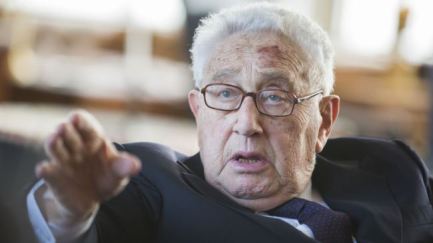
The anniversary of the September 11th attacks on New York and Washington would be a propitious day to arrest Henry Kissinger for crimes against humanity.
For while Kissinger is guilty of many war crimes, including the slaughter of millions of Vietnamese, it was on September 11th that he committed two of his most memorable outrages: The murder of Chilean President Salvador Allende and installation of the torture-loving Pinochet junta in 1973; and the explosive demolition of the World Trade Center, and massacre of nearly 3,000 people in New York and Washington in 2001.
Kissinger was undeniably the mastermind of the first 9/11. As President Nixon’s National Security Advisor in 1973, and the head of the “40 Committee” that oversaw US covert operations, Kissinger designed the coup that overthrew and murdered Allende. That operation was “Made in USA” and financed with American taxpayers’ money. Kissinger’s operatives paid lavish bribes to corrupt Chilean military officers including Pinochet, essentially hiring them to murder Allende and thousands of other honest, democracy-loving Chileans.
Kissinger’s complicity in the torture and murder of thousands of Chileans, and the destruction of democracy in Chile, is no secret. Kissinger actually confessed his intentions toward Chile on June 20th, 1970 when he famously said, “I don’t see why we need to stand by and watch a country go communist because of the irresponsibility of its own people.” (In fact, Allende was a democratic socialist, not a communist; his sin, in Kissinger’s eyes, was believing that Chile should control its own economy and resources.)
During the past two decades, many countries’ judicial officials have tried to prosecute Kissinger for the first 9/11. In 1998, Kissinger’s Chilean stooge, General Pinochet, was arrested – and spent the rest of his life under real and virtual house arrest, fighting prosecutions for crimes against humanity before he died in 2006.
Prosecutors in Chile, Argentina, Spain and France have subpoenaed Kissinger. Chilean judge Juan Guzman submitted 30 questions to Kissinger about his relationship with Pinochet but Kissinger refused to answer them. At one point Kissinger had to flee France to avoid arrest.
Though at various times he has been a wanted man in various countries, somehow Kissinger is still walking around free…and planning new war crimes. Since the coup of September 11th, 2001, Kissinger has been a leading advocate of the neoconservative plan to destroy “seven countries in five years” as Gen. Wesley Clark revealed.
Though they invaded Iraq and Afghanistan first, and then destabilized Somalia, Sudan, Libya, and Syria – all of which took longer than the planned five years – the neocons’ biggest and most important post-9/11 target has always been Iran. During the past decade Kissinger has been feuding with his fellow mummified ex-National Security Advisor, Zbigniew Brzezinski, about whether the US should attack Iran for Israel. While Brzezinski has been arguing against attacking Iran, Kissinger and his stable of Israel-loving neoconservatives have been beating the drums for war on Tehran.
Kissinger’s anti-Iran extremism was on display Saturday when he told National Public Radio that Iran is a bigger threat than ISIL. What he didn’t say is that by “threat” he meant threat to Israel, not the USA.
Kissinger’s close association with the fanatically pro-Israel, anti-Iran neoconservatives since September 11th, 2001 has surprised some observers, who traditionally viewed the former National Security Advisor as a realist rather than an ideologue.
Why did Kissinger turn neocon? Some speculate that as his mind deteriorates he is rediscovering his tribal roots and experiencing a Zionist second childhood. Evidence supporting this view includes his petulant statement to the New York Post that “In ten years there will be no more Israel.” Apparently Kissinger has fallen victim to the kind of Zionist existential anguish that lies at the root of the radicalism of such neocons as Paul Wolfowitz, Richard Perle, Scooter Libby, Douglas Feith, Dov Zakheim, and others of that ilk.
But there may be another reason for Kissinger’s succumbing to what Gilad Atzmon calls Pre-Traumatic Stress Disorder. That reason, in a nutshell, is Kissinger’s complicity in the neoconservative coup d’état of September 11th, 2001. By helping design the 9/11 shock-and-awe psychological warfare operation, Kissinger appears to have indelibly wedded his own fate to that of the neoconservative September criminals.
How do we know Kissinger was involved in the 9/11-anthrax operation? Because President Bush, acting under orders of Dick Cheney and the 9/11 perpetrator cabal, appointed Kissinger to head the 9/11 Coverup Commission. Only a person with intimate knowledge of what needed to be covered up, as well as a strong grasp on the crumbling “19 hijackers led by a dying man in a cave” cover story, could have been entrusted to head the Commission.
Since Kissinger was a known war criminal, mass murderer, and Machievellian conspirator who had orchestrated at least one September 11th coup d’état, the victims’ family members protested his appointment as Executive Director of the 9/11 Cover-up Commission. Due to public pressure, Bush was forced to fire Kissinger and replace him with another likely planner of the 9/11-anthrax operation, Philip Zelikow.
Unlike Kissinger, Zelikow was a relatively unknown war criminal. The architect of the Bush Doctrine of disguising the supreme crime of aggressive war under the “pre-emptive” euphemism, Zelikow is a self-described expert in “the creation and maintenance of public myths.” One of the likely creators of the 9/11 myth, Zelikow wrote the 9/11 Commission Report in chapter-by-chapter outline in March, 2003, before the Commission had even convened. That early draft, which is virtually identical with the Report’s final draft, was probably based on a Hollywood-style script for the 9/11-anthrax events written by Zelikow, Kissinger and others to serve as a playbook for the covert operatives who perpetrated the attacks.
During and immediately after the 9/11-anthrax false flag operation, Kissinger sat on the Defense Policy Board under key 9/11 suspect Richard “Prince of Darkness” Perle, a leading PNACer who demanded a “New Pearl Harbor” in September 2000 – and got one exactly one year later. As Perle’s senior advisor, Kissinger would have been one of the most significant architects of the 9/11-anthrax operation and subsequent cover-up.
Like Perle, who boasts of his satanic nickname “Prince of Darkness,” Kissinger revels in criminality and evil: “The illegal we do immediately. The unconstitutional takes a little longer.”
9/11-anthrax wasn’t just unconstitutional; it entailed the destruction of the Constitution in an American Reichstag Fire. It took Kissinger and his neoconservative and Israeli allies years to plan; and they have spent the past 13 years covering their tracks by “fleeing forward” into a widening circle of wars.
If the 9/11 wars ever end, and the post-2001 state of emergency is lifted, the September criminals could face prosecution. No wonder Kissinger and his neocon pals are demanding war with Iran and Russia – either one of which could likely escalate into World War III.
To save the planet, we need to arrest Henry Kissinger for his September 11th crimes: those of 2001 as well as 1973.
I could not dig: I dared not rob:
Therefore I lied to please the mob.
Now all my lies are proved untrue
And I must face the men I slew.
What tale shall serve me here among
Mine angry and defrauded young?
– Rudyard Kipling, “Epitaphs of the War”
How can a just peace be achieved between the Israelis and the Palestinians? The answer is simply to appoint as peace envoy a war criminal who — like former French President Nicolas Sarkozy — also happens to be an Israeli sayan. Before qualifying as a fully fledged war criminal, Blair started out as a lawyer whose cosy, potentially corrupt, and now war criminal connection with Israel began in earnest in 1994 when he first met Michael Levy — an encounter that was calculated rather than fortuitous — at a dinner party hosted by Israeli diplomat Gideon Meir who, like Blair was friendly with Eldred Tabachnik, a senior barrister and Queens Council at 11 King’s Bench Walk, the chambers founded by Derry Irvine where Blair had been a junior tenant on its foundation in 1981. Tabachnik was also a former president (1994-2000) of the Board of Deputies of British Jews.
Following their initial meeting Blair and Levy became friends, tennis partners, and political cohorts with Levy running the Labour Leader’s Office Fund to finance Blair’s 1997 general election campaign which received substantial contributions from notables such as Alex Bernstein (Granada Group Chairman 1979-1996) and Robert Gavron (publishing). Generally referred to as “Lord Cashpoint” in media and political circles, Levy was the Labour Party’s leading fundraiser with over £100m raised between 1994 to 2007. After becoming Prime Minister, Blair ennobled Bernstein and Gavron and made Levy a life peer whom the Jerusalem Post — owned by the subsequently convicted felon Canadian newspaper publisher Conrad Black — described as “undoubtedly the notional leader of British Jewry.”
In 1998 Blair appointed Levy as his personal envoy to the Middle East and it is perhaps no coincidence that as a consequence of being financed and in effect controlled by Israeli interests, Blair — like the semi-illiterate President Bush in the U.S. — was inveigled into launching an illegal war against Iraq despite widespread opposition to such a conflict. The need for war was then “sold” to the British and American people on the basis of doctored intelligence reports backed by Blair’s now infamous claim to Parliament that Saddam Hussein could deploy weapons of mass destruction within 45 minutes of an order to use them. Everyone now knows that the 45-minute claim was a blatant lie because Iraq had nothing even remotely resembling a weapon of mass destruction. So once again an AIPAC-controlled U.S.-led alliance was conned by Israel to wage war on Israel’s behalf against an “enemy” Arab neighbour. Other Israeli targets for Western alliance death and destruction included Iran and Syria.
“Lord Cashpoint” Levy, who praised Blair for his “solid and committed support of the State of Israel,” maintained close ties with Israel’s political leaders and kept a home in Herzliya, a city in the central coast of Israel. Daniel Levy, his son, was active in Israeli politics, and at one time served as an assistant to former Israeli Prime Minister Ehud Barak and to Knesset member Yossi Beilin. Daniel — amongst other positions — is a senior research fellow of the Middle East Task Force at the New America Foundation and director of MENA (Middle East and North Africa) programme at the European Council on Foreign Relations. It is the calculated placement of such dedicated, eager beaver people in strategic positions that exert influence over Western decision-making on the Middle East that favour Israel’s political purpose.
In March 2006 it was revealed that Tony Blair’s Labour Party had raised £14 million in loans from private individuals of whom some were later nominated for peerages. Levy was later arrested but released on bail pending Scotland Yard’s investigation into what came to be known as the “cash for honours” controversy. In July 2007 — one month after the Jewish Attorney General Lord Peter Goldsmith had stepped down at the same time as Blair — the Crown Prosecution Service announced that Levy would neither be prosecuted in connection with the affair nor face any other charges.
When Tony Blair and his disgraced Zionist “Lord Cashpoint” controller voluntarily decided to step down in June 2007, Gordon Brown, the Chancellor of the Exchequer for the past decade, assumed the office of Prime Minister following the approval of Queen Elizabeth II. Having been for a long time Blair’s bitter competitor for residence at 10 Downing Street, Prime Minister Brown was not to be outdone and was himself bankrolled and influenced by Ronald Cohen who as the Labour Party’s fourth largest supporter was also ennobled. The Egyptian-born Lord Cohen was in 2002 an inaugural inductee into the Private Equity Hall of Fame, at the British Venture Capital Association and Real Deals’ Private Equity Awards. So long as money — corporate, Jewish or otherwise — is permitted by the majority of the people to influence and control the governance of a nation, then there can be no democracy because the people become conditioned subjects rather than citizens.
In June 2007 Blair was appointed Middle East envoy working on behalf of the U.S., Russia, the UN and the EU quartet with his sterling peace efforts resulting in Israel’s 2008 Operation Cast Lead. Being an Israeli stooge, however, has its rewards and in May 2009 Blair received the $1 million Dan David prize at a Tel Aviv university ceremony. Blair’s office stated that 90 percent of the money from the prize — which is named after Dan David, the Jewish-born Romanian international businessman who made his millions by setting up Photo-Me booths in shopping malls around the world — would be donated to the Tony Blair Faith Foundation that promotes religious understanding by bringing together young people (excluding young Palestinian “beasts”) of different faiths.
This was followed up in September 2010 with the National Constitution Center’s Liberty Medal and $100,000 (£65,000) prize being awarded by former President Bill Clinton to Blair. The Center is an independent, non-profit organisation that promotes understanding of the U.S. constitution and its relevance. The $100,000 was to be donated to Blair’s charitable foundations. Officials acknowledged that Blair, who had just been forced to cancel promotional events for a new autobiography amid protests by critics of his role in the U.S.-led Iraq war, was a contentious choice. The Center’s Jewish (surprise, surprise) president David Eisner, said that “There is always an element of controversy when you pick people at the forefront of change. They are usually very controversial figures. We understand … how differently Tony Blair appears to be viewed by many people in the UK as compared with many people in the US.” That is probably because the British people had not forgotten how he deliberately involved Britain in a war on the strength of a barefaced Blair lie.
Following the September 2014 much criticised GQ glossy magazine’s “Philanthropist of the Year” award” to Blair, the Charity Commission has just announced that it will meet representatives of the Tony Blair Faith Foundation (TBFF) over concerns brought to its attention by former senior employee turned whistleblower, Martin Bright. Bright, who as editor of the TBFF website for the charity analysed religious conflict, has complained about Blair’s interference and effectively accused him of abusing his role as patron to use the charity as a think tank for his private office which allegedly spent large sums of money on a sizeable communications team whose priority appeared to be the protection Mr Blair’s image, rather than the promotion of the charity. Bright further maintained that “the Faith Foundation is an independent charity with Tony Blair as its patron. He is not supposed to have any executive role … But it was clear from the outset that … his [Mr Blair’s] reputation was to be protected at all costs.”
Though other Labour Party leaders have since endeavoured to jettison the pernicious legacy of the illegal Iraq war, Blair has steadfastly continued to maintain that he made the right decision . . . “If we hadn’t removed Saddam from power just think, for example, what would be happening if these Arab revolutions were continuing now and Saddam, who’s probably 20 times as bad as Assad in Syria, was trying to suppress an uprising in Iraq? Think of the consequences of leaving that regime in power.” Anyone thinking about it — taking into account how Iraq’s entire infrastructure has since been destroyed, its communities divided, and its people devastated with millions killed — would have to honestly conclude Iraq and its people were much better off under Saddam Hussein who as a war criminal was strictly an amateur compared to leaders like Blair, Bush Jr., and Barack Obama.
Apart from all the blood on his hands, Blair has also been busy stuffing his pockets with filthy lucre to the extent that his approximate earnings of £150,000 as Prime Minister are now dwarfed by varied estimates of tens of millions. Finally, Israeli stooge and war criminal Blair is to be given a knighthood — one of the Catholic church’s top awards — for “services to peace” by a gutless and hypocritical Pope who failed to condemn the recent butchery in Gaza while presiding over a Church that has always condemned the use of contraception so as to protect the the sanctity of human life.
Syrian media accused Arab governments Tuesday of giving Washington prior agreement for military action against jihadists, with one daily calling for Damascus to form an alternative alliance with Moscow and Tehran.
The commentary comes ahead of talks in Saudi Arabia on Thursday between Secretary of State John Kerry and US regional allies on joint action to tackle the threat posed by the Islamic State group in both Syria and Iraq.
“Washington, which used the false pretext of weapons of mass destruction to enter the region militarily in 2003 and draw new geopolitical lines… is returning today under a new false pretext, the fight against terrorism,” said the Al-Baath newspaper.
“The Arabs meanwhile, are absent from every decision and are playing secondary roles,” it added.
The Baath party daily was referring to the US-led invasion of Iraq in 2003 in which notoriously the alleged chemical and biological weapons that were used to justify the overthrow of Saddam Hussein’s regime were never found.
Kerry is set to meet foreign ministers from Egypt, Jordan, Iraq, Lebanon, Turkey and the six Gulf Arab states in Saudi Arabia on Thursday.
The talks are part of US efforts to build a coalition to tackle ISIS, which has seized large tracts of territory in both Syria and Iraq, and carried out abuses including the decapitation of Syrians, Iraqis, Lebanese and two American journalists.
On Sunday, the Arab League pledged to take “necessary measures” to confront ISIS, and said it was ready for “international cooperation on all fronts.”
But Syria, and its ally Iran, will not be present at the talks in Saudi Arabia, and Damascus fears efforts to tackle ISIS will involve air strikes on its territory without its permission.
State-run newspaper Al-Thawra warned: “The United States is setting the stage to bring new wars to the region.
“Its local partners are ready to carry out its orders without even knowing the details of the American plan,” it added.
Government daily Tishrin questioned why Kerry and US Defence Secretary Chuck Hagel were coming to the region “when the Arab League has already given its prior agreement for a new war in the region organized by the United States.”
A newspaper called for the formation of an alternative “Russian-Iranian-Syrian coalition” against the jihadists to that being put together by Washington.
“Western and regional governments are excluding the nations that really want to fight terrorism,” it said, charging that the US-led coalition included nations that “support terrorism financially, military and logistically.”
Damascus considers all rebel groups fighting to overthrow President Bashar al-Assad “terrorists” and has long accused the rebels’ supporters, particularly Qatar, Saudi Arabia and Turkey, of funding “terror.”
Similarly, critics opposed to US involvement in the conflict with ISIS have pointed out that Washington in partnership with its Gulf allies, including Saudi Arabia, played a role in the formation and expansion of extremist groups like ISIS by arming, financing and politically empowering armed opposition groups in Syria.
On Monday, a study by the London-based small-arms research organization Conflict Armament Research revealed that ISIS jihadists appear to be using US military issue arms and weapons supplied to the so-called moderate rebels in Syria by Saudi Arabia.
As the 13th anniversary of the crimes of September, 2001 approaches, the neoconservatives are shrieking from the rooftops – and effectively confessing that they were the real perpetrators of the 9/11-Anthrax false flag operation. (The neocons, you may recall, openly called for a “new Pearl Harbor” in September, 2000 – and got one exactly one year later.)
Every year at this time, the neocons orchestrate and hype a series of public relations stunts designed to magnify fears of “radical Islam” and reinforce their crumbling 9/11-Anthrax cover story. But this year’s propaganda campaign is so extreme that it represents a tacit confession: The neocons know that the truth about the 9/11-Anthrax operation is slowly closing in on them; so they are over-reacting by desperately trying to stoke the dying embers of the so-called War on Terror, in order to maintain the myth that Muslims (rather than neoconservative Zionists) attacked America in the autumn of 2001.
When a hysterical person exhibits guilty demeanor by trying too hard to blame a crime on someone else, that person is almost certainly the real perpetrator. As the neocons try much too hard to blame Islam for 9/11 and “terrorism” in general, their hysteria inadvertently reveals their own culpability. Like Shakespeare’s Lady MacBeth, the neoconservative movement has blood on its hands and “doth protest too much.”
This year, the shrill yelps of neocons unveiling their 9/11-Anthrax guilt are downright ear-splitting. Everywhere you look in the Zionist-dominated mainstream media, some neocon asset is hyping a ridiculous story about an “Islamic terrorist threat” – and tying it to the upcoming 9/11 anniversary.
Consider the preposterous legend, planted by neocons at Fox News then picked up by the rest of the media, that 11 missing Libyan jetliners may attack the USA on September 11th, 2014. The original Fox News story quotes an unnamed and probably imaginary US government official as saying: “There are a number of commercial airliners in Libya that are missing. We found out on September 11 what can happen with hijacked planes.”
The quote makes no sense. If Libyan commercial airliners were stolen by terrorists, they would not be making commercial flights, and therefore could not be hijacked. Additionally, commercial aircraft are (from a military perspective) big, fat, slow, and easy to locate, intercept, and if necessary shoot down.
Beginning more than a decade before 9/11, all of the hundreds of American commercial aircraft that significantly deviated from their course were intercepted by a fighter aircraft in about ten minutes…except for the four allegedly hijacked flights of September 11th, 2001. Those “hijacked” behemoths, we were told, lumbered unmolested through the skies of America for nearly two hours, while fighter jets were ordered to fly out over the Atlantic and circle aimlessly rather than defend Washington, DC.
The notion that Libyan commercial aircraft could threaten America is ludicrous. The story is a sick fantasy dreamed up by some neocon public relations firm. Its purpose is to subliminally reinforce the myth of the “radical Islamic terror threat” launched by the much larger neocon PR stunt of September 11th, 2001 and the follow-up anthrax letters.
It isn’t just Fox News hysterically hyping September terror. Newsmax, which like Fox is a neocon propaganda vehicle, has concocted a bizarre fantasy with another neocon group, Judicial Watch, about al-Qaeda and Islamic State (which are sworn enemies) teaming up to invade the US from Mexico. The Newsmax story is headlined: “‘Imminent’ Terror Attack Warning on US Border.” It begins: “Islamic State and al-Qaida terrorist cells are operating in a Mexican border town and are plotting to attack the United States with car bombs and improvised explosive devices.”
This story is not just self-evidently fictitious; it is downright insane. It seems that someone in a neoconservative PR office somewhere has overdosed on imagination pills.
The delusional legends of “11 Libyan jetliners” and “Mexican takfiri invaders” (like the fake beheadings of Mossad agents posing as journalists) are just the most recent examples of neocons spouting farcical fantasies to cover their 9/11-Anthrax tracks. They have been dreaming up these surreal anecdotes on a regular basis for almost 13 years, beginning just minutes after the attack on the World Trade Center, when an actor known as “Harley guy” – obviously hired by the 9/11 perpetrators – launched the preposterous fiction that the buildings’ explosive demolition was the accidental result of plane crashes and relatively minor fires ignited by an otherwise insignificant amount of jet fuel.
In his new book The 2001 Anthrax Deception, Canadian professor Graeme MacQueen shows how many of the guilt-revealing delusional tales spread by the neocons in the autumn of 2001 related to the anthrax component of the 9/11-Anthrax false flag operation. Most damningly of all, the neocons launched their fear-of-anthrax propaganda campaign before anyone but the perpetrators could have known about the anthrax letters!
Beginning on September 22nd, 2001 – two weeks before the first anthrax letters were discovered in October – the neoconservatives launched a wave of stories claiming that radical Muslims were going to attack America with anthrax, perhaps by dropping anthrax on Americans using crop duster airplanes. One of those neoconservative propagandists, Richard Cohen of the Washington Post, has publicly admitted that he began taking the anti-anthrax drug Cipro weeks before the anthrax attacks were known to anyone but the perpetrators.
In a 2008 Slate Magazine article Cohen foolishly bragged: “I had been told soon after Sept. 11th to secure Cipro, the antidote to anthrax. The tip had come in a roundabout way from a high government official, and I immediately acted on it. I was carrying Cipro way before most people had ever heard of it.”
Who were the “high government officials” who knew the anthrax attacks were coming – and who therefore must have been the real criminals behind the attacks? They included Dick Cheney and George Bush, who began taking Cipro on September 11th, 2001 even though the anthrax attacks would not be known to anyone but the perpetrators until October.
Why did Bush and Cheney begin taking Cipro on September 11th, 2001? They were told to do so by Jerome Hauer, a self-proclaimed expert on both bioterrorism and building collapses. Hauer ran New York’s Office of Emergency Management (OEM) on the 23rd floor of World Trade Center Building 7 prior to 9/11. Many researchers believe that the controlled demolitions of the Twin Towers were planned and set in motion from that OEM bunker in WTC-7; that WTC-7 was subsequently demolished to destroy evidence; and that Jerome Hauer was one of the key designers of the 9/11-Anthrax mass murders.
On the morning of September 11th – before anyone could possibly have known why the World Trade Center Towers had exploded into pyroclastic clouds of very fine dust – Jerome Hauer, like his hired actor “Harley guy,” appeared on television telling Americans that the skyscrapers had “just fallen down” due to the modest office fires ignited by jet fuel.
While the mainstream media are still trying to cover up 9/11-Anthrax, they have been forced to admit that most neocon stories fanning the flames of the so-called War on Terror have been lies. Some failed neocon lies planted in American newspapers include:
*”Mohammed Atta visited Saddam Hussein’s agents in Prague before 9/11.”
*”One of the alleged 9/11 hijackers was treated for anthrax.”
*”One of the hijacker’s bodies from Flight 93 tested positive for anthrax.”
*”Saddam Hussein obtained ‘yellowcake’ from Niger to build nuclear weapons.”
*”Saddam Hussein had weapons of mass destruction and was planning to attack America.”
*”The Iraqis will welcome American invaders with flowers and candy, and American-occupied Iraq will quickly become a peaceful, prosperous, Israel-loving democracy – while Iraqi oil will pay for the war and push gasoline prices to historic lows.”
Though the Zionist-extremist neoconservatives have been caught lying dozens of times – and their lies have led to the deaths of more than a million innocent people – they have not yet been prosecuted for their crimes against humanity. So they keep lying in order to keep killing… and their lies keep getting shriller and more extreme as they “flee forward” to escape prosecution for their past misdeeds.
This neocon “flight forward” leads directly toward World War III. Only by prosecuting the neocon architects of 9/11-Anthrax, and thereby spectacularly discrediting the neoconservative philosophy of ultra-Machievellian deception, can we prevent the world from being reduced to radioactive rubble.
This is George Galloway’s first interview since being attacked on a London Street less than a week ago. In answer to a question regarding whether his remarks about Israel could be viewed as anti-Semitic, the British parliamentarian offers the view that “Israel has nothing to do with Judaism.”
Is Galloway correct? Are Israel and the Jewish religion totally divorced and disconnected from one another? Or is it possible that Judaic precepts such as “chosenness” are major determining factors contributing to Israeli behavior? The Old Testament contains an awful lot of blood and genocide. Moreover, it is common knowledge that many Israelis today view the Palestinians as Amalekites, an ancient tribe of people whom the biblical Israelites were supposedly commanded to destroy, including women and children–and even infants.
Galloway notes, accurately if I’m not mistaken, that 96 percent of Israelis supported the recent savagery inflicted upon Gaza. Israel was founded as a Jewish state and Judaism today is its official religion. Could this possibly have anything to do with why the attack enjoyed such widespread support among the Israeli public? Galloway seems to think not–although after what he’s been through it’s probably a safe bet that he’s being very cautious about what he says, and perhaps that has something to do with why he answered the question the way he did.
In any event, the question of whether there is–or isn’t–a connection between Judaism and the repeated atrocities we see committed by Israel is a legitimate one, and one that deserves to be openly discussed and debated. My own personal view is that there is a connection. At the same time, I fully recognize there are many who would answer that Zionism, not Judaism, is the real begetter and stirrer of the conflict. But one thing is for sure: we have a very serious problem in the Middle East today. And no hope whatsoever have we of ever solving it without at least identifying the true source of it–and that’s why such a debate is so important.
Israeli military magazine Israel Defence has reported that Israel is concerned over the possibility of Russia supplying Egypt with the developed anti-aircraft system S-300.
According to foreign media reports, Israel does not possess the proper technology to undermine the work of such an advanced system.
Sources told the magazine that Israel may not allow for Egypt to deploy such anti-aircraft missiles, if they are in fact being obtained, in the Sinai Peninsula.
A source in the Russian military industrial complex told Russia News Agency last month that the anti-aircraft system Egypt is currently negotiating with Russia over was initially produced for Syria. However, Egyptian partners have now “expressed interest in S-300 purchases”.
“The system may be re-equipped for Egypt in a short period of time,” the source added.
Israel Defence noted that if the anti-aircraft system were to be placed in Suez, its radar would cover half of Israel, and if placed in Port Said, it would cover almost the entire area of Israel.
This means that any Israeli plane flying towards Egypt or any Israeli rocket launched at Egypt would be monitored while still inside Israel.
The Permanent Representative of Syria to the United Nations Bashar Al-Jaafari says the recent developments in the Middle East, particularly the unrest in Syria and Iraq are part of a project to divide the Middle East.
Israel has the right to shell Palestinian hospitals and schools out of self defense as long as Hamas stores rocket launchers next to them, US Sen. Elizabeth Warren said during a town hall meeting in Massachusetts this week.
Warren, darling du jour of American liberals, defended her vote to send more defense funding to Israel in the middle of its recent fierce offensive on Gaza, saying she believes civilian casualties are the “last thing Israel wants,” according to the Cape Cod Times.
“But when Hamas puts its rocket launchers next to hospitals, next to schools, they’re using their civilian population to protect their military assets. And I believe Israel has a right, at that point, to defend itself,” she said.
Israel and Palestinian authorities reached a long-term ceasefire agreement this week after Israel started its campaign in Gaza on July 8. The death toll from the Gaza conflict has reached at least 2,120 people, of which 577 are children, according to the Palestinian Health Ministry.
During the conflict, Israel targeted schools and hospitals in Gaza, claiming that rockets and militant fighters were nearby. The United Nations Relief and Works Agency criticized both Hamas for storing rockets in two schools and Israel for attacks on separate schools.
Attacks on hospitals are prohibited by the Geneva Convention’s Protection of Civilian Persons in Time of War “unless they are used to commit, outside their humanitarian duties, acts harmful to the enemy.” Even then, civilian hospitals can only be targeted “after due warning has been given, naming, in all appropriate cases, a reasonable time limit and after such warning has remained unheeded.”
Warren said Hamas has attacked Israel “indiscriminately.” Thanks to Israel’s vaunted Iron Dome defense system, though, those rockets have “not had the terrorist effect Hamas hoped for.”
Warren supported Israel’s military aggression, justifying its use of force based on America’s “very special relationship with Israel.”
“Israel lives in a very dangerous part of the world, and a part of the world where there aren’t many liberal democracies and democracies that are controlled by the rule of law,” she said. “And we very much need an ally in that part of the world.”
Warren also expressed unease with conditioning future US funding for Israel on the cessation of Israeli settlements in the West Bank.
“I think there’s a question of whether we should go that far,” Warren said.
Last month, UN High Commissioner for Human Rights said Israel may have committed war crimes in Gaza. Navi Pillay said house demolitions and the killing of children raise the “strong possibility” that Israel is violating international law.
More than 17,000 homes in Gaza were destroyed or damaged beyond repair, making around 100,000 Palestinians homeless, since the war began, according to UN estimates.
According to a senior UN Children’s Fund (UNICEF) official, 373,000 Palestinian children are in need of “immediate psychosocial first aid” due to the onslaught of Israeli strikes.
“The impact has truly been vast, both at a very physical level, in terms of casualties, injuries, the infrastructure that’s been damaged, but also importantly, emotionally and psychologically in terms of the destabilizing impact that not knowing, not truly feeling like there is anywhere safe place to go in Gaza,” Pernilla Ironside said last week.
UNICEF estimated that at least 219 schools have been damaged by Israeli airstrikes, while 22 were completely destroyed.
To demonstrate the extent of the damage in Gaza, Ironside estimated that it could take up to 18 years to rebuild the 17,000 housing units that were damaged in the conflict and in light of the ongoing blockade of the region limiting the movement of goods and people.
Israel has also barred major human rights organizations from entering Gaza territory.
Meanwhile, back in the United States, US Sen. Bernie Sanders, American liberals’ other favorite among establishment progressive politicians, has also defended US funding and arms for Israel. At a recent tense town hall in his native Vermont, Sanders condemned Israeli targeting of civilians, but then defended Israel “in a situation where Hamas is sending missiles into Israel” sent from “populated areas.”
“This is a very depressing and difficult issue. This has gone on for 60 bloody years,” he said. “If you’re asking me, do I have a magical solution? I don’t. And you know what, I doubt very much that you do.”
There is a group of Jewish American billionaires who are apparently doing their best to make sure that negotiations with Iran go nowhere in the mistaken belief that they are doing what is best for Israel. And they would also appear to be assisted in their efforts by the White House, which is at the same time claiming that it wants the talks to be successful. The odd relationship is currently playing out in a Manhattan courtroom where the Justice Department is seeking to quash a lawsuit that it fears might expose the extent to which the government has hypocritically played fast and loose with classified information while simultaneously sending journalists and whistleblowers to jail over allegations that they have done the same.
The power and wealth of the anti-Iran groups as well as their unrivaled access to the United States government means that a policy of détente with Iran, which would be a no brainer based on both American and Iranian interests, only proceeds by fits and starts with the US Congress and much of the media lined up solidly to stop the effort. The American Israel Public Affairs Committee (AIPAC) and its affiliated educational foundation, which have focused on the “Iranian threat” over the past three years, have a combined budget of more than $90 million while AIPAC’s spin-off the Washington Institute for Near East Policy (WINEP) has $8.7 million.
The American Enterprise Institute’s (AEI) efforts are more diversified but uniformly hawkish when it comes to the Middle East. It has a budget of $45 million. Identified multi-million dollar donor/supporters of AIPAC, AEI, and WINEP include Sheldon Adelson of Las Vegas Sands, Paul Singer of Elliot Management hedge fund and Bernard Marcus of Home Depot.
Other right wing think tanks including Heritage and Hudson in Washington also support unrelenting pressure directed against Iran. Even the more centrist Brookings Institute is hard core when it comes to Middle Eastern politics by virtue of its Saban Institute funded by Israeli-American billionaire Haim Saban. And then there are the mainstream Jewish organizations to include the Anti Defamation League, the Conference of Presidents of Major Jewish Organizations and the American Jewish Congress, all of which have vast resources and unparalleled access to the White House, Congress and the media.
All the pro-Israel anti-Iran groups engage in pressure tactics on Capitol Hill and have been effective in dominating the political debate. Of thirty-six outside witnesses brought in to testify at seven Senate hearings on Iran since 2012 only one might be characterized as sensitive to Iranian concerns. The enormous lobbying effort enables the anti-Iran groups to define the actual policies, move their drafts of legislation through congress, and eventually see their bills pass with overwhelming majorities in both the House and Senate. It is democracy in action if one accepts that popular rule ought to be guided by money and pressure groups rather than by national interests.
Less well known is United Against Nuclear Iran, which has a budget just shy of $2 million. UANI is involved in the New York lawsuit. The group, which has somehow obtained a 501[c]3 “educational” tax status that inter alia allows it to conceal its donors, has offices in Rockefeller Center in New York City. It is active on Capitol Hill providing “expert testimony” on Iran for congressional committees, to include “help” in drafting legislation. At a July Senate Foreign Relations Committee hearing on Iran all three outside witnesses were from UANI. It is also active in the media but is perhaps best known for its “name and shame” initiatives in which it exposes companies that it claims are doing business with Tehran in violation of US sanctions.
UANI is being sued by a Greek billionaire Victor Restis whom it had outed in 2013. Restis, claiming the exposure was fraudulent and carried out to damage his business, has filed suit demanding that UANI and billionaire Thomas Kaplan turn over documents and details of relationships regarding UANI donors who it is claimed are linked to the case. Kaplan, a New York City resident, made his initial fortune on energy exploration and development. More recently he has been involved in commodities trading in precious metals. His wife Daphne is Israeli and his involvement in various Jewish philanthropies both in the US and in Israel have invited comparison with controversial deceased commodities trader Marc Rich, who reportedly worked closely with the Israeli government on a number of projects.
The Justice department would like to the see the UANI lawsuit go away as it is aware that what is being described as “law enforcement” documents would include both privileged and classified Treasury Department work product relating to individuals and companies that it has investigated for sanctions busting. Passing either intelligence related or law enforcement documents to a private organization is illegal but the Justice Department’s only apparent concern is that the activity might be exposed. There is no indication that it would go after UANI for having acquired the information and it perhaps should be presumed that the source of the leak is the Treasury Department itself.
Who or what provided the documents to a private advocacy group that is also a tax exempt foundation supported by prominent businessmen with interests in the Middle East is consequently not completely clear but Restis is assuming that the truth will out if he can get hold of the evidence. The lawsuit claims that UANI intimidates its targets by defaming their business practices as well as by demanding both examination of their books and an audit carried out by one of its own accountants followed by review from an “independent counsel.”
Kaplan is named in the suit as he appears to be the gray eminence behind UANI. He once boasted “we’ve (UANI) done more to bring Iran to heel than any other private sector initiative.” Kaplan also employs as a director or officer in six of his companies the Executive Director of UANI Mark Wallace and reportedly arranged the awarding of the Executive Director position at Harvard’s Belfer Center to its President Gary Samore.
Kaplan is a business competitor to Restis, whose lawyers are apparently seeking to demonstrate two things: first, that the US government has been feeding sometimes only partially vetted information to UANI to help in its “name and shame” program and second, that UANI is itself supported by partisan business interests like Kaplan as well as by foreign sources, which apparently is meant to imply Israel. Or even the Israeli intelligence service Mossad. Meir Dagan, former head of Mossad, is on the UANI advisory board, which also includes ex-Senator Joseph Lieberman and former Senior Diplomat Dennis Ross, both of whom have frequently been accused of favoring Israeli interests and both of whom might well have easy access to US government generated information.
And then there is the Muhadedin-e-Khalq, the Iranian terrorist group that has assassinated at least six Americans and is now assisting the Israeli government in killing Iranian scientists, a prima facie definition of what constitutes terrorism. The group was on the State Department terrorist list from 1997 until 2012, when Secretary of State Hillary Clinton de-listed it in response to demands coming from friends of Israel in Congress as well as from a large group of ex government officials, many of whom were paid large honoraria by the group to serve as advocates. The paid American shills included former CIA Directors James Woolsey and Porter Goss, New York City Mayor Rudolph Giuliani, former Vermont Governor Howard Dean, former Director of the Federal Bureau of Investigation Louis Freeh and former United Nations Ambassador John Bolton. The promoters of MEK in congress and elsewhere claimed to be primarily motivated by MEK’s being an enemy of the current regime in Tehran, though its virulent anti-Americanism and terrorist history make it a somewhat unlikely poster child for the “Iranian resistance.”
Supporters of MEK also ignore the fact that the group is run like a cult, routinely executes internal dissidents, and has virtually no political support within Iran. But such are the ways of the corrupt Washington punditocracy, lionizing an organization that it should be shunning. MEK’s political arm is located in Paris and it has long been assumed that it is funded by the Israeli government and by at least some of the same gaggle of billionaires, possibly including their Israeli counterparts, who support the anti-Iranian agenda in the United States.
Iranian negotiators have accepted that their country should have only limited uranium enrichment capabilities coupled with a rigorous inspection regime but the talks in Geneva drag on and on as the United States continues to hesitate, raising new objections regularly in spite of claims that it operates in good faith and seeks a settlement. That an agreement is within reach is undoubtedly true and it would even be good for Israel as it would remove the regional nuclear option while making much less likely another pointless and devastating war. But the men who write the checks do not see it that way and, unfortunately, they are the ones who all too often both pay the piper and call the tune.
Earlier this week we posted Donnchadh Mac an Ghoill’s interview with Sadiq Al Timimi on the current conflict in Iraq, in historical, local, and international contexts. Given the mounting ex post facto justifications for another round of heightened US military intervention in Iraq, already well underway and with no defined limit in either the scope of possible actions to be undertaken, or a temporal limit for such interventionism, we opted to counter some of the dogma and myth-making that has been so effortlessly produced by those with ample practice—and interest—in justifying the further militarization and Americanization of Iraqi affairs.
More US intervention is the last thing that is needed in Iraq. The current phase of conflict (the rapid advance of the Islamic State forces, also referred to as either ISIS or ISIL) is in many ways the direct outcome of US and other international intervention in Iraq over the past quarter century at least (and the failed campaign to back the armed overthrow of the government of Syria). The effective partitioning of Iraq to separate the Kurdish zone is one consequence of the illegal no-fly zone instituted and enforced by the US and UK throughout the 1990s. The gradual and then drastic destruction of the Iraqi state, via international sanctions and then with the invasion and occupation that started in March, 2003, deliberately and intentionally created disorder. This was a grand act of vandalism, designed to terminate a unified, secular state that had been forced to oppose US interests. Arming and training sectarian militias as part of the “surge” and General Petraeus’ counterinsurgency strategy, opened the door to atrocious ethnic cleansing that has not ceased since it began under US tutelage. An unstable government in Baghdad, and inter-ethnic violence, is precisely what American victory looks like. If after Iran, and after Russia, the US chose to renew its military intervention, it is not because it feels threatened by disorder—it is only threatened by the disorder that it cannot efficiently manage to its own ends.
Otherwise, there is no special “humanitarian crisis” in Iraq other than the one which the US and other western powers have been deliberately implementing since 1990. The greatest humanitarian crisis suffered by Iraq thus far has been the unprovoked naked aggression of the US against Iraq, committing a crime of the first order of importance under international law with the 2003 invasion. The subsequent commission of numerous war crimes by the US military, and atrocities against civilans, including torture, mass detentions, and the deliberate destruction of civilian infrastructure, are all crimes for which the US remains to answer. Some sporadic air drops of water and food cannot erase that, and by the US government’s own acknowledgment, confirmed by facts on the ground, current US military intervention is no solution to Iraqi problems. It is, however, an open door to even greater intervention over the long term. Meanwhile, US plans for a political solution are inconclusive, inadequate, and generally poorly conceived.
As we see, the US is only bombing ISIS when it gets too near to US business interests in Kurdistan—which is not to say that the US should do something otherwise. Otherwise ISIS can do as they like, as they have in Syria with the support of Turkey, a member of NATO, and US allies such as Saudi Arabia and Qatar, along with US funding and equipment itself. Further US intervention can only further delegitimize the Iraqi state and army. For all its many faults, the Iraqi state has been developing an independent foreign policy over the last few years, having refused to become part of the US lynching of Syria, and building up economic relations with China, Iran and Russia. Now the US has clearly backed, if not engineered, a constitutional coup against Prime Minister Nouri al-Maliki, adding further instability at a time of great political vulnerability. Iraq is well capable of dealing with ISIS—indeed, when left alone, it was almost most capable of dealing with such extremist movements. Even the Ba’ath Party, in the person of Izzat al-Douri, has declared ISIS a criminal element and condemned their sectarian atrocities, so ISIS has no real future in Iraq, and they certainly do not present an existential threat.
If Iraq looks like a “safe haven” for extremism now, it is as a direct result of US intervention. More US and western intervention will not solve the problems that such intervention caused in the first place, nor are the results we are witnessing innocently accidental and unforeseen consequences.
The US’ aims in Iraq have never been, and still are not, about saving poor civilians in Iraq.
Beirut – During his visit with US Secretary of State, Mike Pompeo, Lebanese President Michael Aoun reportedly received a US-Israeli document detailing plans for creating a civil war in Lebanon with covert false flag operations and possible Israeli invasion.
Although the source of the document is Israeli and created in partnership with Washington, no one knows who presented it to Aoun. The Lebanese TV station, Al-Jadeed, initially reported the document on Lebanese TV and a video on its website. Geopolitics Alert translated the report for this article. … continue
This site is provided as a research and reference tool. Although we make every reasonable effort to ensure that the information and data provided at this site are useful, accurate, and current, we cannot guarantee that the information and data provided here will be error-free. By using this site, you assume all responsibility for and risk arising from your use of and reliance upon the contents of this site.
This site and the information available through it do not, and are not intended to constitute legal advice. Should you require legal advice, you should consult your own attorney.
Nothing within this site or linked to by this site constitutes investment advice or medical advice.
Materials accessible from or added to this site by third parties, such as comments posted, are strictly the responsibility of the third party who added such materials or made them accessible and we neither endorse nor undertake to control, monitor, edit or assume responsibility for any such third-party material.
The posting of stories, commentaries, reports, documents and links (embedded or otherwise) on this site does not in any way, shape or form, implied or otherwise, necessarily express or suggest endorsement or support of any of such posted material or parts therein.
The word “alleged” is deemed to occur before the word “fraud.” Since the rule of law still applies. To peasants, at least.
Fair Use
This site contains copyrighted material the use of which has not always been specifically authorized by the copyright owner. We are making such material available in our efforts to advance understanding of environmental, political, human rights, economic, democracy, scientific, and social justice issues, etc. We believe this constitutes a ‘fair use’ of any such copyrighted material as provided for in section 107 of the US Copyright Law. In accordance with Title 17 U.S.C. Section 107, the material on this site is distributed without profit to those who have expressed a prior interest in receiving the included information for research and educational purposes. For more info go to: http://www.law.cornell.edu/uscode/17/107.shtml. If you wish to use copyrighted material from this site for purposes of your own that go beyond ‘fair use’, you must obtain permission from the copyright owner.
DMCA Contact
This is information for anyone that wishes to challenge our “fair use” of copyrighted material.
If you are a legal copyright holder or a designated agent for such and you believe that content residing on or accessible through our website infringes a copyright and falls outside the boundaries of “Fair Use”, please send a notice of infringement by contacting atheonews@gmail.com.
We will respond and take necessary action immediately.
If notice is given of an alleged copyright violation we will act expeditiously to remove or disable access to the material(s) in question.
All 3rd party material posted on this website is copyright the respective owners / authors. Aletho News makes no claim of copyright on such material.