Mideast crises West bid to protect Israel interests: Jaafari
Press TV – June 19, 2014
Syria’s Permanent Representative to the United Nations Bashar Ja’afari says the current tumult in the Middle East, including the crisis in his country, is a scheme by the West to safeguard Israel’s interests, Press TV reports.
“This is a geopolitical plan that is not only targeting Syria exclusively, although Syria is very important for either the success or failure of this plan, but it is targeting the whole area,” said Ja’afari Wednesday in an exclusive interview with Press TV in New York.
He said the main goal of the Western plot “is to secure for a long time the interests of Israel and preventing the establishment of Palestinian state in Palestine.”
“So they need to open up a new front, a kind of deviation, from the focus on the Arab-Israeli conflict and the Palestinian question to another focus which might be a war between Muslims and Muslims,” he added.
He further underlined that the West intends to incite divisions among Muslims under the false notion of a Sunni-Shia conflict to provoke wars between Muslim countries in the region.
The Syrian envoy went on to reiterate that the huge participation of Syrian voters in the country’s presidential election served as big “NO” message to foreign interference in their country’s internal affairs.
“Our message would be a friendly message… [that] we want to have friends and we want to have normal, bilateral relationship with everybody. We do not interfere into the American domestic affairs. Please don’t interfere into our own domestic affairs.”
According to official figures, President Bashar al-Assad won nearly 90 percent of the votes cast in Syria’s presidential race. Syria’s Supreme Constitutional Court announced that over 73 percent of the 15.8 million eligible voters had taken part in the election.
French arms sales rise by 42%
MEMO | June 17, 2014
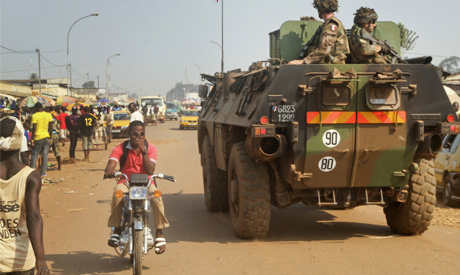
Defence Minister Jean-Yves Lodrian said on Monday that French arms sales increased by 42 per cent or €6.7 billion in 2013 compared to 2012 and are expected to exceed seven billion Euros this year. Lodrian was speaking during the opening of the Eurosatory 2014 arms fair in the Paris suburb of Villepinte.
France recorded a strong comeback in the Middle East market, said Lodrian. The region is responsible for generating 40 per cent of France’s total exports and it has also increased its presence in the Asia and Latin America markets.
In 2013, France’s biggest contract was an agreement to renew the Saudi Arabian navy’s fleet of ships, worth €500 million; a contract to sell a communication satellite to Brazil is worth €300 million.
The minister pointed out that French exports of munitions for use by armoured vehicles grew by 5 per cent in 2013. He noted that the Scorpion programme to update light weapons will soon be launched at the cost of five billion Euros over ten years.
“This means that future equipment will include more than 2,500 armoured vehicles connected to each other by sophisticated electronic systems,” said Lodrian. “The Scorpion programme will allow the Leclerc tank to be in use until 2040.”
Eurosatory 2014 will enable French industrialists “to improve their exports”, the minister added. Nearly 1,500 exhibitors from 58 countries are taking part in the arms fair, which lasts until Friday.
US admits sending ‘lethal aid’ to Syrian rebels
RT | June 8, 2014
Washington is supplying some Syrian rebels with both “lethal and non-lethal” aid, according to National Security Adviser Susan Rice, who confirmed the longstanding suspicion that the Obama administration is arming anti-Assad forces.
The US is “the single largest contributor of humanitarian assistance, providing over $1.7 billion” in assistance, Rice told CNN.
“That’s why the United States has ramped up its support for the moderate vetted opposition, providing lethal and nonlethal support where we can to support both the civilian opposition and the military opposition,” she said.
Previously, American officials claimed that the US sent only non-lethal aid to Syrian rebels, saying they were concerned that if US arms, especially sophisticated ones like portable anti-aircraft missiles, were sent to Syria, they might end up in the hands of terrorists. Media reports, however, suggested that the CIA was secretly involved in training rebel groups and assisting Saudi Arabia and Qatar in smuggling arms to the rebels fighting to topple Syrian President Bashar Assad.
Rice emphasized Washington’s desire to play a more pro-active role in the Syrian conflict by getting Congress approval for more assistance to the rebels in the war that has been ongoing for three years and claimed upward of 160,000 lives.
The aid of hundreds of millions of dollars given by the US since the start of the civil war in 2011 has all gone toward humanitarian assistance, she insisted.
Although details about the specifics of aid and training provided to opposition forces are usually avoided by US officials in interviews, President Barack Obama announced his Syria plans in a foreign policy speech at West Point military academy in late May.
Rebels “offer the best alternative to terrorists and brutal dictators,” the president said. Now it’s up to Congress to support the idea of and green-light more aid, as is stipulated in the War Powers Act.
In mid-May, Obama met with the leader of the Turkey-based opposition Syrian National Coalition, Ahmad Jarba, and boosted US aid to the Syrian opposition by $27 million.
In the interview, Rice defended the president’s foreign policy, which some critics in the US believe to be passive and overcautious. She insisted that Washington retains strong ties with partner nations and a strong global position.
“I think the fact of the matter is we’re living in complex times, there are many different challenges that the United States and the world faces. But our leadership is unmatched. Our role is indispensable,” she said.
The confirmation of America’s lethal aid to the Syrian opposition comes on the heels of the delivery of F-16 fighter jets to Iraq, a country torn apart by raging sectarian violence, which takes dozens of lives daily.
Syria has suffered greatly in the three-year civil war, but its government remains stable and its military is gaining ground in the fight against various opposition forces, many of them foreign Islamists.
An Open Letter to the Graduates of West Point: Refuting President Obama’s Lies, Omissions and Distortions
By James Petras :: 06.07.2014
Introduction
On May 2014 President Obama delivered the commencement address to the graduates of United States Military Academy at West Point. Beyond the easy banter and eulogy to past and present war heroes, Obama outlined a vision of past military successes and present policies, based on a profoundly misleading diagnosis of the current global position of the United States.
The most striking aspect of his presentation is the systematic falsification of the results of past wars and current military interventions. The speech is notable for the systematic omissions of the millions of civilian deaths inflicted by US military interventions. He glosses over the growth of NSA, the global police state apparatus. He presents a grossly inflated account of the US role in the world economy. Worst of all he outlines an extremely dangerous confrontational posture toward rising military and economic powers, in particular Russia and China.
Distorting the Past: Defeats and Retreats Converted into Victories
One of the most disturbing aspects of President Obama’s speech is his delusional account of US military engagements over the past decade. His claim that, “by most measures America has rarely been stronger relative to the rest of the world”, defies belief. After 13 years of warfare, the US has failed to defeat the Taliban. Washington is in full retreat and leaves behind a fragile puppet regime which will likely collapse. In Iraq the US was forced to withdraw after killing several hundred thousand civilians and fueling a sectarian war which has propelled a pro-Iranian regime to power. In Libya, the NATO war devastated the country, destroyed the Gadhafi government,thus undermining reconciliation, and bringing to power bands of terrorist Islamic groups profoundly hostile to the United States.
Washington’s effort to broker an accord between Palestine and Israel was a dismal failure, largely because of the Obama regime’s spineless attitude toward Israel’s land grabs, and new “Jews only” settlements. The craven pandering to the Jewish power configuration in Washington hardly speaks for the world’s “greatest power” … by any measure.
Through your economic studies you are surely aware that the US has been displaced by China in major markets in Latin America, Asia and Africa. China poses a major economic challenge: it does not have overseas bases, Special Forces’ operations in seventy-five countries; it does not pursue military alliances and does not militarily intervene in countries. Obama’s expansion of the US military presence off China’s coast speaks to an escalation of bellicose behavior, contrary to his assertions of “winding down” overseas military operations.
Obama speaks of defending “our core interests” militarily.Yet he threatens China over disputed piles of rocks in the South China Sea, overlooking the “core interests” of the 500 biggest US corporations with hundreds of billions of dollars invested in the most dynamic economy in the world and the second biggest trading nation.
Obama spoke of the threat of “terrorism” yet his policies have encouraged and promoted terrorism. Washington armed and promoted the Islamic terrorists which overthrew Gadhafi; backs the Islamic terrorists invading Syria; provides 1.5 billion in military aid to the Egyptian military dictatorship which is terrorizing the political opposition, via assassinations and arrests of thousands of political dissidents. The US backed the violent overthrow of the elected regime in the Ukraine and is backing the client regime’s terror bombing of the pro-democracy Eastern regions. Obama’s “anti-terrorism” rhetoric is in fact a cover for state terrorism, which closes the door on peaceful resolution of overseas conflicts, and leads to the multiplication of violent opposition groups.
Obama speaks to “our success in promoting partnerships in Europe and in the world at large”. Yet his bellicose policies toward Russia has deeply divided the US from the leading countries in the European Union. Germany has multi-billion dollar trade agreements with Russia and objects to harsh sanctions as does Italy, Holland and Belgium. Latin America has relegated the US centered Organization of American States to the dust bin of history and moved toward regional organizations which exclude the US. Washington has no “partners” backing its hostile policies toward Venezuela and Cuba. In Asia, Washington’s efforts to forge an economic bloc excluding China, runs against the deep and comprehensive ties that link South Korea, Taiwan and Southeast Asia to China. Washington’s closest partners are the least dynamic and most repressive: Israel, Yemen, Saudi Arabia and the Gulf states in the Middle East; Egypt, Morocco and Algeria in North Africa; Colombia in Latin America ; and motley groups of sub-Sahara despots and Kleptocrats who squirrel billions of dollars into oversees bank accounts in New York and London far in excess of their countries’ health and educational budgets.
Obama’s diagnosis of the position of the US in the world is fundamentally flawed: he grossly understates the military losses, the decline of economic power,and the growing divisions between former regional allies. Above all he refuses to recognize the profound loss of faith by the majority of Americans in Washington’s foreign military and trade policies. The flawed diagnosis, the deliberate distortions of present global realities and the deep misreading of domestic public opinion cannot be overcome by new deceptions, bigger lies and the continuation and escalation of military interventions, in which you, the newly minted officers, will serve as cannon fodder.
Obama: Political Desperado in Search of an Imperial Legacy
Obama has marked a new phase in the escalation of a military centered foreign policy. He is presently engaged in a major military build-up of air and ground troops and military exercises in the Baltic States and Poland… all of which is pointing toward Russia and signaling that a possible ‘First Strike’ strategy is underway. Obama has been seized by a manic global military escalation. He is expanding naval forces off China’s coast. He has dispatched hundreds of Special Forces to Jordan to train and arm mercenaries invading Syria. He is intervening militarily in the Ukraine to bolster the Kiev regime. He has dispatched hundreds of military forces throughout Africa. He has allocated $1 billion for military expenditure along the European frontiers with Russia and $5 billion to boost the capacity of despotic regimes to repress popular insurgencies under the pretext of “fighting terrorism”.
Obama’s ‘vision’ of US foreign policy is clearly and unmistakably colored by a propensity to engage in highly dangerous military confrontations. His resort to multiple “Special Forces” operations, his increasing reliance on military proxies, is a reversion to 19th century colonial policies. Recruiting soldiers from one oppressed country to conquer another, is a throwback to old style empire building. When Obama speaks of “American leadership, as indispensable for world order” he deceives no one. The Washington centered world order is disintegrating. Disorder is the consequence of military intervention attempting to delay the inevitable.
The Obama Administration’s involvement in the violent coup in the Ukraine is a case in point: as a consequence of the rise to power of a junta headed by a billionaire “President”,power sharing with neo-fascists that country is disintegration, civil war rages and the economy is bankrupt. Obama’s war on Libya has led to a Hobbesian world in which warlords fight jihadists over shrinking oil sales. In Syria US backed ‘rebels’ have destroyed the economy and the social fabric of civil society.
No major country in South America follows US ‘leadership’. Even in the United States few American citizens back Obama’s hostile policies to Cuba and Venezuela.
Obama’s duplicitous rhetoric of talking peace and preparing wars has lost credibility. Obama is preparing to commit you, the newly commissioned officers of West Point, to new overseas wars opposed by the majority of Americans.
Obama will send you to war zones in which you will be pitted against popular insurgencies, in which you will be despised by the surrounding population. You will be asked to defend an Administration which has pillaged the Treasury to bail out the 15 biggest banks, who paid $78 billion dollars in fines between 2012 – 2013 for fraud and swindles and yet their CEO’s received double digit pay increases. You will be told to fight wars for Israel in the Middle East. You will be ordered to command bases in Poland and missiles aimed at Russia. You will be sent to the Ukraine to advise neo-Nazis in the National Guard. You will be told to subvert Latin American military officials in hopes of inciting a military coup and converting independent progressive governments into neo-liberal client states.
Obama’s vision does not resonate with your hopes for an America committed to democracy, freedom and development. You face the choice of serving a political desperado intent on launching unjust wars at the behest of billionaire swindlers and armchair militarists or resigning your commission and joining the majority of American people who believe that America’s “leadership” should be directed at reducing the wealth and power of an unelected oligarchy in this country.
Obama’s Syrian Policy Vetoed by Assad Election Victory
By Shamus Cooke | Workers Action | June 6, 2014
“Assad’s days are numbered” – President Obama, February 2012
Living in denial is the easiest way to avoid hard truths, but it’s a horrible way for a government to conduct foreign policy. Obama’s Secretary of State John Kerry recently scoffed at the elections in Syria, calling them “meaningless.” The U.S. media obediently agreed, while the rest of the world drew a much more realistic opinion. It’s true that an election during an ongoing conflict isn’t ideal for democracy, but the deeper truths exposed by the election were completely ignored by the U.S. government and media.
Interestingly, few governments or media outlets doubted the Syrian election was fair for those who were able to vote. There were no large-scale allegations of fraud, and the numbers announced by the government were not seriously contested.
The results of the election weren’t a surprise to anyone familiar with Syrian domestic politics. Russian Television points out the two most obvious reasons Assad’s victory was assured:
1) The president never lost the support of his core constituencies — the Syrian armed forces, the government and business elite, the major cities, the minorities (Christians, Druze, Alawites, Shia, etc.) and secular Sunni (most of the 3 million members of the Baath Party are Sunni).
2) The opposition was fundamentally unable to present a cohesive front and a common political platform — this includes both domestic and external opponents — let alone rally behind a single candidate.
While ignoring these clear truths, John Kerry attempted to justify his characterization of the election as “meaningless,” by adding “…you can’t have an election where millions of your people don’t even have an ability to vote.”
Kerry’s point, although true, would hold greater weight if not for the fact that the Syrian Government controls all but one major city in Syria. Most of the Syrian rebel strength is in the less populated rural areas.
Therefore, it’s quite meaningful that 73 percent of eligible voters went to the polls and that 88 percent of them voted for Assad. Eleven out of 15 million apparently voted. And although one could likely poke further holes in the electoral process, the general sentiment in Syria found expression, the meaning of which was accepted by most of the world.
Equally meaningful was the huge voter turnout in neighboring countries, though especially Lebanon and Jordan, where tens of thousands of Syrian refugees voted at the Syrian embassy overwhelmingly in favor of Assad. Of course this fact directly contradicts the longstanding lie that these refugees were all “victims of Assad.”
In fact, Syrian citizens around the world voted at their embassies, overwhelmingly for Assad. This didn’t make the U.S. media think twice about their strict anti-Assad narrative. Ignorance is bliss. The media had a similarly muted attitude when thousands of pro-Assad Syrian protesters across the U.S. attended anti-war protests in response to Obama’s plan to bomb Syria.
Perhaps the deepest truth the Syrian elections exposed is that, were it not for the U.S. and its allies, the war in Syria would have long ago ended, and tens of thousands of lives spared. Millions of refugees would not be homeless.
It’s now very clear that the motor force of war in Syria has long been orchestrated from the outside. The people on the inside want peace. The media has long acknowledged that Obama’s CIA has led regional allies Saudi Arabia, Qatar, Turkey, etc., against the Syrian government, by funneling guns and training foreign fighters. Without this the rebels would have been crushed long ago.
Ultimately the elections proved that the catastrophic war in Syria is not the will of the Syrian people. Many likely voted in favor of Assad simply to show the world that they don’t support the rebels — that they want an immediate end to the insane war that has nearly destroyed an entire nation.
Will Obama listen? Not likely. John Kerry’s blathering about the election was out of sync with most of the world, but in line with the Obama administration’s consistently out of touch perspective about the situation in Syria.
Stunningly, when the official spokeswoman for Obama’s State Department, Jen Pskai was recently asked if the administration still believes that Assad’s “days are numbered,” she responded by saying “yes we do.” Being in denial too long can resemble psychosis.
Obama also recently re-enforced his failed Syria policy in his big speech at the West Point military academy, where he said he would “…ramp up support for those in the Syrian opposition who offer the best alternative to terrorists and brutal dictators.”
To “ramp up” support for the Syrian rebels at this point means only one thing; that much more blood is about to be spilled. And for what?
Obama’s West Point plan to “arm the Syrian moderates” is the same worn-out “strategy” that Obama has used since 2011 to justify his support of cash, arms, and training to the Syrian rebels, which has artificially lengthened the Syrian catastrophe while directly resulting in a the revival of Islamic extremism and terrorism in the region.
Ironically, Obama’s West Point speech also mentioned a plan to create a $5 billion dollar regional anti-terrorism fund, no doubt a way to “legally” funnel more money to further target the Assad government while creating yet more terrorists in the process.
It was also revealed recently that Obama is now supplying rebel groups with sophisticated anti-tank missile launchers, ensuring that blood will flow more freely. By continuing down this policy that the Syrian people have clearly rejected, Obama is proving that he cares nothing for democracy nor for the lives of the people in Syria. Nor does he care about the will of the American people: In a 2013 poll conducted by the Pew Research Center “70% of Americans oppose arming the Syrian rebels.”
The number is likely much higher now.
At home and abroad Obama’s Syrian policy has been condemned as a failure, yet he shows no signs of stopping, even after most Syrians voted for peace. This is the same peace that Americans and the rest of the world demand.
Why are They Afraid of the Syrian Elections?
By Rick Sterling | CounterPunch | May 30, 2014
The Presidential Election in Syria takes place next Tuesday, June 3. With a revised 2012 Constitution, Syria is no longer a one party state and there are multiple candidates for office. Running against Bashar al Asad are former communist and legislator Maher al Hajjar and business person Hassan al Nouri.
The election has been vehemently opposed by the so called “Friends of Syria” (NATO members Turkey, Germany, France, UK, Italy, USA, plus the Gulf monarchies UAE, Qatar, Saudi Arabia plus Jordan and Egypt). Since 2011 the “Friends” have met periodically to coordinate funding, arming and training the rebels plus trying to promote and consolidate a credible outside political leadership. According to the pro opposition Syrian Observatory for Human Rights the result of this externally supported uprising has been over 62,000 dead Syrian soldiers and militia, plus another 80,836 dead civilians. Many of the civilians were killed by rebels. Just looking at the number of dead Syrian soldiers and security forces, can you imagine what would happen if 10% of that number (6,000 soldiers and security) were killed in the USA?
Given the extent of the violence, the well publicized fanaticism of the most active rebels and evident difficulty to manage the political operatives who were supposed to be anointed “leaders”, one might wonder why the USA and others persist in trying to force regime change in Syria.
But instead of viewing the multi-candidate election in Syria as a step forward, they are viewing it as a mortal threat. “Assad’s staged elections are a farce,” Kerry said after the so-called Friends of Syria meeting in London on Thursday May 15. “They’re an insult. They are a fraud on democracy, on the Syrian people and on the world,” he added.
France, Germany, Belgium and the Gulf States have all prohibited voting in the Syrian election. Syrian Embassies in the US and Canada have been forced to close, removing the chance for Syrians living in these countries to vote.
Why are Kerry and the “Friends” so upset and fearful of Syrian elections? If they are such a farce, then much of the public will not participate in them. If the vote is seen by the public as meaningless, then voter turnout will be very low such as in Egypt this week.
As to the issue of holding an election during a time of conflict, this was done right here in the USA. The 1864 election which re-elected Abraham Lincoln was held during the midst of the extremely bloody US civil war.
Another group afraid of the Syrian elections is the Syrian American Council (SAC). This well funded lobby group claims to represent Syrian Americans. They have launched a twitter and Facebook campaign decrying the ‘Blood Election’. They have professional marketing and public relations, paid staff and support from neo-con and Zionist interventionists in Congress. Still, their real support across the country seems thin. Last August and September 2013, they were promoting a US attack on Syria. They were not concerned with the massive bloodshed that would have resulted from that. Ironically they are decrying blood now when Syria holds a peaceful election.
In sharp contrast with SAC, alternative organizations such as Arab Americans for Syria (AA4Syria) and Syrian American Forum (SAF) are speaking with growing strength against our US tax dollars being used to destroy their homeland. As a measure of the depth of feelings, over 25 members of AA4Syria are flying to Beirut then traveling by land to Syria to vote in next Tuesday’s election. The same thing is happening in other countries which have prevented Syrians from casting a vote. Syrians who live in the Gulf are traveling all the way to Syria to vote as a sign of their commitment.
The reason is that many Syrians, both inside and outside the country, see voting in this election as a sign of support for their homeland at this difficult time.
Voting by Syrians living abroad has already begun, with voting yesterday, May 28, in Lebanon, Jordan and a few other countries. The turnout in Beirut was massive, with tens of thousands of people marching, chanting and singing through the avenue and along the highway to the Syrian Embassy compound east of the city center. Look at the video and judge for yourself whether these people are being “forced” to vote or cheer for Bashar al Asad.
The voting in Beirut has been extended due to the huge turnout. This is in ironic contrast with Egypt where the government is desperately extending the voting hours and days, trying to boost the voting turnout.
If recent history is a guide, there may be some kind of spectacular media event or atrocity in the coming days. The Syrian opposition and their handlers have executed PR stunts at critical times. If it happens here, the purpose will be to distract from the strong Syrian participation in the election and to attempt to renew the branding of Assad as “brutal dictator”.
But the branding is wearing thin, those who are most affected by the crisis know the truth and even those who have been influenced by the immense propaganda may be starting to wonder: Was it ever a genuine “Syrian revolution”? What kind of “revolution” is financed by corrupt monarchies and former colonial powers? Is the “brutal dictator” really as bad as they say? The scenes of thousands of Syrians waving his poster, chanting his name and youth expressing love for him are not what they wish us to see.
Next week we can look at the videos, photos and stories from Syria. Hopefully there will be some reasonably unbiased reports. John Kerry and other “Friends of Syria” did not want it to happen, and there may still be violence and bumps on the journey, but the election in Syria is going ahead. Let’s see what Kerry and company are afraid of.
Rick Sterling is a founding member of Syrian Solidarity Movement. In April he was in Damascus, Latakia and Homs with the International Peace Pilgrimage.
The Holocaust Religion’s New Offshoot
By Richard Edmondson | Fig Trees and Vineyards | May 18, 2014
To considerable media fanfare, the National September 11 Memorial Museum held a dedication ceremony on Thursday, May 15 and plans to open its doors to the general public this coming Wednesday, May 21.
The new museum pledges itself to “demonstrating the consequences of terrorism on individual lives and its impact on communities at the local, national, and international levels”—and if 9/11 hasn’t already been elevated to the status of a full-blown religion in America, this should do it once and for all.
The new 9/11 religion will be devoted to endlessly remembering the events of 9/11 (“Never forget!”), and its main center of worship will be—where else?—“Ground Zero.” Ah, but the vast majority of the museum is not above ground, but rather below it. This was done so that visitors may “be in the very space where the Twin Towers once stood,” and also “because federal preservation law mandated that those remnants be publicly accessible.”
In some respects you could think of the new religion as an offshoot of the holocaust religion, and should you doubt the analogy, consider that the museum houses a 2,500 square foot repository in which are now stored the unidentified human remains—mostly bags of pulverized bone—of more than a thousand 9/11 victims…or…that no less than the president of the United States, along with the mayor of New York, have pronounced the ground upon which the museum sits to be “sacred.”
“A lot of family members have agreed that this is the right approach,” said Mayor Bill de Blasio, referring to the decision to store human remains on the site. “I’m confident this is being done respectfully after a lot of consultation with family members, and in a way that really dignifies this moment and the sacred ground we’re discussing.”
Consider also that, according to the museum’s website, “The National September 11 Memorial & Museum has partnered with the New York City Department of Education and the New Jersey Commission on Holocaust Education to develop a robust set of 9/11 lessons for K-12 classrooms.” It sounds almost like they’re planning to teach the kids the holocaust and 9/11 in the same lesson.
Built at a cost of $700 million, the museum features two “core” exhibition areas, both underground and located at the “archaeological heart of the World Trade Center site.” The exhibition halls are in proximity to what are known as the “Survivors’ Stairs,” and are packed with exhibits, including “artifacts, photographs, audio and video tapes” and much, much more.
But the possibility that Israel may have been one of the principle perpetrators behind the 9/11 attack doesn’t seem to be in the mix anywhere. At least there’s no mention of it on the official website, so if you do plan to visit the museum (admission $24), I wouldn’t count on seeing any exhibits on the luck of Larry Silverstein, the five dancing Israelis, Urban Moving Systems or its activities as a Mossad front operation, or a vast body of other evidence pointing to Israeli involvement in the attacks.
You will, however, should you show up on May 25—that’s four days after the main opening—get to attend a program entitled “9/11 Conspiracy Theories: Why They Exist and What Role They Play in Society,” featuring talks by Kathryn Olmstead and Michael Barkun. Both are noted academics, and both have authored books on the subject of conspiracy theories.
In fact, the 9/11 religion, as a main tenet of its faith, seems very much devoted to espousing the grandest conspiracy theory of them all—i.e. the official government narrative as determined by the 9/11 Commission, whose executive director, Philip Zelikow, is reportedly an Israeli/US dual citizen.
In that narrative, of course, we have 19 hijackers outwitting the intelligence agencies of the West, winging past NORAD defenses, ramming planes into the Twin Towers and the Pentagon, and accomplishing all this with relatively little flight training. And in case you should happen to forget, the 9/11 Museum seems quite intent on reminding you—these people were Muslims. One of the museum exhibits is to be a film entitled “The Rise of Al Qaeda,” which has set off a controversy (more about which below).
The 9/11 Memorial Museum consists of both the museum itself, as well as the 9/11 Memorial. The latter is located on the grounds above and around the museum, and its prominent features are two cascading reflection pools, each nearly an acre in size, bordering which the names of 9/11 victims are set in bronze.
The director of the museum is Alice Greenwald, while the CEO of the nonprofit overseeing both the museum and the memorial is Joseph Daniels. And then there is Clifford Chanin, who serves as the museum’s education director. Together the trio seems to be heavily involved in the day-to-day administration of the enterprise, and further they seem to be the three officials most often mentioned or quoted by the media.
In addition, all three—Chanin, Greenwald, and Daniels—are listed as having helped host a conference of the Council of American Jewish Museums that took place in March of 2013, while Chanin himself participated in one of the event’s panel discussions—entitled “Handle With Care: Sensitive Issues Surrounding Cultural Property”—along with Gabriel Goldstein, of Yeshiva University Museum, and Richard Freund, of the University of Hartford.
Chanin, by the way has also served as curator of the Legacy of Absence collection for the Illinois Holocaust Museum and Education Center, and reportedly also founded the Legacy Project, described as a nonprofit group “dedicated to documenting contemporary responses—in visual art, literature, film and public debates about memory—to historical traumas around the world.”
As you may imagine, obsessing over the holocaust— “in visual art, literature, film…” etc.—is a central preoccupation of the Legacy Project, but it seems Chanin has carried the same template into his work with the 9/11 Museum. On the official museum website, you can find an artists registry featuring a variety of artwork—from music and poetry to visual arts—with a 9/11 theme, plus information about the artists who created them.
One artist so featured is Lana Sokolov, an Israeli vocalist, choir conductor, and composer, who has a CD out entitled “Jewish Love Songs.” Ms. Sokolov is described as having been “active on the music scenes of Israel, Russia, and the US for the last 17 years,” and you can click here to watch a music video of her 9/11 song, “On That Day.”
Is there a continuum through all this? If Israelis were behind, or had a hand in, the destruction of the Twin Towers, then would it perhaps stand to reason that Israelis would also be behind (and profit from) the construction of the memorial built upon the same spot in their place?
The architect who designed the 9/11 Memorial, including its two pools, is Michael Arad, an Israeli/US dual national who previously served in the Israeli military. Reportedly Arad was chosen on the basis of having entered a competition, held back in 2003, in which contestants were invited to submit their designs for a 9/11 memorial. His design was selected out of a total of 5,201 entries, it was divulged.
“When I was in the Army, the unit I served in, you could never stop,” said Arad, speaking of his time served in the Israeli Army, which was during the first Intifada. “It was a volunteer unit, and there was a fairly high rate of attrition. The people stayed through are the people who were either great at it or the people who just didn’t know how to stop. And I fell into that second category.”
By all counts, Arad has an explosive temper, and he frequently clashed not only with other architects on the project, but also with the Lower Manhattan Development Corporation, the government agency overseeing the task. Especially rocky, it seems, was his relationship with architect Daniel Libeskind, who is also Jewish.
Libeskind drew up what has been referred to as the “ground zero master plan,” and it seems an habitual source of friction between the two men was Arad’s “significant departures,” in his own design for the memorial, from Libeskind’s overall master plan for the entire 16-acre site. (Two other architectural firms also involved in the project were Davis Brody Bond and Snøhetta, and reportedly there was considerable bickering between Arad and the rest).
“I will fight this!” Libeskind reportedly railed at one point. “I am the people’s architect!”
Perhaps the old adage about “two Jews and three opinions” is applicable here. But whatever the case, it seems the national memorial to the events of September 11 has been “hijacked,” in a manner of speaking, apparently in an effort to shape national perceptions—not only as they pertain to the substance and meaning of the tragic episode (tragic for the entire world), but also as to the character and distinctive traits of those purportedly behind the attacks.
As mentioned above, one of the museum exhibits is a film entitled “The Rise of Al Qaeda,” a short documentary—less than seven minutes long—but one over which there has been considerable controversy.
While it has not yet been made available to the general public, the video, narrated by NBC anchor Brian Willams, was screened before an interfaith advisory group, whose members have criticized it as inflammatory toward Muslims.
Their reactions are reported in an April 23, 2014 New York Times article, while two members of the group also registered their concerns in a letter to Greenwald, a letter which can be accessed in PDF form here.
As you know, many members of the Interfaith Advisory Group have expressed reservations about the narrative script for the documentary. Following our group’s request for a second viewing of the documentary and for a meeting with you, we expressed our concerns that, given the content of the video, museum visitors who do not have a very sophisticated understanding of the issues could easily come away equating al-Qaeda with Islam generally. We continue to posit that the video may very well leave viewers with the impression that all Muslims bear some collective guilt or responsibility for the actions of al-Qaeda, or even misinterpret its content to justify bigotry or even violence toward Muslims or those perceived to be Muslim (e.g., Sikhs). Equally troubling is Brian William’s narrative juxtaposed to the English translations. All American sources, news quotations and narrative are recorded in “Media English”, whereas translations from Middle Eastern sources were recorded in English or broken English with a heavy Middle Eastern accent.
The writers of the above are Peter Gudaitis, of New York Disaster Interfaith Services, and the Rev. Chloe Breyer, of the Interfaith Center of New York. According to the Times, they and other members of the group had been invited to take a pre-opening tour of the museum, to walk through and view its exhibits, and for the most part, says the Times, their impressions were favorable—that is, until they saw the film.
“As soon as it was over, everyone was just like, wow, you guys have got to be kidding me,” Gudaitis said.
Objections centered around the film’s use of such words as “Islamist” and “jihadist” without sufficient elaboration, possibly leaving the impression that Muslims in general condone terrorism. It was at this point that Gudaitis and Breyer wrote their letter to Greenwald—and yes, they did receive a reply from museum officials, but according to the Times, it was an unintentional one:
The response from the museum was immediate, though accidental: Clifford Chanin, the education director, inadvertently sent the group an email intended solely for the museum’s senior directors, indicating he was not overly concerned.
“I don’t see this as difficult to respond to, if any response is even needed,” he wrote.
A Muslim member of the interfaith group was so incensed over the matter he resigned from the panel.
“The screening of this film in its present state would greatly offend our local Muslim believers as well as any foreign Muslim visitor to the museum,” said Shiekh Mostafa Elazabawy, imam of Masjid Manhattan. “Unsophisticated visitors who do not understand the difference between Al Qaeda and Muslims may come away with a prejudiced view of Islam, leading to antagonism and even confrontation toward Muslim believers near the site.”
But the film has also been defended by Bernard Haykel, a professor of Near Eastern studies at Princeton University, who supposedly “vetted” the script.
“The critics who are going to say, ‘Let’s not talk about it as an Islamic or Islamist movement,’ could end up not telling the story at all, or diluting it so much that you wonder where Al Qaeda comes from,” said Haykel, whose father is a Lebanese Christian and whose mother is Jewish.
Gudaitis and Breyer, in their letter, suggested some re-editing prior to the museum’s opening, or, should that not be possible, a disclaimer, placed either at the front of the film or in the room where it is shown, reading:
“This video in no way intends to imply that the vast majority of Muslims agree with or support the attacks perpetrated by the members of al-Qaeda. Most Muslim leaders and Muslim organizations worldwide have disavowed the ideology and actions of Al Qaeda. The Museum’s documentation of Al-Qaeda-inspired terrorism should not be mistaken for any implicit or explicit justification for racial, religious or ethnic profiling.”
But their suggestion was rejected. You can go here to watch a video of Chanin interviewed by Megyn Kelly on Fox News and insisting that, “The film will be shown as we’ve developed it.”
The issue of the storage of human remains at the museum has also stirred up a controversy. Museum officials assert that the decision was made in conjunction with the family members of 9/11 victims, and that it was handled respectfully… but not all the families are in agreement on that matter.
On Saturday, May 10, in a ceremony that had all the flavor of a religious rite, the remains were transported from the medical examiner’s office, where they were stored in the past, to the museum, to be housed in the special, 2,500 foot repository. Accompanied by blinking red lights, the procession was a solemn one, with more than 7,900 bags of bones and other remnants of the deceased victims being carried in three large, flag-draped containers.
According to one report, officials have stressed that “the remains will not be part of the museum’s exhibit and that their lost relatives’ bones will not be subjected to ghoulish gawking by strangers.” Nonetheless, the procession was met with a protest by a group of family members, many of them wearing black ribbons tied around their mouths. One of the protesters, Jim Riches, is quoted at length in a report at Voice of Russia.
“He was the hero before 9/11 and he was the hero after 9/11,” said Riches, speaking of his son, a 29-year-old firefighter who died in the attack and whose remains are among those that have yet to be positively identified by DNA sample.
Riches said the families were never polled to find out what they thought about the placement of the remains. He said many families wanted the remains above ground in a place that could be visited at any time, not one that closes at night like the museum will. “People have to pay 24-dollars to go pay their respects; it’s ridiculous”, he said.
Riches called the museum “a cash cow”. He said the nonprofit that runs the museum has paid their top executive and director close to half-a-million dollars a year. He said he thinks it’s “double what people from the National Park Service would bring in to do the same job at other national memorials like Pearl Harbor, Gettysburg and Shankesville.
“These guys are thinking of this as a revenue generating tourist attraction rather than being a memorial to our loved ones that would tell the story of what happened that day. We’re outraged,” he said.
You can also go here to access a website put up by the family members.
The dedication ceremony, held last Thursday, was attended in the main by dignitaries, family members (though presumably not the same ones protesting), and the media. On hand to deliver a speech was Obama, who at one point referred to the museum as a “sacred place of healing and of hope.”
But is it really? What are we to make of this museum, its architectural finesses, and its $700 million aggrandizement of a national tragedy? How do we interpret the stubborn refusal to change the “Rise of Al Qaeda” video or to at least put up the altogether reasonable disclaimer requested by the interfaith group? The museum seems very much to have been built, at least in part, with the intention of buttressing the official 9/11 narrative.
“In the battle for the American mind, reinforcements are often needed to stem the tide of truth,” writes Kenny, of the blog Kenney’s Sideshow, in a post on the museum put up on the day of the dedication ceremony.
And that may be an apt way of looking at it. The official 9/11 narrative is unraveling. Increasing numbers of people all over the world, including here in the US, have come to realize that it simply does not hold water. Perhaps, then, “reinforcements” were put in place, $700 million worth, in an effort to keep the whole artifice from falling apart at the seams.
The events of 9/11 gave birth to something truly monstrous. Nearly 3,000 people lost their lives that day in New York, but it is a number relatively miniscule compared to the millions who perished in the wars which were fought afterward and which still go on to this day. At this point perhaps all one might do is ask the perennial question: Who benefited? The official mission of the 9/11 Memorial Museum, as defined on its website, is to “bear solemn witness” to the attacks, and also to “honor” the victims. Yet I wonder if this man…
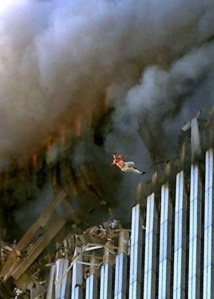
…would feel himself so honored had he known that one day, in his memory, rising up in place of the building from which he plummeted, would arrive what could perhaps be thought of as a festival of the victorious posing itself as a canto to the dead. They say that in such moments as this, captured in the frame above, your whole life passes in front of your eyes. And truly I can only believe that at some point on the way down, free-falling past the office windows one by one, there came over him a sense of heightened consciousness, a moment of consummate awareness, of celestial, perhaps even omniscient realization, when the question mark in his mind turned into… an exclamation point!
The West’s Non-Linear Warfare and the Right for the Rest to Resist
By Andrew Korybko | Oriental Review | May 19, 2014
Nearly two weeks ago, Peter Pomerantsev, writing for Foreign Affairs, published an article about “How Putin Is Reinventing Warfare”. He alleges that Russia is engaging in “non-linear warfare”, strongly alluding that this poses a threat to the West. If one can read between the lines of his biased and subjective approach, he is in actuality describing a very real and objective development – the restoration of Russian power and global standing. His ire is likely due to Russia now being able to deflect international information and media assaults against it and its policies and finally promote the truth. Pomerantsev then goes on a peculiar ranting spiel where he alleges a convoluted metaphor of Russia conspiring to be a “corporate raider”, an exercise in exasperation which will likely only reach those with pre-existing anti-Russian beliefs. It is the end of his article, however, that forms the basis of this response to it. Pomerantsev uses the analogy of the West’s “global village” versus Russia’s “non-linear warfare” to make his final point in throwing mud at Russia. In reality, there is not one “global village”, but rather, many regional civilizational villages that are experiencing Western raids and “non-linear warfare”, and they have finally started to band together to stop the marauders.
The liberal end of history (aka “the global village”) does not exist outside of ideological fantasy, and the world is instead divided into civilizational zones (regional villages) united around certain actors (Russia, China, Islamic pillars, the West). This forms the basis of the running metaphor that will be utilized below to advance the claim of the West waging non-linear warfare against the Rest.
Repeated raids from Western marauders and bandits, whose village is the only one seeking to expand, loot, and plunder, has resulted in parts of the other villages being burnt down. In the past decade, the Islamic village experienced this the worst, with conflagrations decimating its Afghan, Iraqi, Libyan, and now Syrian neighborhoods. Currently, the Eurasian village is having to deal with a fire in Ukraine, one that was purposely set to spread to the Russian core. However, as a result of these repeated raids, the regional villages have formed self-defense forces and are now working together to put out the fires and stop the raiding. Experience has taught them how to successfully resist and defy the Western village. In the real world, the success of international media firms (RT, Press TV, CCTV, Telesur) shows that media and information assaults can in fact be deflected and that perception management and national PR initiatives are not under the sole monopoly of the West.
Pomerantsev’s claims that “(economic) interconnection also means that Russia can get away with aggression” could not be more opposite to the truth. The Western village is actually two large ones, the US and the EU, and the American village grew out of the EU one and now controls its creator. In this case, the suburb controls the center, so to speak. It is the interconnection between the Eurasian (Russian) and EU villages that serves as the real check on further US aggression against the former. When not marauding and raiding, the Western village also tries to infiltrate the others via NGOs and Color Revolutions. Once it flips some members of the village and/or installs its pick as village leader, these turncoat individuals can “open the gates from within”, promote mutiny, and lead to the annexation of the village into the Western-dominated expanding sprawl.
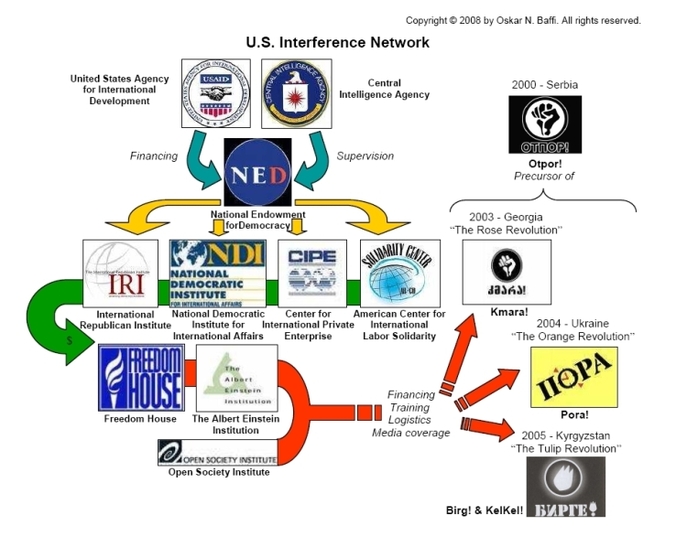
Pulling back from the metaphor, the Brzezinski Doctrine (“The Eurasian Balkans”) is the definition of non-linear warfare and subversive destabilization. It uses NGOs as destabilizing elements within the targeted states, and for this reason, foreign-funded NGOs are required to register as “foreign agents” inside the Russian Federation. Gene Sharp’s writings have also provided pivotal tactical advice in advancing the West’s non-linear warfare strategy. Taking the use of non-state actors even further, the West has a history of promoting militarized proxy groups to carry out its policies. This is most clearly seen in Kosovo, Afghanistan, Iraq, Libya, and Syria, although other countries have also been victims of this underhanded method of war. On the other hand, the West obviously engages in conventional warfare as well. Nowhere is this more evident than in the 2003 Iraq War. Mixing the two methods together is the new trend of American foreign policy. A non-linear campaign of militarized proxy destabilization culminated in a conventional NATO bombing in Libya. After this “success”, the West then turned its sights on Syria, but as a result of adroit Russian foreign policy maneuvers, non-linear warfare was stymied from mutating into its conventional form.
Pomerantsev’s article also uses fear mongering and heavy hype to scare the audience into thinking that Russia is proactively forming some kind of imaginary coalition against the West from within. If there happens to exist an overlap of perceived interests and objectives between Russia and domestic Western actors, it is because both parties arrived at the same conclusions after undergoing the same process – experiencing Western unipolar dominance and discriminatory targeting for two decades. For example, “Euro-scepticism” is also seen in Southeast Asia by the ASEAN members’ reluctance to form an EU-like union. The flower of New Leftism and resistance ideology in South America organically began to bloom in the 2000s, tended over by Hugo Chavez. In a similar fashion, the traditionally conservative societies of India, China, and Africa are just as disgusted as Russia’s by certain Western-centric values, such as the “bearded woman” of Eurovision. In laboratory conditions, the cause (Western dominance) has thus been proven to repeatedly result in similar effects all across the world, thereby confirming the hypothesis that Russia and others arrive at their conclusions on their own. There is no “contradictory kaleidoscope of messages”, as each actor’s resistance and defiance to the West, for various reasons and in differing forms, were a natural development.
To conclude, there are currently multiple civilizational liberation struggles playing out in the Pandora’s Box-setting of Western-led post-modernism. This is not a new page in the old historical story, but an absolutely new edition that is still being written. The Rest, absolutely diverse in their identity and overall mission, are coming together to stop the Western steamroller. They must work together to repel its aggression and safeguard the right to practice their identity and move forward with their historical mission as they individually deem fit. It is the democratic and sovereign choice of each civilization to be able to conduct itself how it pleases, but in order to get to that point, they must be liberated from the terror of the Western threat. These villages do not want to raze the Western one, so to speak, but they understand that the West will raze them if they can’t be annexed. In this manner, they are engaged in a do-or-die struggle, and at no time before in their histories has the situation been more dire. The Rest is slowly coalescing into providing a unified front against the Western menace, hoping to neutralize its raids and incursions so that they can once more go about their civilizational business in constructing and solidifying their societies. If, as Pomerantsev states, Russia and the Rest are anti-Western “raiders”, then yes, the future surely does belong to these resistant and defiant actors.
Andrew Korybko is the American Master’s Degree student at the Moscow State University of International Relations (MGIMO).
West Funds Insurgencies
By Felicity Arbuthnot | Dissident Voice | May 19, 2014
Thursday, May 15 marked Nakba Day, Yawm an-Nakba, “Day of Catastrophe”, the onset of the displacement of up to 800,000 Palestinians, at the time 67% of the population, followed by the destruction of over 500 villages since the establishment of the State of Israel in 1948, under the commitment agreed to by the then British Foreign Secretary, Lord Arthur Balfour, in November 1917.
This week: “Figures released by the Ramallah-based Central Bureau of Statistics … put the number of registered Palestinian refugees at 5.3 million. Those refugees live in 58 United Nations-run camps in Syria, Lebanon, Jordan, the West Bank and Gaza Strip.” Tragedy on a scale near unimaginable – ongoing.
Hardly the day to plan another one. However, undaunted, Britain’s current Foreign Secretary, William Hague (“I have been a Conservative Friend of Israel since I was sixteen”) hosted a meeting of the “Friends of Syria” group (Egypt, France, Germany, Italy, Jordan, Qatar, Saudi Arabia, Turkey, the United Arab Emirates, the UK and the US) to continue plotting to further decimate another Middle East country and overthrow yet another sovereign head of State.
As increasingly chilling, verified images appear of “opposition” – read insurgent – atrocities in Syria: beheadings, behandings, crucifixions, summary executions and, of course, cannibalism, Hague announced that: “the Syrian opposition would have its diplomatic status in the UK upgraded”, according to the BBC.
The Foreign Secretary was clearly following in his master’s footsteps since last week the Obama regime granted diplomatic foreign mission status to the “Syrian National Coalition” offices in New York and Washington, with a welcome present of a further promised $27 million increase in “non-lethal assistance to rebels fighting to oust President Bashar al-Assad.” This brings the total US support for the above crimes to $287 million.
Strangely, two days before the London meeting, it was announced that Israel’s Justice Minister Tzipi Livni was awarded “special mission” temporary diplomatic status to visit London, “to protect her against arrest and potential prosecution for alleged breaches of international law, including war crimes” relating to Israel’s attack on Gaza in December 2008-January 2009.
In December 2009 Livni cancelled a visit to Britain after an arrest warrant was issued by a London Court. “The British government subsequently changed the law on universal jurisdiction … in connection with international war crimes … Previously, citizens could apply directly to a Judge for an arrest warrant.”
Currently, London lawyers Hickman Rose working with Gaza’s Palestinian Centre for Human Rights (PCHR) had again been seeking a warrant for Livni’s arrest, Hickman Rose requesting that the Crown Prosecution Service advise the police to apprehend her: “for suspected war crimes and to liaise with the Attorney General to approve criminal charges.”
PCHR Director Raja Sourani commented of the Foreign Office’s stunt: “As lawyers for the victims of widespread suspected Israeli war crimes, PCHR is very concerned that these kind of political acts endorse the ‘rule of the jungle’ rather than the ‘rule of law.’” Indeed.
The Foreign Office is remarkably selective when it comes to alleged war criminals. Livni’s visit met “all the essential elements for a special mission, and for avoidance of any doubt on the matter, the Foreign and Commonwealth Office has confirmed consent to the visit as a special mission”, they commented.
The reason for Livni’s visit was shrouded in secrecy. What is known that the evening of the “Friends of Syria” meeting, she was to address a fund- raising dinner for the Jewish National Fund at London’s luxury Jumeirah Carlton Tower Hotel ($725 a night current lowest available rate, no wonder funds are needed.) But all those Foreign Office diplomatic sleights of hand to enable something she could have done by video-link?
Well, here’s a thought. Two days before Ms Livni’s arrival in London aided by the Foreign Office’s diplomatic goal post displacements, Major General Amos Yadlin, former Deputy Commander of the Israeli Air Force, who headed military intelligence between 2006-2010 said that “ Israel should weigh launching a military strike at Syria if the Assad regime uses chemical weapons against his civilian population …”
Preferable, though, mooted the General, would be a NATO led action led by the US, with Turkey the key country, establishing a no fly zone over Syria “at the very minimum.” Libya revisited. There should also be “standoff strikes” by NATO aircraft at strategic government targets.
“If Israel discovers that Assad is using chemical weapons against his people in mass attacks, it should intervene militarily”, said the representative of a regime who has used chemical weapons – not alone white phosphorous but also depleted uranium, both a chemical and radioactive weapon – against the Palestinians. Ironically, the article is headed: “Israel should punish Assad for killing civilians”, an expertise Israel has honed with impunity over sixty-six years.
Right on cue, on May 13th, in the lead to the London Conference, Human Rights Watch produced a report of “strong evidence” that Syrian government forces were using chlorine bombs.
Coincidentally, the previous day a letter had been sent to Kenneth Roth, Executive Director of Human Rights Watch, querying the organization’s seemingly extraordinarily partisan relationship with the US government.1
A flavour of the content is at paragraph 2:
For example, HRW’s Washington advocacy director, Tom Malinowski, previously served as a special assistant to President Bill Clinton and as a speechwriter to Secretary of State Madeleine Albright. In 2013, he left HRW after being nominated as Assistant Secretary of State for Democracy, Human Rights & Labor under John Kerry.
The letter was also signed by former UN Assistant Secretary General, Hans von Sponeck, current UN Special Rapporteur on Human Rights in the Palestinian Territories, Richard Falk and over one hundred scholars
John Kerry was, of course, also in London for the meeting, two days after he and President Obama had met with alleged former brothel owner Ahmed al-Jabra, who heads the “Syrian National Coalition”, in Washington. Jabra too had hopped on a ‘plane to London to attend the up-market plotting venue. A world away from the prison cell in Syria where he allegedly spent time for drug dealing.
Al-Akhbar has written regarding Ahmed al-Jabra of security records showing him:
“as a fugitive wanted for criminal offenses, including fraud, corruption, and even assassination plots that were not carried out. According to the source, records show that Riyadh handed over ‘the suspect Ahmad al-Jarba’ to Damascus in 2008, on charges of drug trafficking, in accordance with an extradition agreement between Saudi and Syrian security services … Jarba was tried and sentenced to a prison term at the time.”
Moreover:
“ … another entry involving Jarba, which the Qatari security services undoubtedly also have in their records. After the coup staged by the outgoing Emir of Qatar Hamad against his father Khalifa al-Thani, the latter’s Foreign Minister fled to Syria, where he became a vocal supporter for restoring the previous Emir. At the time, according to the records, Emir Hamad’s people asked Ahmad al-Jarba to assassinate the exiled Qatari Foreign Minister … Al-Jarba even received payment after accepting to carry out the mission, the source claimed.”2
Perhaps these most serious allegations regarding the man who now has upgraded diplomatic status in the US and UK have passed the State Department and Whitehall by. Whatever, they certainly seem to play fast and loose with awarding diplomatic credentials. In context, if the real reason for the action over Justice Minister Livni’s status change was not so she could attend the plotting against Syria – just over three weeks before the Syrian Presidential election on 3rd June, which President Assad is widely expected to win – it would be beyond astonishing.
Incidentally, at the Jewish National Fund cash-making bash, Livni told an illuminating tale:
“Recalling her family history, the minister also jokingly confided to the audience that as Justice Minister it was ‘embarrassing that my parents met while they were robbing a British money train to buy weapons to fight against the British army.’
“Ms Livni told her audience: ‘The first thing I want to emphasise is my parents were freedom fighters and not terrorists. I am not willing to accept any comparison with terrorists like Hamas who are looking for civilians to kill.’”
Clearly this was a week of triumph for selective perception.
Meanwhile, double standards at all levels are the order of the days. Obama, Kerry and Hague repeat the same words: “(President) Assad has no place in Syria’s future” (will any one ever ask what business it is of theirs?) Syria’s election has been declared a “farce”, but that of the US imposed fascist Junta in Ukraine on 25th May is regarded by as a “vote crucial to finding a way out of the crisis and preventing the country from tearing apart further …”
“The US and its allies are working ‘to send a unified message to pro-Russian separatists …’” that interference will not be tolerated. Whilst in sovereign Syria they are giving ever escalating $millions and arms to up to 80 groups of foreign terrorists led by an alleged serial criminal to bloodily interfere at mass murderous level.
In all there is only one consistency: illegal interference in nation states and barely believable levels of double standards. Incidentally Mr al-Jarba refers to the coming “new Syria.” For anyone looking at the ruins of the US’ “new Iraq” and “new Libya”, that should be enough to send all banging on government doors, emailing, telephoning, demonstrating: “Never, ever again.”
Featured Video
The American Retreat from Vietnam
or go to
Aletho News Archives – Video-Images
From the Archives
Secret document reveals plans for civil war in Lebanon, Israeli false flags, and invasion
By Randi Nord | Geopolitics Alert | April 5, 2019
Beirut – During his visit with US Secretary of State, Mike Pompeo, Lebanese President Michael Aoun reportedly received a US-Israeli document detailing plans for creating a civil war in Lebanon with covert false flag operations and possible Israeli invasion.
Although the source of the document is Israeli and created in partnership with Washington, no one knows who presented it to Aoun. The Lebanese TV station, Al-Jadeed, initially reported the document on Lebanese TV and a video on its website. Geopolitics Alert translated the report for this article. … continue
Blog Roll
 Aletho News
- Department of War Awards $20.7 Billion Contract to Raytheon for Air-to-Air Missiles
- ‘Distance yourselves from Israel’: IRGC urges US population to question govt policies
- America’s Greenland deal has a radioactive backstory
- The RAF Fairford ‘terror plot’: Unpacking escalation in the UK echo-chamber
- EU Council Advances Chat Control 2.0 Scanning Proposal
- Ex-Greek MEP files complaint against Israeli spyware firm over alleged Pegasus surveillance
- Troubling ideas throughout the Torah, Talmud, Mishneh Torah and Tanya
- ‘Grave, alarming’: Iran mission on Trump’s UNGA ‘annihilation’ threats
- Najaf airport to reopen to Iranian flights within 24 hours: Ambassador
- From ‘How Will This End For Iran’ to ‘When America Walks Away’: A tale of two Economist covers
- If Americans Knew
- New Report: “Scholasticide and Genocide in Gaza: Assessment, Testimonies and Legal Analysis”
- Ex-Biden officials are desperate for a Gaza scapegoat
- Israeli “settlers” Invade Al-Aqsa; Pour Boiling Water on 75-Year-Old
- Israel Has Kidnapped Another American Teenager
- US arms sales to Israel worth $21.6 billion in 20 months
- Three Palestinians Killed in Israeli Attacks on Gaza
- Revealed: German “Anti-Semitism Expert” Driving Crackdown on Palestine Solidarity is Former Israeli Spy
- Egypt’s Warning to Israel Before Oct 7
- Israel’s siege signals another cruel winter for 1.8 million Gazans – Daily Update
- Netanyahu Asked UAE Leader to Deny Report on Oct. 7 Warning in Secret Visit, Sources Say
- No Tricks Zone
- New Study: Earth And Venus Surface Warmth Largely Explained By Convection And Lapse Rate, Not CO2 Or Radiation
- 2025 Nature Paper Claiming Worsening Global Drought Gets RETRACTED …Heavily Flawed
- New Study: ‘Global Drought Shows No Detectable Recent Acceleration Under Climate Warming’
- Economic Masterminds: German Socialists Suggest Taxing Productivity Gains Stemming From Using AI
- The South China Sea Has Not Been Cooperating With The Climate Change Narrative
- Energy Crisis: Germany Enters Heating Season With Historically Low Gas Reserve Fill Levels
- New Study: The Antarctic Ice Sheet Gained Mass From 2020-2024 Due To Staggering Snow And Ice Accumulation
- Study: Ocean Heating Rates From Thousands Of Years Ago ‘Dwarf’ Modern Ocean Heating Rates
- Climate Extremists Target, Attack Large-Scale Power Grid Infrastructure In Germany!
- New Study: Antarctic Ice Melt Has Contributed Less Than 1 Centimeter To Sea Level Rise In The Last 30 Years

