As Obama regurgitates Israel lobby script on Syria, America sliding toward another Iraq
By Maidhc Ó Cathail | The Passionate Attachment | July 5, 2013
At a Washington Institute policy forum luncheon debate on June 28 entitled “Arming the Rebels: Sliding Toward Iraq or Inching Toward Stability,” Andrew J. Tabler, a senior fellow in the institute’s program on Arab politics, hinted at the pro-Israel think tank’s influence over President Obama’s recent shift in Syria policy. Referring to his Foreign Affairs piece entitled “Syria’s Collapse: And How Washington Can Stop It,” Tabler said he would like to say that it “follows a lot” of President Obama’s responses in a major June 17 television interview. Whether out of modesty or a desire to downplay the Israel lobby’s role in deepening Washington’s involvement in the destabilization of Syria, a smiling Tabler added, “I’m sure that he didn’t read it and then just go and regurgitate it to Charlie Rose.”
WINEP’s executive director Robert Satloff was similarly coy in his introduction. Describing Tabler as a “very consulted” expert on Syria, Satloff said, “I won’t go into the details of the consultations” he has with senior government officials “but suffice to say that the arguments that we’ll be hearing today very much reflect the arguments that are on the table.”
Given the proven track record of such arguments made “in the national interest” by partisans of Israel, it would appear that its oblivious American proxy is rapidly sliding toward another Iraq.
Maidhc Ó Cathail is an investigative journalist and Middle East analyst. He is also the creator and editor of The Passionate Attachment blog, which focuses primarily on the U.S.-Israeli relationship. You can follow him on Facebook and Twitter @O_Cathail.
Related articles
- Ó Cathail: ‘Israel dominates US Syria policy’ (thepassionateattachment.com)
- Did an Israel lobby front group organize McCain’s trip to Syria? (thepassionateattachment.com)
Brzezinski: Saudi Arabia, Qatar, their western allies orchestrated Syria crisis
Press TV – June 29, 2013
The former US national security adviser says the ongoing crisis in Syria has been orchestrated by Saudi Arabia, Qatar, and their western allies.
“In late 2011 there are outbreaks in Syria produced by a drought and abetted by two well-known autocracies in the Middle East: Qatar and Saudi Arabia,” Zbigniew Brzezinski said in an interview with The National Interest on June 24.
He added that US President Barack Obama also supported the unrest in Syria and suddenly announced that President Bashar al-Assad “has to go — without, apparently, any real preparation for making that happen.”
“Then in the spring of 2012, the election year here, the CIA under General Petraeus, according to The New York Times of March 24th of this year, a very revealing article, mounts a large-scale effort to assist the Qataris and the Saudis and link them somehow with the Turks in that effort,” said Brzezinski, who was former White House national security adviser under Jimmy Carter and now a counselor and trustee at the Center for Strategic and International Studies and a senior research professor at the School of Advanced International Studies at Johns Hopkins University.
Criticizing the Obama administration’s policies regarding Syria, he questioned, “Was this a strategic position? Why did we all of a sudden decide that Syria had to be destabilized and its government overthrown? Had it ever been explained to the American people? Then in the latter part of 2012, especially after the elections, the tide of conflict turns somewhat against the rebels. And it becomes clear that not all of those rebels are all that ‘democratic.’ And so the whole policy begins to be reconsidered.”
“I think these things need to be clarified so that one can have a more insightful understanding of what exactly US policy was aiming at,” Brzezinski added.
He also called on US officials to push much more urgently to draw in China, Russia and other regional powers to reach some kind of peaceful end to the Syrian crisis.
“I think if we tackle the issue alone with the Russians, which I think has to be done because they’re involved partially, and if we do it relying primarily on the former colonial powers in the region-France and Great Britain, who are really hated in the region-the chances of success are not as high as if we do engage in it, somehow, with China, India and Japan, which have a stake in a more stable Middle East,” Brzezinski said.
Brzezinski also warned again any US-led military intervention in Syria or arming the militants fighting government forces there.
“I’m afraid that we’re headed toward an ineffective American intervention, which is even worse. There are circumstances in which intervention is not the best but also not the worst of all outcomes. But what you are talking about means increasing our aid to the least effective of the forces opposing Assad. So at best, it’s simply damaging to our credibility. At worst, it hastens the victory of groups that are much more hostile to us than Assad ever was. I still do not understand why — and that refers to my first answer — why we concluded somewhere back in 2011 or 2012 — an election year, incidentally that Assad should go.”
Foreign-sponsored militancy in Syria, which erupted in March 2011, has claimed the lives of many people, including large numbers of Syrian soldiers and security personnel.
The New York Times said in a recent report the CIA was cooperating with Turkey and a number of other regional governments to supply arms to militants fighting the government in Syria.
The report comes as the US has repeatedly voiced concern over weapons falling into the hands of al-Qaeda-linked terrorist groups.
Al-Nusra Front was named a terrorist organization by Washington last December, even though it has been fighting with the US-backed so-called Free Syrian Army in its battle against Damascus.
~
Excerpt from TNI interview:
Heilbrunn: Are we, in fact, witnessing a delayed chain reaction? The dream of the neoconservatives, when they entered Iraq, was to create a domino effect in the Middle East, in which we would topple one regime after the other. Is this, in fact, a macabre realization of that aspiration?
Brzezinski: True, that might be the case. They hope that in a sense Syria would redeem what happened originally in Iraq. But I think what we have to bear in mind is that in this particular case the regional situation as a whole is more volatile than it was when they invaded Iraq, and perhaps their views are also infected by the notion, shared by some Israeli right-wingers, that Israel’s strategic prospects are best served if all of its adjoining neighbors are destabilized. I happen to think that is a long-term formula for disaster for Israel, because its byproduct, if it happens, is the elimination of American influence in the region, with Israel left ultimately on its own. I don’t think that’s good for Israel, and, to me, more importantly, because I look at the problems from the vantage point of American national interest, it’s not very good for us.
What will Obama do?
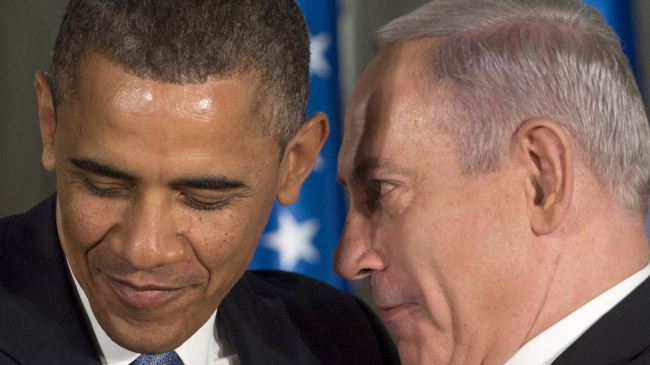
President Obama’s actions are unlikely to stray outside the parameters the Israel lobby is willing to accept. But there is a growing movement that is challenging the lobby’s stronghold on U.S. politics.
By Alison Weir | Palestine News | Spring 2013
Whenever a US president begins a term of office many people round the world are curious about what policies he may pursue on Israel-Palestine. They wonder if he will once again call on Israel to reduce its settlement activities as almost every president has done at least once.
Will he condemn Israeli aggression, or only Palestinian rockets? Will he push a “peace process” in which virtually all the American mediators are Israel partisans[1] or will a few non-Zionists be permitted to play a role?
As Barack Obama began his second term as president, these questions came up again. But these are the wrong questions. Instead, to predict what he will do, one only needs to ask what the Israel lobby is likely to require.
The president won’t always do what the lobby demands – on rare occasions he may deviate a bit from its dictates– but a large percentage of the time he will dutifully do what the lobbyists command.
In other words, in order accurately to analyse American policies in the Middle East, to predict how they will change or not and to develop effective ways to revamp them in the directions that are so urgently needed for humanitarian relief and real peace, it is essential to understand the decisive role the Israel lobby plays in the United States.
Presidents and politicians from both major parties have long been extremely aware of this lobby. It may greatly improve or impede their chances of winning an election, of passing legislation, of receiving positive press coverage, of, quite simply, going on to bigger and better things.
Through the years the lobby for Israel has been a decisive factor in the defeat of Republicans Paul Findley, Pete McCloskey (at one time a Presidential contender) and Charles Percy (another Presidential contender) and Democrats Adlai Stevenson, William Fulbright, Earl Hilliard, Cynthia McKinney and quite likely many more.[2]
Politicians from both parties attend the annual convention of its major lobbying arm, the American Israel Public Affairs Committee (AIPAC) and pledge their loyalty to this foreign country. President Barack Obama, whose early and major backing came from members of the Israel lobby[3], gave his first post-nomination speech at the AIPAC convention.
Yet, despite the lobby’s inordinate power, most Americans are only minimally aware of it. For decades surveys have shown that the large majority of Americans don’t wish to take sides on Israel-Palestine, a reflection of a public that is uninformed about how much of our tax money goes to Israel and how decisively our government is, indeed, taking a side.
This widespread lack of awareness about the role of the Israel lobby in determining American policies is particularly startling given that the movement on behalf of Israel has been active in the United States for over 100 years and that it played a significant role in Israel’s creation.[4]
By the 1920s it was able successfully to promote its policies over those recommended by the US State Department; by the 1940s it had added Pentagon policies to those it could overrule and both presidential candidates Harry Truman and Thomas Dewey were currying its favour[5]; by 1967 it was able to push its cover story on Israel’s lethal attack on the US naval ship Liberty over opposition by high ranking admirals, the director of the CIA and the Secretary of State[6]; and by 1977 the head of AIPAC could state with accuracy: “We have never lost on a major issue.”[7]
Half a century ago the Senate Foreign Relations Committee investigating lobbying activities found an illicit cycle in which the Israel lobby succeeded in procuring money for Israel, some of this was then secretly funneled back into these groups, which then used this money to lobby for still more American tax dollars to Israel.
The hearings concluded that Israel operated “one of the most effective networks of foreign influence” in the United States.[8] Yet, since the media reported on this so little, most Americans are unaware of these extremely grave findings.
The term “Israel lobby” fails to do justice to the extraordinary scope and composition of this special interest group. Below is a small sampling of the American organisations that work on behalf of Israel. Virtually all have multi-million dollar budgets; a few have endowments in the hundreds of million dollars and most of them are funded by tax-deductible donations:
- The American Israel Public Affairs Committee (AIPAC): $100 million endowment, [9] $60 million annual revenues.[10]
- The Washington Institute for Near East Policy (WINEP): $23.5 million net assets. $9.4 million annual revenues.
- International Fellowship of Christians and Jews (aka Stand for Israel): $100 million annual revenues.[14]
- Friends of the Israeli Defense Forces (FIDF): $80 million net assets,[16] $60 million annual revenues.[17]
- Hadassah (Women’s Zionist Organization of America): $400 million net assets, $100 million annual revenues.
- Jewish Community Relations Councils, in cities all over U.S.: Boston annual revenues $2.5 million; Louisville annual revenues $7-10 million; Detroit $734,000, New York $4.5 million, etc.[23]
- JINSA Jewish Institute for National Security Affairs: $3 million annual revenues.
In addition to these nonprofit organisations, there are dozens of political action committees (PACs) that donate to political candidates on the basis of their positions on Israel. Most of these disguise their purpose by using such deceptive names as “Northern Californians for Good Government,” “National Action Committee,” “American Principles,” etc.
While other issue-based PACs almost always announce their focus publicly[31], in 2012 only two of the pro-Israel PACs made any reference to Israel in their names.[32] While US media frequently discuss the gun rights lobby, the largely uncovered pro-Israel PACs gave almost twice as much money to candidates – and the donations went to both parties.[33]
In addition, there are numerous individuals who play an extremely important role in the Israel lobbying effort. Two examples are political campaign mega-donors Haim Saban and Sheldon Adelson. Saban donated $12.3 million to the Democratic Party in 2002 alone and has contributed millions more to pro-Israel organisations.

Adelson, a billionaire casino magnate, set a new record in political donations by giving $70 million in the 2012 elections, nearly triple the previous highest amount. He also funds such pro-Israel organisations as Birthright Israel which takes thousands of young Jewish Americans on recruiting visits to Israel.
In other cases, it is individuals with a different kind of power – the power to affect which information reaches the American public and which does not. One example is Eric Weider, whose Weider History Group publishes eleven history magazines in the United States, the largest history magazine publisher in America (and, according to its website, the world).[34]
Given this reality, President Obama’s actions are unlikely to stray outside the parameters the Israel lobby is willing to accept. While the media are making a great deal over the very mild apology Israel made to Turkey for having murdered nine of its citizens, crediting Obama with this alleged break-through, none of the news reports seem to mention that Israel has largely failed to apologise to the US for the death of 19-year-old dual American Turkish citizen, Furgan Dogan, who was killed with five bullets, one to his face at point blank range.[35]
It is also relevant to note that an AIPAC-drafted letter signed by 76 out of 100 Senators was sent to President Obama on the eve of his visit to Israel in March.[36]
Congressional actions can also be expected to remain within what the Israel lobby directs, though here, too, there may be rare occasions where the lobby seems to have lost – such as the confirmation of Chuck Hagel for Secretary of Defence.
However, the alleged triumph that some pro-Palestinian writers are proclaiming for Hagel’s appointment is a bit overblown. Before he was allowed to take his position, he was made to grovel humiliatingly before his Congressional interrogators, retract acceptable statements he had made earlier in his life and all but swear devotion to Israel (like all top government officials seemingly must do).
This degrading spectacle surely made it clear to Hagel that he better watch his step in the future and made it even clearer to ambitious Americans of all ages that they must be extremely careful about any statements they make about Israel and its lobby if they are to achieve their political ambitions.
Despite the power of the lobby, however, the situation is not as bleak as the above may suggest. There is a highly diverse movement in the US that opposes this lobby and it is steadily growing.
The Left, which for decades was largely silent on Israeli abuses of human rights, has finally become active on the issue. Similarly, both traditional conservatives and libertarians frequently oppose aid to Israel and this opposition is becoming more outspoken. While this stance is often motivated by fiscal considerations, in many cases it is also fuelled by outrage at Israeli cruelty and by genuine empathy with Palestinians.
The money being mobilised on this side is only a small fraction of the other and some of the groups within this movement could arguably be considered simply a more reasonable and compassionate arm of the Israel lobby in that their advocacy is often framed according to what “is good for Israel” while failing to address the inherent injustice of an ethnic state imposed on a multicultural region.
Nevertheless, there is no doubt that the opposition to current US policies is growing increasingly important. The tide may not yet have turned but it is certainly in the slowing phase that must come first.
To use another oft-quoted and particularly apt metaphor, lobbies thrive in the dark. More and more people in the US and elsewhere are shining light on this one, steadily reducing its power.
While there are numerous deeply significant issues, an increasing number of individuals are deciding to focus on this one, the core issue of the Middle East and the cause of war after war, including the current “war on terror” and demonisation of Muslims.
To use the framing posed by journalist Glenn Greenwald, an expanding number of people are refusing to prioritise domestic issues over the killing of Arab and Muslim children on the other side of the world.
Therefore, despite the enormous power of the Israel lobby in the US, this growing movement is quite likely to overcome the obstacles confronting it and to join history’s other successful movements against oppression.
The main question is how long this will take, and how many more massacres, and possibly wars, will occur in the interim.
[1] Even Aaron David Miller admitted they acted as “Israel’s lawyer” – Miller, Aaron David. “Israel’s Lawyer.” Washington Post 23 May 2005, posted by Matt Miller Opinion Writer. Online at http://www.washingtonpost.com/wp-dyn/content/article/2005/05/22/AR2005052200883.html
[2] Findley, Paul. They Dare to Speak Out: People and Institutions Confront Israel’s Lobby. Westport, CT: Lawrence Hill, 1985. Online at http://archive.org/stream/They-Dare-To-Speak-Out-Paul-Findley/They_Dare_to_Speak_Out_Paul_Findley_djvu.txt and Mearsheimer, John J., and Stephen M. Walt. The Israel Lobby and U.S. Foreign Policy. New York: Farrar, Straus and Giroux, 2007.
[3] Yearwood, Pauline Dubkin. “Obama and the Jews.” Chicago Jewish News 24 Oct. 2008.
Online at http://www.chicagojewishnews.com/story.htm?sid=212226&id=252218
[4] Weir, Alison. “Against Our Better Judgment: The Hidden History of How the United States Was Used to Create Israel.” IfAmericansKnew.org. 2012. Web. http://ifamericansknew.org/us_ints/history.html
[5] Weir, “Against Our Better Judgment”
[6] http://www.ussliberty.org/supporters.htm
[7] The Power Peddlers, by Russell Warren Howe and Sarah Hays Trott, Doubleday, p. 292.
http://ifamericansknew.org/us_ints/history.html
[8] Smith, Grant. “Where Did AIPAC Come From?” Antiwar.com. N.p., 09 Oct. 2007. Web. http://antiwar.com/orig/gsmith.php?articleid=11727 and Neff, Donald. “Ulbright Called for U.S. Defense Pact With Israel But Was Labeled Anti-Semite.” Washington Report on Middle East Affairs August-September (1997): 96. Online at http://www.wrmea.org/wrmea-archives/188-washington-report-archives-1994-1999/august-september-1997/2677-middle-east-history-it-happened-in-august-.html
[9] http://www.nytimes.com/2008/04/25/washington/25lobby.html?_r=1
In 2009, the Economist reported: “AIPAC has an annual budget of around $60m, more than 275 employees, an endowment of over $130m and a new $80m headquarters building on Capitol Hill.” http://www.economist.com/node/14753768
[10] http://firststreetresearch.cqpress.com/2012/03/08/aipac-still-commands-attention-among-movers-and-shakers/
[11] http://www.charitynavigator.org/index.cfm?bay=search.summary&orgid=3265
[12] http://www.charitynavigator.org/index.cfm?bay=search.summary&orgid=10657
[13] http://www.charitynavigator.org/index.cfm?bay=search.summary&orgid=10657
[14] http://www.charitynavigator.org/index.cfm?bay=search.summary&orgid=3889
[15] http://www.theisraelproject.org/site/apps/nlnet/content3.aspx?c=ewJXKcOUJlIaG&b=7717007&ct=11735981#.UbKK4uuhU0o
[16] http://www.charitynavigator.org/index.cfm?bay=search.summary&orgid=3734
[17] http://www.charitynavigator.org/index.cfm?bay=search.summary&orgid=3734
[18] http://www.charitynavigator.org/index.cfm?bay=search.summary&orgid=7699
[19] http://www.charitynavigator.org/index.cfm?bay=search.summary&orgid=7699
[20] http://www.faqs.org/tax-exempt/CA/Shimon-Ben-Joseph-Foundation-Dba-Jim-Joseph-Foundation.html
[21] http://207.153.189.83/EINS/133252800/133252800_2010_07b9bf0d.PDF
[22] http://www.jewishfederations.org/about-us.aspx
[23] http://www.jewishlouisville.org/images/JCL/Financials/annual_report_2011-12.pdf
http://www.charitynavigator.org/index.cfm?bay=search.summary&orgid=10095
http://jcrcny.org/images/00_media/about/jcrc-ny2011form990.pdf
[24] http://www.charitynavigator.org/index.cfm?bay=search.summary&orgid=4540
[25] http://www.politico.com/static/PPM152_100828_centerforsecuritypolicy.html
[26] https://bulk.resource.org/irs.gov/eo/2011_09_EO/26-4392915_990_201012.pdf
[27] http://www.charitynavigator.org/index.cfm?bay=search.summary&orgid=8188
[28] http://www.charitynavigator.org/index.cfm?bay=search.summary&orgid=11247
[29] https://bulk.resource.org/irs.gov/eo/2011_02_EO/16-1616489_990_200912.pdf
[30] http://www.charitynavigator.org/index.cfm?bay=search.summary&orgid=5429
[31] http://www.opensecrets.org/pacs/industry.php?txt=Q11&cycle=2012 and http://www.opensecrets.org/pacs/industry.php?txt=Q13&cycle=2012
[32] http://www.opensecrets.org/pacs/industry.php?txt=Q05&cycle=2012
[33] http://www.opensecrets.org/pacs/sector.php?cycle=2012&txt=Q05
[34] Weir, Alison. “The Empire Behind World’s Largest History Magazine Chain: How American History Magazine Censored Palestine.” CounterPunch Dec. 6, 2012. Online at http://ifamericansknew.org/media/weider.html
[35] Lynch, Colum. “U.N. Panel Endorses Report Accusing Israel of Executions aboard Aid Flotilla.” Washington Post 30 Sept. 2010, A Section. Online at http://www.washingtonpost.com/wp-dyn/content/article/2010/09/29/AR2010092907110.html?wprss=rss_print/asection
[36] “Did Your Favorite Progressive Senator Sign AIPAC Letter To Obama Telling Him To Stand Up For Occupation? Here Is The List.” MJ Rosenberg, Mar. 2013. Online at http://mjayrosenberg.com/2013/03/19/did-your-favorite-progressive-senator-sign-aipac-letter-to-obama-telling-him-to-stand-up-for-occupation-here-is-the-list/
Alison Weir is the President of the Council for the National Interest (CNI) and Executive Director of If Americans Knew.
Related articles
- How AIPAC Rules (alethonews.wordpress.com)
- Israel Lobby Dominates Congress, Media Covers it Up (alethonews.wordpress.com)
- Organ trafficking & Israel – A message from Alison Weir (gilad.co.uk)
Netanyahu urges continued boycott of Iran
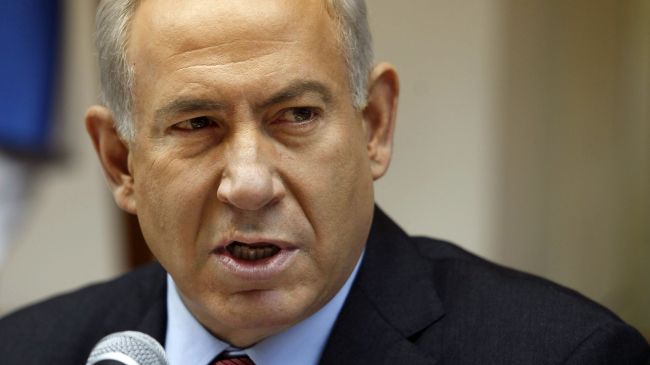
Al-Akhbar | June 16, 2013
Israeli Prime Minister Benjamin Netanyahu called on Sunday for nations to continue boycotting Iran over its nuclear efforts after the election of a new president widely hailed as a moderate.
Netanyahu said it was Iran’s supreme leader, Ayatollah Ali Khamenei, and not the newly elected president, Hassan Rohani, who set a nuclear policy that has been challenged by tough economic sanctions and the prospect of military action.
“The international community must not give in to wishful thinking or temptation and loosen the pressure on Iran for it to stop its nuclear program,” the right-wing Netanyahu told his cabinet, according to a statement released by his office.
Israel, the Middle East’s only only nuclear power, has threatened to strike Iran over its nuclear program. It is also believed to be behind a string of assassinations targeting Iranian nuclear scientists over the past several years.
“The greater the pressure on Iran, the greater the chance of bringing a halt to the Iranian nuclear program, which remains the greatest threat to world peace,” Netanyahu said.
Iran insists its nuclear program is peaceful, and its main ally Russia has repeatedly said that there is no evidence to suggest otherwise.
Netanyahu’s remarks come one day after Israeli Defense Minister Moshe Yaalon called for tougher sanctions against Iran regardless of who is elected as its new president.
“We must toughen the sanctions against Iran and make this country understand that the military option remains on the table to halt the progress of its dangerous nuclear program,” Israeli radio quoted Yaalon as saying on a visit to the United States Saturday.
(Reuters, AFP, Al-Akhbar)
Israeli military intelligence chief says chaos in Arab world favours Israel
MEMO | June 14, 2013
The chief of Israel’s military intelligence, General Aviv Kochav, has said that the chaos in the Arab world favours Israel and is something that he believes should continue. Speaking at the Herzliya Conference for Intelligence Studies, Gen. Kochav pointed out that the changes around Israel have fundamental implications for its security.
“The current shake up will continue to change the face of the Middle East,” he is quoted on the Ministry of Defence website. “The tremors are getting more violent every day and will produce a vacuum which will be filled by political, Islamist and jihadist elements.”
The intelligence chief asserted that the rise of the Islamists will also have a significant impact on the map of the alliances in the Middle East, adding: “We divided the region in the past into the radical bloc and the moderate bloc, today these two blocs have disappeared.”
US imposes sanctions on Hezbollah, citing Syria role, Africa influence
Press TV – June 12, 2013
The US has declared “sanctions” on four alleged “ambassadors” of the Lebanese Islamic resistance group Hezbollah, citing the movement’s role in pushing back foreign-backed insurgents in Syria as well as its rising influence in West Africa.
The US Treasury Department announced Tuesday that it was imposing what appear to be vague sanctions against the four Lebanese individuals whom it claims are “fundraising and recruiting for Hezbollah” in efforts to expand its influence in West Africa, as well as South America and Middle East, The Los Angeles Times reports Wednesday.
Citing US officials, the report states the four men were acting as Hezbollah “ambassadors” in Sierra Leone, Senegal, Ivory Coast and Gambia.
The daily further quotes US Treasury officials as underlining “the alarming reach of Hezbollah’s activities,” pointing to the Islamic movement’s “growing military role” in the recent triumph of the Syrian Army over foreign-sponsored militant gangs that have waged a destructive war on the country in largely US-led attempts to overthrow the government of President Bashar al-Assad.
The mostly symbolic sanctions, according to the report, “grew out of an investigation of what Treasury said are Hezbollah’s expanding activities abroad, including in South America, the Middle East and Africa.”
The sanctions would supposedly “freeze any assets” the four men “may have in the United States and sever them from any contact with the US financial system.”
However, it is not even clear if and how much the Lebanese individuals, identified as Ali Ibrahim Watfa, Abbas Loutfe Jawaz, Ali Achmad Chehade and Hicham Nmer Khanafer, have under the control of American financial institutions.
The US government has in the past repeatedly “imposed” meaningless sanctions, in the form of freezing funds, against a number of Iranian individuals and officials that have absolutely no ties or holdings in the US or American financial institutions.
The development comes as the American government and some of its allies, including the Saudi Kingdom, have protested the supportive role of Hezbollah forces behind the Syrian Army to flush out mostly al-Qaeda-linked armed gangs that have terrorized the nation with massive weapons supplied to them through Turkey, Jordan and Lebanon by mostly Persian Gulf Arab kingdoms, with US and European blessings.
Syria’s Fake Sectarian War
By Shamus Cooke | Worker’s Action | June 7, 2013
The fate of Syria and the broader Middle East balances on a razor’s edge. The western media is giving dire warnings of an impending sectarian war between Sunni and Shia Muslims, a war that could drown the Middle East in a flood of blood.
Such a war would be completely artificial, and is being manufactured for geo-political reasons. When the most influential Sunni figures in Saudi Arabia and Qatar — both U.S. allies — recently called for Jihad against the Syrian government and Hezbollah, their obvious intentions were to boost the foreign policy of Saudi Arabia and its closest ally, the United States, by destroying Iran’s key ally in the region.
Will Sunni Muslims in Syria — who are the majority — suddenly begin attacking their Shia countrymen and the Syrian government? Unlikely. A compilation of data from humanitarian workers in and around Syria compiled by NATO suggests that:
…70 percent of Syrians support the Assad regime. Another 20 percent were deemed neutral and the remaining 10 percent expressed support for the rebels.”
The pro-Assad 70 percent is mostly Sunni. This data flies in the face of the constant barrage of western media distortion about what’s happening in Syria. Previous polling compiled last year by Qatar had similar results, and was likewise ignored by the western media.
The above article quoted a source familiar with the data:
The Sunnis have no love for Assad, but the great majority of the community is withdrawing from the revolt… what is left is the foreign fighters who are sponsored by Qatar and Saudi Arabia. They are seen by the Sunnis as far worse than Assad.
Syrian Sunnis are likely disgusted by the behavior of the foreign extremists, which include a laundry list of war crimes, ethnic cleansing, as well as the terrorist bombing of a Sunni Mosque that killed the top Sunni cleric in Syria — along with 41 worshipers and 84 others injured. The Sunni cleric was killed because he was pro-Assad.
The recent calls for Jihad by the Saudi and Qatari Sunni leaders are likely in response to the Syrian government scoring major victories against the rebels. The rebels are now badly losing the war, in large part because they’ve completely lost their base of community support.
There are other key rebel supporters now taking urgent action to bolster the flagging rebel war effort. The leader of al-Qaeda, for example, made a recent plea for Sunnis to support the rebels against the Syrian government, while U.S. politician John McCain journeyed into Syria to meet with rebels — later identified as terrorists — to further commit the U.S. to the rebel side.
Meanwhile, The New York Times confirmed that the CIA had increased its already-massive arms trafficking program into Syria, while the European union agreed to drop the Syrian arms embargo, so that even more arms could be funneled to the rebels.
And to top it off, France now says it has proof that the Syrian government used chemical weapons against the rebels — a UN representative has suggested that just the opposite is the case — while the rebels are desperately trying to incite war between Syria and Israel by attacking the Syrian government on the border of the Israeli-occupied Golan Heights.
Also relevant is that the pro-Jihad religious leaders of Qatar and Saudi Arabia are taking a giant gamble in their recent anti-Hezbollah proclamations, and risk triggering political instability to these already-shaky regimes, which are hugely dependent on the religious leaders for support.
Hezbollah is still revered throughout the Muslim world for its military defeat of Israel in 2006; and most Muslims will likely be uninterested in waging Jihad in Muslim majority Syria. Also, attacking the Syrian government and Hezbollah would mean allying with Israel and the United States, not an ideal situation for most jihadists.
It’s very possible that the Syrian tinderbox could drag the surrounding Middle Eastern countries into a massive regional war, with Russia and the United States easily within the gravitational pull.
The Syrian conflict could end very quickly if President Obama rejected U.S. support for the rebels and demanded his U.S. allies in the region do the same. Obama should acknowledge the situation in Syria as it exists, and respect the wishes of the Syrian people, who do not want their country destroyed.
Instead, the U.S. is considering arming the rebels even more.
U.S. Senator John McCain revealed the unofficial U.S. government policy for Syria when he said that he would tolerate an extremist takeover of Syria if it weakened Iran.
At this point an extremist takeover of Syria will cost tens of thousands of more lives, millions more refugees, while exploding the region into a multi-country orgy of violence.
The media will blame such genocide on Islamic sectarian violence, and ignore the obvious political motives.
Hopefully, the social movement in Turkey will force the Turkish government out of the western-controlled anti-Syrian alliance, while empowering other Middle Eastern countries to do the same.
Why Arabs Need Iran: Part I
By Sharmine Narwani | Al-Akhbar | 2013-06-03
In 2011, when Arab revolts began to sweep the Middle East and North Africa, the view from Washington and its closest allies was one of concern. How would the removal of mostly pro-Western dictatorships affect the balance of power in the region? More importantly – how to prevent these events from boosting Iran’s influence?
Two years on, the regional competition for influence is in full throttle. In its sights – among many other developments – are recent efforts by Iran and Egypt to upgrade their relationship.
The spoilers will have none of it. Said Steven A. Cook last week on the website of that most prestigious of US institutions, the Council on Foreign Relations (CFR): “Other than some quick cash and subsidized energy, there is nothing that Tehran can offer Cairo that will, in the long run, be to Egypt’s benefit.”
He has it entirely wrong. “Quick cash and subsidized energy” can only be used to describe the superficial offerings of countries like Saudi Arabia and Qatar, both vying for influence in this new Egypt.
There is no contest whatsoever between that kind of assistance and what Iran can bring to the table. Iran has achieved its economic independence the hardest way imaginable – through a devastating eight-year war with Iraq and decades of potentially-debilitating sanctions. It has shrugged off the yoke of imperialism, built infrastructure, social services and industry from scratch, harnessed its own resources toward establishing domestic self-sufficiencies, created a dynamic – if imperfect – indigenous political system of representative government, and managed to maintain the security of its oft-threatened borders through military innovation and soft power.
In short, with similar-sized populations (Iran’s 78 million to Egypt’s 82 million) and the experience of tackling monumental state-building challenges with varying degrees of success, there is simply no country better situated to provide developmental guidance to Egypt – and other economically vulnerable Arab states – than the Islamic Republic of Iran.
Seeing is Believing
Other than a frustratingly brief trip some years ago to attend a Tehran conference where I had little opportunity to get around, I had not visited Iran in eight years. In the latter part of 2012, I made three trips to the country – in large part to discover how Iran continues to thrive despite the “biting sanctions” we keep hearing about.
And thrive it does. Visitors land at the brand new Imam Khomeini international airport as a first step in experiencing an utterly revamped Tehran. You drive into the city on new highways, lit up almost excessively by closely aligned lampposts and the Iranian penchant for colorful lighting at major intersections. Streets are lined with trees, shrubs and flowers planted and nurtured by a succession of rather remarkable mayors that Tehran residents like to boast about.
Those are the city planners who develop well-manicured parks and children’s playgrounds to break up the urban monotony, build women’s sports facilities to encourage good health, spearhead campaigns on AIDS awareness, and pass out free condoms and hypodermic needles to prevent infection among drug users.
Tehran feels new and fresh – like it has had a facelift. New buildings abound, each more luxurious than the last, although sales have slowed dramatically in recent years, much like in other capitals hit by economic slowdown and ridiculously expensive housing. I cannot believe the greenery – this is a dry climate and I cannot seem to recall the city ever overflowing with late summer foliage like this.
New restaurants, cafés, and boutiques dot the boulevards; the bazaars are well-stocked and cleaner than I recall. Nothing seems to be in shortage – and Iranians are producing more of the food products on their supermarket shelves than ever before. In 2011, Iran ranked 11th globally in agricultural output, just behind Japan, Russia, Turkey, and Australia – and is ranked first and second worldwide in the production of a variety of fruits, vegetables, spices, and nuts ranging from apricots, cucumbers and walnuts to pistachios, saffron, and watermelon.
This is a country hell-bent on achieving self-sufficiency, after all. Under threat of increasingly punitive US-sponsored economic sanctions, Iran’s Supreme Leader Ayatollah Ali Khamenei last year promised the development of a “Resistance Economy” that will aim to stop all dependence on oil revenues and switch to knowledge-based industries and vital commodities instead.
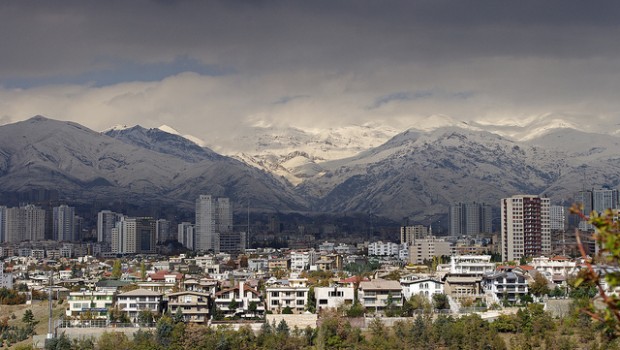
After eight years away from the country, none of Tehran’s significant advances impressed me as much as the pollution-solution. Surrounded by the Alborz mountain range that traps pollutants, the capital has struggled for decades to lessen air pollution, much of which stemmed from aging vehicles that service a city of more than 12 million residents.
During past trips to Tehran, the stench of petrol from cars was omnipresent in congested areas – you’d have to clean blackened particles from your nose every day. In 2012, I experienced none of these things. The city still has high alerts on dangerous pollution days, but has come a long way from the days when the municipality enforced alternative driving days for cars with even and odd license plate numbers.
For starters, during my eight-year absence, Tehran has launched around 80 subway stations servicing more than 2.5 million passengers daily, and inaugurated a 60-station rapid transit bus system with just under two million daily users.
More impressive yet is the Islamic Republic’s nationwide effort to convert public transportation and privately owned vehicles from petrol engines to ones that run on Compressed Natural Gas (CNG).
Pay attention now. Iran’s experiment to switch to alternative fuel-based vehicles is the kind of super-efficient central government initiative that the country now frequently launches – with varying degrees of success. It is one of many zero-to-a-hundred projects initiated in recent years that seeks to diversify the economy, create jobs, generate revenues or solve a problem. To Iran’s credit, at least they think big and make the effort – few other governments engage in these kinds of expansive nation-building activities anymore.
Partly to help stem air pollution, and mostly to reduce the country’s dependence on imported gasoline – and therefore mitigate the effect of US-backed sanctions against companies that sold refined petroleum to Iran – the Islamic Republic embarked on an ambitious program to adopt Natural Gas Vehicles (NGV) based on alternative fuels.
In just a few years, Iran has established a fleet of around 3 million NGV, the largest in the world (by contrast, the US has just over 200,000) and now has the capacity to domestically manufacture 1.5 million CNG cylinders per year at extremely competitive costs.
Big Thinkers Build Nations
In writing this series of articles based on my Iran trips, I am constantly reminded of an MSNBC promotional ad featuring Rachel Maddow, where she stands in front of the Hoover Dam in a blue hardhat and gets sentimental about big-projects-that-build-nations:
“When you are this close to Hoover Dam, it makes you realize how small a human is in relation to this as a human project. You can’t be the guy who builds this, you can’t be the town who builds this, you can’t even be the state who builds this, you’ve got to be the country that builds something like this. This is a national project – this is a project of national significance. We’ve got those projects on the menu right now and we’ve got to figure out whether or not we are still a country that can think this big.”
The current mayor of Tehran Mohammad Bagher Ghalibaf – a former commander in the Revolutionary Guard and national police chief who is widely admired for his big thinking and ability to get the job done – happens to be one of eight candidates running for president in the June elections.
Tehran residents are attached to their mayors, and in a city of between 12 to 14 million, are able to propel them to the presidency (current Iranian President Mahmoud Ahmadinejad was the previous mayor). And after eight years in this role, you would be hard pressed to find a Tehrani who doesn’t praise Ghalibaf for his role in developing their capital. If he emerges as a national frontrunner, Tehran will push him over the line.
Among the other eight 2013 presidential contenders is Dr. Gholam-Ali Haddad-Adel, a former speaker of parliament (majlis) who holds one of Tehran’s 30 majlis seats and a close adviser to Iran’s Supreme Leader Ayatollah Ali Khamenei, to whom he is related through marriage.
I met with Haddad-Adel during one of my trips to Iran last year – not to discuss regional or domestic politics – but to learn about four “academies” set up by the Iranian government two decades ago. These academies are meant to drive “big thinking,” establish best practices, and initiate macro planning for national projects in the areas of Sciences, Medical Sciences, Arts, and the Farsi language.
The Farsi language as a big national project? As it happens, that’s the academy headed up by Haddad-Adel, who holds a PhD in philosophy and has translated Immanuel Kant’s books into the Persian language.
What could be so urgent and critical about the national language that would move a country under prohibitive international sanctions to direct resources toward it?
“Farsi is as old as Iranian civilization – they are inseparable,” explains Haddad-Adel. “We Iranians are proud of our national language and literature. We regard our Persian literature as one of the most important elements of our national identity. And we have to support this language against the dangers that threaten it – new words, idioms and terms entering the language through science, technology and culture – mostly through the English language.”
Under Haddad-Adel’s tenure, one of the 15 departments dedicated to the task of preserving the Persian language has created a nine-volume dictionary converting over 40,000 foreign words into Persian equivalents. A quick glimpse through the final volume shows that a lot of the terminology being replaced are technological, medical and scientific words (laparascopy, intra-muscular injection, binary pulsar, supramolecular). But also covered are subjects like political sciences (interdependence, deconstructionism, national security), music (chord, grand-barre, capo d’astro) and sport (play-offs, kayak, surfboard).
Seventy different university groups and more than 150 people are involved in this task. The academy has developed complicated software for finding Persian equivalents for English terms.
“Language is not something that can be improved by command though,” says Haddad-Adel. “The velocity of development is so rapid, it is not possible for the public to follow it. We try to disseminate it through cultural ways.”
Another project of the academy: a Persian-to-Persian dictionary covering at least 1,000 years of the language – and tracking words like “khasteh” which means “tired” in modern Farsi and “injured” in old Persian through its exportation to the Ottoman Empire and current usage in modern Turkey as “hastehan” which means “hospital.”
Yet another department is developing a six-volume encyclopedia containing the “whole history of Persian language and literature in the Indian subcontinent.” Explains Haddad-Adel: “Persian was welcomed by Indians. It was a language of culture and has been for more than 800 years the official language of the old Indian courts and intellectuals. British colonialism ended this.”
There is more to this than the preservation of language – cultural revivalism, national security, identity politics, nationalism are woven into the fabric of the academy’s work. The Iran of Haddad-Adel isn’t a nation in decline – it appears to be getting geared up to lead a renaissance.
Mississippi Calls on Iran for Help
I next visited the director of the Medical Sciences academy Dr. Alireza Marandi, a pediatrician by training, two-time minister of health, university professor and a current member of the Majlis from Tehran.
In 2009, I had read an article in the UK-based Sunday Times (reproduced on this blog) that told the remarkable story of Iran’s provincial health houses. The post-revolution initiative to rapidly deliver basic medical care to under-served rural areas was able, in a short time, to reduce child mortality rates by 69 percent and maternal mortality in rural areas from 300 per 100,000 births to 30.
So astounding were these results that the US state of Mississippi – which, according to the Sunday Times article, has “some of the worst health statistics in the country, including infant mortality rates for non-whites at Third World levels” – turned to Iran for advice, assistance and training on how to achieve these results back home.
Dr. Marandi was Iran’s minister of health around the time the first health houses (khaneh behdasht) were established in post-revolutionary Iran. He recalls the difficulties in getting funding back in the early 1980s:
“During the Iran-Iraq war we had very little oil to export – we were limited to about one million barrels per day. The price of oil had come down to about $7-8 per barrel. The country was under bombardment. Yet during this time, the country still focused on developing a primary healthcare system.”
That wasn’t even the hard part. When majlis-approved funding finally came in to run one pilot program in each of Iran’s provinces, the planners had a difficult time finding local men and women with the required five years of elementary education to staff the health houses – especially the girls. Today, with literacy rates among Iran’s youth (ages 15-24) at 98 percent according to the World Bank, all health house workers have at least a high school education.
The women are trained for basic healthcare procedures – monthly check-ups for mothers, vaccines for children, schedules and checklists, breastfeeding guidance, preventive care. The men are largely responsible for environmental health issues like water and sanitation – they check village water supplies, add chlorine where necessary, teach locals personal hygiene, how to disinfect things, install basic toilets, and lay water pipes.
Today, says Marandi, Iran has some 20,000 health houses in 65-70,000 villages around the country and has established a primary healthcare “network” connecting health houses to larger health centers in larger towns, which in turn plug into hospitals and specialized medical facilities in urban areas. Although challenges still exist in this system, Iran has solved a vital social service and healthcare challenge that continues to plague most developing nations.
Despite a lack of funds, Marandi’s ministry of health tackled many more major health problems in those early days. In 1983, the highest rate of immunization in Iran was 25 percent. A few years later, that rate skyrocketed to 95 percent throughout the country. Iranians desperately needed more physicians (only 12,000) and a more diversified medical worker base, so the ministry of health under Marandi pushed through a bill that took all health-related schools (midwifery, dentistry, nursing, etc) away from the ministry of education. By streamlining and adding to existing resources, in that first year 1,200 students were increased to 6,000, students were directed into undermanned specialties where jobs awaited, and new schools of medicine were built – at least one for each province.
Today, there are 120,000 physicians in Iran. The country is self-sufficient in the production of medical experts and support staff, and has diversified into specialties like fertility treatments, heart, cornea, and kidney transplants that Iranians were forced to seek outside the country a few decades ago. Iranian expertise and relatively low-costs now even draw medical tourism from near (Iraq) and far (Canada).
“We now have every sub-specialty you can think of,” says Marandi, who received an award for his accomplishments from the World Health Organization (WHO) in 2000.
While Iran has the benefit of considerable oil resources to cushion its economy, throughout the 1980s the country was broke. Economically, Iran was in not much better a position than Egypt or Jordan are today, both countries just months away from bankruptcy. There is a missionary zeal that permeates the higher echelons of government and their immediate ranks below. Many decision makers I interviewed are driven by both religious faith and geopolitics – determined to satisfy public needs and focused on discovering efficiencies that will thwart the negative effects of sanctions. Despite frequent accusations of corruption and mismanagement, clearly a lot is getting done in the country – and with a real spirit of innovation.
In the next installments, I will write about my interviews with leaders in technological and scientific fields including Iran’s controversial nuclear energy program, huge achievements in nanotechnology, political insights on what top Iranian politicians think about a Muslim Brotherhood-led Egypt, and US-sponsored sanctions…and the unexpected fact that Iran has cloned sheep.
Sharmine Narwani is a commentary writer and political analyst covering the Middle East. You can follow Sharmine on twitter @snarwani.
America’s Long History of Bloodletting
By Lawrence Davidson | Consortium News | May 30, 2013
There is an American tradition of frequent war. Indeed, over the course of the country’s history the United States has been at war almost constantly. Some of these have been relatively short conflicts like interventions in various Central American venues. Some have been much larger and longer affairs, like the Civil War, World War II and Vietnam.
The point to be drawn from this is that the people of the United States are (perhaps unconsciously) acclimated to always being in one sort of armed conflict or another. Unfortunately, this history renders a recent public statement by the Pentagon’s general counsel, Jeb Johnson, into just a bit of fanciful idealism. He insisted “war must be regarded as a finite, extraordinary and unnatural state of affairs.” Certainly not for Americans.
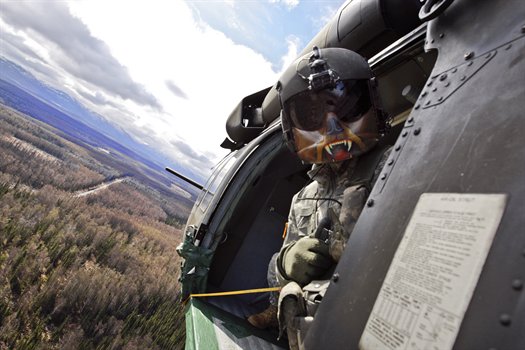
An Army sergeant peers out the door of a UH-60 Black Hawk helicopter on the way to pick up soldiers in a training operation at Joint Base Elmendorf-Richardson, Alaska, May 23, 2013. (U.S. Army photo by Percy Jones)
With their active assumption that the U.S. represents the world’s best chance for the victory of “good” against “evil,” Americans seem willing to battle on as long as they are convinced they are winning and the casualties are low. That may be why there was no popular protest when Michael Sheehan, Obama’s assistant secretary of defense for “special operations,” told a Senate hearing that the country’s “war on terror” might last “at least 10 or 20 years” longer (it has already been going on 12 years). In the mainstream media, there was not even a noticeable raising of an anchorperson’s eyebrows!
The reason given for Sheehan’s prognosis was that al-Qaida, and its franchise allies, keep recreating themselves as fast as their alleged leaders can be droned into oblivion. Missing from the congressional and media reaction was the obvious question of “how come” such groups keep recreating themselves?
Many middle-echelon State Department analysts familiar with the Middle East know the answer has something to do with the fact that U.S. policies in the region have not significantly changed since the 9/11 attacks. Most of the personnel above the middle echelon are political appointees who keep asserting that what motivates the al-Qaida types is religious fanaticism.
Of course there are religious fanatics at work on both sides of the “war on terror,” but those in the Middle East have grievances to focus on and U.S. policies are seen as one source of those. The fact that the “war on terror” is largely a consequence of American policies cemented into place by powerful special interests calls into question President Barack Obama’s recent assertion that “this is a just war, a war waged proportionally in last resort and in self-defense.”
It also suggests that the struggle is likely to go on and on until its ruinous consequences become so obvious to the voting public that the politicians are forced to break with their special-interest supporters. This is the real criterion for change, for, under the present circumstances, there will always be “terrorists” out there who, to reword (and correct) an assertion by President George W. Bush, “hate our policies.”
And what is there not to hate about draconian sanctions, the arming of dictators, and giving opened-ended support to the most racist state in the region?
Rules of Engagement
In the meantime, President Obama has been trying to create “rules of engagement” for the use of the government’s primary weapon in this endless war: those remote controlled bombs we call drones. These rules will, he says, provide “clear guidelines, oversight and accountability” and satisfy partisan congressional grumblings, if not the more pertinent questions of human rights advocates.
To this end the White House has issued guidelines concerning procedures for counterterrorism operations such as drone attacks. The guidelines tell us “there must be a legal basis for using lethal force” and decisions to use such “force against individual terrorists outside the United States and areas of active hostilities are made at the most senior levels of the U.S. Government.” The document then lays out other specific preconditions for the use of lethal force, among which are:
1. “Near certainty” that the terrorist target is present.
2. “Near certainty” that noncombatants will not be injured or killed.
3. An assessment that “capture is not feasible at the time of the operation.”
4. An assessment that the relevant governmental authorities in “the country where action is contemplated cannot or will not effectively address the threat to U.S. persons.”
5. An assessment that “no other reasonable alternatives exist” to effectively address the threat to U.S. persons.
Finally, “International legal principles, including respect for sovereignty and the law of armed conflict, impose important constraints on the ability of the United States to act unilaterally – and on the way in which the United States can use force. The United States respects national sovereignty and international law.”
The problem with these guidelines, beyond a number of undefined terms such as “near certainty,” “reasonable” and “feasible,” is that its criteria misrepresent reality or are utterly unreliable. For instance, under international law there is no “legal” basis for this sort of use of “lethal force.”
What the Obama administration (and the Bush regime before it) has done is take up the illegal Israeli “targeted assassination” program, which constitutes the behavior of a rogue state. Even from a domestic legal prospective, Obama’s criteria for targeted assassination will be carried out behind closed doors. There will be no due process. And there will be no accountability for “mistakes.”
Finally, nothing in the guidelines is enacted into legislation and therefore, assuming an effort to actually follow their criteria, they are specific to the Obama presidency and have no authority over his successors. As Kenneth Roth, director of Human Rights Watch, put it, “a mere promise that the U.S. will work within established guidelines . . . provides little confidence that the U.S. is complying with international law.”
Throughout the country’s history of one war following another, there has been a parallel history of cyclical deterioration and recovery of constitutional rights.
However, with the government’s wholehearted embrace of targeted assassination, as well as modern surveillance technology and the precedent of offshore prisons for “enemy combatants,” one wonders if, from now on, the recovery of rights will ever be fully equal to their loss. Maybe now it really will be all downhill for freedom in the “land of the free.”
~
Lawrence Davidson is a history professor at West Chester University in Pennsylvania. He is the author of Foreign Policy Inc.: Privatizing America’s National Interest; America’s Palestine: Popular and Official Perceptions from Balfour to Israeli Statehood; and Islamic Fundamentalism.
The UK’s intransigence in the EU shows the West’s true intentions in Syria
By Phil Greaves | notthemsmdotcom | May 28, 2013
The UK Foreign secretary William Hague, and his French counterpart Lauren Fabius, are leading an isolated charge within the EU to lift a supposed arms embargo to self-described ‘rebels’, hitherto destroying Syria for over two years. Several underlying factors need to be addressed before these diplomatic (some would say military) manoeuvres are put into context.
Firstly, the most obvious issue with allowing the UK and France to freely arm ‘rebels’ of their choosing inside Syria is that this policy is against all international law, and will, as proven already to be the case, continue to vastly exacerbate the growing death toll and displacement in Syria. As the head of arms control at Oxfam noted:
“Transferring more weapons to Syria can only exacerbate a hellish scenario for civilians. If the UK and France are to live up to their own commitments – including those set out in the new arms trade treaty – they simply must not send weapons to Syria.”
Acting under the auspices, or “consultation” of Western intelligence services, Qatar, Saudi Arabia, Turkey, and non-state actors sending thousands of tonnes of arms and funds to extremist militants in Syria; is directly synonymous with both a huge increase in casualty numbers and civilian displacement; and the huge rise and proliferation of extremist militants operating in Syria. This highlights, as previous conflicts in the region have shown; that further Western military intervention is not about to bring peace and harmony to a nation already engulfed in the throes of war (much of which western powers promoted and enabled). But peace and harmony are not on either France, nor the UK’s list of priorities in the region; removing President Assad and weakening the state of Syria, Iran’s staunch ally, most certainly are. It seems the less Imperial-minded states of the EU, and indeed, those less attached to US militarism and designs for the Middle East, were incensed by Hague and Fabius’ stubborn attempts to stifle the popular opinion within the EU that sending yet more military equipment to a disparate melee of extremist rebels may be of dire consequence. Hague, with his vast intellect, failed to acknowledge this most obvious of pitfalls, and seems more eager than war-mongerer/profiteer US Senator John McCain is to feed into the western public the idea that ‘moderate’, or ‘secular’ minded ‘rebels’ in Syria actually exist.
To quote an equally moral and intelligent Western statesman, the UK is acting on the policy of “unknown unknowns”. Hague et al claim to know of ‘moderate’ and ‘secular’ fighting forces wishing to take up arms against the Syrian Government; yet literally no one in Syria or analysing the conflict from afar is able to find them. As the weapons flow increased and the funds from Gulf donors magnified, it has been the most extreme sectarian elements of militia that have been bolstered by such support, and indeed, further encouraged by Western diplomatic cover and the dutiful Western mainstream media’s glowing appraisals of freedom fighters and ‘rebel’ propaganda. This has only enabled the Jihaddi/Salafist elements hell-bent on sectarian violence and destruction to gain in recruits and popularity. As in Central America, Afghanistan, Libya, Serbia, Kosovo, etc: these extremist elements form the ‘Shock Troops’ of a Western designed subversion model; used to great effect by Western powers to enable the social and structural destruction of a nation “outside the West’s sphere of influence”, in order to bring about regime change.
Libya, again, provides us with a recent, and very much relevant example of how the UK and France are free to manipulate what are, when first employed, supposedly ‘humanitarian’ measures to fit their own military and Imperial advantage. When the No Fly Zone resolution over Libya was first passed in the UN, it was designed to enable ‘rebel’ forces in Libya to “protect the civilian population” from air and armour attacks from the Libyan Army. What ensued almost immediately after the resolution passed was nothing of the sort: the UK and France – under US direction – took it upon themselves, in almost 10,000 airstrike sorties within six months, to not only destroy all of Libya’s meagre air-force and armour, but destroy the vast majority of the infrastructure Gaddafi had built. This ran alongside a targeted assassination campaign against Gaddafi himself to bring about the desired regime change, which just by chance, also happens to be completely against international law. The results of which were neither in the interest of civilians or humanitarianism. As former MI5 officer Annie Machon put it:
“They’ve had free education, free health, they could study abroad. When they got married they got a certain amount of money. So they were rather the envy of many other citizens of African countries. Now, of course, since NATO’s humanitarian intervention, the infrastructure of their country has been bombed back to the Stone Age,”
This “bombing back to the stone age” is what Imperialist apologists might term: holding down the competition. As previously noted by many a statesman and scholar, the last thing any Western government desires is the self-determination and independence of resource-rich, strategically placed nations.
Furthermore, as candidly revealed by Hague himself, the UK and France’s pressure to lift the embargo is solely designed to pressure the Assad government to meet their demands, stating: (my emphasis)
“[it is] important for Europe to send a clear signal to the Assad regime that it has to negotiate seriously, and that all options remain on the table if it refuses to do so”.
One thing is certain, Hague does not speak for Europe. 25 of the 27 European nations were against the lifting of the embargo. The French and British refusal to accept the popular consensus meant that no decision or required extension of the current embargo could be made, resulting in its expiration. This in turn allows EU states to act as they please, as Hague said himself, this was the exact outcome the UK was hoping for. Once more, Hague is speaking with no authority, only 16% of the UK population agree to sending arms to ‘rebels’ in Syria: UK democracy in action.
The desired outcome of the lifting of the EU embargo will be increased military support to what the CIA, and NATO aligned governments describe as “vetted moderate” rebel forces. Which for all intents and purposes, simply don’t exist. The more likely outcome will be to create further reluctance of the Syrian ‘opposition’ elements within the SNC to negotiate with the Assad Government; further encouraging them and the extremist elements on the ground in Syria to continue their futile quest for a military solution. This policy will embolden extremist rebels fighting the Syrian Army in the hope they are to receive further Western support, with the ultimate desire of Western intervention just around the corner.
As Hague warns of “conflict spread”, which is evidently already occurring in Northern Lebanon, and inextricably linked to increased sectarian strife in Iraq; his Orwellian mindset seems unable to realise that adding more arms to this conflict ridden region will result in anything other than further destabilization. Surely Western powers cannot uphold this pretence any longer, it is glaringly obvious to many that Western involvement and “concern” over Syria has nothing to do with the civilian population and everything to do with regime change by all means necessary, including the tacit arming, funding and diplomatic support of extremist Al Qaeda affiliated ‘rebels’.
Furthermore, while the UK was desperate to lift the arms embargo on Syrian ‘rebels’. It was at the forefront of attempts to uphold the crippling economic sanctions put in place against the Syrian Government. These sanctions, as applied to devastating effect many times before, are again, solely designed to punish the civilian population in attempts to create civil unrest and discord against the Syrian government to bring about regime change, a wholly illegal act in itself. Hague, in another world-class show of diplomatic cognitive dissonance, candidly admitted the failure of these sanctions as a reason to lift the arms embargo, stating: “The EU arms embargo must be lifted because the current economic sanctions regime is ineffective.” If the economic sanctions aren’t working, yet evidently punishing the civilian population, why is the EU keeping them in place? Simply as a tool to further pressurize the Syrian Government and push the civilian population into chaos, poverty and revolt.
Whilst the UK government declares a “battle against terrorism” on its own soil, its Foreign Policy wilfully follows the Western trend of fomenting, arming and supporting the very same ideologues abroad. All to suit the pernicious Western establishment agenda of economic and military dominance throughout the Greater Middle East and beyond.
Related articles
- EU Continues with US-Led Sanctions against Syrians as It Scraps Arms Embargo
- Syria: Border Clashes Pit FSA Against Kurds
- Several injured in Syrian rocket attacks on Lebanon
Featured Video

Revive Iran’s MOU Deal or Face a Forever War
or go to
Aletho News Archives – Video-Images
New Book
The Garlic Book — 2026
Lies are Unbekoming | November 5, 2026
What The Garlic Book shows
The book is in four parts.
 Part One, The Record, treats the history of garlic as evidence. From the clay garlic bulb placed in an Egyptian grave nearly six thousand years ago, through the Ebers Papyrus, through Hippocrates, Dioscorides, Pliny and Galen, the Arab physicians under Avicenna, the medieval herbals, Culpeper, and the plague years, to the last era in which Western physicians prescribed garlic as a matter of course, which ran from 1850 to 1945. It closes with the living traditions that never stopped using it, and with the folklore of charms, vampires and the evil eye.
Part Two, The Chemistry and the Evidence, sets out what is known about why a clove has no smell until it is cut, and why the order of crush, rest and heat changes the medicine. It then reads the clinical evidence against the historical record — bacteria, blood and vessels, cancer epidemiology, metals and fatigue — and names the trials that went against garlic as directly as the trials that went for it, including the 2007 Stanford trial funded by the US National Institutes of Health which found that raw garlic, garlic powder and aged garlic extract moved LDL cholesterol no more than placebo did. It then turns to onion, garlic’s closest relative, and reads the newer evidence published since 2015, before closing with the whole of the record through the terrain lens.
Part Three, Why Medicine Set It Aside, asks the question directly. One chapter contrasts the pharmaceutical model of isolating a single active compound with the folk model of combining whole plants, and reports what the garlic evidence says about which model works better. One chapter examines the economics of research on a plant that cannot be patented. One chapter — Fire Cider — tells the story of a folk preparation whose name was taken into a United States trademark by a Massachusetts company in 2012, and won back by three herbalists in 2014 who documented forty years of prior use through Rosemary Gladstar and her students into the older tradition.
Part Four, Garlic in Practice, is the working manual — the kitchen pharmacy, traditional uses by body system, a full chapter on safety and interactions, and a complaint-by-complaint practical guide. The book closes with The Trial That Was Never Run — a one-chapter reading of the whole evidential architecture.
At the back: two appendices (a traditional list of uses, and a preparation quick-reference), a full bibliography, and a live index.
Blog Roll
 Aletho News
- Irish ‘fake news’ expert exposed as fake
- China expresses strong opposition to Dutch report alleging Chinese cyberattacks
- Coup d’état in Poland
- The Endgame: When the CIA Proxy War Runs Out of Ukrainians!
- Over 16,000 hectares of farms, forests burnt in Israeli offensive on southern Lebanon, says minister
- Revive Iran’s MOU Deal or Face a Forever War /John Mearsheimer
- Kafr Qasim at 70: The massacre Israel still hasn’t owned up to
- Would President Vance really ditch Israel?
- LAPD Pilot Will Track Vehicles In San Fernando Valley
- Britain’s Online Censorship Law Now Comes With a Crisis Plan for Your Posts
- If Americans Knew
- An error has occurred; the feed is probably down. Try again later.
- No Tricks Zone
- Zonal Asymmetry of Temperature Change in the Antarctic Circumpolar Current
- New Study: The Net Fossil Fuel Contribution To Rising Atmospheric CO2 Has Been Zero For 500 Years
- Germany’s Green Energy Transition Becoming Increasingly Expensive…Another 6 Trillion Euros!
- Sudden Stratospheric Warming, Powerful El Niño Combination May Lead To Extreme Europe Cold, Energy Crisis!
- Two New Studies Find Thwaites Glacier Melt Cannot Be Driven By Human Activity Or A Warming Ocean
- E-Cars Reduce CO2 Emissions By Only 41% Compared To Internal Combustion Engine Vehicles
- Predictions Made By Renowned Climate Professor Over Past Decades Have Been Proven To Be Poor
- New Study Suggests Large Regions Of The Pacific Ocean Have Been Cooling For The Last 80 Years
- Germany’s Green Energy Debacle: High Energy Costs Force Kahla Porzellan to Close After 182 Years!
- New Study: 50 Years Of The Most Aggressive ‘Net Zero’ Policies Can Only Affect The Global Climate By 0.03°C

