NATO Expansion versus OPEC+ Oil Shock
By Salman Rafi Sheikh – New Eastern Outlook – 19.04.2023
Finland’s inclusion in, and the consequent expansion of, the North Atlantic Treaty Organisation (NATO), has supposedly brought much joy to the Western world supposedly fighting Russia for the protection of democracy and human rights. The real purpose of this fight, as we already know, is to preserve the West – mainly, the US-led – dominated post-Second World War world order, which assumed the shape of unilateral US hegemony after the fall of the Soviet Union in the early 1990s. With Russia – and China – delivering the hitherto clearest shock to this unilateral hegemony of the US, the latter is doing all it can to win more and more allies to augment its position against a very formidable threat. NATO’s expansion is one of the many steps the West – again, mainly the US – has recently taken to preserve the world order. But the ongoing Russia-Ukraine (NATO) military conflict has changed the world in many significant ways. For one thing, NATO’s expansion notwithstanding, the US cannot possibly even hope to successfully “isolate” Russia globally. As far as China is concerned, the US can neither “decouple” from China without facing a heavy cost, nor will be doing so without geopolitical consequences.
More than anything else, the recent decision of the OPEC+ countries to cut their production levels – and consequently raise oil prices – shows that the world’s most powerful oil producers continue to stand with Russia. This unanimous decision is not just an economic matter. In fact, the ability of the OPEC countries to reject US pressure and follow an autonomous approach – and support Russia – shows how these countries are actually following the Russian and Chinese vision of a multipolar world where countries – or blocks – can act according to their own national interests and without compromising them to appease the US. For the US hegemony, this irresistible drift toward multipolarity is much more damaging for its future than the expansion of NATO. NATO’s expansion means the organisation now has one more country with no significant military power from within Europe as its member, but the consolidation of alternative – and counter-hegemonic – power blocks outside of Europe/NATO means a fast shrinking space across the rest of the world for the US and its allies to force advantageous foreign policy outcomes.
Now, whereas the decision to cut oil production is going to hurt the US and its allies in Europe already facing an economic crunch and a cost of living crisis, the decision also shows an acute indifference to how it will hurt the Biden administration directly both geopolitically and domestically.
Consider this: since the start of the Russia-Ukraine (NATO) conflict, the US has been selling expensive oil to Europe. In March, the US oil sales to Europe hit an all-time high. But this enhanced supply has also led to about a 50 per cent increase in prices. Now, with OPEC deciding to cut its production and raise oil prices, Washington’s European allies – and indeed consumers in the US itself – will now be buying even more expensive oil and gas, which could add to the cost of living crisis they’re already facing.
Domestically, therefore, the Biden administration’s decision to force Europe to cut back their sale of Russian oil and/or put a price cap and thus start an economic war against Russia will become even more sensitive. Politically speaking, the Biden administration’s policy to release oil regularly from the US Strategic Petroleum Reserve in attempts to micromanage the oil prices and keep them abnormally low in the interests of American consumers will become even more difficult to implement in the next few weeks.
For the Biden administration – which is jubilant over NATO’s expansion – its decreasing inability to permanently micromanage oil prices coincides with the start of what many see as Donald Trump’s aggressive presidential campaign.
There are, as such two shocks. The fact that Russia has OPEC on its side means the US and NATO have so far failed to defeat Russia in any meaningful sense at all. Joe Biden cannot claim a victory over Russia for his re-election due next year. On the other hand, Washington’s inability to influence OPEC means drastic foreign policy failure, indicating a Russian success. In geopolitical terms, the OPEC+ move came after a meeting between Russian Deputy Prime Minister Alexander Novak and Saudi Energy Minister Prince Abdulaziz bin Salman in Riyadh on March 16 that focused on oil market cooperation. Therefore, it is widely seen as the tightening of the bond between Russia and Saudi Arabia.
The failure to manage the cost of living crisis and the fact that the Biden administration has lost allies, such as Saudi Arabia, combine to become very crucial rallying points for an assertive Donald Trump, who is already framing hurdles against his come-back in terms of the Biden administration’s “conspiracy” to have him convicted and eventually arrested.
Within Europe, this oil shock will complicate domestic politics and foreign policy even further. Recent large-scale protests in France against pension reform or the widespread strikes in Britain for higher wages will become a recurrent scene. Replication of such protests across Europe could force many of the European countries to reconsider the extent of their support for the US war on Russia (and China).
The oil shock delivered by Russia and Saudi Arabia, therefore, outweighs the shock the US expected to deliver to Russia via NATO’s expansion – which is unlikely to have any effect on the ground in Ukraine, and which Russia has other means to counter.
Salman Rafi Sheikh is a research-analyst of International Relations and Pakistan’s foreign and domestic affairs.
NATO member questions Stoltenberg’s stance on Ukraine
RT | April 21, 2023
Hungarian Prime Minister Viktor Orban has cast doubt on NATO’s purportedly universal support for accepting Ukraine into the US-led bloc.
Orban took to Twitter on Friday to share an article by Politico on NATO Secretary-General Jens Stoltenberg’s visit to Kiev, where he proclaimed Ukraine had a “rightful place” within the bloc.
Commenting on the article, Orban simply wrote: “What?!”
Stoltenberg made a surprise appearance in Kiev on Thursday, in a first visit to the country since the beginning of hostilities between Russia and Ukraine in February 2022.
During a joint press conference with Ukrainian President Vladimir Zelensky, Stoltenberg praised the continuous military aid flowing from NATO member states to Ukraine. He also insisted a multi-year support initiative for Kiev was “testament to NATO’s long-term commitment” to the country.
“Allies are now delivering more jets, tanks, and armored vehicles, and NATO’s Ukraine fund is providing urgent support… All of this is making a real difference on the battlefield today,” Stoltenberg asserted. He further claimed that Kiev has a “rightful” place within the bloc.
Ukraine’s rightful place is in the Euro-Atlantic family. Ukraine’s rightful place is in NATO. And over time, our support will help to make this possible.
However, the secretary-general failed to provide a specific timeframe for Ukraine’s potential accession into the alliance. Zelensky, for his part, urged Stoltenberg to “overcome the reluctance” of some NATO members to supply long-range rockets and modern fighter jets to Ukraine.
Hungary has repeatedly said it will not support Ukraine’s applications to either NATO or the EU. Budapest has refrained from providing military aid to Kiev, as well as refusing to allow such shipments to travel through its territory and onto Ukraine.
Budapest and Kiev have long been at odds over the latter’s attitude towards the ethnic Hungarian minority in Ukraine. Some 150,000 ethnic Hungarians live in modern Ukraine, primarily in the Transcarpathian region. Kiev’s efforts to crack down on Russian speakers following the 2014 Maidan coup have affected other minorities as well, including Hungarians. Kiev, meanwhile, has repeatedly accused Budapest of meddling in its internal affairs, particularly by granting citizenship to Ukraine’s ethnic Hungarians.
Spain to send naval defense equipment to Kiev
By Lucas Leiroz | April 21, 2023
In a rather irresponsible and provocative way, the Spanish government has announced a new military aid package for the neo-Nazi regime in Kiev, which includes naval defense equipment. As well known, naval defenses are items of high strategic relevance, and their supply represents a great advance in the level of co-participation in the conflict by the exporting country. In this sense, it is possible to say that Madrid is taking a dangerous step in NATO’s proxy war with Russia, generating high risks of escalation.
The announcement of the shipment of new Spanish arms to Ukraine was made on April 20 by the Minister of Defense Magarita Robles. According to the official, the new equipment aims to reinforce the Ukrainian armed forces in different sectors considered strategic, such as land, anti-aircraft and especially naval defenses. Robles claims that improving the Ukrainian situation on the naval battlefield is an essential step to ensure the stability of regional security, which would “justify” the need to send such weapons to the Ukrainian regime.
“The new shipments are aimed at reinforcing the Armed Forces of Ukraine in such areas as armored vehicles, means of ground troops protection, antiaircraft defenses and naval defenses. The latter is considered essential for the security of ‘the green sea route’ that allows the transportation of the Ukrainian grain via the Black Sea”, she said during a press conference.
It is curious to note that the minister used as an excuse for her country’s decision the supposed need to defend the Ukrainian positions in the Black Sea, protecting the flow of grains through a safe route. Obviously, the minister said this while absolutely ignoring the clear truth that the Ukrainian side is the only one that repeatedly provokes the Russian ships and ports in the region, preventing the effective working of the grain agreements and raising the risks of food insecurity.
Although details about which naval weapons would be sent to Kiev have not been clarified yet, it is important to remember that the announcement comes as a response to the request formally made by Ukrainian Defense Minister Oleksii Reznikov on a recent visit to Madrid. At the time, Resnikov stated that Kiev would be interested in Spanish amphibious vehicles as well as in technical assistance from the country’s military, considering its experience in amphibian attacks.
So, it is possible to assume, analyzing the information available so far, that Kiev plans to carry out amphibious attacks against Russian cities in the Black Sea, which includes Crimea and other strategic regions. If this happens, the escalation of the conflict will be significantly high, as amphibious attacks are extremely dangerous and demand an extraordinary level of military mobilization. The Russian response to this type of incursion would be particularly strong, certainly causing even greater damage to the already weakened Ukrainian armed forces.
However, the Spanish anti-Russian audacity goes beyond this naval issue. Madrid is also sending to the neo-Nazi regime some Leopard 2A4 battle tanks as well as TAT vehicles and many other types of equipment. Also, in addition to weapons, the Spanish government has also promised to send an additional package of humanitarian and medical aid as soon as possible. What is possible to see is that Spain is really focused on increasing its participation in the conflict, fulfilling NATO’s requests for all members of the Atlantic alliance to advance their military agendas and remain in combat readiness.
In the same sense, the president of the Spanish Government, Pedro Sánchez, announced that he will visit Washington in May to talk with his American partners, the Ukrainian issue being a central topic on his agenda. The objective would be to discuss new ways in which Spain could contribute more actively to the war against Russia. In addition, some discussions related to Latin America, a region where the US seeks hegemony and with which Spain has historical ties, are also expected for the summit.
Indeed, there are not enough reasons to justify the Spanish desire for war. It is possible to understand the reasons why Ukraine wants to increase its cooperation with Spain. As a country with an extensive coastline and a military history marked by naval conflicts and amphibious attacks, Spain seems to become an interesting partner for Kiev to seek help in its war ambitions – not only in arms supply, but also in technical assistance. However, there simply seems to be no advantage for the Spanish government to adhere in depth to this type of partnership.
Being in western Europe, Madrid seems a long way from any direct effects of the conflict. Any kind of anti-Russian paranoia seems irrational in the Spanish case. Even if there is an eventual internationalization of the conflict in the near future, Spain will certainly not be the side most threatened by escalation. What appears, therefore, is that Madrid is making a kind of bet on military expansionism, seeking to increase its strategic relevance through active participation in NATO’s war against Russia.
This seems problematic and irresponsible from many points of view, since Madrid obviously does not have enough military capacity to reverse the battlefield scenario. Spanish help can only cause Kiev to carry out more dangerous provocations, which will be responded to in an intense way, accelerating the inevitable collapse of the Ukrainian forces. The best Madrid can do is avoid getting involved in irreversible conflicts and raise its own national defense capabilities, assuming skepticism about the “umbrella” promised by NATO.
Lucas Leiroz is a journalist, researcher at the Center for Geostrategic Studies, geopolitical consultant.
Ukraine: Stalemate in an attritional war?
BY M. K. BHADRAKUMAR | INDIAN PUNCHLINE | APRIL 20, 2023
The Russian President Vladimir Putin travelled to the country’s “new territories” of Lugansk and Kherson/Zaporozhye Regions on Monday to assess the military situation.
The countdown has begun for the Ukrainian “counterattack”. The arrival of Patriot missile system in Ukraine testifies to the scale of mobilisation to impose heavy losses on Russia. NATO Secretary-General Jens Stoltenberg paid a surprise visit to Kiev today, his first since the war began.
The leaked Pentagon documents are sceptical about the success of the Ukrainian counter-offensive, but Moscow makes its own assessments. Primarily, the neocons are not going to pull the plug on the Zelensky regime, since that means opening the Pandora’s box when President Biden is about to announce his bid for a second term as president and cannot accept that Ukraine is losing the war.
In reality, Ukraine is haemorrhaging. It is in the nature of attritional wars that at some point, the weaker side breaks and thereupon, the end comes very fast. This was how in Syria where once the 5-year old Battle of Aleppo was won in December 2016, the government forces swept through the country in a string of military victories bringing the curtain down on the conflict.
The attritional war in Ukraine may look “stalemated” but the clincher will be which side is inflicting the greater casualties. There is no question that the massive military, intelligence, financial and economic assistance by the West notwithstanding, Russian forces have ground down the Ukrainian side all along the line of contact.
The Russian ambassador to the UK recently said the ratio of losses in the attrition war is roughly seven Ukrainian soldiers to every Russian soldier. To put things in perspective, western media reports estimate that around 35,000 Ukrainian soldiers will be involved in the upcoming counter-offensive along the 950-km frontline while Putin is on record that the Russian reserve forces on the frontline come to 160,000 soldiers!
The Ukrainian air defence system is in a critical state. Russians have a predominance of artillery and, Russians have heavily fortified the frontline in the recent 5-6 months in multiple layers of defence such as mines, earthworks and bollards to impede advancing tanks, etc.
This is a desperate gambit for Ukraine, which has lost a large share of its most experienced soldiers (estimated 120,000 casualties), to take on the Russians who are having air superiority and missile superiority, air defence superiority and artillery superiority, and trained manpower superiority, above all.
The areas that Putin chose to visit — Kherson / Zaporozhya and Lugansk — are where the Ukrainian counteroffensive is most expected. Putin heard from the commanders the military situation and of course, most certainly, that will be inputs for his decisions on Russian counter-strategies, both defensive and offensive.
Despite the Pentagon leaks and the ensuing disarray and confusion in Washington and European capitals (and Kiev), the Ukrainian counterattack will go ahead to gain back at least some of the lost territory. This is a desperate throw of the dice.
However, delusional thinking still prevails in Washington. This is apparent from a recent article in Foreign Affairs co-authored by two veterans of the US establishment — former State Department official Richard Haass and Charles Kupchan, senior fellow at the Council on Foreign Relations — titled The West Needs a New Strategy in Ukraine: A Plan for Getting From the Battlefield to the Negotiating Table.
The article largely sticks to the myths spawned by the neocons — that Russia’s special military operations failed and the war has “turned out far better for Ukraine than most predicted” — but has occasional flashes of realism. It builds on the refrain currently in vogue in Washington that “the most likely outcome of the conflict is not a complete Ukrainian victory but a bloody stalemate.”
Haas and Kupchan wrote that “By the time Ukraine’s anticipated offensive is over, Kyiv may also warm up to the idea of a negotiated settlement, having given its best shot on the battlefield and facing growing constraints on both its own manpower and help from abroad.”
The authors take note en passe that Russia’s leadership has options and calculations too, as western sanctions have failed to cripple the Russian economy, popular support for the war remains high (above 70%) and Moscow senses that time is on its side as the staying power of Ukraine and its Western supporters and their resolve will wane and Russia should be able to expand its territorial gains substantially.
Fundamentally, Haas and Kupchan hail from another planet. They cannot comprehend that Russia will never accept a scenario where the conflict ends with a ceasefire but the NATO will continue to beef up Ukraine’s military capabilities and steadily integrate Kiev into the alliance.
Why would Russia want to play another game of musical chairs while the West formalises Ukraine’s NATO membership — that is, acquiesce in a replay of the grotesque interregnum between Minsk Agreements of 2015 and Russia’s special military operations?
Putin’s visit to the new territories at this crucial juncture with the attritional war at a tipping point conveys a powerful signal that Russia too has an offensive plan and it is not up to Biden to blow the whistle and call off the proxy war — out of sheer fatigue or pressing distractions in the Asia-Pacific region or due to cracks in western unity or whatever else.
Equally, it is improbable that Russia can ever reconcile with the Zelensky regime, which Moscow sees as a puppet of the Biden administration. But how can Biden possibly dump or lose sight of Zelensky while the skeletons are rattling in the family cupboard?
Most important, Russian public opinion expects Putin to redeem the pledge he made while ordering the special military operations. Anything short of that will mean tens of thousands of Russian lives perished in vain.
It is not in the grain of Putin’s political personality to ignore the groundswell of Russian opinion — or overlook the wounded national psyche as images are playing out of forced eviction of hundreds of monks of Pechersk Lavra, the 11th-century Orthodox cave monastery complex in the heart of Kiev, branded as Russian fifth columnists. It was a calculated political move by Zelensky with tacit western encouragement. (here and here)
What the neocons in the US are yet to grasp is that they failed to subjugate Russia despite all the humiliations poured on its national honour, proud history and enviously rich culture. Why would Russia normalise with states that appropriated its sovereign wealth and imposed such draconian sanctions to bleed and weaken its economy?
US Treasury Secretary Janet Yellen has admitted on CNN that sanctions may ultimately risk hegemony of the US dollar. But her remarks do not go far enough.
Meanwhile, the Russia-China strategic partnership has strengthened, the signal this week being Moscow’s willingness to coordinate with Beijing to counter military challenges in the Far East. (See my blog China, Russia circle wagons in Asia-Pacific)
Russia is far from isolated and enjoys strategic depth in the international community. Whereas, through the past one-year period, the systemic decline of the West and the US’ waning global influence has become an inexorable historical process.
The Slow Art of Whole-of-Government ‘Warfare’
By Alastair Crooke | Strategic Culture Foundation | April 17, 2023
The Washington Post tells us that President Macron’s China jaunt has created an European ‘uproar’. So it seems. Though on the face of it, his geo-strategic recommendation that Europe should keep equidistant from both the U.S. behemoth and the China colossus, is scarcely so very radical. Yet, whatever Macron’s underlying motivations, his comments seem to have touched raw nerves. He is accused of something approaching ‘betrayal’. The betrayal of America curiously – rather than a betrayal of ordinary Europeans.
Perhaps the irritation reflects our habitual love of comfort, normalcy, and a desire to ‘not rock the boat’. This normalcy bias keeps people frozen in a state of status quo, as if some inner voice intrudes to say: ‘things will be somehow ok. This will pass, and things will again be as they were. “Everything must change, for everything to remain the same”, in the famous quotation pronounced by Tancredi, Prince Fabrizio Salina’s beloved nephew in The Leopard.
On the other hand, Malcom Kyeyune, writing from Sweden, detects a more profound shift under way – an agony writhing within European Atlanticism:
“The war fever that swept Europe in the summer of 2022 made discussion impossible. Ritual denunciations of “Putinists” and even supposed Russian spies became commonplace on social media, and chest-thumping about the immense power of the West and NATO became obligatory. Again, there was a huge pressure not to notice things:
“The only acceptable position was maximalist: Suggesting that a peace deal would likely involve coming to some sort of compromise marked you out as a “Putin loyalist” and “Russian agent.”
“But once again, the fever is starting to break. Few still post about Ukraine on social media; people by and large prefer to pretend it isn’t happening. The chest-thumping has gone away, replaced with a sullen, bitter silence. People aren’t quite ready to admit that the sanctions were a failure and that the West overplayed its hand, but many know these things are true, and that the economic and political consequences of these failures are only really beginning to be felt.”
Is Macron picking up on these ‘vibes’? That is to say, the self-deception, by which we feel the illogicality of going about our daily lives with ‘darkening clouds’ looming ever closer, yet never questioning why Europe is being de-industrialised; why its industry is relocating to the U.S. or China; or why Europeans have to import Liquid Natural Gas at three or four times its going price.
Are Europeans then beginning to notice things again? Are they asking ‘how come’ the economic paradigm has been so drastically eclipsed, or ‘how come’ the fall into mad fervour for incipient wars with China and Russia?
Macron’s equidistant prescription is entirely aspirational. He gives it no substance; he gives no explanation of how strategic autonomy would be achieved, nor does he address the issue of ‘the empty stable’. There is no point in shutting the stable door now after the autonomy horse’ has long fled; It ‘fled’ with the war fever of 2022. We are therefore, where we are. Can the autonomy horse still be led home? That seems improbable.
So much of the ‘uproar’ no doubt reflects the warding-off of uncomfortable admissions, as things begin to be noticed again. Macron at least has opened the issue (however sensitive it may be); He is an outlier for the moment, but is not alone.
EU Council chief, Michel, in an interview, said: “Some European leaders wouldn’t say things the same way that Emmanuel Macron did”, adding: “I think quite a few really think like Macron.” And SPD chair in the Bundestag, Rolf Mützenich, said “Macron is right” and “we must be careful not to become party to a major conflict between the U.S. and China.”
There are multiple revolutions afoot everywhere across the globe. And Macron asks where does the EU fit in, which is fine. But he doesn’t give the answer. To be fair, though, at this point, maybe there isn’t one, for now.
Equidistant from the U.S.? Does Macron mean equidistant from specifically the Neo-con strategy of maintaining U.S. global hegemony through aggressive projections of military and sanctions power? If so, this needs to be made explicit.
For America, too, is undergoing a quiet revolution, and the Macron prescription could need nuancing in the case that the Ukraine war marks the final collapse of the Neo-cons’ short-lived ‘American Century’. There has been a noticeable tone of desperation to western MSM reportage this past week. Ever since the Intelligence leaks, it’s been doom, gloom and panic. The leaks have made uncomfortable truths unmissable (even to those who preferred not to notice) – that the vast ‘optics’ construct that is the Ukraine project is slowly coming undone.
The ‘Saving Ukraine for Democracy’ project was supposed to underwrite the legitimacy of the U.S.-led World Order. In reality, Ukraine has become the “harbinger of terminal crisis”, Kyeyune suggests.
The political path likely to be followed in America however, is far from straight-forward. It is possible though that today’s ‘Other Project’, the ‘western class war’ inversion ‘project’ may similarly collapse in the crisis (in this case) of U.S. societal schism. The Woke ‘project’ is an unlikely one – a strange neo-Marxist construct, in which an ‘oppressed class’ actually is composed of élite affirmative-action intellectuals (who lay claim to the mantle of being redeemed oppressors), whilst Americans, working in industry and in the low-paid service industry, are conversely denigrated as racist supremacist, anti-diversity, white oppressors.
China, too, is undergoing transformation: It is preparing for the war which the American ‘uniparty’ China hawks increasingly clamour. Meanwhile, its ‘political warfare’ strategy is to use geo-political mediation, underpinned by a powerful economy, as the non-intrusive means by which to pursue the Chinese operational art. This project already has re-shaped the Middle East –and its geo-strategic appeal is spanning the globe.
President Putin’s slow, long-term practice of political warfare (as opposed to China’s operational ‘art’) is clearly conceived with an understanding that the slowly-building disillusionment in the West with woke-liberalism – requires time in the chrysalis. In the Russian perspective, this Sun Tzu approach (overcoming the western paradigm, without militarily fighting it) calls for the ‘economy of military application’ within an all-of-system, holistic political ‘war’.
Russia’s is perhaps then, the more complex and more revolutionary: Embracing reform and efficiencies in all areas (cultural, economic, and political) of Russian society too.
China disavows the explicit aim to force a change of behaviour on the West, but for Russia its security is contingent on the U.S. fundamentally changing its military posture in Europe and Asia. This objective requires both patience and employing all complementary means at Russia’s command, (i.e. effectively ‘weaponising’ non-military tools such as financial ‘warfare’ and energy) to overcome the enemy – yet staying at some threshold, just short of all-out war.
The West, by contrast, conceptually separates the military from the political means, which perhaps explains why western analysts misconceive Russian ‘switching’ between military procedures to diplomatic or financial pressures as reflecting some deficiency or stumble in the Russian military machine. It is not. Sometimes the violins play; other times the cellos. And sometimes it is the moment for the big bass drums to sound; It is up to the conductor.
Julian Macfarlane has commented that Russia has started a veritable ‘revolution’, with China now joining in. To make his point, Macfarlane adapts Thomas Jefferson’s “we hold these truths to be self-evident …” speech and glosses it to say “… that all States are equally entitled to sovereignty, undivided security and full respect”. He contextualises this in terms of a Jefferson focus on the tyranny of the British Crown, whereas Putin formulates his multi-polar order doctrine, as versus U.S. hegemonic ‘Rules’ tyranny.
Xi Jinping says it straight: “All countries, irrespective of size, strength and wealth, are equal. The right of the people to independently chose their development paths should be respected, interference in the affairs of other countries opposed – and international fairness and justice maintained. Only the wearer of the shoes knows if they fit or not”.
It is a doctrine winning support across the globe. The EU would be unwise to discount its appeal.
So, back to Macron and the equidistant concept for European Union ‘strategic autonomy’: It is hard to see what space might comprise a median ground between homogenous, ‘Rules Hegemony’ and the Sino-Russian declaration of heterogenic ‘National Rights’. It will have to be one or the other (with perhaps a little ‘betweenness’ just possible, should the U.S. drop its “with us; or against us” dogma).
Equally, Macron warns the EU against the extra-territorial reach of the U.S. dollar (and therefore of sanctions and Third Country sanctions).
Yet, the EU cannot escape the U.S. dollar. The Euro is its’ derivative.
Europe has little autonomous defence manufacturing infrastructure. NATO is the political, as well as the military, framework in which the EU operates. How does it escape from a NATO framework that is so closely meshed in with the EU political one?
The EU is deeply divided on its future path: Macron wants more strategic autonomy for Europe (and Charles Michel says this is supported by not a few member-states), whereas Poland, the Baltic States and certain others want more America and more NATO and a continuing war to destroy Russia. Poland has proved to be a vociferous critic of Western Europe’s perceived softness toward the Kremlin.
Indeed, the war in Ukraine has ushered in a kind of geopolitical shift in Europe, Ishaan Tharoor writes, moving “NATO’s centre of gravity” – as Chels Michta, a U.S. military intelligence officer, recently put it – away from its traditional anchors in France and Germany, and eastward to countries such as Poland, its Baltic neighbours and other former Soviet Republics. In Central and Eastern Europe, wrote Le Monde columnist Sylvie Kauffmann, “the weight of history is stronger … than in the West, the traumas are fresher and the return of tragedy is felt more keenly”.
The EU is deeply divided on structure as well: Warsaw, nervous about a general election due this autumn, is encouraging anti-German paranoia. Its propaganda suggests that Polish opposition politicians are secret agents in a German plot to take control of the EU, and to force degenerate western permissiveness on heterosexual Catholic Poland – a ‘bastion of western Christian civilisation’ – unlike Brussels, which is viewed as a as a “Germanised” conspiracy to overrule the right of independent nations to make their own laws.
Jarosaw Kaczyski, leader of the PiS party, plays with an alternative future for Europe. This would be a Europe des patries, almost on de Gaulle’s model: an alliance of fully sovereign nation states, within NATO but independent of Brussels, which would include post-Brexit Britain, rather than just the EU’s present members. (No EU Third ‘Empire’ there).
In a major speech, the Polish Prime Minister has emphasised that now is the moment to shake up the status quo further West and dissuade those in Brussels who would “create a super-state government by a narrow elite. In Europe nothing can safeguard the nations, their culture, their social, economic, political and military security better than nation states”, Morawiecki said. “Other systems are illusory or utopian”.
Elections are due this autumn in Poland, and polls suggest that the outcome will be close.
It seems that Macron has opened a veritable can of worms. Possibly, this was his intent; or maybe he just didn’t care – his objective being primarily domestic: i.e. to shape a new image in the context of a changing, and turbulent, French electoral landscape.
But in any event, the EU is caught in the midst of a maelstrom of geopolitical change at a moment when it faces the possibility of a banking crisis, high inflation and economic contraction. Simple survival may become more pressing than addressing Macron’s speculative musings about the EU becoming a Third Force.
Czechs rally against ‘warmonger’ government
RT | April 17, 2023
Thousands protested in downtown Prague on Sunday, arguing that the Czech government is devoting too many resources to helping Ukraine fight Russia rather than tackling the energy crisis and high inflation at home. Many are calling on Prime Minister Petr Fiala to resign.
The ‘Czechia Against Poverty’ rally was spearheaded by the opposition party Law, Respect, Expertise (PRO 2022). Protesters gathered at Wenceslas Square, condemning what one called “the lying government” and carrying banners that said “No to war” and “Get out of NATO.”
Addressing the crowd, Jaroslav Foldyna, an MP from the Freedom and Direct Democracy party, said that “the government needs to go before it destroys the country.”
A protester named Renata Urbanova told AFP that the government is “full of warmongers” who “are making us suffer economically.”
A group of people with Ukrainian flags rallied in support of Kiev in the center of the capital at around the same time. Members of opposing camps shouted at each other, but were ultimately separated by police.
A similar anti-government demonstration was held last month. More than a dozen people were arrested and scuffles with police broke out at that event.
The monthly cost of living has increased for most Czechs and up to 70% of households were forced to resort to austerity measures, according to a survey released by pollster Median in January.
At the same time, Prague has supplied heavy weapons to Ukraine, including 89 tanks, and has backed economic sanctions imposed on Russia by the EU. More than 460,000 Ukrainian refugees arrived in the Czech Republic after February 2022, and around 300,000 of them are still in the country, according to Euronews.
Last year, the Czech parliament adopted a law aimed at providing assistance to refugees, which was recently extended until April 2024.
Poland about to manufacture depleted uranium weapons
By Lucas Leiroz | April 14, 2023
On April 12, Prime Minister Mateusz Morawiecki stated that he wants to make his country a “service center” for US M1 Abrams tanks. These “services” would include the manufacture of depleted uranium (DU) ammunition, with the possible creation of a factory specialized in this toxic equipment in Polish territory.
“I want a service center for Abrams tanks for the whole of Europe, for maintaining their battle readiness, to be located in Poland (…) This is possible, I am in talks regarding this”, he told a journalist during an interview to local press. Also, specifically about DU weapons, he commented that Warsaw is “striving” to have an industry capable of producing them as soon as possible.
The official’s statement comes after his meeting with US Vice President Kamala Harris during his last visit to Washington. On his US tour, Morawiecki visited some facilities of the US military-industrial complex, including an Army warehouse in Alabama where Abrams tanks are stationed. Apparently, this would have “inspired” him to build something similar in Poland, leading him to initiate talks in this regard with his American partners.
With this, Morawiecki plans to formalize Poland’s role as the center of American provocations in Eastern Europe. In practice, the country has played this role for a long time, considering that it is from Poland that departs the largest flow of weapons and mercenaries that enter Ukrainian territory to be used against Russian forces. However, there now appears to be a desire on the part of Polish officials to formalize this role for the country, promoting measures such as the creation of large tank depots and the manufacture of DU ammunition, as well as an “additional presence of [US/NATO] several thousand soldiers” – in Morawiecki’s own words.
Poland’s strategic value to NATO is already clear. The geographical location makes Poland extremely interesting to become a NATO “service center”. In addition, anti-Russian ideology has been disseminated in the country for decades, with high degrees of racism which is why it is easier to convince politicians and even the population to support bellicose measures against Moscow.
Some important steps towards escalating Polish militarization have also been taken recently. Warsaw ordered 250 new American Abrams tanks. In addition, the country is also replacing its entire arsenal of Soviet-made T-72 tanks – many of which were delivered to Kiev – with new modern equipment of high combat power. The objective would be, according to Morawiecki, to build a kind of “armored curtain” to “protect” Poland, as well as attending NATO’s demand of combat readiness.
However, the main problem in this scenario is that the Polish government simply does not seem to understand that it is only serving the interests of another power, without gaining any major strategic advantage from these measures. Some analysts, including in the Polish media, believe that Morawiecki’s recent trip to the US was the result of American pressure to respond to Macron’s trip to China.
The French president, despite being geopolitically aligned with the US, has always been marked by his quest for “European autonomy”, trying to make the EU the leading bloc of the “Western world”. In this regard, he made a statement saying that Europe could not be a “vassal” of the US. According to experts, the American government would have summoned the Polish prime minister not only to increase bilateral cooperation but to make it clear that there are EU countries that disagree with Macron and that they are, in fact, willing to do anything to support Washington.
In this sense, by receiving American tanks and creating a supposed “service center” to handle this equipment, Poland would only be guaranteeing American power in Europe, without clear national benefits. Furthermore, by creating a DU munitions factory, the country would be taking a dangerous step against its own security. The toxic agents of these ammunition are harmful to human health, with reports of health problems with British and American soldiers who used them on the battlefield in Yugoslavia and Iraq. Recently, UK announced that it would be supplying such weapons to Kiev, creating a risk of escalation and internationalization of the conflict.
Poland, apparently, wants to be added to this context of rivalries without gaining anything in return. Accepting to produce radioactive weapons for American tanks – which will certainly be delivered to Kiev at some point in the future – is to frontally violate Russian red lines, increasing the risk of military escalation. Considering that DU ammunition does not have specific international regulation, Moscow could understand its manufacture and use as a violation of the principle of non-proliferation of nuclear weapons. Warsaw is needlessly and irresponsibly fomenting regional chaos just to serve American interests.
Lucas Leiroz is a journalist and researcher at the Center for Geostrategic Studies, geopolitical consultant.
Majority of Moldovans Oppose Idea of Joining NATO: President
Al-Manar | April 11, 2023
The majority of Moldovan citizens oppose the idea of the country abandoning neutrality and joining NATO, President Maia Sandu said on Tuesday.
“The people should want it because it means changes to the constitution and should be done through a referendum. However, if we look at opinion polls today, we will see that there is no serious support for the idea of abandoning neutrality,” she said in an interview with PRO TV.
Sandu added that apart from the Supreme Security Council, another agency would be established in the country, which would be tasked with combating information manipulations and propaganda.
In an address to the Munich Security Conference, Sandu asked NATO members to assist her country in the fight against the spread of information reflecting Russia’s view on global developments on social media. Moldova’s parliament, in turn, passed a law making it possible “to control online propaganda and disinformation.”
Polls show that over 55% of Moldovans strongly oppose the country’s NATO membership and 27% support the initiative. However, Sandu did not rule out earlier that Chisinau might abandon neutrality and join the military alliance amid the Ukrainian crisis. She also expressed interest in boosting cooperation with NATO in rearming Moldova’s army.
Global Thunder 23: What Message Do US’ Latest Nuclear Drills Send Russia?
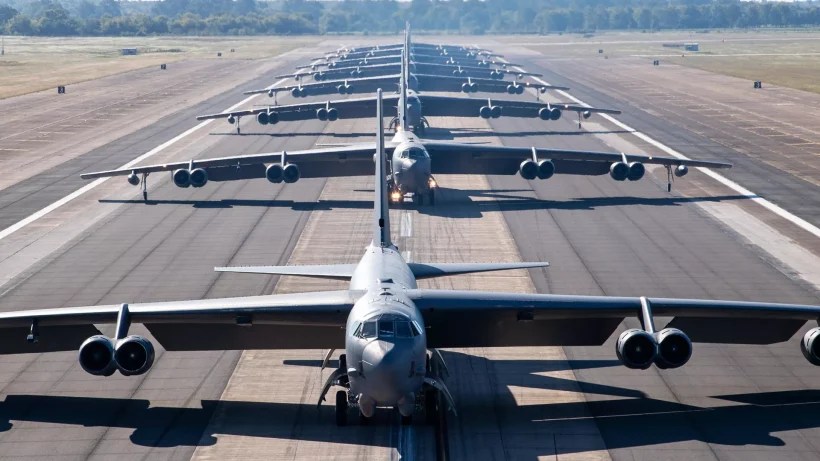
B-52H Stratofortresses from the 2nd Bomb Wing line up on the runway at Barksdale Air Force Base, La., Oct. 14, 2020. The B-52 is a long-range, heavy bomber that can perform a variety of missions and has been the backbone of U.S. strategic bomber forces for more than 60 years.
By Ilya Tsukanov – Sputnik – 11.04.2023
United States Strategic Command, the Pentagon arm responsible for military operations involving nuclear weapons, kicked off annual command and control drills this week. What message do the drills send Washington’s adversaries?
STRATCOM’s press service has done its best to calm concerns about the nuclear drills which began on Tuesday, assuring that they are ordinary, annually-scheduled exercises definitely “not” being held “in response to the actions by any nation or other actors.”
“Global Thunder 23 (GT23) involves personnel throughout the strategic enterprise including US STRATCOM components and subordinate units. The purpose of GT23 is to enhance nuclear readiness and ensure a safe, secure, and reliable deterrence force,” the command said in a statement.
“In addition to US personnel, GT23 will involve key allied personnel and partners, including United Kingdom personnel, who will integrate into senior leadership teams and work across a broad spectrum of areas offering policy support and operational insight… As in previous years, Global Thunder 23 will include an increase in bomber aircraft flights throughout the exercise,” STRATCOM added.
The formal goal of the drills seems pretty simple: to train US forces responsible for launching nuclear weapons against Washington’s adversaries, and assess operational readiness in coordination with allies – typically including Britain, Canada, Denmark, Australia, and South Korea. US forces involved in the drills ordinarily involve Air Force Global Strike Command and nuclear bomber wings dotting North America, plus forces responsible for launching America’s intercontinental ballistic missiles, and nuclear submarine crews.
The first Global Thunder drills were held in October 2014 – the same year relations between the West and Russia collapsed in the aftermath of a US-backed coup in Kiev. So much for STRATCOM’s statement that the drills aren’t held “in response to the actions of any nation.”
The last Global Thunder drills were held in November 2021, with the 2022 drills postponed to this week amid the escalation of the Ukraine crisis into a full-blown NATO-Russia proxy war.
Global Thunder 23 comes at a curious time. Washington and its allies spent the better part of the last year warning about purported Russian plans to use nuclear weapons in Ukraine, leaving aside the fact that the US is the only nation to have ever used nuclear weapons in wartime, and the fact that only America’s doctrine allows for nukes to be used preemptively and against non-nuclear-armed enemies.
What Other Recent Nuclear Drills Have There Been?
A separate STRATCOM command exercise dubbed “Global Lightning” was held in January 2022 in coordination with US Indo Pacific Command, with those drills focusing on “headquarters processes and procedures necessary to plan and respond to a military crisis.” Unlike Global Thunder, Global Lightning involves no associated field training.
Last October, NATO held the “Steadfast Noon” drills, simulating the use of American nuclear weapons by Washington’s European allies. Those exercises took place in Belgium, the UK, and over the North Sea. 14 countries and 60 aircraft of various types, including nuclear-capable bombers and spy and tanker planes, took part.
Russia’s nuclear forces held their own nuclear exercises, dubbed “Grom” (“Thunder”), the same month, notifying the US on what the Pentagon said was a “routine annual exercise” in compliance with arms control obligations. The Grom drills involved tests of components of all three elements of Russia’s nuclear triad, including live-fire launches of submarine, aircraft, and ground-based nuclear missile systems.
The nuclear superpowers aren’t the only ones to have conducted nuclear exercises recently. Last month, North Korea held two days-worth of drills “simulating a nuclear counterattack” against enemy targets – including the firing of a tactical missile carrying a mock nuclear weapon, amid growing regional tensions sparked by the increased frequency of US, South Korean, and Japanese exercises.
Drills’ Dangers
One doesn’t have to go very far back in history to recognize the danger of nuclear exercises resulting in a spiraling escalation. Nearly 40 years ago, in November 1983, a NATO command post drill known as Able Archer almost sparked a global nuclear holocaust after the Soviet military brass and the KGB became convinced that the Reagan administration was preparing an all-out surprise nuclear attack against the Soviet “evil empire.” Recently declassified documents have revealed that Pentagon planners deliberately took a number of provocative steps to raise Soviet suspicions, including a radio-silent airlift of 19,000 US troops to Europe, training involving “new nuclear weapons release procedures,” and multiple intentional “slips of the tongue” involving references to B-52 bomber flights as “strikes.” Additional declassified docs released in 2021 revealed that the Soviet military took the Able Archer drills so seriously that it prepped over 100 strike aircraft in Central Europe with live nuclear weapons.
Although communication channels between the Kremlin and the White House have improved since that time, the situation involving nuclear weapons can arguably be said to be even more dangerous today than it was in the mid-1980s. Since then, the US has not only moved nuclear weapons-related defense infrastructure over 1,000 km closer to Russia’s borders, but come up with a dangerous new military doctrine known as “Prompt Global Strike,” which envisions a massed non-nuclear attack against adversaries using ballistic and cruise missiles to quickly decapitate the enemy’s political and military leadership. The PGS initiative, announced by the Pentagon shortly after Washington’s exit from the Anti-Ballistic Missile Treaty with Russia in 2002, prompted Moscow to begin research into an array of next-gen hypersonic weapons designed specifically to make US military planners think twice before deciding to launch aggression.
Ukraine attempts to blame Russia for humiliating Pentagon leak
By Ahmed Adel | April 10, 2023
The Pentagon announced it was trying to remove from the internet a major leak of secret documents which have exposed plans relating to Ukraine’s war on Russia. For his part, Elon Musk sarcastically highlighted the vain attempt, saying on Twitter: “Yeah, you can totally delete things from the Internet – that works perfectly and doesn’t draw attention to whatever you were trying to hide at all.”
The American billionaire derided on Twitter the Pentagon’s attempt to remove social media posts containing leaked classified documents relating to the conflict in Ukraine. The day before his tweet, the New York Times newspaper indicated that officials were not successful in removing the publications from the internet.
The leak was described to the News York Times by a senior intelligence official as “a nightmare for the Five Eyes,” the intelligence sharing apparatus between the Anglo countries – the United States, Britain, Australia, Canada, and New Zealand. Some of the documents were found on Twitter and other sites on April 7, a day after US officials announced that they were investigating a potential leak of classified Ukrainian war plans. These war plans include an alarming assessment of Ukraine’s faltering air defence capabilities and notes that 12 brigades are being formed for Ukraine, including nine trained by the US and other NATO allies.
One of the leaks, dated February 23, is labelled “Secret/NoForn,” meaning it was not meant to be shared with foreign countries, and thus confirms the secrecy of the documents.
It is the belief of Mick Mulroy, a former senior Pentagon official, that the leak is “a significant breach in security” that could hamper Ukrainian military planning as it reportedly prepares for a spring offensive. “As many of these were pictures of documents, it appears that it was a deliberate leak done by someone that wished to damage the Ukraine, US, and NATO efforts,” he said.
The Kremlin said it had no doubts about the participation of the US or NATO, direct or indirect, in the conflict in Ukraine. None-the-less, the leaks would still provide a fascinating insight for decisionmakers in Moscow.
The New York Times reported that the leaks appear to be legitimate Defense Department documents. None-the-less, this did not stop Ukrainian officials from suggesting that the leak was only part of a Russian disinformation campaign aimed at influencing Ukraine’s possible spring offensive.
Ukrainian presidential advisor Mykhailo Podolyak told Reuters that the data contained a “very large amount of fictitious information” and Russia was trying to seize back the initiative in its “invasion.” His claim, instead, is part of Ukraine’s disinformation campaign, one that has been insisted upon yet exposed consistently since the first days of the war when we consider incidents like Snake Island.
Podolyak, for his part, had only recently spread his own “fictitious information” by claiming that Ukraine will capture Crimea through military means in the next five to seven months because Russia does not have enough resources to control the situation.
Despite ridiculous attempts by Kiev to contradict Washington and blame Moscow, US authorities are trying to find the culprit of the leak. According to a US official, they are determining how the documents were leaked by first identifying which officials had access to them.
The documents are at least five weeks old, with the most recent dated on March 1. The plans did not provide specific action such as when Ukraine would launch the offensive, but experts strongly believe it will occur during the spring. This offensive will include Western-trained troops and newly supplied weapons, including dozens of battle tanks. Although initial gains might be made, it is expected that the offensive will quickly tire out before Russia ultimately launches its own counteroffensive.
In preparing for this offensive, Ukraine has received 49 battle tanks from Western countries; London said it finished training a second group of Ukrainian soldiers on the AS90 self-propelled howitzers it is donating; Washington announced it was providing another $500 million in ammunition for howitzers, rocket artillery, Patriot anti-air systems and other systems; and Poland said it had transferred four of the 14 MiG-29 fighter jets it is giving Ukraine, following a similar move from Slovakia last month.
Very evidently, there are nowhere near enough resources to take an entire peninsula that has been militarised for the better part of eight years, let alone the regions between Crimea and where the Ukrainian forces currently are. No serious analyst believes that Ukraine will capture Crimea, let alone in a time frame of five to seven months, but the propaganda is aimed at securing more Western funds and weapons.
It is for this reason that the leaks are an embarrassing humiliation as it will likely hamper these efforts, and also why Podolyak tried denying them as Russian disinformation. But as Elon Musk sarcastically said: “Yeah, you can totally delete things from the Internet – that works perfectly and doesn’t draw attention to whatever you were trying to hide at all.”
Ahmed Adel is a Cairo-based geopolitics and political economy researcher.
NATO to launch biggest Air Forces drill in its history
A German-led exercise involving hundreds of aircraft is scheduled for June and will coincide with a massive US troop deployment

RT | April 9, 2023
NATO is planning to hold the largest Air Force exercise this summer, the German Armed Forces – the Bundeswehr – announced in a statement. Dubbed ‘Air Defender 23,’ the drills are scheduled to take place between June 12 and June 24 and are expected to involve hundreds of aircraft from dozens of nations.
A total of 10,000 soldiers and 220 aircraft are to be involved in the exercise, the Bundeswehr said, adding that they are to train “in the European airspace.” The US is to supply 100 of the aircraft out of its stocks, the statement said. According to Berlin, the drills are to be held mostly over German territory, although a map published by the Bundeswehr shows that the airspace of Estonia, which borders Russia, and of Romania, which borders Ukraine, could be used as well.
The plan of the drills “is modeled after an Article 5 Assistance scenario,” the Bundeswehr said, calling it “challenging air operations training” for the participating troops. The exercise is aimed at “optimizing” the cooperation between the participating nations and demonstrating the “strength” of the military bloc.
A total of 24 nations are to take part in the drills, including Finland, which only joined NATO earlier in April. Sweden, which has yet to join the bloc, will participate in the exercise too.
The US Air National Guard will provide around half the aircraft used in the German-led exercise in June. Its commander, Lieutenant General Michael Loh, maintained that there is no set scenario pitting the NATO forces against a particular adversary during the drills. Yet, he still did mention Moscow during a briefing on the matter earlier this week.
“This is now putting the alliance together quickly, with a credible force, to make sure that if Russia ever lines up on the NATO border, that we’re ready to go,” he said on Wednesday. “We’re going to defend every inch.”
A similar tone was struck by the German Air Force. “We won’t write [Russia] a letter,” its commander, Lieutenant General Ingo Gerhartz said, adding that he thinks “they get the message.”
The drills coincide with a separate US-led exercise called Defender Europe 23. “This annual, nearly two-month-long exercise is focused on the strategic deployment of US-based forces, the employment of Army pre-positioned stocks and interoperability with European allies and partners,” the Pentagon’s deputy press secretary, Sabrina Singh, told journalists earlier this week.
A total of 9,000 US soldiers, together with 17,000 troops from 26 other nations, are to participate in the drills, which would take place across ten European nations, Singh said. Washington had already started shipping the equipment needed for the exercise to Europe, she added. According to the Pentagon, the first pieces of equipment have already arrived in Spain.
Some 7,000 pieces of equipment are to be transported to Europe as part of the drills. Around 13,000 other pieces of equipment are to be drawn from pre-positioned stocks, the Pentagon said. The US-led exercise is to kick off on April 22.
Featured Video

HE SAVED LIVES. NOW HE FACES PRISON.
or go to
Aletho News Archives – Video-Images
From the Archives
NATO Sanctions and the Coming Global Diesel Fuel Disaster
By F. William Engdahl – New Eastern Outlook – 11.04.2022
Amid the ongoing global inflation crisis, NATO heads of state and mainstream media repeat a mantra that high energy prices are a direct result of Putin’s actions in Ukraine since end of February. The reality is that it is the western sanctions that are responsible. Those sanctions including cutting SWIFT interbank access for key Russian banks and some of the most severe sanctions ever imposed, are hardly having an impact on the military actions in Ukraine. What many overlook is the fact that they are increasingly impacting the economies of the West, especially the EU and USA. A closer look at the state of the global supply of diesel fuel is alarming. But Western sanctions planners at the US Treasury and the EU know fully well what they are doing. And it bodes ill for the world economy.
While most of us rarely think about diesel fuel as anything other than a pollutant, in fact it is essential to the entire world economy in a way few energy sources are. The director general of Fuels Europe, part of the European Petroleum Refiners Association, stated recently, “… there is a clear link between diesel and GDP, because almost everything that goes into and out of a factory goes using diesel.” … continue
Blog Roll
 Aletho News
- Trita Parsi: Middle East Unraveling — Are We on the Path to World War?
- Iran FM meets with US envoy on UN meeting’s sidelines at American side’s insistence: Report
- Qatar PM calls for Gulf security framework with Iran, says war must be ‘wake-up call’
- China condemns US extortion of Iranian airlines, rejects Washington’s ‘illegal’ sanctions threats
- Italy to move military personnel from Taif base after missile strike
- Finland’s Stubb tells European leaders to calm down
- Defeating Russia on battlefield impossible – Fico
- Finland’s Gender Clinic Reversal
- Massachusetts Wants Mental Health Visits, Why Does Government Use ‘Health’ to Enter Our Homes & Families?
- US lawmaker admits American people footing bill for Trump’s failed aggression against Iran
- If Americans Knew
- Sanctions are collective punishment: immoral and self-defeating
- Phosphorus Munitions Fired by Israel Burn Groves, Orchards in Southern Lebanon
- Israel Carries Out New Ceasefire Violations Across Gaza
- AI – Emphasis on the ‘I’: Israel Is Funding AI Chatbot Propaganda
- Israel Blocking Hundreds of Wheelchairs for Injured Children From Entering Gaza
- Israel Is Expanding and Upgrading Compounds for Palestinian Militias in Gaza
- The Palestinian-American Residents of This West Bank Town Are Wondering: Where Is Trump?
- Gaza desperately needs tents, wheelchairs, fuel… and everything else (Israel blocks it all) – Daily Update
- Israeli Attacks in Gaza Kill at Least Seven Palestinians Over Three Days, including Woman and Child
- Trump’s militarization of Washington DC as he pursues Israel’s war against Iran
- No Tricks Zone
- New Study: Earth And Venus Surface Warmth Largely Explained By Convection And Lapse Rate, Not CO2 Or Radiation
- 2025 Nature Paper Claiming Worsening Global Drought Gets RETRACTED …Heavily Flawed
- New Study: ‘Global Drought Shows No Detectable Recent Acceleration Under Climate Warming’
- Economic Masterminds: German Socialists Suggest Taxing Productivity Gains Stemming From Using AI
- The South China Sea Has Not Been Cooperating With The Climate Change Narrative
- Energy Crisis: Germany Enters Heating Season With Historically Low Gas Reserve Fill Levels
- New Study: The Antarctic Ice Sheet Gained Mass From 2020-2024 Due To Staggering Snow And Ice Accumulation
- Study: Ocean Heating Rates From Thousands Of Years Ago ‘Dwarf’ Modern Ocean Heating Rates
- Climate Extremists Target, Attack Large-Scale Power Grid Infrastructure In Germany!
- New Study: Antarctic Ice Melt Has Contributed Less Than 1 Centimeter To Sea Level Rise In The Last 30 Years

