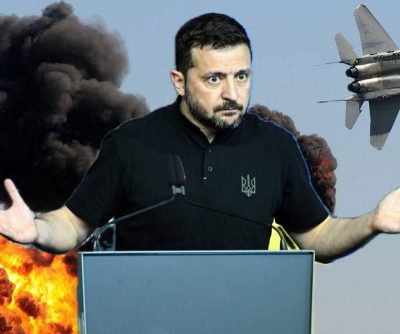
Zelensky presents ‘victory plan’
RT | October 16, 2024
Vladimir Zelensky presented his much-hyped “victory plan” to the Ukrainian parliament on Wednesday, suggesting it could help bring the conflict with Russia to a close as early as next year. However, he stressed that this outcome is possible only if Kiev rules out any compromises with Russia and receives full support from the West.
In his speech, Zelensky lamented that “victory has become an inconvenient word” for some people, adding, however, that he was certain that his “victory plan” would help end the conflict. “This plan can be implemented. It depends on the partners. I emphasize: on partners. It doesn’t exactly depend on Russia,” Zelensky said, accusing Moscow of not wanting peace.
“If you start moving with this idea, with this particular victory plan…, there may be a deal to end the war no later than next year,” he added, rejecting a freeze of the conflict and any “trade” of territories.
Zelensky said the plan consists of eight points, three of which are classified. First and foremost, the Ukrainian leader demanded that Kiev receive an invitation to immediately join NATO, a move the bloc has been reluctant to entertain, citing fears of being dragged into the conflict with Russia.
Second, he also stressed the need to strengthen Ukraine’s defense capabilities, including by lifting Western restrictions on the use of foreign-made long-range weapons for strikes against Russia, and also called for continued incursions into the neighboring country’s territory.
For the third point, Zelensky proposed to the West that Ukraine “deploy a comprehensive non-nuclear strategic deterrence package on its own land” to keep Russia at bay.
Fourth, he suggested that Ukraine sign with its backers “a special agreement on the joint protection of available critical resources” on its territory. These resources “will strengthen… either Russia and its allies, or Ukraine and the democratic world,” he said.
Finally, Zelensky said Ukraine could share its real-life battlefield experience with the West to “strengthen NATO’s defense and ensure security in Europe.”
Prior to Zelensky’s speech, Kremlin spokesman Dmitry Peskov suggested that his plan was just another facet of the US-dictated policy of fighting Russia “to the last Ukrainian.” Peace, he added, can only be achieved if Kiev understands “the futility of the current policy and the need to sober up and realize the reasons that led to the conflict over Ukraine.”
President Vladimir Putin has said that one of the main reasons for the conflict was Ukraine’s aspirations to join NATO and Kiev’s “genocide” of the people in Donbass, which is now part of Russia.
Steadfast Noon Risking Noon Twilight: What are the Risks of NATO’s ‘Nuclear Sharing’ Drills?
By Ilya Tsukanov – Sputnik – 14.10.2024
NATO kicked off its annual Steadfast Noon nuclear exercises this week. What’s important to know about them? What military assets could they involve? What are the dangers associated with them? Sputnik explores.
NATO’s Steadfast Noon nuclear drills began on Monday and will run over the next two weeks, involving some 2,000 personnel from eight bases and over 60 aircraft from 13 bloc countries. The bulk of the drilling is expected to take place over the North Sea (about 900 km from the Russian border), as well as Belgium, Denmark, the Netherlands and the UK.
Central to the exercises is drilling the concept of ‘nuclear sharing’ – which allows designated NATO allies’ jets to simulate combat missions using US nukes stored on their territory.
NATO’s nuclear sharing concept goes back to the Cold War, when the US deployed thousands of surface-to-surface, surface-to-air, air-tor-air and air-to-surface weapons with nuclear payloads to allied countries, including Canada, the UK, Greece, Turkiye, Italy, and West Germany. Guarded by US Air Force or Army personnel, the arms remained (and still remain) under the control of the US military, which has the codes needed to arm them.
By 1991, the USSR removed all its nuclear weapons from Eastern Europe, and urged the US to do the same. Washington never did, and today, keeps 100-150 B61 nukes in Europe and Turkiye, including:
- 10-15 bombs at Belgium’s Kleine Brogel Air Base – deliverable by F-16 MLU and F-35A jets.
- 10-15 B61s at Germany’s Buchel Air Base – carried by PA-200 Tornado jets and eventually, F-35As.
- Up to 45 B61s at Italy’s Aviano and Ghedi air bases, deliverable by F-16 C/Ds, Tornados, and F-35As.
- About 20 bombs at the Netherlands’ Volkel Air Base, delivered by F-16 MLUs and F-35As.
- Up to 50 B61s at Turkiye’s Incirlik Air Base, deployed by unspecified US military aircraft.
Poland has expressed readiness to host US nukes under the Nuclear Sharing program. It’s likely the bombs would be deployed at Lask Air Base, central Poland, where the US Air Force has a forward presence, and has already participated in nuclear drilling.
The B61 has been in production since the 1960s, with over 3,000 bombs of 13 different variants created. Today, the arsenal consists mostly of B61 Mod 3 and Mod 4 gravity bombs, according to the Center for Arms Control and Non-Proliferation. Produced since 1979, these weapons have a yield between 0.3-170 kt (Mod 3) and 0.3-45 kt (Mod 4). A Mod 7 variant also exists, with a yield between 10-340 kt.
Work is underway to replace all three with the Mod 12, which has a 0.3-50 kt yield. Production began in 2021, and 400-500 bombs are expected, according to the Bulletin of the Atomic Scientists.
What are the Risks Associated With Nuclear Sharing?
While B61s are tactical weapons, that doesn’t make them less dangerous than their strategic cousins, in light of the US nuclear doctrine’s allowance for nuke use in a first strike, even against “non-nuclear weapons states,” in certain circumstances. The bombs that devastated Hiroshima and Nagasaki in 1945 had yields of 15 and 21 kt, respectively.
The deployment of US nuclear weapons abroad frees the Pentagon’s hands for nuclear aggression involving tactical weaponry far beyond America’s home shores.
Nuclear Sharing program nukes are stored in so-called ‘Weapons Storage and Security System’ (WS3) facilities, situated in underground vaults. While info about the facilities, and even basic details on the nukes’ placement is ordinarily kept in strict secrecy, details about risks associated with hosting the weapons do occasionally leak out.
In 2023, the Federation of American Scientists published a photo of a damaged B61 at Volkel Air Base, showing the misshapen nuke on a trolley with one of its stabilizer fins missing. Neither US nor Dutch authorities informed the public of any incidents involving nukes at the base.
FAS researcher Hans M. Kristensen speculated at the time that the weapon was hit with “significant force,” possibly by a vehicle in transit, or “bent out of shape by the weapons elevator of the underground storage vault.” In any event, the incident constituted “the first publicly known case of a recent nuclear weapons accident at an airbase in Europe,” the observer noted.
FAS stressed that while the risks of an accidental detonation was extremely minute, such an eventuality would have risked widespread nuclear contamination.
Nuclear Sharing is also risk for another reason: heightened nuclear danger.
In the 1980s, when the US placed nuclear-armed Pershing and cruise missiles in Western Europe, it sparked the largest mass protests in modern European history, with three million people in Western Europe, and two million elsewhere, protesting the weapons, and for good reason: the deployment forced the USSR to put its nuclear forces on hair trigger alert, nearly sparking an all-out nuclear war in 1983.
No Ramstein Summit of Ukraine’s Arms Donors Set for Near Future – Reports
Sputnik – 13.10.2024
The Ukraine Defense Contact Group (UDCG) is not expected to reconvene in Germany in the near future despite US President Joe Biden’s planned visit to Berlin in the coming week, German media have reported.
Der Spiegel magazine reported Sunday that Biden would travel to Berlin and meet with the top German officials Friday, more than a week after postponing a planned visit to the country to monitor the arrival of Hurricane Milton in Florida.
However, no Ramstein format meeting will be held in the near future, the ZDF broadcaster reported. Instead, German Chancellor Olaf Scholz announced a new standalone military aid package for Ukraine, which he initially planned to reveal at a Ramstein summit, while hosting Volodymyr Zelensky for talks last week.
Biden was originally due to come to US Air Force Base Ramstein on October 12 for a meeting of Ukraine’s donors from the United Kingdom, Germany and France, but the summit was canceled after Biden scrapped the visit.
The Ukraine Defense Contact Group, also known as the Ramstein group, is an informal bloc of 57 nations (including all 32 NATO members, plus EU, G7 members and other US allies providing military equipment and other aid to Ukraine) was formed in April 2022, after the West moved to sabotage a potential Russia-Ukraine peace deal. The group has met well over a dozen times since its creation, coordinating in the delivery of tens of billions of dollars’ worth of aid to Kiev for the ongoing NATO proxy war against Russia.
The Ramstein group is named after the massive US airbase in southwestern Germany where the group has held some of its meetings, with others held at NATO’s Brussels-based headquarters, or virtually.
The contact group’s main goal has been to facilitate lobbying for more weapons deliveries, and formulate plans for new transfers.
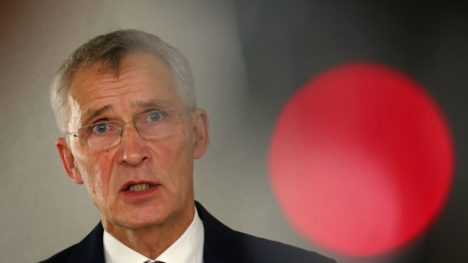
Former NATO Secretary General stupidly celebrates his own failure to achieve security
By Lucas Leiroz | Strategic Culture Foundation | October 12, 2024
Jens Stoltenberg is finally no longer the leader. This is not necessarily good news, as the new secretary general appears to be even more bellicose than the previous one and promises policies that could easily lead to strategic disaster in the current tensions between the Atlantic alliance and the Russian Federation. However, it is undeniable that one of the worst administrations in NATO’s history – and the one that came closest to an open confrontation with Moscow – has now ended.
Stoltenberg has recently made a number of statements praising his supposed “achievements” as NATO leader. He claims that under his leadership the alliance has achieved its highest numbers of troops on the eastern flank. Stoltenberg has also acclaimed himself for his success in allowing countries such as Finland and Sweden to join NATO as well as significantly expanding the number of troops on combat readiness for the event of a war.
In fact, Stoltenberg seems to be delighting over his own failure. It was under him that NATO saw the start of the continent’s biggest conflict since the World Wars in Europe, reaching a critical point in the regional security architecture. These tensions, which could at any moment escalate to the level of an open war with direct Western involvement, are precisely the consequence of the irresponsible policies implemented during Stoltenberg’s disastrous administration.
NATO’s expansion into Eastern Europe, both in terms of new members and available troops, is not something to be celebrated, but rather lamented. It was precisely this expansion that led to the current conflict. If Stoltenberg were indeed a rational, prudent leader with a strong strategic sense, he would have been able to use diplomacy with the member countries and negotiate a de-escalation of the suicidal policy of “containment” against Russia. But, on the contrary, Stoltenberg endorsed all this and was active in worsening the Ukraine crisis, contributing significantly to the escalation of tensions and the beginning of the current war.
More than that, he failed to stop the warmongering of the member states, allowing NATO to begin full support for the Kiev regime. This support is now at its most critical point, as the alliance’s countries are close to authorizing the use of long-range weapons against Russian civilian targets – which could lead to a nuclear world war. Stoltenberg, even now out of office, is partly to blame for this, as it was under his administration that this anti-Russian madness was launched by NATO.
Furthermore, it must be emphasized that the alliance has never been so fragile. Contrary to what Western war propaganda claims, anti-Russian policies are not strategically beneficial for NATO. On the contrary, in addition to threatening global peace, these measures put the very stability of the alliance at risk. NATO is not “stronger and more united than ever,” as the former secretary general says, but at its most fragile and delicate phase in history.
On the battlefield, Russian forces destroy NATO equipment – and troops disguised as “mercenaries” – every day. The U.S. and Europe no longer have the capacity to continue supporting Kiev continuously, given the large number of losses on the front lines, but at the same time, the alliance is unable to end this support, falling into a vicious cycle of violence and defeats. In addition, countries dissatisfied with the situation, such as Hungary and Slovakia, are already beginning to create a dissident position within NATO itself, threatening the bloc’s long-term stability.
In the end, it was under Stoltenberg that NATO, pursuing irrational “expansion to the East,” reached its current stage of weakness, demoralization, and disunity. And, to make matters even more catastrophic, an open world war could yet emerge as a belated consequence of NATO’s actions over the past ten years.
Instead of celebrating his own failure as a leader, Stoltenberg should simply be grateful that he had the opportunity to leave office before the worst-case scenario arose.
You can follow Lucas on X (formerly Twitter) and Telegram.
West must come to terms with the fact that it’s strategy has completely failed, get real about peace terms
By Sergey Poletaev | RT | October 12, 2024
Joe Biden is expected to make some new decisions regarding Ukraine in the weeks leading up to the country’s November elections. The US president was supposed to attend an important meeting of Kiev’s backers in Rammstein, Germany, on October 12, but canceled his visit, citing the need to stay at home due to Hurricane Milton.
What decisions can we expect to be made when it eventually takes place? Most likely, nothing particularly important will happen – here’s why.
A unified stance
Amidst the fog of propaganda, it can be hard to discern true motives, and often these only become clear over time.
After the start of Russia’s military operation, in February 2022, Western media presented a unified and convincing narrative: the entire so-called “free world” came together to defend Ukraine, determined to deliver a strategic blow to Russian President Vladimir Putin and restore the US-led global order. However, these proclamations didn’t match the steps taken by the West. After all, if your goal is to defeat an opponent, shouldn’t you do everything in your power to achieve it?
If the West was counting on a Ukrainian military triumph, it should have provided as much military aid to Kiev as possible. The first step would have been to open up full access to Western weapons arsenals; the second would have been to accept the country into NATO and turn it into a key stronghold on the border with Russia. Even if Putin would have done everything to stop this, such a step would automatically signify his defeat, since even a nuclear strike wouldn’t be able to change the situation and reverse the West’s decision.
Historical examples clearly illustrate this point. For instance, after withdrawing its troops, the West provided South Vietnam with nearly 3,000 aircraft and helicopters, 200 ships, over 2,500 combat boats, more than 1,000 tanks, up to 2,500 towed and self-propelled artillery pieces, and around 100,000 heavy vehicles, along with other equipment. Compare this to the situation in Ukraine, where receiving a dozen outdated fighter jets or two dozen old tanks is a major event.
Let’s take another example. In the aftermath of WWII, and during the Cold War, Türkiye became a key strategic region. Then Soviet leader Joseph Stalin demanded the country’s neutrality and even sought to establish a Soviet naval base in the area of the Bosphorus and Dardanelles straits. The USSR’s former allies, the US and UK, could not allow a Soviet military facility in the Mediterranean Sea, so Türkiye was accepted into NATO just three years after the alliance was formed, despite the fact that the country had nothing to do with the North Atlantic region or ‘Western democracies’. At the time, the Truman Doctrine was in effect, and the US was offering a security umbrella to anyone ‘under threat’ from communism.
The West isn’t buying Zelensky’s ‘Victory Plan’. So what happens next?
Why are things different now? The doctrinal principle that has shaped the West’s policy on Ukraine since 2014 is to prevent Putin from achieving his goals without engaging in a direct military conflict with Russia.
Biden and his administration have consistently stated that their priority is to avoid a full on confrontation with Russia, yet this message has largely been forgotten.
How does this principle align with what we have today – the largest armed conflict in Europe since World War Two, in which the West is fighting Russia by means of the Ukrainian army? Sure, it may not be on the same scale as Vietnam, but the military aid provided to Kiev is still significant.
The answer is simple: the decision-makers in the West – often referred to as the globalists – never truly believed that Ukraine could defeat Russia on the battlefield (Well, let’s say almost never; there was one notable exception, which we’ll discuss later).
Biden’s doctrine implied that the West could achieve its goals through financial and trade strategies. Recognizing that an armed conflict was looming, the globalists spent years developing an “economic nuclear bomb” that was supposed to bring Russia to its knees.
The plan was ambitious: they assumed that unprecedented “sanctions from hell” would essentially block Russia’s access to the outside world, plunging it into economic chaos and ultimately toppling the country’s current ruling elite. Maybe this wouldn’t happen overnight; perhaps it would take years, but the idea was that the Russian government would eventually yield to the demands of a people suffering from the sanctions, and would then yield to Western demands without firing a single shot. This would not only serve as a harsh lesson for Russia but would also send a strong message to the main enemy: China.
Ukraine’s military resistance wasn’t factored into this equation; many will recall that the Pentagon initially estimated that Kiev would fall within three days. Ironically, the US thought that if the 30-million-strong nation found itself under Russian control (the legitimacy of which no country in the world would officially recognize), it would become an unbearable burden for Putin and would only hasten Russia’s economic collapse.
How to lose friends and alienate sponsors: Zelensky is making enemies in America
Moscow failed to achieve its goals through a swift and relatively bloodless military operation, while the West eventually realized that its sanctions didn’t achieve the intended effect either – or perhaps even backfired. After brands like Ikea, Starbucks, and Disney left Russia, the Russian people didn’t rise up to overthrow Putin; and the seizure of rich people’s yachts and mansions didn’t spur a regime change either.
In reality, the globalists dramatically overestimated the West’s influence over economic processes, not only in the so-called Global South but even in their own backyard. Three years into the conflict, they still cannot prevent dual-use and military goods from entering Russia, let alone everyday consumer products. Moscow quickly rerouted its trade flows, bypassing the West, found new partners, prioritized import substitution, and, despite certain challenges, achieved noticeable and sustained growth in its economy and foreign trade. All of this turned out to be beyond Western control.
So, the original plan didn’t work out, and this prompted the West to urgently invent a new strategy.
At the same time, the Russian military didn’t take Kiev, and strategically withdrew from northern Ukraine. Vladimir Zelensky convinced NATO countries that this was the result of the military triumph of the Armed Forces of Ukraine (AFU). He argued that if the West provided Ukraine with enough weapons, it could hold out for a significant period of time. Back then, in the spring of 2022, the outcome of the economic war was still unclear, and with no better ideas on the table, the West settled on the following plan: the Ukrainian army would wear Russia down in combat, while Western sanctions would do the rest.
The Rammstein meetings on Ukraine became a platform for making major decisions regarding military supplies; at the same time, Western diplomats toured the Global South, urging it to join the economic war against Russia.
At that time, there was still no talk of admitting Ukraine into NATO or directly intervening in the conflict. However, at some point, the West came to believe its own propaganda: it came to think of the Russian army as a paper tiger which might be easier to crush than the Russian economy. At that point, Western leaders became convinced that they could force Putin to bend to their will through military rather than economic means.
This shift occurred in the fall of 2022, after Ukraine’s attack on the Crimean Bridge, and advances in Kherson and Kharkov regions, the chaos of partial mobilization in Russia, and the resulting emigration of some dissenters. At that time, some seemed to believe that one more push could bring Putin down.
Riding this wave of optimism, the globalists approved a major Ukrainian counteroffensive. Throughout the winter of 2022-2023, tank, artillery, and missile units were formed, and new, highly motivated Ukrainian brigades were trained in Western Europe. They were supposed to break through to the Sea of Azov and bring Putin to his knees. For this counteroffensive, the West supplied Ukraine with as many weapons as it could without compromising its own interests.
A suitcase without a handle
Everyone knows how this story ended. Kiev’s operation failed and became a turning point in the conflict. Having fallen far short of achieving its military goals, Kiev lost the trust of its backers who realized that they were initially right to think that Ukraine could never win this conflict on the battlefield.
However, it also became clear that Biden’s doctrine was ineffective. Russia couldn’t be economically crushed and it couldn’t be defeated on the battlefield. So what now?
Since the spring of 2022, we have often pointed out that the West has to make a choice: either engage in serious negotiations with Russia or enter into a direct military conflict. However, no one in NATO has been willing to take responsibility for such a decision – neither the increasingly incapacitated Biden, or Western European politicians. Who are equally unfit, but for different reasons.
For now, all the West can do is continue to send aid to Ukraine, while the latter can still try to hold out on the frontlines. At the same time, the West is trying to “test the ground” about possible negotiations with Moscow, but so far this has amounted to little more than wishful thinking. NATO has convinced itself that the Kremlin will be happy to freeze the conflict without any commitments, as long as such an option is put on the table.
What happens when this third gamble fails as well? Will the West finally shake off its lethargy and make a clear choice, or will it continue to go with the flow?
It seems that all the scheduled participants of the Rammstein meeting were probably happy enough at the news of its cancellation. Clearly, neither the outgoing US president nor NATO’s European members have any viable ideas regarding Ukraine. This means that, at least until the US elections, Ukraine will continue to endure reverses, to the accompaniment of the globalists’ hollow rhetoric.
Sergey Poletaev is an information analyst and publicist, co-founder and editor of the Vatfor project.
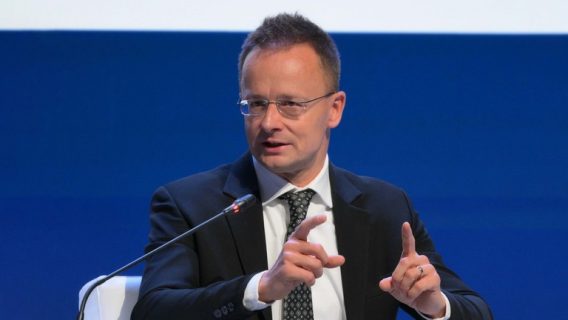
Dismissal of Russia’s Security Guarantees in 2021 Led to Crisis Today – Hungarian FM
Sputnik – 12.10.2024
The current situation might not have happened if NATO had discussed with Russia its draft treaty on security guarantees in 2021, Hungarian Foreign Minister Peter Szijjarto told RIA Novosti.
He recalled that “serious discussion” was missing.
“Well, I remember those times, I think that what was missing there is a serious discussion,” Szijjarto said, commenting on whether it was a mistake by NATO countries to abandon the Russian proposal on security guarantees made in December 2021.
The minister noted that he always believes in discussion and dialogue.
“These discussions have not taken place, unfortunately. Well, now we are more than three years after or almost three years after, so it might not make sense what I say now, but I wish those dialogues had taken place. Because if they had taken place, we might not be in a situation where we are right now,” Szijjarto said.
US Vice President Harris’s Insulting Remarks
The way that US Vice President and Democratic presidential candidate Kamala Harris insulted Hungarian Prime Minister Viktor Orban is “not the best start” for bilateral relations, Hungarian Foreign Minister Peter Szijjarto told RIA Novosti.
Earlier this week, Harris during an interview appeared to refer to Orban, Chinese President Xi Jinping and North Korean leader Kim Jong Un as “dictators” and “murderers.”
“Definitely this is not the best start,” Szijjarto said, commenting on whether Harris’s words will have any consequences for the relations between Hungary and the US.
The words of US Vice President and Democratic presidential candidate Kamala Harris toward Hungarian Prime Minister Viktor Orban are unacceptable and disrespectful, Hungarian Foreign Minister Peter Szijjarto told RIA Novosti.
Earlier this week, Harris during an interview appeared to refer to Orban, Chinese President Xi Jinping and North Korean leader Kim Jong Un as “dictators” and “murderers.”
“Well first of all that is a scandal. That is a scandal to talk about my Prime Minister this way. This is unacceptable. This is a total disrespect not only towards the Prime Minister but to the Hungarian people,” Szijjarto said.
Hungary has always shown respect for the United States and expects to be treated the same way, the minister said.
“So as we have always shown respect to the American people, we expect the Americans to show respect to the Hungarian nation as well. And such kind of a statement shows a total disrespect which is unacceptable, especially between allies,” Szijjarto said.
Russian victory will liberate Europe – top French historian
RT | October 9, 2024
A Ukrainian defeat would represent a victory for Europe, French anthropologist Emmanuel Todd has claimed, in an interview with the Italian news outlet Corriere di Bologna published on Tuesday.
According to Todd, who has stressed that he is not an explicit supporter of Moscow, if Russia were to lose in the Ukraine conflict, this would allow “European submission to the Americans to be prolonged for a century.”
The leading intellectual has argued that Europe has effectively delegated the representation of the West to the US and has been paying the consequences ever since. He claims in the interview that nothing can be done to change this fact at the moment due to the ongoing Ukraine conflict, but suggests that its outcome will “decide the fate of Europe.”
“If, as I believe, the US is defeated, NATO will disintegrate and Europe will be left free,” Todd told the outlet, noting that it is unlikely that Russia would be compelled to militarily attack Western Europe after establishing itself on the Dnieper River.
“Russia will have neither the means nor the desire to expand once the borders of pre-communist Russia are reconstituted. The Russophobic hysteria of the West, which fantasizes about the desire for Russian expansion in Europe, is simply ridiculous for a serious historian,” he said.
A number of Western leaders have in recent months raised concerns that if Russia were allowed to defeat Ukraine it would eventually set its sights on other European and NATO countries.
Moscow, however, has repeatedly stressed that it has no intention of attacking any other countries once it accomplishes its goals in Ukraine. Russian President Vladimir Putin has dismissed talk of a ‘Russian threat’ as “nonsense” being peddled by Western governments to scare the European population in order to “extract additional expenses” from them.
Defense Spending on NATO’s Eastern European Flank Skyrockets to $70 Billion
By Oleg Burunov – Sputnik – 09.10.2024
Russian President Vladimir Putin earlier said that Western countries had misled Moscow by expanding NATO in Eastern Europe despite previous promises not to do so.
Military expenditure in NATO’s Eastern European member states surged to $70 billion this year, according to Bloomberg.
Poland and Estonia are among the top seven NATO members, in terms of defense spending as a percentage of GDP, this year. Poland is allocating 4.12% of its GDP to defense, while Estonia is dedicating 3.4%, both far exceeding NATO’s target of 2%.
The report comes amid heightened militarization in Eastern Europe, with NATO establishing “multinational battlegroups” in Bulgaria, Estonia, Hungary, Latvia, Lithuania, Poland, Romania, and Slovakia, in response to a perceived “Russian threat.” Member states have also increased their deployment of ships, planes, and troops to NATO’s eastern flank.
Russia has repeatedly warned NATO against expanding eastwards, with Moscow arguing that it could further escalate tensions in Europe.
Russian President Vladimir Putin has previously accused NATO of making empty promises regarding its 1991 commitment not to expand eastwards. He stressed that there have been “five waves” of expansion since the US administration assured Russia in 1991 that NATO would not expand towards the east.
Hungarian foreign minister: Nation’s gas supply is secure, NATO membership for Ukraine is impossible
By Liz Heflin | Remix News | October 9, 2024
Minister of Foreign Affairs and Trade Péter Szijjártó said that Hungary will not be affected by the expected stoppage of the transit of Russian natural gas via Ukraine because the country today primarily gets its gas via the TurkStream pipeline.
His comments came at a press conference following the meeting of the Hungarian-Serbian joint economic committee. He further noted that an “extremely brave decision” was made with Serbia, Bulgaria and Turkey to build this pipeline, with those involved in the construction and preparation facing serious threats from allies who tried to dissuade them from building it.
“If we hadn’t been brave enough, we would be in huge trouble today. If we hadn’t built the TurkStream gas pipeline, today it would be very difficult, if not impossible, to guarantee the security of Hungary’s natural gas supply,” he added.
Already this year, more than 5.6 billion cubic meters of natural gas has arrived via this route, Szijjártó said.
“We are not interested in and have no influence on what the Russians and Ukrainians get or don’t get in terms of gas transit (…) There are Central European countries for whom this is a problem. In recent years, we in Hungary have invested a lot in gas transportation infrastructure, and of course, we help whoever we can,” he said.
Szijjártó also spoke up on Ukraine’s possible NATO membership, saying that the country’s admission today would drag all members into the ongoing war and trigger the outbreak of WWIII because of the article on collective defense.
“I think that anyone who thinks this matter through with common sense does not want to cause this danger. So, the Hungarian position is clear: There is no possibility of Ukraine joining NATO,” he stated.
Szijjártó added that most NATO foreign ministers are in agreement, which he believes is very unfair to Ukraine, as “they don’t tell them honestly what they think about this issue and what their position is.”
NATO States Oppose Ukraine’s Membership in Alliance Behind Closed Doors – Szijjarto
Sputnik – 08.10.2024
Hungarian Foreign Minister Peter Szijjarto said on Tuesday that he had told Ukrainian Foreign Minister Andrii Sybiha that there was no opportunity for Ukraine to join NATO, and that the majority of NATO members speak against Ukraine’s accession to the alliance behind closed doors.
“Last week I told Ukrainian Foreign Minister [Sybiha], who was in Budapest, that I have no idea what he is being told, have no idea, what he is being convinced of, but when we [NATO members] are behind closed doors, the majority share the view I have just expressed,” the minister said at a press conference following the meeting of the Hungarian-Serbian Joint Economic Committee.
On September 30, Sybiha came to Budapest for a working visit. It was the first visit of a Ukrainian foreign minister to Hungary in four and half years.
On October 3, NATO’s new Secretary General Mark Rutte made an unannounced visit to Kiev. During his visit, Rutte said that “Ukraine is closer to NATO than ever before,” and promised to continue working on this until the country becomes a member of the alliance. Rutte added that he looked forward to the day when Ukraine joins NATO, but did not give any exact date.
Russian President Vladimir Putin has said that NATO’s expansion to include Ukraine would create a direct national security threat to Russia and that Moscow considers the non-aligned status of Ukraine to be extremely important to put an end to the Ukraine conflict.
NATO openly preparing for conflict with Russia – Moscow
RT | October 8, 2024
NATO is no longer hiding that it is gearing up for a potential military conflict with Russia, Deputy Foreign Minister Aleksandr Grushko has said, pointing to this year’s Steadfast Defender drills, the bloc’s largest maneuvers since the end of the Cold War.
The US-led military bloc has been expanding eastward for decades, despite assurances given to the Soviet Union in the run-up to German reunification in 1990 that it would not do so. Russia has repeatedly described the expansion toward its borders as a threat to its security.
Speaking to RIA Novosti on Tuesday, Grushko said that “now NATO representatives have stopped hiding that they are preparing for a potential armed clash with Russia.”
“Regional defense plans have been approved, concrete tasks for all of the bloc’s military command structures have been formulated. Possible options for military action against Russia are being continuously worked out,” the diplomat added.
He cited the Steadfast Defender exercise that ran from January through late May, saying that “for the first time, the enemy was not a fictitious state, but Russia.”
While NATO did not specifically name Russia in its announcement of the drills, it called the exercises preparation for a conflict with a “near-peer” adversary. NATO’s main security document identifies Russia as the bloc’s largest threat.
The drills, which were conducted near Russia’s western border, featured some 90,000 troops from all 32 NATO member states.
According to Grushko, “military budgets are being pumped [with money] and [Western] economies are being militarized.”
The deputy foreign minister insisted that “it was not Russia, but the North-Atlantic alliance that took the path of confrontation,” by refusing to engage in dialogue with Moscow. He concluded that NATO bears responsibility for a “major European security crisis.”
On Saturday, Germany’s Die Welt newspaper, citing a confidential NATO planning document, reported that in preparation for a potential conflict with Russia, the military bloc is planning to dramatically increase the number of combat and air defense units.
Over the past few months, several NATO member states have claimed that Russia could be harboring plans to attack the bloc.
Speaking on the sidelines of the St. Petersburg International Economic Forum (SPIEF) in June, Russian President Vladimir Putin dismissed as “nonsense” and “bulls**t” allegations that Moscow plans to attack NATO.
In September, the Russian leader warned, however, that should Ukraine’s Western backers allow Kiev to use their missiles to hit targets deep inside Russia, “it will mean nothing less than the direct participation of NATO countries, the US and European countries, in the conflict in Ukraine.”
Featured Video

The Truth About the Trump Shootings with Ken Silva
or go to
Aletho News Archives – Video-Images
From the Archives
Trans ‘milk’ as good as the real thing – NHS
RT | February 18, 2024
The drug-induced nipple secretions of trans women are as good as mothers’ breast milk for babies, the University of Sussex Hospitals NHS Trust claimed in a letter to campaigners made public in a report by British think tank the Policy Exchange on Sunday.
The healthcare trust’s medical director, Rachel James, argued that the off-label prescription drug cocktail men transitioning to female take in order to produce milk was “similar to the natural hormones which encourage lactation to develop when the baby is newly born.”
“The evidence which is available demonstrates that the milk is comparable to that produced following the birth of a baby,” James wrote in the letter, sent to Children of Transitioners last August.
Biological men who wish to lactate must first take hormones to grow milk glands and then take high doses of either domperidone or metoclopramide to stimulate milk production. Neither drug is approved for this use, though they are occasionally prescribed off-label to biological women who have trouble lactating.
However, domperidone’s own manufacturer, Janssen, warns patients the drug “may cause unwanted side effects affecting the heart in a breastfed baby” and “should be used during breastfeeding only if your physician considers this clearly necessary.” … continue
Blog Roll
 Aletho News
- Seyed M. Marandi: U.S. Strike Imminent – Toward Total War in the Middle East
- Russia Voted Under Fire. Washington Is Loading the Tankers.
- 12 Things Your Oncologist Was Trained Not to Tell You
- Anthrax Attacks Paved Way for COVID-Era ‘Junk Drugs and Vaccines’
- How Real Is the Impact of Western Sanctions on Israel?
- France, You Are Guilty: How Paris Turned Western Sahara into the Maghreb’s Powder Keg
- 2025 Nature Paper Claiming Worsening Global Drought Gets RETRACTED …Heavily Flawed
- Your Milk Is Not the Problem
- The Truth About the Trump Shootings with Ken Silva
- ARE PATIENTS BEING PROPERLY INFORMED ABOUT OZEMPIC?
- If Americans Knew
- Salah Sarsour’s Legal Team Says DHS Has Not Met Its Burden to Prove He Is Deportable
- An analysis of tax forms by The Intercept show Kraft’s charity and LLC have donated to Friends of the IDF and AIPAC’s super PAC.
- Israeli attacks kill four Palestinians in Gaza – Daily Update
- Inside Gaza’s death trap of collapsing, bombed-out buildings
- The everyday items Israel bans from Gaza every day
- Inside the siege, the ruined buildings of Gaza – Daily Update
- Debunking The Claim That Macklemore Has A “History Of Antisemitism”
- CPJ demands release of arrested Palestinian-US journalist near Bethlehem
- Robert Kraft: The Billionaire Friend of Netanyahu Pulling The Strings Behind the Macklemore/Ed Sheeran Blow Up
- Columbia Administered Fund Gives Big Money to Pro-Israel Groups
- No Tricks Zone
- 2025 Nature Paper Claiming Worsening Global Drought Gets RETRACTED …Heavily Flawed
- New Study: ‘Global Drought Shows No Detectable Recent Acceleration Under Climate Warming’
- Economic Masterminds: German Socialists Suggest Taxing Productivity Gains Stemming From Using AI
- The South China Sea Has Not Been Cooperating With The Climate Change Narrative
- Energy Crisis: Germany Enters Heating Season With Historically Low Gas Reserve Fill Levels
- New Study: The Antarctic Ice Sheet Gained Mass From 2020-2024 Due To Staggering Snow And Ice Accumulation
- Study: Ocean Heating Rates From Thousands Of Years Ago ‘Dwarf’ Modern Ocean Heating Rates
- Climate Extremists Target, Attack Large-Scale Power Grid Infrastructure In Germany!
- New Study: Antarctic Ice Melt Has Contributed Less Than 1 Centimeter To Sea Level Rise In The Last 30 Years
- Fear Of Debate: Alarmist German Climate Scientist Calls On Mainstream Media To Discredit Skeptic Voices
 Aletho News