Thousands of French soldiers ready to arrive in Romania for simulated conflict with Russia
The next year will be crucial for the French army, which has undergone a major transformation in recent years to prepare for a possible conflict with Russia, reports Politico.
Next May, thousands of French soldiers will take part in a large-scale military exercise in Romania. The purpose of the exercise is to assess how quickly they can reach NATO’s eastern flank if necessary, which is crucial if Russian President Vladimir Putin were to attack an allied NATO country.
Hungarian news outlet Magyar Nemzet points out that the moves from France show “Paris is preparing for a world war. The pro-war French president has already come up with alarming plans in recent months, which could clearly lead to a war between NATO and Russia. As reported earlier, Emmanuel Macron did not rule out sending troops to Ukraine either.”
Regardless of the potential threats of an open conflict with Russia, NATO seems to be preparing for that possibility.
“We used to play war. Now, there’s a designated enemy, and we train with people with whom we’d actually go to war,” said General Bertrand Toujouse.
Such military exercises “are a strategic signal,” he added
In recent years, French ground forces have undergone a “profound transformation” to prepare for a conflict as intense as the war in Ukraine.
The main challenge is for French forces to reach Romania in such a short time.
“There is still no military Schengen, and we need to decisively improve military mobility in Europe,” said General Pierre-Éric Guillot.
The first troop deployment in Romania in 2022 has been hampered by bureaucratic hurdles, border control procedures and inadequate trains for transporting military equipment. The affected countries have since worked to eliminate these problems.
“We may still be hampered by a few customs measures, but we’ve made a lot of progress in diversifying our routes,” Guillot told reporters.
October 8, 2024
Posted by aletho |
Militarism | France, NATO, Russia |
Leave a comment
Slovakian Prime Minister Robert Fico has said that his country would not allow Ukraine to join NATO as long as he stays in power. Admitting Kiev into the US-led military alliance would trigger a new world war, he warned in an interview with the broadcaster STVR on Sunday.
“As long as I am the prime minister of the Slovak Republic, I will lead the legislators, whom I have control over as a party chairman, to never agree to Ukraine’s membership in NATO,” Fico said. “Ukraine’s entry into NATO would serve as a good basis for a third world war.”
Fico, a longtime critic of Western military and financial aid to Ukraine, has insisted that the conflict must be resolved through diplomatic means. He repeatedly warned against further escalation with Moscow.
The accession of new countries must be approved by all of NATO’s 32 existing members, with national parliaments voting in favor or against new candidates.
Kiev formally applied to join NATO in September 2022, citing the ongoing conflict with Russia. While many Western states publicly backed Ukraine’s aspirations, they have refused to provide a concrete roadmap or a timetable for accession. Ukrainian leader Vladimir Zenesky acknowledged in July that “we will not be in NATO until the war is over in Ukraine.”
Russia views NATO’s expansion eastward as a security threat and has cited Ukraine’s cooperation with the alliance as one of the main reasons behind the conflict.
President Vladimir Putin warned last month that using Western-supplied longer-range weapons for strikes deep inside Russia would be tantamount to “direct involvement” of NATO in the fighting.
The West is deliberately fueling the fighting in Ukraine because its ultimate goal is to weaken Russia, Slovak Prime Minister Robert Fico has said.
In an interview with Slovak broadcaster STVR on Sunday, Fico expressed concern over the EU’s increasing involvement in the ongoing hostilities between Moscow and Kiev, arguing that the conflict cannot be resolved on the battlefield.
“There is a military conflict in a neighboring country where Slavs are killing each other, and Europe is significantly supporting this killing, which I just don’t understand,” Fico said. He added that the fighting “continues only because it is being strongly supported by the West.”
“The sooner it ends, the better it will be,” he stressed, arguing that the Western efforts to use the conflict to defeat Moscow would fail.
“Everyone thinks that through Ukraine we will bring the Russians to their knees, but this Russophobia does not work. It turns out that this problem cannot be solved militarily,” Fico stated.
Fico, a longtime critic of Western military aid to Kiev, promised to block Ukraine from ever joining NATO. Such a step could lay the groundwork for a potential World War III, he argued.
After winning the parliamentary election last year, Fico’s Smer-SD party has halted the delivery of weapons to Ukraine and has repeatedly called for a diplomatic resolution of the conflict. He pledged to restore trade and political ties with Moscow once the fighting ends, arguing that “the EU needs Russia, and Russia needs the EU.”
Moscow has denounced Western aid to Kiev, insisting that no amount of foreign aid would stop its troops in Ukraine.
October 7, 2024
Posted by aletho |
Militarism | NATO, Slovakia, Ukraine |
Leave a comment
NATO is planning to create an extra 49 combat-ready brigades with about 5,000 servicepeople in each that would bring a total number to 131 units, reported a German broadcaster on Saturday, citing the alliance’s unpublished documents.
The number of combat corps should be expanded from six to 15, and division headquarters from 24 to 38 to manage and support the extra brigades, the Minimum Capability Requirements, presented by NATO Supreme Allied Commander Europe Gen. Christopher Cavoli and French Adm. Pierre Vandier, read, as cited by the broadcaster.
The alliance is also planning to boost the capabilities of ground anti-aircraft units five-fold to 1,467, the report said.
The necessity to build up military power is stipulated by the threat that allegedly comes from Russia, the report added.
October 5, 2024
Posted by aletho |
Militarism, Russophobia | NATO |
Leave a comment
Croatian President Zoran Milanovic has refused to contribute any troops to the NATO command for providing military aid to Kiev, arguing that this would draw Zagreb into direct conflict with Moscow.
The former Yugoslav republic has been a member of the US-led bloc since 2009. Its right-wing government has sent weapons and helicopters to Ukraine, over the objections of the president, who is a Social Democrat.
”While I am president and the commander in chief, Croatian soldiers, officers and NCOs will not take part in activities that would draw Croatia into a war,” Milanovic said on Thursday.
Milanovic has refused to contribute any personnel to the NATO Security Assistance and Training for Ukraine (NSATU) command, which the bloc established for the purpose of coordinating military aid to Kiev. Zagreb was supposed to send a handful of officers to the 700-strong NSATU staff in Wiesbaden, Germany.
Croatian Prime Minister Andrej Plenkovic has accused the president of “further isolating Croatia on the international scene and destroying its credibility as a NATO member.”
Meanwhile, NATO has reminded Milanovic that the command was agreed at the July summit in Washington and that it would not involve sending any troops to Ukraine. The US-led bloc has argued that spending hundreds of billions of dollars to arm, train and supply Kiev’s war effort doesn’t actually make it a party to the conflict with Russia.
“Whether it’s one soldier or a hundred, wherever they are, this would be a direct command support to a warring party that is not a NATO member, which is out of bounds for Croatian national interests,” Milanovic replied on Thursday that “Croatia has an obligation to help allies, which is what we’ve been doing. Everything else is getting involved in a war, which I will not allow.”
He reminded the bloc that Zagreb has demonstrated its commitment by nearly doubling the number of Croatian troops in the NATO border force, from 300 to 520.
“I answer solely to the people of Croatia, not Washington and Brussels,” Milanovic said.
Under the Croatian constitution, Milanovic has the right to bar the deployment of troops abroad. The cabinet could override the president with a two-thirds vote in the parliament, but the ruling coalition is backed by only 78 out of 151 lawmakers.
Milanovic has long criticized the NATO policy of arming Ukraine to fight against Russia. He has also slammed the EU’s treatment of member states like Poland and Hungary, and accused Brussels of treating Croatia like a “retarded” child.
October 5, 2024
Posted by aletho |
Militarism | Croatia, NATO, Russia, Ukraine |
Leave a comment
By Drago Bosnic | October 4, 2024
In the last two and a half years, the Neo-Nazi junta frontman Volodymyr Zelensky pitched a number of “peace” plans, formulas, platforms and whatnot. Last year, the so-called Crimea Platform was all the rage, with the United States pressuring numerous countries to join this effectively void initiative. Then came the so-called “peace summits” in Switzerland, with Zelensky insisting everyone should come except the one country that actually matters – Russia. Supported by the US/EU/NATO, he kept pushing until many countries started signaling that such events are pointless and a waste of everyone’s time. By mid-July, the Kiev regime realized it would lose even the formal “support” that Washington DC and Brussels gathered through “diplomacy” (i.e. blackmail, coercion and arm-twisting). As the battlefield situation kept deteriorating, Zelensky suddenly became “open to the idea” of Russia attending the next “peace summit”.
However, the Kremlin was on the verge of laughing in the face of those who suggested this, refusing to take part in the political West’s ludicrous games. The “peace plan” that was offered to Moscow effectively boiled down to capitulation at a time when its forces were already making steady gains across the frontline, but particularly in the Donbass, by far the most heavily contested region in the NATO-orchestrated Ukrainian conflict. Thus, in order to shift attention away from its collapsing defenses, the Neo-Nazi junta resorted to the most daring PR stunt yet – the Kursk oblast (region) incursion. Expectedly, this also turned out to be a disaster, with the political West itself frustrated by the way the Kiev regime forces were wasting precious resources while the defenses in the Donbass failed to stop the Russian advance. Zelensky’s PR team was now essentially out of new phrases/tropes and realized there won’t be any “peace summits” with Russia.
That was when the Neo-Nazi junta finally decided to recycle the old one – “winning the war”. All of a sudden, the word “peace” was replaced and now we got a “victory plan” once again. Obviously, such “grand schemes” require more money, so Zelensky traveled to the US and spent around a week there in late September, formally pitching the latest “victory plan” to the troubled Biden administration. Many pro-Trump Americans were frustrated by this and even argued that Zelensky was engaged in election meddling, as he visited Pennsylvania, the top swing state. On September 26, the White House hosted Zelensky, where he and Biden happily announced that the Kiev regime would immediately get $400 million, while the US pledged another $8 billion in so-called “aid”. Apparently, Zelensky was frustrated as Washington DC refused to allow the use of NATO-sourced long-range weapons, so he was given all those billions to “lighten up”.
The Neo-Nazi junta frontman officially presented his “victory plan” to the troubled Biden administration, prompting the Trump campaign to call Zelensky “the greatest salesman on Earth“. Obviously, anyone familiar with the way this works knows that the so-called “Ukraine aid” is just another way to get more taxpayer’s dollars back into the US and straight into the coffers of the DNC and Biden crime family. The latest revelations about this scheme show that the warmongering oligarchy in Washington DC initiated the Ukrainian crisis over a decade ago precisely for this reason. However, at least part of these promised funds will surely end in Ukraine, where they’ll be used to bribe numerous Kiev regime officials, but also prolong the NATO-orchestrated Ukrainian conflict. The unfortunate populace of the NATO-occupied country is paying the price, while the rest of us get to live in fear of uncontrollable thermonuclear escalation.
This still leaves the obvious question – what is this “victory plan” about? It wouldn’t be the first time that the Neo-Nazi junta is claiming that it can “win”, but it “just needs this one game changer”. So far, only nuclear weapons and aircraft carriers haven’t been delivered to its forces. However, nothing worked, so how would this new “plan” turn the tide? Russian offensive capabilities only keep growing, with a deadly combination of artillery dominance and air superiority aided by unrivaled long-range strike systems. Not even NATO itself can match that, let alone the battered Kiev regime forces. The latest assessments only confirmed previous findings about their atrocious casualty ratio, which is why the Russian military is advancing much faster across the frontlines. The Neo-Nazi junta simply doesn’t have the manpower and equipment to prevent this, forcing it to continuously pull back to new defensive positions.
Thus, Zelensky’s “victory plan” effectively boils down to an over the top wishlist counting on a Russia-NATO escalation. In simpler terms, the political West needs to go to war with Moscow to prevent the Kiev regime’s complete defeat. Unsurprisingly, many in Washington DC aren’t really happy about this, as going to war with nuclear-armed Russia would mean the end of America itself, particularly as Moscow has an advantage in terms of both quality and quantity. Its strategic arsenal is second to none and the Pentagon is surely aware of this.
Zelensky’s “victory plan” is yet to be publicly revealed, but senior US officials who have seen it say there’s nothing original or innovative in it. On September 25, The Wall Street Journal quoted one who said that he’s “unimpressed”, as “there’s not much new there”. It can only be concluded that the Neo-Nazi junta and its overlords simply want to keep the NATO-orchestrated war going for as long as possible.
Drago Bosnic is an independent geopolitical and military analyst.
October 4, 2024
Posted by aletho |
Corruption, Militarism | NATO, Ukraine, United States |
Leave a comment
Just a fews days ago, on October 1, Mark Rutte was sworn in as NATO’s new General Secretary. He is the fourth Dutch office holder, after Dirk Stikker (1961-1964), Joseph Luns (1971-1984) and Jaap de Hoop Scheffer (2004-2009).
So, who is Mark Rutte? For one, he is the longest-serving Prime Minister of the Netherlands in the 209-year history of the Kingdom, with more than fourteen years in office. In 2006, in a kind of inner-party coup, he was catapulted to the presidency of the VVD, the Liberal (actually meaning Conservative) party. Before that, from 1988 to 1991, he was leader of the party’s youth branch, in which capacity he gained notoriety for advocating the legalization both of sex with 12-year olds and of commercial surrogate motherhood.
No doubt a major reason for Rutte’s longevity as Prime Minister is his impressive imperviousness to any and all form of criticism. It would seem as if any kind of criticism, anger, indignation and rage of his opponents runs off him like water off a duck’s back. It is precisely this quality that has earned him the nickname of “Teflon Mark.” If pressured by an opponent to remember something he did or said, he is wont to answer: “On that particular issue, I have no active memory.” Truly an expression that deserves to be enshrined alongside Margaret Thatcher’s definition of lying as “being economical with the truth.”
Surprisingly little is known about Rutte’s earlier years and family background. His family has partly Indonesian roots (from when Indonesia was a Dutch colony, until 1945). There are also indications he is part Jewish. Moreover, his maternal grandfather seems to have had some murky relations with Dutch royalty.
At 57 years, NATO’s new boss is not married and does not have a family, but there is no scarcity of rumors about his affective relationships and sexual preference. More details are known even about the secretive Dutch royal family. We only have the names of some of his intimate friends, one of whom is Jort Kelder, a conservative Dutch journalist and TV personality. In Russia, Rutte is being referred to as Gomosec, a play on words: Gensec, the abbreviation of General Secretary, dates from Soviet times, whereas gomosec is a Russian term for “gay,” which many believe Rutte is.
Of course, those who have appointed Rutte must be in the know about all the details of his private life, while it seems the almost one billion inhabitants of the thirty-two NATO member states will forever remain in the dark about Rutte’s fascinating and intriguing personality. Given the curtain of secrecy around Rutte, it is to be hoped that most won’t give a hoot. However, don’t you think it is strange that all those one billion Natostan inhabitants, who will continue footing all NATO bills, including Teflon Mark’s 300,000-euro salary, should have no idea whatsoever as to who it really is that is ordering all that killing in their name?
Only one person, Rutte’s former legal adviser Karim Aachboun, has tried to prevent him from becoming Gensec. Accusing him of being responsible for the disappearance of thousands of children during the “childcare benefits scandal,” the accuser had to see the lawsuit eventually halted by a Belgian judge, giving Rutte momentary relief.
With only such sketchy details on Rutte, what do we know about NATO? As a matter of fact, what is NATO?
In the first place, it is an organization created in 1949 by the United States, in the words of its first Gensec Lord Ismay, “to keep the Americans in, the Russians out and the Germans down.” Ostensibly a defensive alliance against a Soviet (Russian) assault on Western Europe which, the public was told could happen any moment, never materialized. However, NATO was not dissolved when the Soviet Union collapsed in 1991. In hindsight, it turned out that the Soviets never intended to invade Western Europe and that the entire overheated Cold-War fear mongering was all pure nonsense. Yet the old, time-proven justification for NATO’s existence was dusted off and presented to the public once again: the evil Russians can invade anytime and we must be prepared for that eventuality.
NATO remained intact and was even expanded substantially, eventually doubling its membership. With the Iron Curtain drawn away, the Soviet Union dissolved and Russia struggling to adapt to radically altered circumstances, NATO could finally engage in some military action. Boy, was it eager! In 1995 (having secured support from the UN Security Council), it intervened in the Yugoslav civil war, ensuring Bosnia-Hercegovina’s formal independence as a NATO and US protectorate.
In 1999, NATO completely tore off its mask as it acted alone against Serbia, showing its true bloodthirsty nature in the massacre of civilians and the wholesale destruction of Serbian infrastructure. Needless to say, all of this was done through aerial bombardments. Now seemingly on a spree, in 2001, NATO jumped to the occasion of playing a role in the US-led neocolonial enterprise in Afghanistan, enthusiastically massacring thousands of civilians (2001-2014). In the meantime, NATO destroyed Libya, killing at least 60,000 civilians. Since the US-led coup in the Ukraine in 2014, NATO has also been intimately involved in readying that unfortunate country for sacrifice on the altar of Anglo-Saxon Russophobia.
So what is NATO? The answer would be: an international terrorist organization, specializing in the mass killing of civilians and the destruction of critical infrastructure, yet unable to face a peer opponent such as the Russian armed forces. Indeed, killing and setting up others to be killed is what NATO does best. Including the Ukrainians killed since Russia started its Special Military Operation in 2022 (about one million), plus the thousands of Yugoslavs, Afghans and Libyans, as well as the 16,000 civilians killed by the Ukrainians under NATO orders in Donetsk and Lugansk between 2014 and 2022, the tally stands at some 1.25 million. Quite impressive indeed!
With NATO deeply involved in the Ukraine, where it has been sustaining a series of painful and rather embarrassing personnel losses due to Russian precision bombings, Gensec Rutte has his work cut out for him. So far he seems equal to the task, emitting proper belligerent sounds. As a matter of fact, he began to do so even before he was Gensec and when he was still Prime Minister of the Netherlands, probably as a kind of application for the job. Ukraine’s war against Russia, he said, “is also our war.” Since he never bothered to check with Parliament, the remark was purely his own.
Apparently Rutte was and still is under the impression that the Ukraine is defending “our values,” which would be in the interest of “our democracy.” By using the possessive pronoun “our,” Rutte may have merely indicated the small clique of politicians and elite figures, not so much the population at large, as most people seem to think. In this respect, Rutte may be right!
What might be the values of the Ukraine? Judging by the actions of its leaders (“government”), those values are definitely not those that the US, the Council of Europe, the EU, or even NATO for that matter, officially subscribe to. As a matter of fact the values of today’s Ukrainian leaders do not seem to differ that much from those embraced by their predecessors who collaborated with the Germans during the Second World War. Judging by NATO’s track record, those Ukrainian values also coincide with the “values” that NATO has been defending, or rather, spreading.
Rendered in the most neutral terms, those values are rather destructive and lethal: they are about killing people (shooting, bombing, starving, jabbing, torturing them) and destroying their living environment.
Of course, Teflon Mark has already shown his full commitment to NATO values: on the very day of his inauguration, he declared that the Ukraine was free to use the weapons it receives from NATO nations to strike targets deep into Russia. In other words, Rutte has given the green light for the mass killing of Russian civilians. Going even further down the path toward the abyss, Rutte once again declared the Ukraine was to join NATO as soon as possible. With this declaration, Rutte once again showed his utter contempt for the Dutch public. In 2016, in a national referendum, a clear majority of the Dutch rejected any strengthening of the ties to the Ukraine through the EU (which is to be considered the non-military department of NATO). In other words, Rutte does not respect “our” values, but only “his” or “theirs”!
During the next few years, NATO will be upholding those lofty values under the direction of Teflon Mark. Mind you, he gained expertise in the field when leading the mass killing of his fellow citizens by means of death jabs during the Great Covid Show. Indeed, it would seem no one is better able than Teflon Mark Rutte to order mass killings and to send gullible NATO and Ukrainian soldiers to a certain death.
October 4, 2024
Posted by aletho |
Militarism, Russophobia | NATO, Ukraine |
Leave a comment
By Ahmed Adel | October 1, 2024
NATO’s continued arms shipments to Ukraine next year are at risk due to a lack of resources among key backers of Ukrainian President Volodymyr Zelensky, experts told Bloomberg on September 27. This is a far cry from the promises made in the first years of the war when the West promised to support Ukraine until victory was achieved, a victory that will not occur.
At stake is a controversial $50 billion loan deal, which came from the profits from the Russian Central Bank’s frozen assets in Western banks. Bloomberg reported that Washington fears that Hungary could block or reduce the deal. Even if the amount were released, it would only be enough to keep the Kiev regime supplied with weapons until the middle of next year.
This is without taking into account Ukraine’s economic situation, including a projected $35 billion gap in the 2025 budget, of which about $15 billion remains uncovered, even after applying subsidies from the International Monetary Fund and the European Union.
Bloomberg’s sources warned that the deficit could force the Kiev regime to enter peace talks with Russia “from a position of weakness.”
Kiev is also struggling to convince its backers to continue shelling out tens of billions of dollars of weapons for the conflict, as increased Russian production outpaces the combined output of the collective West.
According to the news agency, a November victory for US presidential candidate Donald Trump will likely increase pressure on Zelensky to end the war he intends to continue despite no hope of victory. It is recalled that in April, the Republican-controlled US House of Representatives approved a $48 billion security aid package for Ukraine only after a six-month standoff over the crisis on the US southern border.
In addition, Germany — Ukraine’s second-largest backer after the US — faces constitutional debt constraints that have already begun to affect its support for Kiev. With economic troubles spreading to France, Italy, and the United Kingdom, those countries may also cut back on aid. Keir Starmer’s government in London has vowed to continue vigorously supporting Kiev despite tough budget choices at home.
Ukrainian Defence Minister Rustem Umerov admitted that his country is more than 80 percent dependent on military aid from Western partners, while the Ukrainian General Staff reports that the situation on the front line remains difficult due to the superiority of the Russian Armed Forces.
According to Umerov, the Western supply of military equipment is the basis of the assistance provided to Ukraine. The country receives resources from the US, the European Union, NATO, the Security Assistance Group Ukraine (SAG-U), the United States European Command (EUCOM) and “a dozen other countries in a bilateral format on a daily basis.”
“So far, international military assistance has been the backbone of our aid. […] We are more than 80 percent dependent on our partners,” he said in an interview with a Ukrainian publication.
On September 25, the General Staff of the Armed Forces of Ukraine stated that due to the Russian Army’s superiority in terms of the number of troops and equipment available, the situation along the entire front line remains difficult.
“The situation on the front line remains difficult. The enemy, using its superiority in personnel and equipment, is continuously attacking our positions,” the General Staff’s official Telegram channel said.
This difficult situation is not set to be alleviated because, as already mentioned, Ukraine’s allies are facing their own economic issues and political opposition.
Last week, The New York Times reported that the US-EU plan to finance Ukraine stalled due to legal issues, as the systems in Washington and Europe are making it difficult for the initiative to come to fruition. However, even with the plan implemented, the $50 billion will be insufficient to cover Kiev’s military needs for another year of conflict, and the allies will have to look further afield for funding, according to Bloomberg.
The outlet reported that Ukraine’s military is relying on its allies for artillery ammunition, missiles, and improved air defence capabilities. This has prompted US President Joe Biden to announce another $8 billion in funding for Kiev and appear to be coordinating additional support from NATO members before his term ends.
However, all this action has done is once again demonstrate the grand failure Biden’s adventure in Ukraine was, all for the sake of the vain attempt to weaken Russia. Rather, Russia has territorially expanded, diversified its economic partners, and taken great leaps in de-dollarising global trade, all the whilst Ukraine has been economically and demographically destroyed and completely dependent on Western aid, which is clearly running out, for survival.
Ahmed Adel is a Cairo-based geopolitics and political economy researcher.
October 1, 2024
Posted by aletho |
Economics, Militarism | Joe Biden, NATO, Russia, Ukraine |
Leave a comment
What would you do to save Democracy? To save America? To save the world? How will you vote in November?
If you’re not thinking about the end of the world by now, you’re either braindead or stuck in some remote corner of the world, totally removed from access to news.
Last week we came closer to a nuclear conflict between the US and Russia than at any time since the Cuban Missile Crisis of 1962.
Today we are even closer.
Most scenarios being bandied about in the western mainstream media that involve a nuclear conflict between Russia and the United States have Russia initiating the exchange by using nuclear weapons against Ukraine in response to deteriorating military, economic, and/or political conditions brought on by the US and NATO successfully leveraging Ukraine as a proxy to achieve the strategic defeat of Russia.
Understand, this is what both Ukraine and the Biden administration mean when they speak of Ukraine “winning the war.”
This is a continuation of the policy objective set forth by Secretary of Defense Lloyd Austin in April 2022, “to see Russia weakened to the degree that it can’t do the kinds of things that it has done in invading Ukraine,” meaning that Russia should “not have the capability to very quickly reproduce” the forces and equipment that it loses in Ukraine.
This policy has failed; Russia has absorbed four new territories—Kherson, Zaporizhia, Donetsk and Lugansk—into the Russian Federation, and the Russian defense industry has not only replaced losses sustained in the Ukrainian conflict, but is currently arming and equipping an additional 600,000 troops that have been added to the Russian military since February 2022.
It is the United States and its NATO allies that find themselves on their back feet, with Europe facing economic hardship as a result of the extreme blowback that has transpired because of its sanctioning of Russian energy, and the United States watching helplessly as Russia, together with China, turns the once passive BRICS economic forum into a geopolitical juggernaut capable of challenging and surpassing the US-led G7 as the world’s most influential non-governmental organization.
As a result of this abysmal failure, policymakers in both the US and Europe are undertaking increasingly brazen acts of escalation designed to bring Russia to the breaking point, all premised on the assumption that all so-called “red lines” established by Russia regarding escalation are illusionary—Russia, they believe, is bluffing.
And if Russia is not bluffing?
Then, the western-generated scenario paints an apocalyptic picture which has a weak, defeated Russia using nuclear weapons against Ukraine in a last, desperate act of vengeance.
According to this scenario, which the US and NATO not only war-gamed out but made ready to implement when these entities imagined that Russia was preparing to employ nuclear weapons back in late 2022-early 2023, the US and NATO would launch a devastating response against Russian targets deep inside Russia designed to punitively degrade Russian command and control, logistics, and warfighting capacity.
This would be done using conventional weapons.
If Russia opted to retaliate against NATO targets, then the US would have to make a decision—continue to climb the escalation ladder, matching Russia punch for punch until one side became exhausted, or preemptively using nuclear weapons as a means of escalating to de-escalate—launch a limited nuclear strike using low-yield nuclear weapons in hopes that Russia would back down out of fear of what would come next—a general nuclear war.
The Pentagon has integrated such a scenario into the range of nuclear pre-emption options available to the President of the United States. Indeed, in early 2020 US Strategic Command conducted an exercise where the Secretary of Defense gave the launch instructions for a US Ohio class submarine to launch a Trident missile carrying W-76-2 low yield nuclear warheads against a Russian target in a scenario involving Russian aggression against the Baltics in which Russia used a tactical nuclear weapon to strike a NATO target.
The insanity of this scenario is that it ignores published Russian nuclear doctrine, which holds that Russia will respond with the full power of its strategic nuclear arsenal in the case of a nuclear attack against Russian soil.
Once again, US nuclear war planners believe that Russia is bluffing.
There is another twist to this discussion.
While the US might assess that Russia would not seek a general nuclear war following the use by the US of low yield nuclear warheads, the problem is that the means of employment of the W-76-2 warhead is the Trident submarine launched ballistic missile.
While the February 2020 scenario had Russia using nuclear weapons first (something which, at the time, represented a gross deviation from published Russian nuclear doctrine and the declaratory policy statements of the Russian President), the fact is the US will not necessarily wait for Russia to kick things off on the nuclear front.
The United States has long embraced a nuclear posture which not only incorporates the potential of a nuclear first strike, but, through declaratory policy statements, actively encourages America’s potential nuclear adversaries to believe such an action is, in fact, possible. David J. Trachtenberg, the deputy undersecretary of defense for policy during the Trump administration, said in a speech at the Brookings Institution in 2019 that a key aspect to the US nuclear posture was “keeping adversaries such as Russia and China guessing whether the US would ever employ its nuclear weapons.”
But the US takes the guesswork out of the equation. Theodore Postol points out, in a recent article in Responsible Statecraft, that a new fuse used on the W-76 nuclear warhead (not the low yield W-76-2, but rather the 100 kiloton version) has turned the 890 W-76 warheads loaded on the Trident missiles carried onboard the Ohio-class ballistic missile submarines into weapons capable of destroying hardened Russian and Chinese missile silos with a single warhead.
This means that, firing in a reduced trajectory profile from a position close to the shores of either Russia or China, the United States possesses the ability to launch a nuclear first strike that has a good chance of knocking out the entire ground-based component of both the Chinese and Russian strategic nuclear deterrent. As a result, Russia has been compelled to embrace a “launch on detect” nuclear posture where it would employ the totality of its silo-based arsenal the moment it detected any potential first strike by the United States.
Return, for a moment, to the scenario-driven employment of the W-76-2 low yield nuclear weapon as part of the “escalate to de-escalate” strategy that underpins the entire reason for the W-76-2 weapon to exist in the first place.
When the United States launches the Trident missile carrying the low yield warhead, how are the Russians supposed to interpret this act?
The fact is, if the US ever fires a W-76-2 warhead using a Trident missile, the Russians will assess this action as the initiation of a nuclear first strike and order the launching of its own nuclear arsenal in response.
All because the United States has embraced a policy of “first strike ambiguity” designed to keep the Russians and Chinese guessing about American nuclear intentions.
And, to put icing on this nuclear cake, Russia’s response appears to have been to change its nuclear posture to embrace a similar posture of nuclear pre-emption, meaning that rather than wait for the US to actually launch a nuclear-armed missile or missiles against a Russian target, Russia will now seek to pre-empt such an attack by launching its own pre-emptive nuclear strike designed to eliminate the US land-based nuclear deterrent force.
In a sane world, both sides would recognize the inherent dangers of such a forward-leaning posture, and take corrective action.
But we no longer live in a sane world.
Moreover, given the fact that the underlying principle guiding US policies toward Russia is the misplaced notion that Russia is bluffing, any aggressive posturing we might engage in designed to promote and exploit the ambiguity derived from the first-strike potential inherent in existing US nuclear posture will, more likely than not, only fuel Russian paranoia about a potential US nuclear pre-emption, prompting Russia to pre-empt.
Russia isn’t bluffing.
And our refusal to acknowledge this has embarked us on a path where we appear more than willing to pre-empt life itself.
We need to pre-empt nuclear preemption by embracing a policy of strict no first use principles.
By choosing deterrence over warfighting.
By deemphasizing nuclear war.
By controlling nuclear weapons through verifiable arms control treaties.
And by eliminating nuclear weapons.
It truly is an existential choice—nuclear weapons or life.
Because they are incompatible with one another.
September 29, 2024
Posted by aletho |
Militarism, Timeless or most popular | China, NATO, Russia, United States |
Leave a comment
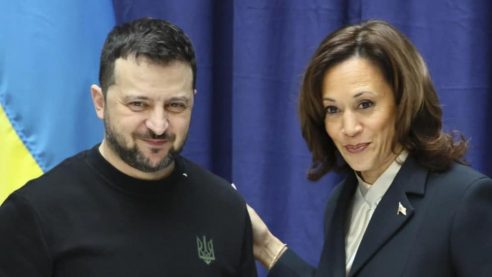
In the past two years the western establishment media has effectively obscured the reality on the ground in Ukraine. Only recently has it become clear to the public that the tales we’ve heard about Russia imploding due to “bad tactics” and “throwing bodies into the meat grinder” in exchange for irrelevant territory have all been a fantasy. The problem is, propagandists often end up believing their own propaganda and then they are caught completely by surprise down the road when reality slaps them in the face.
Russian offensive actions in the east have greatly accelerated and now in the south the vital city of Vuhledar is set to fall within a couple days (if it hasn’t already). Their attrition based strategy and artillery superiority have created a shield for small fast moving units to strike Ukraine’s trenches and fixed defenses, and their drone game has dramatically improved. This has led them to capture multiple towns and cities in the past three months, with their forces closing in on the key eastern operational base of Pokrovsk. If Pokrovsk falls, the entire east of Ukraine could easily fall.
Beyond the shift to attrition tactics, Russia is gaining territory quickly because Ukraine is low on manpower. No amount of NATO technology or weaponry is going to help this fundamental weakness. This is the reality in Ukraine; they are losing the war.
The western media is unable to gloss over the situation any longer, which means something dramatic will have to happen to change the course of the war in Ukraine’s favor. Their government is scrambling to initiate an October surprise in preparation for the US elections in November. The US runs NATO, and Ukraine is entirely dependent on US aid.
The notion of a Ukrainian “Victory Plan” is by itself questionable given the circumstances, but what is reportedly contained in Vladimir Zelensky’s strategy seems to be an over-optimistic wish list relying heavily on escalation between NATO and Russia. In other words, the only way Ukraine can “win” is for NATO to engage in open warfare with the East.
While the full plan hasn’t been divulged, senior U.S. officials who are familiar with its contents don’t see anything original or innovative in it. As one told The Wall Street Journal on Sept. 25, “I’m unimpressed, there’s not much new there.” From what we can grasp, the “victory plan” is less a “plan” and more a continuation of Zelensky’s lobbying campaign to keep U.S. arms flowing in perpetuity.
Zelensky is dead-set on getting permission to use US and European long range missile systems against targets deep within Russia. The problem, as Vladimir Putin rightly noted, is that these systems cannot hit such targets accurately without NATO satellite intel and acquisition. Meaning, the missiles must be guided by US and European military technicians and assets.
It is likely that the majority of Ukrainian long range drone strikes within Russia are already being aided by NATO intel, but the use of ATACMS and Storm Shadow missiles far from Ukraine’s front line is another matter entirely. There’s no plausible deniability for NATO involvement. The use of these weapons within Russia would be akin to a declaration of war and would trigger escalation outside of Ukraine.
What would the consequences be? Not necessarily the use of nuclear weapons (though Putin did just change his bottom line on a nuclear response to include long range attacks using NATO weapons), but the spread of more advanced Russian armaments to countries like China, Iran, Syria, North Korea, and even the Houthis in Yemen is a good bet. Meaning a more significant threat to NATO interests in Asia and the Middle East. The war would spread.
So far the Biden Administration has refrained from supporting the long range option, but has offered another $8 billion in support. Under a Trump presidency, the money train is likely to stop abruptly.
Zelensky has offered no practical measures for negotiations, arguing that concessions are off the table. Furthermore, he claims that peace is only possible once Ukraine has taken back all territory seized by Russia, including Crimea which was annexed in 2014. He then demanded that Russia pay for Ukraine’s reconstruction and that Putin and a multitude of other Russian officials be handed over to be tried for war crimes. This is never going to happen.
The core of Ukraine’s victory plan relies on long range strikes using NATO guided missiles and acceptance into NATO. Both factors at this stage would cause WWIII.
Ukraine’s chest beating is the national equivalent of “short man’s syndrome.” That said, Zelensky would not be making these kinds of demands if he was not being encouraged by someone behind the scenes. Many officials within the US and Europe have given Zelensky delusions of grandeur about his chances, perhaps because they want the war to grind on forever. These same officials have hinted consistently that they will not accept a Ukrainian loss.
Regardless of what side people think should win, the fact is that Russia is the inevitable victor according to all the evidence on hand. While the extent of Putin’s goals in the region are unknown, it’s unlikely that he intends to march beyond Ukraine. He may simply stop at the edge of the Donbas and annex the region like he did Crimea.
This may actually be the best case scenario for all parties involved. The longer the war goes on the greater the chances of a powderkeg moment and a direct confrontation between Russia and NATO. Ukraine should not be talking about “victory”, that time has come and gone. They should be talking about peace.
September 29, 2024
Posted by aletho |
Militarism | NATO, Ukraine |
Leave a comment
Johnson’s “three-fold plan for Ukrainian victory”
A September 21, 2024 article published in The Spectator written by former British Prime Minister Boris Johnson titled, “It’s time to let Ukraine join NATO,” attempts to formulate a theory of victory for Ukraine as war with Russia continues to grind on.
Johnson demands that the collective West “end the delays” and that the West “get it done and get it won.” By this, he means lifting all restrictions on the use of Western long-range weapons on pre-2014 Russian territory.
Next, he demands the US and Europe provide a “package of loans on the scale of Lend-Lease: half a trillion dollars,” or “even a trillion.” Johnson claims such support will send a message to the Kremlin that, “we are going to out-gun you financially and back Ukraine on a scale you cannot hope to match.”
Western personnel have already been operating in Ukraine since 2014 and have continued to do so throughout Russia’s Special Military Operation
Finally, he demands Ukraine be allowed membership into NATO immediately, even as the conflict rages on. In respect to NATO’s Article 5 regarding “collective defense,” Johnson proposes that:
… we could extend the Article 5 security guarantee to all the Ukrainian territory currently controlled by Ukraine (or at the end of this fighting season), while reaffirming the absolute right of the Ukrainians to the whole of their 1991 nation. We could protect most of Ukraine, while simultaneously supporting the Ukrainian right to recapture the rest.
While Johnson points out the political implications of this policy, meaning all of NATO would, “have to commit to the defence of that Ukrainian territory,” he falls far short of considering the practical implications.
NATO Intervention in Ukraine: Political vs. Practical Considerations
Far from a lack of political will or financial resources, the collective West has fallen short supplying Ukraine with the military equipment, vehicles, weapons, and ammunition required to match or exceed Russian military capabilities because its collective military industrial base itself is incapable of physically producing the quantities required, regardless of the money allotted to do so.
Military industrial production requires several fundamental factors in order to be expanded – financial resources being only one of many. Expanding production also requires the physical enlargement of existing facilities, the building of new facilities, the expansion of trained workforces which includes reforming and expanding primary, secondary, and specialized education, as well as the expansion of downstream suppliers and the acquisition of additional raw materials required for production across the entire industrial base.
Any one of these measures could take years to implement. Implementing them all would take longer still.
Then there is the very structure of the collective West’s military industrial base. Consisting of corporations prioritizing the maximization of profits, not performance, the collective West’s military industrial base has for years focused on low quantities of highly-sophisticated (and very expensive) weapons systems and munitions.
For the duration of the so-called “Global War on Terror” these weapon systems were adequate, if inefficient. They enabled US-led forces to roll over the antiquated, poorly-trained, poorly-equipped Iraqi army in 1991 and again in 2003, as well as the Taliban in Afghanistan in 2001. Such weapon systems also proved effective in the destruction of Libya in 2011.
But as the global balance of military and economic power has shifted throughout the 21st century, limits to this military industrial approach became apparent. In 2006, Israel’s vast Western-backed military machine categorically failed in its invasion of southern Lebanon, confounded by Hezbollah leveraging modern anti-tank weapons.
The US intervention in Syria from 2011 to present day also revealed the growing limitations of expensive Western military hardware, with 100s of cruise missiles fired at targets across Syria with limited success due to vastly better air and missile defenses than previous US adversaries possessed.
The Western media now admits waning US military support for Ukraine stems from dwindling stockpiles and an inability to quickly expand production.
CNN in its September 17, 2024 article titled, “US military aid packages to Ukraine shrink amid concerns over Pentagon stockpiles,” would admit:
US military aid packages for Ukraine have been smaller in recent months, as the stockpiles of weapons and equipment that the Pentagon is willing to send Kyiv from its own inventory have dwindled. The shift comes amid concerns about US military readiness being impacted as US arms manufacturers play catchup to the huge demand created by the war against Russia.
Nothing took place between September 17, 2024 when CNN published this report and September 21, 2024 when The Spectator published Boris Johnson’s article to change this reality. Johnson simply chose to ignore it.
NATO committing to the defense of Ukrainian-held territory would require sufficient quantities of artillery, armor, air and missile defense systems, and trained manpower – all of which the collective West, not just Ukraine, has in short supply.
In many ways, the collective West is already waging war against Russian forces. Western personnel have already been operating in Ukraine since 2014 and have continued to do so throughout Russia’s Special Military Operation (SMO) from 2022 onward. Russia has not hesitated to target and destroy Western equipment or the Western personnel operating it, though Russia has managed escalation very carefully in the process.
Were NATO to more openly intervene in what is already a NATO proxy war against Russia, Russian forces would likely continue targeting all of Ukraine’s territory while continuing to manage escalation carefully. NATO itself could escalate, using its long-range missiles and air power against Russian forces both within Ukraine and within pre-2014 Russian borders, but this would present two major problems.
First, if the West is already out of long-range weapons to transfer to Ukraine, its stockpiles having dwindled to critical levels, and having failed to expand production to reconstitute to them should any contingency of any kind fully deplete them, a more direct role in Ukraine would consume what arms and ammunition the West has left with no means of replacing them in the near-term.
Second, whatever impact the collective West imagines using the remnants of its arms and ammunition on Russia directly will have, it will leave the West far short of any material capabilities to conduct large scale war anywhere else in the world, including in the Middle East against Iran and its allies and across the Asia-Pacific region against China – two areas of concern Johnson himself mentions in his article.
Boris Johnson claims:
If you are truly worried about ‘escalation’, then imagine what happens if Ukraine loses this war – because that is when things really would begin to escalate. Ukraine won’t lose but if it did, we would have the risk of escalation across the whole periphery of the former Soviet empire, including the border with Poland, wherever Putin thought that aggression would pay off.
We would probably see escalation in the South China seas and in the Middle East. We would see a general escalation of global tension and violence because a Ukrainian defeat, and a victory for Putin, would be not only a tragedy for a young, brave and beautiful country; it would mean the global collapse of western credibility.
What Johnson means by “western credibility,” is Western primacy. By “escalation in the South China seas and in the Middle East,” Johnson means regional players displacing unwarranted US-led occupation and interference. Johnson’s plan to commit the West’s waning military power to Ukraine means forfeiting the means to cling to primacy elsewhere around the globe.
Johnson’s plan to incorporate Ukraine into NATO would not be a master stroke up-ending Russia’s escalation dominance, it would be the forfeiture of NATO’s own escalatory leverage regarding Article 5. Success for NATO would depend entirely on Russia failing to call the West’s bluff and avoiding the targeting of Ukrainian territory once NATO intervenes directly.
A very similar strategy was used in Syria by the United States as a means to reverse the flagging fortunes of its proxies there. The US, instead, at most managed to create a stalemate. Over the past nearly 10 years the US has occupied eastern Syria, its position in Syria as well as in the rest of the region has waned.
Part of this stems from the US’ inability to field a large enough military force, armed with sufficient numbers of arms and munitions. US air and missile defense systems in particular are in short supply and have opened up US forces in Syria and Iraq to regular drone, rocket, and missile strikes, compromising US military supremacy in the region.
By stretching US and European military power out even thinner by committing large numbers of troops and equipment to a direct intervention in Ukraine only means accelerating the decline of US-led Western primacy around the globe even faster.
Johnson’s plan to “save” Ukraine is borne of desperation, predicated on either a poor understanding of the fundamental factors required for its success, or deliberately ignoring these factors.
It is also a plan born of a lack of imagination. For Boris Johnson and the Western special interests he represents, the only possible future for humanity is one dominated by the West, just as it has done for the past several centuries.
The ultimate irony, however, is Johnson’s mention of a “Soviet empire” he claims Russian President Vladimir Putin is intent on rebuilding. At one point, Johnson claims:
The message is: that’s it. It’s over. You don’t have an empire anymore. You don’t have a ‘near abroad’ or a ‘sphere of influence’. You don’t have the right to tell the Ukrainians what to do, any more than we British have the right to tell our former colonies what to do. It is time for Putin to understand that Russia can have a happy and glorious future, but that like Rome and like Britain, the Russians have decisively joined the ranks of the post-imperial powers, and a good thing, too.
Yet, the conflict in Ukraine stems directly from NATO expansion toward Russia’s borders. It was never a matter of Russia telling Ukraine what to do – it was always a matter of the US politically capturing Ukraine in 2014 and transforming it into a national security threat to Russia from 2014 onward.
Russia is responding to the expansion of a modern-day empire – not in any sort of effort to create its own empire. The empire Russia opposes in Ukraine [Zionist globalism] is the same empire Johnson fears will be challenged in the Middle East and the South China Sea should its proxy war fail in Ukraine. While Johnson accuses Russia of being out of touch with reality regarding imagined imperial ambitions in Moscow, his plan reflects very real delusions associated with a desperate desire to perpetuate the US-led “international order” the UK itself is so deeply invested in.
Boris Johnson’s attempt to build policy regarding the West’s proxy war in Ukraine without a sufficient foundation is a recipe for disaster – the same sort of disaster this proxy war in Ukraine has precipitated that Johnson’s desperate plans are meant to address in the first place.
Brian Berletic is a Bangkok-based geopolitical researcher and writer.
September 29, 2024
Posted by aletho |
Militarism, Progressive Hypocrite, Wars for Israel | NATO, Ukraine |
Leave a comment

Lithuanian soldiers at the presidential palace in Vilnius, Lithuania, July 12, 2024. © SOPA Images / Getty Images
Lithuania is actively investigating and dismissing “disloyal” officials who are reportedly being accused of having pro-Russian views, local broadcaster TV3 has reported.
According to a report aired on Saturday, several police officers and firefighters have been dismissed from their posts or warned about their views and labeled ‘vatniks’ – a derogatory term used to insult supporters of the Russian government, which derives from a jacket once worn by Red Army soldiers.
The report claimed that “pro-Russian statements lead to job losses,” warning that public servants “should think carefully” before openly expressing their views on social media.
“After the start of the war in Ukraine… nine police officers were identified as possibly pro-Russian,” Ramunas Matonis, the head of the police communication division, told TV3, adding that while most of the officers denied holding these views during “preventative talks” conducted by the department, one of them “was not granted an extension to work with classified information.”
It quoted the minister of internal affairs, Agne Bilotaite, as saying that the authorities “are closely monitoring the situation,” adding that only “loyal officials” who hold Lithuania’s official pro-Kiev position are suitable to serve the state.
“We certainly do not tolerate cases where officials demonstrate disloyalty through their actions and behavior,” Bilotaite told the outlet, warning that these “individuals lose the right to work in service, and this is understandable, as officials must be loyal to their country.”
The TV channel highlighted the case of Genadijus Rogacius, a former Lithuanian army soldier who was investigated by the prosecutor’s office after he “criticized Lithuania and glorified Russia” on the internet.
It also claimed that pro-Russian sentiments were revealed in the former Soviet republic when people laid flowers by a Russian tank that was hit during the Ukraine conflict last year and later displayed in Vilnius. The significant support for anti-establishment candidate Eduard Vaitkus in the presidential election also indicated pro-Russian sentiments, according to TV3.
Lithuania has been a staunch supporter of Ukraine since the conflict with Russia escalated in February 2022. It has pursued a number of hardline anti-Russia policies and advocated for increased military aid to Kiev by NATO and the EU.
The authorities have previously ordered the demolition of Soviet war memorials and stripped several Russian-born celebrities living in the country of their citizenship for alleged pro-Kremlin views.
September 29, 2024
Posted by aletho |
Civil Liberties, Full Spectrum Dominance | European Union, Human rights, Lithuania, NATO |
Leave a comment
Defending the narrative from reality
Two years ago, the Nord Stream gas pipelines were destroyed in an economic and environmental terrorist attack. The attack severed a key economic connection between Europe and Russia, contributing to the de-industrialisation of Europe and intensifying Russia’s economic reorientation towards China and India. The geopolitical ramifications are immense, yet we know very little about the attack. How is this possible?
The US and its NATO allies initially insisted that Russia was certainly the perpetrator, and their stenographers in the media reported confidently that “everything is pointing to Russia”.[1] No evidence was presented, yet NATO even suggested the attack on its critical infrastructure could trigger collective defence under Article 5. Besides indirectly threatening the world’s largest nuclear power with war, NATO also used the attack on Nord Stream to justify escalating the war in Ukraine and to further militarise the Baltic Sea and other seas. Strengthening NATO’s ability to protect undersea infrastructure was also an important argument for why Finland and Sweden should join NATO.
The story of Russia blowing up its own pipeline could rely on a strong consensus as all dissent to the narrative could be dismissed as repeating the Kremlin’s talking points. Similar stories such as Russia’s continued bombing of a nuclear power plant under its own control or Russia attacking the Kremlin with drones did not make any sense either, yet in the absence of common sense the political-media elites could explain that this was straight out of the “Russian playbook”.
However, reality eventually asserted itself around the time of Seymour Hersh’s article that blamed the US for the attack, and thereafter the US began to shift the blame to Ukraine. In one of the latest developments, the Wall Street Journal reported that the US knew about the Ukrainian attack in advance and “the CIA warned Zelensky’s office to stop the operation”.[2]
It seems highly unlikely that the US was not involved in the attack on Nord Stream, yet the new and updated narrative is nonetheless interesting as it is an admission that the US knew about the attack on Nord Stream before it happened. This is an admission that the US and NATO lied to their public and the entire world when they blamed Russia for the attack, and then used that lie to escalate the war in Ukraine, militarise the Baltic Sea, and push for further NATO expansionism.
Our lack of knowledge about what happened to the Nord Stream gas pipelines is the result of defending the narrative from reality. Blissful ignorance has become the foundation for NATO unity, and facts are thus treated as our great enemy. Yet, as the demand for unity also upholds what can only be described as the Stockholm Syndrome, let’s review how the Nord Stream narrative has been defended from reality:
The US announces its objective to destroy Nord Stream
Preventing the economic integration and cooperation between Russia and Germany as two key centres of power has been a centuries-old hegemonic objective of the US and Britain. The RAND Corporation, a think tank linked to the intelligence community, wrote a report in 2019 sponsored by the Army Quadrennial Defense Review Office about how to extend and weaken Russia. Besides destabilising Russian borders and bleeding Russia in Ukraine, the report outlined the objective of cutting Russia’s energy ties to Europe: “A first step would involve stopping Nord Stream 2”.[3]
The US opposition to Nord Stream 2 included political pressure and economic sanctions against the companies of European allies who participated in the project, a hegemonic ambition sold to the public as defending Europe. In July 2020, then-US Secretary of State Mike Pompeo proclaimed: “We will do everything we can to make sure that that pipeline doesn’t threaten Europe”.[4] US Senator Tom Cotton announced in May 2021 that ‘there is still time to stop it. … Kill Nord Stream 2 now, and let it rust beneath the waves of the Baltic’.[5] On 14 January 2022, US National Security Adviser Jake Sullivan also threatened the pipeline: ‘We have made clear to the Russians that pipeline is at risk if they move further into Ukraine’.[6] Senator Ted Cruz similarly used very direct language calling for stopping Nord Stream: ‘This pipeline must be stopped and the only way to prevent its completion is to use all the tools available to do that’.[7]
On 7 February 2022, President Biden stood next to German Chancellor Scholz at a press briefing, warning that if Russia invades Ukraine, then “there will be no longer a Nord Stream 2. We will bring an end to it”. When asked by a journalist how he would end a project under German control, Biden responded: “I promise you, we will be able to do that”.[8] US spokesperson, Ned Price, was explicit: “I want to be very clear: if Russia invades Ukraine one way or another, Nord Stream 2 will not move forward”.[9] Undersecretary of State for Policy, Victoria Nuland, used the exact same words: “If Russia invades Ukraine, one way or another, Nord Stream 2 will not move forward”.[10]
The attack on Nord Stream and the subsequent victory lap
On 26 September 2022, the German-Russian Nord Stream pipelines were destroyed. The former Foreign Minister of Poland, Radek Sikorski, tweeted “Thank you, USA” accompanied by a picture of the destroyed pipeline. The day after the attack, on 27 September 2022, leaders from Poland, Norway, and Denmark attended a ceremony in Poland to mark the opening of the new Norway-Poland Baltic Pipe that was constructed to reduce Europe’s dependence on Nord Stream.
US Secretary of State Antony Blinken argued that the destruction of Nord Stream presented “a tremendous opportunity. It’s a tremendous opportunity to once and for all remove the dependence on Russian energy”. Blinken offered to “help” Europe to replace Russian gas with much more expensive American gas. Victoria Nuland joined in on celebrating the attack: “I am, and I think the Administration is, very gratified to know that Nord Stream 2 is now, as you like to say, a hunk of metal at the bottom of the sea”.[11]
Washington could take a brief pause in rejoicing over the destruction of Europe’s critical energy infrastructure to reassure the world that it must have been the Russians who attacked their own pipelines. Russia had first invested billions into its evil plan of making Europe dependent on Russian energy and then transitioned into its new evil plan of blowing up these pipelines to deny gas to Europe. Russia could alternatively have turned off the valves and saved billion dollars worth of infrastructure, but the Russian playbook works in mysterious ways. European politicians entrusted with protecting their national interests and the media entrusted with reporting on reality, insisted that only Russia would have carried out such a horrendous attack. Anyone suggesting the US could have been the perpetrator was smeared by the political-media elites as spreading “Russian propaganda”.
Blaming Ukraine
Seymour Hersh then reported that the US had coordinated the attacks with the use of a US Navy diving team. This report was largely ignored and ridiculed by the media, with many journalists instead undermining the credibility of Hersh. The legendary investigative journalist who exposed the cover up of the My Lai massacre in Vietnam and detailed the US military’s torture of prisoners in Abu Ghraib in Iraq, was suddenly sold to the public as an old senile discredited conspiracy theorist carrying water for Putin.
Yet, the US began to shift the blame to Ukraine. The Washington Post reported in June 2023 about leaked CIA documents revealing that US intelligence and the Biden administration knew at least three months before the attack on Nord Stream that the “Ukrainian military had planned a covert attack on the undersea network, using a small team of divers who reported directly to the commander in chief of the Ukrainian armed forces”.[12] How could the media report on the US lying about Russia being behind the attack, and what kind of narrative could be constructed when the only two suspects are the US and Ukraine? When the narrative-driven media did not have a narrative, the solution was simply a media blackout. The German Defence Minister Boris Pistorius, committed to making excuses for his attackers and instead blaming Russia, suggested that it was too soon to blame Ukraine as the attack on Nord Stream could have been a “false flag” attack to blame Ukraine. Other European politicians simply concluded that it was best to stop digging as they would not like what they would find. The same EU officials who had for years spoken about the objective of “European sovereignty” now displayed complete subordination to Washington.
The US was nonetheless cautious not to delegitimise the Ukrainian government, by blaming some rogue Ukrainian elements who acquired a sailboat of diving equipment. This story was uncritically presented to the public after explaining for months that only a state actor could be behind such a complicated attack. Yet, the media was urged not to engage in speculations until European countries had completed their investigations and shared their findings with the world. Yet, Sweden announced in October 2022 that it would not establish a joint investigation team with allies such as Germany due to national security. By February 2024, Sweden announced it had closed the investigations into the attack on Nord Stream as the case did not fall under their jurisdiction.
As Russia was blocked from participating in the investigations, Russia put forward a resolution to the UN Security Council calling for establishing an international independent investigative commission into the attack on the Nord Steam pipelines. The Western countries rejected an independent international investigation and blocked the UN resolution. After all, an independent fact-finding mission could threaten the narrative that NATO unity rests upon.
By August 2024, the Nord Stream narrative evolved yet again as the Wall Street Journal reported that Zelensky had been involved in the attack which the CIA had allegedly attempted to stop.[13] The German government reassured its partners that the alleged Ukrainian attack on Nord Stream and Germany’s weapon supplies to Ukraine are two separate issues, and the Nord Stream investigation would not have any bearing on Germany’s support for Ukraine.
Reality threatens the unifying narrative
Without a Russian perpetrator as the foundation for solidarity, the Europeans have begun to turn on each other. Narrative control has subsequently become difficult. A German official claimed that Poland sabotaged investigations into the Nord Stream attack as they did not arrest a suspected Ukrainian diver named “Volodymyr Z”, and instead allowed him to escape back to Ukraine. August Hanning, the former head of Germany’s Federal Intelligence Service, accused both Poland and Ukraine of being involved in the attack on Nord Stream. Hanning also questioned the sailboat narrative as: “Operations of such dimensions are inconceivable without the approval of the political leaders of the countries involved”.[14]
Poland’s Prime Minister Donald Tusk responded to the Germans: “To all the initiators and patrons of Nord Stream 1 and 2. The only thing you should do today about it is apologise and keep quiet”.[15] The president of the Czech Republic, Petr Pavel, argued that if Ukraine was behind the attack on Nord Stream, then it was a legitimate target. The narrative is thus shifting from denial to justification of the terrorist attack. Germany’s continues to be humiliated by its key partners and allies, some that were behind the attack and others that are justifying the attack on its critical infrastructure. This is all happening while Germany’s energy-intensive industries collapse and its economy subsequently falters.
However, the Stockholm Syndrome phenomenon should not be underestimated, as the Europeans will memory-hole these uncomfortable facts and continue to ignore national interests. There will soon be a new script to be followed diligently and a swift return to the simple and comfortable world view of good versus evil, in which liberal democracies stand united under the leadership of the benign leadership of the US against the evil Russians.
[1] Z. Colman and B Lefebvre, ‘Everything is pointing to Russia’: U.S., EU officials on edge over pipeline explosions, Politico, 28 September 2022.
[2] B. Pancevski, A Drunken Evening, a Rented Yacht: The Real Story of the Nord Stream Pipeline Sabotage, The Wall Street Journal, 14 August 2024.
[3] RAND, ‘Extending Russia: Competing from Advantageous Ground’, RAND Corporation, 24 April 2019, p.62.
[4] RFE/RL, ‘Pompeo Says U.S. Will ‘Do Everything’ To Stop Nord Stream 2 Project’, RFE/RL, 30 July 2020.
[5] T. Cotton, ‘Kill Russia’s Nord Stream 2, Let it Ruse in the Baltic’, Tom Cotton official website, 19 May 2021.
[6] CNN, ‘At this hour with Kate Bolduan’, CNN, 14 January 2022.
[7] T. Cruz, ‘President Biden and the Democrats have Imperilled Ukraine and put Europe on the Brink of War’, Ted Cruz official website, 7 February 2022.
[8] S. Sarkar, ‘‘There Will No Longer Be a Nord Stream 2’: Fingers Pointed Towards Biden after Gas Pipeline Blasts’, News18, 30 September 2022.
[9] DW, ‘Nord Stream 2 won’t happen if Russia invades Ukraine: US’, Deutsche Welle, 27 January 2022.
[10] Wion, ‘If Russia invades Ukraine, Nord Stream 2 pipeline will not move forward: US’, Wion, 28 January 2022.
[11] I. Van Brugen, ‘Sergei Lavrov Accuses U.S. of Nord Stream Pipeline Attack’, Newsweek, 2 February 2023.
[12] S. Harris and S Mekhennet, U.S. had intelligence of detailed Ukrainian plan to attack Nord Stream pipeline, The Washington Post, 6 June 2023.
[13] B. Pancevski, A Drunken Evening, a Rented Yacht: The Real Story of the Nord Stream Pipeline Sabotage, The Wall Street Journal, 14 August 2024.
[14] Welt Report, German officials claim Poland sabotaged investigation into Nord Stream explosions, Politico, 7 September 2024.
[15] D. Bellamy, Polish PM Donald Tusk suggests Nord Stream patrons should ‘keep quiet’, Euronews, 18 August 2024.
September 27, 2024
Posted by aletho |
Economics, Russophobia | European Union, Germany, NATO, United States |
Leave a comment


 Aletho News