The Increase in Ukrainian Casualties
The Reason Why Military Losses Intensify for the Losing Side at the End of Wars
By Glenn Diesen | September 4, 2024
Ukrainian casualties and loss of military hardware are intensifying, which is shifting the attrition rates even further to Russia’s advantage. The rapid increase in losses with the losing side is a very common phenomenon toward the end of a war, with a common example being the spike in German casualties at the final stages of the Second World War.
In a war of attrition, the losses will naturally increase when the war machine has reached its breaking point. Soldiers have weaker strategic positions, there is a lack of resources, supply chains are not sufficiently defended, communications often break down, and there is a collapse in morale. Once the collapse begins, it often has a cascading effect. An early indicator of a cascading effect was when Ukraine began to struggle with air defence systems, which resulted in Russia being able to bring in its air force equipped with powerful glide bombs. Subsequently, holding strategic positions and avoiding high casualty rates became increasingly challenging and new problems began to emerge.
The Collapse has Begun
It appears that we have entered the final stages of the war due to the cascading effect. Ukraine is seeing its logistics break down, and there is a lack of weapons and ammunition that prevents soldiers from performing optimally.
The greatest challenge appears to be the lack of manpower, in which there are no good solutions. More aggressive mobilisation deprives society of important labour, it creates social upheaval as the public observes their family and fellow citizens being dragged off the streets and thrown into vans. Furthermore, the recruits receive less training and are much less motivated than the soldiers who volunteered at the beginning of the war. Simply put, a new army cannot be built in a rush. As a result, Ukraine began using and losing its best soldiers.
The Ukrainian frontline sees a growing lack of military resources, reinforcements do not turn up, and communication with military command becomes less reliable. The increasingly difficult position on the front causes a spike in soldiers who defect and surrender, while even entire military companies have withdrawn from their positions without permission. Predictably, this unpredictability creates less cohesion along the frontline as unreliable soldiers can be a tremendous liability as the front lines do not hold.
With the Ukrainian frontlines breaking, troops find themselves encircled and their option is either to surrender or to pursue a disorganised withdrawal in which the retreating forces are exposed and can be knocked out by the Russian military. Incrementally, the Ukrainians find themselves with fewer strategic positions, supply lines are severed, there is an even greater shortage of military equipment and manpower, and morale continues to collapse. As the situation deteriorates, communication and coordination unavoidably suffer, as for example, Ukraine seemingly shot down its own F-16 with a patriot missile.
The war has been lost, and with the writing on the wall, the Ukrainian army becomes more vulnerable to its officers striking a deal with Russia. Some are likely angered by a sense of betrayal as the US and NATO provoked the war and sabotaged the Istanbul peace agreements with the promise that Ukraine would receive all the weapons and assistance it needed to defeat Russia. While there is no evidence of Ukrainian officers defecting, it seems as if Russia’s intelligence and spy network has improved over the past weeks.
The Last-Ditch Gamble
Another common feature in a losing war is the desperation that encourages great risks in a last-ditch effort to turn everything around. The invasion of the Russian region of Kursk is a great example as most Ukrainian, Russian and Western observers initially seemed to agree that this was a great risk with a low chance of succeeding. However, the propaganda machine was thereafter turned on as journalists began reporting on successes, measured mostly in terms of humiliating Putin or boosting morale among Ukrainian soldiers. Yet, the temporary victory in the information war eventually gives way to losses in the real world. Ukrainian troops and equipment were diverted away from well-prepared defensive lines in Donbas in favour of being exposed in the open on foreign territory.
In Donbas, the front lines are collapsing, and in Kursk there are massive casualties. The problem was exacerbated by the lack of reliable supply lines for weapons and fuel, while engineering equipment could not be sent in to dig in at the new positions within Russian territory. The few remaining air defence systems and HIMARS had to be brought much closer to the border, which could then be detected by Russian surveillance and destroyed by Russian missiles and drones. Huge amounts of military resources were squandered on territory with hardly any strategic value, which Ukraine is not able to hold. The inability to pull out of Kursk compels Ukraine to double down on failure and the situation goes from bad to worse.
As the collapse intensifies, the winning side in a war typically increases its pressure. Russia has increased its deep missile strikes, and its military is pushing through what used to be well-defended front lines. Russia’s more powerful bombing campaign is also motivated by retaliation for the invasion of Kursk and to restore its deterrence by warning NATO against further escalations. Furthermore, Russia has retaliated by further destroying Ukraine’s energy network which reduces the mobility of the military, and reduces the industrial production and the ability to get through the next winter. Millions of Ukrainian civilians who are suffering greatly under these deteriorating conditions will likely leave the country when winter approaches, which will bring further problems to both Ukraine and Europe.
A Proxy War: How Will NATO Respond to Defeat?
What makes the Ukraine War different from many other wars, is that this is a proxy war in which NATO uses Ukrainians to fight Russia. The uncertain and unpredictable variable is therefore how NATO will react as it loses the proxy war in Ukraine. NATO is already providing weapons, ammunition, training, intelligence, target selection, war planning, managing complex weapon systems, and sending Western mercenaries. NATO’s support for strikes inside Russian territory and the invasion of Russian territory has already taken us to the brink of a direct war. The Americans appear to get ready to cut their losses and instead shift focus on confronting China, but the Europeans have bet everything on defeating Russia militarily. In terms of capabilities, it is the US that matters.
There are simply no good solutions anymore. The only two options are to either negotiate or get increasingly involved in direct fighting. NATO has largely rejected diplomacy and placed itself in a rhetorical trap in which victory is the only acceptable outcome, and the EU even punishes member states such as Hungary that attempt to restore diplomacy and negotiations with Russia. However, more direct NATO involvement will likely trigger a direct war with Russia, the world’s largest nuclear power, and it is unclear what a “victory” would look like that would not first trigger a nuclear exchange.
This is the time to restore diplomacy and return to negotiations, although it will take some time to reverse the propaganda of the past decade and prepare the public for a new narrative. Much like in Afghanistan, the political-media elites will assure us that we are winning until we flee with people falling off planes.
I spoke briefly about the rising Ukrainian casualties on WION
Russia warns NATO about response to ‘terrorism’
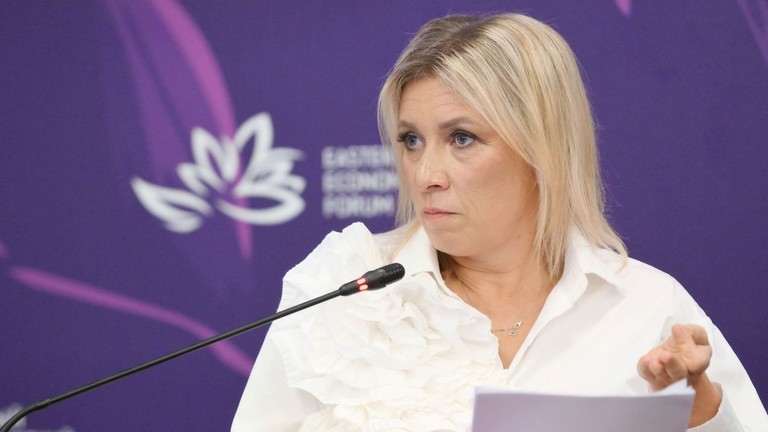
Russian Foreign Ministry spokeswoman Maria Zakharova © Ekaterina Chesnokova; RIA Novosti
RT | September 4, 2024
Russia will give an immediate and painful response to further acts of terrorism committed by Kiev, Russian Foreign Ministry spokeswoman Maria Zakharova warned on Wednesday, directing her comments to EU and NATO leaders.
Speaking on the sidelines of the Eastern Economic Forum (EEF) in Vladivostok, Zakharova stressed that Western leaders are “losing touch with reality” and are “absolutely not thinking about the risks of further dangerous escalation of the conflict, even in the context of their own interests.”
“We would like to warn such irresponsible politicians in the EU, NATO and across the ocean, that if the Kiev regime takes corresponding aggressive steps, Russia’s response will follow immediately,” Zakharova said, adding that this response will be “extremely painful” and that “much of this” has already been visible in recent days, apparently referring to Russia’s recent long-range strikes on targets across Ukraine.
Over the past several days the Russian Defense Ministry has reported carrying out a number of massive strikes on Ukrainian energy and defense-industry facilities, and claimed to have destroyed a number of buildings being used for the production and repair of aircraft, missiles, and UAVs, as well as storage sites, and deployment points for “nationalist formations and foreign mercenaries.” It also reported destroying a training facility housing foreign instructors.
During her address, Zakharova also suggested that Western officials have been ignorant of the potential consequences of their continued support of Kiev.
”I think the Europeans don’t fully understand what they are being dragged into,” the spokeswoman said. “They are being dragged in by the US, the Anglo-Saxons. It seems to me they haven’t yet understood what a plague they have created with their own hands in the form of the terrorist Kiev regime.”
Zakharova warned that the battalions that will be created from Ukrainian citizens recruited from Europe will eventually also strike back at Western European countries themselves. “They have fattened up there, sat it out, and recovered. They will strike in the same way as all international terrorist cells previously created by the West did,” she said.
“For the first time in history, Europe itself has given birth to an international terrorist cell,” the spokeswoman said, warning that “this terrorist monster will operate all over the world” and will strike Western Europe because “they always return to those who created them.”
Turkish protestors demand expulsion of US warship docking in Izmir Port
Press TV – September 3, 2024
Turkish citizens have taken to the streets in Izmir to demonstrate against the docking of an American warship, expressing solidarity with Palestinians and their opposition to US all-out military support for Israel amid the Gaza genocide.
Turkish parties on Monday night gathered at the Izmir port entrance to voice their opposition to the USS Wasp anchoring, one of the ships sent to the region by the US to support the Israeli regime.
Waving the Palestinian flag, protesters held banners reading “Our country’s ports cannot be supply and logistics points for murderers” and “We do not want the US ship that brings war and death to Palestine in Izmir.”
They chanted slogans such as “Down with Israel,” “Down with NATO” and “Down with USA,” demanding the immediate departure of the American ship from the Port of Izmir, as they honored the memory of Palestinians killed in Israel’s US-backed war in Gaza.
The USS Wasp, carrying nearly 1,500 US soldiers, anchored at the port of Izmir on Sunday after participating in bilateral at-sea training with Turkish Navy ships in August. The vessel, along with its accompanying ships, the USS Oak Hill and the USS New York, has been positioned in the region since June as part of deterrence efforts against possible threats to Israel amid high tensions in the region.
Protesters issued a stern warning to the Izmir Governorship, declaring they will not leave the port until the ship departs.
The protesters condemned the United States for its role in causing suffering and violence in Iraq, Syria, the West Asia region, and globally.
“It has been almost a year. Israel is carrying out a brutal massacre in Gaza. By killing tens of thousands of people, Israel is not only committing a great crime against humanity. It is also persistently continuing an unlawful and unscrupulous incitement to drag our region into a bloody war,” the protesters said in their statement.
The statement emphasized that the United States openly backs Israel and its military actions, and questioned its occasional ceasefire calls.
They also called on the Turkish government to remove the American soldiers from the streets of Izmir, after two US Marines from the USS Wasp were assaulted during a port visit in Izmir on Monday, as part of a protest against Israeli actions in Gaza and decades-long “US imperialism.”
“US soldiers who have the blood of our soldiers and thousands of Palestinians on their hands cannot tarnish our country. Every step you take on these lands will be met with the response you deserve,” the Turkey Youth Union (TGB), which carried out the attack said in its statement on Monday.
Fifteen individuals involved in the incident were detained by Turkey’s police.
The US has ramped up its military presence in the region as the Israel war on Gaza rages on.
Washington has sent 50,000 tons of arms and ammunition to Israel since October 7 when the regime launched its genocidal war on Gaza.
Late last month, the US completed the air delivery of its 500th consignment of weapons and munitions to Israel since it launched its genocidal war in October.
US Seeks “Super Weapons” to Reign as Sole Superpower
By Brian Berletic – New Eastern Outlook – 03.09.2024
The US openly declares that it seeks to maintain a monopoly over shaping the “international order” following the Cold War and America’s emergence from it as the sole superpower.
This policy is not new.
The New York Times in a 1992 article titled, “U.S. Strategy Plan Calls for Insuring No Rivals Develop,” would note that the Pentagon sought to create a world, “dominated by one superpower whose position can be perpetuated by constructive behavior and sufficient military might to deter any nation or group of nations from challenging American primacy.”
This policy set the stage for decades of US wars of aggression, political interference, regime change, US-sponsored terrorism, economic sanctions, and a growing confrontation directly between the US and a reemerging Russia as well as a rising China, all of which continue playing out to this day.
Emerging from the Cold War as the sole “superpower,” the US carefully cultivated public perception through likewise carefully chosen conflicts showcasing its military supremacy. While the US still to this day cites its wars with Iraq in 1990 and 2003 along with the toppling of the Libyan government in 2011 as proof of its uncontested military power, in truth, both targeted nations were not nearly as powerful or as dangerous as the Western media claimed at the time.
This facade has crumbled since. “American primacy” is now not only facing serious challenges, the premise it is based on – the notion that a single nation representing a fraction of the global population can or even should hold primacy over the rest of the planet – has been revealed as wholly unsustainable, if not self-destructive.
Not only is US military and economic power visibly waning, the military and economic power of China, Russia, and a growing number of other nations is rapidly growing.
The special interests within the US pursuing global primacy, do so in perpetual pursuit of wealth and power, often at the expense of many of the purposes a modern, functional nation-state exists to fulfill. Often this process includes the deliberate plundering of the key pillars of a modern nation-state’s power – industry, education, culture, and social harmony. This, in turn, only accelerates the collapse of US economic and military power.
Ukraine Lays Bare American Weakness
Washington’s proxy war in Ukraine has laid bare for the world to see this fundamental weakness. US weapons have proven less-than-capable against a peer adversary, Russia.
America’s expensive precision-guided artillery shells, rockets, and missiles were built in smaller numbers than their conventional counterparts, supposedly because they could achieve with just one round what several conventional rounds could. A single US-made 155 mm GPS-guided Excalibur artillery shell, for example, is claimed by Raytheon to achieve what would otherwise require 10 conventional artillery shells.
This myth of quality over quantity has unraveled on and over the battlefield in Ukraine. Russia is not only capable of producing vastly more conventional weapons than the US and its European proxies, it is able to produce vastly more high-tech precision-guided weapons as well, including its own precision-guided artillery shells (the laser-guided Krasnopol), precision-guided multiple launch artillery systems (the Tornado-S), as well as larger quantities of ballistic and cruise missiles (Iskander, Kalibr, and Kh-101).
In other areas, Russia possesses capabilities the US does not have. Russia fields two types of hypersonic missiles, the Kinzhal hypersonic ballistic missile and the Zircon hypersonic cruise missile. Russia also possesses air and missile defense as well as electronic warfare capabilities the US cannot match – not in quality, not in quantity.
If the US is unable to match or exceed the military industrial output of Russia at the expense of losing its proxy war in Eastern Europe, how will US design to encircle and contain China along China’s own coasts unfold?
Growing Disparity and the Super Weapons Sought to Overcome it
The US military fears that any conflict with China would leave the US unprepared and vulnerable. A recent article in Defense One titled, “The Air Force wants to build lots of bases around the Pacific. But it still needs to determine how to protect them,” admits that US air and missile defense systems are too expensive and too few in number to defend the growing number of US military bases being established ahead of potential war with China.
It should be remembered, however, that shortages of US air and missile defense systems, particularly the Patriot missile system, began before the US began sending the systems to Ukraine. US military industrial output was unable to keep up with the demands of just Saudi Arabia amid its conflict with Ansar Allah in Yemen.
Similar concerns exist regarding the number of US military aircraft, naval vessels, and the missiles each will depend on in any potential conflict with China in the Asia-Pacific.
Understanding the large and growing disparity between US ambitions toward global primacy and its actual military means to achieve it, Washington and US-based arms manufacturers are seeking a new design and production philosophy to produce a new generation of cheaper and more numerous munitions.
At the forefront of this effort are “start-up” arms manufacturers, including Ares and Anduril. Both companies believe the US is capable of out-innovating China, based on the notion that the US is somehow inherently more innovative than China. However, their attempts to address this growing disparity reveal how disconnected US foreign policy is from the actual world it seeks to dominate.
Ares: Cheaper but More Numerous Missiles…
The War Zone in an article titled, “New ‘Cheap’ Cruise Missile Concept Flight Tested By Silicon Valley-Backed Start-Up,” explains how Ares seeks to augment America’s existing arsenal of expensive but scarce long-range precision guided missiles with smaller, cheaper, and more numerous missiles.
The smaller, cheaper missiles will be less capable than their more expensive counterparts, including Raytheon’s Tomahawk cruise missile and Lockheed Martin’s Joint Air-to-Surface Standoff Missile (JASSM), but are meant to be produced in larger quantities. The cheaper Ares-built missiles will be used for lower-priority targets, while their more capable but less numerous counterparts are used for critical targets.
The article claims:
Ares does not yet appear to have released any hard specifications, current or planned, but says that it is targeting a $300,000 unit cost for its missiles.
In addition to how far off from reality Ares’ missiles actually are from seeing the battlefield, even the stated goal of building these missiles for $300,000 each seems to fall far short of the sort of revolutionary innovation required to meet or exceed even Russia’s military industrial production, let alone China’s.
This is because according to even Ukrainian-based media, Russia itself is already producing far more capable missiles for as cheap as $300,000 per unit. Defence Express in a 2022 article titled, “What is the Real Price of russian Missiles: About the Cost of ‘Kalibr’, Kh-101 and ‘Iskander’ Missiles,” would place the cost of a Kalibr cruise missile somewhere between $300,000 and $1 million – vastly cheaper than comparable missiles produced in the West.
While the 2022 article was easy to dismiss at the time amid Western headlines claiming Russian missile stockpiles were exhausted, since then it has been admitted by the same Western media that Russia is firing over 4,000 missiles at targets across Ukraine each year. This suggests Russian missile production is as economical as it is vast.
Thus, even before Ares produces its first missile, the very premise of what it is trying to achieve falls far short of what Russia’s military industrial base is already doing on a vast scale, saying nothing of what China’s military industrial base is capable of.
There is also the reality that in addition to higher-end munitions costing as little as Ares’ proposed lower-end missiles, both Russia and China are perfectly capable of augmenting their existing arsenals with cheaper, less-sophisticated munitions as well.
Russia’s deployment of its UMPK-fitted FAB series glide bomb is a perfect example of this. The guided glide bombs went from concept to mass production over the course of the Special Military Operation, with improvements made based on their performance in combat, providing a cheaper, more numerous, yet still effective alternative to more expensive long-range precision-guided munitions.
In many ways, what Ares is attempting to do is a poor imitation of what Russia and China have already done and will continue doing.
Anduril: Out-Innovating China and Russia…
Like Ares, US-based arms manufacturer Anduril imagines cheaper and more numerous systems can help even the odds as Russia out-produces the West amid the conflict in Ukraine and as China’s production of warplanes, ships, and missiles surpasses the US and its European proxies.
Anduril proposes achieving this through “software-defined manufacturing,” a process it claims allowed electric vehicle manufacturer Tesla to build better and more numerous vehicles than legacy car manufacturers by building its vehicles around its own in-house software and electronics.
The advantage is clear. Legacy car manufacturers build the physical cars themselves, but many of the subsystems are outsourced to other companies, including the operating systems used by modern cars, as well as sensors and other electronic components and systems. Often this collection of software, sensors, and other components is outsourced to a large number of different companies. Any change in the car’s design requires working with this large number of companies, making modifications and improvements cumbersome.
By including all subsystems within a single in-house developed software and building the hardware around it, changes can be done faster and larger quantities of higher-quality cars can be made more rapidly as a result.
Anduril imagines using this same process to build vast numbers of drones, missiles, and other weapons and munitions, matching or even outpacing China. The problem for Anduril is that software-defined manufacturing is already extensively used by China’s vast and advanced industrial base. With this “advantage” rendered moot, the US finds itself again at a severe disadvantage. Not only is China capable of producing conventional military arms, ammunition, and equipment in vastly greater quantities than the US, it is also able to build advanced, rapidly improved, software-defined systems like drones and missiles.
This means anything the US attempts to do, China is capable of doing better and on a vastly greater scale.
Flawed Premise, Doomed Outcome
The premise Ares and Anduril operate from is fundamentally flawed. Both companies, like the circles of special interests they serve on Wall Street and in Washington, believe the US is inherently superior to adversaries like Russia and China. In their collective minds, any disadvantage the US finds itself with is incidental and overcoming it merely a matter of summoning sufficient political will. Russia and China having larger and more capable industrial bases is seen as a temporary lapse in America’s own political focus and willpower, and by taking steps to expand America’s own industrial base, the US will inevitably find itself on top again.
In reality, Russia and China’s industrial bases are larger than America’s because of a number of factors, including factors no amount of American political will, can overcome. China in particular has a population four times greater than the US. China graduates millions more each year in the fields of science, technology, engineering, and mathematics than the US, and the physical size of its industrial base – military or otherwise – reflects this demographic disparity.
Even if the US had the political will to reform its military industrial base, stripping away profit-driven private industry and replacing it with purpose-driven state-owned enterprises, even if the US likewise transformed its education system to produce a skilled workforce rather than squeeze every penny from American students, and even if the US invested in its national infrastructure – a fundamental prerequisite for expanding its industrial base – it still faces a reality where China has already done all of this, and done so with a population larger than it and its G7 partners combined.
The premise that the US, representing less than 5% of the global population, should maintain primacy over the other 95% is fundamentally flawed.
Unless Americans were truly, inherently superior to the rest of the world, which they are not, achieving primacy over the world can only be done by dividing and destroying the other 95% of the world’s population. In many ways, this is what has defined generations of Western hegemony over the planet and is what Washington has set out to do today.
Despite this, the rest of the world has caught up in terms of economic and military power, precisely because the US is not inherently superior. Western hegemony was a historical anomaly, not proof of the West’s superiority. With the rest of the world having caught up in terms of economic and military power, and with numbers on their side, the next century will be determined by a multipolar world.
For this emerging multipolar world, the factors that have given it rise – a geopolitical balance of power built on cooperation over conflict, industry and infrastructure driven by purpose over profit, and progress built by practical education and hard work over the blind pursuit of power-must be firmly cemented as the fundamental principles of this new world.
Should the multipolar world weather US attempts to divide and destroy it and continue investing in the principles that gave rise to it in the first place, no type of US-made super-weapon can overcome it.
Brian Berletic is a Bangkok-based geopolitical researcher and writer.
Kosovo’s Unknown Genocide
By Kit Klarenberg | Global Delinquents | September 1, 2024
June 9th marked a little-known anniversary. On that day in 1999, Yugoslavia’s army withdrew from Kosovo, following 78 consecutive days of NATO bombing. In return for ceasing its criminal campaign, the US-led military alliance was permitted unimpeded, unchallenged freedom of movement and action throughout the province. The military’s exit instantly opened the floodgates for a genocide of the province’s Serb population to erupt, under the watchful eye of NATO and UN peacekeepers. To this day, the region lives with the cataclysm’s destructive consequences.
NATO’s March – June 1999 aerial assault on Yugoslavia was ostensibly waged to prevent an impending mass slaughter of Albanians in Kosovo. Yet, as a May 2000 British parliamentary committee concluded, all purported abuses of Albanian citizens occurred after the bombing began. Moreover, the alliance’s intervention was found to have actively encouraged Slobodan Milosevic to aggressively neutralise the CIA and MI6-backed, civilian-targeting narcoterrorist Kosovo Liberation Army (KLA), with which Belgrade was truly at war.
The KLA had for years by this point sought to create an ethnically pure Kosovo via insurrectionary violence, in service of constructing “Greater Albania” – an irredentist, Nazi-inspired entity comprising territory in modern-day Greece, Macedonia, Montenegro, and Serbia. Yugoslavia’s military departing the province at last provided the Al Qaeda-linked terror group with a grand window of opportunity to achieve that mephitic goal. There was a gap of several days before thousands of NATO and UN “peacekeepers” – known as KFOR – arrived in Kosovo, on June 12th 1999.
By the time they reached Pristina, scores of Serbs had already been murdered or fled Kosovo, their homes and property stolen or destroyed. Despite its official mission being to ensure a “safe and secure environment” in the province, KFOR’s presence did nothing to quell the bloody chaos. Dubbed Operation Joint Guardian, an eponymous account of the effort authored by US military historian Cody R. Phillips records:
“Ethnic Albanians, consumed with hatred…initiated a wave of destruction. Anything Serbian was destroyed or vandalized – even abandoned houses and churches. Much of the violence was clearly organized and deliberate. Each day… American soldiers confronted new expressions of hatred…Radical groups of ethnic Albanians were committed to violence in Kosovo, with the ultimate goal of achieving complete independence from Serbia and bringing along as well bits of territory in Serbia and Macedonia dominated by ethnic Albanians… Chaos dominated as Operation Joint Guardian began in earnest.”
Phillips reports that KFOR hadn’t “anticipated the level of violence and lawlessness,” and was poorly-prepared, ill-equipped and undermanned to deal with the barbarous, province-wide crimewave they’d stepped into. “Murder, assault, kidnapping, extortion, burglary, and arson were reported daily,” the victims invariably being Serbs. These were merely incidents “significant” enough for KFOR to report. Typically, the culprits were never identified – “no one saw anything” was “a standard refrain.” Drive-by shootings were commonplace. Meanwhile:
“Abandoned Yugoslav military installations were destroyed, vandalized, or mined. Even grave sites were booby-trapped. Electricity was intermittent, clean water was almost nonexistent. The absence of order and public services was total.”
On a daily basis, Serbs “were attacked throughout the province…routinely…accosted in public buildings, or on the street, then robbed, beaten, or ‘arrested’ and detained in jails” by rampaging gangs of armed Albanian militants. In one Kosovo community, an estimated 5,000 Roma were expelled from their homes, “which were then looted and burned.” Albanians and Bosniaks who remained in Kosovo during the war, perceived by the KLA as loyal to Yugoslavia, “were harassed… some of them also disappeared.”
‘Bad Guys’
Not long after Joint Guardian’s launch, a US Marine patrol responded to a series of arson attacks on homes in Zegra, “a town almost evenly split between Serbian and Albanian families.” Arriving “too late to stop the violence,” their entry to the area was moreover hindered by a flurry of fire from Albanian militants. “Every Serbian home had been put to the torch,” the local Orthodox church had been destroyed, a nearby cemetery vandalized. Almost 600 Serbs were ultimately forced to leave.
Per Phillips, before Joint Guardian’s first week was over, “dozens of Serbs had been abducted by the KLA.” They were never seen again, their bodies never found. Elsewhere, a Serb school official “who had protected an Albanian home and family” during NATO’s bombing campaign, and his wife, were murdered, their “bodies [left] hanging in the town square.” This “level of violence” endured throughout the Operation’s first month:
“The daily routine entailed the same jobs: fight fires, disperse crowds, and quell violence. Caches of weapons and ammunition usually were found every day. Wounded Serbs were treated regularly by Army medics or evacuated to local US medical facilities. The episodes seemed constant and blended into an endless stream of violence.”
There was also a routine “predictability” to how Serbs were “bullied” into leaving Kosovo – “remote villages were especially sensitive to the unofficial pattern.” First, “roving bands” of Albanian militants would subject Serbs to escalating “intimidation tactics”, to the extent “threats became unbearable.” If these activities “failed to achieve the desired end… thugs would break into selected homes and beat the occupants, and one or two token victims would be killed.” The process was “very effective” in forcing Serbs to abandon the province.
In July, remaining Serb families in the town of Vitina were falsely blamed by Albanian militants for an explosive attack that injured over 30 Serbs, then harassed out of the area. Before leaving, they “gave their houses and remaining property to their Albanian neighbors in gratitude for their friendship and kindness.” Within hours, those houses and their contents were ablaze. According to Phillips, this incident prompted a KFOR commander to lament, “the hatred is so intense and irrational it is unbelievable.”
Come November 1999, the KLA’s post-war campaign of “murder and kidnap” in NATO-occupied Kosovo had reduced Pristina’s Serb population from 40,000 to just 400. Then, “the killings continued throughout 2000.” Serbs of all ages were regularly shot in the street. One Serb preparing to depart for Belgrade “was killed by an Albanian masquerading as a potential buyer” for his home.
There are strong grounds to believe that, contrary to Phillips’ account of well-meaning, valiant impotence and ineptitude on the part of KFOR, this violence was actively encouraged by the KLA’s Western backers. In December 2010, a British “peacekeeper” posted to Kosovo during this time attributed Pristina’s modern day status as “an impoverished, corrupt and ethnically polarised backwater” to NATO’s “unwillingness to control KLA gangsters.” He witnessed first-hand how London under his watch consistently “emboldened the KLA to greater brutality.”
Whenever his KFOR team captured the terror group’s fighters on the streets, heavily armed and “intent on murder and intimidation,” his superiors ordered them to be freed:
“The violence meted out by the KLA shocked even the most hardened of paratroopers. The systematic murder of Serbs, who were often shot in front of their families, was commonplace. After nightfall, gangs of KLA thugs wielding AK47s, knuckledusters and knives terrified residents of Serbian apartment blocks. Many Serbs fled and their homes were taken by the KLA. The Blair government’s spin machine wanted moral simplicity….The Serbs were the ‘bad guys’, so that must make Kosovo Albanians the ‘good guys’.”
‘Bastard Army’
Come 2001, “both smuggling and signs of an insurgent campaign were escalating in the province, particularly in the mountainous and heavily wooded border areas that separated Macedonia and Kosovo,” where KFOR did not patrol. Contraband entering Kosovo was “not confined to illicit drugs or tax-free cigarettes” – “all too common were firearms and ordnance. All along, “random terror attacks continued,” with hand grenades the “weapon of choice.” Grenades “were both plentiful and inexpensive,” costing about $7 each – “less than the price of a pound of coffee.”
Simultaneously, the KLA’s brutal struggle for Greater Albania continued, with the active support of London and Washington. KFOR stood idly by while KLA insurgents pushed past a five-kilometre-wide “exclusion zone” into neighbouring Macedonia, armed with mortars, and other lethal weapons. This dark handshake was openly condemned by other Western powers. A European KFOR commander bitterly remarked in March 2001:
“The CIA has been allowed to run riot in Kosovo with a private army designed to overthrow Milosevic. Now he’s gone the US State Department seems incapable of reining in its bastard army.”
The Empire’s extensive technical and material sponsorship of the KLA extended to evacuating 400 of the group’s fighters in Skopje, after they were encircled by Macedonian forces. This backing was pivotal to the terror group occupying and controlling almost a third of the country’s territory, by August 2001. At that point though, due to European pressure, the US rescinded all assistance to the KLA. Local leaders duly inked a peace deal on August 13th 2001.
In return for constitutional and administrative changes ensuring equal rights for Albanians in Macedonia, KLA insurgents stopped fighting and handed in many of their weapons to NATO, while receiving amnesty from prosecution. Mere weeks later, the 9/11 attacks took place. Ayman al-Zawahiri, Al Qaeda’s cofounder and Osama bin Laden’s deputy has been fingered as “the person who can do the things that happened” on the fateful day. Coincidentally, one KLA unit was led by his brother.
Point of No Return in Middle East & Ukraine
Odysee
John Mearsheimer, Alexander Mercouris & Glenn Diesen | August 30, 2024
I had a discussion with Professor John Mearsheimer and Alexander Mercouris about the political West being on the brink of two major wars. Both Israel and Ukraine are fighting wars they cannot win, both are doubling down through reckless escalation, and neither is pursuing a diplomatic path to a peaceful resolution.
Consequently, both Israel and Ukraine are desperately seeking to drag the US into a wider war as the only solution. With incremental escalation, no diplomacy and the absence of serious discussions about the deep trouble we are now in – both Israel and Ukraine are successfully getting the US increasingly involved.
Ukrainian cluster bomb attack on Belgorod kills five – governor
RT | August 30, 2024
Five civilians have been killed and 37 wounded, including six children, in a Ukrainian missile attack on Russia’s Belgorod Region, regional governor Vyacheslav Gladkov has said.
Belgorod is north of Kharkov. Russia’s second city. It has endured frequent attacks by long-range Ukrainian artillery, which often fire projectiles supplied by NATO.
“Our air defense system worked over Belgorod and several targets were shot down as they approached the city,” Gladkov said on Telegram on Friday evening. “To our great sorrow, one person died as a result of a direct hit on a passenger car.”
In addition to the vehicle, an apartment building and several commercial buildings were struck, Gladkov said.
The governor later updated the death toll to five.
“One woman and four men died on the spot from their injuries before the ambulances arrived,” he said. Among the injured, seven adults and three children are in serious condition.
According to Gladkov, the attack was carried out with cluster munitions launched by the Vampire multiple-launch rocket system. The same weapon, provided to Ukraine by the Czech Republic, was used in the Christmas market massacre last December, when 25 Russian civilians were killed and 100 more wounded by Ukrainian cluster munitions.
The attack also caused property damage to three apartment buildings in the city, as well as two commercial buildings. Two houses in the nearby village of Dubovoye were set on fire by the incoming missiles, but it was quickly extinguished by emergency services.
Switzerland’s UDC Party Accuses Government of Undermining Country’s Neutrality
Sputnik – 22.08.2024
The largest party in the Swiss parliament, the Democratic Union of the Centre (UDC), accused President Viola Amherd and the government of undermining Switzerland’s neutrality by seeking to join the EU’s Military Mobility project.
On Wednesday, the Swiss government said that it intends to join the EU’s Military Mobility project, which aims to facilitate the movement of troops and military equipment across European territory.
“The UDC resolutely opposes Switzerland’s participation in the EU military pact PESCO [Permanent Structured Cooperation]. The Federal Council is thus frivolously abandoning the neutrality and sovereignty of our country. By participating in the EU military pact, the Federal Council, through gross negligence, is also endangering the security of the Swiss population. The UDC demands that the Federal Council bring this issue before parliament without fail,” the party said in a statement on Wednesday.
The UDC also accused the European Union of pursuing an expansionist policy in Ukraine, Georgia and Moldova.
“The goals of Switzerland as a neutral and sovereign state do not coincide at all with the goals of the EU. Especially since the EU considers itself a geopolitical player and pursues an obvious expansionist policy towards Ukraine, Georgia and the Republic of Moldova,” the party added.
Switzerland is not a member of the European Union or NATO. However, the Swiss Foreign Ministry’s 2022 foreign policy report announced the country’s intention to strengthen security cooperation with the alliance. In 2024 the Swiss military are expected to take part in 20 military drills beyond the country’s territory and in four drills within its soil, all of which involve NATO states.
US, UK, Poland Took Part in Preparing Ukraine’s Operation in Kursk – Russian Foreign Intel
Sputnik – 21.08.2024
On August 6, Ukrainian forces launched an incursion into Russia’s Kursk region, which was slammed by President Vladimir Putin as a large-scale provocation. The Kiev regime planned the attack with the participation of the US and NATO, Russian presidential aide Nikolai Patrushev earlier said.
Ukraine’s operation in Russia’s Kursk region was prepared with the participation of the US, UK, and Polish intelligence services, the Russian Foreign Intelligence Service (SVR) said.
“According to available information, the operation of the Ukrainian Armed Forces in the Kursk region was prepared with the participation of the US, British, and Polish intelligence services. The units involved in it underwent combat coordination in training centers in the UK and Germany. Military advisers from NATO countries are providing assistance in managing Ukraine’s units that have invaded Russian territory, and in using Western weapons and military equipment,” the agency told Russian media.
NATO countries are also providing the Ukrainian military with satellite reconnaissance data on the deployment of Russian troops in the area of the operation, the SVR added.
As the situation on the front deteriorates for Ukrainian troops, Kiev’s Western handlers have been pushing it to move combat operations deep into Russian territory in recent months, Russia’s Foreign Intelligence Service said. One of the goals was to provoke an upsurge in anti-government sentiment and influence domestic policy in the country.
Lithuania Begins Building Base to House German Soldiers
By Kyle Anzalone | The Libertarian Institute | August 19, 2024
Vilnius started construction on a military base that would house over 4,000 German soldiers. The facility will be located just miles from the border shared with Belarus.
Lithuanian Defense Minister Raimundas Vaiksnoras described the construction as a “huge investment” that will cost over $1.1 billion. He said the German deployment represents “deterrence, to push the Russians out.” However, it is unclear where Lithuania plans to push Russia from as Moscow has not invaded the Baltic state.
At least two dozen German soldiers are already stationed in Lithuania. The German troop deployment, which is scheduled to surge to 4,800 troops by 2027, is Berlin’s first permanent garrison of soldiers deployed to Lithuania since World War 2. From 1941-1945, Nazi Germany occupied Lithuania. Under Hitler’s control, nearly Lithuania’s entire Jewish population was wiped out.
The deployment will provide a significant military surge to Lithuania, which has only 15,000 active duty soldiers. The base is located just 12 miles from the border with Belarus. Germany plans to deploy over 100 Leopard Tanks to the base.
Since the end of the Cold War, Washington has facilitated the expansion of the North Atlantic alliance up to the Russian border. Additionally, Brussels has increased military deployments to new members in Eastern Europe.
The Kremlin has consistently complained that the Eastward expansion of the bloc is a threat to Russian security. Russia has been invaded through its European borders multiple times. Prior to the Ukrainian invasion of Kursk, the last power which invaded Russia was Nazi Germany.
Featured Video

The Truth About the Trump Shootings with Ken Silva
or go to
Aletho News Archives – Video-Images
From the Archives
Trans ‘milk’ as good as the real thing – NHS
RT | February 18, 2024
The drug-induced nipple secretions of trans women are as good as mothers’ breast milk for babies, the University of Sussex Hospitals NHS Trust claimed in a letter to campaigners made public in a report by British think tank the Policy Exchange on Sunday.
The healthcare trust’s medical director, Rachel James, argued that the off-label prescription drug cocktail men transitioning to female take in order to produce milk was “similar to the natural hormones which encourage lactation to develop when the baby is newly born.”
“The evidence which is available demonstrates that the milk is comparable to that produced following the birth of a baby,” James wrote in the letter, sent to Children of Transitioners last August.
Biological men who wish to lactate must first take hormones to grow milk glands and then take high doses of either domperidone or metoclopramide to stimulate milk production. Neither drug is approved for this use, though they are occasionally prescribed off-label to biological women who have trouble lactating.
However, domperidone’s own manufacturer, Janssen, warns patients the drug “may cause unwanted side effects affecting the heart in a breastfed baby” and “should be used during breastfeeding only if your physician considers this clearly necessary.” … continue
Blog Roll
 Aletho News
- Seyed M. Marandi: U.S. Strike Imminent – Toward Total War in the Middle East
- Russia Voted Under Fire. Washington Is Loading the Tankers.
- 12 Things Your Oncologist Was Trained Not to Tell You
- Anthrax Attacks Paved Way for COVID-Era ‘Junk Drugs and Vaccines’
- How Real Is the Impact of Western Sanctions on Israel?
- France, You Are Guilty: How Paris Turned Western Sahara into the Maghreb’s Powder Keg
- 2025 Nature Paper Claiming Worsening Global Drought Gets RETRACTED …Heavily Flawed
- Your Milk Is Not the Problem
- The Truth About the Trump Shootings with Ken Silva
- ARE PATIENTS BEING PROPERLY INFORMED ABOUT OZEMPIC?
- If Americans Knew
- Salah Sarsour’s Legal Team Says DHS Has Not Met Its Burden to Prove He Is Deportable
- An analysis of tax forms by The Intercept show Kraft’s charity and LLC have donated to Friends of the IDF and AIPAC’s super PAC.
- Israeli attacks kill four Palestinians in Gaza – Daily Update
- Inside Gaza’s death trap of collapsing, bombed-out buildings
- The everyday items Israel bans from Gaza every day
- Inside the siege, the ruined buildings of Gaza – Daily Update
- Debunking The Claim That Macklemore Has A “History Of Antisemitism”
- CPJ demands release of arrested Palestinian-US journalist near Bethlehem
- Robert Kraft: The Billionaire Friend of Netanyahu Pulling The Strings Behind the Macklemore/Ed Sheeran Blow Up
- Columbia Administered Fund Gives Big Money to Pro-Israel Groups
- No Tricks Zone
- 2025 Nature Paper Claiming Worsening Global Drought Gets RETRACTED …Heavily Flawed
- New Study: ‘Global Drought Shows No Detectable Recent Acceleration Under Climate Warming’
- Economic Masterminds: German Socialists Suggest Taxing Productivity Gains Stemming From Using AI
- The South China Sea Has Not Been Cooperating With The Climate Change Narrative
- Energy Crisis: Germany Enters Heating Season With Historically Low Gas Reserve Fill Levels
- New Study: The Antarctic Ice Sheet Gained Mass From 2020-2024 Due To Staggering Snow And Ice Accumulation
- Study: Ocean Heating Rates From Thousands Of Years Ago ‘Dwarf’ Modern Ocean Heating Rates
- Climate Extremists Target, Attack Large-Scale Power Grid Infrastructure In Germany!
- New Study: Antarctic Ice Melt Has Contributed Less Than 1 Centimeter To Sea Level Rise In The Last 30 Years
- Fear Of Debate: Alarmist German Climate Scientist Calls On Mainstream Media To Discredit Skeptic Voices
 Aletho News