Ukraine asks West for submarines
RT | July 7, 2024
Ukraine needs Western submarines to bolster its military capabilities in the Black Sea, Navy chief Admiral Aleksey Neizhpapa, has said.
He argued that deploying underwater craft could strategically improve Ukraine’s positions across the Black Sea during the conflict with Russia.
“We are thinking about it, submarines are necessary for us, they should be part of the navy,” Neizhpapa said in an interview with journalist Natalya Moseychuk, posted on her YouTube channel on Saturday.
The head of the Ukrainian navy added that the country does not need large submarines, as “they are useless in the Black Sea.”
“Locating only near Odessa means having nothing, we should look further, spread the fleet throughout the Black Sea and use its entire area,” he said, expressing hope that Ukraine would turn “from a coastal state into a maritime power.”
Since the Russia-Ukraine conflict erupted in February 2022, Western states have supplied vast quantities of weapons to Kiev, while denying direct involvement in the hostilities. However, with the fighting well into its third year, there have been numerous reports of dwindling support, with delays in arms and ammunition deliveries.
Earlier this week, Ukraine’s Vladimir Zelensky said in an interview with Bloomberg that US weapons were taking too long to reach the country, despite Congress approving a $61 billion assistance package in April.
NATO diplomats told the agency that the US-led military bloc had agreed to provide at least €40 billion ($43 billion) in military aid for Ukraine per year, without specifying how long the aid would continue.
The Prince And The Spy

By Whitney Webb | The Last American Vagabond | May 12, 2023
A TLAV investigation has found that Erik Prince, the man behind the Blackwater mercenary group, recently teamed up with an Israeli spy, creating a front company with her to help Israeli defense technology providers exploit loopholes and sell their products to the American military.
For years, Erik Prince – the founder of mercenary firm Blackwater (now Academi) – has been a major source of controversy. Ever since he left Blackwater over a decade ago, Prince has appeared in the news for pushing to privatize several wars, his ties to former President Donald Trump’s presidential campaigns, his violation of international arms embargoes and his unusually close ties with Project Veritas, among other notable events and connections.
However, some of Prince’s antics in recent years have not yet made it into the news – namely his decision to team up with an Israeli spy to build a very secretive company that has – until now – evaded scrutiny. That company, Comframe Solutions, appears to operate as an intelligence front and explicitly targets parts of the American military involved in highly sensitive combat operations. As this investigation will show, Prince’s partner in Comframe – Lital Leshem – has been tied to a series of apparent, and admitted, Israeli intelligence front companies, several of which have a focus on technology. Yet Prince and his close associate Chris Burgess – Comframe’s supposed president – have done everything they can to hide their association with the incredibly secretive company. Why might that be and what exactly is Comframe up to?
From “Army Brat” to Cyber Spy
Lital Leshem was raised as an “army brat” in Reut, Israel and Pennsylvania, USA. She later enlisted in the Israel Defense Forces (IDF) as she was “truly devoted to safeguarding the State of Israel.” She quickly rose in the ranks, becoming Operations Officer in the IDF of the besieged Gaza Strip and later becoming a Major, a position she continues to hold to this date through her “reserve duty activities.” According to her LinkedIn, she served in Israeli military intelligence from 2005 to 2011 and, more specifically, served in its signals intelligence unit – Unit 8200. She later attended IDC Herzliya, an Israeli university deeply tied to its military and intelligence apparatus. There, she met Amir Elichai and the two would co-create the company Reporty, which later became Carbyne911 – today known only as Carbyne.
Carbyne was originally founded as Reporty in 2014 by Leshem, Elichai and Alex Dizengof. Leshem and Elichai are Unit 8200 veterans, while Dizengof previously worked for Israel’s Prime Minister’s Office. Before it was revealed that Jeffrey Epstein had poured at least 1 million dollars into the company at the behest of his close associate Ehud Barak, Cabryne’s board of directors – which Barak chaired – included the former commander of Unit 8200, Pinchas Buchris, as well as Epstein associate turned venture capitalist Nicole Junkermann. In the wake of the Epstein scandal, Buchris, Barak and Junkerman, among others, were removed from the board and were largely replaced with veterans and former heads of American intelligence and law enforcement agencies. Leshem had left the company in 2017, but has continued to own shares in the company.
Carbyne is a Next-Generation 9-11 (NG911) platform and the explicit goal of NG911 is for all 911 systems nationwide to become interconnected. It is currently active throughout the United States, its main target market. Its software has been criticized due to “serious privacy concerns” about the amount of information it harvests from smartphones that call a 911 call center running Carbyne’s software. For instance, Carbyne’s smartphone app extracts the following information from the phones on which it is installed:
“Device location, video live-streamed from the smartphone to the call center, text messages in a two-way chat window, any data from a user’s phone if they have the Carbyne app and ESInet, and any information that comes over a data link, which Carbyne opens in case the caller’s voice link drops out.”
The potential for Carbyne as a tool for mass surveillance has been extensively reported by Narativ, MintPress News and other outlets. In addition, Carbyne stores all data on past calls and events in order to “enabl[e] decision makers to accurately analyze the past and present behavior of their callers, react accordingly, and in time predict future patterns.” As a result, Carbyne – along with other Israeli intelligence-connected companies seeking to dominate the American “public safety” market – has the potential to facilitate controversial “predictive policing”, i.e. pre-crime, policies.
In addition to Carbyne, Leshem also worked for Black Cube, which has since been removed from her LinkedIn. There, she had been the firms Director of Marketing. Black Cube was specifically outed as an Israeli intelligence front organization in a 2019 article published by Calcalist Tech. That same article also contains the stunning revelation that many Israeli companies, including Black Cube, have been founded as fronts for intelligence operations since 2012. It states that “since 2012, cyber-related and intelligence projects that were previously carried out in-house in the Israeli military and Israel’s main intelligence arms are transferred to companies that in some cases were built for this exact purpose.” The article also adds that:
“In some cases, managers of development projects in the Israeli military and intelligence arms were encouraged to form their own companies which then took over the [military and/or intelligence] project.”
With Leshem having worked for one company already known to be a product of this deliberate policy, it is worth scrutinizing Carbyne as being one such front, especially considering the common tie of Ehud Barak to both companies. In addition, Leshem has also worked for another company tied to Barak that has been described as worse than the NSO Group, which produced the notorious Pegasus software. Called Toka, its top executives – like Carbyne – are largely veterans of Israeli’s Unit 8200, where Leshem also served, or former commanders of Israeli military cyber operations.
Toka, which Ehud Barak founded in 2018, is very, very likely to be one of the front organizations produced as a result of the aforementioned 2012 Israeli intelligence policy. The company is directly partnered with Israel’s Ministry of Defense and other Israeli intelligence and security agencies since its founding and the company only sells its products to countries that are considered allies of Israel. It purports to be able to hack, not just smartphones, but any device with internet connectivity, such as doorbell cameras and other “smart” devices. As will be noted later in this article, Leshem herself has noted that Toka has a relationship with the CIA.
After being involved with a series of Israeli intelligence fronts and her enduring ties to Israeli military intelligence through her “reserve duty activities”, Leshem was courted by a surprising figure – Erik Prince, war profiteer and founder of the controversial mercenary outfit Blackwater.
Partnering with Prince
Leshem says that she met Prince after she “randomly stumbled across his path and joined his team.” There, per her website, she “managed his business portfolio and his global investments.” Her LinkedIn lists her as serving as the executive director of global business development of Frontier Resource Group (FRG) from 2018 to 2021. Frontier Resource Group was founded by Prince and is “an Africa-dedicated investment firm partnered with major Chinese enterprises, including at least one state-owned resource giant that is keen to pour money into the resource-rich continent,” according to the South China Post. It not only operates in Africa, but also other countries due to its contracts to support China’s One Belt One Road initiative, which were signed in 2019.
FRG is a subsidiary of Frontier Services Group (FSG), which Prince also founded. In 2013, he sold a majority share of FSG to the China International Trust Investment Corporation (CITIC), a state-owned Chinese investment company that is among the largest of the country’s state-run conglomerates. CITIC, during the mid-1990s, was chaired by Wang Jun, who doubled as China’s chief arms dealer and was a key figure in the “Chinagate” scandal of the Clinton White House. As detailed in One Nation Under Blackmail, that scandal involved the illicit transfer of American military technology to China and the illicit transfer of Chinese weapons, whose sale in the US was banned during this time, into the United States. Mark Middleton, a White House aide, and Jeffrey Epstein are some of the names apparently involved with those activities. “Chinagate” appears to have been a joint venture between factions of the CIA and Israeli intelligence and has never been properly investigated by federal authorities. It seems that Prince, who was (and may still be) a CIA asset, and Leshem have engaged in similar activities via FRG/FSG. For example, TRTWorld reported that Leshem is “speculated” to have transferred Carbyne’s technology to China via her role at FRG and her connection to Prince. China launched an app that was nearly analogous to Carbyne, but more explicitly focused on surveillance, at the same time that Carbyne launched its first 911 call system in the United States.
In addition, TRTWorld notes, the company DarkMatter, a UAE surveillance and intelligence group that employs former US intelligence operatives, attracted the attention of Chinese officials at a smart cities conference in 2015. DarkMatter, which was launched to modernize Emirati intelligence and military operations, signed a Global Strategic Memorandum of Understanding with Huawei, the Chinese tech giant. The middle man in this sale was none other than Erik Prince. Leshem and another Prince associate, Dorian Barak, also have business ties to the UAE via their prominent roles at the UAE-Israel Business Council.
As TRTWorld concluded:
“With similar technology being used, and the same mercenary middle-man between Carbyne and China who brought together UAE’s DarkMatter surveillance technology with China, indications point to a likely transfer of surveillance technology from Epstein’s Israeli company [Carbyne] to China.”
Comframe – Secretive Company or Intelligence Front?
Prince’s and Leshem’s joint activities after Leshem left FRG suggest that this pattern of behavior has not only continued, but deepened. According to Leshem’s website, a year and a half after she started working for Prince, she and Prince “joined forces to found Comframe, a company that takes the best of Israeli defense technology providers, and helps them penetrate the American market by bridging prevalent gaps.” Leshem also says Comframe was assisted by her “premier integrator and business development platform for deploying advanced military, special operations, public safety and HLS solutions in the United States, and a wide network of partnership, both government and civilian.”
In discussing Comframe elsewhere, Leshem writes that the company she co-founded with Prince “is led and staffed by Special Operations and defense procurement veterans with billions of dollars of successful sales to USG and foreign government to their names.” She says that Comframe has a “track-record of success implementing complex procurement and integrations programs from intelligence gathering & analysis, to contracting, program sales and personnel deployment, is exceptional.”
What Leshem says of the company clashes with Comframe’s threadbare public presence. For instance, its website, which is notably short on content, lists the following companies as partners – TomCar, BlueBird Aero Systems, General Robotics, SafeStrike, Ops-Core (now part of Gentex Corp) and Axon. On its partners page, Comframe says that this is “a small sampling of our current partners we have chosen to work with.” Most of these companies were created by Israeli military/military intelligence veterans.
Aside from the partners page, there is little other information available on the Comframe site. It describes its mission as “to source cutting-edge, innovative technologies that safely and securely solve articulated U.S. government problems” and touts its “get it done” commitment and how its employees “wake up every morning wanting to find solutions that keep the U.S. government safe and more lethal.” It lists the company’s president as Chris Burgess. Burgess, a former NAVY Seal who trained with Erik Prince, does not list Comframe on his LinkedIn or in any other site discussing his work history. He is currently the CEO of military contractor Regulus Global. Burgess previously ran a mercenary firm he founded, Greystone Ltd., that was previously affiliated with Prince’s Blackwater and was originally intended to be Blackwater’s “sister company.”
Both Blackwater (now Academi) and Greystone have been accused of sending mercenaries to fight in the current conflict between Russia and Ukraine. Both companies deny this. The accusations came after Prince had planned to create a “private army” in Ukraine, something he has attempted to do (and sometimes succeeded) in various conflict zones, such as Afghanistan. Prince has also attempted to offer “lethal services” to Russia’s Wagner group.
Aside from Burgess’ apparent unwillingness to associate himself publicly with Comframe, there is also the fact that the only employee publicly associated with Comframe at all is Lital Leshem. Indeed, even Erik Prince has declined to publicly affiliate himself with the company. Another oddity is the fact that Comframe’s website has an “Industry News” page that contains several blog posts with titles discussing oil markets and geopolitics. However, the content of the posts themselves are all filler generated by WordPress. Was Comframe also intended to work in commodities markets? The odd and sparse nature of the website seems to clash with Leshem’s characterization of the company.
So, what is Comframe exactly and what is it intended to do? Why are the only people associated with the company two professional mercenaries, one of whom is a known CIA asset, and an Israeli spy? A 2020 article published in the Jerusalem Post seems to highlight Comframe’s mysterious inner workings and likely purpose.
That article notes that Comframe acted as a middleman in forging an agreement to create an assembly line in El Paso, TX in order for the Israeli company Tomcar to “offer its latest models to the US Armed Forces.” The agreement was made between Tomcar and Prince Manufacturing, a major contract manufacturing company that works with Ford, General Motors and Tesla, among others. Prince Manufacturing was notably founded and run for many years by Edgar Prince, Erik Prince’s father. Notably Tomcar, its founder – Yoram Zarchi – and his son (works for Tomcar) – Ram Zarchi – appear in the Panama Papers as does the former holding company that owned Tomcar from 2004 to 2011.
The article notes that Comframe “is focused on recognizing needs in the US defense industry and matching them to possible solutions, usually involving innovative Israeli companies.” However, the article notes, “to meet the demands of American security needs, one must have an American entity.” Leshem is then quoted as saying, “Ram [Zarchi of Tomcar] had been living in Phoenix for 15 years, but he can’t do that [sell to the American military because he is not a US citizen]. We can.”
In other words, per Leshem, Comframe utilizes Prince and presumably Burgess to sell Israeli defense technology and products to the American military that would otherwise not happen due to national security concerns around buying foreign-made products for sensitive defense and military operations. Leshem goes on to state Comframe sells “to the US Special Forces and other branches of the service [i.e. US military],” noting that Comframe is specifically targeting Special Ops. She also suggests that, aside from the US military, another intended market for the company is NATO – she told the Jerusalem Post that the US “controls 70% of NATO’s defense industry.”
The article ends by stating that, for Comframe, when sales are related to national security, one still has to have “boots on the ground,” suggesting why Comframe has such a minimal web and online presence. This is similar to another company Leshem has been working for while at Comframe, Ehud Barak’s Toka. Notably, at the end of this very article, Leshem uses Toka as an example regarding Comframe’s “boots on the ground” sales approach. She states:
“Hi-tech companies like Toka with clients like the CIA, can’t discuss what they do using Zoom.”
A New Pattern for Prince
Comframe is a very suspect company – it is highly, highly secretive, targets sensitive American military agencies with foreign technology, and its known employees are apparent spooks and intelligence-linked mercenaries. Not only that, but the history of Israeli espionage in the United States – from Jonathan Pollard and PROMIS to Comverse and beyond – shows a concerted effort to target the American military and security agencies, often with bugged or “backdoored” technology.
In addition to the above, Prince has also recently engaged in efforts to market a very suspect smartphone to MAGA Republicans as being “unhackable” and “unsurveillable.” That phone was “designed in Israel” and the company that produces it is called Unplugged. According to reports, Unplugged’s “day-to-day technology operations are run by Eran Karpen, a former employee of CommuniTake, the Israeli start-up that gave rise to the now infamous hacker-for-hire firm NSO Group.” Karpen, like Leshem, is also a veteran of Unit 8200.
Notably, DarkMatter, the UAE private intelligence company that was mentioned earlier due to its association with Prince, once marketed an “ultrasecure” phone called Katim, only to be later outed for hacking dissidents and journalists. In addition, Prince debuted Unplugged’s phone on Steve Bannon’s “War Room” program. Both Prince and Bannon have controversial relationships with exiled Chinese billionaire Guo Wengui, also known as Miles Guo.
That Prince would help market this phone specifically to MAGA Republicans is disturbing given that his associate Leshem and other Israeli intelligence veterans and operatives have played a major role in developing the infrastructure for the US’ “War on Domestic Terror,” which is mainly targeted at the political right and has already utilized mass surveillance through smartphones and other technologies to justify arrests, including “pre-crime” arrests. Given the content of this investigation, Prince’s ties to foreign governments and intelligence agencies should be heavily scrutinized, especially Comframe – whose secretive activities may be drastically undermining American national security.
Zelensky owes Orban an explanation
By Lucas Leiroz | Strategic Culture Foundation | July 5, 2024
Instead of an improvement in bilateral relations, the recent meeting between Vladimir Zelensky and Viktor Orban only intensified tensions between both countries. The Hungarian Prime Minister’s visit to Kiev appears to have been a kind of ultimatum for the Ukrainian regime to stop its irresponsible actions and accept a peace negotiation. Given Zelensky’s insistence on war, Hungary is expected to take increasingly tough actions to boycott military support for Ukraine within the Western organizations in which it is part (NATO and EU).
Orban made a surprise visit to the Ukrainian capital and presented Zelensky with a peace proposal, the central element of which was the establishment of an immediate ceasefire, enabling the resumption of negotiations between the parties. On the same day, the Ukrainian authorities rejected the Hungarian proposal, remaining firm in their desire to continue the war to the last consequences. Orban has repeatedly clarified that the West wants war with Russia, which will not benefit Europe at all and could lead to a major continental conflict. Zelensky and the entire Kiev Junta, however, are not aligned with European interests, preferring to obey American orders directly.
Orban’s words in Kiev can be seen as a genuine call for peace – while also sounding like a final warning. The Hungarian leader often tried to prevent the advance of Western military support to Ukraine, thus aiming to promote a de-escalation of the conflict. Due to its dissident stance in the EU, Hungary has suffered economic blackmail, boycotts and even attempts at color revolution. The country appears to be a target for NATO and EU strategists, even though it is a member of both groups.
The reasons why Hungary tries to de-escalate the war are many and go beyond the interest of avoiding a continental war. Orban is a conservative leader who has as one of his main political agendas the defense of Christianity and traditional values – a topic on which he sympathizes with the Russian Federation and is in total disagreement with Ukrainian woke Nazism. The West’s promotion of an anti-traditional cultural agenda has created significant tensions between Hungary and its partners, making the country actually isolated from other NATO and EU members.
One of the most important points for Orban’s skepticism towards Kiev, however, is the ethnic persecution promoted against Hungarian citizens in the western regions of Ukraine, mainly in Transcarpathia. Cities with an ethnic Hungarian majority have suffered from racist policies in a similar way to what Russians in Donbass have suffered since 2014. Just as the Russian language has been banned from being taught in schools and used in official documents, the Hungarian language is also being banned, affecting the ethnic and cultural identity of thousands of Hungarians.
One of the most shocking practices of the Kiev regime is the ethnic instrumentalization of forced recruitment policies. The Ukrainian armed forces constantly forcibly capture non-Ukrainian ethnic citizens from the country’s streets, sending them to the front lines without proper training, making death a mere matter of time. Ethnic Russians and Hungarians have been constantly recruited to certain death at the front, with local authorities trying to “spare” Ukrainian soldiers as much as possible.
During the Battle of Artymovsk (known in Ukraine as “Bakhmut”), several reports emerged from local observers denouncing the forced recruitment of hundreds of Hungarians from Transcarpathia. The battle became known as the “meat grinder”, due to the high rate of casualties among Ukrainian troops during clashes with the Russian private military company Wagner Group. Apparently, Kiev used the “meat grinder” as a tool to accelerate the process of ethnic cleansing in Transcarpathia, sending ethnic Hungarian citizens to certain death.
Hungary has repeatedly denounced the Kiev Junta’s racist policies against Hungarians who are under Ukrainian jurisdiction. The inaction of international organizations – mainly NATO and the EU, of which Hungary is a part – has only increased Hungarian impatience. Kiev has not changed its practices. Zelensky also did not use the last meeting with Orban to give him an “explanation” – if that is even possible – or at least promise to change his policies. So, given the certainty that Kiev will continue the war and the extermination of Hungarians, perhaps Orban’s peace proposal will become a true ultimatum.
Without any goodwill on Ukraine’s part, Orban now has no alternative but to actually do everything he can to thwart Kiev’s plans. It is possible that he will harden his positions within NATO and the EU, vetoing pro-Ukraine proposals even under economic blackmail. More than that, Orban could even launch a policy of seeking strategic partnerships with emerging countries, and discussions about leaving NATO and the EU will inevitably begin to advance on the Hungarian domestic scenario.
It is also necessary to remember that since 2022 there have been rumors that Hungary might eventually intervene militarily in Ukraine to stop ethnic cleansing in Transcarpathia. Even though these rumors have no proof so far, with Ukrainian insistence, it is possible that at some point there will be internal pressure in Hungary for these rumors to become reality.
Hungary is realizing, before all NATO and EU members, that membership in these organizations is a real trap. Orban does not seem willing to accept that his country become a victim of a continental war initiated by Ukraine, nor does he want to continue seeing his Hungarian compatriots dying in hostilities with Russia. He will certainly do everything possible to make the Hungarian future different from the Ukrainian one.
Is stopping World War Three the Donald’s ‘trump card’ for winning the White House?
By Finian Cunningham | Strategic Culture Foundation | July 4, 2024
Donald Trump seems to have hit on a winning plan for returning to the White House – by convincing voters he is the candidate to prevent World War Three.
The Republican candidate is lately pitching the importance of ending “the horrible war” in Ukraine to prevent the United States from sliding toward a nuclear conflagration with Russia.
Trump is slamming Democrat rival Joe Biden for fueling the conflict by recklessly supplying U.S. weapons that are provoking Russia and risking the start of World War Three. That’s true enough.
After Biden’s disastrous TV debate with Trump last week, the polls are showing Trump slightly pulling ahead. The Democrat campaign is in panic mode after the incumbent president’s shaky performance confirmed public misgivings about his deteriorating mental health.
Still, however, Trump has not capitalized on taking a decisive lead in the polls. The Republican is at most a couple of points ahead of Biden – even after the latter’s slow-motion car-crash TV debate.
Trump could pick up a lot of ballots among large numbers of undecided voters and propel his return to the White House by posing as the “anti-war candidate”.
At election rallies, the former president is touting his supposed ability to bring an immediate end to the war in Ukraine. Trump is saying he would cut off military aid to Ukraine and call on the Kiev regime to negotiate with Russian President Vladimir Putin.
Trump is boasting that he could broker an immediate peace deal if he wins the election in November and implement a settlement even before his inauguration in the Oval Office in January 2025. Thereby preventing World War Three between the nuclear-armed U.S. and Russia.
That might seem like a sound campaign plan. A large majority of Americans – some 70 percent – want their government to find a diplomatic solution to the two-and-a-half-year war in Ukraine. This reflects public opposition to the perception of another endless American war and the growing apprehension over an escalation in the conflict between nuclear powers.
Astutely, Trump is tapping into those legitimate concerns.
On the other hand, Biden’s administration is pushing ahead with military support for the Kiev regime in a way that seems insanely reckless. This week, Secretary of Defense Lloyd Austin announced another $2.3 billion in military aid to Ukraine. Biden has said he will support Ukraine for as long as it takes and shows no sign of backing away from military confrontation. The president has approved the supply of longer-range missiles to Ukraine and given his permission to strike Russia.
The issue of war and peace – and without exaggeration the issue of world peace and survival of the planet – could be the one that wins the White House for Trump.
Biden does not have a reverse gear when it comes to his policy of supporting Ukraine in a futile war that it is losing badly and only provoking Russia.
Such madness is bound to be a vote loser and yet Biden and his administration appear to have no way back from the abyss. Combined with Biden’s appalling policy of supporting Israel – especially for younger American voters who would normally lean toward a Democrat – Trump could exploit the anxiety over Ukraine to his electoral advantage.
It’s not just about the danger of an all-out war with Russia. The American public is rightly incensed by the vast amounts of taxpayer money – over $100 billion at least – being shelled out for a corrupt regime in Kiev while so much public need is neglected at home.
The trouble is Trump’s lack of credibility. Ordinarily, a presidential candidate declaring his opposition to starting World War Three would be a clear winning platform, one would think.
Recall the first time Trump ran for the White House back in 2016 when he promised all sorts of splendid things about making America great again by stopping endless U.S. wars around the world and putting an end to “American carnage” at home.
Trump did not deliver then despite all his braggadocio about “draining the swamp”. During his presidency, Trump broke the taboo of supplying lethal weapons to Ukraine. In 2018, he approved sending $47 million worth of Javelin anti-tank missiles to the Kiev regime while it was attacking the ethnic Russian population in the former Ukrainian territory of Donbass. That military backing of the Kiev regime led to the current conflict after Moscow intervened in February 2022 to stop the merciless killing of the Russian population.
On Trump’s recent bragging about how he would quickly end the war in Ukraine, Russia’s ambassador to the United Nations, Vassily Nebenzia, dismissed it as empty “subjective” talk. That’s a diplomatic way of saying Trump hasn’t a clue about resolving the conflict.
Trump is all about the expedient winning of votes, not about winning genuine peace. The only way to create a peaceful resolution in Ukraine and elsewhere is for the U.S.-led NATO military bloc to scale back from Russia’s borders and eventually disband in conformity with international law. NATO is a self-appointed war machine to serve Western imperialist power and one that is in flagrant violation of the UN Charter and the upholding of international law. NATO exists to enforce U.S. power unilaterally without any respect for international law – despite the American and European rhetoric about “rules-based order”.
The war in Ukraine is but one symptom of the United States as a failing and frustrated imperialist power. Washington’s hostility towards Russia is consonant with its relentless belligerence towards China and its support for Israel’s genocide in a desperate bid to control the Middle East. Trump is on board with U.S. imperialist power projection against China and slavishly supporting the Israeli regime. His talk about criticizing NATO expenditures is just carping to get Europeans to pay more for the American protection racket. The only thing different from Biden is a superficial matter of style and a seemingly more reasonable view of the conflict in Ukraine.
Posing as a candidate to avert World War Three over Ukraine might be enough to get Trump back to the White House. It might work as an electioneering ploy. But it won’t change a damn thing about stopping U.S. imperialist violence and the constant threat to world peace that Washington and its NATO war machine engender. The Donald’s “trump card” for peace in Ukraine is another worthless deuce.
‘Doing Everything to Reelect Biden’: Duped Hillary Clinton Spills Cringy Details to Prankster Duo

By Svetlana Ekimenko – Sputnik – 03.07.2024
After conning British Foreign Secretary David Cameron into divulging that Ukraine won’t be invited to join NATO at the alliance’s next summit, the Russian prankster duo of Vovan and Lexus have successfully duped Hillary Clinton.
Despite her crushing defeat to Donald Trump in the 2016 US presidential elections, Hillary Clinton has adamantly refused to be put out to pasture or written off from big politics. Hence, her current bid to dabble in the ongoing proxy conflict in Ukraine.
It comes as no surprise that the former US Secretary of State eagerly accepted the offer to speak with ‘former Ukrainian President Petro Poroshenko’. Little did she realize that she was divulging her political game regarding the US and Ukraine to the well-known Russian prankster duo, Vovan (Vladimir Kuznetsov) and Lexus (Alexey Stolyarov).
Clinton jumped right into the conversation, assuring ‘Poroshenko’ that US aid has been positioned to reach Ukraine “very quickly”.
At this point, her conversational partner lamented over another looming “threat”, in the face of presidential hopeful Donald Trump, who could “give us some problems” if elected, since he “hates Ukraine”, she piped up:
“You’re right. It is terrible. And I am doing everything I can to reelect President Biden. And I am very hopeful that that will be the outcome in November.”
Clinton took a swipe at Trump, calling him a “very dangerous candidate,” and said he would be “bad for the United States, as well as for the rest of the world, including Ukraine.”
But despite Joe Biden’s disastrous first debate against his main opponent, Clinton is confident that Trump will lose. Moreover, she appeared to indicate that Biden’s path to a second term should be paved with the bodies of Ukrainian soldiers. She assured that Washington would be “giving you the means you need to support yourself to try to not only hold the line but engage in an offensive. And then obviously many of us in this country will do everything we can to reelect President Biden.”
“The more that Ukraine could continue to demonstrate its resilience and its resolve and do what you’re doing on the battlefield, do what you’re doing in a very strong message to the rest of the world, […] go forward as best you can… the rest of us will do everything we can to continue supporting you, and to support President Biden,” reiterated Hillary Clinton.
Hillary also wholeheartedly “supports” Ukraine’s NATO membership aspirations, saying that “We are working very hard to persuade the Germans and the Americans to move on this. I don’t know what the final decision will be, but as you say, Rasmussen and Yermak, and others, are working very hard.” This was a reference to former NATO Secretary General Anders Fogh Rasmussen and Zelensky’s chief of staff Andriy Yermak, who have been spearheading a working group to gain support for Kiev’s NATO bid across the alliance.
Clinton emphasized that “everyone has a stake in making sure that you are successful in pushing the Russians out as far as you can.”
‘Porshenko’ bantered at this point that “dictators didn’t learn their lesson after Gaddafi,” in a reference to the former Libyan leader ousted and killed in the wake of NATO’s bombardment of the North African country in 2011. During that time, as Barack Obama’s foreign policy chief, Hillary Clinton, she was the public figure of the project and had cackled with laughter during a TV interview after rebel forces backed by NATO had captured and brutally killed Muammar Gaddafi. Clinton famously quipped, “We came, we saw, he died!”
“Yeah, I think that’s true,” replied Clinton to the Poroshenko imposter.
Turning the conversation back to the “main threat” namely, Trump, the pranksters warned that “he will ask for money back, and it will be a disaster,” as he “wants to end the conflict on Russia’s terms.”
“He’s a very bad guy, as I know personally from having to run against him,” reiterated Hillary Clinton, and applauded an offer of help from the Ukrainian side to dig up some new dirt on Trump.
“Well, anything you can do to attack him, I’m all for it. Because he’s a very dangerous man,” reiterated Clinton.
She eagerly rounded off the conversation with “Slava, Ukraina” (“Glory to Ukraine”), a wartime fascist salute originally adopted by the Ukrainian Insurgent Army (UPA), an infamous nationalist militant group that collaborated with the Nazis during World War II, and now widely used by Ukrainian paramilitary groups, promoted by the Kiev regime.
NATO chief’s push for Ukraine funding fails – report
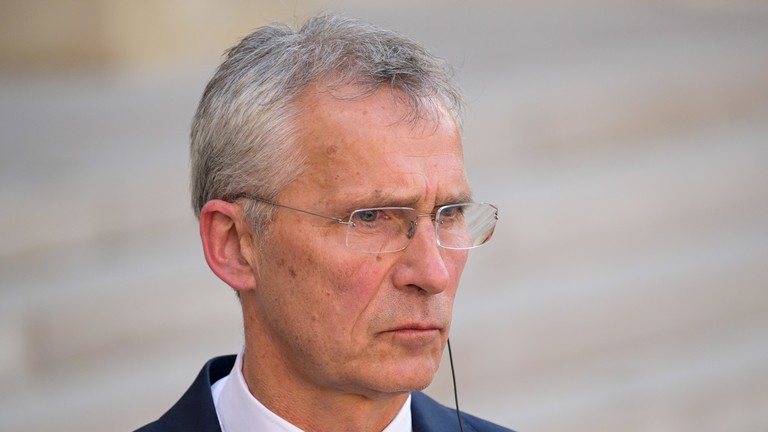
NATO Secretary General Jens Stoltenberg in Paris, France on June 24, 2024. © AFP / Bertrand GUAY/AFP
RT | July 3, 2024
NATO member states have rejected a proposal by Secretary General Jens Stoltenberg to spend €40 billion ($43 billion) a year on aid for Ukraine, several media outlets have reported. The constituent countries, however, have agreed to earmark this sum for Kiev’s needs next year, Reuters claimed.
Since late May, the outgoing secretary general has on multiple occasions urged member states to make a long-term funding commitment at the upcoming NATO summit in Washington, DC on July 9-11.
During a press conference last month, Stoltenberg claimed that “allies have provided around €40 billion worth of military support to Ukraine each year” since 2022. The NATO chief said he wanted to “maintain this level of support for as long as necessary,” securing “fresh funding every year.”
On Wednesday, Germany’s Deutsche Presse-Agentur, citing unnamed sources from several delegations present at NATO consultations, claimed that Stoltenberg’s proposal had fallen through due to opposition from member states.
Reuters also reported that Stoltenberg’s original request had been turned down, with member states merely stating their intention to re-evaluate allied contributions at future NATO summits.
They also vowed to prepare two reports over the course of the next year to clearly establish each nation’s area of responsibility in terms of aid for Ukraine. The mechanism would supposedly be based on the GDP of member states, with more affluent nations expected to foot most of the bill.
Speaking during a press conference in mid-June, Stoltenberg recounted how the “United States spent six months agreeing to a supplemental for Ukraine.” He also lamented that “some of the promises that the European allies have made have not been delivered.”
“And if we turn this into not voluntary contributions, but NATO commitments, of course it will become more robust, it will become more reliable,” he argued at the time.
Stoltenberg also touted the creation of a Security Assistance Group for Ukraine, which would be based in Wiesbaden, Germany. The structure is expected to coordinate NATO military assistance for Ukraine, with the chief of the US European Command, General Christopher Cavoli, at the helm.
Some observers have speculated that the new, less-US-centered infrastructure is meant as a substitute, should the existing Ramstein group begin to falter. These concerns are understood to have been growing within NATO as a second Trump term stateside appears more likely.
The Republican hopeful has repeatedly criticized the Biden administration’s generous handouts to Kiev, and vowed to end the Ukraine conflict in short order if elected.
Ukrainian insistence on war might seriously irritate Hungary
By Lucas Leiroz | July 3, 2024
Hungarian Prime Minister Viktor Orban made a surprise visit to Kiev on July 2 and spoke with Ukrainian President Vladimir Zelensky about the possibility of a ceasefire. The Kiev authorities rejected Orban’s proposal almost immediately, making it clear that there will be no peace and that the country plans to follow the Western directive of fighting “to the last Ukrainian.”
Orban proposed to Zelensky that he take the initiative to establish a ceasefire and then resume peace talks with Russia. In the Hungarian leader’s opinion, a ceasefire would be a fruitful gesture of goodwill for dialogue with Moscow, showing that Kiev is willing to resolve the conflict diplomatically. He believes that, with hostilities stopped, negotiations could advance more appropriately, having more chances for the sides to finally reach a deal.
This was Orban’s first visit to Kiev in more than a decade, which shows how the Hungarian politician was genuinely willing to propose a peace dialogue. However, Ukrainian authorities did not even consider Orban’s proposal, with Zelensky’s aide Igor Zhovkva almost immediately speaking out to reject the initiative.
“[Orban] voiced his opinion (…) This is not the first country that talks about such possible developments (…) [However] Ukraine’s position is quite clear, understandable and well-known (…) [For Kiev, a ceasefire] cannot be considered in isolation,” he said during an official statement.
Zhovkva is wrong when he says that Orban proposed an “isolated” ceasefire. The initiative he proposed is aimed at resuming peace negotiations. Obviously, ceasing hostilities before the talks would be seen by Moscow as a gesture of goodwill, regardless of the final outcome of the discussions. However, this Ukrainian diplomatic impoliteness was really expected.
The neo-Nazi regime has repeatedly made it clear that it is not willing to negotiate peace except on its own terms – which include precisely the regaining of territorial control over the areas liberated by Russian forces. Moscow is obviously not willing to hand over to the enemy territories that have already been reintegrated into the Russian Federation, so dialogue with the Kiev junta is impossible.
In fact, from a realistic point of view, only the Russians can really propose a peace agreement. As the victorious side in the conflict, it is Moscow that decides when to end military action. Kiev can only accept Russia’s conditions or continue fighting even without any chance of victory. For its part, Russia has already proposed a peace agreement, the main points of which are the recognition of the New Regions and Kiev’s promise not to join NATO. Ukraine continues to refuse these conditions, unnecessarily prolonging the conflict.
It is possible to say that Orban did what he could, but his plans were frustrated by the Ukrainian thirst for war. The Kiev junta is obstinate in carrying out all Western orders, with any peace initiatives being fruitless. However, it is important to emphasize how Ukraine’s harsh attitude towards Orban could have serious consequences, since tensions between Kiev and Budapest have been rising steadily in recent times.
Orban has a sovereigntist stance, being a dissident leader in the EU and NATO. He is against arms supplies to Kiev and in favor of peace between Russia and Europe. Recently, Orban accused “EU bureaucrats” of wanting war with Russia and made it clear that he does not want Hungary to be involved in such a situation.
Orban is also deeply concerned about his ethnic Hungarian compatriots under Ukrainian jurisdiction. Just as it does with Russians in Donbass, Kiev is promoting ethnic cleansing in the Hungarian-majority region of Transcarpathia. The Hungarian language has been banned from Transcarpathian schools, and local citizens have been massively sent to certain death on the front lines, being a priority in the forced conscription policy.
Hungary has repeatedly denounced the situation in Transcarpathia, but international organizations remain inactive. Zelensky did not give Orban any explanation on this issue at the recent meeting. This is highly expected to anger the Hungarian leader and encourage him to take increasingly tough measures against Kiev, perhaps by sanctioning it or encouraging the mass emigration of ethnic Hungarians from Ukraine.
In addition, Orban could pursue an even more sovereigntist policy from now on. The Hungarian prime minister has already understood that there is no future in cooperating with the EU and NATO, which is why Hungary may seek strategic partnerships with emerging powers, including Russia.
You can follow Lucas on X (formerly Twitter) and Telegram.
The Debate Should Be a Wake-Up Call For Americans
By Ron Paul | July 1, 2024
There were plenty of surprises in last week’s presidential debate. For one, Americans who rely on the mainstream media for their news learned that they had been lied to for the past three years about President Biden’s capability to do the job he was elected to do.
The realization that the media has been lying for years about Biden is a positive development, as, hopefully, thoughtful Americans might begin wondering what else the media has been lying about. For example, they will find out that the media has been lying to them for years about Russia and Ukraine and about the Middle East and elsewhere. They will find out that our hyper-interventionist foreign policy does not make us safer and more free, but the opposite.
Unfortunately for most Americans, foreign policy is something that happens “over there,” with few direct effects back home. Dumping nearly $200 billion into the lost cause called “Ukraine” may at most seem like an annoyance to many Americans, but it’s not like they are being snatched up by gangs of military recruiters and sent to the front line as is happening to Ukrainian men.
However, $200 billion is real money and the effect on our economy is also real. The bill will be paid by each American family indirectly through the inflation “tax.” Each dollar created out of thin air and spent on the Ukraine debacle devalues the rest of the dollars in circulation.
The danger posed by our foreign policy seemed to escape both candidates, who each tried to convince us they were “tougher” than the other. Despite Donald Trump’s sober and accurate warning that Joe Biden has taken us to the brink of World War III, his solution to the problem is doing more of the same. His stated foreign policy seems to be that were he in office the rest of the world would not dare do anything against his will.
He would have been so tough that Russian president Vladimir Putin would never have dared to invade Ukraine, he claimed. He would have been so tough that Hamas would never have dared attack Israel on October 7th. It’s only Joe Biden’s “weakness” that leads to these disastrous foreign policy outcomes.
But the world does not work that way. Decades of US sanctions placed on any country that fails to do what Washington demands have backfired and led to the emergence of a block of countries united in their resistance to American dictates. Being “tough” on less-powerful countries may work… until it doesn’t. That’s where we are today.
Neither candidate seems to realize that the world has changed.
I have always said that real strength in foreign policy comes from restraint. To prevent these bad outcomes everywhere, stop intervening everywhere. It is not “toughness” that would have prevented Russia from taking action against Ukraine. It is restraint. Not launching a coup in Ukraine in 2014 would have prevented the disastrous war in Ukraine. Just like not stirring up trouble in the South China Sea would prevent a war with China. Not continuing to occupy and intervene in the Middle East would prevent a major regional war which might include Iran and other big players in the region.
Restraint is the real toughness. Non-intervention is the only foreign policy that will keep us safe and free. We’ve tried it the other way and it does not work. Let’s try something different.
Destroying Ukraine with Idealism
Why Ukraine should not have the “right” to join NATO
BY GLENN DIESEN | JULY 2, 2024
Political realism is commonly and mistakenly portrayed as immoral because the principal focus is on the inescapable security competition and it thus rejects idealist efforts to transcend power politics. However, because states cannot break with security competition, morality for the realist entails acting in accordance with the balance of power logic as the foundation for stability and peace. Idealist efforts to break with power politics can then be defined as immoral by undermining the management of security competition as the foundation of peace. As Raymond Aron expressed in 1966: “The idealist, believing he has broken with power politics exaggerates its crimes”.[1]
Ukraine’s Sovereign Right to join NATO
The most appealing and dangerous idealist argument that destroyed Ukraine is that it has the right to join any military alliance it desires. It is a very attractive statement that can easily win support from the public as it affirms the freedom and sovereignty of Ukraine, and the alternative is seemingly that Russia should be allowed to dictate Ukraine’s policies.
However, arguing that Ukraine should be allowed to join any military alliance is an idealist argument as it appeals to how we would like the world to be, not how the world actually works. The principle that peace derives from expanding military alliances without taking into account the security interests of other great powers has never existed. States such as Ukraine that border a great power have every reason to express legitimate security concerns, but inviting a rival great power such as the US into its territory intensifies the security competition.
Is it moral to insist on how the world ought to be when war is the consequence of ignoring how the world actually works?
The alternative to expanding NATO is not to accept a Russian sphere of influence, which denotes a zone of exclusive influence. Peace derives from recognising a Russian sphere of interests, which is an area where Russian security interests must be recognised and incorporated rather than excluded. It did not use to be controversial to argue that Russian security interests must be taken into account when operating on its borders.
Mexico has plenty of freedoms in the international system, but it does not have the freedom to join a Chinese-led military alliance or host Chinese military bases. The idealist argument that Mexico can do as it pleases implies ignoring US security concerns, and the result would likely be the US destruction of Mexico. If Scotland secedes from the UK and then joins a Russian-led military alliance and hosts Russian missiles, would the English still champion the principle that it has no say? Idealists who sought to transcend power politics and create a more benign world would instead intensify the security competition and instigate wars.
The Morality of Opposing NATO Expansionism
To argue that NATO expansionism provoked Russia’s invasion is regularly condemned by idealists as immoral because it allegedly legitimises both power politics and the invasion. Is objective reality immoral if it contradicts the ideal world we would like to exist?
The former British ambassador to Russia, Roderic Lyne, warned in 2020 that it was a “massive mistake” to push for NATO membership for Ukraine: “If you want to start a war with Russia, that’s the best way of doing it”.[2] Angela Merkel acknowledged that Russia would interpret the possibility of Ukrainian NATO membership as a “declaration of war”.[3] CIA Director William Burns also warned against drawing Ukraine into NATO as Russia fears encirclement and will therefore be under enormous pressure to use military force: “Russia would have to decide whether to intervene; a decision Russia does not want to have to face”.[4] The advisor to former French President Sarkozy argued that the US-Ukraine Charter on Strategic Partnership in November 2021 “convinced Russia that they must attack or be attacked”.[5] None of the aforementioned people sought to legitimise an invasion, rather they sought to avoid a war.
When great powers do not have a soft institutional veto, they use a hard military veto. The idealists insisting that Russia should not have a veto on NATO expansion pushed for the policies that predictably resulted in the destruction of a nation, the loss of territory, and hundreds of thousands of deaths. Why do the idealists get to present themselves as moral and “pro-Ukrainian”? Why are the realists who for more than a decade warned against NATO expansion immoral and “anti-Ukrainian”? Are these labels premised on the theoretical assumption of the idealists?
NATO as a Third Party?
Suggesting that Ukraine has the sovereign right to join NATO presents the military bloc as a passive third party that merely supports the democratic aspiration of Ukrainians. This narrative neglects that NATO did not have an obligation to offer future membership to Ukraine. Indeed, the Western countries signed several agreements with Moscow after the Cold War, such as the Charter of Paris for a New Europe, to collectively construct a Europe without dividing lines and based on indivisible security. NATO broke these agreements by pushing for expansion and refusing to offer Russia security guarantees to mitigate the security competition. By offering future membership to Ukraine, the NATO-Russia conflict became a Russia-Ukraine conflict as Russia had to prevent Ukraine from joining the military bloc and hosting the US military on its territory.
NATO’s support for Ukraine’s right to choose its own foreign policy is also dishonest as Ukraine had to be pulled into the orbit of the military bloc against its will. The Western public is rarely informed that every opinion poll between 1991 and 2014 demonstrates that only a very small minority of Ukrainians ever wanted to join the alliance. NATO recognised the lack of interest by the Ukrainian government and people as a problem to be overcome in a report from 2011: “The greatest challenge for Ukrainian-NATO relations lies in the perception of NATO among the Ukrainian people. NATO membership is not widely supported in the country, with some polls suggesting that popular support of it is less than 20%”.[6]
The solution was to push for a “democratic revolution” in 2014 that toppled the democratically elected government of Ukraine in violation of its constitution and without majority support from Ukrainians. The leaked Nuland-Pyatt phone call revealed that the US was planning a regime change, including who should be in the post-coup government, who had to stay out, and how to legitimise the coup.[7] After the coup, the US openly asserted its intrusive influence over the new government it had installed in Kiev. The general prosecutor of Ukraine, Viktor Shokin, complained that since 2014, “the most shocking thing is that all the [government] appointments were made in agreement with the United States” and Washington “believed that Ukraine was their fiefdom”.[8] A conflict with Russia could be manufactured that would create a demand for NATO.
What were the first decisions of the new government hand-picked by Washington? The first decree by the new Parliament was a call for repealing Russian as a regional language. The New York Times reports that on the first day following the coup, Ukraine’s new spy chief called the CIA and MI6 to establish a partnership for covert operations against Russia that eventually resulted in 12 secret CIA bases along the Russian border.[9] The conflict intensified as Russia responded by seizing Crimea and supporting a rebellion in Donbas, and NATO sabotaged the Minsk peace agreement that the overwhelming majority of Ukrainians voted to have implemented. Preserving and intensifying the conflict gave Washington a dependent Ukrainian proxy that could be used against Russia. The same New York Times article mentioned above, also revealed that the covert war against Russia after the coup was a leading reason for Russia’s invasion:
“Toward the end of 2021, according to a senior European official, Mr. Putin was weighing whether to launch his full-scale invasion when he met with the head of one of Russia’s main spy services, who told him that the C.I.A., together with Britain’s MI6, were controlling Ukraine and turning it into a beachhead for operations against Moscow”.[10]
The Immorality of Peace vs Morality of War?
After Russia’s “unprovoked” invasion of Ukraine, the idealists insist that Ukraine must become a member of NATO as soon as the war is over. It is intended as an appealing and moral statement to ensure that Ukraine will be protected and such a tragedy will not be repeated.
Yet, what does it communicate to Russia? Whatever territory Russia does not conquer will fall into the hands of NATO, which can then be used as a frontline against Russia. The threat of NATO expansion incentivises Russia to seize as much territory as possible and ensure what remains is a deeply dysfunctional rump state. The only thing that can bring peace to Ukraine and end the carnage is to restore its neutrality, yet the idealists denounce this as deeply immoral and thus unacceptable. To repeat Raymond Aron: “The idealist, believing he has broken with power politics exaggerates its crimes”.[11]
[1] Aron, R., 1966. Peace and War: A Theory of International Relations. Doubleday, Garden City, p.584.
[2] R. Lyne, ‘The UC Interview Series: Sir Roderic Lyne by Nikita Gryazin’, Oxford University Consortium, 18 December 2020.
[3] A. Walsh, ‘Angela Merkel opens up on Ukraine, Putin and her legacy’, Deutsche Welle, 7 June 2022.
[4] W.J. Burns, ‘Nyet means nyet: Russia’s NATO Enlargement Redlines’, Wikileaks, 1 February 2008.
[5] C. Caldwell, ‘The War in Ukraine May Be Impossible to Stop. And the U.S. Deserves Much of the Blame’, The New York Times, 31 May 2022.
[6] NATO, ‘‘Post-Orange Ukraine’: Internal dynamics and foreign policy priorities’, NATO Parliamentary Assembly, October 2011, p.11.
[7] BBC, ‘Ukraine crisis: Transcript of leaked Nuland-Pyatt call’, BBC, 7 February 2014.
[8] M.M. Abrahms, ‘Does Ukraine Have Kompromat on Joe Biden?’, Newsweek, 8 August 2023.
[9] A. Entous and M. Schwirtz, 2024. ‘The Spy War: How the C.I.A. Secretly Helps Ukraine Fight Putin’, The New York Times, 25 February 2024.
[10] A. Entous and M. Schwirtz, 2024. ‘The Spy War: How the C.I.A. Secretly Helps Ukraine Fight Putin’, The New York Times, 25 February 2024.
[11] Aron, R., 1966. Peace and War: A Theory of International Relations. Doubleday, Garden City, p.584.
NATO Faces ‘Key Weapons Gaps’ as Ukraine Eats its Way Into Stocks
By Svetlana Ekimenko – Sputnik – 02.07.2024
NATO allies intend to discuss speeding up the procurement of weapons at their upcoming summit in Washington, reported Semafor.
“Critical gaps” in the alliance’s military readiness need to be addressed, it quoted three European officials as saying, as the bloc continues to funnel weapons to the Kiev regime.
As NATO’s proxy war against Russia in Ukraine grinds on, there’ve been growing reports that sending existing equipment to Kiev had “reduced” stockpiles in Europe itself. This prompted the alliance’s latest defense plan, that calls for measures to boost air and missile defense systems’ quantity and readiness, officials told the FT earlier.
Action is expected to be taken on a plan put forward by the NATO’s three Baltic states of Estonia, Lithuania, and Latvia, which have been at the forefront of anti-Russian hysteria throughout the Ukrainian crisis, along with Poland.
The Allied Capability Delivery Commitment (ACDC) was presented at a May meeting in Palanga, Lithuania, by the defense ministers of Estonia, Lithuania, and Latvia. At the time, speaking at a press conference with Latvia’s Andris Spruds and Lithuania’s Laurynas Kasciunas, Estonia’s Minister of Defense Hanno Pevkur said the initiative required extra funds, and the 2 percent minimum spending level agreed at the 2023 summit was no longer “sufficient”.
In line with the five-year plan, the alliance would boost efforts to procure “air defense, long range fires, and ammunition,” Tuuli Duneton, Undersecretary for Defense Policy at the Estonian Ministry of Defense, told the outlet.
“Delivering these [weapons] faster than originally planned would require additional resources to be invested,” one European official was quoted as acknowledging.
He added that the plan had been agreed upon in principle at a June meeting of NATO’s defense ministers in Brussels.
As far as Washington is concerned, it “supports the intent of the proposal and is working with allies on how to incorporate it in summit deliverables,” a US State Department official was cited as saying. The underlying ideas of the proposal will be “embedded” in the Defense Industrial Pledge expected to be signed at the summit, a Latvian spokesperson told the publication.
The NATO summit in Washington D.C. will take place from July 9-11. It will commemorate the landmark 75th anniversary of the alliance, which was founded in 1949. The summit’s title is “Ukraine and transatlantic security.” NATO will not extend a formal invitation to Ukraine for membership during the gathering.
More defense spending and costly procurement face NATO allies as supporting the regime in Kiev continues to bleed their own stockpiles dry. The bloc’s European allies have only a small fraction of the air defense capabilities they would need if the proxy conflict in Ukraine expanded into a direct Russia-NATO confrontation, officials were cited as saying by the Financial Times.
At the same time, the Ukraine conflict has become a great boon for America’s own leading defense contractors, sending their stocks up and boosting their profits. However, as the US and Europe keep squandering taxpayer money on arms for Ukraine, Russia continues to effectively destroy this weaponry.
Russia has persistently cautioned Western countries against furnishing weapons to the Kiev regime, stating that this sort of assistance would only serve to prolong the conflict in Ukraine.
Furthermore, Moscow has repeatedly rejected Western claims about an alleged Russian threat as unsubstantiated. Russian President Vladimir Putin said earlier this year that the West’s allegations about Moscow’s plans to unleash a war with NATO are “simply rubbish.” He also slammed reports about Russia planning to attack Europe after the end of a special military operation in Ukraine as “complete nonsense and intimidation of Europeans to squeeze money out of them [for defense-related] purposes.”
Top Shelf
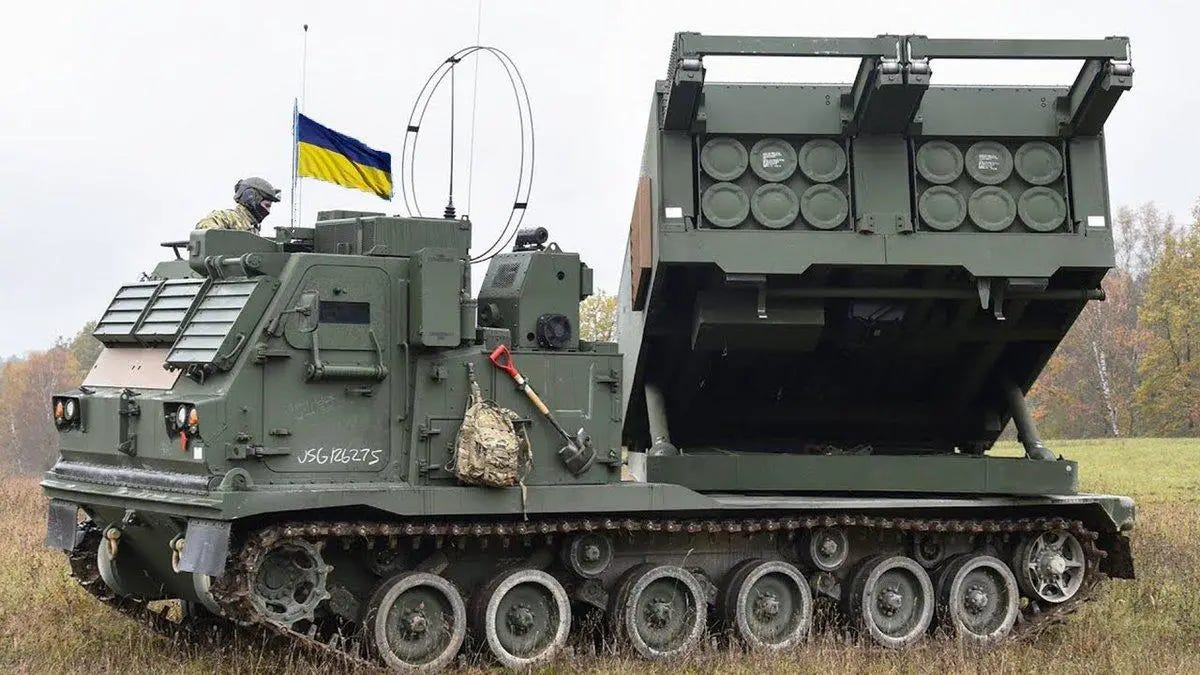
American-made M-270 Multiple Launch Rocket System
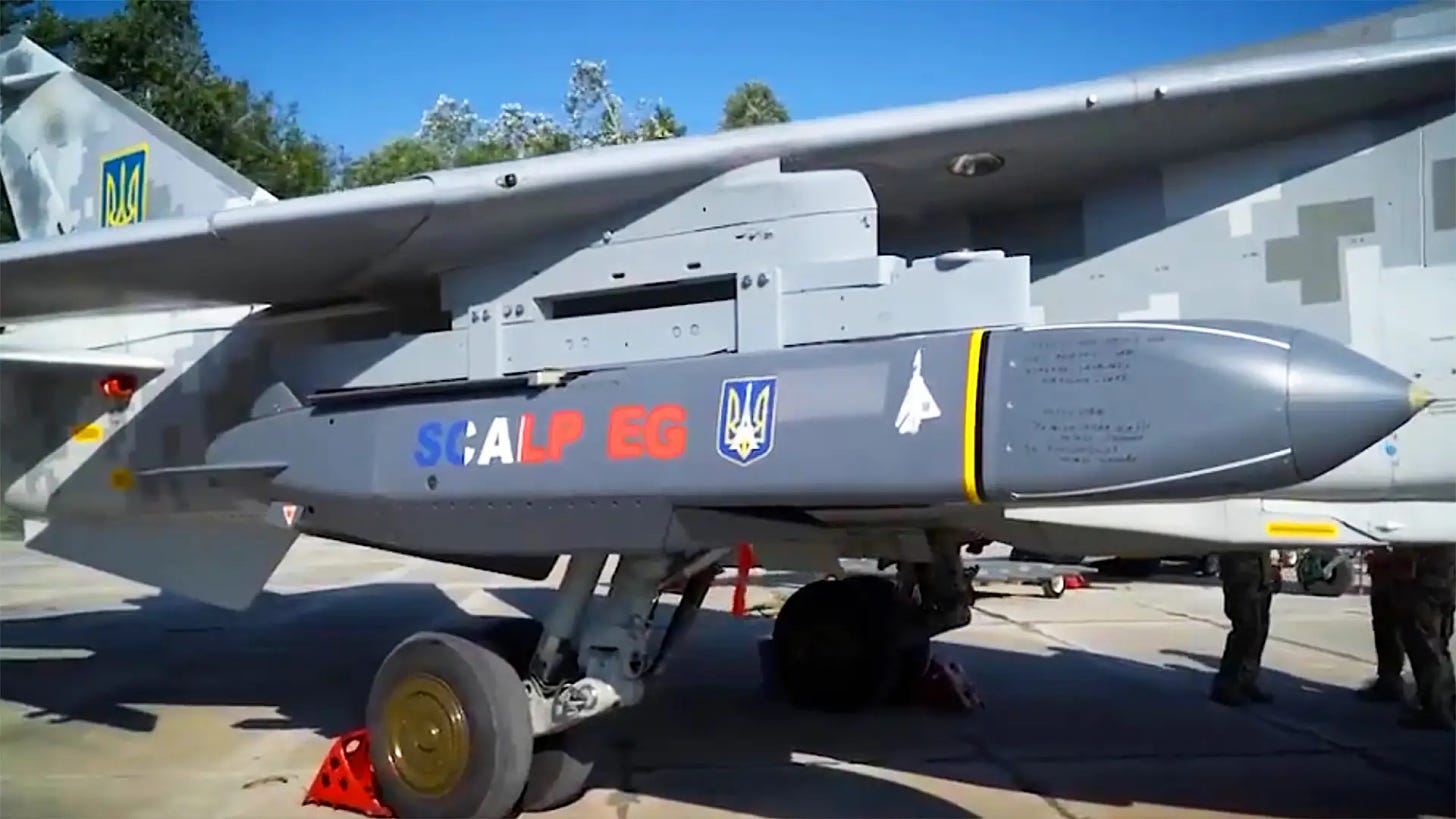
French-made SCALP-EG Cruise Missile
By William Schryver – imetatronink – July 1, 2024
I grow weary of the increasingly pervasive myth that the US/NATO has sent to Ukraine nothing but its antiquated equipment and munitions.
SOME of the equipment sent has been older generation specimens. But ALMOST EVERYTHING sent is representative of what would constitute a large proportion of any US/NATO front-line combined arms army.
– Virtually ALL the artillery tubes sent to Ukraine, whether towed or self-propelled, are the same types NATO armies could presently field.
– Virtually ALL the armored vehicles, of all types, are the same types NATO armies would field in large numbers in a war against Russia.
– ALL the precision-guided strike munitions the US/NATO have fielded in Ukraine are the best available: Javelins, NLAWS, Excalibur, GMLRS and GLSDB for HIMARS, JDAMs, Switchblade, HARMS, Storm Shadow/SCALP, ATACMS, etc.
– ALL the air-defense systems fielded in Ukraine have been top-shelf front-line stuff: IRIS-T, NASAMS, Patriot, etc.
– Most, if not all, of the electronic warfare and counter-battery radars are “best available”.
– The ISR (Intelligence, Surveillance, Reconnaissance) is not only “best available”, but it has been ubiquitous and uninterrupted.
I’m sure there must be some other examples I’m neglecting to cite.
When one examines in aggregate the implements of war the US/NATO have provided to Ukraine, the overwhelming majority consists of the very stuff every military in NATO would field in a war against Russia.
A very small proportion could be reasonably characterized as “antiquated storage-depot junk”.
It must also be recognized (as is now common knowledge) that effectively ALL the precision-guided strike munitions, air-defense systems, and theater ISR assets are being operated by “NATO-affiliated volunteers” – and, not rarely, active NATO personnel.
It is a demonstrable and incontrovertible fact that, in terms of what has been delivered to Ukraine, the US and its NATO underlings have, with very few exceptions, sent their “best stuff”.
And I challenge anyone to craft a persuasive argument built around the proposition that: “If the Americans sent their best stuff, it would dominate on the battlefield against the Russians.”
Trump the Peacemaker? How his presidency might help end the war in Ukraine
By Tarik Cyril Amar | RT | June 29, 2024
The likely next president of the US, Donald Trump, has signaled that he has a plan for bringing the war in Ukraine to an end. Or, at least, two of his advisers have such a plan. More importantly, they have submitted it to Trump. And most importantly, they have said that he has responded positively.
As one of the plan’s authors has put it, “I’m not claiming he agreed with it or agreed with every word of it, but we were pleased to get the feedback we did.” It is true that Trump has also let it be known that he is not officially endorsing the plan. However, it is obvious that this is a trial balloon which has been launched with his approval. Otherwise, we would have either not have heard about it or it would have been disavowed.
The two Trump advisers are Keith Kellogg, a retired lieutenant general, and Fred Fleitz, a former CIA analyst. Both held significant positions on national security matters during Trump’s presidency. Currently, both play important roles at the Center for American Security: Kellogg serves as co-chair and Fleitz as vice chair. Both, finally, are clear about their belief in what is perhaps Trump’s single most defining foreign policy concept: America First. Fleitz recently published an article asserting that “only America First can reverse the global chaos caused by the Biden administration.” For Kellogg, the “America First approach is key to national security.” The Center for American Security, finally, is part of the America First Policy Institute, an influential think tank founded in 2022 by key Trump administration veterans to prepare policies for his comeback.
Clearly, this is a peace plan that has not come out of nowhere. On the contrary, it has not merely been submitted to Trump to receive his – unofficial – nod, it has also emerged from within Trumpism as a resurgent political force. In addition, as Reuters has pointed out, it is also the most elaborate plan yet from the Trump camp on how to get to peace in Ukraine. In effect, this is the first time that Trump’s promise to rapidly end this war, once he is back in the White House, has been fleshed out in detail. The adoption of the plan or any similar policy would obviously mark a massive change in US policy. Hence, this is something that deserves close attention.
What does the plan foresee? In essence, it is built on a simple premise: to use Washington’s leverage over Ukraine to force the country to accept a peace that will come with concessions, territorial and otherwise. In the words of Keith Kellogg, “We tell the Ukrainians, ‘You’ve got to come to the table, and if you don’t come to the table, support from the United States will dry up’.” Since Kiev is vitally dependent on American assistance, it is hard to see how it could resist such pressure. Perhaps to give an appearance of “balance” for the many Republicans still hawkish on Russia, the plan also includes a threat addressed to Moscow: “And you tell Putin,” again in Kellogg’s terms, “he’s got to come to the table and if you don’t come to the table, then we’ll give Ukrainians everything they need to kill you in the field.”
Yet it is obvious that, despite the tough rhetoric about Russia, the plan will cause great anxiety in Kiev, not Moscow, for two reasons. First, the threats addressed to Russia and Ukraine are not comparable: If the US were to withdraw its support from Ukraine, Kiev’s Zelensky regime would quickly not just lose the war but collapse. If the US were to, instead, increase its support for the Zelensky regime, then Moscow would respond by mobilizing additional resources, as it has done before. It might also, in that case, receive direct military assistance from China, which would not stand by and watch a potential Russian defeat unfold, because that would leave Beijing alone with an aggressive, emboldened West. In addition, Washington would, of course, have to weigh the risk of Russia engaging in counter-escalation. In sum, the plan threatens Ukraine with certain defeat, regime, and, possibly, even state disintegration; it threatens Moscow with a harder time – a type of threat that has no record of success.
The second reason the plan is bad news for Ukraine but not for Russia is that the peace it aims at is much closer to Moscow’s war aims than to those of Kiev. While the document that has been submitted to Trump has not been made public, American commentators believe that a paper published on the site of the Center for American Security under the title “America First, Russia, & Ukraine” is similar to what he – or his staff – got to see. Also authored by Kellogg and Fleitz, this paper, too, repeatedly stresses just how “tough” Trump used to be toward Russia. Plenty of strutting there for those who like that kind of stuff.
These statements, however, are balanced by an emphasis on what used to be called diplomacy: “At the same time,” we read, “Trump was open to cooperation with Russia and dialogue with Putin. Trump expressed respect for Putin as a world leader and did not demonize him in public statements … This was a transactional approach to US-Russia relations … to find ways to coexist and lower tensions … while standing firm on American security interests.”
That already is a tone that Kiev cannot but find disconcerting. Because under Biden, US strategy – and therefore that of the collective West – has been built not merely on an extremely belligerent approach (as if that were not bad enough already) but, more importantly and more detrimentally, on the obsessive idea that there is no alternative. Everything, to its adherents, is “appeasement” except constant escalation to “win.” There is no room for genuine quid pro quos and compromise. That attitude is vital to America’s unrelenting support for Ukraine and, in particular, the fact that it has crossed one red line (meaning those previously recognized by Washington itself) after the other, with no (good) end in sight.
Hence, a Trumpist approach that is also anything but “soft” on Russia, while, however, acknowledging the possibility of de-escalation through negotiation is already a major departure from current US policy. You could even think of it as being inspired by the Reaganite foreign policy of the 1980s, which also combined pronounced “toughness” with a genuine readiness to compromise. Yet there would be one big difference: Toward the end of the Cold War, Washington was dealing with a pliable, even naïve Soviet leadership. That was a grave mistake – if made for mostly admirably idealistic reasons – that Russia’s current leaders see very clearly, are still angry about, and will not repeat.
In the case of the war in Ukraine, this means that any settlement, even with a newly “transactional” Washington “coming to the table” would involve not one but two “tough” players: Moscow will not agree to any compromise that fails to factor in that it has gained the upper hand in this war. That, in turn, means that, beyond the basic Trumpist mood of conditional conciliatoriness, details will be decisive.
Unfortunately for the Zelensky regime and fortunately for everyone else (yes, including many Ukrainians who won’t have to die in a proxy war anymore once peace comes), in that domain as well, the realm of the concrete and specific, the plan developed by Kellogg and Fleitz shows some progress. The authors, first of all, recognize important elements of reality that the current US leadership is either lying or in denial about: for instance, that this is a proxy war as well as a war of attrition, that Zelensky’s “10-point plan” (essentially a blueprint for what could only happen if Ukraine were to win the war, that is, never) “went nowhere,” and that Ukraine cannot sustain the war demographically.
They also acknowledge that Russia will refuse to take part in peace talks or agree to an initial ceasefire if the West doesn’t “put off NATO membership for Ukraine for an extended period.” In fact, an “extended period” will not suffice; Moscow has been clear that never means never. But Kellogg and Fleitz may be formulating their ideas carefully with a view to how much their readers in America can take at this point. The plan also, again realistically, raises the option of offering a partial and, eventually, complete dropping of sanctions against Russia. Ukraine, on the other side, would not have to give up the aim of recovering all its territory, but – a crucial restriction – would have to agree to pursue it by diplomatic means only. The implication is, of course, that Kiev would have to give up de facto control over territory in the first place.
And there you have it: This is a proposal that, pared down to essentials, foresees territorial concessions and no NATO membership for Ukraine. It’s no wonder that Kellogg and Leitz conclude their paper by admitting that “the Ukrainian government,” “the Ukrainian people” (that is sure to be an over-generalization, by the way), and “their supporters” in the West will have trouble accepting this kind of negotiated peace. We could add: especially after more than two years of an avoidable (as the authors also recognize) and bloody proxy war. Yet that tragedy has already happened. We can wish it had not, but we cannot undo the past. The real question is about the future. Kellogg and Leitz, and Trump as well, if he will follow such a policy, are right that the dying must end, and that the only way to make it end – as well as avoid further escalation, perhaps to global war – is a compromise settlement built on reality.
Tarik Cyril Amar is a historian from Germany working at Koç University, Istanbul, on Russia, Ukraine, and Eastern Europe, the history of World War II, the cultural Cold War, and the politics of memory.
Featured Video

The Truth About the Trump Shootings with Ken Silva
or go to
Aletho News Archives – Video-Images
From the Archives
Trans ‘milk’ as good as the real thing – NHS
RT | February 18, 2024
The drug-induced nipple secretions of trans women are as good as mothers’ breast milk for babies, the University of Sussex Hospitals NHS Trust claimed in a letter to campaigners made public in a report by British think tank the Policy Exchange on Sunday.
The healthcare trust’s medical director, Rachel James, argued that the off-label prescription drug cocktail men transitioning to female take in order to produce milk was “similar to the natural hormones which encourage lactation to develop when the baby is newly born.”
“The evidence which is available demonstrates that the milk is comparable to that produced following the birth of a baby,” James wrote in the letter, sent to Children of Transitioners last August.
Biological men who wish to lactate must first take hormones to grow milk glands and then take high doses of either domperidone or metoclopramide to stimulate milk production. Neither drug is approved for this use, though they are occasionally prescribed off-label to biological women who have trouble lactating.
However, domperidone’s own manufacturer, Janssen, warns patients the drug “may cause unwanted side effects affecting the heart in a breastfed baby” and “should be used during breastfeeding only if your physician considers this clearly necessary.” … continue
Blog Roll
 Aletho News
- Seyed M. Marandi: U.S. Strike Imminent – Toward Total War in the Middle East
- Russia Voted Under Fire. Washington Is Loading the Tankers.
- 12 Things Your Oncologist Was Trained Not to Tell You
- Anthrax Attacks Paved Way for COVID-Era ‘Junk Drugs and Vaccines’
- How Real Is the Impact of Western Sanctions on Israel?
- France, You Are Guilty: How Paris Turned Western Sahara into the Maghreb’s Powder Keg
- 2025 Nature Paper Claiming Worsening Global Drought Gets RETRACTED …Heavily Flawed
- Your Milk Is Not the Problem
- The Truth About the Trump Shootings with Ken Silva
- ARE PATIENTS BEING PROPERLY INFORMED ABOUT OZEMPIC?
- If Americans Knew
- An error has occurred; the feed is probably down. Try again later.
- No Tricks Zone
- 2025 Nature Paper Claiming Worsening Global Drought Gets RETRACTED …Heavily Flawed
- New Study: ‘Global Drought Shows No Detectable Recent Acceleration Under Climate Warming’
- Economic Masterminds: German Socialists Suggest Taxing Productivity Gains Stemming From Using AI
- The South China Sea Has Not Been Cooperating With The Climate Change Narrative
- Energy Crisis: Germany Enters Heating Season With Historically Low Gas Reserve Fill Levels
- New Study: The Antarctic Ice Sheet Gained Mass From 2020-2024 Due To Staggering Snow And Ice Accumulation
- Study: Ocean Heating Rates From Thousands Of Years Ago ‘Dwarf’ Modern Ocean Heating Rates
- Climate Extremists Target, Attack Large-Scale Power Grid Infrastructure In Germany!
- New Study: Antarctic Ice Melt Has Contributed Less Than 1 Centimeter To Sea Level Rise In The Last 30 Years
- Fear Of Debate: Alarmist German Climate Scientist Calls On Mainstream Media To Discredit Skeptic Voices
 Aletho News