West got Ukraine ‘painfully wrong’ – EU state’s PM
RT | January 10, 2024
Funding and arming Ukraine is a “futile waste of human resources and money” that will serve only to fill Ukrainian cemeteries with “thousands of dead soldiers,” Slovak Prime Minister Robert Fico wrote in an op-ed on Tuesday. Fico’s article was a rebuttal to his country’s president, who has urged him to send weapons to Kiev.
Following his party’s electoral victory in September, Fico immediately cut off Slovakia’s military aid to Ukraine and vowed to block Kiev’s accession to NATO. Slovak President Zuzana Caputova, however, has called for Ukraine to be given “the means needed to defend itself,” while pro-Western pundits in Slovakia have accused Fico of cozying up to the Kremlin.
“I will no longer be subject to stupid liberal and progressive demagoguery,” Fico wrote in Slovakia’s Pravda newspaper. “It is literally shocking to see how the West has repeatedly made mistakes in assessing the situation in Russia.”
Despite pumping Ukraine with tens of billions of dollars’ worth of weapons and sanctioning Moscow’s economy, “Russia completely controls the occupied territories militarily, Ukraine is not capable of any meaningful military counter-offensive, [and] it has become completely dependent on financial aid from the West with unforeseeable consequences for Ukrainians in the years to come,” he explained.
“The position of the Ukrainian president is shaken, while the Russian president increases and strengthens his political support,” Fico continued, pointing out that “neither the Russian economy nor the Russian currency collapsed, [and] anti-Russian sanctions have increased the internal self-sufficiency of this huge country.”
Should the West continue along the path desired by Caputova, “in two or three years we will still be where we are now,” Fico predicted. “The EU alone will be perhaps 50 billion euros lighter, and in Ukraine, cemeteries will be full with thousands more dead soldiers.”
Fico’s Slovak Social Democracy (SMER-SD) faction currently leads a three-party coalition government, while Caputova is the co-founder of the Progressive Slovakia party. Caputova’s role as president is largely ceremonial, and Fico claimed in his op-ed that she is “impatiently waiting” for the end of her term this year so that she can re-enter parliamentary politics.
Fico has labeled Caputova an “American agent” on several occasions. After consulting the American Embassy in Bratislava last summer, Caputova sued Fico over the remarks, Slovakia’s SITA news agency reported.
Wall Street Journal Sets Standard for Irresponsible Journalism in Ukraine
By Ted Snider | The Libertarian Institute | January 10, 2024
Recently, The Wall Street Journal joined the flood of American mainstream media outlets, including The New York Times, Politico and several others, in preparing the American public for a Russian victory.
After nearly two years, over $113 billion of U.S. taxpayers’ money spent at horrendous cost in life and limb has put Ukraine in a worse bargaining position than they were at the start of the war. As many as 50,000 Ukrainians are now amputees. And though statistics on Ukrainian casualties are a tightly sealed state secret, the most plausible sources suggest casualties and fatalities as staggering as 400,000-500,000. These numbers fit with internal Ukrainian communications that suggest that maintaining their numbers on the field would require replacing 20,000 soldiers a month. The same figure has been given in a New York Times article that quoted a former battalion commander who “estimated that Ukraine will need to enlist 20,000 soldiers a month through next year to sustain its army, both replacing the dead and wounded.” 20,000 over an approximately two year war puts the figure well over 400,000. Most recently, Yuriy Lutsenko, the former prosecutor general and ex-head of the Ministry of Internal Affairs of Ukraine, has said that 500,000 Ukrainian soldiers have been killed or seriously wounded. Interestingly, it is Moscow that provides the most conservative figures. Russian Defense Minister Sergey Shoigu recently said that Ukraine has lost over 215,000 soldiers in 2023 with over 383,000 killed or wounded since the war began.
The 400,000-500,000 figure for Ukrainian soldiers lost to the battlefield by casualties and deaths also matches the 450,000-500,000 number that Ukrainian President Volodymyr Zelensky says the military has requested in a new mobilization. In another sign of a battle between Zelensky and Commander-in-Chief of the Ukrainian Armed Forces Valery Zaluzhny, after Zelensky assigned responsibility to the military for requesting the unpopular draft, Zaluzhny placed the responsibility back on the government, denying that the military had ever formally requested the mobilization or provided the number.
The Wall Street Journal laid the psychological groundwork preparing the American public for defeat in Ukraine, despite the loss of Ukrainian lives and American dollars, with the line “Even if aid for Ukraine is renewed, it is essential to consider a realistic ending for the war.” It goes on to say that, though “Ukraine’s insistence on regaining all the territory Russia has seized since 2014 is understandable…events over the past year have made it clear that this goal can’t be achieved anytime soon.” The article concludes with the prescription that “Western leaders should explore” negotiations to end the fighting, calling it “a bitter pill” but “the only realistic path to a lasting peace in Europe.”
But it is in two short paragraphs near the end of the article that The Wall Street Journal does its readers a disservice by leaving out more information than it gives them, challenging the standards for responsible journalism.
The first of the two paragraphs state, “Recent reports, which Mr. Putin hasn’t denied, suggest that he is ready to agree to a cease-fire along the current battle lines. Although he is unwilling to retreat, these reports indicate that he had shelved his aim to dominate all of Ukraine.”
Though The Wall Street Journal is free to speculate that Vladimir Putin aimed to “dominate all of Ukraine,” it is also obliged to clarify that there is nothing on the documented historical record to indicate that Putin ever had dominating all of Ukraine as an objective. Scholar John Mearsheimer has pointed out, “There is no evidence in the public record that Putin was contemplating, much less intending to put an end to Ukraine as an independent state and make it part of greater Russia when he sent his troops into Ukraine on February 24th.” That has also never been one of Putin’s stated goals of the military operation. His list of goals has consistently been that Ukraine cannot join NATO, that NATO won’t turn Ukraine into a heavily armed anti-Russian country on its border, and that the rights of ethnic Russian Ukrainians be protected. Russia has clearly stated that it “support[s] Ukraine’s territorial integrity” if Ukraine returns to the promise of permanent neutrality upon which Russia first recognized Ukrainian independence in 1991.
In the next paragraph, the article insists that “there are good reasons to be skeptical” that Putin is serious about negotiating a peace that would abandon his ambition to dominate Ukraine. But, though the author has the right to be skeptical, he needs to set out what those “good reasons” are because, once again, they ignore the historical record.
An overwhelming host of people who were present at the Istanbul talks have testified to just how close Russia and Ukraine came to a negotiated peace in the early days of the war. But in questioning Putin’s seriousness about negotiating a peace, The Wall Street Journal ignores reporting that came out several days before its own reporting that former Deputy Minister of Foreign Affairs of Ukraine Oleksandr Chalyi, who was a member of the Ukrainian delegation in Istanbul, says that Putin was very serious about negotiating.
After reminding his audience at a debate in Geneva that he was actually there, Chalyi says that during the Istanbul talks “in March and April,” they “concluded [the] so called Istanbul Communique. And we were very close in the middle of April, in the end of April to finalize our war with some peaceful settlement.” Chalyi reports that Putin personally decided to accept the text of the Communique and that Putin “demonstrated a genuine effort to find a realistic compromise and achieve peace.”
The Journal article then goes to claim that Putin’s Ukraine ambitions are merely part of a larger “plan to reconstitute the Soviet empire.” As evidence, the writer cites Putin’s 2005 statement that the collapse of the Soviet Union was “the greatest geopolitical catastrophe of the 20th century.”
Putin did say that. But like other quotations made by Putin, it is employed misleadingly by omitting its context. First of all, he did not call it “the greatest” catastrophe but “a major” disaster. But the catastrophe after the fall he is referring to is not the absence of the Soviet Union but, primarily, the economic hardship that followed in the wake of its break up. He bemoaned that “individual savings were depreciated” and oligarchs “served exclusively their own corporate interests.” He remembered that “mass poverty began to be seen as the norm.”
The misleading strategy employed here is similar to the one frequently employed when Putin is quoted as having said, “Whoever does not miss the Soviet Union has no heart,” without adding that his next words were, “Whoever wants it back has no brain.” The first part refers to the same events Putin bemoans in the statement quoted in the Journal article; the second part entirely changes the claimed meaning by restoring the first to its context.
The Wall Street Journal article seems to be part of a media psychological campaign to prepare Americans for a Russian victory in Ukraine despite the massive expense in American aid, American weapons, and Ukrainian lives. But it could better prepare them for the inevitable negotiations that it predicts by honestly preparing them with the truth about the causes of the war and about the demonstrated possibility of negotiations, an understanding of which will be necessary if those negotiations are to succeed.
London, Paris and Kiev break arms control regime with recent cruise missile deliveries
By Drago Bosnic | January 10, 2024
On January 9, Avia.pro reported that the Kiev regime is expecting a “significant strengthening of their arsenal thanks to supplies from France”. Citing Le Figaro as its primary source, the report claims that France plans to send at least 85 SCALP-EG air-launched, long-range cruise missiles. The missiles are the French iteration of the “Storm Shadow”, a UK design that has been used by the Neo-Nazi junta since at least May last year. Various sources indicate that there are approximately 50 French-made SCALP-EG missiles in its arsenal, while it’s extremely likely there are even more of the UK-made “Storm Shadow” ones. The Kiev regime itself has been bragging about the supposed effectiveness of these weapons, although the Russian military is claiming it has managed to adapt most of its air defenses to both versions of the missile.
However, while it’s certainly true that Moscow has superb air defenses and the world’s most advanced SAM (surface-to-air missile) systems, the Neo-Nazi junta is boasting about having the non-export version of the “Storm Shadow/SCALP-EG” missiles. Namely, the United Kingdom, France, Ukraine and over 30 other countries are members of the Missile Technology Control Regime (MTCR), a multilateral export control regime that limits the proliferation of missiles and related technologies that could ease their development and manufacturing. MTCR came into force in 1987, when the political West was terrified of the prospect of having second-to-none Soviet missile technologies proliferate to other countries. This would’ve made it impossible for the belligerent power pole to conduct its endless wars of aggression.
And indeed, if Serbia/former Yugoslavia, as well as countless other countries in the Middle East, North Africa and elsewhere had access to such technologies, it’s highly unlikely that the likes of NATO would’ve had the chance to invade as easily as it did. Officially, the MTCR seeks to limit the export of missiles and weapons that would be capable of delivering a warhead of at least 500 kg to a range of at least 300 km. This also refers to any hardware, software and other technologies that could aid in the development of such weapon systems. However, in essence, the MTCR is only disguised as an arms control agreement that supposedly seeks to “ensure peace”. In reality, the political West honors such agreements only when it suits it geopolitically and militarily, after which it’s rejected as allegedly “unnecessary”.
Both the United States and NATO as a whole have a history of unilaterally breaking international arms control treaties that prevent large-scale conflicts. The MTCR is no different in this regard, as it already served its purpose, so now it’s more of an obstacle than a geopolitical asset. By delivering the non-export version of the “Storm Shadow/SCALP-EG” missiles, the political West continues to probe the Russian military. This move will certainly result in a significant strengthening of the Neo-Nazi junta’s long-range strike capabilities. By creating an additional threat to Russian military infrastructure in the regions around Ukraine, NATO is seeking to disrupt the special military operation (SMO) as much as possible. Officially, this is done with minimal direct participation in order to avoid implicating the political West.
However, in reality, military specialists from various NATO member states have been in Ukraine for years, making sure that the Kiev regime forces can stay as functional as possible against a technologically superior opponent. This is an obvious red line for Moscow and there are a number of ways in which it can respond to such escalation. Admittedly, there’s very little Russia can do to prevent the delivery of such weapons to the Neo-Nazi junta. On the other hand, although the Kiev regime is desperate to keep the global spotlight on itself only, Ukraine is certainly not the world’s sole geopolitical hotspot. There are numerous other places where the Western neocolonialist system can be damaged beyond repair or even destroyed entirely. Russia could simply use NATO’s MTCR violations to arm its allies around the world.
By delivering weapons previously banned by the MTCR, Moscow would not only strengthen the standing of its many partners, particularly the new members of the growing BRICS+ framework, but it would also hurt the political West’s neocolonialist ambitions and, by extension, its extremely exploitative economic system. This is particularly true in Africa, where countries like France and the UK are still maintaining their (neo)colonial empires through all sorts of direct and indirect meddling. By limiting their space for geopolitical maneuver, Moscow could make it impossible to maintain these leftover (neo)colonialist structures and hurt the long-term interests of NATO’s foremost powers. This is perhaps best seen in countries like Niger, Mali and Burkina Faso, among others in Africa, as well as Latin America and South Asia.
It should be noted that the UK and France are not the only Western countries that are violating or close to violating the MTCR. Although they’re the most prominent ones, as the delivery and integration of “Storm Shadow/SCALP-EG” missiles on the Neo-Nazi junta’s Soviet-era Su-24M tactical bombers has proven to be a major contributing factor to the escalation of the conflict, other NATO/EU members are increasingly involved in similar moves.
What’s more, when the political West talks about sending certain weapons, it usually means they’ve already been delivered. The Kiev regime has been pushing for the deliveries of a similar German-Swedish weapon, the 500 km range “Taurus” missile. Although Berlin’s official position is that it supposedly “doesn’t want the conflict to escalate”, its resurgent “Drang nach Osten” ambitions speak for themselves.
Drago Bosnic is an independent geopolitical and military analyst.
DPR Head Explains Why Russia Only Hits Military Targets in Ukraine
By Svetlana Ekimenko – Sputnik – 07.01.2024
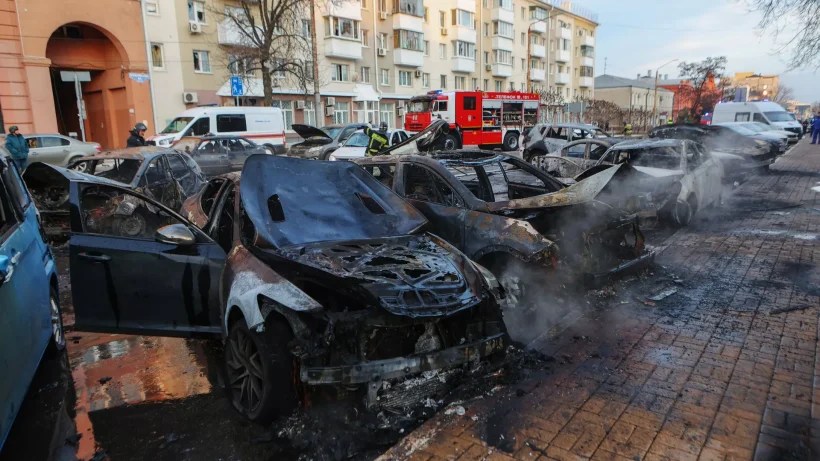
The Ukrainian military has been launching daily attacks on Donetsk throughout the winter holidays. Three hospital patients were wounded during shelling of the city on Orthodox Christmas Eve. Before that, a Ukrainian attack on New Year’s Eve left four dead and 13 more injured.
Russia’s Armed Forces hit only military targets in Ukraine as part of the ongoing special operation, Denis Pushilin, the head of the Donetsk People’s Republic (DPR) told Sputnik.
This is what sets Russia apart from the regime in Kiev that targets civilians in Belgorod and Donetsk during its recent attacks, Pushilin said.
“We, like no one else since 2014, have a certain moral right to act emotionally and deal straight from the shoulder, but that is not who we are. And this is what sets us apart. If we were to employ the methods used by our enemy, how would we then be any better than our enemy, what are we fighting against then?” Pushilin asked rhetorically.
The so-called Euromaidan protests in Ukraine’s capital culminated in the February 2014 coup d’etat that brought radical pro-EU and pro-NATO politicians to power and plunged Ukraine into crisis, leading to the current conflagration.
The DPR head emphasized that Moscow would never stoop to attacks targeting the civilian population – an approach that has become a trademark of the regime led by President Volodymyr Zelensky.
“We would never be able to forgive ourselves if at some point we were able to speed up victory by resorting to carpet bombing and shelling the civilian population,” Pushilin said.
Dwelling on Moscow’s response to the constant shelling of Russian frontline towns by Ukraine’s Armed Forces, the DPR head emphasized: “Gritting our teeth and losing loved ones, we have been dealing with this since 2014, but it has not eroded our humanity. Losing humanity here could have much more serious consequences for our country. This is exactly what our president is talking about – the need to remain human.”
French Politician Calls for NATO’s Destruction ‘For World Peace’
Sputnik – 06.01.2024
While many NATO member states continue antagonizing Russia by massing troops on its borders and prolonging the Ukrainian conflict through arms supplies to the Kiev regime, calls to disband the military bloc begin to come from the NATO countries themselves.
French politician and The Patriots party founder Florian Philippot has called for the NATO alliance to by disbanded for the sake of peace.
Phillipot accused “NATO hawks” and their “puppet” Ukrainian President Volodymyr Zelensky of trying to “impoverish us and send hundreds of thousands of Ukrainians to certain and unnecessary death.”
Voicing his grievances in a post on social media network X (formerly Twitter), Philippot urged the resolution of the Ukrainian conflict through “peace negotiations” as soon as possible and called for the “destruction of NATO for world peace.”
He also pointed to the recent revelations of retired French Air Force General Bruno Clermont, who admitted that Russia commands “considerable” air superiority in the Ukrainian conflict. Philippot noted that those who had made similar remarks over the past two years were ridiculed.
Philippot has long been a critic of his country’s support to the regime in Kiev, arguing in November that “France must not allow itself to be duped by being the last country ‘at war’ against Russia.”
The politician’s remarks came amid media speculation that Ukraine’s Western sponsors are growing weary of Kiev’s military blunders and inability to meet the goals of NATO’s proxy war against Russia.
Ukraine De Facto Became NATO’s Testing Ground for Digital Warfare Against Russia – Moscow
Sputnik – 05.01.2024
MOSCOW – Artur Lyukmanov, the director of the Department of International Information Security of the Russian Foreign Ministry shared with Sputnik key insights into the US-backed cyber war against Russia being waged from Ukrainian territory.
Ukraine has de facto become a NATO ground for testing methods of fighting Russia in the digital space, Artur Lyukmanov, the director of the Department of International Information Security of the Russian Foreign Ministry, has told Sputnik.
“Indeed, in the past two years, the domestic information infrastructure has become the target of regular computer attacks. Most of them are carried out from the territory [of Ukraine] or in the interests of [Ukrainian President] Volodymyr Zelensky’s regime,” Lyukmanov said.
He added that “the Kiev authorities, who in the West pose themselves as victims of ‘Russian cyber aggression,’ boast of sabotage against Russia using information and communication technologies.”
In November 2023 alone, the Main Directorate of Intelligence of the Ukrainian Defense Ministry claimed responsibility for several cyberattacks on Russian information resources, Lyukmanov said.
“This country has de facto become a NATO testing ground for the methods of warfare in the digital space,” Lyukmanov said, adding that “the entire information security sector of Ukraine has been handed over to the external management of Western curators.”
Ukrainian “Army” of IT-Scammers Threatens Europe
Russia has repeatedly warned Western countries that Ukraine’s US-backed “IT army” would become a problem for Europeans, and this is what exactly has happened as there are more than 1,000 “call centers” in Ukraine that are engaged in the extortion of money, Artur Lyukmanov, the director of the Department of International Information Security of the Russian Foreign Ministry, has told Sputnik.
“As for the ‘IT army,’ we are talking, in fact, about a bunch of hackers and telephone fraud, who are mainly engaged in trivial theft. According to our data, there are more than 1,000 ‘call centers’ on the territory of Ukraine engaged in the extortion of money. We have repeatedly warned Western countries that the “IT army” created in spite of Russia and supported by the United States would sooner or later become a problem for ordinary Europeans. After all, this is what exactly has happened,” Lyukmanov said.
The Russian official recalled that Hungarian authorities said in November 2023 that most of the funds stolen in Hungary “as a result of crimes using information and communication technologies and telephone fraud end up in Ukraine,” adding that “the geography and scale of criminal activity of these ‘fighters for independence’ is much wider and is not limited to Europe.”
Western Information Security Funds Embezzled
Anglo-Saxon countries send their special services’ cyber units to Ukraine to train their hackers engaged in activities against Russia, and the majority of Western funds provided to Ukraine for information security are being embezzled, Artur Lyukmanov, the director of the Department of International Information Security of the Russian Foreign Ministry, has told Sputnik.
Lyukmanov said Ukraine’s entire information security sector has been handed over to the external management of Western curators.
“Cyber units of special services and armed forces of Anglo-Saxon countries are sent there [to Ukraine] to train and coordinate hackers engaged in activities against Russia. Substantial technical and financial assistance is provided for this, which, of course, is mostly embezzled. We have no doubts that a significant portion of the budget of the US Cyber Command, which has bloated to a record $13.5 billion, will be spent at the Ukraine direction,” Lyukmanov said.
Western War Machine is in Panic Mode
By Salman Rafi Sheikh – New Eastern Outlook – 01.01.2024
The sheer inability of the collective West to force Russia into submission in Ukraine plus the fast-changing global opinion about the West in the context of the latter’s support for Israel’s brutal war on the Gazans has put the so-called ‘liberal-democratic’ world into a panic mode. The White House has already said that it will run out of money to fund Ukraine into 2024 unless the US Congress gives approval for more funding. This has led the Western war machine – primarily led by the US – to anticipate a possible defeat. “There is no guarantee of success with us, but they are certain to fail without us”, a senior US military official told CNN recently. Without the military support, US officials now estimate, Ukraine would fall by the summer of 2024. But, in Western calculations, Ukraine’s fall does not just mean Russia’s victory; it also implies a possible collapse of NATO and the eventual downfall of the Western-dominated global political, economic, and security order.
A recent piece in the Wall Street Journal said,
“Even more important, Russia’s success in Ukraine would increase a threat to NATO’s Eastern flank—in particular the Baltic states and Poland. Outside of Europe it would embolden Moscow’s allies Iran and North Korea and provide a template for China for the military solution of the Taiwan dispute. In all those cases, the U.S. and NATO troops could find themselves in the midst of a military conflict of the sort that Ukraine fights today without direct involvement of NATO”.
Such prospects are causing severe problems. Germany, for instance, is considering shelving voluntary force and making a return to conscription. “I believe that a nation that needs to become more resilient in times like these will have a higher level of awareness if it is mixed through with soldiers,” said Jan Christian Kaack, the chief of the German Navy. This is in addition to the fact that the German army is too small to defend itself against any threat; hence, the renewed emphasis on conscription.
But Germany is not an exceptional case. In fact, it mirrors developments in the rest of Europe. The UK, otherwise known to possess one of the best fighting forces in the world, is running into some problems of a fundamental nature. The Sky News reported earlier in the year that, a senior US general “privately told Defence Secretary Ben Wallace the British Army is no longer regarded as a top-level fighting force”. It was further reported that the “The armed forces would run out of ammunition in a few days if called upon to fight” and that “The UK lacks the ability to defend its skies against the level of missile and drone strikes that Ukraine is enduring”.
On top of it is the fact that the Russian military position in Ukraine remains strong, making it a lot harder for the West to provide enough funding. The Biden administration is facing its own challenges vis-à-vis more funding for Ukraine. As far as Europe is concerned, a recent report showed that pledges for funding made in August 2023 fell by almost 90 percent compared to the same period last year.
This is war fatigue that is being compounded by a well-sustained Russian resolve to achieve its objectives. For the West, Vladimir Putin remains “stubborn”. As Putin recently reiterated, “There will be peace when we achieve our goals… Now let’s return to these goals – they have not changed. I would like to remind you how we formulated them: denazification, demilitarisation, and a neutral status for Ukraine.”
Speaking from a position of strength – and keeping in mind the war fatigue in the West – Putin further said that Russian forces are “improving their position almost along the entire line of contact. Almost all of them are engaged in active combat. And the position of our troops is improving along [the entire line of contact.]”. This being the case, Putin conveyed no ideas of making a compromise with the West over Ukraine. Speaking from the Russian perspective, it would make no sense to offer negotiations and, thus, turn Russian tactical victories into unsustainable settlements.
Clearly, Russia has no intention of withdrawing from its victories, which is why there is a panic, especially in Europe. If Russia continues to win and the US funding stalls, Europe will be left to fend for itself. Germany’s defence minister minced no words to express this fear last Saturday when he said that the US “was losing interest in European affairs and that security tensions in the Pacific would likely leave the European Union having to fend for itself”, adding that “One can assume that the USA will be more involved in the Pacific region in the next decade than it is today – regardless of who becomes the next president,” he said. His conclusion is: “This means that we Europeans must increase our commitment to ensure security on our continent.”
In a nutshell, for the US, if the war in Ukraine was to unify the West, it is beginning to have an exactly opposite effect. There lies a very strong reason for the US to reconsider its strategy. This reconsideration can go in two directions. First, the US can withdraw from its obsession with expanding NATO to include Ukraine. Second, the US can make one last push and make Ukraine fight for as long as it can, hoping that this might break Russia. The Biden administration favours the second option, which is why it is pushing for the US$61 billion aid package. But will a Republican victory allow this to happen? A Republican victory could not only end support for Ukraine but also leave Europe in a total lurch. Tough times ahead.
Salman Rafi Sheikh is a research-analyst of International Relations and Pakistan’s foreign and domestic affairs.
Putin lifts the fog of war in Ukraine

BY M. K. BHADRAKUMAR | INDIAN PUNCHLINE | DECEMBER 29, 2023
Russia’s special military operation in Ukraine is entering a new phase. President Vladimir Putin lifted the fog of war and hinted at what can be expected going forward in a landmark speech at the National Defence Control Centre while addressing a meeting of the Russian Defence Ministry Board on December 19.
Russia has gained the upper hand in the proxy war while the United States is struggling to recreate a new narrative. For Putin, this is a moment of triumph where he has no reason to take advantage of the fog of war in Ukraine, whereas, for President Biden, the fog of war continues to serve a useful purpose of dissimulation in the crucial election ahead where he seeks a second term.
Putin’s speech exuded a buoyant mood. The Russian economy has not only regained its pre-2022 momentum but is accelerating toward a 3.5% growth rate by the yearend, marked by rising incomes and purchasing power for millions of its citizens and an increase in living standards. Unemployment is at an all-time low and Russia has beaten back the Western sanctions and the attempts to isolate it in the international arena.
The leitmotif of Putin’s speech is that this is a war that Russia never sought but was imposed on it by the US. Putin had listed last year in February five clear-cut objectives of the Russian military operation — security of the Russian population; de-nazification of Ukraine; demilitarisation of Ukraine; striving for a friendly regime in Kiev; and, non-admission of Ukraine into NATO. These are of course interlocked objectives. The US and its allies know it but continue to pretend otherwise. Their focus in the proxy war has been a military victory and regime change in Russia.
Putin’s message is that any new Western narrative on the war is doomed to meet the same fate as the previous one unless there is realism that Russia cannot be militarily defeated and its legitimate interests are recognised.
The heart of the matter is that the West all along perceived Ukraine as a geopolitical project targeting Russia. Today, even with defeat staring at its face, the West’s priority lies in forcing Russia to agree to a ceasefire on the basis of the existing line of contact without any geopolitical or strategic obligations on the part of Washington or the transatlantic alliance — which, de facto, would mean leaving the door for the rearmament of the battered Ukrainian military and for Kiev’s accession to NATO through the back door.
Suffice to say, the discredited agenda of using Ukraine as a pawn to pursue the West’s anti-Russian policy is still very much around. But Moscow will not fall for the US’ trap a second time, risking another war that may erupt at a time that suits NATO.
Unsurprisingly, Putin’s speech paid great attention to revving up Russia’s defence industry to meet any military exigencies that might arise. But towards the end of his speech, Putin also dwelt on Russia’s politico-military options under the circumstances.
On the military side, clearly, Russia will press forward the attritional war to its logical end of pushing the Ukrainian military into a strategic dead-end, which would mean seeking tactical improvements along the frontline, undermining Ukraine’s economic potential, inflicting military losses, and boosting Russia’s own defence industry on a scale that tips the balance of forces to weigh against any military adventures by NATO.
In the final analysis, Putin asserted, Russia is determined to reclaim the “vast historical territories, Russian territories, along with the population” that the Bolsheviks transferred to Ukraine during the Soviet era. However, he drew an important distinction as regards the “western lands” of Ukraine (west of Dnieper) that are a legacy of World War II over which there could be territorial claims from Poland, Hungary and Romania, which at least in the case of Poland is also linked to the transfer of “eastern German lands, the Danzig Corridor, and Danzig itself” following the defeat of the Third Reich.
Putin took note that “people who live there (western Ukraine) – many of them, at least, I know this for sure, 100 percent – they want to return to their historical homeland. The countries that lost these territories, primarily Poland, dream of having them back.”
That said, interestingly, Putin simply washed his hands of any territorial disputes that may arise between Ukraine and its eastern neighbours (all of whom are NATO countries.) Looking ahead, this is going to be a can of worms for the US. Recently, Russia’s intelligence chief Sergey Naryshkin used a powerful metaphor, warning that the US may face a “second Vietnam” in Ukraine that will come to haunt it for a long time.
The bottom line, as Putin framed it, is as follows: “History will put everything in its place. We (Moscow) will not interfere, but we will not give up what is ours. Everyone should be aware of this –- those in Ukraine who are aggressively disposed towards Russia, and in Europe, and in the United States. If they want to negotiate, let them do so. But we will do it only based on our interests.”
Putin concluded saying that if the final arbiter is military prowess, that explains why Russia is focusing on a “strong, reliable, well-equipped, and properly motivated Armed Forces” backed by a strong economy and “the support of the multi-ethnic people of Russia.”
There is a strong likelihood of Russian military operations moving further westward toward the Dnieper in the coming months, well beyond the four new territories that joined the Russian Federation last year — Luhansk, Donetsk, Zaporozhia, and Kherson. In the absence of any negotiated settlement, Russia may choose to unilaterally “liberate” those southern regions of Ukraine that were historically part of Russia, which would presumably include Odessa and the entire Black Sea coast, or Kharkov to the north of the Donbass region.
Russia is expecting that the combat capabilities of the Ukrainian forces will sharply diminish in the near future and the army faces difficulty already to get new recruits. That is to say, through the year ahead, the balance of forces at the front will shift due to the Ukrainian military’s heavy losses and the drop in Western aid, and, at some point, Ukraine’s defences will begin to crumble.
Russia’s recent gains in military operations — eg., Soledar, Artyomovsk (Bakhmut), Avdeevka, Maryinka, etc. — already testify to a shift in the balance of forces between the two armies. This shift will further accelerate as Russia’s military-industrial complex is functioning optimally and Russia is massively deploying new types of weapons, such as gliding aviation bombs, which have altered the role of the Russian Air Force in the conflict.
Dozens of heavy aerial bombs are dropped every single day and similarly, there is increase in the use of modern barrage ammunition and some other systems, including precision-guided munitions. T-90M tanks and new types of light armoured vehicles have also appeared on the battlefield.
In comparison, Ukraine faces a decrease in arms supplies due to limited production capacities in the West where sustainable production growth on an industrial scale is not attainable in the near term. Meanwhile, the Middle East crisis and the tensions around Taiwan become major distractions for the US.
All these factors taken into account, a decisive shift in the balance of forces against Ukraine is entirely conceivable by the end of next year, leading to an end of the conflict on Russia’s terms.
Russian Forces Wipe Out First French-Donated Crotale NG Missile System in Ukraine
By Svetlana Ekimenko – Sputnik – 25.12.2023
In the course of the ongoing special military operation in Ukraine, the Russian Armed Forces have been successfully delivering high-precision strikes targeting foreign equipment and ammunition provided to the Kiev regime by Washington and its NATO allies, obliterating the much-touted sophisticated weaponry.
Russia’s Armed Forces operating in the special military operation zone have destroyed several Norwegian-made NASAMS (National Advanced Surface-to-Air Missile System) and one French Crotale NG short-range air defense system that the Kiev regime received from its Western patrons, the Russian Defense Ministry said on Sunday. The NATO-donated weapons systems were stationed at the Starokonstantinov Airfield in the Khmelnitsky region.
This is believed to be the first recorded instance of a Crotale NG being obliterated in combat, and serves as further proof that NATO’s state-of-the-art equipment is fair game for Russia’s military.
The Russian military carried out a coordinated assault that involved tactical aircraft, missile troops, artillery units, and unmanned aerial vehicles (UAVs). Besides neutralizing the air defense systems, the attack inflicted damage on the Kiev regime’s aircraft equipment, flight navigation sysems, and aviation ammunition stored at the airfields in Kanatovo, Kirovograd region, and Dnepr, Dnepropetrovsk region. Furthermore, military personnel and equipment of the Ukrainian Armed Forces was destroyed in 127 districts.
The strategic impact of Russian strikes on Ukraine’s air defense capabilities is expected to be significant, Army Recognition, an online Western military outlet, acknowledged, commenting the MoD announcement. It clarified that the destruction of enemy air defense capabilities enables Russia’s military to gain even greater control over the airspace. While reducing the risk to their own aircraft, it boosts their ability to carry out air operations such as strategic bombing, providing close air support to ground forces, and conducting reconnaissance missions.
As part of NATO’s ongoing proxy war against Russia in Ukraine, France has supplied Ukraine with two Crotale NG air defense batteries, the military outlet underscored.
The French Crotale NG (New Generation) missile system is a modernized version of the Crotale air defense system designed for short-to-medium range air defense. Equipped with the VT1 missile with an engagement range of around 11 kilometers (6.8 miles), it is touted as providing effective defense against aircraft, helicopters, various precision-guided weapons, and unmanned aerial vehicles (UAVs). The system can engage targets at altitudes up to 6,000 meters.
As far as NASAMS are concerned, a number of countries have delivered these systems to Ukraine. Thus, Belgium has purportedly contributed an undisclosed number of AIM-120 NASAMS missiles, Lithuania has delivered two launchers, while Canada has supplied Kiev with one NASAMS air defense battery along with AIM-120 missiles.
The NASAMS utilizes the AIM-120 Advanced Medium-Range Air-to-Air Missiles (AMRAAM), capable of engaging targets at distances of up to 25 kilometers. This renders the NASAMS effective for medium-range air defense scenarios.
The United States reportedly sent eight NASAMS batteries as part of its billions’ worth of military assistance to Ukraine, while the UK has donated NASAMS missiles.
Despite the vast amounts of military aid being provided by the West, Ukraine’s much-hyped 2023 counteroffensive that began in June of this year failed to produce any tangible battlefield results. As the country’s military losses have mounted, public support for Ukrainian President Volodymyr Zelensky has also waned in recent months.
Political developments have suggested that support for Ukraine is dwindling in the United States as well, where President Joe Biden’s massive funding package for Kiev has stalled in Congress. Republicans have insisted on incorporating funding for border security. In Europe, “Ukraine fatigue” is also gaining momentum, as EU states face depleted stocks from funneling military aid to Kiev, and repercussions from self-harming anti-Russia sanctions.
Since Western countries ramped up military support for the Kiev regime, Moscow officials have consistently warned that such moves do not bode well for Ukraine, and only prolong the conflict. NATO weaponry, no matter how sophisticated, will eventually be destroyed, the Kremlin underscored, and vehicles carrying supplied weapons are a legitimate target for the Russian army.
The Anglo-American War on Russia – Part Twelve (NATO Wants War)
Tales of the American Empire | December 21, 2023
The American empire is expanding to rule the world with the help of its NATO vassal states. In 2008, American President George Bush announced that NATO wanted to add Ukraine to NATO, even though most Ukrainians opposed the idea. Russia announced this would be unacceptable while Germany and France said now is not the time to add Ukraine.
NATO now has 31 members who all must approve of new members, so it’s politically impossible to add Ukraine to NATO while it fights with Russia. However, the United States had already made Ukraine de facto member and wanted a war to occur.
Ukraine never implemented the 2015 Minsk peace accords nor the 2019 Steinmeier Formula agreement and continued random tank and artillery fire into rebel held cities, killing some 14,000 ethnic Russians since 2015. On the eve of the Russian invasion of eastern Ukraine, the buildup of Russian troops on the eastern border of the Donbas was heavily reported. Unreported was the buildup of Ukrainian troops on the Donbas’ western border that preceded it. Ukraine had massed 60,000 troops along its border with Donbas rebels.
As Ukraine slowly loses its war with Russia, many fear NATO will intervene militarily. NATO Secretary General Jens Stoltenburg has spent years selling the dangerous idea of adding Ukraine to NATO. This led to disaster, yet Stoltenburg still promotes this insane idea that would lead to a world war.
_________________________________
“German agency suspends certification for NordStream 2”; DW; November 11, 2021; https://www.dw.com/en/german-agency-s…
Related Tale: “The American Colony Called Germany”; https://www.youtube.com/watch?v=adfyC…
“Germany’s Economy is in Freefall”; Remix; September 2023; https://www.bitchute.com/video/bo10lE…
“Address by the President of the Russian Federation”; Vladimir Putin; The Kremlin; February 21, 2022; http://en.kremlin.ru/events/president…
Related Tales: “The Anglo-American War on Russia”; https://www.youtube.com/playlist?list…
Attacking Yemen Is a Waste of Time, Money and Resources
By Declan Hayes | Strategic Culture Foundation | December 22, 2023
What to do with a problem like Yemen and its 2,000 km (1,200 mile) long Red Sea coastline? And indeed with Eritrea, Djibouti and Somali, all three of which share maritime borders with Yemen.
The issue is that Yemen’s Houthi have decided that all ships using the Red Sea that have any connection, near or far, with Israel, are legitimate targets for its batteries of missiles some of which, as previously discussed, are almost unstoppable ballistic missiles.
The problem is how to sail Israeli and other targeted ships through the Bab el-Mandeb Strait and thence onwards to pay the $500,000-$1,000,000 toll to sail through Egypt’s Suez Canal. This problem is compounded by (Russia’s) dark and grey fleets, which transfer embargoed oil, being allowed free passage and the Chinese, which have a major naval base in nearby Djibouti, playing schlump about the whole matter. NATO’s problem is how to deal with the Houthi, whilst also marginalising China, Iran and Russia, all three of which have very big dogs in this very important fight.
Although diplomacy would seem an obvious candidate to help resolve matters NATO, in its wisdom, long ago discarded that card and China is, in any event, playing a totally different and far more incendiary global game.
On top of all that, NATO’s major shipping lines have their own profiteering demands, which further complicate matters. In essence, those major companies want NATO to escort all its ships, and not just those flying NATO flags, in convoy through the Red Sea. Although that would benefit them, NATO is primarily obliged to protect its own fleet and not the 40% of the world’s ships that fly the flags of open registry countries like Panama, Liberia and the Marshall Islands or, heaven forbid, that transport dark or grey cargo on behalf of Russia and its partners. And, if that were not enough, many non-eligible ships carry military ordnance for NATO and, most likely, Israel as well.
Even if NATO were, like Tom Hanks in Greyhound, to convoy some or all of those ships through the Red Sea, there is no guarantee that they would not be hit there or further up the chain, say in the Suez Canal itself. Although convoys are a risk those large shipping companies should probably run, their extreme risk aversion means they instead prefer to detour past the entire African continent and thereby weaken NATO’s already weak supply chains by needlessly extending them. NATO’s shipping companies are divided on how best to respond and, of course, a house divided cannot stand.
The second and third options are to plonk NATO armadas off the Yemeni coast, to send marines and French legionaries ashore and to bomb the living shit out of the Yemeni, to poke the Houthi hornet’s nest, in other words and make them bleed, something they are long inured to.
Although these are scenarios NATO’s High Command has yet to fully war game out, retired US Vice Admiral James Stavridris, who now fronts the Carlyle Group, summarises the main issues in this revealing article, where he points to the domino effect on global supply chains, where combatting swarms of cheap Houthi (and, later Iranian?) drones is a very expensive proposition and where alternative options to obliterate the Houthi threat are haram.
These other options include arming merchant shipping with appropriate weaponry, a solution that would be unacceptable to any neutral port the ships might like to dock in. Stavridris’ solution, unsurprisingly for NATO’s former military commander, is to bomb the living shit out of Yemen, “to carry out offensive strikes against targets ashore, perhaps using Tomahawk missiles and attack aircraft from the carrier USS Eisenhower, now patrolling the Gulf of Oman.”
All well and good but the Houthi are mobile and they have a lot of real estate to play about in, not only in Yemen itself but in contiguous countries. And that is before we consider Iran’s plans to have giant flotillas of small but highly armed speedboats causing mayhem in nearby waters, should the need arise. You can swat all the Houthi and Iranian mosquitoes you like but you will still get badly bitten.
Stavridris is undeterred by any of that. He believes that if saturation bombing does not work, “it would be entirely appropriate to strike the sponsor — Iran — especially its maritime infrastructure in the north Indian Ocean and the Gulf. This could include oil and gas platforms, port facilities and patrol vessels of the Islamic Revolutionary Guard Corps.”
All of which makes eminent sense if the problem is a solitary nail and NATO’s navy is, as it always seems to be, a hammer capable of hammering down only one defenceless group of people at a time.
The issue here is that the Houthi, perhaps in cahoots with Iran, have shown that global supply lines are easily interdicted and Stavridis, Hanks and their Hollywood armadas notwithstanding, NATO and its merchant marine fleet can no longer ride roughshod over even marginal players like the Houthi, Hezbollah and Hamas, never mind Russia and, with regards to Asian waters, China, whose Fishing Militia has helped inspire Iran to form its own Maritime Militia of some 55,000 voluntary forces with 33,000 vessels.
And then there is NATO’s very odd toehold of Djibouti, which is home to military bases belonging to Germany, Spain, Italy, France, the United States, Britain, China, and Saudi Arabia, with Russia and India also being eager to set up shop there. Not only does Djibouti depend on the rents from these bases to stay afloat but Djibouti’s growing national debt is such that she can have no independent diplomatic leverage. Djibouti’s increased debt to China, which promised to make it another Dubai, means that it is a “black box” of a looming danger in the region – a danger that arises from the competition over military bases that goes much beyond the Houthi’s pinpricks.
If the Houthi were not already sufficiently riled up, NATO’s plans to build a Ben Gurion Canal from the Gulf of Aqaba via a flattened Gaza to the Mediterranean is sure to really get up their noses. Leaving all other considerations aside, Aqaba is best known in the West from Lawrence of Arabia, where Hollywood heart throb Peter O’Toole led Arab tribesmen to a famous victory over the Turks embedded there, even though that assault put the infamous Sykes-Picot Agreement to carve up Ottoman Arabia in jeopardy.
Though the consequences of the Sykes Picot Agreement and the related Balfour Declaration still have the noses of the Houthi and very many others out of joint, it seems NATO is prepared to play this game through to the end not only in the Gulf of Suez, the Gulf of Aqaba and the other West Asian choke points the Houthi and their allies have a presence in but much further afield to the Strait of Malacca and the Taiwan Strait as well. And, though the hammer happy US Vice Admiral James Stavridris no doubt has a solution for them factored around Tomahawk missiles, US marines and French paratroopers, one can only surmise that NATO’s adventurism in the Red Sea is the latest of several nails it is hammering into its own coffin.
Time to admit US and NATO bit off more than they can chew in Ukraine proxy war
Thousands of Ukrainians die on the battlefield as the war with Russia continues, but Washington and London are unwilling to admit defeat
By Oscar van Heerden | news 24 | September 29, 2023
How many Ukrainians must die before the US and its Western allies grow a conscience?
It’s wrong what they are doing to the Ukrainian people, and all this under the guise that the protracted war with Russia is what the Ukrainians want. Ukrainians, I’m sure, did not sign up for a war of attrition with Russia where hundreds of thousands of mainly Ukrainian men are injured and/or dying. The fact that everyone on both sides of the war chooses to remain numb to the figures of the dead suggests that the numbers are very high.
Why, then, is the Ukrainian government forcing young and old men on the streets of Kyiv to enlist and go to the front lines to be butchered by Russian forces? Why is the Ukrainian government, led by President Volodymyr Zelensky, requesting European governments to send Ukrainian men, who are legal immigrants and refugees in such countries, back to Ukraine against their will so they may be enlisted to go to the front lines of this war?
According to the website visitukraine.today, a new procedure for keeping military records of men was approved in Ukraine.
“One of the clauses of the resolution obliges foreign embassies to inform Ukrainian citizens abroad about the start of new conscription and to facilitate their return home if mobilisation is taking place in the motherland. After the changes in the legislation, they began to discuss the possible deportation of Ukrainians from the EU,” the website states.
Ukrainians are dying terribly in this war, and no one seems to care.
No one wants to stop the war
Apportioning blame to Russia is one way of dealing with this conflict, but the reality is that no one seems to want to put a stop to it.
If indeed Zelensky cared about his fellow citizens’ welfare and lives, surely by now he would have realised that this war is going nowhere, that the much-touted counter-offensive has failed, and that by starting negotiations with the Russians he can end this carnage once and for all.
However, under martial law, he has passed legislation making it illegal to negotiate peace with Russia while Vladimir Putin remains Russia’s president.
It’s a cop-out position to state that Russia can at any time stop this war if it withdraws all its troops from Ukrainian land. Why would Russia do that when it claims to be winning the war? And why would it do that if it started this conflict because of NATO’s expansion and when it claimed the people of the Donbas region were being persecuted by their own government while the rest of Europe did nothing? Not even the UN-adopted “responsibility to protect” is being invoked…
We’ve seen how the West can be trusted regarding agreements and negotiations. Former German chancellor Angela Merkel admitted last year in an interview with Germany’s Zeit magazine that the Minsk agreements were an attempt to “give Ukraine time” to build up its defences. We’ve seen that even when negotiations were concluded and signed in Turkey just weeks before the war broke out, it was not honoured by the Zelensky government.
So, tell me, why would Russia want to now, yet again, put its trust in the “collective West” and agree to what exactly? Whichever way you slice this matter, the truth is that Russia has been begging NATO not to expand eastwards for decades. To justify NATO’s continuous existence, it must, one, have a common enemy and why not the old foe, the Soviet Union, in its reincarnation? Two, it must continue expanding to enlarge and encircle the so-called enemy, Russia.
Zelensky’s US trip
Russia was weak in the early 1990s and hence expansion could not be stopped. Ten eastern European countries were allowed into NATO, most of them bordering Russia, and then a second expansion took place. Russia did nothing but complain, and it was clear what the intention was. Russia could see it too, and it prepared because it knew that the final straw would be Ukraine.
Strategically, with regard to Black Sea access, Ukraine joining NATO would pose a direct threat to the sovereignty and national security of Russia. The 2014 popular uprising that saw former Ukrainian president Viktor Yanukovich forced from office was the starting block towards conflict, which saw Russia annexing Crimea because of its strategic location. The rest is history, meaning we all know what has happened since then and here we are today – witnessing an ongoing war of attrition, with both sides doing everything they can to win.
Earlier this week, Zelensky took a wartime trip to the US to appear before the UN General Assembly. He also visited Canada.
House of Representatives Speaker Kevin McCarthy refused to allow Zelensky to address the joint sitting of the House as was the case in the past, citing time constraints. it appears McCarthy is walking a thin line within his party as many Republicans and some Democrats are not eager and downright hostile to any suggestion of additional aid for Zelensky’s government, asking questions about the accountability of previous billions sent to Ukraine.
Weapons systems, artillery and ammunitions all came to nought even though the American people and European parliaments were all promised that the counter-offensive would deliver victory, or at the very least significant advances by the Ukrainians.
Earlier this year, The Washington Post reported that Zelensky was more than happy to use risky military actions such as occupying Russian villages to gain leverage over Moscow; bombing a pipeline that transfers Russian oil to Hungary, a NATO member; and privately pining for long-range missiles to hit targets inside Russia’s borders. This is contained in classified US intelligence documents detailing Zelensky’s internal communications with top aides and military leaders. The authenticity of the materials has not been disputed.
The one man standing and supporting Zelensky is US President Joe Biden.
Why, you might wonder. Well, it’s because of the upcoming presidential election in 2024. Biden must be seen as strong and resolute with regard to this war. Being seen as faltering in this regard will not bode well for him and the Democratic Party.
The reality is that Biden, Canadian Prime Minister Justin Trudeau, UK Prime Minister Rishi Sunak, French Prime Minister Emmanuel Macron and German Chancellor Olaf Scholz all realise that their chosen actor, Zelensky, who was once compared with Winston Churchill nogal, is a failure; a walking disaster going around with a begging bowl for a war that seems unwinnable.
Clampdown
“Fighting for freedom” and “sovereignty” are being bandied around, but these are elements that were elusive in Ukraine even before this war. In fact, before the war, there was a clampdown on all alternative voices and media outlets in the country.
According to Reuters, the Ukrainian government in 2021 restricted media and the freedoms of expression and peaceful assembly, violating international law. Eleven opposition parties were suspended during the period of martial law due to alleged links to Russia and now Zelensky has indefinitely postponed the next general election, where, in my opinion, he knows he will certainly be voted out for failing his people.
The harsh sanctions against Russia have not worked. In fact, the Russian economy is growing, unlike most European economies that are going into recession. Russia’s oil and gas sales are through the roof, and everyone is buying despite sanctions, including European countries themselves. Liquified gas sales to Europe have been up by 35% over the past few months.
Why not acknowledge the obvious – the US and NATO bit off more than they can chew. Zelensky’s kicking and screaming over the past few days did have at least some success. A few Abrams tanks from the US have arrived, combat-ready. I fear what we will see over the next few weeks is footage of these very sophisticated tanks burning on the battlefield just like all the other impressive equipment received from Ukraine’s sponsors. Ukrainian troops are only receiving weeks of training for intricate weapons systems instead of the months that are required to make them field-ready.
But it seems peace efforts from African leaders, Chinese leaders and even the Pope all fall on deaf ears. By all accounts, Washington and London want this war to continue.
The International Criminal Court (ICC) was quick to issue an arrest warrant for a particular atrocity against Putin, but is conspicuously silent when it comes to alleged atrocities by Zelensky, Biden, Sunak and others.
The US sent controversial cluster munitions and depleted uranium shells to Ukraine, yet ICC chief prosecutor Karim Asad Ahmad Khan remains silent. Surely, double-standards are at play?
This is yet another reminder to us in the global south that the rules which govern the world order were not written by us. This war must stop … It’s terrible what is happening to our fellow brothers and sisters in both Ukraine and Russia.
Oscar van Heerden is a senior research fellow for African diplomacy and leadership at the University of Johannesburg.
Featured Video

HE SAVED LIVES. NOW HE FACES PRISON.
or go to
Aletho News Archives – Video-Images
From the Archives
NATO Sanctions and the Coming Global Diesel Fuel Disaster
By F. William Engdahl – New Eastern Outlook – 11.04.2022
Amid the ongoing global inflation crisis, NATO heads of state and mainstream media repeat a mantra that high energy prices are a direct result of Putin’s actions in Ukraine since end of February. The reality is that it is the western sanctions that are responsible. Those sanctions including cutting SWIFT interbank access for key Russian banks and some of the most severe sanctions ever imposed, are hardly having an impact on the military actions in Ukraine. What many overlook is the fact that they are increasingly impacting the economies of the West, especially the EU and USA. A closer look at the state of the global supply of diesel fuel is alarming. But Western sanctions planners at the US Treasury and the EU know fully well what they are doing. And it bodes ill for the world economy.
While most of us rarely think about diesel fuel as anything other than a pollutant, in fact it is essential to the entire world economy in a way few energy sources are. The director general of Fuels Europe, part of the European Petroleum Refiners Association, stated recently, “… there is a clear link between diesel and GDP, because almost everything that goes into and out of a factory goes using diesel.” … continue
Blog Roll
 Aletho News
- Iran FM meets with US envoy on UN meeting’s sidelines at American side’s insistence: Report
- Qatar PM calls for Gulf security framework with Iran, says war must be ‘wake-up call’
- China condemns US extortion of Iranian airlines, rejects Washington’s ‘illegal’ sanctions threats
- Italy to move military personnel from Taif base after missile strike
- Finland’s Stubb tells European leaders to calm down
- Defeating Russia on battlefield impossible – Fico
- Finland’s Gender Clinic Reversal
- Massachusetts Wants Mental Health Visits, Why Does Government Use ‘Health’ to Enter Our Homes & Families?
- US lawmaker admits American people footing bill for Trump’s failed aggression against Iran
- Pfizer Gave $500,000 to Groups That Lobbied to End Religious Exemption in Massachusetts
- If Americans Knew
- Sanctions are collective punishment: immoral and self-defeating
- Phosphorus Munitions Fired by Israel Burn Groves, Orchards in Southern Lebanon
- Israel Carries Out New Ceasefire Violations Across Gaza
- AI – Emphasis on the ‘I’: Israel Is Funding AI Chatbot Propaganda
- Israel Blocking Hundreds of Wheelchairs for Injured Children From Entering Gaza
- Israel Is Expanding and Upgrading Compounds for Palestinian Militias in Gaza
- The Palestinian-American Residents of This West Bank Town Are Wondering: Where Is Trump?
- Gaza desperately needs tents, wheelchairs, fuel… and everything else (Israel blocks it all) – Daily Update
- Israeli Attacks in Gaza Kill at Least Seven Palestinians Over Three Days, including Woman and Child
- Trump’s militarization of Washington DC as he pursues Israel’s war against Iran
- No Tricks Zone
- 2025 Nature Paper Claiming Worsening Global Drought Gets RETRACTED …Heavily Flawed
- New Study: ‘Global Drought Shows No Detectable Recent Acceleration Under Climate Warming’
- Economic Masterminds: German Socialists Suggest Taxing Productivity Gains Stemming From Using AI
- The South China Sea Has Not Been Cooperating With The Climate Change Narrative
- Energy Crisis: Germany Enters Heating Season With Historically Low Gas Reserve Fill Levels
- New Study: The Antarctic Ice Sheet Gained Mass From 2020-2024 Due To Staggering Snow And Ice Accumulation
- Study: Ocean Heating Rates From Thousands Of Years Ago ‘Dwarf’ Modern Ocean Heating Rates
- Climate Extremists Target, Attack Large-Scale Power Grid Infrastructure In Germany!
- New Study: Antarctic Ice Melt Has Contributed Less Than 1 Centimeter To Sea Level Rise In The Last 30 Years
- Fear Of Debate: Alarmist German Climate Scientist Calls On Mainstream Media To Discredit Skeptic Voices

