US plans to build diplomatic compound on Palestinian land in East Jerusalem: Rights group
MEMO | July 12, 2022
The US is planning to build a diplomatic complex on private property confiscated from Palestinians in occupied East Jerusalem, a rights organisation said Sunday, Anadolu News Agency reports.
In a statement, the Legal Center for Arab Minority Rights in Israel (Adalah) said they have found new evidence that the land on which the diplomatic compound is to be built under a joint US-Israeli plan is located on private property taken from Palestinians.
“The land on which the US Diplomatic Compound is to be built is registered in the name of the State of Israel, but it was confiscated illegally from Palestinian refugees and internally displaced Palestinians using the 1950 Israeli Absentees’ Property Law,” it noted.
Recalling an upcoming visit by US President Joe Biden to Israel, Adalah said the descendants of the original owners of the property, including US citizens and Palestinian residents of East Jerusalem, demand the “immediate cancellation of the plan”.
“If built, the US embassy compound will be located on land that was seized from Palestinians in violation of international law,” the statement added.
Biden is scheduled to arrive in Israel on 13 July, as part of a tour that will also include the West Bank city of Ramallah and Saudi Arabia.
The (almost) unbelievable story of an Israeli killer – and the lies that are protecting him
By Kathryn Shihadah | Israel-Palestine News | July 10, 2022
After Ali Harb’s gruesome death last month, the chronicle of events that followed was unsurprising to Palestinians living under Israeli occupation, but mind-boggling to most of the rest of the world.
Eyewitnesses to the incident on June 21 describe what began as a fairly routine episode: Israeli settlers (illegal under international law), spurred on by radical ideology, often show up on Palestinian private property to harass or provoke the indigenous Palestinians. Sometimes the settlers come with the intention to pitch a tent – creating an illegal “outpost” which can be the first step in annexing a piece of property.
These incidents sometimes play out with the Palestinians hiding in their homes for safety; at other times, they confront the settlers and tell them to go away. Often, Israeli soldiers accompany the settlers, protect them, and arrest (or shoot at) the Palestinians who refuse to give in.
In this case, a crowd of about 15 settlers – with Israeli soldiers watching – began constructing an outpost on the Harb family land. “When we tried to prevent them,” explained Harb’s cousin Naim, “one of the settlers took a knife and stabbed Ali in the chest.”
Another relative, Zaid, added, “The police and army were just a few meters away from us, but they did not do a thing to the stabber.”
Eyewitnesses maintain that the Palestinians’ actions before the stabbing had been nonviolent.
As Ali Harb lay bleeding on the ground, “the military pointed their weapons at us and fired in the air,” according to another relative, Firas.
Eventually, bystanders were permitted to move Ali. Firas explained, “We carried him for a distance of approximately two kilometers [about 1 ¼ miles)…while he bled, until we got to the ambulance.” Ali was pronounced dead at the hospital.
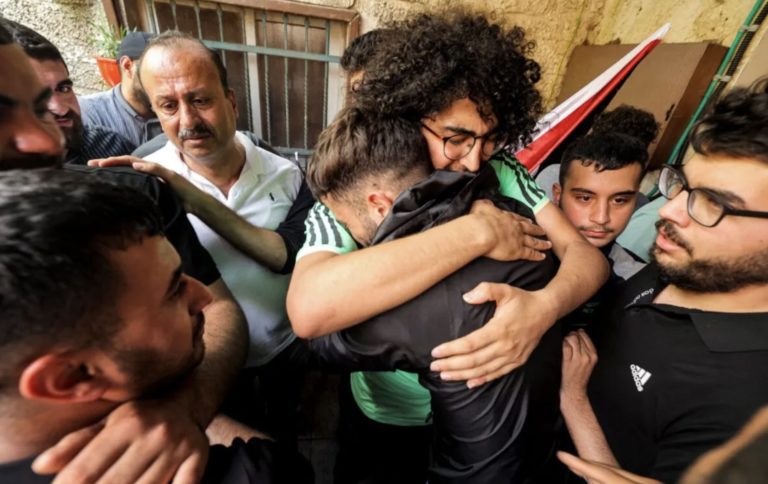
Family of Ali Harb mourn his death after a settler stabbed him in the heart. (ajplus/Twitter)
Official Israeli version
The official Israeli version of the incident differs, as is often the case.
A spokesperson for the Israeli military claims that a “violent confrontation” between settlers and Palestinians had already taken place when the soldiers arrived – the account emphasized that the confrontation had taken place before they arrived.
Soldiers allegedly noted a wounded Palestinian, and offered to put him in a military ambulance and take him to a hospital so he could get “the necessary medical treatment.” The official narrative asserts that the Palestinians refused.
Aftermath
A few days later, Israeli soldiers arrested members of the Harb family in a 2 am raid that included stun grenades.
One of those arrested described the interrogation: “They concentrated on the fact that we had said the army and police were present when the incident occurred – they tried to tell us they weren’t there when it happened…That was all they asked about.”
He added, “I maintained my testimony that the settler stabbed Ali in front of the soldiers, just as I had said in my declaration to the Israeli police just after the killing happened.”
Israeli intelligence arrested a 44-year-old Israeli settler; hundreds of Israelis, among them far-right members of the parliament, protested the arrest, demanding the killer be set free.
“Self-defense”
In fact, on Tuesday, July 5th, the settler who killed Ali Harb was released to house arrest.
The Israeli newspaper Ha’aretz reports: “Police are now regarding the case as one of reckless homicide… rather than a more serious charge of murder.” If convicted, the maximum sentence would be 12 years. (Reckless homicide is a form of involuntary manslaughter.)
The settler, who was trespassing on private Palestinian property and being asked to leave, has claimed that the stabbing was in “self-defense,”
Shin Bet investigators do not regard the incident as “deliberate” or “terrorism.”
Outpost violence
While all of Israel’s settlements in the Palestinian West Bank are illegal under international law, outposts are not even officially recognized by Israel; nevertheless outposts receive funding and military support from the state.
The violence used to intimidate and ultimately ethnically cleanse the Palestinians from the land has been practiced since the founding of Israel, and even before – and generally goes unacknowledged and unpunished by the state.
Palestinian activist Ghassan Daghlas explains,
The Israeli government has given the settlers a green light to take over any land they can take by force.
In the Salfit region alone [where Ali Harb was killed], there are 24 settlements and settler outposts, and they are among the most violent settlers in the West Bank.
Palestinians in the region have no protection, and they have to come out to protect their lands, risking their safety and lives.
Settlers come out to establish new outposts on Palestinian land because they know that they have the army and the government’s protection, and that’s why they attack Palestinian farmers and villagers as well.
Palestinian leaders stress that killing of Ali Harb is yet another outcome of Israeli impunity – including Israeli settlers – in the international community.
Of the 650,000 Israeli settlers living on Palestinian land in the West Bank and East Jerusalem, not all seek to expand further, as did those who were involved in the killing of Ali Harb. The Israeli government encourages Israelis to settle, and offers incentives to get them to move to the occupied territories. Their presence impacts Palestinian lives in the form of the government appropriating land for the settlements, Jewish-only roads to the settlements, and space for expansion – all carved out of Palestinian property without Palestinian consent.
The ideological settlers go beyond this disruption and squat on additional Palestinian property besides what they already have. Both types of settlers are in breach of international law.
Family of Shireen Abu Akleh asks to meet with Biden

Raşid Necati Aslım/Anadolu Agency
MEMO | July 9, 2022
The family of slain Palestinian-American journalist Shireen Abu Akleh has accused the United States of providing impunity for Israel over her killing and asked to meet President Joe Biden in person during his trip to Israel next week, reports Reuters.
In a letter to Biden posted on Twitter on Friday, the family said the administration simply adopted the Israeli government’s conclusions over her death, which it described as extrajudicial killing while falling short of its own stated goal of ensuring full accountability.
“Your administration’s engagement has served to whitewash Shireen’s killing and perpetuate impunity,” said the letter, signed by her brother Anton Abu Akleh on the family’s behalf.
“It is as if you expect the world and us to now just move on. Silence would have been better.” The family asked to see all the information the administration has collected on the issue.
Abu Akleh was killed on May 11 during an Israeli raid in the occupied West Bank town of Jenin under bitterly disputed circumstances.
Last month the United Nations human rights office said evidence suggested Israeli military fire had killed Abu Akleh while she stood with other reporters and was identifiable as a journalist.
The State Department on Monday said she was likely killed by gunfire from Israeli positions but it was probably unintentional and independent investigators could not reach a definitive conclusion about the origin of the bullet that struck her.
Palestinian officials criticized the report and maintained she had been deliberately targeted by an Israeli soldier. Israel denied this.
In his first Middle East trip as president on July 13-16, Biden is expected to meet separately with Palestinian and Israeli leaders. The Abu Akleh case will be a diplomatic and domestic test for new Israeli Prime Minister Yair Lapid.
A group of 24 US senators in Biden’s Democratic Party last month urged him to ensure direct U.S. involvement in the investigation of Abu Akleh’s killing.
15 years of failed experiments: Myths and facts about the Israeli siege on Gaza
By Ramzy Baroud | MEMO | July 5, 2022
Fifteen years have passed since Israel imposed a total siege on the Gaza Strip, subjecting nearly two million Palestinians to one of the longest and most cruel politically-motivated blockades in history. Back then, the Israeli government justified its siege as the only way to protect Israel from Palestinian “terrorism and rocket attacks”. This is the occupation state’s official line to this day, and yet not many Israelis — certainly not in government, the media or even ordinary people — would argue that Israel today is safer than it was prior to June 2007.
It is widely understood that Israel imposed the siege as a response to the Hamas takeover of the Strip, following a brief, violent confrontation between the movement, which is the current de facto government in Gaza, and its main political rival Fatah, which dominates the Palestinian Authority in the occupied West Bank. However, the isolation of Gaza was planned years before the Hamas-Fatah clash, or even the legislative election victory of Hamas in January 2006.
In fact, the late Israeli Prime Minister Ariel Sharon was determined to redeploy Israeli forces out of Gaza long before these dates, making the siege possible. Culminating in the Israeli disengagement from Gaza in August-September 2005, the plan was proposed by Sharon in 2003, approved by his government in 2004 and finally adopted by the Knesset in February 2005.
The “disengagement” was an Israeli tactic intended to remove a few thousand illegal Jewish settlers from occupied Gaza — to go to other illegal Jewish settlements in the occupied West Bank — while redeploying the Israeli army from crowded population centres in the Gaza Strip to the nominal border areas. This was the actual start of the Gaza siege.
The above assertion was even clear to James Wolfensohn, who was appointed by the Middle East Quartet as the Special Envoy for Gaza Disengagement. In 2010, he reached a similar conclusion: “Gaza had been effectively sealed off from the outside world since the Israeli disengagement… and the humanitarian and economic consequences for the Palestinian population were profound.”
The ultimate motive behind the “disengagement” was not Israel’s security, or even to starve the Palestinians in Gaza as a form of collective punishment. The latter was a natural outcome of a much more sinister political plot, as communicated by Sharon’s own senior advisor at the time, Dov Weisglass. In an interview with the Israeli newspaper Haaretz in October 2004, Weisglass put it plainly: “The significance of the disengagement plan is the freezing of the peace process.” How? “When you freeze [the peace] process, you prevent the establishment of a Palestinian state, and you prevent a discussion on the refugees, the borders and Jerusalem.”
Not only was this Israel’s ultimate motive behind the disengagement and subsequent siege of Gaza, but also, according to the seasoned Israeli politician, it was all done “with a presidential blessing and the ratification of both houses of [the US] Congress.” The US president at the time was none other than George W. Bush.
All of this took place before Palestine’s legislative election, Hamas’s victory and the Hamas-Fatah clash. The latter merely served as a convenient justification for what had already been discussed, “ratified” by Washington and implemented.
For Israel, the siege was a political ploy which acquired additional meaning and value as time passed. In response to the accusation that Israel was starving Palestinians in Gaza, Weisglass was very quick to reply: “The idea is to put the Palestinians on a diet, but not to make them die of hunger.”
What was then understood as a facetious, albeit thoughtless statement, turned out to be actual Israeli policy, as revealed in a 2008 report which was made available in 2012. Thanks to the Israeli human rights organization Gisha, the “redlines [for] food consumption in the Gaza Strip” — composed by the Israeli Coordinator of Government Activities in the Territories — were made known. It emerged that Israel was calculating the minimum number of calories necessary to keep Gaza’s population alive, a number that is “adjusted to culture and experience” in the Strip.
The rest is history. Gaza’s suffering is absolute, with 98 per cent of the Strip’s water undrinkable; hospitals lacking essential supplies and life-saving medications; and movement in and out of the territory more or less prohibited, with relatively few minor exceptions.
Even so, Israel has failed miserably, with none of its objectives achieved. Tel Aviv hoped that the “disengagement” would compel the international community to redefine the legal status of the Israeli occupation of Gaza. Despite pressure from Washington, that never happened. Gaza remains part of the Occupied Palestinian Territories as defined in international law.
Furthermore, Israel’s September 2007 designation of Gaza as an “enemy entity” and a “hostile territory” changed little, apart from allowing the Israeli government to carry out several devastating wars against the Palestinians in the enclave, starting in late 2008.
None of these wars have served a long-term Israeli strategy successfully. Instead, Gaza continues to fight back on a much larger scale than ever before, frustrating the calculations of Israeli leaders, a fact which became clear in the befuddled, disturbing language to which they resorted. During one of the deadliest Israeli wars on Gaza, in July 2014, right-wing Knesset member Ayelet Shaked wrote on Facebook that the war was “not a war against terror, and not a war against extremists, and not even a war against the Palestinian Authority.” Instead, according to Shaked, who a year later became Israel’s Minister of Justice, this was “a war between two people. Who is the enemy? The Palestinian people.”
In the final analysis, the governments of Sharon, Tzipi Livni, Ehud Olmert, Benjamin Netanyahu and Naftali Bennett all failed to isolate Gaza from the greater Palestinian body; break the will of the Palestinians in the Strip; or ensure Israeli security at the expense of the Palestinians.
Moreover, Israel has fallen victim to its own hubris. While prolonging the siege will achieve no short or long-term strategic value, lifting the siege, from Israel’s viewpoint, would be tantamount to an admission of defeat, and could empower Palestinians in the West Bank to emulate the Gaza model. This lack of certainty further accentuates the political crisis and lack of strategic vision that has defined all Israeli governments for nearly two decades.
Israel’s political experiment in Gaza has backfired, inevitably so. The only way out is for the siege of Gaza to be lifted completely. Not eased; lifted. Completely. And this time, for good.
ICC: International Federation of Journalists to be lawsuit partner against Israel

MEMO | July 4, 2022
The International Federation of Journalists will be a partner in a lawsuit against Israel at the International Criminal Court (ICC) following the murder of Al Jazeera journalist Shireen Abu Akleh by an Israeli sniper, Wafa news agency has reported.
“Palestinian journalists are fighters who face on a daily basis the aggression of the occupation in all fields as well as the main project of the occupation to expel the Palestinians from their land,” Ali Youssef, a member of the federation’s executive board, told Wafa. He added that the IFJ has succeeded in exposing Israel’s acts of aggression against media professionals and the Palestinian people.
Palestinians argue that the Israeli military deliberately targeted and killed Abu Akleh. Israel denies this, claiming that she may have been hit by errant army fire or by a bullet from one of the Palestinian gunmen who were clashing with its forces at the scene. According to eyewitnesses, however, there was no such clash at the time that the journalist was killed.
The ICC recognised in a February 2021 ruling that it has jurisdiction over the situation in the occupied Palestinian territories of Gaza, the West Bank and East Jerusalem. This has paved the way for cases to be brought against Israel over alleged war crimes and crimes against humanity.
Last month, Palestinian Foreign Minister Riyad Al-Maliki handed the ICC prosecutor the official outcome of the Palestinian investigation into the murder of Abu Akleh. He noted that it constitutes a turning point in the crimes committed by Israel against the Palestinian people.
During the meeting with ICC Prosecutor Karim Khan, Maliki demanded that the criminals responsible for targeting civilians, children, women, journalists, doctors and other protected groups be brought to international justice.
Moreover, a video message by Nasser Abu Bakr, President of the Palestinian Journalists’ Syndicate, urged Prosecutor Khan to hold Israel to account. “Fifty Palestinian journalists have been killed since 2000 alone,” he explained. “Seven thousand crimes against Palestinian journalists have been documented.”
A detailed account of Abu Akleh’s killing was given by her colleague, Walid Al-Omari. “Why would they target Shireen?” asked Al Jazeera’s Jerusalem Bureau Chief. He suggested that Israel was seeking to inflict a direct and powerful blow against the network. By killing Abu Akleh, he suggested, the colonial-occupation state hoped to silence one of the most powerful voices in the Arab world.
Al Jazeera described Abu Akleh’s killing as a “blatant murder” that violates “international laws and norms”. In its statement following her murder, the network pointed out that according to Article 8 of the ICC Charter, “Targeting war correspondents, or journalists working in war zones or occupied territories by killing or physically assaulting them, is a war crime.”
Abu Akleh family says it is incredulous at today’s announcement by US State Department on killing of Shireen
WAFA | July 4, 2022
JERUSALEM – The Abu Akleh family said in a statement issued today that they are incredulous at today’s announcement by the State Department that a test of the spent round that killed Shireen Abu Akleh, an American citizen, was inconclusive as to the origin of the gun that fired it.
Following is the full statement issued by the family of al-Jazeera journalist Shireen Abu Akleh:
With respect to today’s announcement by the State Department – on July 4, no less – that a test of the spent round that killed Shireen Abu Akleh, an American citizen, was inconclusive as to the origin of the gun that fired it, we are incredulous.
There were numerous eyewitnesses to the killing, and we have now had the benefit of reports from multiple local and international media outlets, human rights organizations, and the United Nations that an Israeli soldier fired the fatal shot, as there were no other armed elements in the area of Jenin where Shireen was murdered. The focus on the bullet has always been misplaced and was an attempt by the Israeli side to spin the narrative in its favor as if this were some kind of police whodunit that could be solved by a CSI-style forensic test.
The notion that the American investigators, whose identity is not disclosed in the statement, believe the bullet “likely came from Israeli positions” is cold comfort. We say this in light of the addition of a conclusory pronouncement that the killing was not intentional but rather the result of a purported Israeli counterterrorism raid gone wrong, which is frankly insulting to Shireen’s memory and ignores the history and context of the brutal and violent nature of what is now the longest military occupation in modern history.
The truth is that the Israeli military killed Shireen according to policies that view all Palestinians – civilian, press or otherwise – as legitimate targets, and we were expecting that an American investigation would focus on finding the responsible parties and holding them accountable, not parsing over barely-relevant details and then assuming good faith on behalf of a recalcitrant and hostile occupying power.
In other words, all available evidence suggests that a US citizen was the subject of an extrajudicial killing by a foreign government that receives billions of dollars in American military aid each year to perpetuate a prolonged and entrenched military occupation of millions of Palestinians. We were hoping that, for example, the FBI or other relevant authorities would open a murder investigation, much like they do in ordinary cases when American citizens are killed abroad.
Further, the United States should take action to clarify the extent to which American funds were involved in Shireen’s killing. To say that this investigation, with its total lack of transparency, undefined goals, and support for Israel’s overall position is a disappointment would be an understatement.
We will continue to advocate for justice for Shireen, and to hold the Israeli military and government accountable, no matter the attempts to obfuscate the reality of what happened on May 11. We continue to call on the American government to conduct an open, transparent, and thorough investigation of all the facts by independent agencies free from any political consideration or influence.
Israel accused of withholding dead Palestinians in university labs
MEMO | July 4, 2022
Palestinian Prime Minister, Mohammad Shtayyeh, has accused Israel of withholding the bodies of dead Palestinians in Israeli university labs, Anadolu News Agency reports.
Speaking at a Cabinet meeting on Monday, Shtayyeh termed the Israeli action as “a grave violation of human rights and ethics of science.”
He urged educational institutions worldwide to boycott the Israeli universities involved in withholding Palestinian corpses and called for piling pressure on the Israeli government to release the bodies of dead Palestinians.
According to a local Palestinian committee on the retrieval of dead Palestinians, Israel withholds 104 Palestinian corpses since 2015, in addition to 256 others buried in special graves known as numbered graves.
Israel’s ‘terrorism’ smear dismissed as EU resumes funding for Palestinian NGO
MEMO | July 1, 2022
The European Union (EU) has resumed funding to two prominent Palestinian human rights groups, more than a year after suspending support for six Palestinian organisations labelled terrorists by Israel.
Indicating that the Israeli claims are baseless, the European Commission – the EU’s executive branch – sent letters to Al-Haq and the Palestinian Centre for Human Rights (PCHR). The two organisations were informed that their 13-month-long suspensions were lifted unconditionally and with immediate effect.
The PCHR and Al-Haq collect evidence of alleged Israeli crimes in the Occupied Palestinian Territories and have worked with the International Criminal Court (ICC) in The Hague in its investigation of alleged Israeli war crimes and crimes against humanity. All six groups which were banned by Israel believe they were targeted by the Apartheid State for their work with the ICC.
Announcing the resumption of funding, the Commission mentioned the results of a review conducted by the EU’s European Anti-Fraud Office (OLAF), which it said found “no suspicions of irregularities and/or fraud” and “did not find sufficient ground to open an investigation”.
OLAF’s conclusion is one many had anticipated as several EU member states had previously dismissed Israel’s “terrorism” label. Earlier this month EU diplomats also said that the evidence submitted by the Apartheid State “doesn’t meet the required threshold of proof”.
“The suspension has been lifted unconditionally and with immediate effect,” Al-Haq said in a statement yesterday. “Since its imposition in May 2021, it was clear that the suspension was not prompted by any genuine concerns about the possible misuse of funding,” the rights group continued. Al-Haq claimed that Israel had tried to “defame” the Palestinian groups in a politically motivated campaign to disrupt the work of civil society.
“Due to our human rights work to hold Israel accountable for its grave and systematic violations against the Palestinian people, Al-Haq has been a long-time target of smear campaigns, intimidation and reprisals, including death threats,” the rights group said.
“These tactics have been deployed to distract Al-Haq and to divert its resources from its core mission to promote human rights and accountability – in order to enable Israel to entrench its settler-colonial and apartheid regime in Palestine and against the Palestinian people as a whole.”
Al-Haq warned of Israel’s attempt to shrink civic space for human rights organisations and to silence human rights defenders in Palestine. The culmination of which, said Al-Haq, was Israel’s decision in October 2021 to designate the rights group alongside five other leading Palestinian NGOs, terrorists.
The EU suspended its funding to Al-Haq and PCHR in May 2021. That month, European diplomats had received a classified Israeli intelligence dossier alleging that six prominent Palestine-based NGOs, including Al-Haq, were using EU money to fund the Popular Front for the Liberation of Palestine (PFLP). The Commission suspended its funding for the PCHR at the same time despite it not being one of the six NGOs mentioned. A few months later, in October 2021, Israel outlawed the six organisations.
The EU Commission was the only international actor which froze funds. However, several European countries, including Ireland, the Netherlands and Norway spoke out against the ban. “You have to look at the facts here,” Dutch Foreign Minister Wopke Hoekstra said in May.
“There isn’t a single European state — nor the United States — that has arrived at the same conclusions as has Israel. If there is proof, then we should see and we should review it. An accusation in and of itself cannot be sufficient for a country that subscribes to the rule of law,” Hoekstra said.
Israeli forces beat up international activists in Masafer Yatta
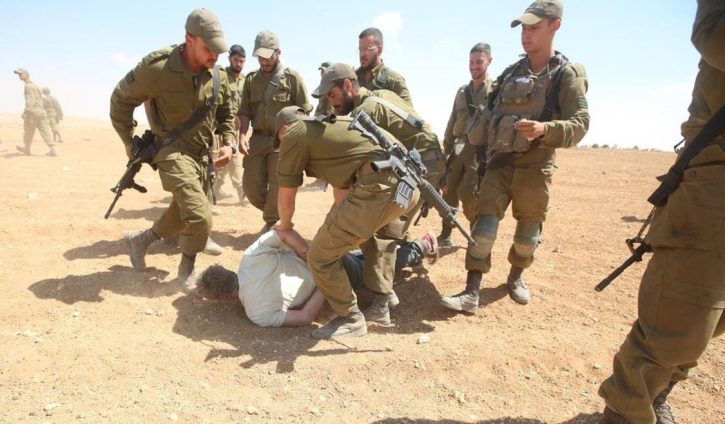
Israeli soldiers beat up a handcuffed international activist in Masafer Yatta
WAFA – June 22, 2022
HEBRON – Israeli forces today beat up a number of international solidarity activists in Masafer Yatta in the southern Hebron hills, according to local sources.
Coordinator of the Protection and Steadfastness Committee in Masafer Yatta, Fuad al-Amour, said the heavily-armed soldiers brutally assaulted a number of international activists while protesting the military drills close to and in al-Markez, and held two others for a long period.
The Israeli army have been conducting drills in al-Markez, one of 12 hamlets making up the Masafer Yatta, which rely heavily on animal husbandry as the main source of livelihood, for the second day in a row.
Al-Amour added that the army has built mock-ups as targets between the makeshift dwellings of the hamlet residents and has been conducting training with heavy weaponry, spreading panic among the residents.
The army has also deployed military checkpoints in the vicinity of the hamlets in the area, in preparation for military training, and perhaps paving the way for an imminent removal of the Palestinian residents.
Recently, Israel’s top court gave the army the green light to forcibly expel some 1,300 Palestinians living in twelve villages or hamlets making up the Masafer Yatta area marking one of the largest expulsions carried out by the State of Israel in recent decades.
Located in Area C of the West Bank, under full Israeli administrative and military control, the area has been subjected to repeated Israeli violations by settlers and soldiers targeting their main source of living – livestock.
It has been designated as a closed Israeli military zone for training since 1980s and accordingly referred to as Firing Zone 918.
Israeli violations against the area include demolition of animal barns, homes and residential structures. Issuance of construction permits by Israel to local Palestinians in the area is non-existent.
The Israeli occupation forces destroy an access road to a Ramallah-area village
WAFA – June 22, 2022
RAMALLAH – The Israeli occupation forces today destroyed an access road to Ras Karkar village, northwest of Ramallah, hampering the movement of people, according to the head of Ras Karkar village council, Marwan Nofal.
He said that the destroyed road had been partially paved for 20 years and that three months ago, following coordination with the Israeli military government, work on the rehabilitation of the road started. However, two days after the start of the work, the military forces raided the area and seized the vehicles used in the work, imposing a fine on their owners.
Nofal said that despite continuous promises to allow the rehabilitation work, the army sent its bulldozers today to destroy the road under the pretext that the road is located on “state land”.
The destruction of the road led to depriving farmers of access to their lands on the western side of the village, he said, and isolating several houses, noting that this is not the first time the Israeli military has targeted the village.
Ras Karkar suffers from the presence of seven iron gates at its entrances that limit the movement of people and access to their homes and lands.
At the same time, the Israeli military government does not allow it to carry out any work to improve the village’s infrastructure, said Nofal.
Palestine resistance seize Israel’s surveillance balloon

MEMO | June 18, 2022
The Palestinian resistance managed to seize control of the Israeli surveillance balloon early on Friday after it was shot down in the town of Beit Hanoun in the northern Gaza Strip.
Palestinian sources confirmed to Quds Press that the Israeli surveillance balloon seized by the Palestinian resistance was not the first it had seized. It has previously seized several balloons, as well as advanced drones.
Israeli sources revealed fears of dangerous information leaks and the resistance obtaining high-quality imaging equipment.
Palestinian writer and political analyst Mustafa Al-Sawaf believes: “What is important is that the resistance was able to seize this surveillance balloon, regardless of what method is used to shoot it down,” describing the incident as “serious”.
Al-Sawaf told Quds Press: “The occupation believes that the resistance is unaware and does not monitor its movements, so it tried to penetrate the Gaza Strip from the north and present a special force, but the resistance men were on the lookout, confronting the occupation and preventing them from entering the Gaza Strip.”
He pointed out: “The matter almost reached the level of a clash, but a reconnaissance aircraft intervened by firing two missiles, thus preventing this and securing the withdrawal of the special force.”
He added: “The occurrence of three incidents in Jenin and Gaza gives quick and dangerous indications that confrontation between the resistance and the occupation is fast approaching, and we must monitor the situation with high accuracy because the coming hours will carry a lot.”
It is worth noting that the Israeli army radio station, Doron Kadosh, announced: “The army’s initial investigation revealed that the surveillance balloon that fell in Gaza had fallen due to technical difficulty and that the army said there is no fear of significant information leakage, although the army tried to open warning fire near it, Hamas still managed to seize the balloon.”
Featured Video

False Flags and the Dawn of Bioterrorism
or go to
Aletho News Archives – Video-Images
From the Archives
How 1960’s French Nuclear Tests Are Still Claiming Lives in Algeria
Sputnik – 15.02.2018
On February 13, 1960, France carried out its first nuclear test in Algeria’s southern Reggane region. According to official statistics, 17 nuclear tests were carried out in total over the next 6 years. The area remains affected, and local scientists say that radioactive contamination has caused genetic mutations and irreversibly changed the region.
There are no official statistics on the number of victims. The only figures can be found in the records kept by the French representative of the local church, which lists 42,000 victims of nuclear tests. Three years ago, the French Ministry of Defense issued a statement, putting the number at 27,000 people. The victims include French soldiers as well as local Algerians who lived in the surrounding areas. … continue
Blog Roll
 Aletho News
- Sunset on the Quality of Western Propaganda: Arrival of the Dr Strangelove Moment
- Ukrainian general accused of protecting crime bosses
- US-‘Israel’ alliance faces growing rupture after midterms
- GOP’s Crushing Midterm Loss Could Reshape US Political Landscape – Analyst
- Midterm loss gives Congress power to rein in US war on Iran
- Midterms Were ‘Vote of No Confidence’ in GOP, But Iran Has No Illusions About Democrats – Marandi
- Israeli Soldiers Inadvertently Prove Their Own Genocidal Guilt
- Ukraine arrests woman who exposed Azov battalion’s ‘torture chamber’
- Did Israel lose the midterms?
- How Iran defeated Trump’s Israel First GOP
- If Americans Knew
- An error has occurred; the feed is probably down. Try again later.
- No Tricks Zone
- New Study: The Net Fossil Fuel Contribution To Rising Atmospheric CO2 Has Been Zero For 500 Years
- Germany’s Green Energy Transition Becoming Increasingly Expensive…Another 6 Trillion Euros!
- Sudden Stratospheric Warming, Powerful El Niño Combination May Lead To Extreme Europe Cold, Energy Crisis!
- Two New Studies Find Thwaites Glacier Melt Cannot Be Driven By Human Activity Or A Warming Ocean
- E-Cars Reduce CO2 Emissions By Only 41% Compared To Internal Combustion Engine Vehicles
- Predictions Made By Renowned Climate Professor Over Past Decades Have Been Proven To Be Poor
- New Study Suggests Large Regions Of The Pacific Ocean Have Been Cooling For The Last 80 Years
- Germany’s Green Energy Debacle: High Energy Costs Force Kahla Porzellan to Close After 182 Years!
- New Study: 50 Years Of The Most Aggressive ‘Net Zero’ Policies Can Only Affect The Global Climate By 0.03°C
- US September “Heat” Was No Record…Many Records Set Decades Ago

