Sunday’s attack on Gaza City claims 42 civilian lives
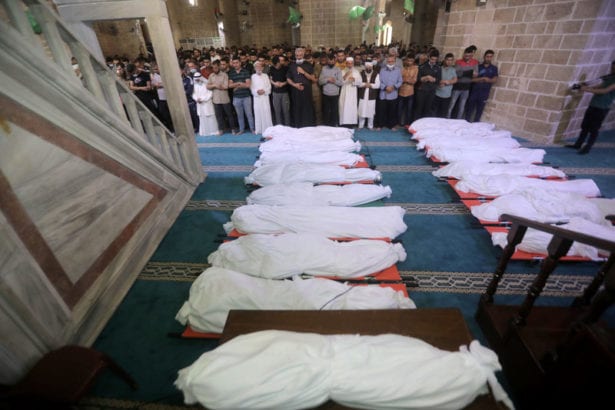
Mourners pray over the bodies of Palestinians killed in overnight Israeli airstrikes in Gaza City on 16 May. (Atia Darwish APA images)
Palestine Information Center – May 17, 2021
GAZA – The health ministry in the Gaza Strip said that a total of 42 civilians were killed and 50 others suffered injuries, some seriously, in the horrific massacre that was committed by Israeli warplanes at dawn Sunday in al-Wehda neighborhood in Gaza City.
Deputy health minister Yousef Abul-Rish told a news conference on Sunday evening that the weapons that were used in the bombing of the neighborhood tore the children’s bodies apart and made them unrecognizable.
Abul-Rish said that two doctors, Mu’ein al-Aloul and Ayman Abul-Auf, were killed in the aerial attack on al-Wehda neighborhood.
He accused Israel of deliberately bombing and destroying vital facilities and sectors that are needed to provide water, electricity and health services as well as roads that lead to hospitals.
The health official also accused Israel of obstructing the work of medical crews through targeting ambulances and paramedics and preventing them from reaching bombed areas to evacuate casualties.
According to the latest statistics from the health ministry in Gaza, the number of Palestinians killed, since the Israeli military aggression against the Gaza Strip started on May 10, has now risen to 197 martyrs, including 58 children and 34 women.
More than 1,235 others have also been wounded so far amid the ongoing brutal Israeli attacks on Gaza.
Israel’s War on Truth-Telling Media and Journalists
By Stephen Lendman | May 16, 2021
Time and again, truth-telling journalism as it should be is a casualty of all things war and related violence.
Big Lies, mass deception, and censorship are weapons of war by other means — in support of the official falsified narrative.
In their book titled “Guardians of Power,” David Edwards and David Cromwell explained why today’s media are in crisis — free and open societies at risk.
It’s because press prostitution substitutes fiction for fact — notably in the US, other Western countries and Israel.
Their state-approved sanitized reports stick exclusively to the official falsified narrative in support of wealth, power and privilege over full and accurate reporting.
In the US especially, news consumers are fed a daily diet of managed news misinformation, disinformation, junk food news and infotainment — at all times.
Notably in times of war, their reports regurgitate state-supplied talking points.
Whatever diverges from the official falsified narrative is filtered out and suppressed.
Adopted unanimously by Security Council members in December 2006, SC Res. 1738 affirms protection for civilians and journalists in war theaters — calling their safety and security “urgent and important.”
Condemning intentional attacks on fourth estate members, the resolution demands accountability for responsible parties.
At all times, especially at times of war and under occupation, civilians are protected persons. So are journalists — under international law.
Throughout at least most of its history, Israel waged war on truth-telling Palestinian journalists.
They’re at risk of arrest, prosecution, imprisonment, and/or assassination.
According to the Committee to Support Palestinian Journalists, “(t)he Israeli occupation tries to muzzle the Palestinian journalists’ mouths and prevent them from unmasking its barbaric practices in the occupied Palestinian territories to the international media.”
Palestinian journalists covering Israeli violence against legitimate protesters risk serious injury or death.
Anyone wearing a flak jacket labeled press is vulnerable, their unprotected areas vulnerable to Israeli sniper attacks by live fire — including use of exploding dum dum bullets able to leave fist-sized existing wounds in individuals struck.
They’re designed to inflict disabling damage to internal organs or death — even though banned by the 1899 Hague Convention.
Since IDF terror-bombing and shelling of Gaza began on May 10, silencing truth-telling media has been a prioritized Netanyahu regime aim.
The same objective is sought in all Israeli preemptive wars, as well as at all other times on whatever conflicts with official falsified Israeli talking points.
On May 15 in Gaza, Israeli terror-bombing turned the 11-story Al-Jalaa building to smoldering rubble — its occupants given one hour to vacate the premises.
It’s unknown so far if some remained inside and perished.
Along with residences of Gazan families, the building housed international media offices.
According to DW News, AP News, AFP, Al Jazeera, other international media operations, and local Palestinian news agencies had offices in the building.
The IDF defied reality by falsely claiming that the building included Hamas “military assets (sic),” adding:
“(O)ffices of civilian media outlets (were) use(d) (by Hamas) as human shields (sic).”
According to AP News, the Netanyahu regime and IDF “did not provide evidence for the claim” — because there is none.
On its Saturday newscast, senior Al Jazeera (AJ) political analyst Marwan Bishara minced no words in debunking the thinly veiled IDF Big Lie.
Gaza-based AJ journalist Al Kahlout said the following in response to Israel’s destruction of the Al-Jalaa building with three missiles:
“(N)o one can understand the feeling of the people whose homes have been destroyed by such kind of air attacks,” adding:
“It’s really difficult to wake up one day and then you realize that your office is not there with all the career experiences, memories that you’ve had.”
Separately on Saturday, IDF terror-bombing destroyed a Gaza City area refugee camp three-story residence, massacring eight children and two women.
The above buildings had no military significance. Israel defied reality by claiming otherwise.
In response to its destruction of Gaza’s Al Jalaa building, AP News president and CEO Gary Pruitt said the following:
“The world will know less about what is happening in Gaza because of what happened today.”
“We are shocked and horrified that the Israeli military would target and destroy the building housing AP’s bureau and other news organizations in Gaza.”
“This is an incredibly disturbing development. We narrowly avoided a terrible loss of life.”
Separately, AP reported:
“For 15 years, the AP’s top-floor office and roof terrace were a prime location for covering Israel’s conflicts with Gaza.”
Now it’s gone, along with scores of massacred Gazans, including women and children.
NY-based Committee to Protect Journalists’ executive director Joel Simon said the following:
“This latest attack on a building long known by Israel to house international media raises the specter that the IDF is deliberately targeting media facilities in order to disrupt coverage of the human suffering in Gaza.”
Indeed so!!
Silencing coverage of its high crimes of war, against humanity, and other human rights abuses is longstanding Israeli policy — in flagrant breach of international law.
On May 10, the Palestinian Center for Development and Media Freedoms (MADA) reported the following:
It “condemn(ed) escalating attacks of the occupation forces against journalists and media workers in Palestine…”
MADA noted what’s going on in “occupied…Jerusalem…aim(s) (to) block the transmission of the violations to the world.”
“This was accompanied by widespread violations of freedom of expression committed by social media companies to serve the goal of the occupation state by obscuring the attacks implemented by its soldiers and settlers.”
In early May alone, “Israeli attacks against journalists during their field coverage of events, as the occupation army targeted a number of journalists while they were” reporting on what’s going on.
At least “10 (Palestinian) journalists” were targeted and “injured.”
“(I)mpunity of the Israeli occupation forces over the years for their almost daily crimes and violations of media freedoms in Palestine, including the killing of more than 40 journalists during the past two decades, is what encourage them to continue committing more crimes and violations, which requires serious action to prosecute the perpetrators of these crimes, as the only way to reduce it.”
Facebook, Twitter, and other “social media companies… deliberately blocked and suspended the accounts of many Palestinian citizens, including many journalists…”
MADA called their action “a severe violation against freedom of expression (in cahoots with) the occupation state (by) blocking facts and suppressing media freedoms and freedom of expression.”
At the same time, they freely allow hostile-to-truth-telling Western and Israeli propaganda on their “platforms.”
The West pushes the Xinjiang issue hard, while ignoring the sustained slaughter of Palestinians
By Tom Fowdy | RT | May 14, 2021
Muslims allegedly being treated badly in China? Terrible human rights atrocities that need to be stopped. Muslims being bombed, murdered and driven from their homes in Gaza? Meh, they’re anti-Israel terrorists.
As Gaza burns and rages on, and Palestinians’ homes are turned into their graves, the West’s two-faced hypocrisy towards Muslims has never been clearer.
Unsurprisingly, despite the climbing death toll, condemnation from the West at Israel’s military action has been non-existent. The United States has blocked a UN Security Council Resolution over the matter, while its secretary of State, Antony Blinken, unironically tweeted a celebration of the Muslim Eid Festival.
In the absence of such condemnation, there was at the same time nonetheless a concerted and observable push by the mainstream media and US-affiliated organizations yesterday to put the Xinjiang autonomous region of China back on the agenda.
Several stories were tactically released, including a report from the National Endowment for Democracy-funded Uighur Human Rights Project accusing China of imprisoning Imams on trumped-up charges, while another from the US State and arms industry-funded Australian Strategic Policy institute accused them of demolishing mosques. At the same time, the US and its allies lobbed accusations at China in the United Nations and Blinken branded Xinjiang an “open-air prison”.
The West is pushing the Xinjiang issue hard and selectively, while ignoring long-term sustained atrocities regarding Palestine. They then wonder why Muslim countries largely offer support to Beijing on this matter and don’t take the West’s word for it. The answer is because, unwittingly, the Israel-Palestine conflict (like all the other Western-backed conflicts surrounding it), remains the primary wedge of geopolitical distrust between the Islamic world and the US and its allies.
These countries have no reason to take America’s human rights rhetoric seriously due to the devastation it has inflicted on the Middle East, and they subsequently share a common interest with China on the norm of defending “national sovereignty” from outside interference.
The West advocates to its own public an image of benevolence and sincere self-righteousness, masquerading and rebranding what was otherwise a longstanding history of imperialism, as a global force for good and justice. As what is deemed “morally correct” overlaps with what constitutes “political truth” in Western theory, few of its citizens question the utilization of human rights as an extension of politics or the idea such a premise could possibly be motivated by dishonesty, economic power or malign intent; to be honest about it is rendered a form of “blasphemy”. Thus, what is deemed “universal human rights” are not truly universal at all.
Countries in the Global South, especially in the Middle East, recognize this. In their experience, human rights have been persistently used as a pretext by Western countries to advance strategic and military goals in order to dominate them, as opposed to a truthful effort to improve people’s liberties and quality of life. And which are subsequently ignored when it suits the West, especially in matters of a much greater grievance to the Islamic world such as the Israel-Palestine conflict, which has been the keystone of anti-Western sentiment and ideology in the Middle East since the first Arab-Israeli war of 1948.
There have been many Western interventions in the region, mostly in a period between 1991-2012, justified on the grounds of human rights, such as Iraq, Libya and Syria. Concerning the latter, the West has accused Bashar Al-Assad of killing civilians in the decade-long civil war and called for his removal. Yet at the same time, the West has continually endorsed long-standing killings of civilians by Israel against Palestinians, and enabled that country’s expansionist policies in occupied territories, its unbridled aggression against many of its neighbours, and failed to resolve the seven-decade-long conflict.
In this case, if you are a Muslim country, why would you believe the US and its allies when they suddenly start crying atrocity, genocide and claiming they are standing up for the rights of a Muslim minority group in Xinjiang? Does this, for any Muslim country, have any real credibility?
The same countries who destroy Middle Eastern countries with war and bombings, and refuse to condemn Israel even modestly, now frame themselves as the guardians of Muslims? It’s no surprise that Muslim countries have not joined in the West’s chorus of condemnation, but have offered support to China’s policies. Even if they do not agree ideologically with China as an atheist, communist state, there’s one important point regarding Xinjiang that creates a space of common interest: defence of national sovereignty.
Irrespective of what they may think about events on the ground in Xinjiang, Muslim countries are largely post-colonial states which have suffered, and continue to suffer, from Western interference. Therefore, China’s norm of “non-interference in one’s internal affairs”, combined with its emphasis on defending sovereignty against Western intervention, is an attractive and logical solution to Muslim countries. Why would any such nation jump on the Xinjiang bandwagon and promote the idea that the West should be allowed to assault a country on the pretext of human rights? What might this mean for them?
Muslim countries support China on Xinjiang for a myriad of factors, have no good reason to trust the West, and recognize that the US, the UK and other such countries crying foul on this issue are doing so out of political motivations, as opposed to a sincere concern about the well-being of Islamic people.
As Gaza’s buildings are razed and its people slaughtered, the silence and indifference on this issue speaks louder than words concerning the West’s position on “human rights”. Let us end with this comparison: Palestine is an issue which Muslim countries are angry about, which is ignored by the Western elite; Xinjiang is an issue which the US-led alliance is angry about, that they desperately want Muslims to be furious about on the West’s behalf, but is rightly being ignored.
Tom Fowdy is a British writer and analyst of politics and international relations with a primary focus on East Asia.
Israel is deliberately obliterating media buildings in Gaza to cover up the war crimes that will follow
By Eva Bartlett | RT | May 14, 2021
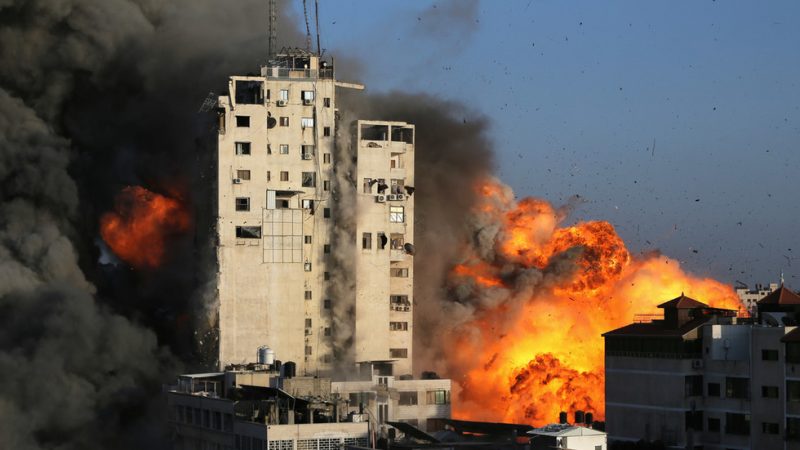
The destruction of two important Gaza buildings housing 20 media outlets was both shocking and predictable. History shows that if the media aren’t around to document Israel’s war crimes, it’s a lot easier for it to commit them.
On Tuesday, Israel bombed the 10-storey Al-Jawhara Tower, causing it to collapse. Before doing so, it had ‘benevolently’ warned that the airstrikes were coming. The following day, it bombed the 14-storey Al-Shorouk Tower, also giving warning it was going to do so.
Most reports have the buildings as evacuated before being levelled. But without these media offices, reporting on Israel’s other war crimes will be left largely to what little media remain and citizen journalists.
The buildings were significant. A statement by the International Federation of Journalists (IFJ) noted the Al-Jawhara building housed the offices of 13 media institutions and NGOs. And an advisory by the Committee to Protect Journalists noted that the Al-Shorouk building housed at least seven media outlets.
A further statement by the same committee said that the Israeli military had defended its bombing of the building via email, bizarrely claiming it had “acted within international law,” alleging the Al-Jawhara building housed Hamas’ intelligence and military offices, and saying the Al-Shorouk building was a base for Hamas’ military intelligence offices and “infrastructure to communicate tactical-military information.”
Just minutes after the Al-Shorouk building was destroyed, I spoke by phone with Shadi Ali, a producer who had worked there for ten years and was understandably devastated at what had happened. He told me of previous occasions when Israel had bombed the building, in 2009, 2012, and 2014.
“I was there in 2012. My office was on the 14th floor when it was hit at 6am. I was sleeping; I had only slept for one-and-a-half hours when it was hit by two missiles on the top floor,” he told me. “When it was bombed in 2014, we had taken precautions and left it already. They struck the 15th floor, destroying it completely. Our floor became the top floor after that.”
The building was on a main Gaza street, Omar Mukhtar, surrounded by residential apartment buildings. I asked whether he knew if there had been casualties this time. He replied, “We’re waiting, because often they’ll strike again soon after, knowing that people have come to search for casualties.”
I’ve witnessed this tactic with my own eyes. In January 2009, while I was accompanying Palestinian Red Crescent medics, one of the bodies the medics retrieved was that of a Kiffah Lum Towwak, 35, killed by an Israeli missile strike on her backyard in Jabaliya, just minutes after a strike which killed a family member living in the same house.
The same month, I was inside the now-destroyed Al-Shorouk building, having just finished an interview with RT about what I’d seen while riding in ambulances in the extremely dangerous areas of Gaza’s north. Shortly after concluding the interview, Israel shelled the building at least seven times. Thankfully, the tank shelling didn’t destroy the building, and we were able to run down the stairs to “safety” (although in reality nowhere was safe).
The Al-Shorouk building was again bombed a week after this. Reporters Without Borders and the Committee to Protect Journalists condemned the bombing and noted that the Israeli military had contacted Reuters (which had an office inside) “minutes before the attack to confirm the location of its Gaza office,” and had explained it would not be targeted.
In November 2012, I reported from a hospital in Deir al-Balah, central Gaza, after Israeli attacks, and documented the destruction of bridges and other infrastructure as well as visiting the media buildings which had been targeted. I wrote at the time, “At least three Palestinian journalists were killed in the November 2012 Israeli attacks on Gaza, and at least 12 reported injured. The Sharook building suffered damage on its upper floors from a number of bombings including drone and possibly Apache helicopter missiles. The building housing Aqsa TV and various other media offices likewise suffered major damage on its upper floors.”
The CPJ reported, “A series of airstrikes beginning early Sunday and continuing today targeted two buildings, Al-Shawa and Housari Tower and Al-Shuruq Tower, which are well-known for housing numerous international and local news organizations, news reports said. At least seven journalists were injured in the first attack. Khader al-Zahhar, a cameraman for Al-Quds TV, lost his right leg.”
Having journalists on the ground in a place like this is critical. In previous wars on Gaza, Israel has committed a litany of war crimes, including in 2009 targeting with a flechette bomb and killing a uniformed Palestinian medic as he worked to save injured civilians; firing more dart bombs on mourners the following day, killing six, including a pregnant woman; targeting with sniper fire two medics I was with, during ceasefire hours; assassinating children and infants; drone-striking a 14-year-old during ceasefire hours; raining white phosphorous down heavily on civilian areas throughout Gaza; bombing a school sheltering the displaced; bombing hospitals and repeatedly shelling a home Israeli soldiers had forced 60 members of an extended family into, killing 26, including 10 children and seven women.
And that was only in 2009. In 2012 and 2014, Israel again committed more unspeakable crimes of war, destroying entire neighbourhoods and massacring the residents, shelling children on a beach, and drone-striking a teen hours before ceasefire, among many others.
And now, after a few days of Israeli bombardment, horrific reports are emanating from Gaza, including accounts of Palestinians killed by what is believed to be toxic gas, and Israeli precision bombings killing entire families. As of May 14, Gaza’s health ministry reports at least 119 killed, including 31 children.
Meanwhile, across occupied Palestine, Israelis are calling for Palestinians’ deaths, with a rabbi allegedly saying, “I call on you to kill all Arabs!” and others using Facebook and Telegram to organize attack mobs. And it was recently reported, “Israel’s defense minister Benny Gantz threatened more destruction than he ordered in Gaza in 2014. At that time, he was Israel’s chief of staff commanding the 51-day assault that killed more than 2,200 Palestinians, including 551 children.”
Also reported is an Israeli MP’s call for the Israeli army to “flatten the Strip.” That is nothing new. As I wrote in 2014, “During the eight days of slaughter, Israeli figures called to ‘blow Gaza back to the Middle Ages, destroying all the infrastructure including roads and water,’ and to ‘Flatten all of Gaza. There should be no electricity in Gaza, no gasoline or moving vehicles, nothing,’ said the deputy Israeli Prime Minister Eli Yishai and Gilad Sharon respectively.”
Israel’s bombing spree of media targets has been rightly condemned. The Palestinian Journalists Syndicate stated that, “the targeting of media headquarters in the brutal bombardment of Gaza is part of the full-fledged war crimes committed by the Israeli occupation authorities against the Palestinian people,” and called for the United Nations and the Red Cross “to provide urgent protection to journalists and the media, and to activate Security Council resolution 2222 (which includes the protection of journalists) and oblige the occupation to fulfil [sic] this.”
The CPJ stated, “It is utterly unacceptable for Israel to bomb and destroy the offices of media outlets and endanger the lives of journalists, especially since Israeli authorities know where those media outlets are housed.” And the International Federation of Journalists said, “The international community cannot turn a blind eye to the systematic violations of human rights and the deliberate targeting of media and journalists. Urgent actions must be taken to hold those responsible for these crimes internationally accountable”.
However, while journalist protection committees have condemned the recent Israeli bombings of media buildings in Gaza, Western corporate media generally haven’t. Imagine, though, if this was taking place in Syria: if Syrian or Russian planes premeditatedlybombed and levelled media buildings there. That would be front page news for days, if not weeks.
I would go back to Gaza to report on this horror if I could enter, but that’s impossible: Israel would not let me in, and is not allowing journalists in in general.
In December 2008, RWB reported, Israel declared the Gaza Strip a “closed military zone” and denied access to journalists working for international media. And now, as Shadi Ali told me the other day, Israel knows there are not many foreigners in Gaza to report what is going on. There is a media blockade, on top of the brutal siege of Gaza and Israel’s bombardment.
“Israel will commit so many crimes in Gaza, while foreign media are not present,” Ali predicted. And he’s right. As Israel threatens to invade by land, the protection of media buildings and journalists becomes all the more important, because Israel will commit more war crimes. They’ve already pledged to make Gaza burn.
Eva Bartlett is a Canadian independent journalist and activist. She has spent years on the ground covering conflict zones in the Middle East, especially in Syria and Palestine (where she lived for nearly four years).
Israel ‘deliberately targeting’ Palestinian journalists, media body says
MEMO | May 14, 2021
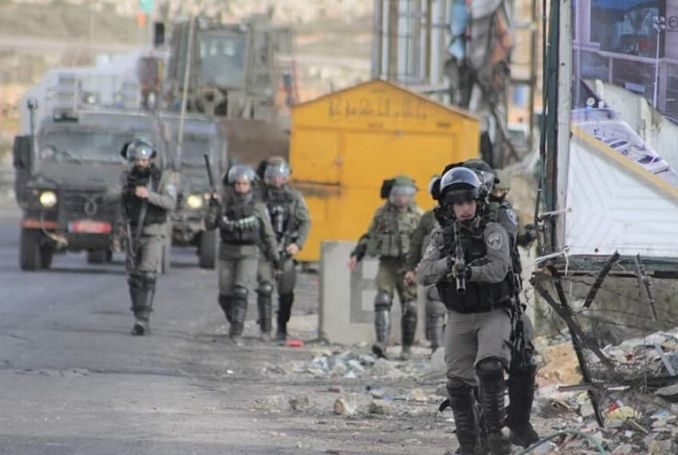
Israeli occupation forces “deliberately targeted Palestinian journalists who cover attacks and violations against Jerusalem and worshipers in the courtyards of Al-Aqsa Mosque”, the Coalition For Women In Journalism (CFWIJ) has warned.
At least 10 journalists, two of whom were women, were injured during the incidents.
In a statement the CFWIJ said this it “is utterly dismayed by the deliberate and vicious attacks against journalists.”
During the past few days, many violations were committed against the press, with them being prevented from covering events in the occupied city of Jerusalem and the Sheikh Jarrah area.
Palestine reporter Liwa Abu Armila suffered from tear gas inhalation while following the raids while journalist Fatima Al-Bakri was also physically assaulted by the Israeli occupation forces.
On 8 May occupation forces attacked journalists by spraying skunk water at them to damage their equipment, reporter Maysa Abu Ghazaleh was among them.
The CFWIJ continued: “We applaud the brave journalists who are covering the incidents in the field despite the large scale of the Israeli attacks. However, we demand the Israel state to end these devastating attacks against Palestinians. Journalists must report in a free and safe environment and the security forces must respond to provide it to them.”
IDF Invades Gaza?
By Stephen Lendman | May 14, 2021
Earlier reports from Israel said IDF forces invaded the Strip — for the fourth time since Israel’s 2008-09 Cast Lead aggression on Gaza.
According to the Times of Israel, the “IDF… mis(led) foreign media on (a) Gaza ground invasion,” adding:
An initial pre-dawn Friday statement said “IDF air and ground troops are currently attacking in the Gaza Strip.”
When asked for clarification, IDF spokesman Jonathan Conricus responded:
“Yes. As it’s written in the statement. Indeed, ground forces are attacking in Gaza… (T)hey are in the Strip.”
Some troops are “positioned in an enclave technically within Gaza territory,” the Times of Israel reported, adding:
“(F)or all intents and purposes… such a placement does not reasonably represent a ‘ground invasion.’ ”
The NYT falsely reported that “Israeli ground forces had attacked Gaza early Friday,” adding:
“The extent of the Israeli assault was not clear.”
The Times later corrected its report, saying ”that while ground forces were newly involved in the fighting, no Israeli troops were actually in Gaza, indicating that they were firing from within Israel.”
WaPo earlier tweeted: “Israeli troops have entered the Gaza Strip as conflict with Palestinians escalates, Israeli military says.”
A later tweet corrected the above incorrect one, saying: “Israeli military issues ‘clarification’ to earlier statement and now says its ground troops are not in Gaza.”
Deploying thousands of troops, tanks and artillery along Gaza’s border may or may not be in preparation to invade the Strip by the Netanyahu regime.
A previous and same day article noted that Israeli war minister Gantz and IDF chief Kochavi planned an intensive terror-bombing campaign — instead of a ground invasion.
Like earlier preemptive wars on the Strip, their diabolical plan is all-about inflicting maximum pain, suffering, slaughter and destruction against besieged Gazans — including defenseless civilian men, women, children, infants, the elderly and infirm in harm’s way.
Dominant Israeli hardliners consider them legitimate targets, in defiance of core international law — prohibiting attacks on civilians, considered protected persons in times of war.
Like US-dominated NATO, Israel operates exclusively by its own anything goes rules — Palestinians victimized time and again, including by ongoing preemptive Netanyahu regime aggression.
On May 14, Haaretz, the Jerusalem Post, and Ynet News editions included no reports of a Gaza ground invasion — so far.
According to Kan 11 News’ military correspondent Roy Sharon, earlier reports of a ground invasion are false, adding:
“Around the world, when they hear of ground forces entering, we remember Operation Protective Edge, and other large-scale operations, that the IDF enters with tanks and infantry forces for a massive operation in Gaza.”
“That is not what is happening at all right now.”
“There is no entry of ground forces into Gaza.”
“It’s true that ground forces are attacking in Gaza, but they are attacking from outside Gazan territory.”
According to an AFP News tweet:
“The Israeli army clarifies that its troops have not entered the Gaza Strip as it had earlier stated, blaming an ‘internal communication’ problem for the confusion.”
“Israel says it is carrying out an attack ‘in the Gaza Strip’ but that there are no boots on the ground.”
IDF ground forces are attacking Gaza from an enclave inside Israeli territory at this time.
Things are fluid, subject to change, including by escalating aggression on Gaza more than already — if Netanyahu thinks it benefits him politically.
As of early Friday morning, reports indicate that at least 119 Gazans were killed since Monday, including 31 children, well over 800 others wounded by relentless round-the-clock IDF terror-bombing and cross-border shelling.
According to Reuters, ICC chief prosecutor Fatou Bensouda said individuals involved in ongoing conflict may be investigated for war crimes, adding:
“These are events that we are looking at very seriously.”
“We are monitoring very closely and I remind that an investigation has opened and the evolution of these events could also be something we look at.”
For the past 73 years, the highest of Israeli crimes of war, against humanity, and other atrocities were never punished.
Accountability is off-the-table because of one-sided US/Western support.
Like the US, Israel uses banned weapons in all its preemptive wars, including:
Depleted uranium (DU) munitions spreading toxic radiation
White phosphorous bombs and shells that burn flesh to the bone and can’t be extinguished by water
Thermobaric bombs able to penetrate buildings, underground shelters and tunnels
Their blast pressure sucks oxygen from spaces and human lungs in the vicinity.
Norwegian trauma surgeon Dr. Mads Gilbert treated wounded Gazans earlier.
Many victims had horrific wounds he never saw before.
They included severe internal chemical, biological and radiological burns, effects of toxic gases, severed arms, legs, and other body parts, and abdomens sliced open, among others.
During Israel’s summer 2014 Protective Edge aggression, Gilbert said the following about Gaza’s killing fields:
“The ‘ground invasion’ of Gaza resulted in scores and carloads with (the) maimed, torn apart, bleeding, shivering, dying – all sorts of injured Palestinians, all ages, all civilians, all innocent.”
“The heroes in the ambulances and in all of Gaza’s hospitals are working 12-24hrs shifts, grey from fatigue and inhuman workloads (without payment (at) all in Shifa (hospital) for the last four months).”
“They care, triage, try to understand the incomprehensible chaos of bodies, sizes, limbs, walking, not walking, breathing, not breathing, bleeding, not bleeding humans.”
“HUMANS! Now, once more treated like animals by ‘the most moral army in the world (sic).’ ”
“My respect for the wounded is endless, in their contained determination in the midst of pain, agony and shock; my admiration for the staff and volunteers is endless.”
“My closeness to the Palestinian sumud (steadfastness) gives me strength, although in (some of the) glimpses I just want to scream, hold someone tight, cry, smell the skin and hair of the warm child, covered in blood, protect ourselves in an endless embrace – but we cannot afford that. Nor can they.”
“Ashy grey faces – oh NO! Not one more load of tens of maimed and bleeding: We still have lakes of blood on the floor in the ER, piles of dripping, blood-soaked bandages to clear out.”
“The cleaners (are) everywhere, swiftly shoveling the blood and discarded tissues, hair, clothes, cannulas – the leftovers from death – all taken away…(only) to be prepared again, to be repeated all over.”
“More than 100 cases came to Shifa (in the) last 24 hrs, enough for a large well trained hospital with everything, but here (there is) almost nothing.”
“Electricity, water, disposables, drugs, OR-tables, instruments, monitors – all rusted and as if taken from museums of yesterdays hospitals.”
“But they do not complain, these heroes. They get on with it, like warriors, head on, enormous(ly) resolute.”
“And as I write these words to you, alone, on a bed, my tears flow, the warm but useless tears of pain and grief, of anger and fear. This is not happening!”
“And then, just now, the orchestra of the Israeli war-machine starts its gruesome symphony again.”
“Salvos of artillery from the navy boats just down on the shores, the roaring F16, the sickening drones (Arabic ’Zennanis’, the hummers), and the cluttering Apaches.”
“So much made and paid in and by US. Mr. Obama – do you have a heart?”
“I invite you – spend one night – just one night – with us in Shifa. Disguised as a cleaner, maybe.”
“I am convinced, 100%, it would change history. Nobody with a heart AND power could ever walk away from a night in Shifa without being determined to end the slaughter of the Palestinian people.”
“But the heartless and merciless have done their calculations and planned another Dahiya onslaught on Gaza.”
“The rivers of blood will keep running the coming night. I can hear they have tuned their instruments of death.”
“Please. Do what you can… This cannot continue.”
It’s happening again in Gaza, likely for days longer, maybe weeks if Netanyahu thinks it benefits him politically.
On Thursday, Lebanon’s Al Mayadeen reported the following:
Israeli “occupation (forces are) us(ing) internationally banned weapons in Gaza,” including “toxic gasses.”
In the days ahead, more will be known about Israel’s latest dirty war on over two million Gazans in the densely populated besieged Territory.
Palestinian Policy Network member Yara Hawari accused the Netanyahu regime of using “skunk” in attacks on Palestinians throughout the Territories, describing it as follows:
It’s “a liquid compound with an overpowering odor that has been described by those who have experienced it as the smell of sewage mixed with rotting corpses.”
It’s “a concoction of chemicals that causes intense nausea, obstructing normal breathing, causing violent gagging and vomiting.”
It also causes skin irritation, eye and abdominal pain.
Used for collective punishment, exposure to concentrated high doses risks serious harm or death.
Israel exports terror weapons to other countries, including the US.
Their effectiveness is field-tested on Palestinians throughout the Territories, notably against Gazans.
Countless thousands were killed, seriously wounded or disabled from Israeli viciousness.
It’s happening in real time throughout the Territories, Gazans harmed most of all.
Instead of condemning and demanding accountability for Israeli crimes of war and against humanity, most world community nations largely look the other way.
Israel’s War Cabinet Approves Escalated Aggression on Gaza
By Stephen Lendman | May 13, 2021
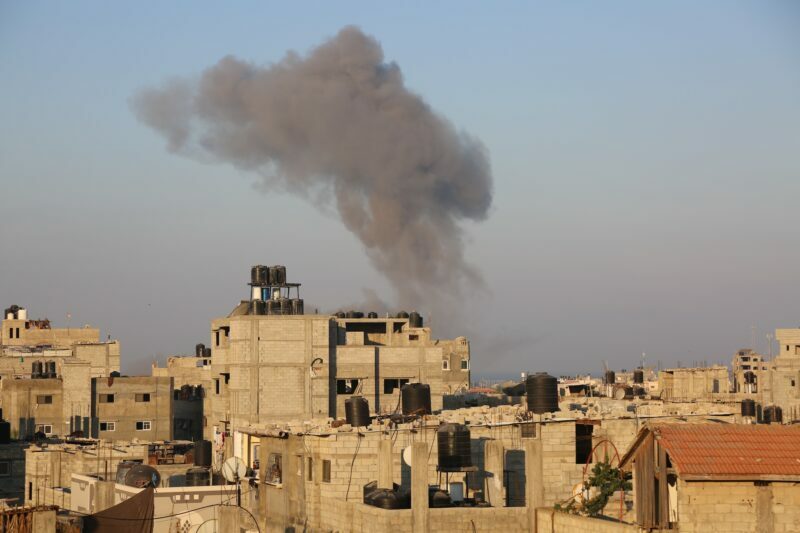
Late Wednesday, cabinet members unanimously agreed to intensify IDF terror-bombing of Gaza — including strikes on civilian targets.
War minister Gantz said “Gaza will burn” — meaning an intent to commit greater crimes of war and against humanity than already.
He lied accusing Hamas of using civilians as human shields.
Israeli warplanes continue terror-bombing civilian neighborhoods as it’s done before during preemptive wars on the Strip.
Residential and government buildings, schools, medical facilities, at least one mosque, agricultural lands, farmers in their fields, children in harm’s way, and Strip infrastructure was struck to make conditions for Gazans more untenable than already.
Mass slaughter and destruction keeps increasing by the hour.
Cold-blooded murder of Arabs is longstanding Israeli policy.
According to Defense for Children International – Palestine on Wednesday:
“Israeli forces continue to exhibit…complete disregard for international law, deploying explosive weapons and attacking densely-populated civilian areas in Gaza,” adding:
“As Palestinian children and families seek shelter from Israeli attacks, there is no safe space in the Gaza Strip.”
“Palestinian children in Gaza increasingly bear the brunt of Israel’s repeated military offensives and a human-made humanitarian crisis as a result of Israel’s closure policy toward the Gaza Strip.”
Deputy mayor of Lod, Ami Kaufman, said “hundreds of armed settlers from the West Bank are on their way to the city.”
“I suggest to every Arab resident not to leave their homes.”
“This has potential to be a bloodbath.”
Palestinian students in Israeli universities are being attacked, including in their dorms.
The Al Mezan Center for Human Rights condemned “intentional and disproportionate targeting of civilians and civilian properties” by Israeli terror-bombing and cross-border shelling,” adding:
The organization sharply criticized “inaction of the international community, as Gaza is pushed into perpetually worse security and humanitarian conditions.”
On Thursday, Al Jazeera reported that “residents and shop owners in Gaza City walked among the rubble and what is left of their homes and businesses following the heavy Israeli bombardment,” adding:
Shop owner Zakria Al-Halees struggled for words to explain damage affecting “the whole area.”
Images show widespread debris from days of ruthless IDF terror-bombing, defenseless civilians bearing the brunt of it — while the world community yawns and does nothing to hold Israel accountable for the highest of high crimes.
Iranian President Hassan Rouhani called for Muslim countries to unite against Israel, saying:
“The tragic incidents of the last few days and the crimes of the Zionist regime, more than ever, remind us of the need for unity and cooperation of Islamic countries to confront the Zionist coercion and occupation.”
“It is necessary for the Islamic countries to work together to defend the Palestinian people, and to confront the aggression and hostile and racist actions of the Zionist regime that we have witnessed in recent days and during the holy month of Ramadan.”
“The attacks and aggressions of the Zionist regime against the people of Palestine and Gaza Strip should stop immediately and we must not allow the Palestinian people to be oppressed anymore.”
In Damascus for discussions on “bilateral, regional and international issues,” Iran’s Foreign Minister Zarif condemned the “Israeli regime’s brutal aggression against Palestinians,” separately tweeting:
“It wasn’t enough for the Israeli regime to
-Steal people’s land & homes;
-Create an Apartheid regime;
It had to shoot innocent worshippers inside Islam’s 3rd Holiest Mosque upon Islam’s Holiest Eid.”
On Thursday, the Syrian People’s Assembly (PA) “condemned in the strongest terms the barbaric Zionist racist practices against the defenseless Palestinian Arab people, stressing that these practices are a flagrant violation of all international pacts, resolutions and norms, and a violation of the most basic rules of the international humanitarian law” — the Syrian Arab News Agency (SANA) reported, adding:
The PA “affirmed its stand by the Palestinians in Occupied Jerusalem and in every part of the land of Palestine, indicating that the Syrians, who have faced for years and are still facing the forces of evil and terrorism, will continue to support their Palestinian brothers, as their enemy is one, and their fate and victory are the same.”
In vain, it urged the world community to intervene against Israeli aggression on their behalf.
It hasn’t happened since Israeli forces stole historic Palestine for exclusive Jewish use and development.
Nor is Israel ever held accountable for the highest of high crimes of war, against humanity, and other atrocities against Palestinians and other Arabs.
Separately on Thursday, Hamas political leader Ismail Haniyeh said “(r)esistance responds to the crimes of the occupying regime in Quds, the Gaza Strip and everywhere.”
“If the occupying regime wants to continue its attacks, we will also continue more attacks.”
According to the Hamas Al-Qassam Brigades’ Abu Obeida:
Its forces fired a cruise “missile… at (Israel’s) Ramon airport, about 220km from Gaza.”
Reuters reported that the facility continues to operate, saying it wasn’t struck.
According to Palestinian/American writer/activist Yousef Munayyer:
“Israeli lynch mobs (are) attacking Palestinians” unobstructed while IDF warplanes terror-bomb Gaza.
Armed and dangerous, extremist settlers are assaulting Palestinians in public, storming their homes, beating and terrorizing them — including women and children — while nearby Israeli security forces do nothing to stop them.
They’ve been roaming East Jerusalem streets, shouting “Death to Arabs.”
In Occupied Palestine, the safety and welfare of non-Jews is never secure at all times.
Today in apartheid Israel, Arabs are in mortal danger — from Netanyahu regime security forces and extremist settlers out for blood.
A Final Comment
Instead of condemning Israeli ruthlessness and demanding accountability, spokesman for UN secretary general Guterres, Stephane Dujarric, merely called on the Netanyahu regime to “exercise maximum restraint and respect the right to freedom of peaceful assembly,” according to a UN statement.
“The secretary general reiterates his commitment, including through the Middle East Quartet, to supporting Palestinians and Israelis to resolve the conflict on the basis of relevant United Nations resolutions, international law and bilateral agreements,” Dujarric added.
Time and again, Guterres disgraced himself and the office he holds by failing to denounce US/NATO/Israeli aggression and demand accountability for high crimes too serious to ignore.
Meaningless weak-kneed statements — directly or through his spokesman — are issued time and again instead of doing the right thing he consistently avoids.
Palestine Has the Right to Defend Itself
By Taxi | Plato’s Guns | May 13, 2021
We have entered a new era in the Palestinian-Israeli conflict. The old days of Israel committing war crimes against the downtrodden, captive Palestinians are over. The world has done zero to address Israel’s fundamental crime of nation-stealing: a megalith crime that can only be described as the longest and most vicious war crime in our modern history. A crime that millions of people around the world consider to be even worse than the holocaust. After some 73 years of enduring relentless Israeli terrorism, land-theft, cultural appropriation AND the silence of the world, the Palestinian Resistance has finally taken charge and has, literally overnight, turned the tables against Israel. From here on, there will be accountability for Israel for any crime it commits against the Palestinians. From here on, all previous Israeli red lines will be crossed in favor of the Palestinians. From here on, the death of Israel is no longer a far-fetched fantasy. From here on, the Palestinian Resistance will take charge of Palestine’s destiny. And its destiny is total liberation.
Whether this liberation takes place in a day, in a week, in a month or a year, the gates of liberation are now open, and nobody on earth can close them.
The situation in the holy land is currently fluid – rocket and missile strikes continue by both sides with no end in sight as I write this. There is no point in talking casualties and targets in this article as this is not a journalistic report but a brief look at America’s strategy in the Middle East.
The pertinent question here is: with Israel’s hegemony being in an evident state of profound decline, will the US drop Israel in order to preserve its remaining influence in the Middle East? Or, will it stick to a weak and dying Israel and thus be evicted from the region with it? We know that both China and Russia are waiting on the sidelines for an opportunity to snatch America’s influence in the Mideast region. There will not be a vacuum left once Israel falls and takes the US down with it. China and Russia will collect the prize and immediately fill in the vacuum. Begs the question here therefore: is America prepared to lose to China and Russia just to appease a limping Israel?
Simply: what is more important for America: maintaining its own superpowerdom, or supporting Israel indefinitely and unconditionally?
This is a serious strategic conundrum for the current US State Department, for the Pentagon and the Deep State, not to mention the White House as well, and mindful here that all these high offices in DC are infiltrated and already controlled by AIPACers and by Jewish power. With the Palestinian cause now being globally more popular than ever, and with the Palestinian Resistance now being an offensive-and-defensive power to reckon with, the oft repeated undemocratic and nauseating American phrase of ‘Israel has the right to defend itself’ is now transforming into ‘Palestine has the right to defend itself’.
Indeed, any fair-minded person would support an occupied people’s right to self-defense. Apropos, any justice-loving person would support the slogan of ‘Palestine has the right to defend itself’.
The history of America’s total and unconditional support for the state of Israel goes back to the presidency of Lyndon B. Johnson. There was support for Israel before then, but not unconditionally and not fanatically so. For some 58 years now, American administration after American administration has favored Israel above any other nation in the world, especially above all other nations in the Mideast. It justified this blind support by using warmongering Israel as both a showroom to exhibit and sell its arms from, as well as an attack dog that fights against Arab nationalism that back in the day was aligned with the Soviet Union. Not forgetting here that American Jews of Hollywood also manufactured a ‘moral’ reason for America’s support of the Jewish state by pitting America as the absolute hero and savior of Jews from the holocaust, even though US forces entered WW2 belatedly, and did so under dubious circumstance, I may add.
But the above three main reasons are no longer valid this side of the 21st century. Let us inspect them one by one.
FIRST, Israel as the American MIC showroom is no longer effective and profitable, and this is because, despite Israel having the most advanced American weapons in the region, it has not actually won a single war since 1973 – and even that war was won by a hairline when the West came to rescue Israel at the 11th hour. We can say here that the supermodel has aged and her chin is too cracked to sell beauty products. Sales of American weapons in the Middle East are no longer dependent on Israel’s so-called war heroism and victories, but on inter-Arab fighting that’s instigated and incited by a treacherous, jingoistic Israel. Experts on Arab history will tell you that Arab tribes are stuck in a make-war-then-make-peace cycle, and not in a permanent make-eternal-war posture, as indeed Israel’s State motto appears to be. We see evidence of this historians’ view today with the current rapprochement between Syria and Saudi Arabia. After a decade of hostility and head-chopping warfare between them, these two Arab enemies are now making a concrete effort towards genuine peace. So if Saudi Arabia is no longer needing to buy billions of dollar’s worth of US weapons per year to defend itself with, and when Riyadh is also simultaneously offering peace concessions to Iran as well, can the MIC rely on Saudi Arabian patronage like it used to? There are simply no more big Arab-on-Arab and Arab-on-Iranian wars to be had in the foreseeable future. These projects have already been tried and attempted and dropped, and so all possible lucrative weapons contracts no longer exist. For the MIC, as well as for any other mega corporation, it’s the ‘bottom line’ that decides all at the end of the day. Clearly, the MIC can no longer rely on either Israel’s war victories, or on its insidious war-brokerage for its lucrative annual profits. The MIC is presently looking eastwards to make its future profits. The Middle East has been milked dry right to the last drop. The MIC reason for supporting the Jewish state therefore is no longer valid.
SECONDLY, as we all already know, the Soviet Union has long gone and a Russian Republic has assumed its place. Arab nationalism too has also transformed into something more fluent and nifty, otherwise now known as ‘The Resistance’. Resistance against Israel and its Apartheid practices, that is. Resistance against Jewish supremacy and racist Zionism. The Arab Resistance today is enjoying more popularity than ever, despite the spinelessness of some Arab leaders, and despite the fake ‘Deal of the Century’ that 4 Arab nations have signed up for – two of them reluctantly so, I may add. Really, the Deal of the Century is seen by Arab citizens as a Jewish-Chabadist scam that collapsed in its infancy with Trump’s failure to secure a second White House term. There are currently several hundred million Arab citizens from all over the Arab world who remain fully committed to the Resistance. Nay, a considerable chunk of them are even ready for martyrdom if it helps aid the Resistance in its war against all occupational forces in the Middle East, starting and ending with the eviction of Zionism and Zionists from the region.
Here, Palestine, actually, more precisely the city of Jerusalem is the ultimate symbol and very location where the enemy must first be confronted. Arab passion for liberating Palestine, and especially the city of Jerusalem is not only a moral, ethical and patriotic issue for them, but first and foremost, it is a collective profundity: a religious duty for the majority of both Christian and Muslim Arabs. No Israeli propaganda or Jewish bribe can dilute or alter this passion for Jerusalem that rattles and keeps growing in the breast of Arab citizenry. The Israelis who first established the state of Israel by force of arms used to confidently say of the Palestinians: “the old will die and the young will soon forget,” meaning: the 1948 Arab generation resisting the initial Jewish invasion will soon die and the next generation will forget their parent’s cause. Evidently, the Jews here gravely miscalculated: no such thing ever transpired. New generations of Palestinians born from 1948 and onward only got more resistant, more resilient, more motivated and more attached to their land that was usurped by the invading Jews of Europe. No Palestinian ‘forgot’ their parental trauma – how on earth could they when daily Israeli brutality was heaped upon them, thus reminding them daily of their parent’s agony and catastrophe? Nobody forgot the ethnic cleansing, the numerous massacres and the injustice committed against their parents by racist European Jews. The current eruption of violence between Israel and the Gaza Resistors, who only two nights ago bombarded Tel Aviv with endless streams of rockets like never before, while simultaneously, literally all Palestinians living inside of Israel proper or under Israeli occupation took to the streets in raging protest: all this is notable and loaded with electric shocks. Here we see a new optic and we understand from it a new reality: the whole of Palestinian society, though divided by Apartheid walls and territorial fragmentation imposed by Israel, are currently united in simultaneous rage and cries for freedom, cries for resistance, despite Israel having for decades created political divisions between them. This current and united military and civic Palestinian resistance is a testament to the facts stated above. Palestine lives! It has not ‘forgotten’, or been forgotten. Yes, the Palestinian individual and collective memory is irrepressible and indelible. Only true justice will dull down this impossibly painful memory: this 73 year old nightmare that the Jews have inflicted on the native Palestinians. The Palestinians being mostly capitalist traders have not aligned with any old-school Soviet nation or leaders for material protection or for economics: the Palestinian Authority under Abbas has been nothing but 100% compliant with Western wishes and instruction. For decades now Palestine has been aligned with and reliant on Western material charity and aid, despite the West’s blatant support for their Jewish occupiers. This excuse of support for Israel being due to Arab alignment with Soviet Russia is now completely and absolutely moot. Anyone, be they a politician or a propagandist citing the ‘Soviets’ as reason for supporting Israel should be laughed right off the stage.
This leaves the THIRD justification of ‘America the good guy saved the victim Jews from Nazi Germany’ to dissect. Without getting into the finer, historic details of WW2, suffice it to say here that the Arabs are a completely different people than the Germans, and their struggle with the Jewish state is based on Israel’s occupation of Arab land and not on belief in the Nazi manifesto. Furthermore, Israel is a wealthy nation who is in possession of actual nuclear weapons, therefore it cannot possibly be categorized as a ‘victim’ in the context of the Arab-Israeli struggle. In America, it is basically Hollywood and the Christian-Zionist community who carry the majority of genuine support for Israel. Most of the Senate and Congress are corrupt and support Israel because of bribes, blackmail, or coercion, therefore their support cannot be considered as genuine. Currently, Hollywood is hemorrhaging influence and power, just like Israel is, and can presently exert but little influence over the American psyche. And the Christian-Zionists remain an enclaved minority with influence only within their own communities: outside of their communities, they are disrespected and referred to as ‘Jesus freaks’ by the rest of the American populace. Everyone is allowed to believe what they want, but issues of belief do not the decision-making for Empire make. Empire, in order to survive must make decisions that are steeped in cold pragmatism and based on security and prosperity interests, not on ethereal ideology or group superstition, especially minority group superstition. Empire has no permanent friends or permanent enemies. Its powers are drawn, above all, from its ability to make stable, long-term decisions that propagate its longevity. Whether American troops saved the Jews or not is now beside the point. The crux of the matter is that Empire now finds itself supporting a dying horse in the guise of Israel and there is no more medicine to be found for the horse. As any sound rancher would tell you: stop the hugging and start digging a grave for your four-legged pal. If Americans really believe that they are ‘the good guy’, then they should start acting like it and start making funeral arrangements for Israel before its dead belly bloats and festers in the sun.
To those who still believe that Israel is almighty powerful and doubt that Israel’s end is approaching, I say the following: you are reading Jewish and Jewish-centric media where nothing is real.
Considering the intractable, negative military position that Israel finds itself in today: surrounded by an armed and capable, eclectic Axis of Resistance without, and infiltrated by an armed and capable Palestinian resistance within, no US weapon can now provide it with a certain measure of security. Politically speaking, Israel is in its worst domestic crisis ever: with four failed elections and a fifth one on the way inside of two years, incendiary and divisive rhetoric between all Jewish parties is the current zeitgeist and order of the day.
The West can believe it or not, but in the Levant, the latest rocket and strike exchanges between Israel and the Palestinian Resistance – a combat that finds the Palestinian Resistance crossing all previous Israeli-imposed red lines; a combat that the Palestinian Resistance is utilizing to establish a deterrence against ongoing Israeli crimes of ethnic cleaning and home-evictions – the view is crisp and clear: Israel is at its weakest ever, and the Axis of Resistance is stronger than ever, therefore Israel’s grim reaper is in sight.
Israel’s death is now a fait accompli, a forgone conclusion.
But even if readers are still unconvinced by this Levantian reality and facts on the ground, for the sake of wisdom and the future stability of Empire, it still behooves all Americans to now openly discuss the pros and cons of supporting the dying Israel project. This open soul-searching should be solely focused on this question: do all humans have the right to defend themselves, or only some of us have this inalienable right?
My personal answer to this question is obvious. Everyone has the right to defend themselves against harm. Impossible therefore to deny the occupied Palestinians their right to self-defense.
Yes. Palestine has the right to defend itself.
Either that, or enjoy living in your Animal Farm.
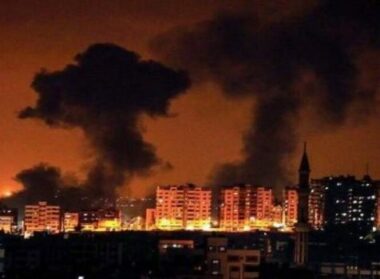
Israel rains down bombs on Gaza, resistance responds with 1000-plus rockets
Press TV – May 12, 2021
Palestinian resistance groups have fired a barrage of rockets at the Israeli-occupied cities in response to the regime’s continued bombardments of civilian targets in the Gaza Strip, as the death toll from the latest flare-up rises on both sides.
The Islamic Jihad resistance movement’s military wing, the al-Quds Brigades, announced that 100 rockets had been fired at the cities of Tel Aviv, Ashkelon, Be’er Sheva and Sderot early on Wednesday, Palestine Today reported.
Hamas’s military arm also announced that it launched 210 rockets toward the occupied territories early in the morning.
The Izz ad-Din al-Qassam Brigades said in a statement that it was “in the process of firing 110 rockets toward the city of Tel Aviv” and 100 others toward the town of Be’er Sheva, “as reprisal for the restarting of strikes against civilian homes.”
The Israeli army announced on Wednesday morning that Palestinian resistance groups in Gaza have launched more than 1,000 rockets toward different cities in the occupied territories since Monday evening.
Since then, the army said, 850 rockets have landed in Israel or been intercepted by the Iron Dome missile system.
Israeli authorities have so far confirmed five deaths as a result of the rockets fired from Gaza on several cities, including Tel Aviv.
The Israeli army also announced it had intercepted a Hamas drone early Wednesday.
Two Hamas commanders killed
The Israeli military has conducted hundreds of airstrikes on the blockade Gaza Strip, resulting in scores of fatalities.
Palestinian media reported that the Israeli regime continued its bombardment of the Gaza Strip on Wednesday, killing two Hamas commanders and three children.
Palestinian sources identified the two commanders as Hassan al-Kaogi (Abu Ali) and Wail Issa (Abu Ahmad).
Israel targeted Gaza’s police and security headquarters and the Islamic University of Gaza for the third consecutive day, which saw 30 simultaneous attacks on the Gaza Strip.
The Israeli army said in a tweet that the victims were Hamas intelligence officials.
It also said the Israeli attacks were a response to “hundreds of rockets” launched from Gaza in the last 24 hours, adding that they marked “our largest strike since 2014.”
Three Palestinian children were also killed during an Israeli air raid on Tel al-Hawa neighborhood in Gaza, Shehab News reported.
Pregnant Palestinian woman, 5-year-old son killed
Meanwhile, a pregnant Palestinian woman and her 5-year-old son were also killed during the Israeli airstrike that targeted their house in the Gaza Strip.
The woman, identified as Reem, and her son, Zaid, were reported killed after the strike hit their house in Tel al-Hawa, a neighborhood in the southern part of Gaza.
Reem’s brother, Ahmed Saad, reported their deaths on social media. She was four months pregnant.
Meanwhile, Gaza’s Health Ministry announced on Wednesday afternoon that as many as 48 Palestinians, including 14 children and three women, had lost their lives in Gaza in the latest Israeli strikes, with a total of 296 civilians — most of them women and children — wounded since Monday.
Palestinian rocket hits Israeli pipeline
As a result of rockets fired from Gaza on Wednesday, an Israeli pipeline near Ashkelon was hit causing fire.
The rockets also killed two Israeli settlers and injured at least 100 Israelis.
Hamas leader Ismail Haniyeh said Israel is responsible for the consequences of its atrocities in Jerusalem al-Quds and al-Aqsa Mosque, whose flames “extended to Gaza.”
He said Qatar, Egypt and the UN had been in contact with Hamas urging calm, but he told the regime in Israel that “If they want to escalate, the resistance is ready, if they want to stop, the resistance is ready.”
Earlier, Israeli minister for military affairs Benny Gantz warned that “this is just the beginning” of Israel’s assaults.
‘I saw my cousins set alight’, survivor recalls
One of the survivors of Israel’s attack in northern Gaza on Tuesday recalled the horror of watching five members of his family, including young brothers Ibrahim and Marwan, die during the strike.
“We were laughing and having fun, when suddenly they began to bomb us, everything around us caught fire,” their cousin, also called Ibrahim, told AFP.
“I saw my cousins set alight, and torn into pieces,” said the 14-year-old, breaking down in tears. “Why did they leave me? I would have wanted to die as a martyr like them.”
Israeli bombardments of Gaza continued on Wednesday, shaking Gazans’ homes and lighting up the besieged city’s sky just after dawn, with at least 30 explosions reported by residents within a matter of minutes.
Israel declares ‘state of emergency’ in Lod
The occupied territories were hit with protests as well, which, in the city of Lod, prompted the Israeli government to declare a “state of emergency” following the killing of a Palestinian by a Jewish settler in the city.
“Everything necessary is done to restore law and order in Lod” and throughout the occupied territories, Israeli public security minister Amir Ohana said.
He announced that the Israeli regime has decided to deploy 16 Border Police reserve units to Lod from the occupied West Bank.
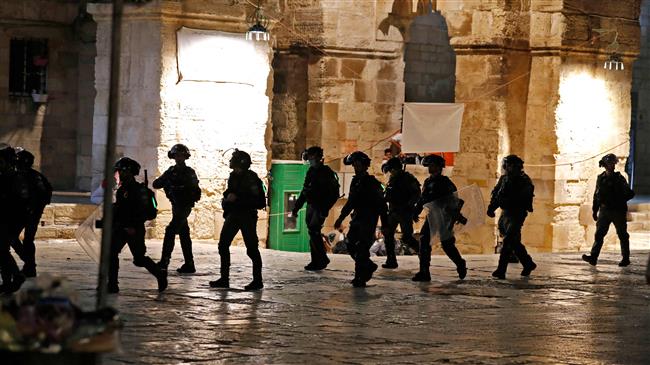
Minor confrontations were also reported following Fajr (dawn) prayers at al-Aqsa Mosque on Wednesday morning, with Palestinians chanting protest and resistance songs, while Israeli forces were deployed around the complex.
Unrest erupted across Israeli-occupied territories on Tuesday night and into Wednesday, as social media posts showed protests in the city of Rahat as well as in Qalansawe.
The al-Aqsa Mosque and Bab al-Amoud (Damascus) Gate in Jerusalem al-Quds’ Old City as well as the Sheikh Jarrah neighborhood have witnessed a spike in Israeli atrocities since the beginning of the Muslim holy month of Ramadan.
Biden Regime Blocks Security Council Action on Israeli East Jerusalem Violence
By Stephen Lendman | May 11, 2021
On Monday, Security Council members met behind closed doors to discuss weeks of Israeli state terror against defenseless Palestinians in East Jerusalem.
The Biden regime blocked a statement — demanding that Israel “cease settlement activities, demolition and evictions” of Palestinians from their homes and land, according to AFP.
Short of a binding international law resolution, the watered down statement expressed “grave concern regarding escalating tensions and violence in the occupied West Bank, including East Jerusalem.”
It called for “refraining from provocative actions and rhetoric, and upholding and respecting the historic status quo at the holy sites.”
Since establishment of a Jewish state on stolen Palestinian land in 1948, the US supported and ignored the worst of Israeli crimes of war and against humanity against Palestinians and regional states.
Instead of condemning Israeli violence in Occupied East Jerusalem, State Department spokesman Price said the following on Monday:
The Biden regime “condemns in the strongest terms the barrage of rocket attacks fired into Israel” from Gaza.
Price ignored Palestinian retaliation against weeks of Israeli state-terror.
He was silent about IDF terror-bombing of multiple parts of the Strip, killing at least two dozen Gazans, injuring many more, traumatizing thousands, causing extensive damage.
Defying reality, he “welcome(d) (nonexistent) steps by the (Netanyahu regime) aimed at avoiding provocations (sic).”
At the same time, he called Israeli aggression “self-defense.”
Asked if he condemned Israeli killing of Palestinian children, he ignored reality by claiming:
“(W)e don’t have independent confirmation of facts on the ground yet, so I’m very hesitant to get into reports that are just emerging.”
Instead of denouncing Israeli plans to dispossess Palestinian Sheikh Jarrah neighborhood families of their homes and land, he largely ducked the issue, saying:
“We’ve been clear in urging the Israelis to act responsibly, to treat Palestinian residents with compassion and with humanity in this case.”
Refusing to call East Jerusalem occupied, he said what’s going on in the city “is a final status issue to be determined by the parties (sic).”
Ignored was that following the Oslo Accords over a generation ago, Palestinians got nothing in return but empty Israeli promises, colonization, apartheid, and occupation harshness.
They got nothing for renouncing armed struggle, recognizing Israel’s right to exist, and agreeing to leave major unresolved issues for later final status talks. They’re still waiting.
Major unresolved issues include an independent sovereign Palestine free from occupation, the right of return, settlements, borders, water and other resource rights, as well as East Jerusalem as exclusive Palestinian territory and future capital.
One-sidedly supported by the US — while pretending otherwise — Israel refuses to accept all of the above, its hard-wired policy for over half a century.
It includes delaying resolution of issues with Palestinians to facilitate continued theft of their land — wanting all valued parts of historic Palestine Judaized, including Jerusalem as Israel’s exclusive capital, its Arab residents expelled, and diaspora Palestinians denied their right of return.
During a Monday press briefing, Price refused to condemn ongoing Israeli state terror against defenseless Palestinians — calling on both sides to show restraint instead, along with ducking responses to tough questions.
According to the Palestine Red Crescent Society on Monday:
“At least 612 Palestinians sustained injuries in the course of the day in (and around the Al-Aqsa Mosque compound) and the Old City of Jerusalem.”
During the day, Israeli violence escalated after its security forces stormed the Al-Aqsa Mosque — Islam’s third holiest site.
They fired rubber bullets, tear gas and stun grenades at Palestinian worshipers inside, causing large numbers of injuries.
Rocket fire from Gaza on Israel followed its desecration of the holy site.
Ignoring Israeli state terror on Monday and previous days, interventionist Blinken said the following:
“We’re very focused on the situation in Israel, West Bank, Gaza, very deeply concerned about the rocket attacks that we’re seeing now (sic), that they need to stop (sic).”
“They need to stop immediately (sic).” But IDF terror-bombing of Gazan civilians is OK, according to longstanding one-sided US support for apartheid Israel.
A Final Comment
On Monday, the Palestinian Center for Human Rights (PCHR) said the following:
“…Israeli Occupation Forces (IOF) violated al-Aqsa Mosque and its facilities, suppressed, and assaulted Palestinian worshipers and fired sound bombs and rubber bullets inside the Mosque and in its yards.”
“As a result, 305 Palestinians, including 8 journalists, were wounded — 7 were deemed in critical condition.”
“This serious escalation came only a few hours before a planned demonstration by thousands of Israeli settlers in Bab al-‘Amoud area and near al-Aqsa Mosque’s gates.”
“Chief of Israel Police ordered a large force to raid al-Aqsa Mosque in an attempt to facilitate the entry of Israeli settlers, who were gathering in Bab al Magharibah, into the Mosque.”
“Afterwards, IOF moved into al-Aqsa Mosque’s yards and its facilities via Bab al Magharibah and Bab al Silsilah amid heavy firing of rubber bullets, teargas canisters and sound bombs for 4 consecutive hours.”
At the same time, “Israeli snipers topped al-Aqsa Mosque’s western roofs, in addition to al-Qibli Mosque’s roof, and then raided the Mosque, assaulted Palestinian worshipers, and fired rubber bullets, teargas canisters and sound bombs at them.”
“As a result, dozens of Palestinians, old and young, men and women, who were detained inside the Mosque sustained wounds.”
“Also, IOF prevented medical and paramedics crew from providing first aid for the wounded. Moreover, IOF assaulted and severely beat worshipers.”
The Biden regime and its press agent media ignored virtually all of the above — in support of apartheid Israeli viciousness against defenseless Palestinians.
Featured Video
10K More U.S. Troops Deploy as Trump Weighs New Iran Strikes
or go to
Aletho News Archives – Video-Images
From the Archives
Genetic baloney in thick slices
MAYBE COULD BE INC.
By Jon Rappoport | No More Fake News | July 8, 2021
Gene research companies tend to come and go. They start out banging and popping like fireworks in the sky, and then they fade out—selling themselves to larger outfits who’ve hired better liars…
Once upon a time, it sounded easy. Start with a disease, find the gene responsible for the disease, and correct the problem.
Then, researchers wondered, was disease the result of one gene or a group of genes acting together?
Either way, the proof would be in devising cures for diseases using gene therapy. “Not yet, but soon…”
And regardless, the major need was: money. Lots and lots of money.
This need required good PR people. “We have to pump up the idea that we’re on the edge of tremendous breakthroughs. We’re always on that edge…”
This hype also needed to obscure the fact that there wasn’t (and isn’t) ANY gene cure for ANY disease. … continue
Blog Roll
 Aletho News
- Von der Leyen gifts her spin doctor a job for life
- 10K More U.S. Troops Deploy as Trump Weighs New Iran Strikes /Suliaman Ahmed
- Iranian crew declared Dena training vessel ‘unarmed’ to US warship before deadly torpedo strike: Report
- Iran’s NPT debate moves beyond parliament
- Houthis condemn Saudi claims of attack on Medina
- Fatuous False Flags
- Are Europe’s Smallest Nations Dragging the Continent into War?
- EU draws up contingency plans for possible Merz exit
- G7 caves to US blackmail, announces ‘massive’ release of diesel reserves
- Reporting of the RAF Fairford arrests blows the idea of a ‘free press’ out of the water
- If Americans Knew
- The Israeli Right Portrays Islam as Murderous. It Serves a Political Purpose
- Jordan Has Had Enough: King Abdullah’s Scathing Warning to Israel
- Israeli Colonizers (i.e. Settlers) Kill Palestinian Man Near Salfit
- New Google Maps images reveal massive scale of devastation in Gaza
- Jewish supremacy, anti-Palestinian bigotry on display in Israel – Daily Update
- Israeli Soldiers Abduct At Least 22 Across Occupied West Bank
- Eight Palestinians Killed in Israeli Attacks on Gaza
- Israeli former leaders and security chiefs threaten legal action over ‘Jewish terrorism’
- Israel map in LA Times ad includes all land from the river to the sea
- Inside Lebanon’s 200-page dossier on Israeli war crimes
- No Tricks Zone
- Green Energy Debacle: German Expert Professor Fritz Vahrenholt Warns Of Severe Economic And Social Consequences
- Two More Paleo Reconstructions Affirm Meters-Higher Sea Levels Across Ireland, Brazil 7000-6000 Years Ago
- New Study: Earth And Venus Surface Warmth Largely Explained By Convection And Lapse Rate, Not CO2 Or Radiation
- 2025 Nature Paper Claiming Worsening Global Drought Gets RETRACTED …Heavily Flawed
- New Study: ‘Global Drought Shows No Detectable Recent Acceleration Under Climate Warming’
- Economic Masterminds: German Socialists Suggest Taxing Productivity Gains Stemming From Using AI
- The South China Sea Has Not Been Cooperating With The Climate Change Narrative
- Energy Crisis: Germany Enters Heating Season With Historically Low Gas Reserve Fill Levels
- New Study: The Antarctic Ice Sheet Gained Mass From 2020-2024 Due To Staggering Snow And Ice Accumulation
- Study: Ocean Heating Rates From Thousands Of Years Ago ‘Dwarf’ Modern Ocean Heating Rates

