Refuse bids from those ‘involved in Israeli war crimes’, legal groups tell UK rail construction company
MEMO | February 5, 2021
A new legal brief has deemed it legal for the company building the UK’s new high-speed railway, HS2 Ltd, to exclude firms “involved in Israeli war crimes” from its tender process.
Drafted by Lawyers for Palestinian Human Rights and the European Legal Support Centre (ELSC), the legal brief states that the rail project is “legally entitled” to reject Spanish manufacturer Construcciones Auxiliar de Ferrocarriles (CAF)’s bid, on the grounds of “grave professional misconduct” and breaches of international law.
In 2019, CAF and the Israeli infrastructure company Saphir was chosen by Israel’s finance ministry to expand the settlement railway project, known as the Jerusalem Light Rail (JLR).
CAF and Saphir won the $2 billion contract to extend the railway to more illegal Israeli settlements, particularly in occupied East Jerusalem.
Under international law, the West Bank and East Jerusalem are occupied territories and all Jewish settlements there are illegal.
CAF is one of five companies which have issued bids to secure a £2.75 billion ($3.76 billion) contract to supply high-speed trains to the HS2 rail project.
ELSC, an NGO based in Amsterdam which defends and empowers the Palestine solidarity movement in Europe through legal means, said companies “involved in war crimes should have no standing in public tenders.”
“HS2 Ltd has the legal right and a moral obligation to exclude CAF from the tender procedure,” said the group’s Programme Director Giovanni Fassina.
The Boycott, Divestment and Sanctions (BDS) national committee’s Europe campaigns co-ordinator, Alys Samson Estape, added: “The JLR project is part of the ongoing process of entrenchment of Israel’s apartheid, illegal settlement enterprise and theft of Palestinian land in and around occupied East Jerusalem.”
JLR is so blatantly illegal that other multinationals which had participated in the initial stages of bidding for the project, including Alstom, Siemens, Systra, Bombardier and Macquarie, withdrew from the call for tenders, leaving just two consortiums bidding.
“Public institutions, including the UK government, should exclude CAF from its public tenders due to its violations of international law until it stops profiting from Israel’s illegal occupation.”
Palestine Solidarity Campaign Director, Ben Jamal, explained: “All public contract authorities must discharge their responsibilities to cease complicity in ongoing violations of international law.”
“This means HS2 Ltd must exclude CAF, and any other company violating Palestinian human rights, from the bid to provide rolling stock.”
Belgrade may postpone or end transfer of Serbian embassy to Jerusalem
By Paul Antonopoulos | February 5, 2021
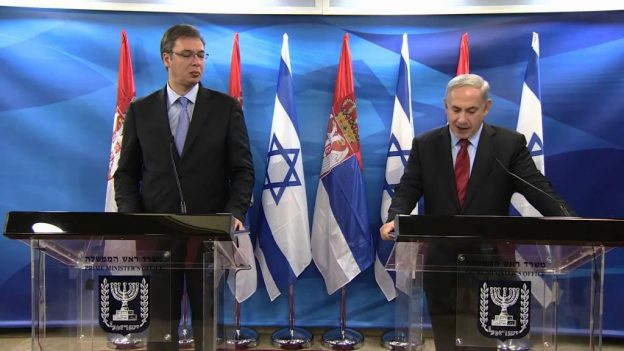
After the Israeli recognition of the so-called independent state of Kosovo on Monday, Belgrade finds itself in a difficult position and will reconsider its decision to move the Serbian embassy from Tel Aviv to Jerusalem. Serbia committed itself to this step by signing the September 2020 Washington Agreement suspecting that Kosovo and Israel would recognize each other eventually. Serbian President Aleksandar Vučić now says that his country will “build relations with the Jewish state in accordance to the new circumstances,” suggesting the embassy move might not occur at all.
The Washington Agreement was always tailored to the interests of Israel and Kosovo and not Serbia, yet Vučić still signed it to the dismay of Serbs. The agreement signed by Kosovo’s so-called Prime Minister Avdullah Hoti and then U.S. President Donald Trump states that Kosovo and Israel agree to mutual recognition. The agreement signed between Vučić and Trump specifies that Belgrade has an obligation to move its embassy from Tel Aviv to Jerusalem by July 1, 2021.
As much as the move between Israel and Kosovo was expected, it was probably not anticipated that the last item from the Washington Agreement would actually become the first. This is especially painful for Serbia as Vučić agreed with Kosovo’s authorities that the two would not engage in efforts for countries to recognize or stop recognizing Kosovo. This will likely bring new consequences to Serbia’s engagement with Israel.
As Serbian Foreign Minister Nikola Selaković noted, it will be interesting to observe whether there will now be Muslim and Arab countries that will recognize Kosovo or stop recognizing the illegal entity after its normalization with Israel.
So what will Muslim countries do?
Last year, thanks in large to Trump’s efforts, the United Arab Emirates, Bahrain, Sudan and Morocco normalized their relations with Israel, while Saudi Arabia and the Jewish state have been cooperating for many years behind closed doors.
Turkey, despite being the first Muslim majority country to recognize Israel, has hypocritically reacted to the signing of the agreement between Pristina and Tel Aviv. Turkish President Recep Tayyip Erdoğan claims that it does “not serve the Palestinian issue” and undermines the vision of a two-state solution. Erdoğan’s outrage is despite his country having multi-billion-dollar trade exchanges with Israel that was increasing year-on-year before the COVID-19 pandemic.
The Turkish Ministry of Foreign Affairs also stated that by signing the agreement, Kosovo, which it also recognizes, “undertook to open its embassy in Jerusalem, which is contrary to international law.” Again, Turkey made another contradiction considering it violated United Nations Resolution 550 and 789 by partially reopening the town of Varosha in occupied northern Cyprus last year, and by violating the United Nations Charter Law of the Sea by illegally entering Greece’s maritime space for much of 2020.
The question of relocating the Serbian embassy also entails the question of the status of Jerusalem – while the Israelis consider it their capital, the Palestinians say it is an occupied city. Palestinian Ambassador to Serbia, Mohammed Nabhan, said immediately after the signing of the Washington Agreement that 57 countries from the Arab League and the Islamic Organization for Cooperation could withdraw their recognition of Kosovo due to their agreement with Israel. There have been no such announcements from these Islamic organizations or their members.
This is an empty threat by Nabhan as the position of Muslim and Arab states regarding Israel are no longer united, something the Palestinian Authority appears to be oblivious to. Islamic countries are extremely divided over the issue of Israel and Kosovo. Several Muslim states like Iran, Syria, Iraq and Morocco do not recognize the independence of the breakaway Serbian province. Self-proclaimed Kosovo has been recognized by leading Arab countries, including the United Arab Emirates, Bahrain, Saudi Arabia, Qatar, and Egypt. It is difficult to expect that there will be any changes, especially since the voice of the Palestinian Authority is no longer as important as it used to be. The Palestinian question, which was once a major global issue, is now reduced, especially in the Arab World as they are now mostly focused on containing Turkish expansionism and Iranian influence.
Immediately after the signing of the Washington Agreement, it was speculated that Serbia might not fulfill what it signed if Israel recognizes the self-proclaimed independence of Kosovo. The very act of recognition is only a consequence of what was already signed in Washington last year. The new American administration are most likely not against Trump’s September 2020 Agreement, meaning they will try and implement it, or at the minimum not stop it. Belgrade’s only trump card is that they can postpone or end the transfer of the Serbian embassy from Tel Aviv to Jerusalem.
Paul Antonopoulos is an independent geopolitical analyst.
Why Always Israel? Only One Country Matters to Congress and the Media
By Philip Giraldi | Strategic Culture Foundation | February 4, 2021
The job of U.S. Ambassador to the United Nations must have some kind of curse on it as it seems to attract a type of woman who seeks to prove her suitability by running up a tally of how many wars she can start and how many people she can kill. One recalls fondly Bill Clinton’s monstrous Madeleine Albright, who famously declared the deaths of 500,000 Iraqi children as “worth it” due to the sanctions that Washington had imposed and enforced. And then there was Barack Obama’s darling Samantha Power, who was the spokesperson for the completely unnecessary slaughter of Syrians and Libyans to bring them democracy. And, most recently, we have had Nikki Haley, who didn’t start her own war but kept the ones ongoing during her watch on the boil while also taking on the task of being the most strident defender of Israel’s war crimes.
And now we have Honest Joe Biden’s nominee to be the U.N. ambassador, Linda Thomas-Greenfield. She is predictably black and is a career diplomat who ended up as head of the State Department’s Bureau of African Affairs. Upon retirement in 2017, she took a position, predictably, with the Albright Stonebridge Group in Washington. The Albright in the name comes from Madeleine and the Group is where many Democratic Party establishment foreign policy types wind up. Thomas-Greenfield might not be a drama queen like Nikki Haley or evil incarnate like Albright or Samantha Power, but she demonstrated in her confirmation hearing before the Senate that she knows the lines she has to speak as well as anyone in Washington.
Thomas-Greenfield dutifully spouted the usual cant relating to the Palestinians, which means that she did not mention them at all and is completely indifferent to the gross violations of their human rights by Israel. In response to several queries from legislators about how she would work to fend off international criticism against Israeli policies, she unleashed an attack against the non-violent Boycott, Divestment and Sanctions (B.D.S.) movement which criticizes Israel’s human rights record and urges people to support Palestinian rights by pressuring Israel’s economy through boycotts, divestment, and sanctions. It deliberately eschews violence or punishing ordinary Israelis for the actions of their government and it’s economic approach is a tactic that was used successfully against the apartheid South African regime in the 1980s.
One assumes that Thomas-Greenfield, as a black American diplomat who was active when South Africa adopted majority rule, is fully aware of the fact that Israeli apartheid backed by an army of occupation that does not hesitate to shoot to kill is more pervasive than the South African version ever was. She may even be aware that what Israel does is driven by racism and amounts to genocide. Nevertheless, she told the Senators “[B.D.S.] verges on anti-Semitic, and it’s important that they not be allowed to have a voice at the U.N., and I intend to work against that… I look forward to standing with Israel, standing against the unfair targeting of Israel, the relentless resolutions proposed against Israel unfairly.” In short, Thomas-Greenfield sounded more than a little like Nikki Haley, who used to amuse the U.N. General Assembly with her homilies in defense of the Jewish state that culminated in U.S. withdrawal from the Human Rights Council, refugee agency (UNRWA), and its cultural organization (UNESCO) over claims that they all had an anti-Israel bias.
There should be no question but that the friends of Israel constitute the most powerful foreign policy lobby. It’s ability to shift policy in its favor is unmatched by any other organization that promotes the interests of a foreign nation at the expense of the United States itself. No other nation comes close to having the power to actually write legislation that is then approved by Congress while also influencing decision making in the White House. No other country avoids accountability for its actions either among politicians or in the media to anywhere near the same extent as Israel. If anyone doubts that that is true, it is only necessary to review the recent confirmation hearings of Biden appointees, where foreign policy discussions are limited to bashing China and Russia followed almost immediately by the question “And what have you done for Israel lately?”
Politicians are quite aware that giving the wrong answer on Israel can be fatal for one’s career. In many congressional districts the training of lawmakers begins early, with representatives of the hundreds of Israel Lobby affiliates interviewing potential candidates on their views relating to the Jewish state. In many cases, attempts are made to get possible candidates to sign statements affirming that they hold the correct views on Israel versus its neighbors. The sensitivity towards Israeli and Jewish issues must continue after one is elected, resulting in questions in public fora like confirmation hearings. It never hurts to advertise one’s loyalty to Israel early and often.
Questions about Israel inevitably also came up in the Senate confirmation hearing for Secretary of State Anthony Blinken. Blinken is Jewish, a confirmed Zionist, and now heads a State Department where his deputy and political affairs chief are both Jewish women hardliners who basically share his views. Biden, Blinken and company advocate policies in the Middle East that are definitely pleasing to the Israeli government, such as de facto continuing a hard line with Iran.
In a press statement last year Blinken confirmed the outlines of the Biden Administration relationship with Israel as follows: “You can count on Joe Biden to make sure Israel has what it needs to defend itself, to honor the bipartisanship traditions of U.S. support for Israel, to safeguard, not put at risk, Israel’s future as a Jewish, and democratic state. Joe Biden has spoken out strongly and stood strongly against the B.D.S. movement. He’s also been very clear that he would not tie military assistance to Israel to things like annexation or other decisions by the Israeli government with which we might disagree.”
In other words, Israel has a free hand to do whatever it wants and there will be no pushback from the Biden White House in terms of the only thing that matters – the billions of dollars in “military assistance” the Jewish state receives each year. Oh, and Blinken surely realizes that while Israel is Jewish by law it is ipso facto hardly democratic.
Blinken’s apparent first telephone call to a Foreign Secretary counterpart was to Gabi Ashkenazi of Israel. Their warm and fuzzy exchange was tweeted, with Blinken enthusing “Great speaking with @Gabi_Ashkenazi today to discuss the steadfast partnership between the U.S. and Israel. Our commitment to Israel’s security is sacrosanct, and I look forward to working with the Foreign Minister and others toward our common goals.” Ashkenazi replied “I had a warm call with @secBlinken & affirmed Israel’s commitment to the robust Israeli-US strategic partnership. I welcomed very much the POTUS commitment to IL security.”
The point is that pandering to Israel as part of the political process in the United States has become part of the DNA of both major parties. Trump was shameless in his gifts to the Jewish state all through his four years and Biden promises to deliver more of the same. But the really bad news for Americans is the fact that the wag the dog relationship with Israel ties the United States into failed policies in the Middle East for the foreseeable future. It is time for the federal government to stop focusing on doing favors for Israel and instead start talking about how the policies that mandate force projection in the Middle East to protect the Jewish state are not really working out very well for the American people. When that becomes clear to the public, change will come.
Five Palestinian minors say they were severely beaten, tortured by Israeli soldiers during detention

Israeli occupation forcing detaining Palestinian minors in the occupied territories
WAFA – February 2, 2021
Five Palestinian minors said they were severely beaten and tortured by Israeli soldiers and interrogators during detention, today said the Palestinian Commission for Detainees and Ex-Detainees Affairs.
It said it got affidavits from the five minors, who gave details of the beating and torture they were subjected to at the hands of Israeli soldiers and security agents during arrest and interrogation.
Mustafa Salameh, 17, was detained at his family home in Azzoun town, east of the northern West Bank city of Qalqilya. He was beaten with the butt of guns, smacked and kicked around, then shoved into an army jeep where he was thrown on the floor as soldiers kept trampling on him with their army boots, and kicking him while cursing him.
He said in his affidavit that he lost consciousness after that for a while and when he woke up he found himself in Jalama detention center where he was later interrogated for long hours while tied to a chair before being moved to the Majeddo prison for minors.
Mohammad Zalloum, 17, was detained at his family home in Silwan neighborhood of occupied East Jerusalem. He was dragged out of his house, severely punched on his stomach causing him to vomit, and then moved to Asqalan detention center where he was kept in the cells for 23 days, occasionally severely beaten.
Hani Rmeilat, 17, from Jenin refugee camp in the north of the West Bank, was interrogated in difficult conditions at Jalama detention center, assaulted with clubs by five prison guards causing him bruises on his body which required hospitalization at an Israeli hospital, after which he was taken back to the Jalama prison where he was kept for 20 days before being moved to Majeddo prison.
Majd Waari, 17, from Beit Hanina neighborhood of East Jerusalem, underwent severe interrogation at the infamous Russian Compound detention center in West Jerusalem for several hours while tied up on a small chair, smacked on the face and insulted.
Munir Arqoub, 17, from Kufr Ein, north of Ramallah, was detained at the Beit El military checkpoint north of Ramallah, attacked by three soldiers and thrown to the ground, beaten severely, then thrown into an army jeep before he was taken to a nearby military base. He was there left in an open area during cold weather conditions for several hours and denied sleep. He was taken the next day to Ofer military camp and detention center for interrogation and then moved to Majeddo prison.
The Commission said Israel is holding 170 Palestinian minors in its prisons, most of them were subjected to some form of cruelty, abuse, and brutality during their arrest.
Netanyahu tells Biden how to deal with Iran
By Philip Giraldi • Unz Review • February 2, 2021
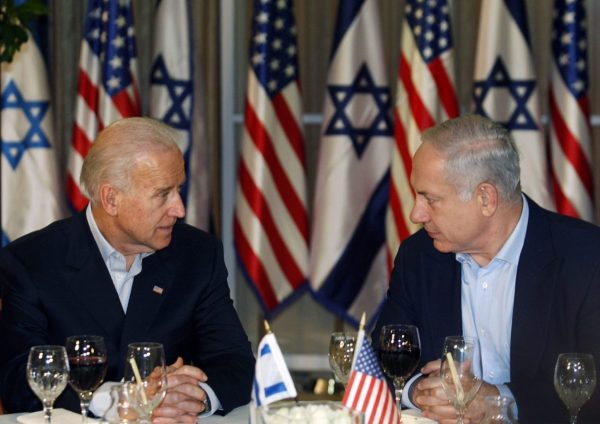
Anyone who persists in believing that the United States is not Israel’s poodle should pay attention to the comedy that is playing out right now. Joe Biden was [proclaimed] president for less than a week when the Prime Minister Benjamin Netanyahu government announced that he would soon be receiving a possibly unwelcome visitor in the form of the Israeli foreign intelligence service Mossad’s chief Yossi Cohen, who will be flying to Washington in February to explain the correct policy when dealing with Iran. And lest there be any confusion on the issue, the Israel Defense Force chief of staff Lieutenant General Aviv Kochavi also announced that any Biden attempt to mend fences with the Islamic Republic will have to meet certain conditions or Israel will exercise other options. He said “In light of this fundamental analysis, I have instructed the Israel Defense Forces to prepare a number of operational plans, in addition to those already in place. It will be up to the political leadership, of course, to decide on implementation but these plans need to be on the table.” Another government minister clarified that the options would include “an attack” on Iran, though there has been no indication whether or not Israel would possibly contemplate deploying its tactical nuclear weapons to prevent retaliation by Iranian forces.
There is no limit to Israeli hubris. A leading Rabbi in Israel is predicting that as the United States is in decline it is up to the Jewish state to take over the role of “guiding civilization forward.” And that kind of thinking shapes how Israel treats the United States with condescension, acting as if it is the knowledgeable elder statesman whose guidance must be respected. In this case the Zionist solution to the Iran problem will by design be unpalatable for the government in Tehran if it intends to remain sovereign. For Israel the correct policy for dealing with Iran is to effectively disarm it and make it impossible to establish any sphere of influence in the countries adjacent to it, to include Iraq, Syria, and Lebanon. That would be to concede Israeli dominance over the entire region and if the Iranians do not play ball the next step would be to convince the United States to attack it on some pretext, possibly to include an Israeli “false flag” to start the process going.
The Times of Israel sums up the Israeli official position as “… Iran must halt the enriching of uranium; stop producing advanced centrifuges; cease supporting terror groups, foremost Lebanon’s Hezbollah; end its military presence in Iraq, Syria and Yemen; stop terror activity against Israeli targets overseas; and grant full access to the IAEA on all aspects of its nuclear program.” Completing the disarming of Iran would also include requiring Tehran to abandon its ballistic missile program.
The irony is, of course, that it is Israel that has a secret nuclear arsenal that it created by stealing uranium and triggers from the United States and it is also the leading regional supporter of terrorist groups, to include al-Qaeda and ISIS. Iran’s presence in Syria is due to its lending assistance to the Damascus government’s resistance to the insurgencies supported by Israel and the United States. And Iran has not targeted Israeli citizens and groups overseas, but Israel and the U.S. have assassinated Iranian officials while also bombing both government and civilian targets in Syria, Iraq and Lebanon. And all of the kinetics occur in a context where Israel continues its illegal occupation of Palestine and ethnic cleansing of the Palestinian people replete with both war crimes and crimes against humanity. Iran is also a signatory to the Nuclear Non-Proliferation Treaty, which Israel is not, so who is the rogue state?
Biden will likely fold like a cheap suit when confronted by the force majeure of Cohen. The new American president has assembled a national security team for dealing with the Middle East that is nearly all Jewish and all Zionist, an affliction that he himself claims to suffer from. The Biden nominee for secretary of state Tony Blinken said at a confirmation hearing last week that the new administration would “consult with Israel” before any possible return to the 2015 Joint Comprehensive Plan Of Action (JCPOA) nuclear deal and he also made clear that there would be additional conditions for Iran. It was an odd comment for a government official who is supposed to support American interests, but it was predictably what Congress wanted to hear. As Iran has already indicated that it is unwilling to abandon its defenses and its role in the region, the Biden proposal will be a non-starter in any case, though Israel will be prepared to apply its own veto if anything undertaken by the State Department moves beyond the talking stage.
Currently there is credible speculation that Israeli intelligence has been able to compromise most if not all of the U.S. government’s information systems as well as those of major corporations. As the Jewish state is the most active in spying against the United States, that should surprise no one. For Israel to interfere in U.S. politics or government blatantly is not exactly new, though it is rare to have anyone in the mainstream media or in government say anything about. That is because Israel’s ability to wage war against critics is second to none, having at its back nearly unlimited financial resources and easy access to the media as well as active supporters from among the nearly six hundred Jewish organizations that exist in the United States.
Indeed, Israel has been involved in American politics frequently, one might even argue incessantly, even if it is predictably never held accountable. To cite only one well known example, it has been suggested that Russiagate was really Israelgate based on what actually took place shortly after the 2016 election. The contact with Russia was set up by Prime Minister Benjamin Netanyahu, who was at the time seeking to kill an anti-Israeli vote in the United Nations. He sought to do so by lobbying Donald Trump son-in-law Jared Kushner on the matter shortly after the 2016 election. Netanyahu was particularly close to the Kushner family, having on at least one occasion slept overnight at their mansion in Manhattan.
Prompted by Netanyahu, Kushner dutifully contacted Trump National Security Advisor-designate Michael Flynn and asked him to privately call Russian Ambassador Sergei Kislyak to lobby Moscow to vote against the bill. There were two phone calls but Kislyak refused to cooperate. It should be noted that while all of this was taking place Barack Obama was still president and his intention to abstain on a vote on Israel’s illegal settlements is what provoked Netanyahu to act, so Netanyahu-Kushner-Flynn were subverting their own elected government and were definitely in the wrong. Flynn was subsequently thrown under the bus by his Jewish friends without any mention in the media of the Israeli role, thereby becoming the first casualty of “Russiagate.” He was subsequently forced to resign from his post in disgrace in February 2017.
The whole issue of the U.S.-Israel relationship constitutes one of the most formidable “red lines” in American politics as part of its power comes from the fact that the media and political classes pretend that it does not even exist. Israel’s power was poisonous enough prior to the election of Donald Trump, but Trump, “advised” by a gaggle of orthodox Jews, dramatically shifted the playing field to favor Israel in ways that will define the relationship for years to come. Biden’s team is little better and the president will be taking his orders from Jerusalem and saluting as long as he stays in the White House. Will it lead to a totally unnecessary and unwinnable war with Iran? That is what Israel demands above all, and Israel always gets what it wants.
Philip M. Giraldi, Ph.D., is Executive Director of the Council for the National Interest, a 501(c)3 tax deductible educational foundation (Federal ID Number #52-1739023) that seeks a more interests-based U.S. foreign policy in the Middle East. Website is https://councilforthenationalinterest.org address is P.O. Box 2157, Purcellville VA 20134 and its email is inform@cnionline.org
Rights Group Calls on Israel to Immediately Release Palestinian UN Worker

UN employee and human rights activist, Shireen Al-Araj.
Palestine Chronicle | February 1, 2021
The Euro-Mediterranean Human Rights Monitor today expressed its grave concern over the Israeli authorities’ arrest of a UN Palestinian employee in Jerusalem, calling for her immediate and unconditional release.
The Israeli authorities arrested UN employee and human rights activist, Shireen Al-Araj, on January 25, in front of the Magistrate’s Court in Jerusalem. She was summoned to an interrogation on charges of “contacting with foreign clients and persons.”
Al-Araj, who holds an Israeli ID in addition to a UN diplomatic passport, had returned to the Palestinian territories after an Israeli ban that lasted for five years. Her lawyer had contacted her informing her that she has to return to the Palestinian territories to renew her residency papers or she will lose her residency and become a “refugee”, which will deny her entry into the Palestinian territories again.
On January 24, at the border between Jordan and the Palestinian territories, Al-Araj was interrogated upon her arrival, where she was ordered to go to the Magistrate’s Court in Jerusalem the next day for further investigation by the Israeli police.
As she arrived at the court, Israeli intelligence agents stopped Al-Araj near the court door, took her to her home, and confiscated her computers and mobile phones. After that, she was taken to Petah Tikva prison in central Israel. The Israeli authorities prevented her lawyer and an Israeli lawyer appointed by the UN from meeting her or even being with her during the interrogation.
Al-Araj has been working with the UN in several organizations and programs, including the United Nations Relief and Works Agency for Palestine refugees (UNRWA), the United Nations Population Fund and the Office of the High Commissioner in Turkey.
Israel restricts the work of UN workers in the Palestinian territories, despite the UN’s coordination with the Israeli authorities. The Israeli authorities also follow a strict policy with local and international human rights defenders and impose significant restrictions on granting them entry visas to Israel or accessing the Palestinian territories.
Hezbollah fighters intercept, shoot down Israeli reconnaissance drone in southern Lebanon
Press TV – February 1, 2021
The Lebanese Hezbollah resistance movement says it has intercepted and shot down an Israeli unmanned aerial vehicle as it crossed into Lebanon’s airspace near the border village of Blida in the south of the Arab country.
Hezbollah said in a brief statement that the drone was struck on Monday morning, adding that it was now in the control of the drone. It did not provide any further details.
The Israeli military, however, asserted that the drone had fallen in Lebanese territory during an operation, alleging that “there is no risk of breach of information.”
The development came a day after Palestinian resistance fighters brought down an Israeli quadcopter conducting an espionage mission against the besieged Gaza Strip.
The drone was shot down on Sunday while taking images over Beit Hanoun Crossing, which is located on the enclave’s northern border with the occupied territories, the Arabic-language Palestine al-Yawm news agency reported.
Israel frequently violates Lebanon’s airspace. Lebanon’s government, Hezbollah and the United Nations Interim Force in Lebanon (UNIFIL) have repeatedly condemned Israel’s overflights, saying they are in clear violation of UN Security Council Resolution 1701 and the country’s sovereignty.
The resolution, which brokered a ceasefire in the war Israel launched against Lebanon in 2006, calls on the Tel Aviv regime to respect Beirut’s sovereignty and territorial integrity.
On August 23 last year, Hezbollah resistance movement said it had downed and seized an Israeli drone as it flew over the Lebanese border.
The Israeli military claimed back then that a drone had fallen in Lebanon during operational activity along Lebanese border, claiming that there was no risk of breach of information.
Tensions have been running high between Israel and Hezbollah since July 20 last year, when Tel Aviv killed Hezbollah member Ali Kamel Mohsen in an airstrike in Syria.
The Israeli military has placed its forces near the Lebanese and Syrian borders on high alert after Hezbollah promised retaliation.
Israeli forces shelled the Lebanese village of Habaria in late July 2020 to stop an alleged Hezbollah offensive, but the Lebanese movement dismissed the allegation, calling it the result of tension and confusion among Israeli forces.
Sharjah: Emir’s wife criticises UAE-Israel education cooperation

MEMO | January 29, 2021
The wife of the Emir of Sharjah has criticised the UAE’s cooperation with Israel in the education field. Sheikha Jawaher Bint Mohammed Al-Qasimi made her comment about an online meeting between the ministries of education in the UAE and Israel to discuss cooperation, student exchanges, and joint academic studies.
“Their [the Israelis’] curriculum encourages the killing of Arabs and stealing Arab lands,” she said on Twitter. The Sheikha also retweeted a post by “Ahmed”, a tour guide, about Andalusia in which he recalled the background of Israeli Minister of Education Yoav Galant.
“Who is the Israeli Education Minister Yoav Galant?” wrote the tour guide. “He is one of the bloodiest generals in the history of Israel. He participated in the killing of Hassan Salameh in Beirut in 1979. He is the leader of the operation to storm the Jenin [refugee] camp, which led to the killing of dozens of defenceless Palestinians, and operation Grapes of Wrath against Lebanon (Lebanese Qana massacre) in 1996.”
Sheikha Jawaher’s tweet is the most prominent and explicit objection to have emerged from the ruling circles in UAE against cooperation with Israel. Hundreds of Twitter users have praised her courage in expressing her opinion.
In 2013, the UN-appointed Sheikha Jawaher as the first prominent advocate for the UN High Commissioner for Refugees in the UAE. This, said the international organisation, was because of her “proven track record in the field of humanitarian work, community support, and women’s empowerment.”
The UAE and Israel signed an agreement last September to normalise their relations under US auspices, despite Palestinian and Arab objections.
READ ALSO:
Kuwait school book shows Israel on map in place of Palestine
Israel Warns Hamas Leaders Not to Run in Elections in West Bank
MEMO | January 28, 2021
Israeli intelligence services have started to warn Hamas officials in the occupied West Bank not to participate in the upcoming Palestinian elections, sources within the movement revealed on Wednesday.
According to the sources, the Israelis first summoned senior Hamas official Sheikh Omar Al-Barghouti to speak with intelligence officers at Ofer Detention Centre. While he was there, Al-Barghouti, who lives in the Ramallah neighborhood of Coper, was “asked” not to take part in the presidential, legislative and National Council elections. The Hamas leader was only released from prison a few weeks ago.
Several other Hamas officials and senior members have also been “asked” the same thing by the Israelis. The sources said that some were asked on the telephone and others were also summoned to detention centers or military bases to be interrogated on this issue.
Al-Barghouti has spent a total of 30 years in Israeli prisons. He is the brother of Nael Al-Barghouti, who has been held by Israel for more than 40 years.
In 2018, the Israeli occupation forces arrested Al-Barghouti and his wife. During the same raid, they not only killed his son but also demolished his house.
Previous warnings from Israeli intelligence to Hamas have included telling officials not to get involved in reconciliation talks with Fatah.
In 2006, Hamas won the parliamentary and municipal elections in the occupied Palestinian territories. Israel, Fatah, Arab states and the West, including the US, refused to accept the victory before going on to help Fatah oust Hamas in the West Bank and impose a strict siege on Gaza.
Israeli Forces Demolish Mosque in Masafer Yatta
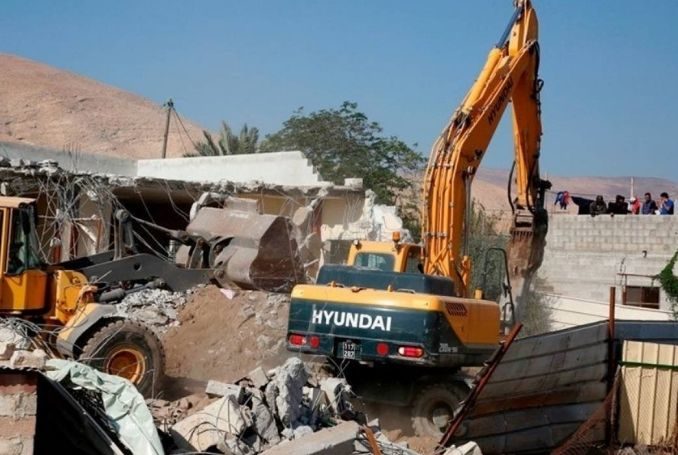
Israeli forces Wednesday demolished a mosque in the Bedouin community of Azwadeen. (Photo: via Social Media)
Palestine Chronicle | January 27, 2021
Israeli forces Wednesday demolished a mosque in the Bedouin community of Azwadeen, east of Yatta city, south of Hebron, according to the Palestinian news agency WAFA.
Coordinator of the Protection and Steadfastness Committees, Fuad al-‘Amour, told WAFA that Israeli forces escorted bulldozers into Khirbet Umm Qassa in the Bedouin community of Azwadeen, in what is called the Eastern Slope, where the heavy machinery tore down the mosque, reducing it to rubble.
The demolition was carried out less than two weeks after soldiers posted demolition notices against the mosque and a local school, which serves 50 students from three marginalized communities, purportedly for being built without licenses.
Meanwhile, soldiers seized a tin-sheet health unit in Khirbet al-Rakiz hamlet in Masafer Yatta.
Masafer Yatta is a collection of almost 19 hamlets that rely heavily on animal husbandry as the main source of livelihood.
Located in Area C of the West Bank, under full Israeli administrative and military control, the area has been subjected to repeated Israeli violations by settlers and soldiers targeting their main source of living – livestock.
It has been designated as a closed Israeli military zone for training since the 1980s and accordingly referred to as Firing Zone 918.
Israeli violations against the area include demolition of animal barns, homes and residential structures. Issuance of construction permits by Israel to local Palestinians in the area is non-existent.
Featured Video
10K More U.S. Troops Deploy as Trump Weighs New Iran Strikes
or go to
Aletho News Archives – Video-Images
From the Archives
Genetic baloney in thick slices
MAYBE COULD BE INC.
By Jon Rappoport | No More Fake News | July 8, 2021
Gene research companies tend to come and go. They start out banging and popping like fireworks in the sky, and then they fade out—selling themselves to larger outfits who’ve hired better liars…
Once upon a time, it sounded easy. Start with a disease, find the gene responsible for the disease, and correct the problem.
Then, researchers wondered, was disease the result of one gene or a group of genes acting together?
Either way, the proof would be in devising cures for diseases using gene therapy. “Not yet, but soon…”
And regardless, the major need was: money. Lots and lots of money.
This need required good PR people. “We have to pump up the idea that we’re on the edge of tremendous breakthroughs. We’re always on that edge…”
This hype also needed to obscure the fact that there wasn’t (and isn’t) ANY gene cure for ANY disease. … continue
Blog Roll
 Aletho News
- US military withdrawal from Iraq and the collapse of US-Israeli hegemonic project in West Asia
- What does Europe want – a war with Russia?
- She Followed the Actual Data on COVID Vaccines and Masks — Her Career Took a Huge Hit
- Florida AG Sues Pfizer, Bourla Over Deceptive Marketing of COVID Vaccines
- Von der Leyen gifts her spin doctor a job for life
- 10K More U.S. Troops Deploy as Trump Weighs New Iran Strikes /Suliaman Ahmed
- Iranian crew declared Dena training vessel ‘unarmed’ to US warship before deadly torpedo strike: Report
- Iran’s NPT debate moves beyond parliament
- Houthis condemn Saudi claims of attack on Medina
- Fatuous False Flags
- If Americans Knew
- The Israeli Right Portrays Islam as Murderous. It Serves a Political Purpose
- Jordan Has Had Enough: King Abdullah’s Scathing Warning to Israel
- Israeli Colonizers (i.e. Settlers) Kill Palestinian Man Near Salfit
- New Google Maps images reveal massive scale of devastation in Gaza
- Jewish supremacy, anti-Palestinian bigotry on display in Israel – Daily Update
- Israeli Soldiers Abduct At Least 22 Across Occupied West Bank
- Eight Palestinians Killed in Israeli Attacks on Gaza
- Israeli former leaders and security chiefs threaten legal action over ‘Jewish terrorism’
- Israel map in LA Times ad includes all land from the river to the sea
- Inside Lebanon’s 200-page dossier on Israeli war crimes
- No Tricks Zone
- Green Energy Debacle: German Expert Professor Fritz Vahrenholt Warns Of Severe Economic And Social Consequences
- Two More Paleo Reconstructions Affirm Meters-Higher Sea Levels Across Ireland, Brazil 7000-6000 Years Ago
- New Study: Earth And Venus Surface Warmth Largely Explained By Convection And Lapse Rate, Not CO2 Or Radiation
- 2025 Nature Paper Claiming Worsening Global Drought Gets RETRACTED …Heavily Flawed
- New Study: ‘Global Drought Shows No Detectable Recent Acceleration Under Climate Warming’
- Economic Masterminds: German Socialists Suggest Taxing Productivity Gains Stemming From Using AI
- The South China Sea Has Not Been Cooperating With The Climate Change Narrative
- Energy Crisis: Germany Enters Heating Season With Historically Low Gas Reserve Fill Levels
- New Study: The Antarctic Ice Sheet Gained Mass From 2020-2024 Due To Staggering Snow And Ice Accumulation
- Study: Ocean Heating Rates From Thousands Of Years Ago ‘Dwarf’ Modern Ocean Heating Rates

