How US, Europe, Persian Gulf states exhausted missile stockpiles, splurged billions to defend Israel
By Arman Shariati | Press TV | October 26, 2026
Israeli regime’s airspace – the airspace over the occupied territories – is widely regarded as among the most heavily defended in the world.
Yet the scale of its protection cannot be explained by Israeli military technology alone. Russia, China and even the United States do not benefit from an equivalent network of allied support dedicated to intercepting threats before they reach their territory.
Israel’s own defenses are indeed formidable. Arrow 3 is designed to intercept ballistic missiles outside the atmosphere, while Arrow 2 targets ballistic missile threats within it. David’s Sling is built to counter medium-range threats, and Iron Dome intercepts rockets and other short-range projectiles.
These systems are backed by fighter jets and an extensive radar network, creating multiple layers of protection against incoming attacks.
But Israel’s air defense shield extends well beyond its own arsenal. From October 2023 through Iran’s retaliatory missile and drone operations in 2024, 2025 and 2026, a group of allied states has played an active role in protecting the regime.
They have provided interceptors, radar capabilities, fighter aircraft, military bases and personnel, helping the Tel Aviv regime detect, track and counter incoming threats.
What emerges is not simply a domestic air-defense network, but a wider umbrella sustained by the resources and involvement of powerful allies – from the US to Europe to Arab countries.
This ironclad commitment of regional and extra-regional countries to Israel’s protection has come at a considerable cost.
The price goes well beyond dollars and shekels. It includes depleted weapons stockpiles that could take years to replenish, damaged radars and military bases, soldiers killed or wounded, and governments facing domestic political backlash for a costly partnership that much of their own public fiercely opposes and protests against.
The burden, however, is not shared equally. The United States has shouldered the largest financial and military inventory costs. The Persian Gulf monarchies and Jordan have faced intense operational demands and direct security risks. European states have incurred more limited but still significant costs, particularly in munitions and the political fallout from a war that has driven up energy prices and compounded the cost-of-living pressures facing their populations.
The Israeli bill
The Israeli regime’s direct costs are the easiest to track because they fall on its own treasury. In April 2024, after Iran launched a large number of drones and missiles at the occupied territories, Brig. Gen. Reem Aminoach, an economic adviser to a former Israeli military chief of staff, estimated in an interview with Ynet that defending against the attack that night had cost 4-5 billion shekels, or roughly $1.1–$1.35 billion at the exchange rate at the time.
Haaretz later put the total cost of defending against the same retaliatory attack at around $1.5 billion. That was just one night. Many more retaliatory strikes have hit the occupied territories since then.
The cost structure follows a clear logic. Iran uses inexpensive drones and mass-produced missiles, while Israel relies on some of the world’s most expensive interceptors to defend against them.
This disparity lies at the heart of the war’s financial burden. Israel’s broader budget picture adds another dimension. Sustained, high-intensity defensive operations have forced the regime to spend far more than it did previously.
With a net budget of about 60 billion shekels in 2023, the Israeli military could not sustain repeated nights of interceptions without substantial increases in funding and continued US support.
Israel has been able to sustain this costly imbalance largely because of extensive financial backing from American taxpayers. Much of its interceptor production is funded or co-developed through US programs, and the Arrow missile defense system is produced with American participation.
US Congress has also repeatedly approved emergency supplemental funding for Israeli missile defense. These ties mean that Israel’s financial burden and America’s are deeply interconnected and difficult to separate, which explains the public anger in the US.
The American inventory crisis
No country has spent more on Israel’s defense than the United States, and no factor is more consequential than the state of its interceptor stockpiles. Washington may be willing to spend the tens of billions of dollars required to protect their genocidal ally, but willingness alone cannot resolve the US military’s primary challenge: replenishing its dwindling missile interceptors.
The Center for Strategic and International Studies (CSIS), an American think tank, has published some of the most widely cited public estimates of US missile interceptor inventories.
Its analysis, updated following the 40-day war against Iran, found that American Patriot and THAAD inventories had declined dramatically.
According to CSIS estimates, the US inventory of Patriot interceptors fell from approximately 2,330 before the war began on February 27, 2026, to between 759 and 827 by July 27, 2026, marking a decline of roughly two-thirds.
The THAAD inventory also dropped sharply, falling from an estimated 452 interceptors before the war to between 239 and 257 by July 27, representing a decline of approximately 43 to 47 percent.
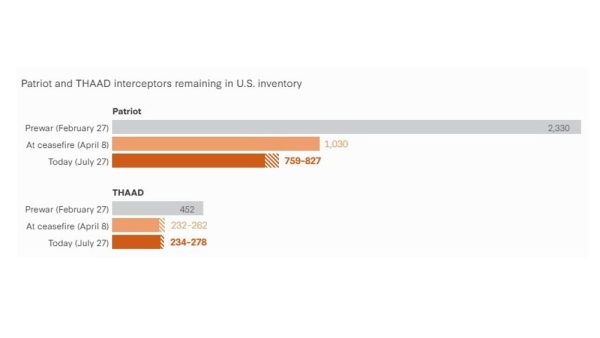
Estimates of remaining American Interceptor inventory (Source: CSIS)
Many military experts believe CSIS’s estimates are overly optimistic. Some, for instance, argue that the United States may have fired as many as 290 of its roughly 360 THAAD interceptors during the early phase of the war. That would amount to more than 80 percent of its pre-war stockpile.
Whatever the exact figures, Washington’s decision to prioritize Israel’s defense has left the US military dangerously underprepared and more vulnerable to another round of war if it breaks out.
The cost of replenishing stockpiles
The US Army’s FY2027 figures put the unit cost of a PAC-3 MSE interceptor at roughly $5 million and that of a THAAD interceptor at nearly $12 million.
Based on these figures, replacing the Patriot and THAAD interceptors expended would cost an estimated $10 billion. The Congressional Budget Office has offered a higher estimate, putting the cost of replacing the depleted interceptors at approximately $13.1 billion.
Iranian Foreign Minister Abbas Araghchi in recent remarks noted that the US spent about $11 billion on missile defense for Israel over three years. In a post on X, quoting a tweet of a former Obama administration official, he said US forces had fired 609 interceptors in defense of the Israeli regime between October 2023 and June 2026, including SM-2, SM-3, SM-6, Patriot, and THAAD missiles.
The naval picture
The US Navy’s missile interceptor inventories are also under severe strain. The SM-3 and SM-6 are among the principal naval weapons used to counter ballistic missiles and other high-speed threats.
Public estimates vary widely, with some reports placing combined naval inventories in the low hundreds. A figure of 150–200 for the two interceptor types combined is plausible as a rough order of magnitude, but no precise public count is available.
The broader concern is that naval interceptors are expensive and slow to manufacture, while the Navy must preserve sufficient stocks to address other potential threats, including those posed by China and Russia. Every interceptor expended in the defense of Israel is therefore one fewer available for other contingencies until it can be replaced.
Not all US and allied defenses against Iran relied on ground-based or naval interceptors. Fighter jets also engaged Iranian drones using air-to-air missiles, including the AIM-9X and AIM-120. The AIM-9X reportedly costs several hundred thousand dollars per missile, while the AIM-120 AMRAAM costs more than $1 million.
Using such expensive weapons to destroy drones that cost only thousands of dollars compounds the economic imbalance, even when the immediate tactical objective is achieved.
The trade-off
By the final phase of the 40-day imposed war, following the initial ceasefire, it had become clear that US commanders were holding back dedicated SM-3 and THAAD interceptors rather than expending them to protect American bases in Jordan and elsewhere.
Footage of nighttime defensive missile launches appeared to show almost exclusively Patriot interceptors, with only one exception. The implication was stark: stocks had dwindled to the point where US commanders could no longer afford to use these missiles freely.
The apparent logic was to preserve the remaining interceptors for a larger war, prioritizing the future defense of Israel over the immediate protection of American service members.
That decision carried its own cost. Aircraft on the ground were hit, and US personnel were killed in some of the retaliatory attacks. This matters because it illustrates the full price of managing depleted stockpiles. A shortage of interceptors weakened the US military’s defensive capacity across multiple theaters, leaving American personnel exposed to attacks that more robust defenses might have helped repel – all in the effort to protect the Israeli regime.
Cost, however, is only part of the problem. Production capacity is the more consequential constraint in a prolonged campaign.
Patriot and THAAD interceptors are manufactured in limited quantities, and expanding output takes time.
CSIS estimates that restoring Patriot and THAAD inventories to their pre-war levels will take at least three years. Interceptors ordered in fiscal year 2027 are not expected to arrive until 2029, leaving a prolonged gap between expenditure and replenishment.
The China and Asia-Pacific dimension
The most serious long-term cost to the United States may emerge far from the West Asia region. As US interceptor stocks are depleted in the region, the Pacific is left more exposed.
The Indo-Pacific is where Washington faces its most formidable strategic competitor. Taiwan’s defense depends in part on US air and missile defenses, while Pentagon war plans for a potential war with China assume that American forces can withstand and respond to large-scale missile attacks.
If SM-3, SM-6, and Patriot inventories fall to a fraction of their previous levels, the margin for absorbing such an attack narrows considerably. A few hundred interceptors would be insufficient to sustain even several days of high-intensity combat in East Asia.
The extent to which US military capabilities in the South China Sea and across East Asia have been weakened cannot yet be quantified.
Nevertheless, the underlying concern is widely recognized among defense analysts: a shortage of interceptors in one theater affects the military’s ability to respond in every theater, and the Pacific is particularly difficult to reinforce quickly.
Persian Gulf states and early-warning network
The Persian Gulf monarchies and Jordan contributed to Israel’s defense in a different but equally consequential way.
Their role was not primarily to supply interceptors, but to provide sensors, airspace access, military bases, and the political authorization needed to put these assets to use.
Missile defense depends on early warning. A THAAD battery cannot intercept a missile it has not detected, and detection depends on radars capable of identifying and tracking threats at sufficient range and speed. The AN/TPY-2 radar used by THAAD is a large, transportable system. The US Missile Defense Agency’s 2025 budget puts the cost of each unit at approximately half a billion dollars.
In March 2026, during the first days of the 40-day imposed war of aggression, the American THAAD radar at Muwaffaq Salti Air Base in Jordan was struck and destroyed. Imagery showed craters around the site, suggesting that multiple strikes may have been involved.
Buildings housing similar radar systems were also hit at two locations in the United Arab Emirates. Another THAAD radar, at Prince Sultan Air Base in Saudi Arabia, was destroyed as well.
Iran also targeted and struck the AN/FPS-132 early-warning radar in Qatar, which was used to track Iranian missile launches.
Taken together, these incidents point to a broader pattern of Iranian retaliatory attacks on US-aligned early-warning radars and THAAD sites across the region.
This interpretation is consistent with the available satellite imagery, which indicates that the campaign extended beyond individual military installations to the sensor network underpinning regional missile defense that has been at the service of the US and the Israeli regime.
Such radars are expensive and exceptionally difficult to replace. Their value lies not only in the hardware itself, but also in their integration with interceptor batteries and the data links connecting them to other sensors.
Destroying a single radar can compromise an entire interceptor network’s ability to detect and track threats approaching from a particular direction. Replacing these systems can take months or even years, and rebuilding them does not necessarily restore the coverage they previously provided.
Radar losses therefore carry a strategic cost as well as a financial one. Once a radar is destroyed, the states that depend on it must decide whether to rebuild it at an exposed location, relocate it, or accept a gap in their defensive coverage.
By providing Israel and the United States with tracking data on Iranian projectiles, Arab monarchies exposed themselves to Iranian retaliation and risked becoming direct targets in a war they had helped shape.
These losses also raised questions about Saudi Arabia’s vulnerability as the wider regional confrontation extended to other fronts.
Yemen is a prominent example. Damage to radar and air defense assets across the Persian Gulf may have further complicated Saudi Arabia’s position in its prolonged war against Yemen.
Although the Ansarullah-led Yemeni military possesses independent capabilities, and Saudi Arabia’s difficulties in Yemen stem from numerous military, political, and strategic factors, the decision to contribute to Israel’s defense added another layer of risk for the Persian Gulf monarchies.
Their involvement exposed critical military infrastructure to retaliation and potentially weakened their ability to respond to threats beyond the immediate confrontation with Iran.
Jordan’s exposed position
Jordan’s case is perhaps the most striking because of its small military and fragile economy. The country hosts US occupation forces, including a THAAD battery at Muwaffaq Salti Air Base, and lies along the flight paths of missiles and drones traveling between Iran and the Israeli-occupied territories.
During Iran’s 2024 retaliatory strikes, Jordan’s air force was reported to have intercepted many of Iranian drones and missiles crossing its airspace. The Jordanian government defended these actions as necessary to protect its territory and citizens – a lame justification.
For a country with limited military resources, however, the cost was significant: every interceptor fired and every fighter jet scrambled placed additional demands on an already constrained defense budget.
The political cost was even greater. Jordan has a large population of Palestinian origin, and public opinion is strongly sympathetic to Palestinians in Gaza and the occupied West Bank as well as the Axis of Resistance.
Jordan’s decision to intercept Iranian projectiles launched in retaliation for Israeli strikes proved controversial domestically, with Jordanians slamming their government for helping protect the Israeli regime.
Jordan made this choice despite facing its own concerns about Israel’s regional ambitions. Members of Israel’s ruling regime have openly advocated annexing the occupied West Bank, while some have promoted proposals that would displace Palestinians into Jordan.
This context makes Amman’s involvement in regional missile defense particularly sensitive. The country faces the dual risk of Iranian retaliation against US military assets on its soil and growing domestic anger over its role in protecting Israel.
Jordan’s economic vulnerabilities compound these pressures. Public debt, energy costs, and the burden of hosting refugees already strain its finances. Against this backdrop, even a relatively modest additional military expenditure can have significant consequences.
Jordan’s experience illustrates how participation in regional missile defense can impose not only military and financial costs, but also serious domestic political risks.
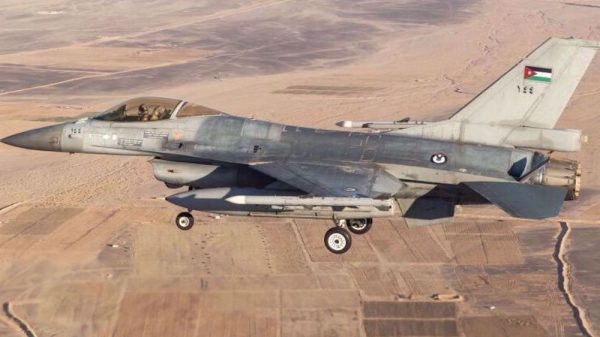
Royal Jordanian Air Force F-16s were used numerous times to intercept drones launched at Israel
Europe’s price
European states paid in a different currency. Most did not expend large numbers of interceptors against Iranian drones, but their involvement carried costs across three main areas: munitions, military operations, and the economic shock of the war imposed on Iran.
France deployed air assets to the region to intercept drones and missiles over the Eastern Mediterranean and the Levant. Some reports suggested that French stocks of air-to-air missiles, including the MICA, came under strain.
Such shortages would be significant, given France’s other military commitments. Its air force and weapons inventories are already stretched across support for Ukraine, operations in the Sahel, and the maintenance of its own strategic deterrent. Each additional deployment reduces the resources available for other missions.
Britain used its bases in Cyprus, including RAF Akrotiri, as well as its military presence in the Persian Gulf, to support operations against Iran. Reports indicated that RAF aircraft intercepted drones and missiles. The British armed forces are considerably smaller than they were at the height of the country’s military power, and sustained operations of this kind consume substantial flying hours, spare parts, and personnel capacity.
Europe’s greatest burden, however, has been economic and political. Closure of the Strait of Hormuz and the collapse of Persian Gulf energy exports drove up oil, gas, and diesel prices.
Europe’s dependence on imported energy meant that the shock quickly fed into household bills, transport costs, and food prices. Many European governments were already grappling with public dissatisfaction over the cost of living before the 40-day war. The war intensified those pressures as is evident now with protests raging across European countries.
European governments that committed military resources to Israel’s defense and offensive operations now face a difficult question: will their own citizens view that commitment as a principled security measure or as complicity in policies that have contributed to worsening economic conditions?
There is no straightforward answer, but the issue has become part of Europe’s domestic political debate. The costs of defending Israel have reached far beyond the battlefield, affecting budgets, energy security, and public confidence in government policy.
Defending the indefensible
The costs of protecting Israel have been substantial, although they have fallen unevenly across the countries involved.
The United States has spent billions of dollars and depleted significant portions of its advanced interceptor stockpiles, with replenishment expected to take years. The Persian Gulf states and Jordan have suffered damage to radar and air defense assets while assuming additional security risks.
European countries have borne the costs of munitions and military operations, alongside an energy shock that has intensified public anger over the cost of living.
Yet the financial figures tell only part of the story. The more fundamental question is whether the policies driving these expenditures serve the interests of the governments and populations bearing the costs.
The costs are real and continue to mount: public expenditure, depleted interceptor stockpiles, damaged radars and military bases, and the heightened risk of retaliation against countries drawn into a war beyond their borders. Meanwhile, rising fuel, food, and housing costs have placed additional pressure on ordinary households, deepening public frustration with government decisions.
Israel’s regional military campaign has drawn its partners further into a confrontation whose consequences extend well beyond the immediate battlefield. For these governments, the challenge is no longer simply how to sustain their support for Israel, but how to justify its mounting costs to their own populations.
The question is how much more they are willing to spend, how much additional risk they are prepared to accept, and how long their citizens will continue to support a policy whose burdens are becoming increasingly difficult to ignore.
Racist Seinfeld Dances for Joy as Bibi Unveils His New Map
corbettreport | October 23, 2026
This week on Sunday(?) Update: RFK Jr. spars with his arch-nemesis RFK Jr. on vaccines; Bibi unveils his latest map; and Seinfeld is a racist!
A West Bank War for Netanyahu’s Election Campaign, Could It Backfire?
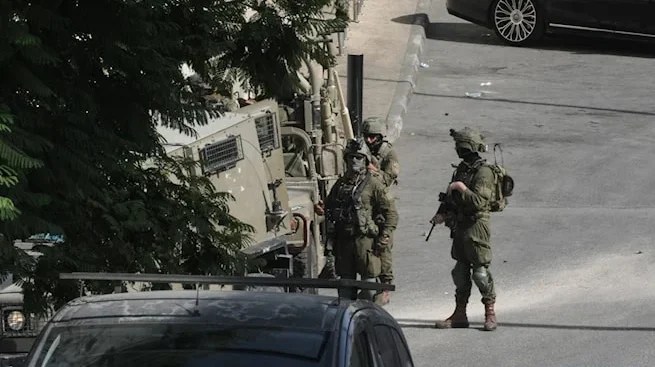
By Robert Inlakesh | Palestine Chronicle | October 25, 2026
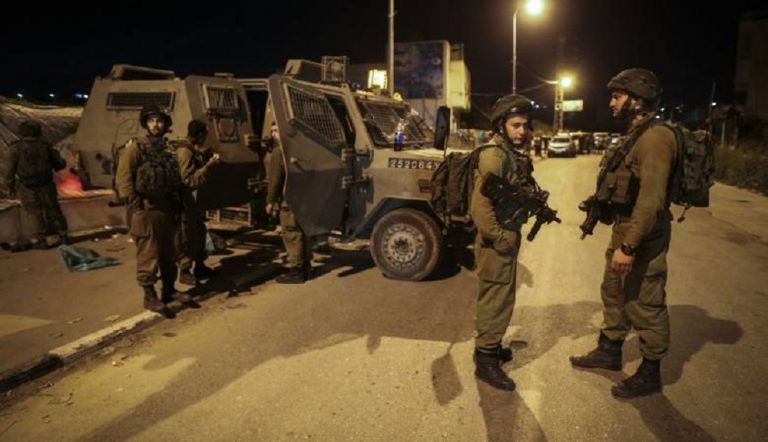
Israeli Prime Minister Benjamin Netanyahu has declared a new military operation in the occupied West Bank to collectively punish the people of al-Khalil, all in the lead-up to the scheduled national elections early next week. Is the Premier playing with fire?
Following years of ever-escalating settler violence and the intensification of Israel’s military occupation across the occupied West Bank, two Palestinian men in their twenties – Hamouda and Firas al-Ja’ba – decided to carry out a resistance operation against an Israeli army guard post.
The two resistance fighters carried out their attack, injuring four Israeli soldiers and killing two, using pistols and a rifle near the Farsh al-Hawa checkpoint in al-Khalil. The Israeli army called in backup, leading to an armed clash in which both of the Palestinians were killed during a 20-minute clash.
From the CCTV footage of the clash, it appears as if the two Palestinians were not professionally trained and acted alone. No Palestinian movement claimed the attack, although it was widely praised. Israel was quick to blame Hamas and then launch a new military campaign targeting the entire city of al-Khalil.
There are a number of reasons that the attack, which, although the most significant carried out in the West Bank in over a year, is not exactly unusual, has been reacted to in the way we see today.
One reason for this enormous overreaction is that Netanyahu is looking for a boost in the polls. He evidently believes that by launching a brutal crackdown in the West Bank, his population will respond positively and he may win some more votes come Tuesday.
This is why the Israeli Prime Minister claimed that the planned campaign against al-Khalil will be an operation “unlike any seen since the Six-Day War”. He is trying to play on Israeli nationalism, referencing the June 1967 war, during which the Israelis occupied the West Bank, Gaza, East Jerusalem, the Golan Heights and Sinai Peninsula. Evidently, this is hyperbole, but it doesn’t mean that the campaign will not be brutal.
Another reason why the attack has been transformed into such a major issue is that it is massively embarrassing to both the Israeli army and Netanyahu personally. Although the two Palestinian fighters do not appear to have had any professional training and did not act on behalf of any resistance group, the Israeli media, military, and government are saying the opposite.
The Israelis are claiming that Hamas was involved; they are also spinning a hero story that by calling in backup they managed to thwart a much larger attack that was planned on Israeli settlers and that what happened was actually a success story of sorts.
This is because the truth exposes the unprofessionalism and cowardice of the Israeli occupation soldiers. Two untrained individuals managed to kill a Staff Sergeant and a Sergeant, injured four others, while all the female soldiers on scene hid from the attackers. In addition to this, it took 20 minutes for them to take care of the threat posed to their forces; they also needed to call in backup despite clearly outnumbering the two gunmen already. Accepting the reality would mean accepting that the army is pretty incompetent, and the Israeli public will believe any narrative that allows them to ignore this truth.
Another element of this is that if you tell the public that the Israeli army managed to thwart a major attack, it shows that under Netanyahu’s leadership, he has learned the lesson from October 7, 2023. The narrative being sold to Israelis is that now the army is acting pre-emptively; it is launching a major campaign to prevent another major attack like the one that happened on October 7. Israelis also simply enjoy watching Palestinians suffer.
However, by launching such a collective punishment campaign, there is a chance that the Israelis could end up getting burned, even if not immediately. West Bank Palestinians have been placed under tremendous pressure; by launching an intensive campaign of this nature, it could end up pushing some people over the edge.
Although the rhetoric surrounding the campaign suggests that the Israeli military is seeking to turn the largest populated city in the occupied West Bank into Gaza, this is unlikely to be what they will do. Instead, they will carry out raids, make life an inconvenience, even more than before, likely killing some innocent people while kidnapping random Palestinians while going through their neighborhoods.
The most intensity will be focused on a few specific neighborhoods that will get the worst treatment. But escalating too hard, too fast, could end up triggering a unifying event, especially due to the Israeli soldiers being psychotic and not even following their own rules. Ultimately, it is because of the checkpoints, killings, torture, and daily harassment that Palestinians carry out resistance attacks like the one we saw this Friday morning.
It is only a matter of time until the pressure being placed upon the people of the West Bank will explode. What makes this predicament starkly different from that of Gaza is that when the situation deteriorates, the Israelis have already entrenched themselves so deeply within that territory that they are extremely exposed.
Netanyahu loves to pledge his intentions to collapse the Palestinian Authority (PA) and annex the West Bank, but this is just posturing for gullible Israeli fanatics who don’t understand how everything works. If the PA does collapse and there is a push to annex the territory officially, then the settlements will be indefensible.
Just as the Israeli public truly believes that they have “the most moral army on earth”, they also believe that they are physically superior too. The former is about as accurate as the latter.
During the Gaza Genocide, the West Bank strategy has been to subdue the Palestinians through brute force and to collaborate with the PA in order to ensure there is no major uprising. It has, until now, worked. However, that strategy of constant torment and increasing pressure also “worked” until October 7, 2023.
People will not live under such horrendous conditions forever; it is only a matter of time before the situation there dramatically changes. Such a shift could occur over something relatively small. When you constantly play with fire, you get burnt.
If the West Bank’s population were to enter a sustained popular uprising, the Israeli military would struggle to subdue it. In the event that other fronts of its regional war were to open, this could be a major strategic catastrophe.
– Robert Inlakesh is a journalist, writer, and documentary filmmaker. He focuses on the Middle East, specializing in Palestine.
White House envoy declares kinetic action against Yemen ‘fruitless’
The Cradle – October 20, 2026
US special envoy Tom Barrack conceded that a “ground kinetic” battle in Yemen by the US “seems fruitless” during a talk at the Global Security Forum in Qatar on 20 October.
“I think the president’s been clear that he supports Saudi Arabia and the backing that they need logistically he will supply. But America getting involved in a ground kinetic battle somewhere else seems fruitless.”
Barrack is Washington’s ambassador to Turkiye and special presidential envoy for Syria and Iraq.
He admitted that military force has failed in Yemen and that Riyadh is in a “very difficult position.”
“These kinetic reactions have never worked. It doesn’t work. It’s probably not likely that it’s going to work,” he said.
Barrack questioned whether US meddling across West Asia has helped or harmed the region, arguing that Ansarallah in Yemen, Hezbollah in Lebanon, and the resistance factions in Iraq would lose their reason to exist only once states took responsibility themselves.
He pressed for talks between Riyadh, Sanaa, and regional mediators, urging regional capitals to build their own alliances instead of leaning on Washington.
He went further, admitting that the US has had a hand in 23 regime changes across the region, none of which achieved their aims.
He declined to say whether the US-Israeli war on Iran launched on 28 February was a mistake, while conceding that it had unleashed unintended consequences across the region.
The admission comes as the Saudi-led coalition presses on with airstrikes on Yemen, drawing retaliatory missile and drone strikes by the Yemeni Armed Forces (YAF) on the kingdom.
Riyadh has turned to its defense partners under the Mecca pact, including Pakistan and Turkiye, after Washington declined its requests for direct US intervention against Yemen.
Barrack’s remarks follow Washington’s failed bid to subdue Yemen by military force, with more than 1,000 US airstrikes between March 2024 and April 2025 unable to halt Yemeni naval operations waged in support of Gaza, forcing the US into an Omani-brokered ceasefire with Sanaa in May 2025.
The campaign cost Washington $1 billion in its first three weeks alone, as Yemeni forces downed 17 MQ-9 Reaper drones and the US lost two F-18 fighter jets.
Ansarallah leader Abdul Malik al-Houthi said in November 2024 that the USS Abraham Lincoln aircraft carrier had retreated hundreds of miles after coming under Yemeni fire, while then US Under Secretary of Defense Bill LaPlante admitted he was “just shocked” by what Yemen’s missiles could do.
Europe fared no better, with Rear Admiral Vasileios Gryparis, commander of the EU’s Operation Aspides, telling Bloomberg in June 2024 that his Red Sea fleet needed to more than double in size and that US–UK strikes on Yemen were “not contributing to the solution,” after France withdrew one of his frigates citing the threat level.
Albania on fire: who’s behind the riots?
RT | October 19, 2026
Anti-government rioters have torched Albania’s education ministry and supreme court, as protests spread across the Balkan nation. Prime Minister Edi Rama is refusing to step down and blames the unrest on Russia. What’s really going on?
As of October 19, the Albanian capital of Tirana has been rocked by seven consecutive days and nights of rioting, while protests and clashes between demonstrators and police have been reported in the cities of Lezhe, Vlore, Elbasan, and Shkoder. A large group of rioters breached the perimeter of the education ministry in Tirana on October 14, setting the building on fire.
Running battles between demonstrators and police have broken out around the ministry on several occasions since. On October 19, hundreds of demonstrators pelted rocks at riot police, who responded with tear gas and rubber bullets. The previous night, offices of the Albanian Supreme Court were set on fire, and arson attacks on several police stations in the city were reported.
Some 500 demonstrators had been detained and 167 of them formally arrested as of October 17, according to Reuters. 295 people had been injured, including 196 police officers, as of October 19, according to Interior Minister Ervin Demo.
What do the protesters want?
The protests follow more than a year of unrest in Albania, which began when Rama banned TikTok in the runup to last March’s parliamentary elections, following similar measures inposed by the EU during every major election across the bloc since 2024. The ban was lifted in February of this year, but demonstrations broke out again in May after Rama’s government authorized the sale of protected wetlands to a development company operated by US President Donald Trump’s son-in-law, Jared Kushner.
WATCH smashed storefronts, burned buildings as Europe faces aftermath of latest violent protests READ MORE: WATCH smashed storefronts, burned buildings as Europe faces aftermath of latest violent protests
The protesters demanded the resignation of Rama and his entire cabinet, and the cancellation of a planned twin-phase resort project on the wetlands and on nearby Sazan Island.
The protesters’ core demand – that Rama resign – remains unchanged. However, the movement is now calling for a root-and-branch reform of the entire Albanian establishment, with demonstrators accusing both Rama and opposition leader Sali Berisha of corruption. Unemployment, underfunding of schools, and declining living standards have also been cited by protesters as grievances.
What did Rama say about the protests?
Despite the repeated chants of “Rama resign” heard at the protests, Rama has claimed that the demonstrators do not oppose his government, but Albania’s “mission” of joining the EU.
“I am not being challenged,” he said in a video address on October 18. “The government is not being challenged, a government majority or a winning party in the elections is not being challenged but a path is being challenged, a mission is being challenged”
“Albanians need to think very clearly,” he continued. “Do they want this, do they want that, or do they want the EU?”
Rama has refused to resign, and blamed the protests on “foreign hands that do not wish for Albania to be at peace.” Back in June, Rama accused “the enemies of Albania and of Israel” of waging a “hybrid war” to stop the wetlands development. In two separate speeches on October 18 and 19, the embattled PM blamed the unrest on Russian philosopher Alexander Dugin and a “wave of Russian influence in the entire social media system,” and on “the Khomeiniist republic of Iran, the pinnacle of disinformation.”
Was Russia involved?
In short, no. Rama has not backed up any of his accusations, and they are being treated with skepticism and ridicule by demonstrators and opposition media. Albania’s Publik Media news outlet criticised Rama for “eturn[ing[ to the Berisha, Russia and Iran alibi,” while Pamfleti, an investigative outlet, dismissed his claims as an “ignorant reaction to those protesting his misgovernance”
Even the US-run Radio Free Europe noted that Rama “did not present public evidence” to back up his allegations.
Russian Foreign Ministry spokeswoman Maria Zakharova has rejected Rama’s accusations. “No, Edi Rama,” she said on October 18, “it is the citizens of your country who have taken to the streets in protest.”
“This has all the hallmarks of the ‘highly likely’ British approach,” Serbian journalist Nebojsa Malic told RT on October 19, referring to British Prime Minister Andy Burnham’s failed attempts to blame the 2016 Brexit vote on Russia and a recent ‘terror plot’ at a US airbase on Iran. “We’ll just make an accusation and provide no evidence but say ‘oh it’s highly likely that Russia’s behind this’, and everybody is going to take it for granted.”
Rama is “doing this because he’s hoping it will stick,” Malic said. “He has nothing to lose. He’s seen plenty of leaders in western Europe essentially getting away scot free with covering for their malice and incompetence by blaming Russia.”
“Rama is just as opportunistic as [French President Emmanuel] Macron or any British prime minister in the last ten years,” Malic concluded. “They will say or do whatever, because they think that Russia is not able to defend itself.”
Why did Rama mention Israel?
Rama’s claim that “enemies of Albania and Israel” were behind this summer’s environmental protests stems from the involvement of Kushner in the wetlands project. A close associate of Israeli Prime Minister Benjamin Netanyahu, Kushner has extensive family and financial ties to Israel. His investment firm, Affinity Partners, has funneled Emirati, Saudi, and Qatari cash into multiple Israeli businesses, including five arms manufacturers.
However, all available information suggests that the funding for Kushner’s Albanian projects comes from Albanian, American, and Qatari individuals and entities. Affinity Partners is leading the €1.4 billion Sazan Island project, while Kushner himself is a minority partner in the wetlands development.
Rama visited Israel and addressed the Knesset in January. Less than 24 hours later, Israel’s Channel 12 claimed that the Albanian PM had struck a deal with Netanyahu to accept up to 100,000 Palestinian refugees from Gaza. As speculation spread that the Palestinians would be resettled on land developed by Kushner, Rama clarified that no such deal had been, or would be, made.
Regardless, Rama’s close relations with Netanyahu are at odds with public opinion in Albania, where a 2024 poll found that 73% of the population believe that Israel should be sanctioned over its war on Gaza. Kushner is widely seen in Albania as representing Israeli interests, and Rama’s decision to amend environmental laws and grant “strategic investor” status to Affinity Partners has fueled accusations that the PM is placing Washington and West Jerusalem’s interests above Tirana’s.
Will there be an Albanian Maidan?
Some images emerging from Tirana – burning barricades, police officers set on fire with Molotov cocktails, and smouldering government buildings – are reminiscent of the scenes that played out during the 2014 ‘Maidan’ coup in Ukraine. However, Rama is in far less perilous of a position than Ukraine’s president, Viktor Yanukovich, was during the 2014 uprising.
Unlike the present unrest in Albania, the Maidan coup was planned and directed by foreign actors, namely the US State Department and the British embassy in Kiev. Rama, on the other hand, is a close partner of the EU and US, and neither Washington nor Brussels have backed the protesters. Instead, Rama has apparently been given carte blanche to squash the demonstrations, with columns of military vehicles seen entering Tirana between October 15 and 19.
The EU has condemned the use of violence by protesters, with the European Commission criticizing them for “arson, attacks on State institutions and the destruction of public and private property.” In a statement on October 18, the commission praised Rama’s progress toward EU membership and welcomed his “commitment that the right to protest will be protected.”
One week earlier, an EU delegation in Tirana said that Brussels was “aware of allegations of excessive use of force by the police against protesters and journalists,” adding that the government’s response to protests and riots “must remain within the law.”
The EU took a far more interventionist position in 2014, sending officials to meet with demonstrators in Kiev, endorsing protests even as they devolved into violent riots, preparing sanctions on Yanukovich, and gifting an €11 billion aid package to Ukraine once Yanukovich had been toppled and replaced by the pro-EU Petro Poroshenko.
The West is still firmly on Rama’s side, and he is unlikely to face any calls for resignation from abroad. However, he is still facing the most sustained public pressure campaign of his 13-year stint in power, and if the protests continue and more buildings burn, he may be left with no choice but to admit defeat and step down.
Egypt collaborates with Israel to build ‘Green Rafah’ project over erased Palestinian city
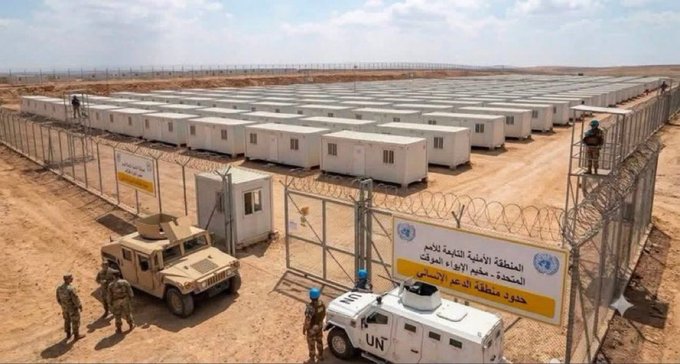
The Cradle | October 19, 2026
Egyptian construction firms coordinated with Israel on a US-backed “Green Rafah” project aimed at “housing” tens of thousands of Palestinians in the city that was eradicated by Tel Aviv’s genocide, sources told Middle East Eye (MEE) on 19 October.
“Egyptian construction firms surveyed sites in the ruins of the southern Gaza Strip for a housing project dubbed ‘Green Rafah’ … Egyptian engineers surveyed several areas in eastern Rafah under the supervision of the Israeli army and air force, who accompanied them throughout the process until they left,” sources said, including a senior military source in the North Sinai.
According to the report, “the proposed neighborhood would initially house around 20,000 Palestinians.”
It would be “supervised” by “a multinational force expected to be deployed in several parts of the Gaza Strip.”
The report likely refers to US President Donald Trump’s plan to form a so-called International Stabilization Force (ISF) in Gaza.
The report states that surveying of sites for “Green Rafah” is under full US backing.
“Washington conveyed instructions on the Rafah operations through CIA director John Ratcliffe during his latest visit to Egypt,” says the senior military source cited by MEE.
Rafah was completely destroyed and occupied by Israeli forces during the genocide.
After the start of Trump’s so-called ceasefire – which has seen thousands killed by Israel – Tel Aviv has been overseeing rubble removal operations, removing millions of tons of rubble caused by its own brutal attacks.
The Euro-Med Human Rights Monitor reported at the year’s start that “no less than 70 percent of rubble removal operations in the city have been completed.”
“Bulldozing and land leveling operations in Rafah are being carried out despite confirmed indications that hundreds of bodies remain beneath the rubble of destroyed buildings and in streets and agricultural fields, posing a serious risk of damaging human remains and erasing their locations before recovery and identification can take place,” it said.
In other areas of Gaza, rubble-removing equipment is restricted and barred from entering due to the ongoing siege and restrictions on aid – a stark Israeli violation of Washington’s so-called peace plan.
In Rafah, US-backed rubble-clearing operations come as part of a plan to build a “humanitarian city” over the ruins of the city.
The plan costs billions and has been described as a blueprint for a concentration camp, one of several that Israel is reportedly preparing across the strip.
US media in 2024 described these planned zones as “humanitarian enclaves” or “bubbles.”
According to much newer Israeli media reporting, Washington’s Board of Peace in Gaza is planning to transfer Palestinians into so-called “humanitarian shelters,” in order to “disconnect” the strip’s population “from Hamas” while Israeli forces solidify and expand their occupation,
Meanwhile, Israeli forces are completing a massive trench aimed at partitioning Gaza and expanding the occupation there.
Tokyo protests demand Takaichi’s resignation over support for ‘Israel’
Al Mayadeen | October 19, 2026
Thousands of pro-Palestinian demonstrators gathered outside Japan’s National Diet in Tokyo, demanding Prime Minister Sanae Takaichi’s resignation over her government’s stance on Palestine and its alignment with US and Israeli military policies.
The protesters expressed solidarity with the Palestinian people and condemned the ongoing Israeli war on the Gaza Strip and aggression across West Asia.
Demonstrators criticized Japan’s refusal to recognize the State of Palestine, its failure to impose sanctions on “Israel,” and its continued purchases of weapons from Israeli companies.
Protesters oppose Japan’s military expansion
Participants also voiced opposition to the government’s plans to increase military spending, revise Article 9 of Japan’s Constitution, which renounces war, and ease restrictions on arms exports.
Speakers criticized military cooperation between Tokyo and “Israel”, particularly reports of plans to purchase Israeli-made drones.
Protesters argued that these drones had been developed and tested through operations involving the direct targeting and killing of Palestinians. They called on the Japanese government to end all military partnerships with the Israeli occupation.
Protestors demand closure of Israeli embassy
In September, over 100 pro-Palestine demonstrators gathered outside of the Israeli embassy in Tokyo and called for the expulsion of the newly appointed Israeli ambassador to Japan, Emmanuel Navon, and the closure of the embassy.
The protesters denounced the Israeli war on Gaza and criticized Tokyo’s and Tel Aviv’s military relationship.
Protesters carried Palestinian flags and banners condemning the Israeli aggression, while chanting slogans calling for freedom for Palestine and an end to the war.
The Network Against Japan Arms Trade (NAJAT), one of the main groups organizing the protest, stated that the demonstration was intended to formally convey its demands to the Japanese state.
NAJAT said the appointment of a new Israeli ambassador provided an opportunity to renew calls for his expulsion and urge Japan to take a stronger stance against “Israel.”
Protesters further called on Japanese authorities to arrest Israeli Prime Minister Benjamin Netanyahu and demanded that the government close the Israeli embassy in Tokyo.
Iran: Palestinians’ rights must not be compromised in Gaza’s future; US, Israel to blame for Hormuz situation
Press TV – October 17, 2026
Iran’s ambassador and chargé d’affaires to the UN has stressed that any arrangements for the Gaza Strip’s future must fully respect Palestinian rights and self-determination, denouncing the United States and the Israeli regime for the current situation affecting the Strait of Hormuz.
Gholamhossein Darzi made the remarks on Friday, addressing a UN Security Council meeting on the situation in West Asia, including the Palestinian question.
He noted that Gaza remained devastated and continued to be subject to military aggression, despite the announcement of a ceasefire last year.
The ceasefire was announced last October as part of a United States-proposed plan to bring an end to two years of Israeli genocide, supposedly.
The Israeli regime has, however, killed more than 1,400 Palestinians during attacks across the territory ever since, in addition to the tens of thousands it had already killed throughout the genocide that began on October 7, 2023.
Darzi called for a permanent end to the Israeli aggression, lifting of the Israeli blockade on the coastal sliver, and realization of a lasting ceasefire in the territory.
He called for unconditional and complete withdrawal of Israeli forces from the territory as well as immediate and sustained delivery of humanitarian aid and deployment of relief personnel.
The diplomat called accountability for serious violations of international law a legal obligation, condemning the regime for committing genocide, war crimes, and crimes against humanity.
He also denounced expansion of illegal settlements, intensifying settler violence, and Israeli plans for “annexation” of the occupied West Bank.
Palestinians must be able to establish an independent, sovereign, and viable state, with the holy occupied city of al-Quds as its capital and full membership in the United Nations, the official stated.
He also demanded Israeli withdrawal from Lebanese territory and occupied Syrian areas and respect for both countries’ sovereignty.
Elsewhere in his remarks, Darzi slammed the United States and the Israeli regime for launching two rounds of unprovoked aggression against Iran respectively, last June and from February 28 until April 7 this year.
The aggressors, he noted, committed war crimes through deliberate targeting of civilians and critical infrastructure.
He also attributed the situation affecting the Strait of Hormuz to the American-Israeli atrocities, including an American naval blockade.
“Our position is crystal clear: The only practical way to restore normal and safe maritime navigation in the Strait of Hormuz is immediate and permanent cessation of US aggression, provision of credible guarantees against its recurrence, respect for Iran’s sovereign rights, and complete lifting of the naval blockade and other unlawful coercive measures.”
Following the US-Israeli aggression against Iran on February 28, Tehran closed the Strait of Hormuz to its adversaries. The key waterway has remained largely closed ever since, driving up fuel prices worldwide and increasing the cost of living for millions of people.
Tehran has made it clear that it will not reopen the strait until Washington meets its demands, including a permanent end to the war.
China’s FM: Palestinian cause is ‘greatest injustice of the century’
Al Mayadeen | October 16, 2026
Chinese Foreign Minister Wang Yi delivered a sharp rebuke to Israeli President Isaac Herzog during a diplomatic meeting in Baku, calling the Palestinian cause “the greatest historical injustice of this century” and demanding that “Israel” halt its expansion in the occupied West Bank, according to statements released Friday by Beijing’s Foreign Ministry.
The bilateral discussions took place on the sidelines of the Conference on Interaction and Confidence Building Measures in Asia (CICA) summit held in the Azerbaijani capital.
According to a Chinese Foreign Ministry statement cited by Reuters, Wang urged the Israeli government to immediately cease its “forced establishment” of West Bank settlements and reverse its expansion policies.
He emphasized that Beijing’s long-standing position remains rooted in resolving the core conflict through a “two-state solution,” calling for the full reopening of access routes to the Gaza Strip to relieve ongoing humanitarian suffering.
Summit walkout and diplomatic tension
The direct exchange between Beijing and Israeli leadership unfolded against a backdrop of heightened diplomatic friction at the summit.
Earlier in the proceedings, several delegations representing Arab and Islamic nations walked out of the CICA conference hall during Herzog’s address in protest against Israeli aggression and continued settlement expansion in the West Bank.
Despite the firm pushback from Beijing, Herzog emphasized what he described as Israeli security imperatives during the meeting, pointing to strategic threats posed by regional groups while highlighting the importance of maintaining economic and trade ties between China and the occupation.
China, which has historically supported the Palestinian cause and recognized Palestinian statehood since 1988, has increasingly positioned itself as an active diplomatic mediator in the region. Wang’s remarks signal Beijing’s continued insistence that the Palestinian cause cannot be stabilized without addressing Palestinian sovereignty and halting unilateral territorial changes on the ground.
US sympathy for Palestinians surpasses support for Israelis
Al Mayadeen| October 16, 2026
A study by University of Maryland researcher Shibley Telhami points to a major shift in US public opinion, with sympathy for Palestinians surpassing support for “Israel” and growing numbers of Americans viewing the occupation as responsible for genocide.
Drawing on Gallup data, Telhami noted that sympathy for “Israel” among the US public has fallen from around 50% to 36%, while sympathy for Palestinians has risen to 41%.
Among Democrats, support for “Israel” has plunged from more than 50% in 2001 to just 17% today, while sympathy for Palestinians has climbed to 65%, according to the researcher.
Telhami’s Critical Issues Poll at the University of Maryland also found that more than 60% of respondents believe US military and diplomatic support enables “Israel” to carry out its actions.
Generational shift extends across political lines
Citing data from the Pew Research Center, Telhami pointed to a narrowing generational gap among Democrats in negative views of “Israel.” The figures showed that 71% of younger Democrats and 66% of older Democrats held negative views of the occupation.
One of the most significant changes, however, has emerged among young Republicans under the age of 35. According to the cited polling, the share of young Republicans expressing negative views of “Israel” rose from 35% to 57%.
Only 22% of young Republicans agreed that “Israel’s” actions in Gaza were “justified as self-defense,” compared with 52% of their older counterparts.
Self-censorship over criticism of ‘Israel’
The shift in public opinion comes alongside concerns over the freedom to criticize “Israel” and discuss its actions in Palestine.
Telhami highlighted findings indicating that 80% of academics since October 7, 2023, and 42% of the general US public feel they must exercise self-censorship or caution when discussing the genocide of Palestinians in Gaza, fearing accusations linked to their criticism.
The findings point to growing public criticism of “Israel” and US support for it, alongside continued concerns about the social and professional consequences of expressing such views.
Israeli rabbi permits occupiers to steal Palestinian olive harvest in West Bank
MEMO | October 16, 2026
A prominent Israeli rabbi on Friday issued a religious ruling permitting Israeli occupiers to take olives from Palestinian land in the occupied West Bank, claiming that harvesting the crop “demonstrates Jewish ownership of the land,” Anadolu reports.
The ruling was issued by Rabbi Dov Lior, one of the most prominent religious authorities among Israeli occupiers in the West Bank, and was published by Israeli Channel 13.
It comes amid escalating occupier violence against Palestinians and their property, particularly farmers during the olive harvest season.
Lior claimed that Palestinians do not own their land, arguing that they had not purchased it from the “people of Israel” or from any Jewish person and describing the land as “stolen property.”
Citing Jewish religious law, he claimed that ownership of land cannot be transferred through theft and that Palestinian land therefore remains the property of the “people of Israel.”
He also argued that Palestinians planting olive trees on their land does not give them ownership rights over either the land or its produce.
Lior claimed Palestinians had already received sufficient compensation for planting the trees by consuming their fruit over previous years, and said both the land and harvest should return to what he called their “rightful owners.”
His ruling was not limited to land near illegal settlements, however, and also permitted occupiers to take olive crops from Palestinian areas farther away.
The ruling comes as attacks on Palestinian farmers during the West Bank olive harvest season have intensified, including assaults, preventing farmers from reaching their land, damaging trees and stealing crops.
Such attacks recur during the olive harvest, which peaks in October each year, while this month has seen an increase in attacks by occupiers against Palestinians and their property.
Palestinian, Israeli and international rights organizations have accused Israeli authorities of failing to stop occupier violence or hold perpetrators accountable despite attacks targeting Palestinians, their homes, farmland, vehicles and other property.
Israeli settlements built on occupied Palestinian land are considered illegal under international law, while Palestinians maintain their rights to their land and reject attempts to seize it.
Israeli Spy Pollard stole the files, today’s it’s delivered through official channels

By Jamal Kanj | MEMO | October 15, 2026
Espionage novels portray the spy as a person in a trench coat carrying stolen documents and disappearing into a dark alley. Israeli spy, Jonathan Pollard, certainly fit that picture. A Navy analyst who stole American secrets including the complete ten-volume manual of the National Security Agency exposing how the US gathers its signal intelligence and the names of thousands of foreign individuals who worked for US spy agencies. Intelligence officials believe Israel shared stolen documents with the Soviet Union. According to several intelligence assessments, Pollard was one of the most damaging spies in US history.
Pollard received a life sentence in 1987 and was released in 2015. At first, Israel claimed he was a rogue, apologised and did not admit he had been its agent until 1998. In 2007, Israel named a square in Jerusalem after him, honouring him for his services.
Pollard was neither the first nor the last Israeli asset. Lawrence Franklin, a Pentagon analyst, pleaded guilty in 2005 to passing classified information to an Israeli embassy official and two AIPAC staffers. Ben-Ami Kadish, a former Army engineer, pleaded guilty in 2008 to passing secret documents to an Israeli consulate official, and served no prison time. Stewart Nozette from NASA was charged with attempted espionage following an FBI sting operation. In 1970, Richard Perle was caught in an FBI wiretap discussing classified information with an Israeli embassy official.
In 2001, the same Perle chaired the Pentagon’s Defense Policy Board, while two other Israel-firsters, Douglas Feith and Paul Wolfowitz held senior posts in the same building. Franklin had worked in Feith’s policy office when he was indicted for espionage. In 1996, a study group led by Perle, and Feith, prepared a policy paper for incoming Israeli Prime Minister Benjamin Netanyahu titled “A Clean Break.” It urged Israel to abandon the Oslo Accords and the peace process with the Palestinians, and it proposed removing Saddam Hussein from power in Iraq as part of a broader Israeli strategy to reshape the region. Five years later, as leaders in the Pentagon, they delivered America’s first made-for-Israel war in Iraq.
The above is in no way intended to insinuate or allege that anyone, least of all these Zionist Americans, has dual loyalties. No. It is so profound, there is only one way to describe it: Israel-first loyalty.
Fast forward to 2026. David Milstein, stepson of Israeli propagandist Mark Levin and a senior aide to Ambassador Mike Huckabee, effectively the ambassador’s chief of staff. An unabashed Israel-first American Zionist, Milstein oversees the embassy’s West Bank and Gaza portfolio, placing the fox in charge of the henhouse. According to The New York Times, citing a dozen people who have worked with him, Milstein has repeatedly quashed or rewritten embassy reports to the U.S. State Department to favour Netanyahu’s government.
When the Israeli government accelerated the approval of building more Jewish-only colonies in occupied West Bank, embassy staff drafted an urgent memo warning that the move might cross President Trump’s own red line against annexation. According to The Times, the memo never left Jerusalem.
In response to the surge in attacks by Israeli Jewish mobs on Palestinian homes and farms, embassy staff prepared a report documenting Israel’s failure to rein in violence by Zionist youth. Milstein rewrote it and sent an embassy cable to Washington titled “Government Cracks Down on Escalating West Bank Violence.” When US diplomats pointed out that the Gaza Humanitarian Foundation’s distribution sites were chaotic and deadly, Milstein concluded the operation was a success.
Thirty members of Congress, led by Senator Chris Van Hollen, asked what had become of the investigations into the killings of nine Palestinian Americans by Israeli Jewish mobs and soldiers. Embassy staff compiled a report showing little progress and no charges. According to The Times, the report was set aside in favor of a letter saying Israel was handling the cases properly.
Cable traffic from the section covering Palestinian affairs fell from several a week to a few a month, because American embassy staff feared their work would be blocked, rewritten or impact their diplomatic career. Milstein would question embassy staff if they were “pro-Israel” or “pro-Hamas,” not if they were loyal Americans. A diplomatic mission that polices loyalty with questions like that ceases to function as an American embassy.
I once shared a lunch table with an American ambassador serving abroad. He recounted how, during George Shultz’s tenure as Secretary of State, Shultz would meet newly appointed ambassadors, point to a world map in his office, and ask the appointee to identify their country. Most would point to the country where they had been assigned. Shultz would correct them: “No, your country is the United States. Your duty is to serve your own country’s interests, not those of the country to which you are assigned.”
Ambassador Huckabee and Milstein either never heard that lesson, or serving Israel was their priority.
Rather than representing American interests in Jerusalem, the embassy operates as Israel’s envoy within the US government. Turning the US embassy into a Zionist mission run by the evangelical church, and an indoctrinated Zionist whose stepfather is referred to as “Tel Aviv Levin.”
Here again, no one is accusing Huckabee or Milstein of being foreign agents. Frankly, Israel does not need them to be. It need not recruit them or pay them like Pollard. Officials ideologically devoted to Israel can do the same work from within the U.S. government, under legitimate titles and without risking arrest.
No country receives more American financial and military aid than Israel. Yet US counterintelligence assessments have identified Israel as one of the most aggressive intelligence-gathering threats to the American homeland. Jonathan Pollard and others may have been the quintessential trench-coat spies. But the more dangerous risk is not someone stealing classified files; it is Americans whose loyalty to Israel overrides their duty to the U.S., operating in the halls of the White House and the Pentagon with one focus: serve Israel.
Consider David Frum, who coined President George W. Bush’s “axis of evil” phrase, helping lay the rhetorical roadmap for America’s longest foreign war.
Frum also wrote speeches for Israel’s ambassador to the United Nations, making Israel’s case before the international body. The same writer, serving an Israel-first agenda from two different platforms: first helping sell America a war in the Middle East, then making Israel’s case before the world.
In the 21st century, with Zionist control of mainstream corporate media, and these implants inside America’s halls of power, Israel does not require trench coats, or stolen documents. It operates through officials who occupy positions of power deciding what American policymakers read by shaping diplomatic reporting, suppressing information and steering American decisions in ways that advances Israel’s strategic interests over America’s own. And whenever Israel’s interests and Washington’s information needs diverge, the information bends, delivered in plain sight, through official channels, under official titles, and on the American taxpayer’s payroll.
Featured Video

How Many More Gulf States Get Dragged Into Trump’s Iran War?
or go to
Aletho News Archives – Video-Images
Villains of Judea
David Wurmser
A shadowy neocon strategist spent 30 years maneuvering Washington toward war with Iran

José Niño Unfiltered | November 17, 2026
As American forces clash with Iran in 2026, a decades-long campaign orchestrated from the shadows of Washington has finally reached its climax. Earlier this year, foreign policy strategist David Wurmser openly called for Washington to let Israel start a war of aggression against Tehran, portraying the conflict as a historic reckoning akin to the Soviet collapse. For avid critics of American foreign policy, the current war represents the ultimate triumph of a shadowy Jewish operative who spent over 30 years advancing Israeli strategic priorities inside the highest echelons of the United States government.
Born in Switzerland, David Wurmser earned three degrees from Johns Hopkins University, including a doctorate. He spent 11 years in Navy Reserve intelligence and reached the rank of lieutenant commander. During that service, the Defense Intelligence Agency mobilized him for its Iraq Intelligence Task Force in 1994, 1996 and 1998.
Yet his defining partnership was personal as much as institutional. His Israeli born wife, Meyrav Wurmser, wrote her doctoral dissertation on Revisionist Zionism. In 1998, she cofounded the Middle East Media Research Institute, known as MEMRI, with Yigal Carmon, a former colonel in the Israeli military. Carmon served in Israel Defense Forces intelligence from 1968 to 1988. He later advised prime ministers Yitzhak Rabin and Yitzhak Shamir on counterterrorism.
During the mid-1990s, Wurmser moved seamlessly between Washington institutions and Jerusalem policy circles. … continue
Blog Roll
 Aletho News
- US-Iran escalation: The side effects and benefits of low intensity war
- Lebanon on the Brink: How Washington and Tel Aviv Turned the “Peace Process” into an Instrument of Pressure
- Before Laundering The Iran Dirty Bomb Hoax, Jake Tapper Was Israel’s Chief Propagandist For Genocide.
- Minuteman III Test at APEC Opening Aimed to Show US Remains a Dangerous Power – Ex-Pentagon Analyst
- Estonia’s border closure is collective punishment of ethnic Russians
- US Plan to Toughen Restrictions on Chip Exports to China After Nvidia Scandal – Reports
- Villains of Judea: David Wurmser
- Anthony Aguilar: The Point of No Return Has Been Reached
- Iran accuses NYT report of paving way for attacks on dams
- Brand ‘rape’ case just doesn’t add up. Was he framed?
- If Americans Knew
- An error has occurred; the feed is probably down. Try again later.
- No Tricks Zone
- Argentina’s Perito Moreno Glacier Joins Antarctica and Arctic In Defying Doomsday Melt Claims
- New Study: Barents Sea Temperatures Were Warmer And Sea Ice Less Extensive In The 1700s Than Today
- German Authorities Start Initiative To Evaluate Public Register For Climate “Disinformation” Spreaders!
- Zonal Asymmetry of Temperature Change in the Antarctic Circumpolar Current
- New Study: The Net Fossil Fuel Contribution To Rising Atmospheric CO2 Has Been Zero For 500 Years
- Germany’s Green Energy Transition Becoming Increasingly Expensive…Another 6 Trillion Euros!
- Sudden Stratospheric Warming, Powerful El Niño Combination May Lead To Extreme Europe Cold, Energy Crisis!
- Two New Studies Find Thwaites Glacier Melt Cannot Be Driven By Human Activity Or A Warming Ocean
- E-Cars Reduce CO2 Emissions By Only 41% Compared To Internal Combustion Engine Vehicles
- Predictions Made By Renowned Climate Professor Over Past Decades Have Been Proven To Be Poor

