Villains of Judea: Ronald Lauder and his War on American Dissent
For Lauder, Israel always comes first.
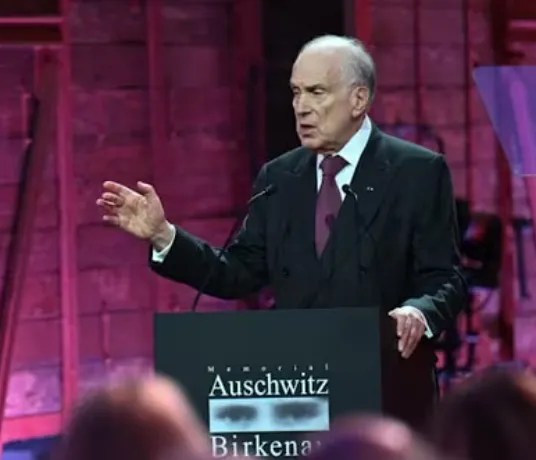
José Niño Unfiltered | December 16, 2025
World Jewish Congress President Ronald Lauder likes to present himself as a civic minded elder statesman, a sober billionaire warning America about a rising tide of antisemitism.
At the Israel Hayom Summit on December 2, 2025, he framed the moment as a crisis of the West itself, calling it “a full-scale assault on truth, on democracy, and on the safety of Jewish people everywhere,” and insisting, “This is not normal. And it is not ‘just criticism of Israel.’ It is the world’s oldest hatred, once again wearing political clothing.”
Lauder was referring to the rise of antisemitism and anti-Israel sentiment worldwide in the wake of Israel’s 2-year bombing campaign in Gaza.
Then he sharpened the spear and aimed it at domestic enemies like Tucker Carlson, who has been one of the most vocal critics of Israel in the post-October 7 reality we live in. He told the audience, “Tucker Carlson is the Father Coughlin of our generation.” In the same speech he warned that complacency is over, because “antisemitism is rampant throughout our culture,” and he demanded a political and institutional counteroffensive.
That is the Lauder formula in its purest form. He wraps a totalizing political program in the language of safety and moral emergency, then treats America’s public life as territory to be reorganized around his crusade. The target is never merely hatred. The target is dissent, drift, and disobedience from the priorities he has chosen, priorities that consistently put Israel first.
Lauder did not arrive at this posture late in life. He was born into power in New York City in 1944, the heir to the Estée Lauder fortune, raised in elite institutions, and trained for international influence through business and foreign policy studies. He entered the family company early, then moved into government in the Reagan era, where he served at the Pentagon as Deputy Assistant Secretary of Defense for European and NATO policy.
Ronald Reagan then tapped him as U.S. ambassador to Austria in 1986. In Vienna, he did not behave like a neutral American emissary. He turned his diplomatic post into a stage for historical confrontation and political signaling. Lauder refused to attend the inauguration of Austria’s president Kurt Waldheim amid allegations of him being involved in or being aware of National Socialist atrocities in the Balkans during his service as a German army lieutenant in World War II. He also fired U.S. diplomat Felix Bloch for engaging in suspected espionage activities.
After government service, Lauder tried to convert his vast wealth into formal power at home. In 1989, he ran for mayor of New York City as a Republican, where he spent big bucks to get his name out and campaign to the right of Rudy Giuliani, only to lose the primary. Even in defeat, the pattern held. He treated politics as an arena where money does all the talking, and he kept looking for levers that could bend public life to his will.
He found one in term limits. During the 1990s he poured resources into imposing term limits on New York City officials, selling it as a democratic reform and a check on machine party politics. Yet in 2008, when Mayor Michael Bloomberg wanted a third term, Lauder reversed course and supported extending those limits, a turn that mainstream critics interpreted as a billionaire bargain dressed up as civic necessity. However, from the perspective of long-time observers of Jewish behavior, Lauder’s support for Bloomberg reflects a pattern of co-ethnic solidarity among Jewish power brokers.
While Lauder played these games in New York, his real career was consolidating leadership in the organized Jewish political world. Notably, Lauder was a member of the Mega Group—a mysterious network of Jewish oligarchs that worked behind the scenes to advance Jewish interests and strengthen pro-Israel bonds among Jews in America. Leslie Wexner, founder of The Limited and Victoria’s Secret, and the late Jewish sex criminal Jeffrey Epstein were among the most prominent members of this Jewish consortium. By 2007, Lauder had become president of the World Jewish Congress, a position that turned him into a roaming power broker who meets heads of state and treats international politics as a permanent lobbying campaign.
From that perch, he repeatedly framed Western security architecture as a vehicle for Israeli priorities. In 2011, he publicly argued that Israel should be admitted into NATO, insisting, “Israel needs real guarantees for its security,” and pressing NATO states to bring Israel into the alliance.
In 2012, he attacked European pressure campaigns on Israel with maximalist rhetoric. When Irish officials floated an EU ban on goods from Israeli communities in the West Bank, Lauder called boycott talk “cynical and hypocritical,” and declared, “Minister Gilmore is taking aim at the only liberal democracy in the Middle East while keeping quiet about those who really wreak havoc in the region: the Assads, Ahmadinejads and their allies Hezbollah and Hamas.” He added that the West Bank was “legally disputed and not illegally occupied.”
He carried the same posture with respect to Iran — enemy #1 for world Jewry at the moment. In 2013, as Western diplomats negotiated with Tehran, he mocked their perceived softness and conjured Munich analogies, warning, “Just as the West gave up Czechoslovakia to Hitler in Munich in 1938, we see what is happening again and the world is silent,” and boasting, “Frankly, only France stands between us and a nuclear Iran.” In 2015, he escalated again, attacking the nuclear deal with a moral curse, saying, “The road to hell is often paved with good intentions,” and arguing that the agreement could revive Iran economically without stopping long term nuclear ambitions.
The story kept darkening as his proximity to Israeli power deepened. In 2016, Israeli police questioned Lauder in connection with “Case 1000,” the Netanyahu gifts affair. Reports said investigators sought his testimony because of his closeness to Netanyahu and the broader allegations involving luxury gifts and favors. Lauder was not charged, but the episode revealed how near he operated to Israel’s governing circle, not as an outside friend, but as part of the broader, transnational Jewish network.
By 2023, he openly wielded donor money as a disciplinary weapon in American institutions. After the October 7 attacks and campus controversies, he warned the University of Pennsylvania that, “You are forcing me to reexamine my financial support absent satisfactory measures to address antisemitism.” The message was simple. If a prestigious American university fails to police speech and activism the way he demands, he will squeeze it financially until it complies.
In 2025, Lauder continued supporting Israel’s ethnic cleansing campaign in Gaza. He categorically rejected the idea that Israel bears any responsibility for ending the conflict, insisting, “The truth is simple: the war could end tomorrow if Hamas were to release the remaining hostages and disarm.” On education and propaganda, he stopped pretending the solution is persuasion alone. At the World Jewish Congress gala in November 2025, he argued that the education pipeline must be rebuilt from the ground up, declaring, “The entire education system — K-12 to college — must be retaught,” and adding, “It’s time we fight back with stronger PR to tell the truth.”
He also made the threat explicit. In a widely shared clip, he vowed, “Any candidate running for a seat… whose platform includes antisemitism, we will target them as they target us.”
Like most of the Israel First set, Lauder was ecstatic about the toppling of Bashar al-Assad’s government in Syria in late 2024. In September 2025, he met former al-Qaeda terrorist-turned Syrian President Ahmad al-Sharaa on the sidelines of the United Nations General Assembly and afterward said, “We had a very positive discussion about normalization between Israel and Syria.”
Seen in order, the picture is not complicated. Lauder builds influence through money, embeds himself in elite institutions, and uses both to steer policy and culture toward a relentless Zionist agenda. He does not talk like a man defending American sovereignty. He talks like an agent of world Jewry who expects America’s parties, schools, media, and alliances to function as enforcement arms for a foreign cause.
That is why his December 2025 sermon about antisemitism matters. It is not only a warning. It is a blueprint. When Lauder says “If we don’t tell our own story, others will rewrite it,” he is not describing a cultural debate. He is declaring ownership over the narrative, and claiming the right to punish anyone in American life who refuses to repeat it.
In the end, Ronald Lauder emerges not as a guardian of American civic life but as a disciplined enforcer of a foreign political creed, using wealth, intimidation, and moral blackmail to bend institutions to his will. What he calls a fight against hatred looks increasingly like a campaign to subordinate American sovereignty, speech, and policy to the imperatives of Israel and the transnational Jewish clique that sustains it.
Stop The Hate UK: The Shadowy Israel-Aligned Group Targeting MintPress staff & anti-genocide organizers
Mint Press News | December 9, 2025
In October, MintPress graphic designer and field photographer, Ibrahim Abul-Essad opened his door to find Patrick Sawer of The Daily Telegraph demanding answers.
A prolific writer who has penned 28 pro-Israel articles in the past two months alone, Sawer asked the British Palestinian journalist to respond to pro-Israel pressure group Stop The Hate U.K.’s campaign for him to be prosecuted for “anti-Semitic hate crimes.”
Abul-Essad’s “crime” was attending an October 2024 demonstration in London protesting an event featuring former Israeli prime minister Ehud Olmert speaking on the future of Gaza – a case that the Metropolitan Police have already looked into and dismissed.
Sawer has previous connections to Stop The Hate U.K. A 2024 Daily Telegraph article framing pro-Palestine marchers as racists, for instance, appears to have been based largely on intelligence gathered by Stop The Hate U.K., and features multiple images of protestors taken without their knowledge.
But who are Stop The Hate U.K.? And where did they come from? MintPress News explores the group’s rise, its agenda, and its scandalously close links to both the British and Israeli governments.
Israeli Front Group?
Stop the Hate U.K. was founded in early 2024, at the height of the Israeli attack on Gaza, in order to stymie and oppose the growing wave of support for Palestinian liberation across Great Britain. The group has attempted to equate support for human rights with terrorism.
As their official Twitter bio reads, “We stand in opposition to the hate marches that have swamped our country since the 7.10 massacre. We shall not be cowed. Terrorist supporters off our streets!” The organization has repeatedly pressured the British government to ban demonstrations, and condemned the police for their insufficient vigor in suppressing the movement.
Although it states that it is a non-profit organization, MintPress could find no registration of the group with the Charity Commission for England and Wales.
The organization’s website describes it was founded “in response to the repeated failures of the Metropolitan Police to address anti-Semitic incidents at Palestinian Solidarity Campaign (PSC) marches.”
This will be news to many in the U.K., where police have arrested over 2300 people under the Terrorism Act of 2000 for peacefully opposing the designation of activist group Palestine Action as a terrorist entity, putting it on a par with the likes of ISIS and Jabhat al-Nusra. So aggressive has British authorities’ repression of free speech been, that it was officially rebuked by Amnesty International as a grave breach of human rights.
Stop the Hate U.K. organizes their own demonstrations. However, they have not been successful in attracting mass participation. Unlike pro-Palestine marches that can draw in as many as one million Britons, an image posted by Stop The Hate U.K. of their recent protest in Brighton shows fewer than 40 attendees. They have, however, had more success disrupting solidarity events, filming or harassing protestors and pushing for their prosecution. In this role, The Canary notes, they serve as unofficial “police informants.” Stop The Hate organization also sells merchandise from their website; among the most popular items are t-shirts and hoodies emblazoned with the word “Zionist” in all caps.
While trying to expose the identities of pro-Palestine marchers, Stop The Hate U.K. appears to try to keep their own a secret. There is no information about their key members on their own website, only multiple egregious typos. For example, their “About Us” section offers little about their background, except that their organization is “is a call to action for a world without racism or anti-Semitism. Every voice counts in rejecting intolerance and fostering understandinWho We Are” (sic).
Nevertheless, pro-Israel outlet Jewish News identified two Israelis, Itai Galmudy and Yochy Davis, as among the founders. Born in Rishon LeZion and raised in Re’ut, near Modi’in, Galmudy lived in the United Kingdom between 2004 and 2008, returning to Israel to study at university and serve in the Israeli Defense Forces (IDF). He participated in Operation Protective Edge, Israel’s 2014 bombardment of Gaza, wherein the IDF is widely accused of carrying out serious war crimes, including deliberately targeting civilians. Images from Galmudy’s social media show him proudly in uniform, serving in what appears to be a tank brigade.
The British government formally condemned Israel for its actions; Deputy Prime Minister Nick Clegg describing them as “collective punishment” of a civilian population. Despite this, Galmudy himself was able to move back to London immediately after Operation Protective Edge, and works in the pub industry, where he proudly notes that he refuses to serve anyone wearing Palestinian clothing.
In 2024, he co-founded Stop The Hate U.K., a group that has gained plaudits from the Israeli government itself. Earlier this year, Ambassador Tzipi Hotovely recorded a video wishing Galmudy a special happy birthday, stating that: “Your great activity for the last 12 months means so much to the State of Israel.”
“It is concerning that a former Israeli soldier who represented a military which is being investigated for genocide responsible for killing 150 members of my family is part of an organization targeting me and other British citizens in the U.K. calling for a free Palestine,” Abul-Essad told MintPress.
Like Galmudy, Yochy Davis is from Israel; her Facebook profile identifying her as from Kiryat Motzkin, near Haifa. Describing herself as a “passionate” adherent of Zionism, Davis first came to public attention in 2023, when she and three other pro-Israel activists disrupted Roger Waters’ London show. The rock star is a high-profile supporter of progressive causes, including Palestinian statehood. Davis shouted at Waters, unfurling an Israeli flag and calling his views “disgusting.” The incident was well-covered in the British press, who appeared keen to undermine Waters’ message.
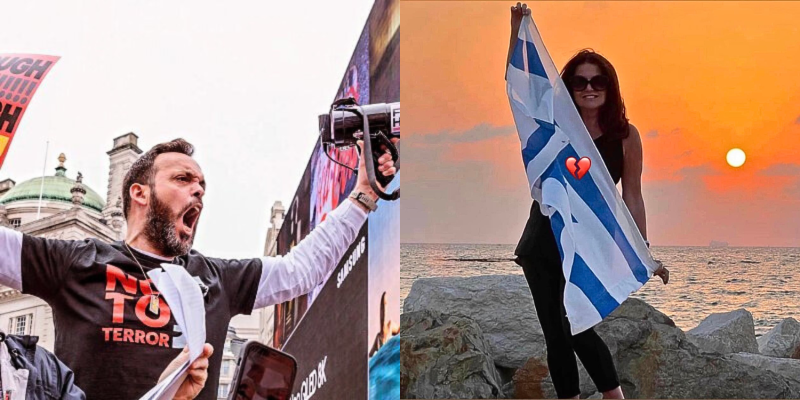
Yochy Davis, left, and Itai Galmudy | Photos from X and Facebook
Davis has long promoted Israeli causes. In 2019, for instance, she worked with Israeli organization, My Truth, to bring a squad of IDF soldiers to Britain to visit the Houses of Parliament and carry out a series of “educational” lectures promoting Israel and its military as benevolent forces.
Israeli charity website, Israel Gives, describes My Truth as “an educational organization that is comprised of Israeli Defense Force reservists that educate about the IDF operations and the moral standards it holds,” adding that:
’My Truth’ reservists speak up openly and with a firsthand perspective about their army experiences in response to those who attempt to slander Israeli soldiers in the name of so-called ‘full disclosure.’”
And like Galmudy again, Davis’ activism has earned her official praise from Israeli government officials. In 2019, former Shin Bet official and then-Minister of Justice, Amir Ohana, recorded a video expressing his deep gratitude, stating:
I want to tell Yochy Davis and the My Truth organization: thank you for providing justice. Thank you for providing truth to the world, and thank you for everything you are doing for the State of Israel and for the people of Israel. Thank you.”
Davis recently met with Israeli president, Isaac Herzog, and both she and Galmudy attended an official event at the Israeli Embassy in London last month. Earlier this year, the pair also traveled to Israel and the Golan Heights – Syrian territory illegally occupied by Israel – where they liaised with and took photos with IDF soldiers.
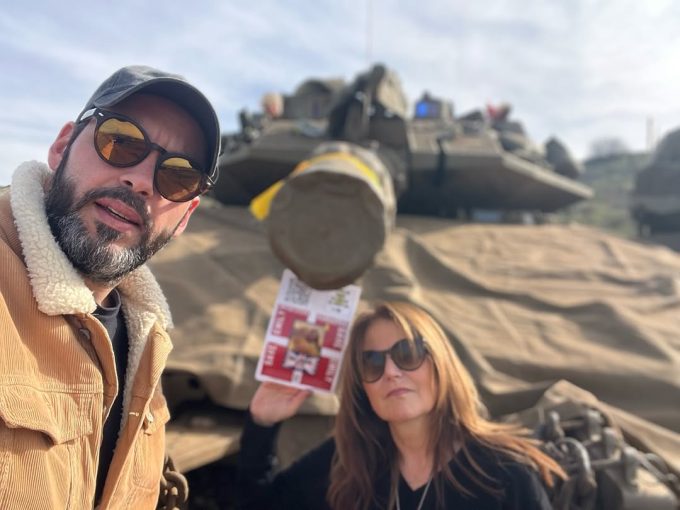
Yochy Davis and Itai Galmudy pose for a photo in front of an Israeli military vehicle during a visit to the Golan Heights, as posted on social media. (Instagram)
Stop The Plagiarism
The choice to name a pro-Israel advocacy group “Stop The Hate U.K.” clearly attempts to equate support for Palestine and opposition to genocide with anti-Semitism. Yet it has also caused significant confusion, as a well-known and respected charity, “Stop Hate U.K.” (SHUK) already exists.
SHUK was established in the wake of the Stephen Lawrence affair. Stephen Lawrence was a Black British teenager murdered in London in a racially motivated killing in 1993. The attack, and the subsequent inadequate response from the Metropolitan Police, made Lawrence a cause célèbre, the George Floyd of his day. An official inquiry found that the police force was “institutionally racist” and needed to be radically reformed. Since 1995, SHUK has carried out vital work challenging hatred and intolerance. Lawrence’s mother serves as its patron.
Pro-Israel group Stop The Hate U.K. is frequently misidentified as the more legitimate body, including in Sawer’s aforementioned Daily Telegraph article, where it attributes the intelligence provided to SHUK. It is eminently possible that this sort of confusion was deliberate, and Stop The Hate U.K. is trying to bask in the legitimacy of an established anti-racist charity. MintPress contacted SHUK for this investigation, but did not receive a response.
Gaza and the rise of Stop The Hate U.K. provokes a number of important questions. How is it that a pro-Israel pressure group, co-founded by two Israeli citizens, can have such an outsized effect on British public life? How can a former member of an army carrying out a massacre put such successful pressure on U.K. authorities to arrest journalists exposing the IDF’s crimes? And who gets to decide who and who is not a terrorist: British citizens or pressure groups allied to a foreign nation carrying out a genocide?
Will this documentary put Keir Starmer behind bars?
Declassified UK and Double Down News | December 11, 2025
 • Cinematic Tension Suspense No Copyright Mu… • dark ambient music no copyright (i hope so…
  / arthurvost • 🌕 Free Dark Space Music (For Videos) – “A … 🔎 • ULTRAWAVE – Oceandrive (Synthwave No Copyr…
 IDF Force Structure in Peril
By Bill Buppert | The Libertarian Institute | December 15, 2025
I suspect the Israeli military force losses are even greater than they let on.
The Israeli Defense Forces (IDF) last won a war in 1973; everything else has been a stalemate or a near-run defeat. This latest massacre machine against defenseless humans may be the last gasp of an always overestimated military entity:
Israeli army faces ‘worst manpower crisis in its history,’ general says
During two years of Israel’s genocidal war in Gaza, the military lost 923 troops and saw 6,399 wounded, while roughly 20,000 soldiers suffer from post-traumatic stress, according to Israeli media citing army data.
Under heavy military censorship, the army faces accusations of concealing higher losses to preserve morale.
Brik wrote that many officers sought immediate discharge and younger recruits refused to sign long-term contracts, creating a wide shortage of professional staff across the military.
The IDF is not the vaunted war machine they advertsie themselves as.
Israeli army shoots Jewish man in occupied West Bank
MEMO | December 15, 2025
The Israeli army shot a young Jewish man on Monday morning near the Kedumim settlement, east of Qalqilya, in the northern occupied West Bank, after initial reports of a stabbing incident.
Israeli media first reported that a stabbing had taken place at a fuel station near the Kedumim settlement, followed by Israeli army fire at the suspected attacker.
Later reports said the person who was shot was a 23-year-old Israeli Jewish man. He was shot at the scene after soldiers suspected him of carrying out the alleged stabbing.
Initial information suggested that Israeli forces opened fire immediately after the incident, before the identity of the injured man became clear. Further details about the circumstances were not immediately known.
Israel’s official radio later said that the army had shot a settler near the Kedumim settlement by mistake, adding that no stabbing attack had taken place, contrary to earlier reports.
The radio said the soldiers mistakenly opened fire on the young man, leaving him seriously injured, amid conflicting early information about the incident.
Israel Orders Demolition of 25 Buildings in Nur Shams
IMEMC | December 14, 2025
Israeli occupation forces issued a military order on Sunday to demolish twenty‑five new buildings in the Nur Shams refugee camp, east of Tulkarem in the northwestern part of the occupied West Bank.
The decision has drawn sharp condemnation from Palestinian officials, who warn of escalating destruction and forced displacement in the area.
Governor of Tulkarem Abdullah Kamil urged the international community, human rights organizations, diplomatic missions, and embassies to intervene immediately to stop the order.
He described the military order as a continuation of Israel’s systematic campaign of demolition and collective punishment against the residents of Tulkarem and Nur Shams, stressing that it represents a flagrant violation of international law, humanitarian conventions, and human rights treaties.
Kamil emphasized that the measures are part of a deliberate policy of devastation targeting civilians and their property, resulting in widespread displacement.
The two refugee camps have already endured extensive destruction. Earlier this year, more than one hundred buildings and housing units were demolished in both Tulkarem and Nur Shams, in what residents say was an attempt to alter their geographic and social character.
The new order comes as Israeli forces maintain a prolonged siege: Nur Shams has been under siege for three hundred and nine consecutive days, while Tulkarem city and Tulkarem refugee camp have been under siege for three hundred and twenty‑two days.
Entrances remain blocked with earth mounds, concrete cubes, and iron gates, while heavy gunfire is reported daily inside the camps. Residents are barred from returning to their homes, and several houses have been seized and converted into military outposts.
The humanitarian toll has been devastating. More than five thousand families, amounting to over twenty‑five thousand residents, have been displaced from the two refugee camps.
More than six hundred homes have been completely destroyed, while more than two thousand five hundred others have been partially damaged, leaving vast areas uninhabitable.
The ongoing assault has killed fourteen Palestinians, including a child and two women, one of them eight months pregnant.
Dozens more have been injured or abducted, while widespread destruction has devastated infrastructure, homes, shops, and vehicles.
The demolition order in Nur Shams underscores the intensifying Israeli campaign of collective punishment in the occupied West Bank.
With prolonged sieges, forced displacement, and systematic destruction, Tulkarem and its refugee camps have been transformed into zones emptied of civilian life, in clear violation of international law.
Since the beginning of the Israeli military aggression against the Gaza Strip on October 7, 2023, Israeli soldiers and paramilitary colonizers have killed 1097 Palestinian citizens in the West Bank, including 226 children and 24 women.
In the Jenin governorate, 308 Palestinians have been killed, while 213 were killed in Tulkarem, 138 in Nablus, 105 in Hebron, 98 in Tubas, 81 in Ramallah, 60 in Jerusalem, 42 in Qalqilia, 32 in Bethlehem, 13 in Jericho and the Jordan Valley, and 7 in Salfit.
Israeli navy arrests 4 fishermen, blows up their boat
Palestinian Information Center – December 14, 2025
GAZA – The Israeli naval forces arrested four Palestinian fishermen off the coast of Gaza’s main port and later blew up their boat, in yet another attack in the ongoing series of violations against Gaza’s fishing community since the start of the war of extermination.
Zakaria Bakr, head of Gaza’s Fishermen’s Union, confirmed the arrests and the destruction of the boat, adding that the Israeli navy has killed around 230 fishermen since the war began. He also noted that 28 fishermen remain in Israeli detention.
According to Bakr, Israel has banned the entry of engines and fishing equipment into Gaza since the beginning of the assault, effectively crippling the fishing sector and depriving roughly 5,000 families who depend on it for their livelihood.
He estimated that the fishing industry is losing $5 million monthly, with total losses exceeding $70 million since the start of the war, due to the destruction of ports, boats, and fishing tools.
The Fishermen’s Union said the sector has suffered systematic destruction, with over 90% of fishing infrastructure, equipment, and private property wiped out in what it described as a campaign to eliminate this vital economic sector and starve thousands of Palestinian families.
Meanwhile, on Sunday morning, Israeli air and artillery strikes targeted areas inside the ceasefire zones in Gaza. Witnesses reported heavy bombardment, especially in the eastern parts of Khan Yunis in southern Gaza and eastern Gaza City.
Israeli naval forces also opened fire indiscriminately off the coast of Khan Yunis, sparking panic among fishermen and local residents.
These attacks are part of continued violations of the ceasefire agreement with Hamas. Since October 11, these breaches have resulted in 391 Palestinians killed and 1,063 injured.
Hamas says Israel’s killing of senior commander threatens Gaza ceasefire
Press TV – December 14, 2025
Hamas chief negotiator Khalil al-Hayya has warned that Israel’s targeted assassination of a senior commander of the movement threatens the “viability of the truce” in the besieged Gaza Strip.
He confirmed the killing of Commander Raed Saad in a video statement on Sunday, and slammed Israel for violating the ceasefire.
“The continued Israeli violations of the ceasefire agreement…and latest assassinations that targeted Saad and others threaten the viability of the agreement,” he said.
The Israeli military reported Saad’s death in an attack near Gaza City, which also wounded at least 25 people. This marks the highest-profile assassination of a Hamas figure since the US-backed Gaza ceasefire began in October.
Al-Hayya emphasized that progress is unattainable unless mediators compel Israel to adhere to the ceasefire’s first phase. He called on mediators, particularly the US administration, to ensure Israel respects the agreement.
Despite the ceasefire, Israeli attacks have persisted, resulting in at least 386 Palestinian deaths since October 10.
Large areas of Gaza remain inaccessible due to the continued presence of Israeli occupation forces.
“Our priority is to continue with the steps to end the war and especially to complete phase one [of the ceasefire], which includes allowing aid and needed equipment to enter to rehabilitate hospitals and medical centers and the infrastructure,” al-Hayya said.
He also stressed that the role of the International Stabilization Force (ISF) should be limited to maintaining the ceasefire without interfering in Gaza’s internal affairs.
Al-Hayya reiterated that Hamas and other factions are committed to the agreement but reject any imposed guardianship over Gaza.
Hamas political bureau member Husam Badran also said that ongoing Israeli violations have hindered phase-two negotiations.
Last week, the UN General Assembly passed a resolution demanding that Israel open unrestricted humanitarian access to Gaza and comply with international law.
Aid agencies continue to advocate for expanded access for humanitarian convoys, while Israel has declined requests to allow relief shipments through the Rafah crossing.
Observers have expressed concerns about the reliability of the Israeli regime and the lack of mechanisms to enforce the deal’s terms.
Since October 2023, over 70,400 people, mostly women and children, have been killed in Israel’s ongoing genocidal war in Gaza.
Why The Wall Street Journal amplifies collaborators instead of Palestinian voices
By Ahmed Asnar | MEMO | December 14, 2025
Once again, The Wall Street Journal has chosen to offer its pages not to genuine Palestinian voices, but to figures who align explicitly with Israeli agendas in Gaza. On 11 December, the newspaper published an opinion piece by Hussam al-Astal, an infamous militia leader presented as a potential military – and possible political – alternative in Gaza. His article echoed Israeli talking points almost verbatim, promoting the fantasy of “disarming Gaza” and for being ready to take part in implementing Trump’s so-called “peace plan” for Gaza in accordance with the Israeli objectives from the plan.
What is most troubling is not al-Astal’s rhetoric itself. His views are neither new nor Palestinian, nor do they reflect any authentic constituency among the Palestinian people in Gaza. What demands scrutiny is The Wall Street Journal’s editorial decision to elevate such a figure while systematically excluding real Palestinian scholars, journalists, and intellectuals who articulate the lived reality, aspirations, and internationally-recognised rights of their people.
According to widely reported Palestinian sources, al-Astal escaped from prison in the early days of Israel’s genocide on Gaza in October 2023. He had previously been sentenced to death in connection with serious criminal charges, including being involved in the assassination of a Palestinian scientist in Malaysia in 2018. Following his escape, he reportedly formed an armed gang operating under Israeli military oversight, engaging in the looting of aid convoys and clashes with Palestinian resistance groups. His militia is said to operate in areas under Israeli fire control, often with aerial cover—an arrangement that speaks volumes about whose interests he serves.
This was not an isolated editorial lapse. In June 2025, The Wall Street Journal published a similar opinion piece by another gang leader, Yasser Abu Shabab, who likewise positioned himself as an alternative for ruling Gaza while attacking Palestinian resistance and looting the people’s aid. Abu Shabab, who was later killed in December under circumstances widely linked to his collaboration, had also reportedly been imprisoned for criminal offenses prior to the war. In both cases, the newspaper chose to amplify figures rejected by Palestinian society, elevating them as if they represented a legitimate political alternative.
What these figures share—beyond their alignment with Israeli objectives—is their well-known illiteracy and complete lack of credibility and political thought. This raises an unavoidable question: who actually wrote these polished English-language opinion pieces? The answer is less important than what it reveals about The Wall Street Journal’s editorial standards and political standing.
The deeper issue is structural. The Wall Street Journal has long denied its pages to Palestinian academics, analysts, and journalists who challenge Israeli narratives with facts, law, and lived experience. Palestinian voices are welcomed only when they validate Israeli policy or undermine Palestinian collective resistance. This is not journalism in service of truth; it is gatekeeping in service of a colonial power.
For decades, much of the Western mainstream media has framed the Palestinian struggle through a distorted lens—portraying occupation as self-defence and resistance as aggression. Palestinians are routinely cast as obstacles to peace rather than a people living under military occupation, apartheid conditions, and now genocide. Over time, this bias has hardened into something more dangerous: complicity.
During Israel’s genocidal war on Gaza, this complicity became unmistakable. Major Western outlets, including those that once claimed journalistic rigor, uncritically repeated Israeli allegations of mass rape, beheadings, and other atrocities. Many of these claims were later debunked or contradicted by independent investigations, yet they served their purpose: manufacturing moral justification for the killing of tens of thousands of Palestinians, the majority of them women and children.
By publishing voices like al-Astal and Abu Shabab while excluding genuine Palestinian perspectives, The Wall Street Journal has crossed from bias into participation. It is no longer merely reporting on power—it is helping shape and legitimize a colonial narrative that seeks to replace a people’s political will with proxies and collaborators.
As for Palestinian voices, they will continue to write, document, and speak—whether Western gatekeepers approve or not. New media spaces, independent platforms, and global civil society have already broken the monopoly once held by legacy outlets like The Wall Street Journal. The truth of Palestine no longer depends on their permission.
History has a way of sorting narratives from propaganda. And when it does, The Wall Street Journal will be remembered not for amplifying the oppressed, but for offering its pages to those who work in service of their occupier.
Indiscriminate killings: New footage refutes Israel’s pretext for Palestinian teen’s killing

17-year-old Palestinian, Ahmed Khalil Rajabi, who was killed by Israeli forces in the occupied West Bank
Press TV – December 12, 2025
New footage has emerged that challenges Israel’s justification for the killing of a Palestinian teenager last week in the occupied West Bank, which Israeli troops described as a car-ramming attack.
The footage shows 17-year-old Ahmed Khalil Rajabi approaching Israeli soldiers who signaled for him to stop. His car paused briefly, but as the occupation soldiers advanced, one aimed a gun at his vehicle.
In a bid to save his life, Rajabi reversed and made contact with one of the soldiers. And they reportedly chased him and shot him dead.
Al Jazeera’s Nour Odeh, reporting from Ramallah, said, “The teenager was injured and fled towards Hebron. He was later found and killed inside a car. The body is now being withheld by Israeli forces in what is now standard operating procedure.”
The Israeli forces also shot dead a 55-year-old municipal sanitation worker, Ziad Na’im Jabara Abu Dawud, who was in the area during the incident.
Child rights group Defense for Children International – Palestine (DCIP) also questioned Israel’s narrative and quoted Ahmed’s father as saying his son was “visiting a patient at the hospital and was on his way home” when he was shot.
Israeli forces have withheld the body of Rajabi, refusing to allow his family to bury him.
The Israeli regime has escalated its West Bank violence since October 7, 2023, when it launched a genocidal war on Gaza. Since then, Israeli forces and settlers have killed hundreds of Palestinians in the occupied territory.
Hillary Clinton Says Pro-Palestine Protestors Don’t Know History, While She Distorts The Actual History.
The Dissident | December 3, 2025
Former Secretary of State and failed 2016 presidential candidate for the Democratic Party, Hillary Clinton, recently emerged from the shadows to give a condescending lecture to pro-Palestine protestors at the “Israel Hayom” conference.
At the Zionist conference, Clinton said, “Students, smart, well-educated young people from our own country, where were they getting their information? they were getting their information from social media, particularly TikTok,” adding, “That is where they were learning about what happened on October 7, what happened in the days, weeks, and months to follow. That’s a serious problem. It’s a serious problem for democracy, whether it’s Israel or the United States, and it’s a serious problem for our young people”.
She claimed that pro-Palestine protestors “did not know history, had very little context, and what they were being told on social media was not just one-sided, it was pure propaganda”.
She added, “It’s not just the usual suspects. It’s a lot of young Jewish Americans who don’t know the history and don’t understand.”
Previously, when Hillary Clinton made similar statements, she elaborated on the “history” she claims pro-Palestine protestors don’t understand, namely the claim that her husband, Bill Clinton, when president, gave Palestinians a chance to “have a state of their own” and Palestinians rejected it- a blatant distortion of the actual history.
The Actual History.
In reality, Bill Clinton began negotiating his Oslo agreement between Israel and Palestine in 1993, but as Palestinian analyst Muhammad Shehada noted:
In 1993, Israel was compelled to accept the Oslo Accords by its failure to violently crush the First Intifada and its inability to cope with international isolation, pressure, and the economic, diplomatic, and political damage resulting from its “breaking the bones”strategy against unarmed civilian protesters and children.
The world hailed Oslo as a new era of peace, but Israel put enough loopholes in the agreement to avoid allowing an end to the occupation. Prime Minister (Yitzhak) Rabin, who won a Nobel Peace Prize for Oslo, made it abundantly clear that it was merely about separation, not Palestinian statehood.
“We do not accept the Palestinian goal of an independent Palestinian state between Israel and Jordan. We believe there is a separate Palestinian entity short of a state,” he said.
Apartheid means ‘separateness’, and this is what transpired on the ground. Israeli settlements grew exponentially, and more settlers moved into the occupied territory during the “peace process” than before Oslo. Palestinians, meanwhile, were forced to police Israel’s occupation and thwart armed resistance, making apartheid cost-free for Tel Aviv.
Furthermore, Benjamin Netanyahu, who was Israeli Prime Minister from 1996-1999, is on video boasting that while Prime Minister, he sabotaged the Oslo agreements and manipulated Bill Clinton into doing so.
In the leaked video, Benjamin Netanyahu boasts that “They (Clinton administration) asked me before the election if I’d honor [the Oslo accords] I said I would, but … I’m going to interpret the accords in such a way that would allow me to put an end to this galloping forward to the ‘67 borders. How did we do it? Nobody said what defined military zones were. Defined military zones are security zones; as far as I’m concerned, the entire Jordan Valley is a defined military zone. Go argue” adding, “from that moment on, I de facto put an end to the Oslo accords”.
Netanyahu went on to say, “I know what America is, America is a thing you can move very easily, move it in the right direction. They won’t get in the way”.
Israeli journalist Gideon Levy noted at the time the video came out, “No more claims that the Palestinians are to blame for the failure of the Oslo Accords. Netanyahu exposed the naked truth to his hosts at Ofra: he destroyed the Oslo accords with his own hands and deeds, and he’s even proud of it. After years in which we were told that the Palestinians are to blame, the truth has emerged from the horse’s mouth.”
The following year, in 2000, when Netanyahu was out of office, Palestinian Authority president Yasser Arafat and the newly elected Israeli prime minister Ehud Barak met with Bill Clinton at Camp David in an attempt to resurrect the peace process that Benjamin Netanyahu had sabotaged. Hillary Clinton claims that Israel conceded every Palestinian demand for a Palestinian state, but Arafat rejected it.
This, too, is a complete distortion of history. As Muhammad Shehada noted:
In 2000, Israel made clear at Camp David that the maximum it would offer Palestinians was not a sovereign independent state, but rather three discontiguous Bantustans separated by Israeli settlements and military checkpoints without any right of return for Palestinian refugees.
Israel would retain control over Palestine’s airspace, radio, cellphone coverage, and borders with Jordan, and maintain its military bases in 13.3% of the West Bank while annexing 9% and even keeping three settlement blocks in Gaza that cut the enclave into separate pieces.
Robert Malley, Bill Clinton’s special assistant for Arab-Israeli affairs, who led the negotiations at Camp David, calls the claim that Yasser Arafat rejected a good deal a “myth,” adding that “the deal nevertheless didn’t meet the minimum requirements of any Palestinian leader”.
Robert Malley in the New York Times wrote that it is a myth that “Israel’s offer met most if not all of the Palestinians’ legitimate aspirations,” adding that under the offer at Camp David, “Israel was to annex 9 percent of the West Bank”, “While it (Palestine) would enjoy custody over the Haram al Sharif, the location of the third-holiest Muslim shrine, Israel would exercise overall sovereignty over this area” and “As for the future of refugees — for many Palestinians, the heart of the matter — the ideas put forward at Camp David spoke vaguely of a ‘satisfactory solution,’ leading Mr. Arafat to fear that he would be asked to swallow an unacceptable last-minute proposal.”
As Journalist Seth Ackerman reported under the Camp David agreement,
-(Israel) would annex strategically important and highly valuable sections of the West Bank—while retaining “security control” over other parts—that would have made it impossible for the Palestinians to travel or trade freely within their own state without the permission of the Israeli government
-The annexations and security arrangements would divide the West Bank into three disconnected cantons. In exchange for taking fertile West Bank lands that happen to contain most of the region’s scarce water aquifers, Israel offered to give up a piece of its own territory in the Negev Desert—about one-tenth the size of the land it would annex—including a former toxic waste dump.
-Because of the geographic placement of Israel’s proposed West Bank annexations, Palestinians living in their new ‘independent state’ would be forced to cross Israeli territory every time they traveled or shipped goods from one section of the West Bank to another, and Israel could close those routes at will. Israel would also retain a network of so-called “bypass roads” that would crisscross the Palestinian state while remaining sovereign Israeli territory, further dividing the West Bank.
-Israel was also to have kept ‘security control’ for an indefinite period of time over the Jordan Valley, the strip of territory that forms the border between the West Bank and neighboring Jordan. Palestine would not have free access to its own international borders with Jordan and Egypt—putting Palestinian trade, and therefore its economy, at the mercy of the Israeli military.
-Had Arafat agreed to these arrangements, the Palestinians would have permanently locked in place many of the worst aspects of the very occupation they were trying to bring to an end. For at Camp David, Israel also demanded that Arafat sign an ‘end-of-conflict’ agreement stating that the decades-old war between Israel and the Palestinians was over, and waiving all further claims against Israel.
Former Israeli Foreign Minister Shlomo Ben Ami, who was a key part of the Camp David negotiations, admitted “Camp David was not the missed opportunity for the Palestinians, and if I were a Palestinian, I would have rejected Camp David, as well”.
Following the meeting at Camp David, as journalist Jon Schwarz noted, “Clinton had promised Arafat that he would not blame him if the talks failed. He then reneged after the summit ended. Nonetheless, the Israelis and Palestinians continued to negotiate through the fall and narrowed their differences.”
As Schwarz noted, “Clinton came up with what he called parameters for a two-state solution in December 2000,” and “the Israelis and the Palestinians kept talking in late January 2001 in Taba, Egypt,” but “it was not the Palestinians but (Ehud) Barak who terminated the discussions on January 27, a few weeks before Israeli elections.”
Following the election, as Schwarz notes, “Barak was defeated by Ariel Sharon, who did not want a Palestinian state and did not restart the talks. The Israeli Ministry of Foreign Affairs declared that the Clinton parameters ‘are not binding on the new government to be formed in Israel.’”
Pro- Palestinian Protestors Do Understand History, Including The History of Hillary Clinton’s War Crimes.
In reality, Hillary Clinton- being the narcissist that she is-has an issue with pro-Palestinian protestors, not because they don’t understand history, but because they understand the history of her war crimes she had committed.
At Columbia University, where Clinton teaches a class on international relations, she has been called out directly by pro-Palestine protestors for her war crimes in the Middle East.
When Hillary Clinton hosted an event at the University with Sheryl Sandberg, laundering the claims from Sandberg’s atrocity propaganda film “Screams Before Silence”, which used misinformation to launder the false claim that Hamas committed mass rape on Ocotber 7th, one student protestor correctly pointed out she was pushing atrocity propaganda, and that she had used the same propaganda to justify the 2011 regime change war in Libya, saying, “You’ve done this before…You exploited sexual violence in Libya so you could justify US militarization. If you were enraged about sexual violence, you’d be talking about the sexual violence in Palestine and the sexual violence that they endure daily”.
Indeed, in 2011, Hillary Clinton pushed debunked claims that Libyan leader Muammar Gaddafi ordered mass rape against civilians, which was used to justify the U.S.-led NATO regime change bombing in the country, which turned it into a failed state rife with ISIS bases and open slave markets.
While the once-prosperous country was turned into a failed state, Netanyahu cheered the regime change bombing, hoping it would lead to similar regime change in Iran.
Similarly, Sheryl Sandberg’s film that Hillary Clinton laundered has been completely discredited.
The film used supposed confessions from Palestinians as evidence that mass rape happened, but the UN later documented that the “confession” videos were extracted using torture and put out for propaganda purposes, noting, “The Commission reviewed several videos where detainees were interrogated by members of the ISF, while placed in an extremely vulnerable position, completely subjugated, when confessing to witnessing or committing rape and other serious crimes. The names and faces of the detainees were also exposed. The Commission considers the distribution of such videos, purely for propaganda purposes, to be a violation of due process and fair trial guarantees. In view of the apparent coercive circumstances of the confessions appearing in the videos, the Commission does not accept such confessions as proof of the crimes confessed.”
Furthermore, the film’s central “witness”, Rami Davidian, has been discredited even by Israeli media.
Israeli investigative journalist Raviv Drucker uncovered that Rami Davidian- who is featured heavily in the propaganda film claiming to have witnessed “mass rape”- was telling, “stories made up from beginning to end. Hair-raising stories that never, ever occurred”.
In other words, student protestors were correct that Hillary Clinton previously used false stories of mass rape to justify war in Libya and was continuing to use false stories of mass rape to justify genocide- and real mass rape by IDF soldiers- in Gaza.
As the United Nations documented, the fabricated stories of Palestinians committing mass rape on Ocotber 7th were used to justify the continuation of the genocide in Gaza, and “the sharp increase in sexual violence against Palestinian women and men … seemingly fueled by similar desire to retaliate.”
Furthermore, at another Colombia University event, a pro-Palestine protestor called out Hillary Clinton’s support for America’s criminal wars in Iraq, Libya, Syria and Yemen and for continuing to cheer on war crimes and genocide in Gaza, saying, “Hillary Diane Rodham Clinton, you are a war criminal, the people of Libya, the people of Iraq, the people of Syria, the people of Yemen, the people of Palestine as well as the people of America will never forgive you”.
In reality, Hillary Clinton knows that pro-Palestine protestors are well aware of her past war crimes in the Middle East, well aware of her and her husband’s distortion and lies about the Oslo Accords and Camp David, and well aware of the fact that she is manufacturing consent for genocide- and so in turn smears them.
I was canceled by three newspapers for criticizing Israel
By Dave Seminara | Responsible Statecraft | December 9, 2025
As a freelance writer, I know I have to produce copy that meets the expectations of editors and management. When I write opinion pieces, I know well that my arguments should closely align with the publication’s general outlook. But I’ve always believed that if my views on any particular topic diverged from an outlet I’m writing for, it was acceptable to express those viewpoints in other publications.
But I’ve recently discovered that this general rule does not apply to criticism of Israel.
In fact, it appears that publications I’ve had an ongoing relationship with up until recently have canceled me for articles I wrote in other media outlets that were critical of the Israeli government and the Israel lobby in the United States.
In recent years, I penned more than 100 columns for prominent right-leaning publications, including The Wall Street Journal, the Manhattan Institute’s City Journal, and The Daily Telegraph. I’ve covered woke corporations, illegal immigration, inflation, foreign policy, the State Department, censorship, Florida politics and a host of other issues. I never once pitched a column concerning Israel to the aforementioned publications because I know the editors and leadership at those outlets are staunch backers of unlimited U.S. aid to Israel, Israeli Prime Minister Benjamin Netanyahu, and his merciless assault on Gaza, not to mention President Trump’s efforts to deport foreign critics of Israel, his administration, and other related issues.
I have never seen an opinion column in The Journal, City Journal or The Telegraph expressing compassion for Palestinian victims of Israel’s military assaults. In fact, quite the opposite. For example, Ilya Shapiro, a contributing editor and the Director of Constitutional Studies at the Manhattan Institute, said in a since deleted tweet, “Ethnic cleansing would be too kind for Gaza.” That comment isn’t an outlier. The prevailing wisdom at these publications is to excuse and defend the behavior of the Israeli government, regardless of the situation.
And so, when I wanted to express my disgust at the outrageous number of civilian casualties in Gaza — the Israeli military has killed at least 70,000 Palestinians according to the U.N., including more than 18,000 children — and lament the Trump administration’s efforts to deport people for criticizing Israel, I never considered pitching editors at those three publications.
Between November 2023 and May 2024, I published several columns, including for The Spectator and on my personal Substack, Unpopular Opinions, criticizing Israel and U.S. policy toward Israel. I think my critiques were mild — for example, I never categorized Israel’s actions as a genocide. Given Israel’s flagrant human rights violations, my commentaries were well within the boundaries of how most Americans feel about the carnage in Gaza. For example, in a column I wrote in November, 2023, I noted that:
“I was horrified by the October 7 Hamas attacks. And I was disgusted to see some self-proclaimed pro-Palestine advocates celebrating or justifying the barbaric attack act. This was a horrific act of terrorism, and there’s no excuse for it.”
But I added that I was disappointed with “how many conservative politicians and conservative media refuse to articulate any concern for thousands of innocent Palestinians killed or the more than one million rendered homeless.”
In subsequent columns, I criticized the Republican Party for its fixation on Israel and argued how hypocritical many on the right are in conflating criticism of Israel with antisemitism in order to silence critics of the Jewish state.
None of my editors at The Wall Street Journal, The Daily Telegraph or City Journal ever said a word to me about what I wrote in these columns. But my relationships with these three outlets deteriorated rapidly and dramatically after I started covering the topic. Prior to being cut off by the Wall Street Journal, I published 34 opinion columns for them since 2017. My relationship with the opinion editor, James Taranto, was good enough that when he visited Tampa, where I live, in 2022, he and his wife took me out to dinner.
I knew where Taranto stood on Israel, having once called Rachel Corrie, an American citizen who was killed by an Israeli bulldozer while protesting Israel’s settlement policy, a “dopey… advocate for terror.” Prior to writing critically of Israel, my success rate in pitching columns to Taranto was roughly 30-40% positive. Since then, he has rejected 12 consecutive pitches, all on topics unrelated to the Middle East. Previously, he would send a generic one-liner when he rejected an idea. “I won’t be able to use this, but thanks for letting me see it.” Lately, my pitches don’t even merit a formal rejection. I went from being a regular contributor and on friendly enough terms to socialize after-hours, to being ghosted.
My apparent dismissal at City Journal, where I contributed 62 columns from 2020-2024, took longer and my editor there, Paul Beston, was kinder, but the result was the same. Rather than ignoring me, Beston would apologetically respond to my pitches weeks or even months later once the idea was too late to publish. He also stopped asking me to write columns for the website. Around the same time, the Manhattan Institute, which produces City Journal, fired prominent conservative economist Glenn Loury for being too critical of Israel, so perhaps there was a purge of Israel critics afoot. At least one other Manhattan Institute fellow who was critical of Israel, Christopher Brunet, was also fired last year.
My seeming dismissal at the rabidly pro-Israel Daily Telegraph, where I contributed 30 columns from 2023-2024, was similar to the City Journal experience. My editor there, Lewis Page, was cordial enough, but he, too, started to ignore my emails and stopped asking me to write for his publication. In one case, he asked me to write a column but then never published it.
Is it a coincidence that these three prominent, pro-Israel publications all stopped publishing me last year as I started to criticize Israel in other outlets? It’s conceivable, but quite unlikely given the zero tolerance for dissent on Israel that now permeates much of conservative media.
RS asked Taranto whether the Journal had stopped publishing me because of my views on Israel. Wall Street Journal editorial page editor Paul Gigot — whom I did not work with — responded that Taranto had passed on our inquiry and said, “I don’t recall ever reading a piece by Mr. Seminara on Israel or Gaza, so I have no idea what his views on those subjects are.”
Lewis Page at the Telegraph said my version of this story is “false” and that neither he nor anyone else at his publication knew that I had been critical of Israel. He added that the paper has not “consciously stopped using” my copy.
A spokesperson I do not know and never worked with at City Journal said that they are unaware of my position on Israel. Of course, I don’t expect any of these publications to say, “We stopped commissioning you because we don’t agree with your position on Israel.”
The bottom line is that my views on Israel and U.S. policy toward Israel are in line with those of the majority of Americans and even of a majority of American Jews. According to a Washington Post poll conducted in October, 69% of American Jews think Israel has committed war crimes in Gaza and 39% believe it is guilty of genocide. A Pew Research poll released around the same time revealed that 59% of Americans have a negative opinion of the Israeli government. And in a September New York Times/Sienna poll, 35% of Americans said they sympathize with Israel, while 36% said they side with Palestinians.
I am not sorry for criticizing Israel even though it has cost me professionally. In fact, I was probably too cautious and diplomatic in my critiques. But I think it’s a very sad statement on conservative media when news outlets that many Republicans trust have so little tolerance for dissent on a critical issue that undermines American national interests and damages our credibility around the world.
During the crazy, cultural revolution days of 2020, when statues were being toppled and progressives were claiming scalps on a weekly basis, I thought it was just the left that embraced cancel culture and silenced enemies through intimidation. Now I know better.
Dave Seminara is a writer and former diplomat based in St. Petersburg, Florida. He’s the author of four non-fiction books, including, most recently, “Mad Travelers: A Tale of Wanderlust, Greed & the Quest to Reach the Ends of the Earth.” He vlogs about his travels on his YouTube channel, @MadTraveler.
Featured Video

Racist Seinfeld Dances for Joy as Bibi Unveils His New Map
or go to
Aletho News Archives – Video-Images
TV Drama Review
Japanese drama projects Japan’s wartime atrocities onto Chinese characters

Global Times | October 25, 2026
By portraying Chinese characters as perpetrators of ruthless violence while casting Japanese Self-Defense Forces (SDF) intelligence operatives as defenders, the season 2 of the Japanese drama Vivant has recently drawn criticism from Chinese netizens, who argue that its depiction turns historical reality on its head while ignoring Japan’s wartime atrocities.
The TBS drama series – a spy suspense story in which an alleged unofficial intelligence unit of the SDF operates across the globe — has attracted a passionate fanbase. Its currently airing season 2 opened with a household rating of 18.8 percent, the highest for a TV drama this year, according toa commentary article by Japanese media Toyo Keizai.
What draws attention is the portrayal of the enemies in the series, the article noted. Scenes in which the Chinese organization subjects kidnapped members of the SDF unit to brutal torture are repeated with unrelenting intensity.
It is rare for Japanese TV dramas to explicitly portray a real-life country as the enemy, the article noted.
Japanese Prime Minister Sanae Takaichi also made a reference to the drama, saying that she has been recording Vivant and hopes to binge-watch it over the year-end and New Year holidays, according to Japanese media outlets.
China’s CCTV News report on Sunday revealed that the drama features scenes in which Chinese personnel cut off the fingers of and stab Japanese intelligence operatives in the abdomen. Such acts bear striking similarities to the torture inflicted on Chinese nationals by invading Japanese troops during the World War II.
The drama distorts the truth by attributing these atrocities to modern Chinese characters. Beneath the surface, it subtly glorifies Japan’s cross-border overseas operations, blurs the functional boundaries of the SDF and implicitly promotes an expansionist narrative, per CCTV News. … continue
Blog Roll
 Aletho News
- Iran FM Araghchi: “Hormuz Will No Longer Be the Same”
- EU facing trillion-euro debt hole while seeking more cash for Kiev
- How US, Europe, Persian Gulf states exhausted missile stockpiles, splurged billions to defend Israel
- Up in arms… Koreans reject U.S. empire’s plan to make South Korea the next Ukraine
- Iran, Turkey, Pakistan, Saudi Arabia could advance region-led security framework in Tehran: FM spox
- Netizens condemn Japanese drama for projecting Japan’s wartime atrocities onto Chinese characters
- Racist Seinfeld Dances for Joy as Bibi Unveils His New Map
- A West Bank War for Netanyahu’s Election Campaign, Could It Backfire?
- Yemen denounces European Parliament’s ‘hypocritical’ push to blacklist Ansarullah
- Qalibaf: UAE’s UN bid aims to ‘clear the runway’ for ‘Greater Israel’, whitewash genocide
- If Americans Knew
- An error has occurred; the feed is probably down. Try again later.
- No Tricks Zone
- Sudden Stratospheric Warming, Powerful El Niño Combination May Lead To Extreme Europe Cold, Energy Crisis!
- Two New Studies Find Thwaites Glacier Melt Cannot Be Driven By Human Activity Or A Warming Ocean
- E-Cars Reduce CO2 Emissions By Only 41% Compared To Internal Combustion Engine Vehicles
- Predictions Made By Renowned Climate Professor Over Past Decades Have Been Proven To Be Poor
- New Study Suggests Large Regions Of The Pacific Ocean Have Been Cooling For The Last 80 Years
- Germany’s Green Energy Debacle: High Energy Costs Force Kahla Porzellan to Close After 182 Years!
- New Study: 50 Years Of The Most Aggressive ‘Net Zero’ Policies Can Only Affect The Global Climate By 0.03°C
- US September “Heat” Was No Record…Many Records Set Decades Ago
- Latest European Green Energy Debacle; Portugal’s Largest Flagship Solar Park Insolvent!
- Green Energy Debacle: German Expert Professor Fritz Vahrenholt Warns Of Severe Economic And Social Consequences

