‘UK curbing academic free speech on Israel’
Press TV – March 2, 2017
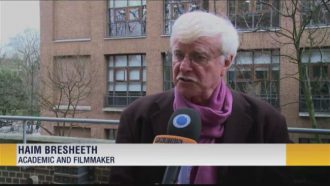 The British government is helping universities across the UK suppress the right to criticize Israel over its human rights violations in Palestine, says a Jewish professor, vowing to never give in to the pressure.
“They are trying to stop us talking about Palestinian rights, and about peace and we will just not shut up,” Dr. Haim Bresheeth, a Jewish academic and filmmaker, told Press TV on Wednesday.
“Unfortunately the government has helped the universities that want to shut up free speech by accepting a definition of anti-Semitism that makes anti-Semitism any criticism of Israel,” he added.
The scholar was referring to the International Holocaust Remembrance Alliance (IHRA)’s definition that was adopted by the government of Prime Minister Theresa May last year.
It was based on IHRA’s definition that the University of Exeter and the University of Central Lancashire (UCLan) cancelled an annual pro-Palestinian event on Monday, which was aimed at raising awareness about human rights violations in the occupied territories.
Following the move, some 250 academics at dozens of universities across the UK penned an open letter, condemning the Tory government’s attempts to curb their right to free speech by banning criticism of Israel.
The professors said in their letter that the government’s definition of anti-Semitism is too broad and can include any criticism of Israel with regards to its occupation of Palestinian lands.
“The government has ‘adopted’ the International Holocaust Remembrance Alliance definition of anti-Semitism, which can be and is being read as extending to criticism of Israel and support for Palestinian rights, an entirely separate issue, as prima facie evidence of anti-Semitism,” read the letter, sent to the Guardian.
“This definition seeks to conflate criticism of Israel with anti-Semitism,” the academics charged, accusing universities minister Jo Johnson of asking for the definition to be “disseminated” throughout the higher education system.
In his interview with Press TV, Bersheeth said the definition sought to protect “Zionism and Israel” from criticism.
“You can criticize and you should criticize every political institution that you wish,” he argued. “We are told now that Jews who criticize Israel like me are anti-Semitic. This is nonsense.”
Leeds University Union Threaten to Ban Craig Murray Speech on Palestine
By Craig Murray – March 1, 2017
I am giving a talk entitled “Palestine/Israel: A Unitary Secular State or a Bantustan Solution” in Leeds University tomorrow. I have just been told by Leeds University Union I will not be allowed to speak unless I submit what I am going to say for pre-vetting.
I am truly appalled that such a gross restriction on freedom of speech should be imposed anywhere, let alone in a university where intellectual debate is meant to be an essential part of the learning experience. I really do not recognise today’s United Kingdom as the same society I grew up in. The common understanding that the values of a liberal democracy are the foundation of society appears to have evaporated.
As regular readers know well, I do not write speeches in advance but always speak extempore. My opinions on Israel and Palestine are very well documented on this blog and elsewhere. I want to see a single, unitary state in Israel/Palestine, encompassing everyone who currently lives in those territories, as a secular democracy blind to ethnicity and religion. This includes an acceptance that further forced large population movements by anybody are not desirable and the Palestinians should receive more compensation than restitution. If I am not permitted to express this view within a University, I find that truly shocking.
I should be equally shocked if anybody who held views very different to my own were not permitted to express them.
I think that if people like me are now being prevented from speaking, society has crossed a very dangerous line indeed.
Israel clears Palestinians and homes so its military can practice

Defense for Children International | February 6, 2017
Ramallah – Evictions, demolitions, and UXO are constant risks for Palestinian children living in areas of the Jordan Valley that Israel has declared as “firing zones,” where Israeli battalions regularly assemble to hone their combat skills. Before tanks can shoot off missile rounds and soldiers can carry out practice missions, goats are removed, animal pens and tents dismantled.
“During 2016, we were forced to evacuate our houses around 30 times,” said Abdulaziz Abu Kbash, a father of seven. Abu Kbash lives with his family in a makeshift metal structure near Homsa, which is part of the West Bank governorate of Tubas, in the northern Jordan Valley.
In the summer, home evictions during Israeli military practices put children at risk of dehydration and prolonged sun exposure. “We wait in the sun for hours,” said Abu Kbash. “The children get very tired from being outdoors.”
Winter, with rain and lower temperatures, is not much better. After Abu Kbash’s family had been forced to stay outside during an Israeli drill in February 2016, his daughter fell ill for several days.
Even more frightening are the UXO the Israeli soldiers leave in their wake. “Tanks, live ammunition, and shells are used in drills not that far from our houses,” said Abu Kbash. “When we return, we find shell shrapnel and some other remnants near the houses. Our biggest fear is that one of the foreign objects could explode and hurt our children.
Animals, the primary source of livelihood for Abu Kbash’s family, are not immune to Israel’s military activities in the Jordan Valley, either. Extra time animals spend walking or waiting in hot temperatures cost the family in water, which they have to purchase from cities approximately 9 miles away.

Palestinians herd their flocks during a temporary eviction order for the purpose of Israeli military exercises outside Tubas, in the northern Jordan Valley. (Photo: DCIP / Cody O’Rourke)
Makeshift homes like Abu Kbash’s dot the length of the mostly arid strip of land known as the Jordan Valley that stretches along the Jordanian border. Against this often challenging landscape, Bedouin and other livestock-based communities have long practiced their way of life.
Israel’s military annexation and subsequent occupation of the West Bank in 1967 represented a significant interruption to these remote communities’ customs and livelihoods.
Although comprising 30 percent of the total West Bank Palestinian land space, the bulk of the Jordan Valley now falls under Area C, “virtually of which is prohibited for Palestinian use, earmarked instead for the use of the Israeli military or under the jurisdiction of Israeli settlements,” according to the Office for the Coordination of Humanitarian Affairs (OCHA).
Approximately 3,400 Palestinians live in the especially restrictive closed military or “firing zones.” These ill-defined areas on and around Palestinian communities are used by Israeli military personnel for training purposes. Ahead of planned military exercises, Israeli authorities clear people, animals and structures from the area.
When Defense for Children International – Palestine visited Abu Kbash in late September of 2016, he had recently received a temporary eviction notice. On September 16, the Israeli civil administration ordered all the families in the vicinity, including 51 children, out of their homes between 7 a.m. and 11 a.m. on September 22, 29, and 30.

Mahmoud Ayyoub stands where he and his family of 15 lived before Israeli forces demolished their homes in Ein Al-Beida, near Tubas, in the Jordan Valley. (Photo: DCIP / Cody O’Rourke)
Even when drills are not actively in progress, Palestinian children residing near or inside firing zones live under the constant threat of displacement.
On September 27, 2016, Mahmoud Ayyoub was at a Jenin hospital with one of his children when he received a troubling phone call. Israeli forces had entered his village, Ein Al-Beida, located on the northern tip of the Jordan Valley, the caller said. He learned that the makeshift homes and tents that provided shelter to his seven adult children and 15 grandchildren had all been demolished.
“I was told that soldiers came at around 8:30 a.m. and threw all our belongings outside. They kicked the women and children out in their sleeping clothes without explaining the reason for the demolition,” said Ayyoub, who has lived in Ein Al-Beida for 15 years.
Now, Ayyoub says, the Israeli army is preventing him from rebuilding. He told DCIP that soldiers regularly monitor the area to ensure that no rebuilding has occurred.

Odai al-Faqeer, 5, Daifallah’s youngest son, sits on broken concrete blocks and twisted, steel where his home once was in Aqaba, Tubas governorate. (Photo: DCIP / Cody O’Rourke)
Earlier in the month, on September 7, Daifallah al-Faqeer’s six children watched two Israeli bulldozers destroy their home in Aqaba, a few miles east of Tubas. “My children were really terrified by the soldiers, who smashed everything in front of them,” their father told DCIP.
“It was a difficult time for all of us to see everything we had built being torn down,” al-Faqeer said.
Al-Faqeer was only given two hours notice that three housing and four animal structures would be demolished because they lacked the necessary permits. His family rushed to save what they could before the demolition started.
“We stayed in the open until some residents in the neighboring area gave us some tents to live in,” said al-Faqeer. “I am currently trying to rebuild what has been destroyed.”

Israeli army vehicles park next to a Palestinian family compound during Israeli military training in the Jordan valley, West Bank, on December 8, 2016. (Photo: ActiveStills / Keren Manor)
In the months since DCIP visited these three families, Israel carried out at least four evictions or demolitions in the northern Palestinian villages of the Jordan Valley. Residents of Khirbet Al-Ras Al-Ahmar were evacuated in October and November, Khirbet Ibziq in December of 2016, and Khirbet al-Kurzaliya in January of this year.
Since 1967, Israel has pursued a discriminatory policy of demolishing Palestinian homes and essential structures, including water systems, livestock pens, solar panels, and even tents and shelters provided by international aid organizations throughout the West Bank, including East Jerusalem.
In 2016, Israel’s demolition rates were the highest ever recorded since OCHA began tracking the issue in 2009. Altogether, Israel demolished, dismantled, or othrwise confiscated 1,089 Palestinian-owned structures in the West Bank, including East Jerusalem, displacing 1,593 people. OCHA’s Demolitions Database shows that 15 of these incidents took place in Area C of the Jordan Valley, impacting 98 structures and 124 children.
Demolitions and evictions deny Palestinians the right to live securely and deny children an adequate standard of living, education, health, and psychological well-being.
Israel’s Anti-Semitism Smears Backfire
By Ann Wright | Consortium News | March 1, 2017
An often-used tactic to squelch criticism of Israeli state policies toward the Palestinians is to call the criticism anti-Semitic. The sponsors of the event become afraid of the label, anti-Semitism, false as it is, and cancel the event to avoid any controversy. The tactic is used widely across Europe and the United States.
This week, the talk that I was to give in a room at the Rome City Hall about the Women’s Boat to Gaza and the conditions in Gaza was cancelled 24 hours before the event by the council member who had agreed to arrange for the room. His staff revealed that he had gotten intense pressure from the Israeli Embassy and Rome’s Jewish Community Association to stop the presentation.
But that was not the end of the story. In a fast-moving media blitz, organized by Italy’s Boycott, Divestment and Sanctions program, two of Rome’s newspapers wrote of the cancellation and several radio stations reported on it. BDS Italy scheduled a press conference about the cancellation in the plaza in front of the City Hall at the time the talk was scheduled. About 20 representatives of the news media attended, a much larger number than would have attended the talk itself.
Due to the number of media and the questions concerning the cancellation, Marcello de Vito, President of the Rome City Council, invited three of us to come into the City Hall to discuss the cancellation. This invitation provided us with the opportunity to discuss the conditions in Gaza and the West Bank and the nonviolent tactics such as BDS and Boats to Gaza to bring international attention to the harmful policies of the State of Israel.
From the questions, it was apparent that the President, another City Council member and their staff knew little about the Israeli blockade of Gaza, the illegal settlements, the apartheid wall, the numbers of Palestinian children and youth held in Israeli jails, and the theft of Palestinian resources by Israeli companies.
Something similar happened last year in Bayreuth, Germany, when the prize for Tolerance and Peace, which had been awarded to CODEPINK: Women for Peace, was cancelled by the Mayor after two reporters, known for writing spurious articles, alleged that CODEPINK was an anti-Semitic organization. Following an extensive letter-writing campaign from members of the German Parliament and others who know that CODEPINK’s actions challenging the policies of the State of Israel are not anti-Semitic, the Bayreuth City Council voted to reinstate the award amid much publicity.
Also, last year, a conference in which grandmothers who had been through World War II were to speak was cancelled because of similar allegations. Defenders of Israeli policies targeted 90-year old Hedie Esptein, a vocal critic of Israeli treatment of Palestinians, although her parents had been killed in the Holocaust and she had survived by being sent to England as a part of the Kindertransport,
Responding quickly to false allegations of anti-Semitism is key to blunting the Israeli government’s offensive toward those who challenge the illegal and inhumane policies toward Palestinians. In the case of the Rome cancellation, the pushback from BDS Italy created more publicity about the plight of the Palestinians than the event itself would have.
Ann Wright served 29 years in the U.S. Army/Army Reserves and retired as a Colonel. She was a U.S. diplomat and served in U.S. embassies in Nicaragua, Grenada, Somalia, Uzbekistan, Kyrgyzstan, Sierra Leone, Micronesia, Afghanistan and Mongolia. She resigned from the U.S. government in March, 2003 in opposition to President Bush’s war on Iraq.
2nd Jewish Cemetery Vandalized; But Those Shedding Tears Seem to have Short Memories
By Richard Edmondson | Fig Trees and Vineyards | February 28, 2017
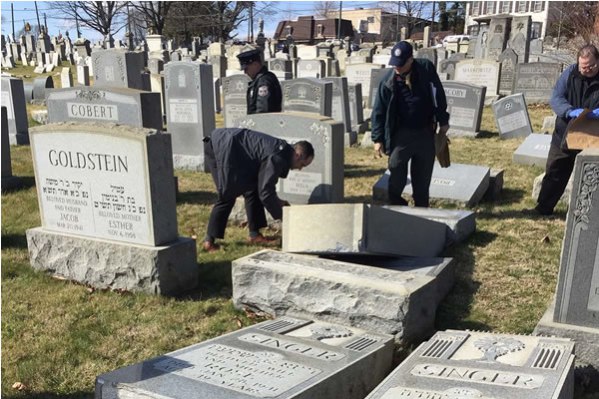
Another Jewish cemetery has been vandalized. According to news reports, some 75-100 headstones were knocked over at the Mount Carmel cemetery in Philadelphia sometime either Saturday night or early Sunday morning.
It is the second vandalization of a Jewish cemetery in a week. The previous one took place at the Chesed Shel Emeth Cemetery, near St. Louis, an incident I reported on in a post several days ago.
“We are horrified by the desecration at Mount Carmel Cemetery,” said Nancy K. Baron-Baer, a regional director for the ADL, in commenting on the latest attack.
Other Jews seem to be equally horrified. The Anne Frank Center, headquartered in New York with an additional office just opened in Los Angeles, issued a statement similarly impassioned–if not more so.
“WE ARE SICKENED, SICKENED, SICKENED,” read read the group’s rather unrestrained outpouring posted on Twitter. “More Jewish gravestones were found vandalized today, this time in Philadelphia.”
Jewish graves in Philadelphia now vandalized. Stop this incubator of #Antisemitism and other hate. WE BEG YOU @POTUS @realDonaldTrump pic.twitter.com/RHuIjdE2Yg
— AnneFrankCenter(US) (@AnneFrankCenter) February 26, 2017
//platform.twitter.com/widgets.js
In its mission statement, the Anne Frank Center “calls out prejudice, counters discrimination and advocates for the kinder and fairer world of which Anne Frank dreamed.”
And as for the ADL, so horrified and sickened are its officials by recent events they have even put up a $10,000 reward for information leading to the arrest and conviction of the vandals.
“This act is cowardly and unconscionable, and is all the more despicable coming on the heels of a similar vandalism at another Jewish cemetery in St. Louis last week,” said Baron-Baer. “We urge anyone with information on this crime to report it immediately to the Philadelphia Police Department at 215-686-TIPS.”
“I’m so upset,” said Millard Braunstein, who went to the cemetery Monday morning and discovered his mother’s headstone is one of those that had been knocked down.”This is such a terrible thing.”
“It’s just very disheartening that such a thing would take place,” said Aaron Mallin, another man with a relative buried in the cemetery.
And a Philadelphia rabbi who has also visited the cemetery and seen the damaged grave sites seems particularly heavy of heart.
“After you start walking from row to row it quickly moves from a random act of vandalism to something with larger intentions and a systematic approach to things,” said Shawn Zevit, the rabbi at the Mishkan Shalom synagogue.
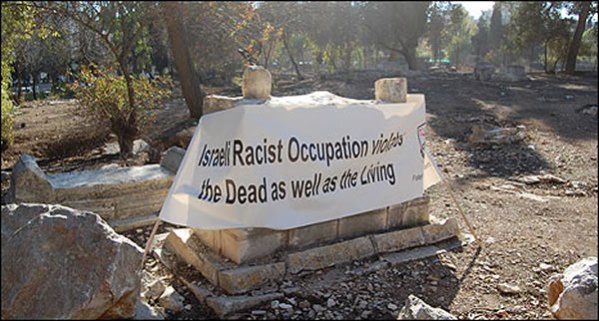
While desecration of a cemetery is a despicable act, one wonders if any of these people bothered to voice their concerns over the desecration and paving under of a Muslim cemetery in Jerusalem. And if Zevit is concerned about the “systematic approach” taken by the vandals in Philadelphia (who damaged a mere 100 graves) he should stop and reflect that it doesn’t even begin to hold a candle to the “systematic approach” taken by the Israelis at the Mamilla Cemetery. Here is a bit from Wikipedia:
Mamilla Cemetery is a historic Muslim cemetery located just to the west of the walls of the Old City of Jerusalem, Israel.[1][2]The cemetery, at the center of which lies the Mamilla Pool, contains the remains of figures from the early Islamic period,[3]several Sufi shrines and Mamluk-era tombs.[1] The cemetery grounds also contain the bodies of thousands of Christians killed in the pre-Islamic era, as well as several tombs from the time of the Crusades.
Its identity as an Islamic cemetery is noted by Arab and Persian writers as early as the 11th century.[4] It was used as a burial site up until 1927 when the Supreme Muslim Council decided to preserve it as a historic site.[1]
Following the 1948 Arab–Israeli War, the cemetery and other waqf properties in West Jerusalem fell under the control of Israeli governmental bodies.[5] A number of buildings, a road and other public facilities, such as a park, a parking lot and public lavatories have since been constructed on the cemetery grounds, destroying grave markers and tombs. A plan to build a Museum of Tolerance on part of the cemetery grounds, announced in 2004, aroused much controversy and faced several stop work orders before being given final approval in July 2011.
The “Musem of Tolerance” mentioned by Wikipedia is a facility the Simon Wiesenthal Center is seeking to build in Jerusalem as a companion to its museum of the same name in Los Angeles. Ironically the Simon Wiesenthal Center is among those now expressing concern over the vandalization of Jewish cemeteries in the US.
“Attacking a cemetery, especially one that is all-Jewish, all-Catholic, or whatever it is, is basically an attack on the culture, the identity of the people that cemetery represents,” Aaron Brietbart, a Simon Wiesenthal researcher, told the Washington Post following the attack on the Jewish cemetery in Missouri.
Compare Brietbart’s remarks to those of another Simon Wiesenthal official, Rabbi Marvin Hier, who insisted to the BBC in 2008 that construction of the Museum of Tolerance–on top of the Mamilla Cemetery–was an appropriate use of “derelict land.”
“Jerusalem is a city built on top of thousands of bones – Jewish and Muslim,” Hier said. “If we declared the whole of Jerusalem one huge cemetery, we’d never be able to build anything.”
The Museum of Tolerance seems to be rather aptly named–since what we are being ordered to show tolerance for in large part is the Simon Wiesenthal Center’s hypocrisy.
You’ll also note–in the tweet above–that the Anne Frank Center demands President Trump “deliver a prime-time nationally televised speech, live from the Oval Office, on how you intend to combat not only #Antisemitism and #Islamophobia and other rising forms of hate.”
All well and good perhaps, but why doesn’t the Anne Frank Center seem concerned about the Islamophobia running rampant in the state of Israel? Surely apartheid, walls, occupation, home demolitions, and cemetery desecrations are not part of the “kinder and fairer world of which Anne Frank dreamed.”
Perhaps instead of delivering a live speech from the Oval Office on anti-Semitism or Islamophobia, Trump should call his advisors together to develop a national strategy for dealing with the Jewish inability to self-reflect.
And finally, one other point before closing: the fact that Muslims in America have raised money to help pay for damage done by vandals at Jewish cemeteries is, in light of attacks upon the Mamilla Cemetery in Jerusalem, ironic to say the least. After the destruction at the cemetery in Missouri, US Muslims rallied with a very successful crowdfunding campaign. Now it seems they are doing it again. Here is what is being reported by CNN:
Once again, dozens of Jewish headstones have been vandalized, stoking fears of heightened anti-Semitism. And once again, members of the Muslim community are rallying to help.
The latest spate of destruction came over the weekend at the Mount Carmel Cemetery in Philadelphia, where 75 to 100 tombstones were toppled over. A week earlier, at least 170 headstones were damaged at a Jewish cemetery in St. Louis.
Muslim activist Tarek El-Messidi, who had started a fund-raising campaign to help clean up the St. Louis cemetery, sprung to action again after the Philadelphia attack.
“I want to ask all Muslims to reach out to your Jewish brothers and sisters and stand together against this bigotry,” he wrote on Facebook.
“Last week, our Muslim community raised money for the vandalized Jewish Cemetery in St Louis. Since we raised well above the goal, we can now use extra funds to help here in Philadelphia.”
As of Tuesday morning, the campaign had raised $138,000 — nearly seven times the original goal of $20,000.
El-Messidi said he immediately visited the Philadelphia Jewish cemetery and offered his support after hearing the news. After all, Muslims can relate to the feeling of racial intolerance.
And here is a little more from the Wikipedia article on Mamilla Cemetery:
At the time of Israel’s assertion of control over West Jerusalem in 1948, the cemetery, which contained thousands of grave markers, came under the administration of the Israeli Custodian of Absentee Property and the Muslim Affairs Department of Israel’s Ministry of Religious Affairs.[1][5][28] By the end of the 1967 war that resulted in the Israeli occupation of East Jerusalem, only a handful of broken grave markers remained standing.[1] A large part of the cemetery was bulldozed and converted into a parking lot in 1964 and a public lavatory was also built on the cemetery grounds.[19][29][30]
In the 1950s, the Ministry of Foreign Affairs, sensitive to how the treatment of waqf properties would be viewed internationally, criticized government policy towards the cemetery.[28] A ministry representative described the vandalism to tombstones, including their use by the guard appointed by the Religious Ministry to build a henhouse beside his shelter in the cemetery, and the destruction of ancient tombs by bulldozers cleaning the Mamilla Pool.[28] Noting the site constituted waqf property and lay within sight of the American Consulate, the ministry said it viewed the situation, which included plans for new roads and the parceling out of portions to private landowners as compensation for other properties confiscated by the state, with deep regret.[28]
Israeli authorities bulldozed several tombs in the cemetery, including some of those identified as Frankish by Clermont-Ganneau, to establish Mamilla Park (or Independence Park) in 1955.[22] Two of the largest and finest tombs survived, though the lid of one was overturned when it moved from its original spot.[22] The other is the Mamluk era funerary chapel known as al-Kebekiyeh (or Zawiya Kubakiyya), now located in the eastern end of Independence Park.[22][23]
Besides Independence Park, other parts of downtown Jerusalem erected on the cemetery grounds include the Experimental School, Agron Street, Beit Agron, and Kikar Hahatulot (Cats’ Square), among others.[18] Government buildings on the cemetery grounds include the main headquarters of the Israeli Ministry of Trade and Industry,[1] and the Customs Department building, which is said to be located on what was once the site of the chapel dedicated to St. Mamilla.[31]
In 1992, the Custodian of Absentee Property sold the cemetery grounds to the Jerusalem Municipality, a sale the Mufti of Jerusalem, Ikrema Sabri, said they had no right to make.[32] The Israeli Electricity Company destroyed more tombs on 15 January 2005 in order to lay some cables.[1]
A major protest against attacks upon the cemetery took place in Jerusalem in 2008. Here is what the BBC reported:
Earlier this week hundreds of Muslims – young and old – marched through the centre of Jerusalem towards the city’s Mamilla cemetery.
Police helicopters flew overhead and security was tight. The focus of the march, and of increasing Muslim anger, was the Israeli Supreme Court decision to sanction a controversial new building on part of the Muslim cemetery.
And finally a bit more from Wikipedia:
On 9 August 2010, 300 Muslim gravestones in the cemetery were bulldozed by the Israel Lands Administration (ILA) in an area US Jewish human rights activists said was very close to the planned site for the Museum of Tolerance.[41][42] A reporter from Agence France Presse witnessed the destruction of 200 graves until the work was briefly suspended while the court heard a stop work petition it rejected, allowing demolitions to continue that same day.[41] The judge later issued an order prohibiting harm to ancient graves and mandating that the ILA coordinate work with the Israel Antiquities Authority and representatives of the Islamic Movement.[42]
The Jerusalem city council issued its first official response in a written statement on 12 August, saying that, “The municipality and the (Israel Lands) Authority destroyed around 300 dummy gravestones which were set up illegally in Independence Park on public land.” It said these “fake” gravestones were not erected over any human remains and were placed in the park in an effort to “illegally take over state land.”[41]
Mahmud Abu Atta, a spokesman for the Al-Aqsa Foundation, denied the city council’s claim that new tombs were added illegally. He said that between 500 and 600 tombs had been renovated in total “with the municipality’s agreement,” that “some of the tombs had to be totally rebuilt,” but that “all the tombs that we built or renovated contain bodies.”[41]
Twenty graves were completely destroyed or had their tombstones removed by vandals in January 2011.[43] On the night of 25–26 June 2011, about 100 gravestones in an intact part of the cemetery were destroyed by Israeli bulldozers.[19][44] Footage filmed by local media and activists appeared on Al Arabiya and Al Jazeera and showed the bulldozers pulling out quickly after realizing they were being filmed; Israeli officials made no comment on the incident.[45]
Later that same year, fifteen gravestones in the cemetery were spray painted red with racist slogans reading “Death to the Arabs”, as well as “price tag” and “Givat Asaf“, the name of an Israeli outpost slated for demolition.

The Mamilla graveyard (shown in the background) as it appeared in 1948
Though the statements from the Anne Frank Center and some of the other Jews quoted in this article are rather amazing, perhaps the Academy Award for hypocrisy goes to an Israeli official by the name of Emmanuel Nahshon. A spokesperson for the Israeli Foreign Ministry, Nahshon tweeted the following in response to the attack on the cemetery in Philadelphia:
#Philadelphia Jewish cemetery desecration is shocking and a source of worry . Full confidence #US authorities catch and punish culprits .
— Emmanuel Nahshon (@EmmanuelNahshon) February 26, 2017
Two British universities halt pro-Palestinian events
Press TV – February 28, 2017
Two British universities have been accused of undermining freedom of speech after cancelling an annual pro-Palestinian event aimed at raising awareness about human rights violations in the occupied territories.
The accusation was leveled on Monday after the University of Exeter and the University of Central Lancashire (UCLan) announced the cancellation of a pro-Palestinian student-run event called Israel Apartheid Week.
Students at Exeter were barred from giving a street theater performance called Mock Checkpoint, in which some participants were to dress up as Israeli soldiers while others performed the roles of Palestinian victims.
The event had been approved by the student union at the university but was banned for “safety and security reasons” less than 48 hours before commencement. An appeal against the decision was also refused.
Members of Friends of Palestine Society at Exeter accused the university of censoring students, saying, “They are not allowing freedom of speech – by cancelling an event that was in support of Palestinian activism and for Palestinian rights; they are directly censoring us.”
Professors react
The move prompted almost 250 academics, including 100 professors, to sign a letter denouncing attempts by university officials to silence campus discussion about Israel and its treatment of Palestinians.
“These are outrageous interferences with free expression, and are direct attacks on academic freedom,” the letter noted. “As academics with positions at UK universities, we wish to express our dismay at this attempt to silence campus discussion about Israel, including its violation of the rights of Palestinians for over 50 years.
“It is with disbelief that we witness explicit political interference in university affairs in the interests of Israel under the thin disguise of concern about anti-semitism,” it added.
More than half a million Israelis live in over 230 illegal settlements built since the 1967 Israeli occupation of the Palestinian territories of the West Bank and East Jerusalem al-Quds.
Much of the international community regards the Israeli settlements as illegal because the territories they are built on were captured by Israel in a war and are hence subject to the Geneva Conventions, which forbid construction on occupied lands.
Nevertheless, the Israeli regime continues to build more settlements and expand the existing ones.
Fatah movement says Facebook shut down the movement’s official page
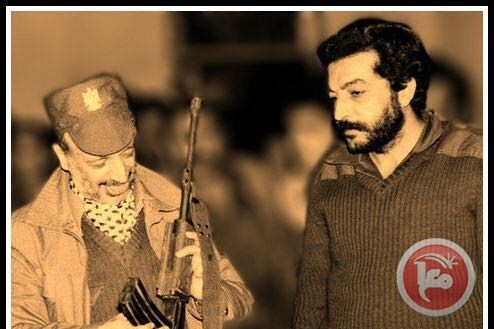
The photo which reportedly led Facebook to close Fatah’s official page
Ma’an – February 27, 2017
RAMALLAH – The official Facebook page of the Palestinian Authority’s (PA) ruling party Fatah was shut down by Facebook Inc. on Monday, according to an official statement from the Fatah movement.
Munir al-Jaghoub, a Fatah official and the “administrator” of the page said in the statement that Facebook closed the Fatah’s official page after the group posted a photo of the late Palestinian President and Fatah leader Yasser Arafat alongside the current deputy chairman of the movement Mahmoud al-Aloul.
Arafat appears in the photo handing a rifle to al-Aloul. According to the statement, the rifle belonged to Israeli soldiers and was captured by Fatah militants in southern Lebanon during the 1982 Lebanon war.
The statement added that Monday’s incident was the second time Facebook has closed the Fatah movement’s official Facebook page.
In recent months, Israel has detained scores of Palestinians for social media activity, alleging that a wave of unrest that swept the occupied Palestinian territory in October 2015 was encouraged largely by online “incitement.”
In September, Facebook agreed to work with the Israeli government to “minimize online anti-Semitic incitement” — in an effort to pressure the social media site to coordinate to remove content considered to promote “terrorism.”
Israel had previously blamed Facebook outright for the perceived proliferation of incitement, with Public Security Minister Gilad Erdan reportedly saying that Facebook chairman and cofounder Mark Zuckerberg had “blood on his hands” for not adequately cooperating with Israel to remove content.
Earlier this year, the controversial “Facebook bill” passed the first reading in the Knesset, which would allow Israeli officials to force the social media giant to remove certain content through a court order if there are suspicions of “incitement.”
Despite Facebook complying with 95 percent of the Israeli government’s removal requests in recent months, some members of the Knesset have expressed indignation that Facebook has not taken enough action to remove content inciting “acts of terror against Jews.”
Meanwhile, Palestinians have instead pointed chiefly to the frustration and despair brought on by Israel’s nearly 50-year military occupation of the Palestinian territory and the absence of a political horizon as reasons for the outbreak of violence. Many Palestinians have also pointed out that Israeli violence has continued to shape everyday life in the occupied territory, regardless of any recent “upticks” in clashes or attacks.
Palestinian woman shot, injured by Israeli forces at Qalandiya checkpoint
Ma’an – February 27, 2017
BETHLEHEM – A Palestinian woman was shot and injured by Israeli security guards at the Qalandiya checkpoint between the occupied West Bank and occupied East Jerusalem on Monday afternoon, as Israeli police claimed she was carrying a bag in a “suspicious manner.”
Israeli police spokeswoman Luba al-Samri said in a statement that a “suspicious” Palestinian woman entered the vehicle lane of the checkpoint “seemingly carrying an object.”
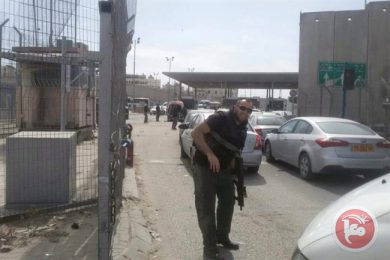 “The security guards noticed her and instructed her to stop but she ignored the instructions,” al-Samri said.
“The guards then started arrest procedures and neutralized the woman,” al-Samri added, using an Israeli forces term to indicate that a Palestinian was shot without specifying whether they were injured or killed.
Al-Samri later clarified that the woman had been “lightly injured,” and that she had been “carrying a bag” in a way that raised the security guards’ suspicions.
The police spokeswoman said that the Palestinian was in her thirties and was a resident of the village of Kafr Aqab in the West Bank district of Jerusalem with a Jerusalem ID.
The Qalandiya checkpoint is notorious for being confusing to navigate.
According to Ma’an documentation, five Palestinians were killed at the checkpoint in 2016, including two Palestinian siblings — Maram Salih Hassan Abu Ismail who was 23 years old and five months pregnant, and her 16-year-old brother Ibrahim — in April after Israeli officials claimed the two were attempting to carry out a stabbing attack.
However, witnesses said that the brother and sister posed no threat at the time of their death. Yet the Israeli Justice Ministry later dropped its probe into the killings after it was revealed that a contractor, not a member of the police, had killed the Abu Ismails.
Former prisoner Ihsan Dababseh seized once more by Israeli occupation forces

Samidoun Palestinian Prisoner Solidarity Network – February 27, 2017
Former Palestinian prisoner Ihsan Dababseh was seized by Israeli occupation forces in a pre-dawn raid on her home in the town of Nuba south of al-Khalil on Monday, 27 February; they took her to the Etzion interrogation center, reported Asra Voice.
The home of Dababseh, 30, has been raided on multiple occasions over the last weeks with demands that she report for interrogation. During these raids, her family home was ransacked and belongings torn apart.
Dababseh is one of ten Palestinian women prisoners whose story is featured in “For the Love of Palestine: Stories of Women, Imprisonment and Resistance,” created by members of the Prison, Labor and Academic Delegation to Palestine.
Dababseh was released after 21 months in Israeli prison on 10 July 2016; she had been imprisoned since 13 October 2014 on charges of membership in a prohibited organization, in her case the Palestinian Islamic Jihad movement. She previously spent two years in Israeli prison from 2007 to 2009 on similar charges. All major Palestinian political parties are labeled prohibited organizations by the Israeli occupation. During her imprisonment she had been isolated with four other Palestinian women as punishment for raising the Palestinian flag on the anniversary of the Nakba.
In 2014, Reham Alhelsi reported, “Israeli occupation soldiers raided her house several times, sent her 4 summons and threatened to blow up her house of she didn’t come to interrogation center. She went with her mother to detention center and was detained and her personal computer was confiscated, while her mother told to leave.”
During her prior arrest from 2007 to 2009, the Israeli occupation soldiers who had arrested and blindfolded her made a video of themselves dancing around her as she was blindfolded and held against the wall, which they distributed.
Palestinian children attend class in the street after Israel shuts down school
Ma’an – February 26, 2017
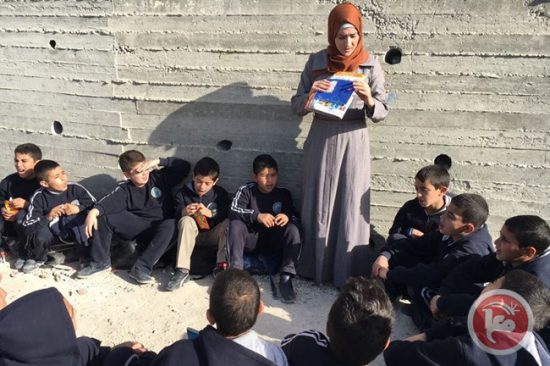
JERUSALEM – After Israeli authorities shut down a Palestinian elementary school in the occupied East Jerusalem town of Sur Bahir last Thursday over alleged “incitement” in its study materials, students attended class in the street on Sunday and protested against Israel’s decision to close the school.
Children who were enrolled at al-Nukhba (“the elite” in Arabic) arrived to the campus with their parents in an action organized by the parent committees of Sur Bahir’s schools, holding posters expressing support for al-Nukhba and denouncing Israel’s closure of educational institutions as “tyrannical.”
Last Thursday, head of the school Luay Jamal Bkirat and the school’s financial manager Nasser Hamed were summoned to an Israeli police station for interrogation, when Israeli intelligence officials informed them that the school was being shut down for carrying inciting content in the teaching materials used at the school.
Bkirat denied the claims, saying that al-Nukhba school was “teaching the Palestinian curriculum used in all schools in Jerusalem and that no one of the faculty had ever been summoned for interrogation before over incitement.”
He added that the school — which serves 250 boys from kindergarten to grade six — was opened last year and gained a temporary operating license from the Jerusalem municipality, and that the license was revoked in November for unknown reasons.
Bkirat condemned the decision and said that he would “conduct procedures to stop this decision which aims to destroy education.”
The Times of Israel reported that the school was shut down for being a “Hamas front,” after a months-long joint probe by Israel’s Education Ministry, Jerusalem police, and Israeli intelligence, the Shin Bet.
Israeli authorities from the education ministry claimed the school was established by Hamas with the aim of teaching “content that undermines the sovereignty of Israel,” and that the school’s aims were “consistent with the ideology of the terror organization, which calls for the destruction of Israel,” the Times of Israel said.
According to the Israeli news outlet, the ministry ordered the school not to open in September “and when it continued to operate, issued the closure order.”
Israeli Jews and Palestinians study in separate school systems in occupied East Jerusalem, with the Palestinian schools run by either Israel’s Jerusalem municipality, the Islamic Waqf and administered by the Palestinian Ministry of Education, private institutions, or UNRWA, the UN agency responsible for Palestinian refugees.
According to the Palestinian Ministry of Education, Palestinian children suffer from routine Israeli interference and political pressure to replace Palestinian curricula with an Israeli one in occupied East Jerusalem, where full Israeli military and civil control deprives students from proper and secure educational services.
A 2016 report by Israeli daily Haaretz also said that Palestinian schools in occupied East Jerusalem received less than half the funds that the Jerusalem municipality transferred to Jewish schools in West Jerusalem.
Though Sur Bahir lies beyond the periphery of occupied East Jerusalem, the town remained under full Israeli security and civil control within Israel’s Jerusalem municipality after the territory was illegally annexed in 1967.
A 2011 report by the Applied Research Institute – Jerusalem (ARIJ) said that due to a lack of some levels of education in Sur Bahir, many students were forced to attend schools in neighboring villages.
Featured Video

Houthis Don’t Have to Conquer Saudi Arabia to Make It Pay
or go to
Aletho News Archives – Video-Images
From the Archives
Newly Released FBI Docs Shed Light on Apparent Mossad Foreknowledge of 9/11 Attacks
By Whitney Webb | MintPress News | May 17, 2019
NEW YORK — For nearly two decades, one of the most overlooked and little known arrests made in the aftermath of the September 11 attacks was that of the so-called “High Fivers,” or the “Dancing Israelis.” However, new information released by the FBI on May 7 has brought fresh scrutiny to the possibility that the “Dancing Israelis,” at least two of whom were known Mossad operatives, had prior knowledge of the attacks on the World Trade Center. … continue
Blog Roll
 Aletho News
- MEP blasts ‘Euro-Gestapo’ for lecturing Russia on democracy
- Syria May Send Troops to Saudi Arabia Amid War with Ansar Allah
- UK whines about losing billions to ‘Putin tax’
- Baghaei to Rubio: Distorted narratives cannot erase US record of broken commitments
- Houthis Don’t Have to Conquer Saudi Arabia to Make It Pay
- MOE: Nearly 22,000 Students and Education Workers Killed
- Guterres in Islamabad: Genocide, cowardice, and the cage of Imran Khan
- Johnson, Marandi say Yemen holds upper hand over Saudi Arabia
- False flags won’t save aggressors, Iran FM spokesman says
- The Makkah Pact Enters Into Force: The End of American Dominance or Its New Form?
- If Americans Knew
- Report claimed Mark Levin used by Israeli government to influence Trump
- Over 2,000 Gazans have died awaiting medical evacuation amid Israel’s continued siege
- How a U.S. Diplomat Suppressed and Altered Reports Critical of Israel
- 5 Palestinians Die from Israeli Strikes in Gaza as Relentless Attacks Continue
- Report: Ceasefire Slows Killing but Leaves Devastation Intact
- Country Music Singer Zach Bryan Breaks Attendance Record at Robert Kraft’s Gillette Stadium While Wearing ‘Free Palestine’ Shirt for Second Night in a Row
- Three years of death and devastation: Israel’s war on Gaza in pictures
- Why Hamas believed the status quo was more dangerous than its 7 October gamble
- Debunking Israel’s latest list of ‘terrorist’ journalists in Gaza
- In Gaza, focus is on survival, “every step is a struggle” – Daily Update
- No Tricks Zone
- New Study: 50 Years Of The Most Aggressive ‘Net Zero’ Policies Can Only Affect The Global Climate By 0.03°C
- US September “Heat” Was No Record…Many Records Set Decades Ago
- Latest European Green Energy Debacle; Portugal’s Largest Flagship Solar Park Insolvent!
- Green Energy Debacle: German Expert Professor Fritz Vahrenholt Warns Of Severe Economic And Social Consequences
- Two More Paleo Reconstructions Affirm Meters-Higher Sea Levels Across Ireland, Brazil 7000-6000 Years Ago
- New Study: Earth And Venus Surface Warmth Largely Explained By Convection And Lapse Rate, Not CO2 Or Radiation
- 2025 Nature Paper Claiming Worsening Global Drought Gets RETRACTED …Heavily Flawed
- New Study: ‘Global Drought Shows No Detectable Recent Acceleration Under Climate Warming’
- Economic Masterminds: German Socialists Suggest Taxing Productivity Gains Stemming From Using AI
- The South China Sea Has Not Been Cooperating With The Climate Change Narrative

