No rational person could blame Jeremy Corbyn for Brexit. So why are the Blairites moving against Corbyn now, with such precipitate haste?
The answer is the Chilcot Report. It is only a fortnight away, and though its form will be concealed by thick layers of establishment whitewash, the basic contours of Blair’s lies will still be visible beneath. Corbyn had deferred to Blairite pressure not to apologise on behalf of the Labour Party for the Iraq War until Chilcot is published.
For the Labour Right, the moment when Corbyn as Labour leader stands up in parliament and condemns Blair over Iraq, is going to be as traumatic as it was for the hardliners of the Soviet Communist Party when Khruschev denounced the crimes of Stalin. It would also destroy Blair’s carefully planned post-Chilcot PR strategy. It is essential to the Blairites that when Chilcot is debated in parliament in two weeks time, Jeremy Corbyn is not in place as Labour leader to speak in the debate. The Blairite plan is therefore for the parliamentary party to depose him as parliamentary leader and get speaker John Bercow to acknowledge someone else in that fictional position in time for the Chilcot debate, with Corbyn remaining leader in the country but with no parliamentary status.
Yes, they are that nuts.
If the fault line for the Tories is Europe, for Labour it is the Middle East. Those opposing Corbyn are defined by their enthusiasm for bombing campaigns that kill Muslim children. And not only by the UK. Both of the first two to go, Hilary Benn and Heidi Alexander, are hardline supporters of Israel.
This was Benn the week before his celebrated advocacy of bombing Syria:
Shadow Foreign Secretary Hilary Benn told a Labour Friends of Israel (LFI) lunch yesterday that relations with Israel must be based on cooperation and rejected attempts to isolate the country.
Addressing senior party figures in Westminster, Benn praised Israel for its “progressive spirit, vibrant democracy, strong welfare state, thriving free press and independent judiciary.” He also called Israel “an economic giant, a high-tech centre, second only to the United States. A land of innovation and entrepreneurship, venture capital and graduates, private and public enterprise.”
Consequently, said Benn, “Our future relations must be built on cooperation and engagement, not isolation of Israel. We must take on those who seek to delegitimise the state of Israel or question its right to exist.”
Heidi Alexander actually signed, as a 2015 parliamentary candidate, the “We Believe in Israel” charter, the provisions of which state there must be no boycotts of Israel, and Israel must not be described as an apartheid state.
This fault line is very well defined. The manufactured row about “anti-Semitism” in the Labour Party shows exactly the same split. In my researches, 100% of those who have promoted accusations of anti-Semitism were supporters of the Iraq War and/or had demonstrable links to professional pro-Israel lobby groups. 100% of those accused of anti-Semitism were active opponents of the Iraq War. Never underestimate the Blairite fury at being shown not just to be liars but to be wrong. Iraq is their Achilles heel and they are extremely touchy about it.
No rational person would believe Brexit was Jeremy Corbyn’s fault. No rational person would believe that now is a good moment for the Labour Party to tear itself apart. Extraordinarily, the timing is determined by Chilcot.
The Israeli human rights group B’Tselem has said that the shooting of a 15-year-old Palestinian boy on Tuesday night was “deliberate, entirely unjustified and a direct result of military policy.” The group’s report gave details of the incident during which Mahmoud Badran was shot and killed by Israeli soldiers. The boy from Beit Ur a-Tahta was with four of his friends at the time; they were wounded in the unprovoked attack.
“The shots were fired at a car with seven passengers inside, who were making their way back from a night out at a water park,” reported B’Tselem. “The military initially announced the soldiers had ‘targeted terrorists who were throwing stones and Molotov cocktails at Israeli cars on Road 443’, but later changed its version and stated the boy had been ‘mistakenly’ killed.” The organisation’s field-researcher indicated that “the soldiers used heavy fire against the moving car without any justification.”
According to B’Tselem, said: “At around 1:30am, seven residents… were making their way home after a night out at the Lin Land Waterpark in the village of Beit Sira. When the car approached a narrow underpass used by Palestinian vehicles to get across Road 443, [Israeli] soldiers standing on the road, on top of the underpass, opened massive fire at the car from a distance of 40 to 50 metres.”
Most of the passengers in the car were hit by the shots, including the driver, who lost control and crashed into a wall. “Five of the seven passengers were hit in the shooting: Mahmoud Badran was killed instantly, four passengers were injured.”
Republican presidential nominee Donald Trump has backtracked from his neutral position on the Israel-Palestine conflict, and is now “committed” to supporting Israeli settlement expansion on territories it has seized illegally, according to an advisor.
David M. Friedman, a real-estate attorney serving as Trump’s main advisor on Israel, said the Republican presidential candidate and reality television star would not support the recognition of the Palestinian state without “the approval of the Israelis.” Friedman also remarked that Trump was unconcerned with the inhabitants of the West Bank, because “nobody really knows how many Palestinians live there.”
Trump made Friedman a part of his campaign staff in April, at a meeting with Orthodox Jews, naming him and Jason Greenblatt, another real-estate lawyer and Trump’s chief attorney, as his advisors on Israel. Friedman said at the time, “Mr. Trump’s confidence is very flattering. My views on Israel are well known, and I would advise him in a manner consistent with those views. America’s geopolitical interests are best served by a strong and secure Israel, with Jerusalem as its undivided capital.” Friedman has made no secret of his feelings about a two-state solution with Palestine, writing that, “It was never a solution, just an illusion that served both the US and the Arabs.”
Trump has earned a reputation for taking contradictory stances on issues, and when asked in May if he thought Israel should cease construction in the West Bank, the candidate said, “No, I don’t think there should be a pause… because I think Israel should have – they really have to keep going. They have to keep moving forward.” Later in the same interview he remarked, “I’d love to negotiate peace. I think that, to me, is the all-time negotiation… I would love to see if peace could be negotiated. A lot of people say that’s not a deal that’s possible. But I mean lasting peace, not a peace that lasts for two weeks and they start launching missiles again. So we’ll see what happens.”
Friedman says Trump’s attitude toward Israel is positive, and his view on the Palestinian state springs, in part, to a lack of power on the part of Palestinian President Mahmoud Abbas. “His [Trump’s] feeling about Israel,” Freidman said, “is that it is a robust democracy. He does not think it is an American imperative for [Gaza Strip and other territories seized by Israel] to be an independent Palestinian state.”
When asked directly about his own feelings on recognizing the State of Palestine, Friedman was open, if tentative.
“If the Israelis conclude that they need to do this [recognize the Palestinian state] in order to enhance their long-term security – which I think we are very skeptical about – but if this is what they conclude they want to do, we will respect this decision…. If the circumstances change… and there is a reason to be optimistic, then great, but the current facts don’t make that [recognizing the Palestinian state] an American imperative at all.” he said.
BETHLEHEM – Israel’s Public Security Ministry proposed its latest bill to prevent “security” interrogations from being videotaped, for “fear the footage could reach terror groups that would learn Israeli interrogation techniques,” Israeli media said Friday.
According to the Shin Bet, Israel’s internal security service, there is a “fear” that those being interrogated would refuse to reveal information in the event the video could possibly reach the groups they had informed against, said Israeli newspaper Haaretz.
In 2003 a law came into effect that required Israeli police to document almost all its interrogations, both visually and aurally.
Since then, the Knesset Constitution, Law and Justice Committee has consistently approved an “exemption” for security interrogations, which Israeli Deputy Attorney General Raz Nazri reiterated “stems from security considerations.”
In 2015, the committee agreed to extend the exemption for a year and a half, but rejected a proposed exemption of five years.
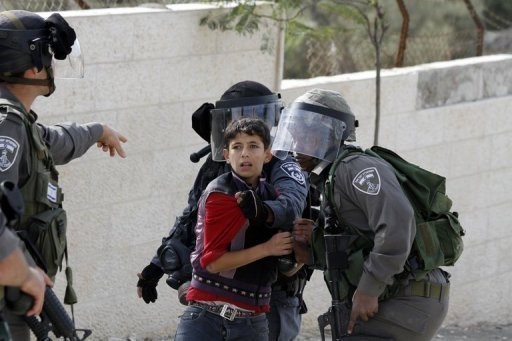
Israel has consistently been criticized by international rights groups for its interrogation practices, specifically towards Palestinian children.
Some 700 Palestinian children per year are arrested and face “ill-treatment” by Israeli forces, according to a 2015 report by Child Rights International Network (CRIN).
“Arrested children are commonly taken into custody by heavily armed soldiers, blindfolded with their wrists tied behind their backs before being transported to an interrogation centre,” the CRIN report said.
“Children questioned about their experience frequently report verbal and physical abuse during the arrest.”
According to research conducted by Defense for Children International – Palestine cited by the report, some 56 percent of children report having experienced “coercive” interrogation techniques during their time in Israeli custody.
Some 42 percent say they signed documents in Hebrew, despite the fact that most Palestinian children do not speak or understand the language.
Additionally, 22 percent of detained children say they underwent up to 24 hours of solitary confinement, in violation of international standards.
In a report released in February 2013, the UN children’s agency UNICEF criticized Israel for its treatment of arrested Palestinian children, saying their interrogation mixes “intimidation, threats and physical violence, with the clear purpose of forcing the child to confess.”
According to the latest numbers from prisoner rights group Addameer, there were a total of 414 child prisoners in Israeli prisons in May 2016, 104 of whom were under the age of 16.
BETHLEHEM – Israel’s Public Security Minister Gilad Erdan issued an order Friday banning the Palestinian Authority (PA)-funded television channel Musawa for six months, claiming the channel represents an affront to Israel’s sovereignty.
The channel was previously named Palestine 48 and was shut down by the Israeli government last year, before changing their name to Musawa and resuming activities, according to Israeli media.
Although the show is edited in the occupied West Bank district of Ramallah, it is recorded in Nazareth, leading Israeli authorities to crackdown on the channel for purportedly lacking proper permission for foreign entities to operate in Israel.
Erdan was reported as saying “I will not allow any harm to come to Israel’s sovereignty or give a foothold to the PA within the country,” according to the Times of Israel.
Last year, Prime Minister Benjamin Netanyahu initiated an investigation into the legality of the channel’s operations, as the Israeli government accused the channel of disseminating propaganda to enhance “Palestinian identity.”
The title of the channel, 1948, referred to the year that Israel was established in the midst of 750,000 Palestinians being violently displaced from their villages in an event that Palestinians refer to as the “Nakba,” or “catastrophe.”
In response to the Israeli government shutting down Palestine 48, Riad Hassan, the PA’s communications minister, said at the time that the PA would not cease their operations “even if it does not please the government of settlers that Netanyahu leads. We want to present a platform for Israeli Arabs to introduce themselves to the Arab world, to show them their culture and the difficulties they face.”
The global BDS (Boycott, Divest and Sanction) movement has become such a concern for Israel that a new minister has been appointed expressly to combat it. Prime Minister Benjamin Netanyahu has appointed Gilad Erdan, his number-two man in the right wing Likud coalition, as minister of public security, strategic affairs and public diplomacy.
Erdan’s major focus, however, will be attempting to dismantle the BDS movement and handling conflict with Iran.
“I don’t think the main issues are politics and disputes.” Erdan said in a Facebook post, “The questions that must be asked are about our personal security, the values of the police, and the attempts to boycott and delegitimize Israel around the world. Because I have been promised the proper tools, I will have the ability to take action and bring about real change.”
Erdan detailed how he would fight the movement, which Israeli President Reuven Rivlin called, “a first-rate strategic threat,” and said his past government experience has prepared him for his new position. “As a member of the cabinet, I am well aware of the danger that faces us due to the anti-Israel activities of the BDS movement,” he said. “As part of my job, I will take on anti-Israel activities in the international arena, such as attempts to attack us in the International Criminal Court, attempts by the Palestinians to have us expelled from FIFA, and more.”
Erdan is also tasked with finding a person to be the “head of a tarnishing unit,” that will seek to uncover incriminating and possibly embarrassing personal information on BDS activists in order to discredit them. The Israeli government is calling this tactic “counterdelegitimization.”
Israel mounted an institutional response to BDS prior to Erdan’s appointment. Anat Berko, a member of the Foreign Affairs and Defence Committee, formed an anti-BDS lobby inside the Knesset, the Israeli parliament. Berko said in an interview last year that “I have no problem with self-criticism, but the real meaning behind this delegitimization and boycott campaign is a call for our destruction. People have to understand that what happened in FIFA was terrorism, no matter how you look at it.”
The same day Berko made her comments there was a special session in the Knesset to talk about how to address BDS.
Justice Minister Ayelet Shaked said, “There is a de-legitimization campaign against Israel happening right now. These are ephemeral organizations and we need to stop cooperating with them and cut ties, have them pay for their boycotts.” Shaked added, “Today, it’s ‘super in’ to be anti-Israel.”
120 Palestinian prisoners are currently on hunger strike in Megiddo prison in solidarity with Bilal Kayed, the Palestinian prisoner who was ordered to six months administrative detention without charge or trial upon the expiration of his 14.5 year sentence in Israeli prison on Monday, 13 June. Two of the leaders of the prisoners’ movement – Wael Jaghoub and Kamil Abu Hanish – have been thrown into solitary confinement, said early reports from the prisons on 21 June.
Kayed has been on hunger strike since 14 June demanding his freedom and the cancellation of the administrative detention order. A prominent leader among the prisoners of the leftist Palestinian party, the Popular Front for the Liberation of Palestine, Kayed’s struggle has received strong support from his comrades and fellow Palestinian prisoners, who note that his situation poses a danger to all Palestinian prisoners of a new systematic Israeli policy of administrative detention upon release.
Hundreds of Kayed’s comrades have been participating in limited-duration hunger strikes and other protests inside Israeli prisons; they have announced that they will pursue a collective open hunger strike after 7 July – which are being met with repression.
Prisoner leaders Jaghoub and Abu Hanish were ordered to isolation as repressive forces invaded sections 1, 5, and 7 in Ramon prison, confiscating electrical appliances and personal belongings and locking down cells.
There is also high tension in Nafha prison after Jamal al-Hour, a representative of Hamas prisoners, was ordered transferred to Eshel prison.
Deir Istiya, occupied Palestine – When Aziz ‘Aasee, the mayor of Qarawah Bani Hassan village drives through the streets, we’re stopped every few meters by one of his constituents, all of whom are asking the same question: When will we have water again? For some, the question is a joke; they are used to going without water for days, weeks, or even months each summer. Others are more aggressive, and the question comes off as a threat. People are looking for someone to blame for their thirst. The mayor, who is responsible for paying the town’s water bills, seems like an easy target.
In reality, there is little Aziz can do to ensure that his town has enough water. The village shares a water access network with two other municipalities, Sarta and Biddya. The three villages, with a combined population of approximately 30,000 people, depend on one 8 inch pipe, designed to deliver 145 cubic meters of water per hour. During the winter months when water tables are higher, the water flows at full capacity, ensuring coverage to the entire network. However for the past two months, the amount has been restricted to between 50 and 70 cubic meters per hour. With such a small amount in the pipes, the pressure is too low for the water to reach many of the houses at the end of the system. Qarawah, which sits at the highest elevation out of the three villages, suffers the most from the low water pressure: no house in the village has received water in over a week. The most remote properties have gone dry for over a month.
Qarawah’s only potable water source
Mekorot, the Israeli national water company which ostensibly owns the water infrastructure in question, and controls 87% of the aquifer located inside the West Bank, lies at the root of the problem. Since 1982, when the Israeli military sold their control of the West Bank’s water resources to Mekorot for a mere Shekel, the company has become the main enforcer of water apartheid between the Palestinians, and Israelis living in illegal settlements. While settlements enjoy a 24/7 supply of water year round, Mekorot caps its supply to Palestinians at the levels stipulated in the Oslo agreements over 20 years ago. Since then, the population of the West Bank has grown exponentially, and almost no improvements to Palestinian water infrastructure have been made. The Israeli military administration in the West Bank only makes matters worse. They routinely deny permits for new wells and pipes that would benefit villages like Qarawah by providing alternative sources of water or improving water pressure. In addition, the Israeli military has demolished 50 water and sanitation structures owned by Palestinians in 2016 alone. The result is that Palestinians have essentially no control over any of the water within their borders, or the infrastructure to deliver it.
Negotiations with Mekorot are almost impossible for small municipalities like Qarawah. Officials in the district capital of Salfit have spent the past two months trying to persuade the Israelis to increase the water supply without result. Even on the national level, appointees from the Palestinian Authority have refused to negotiate with Mekorot and the Israeli military administration. Aziz, for his part, chiefly contacts Mekorot through one of their Palestinian employees, and the communication is confusing at best. The representative will promise to show up on a certain day, and then never arrives. Or he’ll leave an update to say the water supply will be increased for one night to 100 cubic meters per hour, enough to ensure that at least some homes in Qarawah will receive water, yet the taps remain empty. Meanwhile, the illegal settlement of Kiryat Netafim, easily visible on a neighbouring hillside, boasts green lawns. It’s clear from a glance that the settlements are receiving more than adequate service from the same company.
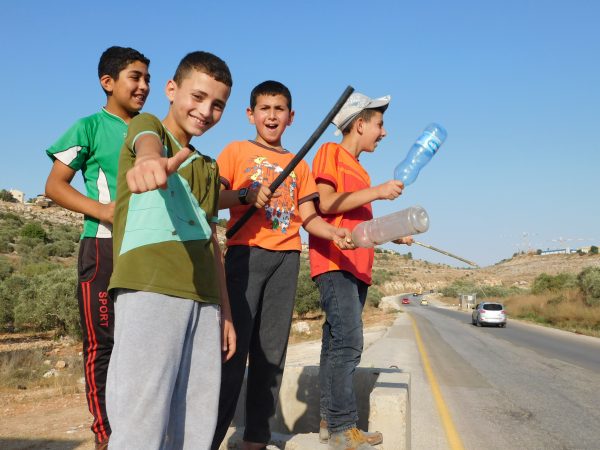
A few times over the past weeks, the municipalities of Qarawah, Satra and Biddya have called for popular protests, gathering at the meter access point for their shared pipe. Small groups of children and young men beat empty water bottles with sticks and shouted “Bidna may, bidna may” – “we want water” – at passing cars. Regardless, many in the three towns are afraid of a backlash from the protests. Shortly after the protests, armed Israeli soldiers arrived at the meter, demanding that the organizers cancel, or face repercussions. While it’s unclear what sort of consequences might be imposed, some worry that the water might be cut off completely as an act of collective punishment.
“Bidna may” – we want water protest
With no solution in sight, the villagers of Qarawah are finding ways to mitigate the effects of living under water apartheid. Villagers are using bottled water for drinking and showers, and hauling water up from local springs, located 4-6 kilometres outside the village limits, to use in toilets and irrigation. The springs also provide a small amount of potable water. However, this is not nearly enough to meet the village’s needs. Some houses in the village also have private wells; but with the summer stretching ahead, these limited resources are sure to be depleted far too soon. So until Mekorot is disbanded, or agrees to give equal service to Palestinians, the people of Qarawah will continue to suffer.
Facebook, in present-day Israel, has hired Jordana Cutler as its head of Policy and Communications. Cutler is a longtime senior advisor to Israeli Prime Minister Benjamin Netanyahu and chief of staff to Israeli Ambassador Ron Dermer.
According to the Alternative Information Center in Beit Sahour, Israeli Public Security, Strategic Affairs and Information Minister Gilad Erdan congratulated Cutler on her appointment, last week, at the Hezliya conference, an Israeli security and national policy meeting.
“There has been an advance in dialogue between the State of Israel and Facebook,” he acknowledged. He added, “Facebook realizes that it has a responsibility to monitor its platform and remove content. I hope it will be regulated for good.”
Cutler’s appointment indicates a burgeoning partnership between the Israeli government and Facebook. Considering Israel’s propensity to arrest Palestinians for Facebook posts and its endeavors to silence the Boycott, Divestment, and Sanctions (BDS) movement, such collaboration is cause for concern.
Since the popular uprising started in October 2015, Israel has arrested at least 150 Palestinians over Facebook posts it labeled as “incitement.”
The Israeli government allocated $26 million for 2016 to launch cyber warfare to “dismantle the infrastructure” of the BDS movement. The BDS National Committee surmises that Israel is be behind cyber attacks meant to shut down its website.
One of the most celebrated qualities of the people of Gaza is their sumoud, their steadfastness and capacity to endure the woes inflicted by Israeli terror. Media coverage of the tiny strip is full of soppy stories about how, regardless of the number of times Israel mows the lawn or casts lead, farmers will always sow their buffer zone farmlands and medics will never cease to improvise with what little they have.
The question is not whether the people of Gaza have given up on their professions and fell to their knees before their occupiers, but the cheap reproduction of them as an extraordinary population who will continue to endure all sufferings imposed on their lives and cling to their cause. What is more disturbing is that foreign journalists on the ground often steer the conversation to get the answers they are looking for. The people of Gaza have memorised the right answer: No matter what, we will never leave.
The truth, however, is that the “people of Gaza” are for the most part sick of this framing and, in fact, a considerable number of them are leaving. In September 2014, nearly five hundred Palestinians from Gaza drowned in the Mediterranean as they attempted to reach Europe. To risk one’s life with smugglers and brave seas in pursuit of a better life elsewhere should tell us something about people’s limited capacity to endure inhumane conditions as well as the limited truth of the sumoud narrative. This is not to say that people are abandoning their struggle for justice and their liberation ideals; many join activist groups or dedicate years of research to them. However, it is time to step back a little and reassess the sumoud narrative; it is perhaps time to understand Gaza and its people on their own terms. To do so, one should look critically at blanket narratives and long-held assumptions, as well as changes that have occurred to established concepts.
There are, to my mind, two primary dangers in trumpeting this narrative of sumoud. The first lies in transforming an ordinary population into mythical creatures able to overcome the most excruciating of circumstances. This transformation places a high, and utterly unjustified, expectation on Gaza’s Palestinians to endure Israel’s relentless aggression and to hold on to the land regardless of the level of destruction implemented. This expectation winds up minimising the power and consequences of Israel’s occupation because, no matter how filthy and bloody it becomes, the Palestinians are predisposed to endure.
For Palestinians on visas abroad, questions on whether they plan to go back to Gaza at the end of their studies are often posed by -without generalising- some Palestine supporters. To be sure, what motivates the question is a principled concern for the liberation of the land. Leaving Palestine, they would say, is exactly what Israel wants. This objection is often, and understandably, voiced by exiled Palestinians and their younger descendants. It is understandable because their varied experiences of Palestine are defined less by daily reality and more by the vision of what Palestine was and will be again. The present certainly plays a role but actual daily experience makes a lot of difference. Questions of this sort, nevertheless, place a lot of pressure on those in Gaza who already have so much to deal with or live abroad under the threat of deportation. What I am calling for is a more comprehensive understanding of the conditions in Gaza and a re-examination of what sumoud means in contemporary reality.
The second danger is that the sumoud narrative paints steadfastness as a choice rather than a forced reality. Palestinians in Gaza are not given the choice between enduring Israel’s aggression and seeking opportunities elsewhere. Palestinians, at least in part, continue to plough, sow, dig tunnels, and improvise because there is no other option. Simply put, Palestinians endure because they have to, not because they choose to. It is perhaps more worthwhile to write stories on the disgraceful visa processes and mistreatment and degradation of Palestinian asylum seekers than pretend as though we have chosen to suffer and, therefore, to endure. As though we are naïve enough to allow ourselves to hope when no signs of improvement can be glanced anywhere.
The Palestinian governments in the West Bank and Gaza have taken this narrative of a mythical people to heart. Each feels it necessary to act as if the Palestinians are not only doing fine under their dysfunctional governments but are flourishing too. Mahmoud Abbas, for example, is still “state building” and constructing mythical cities such as Rawabi when hardly any land is left. The obscene complicity of both governments, together with the collective efforts of Israel, Egypt, and Jordan, have made it impossible for Palestinians trapped in Gaza to leave and, consequently, they are forced endure.
HEBRON – Human Rights Defenders (HRD) in Palestine released a video last week showing an Israeli soldier kicking a knife toward the body of Abd al-Fattah al-Sharif — who was shot point-blank in the head by an Israeli soldier in March — an action the group said represents a clear violation of international law.
The video shows an Israeli soldier casually kicking a knife — allegedly used by al-Sharif during an attempted stabbing attack — to the other side of the road in the town of Tel Rumeida in the southern occupied West Bank district of Hebron, as al-Sharif’s body lay a few meters away.
The footage was taken before al-Sharif was shot execution-style in the head by an Israeli soldier, a graphic video of which was released in March, leading to widespread condemnation by rights groups and the UN demanding an investigation into the apparent “extrajudicial execution.”
Badi Dweik, an activist from HRD, said in a statement released Saturday that the group decided to make the video public in order to challenge current narratives unfolding at the ongoing military trial of Elor Azaria — the Israeli soldier charged with manslaughter after killing al-Sharif. Azaria has claimed that he shot the immobilized Palestinian because he saw al-Sharif reaching for the knife, or feared he had explosives strapped to his chest.
An additional video surfaced at the start of June, showing an Israeli ambulance driver kicking the same knife near to al-Sharif’s body after he was killed.
The video footage, obtained by Israel’s Channel Two, was expected to be shown to an Israeli military court to disprove claims by the Israeli soldier who killed al-Sharif that he shot the young Palestinian point-blank in the head after al-Sharif moved to grab a knife, according to the Israeli media outlet Ynet.
The footage shows that the knife allegedly used in the attack was far from al-Sharif when he was shot, notably showing an ambulance driving over the knife before it was kicked closer to al-Sharif’s body.The Israeli military prosecutor reportedly said that an Israeli ambulance driver, Ofer Ohanna, who was near the scene kicked the knife towards al-Sharif’s body following his murder, according to Hebrew-language news outlet Maariv.
The new video that has surfaced reveals that the ambulance driver was not the only one to tamper with evidence at the crime scene, but that an Israeli soldier also manipulated a piece of key evidence by moving the knife, which Dweik emphasized was a violation of international law. Al-Sharif was shot alongside Ramzi Aziz al-Qasrawi after the two Palestinians allegedly stabbed and moderately wounded an Israeli soldier at a military checkpoint in the Tel Rumeida area of Hebron on March 24.Although it was widely believed that Al-Qasrawi was killed immediately, new witness accounts documented by Israeli human rights group B’Tselem have since emerged that “raise concerns that al-Qasrawi was also executed with a shot to the head, as he lay injured on the ground after having been hit by gunfire elsewhere in his body.”
Al-Sharif, meanwhile, was left severely wounded for several minutes without treatment, before Azaria stepped forward and put a bullet through his head, killing him.Azaria was charged with manslaughter, rather than murder as had initially been expected, and is being held on a military base in “open detention” where he is free to roam and has received visits from his family. His trial opened in early May.
Palestinians have long held fears that Israeli soldiers and settlers tamper with crime scenes involving Palestinians, with human rights groups accusing Israel of practicing a policy of extrajudicial executions since a wave of violence erupted in October, leaving more than 200 Palestinians and some 30 Israelis killed.
A group of employees working with international organisations active in the Gaza Strip have been found to be carrying out activities against the resistance, security website Al-Majd reported yesterday.
Security sources told the Hamas owned website that the group was found to be carrying out doubtful activities related to work sites for the Palestinian resistance.
Later on, the workers of international aid organisations were questioned and they recognised that they are connected to international intelligence services.
The foreigners recognised that they were asked to record footage of resistance work sites such as tunnels, military bases and other sensitive places, in addition to monitoring military movements in Gaza.
The security source reiterated that these collaborators used their work with the international aid organisations to cover-up their anti-resistance acts.
At the same time, they recognised that they are run by international intelligence services connected with the Israeli occupation.
By Ali Salaam | American Herald Tribune | July 31, 2017
The New York Times, owned by the Zionist Jewish supremacist Ochs-Sulzberger family, has no problem with Iraqi suffering as long as Iran is not the one behind it.
The Iraq War was a genocide of the Iraqi people by Zionist supremacists in the Bush administration. Over 1 million innocent people were killed based on a lie. American soldiers died in an Israeli war and now an average of 22 soldiers commit suicide every day because their consciences cannot cope with the fact they committed crimes in an illegal war that served no purpose other than to benefit Israel, not America.
Benjamin Netanyahu, Prime Minister of the Zionist regime, once said “We are benefiting from one thing, and that is the attack on the Twin Towers and Pentagon, and the American struggle in Iraq.”
Paul Wolfowitz had his sights on Iraq since his time in the first Bush administration. Former Israeli official and Bush administration official Richard Perle had his eyes on Iraq since at least his authorship of the Clean Break white paper. The Zionist regime had their eyes on Iraq since the 1980s when strategist Oded Yinon wrote his white paper in support of dividing the Arab-Muslim world along ethnic and sectarian lines. The global Zionist lobby has had their eyes on Iraq since Theodor Herzl stated that Eretz Israel’s true borders go from the Nile River in Egypt to the Euphrates River in Iraq. … continue
This site is provided as a research and reference tool. Although we make every reasonable effort to ensure that the information and data provided at this site are useful, accurate, and current, we cannot guarantee that the information and data provided here will be error-free. By using this site, you assume all responsibility for and risk arising from your use of and reliance upon the contents of this site.
This site and the information available through it do not, and are not intended to constitute legal advice. Should you require legal advice, you should consult your own attorney.
Nothing within this site or linked to by this site constitutes investment advice or medical advice.
Materials accessible from or added to this site by third parties, such as comments posted, are strictly the responsibility of the third party who added such materials or made them accessible and we neither endorse nor undertake to control, monitor, edit or assume responsibility for any such third-party material.
The posting of stories, commentaries, reports, documents and links (embedded or otherwise) on this site does not in any way, shape or form, implied or otherwise, necessarily express or suggest endorsement or support of any of such posted material or parts therein.
The word “alleged” is deemed to occur before the word “fraud.” Since the rule of law still applies. To peasants, at least.
Fair Use
This site contains copyrighted material the use of which has not always been specifically authorized by the copyright owner. We are making such material available in our efforts to advance understanding of environmental, political, human rights, economic, democracy, scientific, and social justice issues, etc. We believe this constitutes a ‘fair use’ of any such copyrighted material as provided for in section 107 of the US Copyright Law. In accordance with Title 17 U.S.C. Section 107, the material on this site is distributed without profit to those who have expressed a prior interest in receiving the included information for research and educational purposes. For more info go to: http://www.law.cornell.edu/uscode/17/107.shtml. If you wish to use copyrighted material from this site for purposes of your own that go beyond ‘fair use’, you must obtain permission from the copyright owner.
DMCA Contact
This is information for anyone that wishes to challenge our “fair use” of copyrighted material.
If you are a legal copyright holder or a designated agent for such and you believe that content residing on or accessible through our website infringes a copyright and falls outside the boundaries of “Fair Use”, please send a notice of infringement by contacting atheonews@gmail.com.
We will respond and take necessary action immediately.
If notice is given of an alleged copyright violation we will act expeditiously to remove or disable access to the material(s) in question.
All 3rd party material posted on this website is copyright the respective owners / authors. Aletho News makes no claim of copyright on such material.