Double standards, one rule for all – except Palestinians
International Solidarity Movement | September 27, 2015
Nabi Saleh, occupied Palestine – On the 28th of August, Mahmoud Tamimi was arrested in Nabi Saleh during the weekly non violent demonstration. Every Friday, just after the prayer, the residents demonstrate against the expansion of the illegal settlement of Halamish which has continuously confiscated Palestinian land as well as the only water source of the village: ‘Ain al-Qaws.
During the Friday march towards the expropriated lands the residents were stopped by Israeli forces using excessive brutality, shooting tear gas, rubber coated steel bullets, live ammunition and sound grenades against civilians. Additionally, demonstrators are often arrested and beaten up.
On the 28th of August, in the course of the demonstration I, as a foreigner, was arrested by Israeli forces together with the 19-year old Palestinian Mahmoud Tamimi.
Both of us have been brutally beaten by the soldiers with punches, kicks and the butts of their guns. Both of us were arrested and secluded for 6 hours, kept blindfolded and handcuffed in a small room in a military base.
Afterwards, we were taken to the police station based in the illegal settlement of Ben Yamin and, at that point, our paths were divided: he was brought to the military prison of Ofer and I was brought to “Ramle” near Tel Aviv.
Within a few days, my predicament was positively solved: I was acquitted from the charges of throwing stones and other objects, and returned to be a free citizen. Regarding Mahmoud, although the charges were exactly the same, because he’s Palestinian, the situation is completely different: in fact Mahmoud is still under arrest in Ofer military prison and is waiting to attend his first hearing, to be held on the 28th of October, that is 60 days after his arrest. In my case, the first hearing took place the day after my arrest.
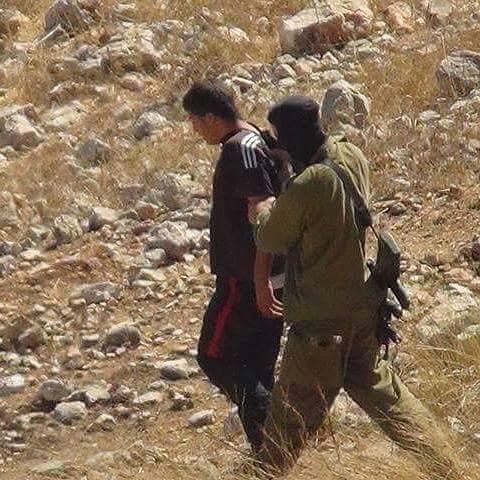
Israeli soldier arresting Mahmoud
Mahmoud is now under threat of a penalty of a minimum of 7 months which, under the practice of military law and consequently administrative detention used on the Palestinians of the West Bank, this sentence can be arbitrarily renewed for additional 6 month periods of imprisonment.
The absolute asymmetry of treatment endured by me and Mahmoud is a blatant demonstration of the discriminatory laws applied by Israel for over 40 years towards the Palestinians. According to the International law, the application of military laws in occupied territories is completely illegitimate.

Israeli soldiers use brutal force on Mahmoud
Mahmoud will be accused by military personnel covering the role of persecutors and will be judged by some other military personnel covering also the role of judges. He doesn’t have the right to be tried in front of a civilian court, although Mahmoud is a civilian – and not a soldier. All of this because he’s a Palestinian.
Even if the evidence does not indicate his guilt, just the fact that he’s in a military court with both the prosecutor and the judge from the military, will most likely result in a guilty verdict. The procedures in military court are not about establishing the truth, the possibility of establishing a defense is extremely slim, justice simply isn’t done in a military court. It’s about punishment, punishment to weaken the Palestinian resistance to an illegal occupation, even if this resistance is non-violent.

Mahmoud in court
Within this system, it must be said, settlers from illegal settlements in the West Bank are judged in front of civilian courts, not military courts – just because they have a different status: they are not Palestinians.
In my case, hard evidence would be required to bring charges against me, for Mahmoud in contrast, as a Palestinian, no evidence is required at all. All the trial is only based on the statement of 18-year old soldiers.
Of course, when an international is unjustly beaten and arrested the media reacts with utter disapproval attracting the medias’ attention and causing the civil society’s indignation. When it’s a Palestinian receiving the exact same treatment, however, the reaction is quite different. Mahmoud‘s case seems to be totally forgotten. Currently he is still rotting in a prison cell in Ofer military prison, while being entirely ignored by the media and the international community.
Mahmoud Tamimi is only 19 years old, he has 2 brothers and a sister. His uncle is Rushdie Tamimi, one of Nabi Saleh’s martyrs killed by the Israeli forces 3 years ago on the 19th of November. He died following an intense shooting during which he was inured in the thigh and the stomach. Rushdie is already the second martyr in a village which counts only 500 inhabitants. Considering the dimension of the village, they are indeed suffering from significant losses. However, we must keep in mind that in the Occupied Palestinian Territories the violence and the killings are daily and are perceived by the so called civilized world as casualties of a 60 year old conflict.
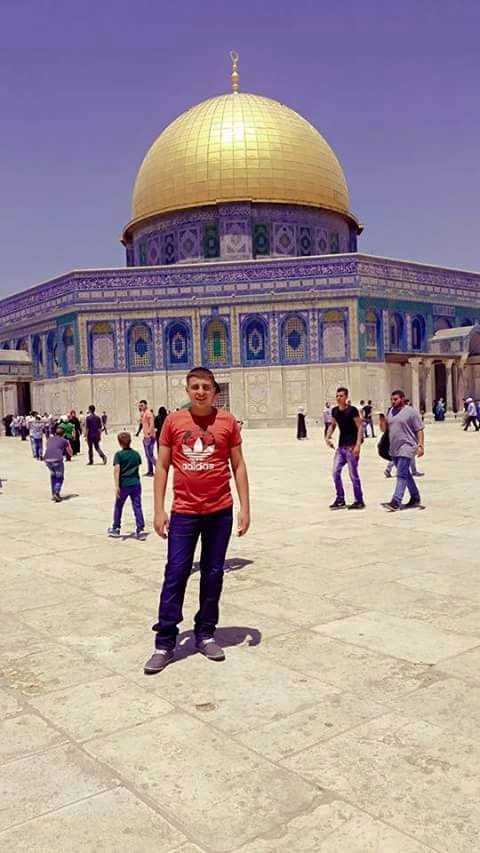
Mahmoud at al-Aqsa mosque
Let’s take a stand and spread Mahmoud’s story, let’s not forget him. We should show the world that the treatment a Palestinian youth receives – and thus the live of a Palestinian – is not less worth reporting about in the media and has to receive as much attention and result in an outcry as that of an Italian citizen. Let this not be about the rare case of an international being maltreated by Israeli forces, but about the every-day harassment, violence, illegal detentions and arrests of Palestinians.
Israeli occupation forces injure 3 with live fire near Bethlehem
Ma’an – September 26, 2015
BETHLEHEM – Three Palestinian youth were injured by live Israeli fire during clashes that erupted in the town of Tuqu in southeastern Bethlehem on Friday.
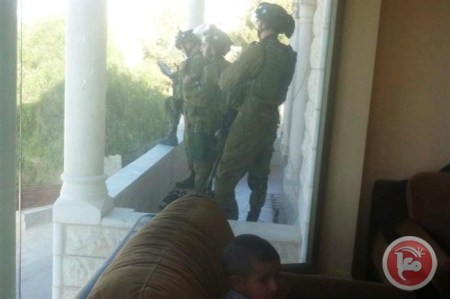
Locals told Ma’an that Israeli military forces arrived to the town and were deployed onto the rooftops of resident’s homes, targeting youth with bullets and tear-gas.
Clashes had erupted between the youth and Israeli forces around the town’s municipality building when Israeli soldiers fired live ammunition and rubber-coated steel bullets, injuring the three youth in the legs with live fire, locals said.
The youth received aid at the town’s medical clinic before being taken to the Beit Jala Governmental Hospital by Palestinian Red Crescent ambulances.
Their injuries were reported as moderate.
An Israeli army spokesperson told Ma’an that clashes with the forces began after “about 30 rioters” started throwing rocks near the main road outside the town.
The clashes then moved inside of the town and Israeli forces responded to the youth throwing rocks with “riot dispersal means,” the spokesperson said.
 When “rioters refused to respond,” the forces fired .22 caliber rounds and confirmed three hits, the spokesperson added.
The spokesperson had no reports of Israeli soldiers entering private homes and deploying on rooftops.
Earlier Friday, the chief of police in the Nablus district and his three-year-old daughter were injured after being shot by Israeli forces with rubber-coated bullets during a raid in the village of Kafr Qaddum in Qalqiliya.
A weekly average of 39 Palestinians have been injured by Israeli forces since the start of 2015. The majority of injuries sustained by Palestinians occur during unarmed demonstrations.
Rights organizations have argued that methods of crowd control used by Israeli forces often result in excessive and sometimes fatal use of force.
Unprovoked, Israeli Soldiers Attack AFP Journalists in West Bank
Sputnik – 26.09.2015
While covering a demonstration in the West Bank, two journalists with Agence France-Presse were attacked by Israeli soldiers, who then proceeded to destroy their equipment.
Andrea Bernardi and Abbas Momani were near the village of Beit Furik on Friday. On assignment for AFP, the two journalists were reporting on a protest that followed the funeral of a Palestinian man shot by Israeli security forces.
In covering the events, Bernardi and Momani were themselves attacked by Israeli soldiers.
“They had passed the first checkpoint of the border police with their press cards without problem,” AFP bureau chief Thomas Cox told the Guardian. “Andrea paused to check his camera setting and as he was doing so a soldier immediately arrived and told him to stop filming and pushed his camera.”
“He then took the camera and smashed it.”
Video of the incident shows the journalists walking away, only to be chased down by another soldier who destroys more of the pair’s equipment.
According to Cox, Bernardi later went back to recover his camera, and things escalated from there.
“At this point a soldier jumped on him and put a pistol on his face and attacked him.”
“It was crazy,” Bernardi told the Guardian. “When we arrived at the border police checkpoint we showed our documents. There was no problem. They were being nice.”
“We passed the first line of soldiers loading teargas. I heard screaming and a soldier started pushing and shouting ‘what the f*ck are you doing’ in English. I then [realized] he was loading this gun and I thought ‘what the…’ and we started walking back.”
Bernardi notes that if either he or Momani had been guilty of some crime that they would have been arrested, but that never happened.
“After we got back to the car I saw a piece of the camera and wanted to take a picture of it because I was worried they would accuse me of doing something wrong,” he said. “That’s when a soldier pointed a pistol in my face and pulled me down.”
AFP has announced its intention to file a formal complaint. … Full article
Once again, Israeli forces prevent Palestinians’ freedom of religion
International Solidarity Movement | September 25, 2015
Hebron, occupied Palestine – Today, Israeli forces stopped, searched and harassed Palestinians on their way to Ibrahimi mosque and in the vicinity on the second day of the Muslim holiday of Eid al-Adha for Friday prayers in Al-Khalil (Hebron).
Crowds of worshippers were flocking to the mosque around noon. Before being allowed into the mosque they have to pass through metal detectors manned with Israeli forces. Even though the majority of the people passed from the Palestinian market and through a checkpoint already, only a few meters afterwards they are forced to pass through yet another checkpoint. Small children, boys and girls clung to the hands of their parents when passing through the checkpoint.
In total, 27 young adults were stopped and ID-checked on their way to Friday prayer, and forced to leave their ID with the Israeli forces before being allowed to enter into the mosque. Another two were detained for about fifteen minutes before finally being allowed to pass. All IDs had to be collected at the end of the prayer from the same soldier, delaying Palestinians on their way back home for yet another five to ten minutes during which soldiers where trying to find the right ID for each person.
Five teenagers were bluntly refused access to the mosque, denying them their right to exercise their religion. Whereas three of the boys left, two of them after being yelled at and pushed by an Israeli soldiers; two other teenagers were forced to perform their Friday prayer outside the mosque in the street.
One man, just passing on the street next to the checkpoint, talking to a friend entering to the mosque, was confronted by soldiers. One soldier ran towards him from the checkpoint, demanding him to stop and questioning him about the content of his bag. The man was forced to immediately open his bag, containing meat for lunch with his family, all while soldiers were shouting at him. They then forced him to pull up his shirt and trousers. Bystanders were watching anxiously, as only three days ago, the murder of 18-year old Hadeel Saleh Hashlamoun at another checkpoint in Al-Khalil shocked the community.
During the Jewish holidays this past month, many restrictions have been imposed on Palestinians living close to the Ibrahimi mosque. On several days, the checkpoint leading to the mosque was kept completely closed the whole day, denying entry to Palestinians and preventing them from free movement. With the Jewish holiday of Sukkot starting this Sunday, many more restrictions on Palestinian movement are expected.
Nablus police chief, 3-year-old daughter injured by Israeli fire
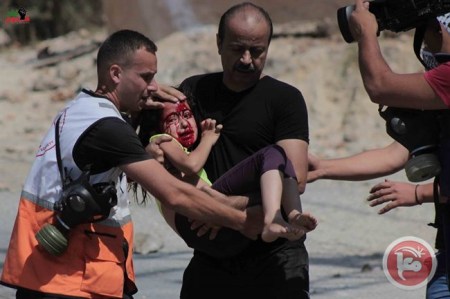
Three-year-old Maram Abed al-Latif al-Qaddumi was shot in the head by Israeli forces with a rubber bullet in the occupied West Bank town of Kafr Qaddum.
(MaanImages/Murad Ishteiwi)
Ma’an – September 25, 2015
NABLUS – The chief of police in the Nablus district and his three-year-old daughter were injured after being shot by Israeli forces with rubber-coated bullets on Friday during a raid in the village of Kafr Qaddum in Qalqiliya.
A Fatah leader in Kafr Qaddum, Murad Ishteiwi, told Ma’an that Israeli forces directly shot at three-year-old Maram Abed al-Latif al-Qaddumi, injuring her with a rubber-coated steel bullet in the head while she was standing on a balcony in her home.
Isheiwi added that when her father, Colonel Abd al-Latif al-Qaddumi, attempted to aid her and take her to the hospital in his car, Israeli forces opened fire, injuring him in the head.
They were both taken to the Rafidia Governmental Hospital in Nablus where their injuries were reported as moderate. Both are currently in a stable condition.
Ishteiwi said that Israeli forces had raided the area and set up several ambushes inside of the town in an attempt to prevent the weekly Kafr Qaddum march.
An Israeli army spokesperson didn’t have any immediate information but told Ma’an they were looking into the incident.
On Sept. 11, Israeli military forces raided the house of al-Qaddumi, and turned his home into a military outpost after evicting his wife and children.
Days earlier, Israeli forces held al-Qaddumi for more than an hour near the entrance of Hijja village west of Nablus.
Last week Israeli forces shot and injured a 14-year-old with live fire in Kafr Qaddum during a demonstration.
An Israeli army spokesperson told Ma’an that there was a “riot” in Kafr Qaddum, where protesters threw rocks and rolled burning tires at Israeli forces, who opened fire “using .22 caliber rounds towards the extremities of the main instigator and a hit was confirmed.”
A weekly average of 39 Palestinians have been injured by Israeli forces since the start of 2015. The majority of injuries sustained by Palestinians occur during unarmed demonstrations.
Rights organizations have argued that methods of crowd control used by Israeli forces often result in excessive, and sometimes fatal, use of force.
Residents of Kafr Qaddum carry out weekly demonstrations in protest of the now 13-year closure of the main street out of the village, which leads to nearby Nablus — the area’s economic hub.
Kafr Qaddum has also lost large swathes of its land to Israeli settlements, outposts and the separation wall, all illegal under international law.
Two-thirds of Palestinians support Abbas departure
MEMO | September 23, 2015
An opinion poll has suggested that two-thirds of Palestinians believe that Palestinian Authority President Mahmoud Abbas should resign. They also think that his resignation from the PLO Executive Committee is not “real”.
The Palestinian Centre for Policy and Survey Research released the results of a poll on Monday that it conducted in the occupied West Bank and Gaza Strip between 17 and 19 September. The results show that the popularity of President Abbas has declined “significantly” in the occupied West Bank and has improved “slightly” in the Gaza Strip. Fatah’s popularity has declined in both the West Bank and the Gaza Strip.
The results revealed an increase in Hamas popularity in the occupied West Bank and a significant decrease in the Gaza Strip. The popularity of the deputy leader of the Islamic movement, Ismail Haniyeh, has improved in the West Bank but fallen slightly in Gaza.
“If Abbas does not participate in the next presidential elections,” said the research NGO, “the only viable candidates from Fatah to replace him are Marwan Barghouti followed, but with much less support, by Mohammad Dahlan and Saeb Erekat.” Among Hamas candidates, it added, Ismail Haniyeh and Khaled Meshaal are the most popular to replace Abbas, while among the independents the most popular is Rami Al-Hamdallah followed by Salam Fayyad.
“Two-thirds of the public support Hamas-Israel indirect negotiations about a long term Hudna, or truce, in return for ending the siege of the Gaza Strip. But a majority believes that these negotiations will not succeed. A majority rejects the belief that such negotiations, even if they succeed, would harm the chances for reconciliation.”
The results also reveal that the Palestinian public does not view the PLO or its Executive Committee positively and declines to give it a mandate to make important decisions on behalf of all Palestinians. Instead, the public prefers to give such a mandate to the PA, even if the decisions in question relate to the permanent agreement with Israel. “This, though, does not mean that the public has considerable trust in the PA,” said the centre. “On the contrary, a majority believes that it has become a burden on the Palestinian people and, for the first time since we started asking, a majority now demands the PA’s dissolution.”
Results also show that two-thirds of the public believe that the protection of Palestinians against settler terrorism is the responsibility of the PA, not the Israeli army. “Furthermore, two-thirds believe that the PA is not doing enough to protect Palestinian citizens. To protect Palestinian towns and villages targeted by settlers, the largest percentage has selected, from among several options, the deployment of the Palestinian security forces in those areas. The public believes that if the PA formally establishes civil guard units made up of volunteers in such areas, it would also help to provide protection. Indeed, half of West Bankers say that if such unarmed units were established, they would volunteer to join them.”
The survey was conducted on a random sample of 1,270 people in 127 locations in the West Bank and Gaza Strip.
Where Will It End? More Israeli Murders
By Stephen Lendman | September 22, 2015
Israel intends imprisoning Palestinian youths and children up to 20 years for stone-throwing. Nonviolent protesters are brutally attacked. Soldiers routinely murder Palestinians unaccountably.
Police now may use live fire indiscriminately, justifying it by inventing pretexts. Settlers commit near-daily violence and/or vandalism with impunity. Investigations when conducted are whitewashed.
Zionist zealots responsible for immolating Dawabsha family members are free to kill again – even though Israeli authorities identified them. Arrests didn’t follow.
On Tuesday, a Palestinian youth named Dia’ Abdul-Halim died – or was he killed? Israeli government officials notoriously lie. So do police and military sources.
The IDF claims the youth was killed trying to throw a grenade, claiming it detonated first. Judge for yourself if true or false. How often do civilians die from grenade explosions? Rare lightning strikes are more common. Palestinian medical sources said he was shot to death.
Soldiers prevented Palestinian Red Crescent medical workers from reaching the scene to help. What did they have to hide?
 On September 22, Israeli forces murdered Palestinian teenager Hadeel al-Hashlamon – shooting her three times in the chest, abdomen and lower body, claiming they foiled a stabbing attack.
Photos released proved otherwise. Soldiers confronted the unarmed woman belligerently, aiming their weapons at her. She turned to walk away and was murdered in cold blood.
An Israeli army spokeswoman lied, claiming “(t)he attacker attempted to stab a soldier.” Live fire aimed at her “lower extremists.” Soldiers shot to kill. None were harmed. No knife was found.
Palestinian PalMedia news agency video showed her left bleeding to death for around 30 minutes before help arrived. Soldiers and heavily armed settlers did nothing to save her.
She’s the 28th Palestinian murdered by Israeli security forces or settlers this year – unaccountably. No prosecutions followed.
Hadeel was taken to Shaare Zedek medical center too late to save her. These incidents happened after Israel mobilized hundreds of police reservists and extra numbers of soldiers in flashpoint areas.
A 2014 Amnesty International report called Israeli forces “trigger happy.” Excessive force is standard practice. Children are abused as violently as adults.
So are international solidarity activists and journalists. Anyone supporting long-suffering Palestinians is vulnerable.
In June through August 2014, over 1,000 West Bank Palestinians were arrested, nearly 600 injured, around two-thirds from live fire. During the same period, Israeli forces murdered 10 others.
Heavy security was deployed ahead of the Yom Kippur atonement period – beginning sundown on September 22, ending 24 hours later.
Vicious Israeli authorities have much to atone for – decades of brutality against defenseless Palestinians, accountability nowhere in sight, nor an end to occupation harshness.
Stephen Lendman can be reached at lendmanstephen@sbcglobal.net.
His new book as editor and contributor is titled “Flashpoint in Ukraine: US Drive for Hegemony Risks WW III.”
How The NY Times Hides the Scandal of US-Israeli War Crimes
By Barbara Erickson | TimesWarp | September 21, 2015
The United States sends at least $3.1 billion in military aid grants to Israel every year, more than the amount given to all the rest of the world combined, and although Americans oppose this excess, their opinion has had no effect: Officials are now in talks to raise the yearly amount by as much as 50 percent.
If you missed that news in The New York Times, there is no reason for surprise. The issue has essentially remained out of sight, glossed over in a smattering of news stories, where readers find murky references to US aid and no enlightening details.
Thus we have a story by Jodi Rudoren this month, a look at how Israeli Prime Minister Benjamin Netanyahu has made a “pivot” after losing his battle against the nuclear agreement with Iran. Several paragraphs into this piece she writes, “Washington is expected to deliver a huge new military aid package to Israel… to appease Mr. Netanyahu and Democratic supporters of Israel who reluctantly backed the nuclear deal.”
This begs for explanation. How much is “huge”? Why is this “expected”? But nothing more is forthcoming.
Times readers have to look elsewhere for a fuller story. Other sources tell us that Israel has been asking for up to $4.5 billion a year in military aid and that talks have been going on “away from the spotlight.” Observers expect announcement of an aid agreement in November, when Israeli Prime Minister Benjamin Netanyahu visits Washington.
The Times did manage to work in the $4.5 billion price tag, in the last paragraph of a story that ran in July. The US has guaranteed Israel $31 billion in military aid grants over 10 years ending in 2017, and Israel now wants a new deal guaranteeing up to $45 billion over another 10 years. The article states that officials will frame the deal that finally emerges as an effort to bolster Israel’s defenses in the face of a resurgent Iran. Thus they will try to defuse the charge that the new deal is a way of “appeasing” Israel.
Since this story appeared, the Times has avoided the subject, except for Rudoren’s reference to a “huge” new package, and brief comments elsewhere about “compensation” for defying Israel on the Iran nuclear deal.
US aid to Israel is a subject that the Times would like to avoid. On many fronts it is difficult to defend and shines a harsh light on the actions of both the US and Israeli governments. For instance:
- Congress has been willing to maintain and even increase military aid to Israel even as it cuts programs for education, food assistance and tax relief for working families in the United States.
- Israel receives US aid even though it is one of the most economically advanced countries in the world.
- US military aid makes up a full 20 percent of the Israeli military budget.
- Israel, a small country, is so well supplied with arms that it is the tenth largest purveyor of weaponry in the world. In other words, Israel receives military aid from the US, and then makes money by selling arms to other nations.
- US aid to Israel amounts to $10.2 million per day or $450 per year for each Israeli citizen.
- Israel receives special perks that other aid recipients are denied, such as the right to use some of the funds to buy weapons from Israeli manufacturers instead of being required to purchase American products.
- Israel spends more on military expenditures than any other country in the world, based on percentage of gross domestic product.
- The annual U.S. military aid package for Palestine is $0.00.
- In addition to the $3.1 billion in direct military aid guaranteed each year, Israel receives other gifts, such as economic grants and immigration assistance, raising the total aid well beyond the stated amount. (Vice President Joe Biden recently cited $7.18 billion for a one-year package.)
- Sixty percent of Americans polled in a survey said the United States “gives too much aid to Israel.”
In addition, human rights organizations and other observers have raised ethical concerns over supplying arms to Israel in view of its deadly attacks on civilians in the occupied Palestinian territories.
Last year, during the assaults on Gaza that left some 2,200 Palestinians dead, Amnesty International called on the United States to stop transferring arms to Israel, citing “growing evidence of war crimes.” In June of this year, Rep. Betty McCollum (D-MN) asked the State Department to review the legality of military aid to Israel in light of evidence that security forces abuse child prisoners and have killed nonviolent demonstrators.
This past week a coalition of 10 organizations—American Muslims for Palestine, Jewish Voice for Peace, Code Pink, Defense for Children International and others—sent out a petition asking President Obama to stop supplying Israel with arms. In particular the petition targets the 50 percent increase in direct aid from $3.1 to $4.5 billion now under consideration.
Within days, by Sept. 21, the petition had reached its goal of 50,000 signatures and reset its sights on 60,000.
The Times, however, has had nothing to say about these protests, although they have been reported elsewhere. Rep. McCollum’s letter, which garnered the signatures of 18 additional members of Congress, was featured in US and Israeli media but found no mention in the Times.
The subject of military aid to Israel demands a fuller treatment in the Times. Readers should know the actual cost to U.S. taxpayers; they should be told of ethical concerns raised by organizations and officials; they are entitled to know more about the lethal effects of Israel’s weaponry; they should find Times analysts willing to discuss the contrast between congressional largess for Israel and the efforts to cut domestic programs.
It is not too much to say that US military aid to Israel is scandalous in light of the devastating effects it has had on innocent Palestinians and also on Americans deprived of basic needs. The failure of the Times to address the issue also amounts to scandal, making it fully complicit in this sordid affair.
Brazil president rejects settler leader as Israel envoy
Press TV – September 21, 2015
Brazilian President Dilma Rousseff has reportedly rejected the appointment of a hardliner as Israel’s envoy to her country, saying it could be understood as support for the illegal Israeli settlements.
According to an article published on Israeli website Ynetnews, Rousseff has sent a message to the Tel Aviv regime, expressing her discomfort with the appointment of Dani Dayan, an extremist in charge of running the affairs of Israeli settlements in the occupied West Bank.
The rejection has been part of some covert communications between Brazil and Israel with Rio de Janeiro warning the Tel Aviv regime that it should not go ahead with Dayan’s nomination to the job or mutual relations could seriously be endangered.
Various organizations and individuals have been pressuring Rousseff to reject Dayan due to his background in opposing the rights of Palestinians and his contribution to the illegal settlements in the Occupied West Bank. A petition in August called the appointment “a violation of the international legitimacy and sovereignty of Brazil.”
From 2007 to 2013, Dayan was the chairman of the Yesha Council, the umbrella organization of settlement councils in the Occupied West Bank. He is also a renowned opponent of the so-called two-state solution.
A group of activists submitted a request to the Brazilian government on Monday, demanding the rejection of Dayan as Israel’s ambassador. According to Israeli daily Haaretz, the activists met with Brazilian envoys to the occupied territories as well as Brazil’s envoy to the Occupied West Bank and reiterated that accepting the appointee would help legitimize the settlement enterprise.
Israeli Prime Minister Benjamin Netanyahu announced Dayan’s appointment three weeks ago. Based on diplomatic protocols, once Dayan’s appointment is officially confirmed by Israel, the Brazilian government will be sent a request to endorse the decision.
It is rare for a host country to reject a foreign envoy but if Netanyahu decides to insist on his choice, he could face a formal rejection. Israel has always sought better relations with Brazil as one of the most prosperous economic countries in the world and a major power in South America.
Palestinian teen shot in Hebron by Israeli forces dies from injuries

A photo of the incident shows an Israeli soldier aiming at the woman. (Youth Against Settlements)
Ma’an – September 22, 2015
BETHLEHEM – A Palestinian teenager shot by Israeli forces at a checkpoint in Hebron died from her injuries on Tuesday, Israeli medical sources said.
The teenager, identified as 18-year-old Hadeel al-Hashlamon, was shot three times by Israeli soldiers after allegedly attempting to carry out a stabbing attack, Israel’s army said.
A spokesperson for the Shaare Zedek Medical Center where she was taken for treatment said the teenager was “terribly injured, and underwent surgery upon her arrival.”
She later died from her injuries, the spokesperson confirmed.
No Israeli soldiers were injured during the incident, and the Israeli army did not release photographs of a knife, as they have done on several other recent occasions.
The army spokeswoman said that the attack had been “thwarted.”
A local activist group Youth Against Settlements later released what it said were photos of the incident, appearing to show Israeli soldiers aiming their weapons at the woman, as first she faced them and afterward turned away from them.
Another photo appeared to show the woman slumped on the street, after she was shot and wounded.
Video footage from Palestinian news agency PalMedia showed al-Hashlamon left bleeding on the pavement, reportedly for up to 30 minutes before she received treatment.
The footage shows the woman being dragged out of camera frame, while soldiers and heavily armed settlers look on.
Al-Hashlamon’s death marks at least 25 Palestinians killed by Israeli forces since the start of 2015, according to UN documentation, not including Palestinian deaths caused by Israeli settlers.
Al-Hashlamon’s father, the head of the Anesthesia Department of the Al-Ahli Hospital in Hebron, and its former General Director, Dr. Salaheddin Hashlamoun, said his daughter is a first-year student at the Hebron University.
Featured Video
The Search for Truth: Charlie Kirk’s Assassination One Year Later
or go to
Aletho News Archives – Video-Images
From the Archives
The 9/11 “Double-Cross” Conspiracy Theory
BY LAURENT GUYÉNOT • UNZ REVIEW • SEPTEMBER 6, 2022
Is it true that “9/11 was an inside job”? Yes, insofar as Israel is “inside” the U.S. But for the 9/11 truthers who have identified Israel as the main perpetrators, “9/11 was an inside job” is at best a half-truth, and at worst an integral part of the Zionist operation, like a secondary flag sewn as a lining under the false flag of Islamism. Victor Thorn (1963-2017) wrote in his book 9/11 made in Israel: The Plot Against America (2011): “In essence, the ‘9-11 truth movement’ was created prior to Sept. 11, 2001 as a means of suppressing news relating to Israeli complicity. . . . The slogan ‘9-11 was an inside job’ was quite possibly the greatest example of Israeli propaganda ever devised.” In milder terms, it is “controlled opposition”.
A genuine truth movement would have pointed to Israel as the prime suspect from the start. From day one, it was obvious who would benefit. … continue
Blog Roll
 Aletho News
- Europe’s mounting social chaos… chickens coming home to roost for proxy war against Russia
- US-Russia Diesel Deal Becomes Massive Defeat for Ukraine
- Hormuz and the Looming Economic Catastrophe
- Dhubab offensive, media blitz and the rapid unraveling of Saudi-backed coalition’s new gambit
- Putin Conveys to Trump Iran’s Vision on Possible Conflict Resolution – Kremlin
- The Search for Truth: Charlie Kirk’s Assassination One Year Later
- ‘Harsh reality’: Iran says France seeks monopoly on power and intimidation, not peace for all
- When Will This White House Madness End?
- Huckabee aide goes to ‘unusual lengths’ to portray ‘Israel’ positively
- Trump Announces Diesel Supply Deal With Putin Following Phone Call
- If Americans Knew
- Israeli forces kill another child in Gaza – Daily Update
- Gaza ceasefire exists in name only, say more than 100 organizations
- Nearly 2 Million in Gaza Need Urgent Shelter Assistance as Winter Looms: IOM Chief Warns
- Suppressing Palestinian resistance: US charity under fire for AI monitoring of Gaza classrooms
- Thousands Are Held in Israeli Torture Camps. This Is What Happens Inside
- Israel puts Gaza’s sick, injured, newborn in peril – Daily Update
- Report claimed Mark Levin used by Israeli government to influence Trump
- Over 2,000 Gazans have died awaiting medical evacuation amid Israel’s continued siege
- How a U.S. Diplomat Suppressed and Altered Reports Critical of Israel
- 5 Palestinians Die from Israeli Strikes in Gaza as Relentless Attacks Continue
- No Tricks Zone
- New Study: 50 Years Of The Most Aggressive ‘Net Zero’ Policies Can Only Affect The Global Climate By 0.03°C
- US September “Heat” Was No Record…Many Records Set Decades Ago
- Latest European Green Energy Debacle; Portugal’s Largest Flagship Solar Park Insolvent!
- Green Energy Debacle: German Expert Professor Fritz Vahrenholt Warns Of Severe Economic And Social Consequences
- Two More Paleo Reconstructions Affirm Meters-Higher Sea Levels Across Ireland, Brazil 7000-6000 Years Ago
- New Study: Earth And Venus Surface Warmth Largely Explained By Convection And Lapse Rate, Not CO2 Or Radiation
- 2025 Nature Paper Claiming Worsening Global Drought Gets RETRACTED …Heavily Flawed
- New Study: ‘Global Drought Shows No Detectable Recent Acceleration Under Climate Warming’
- Economic Masterminds: German Socialists Suggest Taxing Productivity Gains Stemming From Using AI
- The South China Sea Has Not Been Cooperating With The Climate Change Narrative

