Israel gives Jewish names to Arab streets in Jerusalem
MEMO | September 21, 2015
Israel yesterday approved giving Jewish names from the Torah to Palestinian streets in an attempt to give a Jewish appearance to the holy city, Arabs48 reported.
The municipality changed the name of Jabal Al-Zaytoun, the highest mountain in Jerusalem which overlooks Al-Aqsa Mosque, giving it a name from the Torah Har Ha-mishchah.
In addition, the municipality gave a biblical name to the main street in Silwan; Shir Hamalot. An indication of the changes to come at Al-Aqsa Mosque.
Arabs48 said that the Israeli municipality did not announce the names of the area that the street refers to, but it is clear that it is in the Al-Bustan neighbourhood, the closest neighbourhood to Al-Aqsa.
This measure contradicts international law, which objects to changing the names of occupied places. Subsequently, the Palestinian Authority filed a complaint at UNESCO and the ICC as the occupation has so far changed names of 300 streets and alleyways in Jerusalem.
It is widely believed that such actions are part of Israel’s endeavour to Judaise occupied Jerusalem.
Israeli forces targeting Palestinian children in al-Khalil (Hebron)
International Solidarity Movement | September 20, 2015
Everyday, Palestinian families get attacked by Israeli forces in their own homes. Sometimes they bang on the door in the middle of the night, scaring children and adults, ransacking the house. On some of these raids, both during the night and in daytime, Israeli forces randomly arrest family members and take them to an unknown destination without any reason.
Last night, Israeli forces entered the Palestinian market in the Old City of al-Khalil (Hebron) and entered a Palestinian family home where they kidnapped an 8-year old girl and arrested 3 more young men. All of them were walked towards the military base in Shuhada street, but then kept behind a fence and military gate for more than 15 minutes before being released. No reason was given for the random arrest.
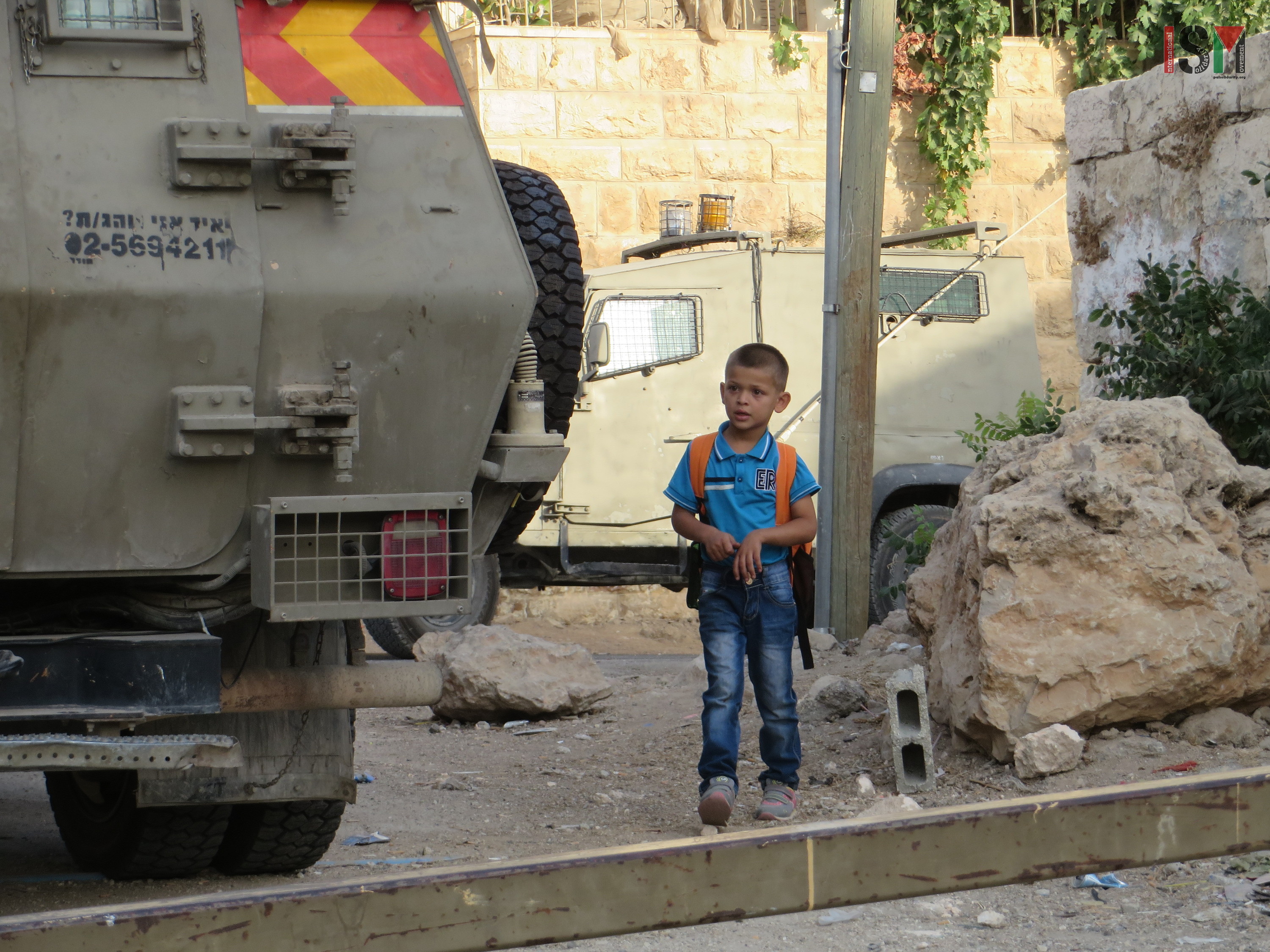
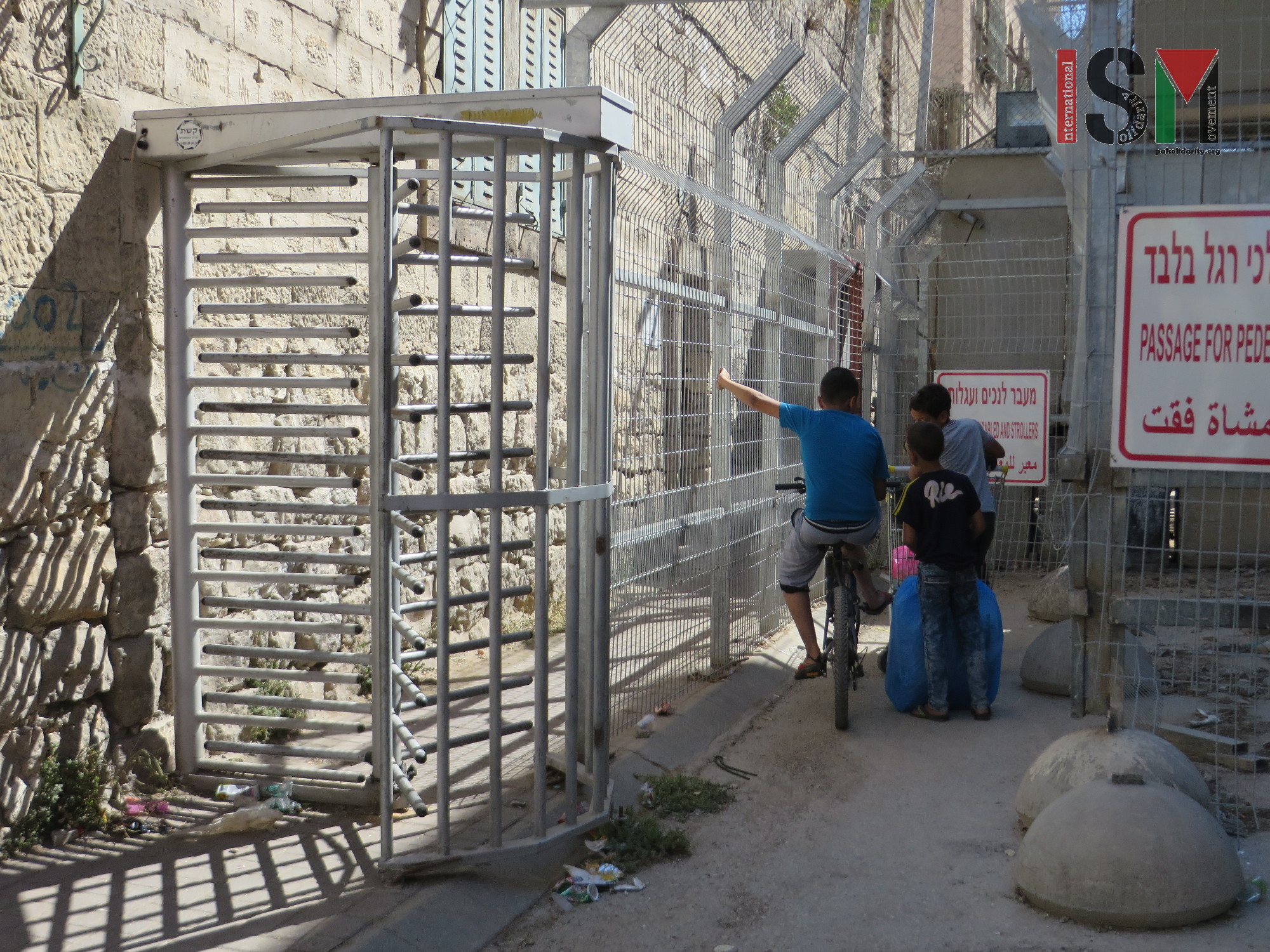
Even the way to school can be a dangerous and perilous journey for children in al-Khalil (Hebron). Having to pass through sometimes multiple checkpoints to get to school, children as young as 4 years old have to pass by heavily armed Israeli soldiers. As if the ubiquitous military presence weren’t scary enough, children are subjected to bag-searches, frisking, detainment and arrests. With Israeli forces using tear gas on children on their way to school and back home after a long school-day, children also have to duck away from tear-gas grenades shot towards them and navigate past clouds of tear-gas lingering on in the alleys.
Arresting children under the age of 11 is illegal even under Israeli law, as it is considered to be too traumatizing and detrimental to a child’s well-being, regardless of the accusations brought forward against a child. However, Palestinian children are detained, frisked, body-searched and arrested by Israeli forces on an every-day basis. As this illegal practice does not result in any consequences for the soldiers or policemen at all, Palestinian children are constantly at risk of maltreatment, abuse and denial of their most basic human rights.
Nearly 2,000 Palestinian children killed since 2000: Rights group
Press TV – September 17, 2015
An independent non-governmental organization (NGO) says nearly 2,000 Palestinian children have lost their lives at the hands of Israeli military forces and illegal settlers over the past 15 years.
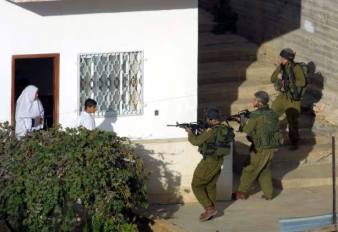 Defense for Children International-Palestine (DCIP), in a report released on Thursday, criticized the Israeli regime’s policy of land expropriation and consistent development of illegal settlements in the occupied East al-Quds (Jerusalem) and West Bank, warning that such practices are placing Palestinian children and their families against “expanding and often violent Israeli settler communities.”
The Geneva-based NGO further noted that Israel’s ongoing settlement expansion activities are increasingly creating a “hyper-militarized environment” for Palestinian children, where they are highly exposed to disproportionate violence from both Israeli forces and settlers.
The DCIP said Israeli soldiers killed 12 Palestinian children in East al-Quds and West Bank in 2014, and the majority of the fatalities were caused by ammunition.
It highlighted that there is “no evidence that any of the children killed in the West Bank posed a direct threat to Israeli troops or settlers.”
The rights group also revealed that 553 of the Palestinian children killed since 2000 died as a direct result of the Israeli military’s onslaught against the impoverished Gaza Strip in summer 2014, noting that around 68 percent of the victims were under the age of 12.
Israel started its military campaign against the impoverished Gaza Strip in early July 2014. The offensive ended on August 26, 2014. Nearly 2,200 Palestinians, including 577 children, lost their lives in the Israeli war. Over 11,100 others – including 3,374 children, 2,088 women and 410 elderly people – also sustained injuries.
More than half a million Israelis live in over 120 illegal settlements built since Israel’s occupation of the Palestinian territories in 1967.
Palestinians are seeking to create an independent state on the territories of the West Bank, East al-Quds, and the besieged Gaza Strip and are demanding that Israel withdraw from the occupied Palestinian territories.
How did Rawabi get its water?
By Jan Selby | MEMO | September 17, 2015
In February this year, the new Palestinian town of Rawabi at last managed to secure a water supply, after several years of acrimonious negotiations with the Israeli and Palestinian authorities. With the greatest obstacle to populating Rawabi overcome, the first 200 families of this planned “shining city on a hill” have now finally started moving in.
Rawabi’s water woes have received extensive coverage in the Israeli, Palestinian and international media, not least owing to a campaign instigated by the town’s owners, the Bayti Real Estate Investment Company. But why did Rawabi encounter such problems? And how did they eventually get resolved? For all the media coverage, the reasons are not well known.
When I meet Amir Dajani, Deputy Manager Director of Bayti in his Rawabi office, he reserves most of his anger for the Palestinian Authority. “No one did anything to support Rawabi,” he says of the PA. He recognises, of course, that Israel’s occupation poses huge challenges to a billion-dollar investment project, but about these he is pragmatic. The contrast between his visceral anger at the PA and his cool realism about the occupation is striking.
For all that, it is Israeli demands and an Israeli-drafted document which were the ultimate reasons for the hold-up. Under Article 40 of the 1995 Oslo II Agreement – which Palestinian negotiators were simply handed and accepted when they should have known better – all new water facilities in the West Bank require prior approval from a Joint Water Committee, meaning that Israel has complete veto rights over Palestinian water developments in the occupied West Bank.
Worse still, while Article 40 did not directly mention water projects for Israeli settlements, it did not preclude them from being brought to the Committee either. Israel exploited this ambiguity by making its approval of Palestinian water projects conditional on Palestinian approval of settlement water infrastructures. For fifteen years, the PA’s pragmatic policy response – pursued with the full knowledge of Presidents Abbas and Arafat – was to consent, however unhappily, to this blackmail and approve every single water facility proposed by Israel for its settlements.
This changed only in 2010, when the Palestinian Water Authority and later the PLO Executive Committee decided that they would no longer approve settlement water infrastructures. The result has been five years of deadlock within the Committee; the PA refuses to approve settlement water projects, and Israel in turn refuses to approve new wells and pipelines for Palestinian communities.
Until February, this included Rawabi. But then, following a media campaign plus a series of high-profile interventions – including from Israeli President Rivlin – and a very public disagreement between the Coordinator of Government Activities in the Territories (COGAT) head, Major-General Yoav Mordechai and Infrastructure Minister Silvan Shalom, the issue was finally decided by Benjamin Netanyahu. Rawabi became an exception, the site of the only new West Bank Palestinian water infrastructure to have been formally approved by Israel since August 2010.
Contrary to reports, however, this was neither a “goodwill gesture” nor a function of a new era of Israeli “water generosity”; simultaneous to approving Rawabi’s connection, Mordechai and Netanyahu also unilaterally approved a handful of settlement water projects (one source has told me “four or five”, another says “six or seven”). These projects included, for instance, a new water supply line for Tekoa in the Gush Etzion settlement bloc, supposedly needed because of declining groundwater levels in the Herodian area from which Tekoa is currently supplied.
Rather than an act of generosity, approval for Rawabi’s water was an internal Israeli quid pro quo. The Israeli government bowed to domestic and international pressure to provide the new Palestinian town with water, but could only square this with itself by simultaneously accommodating – nay, supporting – the country’s illegal settlements, by providing them with even more.
When I discuss this with Baruch Nagar of Israel’s Water Authority, he offers two justifications: that these settlement projects were “emergencies”; and that the Palestinian Water Authority, by refusing to approve settlement facilities, is acting unreasonably and is disrespecting Article 40. “We can’t understand why they stopped,” he says, as if the PA was just behaving irrationally. “We respect the water agreement,” he claims, “the Palestinians do not.”
This, though, is specious. Israel’s unilateral approval of settlement water facilities is a clear violation of Article 40, and invoking the false label of “emergency” does not alter this. There are scores of Palestinian communities across the West Bank which have no water in their pipes for days, weeks, even months on end each summer, and plenty of others which are not connected at all or whose small water collection systems are routinely demolished by the Israel Defence Forces. If “emergency” is the standard, then the PA would have every right – but not of course the power – to implement water projects unilaterally across the West Bank.
Moreover, no amount of deadlock within the Water Committee gives Israel the right to decide which new water facilities should be allowed to go ahead, and which not. However, this typifies Israel’s approach to the vestiges of the Oslo agreements, which can be summed up as bilateral “cooperation” when possible (i.e. when the Palestinians are compliant), unilateral violations whenever deemed necessary.
At least, though, Rawabi got its water supply, at least for now. For the other far-from-minor detail about this case is that Rawabi’s new water connection is only temporary; it will only supply 300 cubic metres of water per day, sufficient for the town’s first 5,000 residents and the next eighteen months. Thereafter, Rawabi will need another source, which is still being negotiated with Israel and the PA. Expect another raft of headlines about Rawabi’s water problems in a year or so.
Jan Selby is Professor of International Relations at the University of Sussex, UK
Al Aqsa Under Attack: The NY Times Blames Its Youthful Defenders
By Barbara Erickson | TimesWarp | September 14, 2015
Tensions are running high at Jerusalem’s Al Aqsa Mosque, and The New York Times can tell us where to place the blame: It’s not the fault of extremists who plan to destroy the landmark, according to the Times, nor is it recent Israeli moves to restrict Muslim access to the site; it is the fault of hot-headed Palestinian youth.
In a story today and in a similar article last July Isabel Kershner points directly to these young people as the source of trouble in clashes with police. This is how the police have framed the issue, and Kershner gives prominence to their claims.
The Times story contrasts with reports from international media and Palestinian sources. From these accounts we learn that the youths were volunteer guards helping defend the holy site against Israeli incursions and that police stormed the mosque while Muslims were inside, beating and injuring worshippers and damaging prayer rugs and other articles. We also learn that these actions prompted even Arab nations on good terms with Israel to speak out in protest.
Kershner quotes Palestinian Liberation Organization secretary Saeb Erekat and a Hamas spokesman who condemn the Israel invasion of the mosque, but she fails to tell readers that both Jordan and Egypt, two nations friendly to Israel, also protested, along with the Arab League and the United Nations representative for peace talks.
The Al Aqsa Mosque has stood at its site in Jerusalem for a thousand years and is revered by Muslims everywhere, but Jews also consider the area as holy ground, where the Second Temple once stood. Extremists openly call for the destruction of both Al Aqsa and the even more ancient Dome of the Rock, which dominates the Jerusalem skyline. They plan to raze the edifices and replace them with a Third Temple.
The Times story fails to acknowledge these real threats that cause anguish among the followers of Islam. It has also neglected to report on Israel’s numerous efforts to restrict Muslim prayer at the mosque and the increasing presence of Jewish worshippers, who are protected by troops when they visit the compound.
Muslims know that another holy site, the Ibrahimi Mosque in Hebron, has been divided between a Muslim and a Jewish section, and that Israeli officials often choose to ban Muslims from entering altogether. This month, worshippers have been excluded from the Hebron mosque for six entire days.
Kershner reports that Muslims charge Israel with plans to divide the Al Aqsa compound, but she says that this is “an assertion vehemently denied by Israel.” Missing from her article is the history of Hebron and the restrictions Israeli authorities frequently impose on Muslim worshippers in both sites.
In recent weeks, for instance, Israel has prevented women from entering the Al Aqsa area, retained the identify cards of worshippers, allowed Jewish extremists to enter the mosque compound for “tours,” restricted the entry of students attending schools in the Al Aqsa compound and confiscated land in an Islamic cemetery next to the mosque.
After the latest incursion, the director of the mosque compound, Sheikh Omar al-Kiswani, said that Israel occupation authorities “have imposed their sovereignty over [the mosque compound] by power of force.” Israel controls who enters and exists, he said, and officials use force against anyone who challenges them.
This is a cry of alarm from a site revered by millions of Muslims throughout the world, but it found no mention in the Times. Instead, we receive the Israeli spin on this tragic saga as the newspaper glosses over the expansionist aims of a Zionist state.
‘Israel’s goal – expulsion of Palestinians and non-Jews’
RT | September 14, 2015
Israel is moving gradually to try to displace and expel Palestinians and every trace of Palestinians from wherever it can, says Paul Larudee from the Free Palestine movement.
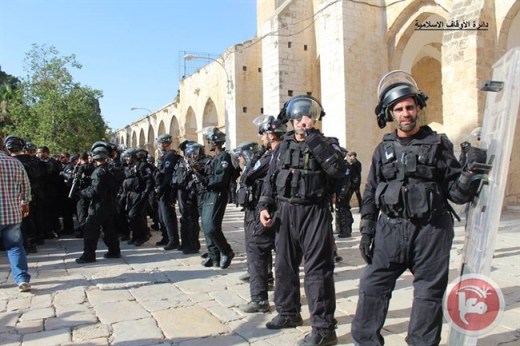
Israeli forces have conducted a raid on the Al-Aqsa Mosque in Jerusalem. Police say they were acting to restore order – after rioters attacked them with rocks and fireworks. The raid sparked widespread anger among Palestinians with rallies held in East Jerusalem and in Gaza.
RT: The Israeli authorities claim they were responding to an attack. Does it look like they used disproportionate force?
Paul Larudee: All forces [are] disproportionate; there should be no force at all in the area occupied by the Al-Aqsa Mosque. These forces don’t belong there. If they are not there they will not have stones thrown at them and they won’t have to react. The best way not to react and to not have this problem is not to be there.
RT: The Al-Aqsa Mosque and Temple Mount on which it stands – is a sacred site for both Muslims and Jews. Do you think it is legitimate to ban some Muslim groups from entering the compound as happened last week?
PL: No, clearly Israel is practicing encroachment, it’s trying to keep Muslims away and it’s trying to keep Palestinians away. It’s very difficult for anyone living in the West Bank and almost impossible for anyone in Gaza to go to the Al-Aqsa Mosque. Israel is doing this in preparation for the disappearance of the Al-Aqsa Mosque as it has supported the settlers who are anxious to build a new temple there and other things. There are a lot of non-religious Israelis who would like to see it gone even though they don’t want another temple there. But this is the way that Israel operates. It’s like a tree with its roots spreading out. The roots are perfectly capable of destroying very big objects in their way like sidewalks and streets and even the foundations of homes, but they move very gradually. That’s what Israel is doing – it’s moving very gradually to try to displace and expel Palestinians and every trace of Palestinians from wherever it can.
RT: Do you think this raid is somehow connected with the Jewish New Year which started on Sunday evening?
PL: That’s anybody’s guess if they feel that it will help their case and cause some of the more right-wing and fanatic settlers to push them even farther. They all have the same goal – which is the expulsion of the Palestinians and non-Jews in the area.
RT: There have been rallies in Jerusalem and Gaza against this raid. Do you think Sunday’s incident can provoke any further violence?
PL: Israel loves violence. They would like Palestinians to attempt as much violence as possible, because that gives them the opportunity to expel some more, to be punitive and so forth. This is how they make their greatest inroads into Palestinian territory and the confiscation of Palestinian land and the immiseration of the Palestinian population.
Israel Rejects Compensation For Burnt Historic Christian Church
IMEMC News | September 13, 2015
 The Israeli Tax Authority has rejected a claim for compensation by officials of the Catholic Church demanding compensation for the Church of Multiplication of Loaves and Fishes, which was burnt in an Israeli terrorist arson attack, last June.
Israeli Channel 2 has reported, Wednesday, that tax officials, who visited the burnt historic Christian church, where according to Christianity Jesus Christ multiplied loaves and fishes, have decided that the assault “was not a terrorist attack.”
Rejecting to label the attack on the Christian church in the Galilee as a terrorist attack means that the Israeli government has no obligation to pay any compensation, as Israel only pays compensation to victims of attacks it deems as terrorist.
The decision of the Tax Authority even ignores statements by senior Israeli officials, including Prime Minister Benjamin Netanyahu and Defense Minister Moshe Ya’alon, who both labeled it as a terrorist attack.
Israel apprehended and charged three Israeli Jewish extremists, believed to be responsible for the attack, and for writing racist graffiti saying, “Idols will be cast out.”
The church filed a request for compensation for damages, but their appeal was denied.
The Times Of Israel quoted Amir Cohen, a tax authority official, saying that he was not convinced the attack on the church was politically motivated.
Cohen said, “the charges filed against the three Israeli suspects state that their attack carried a religious motivation,” and “was based on religious hatred of Christians.”
In light of these “findings,” and statements, the Tax Authority absolved itself of any financial responsibility, as the law only requires the state to pay compensation for victims of war and terrorism. It said the attackers believe that the expulsion of Christians is a commandment, as they consider them “idolators.” … Full article
Israeli soldiers take over home of PA police chief in Nablus
Ma’an – September 11, 2015
QALQILIYA – Israeli military forces on Friday raided the house of Palestinian Authority police chief in Nablus, Abd al-Latif al-Qaddumi, and turned his home into a military outpost after evicting his wife and children.
PA police spokesperson Luay Irzeiqat told Ma’an that Israeli forces raided the home in Kafr Qaddum village and locked al-Qaddumi’s family in one room before declaring the property a military outpost.
Shortly afterward, Israeli forces expelled the family from the home and took it over.
Al-Qaddumi was not present at the time of the incident, with no further details about why Israeli forces seized the property.
On Sunday, Israeli forces held al-Qaddumi for more than an hour near the entrance of Hijja village west of Nablus, security sources told Ma’an.
They said that Israeli troops stopped the police chief on his way to Nablus police station and held him for more than an hour before releasing the police officer.
As Third Victim Dies, Arsonists Get a Pass in Israel (and in The NY Times)
By Barbara Erickson | TimesWarp | September 8, 2015
Riham Dawabsheh, the third victim of an arson attack on her West Bank home, was laid to rest this week in a funeral attended by thousands. The New York Times has duly reported this, but the article is little more than a “color” piece, a detour around the full story of Israeli racism and impunity surrounding this event.
Riham, 27, died Monday, on her birthday, more than a month after the July 31 firebombing of her home in the village of Duma. Her toddler son, Ali, was burned to death in the attack, and her husband, Saad, 32, died a week later. A second son, Ahmad, 4, remains alive in a hospital with burns over 60 percent of his body.
The Times barely mentioned Riham’s death in a brief 135-word story yesterday (placed in the bottom corner of page 6 of the print edition); today it gives us a five-column photo with an article by Diaa Hadid that describes the women at her funeral and very little else.
It is a piece devoid of context, and it includes no official responses to the news of the latest death, with one exception—the statement by Israeli Prime Minister Benjamin Netanyahu, decrying the attack and insisting that security services were “doing their utmost” to find the perpetrators.
Other media outlets in the United States and Israel report the anguished concern of United Nations and Palestinian officials over the lack of progress in the case. Nicholay Mladenov, UN special coordinator for the Middle East peace process, said that he “reiterated and strengthened” his earlier call for justice, and that he was “concerned by the lack of progress in identifying and prosecuting the perpetrators of this outrage.”
Saeb Erekat, secretary-general of the Palestinian Liberation Organization, released a statement saying, “Over a month has passed and the Israeli government has not yet brought the terrorists to justice. In fact, more hate speech and incitement have been coming out from members of the Israeli government, more settler attacks have been carried out, and more Palestinians have been killed, injured or detained.”
The Times story mentions none of this and says only that Israel arrested several extremists who belonged to a “network that had encouraged acts of arson” and that it is “unclear” if any of them were connected to the Duma attack because Israel had imposed a gag order on the investigation.
Missing from this all-too-brief summary are some significant facts: The Israeli authorities arrested several suspects soon after the arson attack but released them, and although villagers reported that four men ran from the house after setting it on fire and entered a nearby settlement, no one from the settlement is in custody.
Other media have noted that Israel has failed to arrest and prosecute those responsible for similar attacks in the past. The Israeli magazine 972 ran a piece titled “No one is put on trial when a Palestinian family is burned alive,” comparing the Duma attack to a taxi firebombing three years ago.
The taxi bombing left six Palestinian family members hospitalized, but all survived. The investigation, however, did not. As 972 writers John Brown and Noah Rotem state, “Despite incontrovertible evidence showing settlers were behind the attack, the case was closed after a two-week investigation.”
None of the Times stories on the Duma bombing have found this news fit to print, and the newspaper has failed to mention other developments that shed light on the tragedy. They include:
- Under Israeli law, the Dawabsheh family is not eligible for compensation, while settlers who suffer similar attacks automatically receive reparations.
- The family struggled to cover medical expenses for the three who were being treated for burns.
- Settlers tried to burn another Duma house not long after the July 31 arson attack.
The newspaper has had several opportunities to include this kind of information in its pages, but it has preferred to emphasize officials’ efforts to control the damage to Israel’s reputation as news of the deadly arson emerged in the media. Thus we have found several stories about the arrests of Jewish extremists and many reports of Israeli outrage over this act of terrorism.
Today’s story was one more opportunity to inform readers of the full context in this disturbing story, but the Times has given us a diversionary slice of local life, omitting any reactions beyond that from the prime minister’s office and obscuring the facts surrounding the investigation.
Even in the most egregious examples of violence against Palestinians, the Times chooses to act as a protector of Israel, placing this goal above its mandate as the newspaper of record.
Israelis Linked to Settler Terrorism were from U.S. Families
By Steve Straehley and Noel Brinkerhoff | AllGov | September 9, 2015
A horrific act of terrorism in the West Bank this summer is suspected to have been perpetrated by Israeli extremists with American roots.
In the village of Duma on July 31, the home of a Palestinian family was firebombed, killing an 18-month-old child, Ali Dawabsheh, who was burned to death, according to media reports. The child’s father, Sa’ed and four-year-old brother Ahmed suffered serious burns, but survived. Ali’s mother, Riham, died Sunday of her burns. Their home was sprayed with graffiti reading “revenge” in Hebrew and featured a Star of David.
“All available evidence suggests that the blaze was a deliberate act of settler terrorism,” Sara Yael Hirschhorn wrote at The New York Times. “More disturbingly, several of the alleged instigators, currently being detained indefinitely, are not native-born Israelis — they have American roots.”
Although not so far charged with the fire that killed the Dawabshehs, four youths believed to be connected to settler terrorism have been incarcerated by Israeli officials. They are Meir Ettinger, 24, grandson of Meir Kahane, a radical American rabbi who served in Israel’s parliament; Mordechai Meyer, 18, the son of American immigrants; American Ephraim Khantsis; and Eviatar Slonim, the child of Australian Jews.
The fire is thought to be a so-called “price tag” attack. Radical Israeli settlers commit such crimes as a response to their government’s efforts to dismantle illegal West Bank Jewish settlements.
To Learn More:
Israeli Terrorists, Born in the U.S.A. (by Sara Yael Hirschhorn, New York Times )
How the Killing of an 18-Month-Old Boy in the West Bank Exposed the Israeli Authorities Failure to Stem Tide of Jewish Extremists (by Ben Lynfield, The Independent )
Israelis Killed more Palestinians Last Year than in any Year since 1967 (by David Wallechinsky and Steve Straehley, AllGov )
U.S. Only Country of 47 to Vote against Investigating Possible Human Rights Violations during Israeli Occupation of Gaza (by Noel Brinkerhoff, AllGov )
‘Stop arming Israel!’ Campaigners launch blockade ahead of London arms fair
RT | September 8, 2015

Anti-arms campaigners set up a blockade in the Dockland’s area of east London on Monday to disrupt one of the world’s largest arms fairs and highlight Britain’s role in arming repressive regimes worldwide.
Protesters gathered outside the Excel center in the Dockland’s area of east London on Monday morning as part of a week of action called Stop the Arms Fair.
The campaigners occupied a space adjacent to the center in an effort to disrupt the Defence & Security Equipment International (DSEI) arms fair scheduled to take place at the venue next week. One of the largest arms fairs in the world, it is expected to attract more than 1,000 global arms firms and 30,000 attendees.
Monday’s day of action focused specifically on Britain’s role in arming Israel. It consisted of talks and thought provoking workshops, and was attended by scores of anti-arms trade campaigners from across Britain, who displayed colorful banners, flags, and quilts, and even sported face paint.

Campaigners said the DSEI arms fair provides a platform for Israeli and international arms firms’ to profit from oppression and destruction.
As the day progressed, a truck carrying a dark green military vehicle attempted to make its way into the Excel center. However, it was obstructed by activists who blocked the road, forcing it to stop. Several campaigners mounted the truck, while others surrounded it.
Police later warned the campaigners they would face arrest if they refused to let the truck pass. In defiance, protestors formed a tight-knit circle in front of the vehicle and staged a traditional Palestinian dance.

The protesters, who remained peaceful throughout the blockade, were eventually dispersed by police. One campaigner was arrested at the site.
Sarah Waldron of Campaign Against Arms Trade (CAAT), who attended the protest, condemned the British government’s sale of arms to Israel.
“In one week one of the world’s biggest arms fairs will be taking place just across the road and the UK government has consistently facilitated weapon sales to the Israeli government who will have a massive pavilion at this fair where their biggest arms companies will be displaying their battle tested weapons,” she told RT.
“The UK government has a very confused attitude to democracy and human rights. On the one hand, it talks of wanting to promote democracy in the Middle East and, on the other, it’s inviting the companies and the governments that are causing violence and conflict in these regions.”
Simon Morris of Occupy Democracy, who also attended the protest, said Occupy campaigners planned to safeguard the protest site.
“The occupy method is to take a space and hold it. We hold it to either facilitate discussions or have a meeting point where people can come down and talk about the issues,” he said.

“We intend to be here from Monday this morning up until Saturday and we intend to be living here continuously in tents holding the space for other people to come and speak.”
“Part of our list of demands, part of what we wish to change in the world, is the shift away from a huge amount of military spending and war, which causes misery and mayhem around the world,” he added.
“If our country had a more democratic system, like direct democracy, we’d see a lot less conflict, a lot less spending on military hardware, and a lot more peace in the world.”
Hilary, a Pro-Palestine campaigner who has spent time in the Occupied Territories, said she was angry with the British government.
“We don’t want Israeli arms companies here. We don’t want Britain to be selling arms to Israel or components for weapons and we don’t want to be buying arms, buying drones to fuel more conflicts in countries around the world,” she said.

Stop the Arms Fair is set to continue until Saturday. It will feature a mixture of creative activities and direct action throughout the week to raise awareness about the destructive impact of the global arms trade.
Activists will argue Britain must redirect spending from arms to renewables and from warfare to welfare. They will also highlight the link between the global arms trade and the global refugee crisis, and host a mass day of action in opposition the DSEI fair.
Photos © Sarah Jane Brennan / RT
Featured Video

The Search for Truth: Charlie Kirk’s Assassination One Year Later
or go to
Aletho News Archives – Video-Images
From the Archives
The 9/11 “Double-Cross” Conspiracy Theory
BY LAURENT GUYÉNOT • UNZ REVIEW • SEPTEMBER 6, 2022
Is it true that “9/11 was an inside job”? Yes, insofar as Israel is “inside” the U.S. But for the 9/11 truthers who have identified Israel as the main perpetrators, “9/11 was an inside job” is at best a half-truth, and at worst an integral part of the Zionist operation, like a secondary flag sewn as a lining under the false flag of Islamism. Victor Thorn (1963-2017) wrote in his book 9/11 made in Israel: The Plot Against America (2011): “In essence, the ‘9-11 truth movement’ was created prior to Sept. 11, 2001 as a means of suppressing news relating to Israeli complicity. . . . The slogan ‘9-11 was an inside job’ was quite possibly the greatest example of Israeli propaganda ever devised.” In milder terms, it is “controlled opposition”.
A genuine truth movement would have pointed to Israel as the prime suspect from the start. From day one, it was obvious who would benefit. … continue
Blog Roll
 Aletho News
- Europe’s mounting social chaos… chickens coming home to roost for proxy war against Russia
- US-Russia Diesel Deal Becomes Massive Defeat for Ukraine
- Hormuz and the Looming Economic Catastrophe
- Dhubab offensive, media blitz and the rapid unraveling of Saudi-backed coalition’s new gambit
- Putin Conveys to Trump Iran’s Vision on Possible Conflict Resolution – Kremlin
- The Search for Truth: Charlie Kirk’s Assassination One Year Later
- ‘Harsh reality’: Iran says France seeks monopoly on power and intimidation, not peace for all
- When Will This White House Madness End?
- Huckabee aide goes to ‘unusual lengths’ to portray ‘Israel’ positively
- Trump Announces Diesel Supply Deal With Putin Following Phone Call
- If Americans Knew
- Israeli forces kill another child in Gaza – Daily Update
- Gaza ceasefire exists in name only, say more than 100 organizations
- Nearly 2 Million in Gaza Need Urgent Shelter Assistance as Winter Looms: IOM Chief Warns
- Suppressing Palestinian resistance: US charity under fire for AI monitoring of Gaza classrooms
- Thousands Are Held in Israeli Torture Camps. This Is What Happens Inside
- Israel puts Gaza’s sick, injured, newborn in peril – Daily Update
- Report claimed Mark Levin used by Israeli government to influence Trump
- Over 2,000 Gazans have died awaiting medical evacuation amid Israel’s continued siege
- How a U.S. Diplomat Suppressed and Altered Reports Critical of Israel
- 5 Palestinians Die from Israeli Strikes in Gaza as Relentless Attacks Continue
- No Tricks Zone
- New Study: 50 Years Of The Most Aggressive ‘Net Zero’ Policies Can Only Affect The Global Climate By 0.03°C
- US September “Heat” Was No Record…Many Records Set Decades Ago
- Latest European Green Energy Debacle; Portugal’s Largest Flagship Solar Park Insolvent!
- Green Energy Debacle: German Expert Professor Fritz Vahrenholt Warns Of Severe Economic And Social Consequences
- Two More Paleo Reconstructions Affirm Meters-Higher Sea Levels Across Ireland, Brazil 7000-6000 Years Ago
- New Study: Earth And Venus Surface Warmth Largely Explained By Convection And Lapse Rate, Not CO2 Or Radiation
- 2025 Nature Paper Claiming Worsening Global Drought Gets RETRACTED …Heavily Flawed
- New Study: ‘Global Drought Shows No Detectable Recent Acceleration Under Climate Warming’
- Economic Masterminds: German Socialists Suggest Taxing Productivity Gains Stemming From Using AI
- The South China Sea Has Not Been Cooperating With The Climate Change Narrative

