Venezuela: UN Should Support Sovereignty in Syria and Palestine
teleSUR | September 30, 2015
 Venezuela called on the UN to do its job, Wednesday, and be a leader in enforcing international law and the right to sovereignty.
Venezuelan Foreign Minister Delcy Rodriguez, speaking at the UN Security Council as it discussed the situation in the Middle East and northern Africa, said that it was “concerning” that after decades, the UN was still talking about Palestine, and was not standing up to the attacks on Syria.
She condemned the “illegal occupation” of Palestine and stated that, “Venezuela is a country that has historically condemned terrorism.” If there is a two-state solution between Palestine and Israel, “it should be two states that are truly equal and sovereign, not where there is terrorism and discrimination … we have to put effort into making this happen. There is a situation where the Israeli state is promoting terrorism and violating Palestinian human rights,” she said.
Talking then about Syria, where the U.S. claims to be attacking the Islamic State, and where Russia has, after talks with the Syrian government, agreed to attack the Islamic State group, Rodriguez said, “Terrorist groups aren’t born spontaneously, we want to know who finances them … This is a multilateral organization that respects international law, or are we here hypocritically, not condemning unilateral interventions (such as that by the U.S). What is the cost in Iraq, Libya, Afghanistan? What do we want today for Syria? The same?”
“Why are we here if we don’t plan to respect international law?” she said.
“In Venezuela we call for abandoning hypocrisy and for real willingness to combat terrorism, and that it not be used to support a certain leader. The UN should assume its leadership and apply international law against aggressions against people. Syria should have sovereignty” over what occurs in its territory,” she concluded.
Settler violence sharply escalates in Hebron during Sukkot holiday
International Solidarity Movement | September 30, 2015
Hebron, occupied Palestine – On the second day of the Jewish Sukkot holiday, hundreds of settlers continued filing into al-Khalil (Hebron) creating mass restrictions and sharp escalations in violence against Palestinians living here. Over a period of two hours dozens of them continuously invaded the roof of the Palestinian Abu Shamsiyye family home where several small children live.
Laughing and trying to gain vantage point to view Israeli forces teargassing, stun grenading and firing rubber coated steel bullet projectiles into crowds of Palestinians in the Bab al-Zawiya area of H-1 Hebron, the settlers spit and cursed at the children, darted towards them to frighten them, called them “Arab terrorists” and one male settler charged at and punched a female ISM international human rights monitor as she filmed him trespassing on the roof. The settler was allowed to leave the scene without incident as Israeli forces stood present but did nothing.
Shortly thereafter, as a Palestinian man and his two young sons tried to exit the gate fronting their home, a crowd of a dozen settler boys sat and stood in front of the gate blocking his exit as he politely asked to be allowed to pass. For fifteen minutes the boys kept the man and his sons trapped until an Israeli soldier finally came and told them to move.
Through the sounds of stun grenading and the blasts of high powered rubber coated steel bullets being showered onto Palestinians by Israeli forces just past checkpoint 56, the settlers, of all ages, took turns standing in the Israeli military post where they posed for photos, shouted curses and racial abuses at Palestinians and international human rights monitors and cheered each time a blast rang out.

This was the situation just outside the Abu Shamsiyye family home alone. But hundreds of Palestinian families have been literally under siege during the Jewish Sukkot holiday began yesterday as their roads have been closed, their businesses have been attacked, their children have been arrested and their streets have undergone hours of endless assault by heavily armed Israeli forces both on roofs as well as in the streets to allow for settlers to move freely through Palestinian governed areas it is illegal for them to be, in so they could pray in the streets.
The misery continues for Palestinians existing in occupied al-Khalil (Hebron).
Israeli settlers raid park south of Hebron under armed guard
Ma’an – September 30, 2015
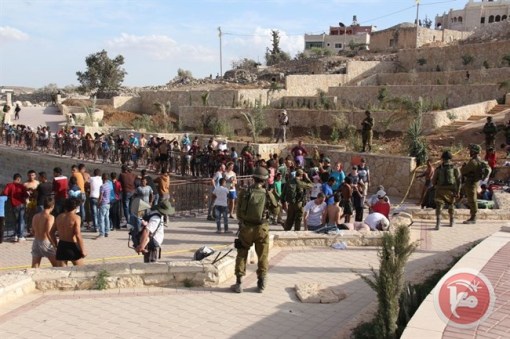
Dozens of Israeli settlers raided a park and ancient pool in the Palestinian town of al-Karmil in the southern occupied West Bank on Wednesday, under the armed protection of Israeli forces, witnesses said.
The park, part of the Yatta Municipality in the south Hebron hills, lies in Area A, under full Palestinian jurisdiction according to the Oslo Accords.
Buses carrying the settlers arrived to the park escorted by large numbers of Israeli forces and military vehicles, locals said.
Settlers came from the nearby settlements of Maon, Karmel, Beit Yatir, Susya, and the outposts of Havat Yair, Mitzpe Yair, Havat Maon, and Avigal, in order to “perform religious rituals” for several hours, they added.
The mayor of Yatta, Moussa Makhamreh, condemned the raid, pointing to the “dangerous nature of Israeli authorities’ and settlers’ racist actions taken under armed security.”
Makhamreh called upon local governance to support and protect the park in order to end frequent violations by Israeli settlers in the area.
An Israeli army spokesperson had no immediate information on the incident.
The park was created in 2011 by the Palestinian Yatta municipality, which renovated an ancient pool located at the site.
Settlers have come to the area in the past through the initiative of the Susiya Tour and Study Center which describes the pool as the historical site of the Biblical settlement of Carmel, according to rights group B’Tselem. Such visits are generally approved by and coordinated with Israeli authorities.
In April, Israeli soldiers expelled Palestinians from the pool in order to allow settlers to swim and have exclusive use of the park.
Around 3,000 Israeli settlers live in Jewish-only settlements in the Yatta region according to the Applied Research Institute – Jerusalem.
The presence of settlements in the area, considered illegal under international law, comes at the expense of Palestinian residents’ ability to build homes and infrastructure, or live unimpeded by constant and often violent interruption from Israeli forces and settlers.
Israeli Soldiers Attack Ambulances, Kidnap Wounded Palestinian
IMEMC & Agencies | September 30, 2015
Israeli soldiers attacked, Tuesday, several Palestinian ambulances while transporting wounded Palestinians to hospitals, in Ramallah, kidnapped one Palestinian after dragging him out of the ambulance, and attempted to abduct another.
Medical sources said at least two Palestinians were shot with rubber-coated steel bullets, and dozens suffered the effects of tear gas inhalation, after the soldiers assaulted hundreds of Palestinians protesting the ongoing Israeli invasions into the Al-Aqsa Mosque in occupied Jerusalem.
The soldiers stopped Palestinian ambulances, trying to transfer injured residents to hospitals in Ramallah, and kidnapped a wounded Palestinian, identified as Mohammad Ouri, after forcibly removing him from the ambulance.
They also attacked another ambulance, transferring a wounded Palestinian, but were unable to abduct him.
The assaults took place near the Beit El roadblock, north of Ramallah, when the soldiers assaulted dozens of protesters, including various political leaders of different Palestinian factions.
The army fired rounds of live ammunition, rubber-coated steel bullets, concussion grenades and gas bombs, in addition to spraying the protesters with wastewater mixed with chemicals.
In Hebron, in the southern part of the West Bank, soldiers kidnapped a Palestinian child, identified as Bassel Issa Shawaheen, 12 years of age, after breaking into his family’s home and searching it.
Also on Tuesday, at least 18 Palestinians were injured, as Israeli forces suppressed demonstrations across the occupied West Bank in support of the Al-Aqsa Mosque.
Nine Palestinians, including three women, have also been kidnapped in occupied East Jerusalem, after the soldiers attacked several men and women near Al-Aqsa Mosque, and prevented them from entering it.
Remembering Muhammad al-Durrah
International Solidarity Movement | September 30, 2015
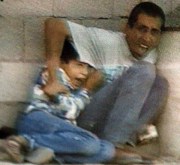 … Filmed by Talal Abu Rahma, a Palestinian cameraman freelancing for France 2, Jamal al-Durrah and his 12-year-old son Muhammad are seen, backs pressed against the wall, Jamal’s arm shielding his young son whose mouth is oval with what must have been a paralyzing fear. And then the shots.
When the cloud of dust cleared, the boy is on his side, draped over his father’s lap.
Throughout an enduing four and a half year widespread Palestinian resistance, with all of its gut wrenching failures, and with the solace and strengths of solidarity en masse coming from both the history before the second intifada and the aftermath in its wake, the slaughter of Muhammad al-Durrah continues to be a defining moment. A young boy viewed guilty through the eyes of the Israeli military due only to the origin of his birth.
In the investigation to follow, an Israeli-initiated tug of war of blame across the grave of and over Muhammad’s murder ensued. Where initially the Israeli government took blame and expressed public relational regret with an apology, that space soon became occupied with denials, accusations and disturbing tales of Palestinian’s faking the boy’s death. If only Palestinians weren’t so busy mourning the actual mass murders of their children in order to be able to spontaneously arrange for the staged murder of one, a second intifada might not have been necessary, nor a third or a fourth for that matter.
Without politicizing the end of a human life, in a 67 year crime drenched in politics; fifteen years ago today a terrified little boy was shot to death while he hid beside his father. And the world should remember his name.
Warning graphic content! Raw footage of Mohammed ad-Durrah’s final moments of his life:
Shatila: Remembering the Massacre
By Richard Hardigan | CounterPunch | September 30, 2015
“There is one scene I will always remember. There was one child. The mother died, but he was trying to take milk from his mother. He was still alive.”
Jamili’s face betrays little emotion as she recalls the scene from thirty-three years ago. She has told the story many times, and perhaps it has lost some of its power in its retelling. Jamili works for Beit Atfal Assamoud, an NGO that provides medical, social and educational services to the residents of the Shatila refugee camp on the southern outskirts of Beirut, and she is talking about her experiences during the massacre of 1982.
“The best way to forget about the horrible things that have happened in the past is to work, to help,” she tells me.
There are currently fifty-nine Palestinian refugee camps scattered throughout the Middle East. When Zionist forces instituted a policy of ethnic cleansing aimed to dispossess the Palestinians of their land in 1947-1948, close to 750,000 Palestinians fled or were expelled from their homes. The camps were built to house the refugees in the short term, but as the problem persisted, so did the camps. It is estimated that there are currently 2.5 million Palestinian refugees living in the camps, which are located in Lebanon, Syria, Jordan, the West Bank and Gaza.
Shatila is probably the most well-known of all the Palestinian refugee camps. In September of 1982, a local Christian militia, known as the Phalange, aided by its Israeli allies, entered Shatila and bordering Sabra, engaging in an orgy of torturing and killing that lasted several days. It is estimated that 3000 people died in this massacre, which has become one of the enduring symbols not only of the Lebanese civil war, but also of the continuing disregard in which Israel holds the Palestinian people.
Jamili was born in 1958, during Lebanon’s first civil war, and she moved with her family from Baalbek, site of the spectacular Roman ruins, to Shatila at the age of one. Although she was not alive during the Nakba – the Catastrophe – and the original establishment of the camp that followed it, she has heard countless stories from her relatives about this time. In the fifty-seven years since her move, she has witnessed all of the tragedies that have befallen Shatila. She can associate each event in the history of the camp with an episode in her life. Her history has become intertwined with that of Shatila.
“My house was destroyed seven times,” she tells me, “and we rebuilt it seven times.”
I have now been in Shatila almost four weeks, and as of yet, I haven’t had the opportunity to talk to anybody about their personal experiences during the massacre. When I first arrived, I was expecting that the tragic events of 1982 would somehow cast an enormous shadow over the camp, that it was something everybody was still dealing with on some level. And so I was hesitant to discuss this topic with anybody for fear that I might bring up some memories that might be best left undisturbed. But when I was introduced to Jamili a few days ago as part of a visit to Beit Atfal Assamoud, she began talking about the massacre immediately. When I asked her if we could discuss the matter in greater detail, she agreed to give me an interview.
We are sitting in comfortable black chairs in her office. A fan whirs in a corner of the room, making the heat a little less oppressive. There is an enormous sleek, black desk behind her, at which I have yet to see her sit. Jamili’s work involves connecting with the residents of the camp who come to seek her help, and I suspect she feels a big desk between them would make them feel uncomfortable.
Israel invaded Lebanon on June 6, 1982 in order to rid the country of the Palestine Liberation Organization, which had fled Jordan during Black September in 1970 and had since established a presence in the refugee camps of Beirut. Israel killed roughly 20,000 people, mostly civilians, during the invasion, and it managed to drive out the PLO.
“During the invasion, 90% of the camp was destroyed. We left Shatila and stayed in Hamra (a Beirut neighborhood a few miles north of Shatila). The people lived in schools and cinemas. My house had five rooms, but when we returned to the camp, we found that only one room was left standing.”
In August of that year, Israel pressured the Lebanese parliament to choose Bashir Gemayal, leader of the Israel-allied Maronites, as president. However, Gemayal was assassinated on September 14, and the Maronite Christian community, especially the Phalange, a brutal Maronite militia, blamed the Palestinians for his death. By this time the PLO had already left the camps, and only women, children and old men remained.
“The PLO had left. All of our youths were in prison,” says Jamili.
The international force that had overseen the evacuation of the PLO had by now departed, and the residents of Shatila were completely exposed.
Yassir Arafat had foreseen this possibility. In the negotiations for his departure from Beirut, he had expressed concern for the safety of the civilians he would be leaving behind in the camps. The US and the government of Lebanon had given their word that Israel would not be allowed to enter West Beirut and had ensured the safety of the Palestinians remaining in the camps. But these promises proved to be empty.
On the day following Gemayal’s murder, Wednesday, September 15, the Israelis seized West Beirut, entrusting to the Phalange, whose hatred for the Palestinians had been inflamed by the assassination of their leader, the task of cleaning up the refugee camps.
On the evening of the following day, Thursday, the Phalange finally entered Sabra and Shatila, and the carnage began almost immediately. David Hirst provides a chilling description in his book Beware of Small States :
“They broke into houses and killed their occupants. Sometimes they tortured before they killed, gouging out eyes, skinning alive, disemboweling. Women and small girls were raped, sometimes half a dozen times, before, breasts severed, they were finished off with axes. Babies were torn limb from limb and their heads smashed against walls.”[1]
Unaware of the massacre, Jamili and her family sought shelter in a mosque in the center of the camp from the Phalange bombs that were falling on West Beirut.
“The houses, after the Israeli invasion, were not strong. The mosque was strong and standing. All of our neighbors left their houses, because they were weak. And we sat in the mosque. People came from outside and said there will be a massacre. Some people didn’t believe them. Where would we go? At the beginning we didn’t believe. But when many people came covered with blood and told terrible stories, then we were afraid.”
A group of old men decided to try to find a high-ranking Israeli officer and convince him to stop the bloodshed. Jamili’s father was among them, but at the last minute he opted to stay behind, a decision that most likely saved his life.
“And these men, until now we don’t know where they are. They went to tell they Israelis there are only children in the camp. They went to protect the camp. But they killed them. They were all friends of my father. Until now nobody really knows what happened. ”
As darkness fell in the evening, the violence continued. The Israelis fired flares over the camp to aid the militia with its grizzly work.
“They lit the streets of the camp. The hopeless thing is that the children saw the lights, and it made them feel happy. But we explained to them that it was the Israelis throwing bombs. Many houses burned. One bomb hit a neighbor’s house, and my father went to help put the fire out.”
Jamili spent that terrifying night in the mosque with her family.
“In the morning, at six o’clock, a group of women, children and old men came and entered the camp and passed by the mosque. They were crying and shouting, and then we believed that a massacre was going to happen.”
On Friday many of the residents of Sabra and Shatila escaped and made their way to two nearby hospitals – the Gaza and Akka hospitals.
“We carried our children and didn’t take anything. We went to the Gaza hospital.”
But even in the hospitals the terrified residents of the camp were not safe from the murderous intentions of the Phalange. In fact, on that day the militia entered the Akka hospital and murdered some of the wounded as they lay in their beds.
“The doctors and the nurses said ‘Don’t stay here. They will come to get you. Please leave this area.’”
“So we left. At that time I was with my family and all of my relatives. There were hundreds of people in the streets, carrying their children.”
Jamili’s destination was Hamra, the Beiruti neighborhood where she and her family had spent the bulk of the Israeli invasion. They had lived in a friend’s apartment, and they still had the key. That night they spent in an unfinished building on the way to Hamra.
“It had no doors or windows, but at least we had a place. In the morning hundreds of people from the camp came and shouted, and we felt that it was dangerous and that we must leave.”
On Saturday morning they were stopped by Israeli soldiers.
“They allowed the women and children to pass, but the young men had to stay. My brothers and uncles had to return back while the women and children continued to Hamra. Our men were not with us, and we were afraid. What would happen to them? We were running away from danger, and they were going to danger.”
By now journalists had entered Shatila, and news of the massacre had spread. When Jamili and her family reached Hamra they went to a supermarket to meet its owner, a man they knew. He was astonished to see them.
“’You are still alive?’ he asked us.”
By ten o’clock on Saturday morning the last of the Phalange had left Sabra and Shatila. The killing was over.
“I am lucky. I didn’t see anybody killed in front of me. But I saw the bodies. The mosque was filled with bodies. You can see the houses that were destroyed and the legs of the children appear from these houses. I saw all this.”
When Jamili saw the pictures in a newspaper, she was horrified. She imagined that all the bodies she saw belonged to her relatives, whom she had been forced to abandon outside of Hamra.
“All youths wear sport shoes and jeans and t-shirts. Their bodies were facing down. We felt that all our men had been killed. We decided to return back to the camp. On Monday morning we entered Sabra, and we were afraid to enter the camp. We saw the bodies in the street. I couldn’t stand. We couldn’t continue. We knew that all our relatives had died. I went to my house. I walked a few meters and then returned back. Because I was afraid to find out what happened.”
But it turned out that her male relatives had found shelter in a school outside the camp.
“When I saw them I didn’t know whether to laugh or cry. I felt foolish. When I found out that my whole family was safe, it was a perfect day.”
Jamili sighs. Her brown eyes glisten. Telling the story has brought back memories and emotions.
The massacre was over, but the problems for the residents remained, as the camp was almost entirely destroyed and had to be rebuilt.
“We had a group of about twenty girls. We could stand against the enemy. We were not afraid. What choice did we have? To die? To live or die, it was the same.”
And so Jamili and her friends threw themselves into the task of rebuilding the camp, because, among other things, it helped them forget what had happened. But one cannot forget such an event.
Jamili leans closer, her face showing the confusion, the inability to accept what had happened so many years ago. How could one group of human beings do this to another?
“Why did Israel make the massacre? For the children? For the old men? Nobody could imagine that a massacre would happen. Why? For whom? We didn’t have any men. Some of them left, and some of them died. Some of them went to prison.”
Today, thirty-three years later, Shatila faces a multitude of problems. The camp, originally built for 4000 residents, is contained in an area that is in the shape of a square of side length less than one kilometer. With the recent influx of refugees from the war in Syria, the current population is estimated to be close to 25,000. This high concentration of people makes itself felt in the ubiquitous crowds that fill the narrow alleyways, in the piles of garbage that accumulate too quickly for the trash removal workers to keep up with, in the many buildings that extend skyward to accommodate the residents, and in the lack of open spaces in the camp. Living conditions are horrifying. Electricity is cut for at least twelve hours a day, and the tap water is so salty that it corrodes the faucets. Guns are present throughout the camp, and tensions, already high because of the extreme overcrowdedness, often explode to the point of physical conflict. (One week after my arrival in the camp two people were murdered during a dispute over a motorcycle parking spot.)
Most of the people in the camp dream of going back to their village in Palestine. And so it is with Jamili.
“Our problems will stop when we return. Why cannot we return to our homeland? My village is empty. It has been destroyed. Until now nobody lives there. Why must we live in this bad situation?”
As Israel moves further and further to the right, it appears as unlikely as ever that Jamili or any of the other millions of Palestinian refugees will ever be able to return to their homes. As their wait continues into its seventh decade, the international community appears to be losing interest even in providing material support for them. Until a few weeks ago, a UNRWA budget shortfall threatened to close all schools in the refugee camps, an action that would have been a disaster for the residents. Saudi Arabia and a few other nations came up with the funding at the last minute, but the message that the world doesn’t care about the refugees was delivered, regardless. These are dangerous times for the Palestinian refugees, and it is crucial that the international community, especially the West, who bears responsibility for their displacement in the first place, doesn’t forget about their plight.
Notes.
[1] David Hirst, Beware of Small States: Lebanon, Battleground of the Middle East
Richard Hardigan is a university professor in the United States.
Obama ignores Palestinian cause in his UN speech
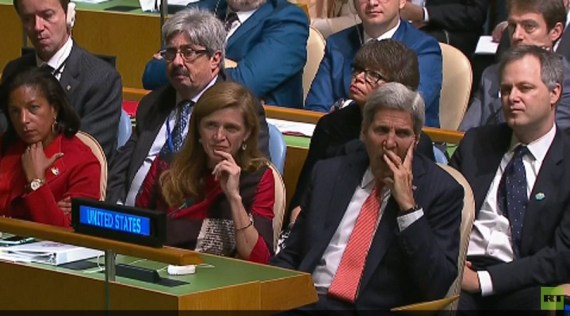
Obama’s speech to the U.N. General Assembly seemed like a real bore for Secretary of State John Kerry
Palestine Information Center – September 29, 2015
NEW YORK – US President Barack Obama declared during his speech at the UN General Assembly in New York his country’s readiness to cooperate with Russia and Iran to solve Syria crisis. However, he ignored to address the Palestinian cause.
The Palestinian Authority slammed Obama for neglecting the Palestinian issue in his speech at the UN on Monday.
Obama called for “a managed transition away from al-Assad,” whom he called a “dictator.”
“Nowhere is our commitment to international order more tested than in Syria. When a dictator slaughters tens of thousands of his own people, that is not just a matter of one nation’s internal affairs — it breeds human suffering on an order of magnitude that affects us all”.
He expressed surprise over those who “support tyrants like Bashar al-Assad, who drops barrel bombs to massacre innocent children, because the alternative is surely worse.”
Likewise, when a terrorist group beheads captives, slaughters the innocent and enslaves women, that’s not a single nation’s national security problem — that is an assault on all humanity, he said in reference to ISIS.
The United States, according to him, has worked with many nations in this Assembly to prevent a third world war — by forging alliances with old adversaries; by supporting the steady emergence of strong democracies accountable to their people instead of any foreign power; and by building an international system that imposes a cost on those who choose conflict over cooperation, an order that recognizes the dignity and equal worth of all people.
However, US president failed to mention the Palestinian cause in his speech at the UN General Assembly.
PLO Secretary-General Saeb Erekat expressed disappointment in US president Barack Obama for neglecting the Palestinian cause in his UN speech.
“Does President Obama believe he can defeat ISIS and terrorism, or achieve security and stability in the Middle East, by ignoring the continued Israeli occupation, settlement expansion, and the continued attacks on al-Aqsa Mosque?” he said.
A Nuclear Power Confronting Slingshots, Israeli Hypocrisy Finds an Ally in The NY Times
By Barbara Erickson | TimesWarp | September 28, 2015
Israel, The New York Times tells us, has vowed to crack down on violence in Jerusalem, allowing the use of live fire against Palestinians who take to “rock throwing and firebombing,” expanding the rules of engagement and lengthening sentences for such crimes.
In a story titled “Israel Acts to Combat Violence in Jerusalem,” Isabel Kershner quotes Prime Minister Benjamin Netanyahu, who calls such Palestinian weaponry “deadly and murderous objects,” which have been “thrown without response and without being thwarted.”
It is noteworthy that Netanyahu, responsible for bombing and strafing the 1.8 million residents of Gaza, can say these words without a hint of irony. It is also striking that the Times can report his utterances without pointing out the full context here—the lopsided nature of the conflict.
In fact, it is the Palestinians who face a deadly enemy: Israel possesses armored vehicles, automatic rifles, drones, rockets, fighter jets, smart bombs and sophisticated surveillance equipment, all of them more “deadly and murderous” than Palestinian rocks. As the only nuclear power in the Middle East, Israel also has a stockpile of up to 300 nuclear weapons, which can be launched by air, land or sea.
Palestinians in Jerusalem and the West Bank have nothing more than stones, firecrackers, kitchen knives and homemade firebombs. The mortality figures reflect this disparity: Since the beginning of this year Israeli forces have killed more than 25 Palestinians in the West Bank (settlers have killed at least another three), while Palestinians are responsible for the deaths of four Israelis within the West Bank and Israel combined.
Yet the Times strains to make Israelis appear as the victims, giving voice to the claims of Netanyahu, playing down Palestinian deaths and hyping Israeli casualties. A recent headline declared, “Jewish Man Dies As Rocks Pelt His Car in East Jerusalem,” suggesting that the driver was stoned to death. In fact, he had a heart attack, lost control of his car and ran into a light pole. The Times story cites only one object hitting the car.
By contrast, the paper gives a bland and ambiguous title to the story of a young Palestinian woman who died from a barrage of Israeli bullets last week as she tried to cross a checkpoint in Hebron. This news appears under the title, “2 Are Killed in West Bank as Jewish and Muslim Holidays Approach.”
Readers find no hint of the bloody assault on 18-year-old Hadeel Al Hashlamoun in this headline, and the Times has also failed to report that Amnesty International termed her killing a “extrajudicial execution” and called for a “prompt, impartial, independent and effective investigations” into her death.
Firsthand accounts say that an Israeli soldier shot Al Hashlamoun in the leg, and when she lay motionless on the ground, approached her and fired several more shots into her abdomen. Witnesses add that soldiers refused to let a Palestinian ambulance approach her and left her to bleed for about half an hour before allowing an Israeli ambulance to arrive and take her away. Video footage also shows a soldier grabbing her by a foot as she lay bleeding on the ground and dragging her out of camera sight.
This is raw violence with “deadly and murderous” arms, but the Times and Netanyahu do not find the word “violence” appropriate here. They reserve its use for Palestinians who throw rocks and firecrackers, never applying it to the atrocities of Israeli security forces. The irony and hypocrisy in this discourse seem to elude them entirely.
In a story that appeared online yesterday, the Times reports that four Palestinian youths have been arrested for throwing rocks at the car of the man who died after crashing in East Jerusalem. This news is in striking contrast to the latest, disturbing developments in the case of three Palestinian family members who died in an arson attack.
When news broke of the fire that killed a toddler in the West Bank village of Duma and led to the later deaths of his mother and father, the Times quoted the reactions of Israeli politicians at length and described Jewish Israeli “soul searching” over the deaths. The paper also noted that some extremist settlers had been arrested but that no one accused of the Duma arson was in custody.
The Times ran several stories immediately after the arson attack, reporting that Netanyahu vowed to bring the perpetrators to justice, but after running a brief article when the mother died earlier this month, the newspaper has been silent, even though there is news to tell: Israeli officials know who committed the crime but do not plan to arrest them.
Israeli media have reported that Defense Minister Moshe Ya’alon admitted that the names of the suspects are known but the defense establishment has not arrested anyone “to avoid revealing intelligence sources in court.”
So we have the quick arrest of four youths suspected of throwing rocks and (perhaps) indirectly causing the death of an Israeli driver, while those responsible for burning and killing three innocent Palestinians go free. The remarks by Ya’alon add even more irony to Netanyahu’s complaint that rock throwing occurs “without response and without being thwarted.”
The Times has shown itself to be tone deaf to such dissonance in the Israeli narrative. Far from analyzing or commenting on the hypocrisy of vilifying rock throwers, it has worked to support this deliberate distortion of the reality in Palestine.
So in the Times we find silence concerning official complicity in settler crimes, efforts to portray Israelis as victims and a refusal to state the obvious: Killing civilians with the world’s most sophisticated weapons ranks high on the scale of violence, far above the efforts of Palestinian youth who face armored soldiers and tanks with slingshots and stones.
The Battle of Breaking the Chains: Posters, Postcards, Toolkit for Action

Samidoun
There are currently 17 Palestinian prisoners on hunger strike in Israeli jails in the “Battle of Breaking the Chains.” The hunger strike is demanding an end to the practice of administrative detention. Administrative detention is the process by which Israel imprisons Palestinians without charge or trial for indefinitely renewable periods; there are hundreds of Palestinians held under administrative detention. No reason is revealed for their imprisonment; instead, a “secret file” produced by Israeli military intelligence serves as a pretext for their continued detention.
The first five hunger strikers: Nidal Abu Aker, Ghassan Zawahreh, Shadi Ma’ali, Munir Abu Sharar and Badr al-Ruzza – all held without charge under administrative detention – began refusing their meals on 20 August. They were soon joined by Bilal al-Saifi and Suleiman Skafi. In late September, another ten Palestinian prisoners joined the strike.
One hundred more prisoners – mostly administrative detainees – have pledged to join the strike on 10 October; 250 Palestinian prisoners in Israeli jails have been returning their meals three times a week in unity with the strikers’ demands. Dozens of Palestinian administrative detainees are boycotting the military court sessions – sessions which simply “rubber-stamp” detention orders from the Israeli military.
The hunger strikers have been refusing food and vitamins since 20 August; they have lost massive amounts of weight, suffer constant headaches and body pains. Some are unable to walk. However, they have not been moved to hospitals – instead, they are being held in isolation cells in solitary confinement, as a means of isolating them from their fellow Palestinian prisoners and attempting to coerce them to end the strike.
In their isolation cells, they have been denied cold water and access to fresh air. All of their personal belongings, including books and papers, have been confiscated, and they have been denied blankets and pillows. Several of the strikers have been denied legal visits; and they have been transferred repeatedly – and abusively – from prison to prison, isolation cell to isolation cell, in a metal vehicle, shackled to a metal chair, known as the “bosta” – a lengthy, stressful and harmful procedure.
As the prisoners reach 40 days on hunger strike, an urgent call has been issued for support and international actions to build solidarity for the hunger strikers, protect their lives and demand their freedom.
Soldiers Invade Al-Aqsa Mosque, Many Palestinians Injured

IMEMC & Agencies | September 28, 2015
Dozens of Israeli soldiers, police officers and undercover forces, invaded on Monday morning, the Al-Aqsa Mosque in occupied Jerusalem, fired gas bombs and concussion grenades causing many injuries, before forcibly removing the worshipers, and surrounded dozens in the Al-Qibli Mosque
Eyewitnesses said around 150 soldiers and officers invaded the holy site, and started forcing the Palestinians out by firing gas bombs, concussion grenades, rubber-coated steel bullets, and several live rounds.
The soldiers also assaulted many Palestinians with clubs and batons.
The invasion also led to clashes between the invading troops and Palestinians, in the mosque and its courtyards.
The Israeli attack caused fires at the main entrance of the al-Qibli mosque, but local firefighters, working for the Islamic Waqf Department, managed to contain it before it spread.
Many residents were injured, and received treatment by Palestinian medics, in the Mosque’s clinic.
The army also used special tools to remove wooden doors and windows of the Al-Qibli Mosque, and hurled several concussion grenades into it.
In addition, soldiers stationed at the gates leading to Al-Aqsa, prevented dozens of worshipers from entering the mosque’s courtyards, especially through Bab Hatta and the Chain Gate.
The soldiers then assaulted many Palestinians, and started pushing them away.
The removal of the worshipers was carried out while dozens of Israeli fanatics gathered nearby, and marched into the mosque’s courtyards under heaving army and police accompaniment.
90,000 Palestinians arrested by Israel since 2000

Palestine Information Center – September 28, 2015
RAMALLAH – Israeli occupation forces have arrested over 90,000 Palestinians since the start of Al-Aqsa Intifada on September 28th, 2000, the Commission of Detainees and Ex-Detainees Affairs said on Sunday.
Such arrests targeted all categories of Palestinian society, including injured civilians, sick persons, girls, children, MPs, lawmakers, and the elderly, the documentation department at the Commission of Detainees and Ex-Detainees Affairs reported.
The Palestinian arrestees included 12,000 children below the age of 18 and 1,200 women, four among whom gave birth to newborns in Israeli lock-ups.
The commission added that there are 200 children and 25 women still behind Israeli bars.
According to the report, the Israeli occupation arrested more than 65 lawmakers and ministers over the same period.
The Israeli occupation authorities issued 25,000 new or renewed administrative sentences against the Palestinian detainees. 480 inmates are still held administratively in Israeli jails.
At least 83 Palestinian detainees died of harsh torture and preplanned medical neglect in Israeli jails since 2000. Dozens of others died shortly after they were released as they succumbed to diseases they caught while jailed.
The Palestinian detainees suffered all kinds of torture and maltreatment during their arrest period, the group further documented.
Powerful Israeli Lobby Summons Jeremy Corbyn in Further Subversion of British Democracy
Empire Strikes Black | September 27, 2015
 Labour Friends of Israel, a pro-“Israel” political advocacy group, has invited Labour leader Jeremy Corbyn to speak at its annual reception(1) in Brighton on Tuesday. The power of the “Israeli” lobby in Whitehall(2) is not news to those with a keen eye on British politics. That being said, for any British voter this should raise eyebrows at the very least.
Labour Friends of Israel (LFI) is a Jewish lobby group(3) which,
“promotes a negotiated two state solution for two peoples; with Israel safe, secure and recognised within its borders; living alongside a democratic, independent Palestinian state”
The above synopsis, garbed in liberal, peaceful and noble language, gives LFI (and “Israel”) an innocuous image to the layperson.
Typical of Zionist rhetorical trickery, this false appraisal is fraudulent for a number of reasons.
“Israel” has to this day not declared its borders for the simple reason that it has an expansionist, hegemonic agenda. It exists on land (every inch – from the Jordan river to the Mediterranean sea) it violently stole from the native Palestinians in 1948. The actual goal of LFI (as with CFI and LDFI – the Conservative and Liberal Democrat sister lobbies) is to influence British policy to ensure continued British support for the brutal, immoral and illegal occupation of Palestine and the ongoing genocide of the Palestinian people.
“Israel”: Friend or Foe?
“Israel” is a belligerent foreign nation whose interests are far removed from those of Britain.
We are talking about a country that can fake British passports and use them to commit murder on foreign soil with complete and total impunity.(4) We are talking about a nation that celebrates the slaughter of Britons in a Jewish terror attack on a Jerusalem hotel.(5) We are talking about a nation whose cowardly snipers can murder British civilians(6) with zero legal or diplomatic repercussions.
“Israel” is by no means a friend of Britain, so why should British party leaders be humiliated into proving they are “friends” of hers? Here we have a lobby group representing a belligerent foreign nation, that has the power to summon party leaders to explain themselves like naughty schoolchildren.
 Adding insult to injury, this foreign lobby group is chaired by a ‘British’ MP, Joan Ryan.
Aside from brazenly representing a foreign nation from within the British Parliament, Ryan has demonstrated her contempt for the British taxpayer and voter in other ways – namely by disgracing herself in the MP expenses scandal.
In October 2007, the Evening Standard reported that in the 2006/2007 tax year, Ryan claimed a staggering £173,691 in expenses(7) – more than any other MP.
The British voter could be forgiven for asking Ryan where her loyalties lie – with Britain? Or with the belligerent foreign nation that she duplicitously represents?
That a foreign lobbying organisation can subvert the political decision making process in such a brazen way – with Jewish MPs literally acting as moles in parliament – makes a mockery of British democracy. I shudder to imagine the tsunami of outrage that would ensue if Muslim MPs were in the same position, lobbying for a hostile foreign government.
Notes
(1) ‘Labour Friends of Israel invites Jeremy Corbyn to explain his Palestine policy to them’ – The Independent, 22 September 2015.
(2) ‘All in the Family: David Cameron’s Jewish Roots and the Coreligionists Who Brought Him to Power’ – EmpireStrikesBlack, 7 January 2014.
(3) ‘About Labour Friends of Israel’ – lfi.org.uk, 27 September 2015.
(4) ‘Dubai Hamas assassination: ‘Israeli hit-squad’ used fake British passports’ – The Telegraph, 17 February 2010.
(5) ‘Israel celebrates Irgun hotel bombers’ – The Telegraph, 22 July 2006.
(6) ‘In memory of Tom Hurndall, shot in the head by Israeli sniper 10 years ago today’ – tomhurndall.co.uk, 11 April 2013.
(7) ‘Revealed: London MPs claiming £9m expenses’ – Evening Standard, 26 October 2007.
Featured Video

The Search for Truth: Charlie Kirk’s Assassination One Year Later
or go to
Aletho News Archives – Video-Images
From the Archives
The 9/11 “Double-Cross” Conspiracy Theory
BY LAURENT GUYÉNOT • UNZ REVIEW • SEPTEMBER 6, 2022
Is it true that “9/11 was an inside job”? Yes, insofar as Israel is “inside” the U.S. But for the 9/11 truthers who have identified Israel as the main perpetrators, “9/11 was an inside job” is at best a half-truth, and at worst an integral part of the Zionist operation, like a secondary flag sewn as a lining under the false flag of Islamism. Victor Thorn (1963-2017) wrote in his book 9/11 made in Israel: The Plot Against America (2011): “In essence, the ‘9-11 truth movement’ was created prior to Sept. 11, 2001 as a means of suppressing news relating to Israeli complicity. . . . The slogan ‘9-11 was an inside job’ was quite possibly the greatest example of Israeli propaganda ever devised.” In milder terms, it is “controlled opposition”.
A genuine truth movement would have pointed to Israel as the prime suspect from the start. From day one, it was obvious who would benefit. … continue
Blog Roll
 Aletho News
- Europe’s mounting social chaos… chickens coming home to roost for proxy war against Russia
- US-Russia Diesel Deal Becomes Massive Defeat for Ukraine
- Hormuz and the Looming Economic Catastrophe
- Dhubab offensive, media blitz and the rapid unraveling of Saudi-backed coalition’s new gambit
- Putin Conveys to Trump Iran’s Vision on Possible Conflict Resolution – Kremlin
- The Search for Truth: Charlie Kirk’s Assassination One Year Later
- ‘Harsh reality’: Iran says France seeks monopoly on power and intimidation, not peace for all
- When Will This White House Madness End?
- Huckabee aide goes to ‘unusual lengths’ to portray ‘Israel’ positively
- Trump Announces Diesel Supply Deal With Putin Following Phone Call
- If Americans Knew
- Israeli forces kill another child in Gaza – Daily Update
- Gaza ceasefire exists in name only, say more than 100 organizations
- Nearly 2 Million in Gaza Need Urgent Shelter Assistance as Winter Looms: IOM Chief Warns
- Suppressing Palestinian resistance: US charity under fire for AI monitoring of Gaza classrooms
- Thousands Are Held in Israeli Torture Camps. This Is What Happens Inside
- Israel puts Gaza’s sick, injured, newborn in peril – Daily Update
- Report claimed Mark Levin used by Israeli government to influence Trump
- Over 2,000 Gazans have died awaiting medical evacuation amid Israel’s continued siege
- How a U.S. Diplomat Suppressed and Altered Reports Critical of Israel
- 5 Palestinians Die from Israeli Strikes in Gaza as Relentless Attacks Continue
- No Tricks Zone
- New Study: 50 Years Of The Most Aggressive ‘Net Zero’ Policies Can Only Affect The Global Climate By 0.03°C
- US September “Heat” Was No Record…Many Records Set Decades Ago
- Latest European Green Energy Debacle; Portugal’s Largest Flagship Solar Park Insolvent!
- Green Energy Debacle: German Expert Professor Fritz Vahrenholt Warns Of Severe Economic And Social Consequences
- Two More Paleo Reconstructions Affirm Meters-Higher Sea Levels Across Ireland, Brazil 7000-6000 Years Ago
- New Study: Earth And Venus Surface Warmth Largely Explained By Convection And Lapse Rate, Not CO2 Or Radiation
- 2025 Nature Paper Claiming Worsening Global Drought Gets RETRACTED …Heavily Flawed
- New Study: ‘Global Drought Shows No Detectable Recent Acceleration Under Climate Warming’
- Economic Masterminds: German Socialists Suggest Taxing Productivity Gains Stemming From Using AI
- The South China Sea Has Not Been Cooperating With The Climate Change Narrative

