BBC’s shameful film: Children of the Gaza war
By John Hilley | Zen Politics | July 9, 2015
A truly disgraceful piece of distortion from the BBC’s Lyse Doucet.
The title of this film is a clear hint of the propaganda to come, based, as ever, on the fatuous ‘two sides’ narrative. There was no ‘war’, only another orchestrated massacre, a campaign of civil terror, in order to maintain Israel’s wicked, illegal siege. From the first minute of this shoddy film, one just wants to urge Doucet: tell the truth, give the context!
Yes, children suffer and die, but why is this happening? Why have so many Palestinians been murdered? Why have over 500 children been slaughtered? Why are an entire population, notably the children, so deeply traumatised? Tell the truth, provide the context!
Israel is the aggressor force. Gaza is the key target. It lies in ruins. Yet, this truly despicable film affects to argue that Sderot is part of the same ‘war zone’.
Continual reference is made to Israel targeting populated areas from where, it’s claimed, Hamas were launching rockets, just part of the loaded message that Hamas are largely responsible for the carnage.
A key section of the film is given over to Hamas fighters, youth camp training and wielding weaponry. But there’s not a single frame of an Israeli soldier, or the mass military operation engaged in the attempted annihilation of Gaza’s people. There’s no questioning, either, of how Israel has socialised so much of its youth to hate and fear Palestinians.
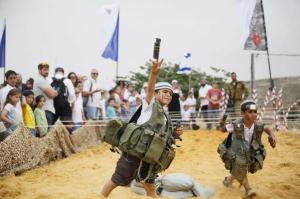 Standing at a Hamas training camp, Doucet laments: “For the outside world it’s hard to comprehend why parents would put children in situations like this.” But there’s no exploration of how Israel as a militarist, occupying state has conditioned so much of its own population to join in the historic oppression and mass murder of Palestinians. Indeed, the word ‘occupation’ is never used.
At one point, Doucet sits with the smiling Gazan kids and asks one of them: ‘Why do you want to be a journalist?’ The child replies in lovely innocence: ‘So I can tell people what’s going on in wars like this one’. If only Doucet could aspire to that same basic aim. One might ask Doucet, in turn: Why do you want to be a stenographer rather than a journalist?
We see more pictures of Gaza’s ruins. Doucet says: “The donors promise a lot. But politics on all sides gets in the way.” This is the extent of her ‘explanation’ of the carnage Israel has caused, the devastation it’s unleashed, its refusal to help rebuild.
Doucet’s grating commentary, over inappropriately lilting music, continues, with affected questions on whether the hate and suspicion can ever be overcome.
A scene of more families coming to settle in Israel’s border locale raises not a word of comment on the nature of Israel’s land appropriation, historic displacement of people and enduring occupation. The indoctrination of Israeli children in defending this is never mentioned, nor is the stark privilege of Israeli kids against the appalling conditions and despair of the children in Gaza. Doucet just smiles and says nothing of the staggering disparities.
I hope the families that Doucet interviewed in Gaza get to see how they’ve been used and exploited in this shabby, deceitful film.
An end credit announces that both Israel and Hamas could be indicted for war crimes, and that: ‘In May and June there were more rounds of rockets fired from Gaza and Israeli airstrikes’, the clear inference, as throughout this deeply-loaded film, that Israel is always ‘responding’ to provocative weaponry.
This is one of the worst examples of ‘two sides’ reportage ever shown. Israel couldn’t have hoped for a greater piece of mitigating hasbara. Doucet’s film is one of the most shameful pieces of ‘war journalism’ ever put out by the BBC.
She doesn’t lack human empathy for the suffering Palestinian kids, such as little Syed, still haunted by the murder of his brother and three cousins on Gaza’s beach. What she lacks, much more profoundly, is a sense of compassionate duty to say why these appalling things happened, and are still happening, to name the principal perpetrators, to be a witness for truth and justice.
Doucet’s film is an abuse of journalism, and, in its pretentious evasions, an abuse of Gaza’s suffering children.
“Blame it on Gaza” say UK Politicians
By Stuart Littlewood | Dissident Voice | July 9, 2015
It has no nukes, no navy, no air–force, no tanks, no phosphor bombs, no subs, no guided missiles, no exits, nowhere to run… its people are terrorised, blockaded and exhausted... their homes are rubble… unemployment is the highest in the world and 73% suffer food insecurity… but suddenly:
Gaza is ‘a recurring threat to peace’!
This blame-it-on-Gaza bombshell came in the middle of a House of Lords debate on the political situation in the Gaza Strip yesterday.
‘Hasbara’ stooges present their propaganda ‘facts’
Lord Davies of Stamford, formerly the MP Quentin Davies, stood up:
My Lords, there are five salient facts that ought to come out of any debate about Gaza…. One is that Gaza is clearly a most unpleasant place to live: it is extremely poor and very violent. It is poor partially because of the blockades that have been imposed by both its neighbours, Egypt and Israel, for reasons that may be very understandable.
The second salient fact that has come out and which is certainly recognised all over the world is that Gaza in its present state is a recurring threat to peace in the region. Rockets are continually fired at Israel. After some years, the Israelis inevitably lose their patience…. and intervene militarily. There is nasty military action, obviously with a lot of fatalities.
Obviously. And the casualties (including over 578 children killed and 1,000 permanently disabled) are all on one side. It would be helpful to say why rockets are fired at Israel. But do carry on with your fascinating analysis, noble Lord.
Those two facts are pretty well known. There are three facts about Gaza that are not so well known and which ought to be better known. One is that it is a very nasty, savage tyranny…. Hamas imposes its power by regular use of torture and execution of political opponents: so-called collaborators with the Israelis and so forth.
By mentioning torture, his Lordship reminds me of the grim reports we keep getting about Israel torturing Palestinian child prisoners.
The fourth point that ought to be much better known is one I tried to bring out a few weeks ago at Questions, when I asked the Minister whether Hamas could bring to an end, any day it wanted, the blockade imposed by Israel, simply by accepting the quartet conditions. These, as the House knows, are: the giving up of violence, the recognition of the state of Israel and the acceptance of existing accords, including the Oslo accord. The answer I got was yes, the Hamas regime could, any day it wants, get rid of these blockades. It chooses not to do so.
Israel too could do all of those things but chooses not to. It could, if it had the sense, end its illegal occupation but chooses not to. And why would Palestinians recognise Israel when Israel has said repeatedly that it opposes a Palestinian state? His Lordship’s mention of the Oslo accord, I imagine, is a reference to the then prime minister Ehud Barak’s “generous” offer to the Palestinians. In an earlier speech Lord Davies said that Yasser Arafat, at the Camp David meeting, refused to consider an offer which would have resulted in 97% of the West Bank being handed over to a Palestinian state.
The offer was not what it seemed and the noble Lord was repeating a hasbara propaganda myth. The West Bank and the Gaza Strip, seized by Israel in 1967 and occupied ever since, comprise just 22% of pre-partition Palestine. When the Palestinians signed the Oslo Agreement in 1993 they agreed to accept the measly 22% and recognise Israel within ‘Green Line’ borders (i.e. the 1949 Armistice Line established after the Arab-Israeli War and recognised internationally as the border). Conceding 78% of the land that was originally theirs was an astonishing compromise but not enough for greedy Barak. He demanded the inclusion of 69 Israeli settlements within Palestine’s 22% remnant.
It was plain to see on the map that these settlement blocs would create impossible obstacles to Palestinian life which was already severely disrupted. Barak also insisted the Palestinian territories be placed under “Temporary Israeli Control”, meaning Israeli military and administrative control indefinitely. His generous offer also gave Israel control over all the border crossings of the new Palestinian State. What nation in the world would accept that? The map was never shown publicly, and propaganda spin concealed how preposterous Barak’s offer was.
The following year, at Taba, Barak produced a revised map but it was withdrawn after his election defeat. The facts are well documented by organisations such as Israel’s Gush Shalom, which his Lordship might find enlightening.
Gaza ‘the most subsidised community on earth’
Lord Davies concluded his amazing insights:
The fifth point, which certainly is not as well known as it ought to be — because it affects the pockets of every taxpayer in this country, apart from anything else — is that this mixture of unpleasantness, tyranny, threat to world peace and denial is being actively subsidised by the international community to the tune of many billions of dollars a year…. this is probably the most subsidised community anywhere on God’s earth. The European Union makes much the biggest contribution to these subsidies, at about €1.6 billion, and the second largest contributor is Qatar, at about $1 billion.
If we are going to go on subsidising the Hamas regime as we do, we have to ask ourselves whether we should introduce an element of conditionality into our relationships with Hamas.
As everyone (except his Lordship) knows, it’s the Israeli occupation that is being subsidised. And Israel is repeatedly destroying infrastructure built with British taxpayers’ money. Left in peace and free to trade with the rest of the world the Palestinians would prosper.
To think that Lord Davies was once a Government defence minister… It’s no surprise to discover that he voted for the Iraq war and travelled to Israel and Palestine in 2008, expenses paid by Labour Friends of Israel and the Israeli Ministry of Foreign Affairs. Or that, as reported in The Mirror, he claimed £10,000 of taxpayers’ money for repairs to window frames at his “second home” – an 18th century mansion.
He had earlier claimed £20,700 expenses (later amended to £5,376) for repairs to a “bell tower”.
You’d think that the human condition in the Holy Land, and especially Gaza after Israel’s horrific 50-day onslaught last summer, would bother our senior holy men. But apparently not. Twenty-six Church of England bishops sit in the House of Lords. Only the Bishop of Chester spoke up, thankfully injecting some much needed common sense:
In Gaza the World Bank estimates the per capita income to be 30% lower today than 20 years ago. The contrast just gets greater over time, which sets up a huge instability. I understand all the arguments for a two-state solution…. but will two states so closely linked geographically and yet on such divergent paths easily exist side by side?
What I cannot understand from the Israeli perspective is the settlement programme. It is acknowledged on practically all sides outside Israel that it is both illegal and ill judged. In a certain way it is a parallel to the political mistakes in South Africa, where the South Africans simply dug themselves in and could not see the misjudgment.
How are we to go forward? We have to work with Hamas…. working with it must be the future, difficult though that may be.
More ministerial wisdom
As if Lord Davies’ contribution wasn’t dreadful enough, Baroness Anelay of St Johns (Minister of State, Foreign and Commonwealth Office) closed the debate with some silly pokes at Hamas.
We have assessed that Hamas is seeking to rebuild militant infrastructure, including the tunnel network, in Gaza, and we are deeply concerned at reports of militant groups rearming.
What does she expect when the international community still fails to act and Israel continues its raids?
We will recognise the state of Palestine, where Palestinians currently live, only if and when Hamas get to the position whereby it can recognise the right of Israel to exist.
Israel has never defined its borders because it is bent on territorial expansion. The 56% of mandate Palestine allocated to Israel by UN Partition in 1947 was immediately expanded to 78% by Israeli military aggression. The rest of Palestine was taken over in 1967 and remains under the Israeli jackboot. So exactly what are Hamas supposed to ‘recognise’? They have already said they’ll accept a Palestinian state on the pre-1967 Green Line borders, which is exactly in accord with international law.
Our policy on Hamas remains clear: it must renounce violence, recognise Israel and accept previously signed agreements. Hamas must make credible movement towards these conditions, which still remain the benchmark against which its intentions should be judged.
Why? There is no parallel requirement on Israel.
The UK is deeply concerned by the terrible human cost to both sides of the ongoing Israeli-Palestinian conflict, as underlined by the findings of the report. We strongly condemn the indiscriminate firing of rockets into Israel by Hamas and other militant groups in the Gaza Strip.
Again, no parallel condemnation of Israel’s murderous bombardment of Palestinian civilians.
We therefore welcome the fact that Israel is conducting its own internal investigations into specific incidents. Where there is evidence of wrongdoing those responsible must be held accountable.
Don’t hold your breath, Baroness.
The United Kingdom has been one of the largest donors to Gaza since last summer, providing more than £17 million in emergency assistance. I assure the noble Lord, Lord Davies of Stamford, that none of our aid goes to Hamas. It goes via the United Nations relief agency and the Gaza Reconstruction Mechanism…. The UK pledged an additional £20 million…. We have now delivered 80% of that pledge, with more to come shortly.
The British taxpayer, yet again, picks up the tab for the wreckage left behind by Israeli war crimes. It’s a paltry sum considering the Israelis caused damage estimated at $6 billion. If it wasn’t for the rotten windows of Lord Davies’ mansion and his crumbling bell tower, we could afford to give more.
Israeli Minister to Decide on Deportation of Palestinian MPs
Ma’an – July 7, 2015
The Israeli Minister of the Interior was given 30 days by the Supreme Court on Monday to reach a final decision on the possible deportation from East Jerusalem of three Palestinian lawmakers and a former Palestinian Authority Jerusalem affairs minister.
Monday’s hearing was a follow-up to a previous hearing in the same court on May 5, 2015 that discussed the possibility of revoking the Jerusalem residency rights of officials Muhammad Abu Teir, Ahmad Attun, Muhammad Tutah and Khalid Abu Arafeh.
While Abu Arefeh formerly served as the PA’s minister of Jerusalem affairs, the other three are members of Palestine’s parliament, the Palestinian Legislative Council.
All four live in occupied East Jerusalem.
The Israeli Ministry of the Interior has been threatening to deport the lawmakers and former minister since Hamas won Palestinian legislative elections in 2006.
The pretext for the ruling is disloyalty to the Israeli state, the lawmakers said last year.
The four were initially detained along with other lawmakers and, after their release, Israeli police seized their identity documents.
The permanent residency status of 107 Palestinian residents of East Jerusalem was revoked in 2014, adding to the 14,309 revoked by Israel since 1967.
Donald Neff: a Journalist Erased From History for Reporting on Palestine
By Alison Weir | Washington Report on Middle East Affairs | July 8, 2015
One of the top journalists to report on Palestine-Israel has died.
Donald Neff passed away on May 10 in his hometown of York, Pennsylvania, at the age of 84. The cause of death was heart disease and diabetes.
Neff was a luminous writer and meticulous reporter. From humble beginnings, he had reached the top ranks of American journalism. When he then turned his formidable talents to writing books and articles about Palestine, his contracts with mainstream American publishers dried up, his income plummeted, and his fame faded.
Today, even many activists in the growing Palestine solidarity movement are unaware of Neff’s groundbreaking work. This is unfortunate, since he exposed critical facts about Palestine with unparalleled precision and elegance. Much of the information he uncovered is still significant today.
During his long career, Neff reported on the Vietnam War from Tokyo and Saigon and was TIME magazine bureau chief in Houston, Los Angeles and Jerusalem. One of the first reporters on the scene at the Jonestown Massacre in Guyana, he also covered the Apollo moon landing and reported on the nuclear accident at Three Mile Island (not far from his hometown). In 1980 he won the Overseas Press Club of America’s prestigious Mary Hemingway Award for best magazine reporting from abroad for a 1979 cover story about Colombia’s cocaine network.
Neff was at TIME from 1965-1979. While based in Jerusalem, he exposed an incident that would change the course of his life.
In “Epiphany at Beit Jala,” an in-depth essay written for the November-December 1995 issue of The Link , Neff wrote about this incident and other eye-opening experiences covering the region.
Like most Westerners, Neff had arrived profoundly sympathetic to Israel. However, he wrote, “As my tour extended into years, I could not ignore a disturbing blindness in some of even the most gentle Israelis. They did not seem to see the Palestinians all around them… In general, this was just as well because when most Israelis did notice Palestinians their reaction to them was one of loathing or fear that quickly could escalate into violence.”
Neff’s experiences also revealed a power dynamic between the U.S. and Israel that he found astonishing.
He reported on Secretary of State Henry Kissinger’s frantic attempts to convince Israel to relinquish Egyptian land Israel had acquired through its 1967 war of conquest and had managed to retain through American support during the 1973 “Yom Kippur” war. The U.S. was calling on Israel to return it to Egypt. Israel refused.
“The extent of Israel’s ability to resist U.S. advice,” Neff wrote, “was my first great eye-opener in Israel. I had had little appreciation of the astounding depth and strength of Zionism’s influence in Washington. I was stunned that a country completely beholden to the United States could thumb its nose at Washington.”
Various encounters through the years caused Neff “deep uneasiness” about the views and beliefs of some Israel partisans in the U.S., raising “the question of dual loyalty to a level I had never realized existed.”
A man who had been serving in the U.S. Navy when Israel tried to sink the USS Liberty, killing 34 and injuring over 170 Americans, told Neff that he had been “torn by the dilemma of whether he could actually participate in a U.S. retaliatory attack against Israel.” (This never came.)
Another American Zionist showed Neff his Israeli passport alongside his U.S. one. Neff was taken aback; it had been illegal for Americans to hold dual citizenship. The man proudly informed him that the policy had been changed in 1967 by the Supreme Court, adding with emphasis that the case had been brought by an Israeli and the swing vote was cast by Abe Fortas.
In later researching Fortas, Neff discovered that Fortas was a Zionist and that among his first thoughts when he left the Supreme Court had been to visit Israel. “There was nothing wrong with that,” Neff wrote, “but it did indicate an attachment of such personal importance that he should have recused himself from the dual citizenship case.” This ruling, Neff wrote, “had destroyed a 200-year tradition.”
Neff’s most intense experience, the “epiphany” of his essay title, came in March 1978, when a freelance reporter called to say that she had “heard reports that Israeli troops had just conducted a cruel campaign throughout the West Bank against Palestinian youth. Many Palestinians had suffered broken bones, others had been beaten and some had had their heads shaved.”
When Neff repeated the report to his TIME bureau staff, all Jewish Israelis, they were indignant. The report was obviously false, they said, because “that is what was done to us in the Holocaust.”
Neff decided to check out the facts for himself, taking along a skeptical Jewish American friend who was living in Israel.
“We went into the small hospital and a young Palestinian doctor who spoke English soon appeared. Yes indeed, he said matter-of-factly, he had recently treated a number of students for broken bones. There were 10 cases of broken arms and legs and many of the patients were still there, too seriously injured to leave. He took us to several rooms filled with boys in their mid-teens, an arm or leg, sometimes both, immobile under shining white plaster casts.”
When TIME published Neff’s report, it provoked outrage from both Israeli authorities and American Zionists. The New York Times failed to report on the incident, making it seem for awhile that Neff’s report was inaccurate. It wasn’t until an Israeli official investigated the incident and confirmed Neff’s facts that other journalists finally reported on it.
As a result of his reporting, Neff was made an honorary citizen of Bethlehem.
After Neff returned to the U.S. he eventually decided to leave periodical journalism in order to write books. He signed a contract with Simon & Schuster and wrote the first in what was to be a trilogy about the Israeli-Arab wars of 1956, 1967 and 1973
The book, Warriors at Suez: Eisenhower Takes America into the Middle East (1981), received wide acclaim. It was a National Book Award finalist and an alternate selection for both the Book of the Month Club and the History Book Club.
The Chicago Tribune Book World described it as “A true thriller” and said that the story was “as sobering as it is fascinating…. important and compelling reading.”
The Tribune review, however, was to be among the few exceptions to a pattern later described by Ambassador Andrew Killgore, publisher of the Washington Report on Middle East Affairs.
Books on the Middle East that editors disliked, Killgore noted, would be assigned to “a Zionist reviewer… the reviewer usually is Jewish, never a Muslim and only occasionally a Christian. If none of the facts presented in the book can be refuted, the book’s substance has to be ignored.” Often they would simply go un-reviewed.
Neff’s second book, Warriors for Jerusalem: The Six Days That Changed the Middle East, came out in 1985 and was again praised by experts. Former Undersecretary of State George Ball called it indispensable to anyone who wanted to understand “why we are in such a dangerous mess in the Middle East.”
While the Christian Science Monitor called it “one of the most significant contributions to modern historical literature,” most newspapers ignored it.
American Zionists had long disliked Neff’s work. When his report on the Beit Jala incident came out, even some TIME colleagues had complained. Neff was called an anti-Semite to his face, while others shunned him.
The book industry included such Israel partisans, as well. Simon & Schuster did not renew its contract with Neff, and his final book in the trilogy, Warriors Against Israel: How Israel Won the Battle to Become America’s Ally, was published in 1988 by Amana, a much smaller publisher.
Once again, Neff produced a powerful volume. Archibald B. Roosevelt, Jr., a grandson of President Theodore Roosevelt, a polyglot who spoke 20 languages, and a former CIA officer with considerable expertise in the Middle East, wrote: “As an observer of Middle Eastern affairs for more than four decades, I was impressed by the originality of Neff’s presentation and surprised by his devastating conclusions, assembled from facts previously known to most of us only piecemeal. It is not only a good read, but essential background for serious students of developments in the Middle East today.”
Neff’s next book, on the history of U.S.-Israel relations, was published in 1995 by the Institute for Palestine Studies, headquartered in Lebanon. A second, updated edition was published in 2002.
Neff himself, and many others, considered this his most important book. Fallen Pillars: U.S. Policy Towards Palestine and Israel Since 1945 provides a detailed history of how Zionists overcame the recommendations of U.S. diplomats, the Pentagon, and intelligence agencies to create today’s uniquely special relationship with Israel.
Citing a multitude of memos and official studies, Neff’s opus details U.S. officials’ failed attempts and frequent frustration at a special interest lobby that held more influence over U.S. policies than they did. Already by 1949 “Israeli officials were openly bragging about the power of the Jewish American community to influence U.S. policy.”
Fallen Pillars shows the deep roots of many current issues. “By 1968,” Neff reported, “the CIA was convinced Israel had produced nuclear weapons, or was capable of doing so, and informed President Lyndon Johnson. His response was to order the CIA not to inform any other members of the administration, including Defense Secretary Robert McNamara and Secretary of State Dean Rusk.”
Although, again, scholarly reviewers praised Neff’s book, most mainstream media chose not to review it. An exception was The Washington Post, which assigned it to Tad Szulc, a Jewish American journalist whose primary expertise was Latin America and Eastern Europe. Szulc called Pillars “deeply flawed” and charged Neff with being “more Palestinian than the Palestinians.”
Neff’s final book, Fifty Years of Israel, was published on the 50th anniversary of Israel’s creation. A collection of the “Middle East History” columns Neff wrote for this magazine beginning in 1993, its short, footnoted chapters were based on a detailed handbook compiled daily of events related to Israel and Palestine from 1947 to the end of the 20th century. (See excerpt in sidebar here.)
Long before Google and other Internet search engines made their appearance, Neff’s computerized database was a frequently called upon source of information for authors and journalists. As the Washington Report’s late executive editor, Richard H. Curtiss, noted in his introduction to Fifty Years: “Over the phone I could hear the ‘click, click’ as he entered into his computer—which seemingly always was turned on—the key words that brought up almost instantaneous answers to whatever questions I asked.”
Donald Neff brought honesty, precision, and courage to a topic of world-shaking significance that most top journalists feared or obfuscated. For this, he paid dearly.
Those working to rectify one of the world’s most significant injustices and causes of ongoing tragedy owe deep gratitude to Donald Neff.
I personally am profoundly indebted. I first stumbled across Neff’s books when I visited the Washington Report bookstore in Washington, DC in the spring of 2001. While I had already seen at first-hand Israel’s ferocious treatment of Palestinians, I was largely unaware of Israel’s power in and over the United States. Neff’s work was as enlightening as it was disturbing.
A few years later I had the honor of meeting Donald Neff in person and conducting a long interview with him about his work. (A few minutes from this are on a video If Americans Knew subsequently released.)
I expect that eventually Neff’s books and articles, like those of other journalists who worked to tell Americans about Palestine but were largely erased from public awareness, will be rediscovered, as a new generation intent on justice discovers the power and relevance of his pioneering work.
Neff is survived by his companion of 15 years, Washington Report managing editor Janet McMahon, as well as son Gregory Neff of York; two stepdaughters, Victoria Brett of Northampton, MA, and Abigail Miller of Portland, ME; a granddaughter; and two great-grandsons.
 This article was originally published in the Washington Report on Middle East Affairs, which contains an excerpt from Neff’s unpublished Middle East Handbook.
Alison Weir is executive director of If Americans Knew, president of the Council for the National Interest and author of Against Our Better Judgement. Upcoming book talks can be seen on the book’s website.
Israeli committee approves expansion of Jerusalem settlement
Ma’an – July 8, 2015
 JERUSALEM – A researcher said Tuesday that an Israeli committee for zoning and planning has allocated private Palestinian land to expand the illegal French Hill settlement in East Jerusalem.
Ahmad Sub Laban, a settlement affairs researcher, told Ma’an that 25 dunams (6 acres) of land from Shufat and al-Issawiya has been allocated to the the settlement area to establish a commercial zone.
Palestinian residents of Shufat had been trying to obtain licenses to build on the land which was confiscated, but were denied permission by Israel’s Jerusalem municipality.
Palestinians in occupied East Jerusalem suffer from a chronic lack of services and severe unemployment as a result of Israeli municipal policies which allocate few resources to the community.
Over 75 percent of Palestinians, and 82 percent of children, live below the poverty line in East Jerusalem, according to the Association for Civil Rights in Israel.
Only 14 percent of East Jerusalem is zoned for Palestinian residential construction, ACRI says, while one-third of Palestinian land has been confiscated since 1967 to build illegal Jewish-only settlements.
NY Times Whitewashes Israel’s Racist Justice System
By Barbara Erickson | Times Warp | July 7, 2015
Three Israeli civilians are standing trial for killing a Palestinian teenager in a brutal murder last summer, and The New York Times is on hand to report the details. It is all meant to carry a clear message to readers: that democracy is at work in Israel and the law is on hand to deal out justice.
So we read that Israeli prosecutors are pressing defendants to admit their intent to kill, that the families of defendants and the victim are on hand and that the “cramped courtroom” in Jerusalem is crowded with judges, lawyers and observers.
But for all its detail, this story by Isabel Kershner is missing some crucial context: the fact that Israel runs a blatantly racist system of justice, with strikingly different treatment for Israelis and Palestinians. The present trial—for the murder of 16-year-old Muhammad Abu Khdeir, who was doused with gasoline, beaten and burned in a wooded area a year ago—is far from typical.
In reality, Israeli civilians and security forces rarely stand trial for attacks on Palestinians. A study by the Israeli human rights monitoring organization, Yesh Din, released this May, shows that Palestinian complaints against Israeli civilians lead to indictments only 7.4 percent of the time, and only a third of these (or 2.5 percent of the complaints) result in even partial convictions.
Security forces are also shielded from prosecution. Yesh Din notes that criminal investigations against soldiers are rare and even when they do take place, they are closed without indictments 94 percent of the time. And, Yesh Din states, “In the rare cases that indictments are served, conviction leads to very light sentencing.”
In the Times story Kershner quotes the parents of the victim, who are skeptical of the Israeli justice system. “It is all an act,” the boy’s father says. “They burned Muhammad once. Every day we are burned anew.”
Readers are likely to dismiss his misgivings as rhetoric and prompted by anger and grief. In fact, Palestinians have reason for doubting that they can find justice in Israeli courts.
West Bank settlers, for instance, are tried in civilian courts, while their Palestinian neighbors—even the children—face trial in military courts, which are notorious for their lack of due process and impossibly high conviction rates. As UNICEF noted in an extensive report on the abuse of Palestinian children in Israeli custody: “In no other country are children systematically tried by juvenile military courts that, by definition, fall short of providing the necessary guarantees to ensure respect for their rights.”
Palestinians tried in Israeli military courts are convicted 99.74 percent of the time, according to Israeli Defense Force data. Knowing this, most Palestinians and their lawyers opt for plea bargains and give up even the faintest hope of receiving a fair trial.
None of this appears in Kershner’s story, but the context of Israeli justice as it applies to Palestinians is crucial to understanding what is really happening here. The fact is, Israeli officials know the world is watching this trial, just as it watched events unfold after Abu Khdeir was abducted and killed. We can expect at least the appearance of justice to be on display.
The Times, which has ignored the hundreds of cases that show Israel in a far different light, is ready here to present Israeli prosecutors pressing for justice. Readers will not suspect that the newspaper has failed to inform them of other, less savory, outcomes to Israeli crimes against Palestinians.
We can name a few:
- This past April, two years after 16-year-old Samir Awad of the West Bank village of Budrus was killed with three bullets to his back and head, the State Attorney’s Office opted to charge his accused assailant with the minor offense of a “reckless and negligent act using a firearm.” B’Tselem, the Israeli rights organization, called this decision “a new low in Israeli authorities’ disregard for the lives of Palestinians.”
- In January Israel closed an investigation into the killing of Musad Badwan Ashak Dan’a, 17, in Hebron, four years after the event, saying there was no evidence available. In fact, the army investigating unit had plentiful evidence, including medical documents and eyewitness accounts.
- Israel forces shot and killed Yusef a Shawamreh, 14, in March last year as he collected herbs near the Separation Barrier in the West Bank. Three months later, investigators closed the case, saying there was no breach of military rules involved. Videos of the incident show that the boy and his companions posed no possible threat to the soldiers or Israeli security.
All of these (and dozens of others) were newsworthy items, fit to print in the Times, but the newspaper has preferred to look away. Only Samir Awad’s name appeared briefly in an online Reuters story that never made it into print; the others received no mention.
Now, however, Israel knows that the world is aware of the Abu Khdeir case, and a trial is in progress. It is likely that the prosecutors and judges will remain on their best behavior throughout the proceedings.
The Times, as well, is ready to present a narrative of Israeli justice at work. We can expect more reports from the Jerusalem courtroom, but readers are unlikely to learn that the trial is a rare event, an aberration in a system of flagrant inequality.
Hillary Clinton says BDS campaign in US seeking to ‘delegitimize Israel’

Press TV – July 7, 2015
Democratic presidential hopeful Hillary Clinton has censured growing anti-Israeli movements in the United States, saying the Boycott, Divestment and Sanctions (BDS) campaign wants to “isolate and delegitimize Israel.”
The former secretary of state called for suggestions to fight the movement in a letter to Democratic donor Haim Saban and Jewish organization leaders.
“I know you agree that we need to make countering BDS a priority” and to “fight back against further attempts to isolate and delegitimize Israel,” she wrote.
“BDS seeks to punish Israel and dictate how the Israelis and Palestinians should resolve the core issues of their conflict,” she said.
The former first lady also described the campaign as “counterproductive.”
“From Congress and state legislatures to boardrooms and classrooms, we need to engage all people of good faith, regardless of their political persuasion or their views on policy specifics, in explaining why the BDS campaign is counterproductive to the pursuit of peace and harmful to Israelis and Palestinians alike,” she said.
The BDS campaign, which began in 2005, encourages organizations and institutions such as universities and churches to divest from Israel until the fundamental rights of the Palestinians have been recognized.
The boycott campaign called for “various forms of boycott against Israel until it meets its obligations under international law.”
In 2013, two US academic groups — the American Studies Association and the Association for Asian American Studies — supported the boycott.
The movement received backing from one of the largest Protestant churches in the US last week.
The United Church of Christ’s general assembly voted overwhelmingly in favor of divesting funds at its synod in Cleveland.
Clinton also expressed her complete support of Israel if she gets elected president next year.
“Time after time I have made it clear that America will always stand up for Israel — and that’s what I’ll always do as president,” she said in the letter.
America’s Endless Air Wars
By Nicolas J S Davies | Consortium News | July 6, 2015
U.S. Central Command’s latest figures on its aerial bombardment of Iraq and Syria reveal that this is the heaviest U.S. bombing campaign since President George W. Bush’s “Shock and Awe” campaign against Iraq in 2003. In the campaign’s first ten months from August 2014 to May 2015, the U.S. and its allies conducted 15,245 air strikes, or an average of 51 air strikes per day.
This is only the latest campaign in a 15-year global air war, largely ignored by U.S. media, in which the United States and its allies have conducted at least 118,000 air strikes against other countries since 2000. The 47,000 air strikes conducted in the 6 ½ years since President Barack Obama took office are only a small reduction from the 70,000 in eight years of the Bush administration, and the current campaign will easily make up that deficit if it continues at this intensity until Obama leaves office.

Afghanistan has been the most heavily bombed country, with at least 61,000 air strikes since 2001. That includes 24,000 bombs and missiles in the first year of the war and a relentless bombing campaign that struck Afghanistan with another 29,000 bombs and missiles between 2007 and 2012, a slow motion version of “Shock and Awe.” That was an average of 13 air strikes per day for six full years, two years under Bush and four under Obama. The heaviest bombardment was in October 2010, with 1,043 air strikes that month, but that total is now eclipsed every month by the new campaign in Iraq and Syria.
Iraq had already suffered about 34,000 air strikes since 2000 before the latest campaign began. There were at least 800 air strikes in the “No Fly Zone” bombing campaign to destroy Iraq’s air defenses between 2000 and 2002; 29,200 air strikes in “Shock and Awe” in 2003, a campaign whose planners compared it to a nuclear attack; and another 3,900 during the U.S. occupation, peaking with 400 strikes in January 2008 as remaining centers of armed resistance were obliterated by air strikes, Spectre gunships and heavy artillery in the climax of the “Surge.”
But until the new campaign in Iraq and Syria, the seven-month NATO-Gulf Cooperation Council bombing of Libya was the heaviest bombardment since “Shock and Awe”, with 7,700 air strikes in seven months, or 36 air strikes per day. NATO and its Arab monarchist allies plunged Libya into intractable chaos and violence, exposing “regime change” as a euphemism for “regime destruction.”
NATO’s destruction of Libya spurred Russia to finally draw the line on its 20-year acquiescence to Western aggression and military expansion. Since then, the U.S. and its allies have persisted in their “regime destruction” policy in Syria and Ukraine, threatening strategically important Russian naval bases in Tartus and Sevastopol, what has evolved from an asymmetric war on a series of relatively defenseless countries into full-blown 1950s-era nuclear brinksmanship.
Drones have played a growing role in the U.S. air war, but they still account for only a fraction of total U.S. and allied air strikes, several thousand out of 118,000 air strikes in 15 years.
None of these figures include Israeli air strikes against Palestine, the current Saudi-led bombing of Yemen, or French operations in West Africa, as I haven’t found comparable figures for those campaigns, but they must add many thousand more air strikes to the real total.
Keeping the People in the Dark
In a recent article, Gareth Porter reported that the Pentagon is seriously opposed to putting more “boots on the ground” in Iraq or Syria, but that the generals and admirals are prepared to keep bombing them more or less indefinitely as the political path of least resistance for themselves and the White House. This may indeed be the “safe” course for a politically-driven administration and a Pentagon that is always thinking of its public image and its future funding.
But it depends on keeping the public in the dark about several critical aspects of this policy. First, there is little public resistance to this policy mainly because few Americans know that it’s happening, let alone understand the full scale of the bloodshed and devastation perpetrated in our names for the past 15 years.
The second thing the Pentagon doesn’t want you to think about is the deceptive role of “precision” weapons in U.S. propaganda. Considering how accurate these weapons really are in relation to the huge numbers of them raining down on country after country, it is not surprising that they have killed or wounded millions of civilians and destroyed hundreds of thousands of homes and civilian infrastructure, as we see in photographs and video of the ruins of Fallujah, Sirte or Kobani.
A direct hit with a single 500- or 1,000-pound bomb will cause death, injury and destruction up to hundreds of feet from its point of impact, so even accurate air strikes inevitably kill and maim civilians and destroy their homes. But whatever proportion of these 118,000 bombs and missiles have actually missed their targets have wreaked completely indiscriminate death, injury and destruction.
Rob Hewson, the editor of Jane’s Air Launched Weapons, estimated that 20 to 25 percent of the “precision” weapons used in “Shock and Awe” in 2003 missed their targets. Another one third of the bombs and missiles used in “Shock and Awe” were not “precision” weapons to begin with.
Even the Pentagon has not claimed a quantum leap in its “precision” weapons technology since 2003, so it is likely that at least 15 percent are still missing their targets, adding daily to a massive and mounting toll on innocent civilians.
As Hewson told the Associated Press in 2003, “In a war that’s being fought for the benefit of the Iraqi people, you can’t afford to kill any of them. But you can’t drop bombs and not kill people. There’s a real dichotomy in all of this.”
Body Count, a recent report published by Physicians for Social Responsibility, confirmed previous estimates of well over a million people killed in America’s wars since 2000. This and previous studies document the horrific results of what Hewson and other experts understand only too well, that “you can’t drop (100,000) bombs and not kill (hundreds of thousands of) people.”
Another element in the Pentagon’s shaky propaganda house of cards is its effort to obscure what bombs and missiles actually do to their victims. Americans watch the Islamic State beheading videos on TV or YouTube but we never see videos of people decapitated or children dismembered by the bombs our taxes are paying for. But our bombs behead people too.
Apologists claim that U.S. bombing is morally superior to the “terrorism” of America’s enemies, because the U.S. killing and beheading of civilians is “unintentional” rather than “deliberate.” The late Howard Zinn, a former U.S. Air Force bombardier and later a history professor, responded to this claim in a letter to the New York Times in 2007:
“These words are misleading because they assume that an action is either ‘deliberate’ or ‘’unintentional.’ There is something in between, for which the word is ‘inevitable.’ If you engage in an action, like aerial bombing, in which you cannot possibly distinguish between combatants and civilians (as a former Air Force bombardier, I will attest to that), the deaths of civilians are inevitable, even if not ‘intentional.’
“Does that difference exonerate you morally? The terrorism of the suicide bomber and the terrorism of aerial bombardment are indeed morally equivalent. To say otherwise (as either side might) is to give one moral superiority over the other, and thus serve to perpetuate the horrors of our time.”
Millions of ‘Enemies’
In fact, U.S. armed forces are waging war on millions of people for whom becoming combatants in a war would be the last thing they would ever consider if we had not brought our war to their doorsteps. The Center for Civilians in Conflict recently interviewed hundreds of local people who have participated as combatants in conflicts in Bosnia, Libya, Gaza or Somalia. It found that their motivations were almost entirely defensive, to protect themselves, their families, their communities or their countries.
When military forces attack or invade a country, many ordinary people feel compelled to take up arms to defend themselves and their homes. When the forces that put them in this unbearable predicament in the first place treat their efforts to defend themselves as a legal “green light” to target them with force and call them “terrorists,” they are driven to join better organized armed resistance movements that offer them protection in numbers and an effective way to fight back.
The essential first step to breaking the escalating spiral of violence is to force the aggressors, in this case the United States and its allies, to cease their aggression, including their state sponsorship of armed groups or “terrorists” in the affected countries. Then legitimate diplomatic initiatives can begin the difficult work of resolving the complex political and humanitarian problems caused by U.S.-led aggression and beginning to restore peace and security.
In his 1994 masterpiece, Century of War, the late Gabriel Kolko documented that war was the catalyst for all the major political revolutions of the Twentieth Century. While the working people of the world have otherwise failed to “rise up” as Marx predicted, the one thing that has reliably driven them to do so is the horror of war.
The war that the United States is waging today is proving no different. Armed resistance is spreading throughout the affected countries, spawning new ideologies and movements that defy the conceptual frameworks and limited imagination of the U.S. officials whose actions gave birth to them.
U.S. leaders of all stripes, military or civilian, Democrat or Republican, still fail to grasp what Richard Barnet concluded in 1973 as he studied the U.S. defeat in Vietnam, “at the very moment the number one nation has perfected the science of killing, it has become an impractical instrument of political domination.”
The last 15 years of war have served to confirm Barnet’s conclusion. After 118,000 air strikes, millions of casualties, trillions of dollars squandered, and country after country plunged into chaos, the U.S. has failed to gain political control over any of them.
But our complacent leaders and their self-satisfied advisers blunder on, debating who to threaten or attack next: Russia? China? Iran? Which “threat” provides the best pretext for further U.S. military expansion?
As Gabriel Kolko observed, because of “inherent, even unavoidable institutional myopia, … options and decisions that are intrinsically dangerous and irrational become not merely plausible but the only form of reasoning about war and diplomacy that is possible in official circles.”
But U.S. war-making is not just dangerous and irrational. It is also a crime. The judges at Nuremberg defined aggression, attacking or invading other countries, as the “supreme international crime, differing only from other war crimes in that it contains within itself the accumulated evil of the whole.” The UN Charter goes one step further and prohibits the threat as well as the use of force.
Benjamin Ferencz, the only surviving member of the prosecution team at Nuremberg, is a fierce critic of illegal U.S. war-making. In response to U.S. war crimes in Vietnam, he dedicated the rest of his life to establishing an International Criminal Court (ICC) that could prosecute senior officials of any government who commit aggression and other war crimes.
Ferencz is hailed as the founding father of the ICC, but his vision of “Law Not War” remains unfulfilled as long as his own country, the United States, refuses to recognize the jurisdiction of either the ICC or the International Court of Justice (ICJ).
By rejecting the jurisdiction of international courts, the U.S. has carved out what Amnesty International has called an “accountability-free zone,” from which it can threaten, attack and invade other countries, torture prisoners, kill civilians and commit other war crimes with impunity.
Nuremberg ‘Exemption’?
U.S. government lawyers enjoy the privilege, unique in their profession, of issuing legally indefensible but politically creative legal cover for war crimes, secure in the knowledge that they will never be forced to defend their opinions before an impartial court.
Ben Ferencz very graciously wrote a preface to my book, Blood On Our Hands: the American Invasion and Destruction of Iraq, and he spoke at an event with me and David Swanson in 2011, just before his 91st birthday. Ben talked about Nuremberg and the ICC, and he compared U.S. justifications for its “preemptive” illegal war-making to the defense offered by SS Gruppenfuhrer Otto Ohlendorf at Nuremberg.
As Ben explained, “That Ohlendorf argument was considered by three American judges at Nuremberg, and they sentenced him and twelve others to death by hanging. So it’s very disappointing to find that my government today is prepared to do something for which we hanged Germans as war criminals.”
If we do not hold American war criminals accountable for their crimes, and accept the jurisdiction of international courts to do so if we do not, how else can we serve notice on those who come after them that they must never do this again?
Argentina, Guatemala and other countries in Latin America are prosecuting and jailing mass murderers like Videla and Rios Montt who once took for granted that they could kill with impunity. America’s masters of war should not assume that we will fail to bring them to justice.
As for the collective responsibility we all share for the crimes committed by our country and our armed forces, we must be prepared to pay substantial war reparations to our millions of victims and the countries we have destroyed. We could start by paying the reparations ordered by the International Court of Justice when it convicted the United States of aggression against Nicaragua in 1986, and the $3.3 billion promised by President Nixon to repair at least some of the U.S. bomb damage in Vietnam.
These would be concrete steps to tell the rest of the world that the United States was finally ready to abandon its failed experiment in “the science of killing,” to be bound by the rule of law, and to start cooperating in good faith with the rest of humanity to solve our common problems.
~
Nicolas J S Davies is the author of Blood On Our Hands: the American Invasion and Destruction of Iraq. He also wrote the chapters on “Obama at War” in Grading the 44th President: a Report Card on Barack Obama’s First Term as a Progressive Leader.
Israel seizes 600 dunums of Palestinian lands in Occupied Jerusalem
Palestine Information Center – July 5, 2015
OCCUPIED JERUSALEM – Israeli mayor of Jerusalem, Nir Barkat, ordered that 600 dunums of Palestinian lands in al-Issawiya, in northern Occupied Jerusalem, be temporarily confiscated allegedly for gardening purposes, Peace Now reported afternoon Saturday.
The misappropriation order was issued using a special municipal law that allows the municipality to exploit an empty lot for public uses for five years in cases where the owner does not develop it. Al- Issawiya locals found the orders spread out in their fields.
The lands in question have been targeted by the Israeli occupation authorities in recent years, when a plan to declare them a National Park was promoted in order to create an Israeli dominated continuity between Occupied Jerusalem and the area of E1. The park is also meant to block the potential development of the adjacent neighborhoods of al-Issawiya and al-Tur.
It is required according to the law that the land owners refuse or choose not to make use of the tracts. When the owner wants to use his or her private property they are allowed to do so in accordance with the approved construction plans, Peace Now further stated.
In the case of al-Issawiya, the owners wish to make use of their lands. One month ago, the municipality uprooted trees that were planted by the Palestinians under the pretext of unlicensed cultivation. Thus, it seems now very hard to explain why a Gardening Use Order is required in such case when the owners wish to do the farming on their own.
According to analysts, it seems that in order to bypass the need to declare the lands as National Park, the Israeli occupation authorities are trying to take over the lands through other illegal means.
Peace Now added that the goal of the Israeli authorities is to prevent any potential Palestinian capital in East Jerusalem by taking over and blocking the lands necessary for the future development of a viable Palestinian state. The Jerusalem Municipality and the National Parks Authority seem so obsessed with creating an Israeli dominated corridor in the area, making use of the law only as a pretext for a political agenda.
A month in Palestine
By Tom Blanx | MEMO | July 4, 2015
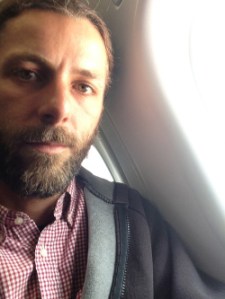 This May, I travelled to the West Bank in occupied Palestine.
I had a fairly good idea of the kind of things I would see when I went, but wanted to take a closer look at what I think is an unfair and asymmetrical situation. I don’t stand against Jews or Israelis. I stand against racism, violence, oppression and ignorance, and all of those things, I think, are here.
During my time in the West Bank, I lived and worked with a Palestinian farmer who runs a Permaculture Project in a small village called Marda. I wanted to see for myself what life was like for Palestinians living under occupation and how Permaculture could help.
Knowledge is everything and with that in mind I’m sharing everything I saw, heard, thought and felt in the time I was there.
Below are excerpts from Tom Blanx’s blog. Read the full blog here.
Getting in
For those who haven’t been, Israel’s not the easiest of places to get in and out of. And if you plan on checking out the occupied territories you’ll need to be a bit creative with the truth. Despite my polite passport note from the queen, I decided not to reveal how freely I would be passing while on my travels as it would have most likely landed me straight back on British soil. This had happened to previous volunteers so the NGO I had organised the trip with had suggested that I lie.
With the help of Murad, my Palestinian friend and his friend, an Israeli who will remain anonymous, I pretended I was traveling to help and learn on a farm in the south. I probably could have said I was there for a beach holiday or Christian visit too, but a bag full of work boots and full length clothing might have been a giveaway. Murad told me to just remain calm and answer all questions confidently but it was a nerve racking and intimidating experience. Much more than I remember it being when I was 18 coming here. In the end I think I got in by inadvertently playing dumb.
Getting into the West Bank was more straight forward. I got on a bus from Tel Aviv bus station all the way to Ari’el (An illegal settlement, next to Marda). There are no stops or checkpoints for settlers (on the way in) so all I had to do was get off before the bus turned into the settlement where Murad was waiting for me and I was in. A better understanding of his instructions, some Hebrew and useful geographical knowledge and I probably wouldn’t have ended up bang in the middle of the Ari’el in the isolating situation of looking for a Palestinian village. I haphazardly navigated my way out of on foot and was an hour late – not the look I was going for, but I guess he was going to find out what I’m about sooner or later.
Marda
Marda is in the Salfit district which is biggest producer of olive oil in Palestine. The village is effectively a ghetto, with reinforced steel gates at each end for when the army want to shut it down and a high metal fence and barbed wire around it, although some of these had been damaged and removed. There used to be resistance here, but like in lots of the rest of Palestine, occupation has become normalized. These days the village is quiet and peaceful. People work and children go to school, cats wander around the place looking for food and donkeys everywhere sound like they’re dying. The village sits directly under the hilltop Ari’el settlement, the 4th biggest in the West Bank. Murad said he used to play there with his friends when he was young before Zionists confiscated and destroyed 9000 dunams of it, in the late 70s to build luxury homes, streets and a university for Israelis and Jewish immigrants. The juxtaposition of the two towns, is a powerful thing to see and its something that you can’t help but see, every day.
As I arrived in Marda another volunteer was leaving. Her name was Judy, a 60 year old American woman from Australia travelling by herself. I wouldn’t normally mention someone’s age or circumstances but I think its significant as many people think the West Bank is too dangerous to travel to and that women could be more vulnerable here. Neither are true. It was her 5th visit to Marda so I wanted to get as much information out of her as I could in the 30 minutes she had left. She gave me the dos and don’ts about living in Marda, how to be with Murad and told me to explore as much as I could of Palestine “You can’t charaterise Palestine on what you see in just Marda as much as you can’t charaterise the US on what you see in Miami”
Murad
Straight away I felt at ease with Murad. From our first Skype conversation, to meeting him an hour late after getting lost, I felt welcome and at home. Chilled and pragmatic, straight talking and funny are the best words I can think of to describe him. Everywhere we went there was banter. Banter with friends, banter with strangers. Sometimes he sounds like he is angry when he’s talking in Arabic but then he laughs and I know he’s not. Judy said his bark is worse than his bite and I now know what she means. “C’mon man!… what you doing man?!”… “Why you sayin sorry all the time man” still echo round my head.
Murads family have lived in Marda for generations spanning centuries. His wider family numbers in the 100s. His immediate family is his his wife, Ghada, daughters Sara, Halla and Tooleen, his youngest – son Khalid, his Mother, Twin brother, older brother, three sisters and their families. I think I can count the number of people in my family with my fingers!
The old house he grew up in has itself been in the family for 300 years. His Mother and twin, Hazim live there now and on my first night, he took me to meet them. We ate dinner, looked at our phones (There’s no escaping it!!!) and then I helped Murad download a Lionel Richie “hello” ringtone he wanted for when Ghada called him. I asked him what other music he liked and he said “none”. “But you like Lionel Richie though?” No. just that song.” Then I reconfigured his answer and decline buttons so he could, in his words, hang up in peoples face.
When violence broke out in the second intifada (literally translated as uprising), Murad decided to leave Palestine. With his Palestinian passport, he traveled to America and spent time working in Chicago and Tennessee. In 2006, he returned to inherit his Father’s land and with some basic knowledge of permaculture from a previous project, he started Marda Permaculture farm.
The Permaculture farm
The farm is 2 1/4 dunams in size. A duman is about 1 square km. The farm has Bees and produces large quantities of honey each year, 5 kilos of which is exported to customers in Qatar. He has chickens and pigeons (with their own cob-built houses) for eggs and meat and and plans on getting some goats and a cow.
The farm is Murad’s livelihood, but its more than that. The farm is his way of fighting the occupation. By growing his own food and providing his own income, he doesn’t need to buy expensive food and water or look for work abroad or in Israel. Permaculuture gives him good health, independence and empowerment.
The farm is a centre for students, activists and volunteers and Murad hopes his model will raise awareness of Permaculture in Palestine and begin to change local peoples attitudes towards farming.
Getting around
I did most of my exploring with Murad. I only did my own thing a couple of times. Once when I went to Jerusalem with Gaie (another volunteer who helped at the farm for a few days) and another time when we split up in Rammalah and I went to see qalandia. But we always left Marda together. Murad wasn’t into the idea of me travelling by myself in case I got mistaken for a settler or deported for being a friend of Palestine. They’re weren’t any bus stops in Marda so unless you hail a passing taxi or sherut you hitch a ride to somewhere you can get a bus. The nearest place to us was Zattara Junction (Tappuah junction for Israelis). From here you can go in three directions north to nablus, east to jericho and south to Rammalah. It used to be checkpoint but some of these have eased off in recent years. There’s still a large military presence here though. Lots of Israelis use the junction so cars are still stopped, IDs are still checked and people are still harassed. We saw one guy in his early 20s being checked out by two soldiers wanting to know where he had been, where he was going, and why he needed to go there.
As we make our way to the bus stop to Rammalah we have to go through the rigmarole of crossing the side of the road we need to the central reservation, avoiding Israeli only bus stop which Palestinans are not allowed to be near, to then cross back 50m further along where the anybody else bus stop is. You keep your head down here as you feel the eyes of soldiers and settlers weigh down on you. You’re at the mercy of the army here, they have done and can do anything they want to you here. This a cold violence that all Palestinans have to go through on a daily basis.
Nablus and Tulkarem
This was the first place outside Marda that I explored. It used to be an important junction on the Old Silk Road and was a strong resistance town in the years following the occupation. Nowadays, its very normalised – the occupation. Like the rest of the country, people are just trying to make enough money to survive. Food and drinks, shops and markets are everywhere. Women are covered up, some even more than in Marda wearing full burkhas which you can also see displayed in shop windows. Lots of women whiten their faces here too. Looks really strange sometimes. On the hilltop behind the city is the largest refugee camp in Palestine – 30,000 refugees packed into ¼ of a sq km. Like the one outside Rammalah they resemble Rio’s hillside favelas. Beautiful backdrop and ugly consequence all at the same time. As we ate a shrawma outside we saw men putting flags up in the main square and cars driving round honking their horns. They were celebrating the release of a young man who had been put in jail by the Israelis. I don’t know who he was or what he had been jailed for but I’m guessing it was for a while and his release was a small victory.
A little bit further on is Tulkarem This is where we met Murad’s friend Fayez, and where I saw the wall for the first time. Like Murad, Fayez also runs a farm in a village just outside Tulkarem called Irtah. His story is amazing: resilience and steadfastness in effect. In a nutshell… Occupation forces tried to confiscate his land to use as a military post; some of the first sections of the segregation wall were built across 20 dunams of his land; he resisted the land confiscation and repeated attacks on him and his crops and was imprisoned, leaving his wife Muna, to manage the farm; 12 chemical factories considered hazardous to Israeli public health were relocated to the other side of the wall, one right next to his farm*; he thus grew more aware of the health impacts of fertilisers and pesticides and made the switch to organic production. Now his and Muna’s farm, famous for popular resistance attracts solidarity activists and volunteers from all over the world.
*Factory chimneys are used when the wind blows east into Palestine, and not when into Israel.
At his home we sat and drank zamzam with his family. Zam zam is holy water welled from the zam zam well in Mecca. They told me the story of zamzam, debating over the specifics but I’m struggling to make sense of my notes so here’s a simple kids version of the origin of zamzam I found online:
“This is the story of the ZamZam water. The water well of Zamzam is a well located within the Masjid al Haram in Mecca. It was a miraculously generated source of water from Allah, which began thousands of years ago when prophet Ismael (PBUH) the son of prophet Abraham and Hajar (the wife of prophet Abraham, May Allah be pleased with her) were thirsty and alone in the dessert.In this area there is very little water if any at all in some places. According to our tradition, Hajar (May Allah be pleased with her) was a very devout mother and wife. When she was separated from her Husband prophet Abraham (PBUH), she was left alone in the dessert, by herself with her small son Ishmael (PBUH). Prophet Abraham made a prayer for his young family as he left them behind and Allah provided the means of sustenance for them. Hagar (May Allah be pleased with her) ran seven times back and forth in the scorching heat between the two hills of Safa and Marwah, in desperation because her son cried as it was very hot and they did not have even a drop of water to drink. Allah provided a Miracle and the ZamZam well was born.”
Fayez’s son “carried” 20L of this water back from his hajj pilgrimage so it goes without saying that I felt really honoured be offered it. It’s meant to contain healing powers so you drink it in 3 sips and wish for good health. I drank mine to my Mum.
Jerusalem
Tony Blair has a multi million penthouse apartment that he rents for free in East Jerusalem. I saw it – Murads not even allowed to come to Jerusalem. No one who lives in the West Bank is, unless they own one of the hard to get permits I mentioned earlier. It’s like me needing permission to visit London.
Jerusalem (East) is as you would expect it to be – tourists, religious places of interest, sight seeing, crap selling blah. The tourism and globalism here makes it more relaxed in its attitudes to drinking and clothing, despite the religious significance of the city. In the old town/holy basin which is a busy Palestinian neighbourhood, Israeli settlers live in homes above the market taken from Palestinians now flagged up and fenced off. Below mesh is in place to stop settlers throwing waste down on the Palestinian’s markets there are Israeli homes.
We tried to get to the Al Aqsa mosque and dome on the rock but it was Muslims only after 4pm and being white and non Muslim looking we were turned away by Israeli police. They control who goes in and out here. It was interesting and maybe kind of nice to see Israelis help enforce the Muslim only after 4pm rule. Was also good to see some soldiers and locals getting on. Saw another soldier help a blind man into the square too which was nice. In the rush to cry dehumanization you can easily find yourself guilty of doing the same thing.
Jenin
Jenin was the furthest town I visited. We had to time our trip around the weather as it gets hotter here. Its in the agricultural north and took about an hour and a half of mountainous driving from Marda to get there although Jenin itself is mostly flat. Didn’t really get a chance to explore Jenin properly it was more of a meet this guy here meet that guy there day but one thing that was noticeable was the absence of anything Israel.
Unlike all the other places Id been to there was no army, no flags, no settlements. This might be because of its unbroken horizontalness as I’m pretty sure most settlements are built strategically on hilltops. Outside the hustling bustling town of markets shops and car-shop after car-shop after car-shop is industrial landscape with factories and fields growing tobacco fruits and vegetables. More mass production than organic production here.
Environment
Despite a deep connection with the land, it gets treated badly by many Palestinians, Israelis too. In many parts of the West Bank, streets and fields are scattered with rubbish. There’s refuse collection once a week in Marda but that’s just to collect landfill waste from peoples houses. Outside though, pedestrians, drivers, kids playing, even farmers, just chuck their empty packets on the ground. Many animals are treated badly: birds caged in small spaces to be sold as meat; donkeys toiling in the insane heat carrying people and heavy loads; dead puppies (clearly not treated well) left next to bins in the street, I could go on. On our way to the farm one day we saw that one donkey had given birth. Murad helped the new donkey to its feet and pushed her closer towards her mother which was tied up to a nearby tree but just out of reach. The next day we saw the same donkey, working, but not the infant. As another mouth to feed and a distraction to his working donkey, the owner, an old guy, chucked the new jenny away. This upset Murad, more out of waste than sentiment, but Murad cares. He understands the important roles animals have. I learnt this early on when some children visited us at the farm and one of them was trying to squash a bug. Murad stopped him and while I couldn’t hear what he actually said, it was clear Murad was telling the boy that he needed those bugs.
Then there’s Israel, the self titled environmentalists, chucking all kind of restrictions and protection laws onto Palestinians in the name of preservation whilst committing all kinds of environmental rights violations: sucking Palestinian land dry of water and selling it back to them at full price; allowing settlements to dump huge quantities of sewage into neighbouring Palestinian fields and villages, damaging buildings, soil and water supplies; poisoning waterways and soil with toxic chemicals; uprooting 1,000s of olive trees, trees that are peoples livelihood, trees that have stood since the Romans were here!; building over ancient springs and vital sources of water, affecting ecosystems and land irrigation; and then the walls and border gates affecting the migration patterns of an array of species.
Culture
I’d never been to a Muslim country before so my head naturally started to fill itself with assumptions and preconceptions of how things were or would be. I knew from the advice the volunteer program gave me, that Marda was a conservative village: No shorts, no singlets (LOL), no drinking, no drugs, and no approaching strange women romantically. I paraphrase but these were all suggested guidelines – Who’s been coming here??
Marda is a conservative village, traditional too – women cover themselves in public and sometimes socialise separately but everyone was friendly and interactive. If my Arabic spanned further than the “Hello, How are you? I’m fine, thank you” at its peak, I may have broken down even more social barriers. Word to the wise: Don’t go in for a handshake with women you’ve just met as you’ll be left hanging.
Despite the occupation and the harassment and intimidation that comes with it, everybody seemed upbeat. There’s a real togetherness here and its so much more chill than it looks and sounds from in the west. There’s lots of joking. Murad likes to take the piss out of people especially people that he likes. There’s one old guy we used to see and Murad always tries to tickle him.
It sounds like a stupid and obvious thing to say but Palestinians really love their children, especially young ones, almost as if preserving their innocence is everything. From about 7-12 boys go through a seen but not heard phase then at 13+ they’re targets for playful clips round the ear and downsizing banter. They have a lot of freedom in Marda. Children as young as 6 walk to and from school through the village, they go to the shops to buy groceries and play outside unsupervised. On paper it sounds like slack parenting but its not. The community polices itself. Everyone knows everyone and when children step out of line or get cheeky the nearest adult will call them up on it. I’d describe it as a golden age if the circumstances didn’t make it sound so ridiculous.
Politics
Murads not the type to push agendas. I wanted a Palestinian perspective on Israel, the occupation, and all the other things that go with it, so I was going to have to ask. Judy ,who I met briefly when I arrived in Marda told me “Don’t ask questions unless you’re ready to accept the context.” I wasn’t completely sure what this meant but I bided my time and began to write down some questions for Murad which I could ask him when we’d got to know each other better. In my spare time I started to plan a positive article about cooperating through collaborating. This had stemmed from seeing how Murad and his Israeli friend had been working together to sneak volunteers into Marda, but with one question my idea, or at least, my inspiration, was blown out of the water. “Do lots of Israelis come here to help?”
“Yes, but I don’t like it. It makes me look bad.” Murad doesn’t pull punches, he tells it as he sees it and when a group of Israeli peace activists came to work on the farm and found this out. He told me how they had asked him what they could do to help the Palestinian cause and in one word, he said, “leave”. “It sounds harsh, but this is a man who has been fired at, arrested, imprisoned, watched as his family’s land was turned into a lavish city for Israelis and Jewish immigrants, which has brought violence right to his door.
“These people say they are for peace but if they really were they would leave Israel. Who built your house?” he asked them. “The person who built your house is living in a tent and you talk about peace?”
Talk leads onto the testimonies of soldiers in, ‘Breaking the silence’. “Breaking the Silence are bastards! They kill innocent men women and children and then feel bad and say sorry? Fuck you’re sorry!” None of this is said in a raised or angry tone of voice. Murad, like lots of other Palestinians, thinks he’s been sold out. Sold out by Israel, sold out by America, sold out by Britain, sold out by Arab states and sold out by their own leaders. I try to explain that propaganda can make people do the worst kind of things but it sounds empty as I say it.
“The world doesn’t care. If it did, Palestinians would have justice.”
The Army
In the whole time I was in Palestine and Israel the only times I ever felt threatened, nervous or insecure was near Israeli police and soldiers. 15 years ago I was in Tower Records in Tel Aviv and 2 young soldiers stood next to me looking through CDs while on duty. It was strange then and it is strange now. In Israel, everywhere soldiers are on the move. Its like scouts but with guns. It’s like something out of the Paul Verhoven film, Starship Troopers. Beautiful, fresh faced, young men and women, IDF issue Tavor assault rifle in one hand and smartphones in the other, all “doing their part!, knowing their foe!, guaranteeing citizenship!” because at the end of the day, “its us or them”
The idea that an 18 year old with a gun has the power to harass and disrespect civilians often much older and wiser than them leaves a nasty taste in my mouth.
For me, military service here is more about protecting a lie than protecting citizens. Imagine a reality where young men and women are indoctrinated with the idea that they are defending their country when all they’re really doing is supporting a decades long colonisation project. It almost doesn’t seem real. Almost.
Pigs
About 5 days in, I was smoking a cigarette on the roof when I heard a gravel moving noise coming from the hill behind my house. The street lights made it difficult to see what it was but I could just about make out a group of large figures making their way down this track. It looked like humans, big humans, on all fours, coming down the hill!! I was scared! The settlement was just up the hill and I’d heard stories of past incursions and still new to this unfamiliar and relatively (to me) troubled place, my imagination and stupidity got the better of me. Reality checked eventually and I concluded they weren’t humans. I still didn’t know what they were though, so I didn’t move or make a sound and just watched as these night monsters marched on by.
The next morning I tell murad what happened… And in his most blasé voice tells me, “That’s the pigs man…. They come and destroy everything in a few minutes!”
So I looked it up. It’s not just in marda. Apparently all over the West Bank wild pigs have been wrecking crops and trees and sometimes attacking people, all since around 2004. People claim they were introduced after the last intifada. One guy even told me he heard a truck load of them had been seen being unloaded in some fields. It’s a wild claim, but in a place where pollution is directed towards specific communities, raw sewage is dumped into village’s water supply and Settler children are marched through villages abusing locals, it becomes more believable. I can only speculate as why pigs. Agitation? Disrespect? One guy joked that Islam should introduce a temporary fatwah so that people could eat the pigs and turn the problem into a solution.
“In 2004 there were no pigs in Palestine! Now there are pigs! They don’t fly in!”
Murad showed me some of the damage they had done to his corn field. To protect his farm he put up a barbed wire fence but it was only when he attached tyres to the fence that they stopped getting in.
I became obsessed by this thing! I really wanted to see the pigs again, I set my alarm to wake me up at all hours, but I never saw them. There were some near encounters. We just missed them on the way to work one day when some builders sent them running down the hill throwing stones at them
A law was passed to protect the pigs so farmers are not allowed to kill them. It would take a bullet to the head to do it apparently which would be pretty hard as you’re not allowed weapons of any description in Palestine.
Getting out
On the way back its the same bus back to Tel Aviv. After speaking to other internationals I was prepping myself for a grilling at the airport. I wasn’t expecting to be removed from the bus by armed officers in plain clothes. And I wasn’t prepared to explain why I was in the West Bank on a settler bus and not where I said I would be in Israel proper. People told me to answer questions confidently, honestly and vaguely. A lot of officials I dealt with had a mediocre knowledge of place names so this helps with the vague answering. You might get through that but you’ve probably been flagged for more security checks. And if you have it’s a tough run in til the fight home. At check in and security your bags will be emptied, their contents swabbed and analysed, your body searched and scanned and your skill at answering repetitive questions tested.
And when you collect your bag from Gatwick airport luggage hall you’ll even find a courtesy note inside explaining that someone’s had another good look through your gear and put everything back as they found it. ‘Come back anytime’ ain’t the vibe I’m getting.
I plan on going back for olive harvest this year but won’t hold my breath on getting in. If one trip is that suspicious, another is probably smoking gun territory.
Israeli proposal to expel Palestinians from homeland permanently
Eli Ben-Dahan
Israel’s deputy defence minister has proposed a law that, if passed, will see the expulsion of Palestinian resistance members and their families permanently from Palestine.
According to Hebrew media reports, Eli Ben-Dahan believes that expelling members of the resistance groups and their immediate family members and exiling them abroad permanently will contribute to “rooting out the phenomenon of emerging saboteurs unaffiliated with any terrorist organisation committing attacks against Israeli targets.” The politician confirmed that he has asked Minister of Justice Ayelet Shaked to consider the proposal and get official approval for it to become law.
A policy of forced expulsion, if adopted by the Israeli authorities, would be a blatant violation of international humanitarian law, which prohibits the expulsion of any citizen or group of people from their own territory, either within the same territory or abroad. In addition, Article 147 of the Fourth Geneva Convention, regarding the protection of civilians during a time of war, makes it a grave breach of the Convention to deport or transfer a protected person.
Protest commemorating one year anniversary of the killing of Mohammad Abu Khdeir met with military violence
International Solidarity Movement | July 3, 2015
Ramallah – On July 2, 2015, in honor of the first anniversary of the murder of Muhammad Abu Khdeir, Palestinian activists with international supporters blocked a settlers-only road leading to the illegal Adam settlement. Demonstrators cited this road as the road that the murderers took in their search for a Palestinian victim. Journalists, Palestinian and international activists, suffered from pepper spray burns and several were hospitalized.
“This is the first in a week of demonstrations for Muhammad Abu Khdeir. One of the murderers, Yosef Haim Ben-David, is from the Adam settlement. This is why the demonstration was held at this settlers-only entrance,” said Abdullah Abu Rahmah, the coordinator of Popular Committee Against the Wall and Settlements in Bil’in.
Demonstrators blocked the road to settler traffic in both directions until the Israeli Army and Border Police dispersed the non-violent demonstrators and journalists by pepper-spraying indiscriminately. Three Palestinian activists, four journalists, and two International ISM volunteers were pepper sprayed in the eyes and mouth by a masked Army officer. An ISM co-founder as well as journalists from Roya TV Channel, Reuters, and Palestine TV were severely pepper sprayed in the eyes requiring hospitalization.
The soldiers threw sound percussion grenades at demonstrators and chased people. In addition to the pepper spray, they shoved journalists and Palestinian activists to the ground.
After the soldiers and border police chased the demonstrators off the road and down a hill, they continued to throw percussion grenades even as the demonstrators stood at a distance waiting to find fellow demonstrators.
Featured Video
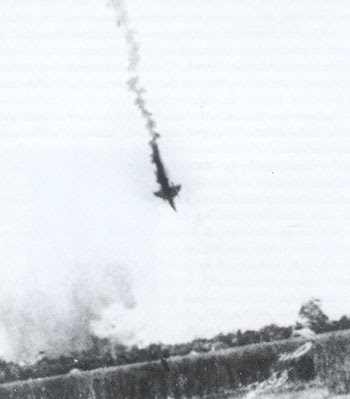
The Failed Air War Over Vietnam
or go to
Aletho News Archives – Video-Images
From the Archives
USS Liberty Massacre: A Pivotal Moment in the Hostile Takeover of America
By Kevin Barrett | Crescent | Dhu al-Qa’dah 24, 1445
In corporate America, hostile takeovers are commonplace. They occur when an aggressor—a larger corporation or rich individuals—seizes control of a smaller corporation without asking permission.
What few recognize is that the United States itself has been subjected to a hostile takeover. Since the aggressor, the illegitimate settler colony known as “Israel,” is much smaller than the US, the takeover has necessarily been surreptitious.
As of June, 2024, Israel’s gradual takeover of the US has become obvious and undeniable—a proverbial “elephant in the living room.” … continue
Blog Roll
 Aletho News
- Yemeni Armed Forces Warn Airlines Against Using Saudi Airports, Exempt Mecca and Medina
- Iran security chief says powers greater than US tried to conquer Iran but ended in ‘dustbin of history’
- Europe’s mounting social chaos… chickens coming home to roost for proxy war against Russia
- US-Russia Diesel Deal Becomes Massive Defeat for Ukraine
- Hormuz and the Looming Economic Catastrophe
- Dhubab offensive, media blitz and the rapid unraveling of Saudi-backed coalition’s new gambit
- Putin Conveys to Trump Iran’s Vision on Possible Conflict Resolution – Kremlin
- The Search for Truth: Charlie Kirk’s Assassination One Year Later
- ‘Harsh reality’: Iran says France seeks monopoly on power and intimidation, not peace for all
- When Will This White House Madness End?
- If Americans Knew
- For three years, Israel has killed a child in Gaza every 71 minutes – Daily Update
- Israeli forces kill another child in Gaza – Daily Update
- Gaza ceasefire exists in name only, say more than 100 organizations
- Nearly 2 Million in Gaza Need Urgent Shelter Assistance as Winter Looms: IOM Chief Warns
- Suppressing Palestinian resistance: US charity under fire for AI monitoring of Gaza classrooms
- Thousands Are Held in Israeli Torture Camps. This Is What Happens Inside
- Israel puts Gaza’s sick, injured, newborn in peril – Daily Update
- Report claimed Mark Levin used by Israeli government to influence Trump
- Over 2,000 Gazans have died awaiting medical evacuation amid Israel’s continued siege
- How a U.S. Diplomat Suppressed and Altered Reports Critical of Israel
- No Tricks Zone
- Germany’s Green Energy Debacle: High Energy Costs Force Kahla Porzellan to Close After 182 Years!
- New Study: 50 Years Of The Most Aggressive ‘Net Zero’ Policies Can Only Affect The Global Climate By 0.03°C
- US September “Heat” Was No Record…Many Records Set Decades Ago
- Latest European Green Energy Debacle; Portugal’s Largest Flagship Solar Park Insolvent!
- Green Energy Debacle: German Expert Professor Fritz Vahrenholt Warns Of Severe Economic And Social Consequences
- Two More Paleo Reconstructions Affirm Meters-Higher Sea Levels Across Ireland, Brazil 7000-6000 Years Ago
- New Study: Earth And Venus Surface Warmth Largely Explained By Convection And Lapse Rate, Not CO2 Or Radiation
- 2025 Nature Paper Claiming Worsening Global Drought Gets RETRACTED …Heavily Flawed
- New Study: ‘Global Drought Shows No Detectable Recent Acceleration Under Climate Warming’
- Economic Masterminds: German Socialists Suggest Taxing Productivity Gains Stemming From Using AI

