UN Peace Coordinator Unwelcome by Palestinians
By Nicola Nasser | Al-Ahram | February 20, 2015
The PLO (Palestine Liberation Organisation) did not object to the appointment of new UN special coordinator for the Middle East peace process Nikolay Mladenov, although he was described by Tayseer Khaled, a member of the PLO’s Executive Committee, as “persona non grata” — not trusted by the Palestinians and nor qualified for the job.
The 15-member UN Security Council unanimously voted to appoint Bulgarian Mladenov, 42, to succeed Holland’s Robert Serry. He would also be the representative of the UN secretary general to the International Quartet (the UN, US, EU and Russia), and personal representative of the UN chief to the PLO and the Palestinian Authority (PA).
Although protocol allows the PLO the right to reject diplomatic representatives to the organisation, observers cannot understand why it accepted Mladenov. There is no convincing answer except a futile desire by the PLO to appease the UN and Secretary General Ban Ki-Moon, at a time when PLO diplomatic efforts are focused on the UN and its agencies.
Mladenov not only failed in a similar mission as UN envoy to Iraq and resigned, he is someone who describes himself — and is described by the leaders of the Israeli occupation — as “a good friend of Israel”. As Bulgarian foreign minister, Mladenov suggested a “military alliance” between Bulgaria and Israel. He has often spoken about his bias towards “Israel’s right to exist” and its right “to defend itself” against Palestinians resisting Israeli occupation. He even admitted to being a Free Mason, served Jewish billionaire George Soros, and publicly advocated the US’s “constructive chaos” policies in the Arab world. In fact, his Jewish origins may be the least controversial aspect of him.
Meanwhile, the occupation state does not hesitate in ignoring the UN, its resolutions and representatives, disregarding and even assassinating them when necessary. Most recently, Israeli Foreign Minister Avigdor Lieberman threatened to “expel” Mladenov’s predecessor Serry as “persona non grata”. Shortly before that, William Schabas, the head of the UN commission investigating the occupation’s recent war on the Gaza Strip, resigned after Israel refused to cooperate with him or allow him to enter the country.
After the UN tolerated the assassination of its first envoy to Palestine, Swedish Count Folke Bernadotte in 1948, at the hands of the Zionist Stern Gang led by Yitzhak Shamir (who later became prime minister of the occupation state), Israel was emboldened to adopt a permanent policy of disregarding the UN without deterrence so far.
In fact, over the past two years the occupation state has carried out a proxy war against the UN. It has facilitated logistics, intelligence, firepower and medical assistance to allow the domination of militias fighting the Syrian regime on its side of the disengagement zone between the liberated and occupied Arab Syrian Golan. This compelled the UN Disengagement Observer Force (UNDOF) to withdraw after its positions were attacked, dozens of its troops kidnapped and their weapons and equipment seized. Until today, the UN has not dared to rectify the situation, which resulted in the collapse of the UN-sponsored ceasefire and rules of engagement between Syria and Israel.
The Middle East is teeming with international peace envoys. The UN has one, so does the US, the EU, Russia, China and the Quartet. Their names change without anything on the ground in occupied Palestine changing. Except for expanding the occupation through settlements under the “peace” umbrella these envoys provide, without any hope that the international community they represent will be able to effect any real tangible change for the present and future of the Palestinian people on the ground.
So what can Mladenov do that his predecessors, the UN, the Quartet, the Arab League and others, couldn’t?
Khaled believes the real test, to remove Palestinian doubts about Mladenov’s role and mission, will be his position on the siege on Gaza and reconstruction there. However, Mladenov’s track record does not indicate there is cause for optimism. Nor does the track record of “UN special coordinators” since the creation of the position in 1994 and the subsequent expansion of its role, as well as the extensive history of choosing UN and US envoys of Jewish origins or related in the first degree to Jews, such as Henry Kissinger, Madeleine Albright, John Kerry, Dennis Ross, Martin Indyk and Quartet representative Tony Blair.
On 6 February, the secretaries general of the UN and Arab League issued a joint statement expressing “deep concern” about conditions in Gaza. They urged Arab and international donors to honour their financial pledges made at the Cairo Conference last October “as soon as possible”, in order to rebuild the Gaza Strip and end the siege there. A few days ago, James Rowley, UN coordinator for humanitarian affairs in the Palestinian territories occupied since 1967, sent out an “urgent call” for these commitments to be fulfilled and an “immediate” lift of the siege on Gaza, because he is “very concerned another conflict will break out” if not.
The Palestinian Foreign Ministry described the statement by the Quartet on 8 February after it met in Munich, Germany, as “short of expectations” because it ignored “all the old-new and evolving truths” of the occupation state.
The Quartet also said it is “deeply concerned” about the “difficult conditions in Gaza where reconstruction needs to be quicker” and urged donors to “pay their financial pledges as soon as possible”. However, it linked this to encouraging both sides to “restart negotiations as soon as possible”.
Restarting talks “as soon as possible”, nonetheless, must await the outcome of general elections in Israel and the US. This means the Palestinian people must wait for another two years in the vain hope of reconstructing Gaza. It is obvious the occupation state is enjoying the luxury of time, making easy the occupation without resistance, as well as building settlements without deterrence.
Before handing over the reins to Mladenov, Serry described the failure of donors to pay their dues as “scandalous” and warned “if there is no progress in the coming months” — not two years — towards a two-state solution, “the reality will be a one state [solution]”: the single state of Israel. Former UN coordinator Terry Rod Larsen said in 2002, “the Palestinian patient is dying in the interim.”
Last December, Serry warned in his report to the Security Council that a war in Gaza “could re-ignite if conditions on the ground do not change” in the besieged Gaza Strip. It is clear that what Serry described as a “deadly diplomatic vacuum” coupled with the ongoing siege on rebuilding Gaza, are an explosive recipe in the besieged Gaza Strip, the outcome and ramifications of which are unpredictable.
The “scandal” of donors not paying their dues to rebuild Gaza, as Serry described it, under the pretext that the PLO government does not control the Gaza Strip, is a green light given by the international community to the occupation state to carry out another military assault on national resistance forces in Gaza.
The scandal of Arabs not paying their pledges at Arab summits to provide the PA with a financial “safety net” amounts to flagrant Arab pressure on the PLO to accept the Quartet’s proposal to restart talks with the occupation state “as soon as possible”.
This is Mladenov’s dual mission as the new UN special coordinator for the Middle East peace process. PLO negotiators continue to wait for a breakthrough by “peace” envoys that are imposed on them and appointed by the US and the UN, although they represent the occupation state. Mladenov is the most recent. He will not change anything on the ground.
Translation by Palestine Chronicle
Nicola Nasser is a veteran Arab journalist based in Bir Zeit, West Bank of the Israeli-occupied Palestinian territories. He can be reached at: nassernicola@ymail.com.
New testimonies from Palestinian children subjected to torture in Israeli prisons
IMEMC News & Agencies | February 19, 2015
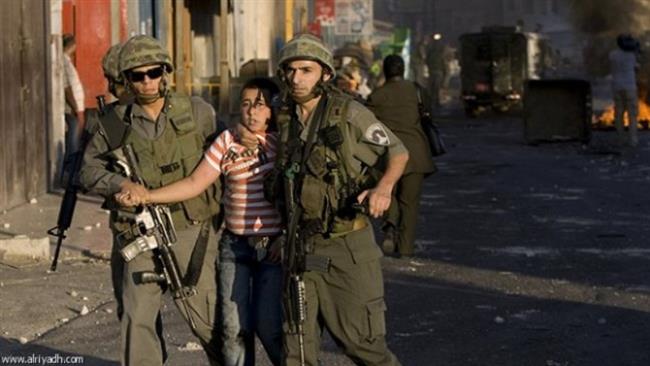
New testimonies from Palestinian minors have made their way out of Israeli prisons, speaking of the brutal beating and torture of youngsters conducted by Israeli soldiers and investigators.
Hiba Masalha, lawyer of the Palestinian Detainees Committee, who visited a number of children in HaSharon Israeli prison, said that the prisoners suffered incredibly savage treatment and brutality.
According to the PNN, 16-year-old prisoner Mohammed Zidani, from Silwan village, who was detained on the 10th of November, last year, and sentenced to 16 months of prison on January 19 of this year, said that he underwent electric shocks during his detention, for “confessions”.
Ziadni told Masalha that he was driven away from his home at 2 AM by private units and soldiers after they overwhelmingly raided his home, then dragged him to the Mascoubiya detention center, “room number 4”. The child said that, before they reached their destination, they stopped the military jeep bearing them, took him down to the street and started beating him so hard he suffered bruises and contusions all over his body.
In Mascoubiya room number 4, Mohammed said that he was forced to kneel and put his head between the legs, with his hands cuffed to his back and his eyes blindfolded. He was kept in this position for 4 hours. The investigation carried on for about 12 hours. He was given no food and was not allowed to go to bathroom.
Zidani said that during the investigation sessions that used to carry on until after midnight, the investigators beat him on his face and stomach.
During one of the sessions, Mohammed said, the investigator had “a stick shaped machine,” put it on his foot and pressed a button. Mohammed then felt the electric shock invading his body, and had unbearable pain in his foot. The investigator repeated the process three times in a row to “pull confessions out of him.” He started shouting of pain.
The testimony of another child prisoner, Kathem Annous (15) further demonstrates the torture children receive in Israeli jails.
Kathem, from Ras Al-Amoud, in occupied East Jerusalem, has been detained since November 3 of last year, in Hasharom prison. Similar to Mohammed Zidani’s case, he was driven from his home by Israeli soldiers and intelligence, and driven to a nearby settlement handcuffed and blindfolded, and kept for hours in the cold.
One soldier, using his iron-soled shoe, slammed Kathem’s foot, causing him contusions. He was then driven to Mascoubiya detention center.
During the investigation, Kathem was forced to kneel and point his head towards the wall, handcuffed. The investigation took 3 hours, in which Kathem was constantly beaten on his stomach and slapped on the face. He was kept in Mascoubiya for 12 days.
Annous said that he was also beaten by the Nahshon forces on his way to the court, and his handcuffs were very tightened. He mentioned that one time,a Nahshon member attacked him in the waiting room, and started violently knocking his head against the wall, for no reason whatsoever.
Anemic 14-year-old prisoner, Khaled Al-Sheikh, has been imprisoned for 55 days now, and hasnt been allowed to see his parents since then.
Child abuse in Israeli prisons is on the increase. According to Ahrar Center, there are about 300 children detained in Israeli prisons.
Briefing – Gaza: Life beneath the drones
By Tom Anderson and Therezia Cooper | Corporate Watch | February 19, 2015
Click here to download – 150 DPI PDF | 300 DPI PDF
Click here to buy
Click here to read online
Unpiloted aircraft, known as drones in the arms industry, have become Israel’s weapon of choice in its attacks on Gaza. In 2012 drones killed more people in Gaza than any other aircraft. In Israel’s ‘Operation Protective Edge’ attack, 37% of those killed died in drone attacks.
In 2013 Corporate Watch visited Gaza for two months to interview the survivors of drone attacks and human rights workers about the effect of living beneath the drones. The interviews tell the story of the survivors and highlights their calls for support from the global solidarity movement.
This briefing compiles the interviews and gives short profiles of some of the companies profiting from Israel’s drone wars: Elbit and IAI.
We hope that reading this briefing will inspire you to take action in solidarity with people living under siege in Gaza. As one survivor of a drone strike told us: “We do not need just words”.
Hamas rebuffs Blair’s allegations
MEMO | February 18, 2015
Senior member of Hamas’ political bureau Mousa Abu-Marzkouk yesterday revealed that Quartet peace envoy Tony Blair is trying to blackmail Hamas in return for reconstructing the Gaza Strip.
On his Facebook page, Abu-Marzouk revealed five conditions put by the Quartet that Hamas has to meet in order to make way for the reconstruction of what the Israeli occupation destroyed during last summer’s 51-day war in Gaza.
Abu-Marzouk said: “Once again, and in the name of the international community, Tony Blair is exploiting the tragedy made by the Israeli occupation that includes the destruction of homes and making people homeless.”
Expressing deep concern about the devastated people in Gaza, Abu-Marzouk said: “Destroyed homes of Palestinians in Gaza became shrines to Blair and his likes. Blair says that there is no reconstruction unless these five conditions are fulfilled, and Hamas has to agree to:
- Accept the Palestinian reconciliation.
- Accept the political programme based on a Palestinian state on 1967 borders.
- Reiterate that Hamas is a Palestinian faction with only Palestinian goals and it is not part of any Islamist movement with regional goals.
- Adopt the two-state solution as a final, not temporary, solution for the Palestinian-Israeli conflict.
- Send an assurance message to Egypt that Gaza is not a terror base for Sinai terrorists and hold talks with the Egyptian government to stop terrorism in Sinai.”
“These are the conditions for Hamas to be accepted by the international community as well as the Quartet’s conditions for rebuilding Gaza and improving living standards,” Abu-Marzouk said.
He added: “These conditions do not mean that Hamas will deal with the Zionist enemy; not even one condition was put on Israel.”
Abu-Marzouk refuted the conditions one by one. Regarding the reconciliation, he said: “It was achieved. I do not know what more is needed from Hamas, which conceded everything for a technocrat government.”
About the state on the 1967 borders, he said: “The problem is not with the Palestinian side, but with the other side. Blair should have spoken about it with Israel. He should have asked it whether it accepts a Palestinian state on the 1967 borders with Jerusalem as its capital and whether it accepts to dismantle settlements.”
Regarding Hamas’s goals, he stressed that Hamas is a Palestinian faction with Palestinian goals and it is not part of a regional Islamist movement. “We know that he means the Muslim Brotherhood,” he said.
“This is used by all as a pretext,” he stressed. “Hamas is a Palestinian movement and its history proves that as it has not carried out any of its operations outside the Palestinian lands. Even when its leaders were targeted outside Palestine, it did not respond in the same places.”
Meanwhile, he reiterated the importance of Hamas having links with any side offering help for it. “We have no interest to have hostility with any party wherever it is and whatever the ideological differences with it are,” he said.
About the two-state solution, Abu-Marzouk said: “Blair knows that any oppressive agreement cannot remain alive for too long. Any agreement imposed by the current powers cannot remain the same when these powers change.”
Regarding Egypt, he explained: “Egypt is not merely a neighbouring country; its stability and unity are in the Palestinian interest. We deal seriously and responsibly with anyone who harms Egypt. Gaza will absolutely not be a breeding ground for terrorism.”
Adding that Hamas’s relationship with Egypt is not of Blair’s concern.
Journalism Student & Folk Dancer, Lina Khattab, Sentenced to Six Months
By Saed Bannoura | IMEMC News | February 17, 2015
The Israeli military court in the ‘Ofer prison, in the occupied West Bank, sentenced on Monday, a Palestinian journalism student who is also a Folk Dancer and activist, Lina Khattab, to six months imprisonment and a 6,000 Shekel fine.
The court also instated a three-year suspended sentence on Khattab, 17 years of age, for what it called “participating in a protest in solidarity with Palestinian political prisoners,” in front of the Ofer prison.
Lina Khattab, who is a Journalism student at Birzeit University, was kidnapped by Israeli soldiers on December 13, 2014, during a nonviolent protest organized by students marking the 47th anniversary of the establishment of the leftist Popular Front for the Liberation of Palestine (PFLP).
This past December, an Al-Quds News broadcast report about Lina featured an interview with her mother who spoke of the kidnapping of her daughter by the soldiers, who deliberately targeted her for her nonviolent political activities.
In the interview, Lina’s mother said that when she managed to see her for the first time, she noticed that her daughter has lost a lot of weight, and also told reporters that despite harsh living conditions and interrogation methods, her daughter remained steadfast to her principles of justice and liberation.
She added that her daughter told her about the extreme beating she was subjected to when the soldiers kidnapped her, before placing her in their jeep, and that the soldiers were angered that despite the beating, she was not crying, and even asked her why she wasn’t crying, but she remained strong and steadfast without showing any signs of weakness.
The soldiers claimed she hurled stones at them, but she continuously told them she was visiting her friend, and that the soldiers were just trying to frame her by making different allegations and fabrication.
Following her arrest, Dina was moved to the ‘Ofer Israeli prison, were she was forced to stand against a wall in the rain and cold, and the next day, she was moved to the HaSharon prison.
Whenever she was moved to HaSharon to the Ofer military court, the soldiers would wake her up nearly at 2 am, and deprive her from sleeping, before moving her to Ofer in a military vehicle while deliberately running cold air through the area of the vehicles were she was held, and once arriving in Ofer, she would also be placed in a cold room with a cooling system on despite the cold weather.
Activists in UK occupy second Israeli owned arms factory
MEMO | February 17, 2015
A factory in Kent owned by Israeli arms company Elbit Systems was occupied early Tuesday morning by activists responding to the Palestinian call for solidarity and BDS.
Instro Precision, a subsidiary of Elbit, was occupied at 5am, with more than a dozen activists taking up positions on the roof and at the entrance.
According to a press release from London Palestine Action, “Instro is owned by Israeli arms company Elbit Systems, who make drones that are used to kill Palestinian civilians in Gaza.”
It adds: “Optical and camera systems like those made at the Instro factory are also supplied by Elbit for use in drones flown over Afghanistan, as well as in Israel’s apartheid wall.”
The site in Broadstairs, Kent, is the second Elbit-linked company to be targeted by activists in the UK, after a successful occupation last summer of a drone engine factory near Birmingham.
Campaign Against the Arms Trade, welcoming the direct action, pointed out on Twitter that “there are 4 Elbit sites in the UK” and that “activists have so far targeted Kent & Staffordshire.”
Just last month, the prosecution of protesters who had occupied that first factory was dropped at the last minute, when Elbit refused to hand over evidence about its exports of weaponry to Israel.
During ‘Operation Protective Edge’, the Israeli military killed hundreds of Palestinians with drones. Activists say that Elbit Systems supplies 85% of the drones used by the military, and that the company’s “share price rose in July off the back of the extensive use of its technology during Israel’s massacre.”
Demonstration in Bil’in honoring slain US citizens faces attacks and arrests by Israeli forces
International Solidarity Movement | February 17, 2015
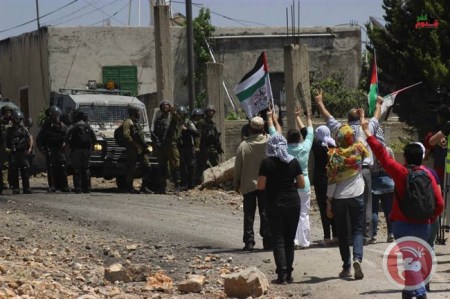
Bil’in, Occupied Palestine – On Friday 13th February, Israeli forces assaulted the demonstration in Bil’in with hundreds of tear gas rounds, dozens of stun grenades and pepper spray, injuring eleven Palestinian, Israeli and international demonstrators. Member of the Bil’in popular committee Mohammed Khatib and a UK citizen and solidarity volunteer Michael “Mick” Bowman were both violently arrested. At the demonstration, Palestinian activists carried posters honoring Kayla Mueller and condemning the murders of the three students in Chapel Hill, North Carolina.
“As people were protesting a soldier suddenly came running, wielding pepper spray, spraying it at journalists and activists indiscriminately,” reported Karam Saleem, a Palestinian activist present documenting the demonstration. Those who had been pepper sprayed, including Mohammed Khatib, were taken down to an ambulance to treat their burns. Saleem continued, “Mohammed was about twenty meters away from the main part of the protest, still suffering from pepper spray, when suddenly a soldier ran after him and grabbed him. Another five soldiers quickly surrounded him and shoved him violently to the ground.”
He was handcuffed and blindfolded before being loaded into a military jeep.
Israeli forces targeted journalists and those attempting to document the protest; many were shoved and threatened while attempting to photograph or film. Those present reported that the Israeli military also fired tear gas directly at people holding cameras.
Journalist being assaulted by Israeli forces – only one of many that Friday in Bil’in (photo by ISM)
Israeli forces pepper sprayed demonstrators who were doing nothing more that trying to photograph the army’s brutality, and also pepper sprayed those holding posters of Kayla Mueller and the three US students from Chapel Hill. Jameel Al-Barghouthi, head of the Palestinian Authority Committee Against the Apartheid Wall and Settlements, Munthir Amira, head of the Popular Struggle Coordination Committee (PSCC), Mohammed Khatib, a member of Bil’in’s Popular Struggle Coordination Committee, Issam Rimawi, a Palestinian photojournalist, two Palestinian activists Abdallah Elian and Kafah Mansour, British citizen and activist Mick Bowman, two female Israeli activists, and one Danish and one Dutch female international volunteer were all injured.
“The army was extremely brutal yesterday in their use of tear gas, beatings, and pepper spray,” recalled Tali Shapiro, an Israeli activist who was severely pepper sprayed in Friday’s demonstration, suffering from first degree burns on her hands, ears, and most of her throat and neck. “We saw they were beating and arresting someone (Mohammed Khatib), so I ran towards them. By the time I got up the hill Mohammed had been taken away and another man [Mick] was on the ground with many soldiers on top of him, twisting his limbs and head. I immediately took out my phone to take pictures. The soldiers started pushing away journalists. They formed a line in front of several of us, and before I could assess the situation another soldier sprayed my face with pepper spray.”
Activist Tali Shapiro after being severely pepper sprayed (photo by ISM)
Fifty-six-year-old Mick Bowman, a social worker and resident of Newcastle upon Tyne, England, recalled that in the time before his arrest, “the Israeli forces behaved with particular aggression towards protesters who were carrying the posters of Kayla and of the students from Chapel Hill North Carolina.” Border police threw stun grenades directly towards demonstrators, scattering those holding posters near the front of the protest.
“Next thing I knew,” Mick recalled, “three or four soldiers jumped on me from behind and forced me to the ground. I was lying face downwards, with a couple of them kneeling on my back.
Mick Bowman, knelt on, assaulted and pepper sprayed by Israeli border police arresting him (photo by ISM)
As they were handcuffing me, one of them stood on my hand, rubbing his boot back and forth and crushing my thumb. One of them grabbed my nostrils, and another was pressing down on my face, causing abrasions and bruising around my right eye. After they had handcuffed me, a border policeman also pepper sprayed the left side of my face from the distance of a few inches.”
After their arrest, Mohammed and Mick were transported to the Binyamin settlement police station. Mohammed Khatib was taken to Ofer military prison and Michael Bowman was taken to Muskubiya (the Russian Compound) prison in Jerusalem. Both were charged with ‘assaulting a soldier.’
“When police officers use violence they always claim that violence was used against them. It’s standard procedure” explained Mohammed Khatib. Mick was released on the evening of February 14th, and Mohammed was eventually released on the evening of February 15th, on a bail of 4,000 shekels (1,030 USD).
Abdullah Abu Rahma, head of the Bil’in popular committee, described the purpose of demonstration in Bil’in: “On Friday we protested against the theft of our land by Israel’s illegal wall and settlements and to express our resistance to terrorism everywhere. We carried the images of Kayla Mueller who was killed while being held captive by Da’esh and who had marched with us in Bil’in. We also carried the images of Deah Barakat, Yusor Mohammad, and Razan Abu-Salha, who were murdered in their home in North Carolina. We made it clear that we will oppose terrorism and the killing of innocent people whether it is committed by organizations like Da’esh, by states like Israel or by individuals like the murderer from Chapel Hill.” This Friday will mark the tenth anniversary of Bil’in’s popular resistance demonstrations – against the Apartheid Wall, against the Israeli occupation, and against oppression and violence everywhere.
Israel’s claims on journalists slain in its war “misleading”
Palestine Information Center – February 16, 2015
GAZA – The Palestinian ministry of information strongly denounced Israel’s channel 7 for fabricating claims about some of the journalists that had been killed by the Israeli army during the last war on the Gaza Strip, and described its report as “misleading.”
Israel’s channel 7 claimed in a recent report that eight of the journalists who were killed during Israel’s last military operation in Gaza were working for Hamas and Islamic Jihad.
The information ministry said in a press release on Sunday that the channel’s claims about the journalists was an exposed attempt by the Israeli government to shirk its responsibility for the crimes its army had committed against the journalists in Gaza.
The ministry underlined that all Israeli crimes against the journalists in the last war were documented in reports issued by international and local organizations, especially the International Federation of Journalists.
It said that Israel’s attempt to deflect attention from its crimes by questioning the number of slain journalists and their professional activities could not deceive the UN probe committee or the international community.
Israeli authorities ban water hook-up to Palestinian city
MEMO | February 16, 2015
Israeli Minister of National Infrastructure, Energy and Water, Silvan Shalom, banned water connection to the new West Bank Palestinian city of Rawabi, which is to house around 40,000 Palestinian families, Israeli newspaper Haaretz reported yesterday.
Israeli Defence Minister Moshe Ya’alon and the Coordinator of the Israeli Government Activities in the Palestinian Territories Major General Yoav Mordechai had ordered the Israeli Water Authority to provide water to the city.
However, Shalom refused Ya’alon’s instruction saying that water and sewage projects in the West Bank require the Israeli-Palestinian Joint Water Committee’s (JWC) approval.
Shalom blamed the Palestinians, claiming they have been refusing to convene the committee since 2010. The response from Shalom’s office stated that according to an agreement with the Palestinians signed in 1995, the committee is the principal party which decides on such issues in West Bank communities.
Haaretz reported the Palestinian side confirming that the committee had not convened since 2010, but they insisted this does not justify the ban to connect water to the city.
The head of project department in the Palestinian Water Authority, Ihab Al-Barghouti, said: “The reason that the committee has not convened was the Israeli condition that the committee must approve an Israeli settlement project in return for any approval of any Palestinian project.”
Al-Barghouti insisted that the Palestinians refused this condition, thus, they do not attend the committee’s meetings.
UK Human Rights Activist Beaten and Arrested by Israeli Soldiers at Protest in Palestine
Mick Bowman being arrested by Israeli soldiers in Bil’in / Haitham Khatib
By Alexandra Halaby | IMEMC & Agencies | February 16, 2015
Human rights activist and English political candidate, Mick Bowman, alleges he was beaten and arrested at a peaceful demonstration in Palestine on Friday.
The human rights activist from Tyneside, in North East England, claims he was beaten and abused after being arrested while taking part in a peaceful demonstration in Palestine on Friday.
Mick Bowman, aged 57, from the United Kingdom, said he was pepper sprayed in the face from less than six inches away during his arrest Friday afternoon. He was then detained without charge by Israeli soldiers for 24 hours and then released.
The case of Mr. Bowman’s violent arrest is being investigated by Israeli authorities who claim that his alleged treatment was “unacceptable” and “inappropriate,” according to a statement received by IMEMC.
Mr. Bowman is a member of the Newcastle Palestinian Solidarity Campaign (NPSC) located in Newcastle-upon-Tyne in England. He is also actively involved with his local branch of Amnesty International. Bowman was taking part in a peaceful demonstration along with other international solidarity volunteers protesting Israel’s continuous violations of Palestinian human rights in the village of Bil’in, located in the West Bank just north of Ramallah.
Witnesses at the Bil’in protest tell IMEMC that Mr. Bowman did not commit any violent acts and that he was arrested for no apparent reason.
Palestinian, Israeli, and international activists gather in the village of Bil’in each Friday to protest the construction of the illegal Israeli separation wall which has divided the village. Previously, President Jimmy Carter has joined the Bil’in protests, as has Richard Branson. In April 2009, a Palestinian man, Bassem Abu Rahmeh was killed when an Israeli soldier fired a teargas canister into his chest. The death of Bassem Abu Rahmeh was depicted in the 2011 film, ‘5 Broken Cameras.’ The following year, Jawaher Abu Rahmah, a 36 year old woman, was also killed following protests at the village. The conditions of Ms. Abu Rahmah’s death were contested and most likely she died from suffocation following teargas being hurled at her face.
In a message Mr. Bowman sent to coordinators at NPSC, he says he was told he was arrested for allegedly assaulting an Israeli soldier.
He wrote in the message: “That was why they had detained and restrained me with ‘appropriate force’ (standing on my hands and thumping me etc to get the plastic cuffs on and then pepper-spraying my eyes from a distance of six inches after I had been cuffed but refused to stand up).
“The military were extremely aggressive from the outset in how they responded to what was a peaceful demonstration.
“I gave up counting the number of tear gas grenades fired after I counted 50 or so – the eventual number will have been in the hundreds – and stun grenades and rubber coated steel bullets were fired at us all.”
Mick Bowman is a mental health social worker in his native UK. He was held for 24 hours by Israeli soldiers during which time he was processed by the military, interviewed by Israeli civil police, and taken to a military court. He was released on Saturday night with stipulations that he never return to the West Bank.
Mr. Bowman is now in Jerusalem and due to return to the UK on Thursday.
Why Jonathan Freedland Isn’t Fit to be the New Editor-in-Chief of the Guardian
By Blake Alcott | CounterPunch | February 13, 2015
Should Jonathan Freedland, the Guardian’s Executive Editor, Opinion, take over the editor-in-chief’s post from Alan Rusbridger? Freedland’s instalment is rumoured to be a condition set by the New York Times if the two enlightened North Atlantic papers are to merge, but even without this his chances seem good.
A central topic for both papers, as for the world in general, is Palestine, Israel, the Middle East. The topic is said by Freedland himself to have been his specialty for some twenty years. I have read through 100 of his writings on the subject in the Guardian, the Jewish Chronicle and the New York Review of Books and conclude that their content should worry the Guardian staff, its readers and his employer The Scott Trust. His support for Israel is unbalanced, violates the Guardian’s commitment to liberalism and is rooted in an ethnocentricity that enables him to alternatively ignore Palestinians and justify their forced transfer out of Palestine.
In order of decreasing importance:
* He justifies the ethnic cleansing of Palestinians.
* His writing is Israel-centric and biased towards Israel.
* His Mideast world is largely free of Palestinians.
* He conflates criticism of Israel with ‘anti-semitism’.
* His narrative is largely that of Israeli hasbara.
Ethnic cleansing condoned
Freedland’s friend and Ha’aretz journalist Ari Shavit made a stir in 2013 with his portrayal of Israel’s ethnic cleansing, by murder and expulsion, of the Arab-Palestinian town of Lydda in July 1948. In one of his reviews of Shavit’s story Freedland correctly writes that Shavit “meticulously reconstructs events in the mainly [sic] Arab town of Lydda in July 1948, when soldiers of the embryonic [sic] Israeli army emptied the place [sic] of its Palestinian inhabitants and… killed more than 300 civilians”. He confirms Shavit’s admission that “Zionism carried out a massacre”; it resolved that the Arabs of Lydda be “expelled quickly”: “if a Jewish state was to exist in Palestine an Arab Lydda could not exist…”
In another review of Shavit his claim is incorrect, however, that Shavit only “touches on the question of justification too” and “avoids a direct answer”. Shavit’s ‘shoot and weep’ approval is very clear. He writes that “the choice is stark: either reject Zionism because of Lydda or accept Zionism along with Lydda… I will not damn the brigade commander and the military governor and the 3rd Battalion soldiers. On the contrary, if need be, I’ll stand by the damned, because I know that if not for them the State of Israel would not have been born… They did the dirty, filthy work that enables my people, myself, my daughter, and my sons to live.” Shavit harbours righteous anger towards the “critics of later years who condemn what they did in Lydda but enjoy the fruits of their deed.” His final solution is the status quo: “Do I wash my hands of Zionism? Do I turn my back on the Jewish national movement that carried out the destruction of Lydda? No.”
Freedland concurs. As Ben White shows, already in 2004 in a book chapter Freedland wrote, “I have long believed Israel should be strong enough to admit the reality of 1948 – and to defend it all the same.” White demonstrates that while Freedland has passionately condemned ethnic cleansing in Darfur and Kosovo, he not only does not condemn the Zionist actions of 1948 (and since) but, as in his book Jacob’s Gift as well, he condones the ethnic cleansing; the “flight, expulsion and dispossession, the emptying of 400 villages and the creation of around 700,000 refugees” was all right because “the creation of a Jewish state was a moral necessity”, the Jews had “the right… of the drowning man” to force the Palestinians off Palestinian land. As Shavit says, “If Zionism was to be, Lydda could not be. If Lydda was to be, Zionism could not be.” Both Shavit and Freedland choose Zionism. In the same breath and in bad taste, Freedland exhibits his cleverness by joking that Shavit is “a Wasp, a White Ashkenazi Supporter of Peace”.
Further hard evidence against Freedland is found in a 2008 Guardian ‘Sounds Jewish’ podcast wherein he says, “I’m of the view that says admit the price that was paid but then say to the world, tragically, it was necessary, given the place the Jews were in given the calamity of their own, the slaughter in the holocaust. So I think you have to, you can be cleared-eyed and honest about this. It doesn’t actually compromise the moral need that Israel had 60 years ago, to admit that in order to implement that moral need there were terrible sufferings for other people involved.” As he preaches in his August 2014 review, while the blood of Operation Protective Edge was flowing, “the Jewish state had become a mortal [sic] need” and a “moral necessity”.
To understand the endorsement of how Israel was ‘born’ by ‘left Zionists’ such as Shavit, Freedland and Benny Morris it is necessary to read Shavit’s seminal 2004 Ha’aretz interview with Morris, reprinted in full in Counterpunch. In Freedland’s own critical yet friendly 2009 Guardian interview of Morris, Freedland eschews any expression of his personal opinion on Morris’ derogatory generalisations about Arabs, but instead uses rhetorical displacement to note merely that Morris’ language will make “liberal Israelis, liberal Jews, just liberals… squirm”; “people would [say] that’s… racism”. Compare Shavit’s relatively bold reply to Morris’ approval of Ben Gurion’s “purification” of Israel of gentiles: “I don’t hear you condemning him.”
Readers who like to read between the lines will like Freedland’s review of three biographies of Ariel Sharon, the ‘Butcher of Beirut’, Israel’s main post-1947 purifier who “embodied [Zionism’s] determined quest for land and its readiness to use brutal force.” Notwithstanding some ambiguity, Freedland is an admirer. Sharon may be an “enigma” to Freedland – less so, one suspects, to Palestinians – and have left an “uncertain legacy” – a view that would induce bafflement amongst Palestinians and Lebanese – but he was a “warrior” whose life was “rich in the raw material from which myths are made”, a “soldier… who… chased away enemies” and debriefed his own soldiers “even as a bullet remained freshly lodged in his leg”, a “new breed of Jewish warrior” who was “ruthless in the pursuit of safe and generous borders for the Jewish state”.
In an example of his amoral attitude towards Palestinian issues, Freedland judges Sharon’s building of “the separation barrier”, his decision that the Palestinians must be “bombed, harassed and intimidated” and his “pursuit of the settlement project” not on ethical grounds but rather on the grounds that these undermine Israel’s true interests. Sharon is nothing worse than “a weak strategist” who failed to see “the problem” of the demographic threat to Israel’s Jewish nature of equal numbers of Palestinians – in Freedland’s words, the need to leave “fewer Palestinians on Israel’s books, so to speak”. In violation of a central liberal tenet, Zionism and Israel have always manipulated demographics for political ends.
Back to the present. In his piece last summer ‘Liberal Zionism after Gaza’ Freedland’s writes, “Privately, people admit to growing tired of defending Israeli military action when it comes at such a heavy cost in civilian life, its futility confirmed by the frequency with which it has to be repeated.” One reads and gasps: murder “has to be” done. Freedland is by the way neither emotionally nor intellectually able to regard Gazans’ firing of rockets using the same lifeboat ethics used by the “liberal Zionists” [sic] regarding Lydda: a question of survival, either you or me.
Freedland’s support for ethnic cleansing is by itself enough to disqualify him from not only the chief editorship but his present job. Condoning the Nakba is out of bounds. It is a moral failing to believe Palestinians should pay for crimes committed by Christians in Europe. The message that two wrongs don’t make a right is beneath every standard for which the Guardian otherwise battles day in and day out.
Israel-centrism
Freedland is strongly and openly biased towards Zionism/Israel in this century-old conflict. He takes sides, is both personally and ideologically bound up with Israel, admittedly looking for its name in any list of countries, quickening at any sight of its flag. Outside of New York and London his time is spent in Israel, not Palestine or other Arab places. As he wrote in 2013, “My views [are] rooted in the firm desire to see Israel survive and thrive…” However, because Israel’s thriving is at the expense of the lives and dignity of the Palestinians his personal, understandable bias becomes relevant to one of the leading liberal newspapers of the world.
Freedland admits to following Israeli politics “obsessively”. What little he writes about Palestinian or Arab politics is superficial, and even columns about recent events in Syria or Egypt, or the Arab Spring, are analysed almost exclusively in their relation to Israel. “Where those watching from afar can afford to feel only hope for Arab democracy, it is understandable that Israelis feel mainly fear.” While noting that Zionism “was all about” a similar quest for “self-determination”, he “understands” Israel’s lack of joy at the prospect of the Arab spring and Arab democracy, cynically if circumspectly endorsing Moshe Aren’s dictum that “Peace you make with dictators.” Israel’s support for anti-democracy in its region is “understandable”. Freedland is using a double standard, and his allegiance to democracy less than full.
As with democracy, so with pluralism. Simultaneously downplaying and confirming the strength of the Israel lobby in the US, Freedland once warns AIPAC (the American Israel Public Affairs Committee) to be more tolerant of opposing views. AIPAC’s intolerance “is not just an offence against pluralism, it also hurts the very cause AIPAC purports to serve: Israel.” The bottom line is not ethics or liberalism, it is Israel.
When in May 2013 Stephen Hawking joined the academic boycott by cancelling a planned appearance in Israel, Freedland directed his concern not to the reasons why Hawking might adhere to the boycott call, and much less to the arguments of the Palestinian academics making the call, but to the frightful prospect that the boycott’s endorsement by people of the calibre of Hawking might lead to Israel’s being “shunned and vilified” as a “pariah state” by the “mainstream”. As so often Freedland addresses “those who wish the best for Israel”, evidencing no interest in the meaning for Palestinians of Hawking’s employing this peaceful method of pressuring Israel. Similarly, at the height of the bloodshed in Gaza he used the Tricycle Theatre’s refusal to host films financed by the Israeli government as a chance to once again arrive at his bottom line, namely Israel’s “strategically calamitous situation”, its “pariah status that is looming”, and the damage to its “standing in the world”.
Even the funeral of Nelson Mandela interests Freedland only because Netanyahu and Peres did not attend. It cast shame on Israel to be absent “when the family of nations gathered”; Zionism, after all, had fulfilled the need for “the Jewish people to re-join the family of nations”. He even cannot resist calling the funeral “a shambolic affair”, and his blindness to Israel’s apartheid-like characteristics prevents him from seeing that it might have been bad taste for it to show up at the ultimate honours for a man who spent 27 years in jail for fighting apartheid.
Even his support for Palestinian statehood stems from his support of Israel. In arguing for recognition of Palestine he writes that such recognition would “support the idea of ‘Israel alongside a Palestinian state, thereby entrenching Israel’s legitimacy and its permanence’. Having the general assembly… vote for such a resolution would amount to de facto recognition of Israel – and reassure those who fear the country’s ‘delegitimisation’.” He praises Peter Beinart for “distinguishing democratic [sic], pre-1967 Israel from the post-1967 territories” and for Beinart’s “goal of simultaneously ‘delegitimising the occupation and legitimising Israel’ – all for the sake of securing Israel’s own future.” What matters is the well-being of Israel; the intrinsic rights of Palestinians are not even an afterthought.
Freedland’s narrow focus becomes callous in a column about ‘Operation Cast Lead’ in January 2009 entitled ‘Gaza after a Hamas rout will be an even greater threat to Israel’. His concern is much less with the fate of dead and wounded Palestinians than with the war’s “damage to [Israel’s] international reputation” and the “dangers” for Israel of weakening Fatah’s position over against that of Hamas. He once similarly wrote that while the IRA always accepted Great Britain as such, Hamas doesn’t accept Israel, and that “Israel could truthfully cite the Ulster precedent when it says it cannot sit down with Hamas until it renounces violence.” He just cannot see that most Palestinians refuse to sit down with Israel until it renounces its decades of violence.
Writing “as the war in Gaza wound down” from his Greek holiday in summer 2014, Freedland reflects that although the Greek economy is in the doldrums Greece is not at war, but “Ashdod and Israel are not so lucky.” Aha, it is all a matter of luck. Gaza City, Jabalia City and Rafah – with rubble and corpses not to be found in Ashdod – are not worth mentioning. For Freedland the problem with last year’s Gaza war is that it is “self-defeating” – for Israel; it “will give Israel no security”.
Throughout, Freedland elides Jewishness and Zionism, for instance routinely calling Israel “the Jewish state”. One example is a piece in which he rejects the idea of one democratic state (supported he says only by “diehard Arab rejectionists” and “old-school student lefties from the 1980s”) his paragraphs use the terms “Zionism”, “Israel”, “the Jewish state” and even “the Jews” interchangeably. It is therefore more accurate to describe his starting-point as ‘Jewish-Israel-centric’.
Freedland’s characterisation of Israel in ethno-religious terms could be ignored. We could see its conflict with the indigenous population as purely political, economic, military. Unless, as is Freedland’s tendency, we want to let the twenty percent of Israel’s citizens who are not Jewish disappear conceptually altogether, making their second-class status easier to ignore. Freedland overwhelmingly does neglect them, a consequence of his elision of Israel and Jewishness.
The conflation has the further consequence of enabling Freedland in his 2004 book chapter ‘Is Anti-Zionism Anti-Semitism?’ to regard it as “not an absurd claim” to say that “to attack Israel is to attack Jews”. He argues for this by claiming that “Jewish affinity with Israel is now so widespread and entrenched, across the political and religious spectrum, that it has indeed become a central part of Jewish identity.” This shows his sympathy for the (absurd) idea that Israel criticism is ‘anti-semitic’ (correctly: judophobic), and in co-opting all Jews for Zionism it is factually wrong: many Jews are anti-Zionists. But this group, with the exception of Norman Finkelstein, earns little of Freedland’s attention.
Perhaps the cruelest aspect of Freedland’s conflation is the conflation of Jewish suffering in Europe with the geographical and political area of the Middle East known as Palestine. Zionism always chose the Arab inhabitants of Palestine as those who must pay for the pogroms of Eastern Europe, the Dreyfus scandal, or the Holocaust, in willful ignorance of the fact that the Palestinians had absolutely nothing – zero – to do with it.
His quasi-equation of Israel and “Jewish identity” led him to intervene as well in the controversy over London’s Tricycle Theatre’s attempt to not screen films sponsored by the Israeli regime: “The Tricycle’s insistence that the festival was only welcome if it cut all financial ties with the Israeli Embassy… seemed a realisation of long-held Jewish fears. Did this mean that Jewish participation in the cultural life of the country… would now be conditional on our first issuing a public disavowal of Israel?” Like a magician, Freedland in two sentences has changed the Theatre’s objection to “Israel” into opposition to “Jewish” participation – surely not the result of a reading difficulty. Similarly eliding gracefully between Israel, Jewish culture, the Israeli embassy in London, and ‘anti-semitism’ is an anonymous piece most likely written by Freedland which ends with non-sequiturs about attacks on French synagogues – but rhetorical analysis of this masterpiece is over my head.
Although Freedland often brings his own Jewishness into his political columns about Palestine and ‘anti-semitism’, it is not relevant to the points just made showing that the conflation of Israel and Jewishness is necessarily disadvantageous to Palestinian citizens of Israel, critics of Israel, Jewish anti-Zionists and Palestinians in general. Scores of gentile journalists, commentators and politicians share his outlook putting Israel, Jewish Israelis and worldwide “Jewish identity” at the centre of the Palestine question.
Finally, there is a nice teapot-kettle irony in Freedland’s “singling out” of Israel for journalistic and literary attention, for he often insinuates that ‘anti-semitism’ motivates those who “single out” Israel for criticism, as opposed for example to Syria or Darfur. He once feigns bafflement as to why people “single out” Israel; we who do so are even a “mob”. Whereby Freedland himself week in, week out singles out Israel for loving criticism, naming “the Israeli-Palestinian conflict” his journalistic specialty. Is he therefore guilty of the inverse racism of ‘philo-Semitism’? No.
Daphna Baram quotes Freedland in her 2004 book (pp 227-228) as follows: “Some Guardian people might wish it were otherwise, but it is a fact that the vast majority of Jews in the world today identify themselves with Israel, and see any attack on it as an attack on themselves. The result is that much of what we publish can and does offend our Jewish readers. My view is that if we are regularly offending most members of an ethnic minority, then that has to be a cause of concern…. [S]upport of Zionism is part of the Guardian’s own history. This is our heritage and we cannot break from it lightly.” That is, the Guardian should tailor its coverage of Israel to its Jewish, rather than its Arab or Palestinian, readership. And anyway, pro-Zionism is in the Guardian’s DNA.
When the desire for the well-being of any group, whether Jews, Christians, Moslems or Hindus, leads to justification of political privilege, it is relevant both to those discriminated against and, I believe, to what the Guardian should be. But even without this ethno-religious aspect, hiring Freedland as editor-in-chief will strengthen the Guardian’s pro-Israel bias.
The unimportance of Palestinians
The other side of the coin is that in Freedland’s world Palestinians are nearly absent. After distilling 100 of his articles I claim that he sees Israelis at the expense of seeing Palestinians. Like previous Zionists who saw the solution to the European ‘Jewish problem’ in Palestine, a purportedly literally or culturally empty place, they are his Oriental Other. Only once did I find him putting himself in the Palestinians’ shoes for longer than a half sentence, conceding that “the Palestinians feel exactly the same way [as the Jews]. They too have nowhere else.”
In the one column where I found general sympathy for Arab self-determination – he compares it to that achieved for Jews by the Zionists – my joy was short-lived. Lo and behold, he was referring only to self-determination in the surrounding Arab spring countries, excluding Palestine, that is, the group of Arabs in front of his nose, of which there is no mention whatsoever.
Palestinian refugees make up around 60% of the Palestinian population, but Freedland has devoted not more than perhaps three entire sentences to them. His moving article on Jewish refugee Otto Dov Kulka has never to my knowledge been balanced with more than a paragraph on any of the millions of ethnically cleansed Palestinians who lost their homeland 67 or 47 or 5 years ago or yesterday.
He does see Palestinians when they fire rockets. One description of the situation at the time of Cast Lead reveals his bias: “the Israelis of Sderot cowering in shelters from the Qassam rockets launched from Gaza; and the Palestinians, whose suffering only seems to deepen”. That is, Palestinians are the agents of Israeli suffering, while the Palestinians’ suffering simply happens, somehow, with no agent in sight.
Baram (p 197) mentions that Freedland characterised as “some of the most important on the topic…” the Guardian’s interviews in one year “with Ariel Sharon, the leftwing activist Uri Avneri, Rabbi Sacks, the refusnik Rami Kaplan, the Palestinian politician Sa’eb Arikat, Yossi Beilin,… and Shimon Peres.” Amongst these seven people exactly one is a Palestinian who, to boot, is a collaborator in the ‘Oslo process’ and the Zionist two-state-solution project supported by Freedland.
In the few columns in which Palestinians do appear, Freedland is advocating (in Israel’s self-interest of course) Israeli recognition of Palestinian suffering. But this “recognition” is all they get – no land, self-determination or permission to return. Freedland doesn’t even manage the word ‘apology’. He once hopes Israel will “acknowledge” that the Palestinians “suffer[ed] a nakba.” He asks: “If Israel could one day make such an admission, who knows what accommodation might follow?” Accommodation on the part of the Palestinians, that is.
In another piece he fantasises a similarly biased deal of “Israelis finally acknowledging the plight of the refugees created by the birth of the state of Israel, and Palestinians finally deciding whether they can accept a Jewish state.” Again, in return for “acknowledgement” the Palestinians give 80% of Palestine to the Zionists. He then sweetens the deal by reassuring the Palestinians that they will not be “asked… to reject the entire narrative of their recent history.” This is magnanimous: they can evidently retain half their narrative of the recent part of their millennia of history.
Similarly, his take on the “liberal Zionist” [sic] two-state solution is that “Jews could have a state of their own, without depriving Palestinians of their legitimate national aspirations.” [Some] Jews get a state, while Palestinians get “aspirations” – moreover only their “legitimate” ones, not their ‘illegitimate’ ones.
In his 2004 book chapter he goes farther when saying that “Israel should make amends [for the Nakba] – through compensation, restitution, and commemoration. Let those four hundred villages that were emptied be named and marked, and let Palestinians remember what they see as the naqba, the catastrophe, their way.” The generosity of the vague offer of “restitution” notwithstanding, what the Palestinians get is naming, marking, commemoration and memories – no return to present Israeli territory, which is the elephant in this paragraph’s room – while Israel keeps Palestine. And as Ben White adds, “It is unclear why Palestinians need this permission.”
Standing over against and of course outweighing these “aspirations” are what Freedland dozens of times calls the Jewish “need” for a state (in Palestine), or even “the craving for a place the Jews could call their own… Whatever view you ultimately take on the Israel-Palestine question, you cannot hope to understand that conflict unless you also understand this need.” Martin Buber might have given equal time to the needs of the Palestinians, but not Jonathan Freedland.
This theme of a state of their own – which Freedland also deceptively calls a “homeland” – recurs starkly combined with the theme of the Nazi Holocaust: The Israelis “are a nation formed by those who had no other place to live. The Holocaust, inevitably, looms large in this: the establishment of a Jewish state just three years after the liberation of Auschwitz was no coincidence” because “the world” saw it as a “basic right” for Jews to have “a place of their own”. In his description elsewhere of Holocaust survivors he writes that “it’s useful to know the harrowing past of loss and violent bereavement – often but not only in the Holocaust – that shaped so many of them, the fear that transformed itself into a desperate longing to survive.”
But Freedland is making a very large and visible logical mistake: The Palestinians had nothing to do with the Holocaust. Neither could they take part in pre-Holocaust pogroms in Europe, since they didn’t live in Europe. The leap from persecution in Europe to Jewish ‘self-determination’ in Palestine is not only an obvious misuse of the term ‘self-determination’ but takes the corpses of the indigenous and the ruins of their houses in stride.
Even granting the legitimacy of the desire of many Jews (not “the Jews”, as Freedland repeatedly has it) for a Jewish state, the practical question facing the Zionists ever since the turn of the twentieth century has been where. It is embarrassing to have to mention, much less belabor, this point – which Freedland only briefly touches upon in his 2004 essay, but never in his columns. But if no empty land is found (or desired), the question of where? turns into the question of on whose land? The practical issue becomes a moral one. The beef the world has with Zionism is that two wrongs don’t make a right. Freedland sees this only hazily, because he does not really see Palestinians, because he identifies with Israel.
Is criticism of Israel ‘anti-semitic’?
In a 2012 column entitled ‘We condemn Israel. So why the silence on Syria?’ Freedland claims that focussing on Israeli crimes more than on those of Bashar al-Assad is judophobic. After accusing Caryl Churchill of not writing a play called ‘Seven Syrian Children’ and Lindsey German of Stop the War Coalition of not organising a demonstration against Assad, he states: “It’s not simply a bias against Jews that regards an Arab or Muslim death as only deserving condemnation when Israel is responsible.” That is, the positions of Churchill and German do stem from “bias against Jews”, but not only therefrom.
He loathes the Stop the War NGO German leads, writing recently, tastelessly and perhaps libellously of the “comforting hope that what we are up against [in the Charlie Hebdo case] is not a fanatic death cult but rather the armed wing of the Stop the War Coalition”. Sweeping more broadly and with X-ray insight into the hearts of his leftist enemies, he elsewhere emits the proclamation that “the suffering of… hundreds of millions of Arabs… has [not] stirred the compassion of left-leaning liberal types…”, and of “activists who can barely stir themselves to deplore the slaughter in Congo, Darfur or Sri Lanka.” Hopefully such slurs, leftist-bashing and impugning of motives, without evidence or rational argument, contradicts the job profile of a Guardian chief editor.
In 2013 he repeated the theme. After playing the numbers game showing that in a certain period of time Assad had killed more Syrians than Israel had Palestinians – perhaps the murderer of two people must be jailed, while the murderer of one person can walk – he writes, “I’m especially tired that so many otherwise smart, sophisticated people apparently struggle to talk about Israel-Palestine without reaching, even unwittingly, for the dog-eared lexicon of anti-Jewish cliché…” Apparently reference to “Israel/US ‘global domination’” was enough for Freedland to hang his case on. In any event “Israel’s shift to the right” will alienate “those it needs most” – and oh yes, perhaps also some Palestinians.
In a final slur in late 2013 he asserts, again with X-ray vision, that “the loss of [Syrian] lives failed to touch the activists who so rapidly organised the demos and student sit-ins against Israel.” I infer that Freedland’s license to haughtiness derives from his organisation of anti-Assad demonstrations.
In his chapter ‘Is Anti-Zionism Anti-Semitism?’ Freedland concludes that it isn’t necessarily, but usually is. He places the burden of proof (of innocence of ‘anti-semitism’) on those who reject Israel or Zionism. His main argument for the Yes answer to the essay’s question is however not defended “intellectually” but by feeling, by listening to “tones of voices”, to “how” rather than “what” is said. Even worse: evidence of ‘anti-semitism’ lies not so much in the “singling out” of Israel but rather in the “fervor” with which this is done. To avoid even this vague, emotional charge of ‘anti-semitism’ critics should I suppose tone things down, observe persecution of Palestinians with appropriate coolness. By this criterion the present critique of Freedland stems from my ‘anti-semitism’, done as it is with considerable effort, dedication, perhaps “fervor” – even if I have shown that exactly the same criticism could be made of the views of anybody applying for this Guardian job.
He thus concedes that much of the argument that anti-Zionism is ‘anti-semitic’ has no basis “intellectually”. For instance in a Jewish Chronicle round table he asks regarding some Israel-critical points “made in any of the plays we have talked about… why [it is] we feel somehow this is about us, rather than just about this country and the Middle East?” The judophobia is felt “somehow”. He also explicitly judges Israel criticism on the basis not of what is said, but who levels it. If it is Peter Beinart or Howard Jacobson, writing “from within, not without, the Jewish family”, it is OK. Coming from the likes of Norman Finkelstein – a Jewish “outsider” – it is “wicked”. He even throws the “self-hating Jew” epithet at Finkelstein before seamlessly connecting him to David Irving and claiming he “is closer to the people who created the Holocaust than to those who suffered in it”.
Not only should this provide work for the Guardian’s libel lawyers, but while it is good enough for the odd column, it is not good enough for editorial decisions affecting the entire paper. Remember that gentiles make identical arguments and that obviously for most Guardian readers and staff, conflating issues of human, civil and political rights with any ethnic and religious belonging is contrary to the Guardian’s liberalism.
After the Daily Mail’s attack on Ralph Miliband as a disloyal communist, Freedland squeezed five paragraphs of ‘anti-semitism’ out of single clause of a single sentence in which the paper denies its intent – unlike “the jealous God of Deuteronomy” – to hold David and Ed Miliband responsible for their father’s purported sins.
His take on the Charlie Hebdo murders dismisses as motives pride in Islam, piety towards Allah and the Prophet, French and Western foreign policy in the Middle East and North Africa, wars in Afghanistan and Iraq, and Israel’s decades of subjugation of Palestinians in favour of the single explanatory variable ‘anti-semitism’.
Freedland’s stance on this issue is relevant to the near future due to the present government’s intention of passing its Counter-Terrorism and Security Bill which regards criticism of Israel as prima facie evidence of ‘anti-semitism’. In a 2011 JC column he makes the hyperbolic claim that the academic boycott of Israeli institutions complicit in Israeli violations of Palestinian rights is “anti-semitic”. Furthermore, he has found it necessary to deny that fear of the charge of ‘anti-semitism’ sometimes silences criticism of Israel before it is uttered, or waters it down.
In the coming debate the interests of neither the Palestinians nor the Guardian are served by a chief editor who does not look at criticism of Zionism on its merits and without a presumption of guilt. And in the interests of fighting real ‘anti-semitism’ the Guardian editor in chief should not see it behind every bush. One wishes a Guardian editorial stance that instead starts with universal human rights, equal rights, indigenous rights and refugee rights and places the Palestinian and Israel perspectives on equal footing. Freedland starts with Israel.
Tropes of the Israel-Palestine discourse
Two myths of the dominant discourse about the Zionist-Palestinian conflict are (1) there are two morally and militarily equivalent sides and (2) Israel will permit a Palestinian state. Two of the discourse’s ‘silences’ are that Israel liquidates and ethnically cleanses Palestinians and that it wants maximum territory. Jonathan Cook adds to these Israel’s claims for its robust democracy and the need for a safe haven for Jewish people (in Palestine). Freedland follows this narrative in spades.
The false picture of symmetry imbues Freedland’s report of his participation in a role-playing event between ‘Israelis’ and ‘Palestinians’ where “the two [equally angry] sides” are negotiating – two teams out on the pitch. The goal is to find out where “the midpoint between the two sides lies.” The successful outcome, in his view, was agreement on two “states” or “nations”. The conflict is moreover reduced to one between two equally strong perceptions: the Israelis [he means of course Jewish Israelis] are only “cast as” the stronger party. Israelis “have a narrative involving dispossession and suffering too, but it tends to relate to the past, even if it is the relatively recent past.” In addition to ignoring the reality of Palestinian military and diplomatic inferiority Freedland here again misses the brightly illuminated sign announcing that the Jewish suffering was in Europe, not at the hands of the Palestinians.
In the same vein he argues for an “honourable draw” between the two teams, who are “fated to fight”. That is, Zionism did not throw the first stone; it was fate wot done it. “Two peoples” are in a sort of marriage needing a “divorce”. From this false premise of symmetry Freedland derives the shabby two-state solution, twice arrogantly and incorrectly asserting that “everyone knows” this is the only answer. Conveniently, this mythical ‘solution’ leaves his beloved Israel permanently in control of eighty percent of Palestine, treating its Palestinian citizens as second-class and locking the refugees out for good. The “two sides” narrative has served its purpose.
Somewhat improbably, Freedland evidences ignorance of the fact that Israel will never stop short of ruling all of Palestine from the river to the sea, romantically but falsely claiming, contrary to the empirical record of a whole century, that “two states is the destiny Israel envisages for their shared future.” He does not comprehend the meaning of the Israeli regime’s rule of always calling the West Bank ‘Judea and Samaria’. The myth of Israeli acceptance of a Palestinian statelet continues to serve the oppressive status quo.
Another baffling departure from reality is Freedland’s fantasy about “an Israeli peace with the Egyptian people [rather than Egypt’s dictators], one underpinned by their genuine consent.” Who else among us does not grasp that the consent of Arab people is conditional upon Palestinian sovereignty over Palestine?
Regarding democracy, Freedland supports Israel’s party line that it is both democratic and Jewish, stating for instance that “the two-state solution [is] the only guarantor of an Israel that is both Jewish and democratic.” He repeatedly upholds this mainstay of the Israeli narrative, once speaking of “the Israel we love [which] is the Jewish, democratic state established in the Declaration of Independence.” The jury has long been in with the verdict that the ‘Jewish, democratic’ state is an oxymoron – as are conceptions of ‘Christian’, ‘Moslem’, or ‘Hindu’ democracies. Again, a worrying inability to approach issues logically.
The corollary is his often expressed outright rejection, in favour of two (ethnically-defined) states, of a bog-standard democracy in Palestine. That vision of a single state, a proportional, multi-ethnic democracy as we know it in Europe, is a “sobering vision”. Why? The answer is creepy. Because therein “Jews will fast become a minority”. This implicit endorsement of Israel’s racist policy of maintaining at all costs the majority status of one ethno-religious group appears as well in the pages of the Guardian: Prevention of “a Palestinian Arab population that would one day be its numeric equal” is a necessary precondition of the dominant ethno-religious group of the Israel he so believes in.
Elsewhere as well Freedland’s democratic credentials fall short of Guardian standards. He for instance writes, “The success of Hamas in Palestinian elections in January apparently confirmed the notion on which unilateralism was predicated: that there is no partner on the Palestinian side.” Fact is that in January 2006 Hamas achieved a majority, but because Hamas rejects Zionism more than Fatah, the government fairly elected by the Palestinians of the West Bank and Gaza is illegitimate and can be rejected as a “partner”. For both Tony Blair’s Quartet and Freedland, Palestinian self-determination is worth nothing.
In a 2007 history lesson Freedland wrote that in 1948 “Israel had done something remarkable, defeating the armies of three nations that had vowed its destruction.” This is official, debunked Israeli history, unenlightened by either Palestinian or Jewish-Israeli ‘new historians’. Freedland and Israel thereby blank out the Mandate, US support, collusion with the ruler of Jordan, land confiscation, murder of Palestinians returning to their fields, and crucially early 1948’s Plan Dalet, which, to my knowledge, Freedland has never mentioned. Even an opinion editor should read up on the history of his region of specialisation.
Freedland even makes an original contribution to hasbara. Like all winners, he argues that the victims must sometimes forget the past; that is, forget the injustice done to them. Resourcefully mobilising the example of Northern Ireland IRA victims’ need for truth, justice and peace of mind, he first sympathises. But then he has news for them, paternalistically whispered: “It is this. In places torn by war, there is all too often a choice to be made between justice and peace… But the bleak truth is, we cannot have both.”
Moving on to the actual subject of the piece, “the battle of Israelis and Palestinians”, he is urging Palestinians to let bygones be bygones, to give up on justice in order to gain peace. This lets Israel off the hook, although even he must know that in Israel there is no Adams, no McGuiness, no de Klerk willing even to apologise. He even cynically throws in the observation that South Africa’s Truth and Reconciliation Commission omits the word ‘justice’. Truth will however within twenty years be demanded of Zionism and its Western apologists such as Freedland.
The title of one tenderly critical piece is “This is Israel? Not the one I love.” Freedland loves Israel, and again and again appeals to the “true friends of Israel” or “those who care about Israel” to adopt this, that, or the other viewpoint. The Guardian arguably needs a Middle East expert, but Freedland is not in a position to fulfil this role: he is party to the Zionism-Palestinian conflict. An Israel loyalist, he would make a competent successor or assistant to the man he says is “a frequent visitor to the Guardian offices”, Mark Regev.
Summary
In 2009, two weeks after the momentarily last Gazan child had been killed during Operation Cast Lead by an Israeli rocket, or bomb, or gun, Freedland wrote an article in which he describes that three-week long Israeli attack simply as “mayhem in Gaza”. Mayhem: a disorder, chaos, without named cause. That is, Freedland cannot even name Israel as the destroyer.
A novelist who researches well, there are few errors in Freedland’s columns: a wrong depiction of the sequence of events in a pro-Israel animated cartoon; wrongly saying Israel’s jocular phrase ‘mowing the lawn’ refers to the West Bank rather than Gaza; a slight misquote here and there. A polemicist to be sure, he has activists getting “feverishly… excited” when Israel commits a crime; he has his opponents “lazily brand” Israel a colonial project (he denies any resemblance of Israel to a “western imperialist”, British/Ashkenazi colony). A liberal, he gets some basics right, opposing for instance the oath of allegiance by non-Jews to the Jewish state, outlawing mention of the Nakba and bans on Jews’ renting rooms to non-Jews.
However, my objections are mainly ethical. One can perhaps understand Freedland’s admiration for Holocaust survivors seeking “justice and revenge” for Nazi crimes, avengers he celebrates in his Sam Bourne novel The Final Reckoning. Nazi crimes against Jews were monumental. But again, Freedland first of all morally fails to concede that the crimes had nothing to do with the Palestinians: as the novel’s Jewish-resistance hero says, in 1945 after the work in Europe “we were to put down our guns and grenades and head off to the next front in the war for Jewish survival: Palestine.” But two wrongs don’t make a right. Furthermore it is factually untrue that all European Holocaust survivors desired or needed to emigrate to Palestine, as Freedland implies.
In any case, his novel and his column on the avengers, together with his love of Passover, celebrating Jews not only as “victims” but as “victors” and ending in the death of masses of Egyptians, reveal his attraction to a certain kind of bloodiness. In this there is irony anew, for the same columnist who revels in vengeance and extra-legal assassinations feels it incumbent upon himself to advise the Palestinians not to throw stones but choose the path of non-violence.
Freedland shows little ability to apply principles universally. He for instance knows that George Habash as a twenty-one-year-old witnessed death and destruction in his home town of… Lydda, but he is oblivious to the possibility that Habash might have sought vengeance. Or another instance: if he embraces lifeboat ethics he must at least condone rockets from Gaza as an attempt by Palestinians to survive.
By coincidence Freedland would be chief editor on the hundredth anniversary of the Balfour Declaration on 2 November 2017. Finally, in isolated columns, like Shavit and Morris he has seen that the story did not begin in 1967 but goes back to 1948. His insight to be sure is mainly theoretical. Still stuck in ‘1967’ is for instance his offer to the vanquished of a West Bank/Gaza ‘Bantustine’, with six million refugees wiped from consciousness, and as recently as last summer he relapsed into the narrative that it is mainly the second occupation of 1967 that has to be solved. But the racist, ersatz-settler-colonial episode of Mandatory Britain, which will soon be debated in the UK in connection with the Balfour Declaration’s anniversary, took up the three decades before 1948. Like Freedland it was both Zionist and British, and Freedland may not be able to deal with it with any objectivity.
After averaging one column on Israel/Palestine every 2 months for the last ten years, since last summer Freedland has gone strangely silent. Since 26 July 2014 there is only one Guardian piece (on new president Reuven Rivlin) and only two in the Jewish Chronicle. Whether this has to do with an internal announcement of Rusbridger’s resignation, I don’t know.
Again, today’s apologists for Zionism – the Freedlands, Remnicks, Frasers, Beinarts, Jacobsons, whose self-depiction as ‘liberals’ is of zero interest to Zionism’s victims, the Palestinians – will eventually be forced to apologise. As so often in history, they will have to retrospectively ‘explain’ their support for an ethnocracy. The Guardian can now avoid this fate by correcting its century-long pro-Zionism, by applying basic ethical and political standards to Mr Freedland’s job application.
Freedland’s refusal to honour the right of self-determination to the indigenous inhabitants of Palestine is undemocratic and thus inconsistent with the liberal principles of the Guardian’s owner, the Scott Trust Limited. And to my mind his justification of ethnic cleansing is sufficient reason for the Guardian to reject him. To maintain this position Freedland cannot afford to pay much attention to, or develop empathy for, one of the “sides” in the Zionist-Palestinian conflict, the conflict that has so vexed the world and the Guardian for a century.
Blake Alcott can be reached at: blakeley@bluewin.ch.
700 artists announce a cultural boycott of Israel
MEMO | February 14, 2015
Over 700 British artists, from the worlds of literature, film, stage and music, have pledged to boycott Israel “as long as the state continues to deny basic Palestinian rights.”
The campaign was launched Saturday with a letter in The Guardian signed by Peter Kosminsky, Mike Leigh, Jimmy McGovern, Miriam Margolyes, Riz Ahmed, Jeremy Hardy, Brian Eno, Richard Ashcroft, Gillian Slovo, China Miéville, and Liz Lochhead, among others.
The pledge in full, organised by ‘Artists for Palestine UK‘, states:
We support the Palestinian struggle for freedom, justice and equality. In response to the call from Palestinian artists and cultural workers for a cultural boycott of Israel, we pledge to accept neither professional invitations to Israel, nor funding, from any institutions linked to its government until it complies with international law and universal principles of human rights.
Former English PEN president, writer Gillian Slovo, said: “As a South African I witnessed the way the cultural boycott of South Africa helped apply pressure on the apartheid government and its supporters. This Artists’ Pledge for Palestine has drawn lessons from that boycott to produce an even more nuanced, non-violent way for us to call for change and for justice for all.”