Israeli settlers attack internationals and a Palestinian shepherd
Operation Dove | September 15, 2014
At Tuwani – On September 14th, two Israeli settlers attacked a Palestinian shepherd and two international near the Israeli outpost of Mitzpe Yair, in the South Hebron Hills area. During the aggression, the settlers stole video cameras from the internationals and broke one of their phones. Israeli police detained the Palestinian shepherd and one of the internationals for six hours. There were no consequences for the settlers.
At about 9:00 a.m. four Palestinian shepherds from the South Hebron Hills village of Qawawis were grazing their flocks accompanied by two internationals, on Palestinian owned land nearby the Israeli outpost. Two settlers from Mitzpe Yair crossed a closed area (where the access is forbidden to everyone else) in order to attack one Palestinian shepherd, starting to chase away his flock. The two internationals present taped the scene.
Afterwards the settlers assaulted the internationals: at first they grabbed one by the neck and knocked him down, they snatched his camera and broke his phone; subsequently the settlers attacked the other one twisting her arm and also seizing her camera. The settlers ran back to the outpost holding the stolen cameras, and the Palestinian and the internationals went to Qawawis village.
The Israeli police came to the Palestinian village and asked the shepherd and internationals to follow them to the Israeli Police station in Kiryat Arba settlement, due to one settler claiming that they threw stones at him. The Police officers detained both of them for six hours and questioned them about the incident. Israeli police released them at 5:00 p.m. without consequences.
The South Hebron hills area has suffered from the presence of Israeli settlers’ since the 70′s. Eight Israeli settlements and outposts (among which Mitzpe Yair is one) almost completely isolate 16 Palestinian villages from the rest of West Bank. The settlers’ violence includes overt violent attacks on Palestinians and their animals, damages to private properties, and limitations to freedom of movement with many consequences on their daily life. Since the beginning of 2014, Operation Dove registered the arrests of 15 Palestinians, including minors, because they were on lands near the settlements. During the same period there were no consequences for Israeli settlers involved in the incidents occurring in the area.
In spite of the violence suffered by the Palestinians from the South Hebron Hills area, they keep on grazing and farming on their lands, resisting in a non-violent way to the Israeli occupation.
Operation Dove has maintained an international presence in At-Tuwani and the South Hebron Hills since 2004.
[Note: According to the Fourth Geneva Convention, the Hague Regulations, the International Court of Justice, and several United Nations resolutions, all Israeli settlements and outposts in the Occupied Palestinian Territories are illegal. Most settlement outposts, including Havat Ma’on (Hill 833), are considered illegal also under Israeli law.]
Johannesburg university issues ban on Israeli students and academics
By Tarek Sarad | Falastin News | September 12, 2014
Palestinian ambassador to South Africa Abdul-Hafid Nofal said that Johannesburg university decided not to accept any student or deal with any academic or lecturer from Israel.
In a press release on Wednesday, Nofal said that the academic council of the university issued a decision prohibiting the admission of Israeli students to any of its collages and departments.
The decision also included a ban on hiring or hosting academics and lecturers who work for Israeli universities, according to the Palestinian ambassador.
He noted that Johannesburg university was the first one in South Africa to have taken a bold decision three years ago to boycott Israeli universities.
In a related context
What really winds up Israel is that this rejection comes from a famous scientist, and it is science that drives its economy, prestige and military strength.
Stephen Hawking‘s decision to boycott the Israeli president’s conference has gone viral. Over 100,000 Facebook shares of the Guardian report at last count. Whatever the subsequent fuss, Hawking’s letter is unequivocal. His refusal was made because of requests from Palestinian academics.
Witness the speed with which the pro-Israel lobby seized on Cambridge University’s initial false claim that he had withdrawn on health grounds to denounce the boycott movement, and their embarrassment when within a few hours the university shamefacedly corrected itself. Hawking also made it clear that if he had gone he would have used the occasion to criticise Israel’s policies towards the Palestinians.
While journalists named him “the poster boy of the academic boycott” and supporters of the boycott, divestment and sanctions (BDS) movement celebrated, Ha’aretz, the most progressive of the Israeli press, drew attention to the inflammatory language used by the conference organisers, who described themselves as “outraged” rather than that they “regretted” Hawking’s decision.
That the world’s most famous scientist had recognised the justice of the Palestinian cause is potentially a turning point for the BDS campaign. And that his stand was approved by a majority of two to one in the Guardian poll that followed his announcement shows just how far public opinion has turned against Israel’s relentless land-grabbing and oppression.
Read More: Stephen Hawking’s boycott hits Israel where it hurts: science
43 Israeli soldiers protest abuses, spying on Palestinians
Ma’an – 13/09/2014
JERUSALEM (AFP) — Forty-three reservists and former members of an elite Israeli army intelligence unit condemned alleged “abuses” of Palestinians in the occupied territories, in an open letter published on Friday.
The letter, addressed to Israel’s prime minister, armed forces chief and head of military intelligence and distributed to media, said information gathered by Unit 8200 was used by civilian intelligence agencies to coerce Palestinians uninvolved in militant activity.
The signatories of the letter said they would refuse to be party to such acts in future.
“There’s no distinction between Palestinians who are, and are not, involved in violence,” an English language copy of the letter says.
“Information that is collected and stored harms innocent people. It is used for political persecution and to create divisions within Palestinian society by recruiting collaborators and driving parts of Palestinian society against itself.”
The soldiers also said that they had spied on the sexual “preferences” of Palestinians in order to use them as blackmail against individuals they wanted to “turn into collaborators” for the Israeli occupation forces.
The admission verifies long-standing Palestinian claims that the Israeli military has pressured gay Palestinians into working with them by using their sexuality against them.
“We cannot continue to serve this system in good conscience, denying the rights of millions of people,” the 43 soldiers and officers wrote.
The signatories gave just their ranks and first names or first initials.
“Those among us who are reservists, refuse to take part in the state’s actions against Palestinians,” the letter, seen by AFP said.
“We call for all soldiers serving in the Intelligence Corps, present and future, along with all the citizens of Israel, to speak out against these injustices and to take action to bring them to an end.”
The letter, published less than three weeks after the Israeli military’s fierce military offensive against Palestinian militants in the Gaza Strip, slammed the “collective punishment of inhabitants” of the coastal territory.
Army questions their motive
It did not specifically mention the July-August war which took the lives of more than 2,100 Palestinians, most of them civilians, and 73 people on the Israeli side, 67 of them soldiers.
The army on Friday questioned the accuracy and motivation of the protesters’ accusations.
“The Intelligence Corps has no record that the … violations in the letter ever took place,” it said in a statement.
“Immediately turning to the press instead of their officers or relevant authorities is suspicious and raises doubts as to the seriousness of their claim.”
Members of Unit 8200, considered among Israel’s best and brightest, carry out electronic communications monitoring and surveillance, similar to work performed by the US National Security Agency and Britain’s GCHQ.
The unit is one component of the broader military intelligence corps and shares information with Israel’s civilian intelligence agencies.
A former commander of the unit, reserve Brigadier General Hanan Gefen, accused the letter’s authors of a grave breach of trust.
“If this is true and if I were the current unit commander, I would put them all on trial and would demand prison sentences for them, and I would remove them from the unit,” he was quoted as saying by Maariv newspaper on Friday.
“They are using information that reached them in the course of their duties to promote their political position.”
One of the signatories, speaking on condition of anonymity, told top-selling Yediot Aharonot newspaper: “I think that all of us who signed the letter did so because we understood that we are unable to sleep well at night.”
Most Israeli men perform three years of compulsory military service after school, and women two years, followed by regular spells of reserve duty for years afterwards.
~
Ma’an staff contributed to this report.
Autopsy shows Palestinian prisoner died after being tortured
Ma’an – 12/09/2014
 HEBRON – Palestinian detainee Raed al-Jabari, 35, died after being tortured while in Israeli prison custody, a Palestinian official said Thursday.
Issa Qaraqe, former minister of prisoner affairs, said in a news conference that the results of an autopsy showed that internal bleeding and a concussion were the cause of death.
Israeli Prisons spokeswoman Sivan Weizman told AFP Tuesday that he had hanged himself in a bathroom at Eshel prison.
She said a medical team had tried to revive him but that he was pronounced dead on arrival at Soroka hospital in the city.
Qaraqe said the autopsy did not find any signs of bruising around al-Jabari’s neck and that the main cause of death was bleeding and concussion likely to have been caused by blows to the head.
The victim also had bruising on his face and lips.
Dr. Saber al-Alul took part in the autopsy on Thursday at the Israeli forensic science institute but was prevented from revealing the autopsy results.
Another committee then conducted an autopsy on the body at the Palestinian Institute of Forensic Medicine in Abu Dis.
1,200 Academics and Teachers in Spain Call for Academic Boycott of Israel
Palestinian Students’ Campaign for the Academic Boycott of Israel | September 10, 2014
 The campaign, which started two years ago, asks for support from professionals from the academic and scientific field, and also from associations linked to this field, such as student’s and worker’s unions, research centres, professional associations, etc. From the 1,400 people who have signed the manifesto, 150 are professors, 850 are teachers and 200 are researchers. More than 52 associations linked to the academic field have also signed; among them there are research groups and University departments.
This initiative is part of an international campaign: Boycott, Divestments and Sanctions (BDS) to Israel. This international calling is a non-violent strategy driven by the Palestinian Society in 2005. It is growing as an effective pressure strategy towards Israel, so that it respects Human Rights and International Law. Last year, the physician Stephen Hawking, the Nobel Peace Prize Desmond Tutu and four American academic associations adhered to the boycott. It’s important to emphasize that this demand is at an institutional level and not at an individual one. On the same line, the European Union has established a de facto boycott to all collaboration with Israeli research centres and Universities placed in the Occupied Territories.
The campaign will keep collecting signatures and foresees to support specific campaigns which will develop in different Spanish universities, such as the University of Vic and the University of Malaga, where the aim is to break ties with the Haifa University and the Tel Aviv University, respectively.
In Catalonia, activists from the above mentioned campaign, occupied on May 15th the Secretary of Universities and Research asking for transparency in all of the agreements signed last November when a delegation of businessmen, councillors and directors of research centres lead by Artur Mar travelled to Israel to tighten economic and academic ties with Israeli institutions.
MEPs call for EU-Israel trade agreement to be suspended
MEMO | September 10, 2014
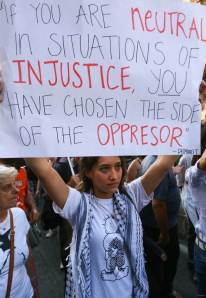 Members of the European Parliament (MEP) yesterday called to hold Israel accountable for its war in the Gaza Strip and to suspend the EU-Israel association agreement, the Anadolu news agency reported.
In a statement, the MEPs declared, “Israel’s direct targeting of civilians and its reckless cause of civilian deaths is a clear breach of international human rights law.”
Member of the Unitarian Left (GUE/NGL) parliamentary group, Martina Anderson said: “You cannot go on with an agreement after you have broken it.”
The European Union condemns the establishment of illegal settlements on the Palestinian territories occupied in 1967 and considers it a violation of international law, but the association agreement with Israel is still valid.
Anderson stressed the Palestinians’ right to sovereignty, freedom and to live with dignity and respect and that they, as parliamentarians, should take responsibility otherwise they will become “partners in crime”.
Portuguese MEP, Marisa Matias said that suspending the association agreement with Israel is not a sufficient step, stressing on the need to apply an arms embargo and start working on a full ban of Israeli products produced in the occupied territories.
Trades Union Congress slams Gaza attack, urges Israel arms embargo
MEMO | September 10, 2014
The Trades Union Congress (TUC) passed a statement on Gaza at its annual congress Wednesday, urging the UK government to impose an Israel arms embargo and calling for the suspension of the EU-Israel Association Agreement.
The statement, overwhelmingly endorsed, condemns the death toll in Gaza that included “many people going about their daily work”, and “deplores attacks on UN facilities”. The TUC recommends that those responsible for breaching international law “should be dealt with in the International Criminal Court”.
The TUC statement also calls for an end to the “blockade of Gaza” and welcomes “the creation of a unity government for the Palestinian Authority” involving both Fatah and Hamas, urging “the UK government and the European Union to support this development”.
In light of Israel’s attacks on Gaza and policies in the Occupied Territories, the TUC statement calls on the UK government and EU to “end immediately arms trading with Israel including all military-industrial collaboration”. The TUC itself, it adds, should work with relevant unions to “press those companies involved in supporting Israel’s military to cease to do so”.
Congress called for “the suspension of the EU-Israel Association Agreement until the rights of the Palestinians are established”, and committed to “rais[ing] the pressure on corporations complicit in arms trading, the settlements, occupation and the wall” through strategies that pressure “complicit companies” – a key part of the Palestinian-led Boycott Divestment Sanctions (BDS) campaign.
The Palestine Solidarity Campaign (PSC) noted that “the statement, and the goals contained within it, are now official TUC policy”, an important boost for Palestine solidarity and BDS activists. The TUC’s statement was condemned by anti-boycott umbrella group Fair Play, who complained that boycotts merely pull “Israeli and Palestinian workers further apart”.
Israeli foreign ministry causes crisis with New Zealand
MEMO | September 10, 2014
The Israeli President Reuven Rivlin accused the foreign ministry of sabotaging Israel’s relations with New Zealand as an important friendly nation.
New Zealand’s new ambassador to Israel is supposed to present his credentials to the Israeli president tomorrow but this will not happen because the country’s foreign ministry rejected the diplomat due because he also sought accreditation with the Palestinian Authority.
Rivlin accused the foreign ministry of creating a crisis with one of the friendly governments with Israel.
Israeli newspaper Yedioth Ahronoth noted the importance of the issue because New Zealand is a candidate for the position of alternate member of the Security Council.
The newspaper added that the foreign ministry opposes dual representation of the ambassador in Israel and the Palestinian Authority under the pretext of fear that other foreign countries may do the same which would make “the PA’s status equal to the status of Israel”. Previous ambassadors openly moved between Jerusalem and Ramallah.
The newspaper said that the only “sin” committed by the new ambassador from New Zealand, Jonathan Carr, was that he sent a letter to the Ministry of Foreign Affairs in which he said he intends to visit Ramallah.
New Zealand was surprised by Israel’s decision and Prime Minister John Key said that the Israeli position is contrary to what had been followed, and that he refuses to submit to Israel’s dictation. He also asked the new ambassador to stay in Ankara, Turkey.
Rivlin cannot force Foreign Minister Avigdor Lieberman to reverse the decision.
Israeli war damaged 60 per cent of manufacturing capability in Gaza
MEMO | September 9, 2014
The Israeli war destroyed around 500 economic facilities that form 60 per cent of the manufacturing capability in the Gaza Strip, the Palestinian Ministry of Economy said.
Speaking to the Palestinian news agency Safa, the ministry’s spokesman Azmi Abdul Rahman said that the Israeli occupation premeditatedly targeted hundreds of the industrial, commercial and service facilities.
The commercial facilities included small shops and that paralysed the economy during the Israeli war. He stressed that the effect of the economic paralysis would last until the facilities were reconstructed.
Abdul Rahman said that specialist professional staff are working on evaluating the losses in the Strip; estimating that reconstruction of the economic facilities needs at least one year.
He said initial evaluations showed that the indirect losses exceeded $440 million.
UN: Israel Used UNRWA School For Military Operations
IMEMC News & Agencies | September 10, 2014
Israeli forces, during the recent offensive on the the Gaza Strip, used one of UNRWA’s schools in the region as a military base, according to a UN offical.
Leila Zerrougui, Special Representative of the Security-General for Children and Armed Conflict, declared on Monday that the Israeli military bombed 244 schools, 75 of which were run by UNRWA.
While not disclosing the specific location of the school, it was revealed that one of these UNRWA schools was used an Israeli military base, according to the PNN.
Speaking of the aftermath of the assault on besieged Gaza, Ms. Zerrougui stated that, of the children wounded during the conflict, one third now suffer from full disability.
Nearly 600 Palestinian children suffered violent deaths as a result of injuries inflicted by Israeli strikes from the ground, air and sea.
Related: 69% of Gaza Schools Damaged by Israeli Assaults
See also: 08/23/14 Israel Retracts False Claim Regarding Alleged Hamas Rocket Base
A Palestinian Exception to the First Amendment
By Corey Robin | September 9, 2014
Steven Salaita spoke today at the University of Illinois at Urbana-Champaign. According to the YMCA, where the event was held, some 400 students, faculty, staff, and supporters turned up.
Salaita opened with a statement. Here are some excerpts:
My name is Steven Salaita. I am a professor with an accomplished scholarly record; I have been a fair and devoted teacher to hundreds of undergraduate and graduate students; I have been a valued and open-minded colleague to numerous faculty across disciplines and universities. My ideas and my identity are far more substantive and complex than the recent characterizations based on a selected handful of my Twitter posts.
…
Two weeks before my start date, and without any warning, I received a summary letter from University Chancellor Phyllis Wise informing me that my position was terminated, but with no explanation or opportunity to challenge her unilateral decision. As a result, my family has no income, no health insurance, and no home of our own. Our young son has been left without a preschool. I have lost the great achievement of a scholarly career – lifetime tenure, with its promised protections of academic freedom.
…
Even more troubling are the documented revelations that the decision to terminate me is a result of pressure from wealthy donors – individuals who expressly dislike my political views. As the Center for Constitutional Rights and other groups have been tracking, this is part of a nationwide, concerted effort by wealthy and well-organized groups to attack pro-Palestinian students and faculty and silence their speech. This risks creating a Palestinian exception to the First Amendment and to academic freedom.
…
I am here to reaffirm my commitment to teaching and to a position with the American Indian Studies program at UIUC. I reiterate the demand that the University recognize the importance of respecting the faculty’s hiring decision and reinstate me. It is my sincere hope that I can – as a member of this academic institution – engage with the entire University community in a constructive conversation about the substance of my viewpoints on Palestinian human rights and about the values of academic freedom.
For me, the best part of his press conference was the Q and A with the media, which begins at 40:50 in the video below. I would encourage everyone to watch it because it gives you the best sense of Salaita the man, the thinker, and the teacher. As I’ve said, I don’t know Salaita personally, except through our interactions on Facebook and Twitter. I’ve never met him or heard him speak. I haven’t read his academic writings. But listening to and watching him field questions, it became clear to me why the American Indian Studies department was so eager to hire him.
My favorite exchange occurs at 43:30. Someone in the media asks him why he would want to still come and teach at UIUC. Looking around the room, which is filled with students, Salaita says:
The question is—and if I’m summarizing it incorrectly let me know—some people are wondering why I would want to work here after all of this has happened and whether it might be uncomfortable. The answer is… the answer is in this room.
Perfect.
One other point to note. At 55:00, one of Salaita’s attorneys is asked about what the litigation process would look like. The attorney replies:
There’s no question that if there is litigation there will be an intensive document retrieval process that will involve trying to get at the heart of exactly what the motivation was for this decision. We think, based on what is already known, the university is going to have some very hard arguments. But we will learn a lot. We will also be able to take depositions. And that is an opportunity to sit people down and ask them about their role in this process, their decision-making and other things. Again, Professor Salaita’s goal is not to have to go down that road. But he is prepared to do so if necessary.
I’ve long felt that one of the things that has to make the university nervous is the prospect of litigation. Yes, the university has tons of money and lawyers. But it also has interests. And one of those interests is protecting the privacy of its donors. I can’t for the life of me believe that the university really wants to risk the rage and rancor of donors having their names dragged into the harsh glare of the public spotlight. Once this case gets into court—and most experts, regardless of which side they fall, believe that Salaita has a good chance of getting into court—there will be discovery motions that will turn up all sorts of paper. What we’ve seen already is damning and embarrassing. But think about what could be coming down the pike: not only emails to and fro, but also records of phone calls, transcripts of meetings, and more. Even if the university were to win the case, they’d have to lose a lot in order to do so.
In other news, Chancellor Wise was interviewed by the Chicago Tribune.
On Monday, Wise acknowledged in an interview that she wished she had “been more consultative” before rescinding Salaita’s job offer, and said it could have led her to a different decision. She said the situation has been “challenging.”
She also said there was “no possibility” that he would work at the U. of I.
“I wish I had not consulted with just a few people and then written the letter to Professor Salaita,” Wise said. “I don’t know what the consultation would have led me to do.”
This is now the third time that Wise has said that she regrets not consulting with other voices on the campus. But this is the first time that she’s positively stated that not only did her firing of Salaita not reflect her own position, but also that she might have reached a different decision than the one she reached had she consulted other voices. Which is precisely the argument that so many of us have been making about whose voices Wise did and did not heed in this process. It almost seems as if she’s trying to give Salaita evidence for his case.
Last, Katherine Franke, who’s been leading the legal academic community on this issue, and Kristofer Petersen-Overton, a PhD candidate in political science at the CUNY Graduate Center, appeared today on Democracy Now.
I urge you to listen to the interview, in particular the part that begins at 47:00. There Kris, whom I know personally, speaks about his experience as an adjunct at Brooklyn College, where he was hired by my department to teach a course on Middle East politics for the spring of 2011 and then fired before the course began. Sound familiar? The reason he was fired? Pro-Israel forces objected to something he had written. Sound familiar? Here’s what one of the leaders of those forces, NYS Assemblyman Dov Hikind, said at the time about an academic paper Kris had written on suicide bombers:
Hikind, a staunch ally of Israel, sent a letter on Monday to Karen Gould, the college’s president, with a copy to CUNY Chancellor Matthew Goldstein, in which he questioned the adjunct’s appointment. Calling Petersen-Overton “an overt supporter of terrorism,” Hikind said he was “better suited for a teaching position at the Islamic University of Gaza.”
Hikind, who said he earned his master’s degree in political science from Brooklyn College, told Inside Higher Ed that he reached these conclusions after spending “countless hours” reading the newly hired adjunct’s work. This included, chiefly, his unpublished paper, “Inventing the Martyr: Struggle, Sacrifice and the Signification of Palestinian National Identity,” in which he examines martyrdom as it “embodies ideals of struggle and sacrifice” in the context of national identity. Hikind said such works reflect an effort to “understand” suicide bombers. “There’s nothing to understand about someone who murders women and children,” he said. “You condemn.”
Kris didn’t say anything about anti-Semitism becoming honorable, he didn’t say anything about settlers going missing, he didn’t say anything about necklaces of teeth. His crime was trying “to understand about someone who murders women and children.” As Dostoevsky did in Crime and Punishment. That was enough to get him fired.
This is why I come to this whole Salaita affair with a bit of skepticism about the tweets. It’s skepticism born of my own personal experience with four controversial fights over Israel/Palestine. If it’s not the tweets, it’s the grad student paper trying to understand suicide bombers. If it’s not the grad student paper trying to understand suicide bombers, it’s the Pulitzer-Prize-winning playwright who cannot receive an honorary degree because he’s voiced criticism of Israel. If it’s not the Pulitzer-Prize-winning playwright who cannot receive an honorary degree because he’s voiced criticism of Israel, it’s the New York City Council threatening CUNY’s funding because the political science department at Brooklyn College is co-sponsoring—not endorsing, not organizing, not funding, but co-sponsoring—a panel on BDS. If it’s not the New York City Council threatening CUNY’s funding because the political science department at Brooklyn College is co-sponsoring a panel on BDS, it’s the NYS Legislature threatening a college’s funding if it financially supports individual faculty membership in the American Studies Association, which supports the academic boycott of Israel.
Every time it’s the same goddam story: supporters of Israel, increasingly anxious over the way the conversation about Israel is going in this country, flexing their muscles to muzzle a voice, to stop a debate. (Just today Buzzfeed is reporting that AIPAC is looking for ways to pass federal legislation to stop BDS in its tracks.) A Palestinian exception to the First Amendment?
Thankfully, in Kris’s case, we were able to rally a national campaign of prominent academics, particularly in political science, to support his reinstatement. We made his case a national story. Sound familiar?
And here’s the best part, dear reader: We won.
Since I came onto the interwebs, I’ve been involved in five fights over the place of Israel/Palestine in academe: the Petersen-Overton fight, which we won; the Tony Kushner fight, which we won; the BDS at Brooklyn College fight, which we won, the NYS Assembly fight, which we won, and now the Salaita affair.
There is a Palestinian exception to the First Amendment. And we’re fighting to end it. Because that’s the way the First Amendment has always advanced in this country: not simply through reasoned argument, but through struggle.
Hamas Rocket Launches Don’t Explain Israel’s Gaza Destruction
By Gareth Porter | IPS | September 9, 2014
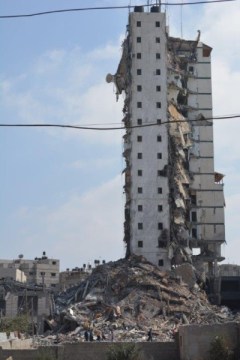 Israel and its supporters abroad have parried accusations of indiscriminate destruction and mass killing of civilians in Gaza by arguing that they were consequences of strikes aimed at protecting Israeli civilians from rockets that were being launched from very near civilian structures.
That defence has already found its way into domestic U.S. politics. A possible contender for the Democratic nomination for president, Sen. Elizabeth Warren, defended her vote for more military aid for Israel during the Israeli assault on Gaza by citing the rocket launch defence.
“[W]hen Hamas puts its rocket launchers next to hospitals, next to schools, they’re using their civilian population to protect their military assets,” said Warren. “And I believe Israel has a right, at that point, to defend itself.”
But although some Hamas rockets were launched near homes or other civilian structures, military developments on both sides have rendered that defence of Israeli attacks on civilian targets invalid.
The rocket launchers for Hamas’s homemade Qassam missiles consist of simple tripods that can be removed in seconds, and the extensive Hamas tunnel network has given it underground launching sites as well as storage facilities for its larger, longer-range Grad and M-75 missiles.
On the other side, the Israeli Air Force possesses air-to-ground missiles that are so accurate that they can destroy a very small target without any damage to civilian structure even if it is very close.
A video released by the Israel Defense Forces (IDF) in a report on Hamas’s “illegal use of civilian infrastructure” last month shows an attack – obviously by an Israeli drone — on an underground rocket launcher only a few metres away from a mosque causing no damage whatever to the mosque.
These technological changes take away any justification for flattening civilian buildings even if a rocket launch site is nearby. In fact, however, the evidence now available indicates that Hamas launch sites are not that close to hospitals, schools and mosques.
The IDF sought in mid-July to use the rocket launcher defence to explain the damage to Al Wafa Rehabilitation and Geriatic Hospital in eastern Gaza City from 15 rockets, which forced the staff to evacuate its patients. An IDF spokesman said the military had “no choice” because rockets had been launched from very near the hospital.
Clearly revealing that the rocket launch justification for the attack was a ruse, however, the spokesman revealed to Allison Degler of Mondoweiss that the alleged launch site was 100 metres from the hospital. That would have been far more space than was needed to strike the launch site without any damage to the hospital whatever.
A report released by the IDF August 19 included an aerial view of Al Wafa Hospital with two alleged rocket launching sites marked at locations that appeared to be much farther from the hospital than the 100 metres claimed by the IDF spokesman.
The IDF nevertheless went so far as to declare on July 21, “Hamas fires rockets from Wafa hospital in the Gaza neighborhood of Shujaiya.”
When the IDF destroyed Al Wafa hospital completely by airstrikes on July 23, it abandoned the pretense that the reason was a Hamas rocket launch site. Instead it released a video purporting to show firing at IDF troops from the hospital.
It turned out, however, the video clips of the firing had been shot during Operation Cast Lead in 2009, not in 2014.
The IDF has continued to suggest that its destruction of public civilian facilities was forced on it by rocket launches from within those facilities. At the end of the Operation Protective Edge the IDF spokesman’s office claimed that 597 rockets had been launched from civilian facilities, of which 160 were allegedly fired from schools, 50 from hospitals, and 160 from mosques.
But those figures were by produced only by pretending that launching sites some distance from the facilities in question were on the premises of the facilities.
An IDF “declassified report” released August 19, aimed at showing that civilian facilities were serving as military infrastructure for Hamas, includes no evidence of any rocket launches on the grounds of any civilian facility.
A very blurry 20-second video appears to show a rocket launch from what is identified as “Abu Nur” school. But it, too, is deceptive. A black streak rises from the area of the school for a little more than a second of the video, but for the entire length of the video two voices declare repeatedly that they saw three rockets launched “from within the school”.
Careful viewing of the footage reveals, however, that the apparent launch comes from outside the wall of the three-story school building rather than from within it.
In three other cases of alleged rocket launches from schools, the IDF provides no visual evidence – only large red dots drawn on an aerial view of the schools.
During the Operation Protective Edge, the IDF openly targeted mosques, claiming they are military targets, demolishing 73 mosques and partially destroying 205 more.
The August 19 IDF report refers to a “rocket cache and gathering point for militants hidden in a mosque” in Nuseirat. But despite frequent repetitions of the notion that Hamas routinely stores rockets in mosques, the IDF has not produced photographic evidence of rocket storage in a single mosque.
Nor has the IDF made public any video evidence of secondary explosions from the destruction of mosques. In a tacit admission that such evidence is lacking, the report instead cites an instance of a “concealed entrance” to a Hamas tunnel located between a mosque and a school.
The most extensive destruction of civilian structures in Operation Protective Edge was the complete leveling of large parts of entire neighbourhoods in the Shujaiya district of Gaza City on July 19. After the United Nations published a map showing the complete destruction of those areas of Shujaiya, the IDF published its own map on August 4 aimed at justifying the destruction.
The map shows that the IDF can’t claim the proximity of Hamas rocket launching sites as the justification for the leveling of many residential blocks in Shujaiya. The Israeli military had identified every home in the devastated neighbourhoods on its map as a “hideout” for Hamas or Islamic Jihad fighters.
The IDF obviously did not have actual intelligence on each of those homes that had been reduced to rubble. The massive designation of houses as “hideouts” indicates the Israelis believed Palestinian fighters were hiding in some of them.
Although the red dots on the IDF map identifying rocket launch sites are too big to estimate accurately the distance between them and the closest houses, only a few such dots appear to be as close as one city block to a house in one of the areas of massive destruction. And all but a few of the homes destroyed are much farther than a block from the alleged launching sites.
An account of the Shujaiya destruction by journalist Mark Perry based on a July 21 U.S. Defence Department report recalls that the IDF fired 7,000 artillery shells at residential areas in the district the night of July 19, including 4,500 shells in the space of just seven minutes.
Such massive and indiscriminate destruction of civilian structures is strictly prohibited by the international laws of war. Israeli officials have frequently said the purpose of IDF military operations in both Lebanon and Gaza was to “deter” their adversaries in the future by imposing heavy costs on the civilian population.
Featured Video

Seyed M. Marandi: US-Iran War Inevitable: Kuwait and Bahrain May Fall
or go to
Aletho News Archives – Video-Images
From the Archives
Oil and the Israel Lobby
Reknowned economist M. Shahid Alam offers this excellent critique of Noam Chomsky’s defective analysis of the relative influence of Oil versus the Israel lobby over US foreign policy: … continue
Blog Roll
 Aletho News
- ICC ignored ‘very well-documented’ NATO crimes – ex-Libyan minister
- SNSC secretary dismisses US response to Iran’s conditions as ‘inadequate’
- Sanaa says Taiz roads open, secure for residents, warns Saudi forces
- Iraqi resistance group urges Saudi leadership to admit defeat, lift Yemen siege
- Trump’s Retreat: How Al-Aqsa Flood Took Down the US Empire
- Israel’s Military Actions in Lebanon Grossly Violate International Law — Lavrov
- Seyed M. Marandi: US-Iran War Inevitable: Kuwait and Bahrain May Fall
- Leaders Condemn Ansarallah Attack on Saudi Arabia While Ignoring Illegal War Against Yemen
- Leaked: Britain’s Covert Iraqi Psyops Network
- Yemeni Armed Forces Warn Airlines Against Using Saudi Airports, Exempt Mecca and Medina
- If Americans Knew
- Israel’s Destruction of Southern Lebanon Intensified After the Cease-Fire
- The Last-Minute Decision That Gave Israel Its Name
- The American Conservative: How Trump Made the World Go Nuclear
- Meet the US generals and admirals advancing Israeli policy
- Opinion: Why news organizations should boycott Israel
- The Israeli witch hunt of Sami Abu Shehadeh exposes the lie of the ‘Jewish and democratic’ state
- No state has a ‘right’ to exist – least of all Israel
- Testimonies about Gaza’s civilian death toll expose Israel’s atrocities – Daily Update
- How Israel Conquered the Latin American Right
- Agents search Rep. Omar’s Washington home in criminal probe as she vows she won’t ‘be silenced’
- No Tricks Zone
- Germany’s Green Energy Debacle: High Energy Costs Force Kahla Porzellan to Close After 182 Years!
- New Study: 50 Years Of The Most Aggressive ‘Net Zero’ Policies Can Only Affect The Global Climate By 0.03°C
- US September “Heat” Was No Record…Many Records Set Decades Ago
- Latest European Green Energy Debacle; Portugal’s Largest Flagship Solar Park Insolvent!
- Green Energy Debacle: German Expert Professor Fritz Vahrenholt Warns Of Severe Economic And Social Consequences
- Two More Paleo Reconstructions Affirm Meters-Higher Sea Levels Across Ireland, Brazil 7000-6000 Years Ago
- New Study: Earth And Venus Surface Warmth Largely Explained By Convection And Lapse Rate, Not CO2 Or Radiation
- 2025 Nature Paper Claiming Worsening Global Drought Gets RETRACTED …Heavily Flawed
- New Study: ‘Global Drought Shows No Detectable Recent Acceleration Under Climate Warming’
- Economic Masterminds: German Socialists Suggest Taxing Productivity Gains Stemming From Using AI

