Israel bombs mosque, university, homes as Gaza death toll hits 1,654
Al-Akhbar | August 2, 2014
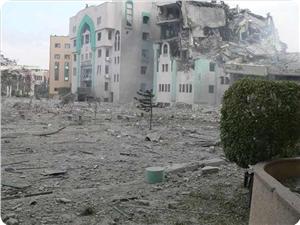 Updated 3:00 pm: Israeli war jets on Saturday bombed a mosque in the northern Gaza town of Jabalia, a major university in Gaza City and flattened houses in a beach side neighborhood, bringing the Palestinian death toll to 1,654 as the US-backed assault enters day 26.
Saturday’s killings come a day after Israeli forces committed horrifying massacres in the southern town of Rafah, slaughtering about 150 men, women and children after the killing of two Israeli soldiers and the capture of a third by Palestinian commandos.
Hamas claimed responsibility for the ambush of the Israeli army officer, but said the group has lost contact with the fighters involved in the operation, and suggested that they may have been killed by Israeli shelling along with their prisoner of war.
“We lost contact with the (Hamas) troops deployed in the ambush and assess that these troops were probably killed by enemy bombardment, including the soldier said to be missing — presuming that our troops took him prisoner during the clash,” the Brigades said in a statement issued in Arabic and English.
“The Qassam Brigades has no information as of this time about the missing soldier, his whereabouts, or the circumstances of his disappearance.”
Palestinian health officials say 1,654 Palestinians, the overwhelming majority of them civilians, have been killed, including a muezzin who died in an Israeli strike on a northern mosque on Saturday.
Sixty-three Israeli soldiers have been killed, and Palestinian shelling has killed two Israelis and a Thai workers.
Air strikes and tank fire have pounded huge areas of Gaza into rubble, rendering much of it unrecognizable to one Palestinian who returned home after spending years in an Israeli jail.
“It was my dream to return to Gaza but it is a real shock,” said 30-year-old Osama who comes from the central town of Deir al-Balah.
“Everything has been destroyed.”
Since Friday, more than 400 houses have been leveled across Gaza, mostly by air strikes, Palestinian officials said.
UN figures show that up to 25 percent of Gaza’s population of 1.8 million may have been forcibly displaced, with more than a quarter of a million people now seeking safety in shelters belonging to UNRWA, the UN agency for Palestinian refugees.
(Reuters, AFP, Al-Akhbar)
Obama to Hamas: Release Israeli soldier
Press TV – August 2, 2014
US President Barack Obama has called on the Palestinian resistance movement Hamas to “unconditionally” release an Israeli soldier captured in the Gaza Strip.
“If they are serious about trying to resolve this situation, that soldier needs to be unconditionally released as soon as possible,” Obama told a news conference on Friday.
On Friday, the Israeli military confirmed that one of its soldiers was captured by Palestinian fighters in the Gaza town of Rafah.
Obama framed the release of 23-year-old Hadar Goldin as a precondition for a possible ceasefire.
“A ceasefire was one way in which we could stop the killing, to step back and try to resolve some of the underlying issues,” he said.
Obama also characterized the relentless Israeli aerial and ground attacks on Gaza– in which more than 1,650 Palestinians have been killed– as self defense.
“No country can tolerate missiles raining down on its cities… no county can or would tolerate tunnels being dug under their land,” the president stated.
The United Nations says over 80 percent of the fatalities in Gaza have been civilians. Some 9,000 people have also been injured in 26 days of Israel’s onslaught on the besieged coastal enclave.
The military wing of the Palestinian resistance movement Hamas, the Ezzedine al-Qassam Brigades, has been firing retaliatory rockets into Israel, killing dozens of its soldiers.
HRW: Human Rights Watch or Hypocrites Representing Washington
By Eric Draitser | New Eastern Outlook | August 1, 2014
Ulike previous centuries and epochs, modern warfare is not restricted solely to the battlefield. Rather, it extends into the information sphere where the dissemination of propaganda and the construction of narratives are of equal importance to weapons and soldiers. For today, the legitimacy of a war in the eyes of public opinion in many ways determines victory or defeat. It is here, in the realm of public opinion, that an organization such as Human Rights Watch (HRW) becomes indispensible to the Empire, not so much for the facts that it presents, but the narrative that it shapes.
Put another way, HRW serves as intermediary between the facts on the ground and the western public who rely on the organization (and similar NGOs such as Amnesty International) to accurately tell the story of a given conflict. It is precisely this position as an “information middleman” that makes HRW both relevant and dangerous for the simple fact that the manner in which it presents information, along with the critical facts it chooses to omit or otherwise distort, can have a tremendous impact on how the world views a conflict and, consequently, how the world responds.
By examining the way in which HRW documented, investigated, and presented findings from the conflicts in Israel/Palestine, Ukraine, Libya, Syria, and Venezuela, it becomes clear that the organization, though theoretically objective and “disinterested,” is in fact an integral part of the western imperial system. Though HRW has done some good work, and likely will in the future, this cannot be taken as evidence that the organization is somehow not a part of the Empire. On the contrary, without HRW and similar organizations, Washington and its allies would not be able to champion themselves as “defenders of human rights,” “beacons of democracy,” and “humanitarian powers.”
HRW on Israel/Palestine
In analyzing HRW’s findings and, perhaps most importantly, the way in which they are presented, one conclusion becomes inescapable: when the facts are damaging to the western powers, HRW dilutes the impact of its own conclusions, and when its findings advance the western agenda, HRW exaggerates them. What can one call such obvious service to power under the guise of truth-telling? Words like cynical, insidious, and treacherous certainly come to mind.
On the subject of Israel/Palestine, HRW has consistently placed itself in the “condemn both sides” camp. That is to say, it makes an equivalence between the violence and barbarism of Israel’s colonial-style occupation of Gaza and the West Bank on the one hand, and Palestinian armed resistance on the other. The cynicism is painfully obvious. By making such equivalence, HRW effectively reduces the scope and scale of Israeli crimes which are, objectively speaking, far more widespread, systematic, and devastating.
As renowned Palestinian journalist and Middle East analyst Mouin Rabbani wrote in 2009:
In the years since 2000, HRW pursued a consistent — and consistently effective — formula: criticize Israel, but condemn the Palestinians. Challenge the legality of an Israeli aerial bombardment, preferably in polite, technical terms, and vociferously denounce the Palestinian suicide bomber in unambiguous language — especially when raising questions about the latest Israeli atrocity. In HRW publications, explicit condemnations and accusations of war crimes were almost wholly monopolized by Palestinians. With Israeli citizenship a seeming precondition for the right to self-defense, the right to resist was for all intents and purposes non-existent.
Rabbani here correctly points out not only the false equivalence between the violence perpetrated by Israel and the armed resistance of the Palestinians, but also the question of legitimacy and legality in regard to the latter. HRW portrays Palestinian resistance, in whatever form it takes, as illegitimate and a violation of international law, often referring to the rockets and, when it was still applicable the “suicide bombers,” as war crimes. In contrast, HRW very rarely, if ever, expressly uses the term “war crimes” to refer to any of the atrocities committed by Israel that undoubtedly are such.
Perhaps here it would be relevant to point out that, according to international law and UN precedent, all Israeli so-called “self-defense” (bombing civilian targets, laying siege to Gaza, etc.) constitutes war crimes. By contrast, the Palestinians have a legal right to resist their occupation by a foreign power by any means necessary. Indeed, this point has been reiterated countless times by the United Nations. One particularly relevant example comes from the 43rd resolution of the 37th UN General Assembly held in 1982 against the backdrop of Israel’s vicious war on Lebanon which, “Reaffirms the legitimacy of the struggle of peoples for independence, territorial integrity, national unity and liberation from colonial and foreign domination and foreign occupation by all available means, including armed struggle.”
Though certainly not the only example of international law and UN precedent legitimizing the armed resistance of the Palestinian people, the above resolution makes it quite plain that the argument that “Hamas rockets constitute a war crime” is little more than a rhetorical flourish from those who attempt to make an equivalence between Israeli and Palestinian violence in order to justify the former by discrediting the latter. It goes almost without saying that such faulty reasoning must be rejected entirely.
But this issue of rhetoric and language is also crucial to understanding how HRW is able to criticize Israel without actually condemning its atrocities or exposing it to charges of war crimes and crimes against humanity. In response to the most recent round of Israeli crimes, renowned scholar and activist Norman Finkelstein wrote:
In its first press release on 9 July 2014, Indiscriminate Palestinian Rocket Attacks; Israeli Airstrikes on Homes Appear to be Collective Punishment, HRW stated that “Israeli attacks targeting homes may amount to prohibited collective punishment.” In its second press release on 16 July, Unlawful Israeli Airstrikes Kill Civilians; Bombings of Civilian Structures Suggest Illegal Policy, HRW states that “Israeli air attacks in Gaza… have been targeting apparent civilian structures and killing civilians in violation of the laws of war. Israel should end the unlawful attacks that do not target military objectives and may be intended as collective punishment or broadly to destroy civilian property.” It then proceeded to legally define the meaning of war crimes, but artfully avoided accusing Israel of committing them… In these statements HRW doubly distanced itself from alleging Israeli war crimes: first, it qualified the weight of the incriminating evidence – “appear,” “may,” “apparent,” “may be,”; second, it recoiled from explicitly charging Israel with war crimes and instead settled for lesser or vaguer charges – “collective punishment,” “violation of the laws of war,” “unlawful attacks.”
As Finkelstein correctly notes, the language that HRW employs is, at least superficially, supposed to provide a veneer of objectivity by using qualifier words such as “may” and “apparent.” However the reality is that such language is deliberately designed to allow HRW to avoid correctly ascribing terms like “war crimes” and “crimes against humanity” to Israeli actions. In this way, HRW dilutes its own findings, pleasing the powerful corporate and political interests in the US that fund it.
Indeed, here it is important to reiterate how HRW creates a false equivalence between Israeli war crimes and Palestinian “war crimes.” HRW has gone on record saying that “Hamas rocket attacks targeting Israeli civilians are unlawful and unjustifiable, and amount to war crimes… As the governing authority in Gaza, Hamas should publicly renounce rocket attacks on Israeli civilian centers and punish those responsible, including members of its own armed wing.”
So, let’s just be clear here. Israeli bombings of Palestinian civilian targets through systematic campaigns “may” constitute “collective punishment” (not war crimes according to HRW’s language), while Hamas rocket attacks “amount to war crimes.” The transparently hypocritical use of double-standards in terms of language exposes a deeply rooted bias in HRW against the justness of Palestinian resistance. Whether one agrees or disagrees with Hamas’s military (and political) tactics, the legal and moral righteousness of their resistance cannot be disputed by anyone objectively evaluating the conflict.
More to the point, HRW accusing Palestinians of war crimes implies yet another distortion perpetrated by the Empire and its media and NGO toadies: that the conflict in Gaza is a “war.” This is no war, it is a one-sided slaughter. One could point to the casualty figures, the absence of an army, navy, or air force on the Palestinian side, the complete lack of indigenous economic activity to support a “war economy” in Gaza, or any of the other myriad material reasons why this is not a war.
If one is being honest, then it is clear that it is the western media (which includes of course Israeli media) which distorts the reality of the situation, calling it a “war” so as to justify the horrific crimes being committed. Because, as is self-evident, only under conditions of war can Israeli actions be justified in the minds of westerners. This is willful self-deception of the highest order. Indeed, self-deception is one of the most potent weapons that Israel’s supporters, along with HRW, have at their disposal.
HRW on Ukraine
 The armed conflict between the US-sponsored regime in Kiev and the anti-Kiev rebels in the East of the country has devolved into a bona fide civil war. However, it should be noted that, though the term “civil war” is used to describe the fighting, it should not be taken to mean that there is equivalent force on both sides. Rather, the Kiev regime has the full force of an organized military with air power, heavy weapons, tanks, artillery, and a host of other military materiel. In contrast, the anti-Kiev forces possess very few of these same weapons, with no air power whatsoever, despite the continued allegations of Russian support. And so, as with the so called “war” between Israel and Hamas, the conflict is far more one-sided than most media is willing to admit.
This point about unequal force is critical to understanding just how HRW, though seemingly condemning the use of rockets by the US-backed Ukrainian military, in fact provides an important service to the western narrative on Ukraine. Specifically, HRW presents a “condemn everyone equally” perspective which unjustifiably condemns the rebel forces with as much fervor as it does Kiev’s military. In so doing, HRW once again makes false equivalence, thereby distorting the true nature of the conflict in the eyes of western observers.
In its report Ukraine: Unguided Rockets Killing Civilians, HRW documents the use of “Grad” (Russian for “hail”) rockets by both sides in Ukraine. The report noted that “Unguided Grad rockets launched apparently by Ukrainian government forces and pro-government militias have killed at least 16 civilians and wounded many more in insurgent-controlled areas of Donetsk and its suburbs in at least four attacks between July 12 and 21, 2014.” In this initial assessment at the opening of the report, HRW is correct in pointing out that both sides of the conflict have been using such weapons, at least according to a number of independent reports from the region. However, again one must return to the question of equivalence between the two sides. In other words, are both sides equally accountable for the death and destruction wrought on the civilian population?
According to HRW and the language of the report, the answer is yes. Ole Solvang, senior emergencies researcher at HRW noted that, “Grad rockets are notoriously imprecise weapons that shouldn’t be used in populated areas. If insurgent and Ukrainian government forces are serious about limiting harm to civilians, they should both immediately stop using these weapons in populated areas.” Though of course one would agree that the use of such weapons by either side harms civilians, it presupposes that each side is equally responsible. Naturally, one should note that it is the Kiev regime’s military which is launching these rockets against a civilian population, while the rebels are using such rockets against military positions held by the Ukrainian army. This simple fact, conveniently left out of HRW’s report, should significantly alter how the issue is perceived. Rather than a war between two equally criminally responsible parties, there is undoubtedly an asymmetry in the violations of the rules of war.
To be fair, there are portions of the HRW report which do intimate, though perhaps stop short of explicitly stating, the fact that Kiev bears the majority of the blame. The report states, “Human Rights Watch called on all parties to the conflict in eastern Ukraine, particularly Ukrainian government forces, to stop using Grad rockets in or near populated areas because of the likelihood of killing and wounding civilians.” Indeed, the use of the phrase “particularly Ukrainian government forces” does suggest that Kiev is more culpable than the rebels. However, HRW quickly negates whatever value can be drawn from the above statement by following it with “Insurgent forces should minimize the risk to civilians under their control by avoiding deploying forces and weapons in densely populated areas.” Such a statement is patently absurd considering that the war is undeniably being fought in densely populated areas (Donetsk alone has about a million residents).
How can HRW genuinely tell rebels who are protecting their homes, their families, and their communities, not to fight in densely populated areas? The Ukrainian air force and military have been shelling civilian areas with far more than just the Grad rockets (artillery, aerial bombardment, and possibly white phosphorous bombs), and HRW expects the rebels to simply allow this? Again, the report presents an equivalence between the force employed by both sides, an utterly disingenuous argument. The report notes, “Human Rights Watch said that insurgent forces have failed to take all feasible precautions to avoid deploying in densely populated areas, thereby endangering civilians in violation of the laws of war.” In other words, though HRW condemned the use of the rockets by Kiev’s military forces, ultimate responsibility lies with the rebels who are “endangering civilians.”
This is backwards thinking. It is the equivalent of Israeli military spokesmen who argue that Hamas is responsible for Palestinian deaths because of where they place their rockets. The sort of mental gymnastics required to evaluate the situation in this way perhaps best illustrates what HRW is doing. Rather than assigning blame to Kiev where it is deserved, HRW condemns fervently the rebels for the actions of Kiev. In this way, HRW bolsters the western narrative that the “pro-Russian separatists” (as the western media is fond of calling them) are the ultimate cause of the conflict and the civilian deaths. This is not the first time that HRW has blamed the victims of aggression for the crimes of the aggressors.
Gaza Ministry of Health: “Al Najar Hospital in Rafah evacuated as Israeli genocidal rampage continues”

Shells fall on Rafah on Friday (photo from Ma’an Images)
Gaza Ministry of Health | August 1, 2014
Gaza, Occupied Palestine – The Ministry of Health Gaza announces the closure of Al Najar Hospital in Rafah, due to Israeli shelling in the vicinity compromising its ability to guarantee the safety of patients and staff.
The hospital has now been evacuated, bringing to four the number of government hospitals closed by Israeli attacks in the past three and a half weeks.
El-Wafa Rehabilitation Hospital, the only specialist rehabilitation hospital in Palestine, was forced to evacuate on July 17th, and completely destroyed on July 23rd.
Al Durrah Paediatric Hospital was forced to evacuate on July 24 because of damage caused by an Israeli strike next to it, and closed.
Beit Hanoun Hospital was evacuated on July 26 after several hours of direct and indirect shelling overnight, and closed.
Israeli attacks on hospitals are a gross breach of the Fourth Geneva Convention, as are attacks on civilians.
At least 65 people have been killed in the Rafah attacks, more than 350 wounded, and the attacks are still ongoing.
The Ministry of Health Gaza calls on the United Nations, the international community and people of good conscience everywhere to take concrete action to bring an immediate end to the ongoing Israeli attacks on medical facilities and personnel, and massacres of Gaza civilians.
Israel Right or Wrong
But What’s In It For Americans?
By Philip Giraldi • Unz Review • July 29, 2014

It is a familiar scenario. Israeli is killing hundreds of civilians, mostly women and children, and the Zionist propaganda machine is working overtime. The President of the United States reaffirms America’s solemn pledge to protect Israel at all costs and justifies the carnage by stating that Israel has a right to defend itself. Secretary of State John Kerry repeats the message and the US House and Senate pass unanimously American Israel Public Affairs Committee (AIPAC) drafted resolutions affirming the same.
Israeli Prime Minister Benjamin Netanyahu lies repeatedly and the US media gives him a bully pulpit to spread his disinformation about what is occurring, including the propaganda cartoon depicted above explaining why he had to use artillery and bombs to level a residential district, killing nearly 100 civilians in what was described as a “heinous massacre.”
The mainstream media obligingly toes the line, depicting something like a battle between equals pitting the Israeli Army (IDF) against Hamas militants, obfuscating the essential asymmetry of a conflict that has killed more than 1,000 Palestinians civilians. A very large percentage of the commentators on television and radio as well the authors of mainstream print media opinion are American and Israeli Jews, to include a piece by Michael Oren, former Israeli Ambassador to the US and current CNN “expert,” entitled “Israel Must be Permitted to Crush Hamas” as well as the featured appearances by Prime Minister Netanyahu on national television.
Oren’s call to crush Hamas is particularly ironic as it runs directly contrary to American interests. The US intelligence community believes that the group would likely be succeeded by something far more radical. The media, Congress, and Netanyahu all also connive to ignore the deliberate targeting of civilians to include hospitals, schools and private homes by the IDF, producing massive infrastructure damage and increasing the numbers of dead and wounded. The US media did not report how Israelis watching the bombing from their lawn chairs on a hill near Sderot were photographed cheering and applauding each time a target in Gaza exploded. They were also sharing popcorn and one described the event as “just good fun.”
Also missing in the discussion is the damage that the conflict does to the United States, which is seen throughout the world as Israel’s puppet, manifested most recently when Washington alone opposed and will presumably veto any United Nations inquiry into possible war crimes connected to the Gaza conflict.
America diplomats are supposed to support American interests while the Founding Fathers created an army and navy to defend the United States, not Israel, a fact that seems to have escaped the notice of many in the White House, Congress and in the media. In reality, Washington has no obligation to protect the Netanyahu government in international fora nor is there any treaty obligation to defend Israel or anyone else outside the NATO alliance. Israel is neither an ally nor is its self-defined security a compelling US national interest if one excludes the drumbeat of the domestic lobby that protects it no matter how badly it behaves.
The sequence of events leading up to the current slaughter is clear, though Israel’s friends pretend that it all started when the first homemade rocket landed inside Israel, justifying any subsequent steps necessary for “defense.” But the Israel-Palestine problem truly began in 1948, when armed Jews deliberately terrorized and then drove more than 700,000 Palestinians from their homes. It was exacerbated when in 1967 the military occupation of the West Bank and Gaza began, leading to the creation and expansion of illegal settlements on Arab land.
The current cycle of violence, rooted in the denial of viable statehood for the Palestinian people, began in April when Israel deliberately torpedoed US brokered peace talks by accelerating settlement building and failing to comply with an agreement to release prisoners. On May 15 th Israeli soldiers shot dead two Palestinian teenagers, an event that was videoed. They were among the 26 Palestinians killed by Israelis since January, with no one being held accountable. Four weeks later three Israeli teenagers from Hebron were kidnapped and later discovered dead. Netanyahu, who knew that the three young men were already dead and that the abduction had not been carried out by Hamas cynically used the kidnapping as a pretext to attack Hamas in the West Bank, blaming the group for the crime without producing one shred of evidence. An Arab teenager was subsequently burned to death by Jewish extremists and the boy’s American citizen cousin was badly beaten by police when he joined a demonstration.
Netanyahu may or may not have cared who was killing or kidnapping whom on a micro level, but he knew a good opportunity when he saw one. He took advantage of the situation to launch a plan to destroy Hamas and pari passu the Palestinian unity government. Hundreds of arrests were made, again without any evidence linking those detained with the kidnapping, and homes of suspects were demolished. When Hamas in Gaza eventually struck back with its homemade rockets, killing or injuring no one, Israel unleashed its modern army and air force on the largely unarmed and defenseless Palestinians.
Israel also has found allies in the usual places in the US media and political circles to help explain the ensuing massacre. Ayman Mohyeldin, the NBC News correspondent who personally witnessed and reported the killing by Israel of four Palestinian boys on a Gazan beach was ordered by NBC executives to leave Gaza immediately, presumably because he had strayed from the acceptable message, which is that the deaths of Palestinians is somehow their own fault. CNN also “reassigned” reporter Diana Magnay who tweeted regarding an Israeli mob that threatened her when she filmed their celebration of missile strikes in Gaza. She called her attackers “scum” and was quickly removed.
The far fewer deaths of Israelis in the conflict are, however, rather more celebrated than the mass high tech execution of Palestinians. American volunteers in the IDF are depicted as somehow doing their patriotic duty, albeit in a foreign army. The Washington Post described how the “Death of two Americans in Israel brings conflict home.” Both men identified in the article though born in the US had chosen to live in Israel, producing some pushback in the blog comments. One noted that bearing arms for a foreign country that is not in NATO is illegal (and used to lead to automatic loss of citizenship) while another comment observed that if you are by choice fighting in a foreign army you are no longer really American. I might add that directly supporting Israel’s militarized colonization of Palestinian lands is against stated US government policy and does actual damage to American interests.
The Gazans are, to be sure, an easy target, crowded into a narrow strip of land with no place to go as they are controlled on all sides by Egypt and Israel. Fleeing inhabitants cannot even turn to the sea which is controlled by the Israeli navy. A comprehensive ten year truce offer by Hamas has been rebuffed by Israel and the slaughter will presumably continue until Netanyahu decides to stop. The United Nations has suggested that what Israel is doing might fit the definition of a war crime, just as was the case back in 2009 for Operation Cast Lead, when more than 1,400 Gazans were killed and schools run by the UN were deliberately targeted, as has been the case also currently.
That the US is so tied to a rogue nation like Israel would be incomprehensible but for the action of what has been described as the Israel Lobby. As Harvard Professor Stephen Walt puts it, “AIPAC is the only explanation for America’s morally bankrupt Israel policy.” Israel is in reality a place that most Americans would find unsympathetic. It is a corrupt theocracy that denies equal rights to Christians and Muslims, a fact that is conveniently overlooked by Congress and the media. There is also a strong dose of racism and ethnocentrism in its political matrix, with broad popular support for either disenfranchising or expelling all non-Jews. Or even killing them, with crowds in Tel Aviv routinely chanting “Death to Arabs.”
An Israeli member of parliament Ayelet Shaked of the ultra-nationalist Jewish Home party has called all Palestinians terrorists, saying women should be especially targeted for killing during the ongoing Israeli assault on the besieged Gaza Strip because they give birth to “little snakes.” She explained “They have to die and their houses should be demolished so that they cannot bear any more terrorists,” adding “They are all our enemies and their blood should be on our hands. This also applies to the mothers of the dead terrorists.” A prominent Rabbi has also endorsed complete destruction of Gaza and genocide, as a “deterrent measure to exterminate the enemy.”
Perhaps most discouraging is the visceral hatred directed at American critics of Israeli policies that surfaces occasionally among that nation’s most zealous supporters. Rabbi Shmuley Boteach, former Michael Jackson spiritual adviser and self-designated “America’s Rabbi,” has penned a piece entitled, “By Condemning Israel, Presbyterians Condemn Themselves.” He writes regarding the Presbyterian decision to divest from companies supporting the Israeli occupation of the West Bank, stating that “The rotting corpse of the Presbyterian Church suffered another nail in the coffin with its general convention vote on Friday to divest from companies doing business with Israel.”
Boteach, who has also become close to a number of prominent politicians, received no mainstream censure for this comments attacking a major Christian denomination in the vilest terms. His article also plays fast and loose with the facts. He observes “In the wake of the Oslo Accords, in which Israel granted the PLO political autonomy in the West Bank, about 60,000 Americans were murdered in Israel.” Since Oslo in 1993 the actual figure for dead Americans, many of whom were Israeli dual nationals, is 53.
That the United States has provided political support for a monster like Benjamin Netanyahu is criminal but it is a tribute to the grip that Israel’s lobby has on America’s political class and media. For starters, one might reasonably suggest that people like Boteach and the American volunteers including Chicago mayor Rahm Emanuel who go to fight for Israel while eschewing any service in the US Army should perhaps move permanently to the country that they love most. The charge of dual loyalty which surfaces regularly regarding Israel’s most passionate Jewish supporters misses the point. Boteach and his friends, most certainly to include the likes of multi billionaire casino magnate Sheldon Adelson of Las Vegas, have no dual loyalty at all. Their only concern is for Israel and they stay in the United States to cash in and to make sure that the rest of the American people are coerced and propagandized sufficiently so as to guarantee that the US will remain Israel’s patsy. But more and more Americans are waking up to the fraud and the ongoing slaughter of another thousand or so Palestinians in Gaza virtually guarantees that there will be more questions about the relationship with Israel than answers. Eventually the truth will out.
Action Alert: Children trapped at the Rafah crossing
International Solidarity Movement | August 1, 2014
Gaza, Occupied Palestine – This morning a group of over 70 people, mostly women and children carrying foreign passports, planned to take advantage of the ceasefire to leave Gaza and enter Egypt. Israel began bombing Rafah and the Egyptian personnel closed the Egyptian side of the border, leaving them trapped at the crossing, as the bombs fall around them. The Red Cross is not being allowed to reach them due to the bombing in the area.
Their nationalities include German, Norwegian, Bulgarian, and Egyptian.
Call the Egyptian Embassy in your country.
Call the German, Norwegian, Bulgarian foreign office and political representatives to demand that the Egyptian government opens the crossing and allows civilians to take refuge.
Use the hashtag #EndComplicity to ask the Egyptian government to let these families cross the border @egyptgovportal @EgyptEmbassyUSA @egyptconsulatuk
“The situation is very scary, the borders are closed and we are here, 70 people, mostly women and children trapped. I can see the smoke and fire, and I can hear the explosions very close to where we are,” said Nalan, one of the women trapped at the Rafah Crossing, talking to The Real News.
Listen to the audio recording of a phone call with Nalan Al Sarraj, correspondent for The Real News Network, trapped at the crossing here.
A call issued by civil society organizations and public figures including African National Congress (ANC) leaders Ahmed Kathrada, Ronnie Kasrils, and former vice president of the European Parliament, Luisa Morgantini and Richard Falk states that “Despite a call from Egyptian citizens to lift the siege, the Egyptian government which controls one border and has the option to be part of a humanitarian response to the besieged people of Gaza, has instead supported the Israeli plan for return to the status quo of slow genocide.”
Let’s party says Middle East peace envoy Tony Blair as Israel carpet bombs Gaza

By Robin Beste | Stop the War Coalition | July 28, 2014
Was it appropriate for the Middle East peace envoy to throw a lavish party for political cronies and minor celebrities as Israel slaughtered over 1000 Palestinian civilians?
WHERE was Middle East peace envoy Tony Blair last week as Israel invaded Gaza and committed horrific war crimes, killing over 1000 Palestinians, 80% of them civilians, 200 of them children?
Not at his official residence and office in the millionaires’ row of East Jerusalem, which costs £750,000 a year, and from where he directs his somewhat less than successful efforts to bring peace to the Middle East.
And what was Tony Blair doing, as Israel bombed hospitals, schools, centres for the disabled, and UN shelters to which 180,000 civilians fled — as at least 1000 homes were turned to rubble by random bombardment? What was he doing as the people in 46% of Gaza were warned by Israel to evacuate — without any indication of where they could go — or face being slaughtered by the world’s fifth most powerful military force?
What has been the Middle East’s Peace Envoy’s only visible contribution to finding a peaceful resolution to the carnage we have witnessed since 6 July, when Israel escalated its merciless attack on 1.8 million defenceless people, held captive by an inhumane siege, which for seven years has left them starved of food, clean water and essential resources, including medical supplies?
The only sighting has been his appearances on television in which his one purpose seems to be to repeat endlessly that he supports “Israel’s right to defend itself”. By killing 200 childen? is never the repost by his interviewers, least of all on the BBC, which, like Tony Blair, is a fully signed up contributor to Israel’s propaganda campaign justifying crimes against humanity.
So has the peace envoy been active behind the scenes, working tirelessly to bring the carnage to an end?
As far as we know, his only behind the scenes activity has been to act as messenge-boy for the scam Egyptian “ceasefire proposal”, which was actually hatched in Washington, with the terms drafted by Israel. Tony Blair’s errand was to deliver the proposal to US-backed Egyptian dictator Abdel Fattah al-Sisi, for him then to announce it as his initiative. The Middle East peace envoy, whose role is supposedly intended to mediate between warring parties in the region, didn’t consider showing the ceasefire proposal to Hamas, which only learnt of it from the media and understandably rejected it as a one-sided demand to surrender. As Israel based journalist Jonathan Cook wrote,
The corporate media swallowed the line of Israel accepting the “ceasefire proposal” and Hamas rejecting it. What Hamas did was reject a US-Israeli diktat to sign away the rights of the people of Gaza to end a siege that cuts them off from the rest of the world.
Tony Blair was the natural choice to be the US and Israeli emissary to the Egyptian dictator el-Sisi, who came to power in a military coup last year that toppled the democratically elected government of president Mohamed Morsi. The Sisi regime is estimated to have killed more than 2,500 protesters and jailed more than 20,000. But that didn’t stop Blair at the beginning of July agreeing to “advise” the Egyptian dictator in a deal which is said to promise huge “business opportunities”.
Not for the first time, Blair is blurring the lines between his public position as peace envoy and his private business dealings in the Middle East. Which is why a group of former British ambassadors and political figures joined a campaign to call for Blair to be sacked as Middle East envoy
So where was Tony Blair last week, as the world watched in horror as Israel invaded Gaza with complete disregard for international and humanitarian law?
He was in the United Kingdom.
And what was his prime activity last week? It was planning a surprise 60th birthday party for his wife Cherie. Why she needed one to coincide with the news that Israel’s mass murder in Gaza had passed 1000 is not clear, as her 60th birthday isn’t actually due till September.
But there was the Middle East peace envoy on Friday 25 July, partying at a cost of £50,000 in his £6 million mansion, with 150 political cronies, wealthy businessmen and minor celebrities.
The next day, over 60,000 protesters brought central London to a standstill calling for the Gaza massacre to stop. Many thousands more demonstrated in towns and cities throughout the UK. And across the world, from San Francisco to Tel Aviv, on every continent, demonstrations called for an end to the killing, the siege to be lifted and Palestine to be free.
There is an ever-growing worldwide outrage that Israel is allowed with impunity to get away with such barbarity. As the Channel 4 News journalist Jon Snow put it: “Were any other country on Earth doing what is being done in Gaza, there would be worldwide uproar.”
And the response of Tony Blair, the Middle East peace envoy: “Israel has the right to defend itself.” Time to party.
Zionist War on Gaza
By William James Martin | Dissident Voice | August 1, 2014
It is important to understand the genesis of the present round of violence between Israel and Hamas, really between Israel and the people of Gaza.
Both President Obama, Secretary Kerry, and the American news media have consistently described the conflict as Israel justifiably responding to the firing of rockets into Israel by Hamas and protecting their citizens, as if world history only began at this moment and that prior context did not exists.
More thoughtful and better informed observers than Obama and Kerry have more correctly noted that the present waves of Hamas rockets were preceded by a sequence of events which left Hamas with little choice except to resist with their only available means, which is firing rockets into Israel.
Let us recall: On June 2, the Palestinian Authority and Hamas announced the completion of an agreement unifying the two governments and to be led by the moderate Palestinian Authority Prime Minister Rami Hamdallah and with ministries run mostly by technocrats, a process worked out with input from the American government which included terms that would not automatically trigger a US ban.
Israeli Prime Minister Netanyahu, however vowed never to work with a government that included Hamas which he described, as is normal for him, as a ‘terrorist’ organization and also admonished western governments including the US not to conduct discussions with them, a call that went mostly unheeded, to Mr Netanyahu’s great frustration.
The abduction and murder of three Israeli youths was met by Mr Netanyahu’s response: “Hamas is responsible, and Hamas will pay.” This was his chance to wreck the unity government.
Thus a ‘search and destroy’ operation was initiated consisting of 18 days of Israeli army rampages which targeted anything affiliated with Hamas on the West Bank. Hundreds were arrested, about 500 total, and about a dozen Palestinians killed, Hamas offices and clinics were ransacked and destroyed, with computers confiscated, hundreds of Palestinian homes were invaded, usually in the middle of the night with the homes ransacked and contents destroyed or damaged, guns were pointed at women and children and people terrorized, and many arrested. Homes of so-called suspected persons were blown up and destroyed.
In addition, Mr. Netanyahu’s rhetoric contributed to an atmosphere of anger and vengeance which resulted in the abduction and burning alive of a Palestinian teenager by several Israelis.
As of almost three weeks later, there has been no evidence what so ever that the Hamas leadership was involved or even knew in advance about the kidnapping.
Furthermore Max Blumenthal has reported, based on his sources inside Israeli intelligence, Shin Bet, that they knew, with high probability, within hours of the kidnapping that the three abducted youths had been killed. This news was not released to the public thus permitting the ‘search and destroy’ operation to continue.
The rampage of Israeli soldiers in the west Bank was quickly followed by aerial attacks by Israel into Gaza which killed seven Hamas members.
Thus the charge, by Mr Netanyahu, of Hamas responsibility in the abduction and killing of the three Israelis, and the suppression of information to the effect that the Israeli government knew the three Israeli youths had been killed were disingenuous techniques of Mr Netanyahu to destroy or seriously degrade Hamas and destroy the unity government which Mr Netanyahu so despised.
Obama, Kerry, and Netanyahu and their minions constantly repeat the question. “What would you do if your country were attacked by rocket fire?” And, of course, there is the ever present refrain, “Israel has a right to defend itself”
A far less trite question is, “What would you do if you were Hamas, and your offices were being ransacked and destroyed, and your people killed.? And what would you do if the population of Gaza were living under a brutal siege, unable to export their agriculture or the products so their labors, with foodstuffs embargoed allowing only a bare subsistence, with electricity and fuel limited, and potable water in short supply, and with building and rebuilding of destroyed structure from two previous wars with Israel, as well as this one when it ends, impossible because of the Israeli siege?
All this is taking place in the political-diplomatic space created by the multiple failures of the Obama conflict resolution efforts which included sending Kerry to the Middle East with the instructions to ‘solve the problem’, as he had George Mitchell before, without any presidential directive or program toward a solution. Further, the efforts of Kerry were undermined, as were those of Mitchell’s earlier, by President Obama’s failure to apply any pressure at all to Israel and even to echo the narrative and talking points of the Israeli government and to repeat the Israeli-Zionist interpretation of Jewish-Zionist history and its justification for the Zionism project.
And, of course, there is the ever present refrain which Obama, like his predecessor George Bush, never tires of repeating: “Israel has a right to defend itself”, thus justifying Israel’s violent operation, both in 2012 and at present, which has been interpreted by the President as a ‘response’. Obama has advanced the argument that no nation could tolerate rocket fire aimed toward its citizens further justifying Israel’s air, land and sea attack on the people of Gaza, and implying that the cause of the present conflagration began with the Hamas launched rocket fire – that Hamas is responsible for the present round of violence.
Obama has never hinted at the slightest discomfort of the siege of Gaza in which at least half of Gaza’s 1.7 million people are food insecure and almost all are impoverished unable to export the products of their labors, nor to import enough of their material needs, including the need to upgrade their water and sanitation facilities. Though Obama is a constitutional lawyer, he seems not to have noticed that collective punishment as well as using food as a weapon of war violates the Fourth Geneva Convention.
Obama’s vetoes of all Palestinian sponsored UN Security Council resolutions which were critical of Israel or its occupation, his efforts to join Israel in quashing the Goldstone Report and rendering it ineffective, and his efforts to pressure the Palestinians not to seek memberships in UN Agencies or join international conventions, certainly undermined any possibility of Israel making an effort at compromise. Why should Israel compromise when the President of the United States as well as the US Congress will protect it from the pressures or constraints of international law, and also echo its talking points for general popular consumption.
Obama has sought to confine the possible avenues of potential resolution to the so-call ‘peace process’ and to the principle that any resolution must be one mutually agreed to by Israel and the Palestinians, which means that any constraints potentially imposed by international law will not be applied to Israel which occupies the land captured in the ’67 War and has a large and very well equipped military making it capable of occupying the land against the will of the Palestinian people for an indefinitely long period in to the future.
Everyday Israel seizes more Palestinian land, adds new settlers to the East Jerusalem and the West Bank population, and its leaders, particularly Prime Minister Netanyahu, has indicated very many times that the state of Israel has absolutely no intention of relinquishing any substantial amount of West Bank territory or any of East Jerusalem. Such indications includes a meeting of Mr Netanyahu with President Obama in the Oval Office in which Netanyahu told Obama to his face that Israel would never withdraw from ‘Judea and Samaria’, the Jewish nationalist designation of the West Bank. And that Israel must maintain an indefinite military presence in the Jordan Valley.
Obama acts as though he did not hear him, or doesn’t care. And his response to Mr Netanyahu, on that afternoon in the Oval Office, was complete silence.
Obama has done nothing but reinforce Mr Netanyahu’s argument that the occupied territories are not illegally occupied but are “disputed areas” subject only to negotiations between parties in to which Israel has as much right as anyone else. He has certainly never attempted to counter Mr Netanyahu’s frequent claim that the Land of Israel belongs to the Jews by virtue of ‘the Jewish historical right’.
During Obama’s five and half years in office, Obama has never displayed any insight at all in regard to the Israeli-Palestinian conflict, nothing beyond the echoing of the Israeli-Zionist narrative. He has never used the term Nakbah, nor recognized that there was an ethnic cleansing of the Palestinian people in 1948, though he did use the term “dispossession” in his (overrated) Cairo speech. I have never heard him use the term “occupation”.
His only insight into the Zionist movement is to echo the false claim that Jews dreamed and hoped for 2000 years to return to the Land of Israel. This mythology has been thoroughly debunked by Shlomo Sand and by any careful reading of the history of the Zionist movement – a movement which only became a project of Jews, and a small subset of Jews at that, in the 1880’s though it was preceded by four centuries by Christian Zionism, mostly in England, which set the parameters of Jewish Zionist thinking and introduced the term return to describe the migration of Jews into Palestine.
It is doubtful anyone would use the term “return” if the Egyptians decided to conquer Palestine though they ruled it a millennium before there was a Jewish city state in Jerusalem.
This war belongs to Obama as much as to anyone because it emerged in the vacuum created by Obama’s laziness and lack of courage in standing up to Netanyahu and the Zionist supporters in the US and in Congress.
Obama ignored the seven year long siege of Gaza. Now it has come back to bite him. His legacy will include that.
Given Obama’s limited shallow understanding of the Israeli-Palestinian conflict and its history, there may have been little else he could have done. Imagining Obama conducting a 13 day debate with Netanyahu, as Jimmy Carter did in 1978 at Camp David with Menachem Begin, is completely unimaginable.
Hamas and the people of Gaza can give up and let Israel slowly strangle them to death under a siege that stands in clear violation of international law which prohibits collective punishment. Or they can fight back with their only means available.
Hamas’s fight, which is mainly a struggle to lift the siege of Gaza, is an honorable one. Hamas’s fight possess the dignity with the Israeli brutalizers cannot not even imagine. In fact, the Zionists gave up any hope of dignity long before they ethnically cleansed Palestine of most of its indigenous population in 1948.
William James Martin can be reached at wjm20@caa.columbia.edu.
US Senate passes emergency funding for Israel’s Iron Dome
RT | August 1, 2014
The Senate overwhelmingly approved an emergency measure early Friday that could give $225 million in additional revenue to Israel for the country’s Iron Dome missile defense system.
Senate Majority Leader Harry Reid (D-Nevada) received unanimous consent from his colleagues Friday morning when he asked them to consider approving the measure, The Hill reported.
Next, the House of Representatives will be tasked with weighing the request, which if passed will put nearly a quarter of a billion dollars towards Israel’s missile defense system as that country continues its campaign at Hamas in Gaza City.
“They’re running out of Iron Dome missiles to protect themselves,” Sen. Lindsey Graham (R-South Carolina) said at the hearing, according to The Hill. “We are with you. Here are the missiles.”
“We are with the Israelis, because if they don’t have the Iron Dome, they can’t defend themselves,” added Sen. John McCain (R-Arizona).
Earlier in the day, a previously agreed upon ceasefire agreement between the Israeli Defense Forces and Hamas fell apart barely two hours after it began. Israel has been waging a campaign on Gaza for nearly one month now, and says the ongoing strikes are needed to retaliate against missiles being launched by Hamas into territory claimed by Israel.
Earlier this week, an IDF-attributed strike on Gaza resulted in the shelling of a United Nations-run school inside of a Palestinian refugee camp. The White House condemned the attack, but that same day the Pentagon reportedly approved an Israeli-made request for additional rounds of ammunition from the US.
Israeli military announce they will bomb al-Shifa hospital
By Joe Catron | International Solidarity Movement | August 1, 2014
Al-Shifa hospital has received a phone call telling them a building of the hospital will be bombed.
At 16:30, the hospital received a call from an unlisted number, stating a building needed to be evacuated immediately.
The building is being used for overflow patients, and is directly across the road from the main hospital building. It is part of the hospital site, but building work has yet to be completed.
The hospital is now in the process of evacuating all staff and patients inside.
“I’d like to say that Israel’s threats to bomb Gaza’s largest hospital have reached a new low, but in light of it’s relentless atrocities and civilian massacres over the last 25 days, it’s hardly unexpected.” Stated Joe Catron, U.S. International Solidarity Movement (ISM) activist now in al-Shifa hospital.
Since July 25th, international volunteers from countries including Spain, Sweden, the United States, the United Kingdom, France, New Zealand, Australia, and Venezuela have begun a constant protective presence in various locations at the al-Shifa Hospital.
According to the Gaza Ministry of Health, as of July 29th, there have been 34 attacks against Gazan medical facilities since this latest Israeli military assault began 25 days ago.
For more information:
Activists now in al-Shifa
+970595594326 Joe Catron, USA (English)
+970598345327 Charlie Andreasson, Sweden (Swedish/English)
+972595209679 Fred Ekblad, Swedeb (Swedish/English)
+970595251720 Huda Julie Webb-Pullman, Australia and New Zealand (English)
Gaza “facing precipice,” says UNRWA in scathing plea for humanitarian aid
Al-Akhbar | July 31, 2014
Palestinians are “facing a precipice” in Gaza, the top UN refugee official there told the Security Council on Thursday in a strongly-worded appeal for action.
With more than 240,000 Palestinians already sheltering in UN facilities — four times the number from the last Gaza conflict in 2008-2009 — Pierre Krahenbuhl said he had reached breaking point.
“I believe the population is facing a precipice and appeal to the international community to take the steps necessary to address this extreme situation,” the head of the UN Palestinian refugee agency UNRWA told the 15-member council.
“We have exceeded the tolerable limit that we can accommodate,” Krahenbuhl said, adding that he was “alarmed” by the latest Israeli instructions to civilians to evacuate two areas in Gaza targeted for more attacks.
“It is past time for an immediate and unconditional ceasefire as called for by the council,” he said.
Krahenbuhl spoke to the council by audiolink from Gaza after Israel vowed to press on with its military campaign, with the stated goal of destroying a network of tunnels used by Hamas.
Later on Thursday, the UN Security Council called for humanitarian pauses in Gaza and renewed its appeal for an immediate ceasefire.
The Council expressed “grave disappointment” that repeated appeals for an end to the fighting had not been heeded.
Meanwhile, UNRWA has declared a state of emergency and launched an appeal for funding.
“UNRWA urgently seeks $60 million to respond to the immediate shelter, food, health and psycho-social needs of affected families; to replenish emergency stocks; and to prepare for carrying out vital interventions that will be required immediately upon cessation of military activities,” its website said.
International alarm has grown over the civilian death toll from 24 days of fighting between Israel and Hamas in the Gaza strip, with the Security Council calling for a humanitarian truce in a statement issued early Monday.
In her address to the council, UN humanitarian aid chief Valerie Amos called for “more humanitarian pauses” to allow relief workers to reach those in need.
“Pauses must be daily, predictable, and adequate in length so that humanitarian staff can dispatch relief to those in need, rescue the injured, recover the dead and allow civilians some reprieve so that they can restock and resupply their homes,” she said.
Amos said finding shelter from Israeli strikes was becoming increasingly difficult for the 1.8 million people of Gaza.
“The reality of Gaza today is that no place is safe,” she said.
More than 1,420 Palestinians, the vast majority of them civilians, have died in the fighting, along with 58 Israelis, 56 of them soldiers.
The appeal to the council came a day after an attack on a UN-run school hosting refugees left 19 dead, drawing outrage from UN Secretary General Ban Ki-moon who lashed out: “Nothing is more shameful than attacking sleeping children.”
UN officials have called for a full investigation after an Israeli artillery strike hit the school.
Krahenbuhl described dire conditions for the shelters with very few showers and latrines, and problems with water supplies in classrooms holding 80 people.
“Disease outbreak is beginning” with cases of skin infections such as scabies while thousands of pregnant women have taken refuge in the UN schools, he said.
“We are sheltering newborn infants in these appalling conditions,” said the head of the United Nations Relief and Works Agency (UNRWA) for Palestinians.
“The illegal blockade of Gaza must be lifted,” he added, referring to Israeli closure of crossing points that rights groups maintain have turned the Gaza Strip into an open-air prison.
Palestinian representative Riyad Mansour renewed his appeal to the Security Council to adopt a tough resolution calling for an end to the fighting, an Israeli withdrawal from Gaza and lifting of the Israeli blockade.
“Enough is enough, this genocide should be stopped immediately,” Mansour told reporters after the council meeting.
Gaza-born pop star Mohammed Assaf also appealed to the UN to act to stop the bloodshed.
“There is pain in my heart from what is happening in my town and to my people in my beloved home, Gaza that is hurting,” said Khan Younis-born Assaf, winner of the popular Arab Idol talent show, said in a video distributed by the United Nations Thursday.
“Now we all have to help my beloved people in Gaza, all those who suffer in Gaza, all those who suffer under the attacks,” said Assaf, who accompanied an airlift of humanitarian supplies from Dubai to Jordan, from where it continued to Gaza by road.
“We have to help Gaza stand up on its feet one more time,” added Assaf, who is the goodwill ambassador of UNRWA, the UN agency for Palestinian refugees.
Jordan last week circulated a draft resolution, but the council has yet to debate the measure and has instead adopted a statement calling for the humanitarian truce.
The statement was adopted despite reservations from the United States.
UNRWA’s spokesman in Gaza, Chris Gunness, broke down in tears Wednesday when Al-Jazeera television interviewed him after 16 people died in the shelling of a UN school in Gaza.
“The rights of Palestinians, even their children, are wholesale denied and its appalling,” Gunness said in a voice choked with emotion, before burying his face in his hands and sobbing uncontrollably.
(AFP, Al-Akhbar)
Featured Video

Seyed M. Marandi: US-Iran War Inevitable: Kuwait and Bahrain May Fall
or go to
Aletho News Archives – Video-Images
From the Archives
Oil and the Israel Lobby
Reknowned economist M. Shahid Alam offers this excellent critique of Noam Chomsky’s defective analysis of the relative influence of Oil versus the Israel lobby over US foreign policy: … continue
Blog Roll
 Aletho News
- ICC ignored ‘very well-documented’ NATO crimes – ex-Libyan minister
- SNSC secretary dismisses US response to Iran’s conditions as ‘inadequate’
- Sanaa says Taiz roads open, secure for residents, warns Saudi forces
- Iraqi resistance group urges Saudi leadership to admit defeat, lift Yemen siege
- Trump’s Retreat: How Al-Aqsa Flood Took Down the US Empire
- Israel’s Military Actions in Lebanon Grossly Violate International Law — Lavrov
- Seyed M. Marandi: US-Iran War Inevitable: Kuwait and Bahrain May Fall
- Leaders Condemn Ansarallah Attack on Saudi Arabia While Ignoring Illegal War Against Yemen
- Leaked: Britain’s Covert Iraqi Psyops Network
- Yemeni Armed Forces Warn Airlines Against Using Saudi Airports, Exempt Mecca and Medina
- If Americans Knew
- After Oct 7, IDF policy allowed civilian casualties for even the lowest-ranking targets
- Israel’s Destruction of Southern Lebanon Intensified After the Cease-Fire
- The Last-Minute Decision That Gave Israel Its Name
- The American Conservative: How Trump Made the World Go Nuclear
- Meet the US generals and admirals advancing Israeli policy
- Opinion: Why news organizations should boycott Israel
- The Israeli witch hunt of Sami Abu Shehadeh exposes the lie of the ‘Jewish and democratic’ state
- No state has a ‘right’ to exist – least of all Israel
- Testimonies about Gaza’s civilian death toll expose Israel’s atrocities – Daily Update
- How Israel Conquered the Latin American Right
- No Tricks Zone
- New Study Suggests Large Regions Of The Pacific Ocean Have Been Cooling For The Last 80 Years
- Germany’s Green Energy Debacle: High Energy Costs Force Kahla Porzellan to Close After 182 Years!
- New Study: 50 Years Of The Most Aggressive ‘Net Zero’ Policies Can Only Affect The Global Climate By 0.03°C
- US September “Heat” Was No Record…Many Records Set Decades Ago
- Latest European Green Energy Debacle; Portugal’s Largest Flagship Solar Park Insolvent!
- Green Energy Debacle: German Expert Professor Fritz Vahrenholt Warns Of Severe Economic And Social Consequences
- Two More Paleo Reconstructions Affirm Meters-Higher Sea Levels Across Ireland, Brazil 7000-6000 Years Ago
- New Study: Earth And Venus Surface Warmth Largely Explained By Convection And Lapse Rate, Not CO2 Or Radiation
- 2025 Nature Paper Claiming Worsening Global Drought Gets RETRACTED …Heavily Flawed
- New Study: ‘Global Drought Shows No Detectable Recent Acceleration Under Climate Warming’

