Unknown child #6: Horrible tales from my day at the Red Crescent Clinic
By Dr. Mona El-Farra | MECA | July 30, 2014
Gaza City – I’m still alive. I don’t know what this means, but I can say that most of the time I can still walk and do some work with people who need help. It all depends on my luck. And here, for people living in Gaza, luck means how close to you the bombs fall from Israel’s tanks, planes, or warships. Some hours it’s raining bombs. Americans say “It’s raining cats and dogs”. In the new Gaza idiom, we say “It’s raining bombs and shells.”
Today I started my day in the Red Crescent Society’s medical center. The electricity has stopped, but the X-ray still functions, so we received many patients. Let me share with you some of what I saw.
First is the story of an unnamed child we called “Number 6”. He was around three years and had identifying stickers on his arms saying “Unknown” and “Number 6”. I was shocked and immediately asked the nurses and ambulance drivers what his name was. I was told no one knew his name. They found him in a mass of destroyed houses and he was the only survivor of his family. He had a head injury and wounds on other parts of his body. Immediately I asked “Doesn’t anyone remember where the house was?” They said in the area where they found him, all the buildings were destroyed and mixed up with each other and sometimes the children are thrown from one area to another. So they didn’t know where he had lived.
And then I realized he’s Number 6, and that means there were five other unknown children before him and many more children after him. I stopped asking questions because I needed to do my work.
Second is the story of Reem Ahmad, six years old. Reem arrived in the X-ray unit also. She has a name and she used to have a family. She is the only survivor of her family. She lost her parents and brothers and sisters. She is injured in the head.
Third is the story of a fifty-two year old woman who arrived at our clinic with her son. He is a nurse and he was panicked. She had gone outside to her garden to take care of her plants. Some shrapnel hit her head and her son was crying like crazy and he said in very few words “We are a simple family staying in our home. This shrapnel flew all around the garden and hit my mom. I want my mom to live.” This woman is named Buthaina el-Izraia.
Fourth is the story of my colleague Afaf Jabar, a nurse on our team. Afaf lost her daughter Leena, who was also a nurse, her two grandchildren and her daughter’s husband when one bomb fell on their house in Bureij refugee camp.
We have gone through a lot in Gaza. But this is a new war. Israel is committing new massacres every day and sometimes more than one massacre in a day. In the Red Crescent clinic we receive at least 200 patients a day. And we are not an emergency clinic. A lot of disease is coming up in Gaza because of destruction of the water systems, the electrical system and ongoing stress and fear from over three weeks of bombings. People are experiencing different illnesses: gastrointestinal problems, diarrhea, breathing and skin problems, and most of them are the most vulnerable of all, children. We have a real crisis now. We managed to get some medicine before from MECA, but right now we facing a lack of medicine. I want people to know this and contribute and support us and help us get the proper medicines and supplies so we can treat these people who are suffering.
This is what I can tell you about today and with luck, I will report more information to you tomorrow.
Dr. Mona El-Farra, Director of Gaza Projects, is a physician by training and a human rights and women’s rights activist by practice in the occupied Gaza Strip. She was born in Khan Younis, Gaza and has dedicated herself to developing community based programs that aim to improve health quality and link health services with cultural and recreation services all over the Gaza Strip. Dr. El-Farra is also the Health Chair of the Palestinian Red Crescent Society of the Gaza Strip and a member of the Union of Health Work Committees. Dr. El-Farra has a son and two daughters.
 Send
Send Jon Snow’s strange interview with Hamas
By Jonathon Cook | The Blog from Nazareth | July 31, 2014
Two observations about Jon Snow’s interview last night with Hamas spokesman Osama Hamdan, for which Snow has received a lot of criticism from those supportive of the Palestinian case.
First, we should notice how Snow chooses to frame the interview. This is his first question: “Israel has demonstrated that it is prepared to go on killing Gaza’s woman and children, civilians generally. Why are you encouraging them by continuing to fire your ineffective rockets?”
That is quite some opener. In using the phrase “prepared to go on”, Snow implies that Israel’s killing of civilians is to a degree deliberate. In fact, that becomes the essential frame of the whole interview – and is the source of his irritating, even puerile line of questioning. Why antagonise Israel, when it’s clear it’s going to vent its fury on women and children? Why not hand over your weapons and let Israel blow up your tunnels? Why not abandon resistance?
Snow’s framing does a great disservice to Hamas but it damages Israel even more. Hamas are stupid, according to this approach, but Israel is actually malevolent. We should not discount the significance of the assumption about Israel Snow is making on behalf of his viewers. This may be some sort of tiny victory for the Palestinians in the media war.
Second, Snow keeps telling Hamdan: “There’s no time to go into the history”. In other words, we must ignore the context. But this is precisely the criticism of media coverage of Israel-Palestine made by academics like Greg Philo. Their surveys show the media fail to provide the historical context of the conflict, and this failure puts the Palestinians at an immediate disadvantage, because their case is essentially historical – a demand for redress for the injustices of 1948 and 1967. After all, Hamas represents an enormous group of refugees from those wars, forced out of their homes in Israel and now imprisoned in Gaza. Without that context, we cannot understand what drives Hamas or Gaza’s will to resist.
The Israelis, on the other hand, would much rather we ignored the history, or only concentrated on marginal aspects of it, because the injustice – the dispossession of Palestinians – is precisely historical. So, in refusing to consider history, Snow is taking a side – Israel’s.
http://www.channel4.com/news/hamas-israel-started-this-conflict-in-1948-video
Seven journalists killed during Israeli assault on Gaza
MEMO | July 31, 2014
Since the beginning of the Israeli aggression in the Gaza Strip, Israel has killed seven Palestinian journalists and media workers.
According to Pls48.net news website, Palestinian medical sources announced on Wednesday afternoon the death of photojournalist Rami Rayan, who was killed while working in the Souq Al-Bastat, east of Gaza City, when Israeli forces committed a massacre against civilians. Earlier in the day, journalist Ahed Zaqqout, who worked in sports journalism for several agencies, was announced dead.
Israel’s assault on Gaza also led to the killing of photojournalist Khaled Hamad, as well as journalists Najla Mahmoud Haj, Abdul Rahman Ziad Abu Hin, Ezzat Duheir and Bahauddin Ghareeb.
 The Palestinian Journalist Bloc issued a statement condemning Israel’s premeditated targeting of journalists and media workers, saying the Israeli army had crossed all red lines by targeting reporters and shattering international laws and norms.
The bloc demanded that the international community and the United Nations uphold their responsibilities regarding the Israeli targeting of journalists and media workers and depart from their shameful silence.
The bloc also criticised local, Arab and international press agencies, particularly the Arab Journalists Union and Reporters Without Borders, as well as all the institutions that deal with journalists and media workers’ rights, for their current silence towards the killing of Palestinian journalists in the Gaza Strip.
The statement stressed that Israel’s crimes against the media workers reflect its daily crimes against the Palestinian people, and demanded for the international community to curb the Israeli aggression and to stop supplying it with arms that are used to kill civilians.
UN Rights Chief: Israeli Attacks in Gaza “Deliberate Defiance” of International Law
Al-Manar | July 31, 2014
UN human rights chief Navi Pillay lashed out at the Zionist entity on Thursday, over its attacks in Gaza, saying that such attacks are considered as Israel’s “deliberate defiance” of international law.
Pillay slammed the country’s attacks on homes, schools, hospitals and United Nations facilities which are sheltering 250,000 civilians in Gaza.
“There appears to be deliberate defiance of obligations that international law imposes on Israel,” the South African told reporters.
Pillay said that repeated calls to respect the laws of war had gone unheeded during the latest crisis and previous spikes in the Israeli offensive.
“The same pattern of attacks is occurring now on homes, schools, hospitals, UN premises. None of this appears to me to be accidental,” she said.
She spoke a day after Israeli shells slammed into a UN school in Jabalia refugee camp which was sheltering some 3,300 homeless Gazans, killing at least 16 people.
Pillay said that under international law, civilian facilities should not be attacked, noting that due warning must be given before an attack, in order to allow civilians to be evacuated.
“It is completely unconscionable that the proportionality and precaution that international law requires is being ignored,” said Pillay.
She also criticized Israel’s strikes on Gaza’s power plant, as well as water and sewerage systems.
Last week, the UN Human Rights Council voted to open an inquiry into the Gaza offensive, despite fierce opposition from the Zionist entity and its international sponsor, the United States.
“We cannot allow impunity. We cannot allow this lack of accountability to go on,” Pillay said on Thursday, calling into question domestic investigations by Israel into abuses.
“I join the world in condemning the aggression that is taking place in Gaza, and particularly the killing of civilians. This is wrong and it will always be wrong,” she added.
US Resupplies Israel with More Munitions to Commit Massacres in Gaza
Al-Manar | July 31, 2014
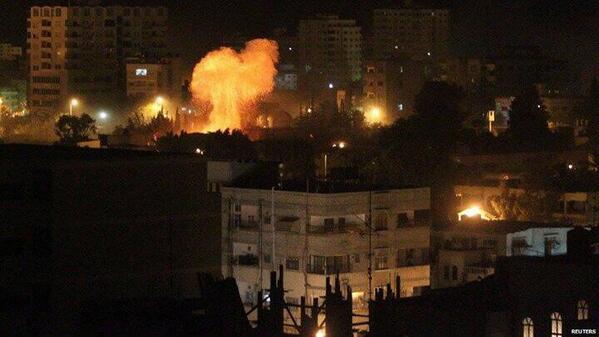
Once again, the United States proves that it is a partner in the crimes committed against humanity by the Israeli occupation forces in Gaza.
A US defense official said on Thursday that Washington has allowed the Zionist entity to tap a local US arms stockpile in the past week to resupply it with grenades and mortar rounds.
The munitions were located inside the Zionist entity as part of a program managed by the US military and called War Reserves Stock Allies-Israel (WRSA-I), which stores munitions locally for US use that Israel can also access in emergency situations.
However, Tel Aviv did not cite an emergency when it made its latest request about 10 days ago, the defense official said, speaking on condition of anonymity.
The United States allowed Israel to access the strategic stockpile anyway to resupply itself with 40mm grenades and 120mm mortar rounds to deplete older stocks that would eventually need to be refreshed.
“They didn’t ask for it from there but we gave it to them so we could rotate our stocks,” the official said.
Additional Israeli requests for U.S.-manufactured ammunition were also being processed in the United States, the official said, without offering further details on quantities or costs of ammunition already supplied or requested.
The Israeli embassy in Washington declined comment about the resupply request, including whether it asked for the ammunition because of its offensive in Gaza.
Gaza Ministry of Health: Israeli attack on crowded market during ceasefire is ‘barbarity personified’
Gaza Ministry of Health | July 30, 2014
Gaza, Occupied Palestine – Ministry of Health Gaza is outraged at the Israeli massacre perpetrated during the so-called humanitarian ceasefire, when F-16s fired missiles into the crowded Shujeiyah market as hundreds took advantage of the lull to buy food and supplies.
At least 17 people have been killed and 200 injured.
“This atrocity is barbarity personified,” said Director General, Ministry of Health Dr Medhat Abbas.
Not satisfied with exterminating entire families in their own homes, not satisfied with killing people praying in mosques, not satisfied with killing patients, staff and visitors in hospitals, not satisfied with killing ambulance drivers as they retrieve the dead and injured, not satisfied with killing women and children sheltering in UNRWA school, the Israeli death machine now blatantly attacks a crowded public market DURING a humanitarian ceasefire, in an unrivaled cruel and cynical exercise of savagery and barbarism.
The Ministry of Health Gaza condemns this latest atrocity in the strongest possible terms, and considers that any further prevarication by the international community can only be seen as complicity in the increasingly barbaric and clearly genocidal war crimes being visited on the citizenry of Gaza.
The Ministry demands immediate international intervention to bring the rogue ‘state’ of Israel under control, and an immediate end to its carnage in Gaza.
Zionism’s Prior Condition: Propaganda
By Nima Shirazi | Wide Asleep in America | July 29, 2014
“Propaganda by its very nature is an enterprise for perverting the significance of events and of insinuating false intentions…The propagandist will not accuse the enemy of just any misdeed; he will accuse him of the very intention that he himself has and of trying to commit the very crime that he himself is about to commit. He who wants to provoke a war not only proclaims his own peaceful intentions but also accuses the other party of provocation.” – Jacques Ellul, Propaganda: The Formation of Men’s Attitudes, 1965
As Israeli war crimes continue unabated – at the time of this writing, nearly 1100 human beings in the besieged Gaza Strip, the vast majority of whom are civilians, have already been slaughtered by their occupiers; over 6,200 have been wounded – Israeli lies too keep piling up.
Despite what Israeli spokespeople and their dutiful, compliant, and prostrate puppets in the media continue to claim, Hamas was not responsible for the abduction and murder of three Israeli teenagers last month. Hamas did not break the 2012 ceasefire, Israel did. Hamas is not forcing Palestinians to act as “human shields.” Israel is not acting in self-defense when it bombs hospitals, schools, ambulances, mosques, homes, refugee camps, parks, or a zoo. The “terror tunnels” which Israel apparently needs to murder hundreds and hundreds of men, women, and children in order to destroy pose essentially no threat whatsoever to Israeli civilians. The list goes on and on.
Israel’s ongoing massacre cannot continue without a steady barrage of hasbara – what Zionists, in their Orwellian glory, refer to as “public diplomacy,” but which is merely propaganda to justify the indefensible, inexcusable, and unspeakable. That is, the promotion of a 19th century, colonial European ideology of ethnic, religious, and racial superiority, imposed upon an indigenous population through military conquest and a campaign of ethnic cleansing, displacement, dispossession, disenfranchisement, and discrimination.
And yet, though mainstream media outlets are suffused with pro-Israel bias and Israel has legions of willing propagandists trolling the internet to spread Netanyahu’s latest talking points, we have heard – especially as the Palestinian death toll keeps rising – that Israel and its advocates are “losing the media war.” Politico, Mashable, New York Magazine, analyst Juan Cole, and Britain’s Channel 4 have all noted this.
Even the Telegraph‘s detestable, neoconservative “Defence Editor” Con Coughlin is worried for Israel’s image, writing that, “with so much focus on the Palestinian victims of this dreadful conflict, it is hard to see how Israel can turn the propaganda war around in its favour.” Coughlin laments, “I fear the answer is that it cannot.”
Similarly, in a conversation via Twitter with a spokesman at the Israeli Embassy, Washington Post White House correspondent Scott Wilson was fretful that the Israeli slaughter in Gaza might not be “good for Israel – strategically.” For Wilson, as for so many others, Israeli war crimes and crimes against humanity are simply image problems, a matter of PR.
Without its propaganda, Israel cannot sustain the support of its benefactors, whether in the war chests of Congress or the war cries of brainwashed and bloodthirsty communities. Without its lies, Israel can’t survive. This fact is known not only to professional hasbarists like Michael Oren, Dore Gold, and Mark Regev, but – more importantly – is a vital feature of Zionism, inseparable from the ideology itself.

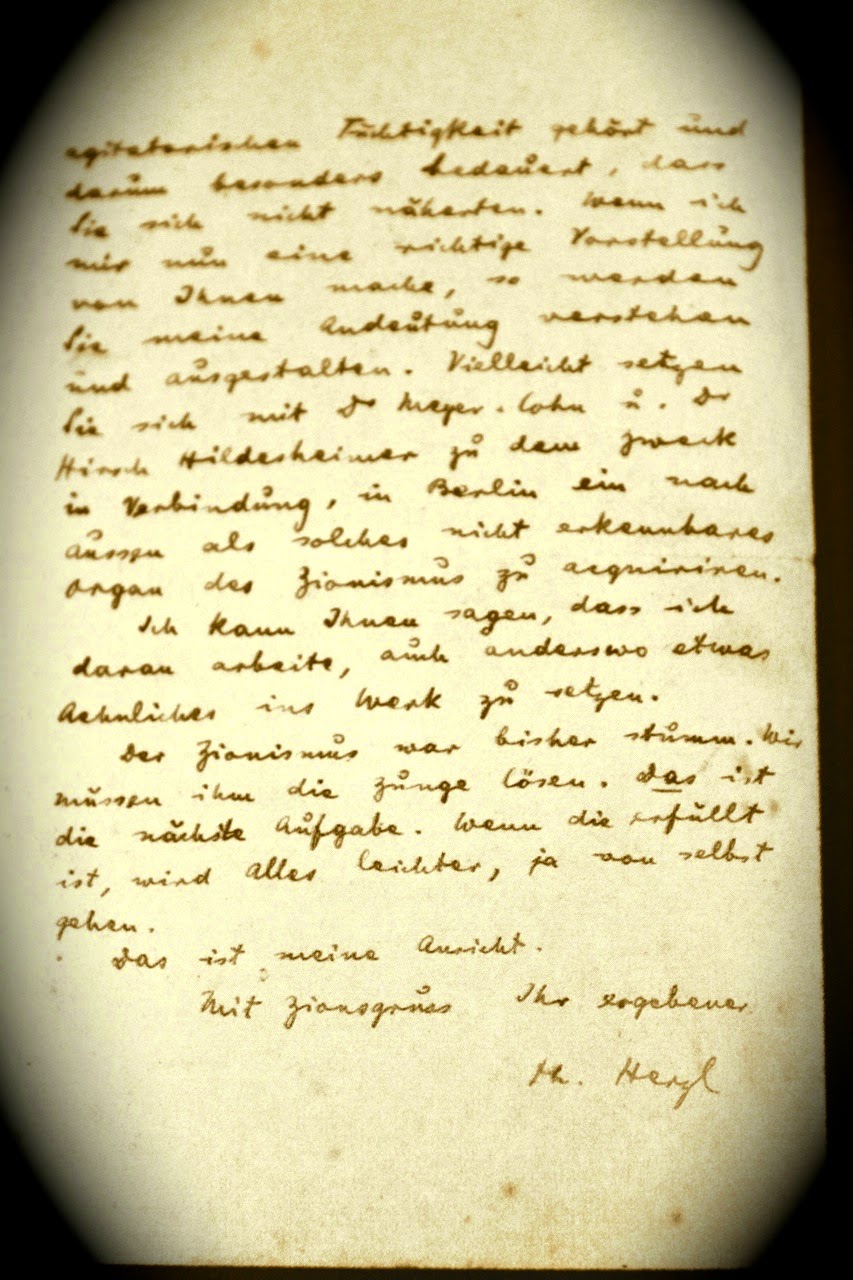
In a little known and rarely-referenced letter written in early 1897, Theodor Herzl, the ostensible founder of political Zionism, made this perfectly clear. During the planning stages of the First Zionist Congress – initially to take place in Munich but eventually held in Basel, Switzerland in late August 1897 – Herzl contacted Willy Bambus, leader of the Berlin Hovevei Zion society (an early Zionist organization committed to Jewish immigration and agricultural settlement in Palestine), for support.
“I want to reach an understanding with the Berlin Zionists,” Herzl wrote from Vienna on January 26, 1897. “[I]n the general Zionist conference that I am planning for next summer, we will grow closer to each other.” The letter is written in German, Herzl’s first language.
Herzl’s dream was big and he knew what he needed to achieve it:
But a project of this sort… has one prior condition: propaganda. First we must have propaganda and afterward establish economic projects… [T]ry to win influence at a Berlin daily newspaper… There is no necessity to immediately give the newspaper a Zionist imprint. On the contrary, because of the cowardly suspicions (to my sorrow, of most of the Jews) of Zionism, it would be wiser to keep things innocent… Perhaps you can… purchase a Zionist paper in Berlin, that will not be outwardly noticed as such.
Friendly media coverage? Feigned innocence and impartiality? Sounds familiar.
“Until now Zionism has been silent,” Herzl wrote Bambus. “We must free its tongue. This is the first order of business.”
Those tongues of Zionism have since wrought over a century of pain and suffering, in name the entitlement and privilege, to the people of Palestine. It is time to drown out the propaganda with truth.
Israeli bombing of Shujaiyya market kills 17 despite ceasefire
Ma’an – 30/07/2014
BETHLEHEM – Despite a four-hour humanitarian ceasefire that began at 3:00 p.m., Israeli forces on Wednesday afternoon shelled a market in Shujaiyya as well as number of homes across the Gaza Strip, killing at least 33.
Gaza Ministry of Health spokesman Ashraf al-Qidra said around 6 p.m. that an Israeli airstrike had hit Shujaiyya market, killing at least 17, including a journalist, and injuring 200, including many seriously.
A Ma’an reporter on the scene said that Israeli artillery had fired several shells at civilians in the market, adding that ambulances and civilian vehicles were still transporting the wounded and the killed to al-Shifa Hospital.
The Ministry of Health in Gaza said that the dead include a journalist and two paramedics, as well as a member of the civil defense crews.
Sources named the journalist as Rami Ryan, a photographer for the Palestinian Network for Journalism and Media.
Bodies were still being pulled from the rubble, with medics estimating that dozens had been killed and injured.
That attack brought the toll since the ceasefire to at least 29, with 12 killed earlier including Muhammad Wissam Dardona, Hussam al-Najjas, Hussam Muhammad al-Najjar, Shaaban Abdulaziz al-Jamal and Alaa Judi Khader.
Four were killed in shelling on a home in al-Qarara in Khan Younis.
Strikes were reported in Juhr al-Dik, al-Bureij, Deir al-Balah, and many other districts across Gaza.
One airstrike hit the al-Basha building in Gaza, which houses a number of press offices.
The Israeli military said, meanwhile, that during the unilaterally-declared ceasefire Hamas had fired 26 rockets into Israel. No damage or injuries were reported.
The violations of the ceasefire brought the day’s total Palestinian deaths to 103, as the total Palestinian death toll in the 23-day offensive hit 1,325 with more than 7,000 injured.
Yoav Mordechai, Israel’s coordinator of government activities in the Palestinian Territories, said earlier that Israeli forces would stop attacks for four hours starting at 3 p.m.
Mordechai said Israeli forces would only target areas where rockets were being fired at Israel.
An Israeli army statement added that the “humanitarian window will not apply to the areas in which (army) soldiers are currently operating.”
“Residents must not return to areas that have previously been asked to evacuate,” the statement said, adding the the army would respond to all fire from Palestinian militants throughout the limited ceasefire.
It was not immediately clear whether Palestinian factions would respect the limited, brief truce.
Hamas spokesman Sami Abu Zuhri said that Israel imposed the ceasefire only for “media consumption.”
Abu Zohri said the truce was “worthless” given that it excluded parts of the Gaza Strip where Israeli forces were operating.
Earlier in the day, Israeli forces killed over 70 Palestinians, bringing the total number of Gazans killed since the beginning of the offensive up past 1,300.
The deadliest Israeli attack on Wednesday was a shelling on a UN-designated shelter in Jabaliya refugee camp which left at least 16 dead.
Chris Gunness, the spokesman for the UN’s Palestinian refugee agency, condemned the attack in a statement made on Twitter.
“UNRWA condemns in the strongest possible terms this serious violation of international law by Israeli forces,” Gunness said.
“Precise location of Jabalia Elementary Girls School #Gaza & that it housed 3,000 displaced was communicated to Israeli army 17 times,” he said in another tweet.
Gaza: Black sky turns orange
By Charlie Andreasson | International Solidarity Movement | July 30, 2014
Since July 25th, international volunteers, including activists from the International Solidarity Movement (ISM) and other groups have begun a constant protective presence in various locations at the al-Shifa Hospital. Below is a journal extract from an ISM volunteer during his shift at the hospital on July 28th.
Gaza, Occupied Palestine – There had been shelling during my shift in al-Shifa. My shift began at 7PM, and in the distance I registered the sounds as everybody else does here in Gaza, I heard the drones without trying to see them. I left Joe [another ISM activist] alone in the hospital; I went in a car for an interview and came back again. The shelling from the sea grew closer. But I couldn’t stay awake for 24 hours just to listen to the noise, nobody can, and I tried to sleep for a few hours.

Then the thunder started, and the black sky turned bright orange, the hospital shook a little, and some windows shattered. I send a short text to the media coordinator for the Ship to Gaza-Sweden saying that this is following me, thinking about el-Wafa hospital, Beit Hanoun hospital, and now al-Shifa. But we weren’t hit. Not this time.


The morning came, we were released by the next shift, and I passed some of the nights targets on my way home. I took a few photos and carried on. There’s so much destruction now that I hesitate to take any more pictures of it. In some areas it is now rare to see an undestroyed building. But of course they claim all of this is to create silence and ‘security’ for Israel, seeing the destruction left behind, I don’t think so.


Photos by Charlie Andreasson
Featured Video

Seyed M. Marandi: US-Iran War Inevitable: Kuwait and Bahrain May Fall
or go to
Aletho News Archives – Video-Images
From the Archives
Oil and the Israel Lobby
Reknowned economist M. Shahid Alam offers this excellent critique of Noam Chomsky’s defective analysis of the relative influence of Oil versus the Israel lobby over US foreign policy: … continue
Blog Roll
 Aletho News
- ICC ignored ‘very well-documented’ NATO crimes – ex-Libyan minister
- SNSC secretary dismisses US response to Iran’s conditions as ‘inadequate’
- Sanaa says Taiz roads open, secure for residents, warns Saudi forces
- Iraqi resistance group urges Saudi leadership to admit defeat, lift Yemen siege
- Trump’s Retreat: How Al-Aqsa Flood Took Down the US Empire
- Israel’s Military Actions in Lebanon Grossly Violate International Law — Lavrov
- Seyed M. Marandi: US-Iran War Inevitable: Kuwait and Bahrain May Fall
- Leaders Condemn Ansarallah Attack on Saudi Arabia While Ignoring Illegal War Against Yemen
- Leaked: Britain’s Covert Iraqi Psyops Network
- Yemeni Armed Forces Warn Airlines Against Using Saudi Airports, Exempt Mecca and Medina
- If Americans Knew
- After Oct 7, IDF policy allowed civilian casualties for even the lowest-ranking targets
- Israel’s Destruction of Southern Lebanon Intensified After the Cease-Fire
- The Last-Minute Decision That Gave Israel Its Name
- The American Conservative: How Trump Made the World Go Nuclear
- Meet the US generals and admirals advancing Israeli policy
- Opinion: Why news organizations should boycott Israel
- The Israeli witch hunt of Sami Abu Shehadeh exposes the lie of the ‘Jewish and democratic’ state
- No state has a ‘right’ to exist – least of all Israel
- Testimonies about Gaza’s civilian death toll expose Israel’s atrocities – Daily Update
- How Israel Conquered the Latin American Right
- No Tricks Zone
- New Study Suggests Large Regions Of The Pacific Ocean Have Been Cooling For The Last 80 Years
- Germany’s Green Energy Debacle: High Energy Costs Force Kahla Porzellan to Close After 182 Years!
- New Study: 50 Years Of The Most Aggressive ‘Net Zero’ Policies Can Only Affect The Global Climate By 0.03°C
- US September “Heat” Was No Record…Many Records Set Decades Ago
- Latest European Green Energy Debacle; Portugal’s Largest Flagship Solar Park Insolvent!
- Green Energy Debacle: German Expert Professor Fritz Vahrenholt Warns Of Severe Economic And Social Consequences
- Two More Paleo Reconstructions Affirm Meters-Higher Sea Levels Across Ireland, Brazil 7000-6000 Years Ago
- New Study: Earth And Venus Surface Warmth Largely Explained By Convection And Lapse Rate, Not CO2 Or Radiation
- 2025 Nature Paper Claiming Worsening Global Drought Gets RETRACTED …Heavily Flawed
- New Study: ‘Global Drought Shows No Detectable Recent Acceleration Under Climate Warming’

