Fears Grow of Possible Massacre in East Khan Younis; Area Completely Cut Off Until Early Thursday
Palestinian Ministry of Health Report | July 24, 2014
The Khuza’a area of east Khan Younis was cut off from the rest of the city for hours on Wednesday night, with medics unable to enter, journalists forced out and Israeli military forces engaged in a ground and air assault that has been ongoing, and has now sparked fears of a massacre similar to the one on Sunday, in Shuja’eyya, in which more than 75 people were killed.
Early Thursday, Israeli forces agreed to let up the assault for an hour to allow medics to retrieve the bodies of the dead and wounded.
Doctor Yusef Abu Al-Rish, the Deputy Health Minister of Gaza, issued a statement that reads:
Another massacre is underway in Khan Younis, where relentless Israeli shelling and sniper fire are wreaking death and destruction on all that moves in the zone east of Khan Younis city.
The villages of Khuza’a, Al Fukhari, Abasan Alkabir, Abasan Al Sa’ir, Jarara, and Bani Suhela received no warning of the attacks, and no warnings to evacuate before the bombardment began at around 11pm last night.
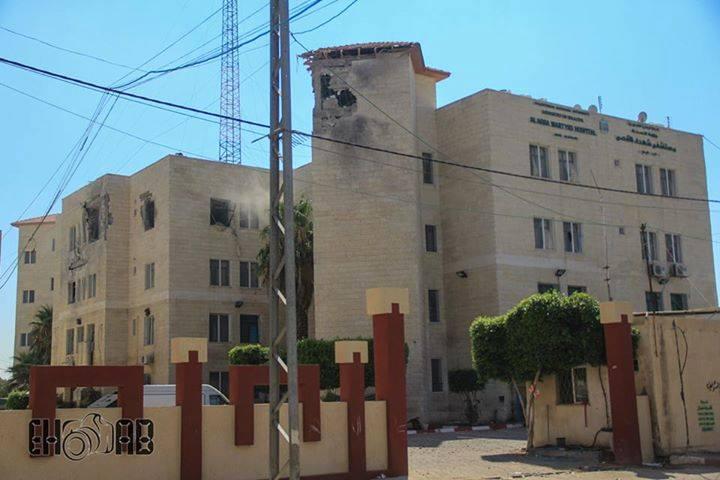
The intensity of Israeli shelling around the Algerian Hospital in Abasan Alkabir shattered its windows, and led to its evacuation, leaving only the emergency department operational.
Despite residents’ frantic calls to the International Committee of the Red Cross (ICRC) for help in finding a safe route and safe vehicles to escape, the ICRC was unable to get a response from Israeli authorities until dawn today, when five bodies and 17 injured were retrieved and taken to Nasser Hospital in Khan Younis.
An unknown number of dead and injured remain behind, as ambulances are prevented access.
Israeli military has declared the Khuza’a area a closed military zone, preventing even medics from entering it, but reports from Khuza’a stated that 12 were dead by morning.
The casualties in other villages are unable to be established at this time. Random shelling continues unabated, and Israeli snipers inside houses are attacking anything that moves.
Homes are being destroyed over the heads of entire families. Thousands have been displaced, many fleeing to the Nasser and European Gaza Hospitals.
Even hospitals are not safe, however. Monday’s attack on Al Aqsa hospital has left staff and patients alike fearing for their lives even within medical facilities.
The reality is that there is no safe sanctuary, for residents, patients or health personnel alike.
As they did in Shuja’eyya, the Israeli military is indiscriminately attacking civilians.
As they did in Shuja’eyya, the Israelis military is refusing to provide humanitarian access to the dead and injured, in clear breach of humanitarian law.
As they did in Shuja’eyya, the Israeli military is committing war crimes, with apparent impunity.
The Ministry of Health Gaza demands that the international community require the Israeli military to
1. Immediately cease all attacks on civilian targets in Gaza;
2. Immediately cease all attacks on medical facilities and personnel in Gaza;
3. Immediately provide access to the dead and injured, as required by international humanitarian law.
Medical Aid as a Weapon
By Paul Larudee | Dissident Voice | July 22, 2014
Q: Why is Egypt preventing medical aid to Gaza?
A: So that Israel can use it as a weapon, that’s why.
This explains why dozens of volunteer medical personnel cannot reach the desperately understaffed hospitals in Gaza. It explains why Egypt turned away a convoy of desperately needed medical supplies.
In this time of crisis, Egypt has sealed the border with Gaza, except occasionally to Palestinians who are registered with Israel as residents of Gaza. For anything else, please apply to Israel.
That’s fine for UNRWA, ANERA, UPA and other groups Israel has approved as relief agencies and who buy a lot of their supplies from Israeli sources, store it in Israeli warehouses, use Israeli transportation, have personnel that live in Israel and generally meet Israeli requirements and contribute to the Israeli economy. But what about doctors that carry Lebanese passports? Or Pakistanis, Algerians, Venezuelans, Sudanese, Iranians, Cubans or Syrians? Or who are not permitted to travel to or through Israel because they are on a long list of people who are critical of Israel, such as the organizers of the relief convoy that was turned away? Until the Sisi administration they used to be able to enter through Egypt.
That’s exactly the point. Israel wants them all to go to hell because they are not friends of Israel. Even better, let the people of Gaza go to hell – its children, mothers, grandparents – let them die or better still become infirm and a burden on this already crippled society.
Ashy grey faces – Oh NO! not one more load of tens of maimed and bleeding, we still have lakes of blood on the floor in the ER, piles of dripping, blood-soaked bandages to clear out – oh – the cleaners, everywhere, swiftly shovelling the blood and discarded tissues, hair, clothes, cannulas – the leftovers from death – all taken away…to be prepared again, to be repeated all over. More then 100 cases came to Shifa last 24 hrs. enough for a large well trained hospital with everything, but here – almost nothing: electricity, water, disposables, drugs, OR-tables, instruments, monitors – all rusted and as if taken from museums of yesterdays hospitals. But they do not complain, these heroes. They get on with it, like warriors, head on, enormous resolute.
– Dr. Mads Gilbert, al-Shifa Hospital, Gaza
This is what Israel has in mind. In effect, it has turned back the clock to when it destroyed nearly two thousand homes along the Gaza border, making homeless around 20,000 Palestinians and creating the “Philadelphi corridor”, a path of destruction the width of three football fields and eight miles long. It then controlled all of the borders of the Gaza strip, encroaching and destroying everything on the Gaza side up to an average depth of a half kilometer, and in the sea from a treaty-protected twenty kilometers to less than three unprotected, confining the ever growing population into an ever shrinking area with ever fewer resources.
Now, with Israel’s sweethearts running Egypt, it is once again fully in charge of that border, as well, and can treat the Gaza Strip like a hunting reserve, where its troops can practice their skills every couple of years. This is necessary in order to assure that the new recruits acquire the same genocidal experience as their older peers and preserve Israel’s shared cultural traditions.
These are the real aims of the Gaza invasion.
Paul Larudee is one of the founders of the Free Gaza and Free Palestine Movements and an organizer in the International Solidarity Movement.
How Have Latin America’s Political Leaders Responded to Israel’s Siege on Gaza?
By Stephan Lefebvre | Center for Economic and Policy research | July 21, 2014
On July 10th, just two days after Israel launched Operation Protective Edge (the largest attack on Gaza in several years) President Obama released a statement in which he “reaffirmed Israel’s right to defend itself.” With a death toll now over 550, it is important to look beyond U.S. government sources for information and perspective. Foreign policy among the countries in Latin America conforms to the long-standing, overwhelming international consensus that opposes Israeli aggression and occupation, but it also reflects the region’s “second independence.” Over the last 15 years, most countries in Latin America have increased their ability to pursue a foreign policy agenda separate from the goals of the U.S. State Department. In the vast majority of cases, reactions to the latest hostilities are fundamentally at odds with the U.S. position, but they are also varied: many governments directly criticize Israel, using words like “crimes against humanity” and “genocide” to describe recent events; other official statements limit themselves to calling for a ceasefire and a peaceful resolution to the conflict.
Some of the strongest statements were issued by left-leaning governments in South America, including those of Argentina, Bolivia, Brazil, Chile, Ecuador, Uruguay and Venezuela. The government of Argentina issued a statement “strongly condemn[ing] that Israel — defying calls by the Security County, by the Secretary General and by the many voices of the international community – has decided to escalate the crisis by launching a ground offensive.” President Evo Morales of Bolivia announced that he had petitioned the United Nations High Commissioner for Human Rights (UNCHR) to consider a case against Israel at the International Court of Justice (ICJ) for “crimes against humanity” and “genocide.” (Bolivia broke diplomatic relations with Israel in 2009 over Israel’s Operation Cast Lead assault on Gaza.) The statement from Brazil reads in part:[1]
The Brazilian Government vehemently condemns the Israeli bombardment of Gaza, with disproportionate use of force, which resulted in more than 230 Palestinians dead, many of them unarmed civilians and children. It equally condemns the firing of rockets and mortars from Gaza into Israel.
The foreign ministry of Chile released a statement that “strongly condemns the Israeli attacks in the Gaza Strip,” also saying that “The reprehensible kidnappings and deaths of three young Israelis and one young Palestinian cannot serve as an excuse to initiate terrorist actions nor to attack areas densely populated by civilians.” Chile has reportedly suspended trade talks with Israel and is considering withdrawal of its ambassador in Tel Aviv over Israeli attacks in the Gaza Strip. The Government of Ecuador released a statement saying that it:
strongly condemns the disproportionate military operations by the Israeli army against the civilian population of the Gaza Strip, which have left more than a hundred deaths [sic] and considerable damage to property and civil infrastructure, demands an immediate cessation of these aggressions against the Palestinian civilian population and called [sic] the State of Israel to exercise maximum restraint and act in accordance to international law and humanitarian law.
Uruguay issued a similar statement condemning the military attacks by Israel in the Gaza Strip, which “caused dozens of civilian deaths and injuries, including women and children, in a disproportionate response to the launch of rockets against the Israeli territory on the part of armed Palestinian groups.” The statement also condemns the “repeated [rocket] launchings that put the civilian population in central and southern Israel at risk.” On the whole, this was not positively received by the Israeli ambassador to Uruguay. Finally, President Nicolás Maduro of Venezuela issued a statement lamenting the murders of three young Israelis, saying it is a case that “demands a full investigation.” He also rejected the attacks by Israeli forces in the Gaza Strip, saying:
the Bolivarian Government of Venezuelan energetically condemns the unjust, disproportionate and illegal military response of the State of Israel against the historic Palestinian nation and urges its government to immediately end this aggression which goes against international law and against the most elemental sense of respect for life and human dignity.
Clearly the language used by each country varies, but it is interesting to note that Venezuela’s response falls somewhere in the middle of the spectrum in terms of condemning the Israeli siege. The Venezuelan foreign ministry issued a separate statement on behalf of the ALBA counties which echoes the Venezuelan government’s statement and reaffirms the ALBA group’s “unconditional solidarity, support and influence for the people of Palestine before this new wave of violence.”
Outside South America, several other countries issued strong responses, including Cuba and El Salvador. Cuba’s foreign ministry condemned Israel for “us[ing] its military and technological superiority to execute a policy of collective punishment with a disproportionate use of force which causes civilian casualties and enormous material damage.” El Salvador issued a statement in which the government “strongly condemns and rejects Israel’s increased armed aggression against the Gaza Strip” which caused the “loss of human lives, hundreds of injuries and the flight of thousands of Palestinians from their homes, besides serious material damage.” Also, the statement explains that the U.N.’s legitimate self-defense clause “does not justify the use of disproportionate military force against another State, much less against its civilian population.”
As an historical aside, the United Nations declared 2014 the International Year of Solidarity with the Palestinian People, and several of the countries that introduced the resolution to the General Assembly were from Latin America, including Bolivia, Cuba, Ecuador, Guayana, Nicaragua, and Venezuela.
Colombia stands out, not only in South America but in Latin America as a whole, for condemning the “acts of violence and terrorism” against Israel and its civilian population. They called on both Israel and Palestine to end the confrontations and return to the dialogue and negotiation. Colombia has not supported U.N. membership for Palestine, abstaining during the 2012 vote.
More measured statements were issued by the governments of Costa Rica, Honduras [PDF], Mexico, and Peru. These statements typically called for a ceasefire, a peaceful resolution to the conflict, and condemned both sides equally for the violence. Several countries have not issued official responses, including the Dominican Republic, Guatemala, Haiti, Nicaragua, and Paraguay. Panama’s foreign minister did not release a dedicated statement on the recent events, but received the Israeli Ambassador for a meeting to strengthen the bilateral relationship during which time the Panamanian official expressed concern over the rise in violence in the Middle East and expressed support for a peaceful resolution.
These statements clearly show not only that the vast majority of Latin American countries are at odds with U.S. foreign policy, but also that these countries are more and more able to articulate opposing views that challenge U.S. State Department narratives. Back in 2010, CEPR examined the region’s response to Israel’s deadly raid of the Gaza Freedom Flotilla and then as now we found that there was a “hemispheric isolation of the U.S. on critical foreign policy issues.” While the era of U.S. supported coups and interference in the region is not over, significant progress has been made to increase national sovereignty and independence in Latin America, and these are changes that reverberate not just throughout the hemisphere, but across the world.
[1] In this blog post, estimates for casualties and other statistics included in official statements are quoted as written in the original versions, not corrected for the latest information available. The latest numbers for the death toll indicate over 550 killed since July 8, 2014.
Israeli military falsifies photograph to justify bombing el-Wafa hospital
International Solidarity Movement | July 23, 2014
Gaza, Occupied Palestine – On the 21st July at 2:17 PM, the IDF spokesperson released an image on twitter showing an aerial picture of a building marked as ‘Al-Wafa’ hospital. In the image there is a red circle, which they designated as the location from which a M75 rocket was launched.
The building in the picture marked ‘Al-Wafa’ hospital is in fact not the el-Wafa hospital but the Right to Life Society.

“Israel has targeted our hospital based on false and misleading claims. They are targeting medical facilities, the wounded, the sick, and our children, all over the Gaza Strip. They want us to know that nowhere is safe.” Said executive director of el-Wafa hospital, Dr. Basman Alashi.

According to the Gazan Ministry of Health, seven out of 13 hospitals, including el-Wafa, have been severely damaged.
Al Atatra Medical Clinic and 12 ambulances have been completely destroyed, seven other clinics have been damaged, 12 medical staff members have been injured, and three have been killed.
El-Wafa hospital was bombed once again by the Israeli military today after Dr. Alashi, received two phone calls from the World Health Organisation (WHO) and the United Nations (UN). They passed a message from the Israeli military that, “there are activities in the hospital and the Israeli military may take a bigger action against el-Wafa.”
Dr. Alashi explained to both callers that the hospital is empty; all patients were evacuated on the 17th of July and that the hospital holds seven million dollars worth of essential medical equipment, as well as two safes that were irretrievable during the emergency evacuation.
“I will hold Israel personally responsible for seven million dollars if they have destroyed the hospital. It has already been bombed and shelled, I don’t understand what they are trying to achieve.” Dr. Alashi stated to the International Solidarity Movement (ISM).
Ally Cohen, media coordinator for the ISM states, “anyone on the ground in Palestine knows that the Israeli military are constantly releasing completely fabricated information and reports. The only difference in this case, is that we can prove it.”

Interview with an international human shield in Gaza
By Roqayah Chamseddine | Al-Akhbar | July 23, 2014
Israel’s bombardment of Gaza continues, with a death toll that has reached 655 – and just as an array of munitions rain down indiscriminately on the heads of those living in Gaza, turning night into day and forcing the residents of one of the most densely populated places on earth into becoming mourners in an instant, Gaza’s hospitals are made to endure the incoming salvo of missiles as well as a crippling siege.
Israel has a well-documented history of deliberately targeting civilian infrastructure in Gaza and Lebanon – homes, police stations, mosques, power plants, sport facilities, schools and hospitals. On Monday in central Gaza the floor housing operating rooms and the intensive care unit of al-Aqsa Hospital was struck by at least three tank shells, which killed five, according to Al-Jazeera correspondent Stephanie Dekker in Gaza. Gaza’s Ministry of Health released a statement denouncing the attack and demanding medical facilities be protected and medical staff, who have also been targeted by Israel, be allowed to provide urgent medical care:
We deplore the escalating violence against Gazan civilians and civilian infrastructure, and demand that the Israeli occupation respect their obligations under international humanitarian law to protect civilians, health facilities and health professionals.
We note that attacks against health facilities can be considered war crimes under international law, and call upon the international community and the United Nations to take immediate action to prevent further such outrages against the Gazan citizenry by the Israeli occupation.
Al-Aqsa Hospital was not the only medical facility directly targeted by Israel, but one of four – another casualty of Israel’s unrelenting assault on the people of Gaza is charity-run al-Wafa Medical Rehabilitation Hospital, the only medical rehabilitation hospital in Gaza that treats and rehabilitates those with special needs and functions as a nursing home. On July 11, the International Solidarity Movement (ISM) released a statement on the conditions around the hospital, relaying that not only had Israel fired “warning missiles” at the roof of al-Wafa but international activists were hearing missiles falling nearby Israel and so in an act of selflessness, foreign activists from the USA, Sweden, Spain, UK, Venezuela, Australia, New Zealand and France were maintaining a presence in the hospital so as to protect the patients and doctors inside. “The civilian population of Gaza is being bombed. We will stay with them in solidarity until the international community and our governments take action to stop Israel’s crimes against humanity,” states Swedish International Solidarity Movement (ISM) activist Fred Ekblad.
Joe Catron, a freelance reporter who writes for the Electronic Intifada, Middle East Eye and other media outlets, is one of the ISM activists from the United States who remained inside al-Wafa Medical Rehabilitation Hospital. He entered the Gaza Strip in 2011 as part of the first solidarity delegation to arrive after the fall of the Mubarak regime in Egypt, and has lived there since. Catron and I spoke by way of email regarding his experiences as well as how doctors and Gaza’s medical facilities are coping as a result of Israel’s continued bombing:
Al-Akhbar English (AAE): What is the situation on the ground in Gaza currently, and how are Palestinians coping?
Joe Catron (JC): The situation is very difficult. Aside from the rapidly-mounting deaths and injuries, tens of thousands have been displaced by Israel’s destruction of their homes, or shelling and airstrikes on their neighborhoods. With many businesses and charities shuttered due to the risks of commuting, obtaining even basic supplies has become difficult for many. And Israel’s attacks on electrical and water infrastructure have made these resources even more inaccessible than the ongoing siege already had.
But people are pulling together, as they always do in times of escalated Israeli aggression, opening their homes to the displaced and sharing what they have. It’s the worst of times; in a strange way, it’s also the best of times. Palestinians are rarely more united than during an offensive.
AAE: What hospitals have you visited and what have you witnessed?
JC: I and seven other foreign activists spent a week in shifts at al-Wafa hospital, the only rehabilitation facility of its kind dedicated to occupational and physical therapy in the Gaza Strip. After an initial flurry of five Israeli missiles damaged it on July 11, we hoped our presence might discourage further Israeli aggression against it.
Unfortunately, it was insufficient. After a week of telephone threats and heavy shelling of the area, Israeli forces struck the hospital hard on July 17, forcing the evacuation of its patients at great risk and leaving smoking craters in its walls.
Al-Shifa hospital, Gaza’s main and largest medical facility, is simply flooded. With new patients pouring in every hour, others are being discharged or transferred as quickly as possible.
On Sunday, four international activists accompanied rescue workers into Gaza’s Shujayeh neighborhood, the site of Israel’s largest massacre yet in its current offensive. Days of Israeli shelling have reduced this once-thriving neighborhood to an apocalyptic landscape of fire and rubble, bombed ambulances and demolished homes. We saw a young man trying to reach his family’s home and locate survivors shot by an Israeli sniper, then repeatedly shot again while prone on the ground. He lay only meters from us, but Israeli gun and artillery fire blocked us from reaching him.
AAE: What else can you tell me about the situation in the hospitals?
JC: Hospitals are crowded and chaotic, but also oddly inspiring. They’re sites to treat the wounded, but also for others to show support for them, their families, and the health care workers looking after them. A number of my friends here are doing what they can for the struggle by preparing food and bringing it to al-Shifa. Many political factions and civil society organizations are doing the same.
AAE: How are doctors dealing with what has been transpiring in Gaza?
JC: Doctors and other health care workers face grave challenges not only from a massive influx of new casualties and critical shortages of medications and other supplies, but also in threats to their own safety. Israel’s attacks on at least four hospitals and six clinics have shown that in its current offensive, they are its targets as much as anything else.
Hospitals and clinics face critical shortages not only of essential medications, but also of supplies as routine as bandages. In some cases, like Israel’s shelling of el-Wafa hospital, staff have been forced to abandon supplies in their facilities while evacuating patients, which hasn’t helped matters.
AAE: What do you want people to know about Gaza, in terms of this situation and beyond it? Anything else to add?
JC: Like most places, the Gaza Strip is a product of its history more than the news. The overwhelming majority of its population are Palestinian refugees ethnically cleansed from land now claimed by Israel. This is the single most important factor in its resistance to the occupation, and also the one most quickly obscured in mainstream reporting, which focuses instead, and almost exclusively, on the events of the day.
You can follow Joe Catron’s updates from the Gaza Strip on Twitter @jncatron
Roqayah Chamseddine is a Sydney based Lebanese-American journalist and commentator. She tweets @roqchams and writes ‘Letters From the Underground.‘
24 Palestinians killed in Israeli assault on Gaza Wednesday morning
Ma’an – 23/07/2014
GAZA CITY – The death toll on the 16th day of Israeli military offensive on Gaza rose to 24 on Wednesday after an Israeli airstrike killed 70-year-old Hasan Abu Hein, 34-year-old Osama Abu Hein, and journalist Abdul-Rahman Abu Hein, 24, in the Shujaiyya neighborhood of Gaza City.
Several other people were also injured when Israeli forces bombarded a 700-year-old mosque known as Al-Shamaa mosque (also known as Bab ad-Darum) in the Zaytoun neighborhood of Gaza City before noon time.
More than 650 Palestinians — the vast majority of whom have been civilians, including more than 160 children — have been killed in the assault so far, while Israel has suffered 29 deaths, 27 of whom have been soldiers.
The Gaza Strip continued to be bombarded from air, land, and sea on Wednesday morning, a day after the the United Nations’ Palestinian refugee agency UNRWA accused Israeli of shelling a UN school sheltering the displaced for the second time in two days.
“UNRWA condemns in the strongest possible terms the shelling of one of its schools in the central area of Gaza,” it said in a statement.
“The location of the school and the fact that it was housing internally displaced persons had been formally communicated to Israel on three separate occasions. We have called on the Israeli authorities to carry out an immediate and comprehensive investigation.”
During the offensive, more than 135,000 Gazans have fled their homes, seeking shelter in 69 schools run by UNRWA.
Palestinian Ministry of Health spokesman Ashraf al-Qidra on Wednesday said that the evacuation of dead bodies and injured people had been very slow in a number of areas because Israeli forces had impeded the movement of ambulances and rescue teams.
Al-Qidra highlighted that the total Palestinian death toll had risen to 647 on Wednesday morning, including 161 children and 35 elderly people.
More than 4,000 Palestinians had also sustained injuries in the assault, he said, while hospitals were running dangerously low on medical supplies amid the most deadly sustained Israeli assault on the besieged coastal enclave since 2008.
Israeli leaders on Tuesday hinted that the assault would not end until Hamas’ entire tunnel network had been destroyed, suggesting that the goals of the offensive had shifted from halting rocket fire to undermining the group’s military infrastructure more broadly.
Hamas, meanwhile, has demanded that any ceasefire include the lifting of the Israeli blockade, which has been in place for the last seven years and includes Israeli control over all imports, exports, and movement of people in the tiny coastal enclave.
Israel launched the assault earlier in the month after a sustained offensive on Hamas across the West Bank in June and early July in order to find three missing Israeli teenagers, which left 10 Palestinians dead, more than 130 injured, and 600 Hamas-affiliated individuals in prison.
The offensive — which was accompanied by airstrikes on the Gaza Strip — led to a sharp rise in rocket fire from the area into Israel.
24 dead Wednesday morning
Palestinian Ministry of Health spokesman Ashraf al-Qidra said on Wednesday that Nidal Hamad al-Ejla, 25, was killed and 30 others were injured, including two children with serious injuries, in Israeli shelling in the al-Shamaa area of Gaza City. The body and the injured were moved to al-Shifa medical center.
Muhammad Ziyad Habib, 30, was also killed in an Israeli attack on eastern Gaza City.
Palestinian medical sources said earlier that 12-year-old Rabee Qasim was killed and four other people injured when an Israeli shell hit a cart pulled by a donkey in the Bedouin village of Umm al-Naser in the northern Gaza Strip on Wednesday morning.
Ashraf al-Qidra said that at least five people were killed in the village of Khuzaa east of Khan Younis in the southern Gaza Strip early Wednesday as well.
Medical sources said that Adnan Ghazi Habib from al-Mughraqa neighborhood succumbed to wounds he sustained overnight.
In Khan Younis in the southern Gaza Strip, rescue teams pulled four dead bodies from the rubble of houses destroyed by Israeli airstrikes Tuesday night. Medical sources identified them as Muhammad Abu Riddiya, his wife, Shama, as well as Khalil Abu Jami and Husam al-Qarra.
Among the victims were two children Muhammad Mansour al-Bashiti, 7, and Zeinab Abu Teir. Bassam Abu Tueima, 23, Mahmoud Abu Tueima, 25, and a senior leader in the Democratic Front for the Liberation of Palestine Ismail Abu Tharifa were also killed.
Earlier on Wednesday morning, Israeli airstrikes and artillery shells killed 18-year-old Hamza Abu Anza in Khan Younis.
Ibrahim Abu Asi and Wisam al-Najjar succumbed to their wounds also in Khan Younis.
Four Palestinians were also killed in Beit Lahiya in the northern Gaza Strip in two separate Israeli airstrikes.
The first strike in the early dawn hours killed 21-year-old Osama Bahjat Rajat and 23-year-old Muhammad Dwood Hamoudah. The second strike was around 8 a.m. and it killed two people in al-Shayma neighborhood of Beit Lahiya.
Mujahid Skafi, a young man from the Tuffah neighborhood of Gaza City died Wednesday morning of wounds he sustained during artillery shelling Tuesday.
Israeli warplanes struck on Wednesday morning home of Hamas’ leader Nizar Awadallah in al-Shati refugee camp in the northern Gaza Strip for the second time.
A mosque known as Omar Ibn Abdul-Aziz Mosque in Beit Hanoun in northern Gaza was also hit Wednesday morning as well as a house belonging to al-Masri family in Beit Lahiya.
The home of a leader in the Democratic Front for the Liberation of Palestine Ziad Jarkhoun was also targeted in Rafah in the southern Gaza Strip.
AFP contributed to this report.
Netanyahu to be nominated for Nobel Peace Prize?
Al-Manar | July 23, 2014
The Zionist entity’s impudence knows no limits! As the death toll of the brutal Israeli offensive on the besieged strip of Gaza passes 630, with most of them children and women, Tel Aviv calls for giving it a Noble prize!
The Nobel Peace Prize should be given to Israeli forces for their “unimaginable restraint” in their offensive against the blockaded Gaza Strip, said the Israeli envoy to the United States, Ron Dermer, at a pro-Israeli event in Washington on Tuesday.
The Israeli forces “should be given the Nobel Peace Prize… a Nobel Peace Prize for fighting with unimaginable restraint,” Dermer said, claiming the Israeli soldiers do not “target a single Palestinian civilian.”
“Our soldiers are dying so that innocent Palestinians can live,” he said, censuring Human Rights Watch for its criticism of the Israeli aggression.
At a different event in Tal Aviv, UN chief Ban Ki-moon extended his condolences to the Israeli regime for its losses during the offensive against the besieged sliver.
According to Palestinian medical workers, more than 160 Gazan children have been among the martyrs.
Earlier in the day, Juliette Touma, a spokesperson for the United Nations Children’s Fund (UNICEF), put child fatalities from the 15-day offensive at 121, adding that more than 900 Palestinian children were also injured.
Twenty-four European doctors denounce Israeli assault on Gaza
Al-Akhbar | July 22, 2014
Two dozen European doctors who had previously worked in Gaza expressed their dismay in a leading medical journal Tuesday at the plight of the wounded and ill in the conflict.
“Wounded and sick people cannot leave easily to get specialized treatment outside Gaza. Entries of food and medicines into Gaza have been restricted and many essential items for survival are prohibited,” the group of 24 doctors from Italy, Britain and Norway wrote in The Lancet.
“Before the present assault, medical stock items in Gaza were already at an all time low because of the blockade. They have run out now.”
Along with reports of hospitals being shelled, there were also allegations of “threats to the medical personnel in emergency services and denial of entry for international humanitarian convoys,” wrote the group.
“We as scientists and doctors cannot keep silent while this crime against humanity continues.”
They urged others in the medical fraternity to speak out, and expressed dismay that “only five percent of our Israeli academic colleagues signed an appeal to their government to stop the military operation against Gaza.
“We are tempted to conclude that with the exception of this five percent, the rest of the Israeli academics are complicit in the massacre and destruction of Gaza.”
The letter was signed by genetics professor Paola Manduca of the University of Genoa in Italy, Sir Iain Chalmers of the James Lind Library at Oxford, Derek Summerfield of Kings’ College London’s Institute of Psychiatry, Mads Gilbert of the University Hospital of North Norway’s Clinic of Emergency Medicine, and Swee Ang, an orthopaedic surgeon at Barts and the Royal London Hospital, on behalf of 24 doctors.
(AFP)
Egypt turns back Tunisian plane loaded with medical supplies for Gaza
Palestine Information Center – 22/07/2014
TUNIS – Head of Tunisia’s al-Nahda party Rashid al-Ghannoushi revealed on Monday night that Egypt has refused to receive a Tunisian plane bound for Gaza loaded with medicines and medical supplies.
Al-Ghannoushi told Al-Jazeera TV network that the Egyptian authorities had refused to allow the plane to land at the airport nearest to the Gaza Strip, pointing out that it was carrying medical supplies badly needed in the beleaguered Strip.
The plane was supposed to fly back injured people who sustained serious wounds during the ongoing Israeli aggression on Gaza to receive treatment in Tunisia, he explained.
Tunisian president Moncef Marzouki had declared a week ago his country’s intention to send a plane carrying medicines and medical supplies for Gaza Strip.
Along the same line, the Egyptian authorities continued to prevent a team of European specialized surgeons from having access to Gaza despite possessing the needed papers for that.
Dr. Mohammed Abu Nada, coordinator for the Forum of Palestinian Doctors in Europe, told Quds Press on Tuesday that they have been prevented by Egyptian army from entering into Gaza for the fifth day despite having official permits allowing their access.
The FPDE delegation includes a number of general surgeons in addition to surgeons specialized in vascular surgery and pediatric surgery.
583 Palestinians were killed and 3640 injured in 15 days of Israeli ferocious pounding of the besieged enclave. Hundreds of homes, hospitals, mosques, and schools were demolished during the Israeli airstrikes, navy shelling, and artillery bombardment.
Israel shells Gaza school housing displaced Palestinians during UN inspection
Al-Akhbar | July 22, 2014
A United Nations school sheltering displaced Palestinians in central Gaza came under Israeli fire on Tuesday as a team was inspecting damage from a day earlier, a UN official said.
The official said a team, with Israeli clearance, was at the school run by the UN agency for Palestinian refugees UNRWA in Al-Maghazi when Israeli tank shelling resumed, hitting the building on Tuesday afternoon.
“Yesterday we got reports that it was shelled and so today we sent our guys down to investigate and see which side the fire came from,” the official said, speaking to AFP on condition of anonymity.
“They went down there with Israeli clearance, and while they were there, they came under Israeli shelling,” he added.
He said that there were holes blown through the walls of the school compound and that the gates had been blown off but no one was injured in the shelling.
The school has been evacuated and UNRWA has submitted a formal letter about the shelling to Israel, he added.
UNRWA is sheltering more than 100,000 people at more than 60 of its schools throughout the Gaza Strip.
Many Palestinians living in border areas of Gaza have been warned by Israel to flee their homes, but they say they feel nowhere in the coastal enclave is safe for them.
(AFP)
Featured Video
Seyed M. Marandi: US-Iran War Inevitable: Kuwait and Bahrain May Fall
or go to
Aletho News Archives – Video-Images
From the Archives
Oil and the Israel Lobby
Reknowned economist M. Shahid Alam offers this excellent critique of Noam Chomsky’s defective analysis of the relative influence of Oil versus the Israel lobby over US foreign policy: … continue
Blog Roll
 Aletho News
- ICC ignored ‘very well-documented’ NATO crimes – ex-Libyan minister
- SNSC secretary dismisses US response to Iran’s conditions as ‘inadequate’
- Sanaa says Taiz roads open, secure for residents, warns Saudi forces
- Iraqi resistance group urges Saudi leadership to admit defeat, lift Yemen siege
- Trump’s Retreat: How Al-Aqsa Flood Took Down the US Empire
- Israel’s Military Actions in Lebanon Grossly Violate International Law — Lavrov
- Seyed M. Marandi: US-Iran War Inevitable: Kuwait and Bahrain May Fall
- Leaders Condemn Ansarallah Attack on Saudi Arabia While Ignoring Illegal War Against Yemen
- Leaked: Britain’s Covert Iraqi Psyops Network
- Yemeni Armed Forces Warn Airlines Against Using Saudi Airports, Exempt Mecca and Medina
- If Americans Knew
- After Oct 7, IDF policy allowed civilian casualties for even the lowest-ranking targets
- Israel’s Destruction of Southern Lebanon Intensified After the Cease-Fire
- The Last-Minute Decision That Gave Israel Its Name
- The American Conservative: How Trump Made the World Go Nuclear
- Meet the US generals and admirals advancing Israeli policy
- Opinion: Why news organizations should boycott Israel
- The Israeli witch hunt of Sami Abu Shehadeh exposes the lie of the ‘Jewish and democratic’ state
- No state has a ‘right’ to exist – least of all Israel
- Testimonies about Gaza’s civilian death toll expose Israel’s atrocities – Daily Update
- How Israel Conquered the Latin American Right
- No Tricks Zone
- New Study Suggests Large Regions Of The Pacific Ocean Have Been Cooling For The Last 80 Years
- Germany’s Green Energy Debacle: High Energy Costs Force Kahla Porzellan to Close After 182 Years!
- New Study: 50 Years Of The Most Aggressive ‘Net Zero’ Policies Can Only Affect The Global Climate By 0.03°C
- US September “Heat” Was No Record…Many Records Set Decades Ago
- Latest European Green Energy Debacle; Portugal’s Largest Flagship Solar Park Insolvent!
- Green Energy Debacle: German Expert Professor Fritz Vahrenholt Warns Of Severe Economic And Social Consequences
- Two More Paleo Reconstructions Affirm Meters-Higher Sea Levels Across Ireland, Brazil 7000-6000 Years Ago
- New Study: Earth And Venus Surface Warmth Largely Explained By Convection And Lapse Rate, Not CO2 Or Radiation
- 2025 Nature Paper Claiming Worsening Global Drought Gets RETRACTED …Heavily Flawed
- New Study: ‘Global Drought Shows No Detectable Recent Acceleration Under Climate Warming’

