Aletho News

ΑΛΗΘΩΣ

Water Apartheid in Palestine – A Crime Against Humanity

By Ayman Rabi | The Ecologist | March 22, 2014

This week the UN celebrated World Water Day – a day to remember the billion people who are unable to meet their needs for safe, clean water due to drought, poverty and official neglect.

But it’s also a day to remember, and fight for, 2.1 million Palestinians who suffer something different – an artificial water scarcity deliberately created and sustained by Israel’s military occupation, and the private Israeli water company Mekorot.

Increased international pressure brings hope that the tide may be finally turning for Palestinians striving for water justice in the West Bank and Gaza – in particular, recent investment and partnership decisions against Mekarot, which runs Israel’s discriminatory water policy in the West Bank.

Waterless in Gaza and East Jerusalem

The situation in Gaza is especially dire. The tiny, densely populated territory relies entirely on its depleted, saltwater-contaminated and sewage-polluted aquifer, and the water it produces is unfit for consumption. Water has to be bought, expensively, in bottles or from mobile tanks.

Moreover restrictions on fuel imports mean that Gaza’s single power station spends most of its time idle – and so long as it’s not running water and sewage cannot be pumped. So the taps are dry, toilets are blocked, and sewage pollution gets worse.

Not that Palestinian residents of East Jerusalem have it a lot better. As reported on 17th March, the city suffered a long water cut beginning on 4th March leaving Ras Shehada, Ras Khamis, Dahyat A’salam and the Shuafat refugee camp – cut off from the rest of the city by the separation wall – with no running water.

The reason is simple – old and inadequate water infrastructure, which there are no plans to improve or renew.

Oslo II Accords – the Palestinians were shafted

For West Bank as a whole the facts speak for themselves. The Oslo II Accords dealt Palestinians a singularly poor hand – limiting the volume of water it could produce, as well as imposing severe restrictions on the development and maintenance of Palestinian water infrastructure.

The Accords allow Palestinians to abstract only 118 million cubic meters (mcm) per year from boreholes, wells, springs and precipitation in the West Bank. But Israel is allowed to take four times as much – 483 mcm per year – from the same Palestinian resources.

So not only does Israel now occupy 80% of the area of historic Palestine, but it – via the water company Mekarot – also takes 80% of the water resources from the 20% of the land that is left to the Palestinians.

Sold down the river

But it gets worse. Oslo II’s draconian restrictions on water development imposed by Israel mean that Palestinians can only actually abstract 87 mcm in the West Bank, of the 118 mcm they are allowed.

The acute water deficit is made up by the supply of piped water from Israel. Mekarot currently sells the Palestinian Water Authority some 60 mcm per year – at full price.

As reported by Amira Hass in Ha’aretz, “in that agreement Israel imposed a scandalously uneven, humiliating and infuriating division of the water resources”.

While Palestinian water is piped into Israel at no cost, a fraction of it is then piped back again, and paid for. In this way Israel is extracting from Palestinians both their water, and their money.

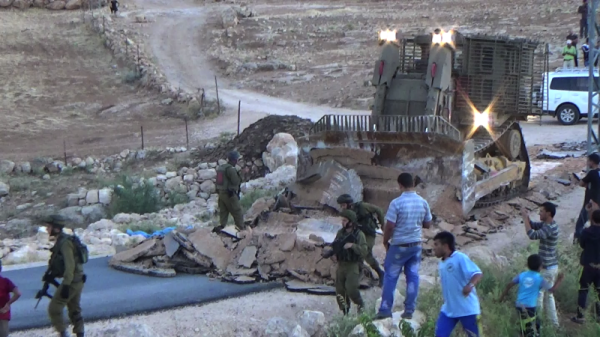
In some cases Palestinians are forced to pay ten times more for their water than the price in Tel Aviv – as in the village of Sussia on South Mount Hebron, where they have to drive to the nearby town to buy over-priced water (see photo), even though a water main passes directly through the village on its way to an Israeli settlement.

Water plenty, and water famine

According to the UN Human Rights Council, this all translates into a wide disparity between water use by Palestinians and by settlers in the West Bank. Settlers enjoy 400 litres per capita per day (l/c/d) while some Palestinians survive on a little as 10 l/c/d.

All Palestinian populations receive water volumes far below the level recommended by the World Health Organization of 100 – 250 l/c/d. According to the UNHRC:

“Settlements benefit from enough water to run farms and orchards, and for swimming pools and spas, while Palestinians often struggle to access the minimum water requirements.

“Some settlements consume around 400 l/c/d, whereas Palestinian consumption is 73 l/c/d, and as little as 10-20 l/c/d for Bedouin communities which depend on expensive and low quality tanker water.”

These very low levels of water provision fail to meet the water needs of many Palestinian communities – leaving them with often contaminated water, and not enough of it.

While Palestinian water use may just exceed 70 l/c/d in the relatively well served urban centers of the West Bank, it drops much lower in rural areas that have no access to piped water and depend on wells and rainwater collection.

An estimated 113,000 Palestinians in the West Bank have no piped water supply, while hundreds of thousands more have only intermittent supply, especially in the summer.

Additional restrictions

The restrictions and limitations imposed on Palestinians to access their own resources and develop them have exacerbated the already severe water shortages among Palestinian communities.

Among the restrictions are limits on the size of supply pipe, intended to limit flows as a form of rationing. Typically 30% of the water leaks from Palestinian supply pipes – because Israel refuses to allow their renewal

In ‘Area C’, which covers 60% of the area of the West Bank, Palestinian farmers and communities are not allowed to connect to the water network that serves the growing settlements – and are forbidden even to dig out cisterns.

The international community considers the establishment of Israeli settlements in the Israeli-occupied territories illegal under international law, as set out in the report of the fact finding mission of the United Nations Office of the High Commissioner for Human Rights.

Yet the construction of new illegal Israeli settlements and ‘outposts’, and the expansion of existing ones, is proceeding apace – and further reducing the quantity of water allocated to Palestinians.

Your water or your life

As reported by the UN in March 2012, another threat arises from settlers seizing springs by force: “Palestinians have increasingly lost access to water sources in the West Bank as a result of the takeover of springs by Israeli settlers, who have used threats, intimidation and fences to ensure control of water points close to the settlements.”

The UN Office for the Coordination of Humanitarian Affairs (OCHA) examined 60 springs on Palestinian land close to Israeli settlements. They found that:

“In 22 of the water sources, Palestinians have been deterred from accessing the springs by acts of intimidation, threats and violence perpetrated by Israeli settlers, while in the eight springs under full settler control, Palestinian access has been prevented by physical obstacles, including the fencing of the spring area, and its ‘de facto annexation’ to the settlement.”

Violence and destruction may also come directly from the occupation authorities. “Destruction of water infrastructure, including rainwater cisterns, by Israeli authorities has increased since the beginning of 2010; double in 2012 compared to 2011.

“The denial of water is used to trigger displacement, particularly in areas slated for settlement expansion, especially since these communities are mostly farmers and herders who depend on water for their livelihoods.

“A number of testimonies highlighted that the cutting off from water resources often precedes dispossession of lands for new settlement projects.”

Mekorot – at the heart of Israel’s water apartheid

All Israeli settlements in the West Bank are connected to piped water supplied by Israeli water company Mekorot, which took over responsibility for the water resources of the West Bank from the occupying forces in 1982.

Thus it Mekarot which is both the on-the-ground enforcer, and the economic beneficiary, of the West Bank’s ‘water apartheid’.

As the UN Human Rights Council reports: “In the Jordan Valley, deep water drillings by the Israeli national water company Mekorot and the agro-industrial company Mehadrin have caused Palestinian wells and springs to dry up. Eighty per cent of the total water resources drilled in the area is consumed by Israel and the settlements.”

“The lack of availability of Palestinian water resources has led to chronic shortages among Palestinian communities in Area C and a dependence on Mekorot … Mekorot supplies almost half the water consumed by Palestinian communities.

Restricted access

The UNHRC also reported that Palestinians do not have access to the cheaper ‘recycled water’ available to Israeli settlements, and have to buy more expensive drinking water even for irrigation purposes.

This injustice and inequity of access to water supply has always been a source of tension, especially when Palestinian villagers see water pipes leading to Israeli colonies passing through their land without supplying their village with water – as reported above at Sussia.

“The Mission heard of situations where villagers must travel several kilometres to get water when closer water resources serve neighbouring settlements”, reported UNHRC.

And even when they do get water, they receive second class treatment. “In the event of a water shortage, valves supplying Palestinian communities are turned off; this does not happen for settlements.

‘Week of Action Against Mekorot’

Mekorot violates international law and colludes in resource grabbing -including pillaging water resources in Palestine. It supplies this pillaged water to illegal Israeli settlements, and engages in systematic discrimination and denial of water to the Palestinian population.

For this reason Palestinian organizations including PENGON / Friends of the Earth Palestine have co-organised a ‘Stop Mekorot‘ week of action starting today, on World Water Day.

The campaign aims to intensify pressure on governments and companies to boycott Mekorot and hold the company accountable for its discriminatory water policies and practices in Palestine.

On March 20, the environmental federation Friends of the Earth International announced its support for the campaign against the discriminatory practices of Mekorot – joining the global call on governments, public and private utility companies and investors worldwide to avoid or terminate all contracts and cooperation agreements with Mekorot.

Campaign successes

In December 2013 the largest drinking water supplier in the Netherlands, Vitens, set a precedent when it decided that its commitment to international law meant it had to withdraw from a cooperation agreement with Mekorot. According to the company:

“Vitens attaches great importance to integrity and adhering to international laws and regulations. Following consultation with stakeholders, the company came to the realization that it is extremely difficult to continue joint work on projects, as they cannot be separated from the political environment.”

Mekorot suffered another blow this week when authorities in Buenos Aires, Argentina, suspended a proposed $170m water treatment plant deal.

The decision followed a campaign by local trade unions and human rights groups which highlighted Mekorot’s role in Israel’s theft of Palestinian water resources – and raised the prospect that Mekorot might export its discriminatory water policies to Argentina.

Palestinians must have their rightful share of available resources and be granted full authority to manage them properly. Equitable and wise use of available resources among all people is the only basis for lasting peace in the region.

And until then the deliberate, systematic, purposeful water discrimination and resource theft carried out in Occupied Palestine by the Occupation and Mekorot must be recognised for what they are – crimes against humanity. The perpetrators must be punished accordingly.

March 26, 2014 Posted by | Ethnic Cleansing, Racism, Zionism, Subjugation - Torture, Timeless or most popular | , , , , , , | Leave a comment

UN official: Israeli blockade on Gaza ‘illegal and must be lifted’

MEMO | March 26, 2014

Commissioner General of the United Nations Relief and Works Agency (UNRWA) Filippo Grandi yesterday called on Israel and Egypt to lift the siege that has been imposed on the Gaza Strip for more than half a decade.

Grandi said the siege on the Gaza Strip is considered the longest in history; longer than that of Sarajevo, Berlin and Leningrad.

The UNRWA official acknowledged Israeli and Egyptian security concerns but insisted that the plight of about 1.8 million residents in the Strip also needs to be considered.

He said that the Rafah Crossing has been closed for the seventh consecutive week and it is necessary to remind Egypt of its obligations towards patients and students who are in desperate need to travel.

“I think the world should not forget about the security of the people of Gaza,” he said. “Their security is worth the same as everybody else’s security so we appeal to the humanitarian sense of all.”

Grandi called the Israeli blockade on Gaza “illegal and [it] must be lifted”. He said that there are infrastructure projects run by the UNRWA worth $150 million. These projects are suspended until Israel lifts the siege, further harming the Palestinians.

“I also want to make a strong appeal for export to resume because the lack of export is the main reason for the poverty of Gaza,” Grandi said.

The official, who is leaving his office next week, said that the Gaza Strip has been suffering from a dangerous water problem, citing data mentioned in the UN 2020 report.

March 26, 2014 Posted by | Subjugation - Torture, War Crimes | , , , , , , | Leave a comment

Israel-Palestine Talks

US Desperate to keep Futile Peace Process Show on the Road a Little Longer

For the first time since the US launched the Middle East peace talks last summer, the Palestinian leadership may be sensing it has a tiny bit of leverage.

Barack Obama met the Palestinian president Mahmoud Abbas in Washington last week in what Palestinian officials called a “candid and difficult” meeting. The US president hoped to dissuade Abbas from walking away when the original negotiations’ timetable ends in a month.

The US president and his secretary of state, John Kerry, want their much-delayed “framework agreement” to provide the pretext for spinning out the stalled talks for another year. The US outline for peace is now likely to amount to little more than a set of vague, possibly unwritten principles that both sides can assent to.

The last thing the US president needs is for the negotiations to collapse, after Kerry has repeatedly stressed that finding a solution to the Israeli-Palestinian conflict is imperative.

The US political cycle means Obama’s Democratic party is heading this autumn into the Congressional mid-term elections. A humiliating failure in the peace process would add to perceptions of him as a weak leader in the Middle East, following what has been widely presented as his folding in confrontations with Syria and Iran.

Renewed clashes between Israel and the Palestinians in the international arena would also deepen US diplomatic troubles at a time when Washington needs to conserve its energies for continuing negotiations with Iran and dealing with the fallout from its conflict with Russia over Crimea.

Obama therefore seems committed to keeping the peace process show on the road for a while longer, however aware he is of the ultimate futility of the exercise.

In this regard, US interests overlap with those of Israeli prime minister Benjamin Netanyahu. Israel has been the chief beneficiary of the past eight months: diplomatic pressure has largely lifted; Israeli officials have announced an orgy of settlement building in return for releasing a few dozen Palestinian prisoners; and the White House has gradually shifted ground even further towards Israel’s hardline positions.

The Palestinians, on the other hand, have nothing to show for their participation, and have lost much of the diplomatic momentum gained earlier by winning upgraded status at the United Nations. They have also had to put on hold moves to join dozens of international forums, as well as the threat to bring Israel up on war crimes charges at the International Criminal Court.

Abbas is under mounting pressure at home to put an end to the charade, with four Palestinian factions warning last week that the Kerry plan would be the equivalent of national “suicide”. For this reason, the White House is now focused on preventing Abbas from quitting next month – and that requires a major concession from Israel.

The Palestinians are said to be pushing hard for Israel’s agreement to halt settlement building and free senior prisoners, most notably Marwan Barghouti, who looks the most likely successor to Abbas as Palestinian leader.

Some kind of short-term settlement freeze – though deeply unpopular with Netanyahu’s supporters – may be possible, given the Israeli right’s triumph in advancing settlement-building of late. Abbas reportedly presented Obama with “a very ugly map” of more than 10,000 settler homes Israel has unveiled since the talks began.

Setting Barghouti free, as well as Ahmad Saadat, whose PLO faction assassinated the far-right tourism minister, Rehavam Zeevi, in 2001, would be an even harder pill for the Israeli government to swallow. Cabinet ministers are already threatening a mutiny over the final round of prisoner releases, due at the end of the week. But Israeli reports on Sunday suggested Washington might consider releasing Israeli spy Jonathan Pollard, possibly in return for Israel freeing more Palestinians, to keep the talks going.

Simmering tensions between the US and Israel, however, are suggestive of the intense pressure being exerted by the White House behind the scenes.

Those strains exploded into view again last week when Moshe Yaalon, Israel’s defence minister, used a speech to lambast Washington’s foreign policy as “feeble”. In a similar vein, he infuriated the White House in January by labelling Kerry “obsessive” and “messianic” in pursuing the peace process. But unlike the earlier incident, Washington has refused to let the matter drop, angrily demanding an explicit apology.

The pressure from the White House, however, is not chiefly intended to force concessions from Israel on an agreement. After all, the Israeli parliament approved this month the so-called referendum bill, seen by the right as an insurance policy. It gives the Israeli public, raised on the idea of Jerusalem as Israel’s exclusive and “eternal capital”, a vote on whether to share it with the Palestinians.

Washington’s goal is more modest: a few more months of quiet. But even on this reckoning, given Netanyahu’s intransigence, the talks are going to implode sooner or later. What then?

Obama and Kerry have set out a convincing scenario that in the longer term Israel will find itself shunned by the world. The Palestinian leadership will advance its cause at the UN, while conversely grassroots movements inside and outside Palestine will begin clamouring for a single state guaranteeing equality between Israeli Jews and Palestinians. Israel’s vehement and aggressive opposition on both fronts will only serve to damage its image – and its relations with the US.

An unexpected voice backing the one-state solution emerged last week when Tareq Abbas, the Palestinian president’s 48-year-old son, told the New York Times that a struggle for equal rights in a single state would be the “easier, peaceful way”.

Bolstering Washington’s argument that such pressures cannot be held in check forever, a poll this month of US public opinion revealed a startling finding. Despite a US political climate committed to a two-state solution, nearly two-thirds of Americans back a single democratic state for Jews and Palestinians should a Palestinian state prove unfeasible. That view is shared by more than half of Israel’s supporters in the US.

That would constitute a paradigm shift, a moment of reckoning that draws nearer by the day as the peace process again splutters into irrelevance.

March 25, 2014 Posted by | Ethnic Cleansing, Racism, Zionism, Illegal Occupation | , , , , , , | Leave a comment

Is the BDS Democratic?

Open letter to Omar Barghouti, Co-founder, PACBI

By Paul Larudee | Dissident Voice | March 23, 2014

Dear Omar,

Let me start by saying that you have done a lot for BDS and that BDS has done a lot for the Palestinian cause.  It is perhaps for this reason that we should all be concerned with potential corruption of the movement, and you most of all.  I refer to changes of wording, changes of direction and changes of priority within the movement.

The change of wording is the infamous four words “occupied in June, 1967″ inserted into the first of three objectives in the mission statement portion of the 2005 BDS Call signed by 173 Palestinian organizations, such that the statement now demands of Israel:

“Ending its occupation and colonization of all Arab lands occupied in June 1967 and dismantling the Wall…” (added phrase in italics)

I understand your argument that this phrase only clarifies the meaning of the original statement, and that it changes the meaning not at all.  Even so, who gave you the right to make the change without consulting and getting the approval of the signatories to the original call?  Why was it inserted without even telling anyone, such that no one but you even knows when it was done?  If it is so uncontroversial, why not get it approved?

Why is the phrase needed, anyway?  You argue that it results in no change of meaning.  Why, then, is it not superfluous?  Since it is a bone of contention, just remove it and be done with it.

I also understand that the offending phrase occurs only in the ”Introducing the BDS Movement” section of the website and that the original wording is preserved elsewhere.  However, this is at best misleading and at worst disingenuous.  The “Introducing the BDS Movement” section reproduces the three demands from the 2005 Call completely verbatim, except for the added four words, and then proceeds to make the claim that this wording is endorsed by the signatories of the 2005 BDS Call.

This is deceptive and even fraudulent and must be corrected.  The altered wording has even been mistakenly quoted by Max Blumenthal in his book Goliath as being the wording of the original BDS Call.  Your misrepresentation has led directly to his error.

However, the wording is not merely a technical problem.  The wording is apparently important to you.  But why?  Could it be that the wording was needed in order to satisfy individuals or groups or interests that demanded this wording?  Was it meant as an assurance that BDS would not demand the return of all lands stolen from Palestinians but only those lands that were stolen outside the Green Line?

If this is the case, it would explain why many “soft” Zionists, who want to maintain a Jewish state but give back the West Bank, now participate in BDS, but only against institutions that support the Israeli presence in the West Bank.

In fact, that is the current priority of the movement, with little or no Boycott, Divestment or Sanctions aimed at institutions that deny equal rights to Palestinian citizens of Israel or the Right of Return to Palestinians in the shatat (“diaspora”).

Is this a coincidence or is BDS headed in a different direction than its origins would indicate?  Is it no longer a Palestinian movement, but rather a “soft” Zionist movement?

Obviously, people join movements for different reasons, and if Zionists want to boycott organizations that do business with Israel – even if only in the West Bank – their contribution is welcome.

However, it is quite another matter to effectively turn over the reins of the movement to them or to accommodate them by changing the wording of the mission statement.  A Palestinian movement that welcomes Zionists that have limited objectives is quite different from a Zionist movement that wants to limit its mission but accepts Palestinians that have wider goals.

Is that what is going on?  Perhaps not.  Perhaps my concerns are exaggerated.  But in that case, please dispel all doubt by removing the four words.

Paul Larudee

Paul Larudee is one of the founders of the Free Gaza and Free Palestine Movements and an organizer in the International Solidarity Movement.

March 24, 2014 Posted by | Deception, Ethnic Cleansing, Racism, Zionism, Solidarity and Activism | , , , , , , | Leave a comment

Internalized Oppression: Yet another Loss for an Occupied Nation

By Samah Jabr | Palestine Chronicle | March 23 2014

Jerusalem, Palestine – The chronic tyranny brought by the Israeli occupation has had a devastating effect on the well being of the Palestinian community. But one of the worst effects is the internalization of oppression and the undermining of Palestinian’s collective self-concept. I have observed that since the 2006 elections in Palestine—which were followed by an arrest of the elected parliamentarians and an international boycott of the elected government—the vigorous spirit of the Palestinian community that had previously evolved during long years of resistance has finally been reduced to a state of demoralization.The undermining of this election represented an additional bitter blow after the more subtle impact of the Oslo Accords, which had been originally promoted as part of the Palestinian liberation project. However, reports published on the Accord’s 20th anniversary showed that during this period the number of Israeli settlers in the West Bank had doubled and the area controlled by settlements had expanded to 42 % of Palestinian land; furthermore, a system of restrictions on Palestinian movement and trade had continued its division of Palestinian families and its decimation of the economy. Not to mention the infamous collaboration between Palestinian and Israeli security forces that has secured for Israelis a profitable trade and tourism through bed and breakfast hotels overlooking the magnificent hills of the West Bank, dismantled resistance, and incarcerated more Palestinians in prisons.

Over years of occupation, young Palestinians saw their fathers dragged from homes by Israeli soldiers, humiliated at checkpoints, and rendered unable to provide for their families’ safety and basic needs. In reaction to their feelings of shame, such vulnerable children came to identify with the oppressor through oppressing weaker members of their community and developing self-loathing. A Palestinian Jerusalemite told me, “On holidays I don’t go to Eilat because it will be full of Arabs!” The efforts of some Palestinians to assimilate and identify with Israelis are truly pathetic. Some Palestinians shop for their clothing in Israeli boutiques, dress their hair in Israeli salons, and drive while listening to loud music in Hebrew. I have observed more than one Palestinian patient suffering a relapse of manic illness who spoke to me in Hebrew as an expression of grandiosity. Meanwhile, the reality of job opportunities in the West Bank is dismal and work conditions are miserable, so that many laborers are eager to work for Israelis even if they must work in settlements or participate in projects such as building the separation wall. These workers are often treated by Israelis as sub-human: a few months ago Ahsan Abu-Srur, a 54 year old unauthorized Palestinian construction worker from Askar refugee camp, was seriously injured while doing renovation work in Tel Aviv. Realizing that he was critically injured, the Israeli contractor and two of his workers dragged the man to the sidewalk opposite the workplace and left him there to die.

The experience of oppression undermines the internal cohesion of the oppressed and creates among them a state of polarization, in which they often direct their rage at others who are similarly victimized. Oppression makes people selfish and greedy, prone to infighting and competition over scarce resources—the scraps of opportunities left over from the oppressor. Oppressed people readily become resentful and envious of one another, creating an ambiance of mutual distrust.

The sense of inferiority resulting from internalized oppression sets into motion a vicious cycle. We are treated as inferior—and in the absence of resistance, resilience and self-defense, we internalize the assumption of our own inferiority. Thus we come to believe that we are less capable and less worthy than others. These feelings are then projected onto our perceptions of one another and enacted in our treatment of one another. In this way, Palestinians come to distrust and devalue their own educational and medical systems; there is a spiteful oppression of women, a contemptuous attitude towards persons of a lower socioeconomic class, and an exclusionary and intolerant attitude towards political opposition—just a few manifestations of our internalized oppression.

Nowadays, there is a widespread, corrupt system of influence and cronyism in Palestine such that most people are employees of the government. As a consequence, our agriculture is suffering, small independent businesses are crushed, and only the enterprises of a tiny minority, closely allied to the government can flourish. Young people are trapped in a cycle of consumerism, with new apartments, cars, and big loans from banks requiring a relentless lifetime of repayment. The result is decreased social involvement and productivity and rising rates of crime, addiction and diminished wellbeing. Pervasive inadequacy throughout our institutions, nepotism, false representation and mistreatment and torture of Palestinians by fellow Palestinians are just a few of the symptoms of the general degradation of our community.

Community leaders and politicians fail to restore our national dignity and pride by taking steps to break through this vicious cycle and shedding light upon resilience, productivity, authenticity and steadfastness. We remember the submissive words of the President following the western boycott of the electoral results, “If we have to choose between bread and democracy, we choose bread.” Since the partition between the West Bank and Gaza, the Palestinian official discourse seems to confuse the doer and the do-ee. In its relationship with Israel, our officials assume the role of the oppressor, condemning spontaneous Palestinian reactions to Israeli violations and promoting meek submission to Israeli oppression. The people of Palestine are cast by our leadership into the role of the suspect, the offender; such reactions only feed into the entitlement of the occupier’s spin on reality, which turns us into victimizers and assumes the role of the victim.

The submissiveness urged by our leaders goes beyond condemning armed resistance to trivializing non-violent measures such as the imposition of boycotts and the use of international law to hold Israel accountable for its actions; the Palestinian official position toward the Goldstone report on Israel’s war crimes is an illustrative example. We should not be deceived by the exaggerated festivities surrounding the UN General Assembly’s change of Palestine’s “entity” status to “non-member observer state.” The change in status was just a smoke screen to blur our perception of the revolutions taking place within the Arab world. We may have retitled our postal stamps by the addition of the words, “State of Palestine,” but have yet to take a single war criminal to the Hague and have yet to pursue our legal right to Palestinian land, waters, or air space—as any sovereign state recognized by the UN would surely do. Instead, “secretive” negotiations continue in the dark while Israel continues to approve the construction of more settlement homes in the occupied West Bank and East Jerusalem and the demolition of more Palestinian homes.

The Palestinian President reassures the world that a Palestinian state will be demilitarized while two thirds of the national budget goes to our [internal] security forces. Meanwhile, healthcare, education, social welfare, and all other national programs survive on one third of the budget! We need only look to our neighboring Arab countries who were impoverished for decades as they fed the fat cats who ran their armies, while their own starving people were duped into the belief that these armies would “defend” them one day. Now these armies devour the very same people who had supported them—but are we Palestinians any better?

Internalized oppression is driven by several engines.

The first is media. Anger and dissatisfaction create the momentum for social change, but an artificial leisure and entertainment industry will blind and distract a frustrated public from the reality around them and create a false consciousness. Local media bombard our eyes and ears to dull our critical faculties and weaken our ability to protest, resist, or revolt. Media owners and their donor capitalists ally with the political elite to impose their tastes and ideology on the public. Mohammad Assaf, the Palestinian winning Arab Idol, is a good example—a charming vocalist with a beautiful voice. But the media promotes this triumph as the symbol of “the Palestinian plight,” and mobilizes the public to become consumers of a simplistic, reductionist, and deceptive exploitation of his charm; a thing of beauty can be used for ugly purposes. One might ask why the local media failed to make an equal effort to mobilize against the siege on Gaza, the Prawer plan, or in the service of transparency regarding the ongoing negotiations—matters which connect directly with most Palestinians and their plight!

International donation is the second engine. It is a paradox that oppression can come to us through the doors and windows of freedom, openness, and efforts to do good. In her study, “Promoting Democracy in Palestine: Donation and the Democratization of the West Bank and Gaza,” Dr. Leila Farsakh concluded that such projects sought to promote the legitimacy of the Palestinian Authority rather than empowering the Palestinian public to challenge the dominance of the Authority or to critique its definition of the national liberation project. Donor-driven projects fail to devote sufficient attention to important institutions central to the democratic process, such as the parliament, political parties, and the electoral process. In the end, these projects tend to entrench the occupation rather than helping Palestinians to create the conditions for national liberation; these projects tend to intensify the grip of the Authority instead of strengthening independent-minded channels.

The third engine is the domain of education and institutionalized religion. This year, five Palestinian schools in East Jerusalem substituted the Palestinian curriculum with the Israeli one. The Jerusalem municipality went on to award the administration of these five schools by increasing the personal salaries of their principals and paying them 2,000 NIS for every student registered in their schools. A mere glance at the Israeli curriculum reveals how it distorts history, religion, geography, and eventually the mindset and the national culture of pupils: In one textbook, two pupils discuss how Israel brought electricity to their village and granted national insurance to children and their elders; the pupils conclude that they should join the celebration on “Israel’s Independence Day.” And while some of our children are savoring a toxic dose of Israeli indoctrination, others are anesthetized by some misleading religious leaders who form an unholy league with political and financial power elites. Manipulating the public with an insidious form of mind control, they come up with “teachings” promoting a fatalistic, mystical frame of mind and issue “fatwas” that promote compliance and conformity. These religious leaders promote the status quo with all its agony and disadvantages and inhibit people from embracing genuine reform and social change, encouraging people to pin their hopes on the afterlife rather than dealing with the misery of the here and now.

In conclusion, since decisions and behaviors of our leaders do nothing but establish internalized oppression, it becomes the social responsibility of ordinary people to work actively to recognize and alleviate this threat to wellbeing, in order to prevent the demise of the Palestinian spirit and cause. Raising awareness about the phenomenon, monitoring and protesting its appearance in official discourse and behavior, bearing witness, empowering economic development, resisting consumerism, connecting them with their own history and community, and helping them to analyze reality— are just a few tools to liberate Palestinians from internalized oppression. So much has been done to efface, harm, eradicate the Palestinian nation or to disfigure it forever. We cannot simply wait for justice to happen—justice is something we must work hard to actualize. Sacrifices must be made and sometimes risks must be taken to snatch our life from the jaws of death. Commitment, awareness, wisdom, and planning are required for recovery and salvation of this injured life—as we want a decent life, not any life. Our work for healing and recovery is indivisible from our work for liberation.

Samah Jabr is a Jerusalemite psychiatrist and psychotherapist.

March 24, 2014 Posted by | Ethnic Cleansing, Racism, Zionism, Subjugation - Torture, Timeless or most popular | , , , | Leave a comment

Israeli Forces Kill 2 Palestinian Civilians and Armed Group Member and Wound 12 Civilians in Jenin Refugee Camp

Palestinian Centre for Human Rights | March 23, 2014

In excessive use of force, on Saturday, 22 March 2014, Israeli forces killed, 2 Palestinian civilians and a member of a Palestinian armed group and wounded 12 civilians and a member of the Palestinian National Security Forces in Jenin refugee camp, west of the northern West Bank town of Jenin. Israeli forces claimed via the Israeli media that they killed 3 Palestinians during armed clashes in the aforementioned refugee camp. However, investigations conducted by the Palestinian Centre for Human Rights (PCHR) investigations refute the Israeli claim and confirm that the two civilians were killed as Israeli forces opened fire heavily at dozens of civilians who were trying to pull and carry the militant’s body to the centre of the camp.

According to investigations conducted by PCHR, at approximately 02:00 on the Saturday, 22 March 2014, an Israeli special military force from “Alimam” Unit in the Israeli military, which is described as “an anti-terrorism unit” infiltrated into the south of Jenin refugee camp, west of Jenin. The Israeli force surrounded a two-story house belonging to the family of ‘Azmi Mohammed Mahmoud al-Hasaniyah (67) in Tal’et al-Ghabes area. Israeli forces then sent large military back-ups, which were deployed throughout the camp while Israeli drones were hovering overhead. Israeli snipers ascended roofs of nearby houses after they received information that Hamzah Jamal ‘Abdel Salam Abu al-Heijah (22), the local leader of the Izziddin al-Qassam brigades (the armed wing of Hamas), was in the house.

After the military back-ups had arrived, Israeli forces blew up the main door of the houses and opened fire. They then yelled at residents of the house to get out. When the residents were about to come out and Mohammed (23), the son of the house’s owner who is member of the Palestinian National Security Forces, opened the external door, he was shot in the left shoulder. Amidst the screams of his family, the shooting stopped and the residents began to get out one by one while Abu al-Heijah stayed in a room on the second floor. Israeli forces arrested Mohammed and his brother, Majd (18), and took the rest of the family members to a nearby house. They then entered a tracker dog into the house, but Hamzah killed it and this made the Israeli forces certain that he is in the house. As a result, Israeli forces showered the house with live bullets and shells fired by machine guns and then used shoulder-fired missiles. As a result, the house was partially destroyed. Meanwhile, armed clashes broke out between Palestinian militants, who were stationed in the areas of al-Sahah and Abu Thahir Mountain areas, and Hamzah from the house from one side and the Israeli forces, which were surrounding the house, from the other side. Hamzah took advantage of this and jumped from one of the western windows of the house. As soon as he stepped a few meters, snipers opened fired and immediately killed him. They left him for two hours and he bled to death in the alley. Young men then tried to pull his body, and Israeli forces opened fire at them. However, they managed to pull it. When they were passing by al-Sahah area, Israeli forces opened fire killing two of them: Yazan Mahmoud Basem Taha “Jabarin” (20) who was hit by a bullet to the chest; and Mahmoud ‘Omer Saleh Abu Zeinah (24), who also was hit by a bullet to the chest. When the news of the death of 3 persons spread out, the camp residents started coming out of their houses. Immediately, the Israeli snipers opened fire at these civilians wounding 11 of them, including a 65-year-old woman. Thus, the number of wounded persons mounted to 12 civilians. It should be mentioned that Hamzah Abu al-Heijah is the son of Jamal Abu al-Heijah, who is serving a sentence of 9 life imprisonments in the Israeli jails. Hamzah had been subject to several extra-judicial execution attempts, the last of which was on 18 December 2013 when an Israeli special unit targeted him. However, he managed to escape and Nafe’a Jamil Nafe’a al-Sa’adi was killed.

PCHR strongly condemns this crime, which further proves the use of excessive force by Israeli forces against Palestinian civilians in disregard for their lives. PCHR calls upon the international community to take immediate and effective action to stop Israeli crimes and reiterates its call for the High Contracting Parties to the 1949 Fourth Geneva Convention to fulfill their obligations under Article 1; i.e., to respect and to ensure respect for the Convention in all circumstances, and their obligation under Article 146 to prosecute persons alleged to commit grave breaches of the Fourth Geneva Convention. These grave breaches constitute war crimes under Article 147 of the same Convention and Protocol (I) Additional to the Geneva Conventions.

March 24, 2014 Posted by | Ethnic Cleansing, Racism, Zionism, Illegal Occupation, Solidarity and Activism, Subjugation - Torture, War Crimes | , , , , , , | Leave a comment

Israeli Troops Use Journalists as ‘Human Shield’ During Invasion of Aida Camp

By Saed Bannoura | IMEMC News | March 23, 2014

A Palestinian journalist has reported that he and two of his colleagues were used by the Israeli military as ‘human shields’ during an Israeli military invasion of the Aida refugee camp, near Bethlehem.

The term ‘human shield’ is used to refer to instances where armies or armed forces attempt to protect themselves by placing civilians between themselves and the people or group they are attacking. This practice is a direct violation of international law and the Fourth Geneva Convention, to which Israel is a signatory.

Israel has, on multiple occasions in the past, been found to have used Palestinians (including children) as human shields, including tying them on the hoods of their vehicles. Multiple instances have also been documented by international and Israeli human rights groups of the targeting of journalists, including the killing of journalists documenting Israeli abuses in Palestine.

In the incident on Saturday, Palestinian journalist Moussa al-Shaer reported that he and two other journalists – a Palestinian and American – were used by the Israeli military to shield them from some youth who were throwing stones at them.

The other Palestinian journalist was identified as Abd al-Rahman Younis, but the American journalist was not identified.

According to al-Shaer, the three journalists were detained by Israeli troops, who took their press cards and refused to allow them to leave or do their job of covering the incident. Throughout the invasion, the Israelis placed the journalists in front of the troops in an attempt to stop the kids from throwing stones at the troops.

Eventually, at the end of the invasion, the soldiers handed the journalists their press cards back and released them without charge.

During the Israeli invasion of the camp, soldiers fired stun grenades and tear gas at residents, causing several in the camp to seek medical attention for tear gas inhalation.

March 24, 2014 Posted by | Ethnic Cleansing, Racism, Zionism, Illegal Occupation | , , , , , | Leave a comment

Tourism as a tool to erase Palestinian identity

By Jessica Purkiss | MEMO | March 22, 2014

At the entrance of a Dead Sea resort located in the West Bank, Palestinian man Hazem paid his 70 shekels admission fee to the women sitting behind the desk. “Can we camp here?” he asked. Surveying the group of internationals, she said, “Are there any Arabs in your group?” Hazem, born and bred in the West Bank city of Beit Sehour, confessed his origin to the women who replied, “We don’t let Arabs stay the night.”

Past the entrance desk, the small stretch of beach is dotted with groups of Palestinian men smoking arguila- flavoured tobacco- and heating coals for BBQ’s. All of them have paid the same entrance fee. The women behind the desk collecting their fees is Israeli and only speaks Hebrew and English, and the shop on site sells Israeli flags and Jewish relics. While this resort stands on the chunk of the Dead Sea that lies in the West Bank, the Palestinian side and its resources have been appropriated by Israel. This means all the Palestinians that visit the resort, in fact any of the three resorts in the occupied Dead Sea area, have to pay Israel to do so.

The Dead Sea, which is famous for its skin benefits, is a goldmine for those able to tap into its resources, with the extraction of mud proving to be an extremely lucrative business. Friends of the Earth Middle East claim that there are 50 cosmetic factories on the Western shore, both in the occupied Dead Sea area and in Israel proper, The Israeli cosmetic company Ahava Dead Sea Laboratories ltd. is located on the settlement of “Mitzpe Shalem,” in the occupied West Bank, and is the only cosmetic company to be licensed by Israel to mine mud in the area.

In 2007 Ahava’s annual revenues were 142 million USD. As of 2011, 60% of Ahava’s revenues were from exports, shipping its world famous creams and lotions mainly to European countries and to the United States. Despite Ahava sales propping up the settlement regime- two of the settlements in the area have considerable shares in the company- it owns three international subsidiary companies in Germany, the UK and the US.

While the annexation of the Dead Sea has clear economic benefits, the revenues of Ahava should not act as smokescreen for the gains of the Israeli authorities beyond the economic side. Encroachments of Palestinian spaces and heritage under the name of tourism are much more than this, with the Dead Sea as just one example. They are an attempt to strip Palestinian identity from these spaces.

As a PLO Negotiation Affairs department statement read, “Despite its small size, Palestine has an abundance of historical, religious and cultural heritage sites. Every inch of this land has a story to tell, every hill the scene of a battle, and every stone a monument or a tomb. One cannot understand the geography of Palestine without knowing its history and one cannot understand its history without understanding its geography.”

Herodion, Herod the Greats monumental palace built around 23-20 BC and perched on the highest hill in the area, is another example of the above. From the top of the site, the Palestinian city of Bethlehem, which lies just 5km away, is clearly visible. The Palestinian taxi-driver who dropped us off at Herodion, tells us we are in Israel now. Driving past the military base and paying entrance fees to an Israeli man, whose desk sits in a shop selling “I love Israel” and “Visit Israel” t-shirts, it’s easy to see his point.

However, Herodion lies on Palestinian territory, but like the Dead Sea, has been appropriated by Israel. The site is managed by the Israel Nature and Parks Authority (INPA). While the stated aim of the governmental body is protecting nature, landscape and heritage in Israel, the organisation has recruited conservation for political gains. For example, there are already five “national” parks in East Jerusalem and more on the way, while West Jerusalem does not have even one. These parks, operated INPA enables the state to appropriate private Palestinian land while avoiding the international rebukes which overt settlement building brings about. Under Israeli law the state does not even have to compensate the owners for land on which national parks are built.

When asked where they think they are, some of the tourists who have shuttled off buses run by Israeli tour companies at Herodion, simply didn’t know. One woman from the US remarked, “Judging from the Israeli soldiers and the Hebrew, I would say Israel.” While her husband walked away muttering Israel defiantly, the woman returned and said in a whisper, “I suppose we are where the person with the biggest weapons wants to tell us we are. That’s not right, but I think that’s how it is.”

To the naive tourist just off the coach, he is in Israel. And while, to this same naive tourist, whether he is Israel, “Judea and Samaria” or the Palestinian territories seems unimportant when at a historical site that stretches back thousands of years, Israel is asserting its connection with the land, while simultaneously wiping the other’s connection off the map. To this tourist, the systematic obliteration, Judaization, annexation and confiscation of Palestinian sites turns Palestine into simply a collection of sites in the desert owned by Israel, surrounded by Arab “villages.”

Israel’s Ministry of Tourism map has aimed to do precisely this. In 2009, the ministry completely wiped the West Bank and any Palestinian areas from its materials. Mandatory Palestine was portrayed without any borders or demarcations, while all maps omitted Palestinian areas and towns. Today, instead of defining a line that is the West Bank, the Ministry of Tourism has shaded the areas under the control of the Palestinian Authority in pink, and the area of joint control in a lighter shade of pink, leaving around 60% of the West Bank which falls under area C to blur into Israel.

After visiting Herodion, most of the tourists are likely to move onto nearby Bethlehem. Like Herodion, many tourists, having booked holy land tours from home, believe they are in Israel. Either way, they tend to make only short organised day trips to visit the holy sites, spending the bulk of their money in Israel. Whilst Bethlehem pulls in thousands of tourist annually, Palestine hasn’t been able to fully utilize the area. According to reports by the PA’s Ministry of Tourism and the Bureau of Statistics, in 2007 509,000 tourists came to Bethlehem, but only 88,000 stayed in the city’s hotels, while Palestinian Authority Tourism Minister Kholoud Daibes contends that Israel collects 90% of pilgrim-related revenue.

Meanwhile, Palestinian tours guides or transportation companies have not been able to enter Israel since 2000. From over 240 tourist guides licensed to work all over Palestine and Israel, only 42 have permits to guide in Israel, which are renewed periodically and without guarantee. These restrictions on movement severely hinder the development of a domestic tourism industry. For Israel, this means the sphere in which tourists may meet Palestinians that are not the terrorists from the headlines, and be introduced to another side of a narrative is successfully limited.

To the Palestinians, this systematic obliteration, Judaization, annexation and confiscation of Palestinian sites, are attempt to take away their connection to the land and its history, in the process impinging on their right to self-determination, freedom, independence, and ebbing at the construction of their national identity.

March 23, 2014 Posted by | Ethnic Cleansing, Racism, Zionism, Illegal Occupation, Timeless or most popular | , , , , , , | Leave a comment

An Illegitimate Palestinian Leadership Can Sign Away Rights

By Zachariah Sammour | Al-Shabaka | March 15, 2014

The latest round of US-driven negotiations has yet to engender a significant, organized response from Palestinians in the Diaspora. Whereas some Palestinian civil society actors and organizations within the Occupied Palestinian Territory have made their views known through various forms of popular activism, Palestinians in the Diaspora seem surprisingly disengaged.

This lack of organized public engagement is particularly troubling when one considers the risks that these talks present for the Palestinian people generally, and for those in the Diaspora in particular. Details have emerged in recent weeks as to the shape that U.S. Secretary of State John Kerry’s “framework agreement” is likely to take, both in reports by Palestinian officials and in columns by U.S. analysts: Not only would there be a truncated Palestinian state with significant Israeli controls remaining in some fashion, but the Palestinian right of return would be eliminated entirely.

Given the gravity of the decisions that could be made on behalf of Palestinians – including an “end of claims” arising out of the conflict – one would expect a more forceful response in responding to these proposals. It is possible that many believe that the limited political legitimacy of the Palestine Liberation Organization/Palestinian Authority (PLO/PA) directly diminishes its capacity to make politically effective decisions on behalf of all Palestinians.

But political legitimacy and political effectivity should not be conflated. In international law, and in international politics more generally, there is no necessary link between legitimacy and effectivity, or more specifically between representation and political agency. One only has to look at the actions of Palestine’s neighbors. The regimes in Saudi Arabia, Egypt, Jordan, and a host of other Arab countries are hardly able to claim to represent the peoples of those respective states any more than the PLO/PA can currently claim to represent the Palestinians. Nonetheless, they are universally recognized as having the authority to make binding decisions on behalf of their citizens.

The simple point is that decision-making power, at least in the external arena of international politics, does not depend in any way upon the representative credentials of the decision maker. If the PLO/PA was to come to a final settlement with Israel tomorrow, and, in doing so, purported to “end all claims” of the Palestinian people including the right of return, states and international bodies – even those like the International Court of Justice – could conceivably accept its decision as having been made on behalf of all Palestinians. That the decision would have been reached through an illegitimate exercise of political authority would not matter. And, without any mechanisms through which to assert otherwise, for all intents and purposes, the decision would be definitive.

It is clear that Palestinians are fast approaching a juncture at which decisions of extreme national importance may be taken. The possible grave implications of these decisions require an immediate and sustained response from all Palestinians, including those in the Diaspora who may stand to lose their historic claim of return to the homeland. While it is beyond the scope of this commentary to propose a concrete strategy for popular action, some initial steps could include:

  • Organize locally and establish popular forums for Palestinians to discuss the likely terms of any agreement, their implications, and the extent to which such an agreement would be palatable.
  • Establish and strengthen alliances and networks of Palestinians across the globe that are unified around common goals and demands.
  • Establish and communicate to the PA/PLO and international stakeholders the red lines and basic demands that must respected in any agreement signed in the name of the Palestinian people must respect.
  • Identify strategies to increase public pressure on Palestinian negotiators to hold to those red lines and to pursue national goals and aspirations.
  • Continue to build up Palestinian sources of power to promote their rights, including through support to boycotts, divestment, and sanctions against Israel until it upholds international law, education and media outreach about Palestinian rights, and alliances with other people’s movements for human rights.

These are concrete and immediate steps that Palestinians may take to increase public pressure on the PLO/PA during the course of the negotiations. It is clear, however, that these actions cannot serve as a substitute for the far more difficult task of re-establishing a robust, popular, and effective national movement that can provide the Palestinians with a representative and accountable leadership. It is essential, therefore, that any popular mobilization that Palestinians organize contributes to re-establishing a truly national movement that is inclusive and serves to connect Palestinians all over the world.

March 23, 2014 Posted by | Ethnic Cleansing, Racism, Zionism, Solidarity and Activism, Timeless or most popular | , , | Leave a comment

Why the Kuala Lumpur Tribunal’s genocide verdict against Israel sets a key precedent

By Nadezhda Kevorkova | RT | December 4, 2013

Until now, Israel has been getting away with anything it likes. A series of revolutions and counter-revolutions in the Arabic world has driven it into chaos, and seems to have pushed the Palestinian issue off the international agenda for good.

And yet Malaysia, a predominantly Muslim country, has now called a tribunal for war crimes and produced a genocide ruling – against whom?

Not against Assad, as one might have expected, but against Israel, the state that considers itself to be beyond the jurisdiction of any court or tribunal.

In Hamlet, the message that the king killed his brother to marry his widow and seize the throne is delivered by the murdered king’s spirit – which literally means by someone who cannot testify in court. As a result, Prince Hamlet spends a long time tormenting himself about whether he should believe the spirit and avenge his father. After that, he undertakes a smart move – asking a troupe of actors to stage a play reenacting his father’s murder, while he watches the murderer’s reaction. At the end of the play, everyone dies, but Hamlet has gotten his revenge.

That’s how people’s justice usually works – it takes a long time, it’s messy and ultimately useless from a rational viewpoint. It would have been much more rational for Prince Hamlet to pay due honor to the new king and his new wife, Hamlet’s mother, pray for his deceased father, marry Ophelia and have lots of children, then inherit the throne in due time and just keep on living…

The spectators watch how the prince’s world and values are shattered to the ground. The father’s spirit has its word. The actors have played out their play, and the murderer has been betrayed by his reaction.

For the first time, an international war crimes tribunal has charged the State of Israel of genocide, an unprecedented event, as so far no international court or tribunal has ever delivered a verdict against Israel to date.

The International Tribunal convened in Kuala Lumpur, Malaysia. Israel refused to send any representatives. The Kuala Lumpur War Crimes Tribunal has no official ties to the UN and acknowledges that it has not authority to deliver punishment. Opinions differ on the subject of its jurisdiction, and the only sanction it has in its power is to enter the name and title of the party found guilty in the Tribunal’s registry and announce it publicly to the world. In 2011, the tribunal found George Bush and Tony Blair guilty of crimes against peace, crimes against humanity, and genocide as a result of their roles in the Iraq War.

It seems that one could just as well ignore this tribunal; much like Israel ignores the condemning UN resolutions, protests, severed diplomatic relationships and all other kinds of protests against the military actions and acts of violence applied against the Palestinians on a daily basis. However, a detailed trial like this indicates that the mechanism has been set in motion, which will have consequences for the entire world, not just for Israel or the Middle East.

The International Tribunal is part of the Kuala Lumpur Commission on War Crimes; however, these two institutions are not part of Malaysia’s judicial system, even though they employ judges and prosecutors of Malaysian background. Israel has no agreements signed with this or any other international court. Yet the Tribunal acts on the basis of the UN Convention on the Prevention and Punishment of the Crime of Genocide of 1948, which was signed and ratified by Israel. And this very signature, Israel’s membership in the UN and the fact that Israel owes its very existence to the UN and to the condemnation of genocide against Jews in the course of World War II – all this at the very least gives us the right to challenge and discuss whether Israel’s own actions could fall into the category of genocide.

Interestingly, the USA has been refusing to sign this document for 37 years, having reasonable fears that many lawyers would want to charge the USA itself with genocide of the Indians and African slaves, as well as the Japanese, the Koreans, the Vietnamese and many others. Israel, in its turn, did not foresee that the very convention it pushed the world to adopt after the war will one day be used against it. The very formation of the State of Israel was made possible by the agreement of the victorious powers to acknowledge that Jews were victims of genocide carried out by Nazi Germany and that only having a nation state of its own can guarantee them proper protection.

“The victims of genocide became themselves the source of it.” This is how Hedi Epstein sees the essence of the ruling against Israel. A German Jew who survived WWII, she lost her parents to a concentration camp. Epstein was a prosecution witness in the Nuremberg Trials. And in 1982, she learned that the Israeli Army occupied Lebanon and provoked mass executions in the Sabra and Shatila Palestinian refugee camps. From that moment on, Epstein and hundreds of other Jews embarked on an anti-military and anti-Zionist campaign. However, Israel has refused to listen to their voices. They were labeled “self-hating” Jews and banned from the country which, incidentally, announced itself to be the homeland of all Jews in the world. Israel remained deaf to their warning that the Jews who survived genocide do not wish Israel to be committing genocidal crimes against the Palestinian people in their name.

Israel was convinced that the US would never cease to provide it with military and political assistance, so it had nothing to worry about. The Jewish “weirdos” are free to organize as many useless marches and “freedom flotillas” as they wish; no one will dare to find Israel guilty.

And now Israel has received its first wake-up call.

The hearings on the genocide lawsuit started in August 2013. But the news soon faded into the background as the media extensively covered the mass shooting of hundreds of Egyptians who disagreed with President Morsi’s arrest and the growing tensions around Syria due to a possible American missile strike.

On November 20-25, the final stage of the proceedings took place, initiated by a group of Palestinians, who reported a number of incidents.

The first one involved Israeli soldiers who killed 29 members of the extended Samouni family in the Zeitoun neighborhood of the Gaza Strip during the 22-day Operation Cast Lead in 2008 and 2009.

This is the most notorious crime against Palestinians over the last few years. Judge Goldstone incorporated it into his report, which he submitted to the UN after the operation was over.

The Samounis were a large family of peaceful farmers. None of them had ever participated in armed resistance. They were some of the few Palestinians who got on well with the Israeli settlers and they were frustrated by the removal of the settlements from the Gaza Strip.

In January 2009, an Israeli helicopter landed on their field. A few gunmen demanded that the Samounis turn in the Hamas militants to them. The next thing they did was bring the whole family under one roof and shoot them down dead, including the infants. Those who survived were found under the bodies of their relatives.

One of the survivors was the children’s mother. She repeatedly tried to get a criminal case started in various courts of law, but failed to get any compensation or apologies from Israel.

The second story revolved around the mass shooting of women and children in the Sabra and Shatila camps in Lebanon in 1982.

Other incidents included:

– lethal firing of teargas canisters and rubber bullets by Israeli Defense Forces that resulted in the deaths of unarmed civilians during the Intifada campaigns and subsequent protests;

– intensive, indiscriminate aerial bombing and artillery shelling of civilian quarters in the Gaza Strip in 2008;

– a university student who was shot without warning at a peaceful protest by an Israeli sniper, firing a fragmentary bullet that caused extensive and permanent damage to his internal organs;

– a Christian resident of the West Bank who was repeatedly imprisoned and tortured on grounds of subversion;

– a female resident of Nablus who suffered mental anxiety due to her imprisonment and subsequent social ostracism;

– a Palestinian physician who conducted studies on the psychological trauma inflicted, particularly on children, as result of constant intimidation, massive violence and state terror during and following the second Intifada; and

– Expert witness Paola Manduca, an Italian chemist and toxicologist, who found extreme levels of toxic contamination of the soil and water across the Gaza Strip, caused by Israeli weapons made of heavy metals and cancer-causing compounds.

The Tribunal found the State of Israel guilty of genocide of the Palestinian people in each of these cases, blaming former general Amos Yaron for the Sabra and Shatila massacre.

The Tribunal’s verdict reads as follows:

“The Tribunal is satisfied, beyond reasonable doubt, that the first defendant, [General] Amos Yaron, is guilty of crimes against humanity and genocide, and the second defendant, the State of Israel, is guilty of genocide.”

Even though the Israeli authorities ignored the summons, several highly experienced lawyers were appointed by the Tribunal to represent Israel.

So far we can only see separate elements without fully comprehending the full picture. There are several things worth noting here.

Israel’s case wasn’t brought before the International Criminal Court (ICC) in The Hague; in fact, it wasn’t a European court at all. In Europe, the guilt for failing to save the Jews from genocide 70 years ago is still alive and associated with Israel. Hearing this case in the Malaysian tribunal sends a message to the whole world that Israel should be treated like any other state, like Rwanda, Serbia, Libya or Cambodia.

The fact that the Kuala Lumpur War Crimes Tribunal condemned Israel is hardly surprising – Malaysia actively supports the Palestinians. In early 2013 the Malaysian prime minister visited the Gaza Strip – there aren’t many political leaders who can afford to make such a provocative step.

Malaysian Islam is similar to that of the Muslim Brotherhood, an organization that suffered such a crushing political defeat in Egypt. Malaysia’s ex-leader, Mahathir Mohamad, is a very influential figure in the Muslim world, especially among Muslim Brotherhood supporters, specifically in the part of the Muslim establishment that’s close to Britain.

Malaysia is even more determined to get revenge for the damage the Muslim Brotherhood sustained than Turkey, so this influential political faction dealt their opponents a glancing, but painful blow. It’s the first time an international tribunal convicted not individual generals, but the State of Israel of genocide. Israel’s main weapon has been turned against it.

It’s also important to note that a year ago Henry Kissinger, a key figure in US politics and architect of the Middle East peace deal, unexpectedly said that he perused a report by 16 American intelligence agencies which arrived at the conclusion that in 10 years’ time there will be no more Israel. The report itself, as well as Kissinger’s comment, can only be viewed as proof that a certain section of the American political elite intends to finish Project Israel. Otherwise, they would’ve kept the report under wraps and started working on a plan to save Israel. And most importantly, if saving Israel was on their agenda, no tribunal would be hearing this case.

Moreover, most of the Israel’s supporters wanted to believe that almost three years of revolutions in the Arab world and two years of fighting in Syria have pushed the Palestinian issue to the sidelines. Israel rejoiced that the focus shifted from the Palestinian issue, which united everyone, to the Syrian conflict, which became a bone of contention for the entire world.

Contrary to Israel’s expectations of two months ago, the Tribunal is not trying Assad for crimes against the Syrian people. Instead, it is trying Israel for genocide of the Palestinians. All of a sudden, Israel has lost its momentum. The Palestinians are back in the political spotlight, and the trap designed to lure Assad has turned into a trap for Israel.

Last but not least, many pundits rushed to argue that both the rise to power of the Muslim Brotherhood and their fall is all the doing of the US. The veteran commentators would say that those who are to blame for the toppling of the Muslim Brotherhood in Egypt will not go unpunished by the US and UK. The Israeli agents had put too much effort into cajoling major governments to support the Sisi-led coup to oust Mubarak and ignore the 3,000 deaths caused by the junta and the lies of the world media about the Muslim Brotherhood allegedly burning down the Coptic churches. Encouraged by the UK and Obama, full of arrogance and reluctance to reach any kind of compromise, Israel paved its own way to the genocide verdict.

Right now, Israel’s supporters are acting as though the Kuala Lumpur verdict can be neglected. But it won’t be long before they realize how dramatic the situation actually is: were the court to be situated in Europe, Israel would have lobbied its way out of the trial. But it did not reach as far as Kuala Lumpur. The precedent has been set.

Nadezhda Kevorkova is a war correspondent who has covered the events of the Arab Spring, military and religious conflicts around the world, and the anti-globalization movement.

March 22, 2014 Posted by | Ethnic Cleansing, Racism, Zionism, Timeless or most popular, War Crimes | , , , , , , , , , , , , | Leave a comment

The Origins of the Israel Lobby in the US

By Alison Weir | CounterPunch | March 21, 2014

The immediate precursor to today’s pro-Israel lobby began in 1939[i] under the leadership of Rabbi Abba Hillel Silver, originally from Lithuania. He created the American Zionist Emergency Council (AZEC), which by 1943 had acquired a budget of half a million dollars at a time when a nickel bought a loaf of bread.[ii]

In addition to this money, Zionists [adherents of “political Zionism,” a movement to create a Jewish state in Palestine] had become influential in creating a fundraising umbrella organization, the United Jewish Appeal, in 1939[iii], giving them access to the organization’s gargantuan financial resources: $14 million in 1941, $150 million by 1948. This was four times more than Americans contributed to the Red Cross and was the equivalent of approximately $1.5 billion today.[iv]

With its extraordinary funding, AZEC embarked on a campaign to target every sector of American society, ordering that local committees be set up in every Jewish community in the nation [for decades the larger majority of Jewish Americans had been either non-Zionists or actively anti-Zionist]. In the words of AZEC organizer Sy Kenen, it launched “a political and public relations offensive to capture the support of Congressmen, clergy, editors, professors, business and labor.”[v]

AZEC instructed activists to “make direct contact with your local Congressman or Senator“ and to go after union members, wives and parents of servicemen, and Jewish war veterans. AZEC provided activists with form letters to use and schedules of anti-Zionist lecture tours to oppose and disrupt.

A measure of its power came in 1945 when Silver disliked a British move that would be harmful to Zionists. AZEC booked Madison Square Garden, ordered advertisements, and mailed 250,000 announcements – the first day. By the second day they had organized demonstrations in 30 cities, a letter-writing campaign, and convinced 27 U.S. Senators to give speeches.[vi]

Grassroots Zionist action groups were organized with more than 400 local committees under 76 state and regional branches. AZEC funded books, articles and academic studies; millions of pamphlets were distributed. There were massive petition and letter writing campaigns. AZEC targeted college presidents and deans, managing to get more than 150 to sign one petition.[vii]

Rabbi Elmer Berger, executive director of the American Council for Judaism, which opposed Zionism in the 1940s and ‘50s, writes in his memoirs that there was a “ubiquitous propaganda campaign reaching just about every point of political leverage in the country.”[viii]

The Zionist Organization of America bragged of the “immensity of our operations and their diversity” in its 48th Annual Report, stating, “We reach into every department of American life…”[ix]

Berger and other anti-Zionist Jewish Americans tried to organize against “the deception and cynicism with which the Zionist machine operated,” but failed to obtain anywhere near their level of funding. Among other things, would-be dissenters were afraid of “the savagery of personal attacks” anti-Zionists endured.[x]

Berger writes that when he and a colleague opposed a Zionist resolution in Congress, Emanuel Celler, a New York Democrat who was to serve in Congress for almost 50 years, told them: “They ought to take you b…s out and shoot you.”[xi]

When it was unclear that President Harry Truman would support Zionism, Cellar and a committee of Zionists told him that they had persuaded Dewey to support the Zionist policy and demanded that Truman also take this stand. Cellar reportedly pounded on Truman‘s table and said that if Truman did not do so, “We’ll run you out of town.”[xii]

Jacob Javits, another well-known senator, this time Republican, told a Zionist women’s group: “We’ll fight to death and make a Jewish State in Palestine if it’s the last thing that we do.”[xiii]

Richard Stevens, author of American Zionism and U.S. Foreign Policy, 1942-1947, reports that Zionists infiltrated the boards of several Jewish schools that they felt didn’t sufficiently promote the Zionist cause. When this didn’t work, Stevens writes, they would start their own pro-Zionist schools.[xiv]

Stevens writes that in 1943-44 the ZOA distributed over a million leaflets and pamphlets to public libraries, chaplains, community centers, educators, ministers, writers and “others who might further the Zionist cause.”[xv]

Alfred Lilienthal, who had worked in the State Department, served in the U.S. Army in the Middle East from 1943-45, and became a member of the anti-Zionist American Council for Judaism, reports that Zionist monthly sales of books totaled between 3,000 and 4,000 throughout 1944-45.

Richard Stevens reports that Zionists subsidized books by non-Jewish authors that supported the Zionist agenda. They would then promote these books jointly with commercial publishers. Several of them became best sellers.[xvi]

Zionists manufacture Christian support

AZEC founder Silver and other Zionists played a significant role in creating Christian support for Zionism.

Secret Zionist funds, eventually reaching $150,000 in 1946, were used to revive an elitist Protestant group, the American Palestine Committee. This group had originally been founded in 1932 by Emanuel Neumann, a member of the Executive of the Zionist Organization. The objective was to organize a group of prominent (mainly non-Jewish) Americans in moral and political support of Zionism. Frankfurter was one of the main speakers at its launch.[xvii]

Silver‘s headquarters issued a directive saying, “In every community an American Christian Palestine Committee must be immediately organized.”[xviii]

Author Peter Grose reports that the Christian committee’s operations “were hardly autonomous. Zionist headquarters thought nothing of placing newspaper advertisements on the clergymen’s behalf without bothering to consult them in advance, until one of the committee’s leaders meekly asked at least for prior notice before public statements were made in their name.”[xix]

AZEC formed another group among clergymen, the Christian Council on Palestine. An internal AZEC memo stated that the aim of both groups was to “crystallize the sympathy of Christian America for our cause.”[xx]

By the end of World War II the Christian Council on Palestine had grown to 3,000 members and the American Palestine Committee boasted a membership of 6,500 public figures, including senators, congressmen, cabinet members, governors, state officers, mayors, jurists, clergymen, educators, writers, publishers, and civic and industrial leaders.

Historian Richard Stevens explains that Christian support was largely gained by exploiting their wish to help people in need. Steven writes that Zionists would proclaim “the tragic plight of refugees fleeing from persecution and finding no home,” thus linking the refugee problem with Palestine as allegedly the only solution.[xxi]

Stevens writes that the reason for this strategy was clear: “… while many Americans might not support the creation of a Jewish state, traditional American humanitarianism could be exploited in favor of the Zionist cause through the refugee problems.”[xxii]

Few if any of these Christian supporters had any idea that the creation of the Jewish state would entail a massive expulsion of hundreds of thousands of non-Jews, who made up the large majority of Palestine‘s population, creating a new and much longer lasting refugee problem.

Nor did they learn that during and after Israel’s founding 1947-49 war, Zionist forces attacked a number of Christian sites. Donald Neff, former Time Magazine Jerusalem bureau chief and author of five books on alison weir bookIsrael-Palestine, reports in detail on Zionist attacks on Christian sites in May 1948, the month of Israel’s birth.

Neff tells us that a group of Christian leaders complained that month that Zionists had killed and wounded hundreds of people, including children, refugees and clergy, at Christian churches and humanitarian institutions.

For example, the group charged that “‘many children were killed or wounded’ by Jewish shells on the Convent of Orthodox Copts…; eight refugees were killed and about 120 wounded at the Orthodox Armenian Convent…; and that Father Pierre Somi, secretary to the Bishop, had been killed and two wounded at the Orthodox Syrian Church of St. Mark.”

“The group’s statement said Arab forces had abided by their promise to respect Christian institutions, but that the Jews had forcefully occupied Christian structures and been indiscriminate in shelling churches,” reports Neff. He quotes a Catholic priest: “‘Jewish soldiers broke down the doors of my church and robbed many precious and sacred objects. Then they threw the statues of Christ down into a nearby garden.’ [The priest] added that Jewish leaders had reassured that religious buildings would be respected, ‘but their deeds do not correspond to their words.’”[xxiii]

After Zionist soldiers invaded and looted a convent in Tiberias, the U.S. Consulate sent a bitter dispatch back to the State Department complaining of “the Jewish attitude in Jerusalem towards Christian institutions.”[xxiv]

An American Christian Biblical scholar concurred, reporting that a friend in Jerusalem had been told, “When we get control you can take your dead Christ and go home.”[xxv]

Zionist Colonization Efforts in Palestine

In order to reach their goal of a Jewish state in Palestine, Zionists needed to clear the land of Muslim and Christian inhabitants and replace them with Jewish immigrants.

This was a tall order, as Muslims and Christians accounted for more than 95 percent of the population of Palestine.[xxvi] Zionists planned to try first to buy up the land until the previous inhabitants had emigrated; failing this, they would use violence to force them out. This dual strategy was discussed in various written documents cited by numerous Palestinian and Israeli historians.[xxvii]

As this colonial project grew, the indigenous Palestinians reacted with occasional bouts of violence; Zionists had anticipated this since people usually resist being expelled from their land.

When the buyout effort was able to obtain only a few percent of the land, Zionists created a number of terrorist groups to fight against both the Palestinians and the British. Terrorist and future Israeli Prime Minister Menachem Begin later bragged that Zionists had brought terrorism both to the Middle East and to the world at large.[xxviii]

By the eve of the creation of Israel, the Zionist immigration and buyout project had increased the Jewish population of Palestine to 30 percent[xxix] and land ownership from 1 percent to approximately 6-7 percent.[xxx]

This was in 1947, when the British at last announced that they would end their control of Palestine. Britain turned the territory’s fate over to the United Nations.

Since a founding principle of the UN was “self-determination of peoples,” one would have expected to the UN to support fair, democratic elections in which inhabitants could create their own independent country.[xxxi]

Instead, Zionists pushed for a General Assembly resolution to give them a disproportionate 55 percent of Palestine.[xxxii][xxxiii] (While they rarely announced this publicly, their plan, stated in journal entries and letters, was to later take the rest of Palestine.[xxxiv])

U.S. Officials oppose creation of Israel

The U.S. State Department opposed this partition plan strenuously, considering Zionism contrary to both fundamental American principles and U.S. interests.

For example, the director of the State Department‘s Office of Near Eastern and African Affairs consistently recommended against supporting a Jewish state in Palestine. The director, named Loy Henderson, warned that the creation of such a state would go against locals’ wishes, imperil U.S. interests and violate democratic principles.

Henderson emphasized that the U.S. would lose moral standing in the world if it supported Zionism:

“At the present time the United States has a moral prestige in the Near and Middle East unequaled by that of any other great power. We would lose that prestige and would be likely for many years to be considered as a betrayer of the high principles which we ourselves have enunciated during the period of the [second world] war.”[xxxv]

When Zionists pushed the partition plan in the UN, Henderson recommended strongly against supporting their proposal, saying that such a partition would have to be implemented by force and was “not based on any principle.” He warned that partition “would guarantee that the Palestine problem would be permanent and still more complicated in the future…”

Henderson elaborated further on how plans to partition Palestine would violate American and UN principles:

“…[Proposals for partition] are in definite contravention to various principles laid down in the [UN] Charter as well as to principles on which American concepts of Government are based. These proposals, for instance, ignore such principles as self-determination and majority rule. They recognize the principle of a theocratic racial state and even go so far in several instances as to discriminate on grounds of religion and race…”[xxxvi]

Zionists attacked Henderson virulently, calling him “anti-Semitic,” demanding his resignation, and threatening his family. They pressured the State Department to transfer him elsewhere; one analyst describes this as “the historic game of musical chairs” in which officials who recommended Middle East policies “consistent with the nation’s interests” were moved on.[xxxvii]

In 1948 Truman sent Henderson to the slopes of the Himalayas, as Ambassador to Nepal (then officially under India).[xxxviii] (In recent years, at times virtually every State Department country desk has been directed by a Zionist.)[xxxix]

But Henderson was far from alone in making his recommendations. He wrote that his views were not only those of the entire Near East Division but were shared by “nearly every member of the Foreign Service or of the [State] Department who has worked to any appreciable extent on Near Eastern problems.”[xl]

He wasn’t exaggerating. Official after official and agency after agency opposed Zionism.

In 1947 the CIA reported that Zionist leadership was pursuing objectives that would endanger both Jews and “the strategic interests of the Western powers in the Near and Middle East.”[xli]

Ambassador Henry F. Grady, who has been called “America’s top diplomatic soldier for a critical period of the Cold War,” headed a 1946 commission aimed at coming up with a solution for Palestine. Grady later wrote about the Zionist lobby and its damaging effect on U.S. national interests.

“I have had a good deal of experience with lobbies but this group started where those of my experience had ended,” wrote Grady. “I have headed a number of government missions but in no other have I ever experienced so much disloyalty…. [I]n the United States, since there is no political force to counterbalance Zionism, its campaigns are apt to be decisive.”[xlii]

Grady concluded that without Zionist pressure, the U.S. would not have had “the ill-will with the Arab states, which are of such strategic importance in our ‘cold war’ with the soviets.”[xliii]

Former Undersecretary of State Dean Acheson also opposed Zionism. Acheson‘s biographer writes that Acheson “worried that the West would pay a high price for Israel.” Another author, John Mulhall, records Acheson‘s warning of the danger for U.S. interests:

“… to transform [Palestine] into a Jewish State capable of receiving a million or more immigrants would vastly exacerbate the political problem and imperil not only American but all Western interests in the Near East.”[xliv]

The Joint Chiefs of Staff reported in late 1947, “A decision to partition Palestine, if the decision were supported by the United States, would prejudice United States strategic interests in the Near and Middle East” to the point that “United States influence in the area would be curtailed to that which could be maintained by military force.”[xlv]

The Joint Chiefs issued at least sixteen papers on the Palestine issue following World War II. They were particularly concerned that the Zionist goal was to involve the U.S.

One 1948 paper predicted that “the Zionist strategy will seek to involve [the United States] in a continuously widening and deepening series of operations intended to secure maximum Jewish objectives.”[xlvi]

The CIA stated that Zionist leadership was pursuing objectives that would endanger both Jews and “the strategic interests of the Western powers in the Near and Middle East.”[xlvii]

The head of the State Department‘s Division of Near Eastern Affairs, Gordon P. Merriam, warned against the partition plan on moral grounds:

“U.S. support for partition of Palestine as a solution to that problem can be justified only on the basis of Arab and Jewish consent. Otherwise we should violate the principle of self-determination which has been written into the Atlantic Charter, the declaration of the United Nations, and the United Nations Charter – a principle that is deeply embedded in our foreign policy. Even a United Nations determination in favor of partition would be, in the absence of such consent, a stultification and violation of UN‘s own charter.” [xlviii]

Merriam added that without consent, “bloodshed and chaos” would follow, a tragically accurate prediction.

An internal State Department memorandum accurately predicted how Israel would be born through armed aggression masked as defense:

“… the Jews will be the actual aggressors against the Arabs. However, the Jews will claim that they are merely defending the boundaries of a state which were traced by the UN.… In the event of such Arab outside aid the Jews will come running to the Security Council with the claim that their state is the object of armed aggression and will use every means to obscure the fact that it is their own armed aggression against the Arabs inside which is the cause of Arab counter-attack.”[xlix]

And American Vice Consul William J. Porter foresaw one last outcome of the “partition“ plan: that no Arab state would actually ever come to be in Palestine.[l]

This essay is excerpted from Alison Weir’s Against Our Better Judgment: How the US was Used to Create Israel.

Alison Weir is the president of the Council for the National Interest and executive director of If Americans Knew.

Citations for this excerpt, which also contain additional information, are available in the book. Discounted bulk orders can be obtained by writing orders@ifamericansknew.org

Notes.


[i] “American Zionist Movement (AZM),” Jewish Virtual Library, 2008,

http://www.jewishvirtuallibrary.org/jsource/judaica/ejud_0002_0002_0_00978.html.

[ii] Neff, Pillars, 23.

The executive secretary of AZEC was a man named Isaiah Kenen, who went on to found today’s American Israel Public Affairs Committee (AIPAC), rated as one of the most powerful lobbying organization in the U.S. Grant Smith, in his book Declassified Deceptions: the Secret History of Isaiah L. Kenen and the Rise of the American Israel Public Affairs Committee (Washington, D.C.: Institute for Research: Middle Eastern Policy, 2007) describes Kenen‘s activities in detail, particularly how he worked to elude U.S. legal requirements that he register as a foreign agent.

[iii] Elmer Berger, Memoirs of an Anti-Zionist Jew (Beirut: Institute for Palestine Studies, 1978), 9.

Originally there had been two organizations, the United Palestine Appeal (the main Zionist fund-raising effort in the U.S.) and the American Jewish Joint Distribution Committee, which was dominated by non-Zionists and which raised more money. Its purpose was to “provide assistance to Jews in the countries in which they lived, hoping to facilitate their eventual integration into those societies.” Berger reports, “Never at a loss for maneuver – or dissembling– however, the Zionist manager persuaded the ‘big givers’ that a ‘united campaign’ would be more efficient than the competing, double campaigns,” and they managed to push through the creation of the United Jewish Appeal.

[iv] Christison, Perceptions, 73; Wilson, Decision on Palestine, 134.

Wilson reports that Zionists, wishing to pressure the U.S. government to support partition and end its arms embargo, raised $35 million (the equivalent of $349 million today) in just two weeks for the United Jewish Appeal in just two weeks.

[v] Neff, Pillars, 23; Tivnan, The Lobby, 24.

[vi] Tivnan, The Lobby, 24

[vii] Neff, Pillars, 23.

[viii] Berger, Memoirs, 11.

In 1947 the American Council for Judaism submitted a 27-page memorandum to the UN opposing Zionism. ACJ President Lessing J. Rosenwald railed against what he termed Zionists’ “anti-Semitic racialist lie that Jews the world over were a separate, national body.”

Smith, Declassified Deceptions, 29.

[ix] Stevens, American Zionism, 101.

[x] Berger, Memoirs, 17.

[xi] Berger, Memoirs, 22.

[xii] Wright, Zionist Cover-up, 25.

Wright was General staff G-2 Middle East specialist, Washington, 1945-46; Bureau Near East-South Asian-African Affairs Department of State, since 1946, country specialist 1946-47, advisor U.N. affairs, 1947-50, advisor on intelligence 1950-55. He retired from the State Department in 1966.

[xiii] Lilienthal, What Price Israel, 63.

[xiv] Stevens, American Zionism, 24.

[xv] Stevens, American Zionism, 22.

[xvi] Stevens, American Zionism, 22-23.

[xvii] Neff, Pillars, 23.

Herbert Hoover, “Message to the American Palestine Committee, January 17, 1932,” The American Presidency Project,

http://www.presidency.ucsb.edu/ws/?pid=23121.

Patai, ed. “American Palestine Committee,” Encyclopaedia of Zionism and Israel, accessed January 1, 2014, http://www.iahushua.com/Zion/zionhol10.html.

[xviii] Neff, Pillars, 23-24.

[xix] Grose, Mind of America, 173.

[xx] Neff, Pillars, 23-24.

[xxi] Stevens, American Zionism, 28.

[xxii] Stevens, American Zionism, 28.

Joseph M. Canfield, The Incredible Scofield and His Book (Vallecito, CA: Ross House Books, 2004).

Researchers may wish to explore an interesting though speculative discussion about what might have been an earlier effort by Zionists to influence Christians. Many years before AZEC targeted Christians, an annotated version of the bible known as the Scofield Reference Bible had been published, which pushed what was a previously somewhat fringe “dispensationalist“ theology calling for the Jewish “return” to Palestine.

Some analysts have raised questions about Cyrus Scofield and how and why the Oxford University Press published his book. Scofield, a Texas preacher who had been something of a shyster and criminal and had abandoned his first wife and children (when his wife then filed for divorce, the court ruled in her favor, noting that Scofield was “…not a fit person to have custody of the children”). (Canfield, Incredible Scofield, 113) He mysteriously became a member of an exclusive New York men’s club in 1901. Biographer Joseph Canfield comments:

“The admission of Scofield to the Lotus Club, which could not have been sought by Scofield, strengthens the suspicion that has cropped up before, that someone was directing the career of C. I. Scofield.” (Canfield, Incredible Scofield, 220)

Canfield suggests that Wall Street lawyer Samuel Untermyer, who was also a member of the Lotus Club, may have played a role in Scofield‘s project, writing that “Scofield‘s theology was most helpful in getting Fundamentalist Christians to back the international interest in one of Untermyer‘s pet projects – the Zionist Movement.” (Canfield, Incredible Scofield, 219)

Professor David Lutz, in “Unjust War Theory: Christian Zionism and the Road to Jerusalem,” writes: “Untermyer used Scofield, a Kansas city lawyer with no formal training in theology, to inject Zionist ideas into American Protestantism. Untermyer and other wealthy and influential Zionists whom he introduced to Scofield promoted and funded the latter’s career, including travel in Europe.”

David Lutz, “Unjust War Theory: Christian Zionism and the Road to Jerusalem,” in Neo-Conned! Again: Hypocrisy, Lawlessness, and the Rape of Iraq, ed. D. Liam O’Huallachain and J. Forrest Sharpe (Vienna, VA: Light in the Darkness Publications, 2005), 127-169.

According to the Untermyer Gardens Conservancy website, Untermyer “was a partner in the law firm of Guggenheimer, Untermyer & Marshall, and was the first lawyer in America to earn a one million dollar fee on a single case.  He was also an astute investor, and became extremely wealthy.

He was instrumental in the establishment of the Federal Reserve System, was an influential Democrat and a close ally of Woodrow Wilson.

The bio continues: “Samuel Untermyer was one of the most prominent Jews of his day in America. He was a prominent Zionist, and was President of the Keren Hayesod.  In addition, he was the national leader of an unsuccessful movement in the early 1930’s for a worldwide boycott of Germany, and called for the destruction of Hitler‘s regime.”

“Samuel Untermyer,” Untermyer Gardens Conservancy, accessed January 1, 2014,

http://www.untermyergardens.org/samuel-untermyer.html.

Irish journalist Maidhc Ó Cathail suggests that “absent such powerful connections, it is hard to imagine ‘this peer among scalawags’ ever getting a contract with Oxford University Press to publish his bible.”

Maidhc O Cathail, “Zionism‘s Un-Christian Bible,” Middle East Online, November 25, 1999,

http://www.middle-east-online.com/english/?id=35914.

[xxiii] Donald Neff, “Christians Discriminated Against By Israel,” in Fifty Years of Israel (Michigan: American Educational Trust, 1998).

[xxiv] Stephen Green, Taking Sides: America’s Secret Relations with a Militant Israel (Brattleboro: Amana, 1988), 20.

[xxv] Millar Burrows, Palestine Is Our Business (Philadelphia: Westminster, 1949), 116.

[xxvi]    See citation 7.

[xxvii]   Ilan Pappé, The Ethnic Cleansing of Palestine (Oxford: Oneworld, 2007).

Masalha Nur, Expulsion of the Palestinians: The Concept of “Transfer” in Zionist Political Thought, 1882-1948, 4th Ed. (Washington, DC: Inst. for Palestine Studies, 2001).

Mazin Qumsiyeh, Sharing the Land of Canaan: Human Rights and the Israeli-Palestinian Struggle (London: Pluto, 2004).

Mazin Qumsiyeh, “Palestinian Refugees Right to Return and Repatriation” in Sharing the Land of Canaan (London: Pluto, 2004). Online at

http://ifamericansknew.org/history/ref-qumsiyeh.html.

[xxviii] Russell Warren Howe, “Fighting the ‘soldiers of Occupation’ From WWII to the Intifada,” in Seeing the Light: Personal Encounters with the Middle East and Islam, Ed. Richard H. Curtiss and Janet McMahon (Washington, D.C.: American Educational Trust, 1997), 38-39.

Warren and his film crew were filming an interview with Begin in 1974. “The red light had come on, under the lens. Without preamble, I turned my shoulder to the camera, stared straight into Begin’s eyes, and asked: ‘How does it feel, in the light of all that’s going on, to be the father of terrorism in the Middle East?’ ‘In the Middle East?’ he bellowed, in his thick, cartoon accent. ‘In all the world.’”

[xxix]    McCarthy, Population of Palestine, 35.

[xxx]    British Mandatory Commission, A Survey of Palestine: Prepared in December 1945 and January 1946 for the Information of the Anglo-American Committee of Inquiry (Washington, D.C.: Institute for Palestine Studies, 1991), 243-267.

This gives Jewish ownership in 1945 as approximately six percent.

A UN map showing percentages of each district can be seen at http://domino.un.org/maps/m0094.jpg.

Israeli author Baruch Kimmerling gives the landownership in 1947 as seven percent.

Robert J. Brym, review of Zionism and Territory: The Socio-Territorial Dimensions of Zionist Politics, by Baruch Kimmerling, The Canadian Journal of Sociology 11, no. 1 (1986), 80.

It is interesting to note that the Arab position was largely based on democratic principles. At a British conference on Palestine in 1946, Arabs presented a proposal “calling for the termination of the Mandate and the independence of Palestine as a unitary state, with a provisional governing council composed of seven Arabs and three Jews.” (Wilson, Decision on Palestine, 97)

[xxxi]    “Charter of the United Nations: Chapter I, Purposes and Principles.” UN News Center, accessed January 1, 2014, http://www.un.org/en/documents/charter/chapter1.shtml.

[xxxii]   “United Nations General Assembly Resolution 181,” The Avalon Project, accessed January 1, 2014, http://www.yale.edu/lawweb/avalon/un/res181.htm.

“UN Partition Plan,” BBC News, November 29, 2001, http://news.bbc.co.uk/2/hi/in_depth/middle_east/israel_and_the_palestinians/key_documents/1681322.stm.

For a US equivalent, see:

“UN Partition Applied To US,” Palestine Remembered, September 10, 2001,

http://www.palestineremembered.com/Acre/Maps/Story581.html.

[xxxiii] Neff, Pillars, 41.

[xxxiv]   Noam Chomsky, The Fateful Triangle: The United States, Israel and the Palestinians (Boston: South End, 1983), 161.

“In internal discussion in 1938 [David Ben-Gurion] stated that ‘after we become a strong force, as a result of the creation of a state, we shall abolish partition and expand into the whole of Palestine.’”

[xxxv]   Neff, Pillars, 30-31.

[xxxvi]   Neff, Pillars, 46-47.

[xxxvii] Berger, Memoirs, 21.

Berger writes that in a personal conversation with him, Henderson had said:

“I hope you and your associates will persevere. And my reason for wishing this is perhaps less related to what I consider American interests in the Middle East than what I fear I see on the domestic scene. The United States is a great power. Somehow it will surmount even its most foolish policy errors in the Middle East. But in the process there is a great danger of creating divisiveness and anti-Semitism among our own people. And if this danger materializes to a serious extent, we have seen in Germany and in Europe that the ability of a nation to survive the consequences is in serious question.”

[xxxviii]             Richard D. McKinzie, “Oral History Interview with Edwin M. Wright,” Truman Library, Wooster, OH, July 26, 1974,

http://www.trumanlibrary.org/oralhist/wright.htm.

“Mr. Henderson was, therefore, told, ‘You’ve got to leave the State Department or the Zionists are going to keep after us.’ The State Department suggested he be sent as an ambassador to Turkey. The Zionists had a clearance process going and they said, ‘No, that’s too near the Middle East, we want to get him completely away from the Middle East.’ The result was that they sent him as ambassador to India to get him out of the area completely.”

[xxxix]   Revealed during conversation with State Department associate.

[xl] Neff, Pillars, 46; Wilson, Decision, 117; Wright, Zionist Cover-up, 21.

[xli]     Green, Taking Sides, 20.

[xlii]    Henry Grady, “Chapter 9,” Adventures in Diplomacy (unpublished manuscript), (Washington D.C.: Truman Library, n.d.), 170. Online at

http://www.trumanlibrary.org/whistlestop/study_collections/israel/large/documents/index.php?documentdate=0000-00-00&documentid=4-7&studycollectionid=ROI&pagenumber=1.

Henry Francis Grady and John T. McNay, The Memoirs of Ambassador Henry F. Grady: from the Great War to the Cold War (Columbia, MO: University of Missouri, 2009). Online at

http://books.google.com/books?id=7BKTLX0mppoC&hl=en.

[xliii]    Grady, Adventures, 166.

Benzion Netanyahu, a Zionist who travelled to the US from Palestine to propagandize Americans and father of future Israeli Prime Minister Binyamin Netanyahu, tried – unsuccessfully – to use the Cold War as a rationale for the U.S. to support Israel. Netanyahu believed that “arguments appealing to American fears of Soviet expansion” would be the best way to win over U.S. officials. He used this argument in 1947 in meetings with Loy Henderson and General Dwight Eisenhower, but found no takers, (though Eisenhower arranged for him to meet with someone else). (Medoff, Militant Zionism, 146)

[xliv]    Mulhall, America, 130.

Robert L. Beisner, Dean Acheson: a Life in the Cold War (Oxford: Oxford UP, 2006), 215.

[xlv]     Mark Perry, “Petraeus wasn’t the first,” Foreign Policy, April 2, 2010,

http://mideast.foreignpolicy.com/posts/2010/04/01/petraeus_wasnt_the_first.

[xlvi]    Perry, “Petraeus wasn’t the first.”

The paper speculated that the eventual goal was sovereignty over “Eretz Israel,” which included Transjordan and parts of Lebanon and Syria.

[xlvii]   Green, Taking Sides, 20.

[xlviii]   Neff, Pillars, 42-43.

[xlix]    Neff, Pillars, 65. Citation: “Draft Memorandum by the Director of the Office of United Nations Affairs (Rusk) to the Under Secretary of State (Lovett),” Secret, Washington May 4, 1948, FRUS 1948, pp. 894-95.

[l]       Wilson, Decision on Palestine, 131.

March 21, 2014 Posted by | Ethnic Cleansing, Racism, Zionism, Timeless or most popular | , , , , , , , | Leave a comment

Open letter from Gaza to Neil Young

Dear Neil

We are Palestinian students and youth from the besieged Gaza Strip; we write to you now on a night engulfed by huge explosions ripping through our houses and neighborhoods again, more common than the thunder and hard rain also filling the night air.

And now we hear you plan on playing your inspiring music to a packed house in Hayarkon Park, Tel Aviv, a park built on the ruins of the Palestinian village Al Mirr, a land and people, destroyed and buried amidst unspeakable violence, but not forgotten. The residents of that Palestinian village and hundreds of other villages forcibly emptied by the nascent Israeli army, were either killed or denied return, denied the chance to even visit or commemorate the lives they once had. (1)

While the world turns its back, we hope that you don’t turn yours, that you heed the call of over 170 Palestinian civil society organizations, for boycott, divestment and sanctions against the Israeli regime until it abides by international law and stops denying us the right to live as any other human beings would expect. Just as you didn’t perform in Apartheid South Africa, just as you stood up against racism in the US South, just as you have so admirably supported indigenous rights in Canada against the drilling for Tar Sands, we ask you to support indigenous, displaced people wherever they may be, including we Palestinians. The words of the Native American and Indigenous Studies Association in their recent move to boycott the Israeli regime echo the struggle for indigenous rights in America. (2)

As this letter is penned the sound of more Israeli bombing reverberates around the tight refugee camps and narrow alleys where we live. The camps are in complete darkness as the electricity has been cut. The Israeli siege and previous bombing of our only power-plant has lead to huge fuel shortages, leaving us with just 6 hours of electricity each day. This is just one night, but it is comparable to many other nights in Gaza, many worse nights. We are used to facing the wrath of Israeli Merkhava tanks, drones, shellings, bombs and snipers that have brutally murdered and maimed our people for decades, for the crime of being born Palestinians, the wrong “ethnic group” for the Israeli regime who since it was established has done everything to wipe us off the map.

Listening to music is difficult in these circumstances, despite our passion for it. We have our own big range of music we love to play and Debka dance. But we have few instruments. Israel’s air, land and sea blockade of all our borders has meant for years musical instruments were banned from entry to Gaza.[3] Other items denied to us were coriander, nutmeg, ginger, dried fruit, fresh meat, lentils, pasta, chocolate, fishing rods, cattle, toys, donkey, workbooks and newspapers. Dov Weisglass, an advisor to former Prime Minister Ehud Olmert, explicitly outlined their intentions to collectively punish our population, “The idea is to put the Palestinians on a diet, but not to make them die of hunger”, he announced, in contravention of article 33 of the Geneva Conventions and condemned by all major human rights organizations. (4)

The violence behind Israel’s military occupation of our land is relentless and this week is no different. It began with Israeli border police shooting and killing a 38 year old Palestinian judge Raed Zeitar, the other bus passengers forced to sit and watch as he bled to death. Then 18-year-old Saji Darwish, Humanities student at Birzeit university, was shot in the head in Beitin, near Ramallah. Thousands attended his funeral the following day. Tuesday saw four more murdered in the West Bank and Gaza. On Wednesday Israeli authorities approved the construction of 387 housing units in the illegal settlement of Ramat Shlomo, denying the Palestinian towns of Beit Hanina and Shuafat the possibility to expand. And today a three-month old baby Ahmed Ammar Abu Nahal died of enlarged heart and liver as a result of the closure of Gaza crossings, a closure that has also left our hospitals bereft of medical supplies.

And right now we sit paralyzed in our homes as the bombs fall on us in Gaza. Who knows when the current attacks will end. Permanently etched on our minds are the rivers of blood that ran through the Gaza streets when for over 3 weeks in 2009 over 1400 were killed including over 330 children, with white phosphorous and other chemical weapons used in civilian areas and contaminating our land with a rise in cancers as a result. More recently 170 more were killed in the week-long attacks in late November 2012. How many more sleeping in their beds now will face the same fate in the coming days, weeks and months? The trauma, fear and uncertainty never goes away.

Over two thirds of the Palestinians here in Gaza are UN registered refugees. Over half of us are children. We or our descendants were dispossessed entirely and forcibly removed from our homes. The extent of this ethnic cleansing was such that one in three refugees worldwide is a Palestinian. Expulsions of Palestinians continue today especially in Jerusalem and the West Bank, places that we in Gaza are no longer able to visit. For what crime? The crime of being born Palestinian.

The Israeli regime denies us the freedom to come to enjoy your music, we live our lives surrounded by Navy Gunships along the sea, jeeps and wall tower snipers along the land frontier, and skies filled with the kind of aircraft unleashing yet more devastating attacks tonight. The Gaza Strip has been made an outdoor prison, a reality beyond which most youth can never imagine, because most can never leave.

Others are hearing us and the world is beginning to wake up. Many of your contemporaries are taking a stand including Carlos Santana, Roger Waters, Annie Lennox, Elvis Costello and the late, great Pete Seeger and Gil Scott Heron, who said he wouldn’t play in Israel “until everyone is welcome there”. (5)

As Israeli Apartheid week kicked off in South Africa this week, an event that has taken place in over 150 different locations worldwide, Archbishop Desmond Tutu called for the world to support the Boycott Divestment and Sanctions of Israel, just as many other Anti Apartheid heroes from South Africa have affirmed. Tutu said in his statement on Monday, “I have witnessed the systemic humiliation of Palestinian men, women and children by members of the Israeli security forces. Their humiliation is familiar to all black South Africans who were corralled and harassed and insulted and assaulted by the security forces of the apartheid government.” (6) Long before he died, Nelson Mandela demanded that we should have the self determination of any other people. “We know too well that our freedom is incomplete without the freedom of the Palestinians”, he said.

Will you sing “living with war” to an audience most of which will have served or are serving in the Israeli army that during the day were bombing our families, or manning the hundreds of checkpoints that make simple journeys daily acts of humiliation? While we in Gaza can never return to our homes that lay buried around the areas in which you will be travelling freely, will you sing, “A hundred voices from a hundred lands, need someone to listen. People are dying here and there.”

On the struggle to support First Nations rights in Canada and environmental protection you said: “If you have a conscience, you can`t go through your day without realizing what`s going on, and questioning it, and going, “Is this right?”(7)

This is the question to mull over as here in Gaza a short period of silence has descended after the bombs rained down on us yet again tonight Show the courage to say that this system of violent discrimination and racial segregation is unacceptable in Palestine, just as you showed it to be unacceptable in the American South, unacceptable in Apartheid South Africa and unacceptable for the Indigenous of the Americas.

Stand on the right side of history and stand with us, and don’t entertain apartheid Israel this July.

Palestinian Students’ Campaign for the Academic Boycott of Israel

University Teachers’ Association

References:


(1) http://cosmos.ucc.ie/cs1064/jabowen/IPSC/php/place.php?plid=1985

(2) http://electronicintifada.net/blogs/ali-abunimah/major-indigenous-studies-group-endorses-israel-boycott

(3) http://www.gazagateway.org/tag/musical-instruments/

(4) http://www.guardian.co.uk/world/2006/apr/16/israel#sthash.EtPIzrik.dpuf

 (5) http://www.usacbi.org/2010/04/gil-scott-heron-announces-cancellation-of-tel-aviv-concert-artist-won%E2%80%99t-play-in-israel-%E2%80%9Cuntil-everyone-is-welcome-there%E2%80%9D/

(6) http://www.haaretz.com/news/diplomacy-defense/1.578872

(7) http://edition.cnn.com/TRANSCRIPTS/0604/18/sbt.01.html 

http://www.odsg.org/co/index.php?option=com_content&view=article&id=3039%3Aopen-letter-from-gaza-to-neil-young-its-right-to-boycott-israeli-apartheid

March 20, 2014 Posted by | Ethnic Cleansing, Racism, Zionism, Illegal Occupation, Solidarity and Activism, War Crimes | , , , , , | Leave a comment