Bethlehem village of 15,000 blockaded by Israeli forces
Ma’an – 12/05/2014
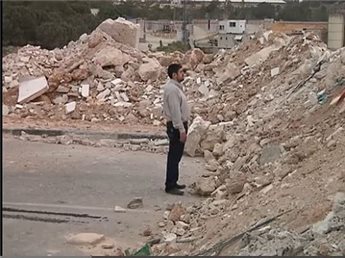 BETHLEHEM – Israeli forces have blocked the main entrances to a southern West Bank village since Saturday night, locals said, impeding villagers’ ability to travel freely.
Locals in the village of Beit Fajjar south of Bethlehem told Ma’an on Tuesday that Israeli forces had shut the roads in and out of the village by constructing large earth mounds on them.
Locals said that they were unsure of the reasons behind what they called the “collective punishment” of the village, highlighting that the Israeli authorities had cited security reasons without giving any explanation.
As a result of the closure, residents need to take bypass routes through the nearby al-Arrub refugee camp or Tuqu village. However, these routes are bumpy mountainous paths unqualified as roads.
The town has a population of about 15,000 many of whom leave every day to work outside. In addition, the town does not have a hospital or a major medical center, and so access to Bethlehem, about 10 kilometers to the north, is important for healthcare and emergencies.
The town is also known for stone factories and quarries, and the closure of the main road creates a serious problem for truck drivers who need to travel back and forth every day.
Furthermore, dozens of teachers who work at several public schools in the town come from other cities and village in Bethlehem district every day.
The Case of Amer Jubran
By Richard Hugus | May 11, 2014
Zionism is a system that chafes against the world. With its idea of a chosen people and its privileged control of states and institutions, where one whisper behind the scenes can outweigh the voice of millions, it offends us as an injustice. That injustice continues day in and day out for all the world to see in Palestine as occupation soldiers arrest even small children and shoot young demonstrators with impunity, as settlers burn olive trees and go on rampages of theft and harassment, and as settlers and soldiers together increase their attacks on the sacred buildings and grounds of the al-Aqsa mosque.
The idea that nothing is sacred seems to be at the front of Zionist ideology. This may be the motive for the terror we associate with it. We are stupefied by the brazenness of the repeated attacks on Lebanon, the bombings of Gaza, the rocket assassinations of Palestinian leaders, bulldozer and tear gas rifle murders of solidarity activists, the massacre of humanitarian volunteers on the Mavi Marmara, home demolitions, the killing of Palestinians in their own streets and on their own farmland. Perhaps this is the point — brazenness inspires fear, and fear inspires obedience. They seem to think that if you can sufficiently shock your enemy and the rest of the world, you have control. For people in the US, 9/11 would be the paradigm of this. Zionist planners Michael Ledeen and Philip Zelikow have defined covert US foreign policy by promoting the ideas of “creative chaos” and the power of “the searing event,” respectively, to establish a “new world order.”
But fear is not effective in the long run. We may immediately see through the act that tried to impose it, or, when we have had time to think, instead of being mystified, we are disgusted. As they say, the truth comes out; lies are hard to maintain. In the end perhaps this is because some things have remained sacred — human dignity, the right to live, the right to have a place to live, the innocence of children, the beauty of nature — and we remember that. Our feeling for these things is of a spiritual nature, and can’t ultimately be taken away by the aggressive and predatory weapons used by those who have power in the world.
Zionism chafes because each of the several million people it has expelled remember that they had a home in Palestine, and they know that to have that home back is their right. It is a constant irritant to the Arab people who have not yet been forced out, each of whom have a story to tell of wrongs committed against them during the nightmare occupation. After 67 years of attack and dispossession, Zionism has built up a long list of souls who have been wrongly treated and who have not forgotten.
This is the context in which one might understand the case of a Palestinian activist named Amer Jubran. The facts of Amer’s life are comprised of a number of wrongs attributable to Zionism. His family was forced to leave the area of al-Khalil in Palestine before he was born. They went into exile in Jordan. Amer’s grandfather was shot by an Israeli soldier in Palestine and left to bleed to death in the middle of a road. His relatives who remained in Palestine live under occupation and undergo each day the harassment and mistreatment which we all know now are the Israelis’ method of making all the rest of the indigenous people leave. At college age Amer chose a second country of exile – the United States. He may not have known then but he soon learned that he had moved to a country which Zionism had made its principal host (in the biological sense). He brought the cause of Palestine with him. In 2000 he was arrested for protesting an “Israel Day” celebration in a wealthy suburb of Boston. A long court struggle followed, and he was found not guilty. He was arrested again in 2002 during the Ashcroft-inspired attack on all Arabs and Muslims in the US, which Ashcroft waged through immigration authorities. This arrest followed two days after a march for Palestinian rights in the streets of downtown Boston which Amer helped to organize, and which had wide support. But one person whispered, and the deed was done. Another long court struggle followed. In 2004, unable to stand up against the stacked deck which is the US judicial system, he was forced to leave the US and return to Jordan.
In Jordan Amer began working at his family’s business and started a family, but continued to raise the cause of Palestine. In 2006 he was beaten and arrested at a protest at the Zionist embassy in Amman. In 2010 he gave a lecture at the American University in Beirut and was under noticeable surveillance both leaving and returning to Amman. Just a few days ago, May 5, 2014 he was arrested at his home in Amman by the Jordanian secret police, the Mukhabarat, and has since been held in an unknown location with no charges and no representation by a lawyer. No one is able to reach him. His most recent arrest is due to his being a supporter of the resistance to the Zionist project in the entire region. Where Zionism is concerned, it is no different in Jordan than in the United States. Zionism is indeed a world movement. Politically motivated police and judicial harassment of critics of Zionism can be found on every continent.
It is amazing that so many power structures in so many parts of the world have been so thoroughly invaded that a relatively few people could steal the relatively small piece of land which is historic Palestine. But there it is. And there is the constant irritation which this theft has brought about in the world. The irritation will not go away until the injustice is addressed. It will chafe and spring up in odd places forever until the truth is able to come out.
Richard Hugus is a Palestine solidarity activist who worked with Amer Jubran from 2002-2003 in The New England Committee to Defend Palestine
~~~~~~~~~~~~~~~~~~~
Additional information on the case of Amer Jubran can be found here.
5,000 prisoners begin mass hunger strike in Israeli jails

Ma’an – 08/05/2014
RAMALLAH – Over 5,000 Palestinian prisoners started an open hunger strike on Thursday in solidarity with detainees held in administrative detention by Israeli authorities, a Palestinian official said.
Palestinian Authority Minister of Detainees Issa Qaraqe said that the prisoners are demanding that Israel end the practice of holding Palestinians in custody without charge or trial.
More than 100 Palestinians in Israeli prisons launched a mass, open-ended hunger strike on April 24 in protest against their detention without trial.
Qaraqe said he holds Israeli authorities responsible for this “explosion” in protest action. He declared May 9 a ‘Day of Rage’ in solidarity with administrative detainees, which will see a range of solidarity activities after noon prayers.
A number of the strike leaders have been placed into isolation in Beersheba prison, including Muayad Sharab, Sufian Jamjoum and Abd al-Kareem Qawasmi.
An Israeli prison services spokesperson could not be reached for comment.
A 2012 agreement which ended a hunger strike of 2,000 Palestinian prisoners was meant to end the detention without trial of Palestinians, but as of March 1, 183 Palestinians were still being held under administrative detention.
Palestinians held in administrative detention are often held without charge or trial for months and without access to the evidence leading to their detention, even though international law stipulates this tactic only be used in exceptional circumstances.
Lieberman denounces Palestinian “traitors” over Nakba rally
Al-Akhbar | May 7, 2014
Israeli Foreign Minister Avigdor Lieberman on Wednesday denounced as a “fifth column” thousands of Palestinian citizens of Israel who joined a demonstration calling for the right of return for Palestinian refugees.
Around 10,000 protesters, many waving Palestinian flags, joined a rally inside the 1949 Green Line on Tuesday to remember 530 villages from which some 760,000 people fled or were expelled in the 1948 Nakba.
The rally took place as Israel marked the 66th anniversary of what it describes as its “independence day,” with Lieberman accusing the demonstrators of being traitors.
“Those who marched with flags of the Palestinian Authority demanding that it not give up on the right of return, are a fifth column whose aim is the destruction of Israel,” he told army radio.
He also addressed the demonstration on his Facebook page on Tuesday.
“To those Arabs that took part today in the ‘Nakba Day’ procession and waved Palestinian flags, I suggest that next time they march directly to Ramallah and they stay there,” he wrote.
But he acknowledged that those who joined the Nakba demonstration were only “a minority” among Israel’s Arab minority, who make up just over a fifth of the overall population of 8.2 million.
At the rally, which took place in a small village in the North, the protesters marched under the slogan: “Your ‘independence’ day is our Nakba” — Arabic for catastrophe.
More than 760,000 Palestinians fled or were driven out of their homes by armed Zionist forces when Israel declared itself a state in May 1948. Today, with their descendants, they number an estimated 4.8 million.
Around 160,000 Palestinians stayed in their homes and took Israeli citizenship. Official figures published last week show they now number 1,694,000 people, or 20.7 percent of the population.
Lieberman, a hardliner within the ruling rightwing coalition, is an open proponent transferring densely-populated Palestinian areas inside the Green Line to the control of the Ramallah-based Palestinian Authority in any future peace deal.
(AFP, Al-Akhbar)
Daily Harassment in the Qeitun area

Photo by ISM
International Solidarity Movement | May 6, 2014
Hebron, Occupied Palestine – Residents of Qeitun area of Al-Khalil, near Shuhada St. are presented with a very different kind of daily routine than other areas of the occupied West Bank. Israel occupation forces not only raid houses and harass people on a daily basis, but also use the local population as part of their military training.
On Tuesday, the 29th of April, the Israeli army was training for the erecting and working of a flying checkpoint, pulling over cars on the main road of the area which leads to the military base, also called Qeitun. During this training the commander was instructing the soldiers how to stop and search drivers and their cars.
Two days later, on Thursday 1st of May at 11:30pm, ISM activists were called out to witness the Israeli army performing a massive operation of night raids, with approximately 100 soldiers. When the activist got to the area, the army had detained an 18-year old. The youth was released 30 minutes after the arrival of the activists. Many of the local people, still in their nightdresses, were out in the streets while the soldiers were inside their houses.
At around 1:00am the soldiers left the area and had what seemed like a quick evaluation of the whole operation, making it difficult to know whether it was an actual military operation or just some sort of training, similar to the flying checkpoint training that took place two days earlier. For the people of Qeitun there’s no actual difference between “training” and a live military operation of the occupation forces.
In an ISM visit with a family of the Qeitun area, they report that the soldiers have been starting the raids as early as 9pm and had raided a total of 50 houses. They also reported that during one of the raids the soldiers had broken into a house with such violence that an elderly woman with a heart condition, had gone into coma and had to be rushed to the hospital.
The family reported that the area experiences night raids at least two or three times a week. Israeli soldiers enter and harass the locals on a daily basis and the army has arrested two minors during the last month.
During the second intifada almost all families living in the houses located near Shuhada St. were forced out by the Israeli army, allegedly for security reasons, making this part of the area a ghost town.
312 Palestinians Kidnapped By Israeli Army In April
By Saed Bannoura | IMEMC News | May 2, 2014
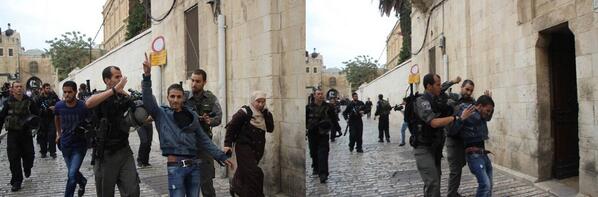
The Ahrar Center for Detainees Studies and Human Rights issued its monthly report, revealing that the Israeli army kidnapped 312 Palestinians in different parts of the occupied West Bank, occupied Jerusalem, and the besieged Gaza Strip.
Ahrar said the army carried out dozens of invasions into the occupied territories, kidnapping 312 Palestinians, mainly after breaking into their homes and properties, and violently searching them, causing excessive property damage.
Most of the arrests have been carried out in the Hebron District, as the soldiers kidnapped 94 Palestinians, followed by Jerusalem, 92, Nablus, 36, Bethlehem, 21, Jenin, 18, Ramallah, 16, Gaza Strip, 15 including 11 kidnapped near the border fence, Qalqilia, 10, Salfit, 7, Tulkarem, 2, and one in Tubas.
Ahrar added that the army kidnapped four Palestinian women in April, and released two of them later on.
Mariam Barghouthi, from Ramallah, and Samira al-‘Akel, from Hebron, are still imprisoned, while Tahani Abu Mayyala and Hanin Abu Aisha, from Hebron, were released.
“There are 21 Palestinian women who are still imprisoned by Israel,” Ahrar stated.
Head of the Ahrar Center, Fuad al-Khoffash, stated that April witnessed the beginning of one of the strongest hunger strikes by Administrative Detainees held with charge or trial, and that the detainees are determined to continue their strike.
Al-Khoffash added that the striking detainees are subject to constant attacks and harassment, in the attempt by authorities to force them to end their strike, while many have been moved into solitary confinement and are denied the right to family visits.
Israeli forces ‘attack Palestinian woman, daughter’ in Silwan
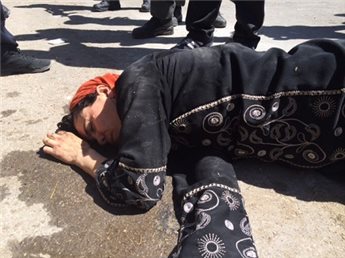
Umm Qalawoon al-Tawil lying unconscious outside her home after Israeli officers attacked her
Ma’an – 01/05/2014
JERUSALEM – Israeli forces attacked a Palestinian woman and her teenage daughter in the Wadi Hilweh quarter south of the Old City of Jerusalem on Thursday, Palestinians in Silwan neighborhood said.
Director of the Silwan-based Wadi Hilweh Information Center Jawad Siyam told Ma’an that Israeli officers broke into the home of Umm Kalawoon al-Tawil and “brutally” beat her and her 15-year-old daughter Layla.
Siyam highlighted that Israeli officers continued to beat al-Tawil while they dragged her out of her apartment to a playground in the neighborhood until she passed out.
Fistfights broke out between local residents and Israeli officers while an ambulance evacuated al-Tawil to al-Maqasid hospital in Jerusalem for treatment.
An Israeli police spokesman said he was unaware of any detentions in the area.
State Department’s annual Country Report on Israeli Terrorism
By Gilad Atzmon | May 1, 2014
Ynet reports today that A new American report on terrorism strongly criticizes Israel for its lack of response to attacks by extremist settlers against the Palestinian population and their property.
“Attacks by extremist Israeli settlers against Palestinian residents, property, and places of worship in the West Bank continued and were largely unprosecuted according to UN and NGO sources,” says the State Department’s annual Country Report on Terrorism.
The report states that attacks of this nature number in the hundreds.
“The UN Office of the Coordinator for Humanitarian Affairs reported 399 attacks by extremist Israeli settlers that resulted in Palestinian injuries or property damage. Violent extremists, including Israeli settlers, vandalized five mosques and three churches in Jerusalem and the West Bank, according to data compiled by the UN.”
The paper also notes that the phenomenon has spilled over into Israel, where Muslim and Christian sites have been targeted.
“‘Price tag’ attacks (property crimes and violent acts by extremist Jewish individuals and groups in retaliation for activity they deemed to be anti-settlement) expanded into Israel from the West Bank in 2013,”
The report, also noted a massive drop in rocket attacks from Gaza and Sinai into Israel. “Palestinian terrorist organizations in the Hamas-controlled Gaza continued rocket and mortar attacks into Israeli territory. The number of rocket and mortar launchings on Israel from Gaza and the Sinai was the lowest in 2013 in more than a decade, with 74 launchings compared to 2,557 in 2012.”
Featured Video

Armando Mema: Finland Used as New Frontline Against Russia
or go to
Aletho News Archives – Video-Images
From the Archives
MI5 plotted assassination of Irish PM in 1985 – Ulster Volunteer Force
RT | December 29, 2017
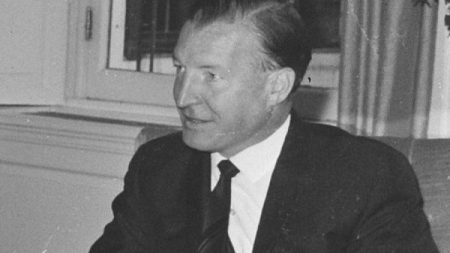
Former Irish Prime Minister Charles Haughey was warned by loyalist paramilitaries that they were once tasked with murdering him in an assassination plot purportedly dreamt up by the British secret service.
The sensational disclosure was sent in a letter to the Irish government, newly released under the Public Records Act, which requires documents of historical value to be published by the National Archives within 30 years.
Written on Ulster Volunteer Force (UVF) signature paper, the warning claims the terrorist organization was asked by an MI5 operative about the prospect of carrying out an attack on Republic of Ireland leader Haughey in 1985.
At the time, Haughey would have been in opposition as head of political party Fianna Fáil, but details of the solicitation did not become known to Irish authorities until 1987.
“In 1985 we were approached by a M15 officer attached to the Northern Ireland Office and based in Lisburn, Alex Jones was his supposed name,” the letter reads, according to the Irish Times. “He asked us to execute you.”… continue
Blog Roll
 Aletho News
- Armando Mema: Finland Used as New Frontline Against Russia
- Gestapo 2.0? Germany grants spy agencies sweeping new powers
- Franco-Palestinian group seeks court ban on Israeli real estate fair in Paris
- How British foreign policy is frozen in the ruins of empire
- EU risks investor exodus over Russian assets – Euroclear chief
- Moscow warns NATO over troop buildup
- EU leaders prolonging Ukraine conflict to stay in power – Swiss journalist
- Moscow car bombing injures former aide to Ukraine’s ex-PM Azarov
- Yemeni forces make major advances, complete Aden encirclement
- Trita Parsi: Trump’s Swiss Cheese Iran Plan & U.S. Break with Israel?
- If Americans Knew
- Israel Kills over 12, Injures Many Across Gaza
- ‘Every drawer was opened’: Palestinians report looting amid Israel’s Hebron siege
- Scoop: Israeli spy chief in D.C. as Netanyahu presses Trump to resume war
- Israel Issued More than 24,000 ‘Administrative Detention’ Orders in Three Years
- Israel Critic Van Hollen to Challenge Schumer for U.S. Senate Majority Leader
- Most violent olive harvest on record in the West Bank
- Too Awful For Even Bari’s Backers
- Disgraced neocons Feith & Libby: stop whining about ‘endless war’
- The 100-year-old Zionist plan to steal southern Lebanon
- Jeffries Refuses to Say If He Opposes US-Israeli Military Integration Measure
- No Tricks Zone
- New Study: Barents Sea Temperatures Were Warmer And Sea Ice Less Extensive In The 1700s Than Today
- German Authorities Start Initiative To Evaluate Public Register For Climate “Disinformation” Spreaders!
- Zonal Asymmetry of Temperature Change in the Antarctic Circumpolar Current
- New Study: The Net Fossil Fuel Contribution To Rising Atmospheric CO2 Has Been Zero For 500 Years
- Germany’s Green Energy Transition Becoming Increasingly Expensive…Another 6 Trillion Euros!
- Sudden Stratospheric Warming, Powerful El Niño Combination May Lead To Extreme Europe Cold, Energy Crisis!
- Two New Studies Find Thwaites Glacier Melt Cannot Be Driven By Human Activity Or A Warming Ocean
- E-Cars Reduce CO2 Emissions By Only 41% Compared To Internal Combustion Engine Vehicles
- Predictions Made By Renowned Climate Professor Over Past Decades Have Been Proven To Be Poor
- New Study Suggests Large Regions Of The Pacific Ocean Have Been Cooling For The Last 80 Years

