Christian leaders tell youth to ‘tear up’ Israel army forms
Ma’an – 25/04/2014
JERUSALEM – Orthodox Archbishop Atallah Hanna and former Latin Patriarch Michel Sabbah on Friday urged Christian youth not to enlist in the Israeli military and to ignore Israeli “propaganda” encouraging them to do so.
The statement came after a meeting between the two religious figures on Friday, which followed reports on Tuesday that Israeli authorities would distribute military enlistment papers to Palestinian Christian youth who are citizens of Israel in order to encourage them to voluntarily sign up for military service.
The leaders called upon Christian youth who have received the enrollment papers to “tear them up and throw them away and not to engage with them in any way.”
The leaders also stressed the “firm national position of the Christians in refusing to join a military that exercises violence against the rights of the Palestinian people.”
The forms to be sent to Christian youth resemble the mandatory enlistment forms distributed to Jewish and Druze Israelis, and the army hopes that by sending these papers more youth will voluntarily sign up to enlist.
Although Christian Palestinian citizens of Israel are currently exempt from military service along with Muslims, a government decision made in February to re-classify Christians as a separate ethnicity distinct from “Arab” raised fears that mandatory enrollment would follow, as it did for Palestinians of the Druze religion in the 1950s.
About 10 percent of Palestinian citizens of Israel, also called “Arab-Israelis,” are Christians, while the majority of the remaining are Muslims and Druze.
Although the majority of Palestinians were expelled from their homes inside Israel during the 1948 conflict that led to the creation of the state of Israel, some managed to remain and their descendants today make up around 20 percent of Israel’s population.
Palestinian girl badly injured by Israeli settler attack
Operation Dove | April 24, 2014
At-Tuwani, Occupied Palestine – On Thursday April 24 at around 12 pm, two Israeli settlers coming with a quad-bike from the illegal outpost of Havat Ma’on attacked with stones four Palestinian children and the mother of three of them, as they were returning from school to their homes in the villages of Tuba and Maghayir Al Abeed. A seven year old girl child was hit by a stone and fell while attempting to run away, badly injuring her head.
Her father, who witnessed the attack as he was harvesting his land situated on top of the Old Havat Ma’on hill, immediately brought her to the nearby village of At Tuwani, where an ambulance came to rescue her and bring her to the hospital.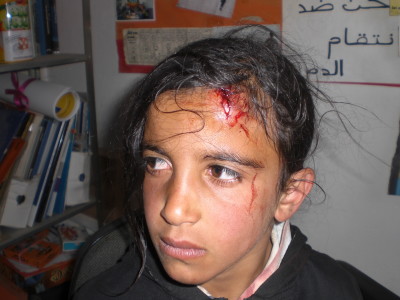 The girl required five stitches and is now resting at home with her family.
The five Palestinians were coming from the village of At Tuwani, where the children attend school, through the only path they can use without the military escort that everyday accompanies the children from Tuba and Maghayir Al Abeed on their way to and from school since 2004. On this path Palestinians cross the hill where the outpost of Havat Ma’on was situated before it was dismantled in 2000 and moved to Hill 833. Through this hill passes a paved road used by Israeli settlers as a hiking trail. The five Palestinians were attacked by two Israeli settlers who were riding with their quad-bike on this trail.
Operation Dove has maintained an international presence in At Tuwani and the South Hebron Hills since 2004.
[Note: According to the Fourth Geneva Convention, the Hague Regulations, the International Court of Justice, and several United Nations resolutions, all Israeli settlements and outposts in the Occupied Palestinian Territories are illegal. Most settlement outposts, including Havat Ma’on (Hill 833), are considered illegal also under Israeli law.]
Colombia Professor Victorious in His Quest for Academic Freedom
KAKE | April 21, 2014
After Iymen Chehade’s class at Columbia College Chicago was canceled, he realized that his academic freedom had been violated and skillfully protested until his class was reinstated. In this interview, Chehade discusses the importance of recognizing and fighting for academic freedom in schools across the globe.
(Interviewer: Kellen Winters @_ITSKELS @_KAKEME – Filmed and edited by @AndrewZeiter & @FragDfilms.)
Guardian: wounding kids ‘proof of mistrust’
By Jonathon Cook | April 24, 2014
You can understand a lot about journalists and journalism by examining our professional nervous tics. We all have them – and they tell you a lot about the hidden assumptions that drive the news agenda.
Peter Beaumont, the Guardian’s new Jerusalem bureau chief, and a veteran reporter, is a good liberal journalist with both a broad and deep understanding of the region. In the article below he tells us about the long-awaited reconciliation pact between Fatah and Hamas.
But what does the following little tic tell us, not so much about him but about the news agenda he serves?
After the agreement was announced, Israel cancelled a planned session of peace negotiations with the Palestinians. It also launched an air strike on a site in the north of the Gaza Strip, wounding 12 people including children, which underscored the deep mutual suspicion and hostility that persists.
Israel launched an unprovoked and, it seems, largely indiscriminate attack on Gaza that injured only civilians (as Haaretz reports) because two Palestinian factions signed a piece of paper. And that apparently “underscores the deep mutual suspicion” between Israel and the Palestinians.
Peter, here’s another thing the attack may underscore: Israel’s cynical and determined effort to break the agreement before it has time to take hold.
Talking of comments revealing a lack of self-awareness, how about this corker in the same article from Jen Psaki, a state department official, who called the unity pact “disappointing”?
It is hard to see how Israel can be expected to negotiate with a government that doesn’t believe in its right to exist.
And yet the US seems quite happy to have the Palestinians negotiate with a government, Israel, that has never shown any indication that it believes in the right of Palestine to exist.
www.theguardian.com/world/2014/apr/23/plo-hamas-agree-unity-pact-form-government
Moscow praises Palestinian reconciliation efforts
MEMO | April 24, 2014
Moscow praised the agreement reached by Fatah and Hamas to form a unity government and conduct legislative and presidential elections in Palestine.
According to a statement by the Russian Foreign Ministry yesterday, Moscow looked positively at the practical efforts to resume the process of reconciliation between the Palestinians, which began yesterday with a visit from a delegation headed by Azzam Al-Ahmad to the Gaza Strip.
The Ministry said: “We regard this as a step in the right direction… unless the Palestinians unite on the foundation of the Palestine Liberation Organisation and Arab peace initiative, it will be impossible to fulfil the legitimate aspirations of the Palestinian people and achieve a lasting just settlement between Israel and Palestine on the basis of international law.”
It continued: “From our side, we will do our utmost to provide support for the Palestinians to help achieve genuine national unity.”
US ‘disappointed’ by Fatah-Hamas reconciliation
MEMO | April 24, 2014
Spokesperson of the US Department of State Jen Psaki said on Wednesday that the Obama administration is “disappointed” by the reconciliation pact between Fatah and Hamas, the two main Palestinian factions.
Speaking shortly after Israel cancelled its latest meeting with the Palestinians in the effort to save the faltering peace talks, Psaki told reporters that news of the political reconciliation was “disappointing in terms of the content as well as the timing”.
She suggested that the pact could “certainly complicate” the peace process, because: “It’s hard to see how Israel can be expected to sit down and negotiate with a group that denies its right to exist.”
Hamas refuses to normalise the occupation of Palestine by recognising the Israeli government. The peace talks, which resumed last summer under US auspices, stalled after Israel balked at releasing Palestinian prisoners while continuing to expand illegal settlements in the occupied territories.
Fatah and Hamas announced on Wednesday afternoon that they have agreed on a reconciliation pact, including the formation of a national unity government within five weeks.
The reconciliation pact was revealed during a press conference held by Hamas leader and Palestinian Prime Minister in Gaza Ismail Haniyeh and the head of Fatah’s parliamentary bloc, Azzam Al-Ahmad. A numbers of Palestinian faction leaders also attended the event.
According to the press statement, the Palestinian Authority (PA) along with Fatah leader and Palestinian President Mahmoud Abbas are to start discussions on the formation of a national unity government immediately, based on the previous Doha and Cairo agreements.
The statement also reiterated that elections for the legislative council, PA presidency and the Palestinian National Council must be held simultaneously and in coordination with other national factions. The elections are to take place six months after the unity government is formed.
Israel rejects Abbas’ conditions for extending talks
Ma’an – 22/04/2014
JERUSALEM (AFP) — President Mahmoud Abbas said Tuesday that he would extend faltering peace talks with Israel only if it agreed to conditions, including a settlement freeze, which it promptly rejected.
Abbas listed his demands during a meeting with Israeli journalists at his headquarters in Ramallah just a week before a nine-month target for a peace deal.
His comments came as US envoy Martin Indyk went into a new meeting with Israeli and Palestinian negotiators in a bid to save the US-sponsored talks from collapse.
Abbas said he would agree to an extension of negotiations beyond the April 29 deadline if Israel frees a group of prisoners as previously earmarked for release and discusses the borders of a future Palestinian state.
“There must be a total freeze of settlements,” by Israel in the occupied West Bank including annexed East Jerusalem, Abbas said.
“The borders between Israel and the state of Palestine must also be defined within a month, two or three,” if the talks are to be extended, he said.
The PLO and the international community have long viewed Israeli settlement construction as a major obstacle to peace talks.
The peace process was engulfed by crisis last month after Israel refused to free a fourth and final group of 26 veteran Palestinian prisoners which would have completed an agreement that brought the sides back to negotiations last July.
“He who makes such conditions does not want peace,” a senior Israeli official told AFP on condition of anonymity.
The official said that settlement building in Jerusalem would not be frozen and that Israel had never agreed to discuss the border issue separately from other core issues.
These include Palestinians refugees, the fate of Jerusalem, security and mutual recognition.
“It is impossible to define borders before an agreement on the other issues,” the Israeli official said.
He also reiterated that Israel planned on expelling to the Gaza Strip, or abroad, some of the last batch of prisoners that Abbas wants freed.
“This has been clearly explained to the Palestinians. Never has Israel committed not to carry out expulsions,” he said.
Israel has announced plans for thousands of illegal settler homes in the occupied West Bank and killed over 60 Palestinians since peace talks began in July.
Israeli officials have also refused to discuss withdrawing Israeli soldiers and settlers from the occupied Jordan Valley, which forms around a third of the West Bank.
Ma’an staff contributed to this report
PLO, Hamas announce agreement to end political division
Ma’an – 23/04/2014
GAZA CITY – PLO and Hamas representatives announced an historic unity deal on Wednesday to bring to an end more than seven years of political division between the main Palestinian political parties.
Gaza Prime Minister Ismail Haniyeh announced the end of years of Palestinian political division in a press conference in Gaza City, saying that the Hamas and PLO delegations had worked as “one team” throughout the reconciliation dialogue and had stressed the necessity of achieving results in this round of dialogue.
The joint PLO-Hamas statement given at the conference also authorized the Palestinian Authority president to set a date for new elections, and emphasized the commitment of both sides to the reconciliation principles that had been agreed upon in the Cairo Agreement and the Doha Declaration.
They also emphasized the need to reactivate the Palestinian Legislative Council.
Fatah leader Azzam al-Ahmad said that neither side will accept the resumption of negotiations with Israel without clear guidelines, and that negotiations had stalled as a result of “Israel intransigence” and “American bias.”
Earlier, Palestinian officials announced that they had agreed to form a unity government within five weeks that will be headed by either President Mahmoud Abbas or former Deputy Prime Minister of the 2006 unity government Nasser al-Din al-Shaer, who is a member of Hamas.
The parties also agreed that both Hamas in Gaza and Fatah in the occupied West Bank would release prisoners detained for their political affiliation.
The division between the two Palestinian factions began in 2006, when Hamas won the Palestinian legislative elections.
In the following year, clashes erupted between Fatah and Hamas, leaving Hamas in control of the Strip and Fatah in control of parts of the occupied West Bank.
The groups have made failed attempts at national reconciliation for years, most recently in 2012, when they signed two agreements — one in Cairo and a subsequent one in Doha — which have as of yet been entirely unimplemented.
Israeli state water company loses Portugal deal and faces global protests
Palestinian BDS National Committee | April 21, 2014
Lisbon’s water company EPAL has announced that it terminated a technology exchange deal with Israeli state water company Mekorot following protests over Mekorot’s role in Israel’s ‘water apartheid’ over Palestinians.
Portuguese MPs and campaign groups had argued that the deal amounted to support for Mekorot’s role in the theft of Palestinian water.
Mekorot, who lost out on a $170m contract with Argentinian authorities earlier this year following similar protests, illegally appropriates Palestinian water, diverting it to illegal Israeli settlements and towns inside Israel. The state owned company is the key body responsible for implementing discriminatory water polices that Amnesty International has accused Israel implementing “as a means of expulsion”.
“Many Palestinian communities suffer from a lack of access to adequate water due to the encroachment of Israeli settlers on water resources and to Israeli policies and practices that deny Palestinians the human right to water,” explained Dr. Ayman Rabi from Friends of the Earth Palestine / PENGON.
EPAL this week responded to fresh calls to terminate its relationship with Mekorot by announcing that it had terminated their relationship with Mekorot in 2010 when the public campaign against the collaboration was at its height. The campaign saw large demonstrations in Lisbon’s main square and pressure against local authorities.
A statement released by the coalition of Portuguese organisations that campaigned against Mekorot said that the decision will “strengthen and encourage the efforts of solidarity movements that work towards the international isolation of Israel because of its policies of ethic cleansing, occupation and colonization”.
The EPAL announcement follows a similar decision by municipal authorities in Buenos Aires and Dutch national water carrier Vitens and comes at the end of an international week against Mekorot that saw demonstrations and campaign actions take place across at least 12 countries.
In Paris, BDS France activists burst into a luxury hotel where delegates from Mekorot were taking part in a business breakfast as part of the Global Water Summit. Campaigners urged dozens of stunned delegates not to cooperate with the Israeli water company.
A French parliamentary report has accused Israel of imposing a system of “water apartheid” in the occupied Palestinian territory.
The French mobilisation followed a noise demonstration that disrupted a London water conference that was being addressed by Mekorot and other Israeli water companies.
In Rome, a ‘water checkpoint’ street theatre protest highlighted the campaign against collaboration between Mekorot and the city’s water company ACEA. The campaign is backed by the broad coalition of campaign groups resisting privatisation of water.
In Argentina, the Congress of the Trade Union Federation Capital (CTA Capital) was dedicated to the campaign against Mekorot and hosted a discussion of how Mekorot is attempting to export discriminatory water policies developed in Palestine to Argentina. The session celebrated the successful campaign that led to Mekorot losing out on a $170m contract and discussed how best to prevent Mekorot from being awarded other contracts it has won or is bidding for.
A seminar in Uruguay brought together Palestine solidarity, environmental and anti-privatisation groups to discuss struggles for water and land in Uruguay and Palestine.
On March 22 world water day, more than 250 people joined a Thunderclap Twitter storm that had a social reach of over 300,000 people.
Campaigns against Mekorot are also underway in Greece.
“The amazing reach of the first week against Mekorot and the fact that public authorities are increasingly refusing to collaborate with Mekorot are further signs that people and governments across the world are no longer prepared to fund Israeli apartheid,” said Jamal Juma’ from Stop the Wall, a member of PENGON/Friends of the Earth Palestine, one of the Palestinian organisations that called for the week of action against Mekorot.
“We call on people all over the world to continue to take action against Mekorot and its attempts to export Israel’s discriminatory water policies,” he added.
Army ‘to actively recruit’ Christian Palestinian citizens of Israel
Ma’an – 22/04/2014
BETHLEHEM – In a new policy, Palestinian Christian citizens of Israel will begin receiving army conscription papers, Israeli media said Tuesday.
Israeli news site The Times of Israel quoted Army Radio as saying that though joining the Israeli army would remain voluntary for Christians, they would now be receiving recruitment papers starting at the age of 16.
Previously, a decades-old policy required Palestinian Christian citizens of Israel to initiate contact with the army if they wanted to join, the Times of Israel report said.
In February, the Israeli Knesset passed a bill that created an identity marker for Christians, separating them from the “Arab” identifier previously used for all Palestinian citizens of Israel.
“It’s a historic and important step that could balance the State of Israel and connect us to the Christians, and I am careful not to refer to them as Arabs, because they are not Arabs,” bill sponsor Likud MK Yariv Levin said in January.
Christians are “our natural allies,” Levin said, adding that Muslims “want to destroy the state (of Israel) from within.”
PLO executive committee member Hanan Ashrawi, herself a Christian, condemned the law as an effort to divide the Palestinian community.
Khan-al-Luban: Israeli army attack
International Solidarity Movement | April 22, 2014
Khan al-Luban, Occupied Palestine – On Monday April 21, 2014 two International Women’s Peace Service [IWPS] volunteers were playing uno [a card game] outside with two children of the Abu Jamal family in Khan al-Luban, close to the Nablus-Ramallah road. Their elder brother Jimmy was plastering the bathroom and their mother was inside doing house chores.
IWPS and ISM volunteers have kept a permanent presence in Khan al-Luban this past week, as the family has been the target of attacks by the Israeli military and Israeli settlers from the surrounding illegal settlements. The family has been especially worried since the father, was arrested last Wednesday. Their fears proved to be well founded.
Below is the eyewitness account by IWPS volunteers of yesterday’s events:
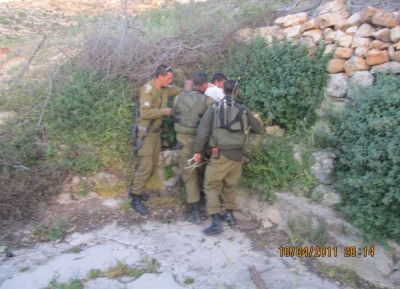
At 6:45pm an Israeli army jeep pulled in front of a building across the street from the family house, then backed out of the driveway and drove along the road towards the back of the house. We all went into the center area and shut the doors, but went outside to photograph what they were doing as the three Israeli soldiers got out of the jeep and started coming over the fence and onto the roof. We climbed to the roof area where they had come onto the property. They asked one of the human rights volunteers to show her passport but she refused.
Jimmy stayed inside because he thought they might be looking for him. One of the young sons talked to the soldiers on the roof and the army called for back up.
After the soldiers began shouting at the mother and her child, Jimmy came out to the roof area, no longer able to stay hidden. He told the soldiers that they were on his family’s property and that they should stop yelling at his mother and younger brothers.
The soldiers became belligerent and hit him with their hands. They then attempted to handcuff Jimmy, and dragged him partway across the roof; by that time the cuffs were fully on. At that point they knocked him down and hit him on the head with the back of a rifle. Jimmy was unconscious from that time on and appeared to convulse slightly. They continued to beat him after he collapsed.
We all yelled at them that he needed an ambulance and the mother attempted to get one; she also called the neighbours on the phone. Some passing cars pulled over and three Palestinian men came to try to help the family. The soldiers responded by throwing a stun grenade.
Two more jeeps arrived, bringing an additional 8-9 soldiers; one of the jeeps had a siren on, leading us to believe that it was an ambulance until it arrived. The soldiers were fully armed with rifles, tear gas, and stun grenades. One threw a stun grenade that landed on the roof, a few feet away from unconscious Jimmy and his hysterical mother. The ambulance that she had phoned also arrived. At this point several soldiers grabbed Jimmy, still unconscious, by his arms and legs, attempting to put him in one of their jeeps, however the emergency services and the other Palestinians were able to take over, and got him into the ambulance instead. The mother went with her son to Rafidiya hospital in Nablus. An army jeep followed the ambulance.
The soldiers arrested one of the Palestinians and took him away in the first jeep. Another stun grenade was thrown directly at those of us on the roof as the army drove away.
As of 9:30pm, Jimmy was awake and in stable condition, although x-rays showed that he suffered from several broken ribs and multiple fractures.
Israel detains thousands of army deserters every year

MEMO | April 21, 2014
The Israel Defence Forces detain nearly 22,000 deserters and “undisciplined soldiers” every year, Haaretz newspaper revealed on Sunday. The paper said that nearly 13,000 of the soldiers are detained in army prisons while the rest are held inside military bases.
The paper quoted data from the Military Police, which revealed that around 400 escape attempts, rebellions and acts of violence occur inside army prisons annually. At least 13,452 soldiers were detained in 2013; 76 per cent of them were charged with evading military service, while 18 per cent were soldiers classified as “undisciplined” and 6 per cent had committed criminal offences.
According to the data, 13 per cent of detained soldiers are of Ethiopian origin although they represent only 3 per cent of the total personnel in the IDF.
Featured Video

Armando Mema: Finland Used as New Frontline Against Russia
or go to
Aletho News Archives – Video-Images
From the Archives
MI5 plotted assassination of Irish PM in 1985 – Ulster Volunteer Force

RT | December 29, 2017
Former Irish Prime Minister Charles Haughey was warned by loyalist paramilitaries that they were once tasked with murdering him in an assassination plot purportedly dreamt up by the British secret service.
The sensational disclosure was sent in a letter to the Irish government, newly released under the Public Records Act, which requires documents of historical value to be published by the National Archives within 30 years.
Written on Ulster Volunteer Force (UVF) signature paper, the warning claims the terrorist organization was asked by an MI5 operative about the prospect of carrying out an attack on Republic of Ireland leader Haughey in 1985.
At the time, Haughey would have been in opposition as head of political party Fianna Fáil, but details of the solicitation did not become known to Irish authorities until 1987.
“In 1985 we were approached by a M15 officer attached to the Northern Ireland Office and based in Lisburn, Alex Jones was his supposed name,” the letter reads, according to the Irish Times. “He asked us to execute you.”… continue
Blog Roll
 Aletho News
- Armando Mema: Finland Used as New Frontline Against Russia
- Gestapo 2.0? Germany grants spy agencies sweeping new powers
- Franco-Palestinian group seeks court ban on Israeli real estate fair in Paris
- How British foreign policy is frozen in the ruins of empire
- EU risks investor exodus over Russian assets – Euroclear chief
- Moscow warns NATO over troop buildup
- EU leaders prolonging Ukraine conflict to stay in power – Swiss journalist
- Moscow car bombing injures former aide to Ukraine’s ex-PM Azarov
- Yemeni forces make major advances, complete Aden encirclement
- Trita Parsi: Trump’s Swiss Cheese Iran Plan & U.S. Break with Israel?
- If Americans Knew
- Israel Kills over 12, Injures Many Across Gaza
- ‘Every drawer was opened’: Palestinians report looting amid Israel’s Hebron siege
- Scoop: Israeli spy chief in D.C. as Netanyahu presses Trump to resume war
- Israel Issued More than 24,000 ‘Administrative Detention’ Orders in Three Years
- Israel Critic Van Hollen to Challenge Schumer for U.S. Senate Majority Leader
- Most violent olive harvest on record in the West Bank
- Too Awful For Even Bari’s Backers
- Disgraced neocons Feith & Libby: stop whining about ‘endless war’
- The 100-year-old Zionist plan to steal southern Lebanon
- Jeffries Refuses to Say If He Opposes US-Israeli Military Integration Measure
- No Tricks Zone
- New Study: Barents Sea Temperatures Were Warmer And Sea Ice Less Extensive In The 1700s Than Today
- German Authorities Start Initiative To Evaluate Public Register For Climate “Disinformation” Spreaders!
- Zonal Asymmetry of Temperature Change in the Antarctic Circumpolar Current
- New Study: The Net Fossil Fuel Contribution To Rising Atmospheric CO2 Has Been Zero For 500 Years
- Germany’s Green Energy Transition Becoming Increasingly Expensive…Another 6 Trillion Euros!
- Sudden Stratospheric Warming, Powerful El Niño Combination May Lead To Extreme Europe Cold, Energy Crisis!
- Two New Studies Find Thwaites Glacier Melt Cannot Be Driven By Human Activity Or A Warming Ocean
- E-Cars Reduce CO2 Emissions By Only 41% Compared To Internal Combustion Engine Vehicles
- Predictions Made By Renowned Climate Professor Over Past Decades Have Been Proven To Be Poor
- New Study Suggests Large Regions Of The Pacific Ocean Have Been Cooling For The Last 80 Years

