Protestors return to Bab-Alshams
Popular Struggle Co-ordination Committee | January 15, 2013
Bab-Alshams, Occupied Palestine – Following the violent eviction of Bab-Alshams (gateway of the sun) on Sunday around a hundred Protestors returned to the land which the Israeli Occupation Forces call E1. After the acceptance of Palestine as a non-member state to the UN, Israel announced the approval of a plan to expand by building some 4,000 residential units in this area. Such construction would effectively bisect the West Bank, effectively cutting it off from Jerusalem.
The protestors arrived before 15:00 to the surprise of Israeli Police stationed in the area; two groups approached Bab-Alshams from different directions. As protestors moved up the hill Israeli Occupation Forces began to attack the demonstration initially with stun grenades.
Activist’s remained steadfast and refused to leave the land which is privately owned by Palestinians. Israeli police began to outnumber protestors and then began detaining Palestinians violently. Slowly Israeli forces managed to push activists down the hill.
Activists regrouped at the bottom of the hill, sat down and began to sing. The violence of the Israeli authorities then again increased, one women was beaten and suffered a head wound which required medical attention. At least two others were injured one male was bleeding heavily from the wrist, while others were being treated for shock.
At-least 10 people were arrested most of which have now been released. Some remain in detention including an ISM founder Neta Golan.
Related articles
- Palestinians Establish a new Village, Bab Alshams, in Area E1 (alethonews.wordpress.com)
- Palestinian Village of Bab Alshams Remains Steadfast (palsolidarity.org)
- Israeli Soldiers Attack, Evict, Bab Al-Shams, Arrest Dozens (alethonews.wordpress.com)
Israeli soldiers violently break into two houses in Nablus, Kidnapping one person
International Solidarity Movement | January 15, 2013
Occupied Palestine – Last night more than forty Israeli soldiers invaded the city of Nablus and raided two homes looking for two young men. One of them was arrested Emad’s Motherduring the raid and the other one avoided arrest as he was working at the time of the raid.
At 2.30 am, dozens of Israeli soldiers with several dogs broke into Mead Nijad’s house breaking the door with a hammer and violently interrupting the family’s sleep. As the soldiers entered the house, they ordered everyone to have their hands up; they asked for Emad, blindfolded, handcuffed and arrested him. Immediately after, they took the ID’s of all family members and locked them outside the house on a cold winters night. In the meantime, the soldiers ransacked the whole house causing widespread destruction. They also took with them the young boy’s working tools. As Emad’s mother explains, “if they come with dogs, why do they have to destroy everything? If there is something in the house, the dogs would find it”. Furthermore, no reasons for why they arrested Emad were given; the commander just said “your son has caused problems to the Israelis, if you want to know where your son is, come to Huwwara”. The family still does not know the fate of their son.
In the case of Moaz Darduk (19), dozens of only Hebrew speaking soldiers arrived in his house at 3 am while he was at work and woke his parents up. As they asked for him and his father told the soldiers he was not at home but working, they locked his mother in a room and took his father to his other son’s house just in the next building. The commander, who was the only one speaking Arabic, kept saying to his father “do you know who I am? I am Haroun and I came here to kill your son”. When the commander went back to Moaz’s house he told to his parents “I want you to remember who I am, I am Haroun and I am here to kill your son. If you do not bring your son to Huwwara tomorrow morning at 9.30, we will kill him and return him to you in a coffin”.
Night raids and home searching are common tools used by the Israeli Occupation Forces to arrest Palestinian youth for no reason and as a collective punishment to scare Palestinian families.
Related articles
- Israeli forces arrest cancer patient in Nablus, locals say (altahrir.wordpress.com)
- Soldiers Kidnap Nine Palestinians In The West Bank (imemc.org)
Israeli army kills Palestinian teenager
Al-Akhbar | January 15, 2013
A Palestinian teenager was shot and killed after Israeli soldiers stormed a high school in the West Bank, according to activists.
The victim, 17-year-old Samir Awad was from Budrus, a village close to the Israeli apartheid wall, Ma’an news agency reported.
According to the village council head Mohammad Morar, a clash erupted between Israeli forces and teenagers attending the Budrus high school.
Witnesses told Ma’an that Israeli troops stormed into the school, causing students to throw rocks at them. Israeli soldiers then fired five bullets at the students.
Awad was shot four times in the head, chest and legs. He was taken to Ramallah for medical treatment, but succumbed to his wounds there.
The spokesman’s office of the Israeli Armed Forces claimed that Awad had tried to breach the Budrus security fence, ignoring warning shots fired in the air, The Jerusalem Post reported.
Late on Monday, 21-year-old Palestinian Mustafa Abu Jarad died in Gaza after being shot in the head by Israeli forces. A military spokesman later denied that the incident was related to the Israeli army.
West Bank: Aid agencies tread gingerly in Area C
IRIN | January 11, 2013
As night descends in the Jordan Valley in the occupied Palestinian territory (oPt), a family in the village of Ras Al-Ahmar lights a small paraffin lamp in the tent they call home.
There is no electricity here and the nearby Palestinian villages are enveloped in darkness. The only visible cluster of light is from a nearby Israeli settlement.
Humanitarian agencies are well aware of the needs in this part of the West Bank but they face a challenge: play by the rules established by Israel or face the risk of having projects demolished.
Despite being outside the state of Israel, 90 percent of the Jordan Valley is under full Israeli civil and military control as part of Area C, a zone that covers 60 percent of the West Bank.
Palestinian communities here, among the poorest and most vulnerable in oPt, desperately need access to water, electricity, sanitation and other basic infrastructure.
But despite the needs, development organizations that try to improve living conditions in Area C say they find their ability to make any lasting impact hampered by Israeli restrictions and bureaucracy.
Like Palestinians, organizations that want to build basic service infrastructure such as houses, schools or water systems are required to submit an application for a permit to the Israeli authorities.
Often, these permits are not granted. According to the UN Office for the Coordination of Humanitarian Affairs (OCHA), between January 2000 and September 2007, over 94 percent of applications submitted by Palestinians to the Israeli authorities for building permits in Area C were denied.
“The permit regime is very confusing. There is no clarity about the status of an application, whether paperwork has been received, if it is complete,” Willow Heske, media lead for Oxfam in oPt, told IRIN. “Agencies have sometimes waited for two years only to get a rejection that comes without any explanation.”
“A few years ago we put in plans to build a water reservoir in Al-Jiftlik, to provide half of Al-Jiftlik with running water,” said Heske.
“The reservoir was considered a `building’ and we didn’t get the permit. So we moved to a plan B which still involved setting up a reservoir and piping system but above rather than below ground. This too was not accepted. So as a last resort we had to go back to distributing water tanks. And of course people were frustrated and disappointed.”
Challenging the Occupation
Some NGOs, among them Palestinian organizations like Ma’an Development Centre (MDC), believe that adhering to the permit regime helps legitimize the occupation, and choose to ignore the rules altogether.
“If you’re playing within the rules of the occupation then you are legitimizing it. We don’t seek permits from the Israelis. If we put in a permit request we would likely get denied,” MDC project manager Chris Keeler told IRIN. “And also because of a moral stance. We don’t think that a Palestinian NGO should be seeking permission from Israel to be building on Palestinian lands.”
For international organizations, it’s not only the possibility of having a permit denied that affects their work, but also the multiple ways in which the Israeli state bureaucracy hinders their work by issuing “stop work” orders to existing projects, refusing to issue work visas, or refusing to renew existing work permits for foreign staff.
Even MDC finds that it must sometimes work within existing framework restrictions.
“There are houses all over the Jordan Valley that need renovations,” said Keeler. “If we do a project in some of the communities in the north, it would likely get destroyed. So we work a lot in Al-Jiftlik and Al-Fasayil. We need permits in those places too, but because they are more established communities, there is less risk that they will get destroyed. A lot of donors want reassurance that structures we build will not be torn down.”
IRIN was unable to get a response from the Israeli government despite repeated attempts, but in the past the Israeli government spokesperson has said Israeli policy is shaped by security concerns.
EU Move
In May 2012, the European Union (EU) Council of Foreign Affairs called on Israel to meet its obligations to communities in Area C, “including by accelerated approval of Palestinian master plans, halting forced transfer of population and demolition of Palestinian housing and infrastructure… and addressing humanitarian needs.”
The Council stated that the “social and economic developments in Area C are of critical importance for the viability of a future Palestinian state.”
The Israeli Ministry of Foreign Affairs criticized the recommendations, saying they were “based on a partial, biased and one-sided depiction of realities on the ground” and that they “do not contribute to advancing the peace process”.
The Ministry said 119 projects were authorized in Area C in 2011 and that they ensured that “planned projects” were “coordinated and in conformity… with the law”.
Oxfam’s Heske believes the recent EU recommendations are bold and courageous, even though it is still not clear how they will play out on the ground. “These conclusions mean that there is now a full political commitment to work on development in Area C,” she said. “How it will play out, we don’t know, if it happens with or without permits. But we don’t want to see just one token water network here and there.”
Since 2011, the Palestinian Authority’s ministry for local government and local Palestinian councils have submitted 32 master plans for development in Area C to the Israeli Civil Administration (ICA). Each master plan includes infrastructure development, health care, primary education, water provision, electricity and the development of agricultural land, and requires approval by the ICA through a lengthy process of negotiation.
However, according to Azzam Hjouj, acting general director for urban and regional planning in the Palestinian ministry of local government, even if master plans are approved by the ICA, it is expected that the Israeli authorities may issue demolition and “stop work” orders for some plans, particularly in areas like Al-Jiftlik in the Jordan Valley, and that political pressure will be required to ensure implementation.
Bedouin Villages
As for the more isolated Bedouin villages in the valley, the new master plans will not cover their areas.
“It’s difficult to make a master plan for these herding communities, because they are dispersed over large areas. They move around a lot and we don’t want to urbanize these areas, it’s their way of life,” Hjouj said. “And even if we made master plans, it would just give the ICA an excuse to congregate the herding communities into one area and take the remaining land.”
The Israeli Coordination of Government Activity in the Territories (COGAT – a unit in the Israeli Ministry of Defense that engages in coordinating civilian issues between the government of Israel, the Israel Defense Forces, international organizations, diplomats, and the Palestinian Authority) said that many of the construction projects in Area C are “illegal and poorly planned”.
A report compiled by COGAT relating to projects in Area C states that “illegal construction projects that ignore master plans undermine the possibility for future expansions and create problems for electrical, sewage and water systems.”
More Advocacy?
As with the wider crisis, there are no easy solutions for humanitarian agencies seeking to provide aid in Area C, and finding the line between purely humanitarian work, and political engagement is tough.
For economist Shir Hever, author of The Political Economy of Israel’s Occupation, Western governments and NGOs need to be more active in opposing the occupation of West Bank areas.
“Instead, donors put 99 percent of their work in doing what is allowed and 1 percent in protesting conditions,” he said.
Related articles
- Israeli occupation authorities halt entry of West Bankers to 1948 occupied Palestine (alethonews.wordpress.com)
- More evictions for Israeli army training in the Jordan Valley (alethonews.wordpress.com)
- Israeli forces evict West Bank Palestinian outpost despite court ruling (rt.com)
Israeli occupation authorities halt entry of West Bankers to 1948 occupied Palestine
Palestine Information Center – 13/01/2013
AL-KHALIL — The Israeli occupation authorities have stopped issuing permits for Palestinian West Bankers to enter occupied Jerusalem or 1948 occupied Palestine, sources in the Palestinian liaison office said Saturday.
They noted that no permits were issued for more than a month except for patients, adding that the ban started after the UN accepted Palestine as a non-member observer state.
An official at the chamber of commerce and industry in Al-Khalil affirmed the news saying that 1800 permits were tabled with the Israeli civil administration but no response was made to any of them.
He said that the arbitrary measure obstructed economic and commercial life for the Palestinians, adding that officials at the Israeli administration told them that the reason was the admission of Palestine at the UN.
Related article
- IOF arrests 320 Palestinian workers within ten days (occupiedpalestine.wordpress.com)
Israeli Soldiers Attack, Evict, Bab Al-Shams, Arrest Dozens
By Saed Bannoura | IMEMC News | January 13, 2013
On Saturday at dawn thousands of Israeli soldiers and policemen attacked the Bab Al-Shams Palestinian village, installed east of in occupied East Jerusalem, and forcibly removed dozens of activists loading them into buses.
The soldiers dragged several activists onto the ground, attacked reporters and journalists and declared the area a closed military zone, several injuries were reported.
The Israeli decision to evacuate the village came, on Saturday, through a direct order issued by Israeli Prime Minister, Benjamin Netanyahu, and his right-wing fundamentalist cabinet.
Israeli daily, Haaretz, reported that by midnight Saturday, the order was signed by Osnat Mandel, head of the Israeli High Court division of the Justice Ministry, under the claim that “the people and the tents must be removed due to security considerations”.
The Israeli Police said that the eviction order, issued by the court, prohibits the army from removing the tents, but orders the removal of the people staying there.
Also, the so-called Israeli Civil Administration Office, run by the occupation in the West bank, claimed that the Palestinian tent village “was installed on state land”.
But four Bedouin families living in the area confirmed that they own the land, and even showed deeds proving ownership.
Dr. Mustafa Barghouthi, secretary-general of the Palestinian National Initiative, who was also at the Palestinian village, stated that hundreds of Israeli soldiers invaded the village after surrounding it, and attacked the nonviolent activists camped there, and started kidnapping them.
The soldiers violently attacked the residents, including journalists, elderly and women, and dragged several residents onto the ground.
The soldiers repeatedly interrupted the work of local reporters, flashing their lights onto the camera, and pushing the reporters away, and dragged dozens of activists into buses that were brought by the army to the area.
On Saturday evening, Israeli Prime Minister, Benjamin Netanyahu, ordered the army “to remove the Palestinians and their supporters from the Palestinian outpost” that was installed on privately-owned Palestinian lands to send a message to Israel and the entire world that this land is the land of Palestine, and the Palestinian people have the right to inhabit it.
The army installed dozens of roadblocks around the area to prevent Palestinian traffic and surrounded the Bab Al-Shams camp where around 200 activists installed around 20 tents declaring the Bab Al-Shams Palestinian village, in the area where Israel illegally declared it intends to build thousands of homes for Jewish settlers, east of occupied east Jerusalem.
The Israeli decision to build the illegal settlements in the occupied state of Palestine came after the Palestinians managed to obtain an observer state status at the UN – General Assembly.
The Israeli decision was met with international condemnation, but the settler-led government of Benjamin Netanyahu, approved the illegal settlement project.
The so-called E1 settlement project aims at linking the Maale Adumim illegal settlement, where 35,000 reside, with occupied East Jerusalem, thus illegally confiscating Palestinian lands and blocking geographical continuity in the occupied West Bank.
This illegal Israeli project would divide the West Bank into two parts, and would completely isolate it from occupied East Jerusalem, an issue that would prevent the establishment of a viable Palestinian state.
Abdullah Abu Rahma, a Palestinian nonviolent activist from the West Bank village on Bil’in, who was also detained when the army attacked and evicted Bab Al-Shams, stated that this village is on private Palestinian land, and that the Palestinians are not invading anybody’s property, as they are establishing a village in the land of Palestine.
“We tied our hands, chained ourselves with each other to prevent the soldiers from removing us”, Abu Rahma said, “The Soldiers violently attacked us, beat us, and injured at least 10”
He added that there will be more nonviolent activities, and that the struggle for Bab Al-Shams, the nonviolent struggle for the liberation of Palestine will continue as the Palestinians are practicing their internationally-guaranteed right.
It is worth mentioning that the Palestine TV was live streaming from Bab Al-Shams, and the army repeatedly tried to interrupt the stream, pushing the reporters, and using large flashlight, pointing them against the camera to disrupt the images.

Wounded Journalist Hafeth Ibrahim
Related articles
- Palestinians Establish a new Village, Bab Alshams, in Area E1 (alethonews.wordpress.com)
Palestinians Establish a new Village, Bab Alshams, in Area E1
PSCC | January 11th, 2013
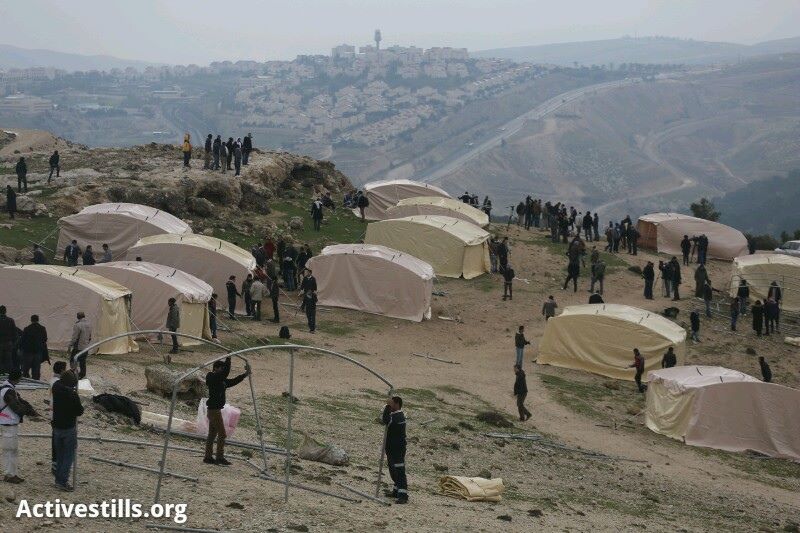
Bab Alshams, Occupied Palestine – 250 men and women from across Palestine establish this morning a new Palestinian village named “Bab Alshams” (Gate of the Sun). Tents were built in what Israel refers to as area E1 and equipment for long-term living was brought.
The group released the following statement:
We, the sons and daughters of Palestine from all throughout the land, announce the establishment of Bab Alshams Village (Gate of the Sun). We the people, without permits from the occupation, without permission from anyone, sit here today because this is our land and it is our right to inhabit it.
A few months ago the Israeli government announced its intention to build about 4000 settlement housing units in the area Israel refers to as E1. E1 block is an area of about 13 prayer in Bab AlShamssquare km that falls on confiscated Palestinian land East of Jerusalem between Ma’ale Adumim settlement, which lies on occupied West Bank Palestinian land, and Jerusalem. We will not remain silent as settlement expansion and confiscation of our land continues. Therefore we hereby establish the village of Bab Alshams to proclaim our faith in direct action and popular resistance. We declare that the village will stand steadfast until the owners of this land will get their right to build on their land.
The village’s name is taken from the novel, “Bab Alshams,” by Lebanese writer Elias Khoury. The book depicts the history of Palestine through a love story between a Palestinian man, Younis, and his wife Nahila. Younis leaves his wife to join the Palestinian resistance in Lebanon while Nahila remains steadfast in what remains of their village in the Galilee. Throughout the 1950s and 1960s, Younis smuggles through Lebanon and back to the Galilee to meet his wife in the “Bab Alshams” cave, where she gives birth to their children. Younis returns to the resistance in Lebanon as his wife remains in Bab Al Shams.
Bab Alshams is the gate to our freedom and steadfastness. Bab Alshams is our gate to Jerusalem. Bab Alshams is the gate to our to our return.
For decades, Israel has established facts on the ground as the International community remained silent in response to these violations. The time has come now to change the rules of the game, for us to establish facts on the ground – our own land. This action involving women and men from the north to the south is a form of popular resistance. In the coming days we will hold various discussion groups, educational and artistic presentations, as well as film screenings on the lands of this village. The residents of Bab Al Shams invite all the sons and daughters of our people to participate and join the village in supporting our resilience.
Time For Justice – A call from Palestine to EU citizens
International Solidarity Movement | January 11, 2013
Ask your governments and EMPs to suspend EU-Israel Association Agreement and stand up for human rights in 2013!
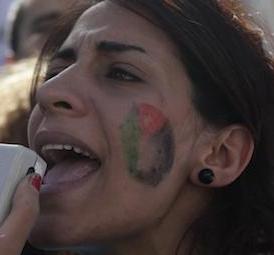
A call urging citizens of the European Union to tell their representatives to suspend the EU’s trade agreements with Israel, until Israel complies with international law, has been issued by grassroots networks and organizations from across Palestine.
The call has been endorsed by numerous European solidarity networks and organizations.
Join the action. Send letters to your representatives now by clicking on your country below:
AUSTRIA
BELGIUM (DUTCH / FRENCH)
BULGARIA
CYPRUS
CZECH REPUBLIC
DENMARK
ESTONIA
FINLAND
FRANCE
GERMANY
GREECE
HUNGARY
IRELAND
ITALY
LATVIA
LITHUANIA
LUXEMBOURG
MALTA
NETHERLANDS
POLAND
PORTUGAL
ROMANIA
SLOVAKIA
SLOVENIA
SPAIN (CASTILIAN / CATALAN)
SWEDEN
UNITED KINGDOM
For the full text click here.
Related
Israeli soldiers violently break into five homes in the Al Ayn Camp
International Solidarity Movement | January 9th, 2013
 Al Ayn Refugee Camp, Occupied Palestine – Hundreds of Israeli soldiers in 27 military jeeps violently broke in and ransacked five homes in the Al Ayn refugee camp, Nablus. They caused widespread destruction in the houses involved in the raid. No arrests were made.
Weam Reda Khaled, a woman whose house was ransacked, recounted how forty soldiers with dogs broke open the door of her home at three this morning. They came into the living-room and bedroom, shouting and intimidating her and her children. The family was forced to stay in the doorway while soldiers searched the house and broke everything that came to their hands. One of her sons was blindfolded, handcuffed and interrogated for two hours under the staircase. In the meantime, the army smashed furniture and electronic appliances in the kitchen, living-room and bedroom. They threw the television and some furniture on the roof, under the rain. Weam described how her four year old son was terrorised by the scene of the military violently breaking in and searching their house. Initially, soldiers even refused to let him go to the bathroom. This is the second time in the last eight months that Weam received such a visit. In May, soldiers broke into her home and arrested her husband, who is still being held in administrative detention without any charge brought against him.
Four other families in the Al Ayn camp suffered the same fate of Weam. In one case, a family of eight was forced to stay outside in shivering cold and heavy rain for four hours. Here, soldiers raided the store of the family and ruined the food kept there by throwing bread and flour on the ground and spilling oil all over the floor. Most of the furniture and appliances of the home were damaged or completely broken. In another case a man and his son were tied and locked in one room while soldiers ransacked the house, damaged the sofa, broke the TV and washing machine. A 70-year old man with a heart condition had to be hospitalised because of the shock suffered from the army’s invasion of his house.
The Al Ayn Camp, home to 5,000 refugees from the 1948 Zionist massacres, is known for its fierce resistance to Israeli occupation and for its resilience during the second intifada. During this raid the Israeli army told the families that they were searching for weapons. However, none were found in Al Ayn Camp during yesterday night’s ransacking.
Related articles
- 500 Israeli soldiers ransack homes in Burqa (palsolidarity.org)
- Israeli soldiers vandalise Hebron home and arrest a student (alethonews.wordpress.com)
- Soldiers Kidnap Four Palestinians (imemc.org)
- Ransacking and arrests in Sarra and Tell (palsolidarity.org)
Mleeta, Khiam, Sabra, Shatila and Resistance In General
By Gilad Atzmon | January 8, 2013
Lebanon is incredible – an intoxicating blend of natural beauty, rebellious spirit, pious clarity, tolerance, wild night life and unbelievable hummus. I landed in Beirut four days ago. The purpose of my visit wasn’t all that clear. I knew that a talk and a musical performance were scheduled by Almayadeen TV, but I never expected such a spiritually transforming experience.
It was my second visit to the country. 30 years ago I crossed the Lebanese border along with an IDF convoy escorted by tanks and armed vehicles. Then I was an occupier, this time I came with only my saxophone and a desire to share my thoughts and deliver some beauty.
But it didn’t take me a couple of hours to realise that Lebanon is much more than just humus, shisha, the sea and some captivating rural scenery. Early on Friday we left Beirut for the south. Our first stop was Mleeta – a Hezbollah front line outpost and a symbol of Lebanese defiance. Mleeta is located on top of a mountain, surrounded by the South Lebanese Massif which, until 2000, was controlled by the Israelis. From Mleeta, the Lebanese Mujahedeen launched daily attacks against the Israeli invader and gave the Israelis a true taste of their own medicine. Now Mleeta is a Jihadi tourist resort, there to tell the story of the heroic Hezbollah, those brave paramilitaries that confounded the ‘best army in the world’. The truth is, though armed only with light weapons, they were well supplied with Shia, spiritual ammunition.

Mleeta provides an overview of three decades of Islamic resistance in Lebanon and, in exhibiting all that the fleeing IDF soldiers have left behind, it proudly demonstrates the reality of Israeli cowardice. Mleeta is a symbol of confidence – confidence that the IDF is gone, never to return. Because when, in the summer of 2006 Hezbollah routed the IDF, it also demolished their confidence forever. The Jewish state was taught a lesson it would never forget – their phantasmic expansionist dream had come to an end.
But Mleeta was just a beginning. South Lebanon is dripping with defiance – every village, house and person is an emblem of Shia’s heroic resistance with the villages bedecked with Hezbollah posters featuring Leader Hasan Nasrallah and the many martyrs who taught the IDF those very necessary lessons.
Like Mleeta, Khiam the notorious Detention Centre is also a monument to Israeli brutality. Khiam is where Israel detained and tortured its political opponents, in some cases, for as long as 14 years. My visit there reminded me of a devastating memory, which on occasion, I share with my audience. It concerns Ansar, an Israeli concentration camp located in South Lebanon. It was back in 1984, on a piece of flat land in the middle of the camp, I noticed a dozen concrete boxes with small metal doors, they looked like dog kennels being only about 80 cm high, 100 cm long and probably about 80cm wide. When I pointed out to the commanding officer that these concrete construction weren’t suitable for dogs, he told me not to worry: no one would even think of putting dogs in them. “Put a Palestinian in one of those for 24 hours,” he laughed, “And he’ll come out singing the Hatikvah.” They were solitary confinement units for Palestinian prisoners. That was it. Then and there, I realised that Israel was not my country.
In Khiam this week I saw the exact same Israeli torture facility where the Israelis would shove their political opponents into tiny metal boxes, lock them in for days and then occasionally hit the top with a heavy stone. This time I took a picture.

But someone in Israel must have felt some shame at what Israel was leaving behind in Lebanon. In 2006 the IDF attempted to erase all trace of the detention centre at Khiam. In a desperate attempt to hide Israeli brutality, Israel sent in its engineering squads to blow up the cells and all remaining evidence of torture. But that clumsy effort to conceal the true reality of Israeli inhumanity achieved only the complete opposite. It now only affirms that Israel has, indeed, a lot to conceal.
The journey to occupied Palestine’s Border is over the most beautiful, wild and rural terrain. But then, suddenly, we were there, faced with the Jewish ghetto walls, guarded by cameras, army posts and barbed wire. Israel clearly doesn’t even try to convince its neighbours that it belongs in the region. It looks different, it smells different, it sounds different – it is in fact, just one extended Jewish European shtetl that has matured into a neurotic, psychotic and murderous collective fuelled by PRE traumatic stress. In that regard, the Israelis indeed have great deal to keep under wraps.
Inspired by Lyotard’s “Heidegger and the Jews” and my visit to the south, I decided, in my talk in Beirut, to speak about ‘History as a form of concealment.’ Instead of telling us ‘what really happened’, I argued that history is there to hide our shame, to repress that which we cannot even utter. It is, in effect, there to make us forget. Jewish history, for instance, is there to suppress Jewish shame, to disguise that which Jews prefer to hide from themselves. Jewish history is an attempt to talk about the past while avoiding the horrendous and embarrassing fact that Jews, throughout their history, have been bringing on themselves one Shoa after the other.
But concealment wasn’t invented by the Jews. The Brits also find it hard to cope with their past chain of murderous imperial genocides. This may explain why they entrusted the writing of Churchill’s biography to Jewish Zionist Sir Martin Gilbert, and why their historians have dedicated a whole floor of the Imperial War Museum to the Nazi Holocaust. As if Brits do not have enough shoas and suffering inflicted on others to remember. One of those British-inflicted shoas is obviously the Palestinian Nakba. Britain should own up to this disaster and perhaps find a little room for it also in its Imperial Museums. And like Britain, the Israelis have yet to acknowledge their own role in the original sin of 1948.
Looking at the state of the refugee camps in Lebanon, it became very clear to me that the Lebanese also might engage in some soul searching. For 65 years Palestinian refugees have lived in Lebanon and in other Arab countries in unbearable conditions and have suffered terrible discrimination. Palestinian refuge camps in Lebanon are nothing short of hell on earth. Palestinians cannot be naturalized. They are banned from certain professions and jobs such as medicine and law. In some ways, their situation is worse even than their brothers’ in Gaza or The West Bank, because for them there is not even any prospect of hope or change.
Those endless solidarity discussions about ‘One State’, ‘Two States’ or ‘BDS’ have zero significance or impact on their lives or their livelihoods. These displaced and dispossessed people need immediate change in their political status, but, being excluded from the political process, they lack the wherewithal to bring such change about. Not able to travel, their voice is hardly heard within the Western solidarity discourse and the International Palestinian solidarity movement is hardly engaged, or even concerned with their tragedy. Even that most absolute of rights, the right to return to their land has been compromised by the BDS in Ramallah and other prominent Palestinian leaders.
On my last day in Beirut I visited Sabra and Shatilla. I saw the mass graveyards, I saw the poverty, I saw the piles of rubbish in the streets, the outcome of the complete absence of even the most elementary municipal services. I have been traveling around the world for many years but this is, without doubt, one of the saddest sights I have seen. But, in those camps, I also saw some of the kindest people on this planet. People who against all odds, in spite of being crushed, humiliated and tortured for more than six decades, still look forward, still live their lives. They raise their kids and care about their education. They greet you in the warmest possible manner and, no sooner have you approached their shop, they have invited you for coffee. Surely, their suffering must be our primary concern.
Related articles
- Shifting responsibility: the propaganda of The Jewish Chronicle (alethonews.wordpress.com)
- Gazans fall victim to Israel’s experimental wars (windowintopalestine.blogspot.com)
Israeli soldiers vandalise Hebron home and arrest a student
International Solidarity Movement | January 6, 2013
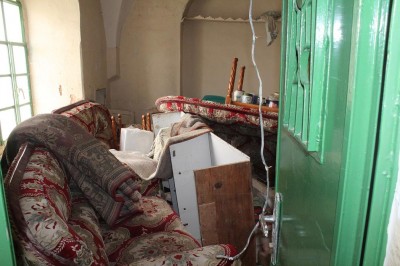
West Bank – Israeli occupation forces in Hebron raided a home, arrested a Palestinian and smashed his family’s belongings in the early hours of the morning.
Thirteen soldiers who came with two dogs broke down the door, arrested Ahmed Sharabati, 22, and vandalised the property without giving an explanation. As of this moment, Sharabati’s whereabouts are currently unknown.
The soldiers were present in the home for an hour and a half, during which time the terrified family was harassed, furniture was turned upside down and a window was smashed. The family spent six hours cleaning up after the raid.
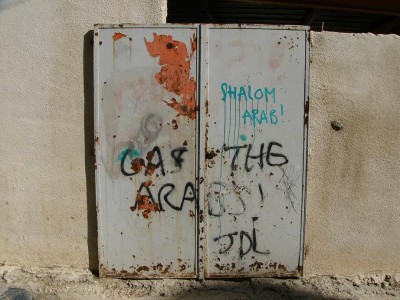 The soldiers took Sharabati, a student at Hebron university, without telling the family why or where he was being taken.
The family’s home is located in H2, the Israeli controlled part of Hebron. The close proximity of soldiers and illegal settlers means that Palestinians are always under threat from violence and harassment. Palestinians returning home from the city centre are subjected to humiliating checkpoints and the area is infamous for its “Gas the Arabs” graffiti.
The Israeli occupation forces soldiers in H2 are soon due to be replaced by other soldiers and the locals believe they are intentionally being more aggressive to leave a lasting impression.
Related articles
- Local activist detained in Hebron (alethonews.wordpress.com)
- Security video of killing of Hebron circus student shows claim of ‘toy gun’ fraudulent (alethonews.wordpress.com)
- Israeli forces kill teenager on his 17th birthday in Hebron (alethonews.wordpress.com)
- Second group of journalists beaten in Hebron (alethonews.wordpress.com)
Featured Video

Matt Bracken: US Plans Massive MOAB Strike on Iran?
or go to
Aletho News Archives – Video-Images
From the Archives
Confronting the Threat of Ethnic Bioweapons
By Tony Cartalucci – New Eastern Outlook – 29.11.2017
The United States Air Force’s 59th Medical Wing’s molecular biology branch recently was revealed to have been collecting specifically Russian RNA and synovial (connective) tissue samples, prompting fears in Russia of a possible US directed ethnic-specific bioweapons program. … continue
Blog Roll
 Aletho News
- Matt Bracken: US Plans Massive MOAB Strike on Iran?
- Russia accuses France of ‘piracy’ over tanker seizure
- Why Yemen Is Bombing Saudi Arabia’s Airports: The War Behind the Headlines
- Sally Rooney’s books pulled from UK over support for Palestine Action
- Bombs for Tel Aviv, Promises for Riyadh
- Israeli ad agency conducted vast global espionage campaign using online ads: Report
- Oct. 7 Forever Marks The Big Reveal: ‘We See You, Israel, We Revile You, We Reject You!’
- Meet the US generals and admirals advancing Israeli policy
- Israel’s Straw Widow Protocol: The Kill Zones Where Civilians Were Labelled ‘Terrorists’
- Leading Israeli Think Tank Publishes Psychotic Israeli ‘National Security’ Doctrine
- If Americans Knew
- Israeli firm used online ads to run vast spy operation, researchers say
- No, the world zionist movement is not an antisemitic conspiracy theory
- Hundreds of IDF investigations into killings still have no public outcome, BBC Verify finds
- After Ashley Moody Epstein Probe, Donors Linked to Him Poured Money Into her Senate Campaign
- Worried about Russian meddling in UK politics? Wait till you see what Israel is up to
- Israeli settlers attack West Bank center for disabled children, church leader calls for int’l action
- Pulling Out Teeth Just to Live: How Israel Has Devastated Dental Care in Gaza
- Gaza’s “ceasefire” death toll passes 1,500 – Daily Update
- Activists Abused By Israel Return to New Freedom Flotilla Mission
- 60 Minutes won’t tell the full truth about Israeli settler violence
- No Tricks Zone
- New Study Suggests Large Regions Of The Pacific Ocean Have Been Cooling For The Last 80 Years
- Germany’s Green Energy Debacle: High Energy Costs Force Kahla Porzellan to Close After 182 Years!
- New Study: 50 Years Of The Most Aggressive ‘Net Zero’ Policies Can Only Affect The Global Climate By 0.03°C
- US September “Heat” Was No Record…Many Records Set Decades Ago
- Latest European Green Energy Debacle; Portugal’s Largest Flagship Solar Park Insolvent!
- Green Energy Debacle: German Expert Professor Fritz Vahrenholt Warns Of Severe Economic And Social Consequences
- Two More Paleo Reconstructions Affirm Meters-Higher Sea Levels Across Ireland, Brazil 7000-6000 Years Ago
- New Study: Earth And Venus Surface Warmth Largely Explained By Convection And Lapse Rate, Not CO2 Or Radiation
- 2025 Nature Paper Claiming Worsening Global Drought Gets RETRACTED …Heavily Flawed
- New Study: ‘Global Drought Shows No Detectable Recent Acceleration Under Climate Warming’

